The end of the semester has brought its usual brand of insanity this week, so no substantial posts so far — but here’s a great story that came across my RSS feeds this morning from The Guardian: scientists have discovered (and filmed) octopuses using coconut shells to construct hiding places on the ocean floor. Thanks to YouTube I can embed a video of the octopus in action.
Today my research group in Collective Memory is presenting our project on collective memory and the passage of the 19th Amendment (ratified 18 August 1920). To celebrate both the end of the semester and women’s “political equality” I thought I’d bring you a little something that was my earliest introduction to the suffrage movement.
A lot of feminist ink has been spilled on the subject of Disney films and the myriad ways they reify gender, racial, and other stereotypes. Today, however, I’d like highlight the fact that Glynis Johns singing “Sister Suffragette” in the 1964 Mary Poppins musical was my introduction, if not to feminism, certainly to the militant suffragist movement.
Regardless of what Disney may or may not have wanted me to glean from the sequence (is Mrs. Banks a bad mother for neglecting her children in order to attend political rallies?), as a six-year-old child I knew where the action was at: it was unequivocally with Mrs. Banks marching about and singing with heartfelt enthusiasm.
We’re clearly soldiers in petticoats And dauntless crusaders for woman’s votes Though we adore men individually We agree that as a group they’re rather stupid!
Cast off the shackles of yesterday! Shoulder to shoulder into the fray! Our daughters’ daughters will adore us And they’ll sing in grateful chorus ‘Well done, Sister Suffragette!’
From Kensington to Billingsgate One hears the restless cries! From ev’ry corner of the land: ‘Womankind, arise!’ Political equality and equal rights with men! Take heart! For Mrs. Pankhurst has been clapped in irons again! No more the meek and mild subservients we! We’re fighting for our rights, militantly! Never you fear!
So, cast off the shackles of yesterday! Shoulder to shoulder into the fray! Our daughters’ daughters will adore us And they’ll sing in grateful chorus ‘Well done! Well done! Well done Sister Suffragette!’
. . . and choose to share that amusement with all of you.
This morning, I spent several hours on Midwest Airlines aircraft on my journey from Boston to Michigan, during which time I flipped through the complimentary SkyMall catalog provided in my seat pocket — it’s like Sears Roebuck for the 12st century! The sheer randomness and bizarreness of the SkyMall catalog never fails to delight. Here are a few of my favorite from this particular edition.
This young man clearly paused halfway through the conversion to cyberman for a senior-year style photoshoot.
While this item is being sold as a back massager, it is clearly a highly complex sex toy designed for a wild night of orgiastic delight.
This isn’t exactly hilarious, but since I’m taking a class right now on collective memory, and we’ve talked some about how both Abraham Lincoln and John F. Kennedy have figured in national collective memory over time, I found it interesting that these four images have been selected and placed side by side.
For all of you (I know you are out there!) who worry about unslightly white feet during the summer — worry no more! Thanks to SkyMall, you can order your very own foot-sized tanning bed to make sure your feet are sandle-ready all summer long. (Doesn’t it look like the person’s feet are being melted off in the bottom picture? or is it just me?)
And finally, the creme-de-la-creme . . .
There’s really so much wrong with this particular product that I can’t even begin to do it justice here . . . but let me just point out that I love how the perceived options here are a) a fake, removable ass or b) a fake, surgically-created ass. Not just, you know, your bum au naturale.
Cheerio kiddos; I’ll be checkin’ in as time permits! Now it’s off to cuddle on my parents’ couch with cocoa, cat, and my weekly reading for Collective Memory before the early morning catches up with me.
Last weekend, while I was in bed with a bad cold, I spent three and a half hours watching the 1915 silent film Birth of a Nation for my seminar on collective memory. So rather than something related to my thesis, this installment of “on the syllabus” brings you some thoughts on this landmark feature film and its infamous interpretation of the Civil War and Reconstruction eras.
First up, here’s the original 1915 trailer.
The fabulous Internet Archive has the entire feature available for streaming and download as part of its Feature Films collection (free of charge since the film is now in the public domain). For a short biography of D.W. Griffith, the director, see PBS’s American Masters profile.
There is a LOT going on in this movie, and I don’t have time to muse about all of it here in this one post. At the same time, it’s the amount of stuff going on in the film that I was most struck by on my first viewing, so I’m going to try and talk a little bit about that without talking a LOT about that fact (if that makes any sense outside of my own head).
The story follows two families, one Northern and one Southern, both white. The first act begins just prior to the outbreak of the war and ends with the assassination of Linooln, which is depicted as a great tragedy for Southern postwar recovery. The second act tells a story of postwar “degredation and ruin” of a people (white Southerners) at the hands of black and mixed-race activists who bring black voters to the polls and disenfranchise white voters. In response to this “anarchy of black rule,” a group of white men form the Ku Klux Klan in order to “save the south” and protect their “Aryan birthright.”
What was interesting to me, considering the film as a whole, was how tightly the depictions of race, gender, economic status, and regional identity were woven together in order to tell a story of Southern loss and redemption. While to our twenty-first century eyes the depictions of African-Americans are appalling, I think it’s important not to let the obvious wrongness of the Nation version of history preclude a more nuanced understanding of how race interacts with the other groups Griffith’s characters belong to. For example, slaves are clearly depicted as black, and freed slaves as by and large dangerous and disorderly — yet Southern blacks chastise Northern blacks and ‘mulattos’ for putting on “northern airs.” The regional differences in some cases trumping (or complicating) racial identities.
The sexual pairings of the story are similarly complicated by race and regional difference. White (obviously hetero) marriage is used throughout the story to symbolize white solidarity across regional lines, juxtaposed with the horror of miscegenation (strictly black men threatening white women with marriage proposals). In both cases, heterosexual marriage is seen as the bulwark of nationhood: the villain of the piece, a ‘mulatto’ named Silas Lynch, “drunk with wine and power” attempts to set up a black kingdom with himself as queen and a young white woman as his queen; the Ku Klux Klansmen eventually marry eachothers’ sisters and (literally) head off into the sunset for a seaside honeymoon in a united (white) American nation.
(On a somewhat related note: The two youngest sons of the families (north and south) die in each others’ arms on the battlefield, in a pose reminescent of two post-coital lovers sleeping. And thus the 1910s version of a thousand slash fic stories were born!)
We’re discussing the film in class this afternoon, and I’m definitely interested to see what others got out of it.
Hanna via Diana tuned me in to this series of animated videos on YouTube. All of you who have cared for a cat will appreciate them! (Click through the embedded video to the YouTube site for more shorts).
Brought to you from mst3k, another educational short (about 10 minutes) demonstrating the proper attitude towards, and behavior at, nightly dinner with one’s family.
My favorite sequence:
Narrator: “First of all, Daughter has changed from school clothes to something more festive.
I know I certainly put on my Sunday best before Hanna and I sit down to supper. Also, it’s creepy that all the characters are referred to by their generic member-of-the-family label, not actual names.
“Dressing a little makes her feel — and consequently look — more charming.”
because it’s all about performance, girls! remember that!
“Mother too changes from her daytime clothes. The women of this family seem to feel that they owe it to the men of the family to look relaxed, rested, and attractive at dinner time.”
In the words of Mike & Co: “So they’re unsuspecting when they kill them!”
aside from the fact it’s about women performing for men, I love the way the emphasis is on appearance: it’s important to “look” relaxed, rested, and attractive . . . never mind that Mother and Daughter are the ones preparing and serving the entire meal!
The whole film, in fact, emphasized the performance of an ideal 1950s family, with the suppression of unpleasant news and discord in favor of harmony and surface-level conversation. The narrator’s script keeps emphasizing this point, as if he’s just begging for us to wonder what evils are lurking in the shadows, unspoken.
. . . “Everyone wants to flee this seething cauldron of angst!”
Hanna introduced me to this timely 1951 promotional video from Iowa State College just as I was reading Paul Goodman’s Growing Up Absurd last week. It is an incredible snapshot of the way college attendance was presented to young women in the postwar period; watch to be bitter end for the senior year requirement to play house in preparation for “real life” for the full creepy effect. Almost as good as the marriage preparedness video I posted back in March.
Running time: 25:02 minutes.
UPDATE: Hanna chastised me for not including the mystery science theater version of this short, which is available via YouTube, so here are the links (it comes in two parts): part one and part two. Better late than never?
Hanna and I have been slightly mesmerized by a performance art project going on in London’s Trafalgar Square, 6 July – 14 October, atop the Fourth Plinth. 2400 UK citizens have been selected randomly from a pool of 22120 applicants to spend one hour each, twenty-four hours a day, for one hundred days as living art on the empty plinth in the square outside the National Gallery. This morning when we logged on, for example, a young woman just starting her hour (early afternoon in the UK) was tossing 1,000 paper airplanes into the crowd. Yesterday at about the same time, a woman was enjoying tea under a red umbrella in the company of a small garden gnome. Up next, as I’m typing this, is a small purple puppet named Cheeky.
The project, titled “One & Other,” is the brainchild of artist Antony Gormley.
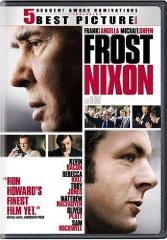
Yesterday, Hanna and I finally got around to watching the film adaptation of Peter Morgan’s 2006 stage playFrost/Nixon. Both the play and the film starred a perpetually startled-looking Michael Sheen as British talk show host David Frost and Frank Langella as a very sleepy-sounding Richard Nixon. The drama centers on an actual historical event: David Frost’s interviews with Nixon, broadcast in 1977, two years after Nixon resigned the presidency. It was a compelling film, paced very much as I imagine the original stage play ran, and aside from the two main actors sported several cameos by folks I enjoy, such as Oliver Platt and Matthew Macfadyen (disconcertingly blond). Since I know very little about the Nixon presidency or his political demise, beyond the broad brush strokes of our collective historical memory, the film has made me curious to check out the original interviews and compare the fictionalized version with the actual footage. Possibly more later if I (or Hanna) remain motivated enough to track them down.
“There are times when an abortion is necessary. I know that. When you have a black and a white,” he told an aide, before adding, “Or a rape.”
As elle over at Shakesville points out (as do virtually all the feminist blogs I regularly read), interracial relationships are in no way shape or form analogous to rape . . . the first being, you know, a relationship and the other being a specific act of violence. The fact that this was the first circumstance that came to Nixon’s mind in 1973 as a situation warranting abortion — before he even thought to mention sexual violence, almost as an afterthought — is a fascinating example of the way he made sense of both race and abortion.
Anyway. May all the Nixon historians out there have fun and do good work with these new resources, many of which have been made available online.
In my apartment we have what we refer to as The List. It began as something Hanna and I put together to swap book and movie titles one of us hadn’t seen and thought the other would like . . . over the past year it has morphed into a list of films and books which Hanna considers an essential part of my cultural literacy. I am industriously (and, I admit, quite pleasurably) making my way through The List — a little more swiftly and purposefully at the moment, now that I don’t have classes and homework with impending deadlines. This past week, I ticked no less than three films off the list: Jaws, In Bruges, and Silent Hill.
To begin with the least serious first, I realize I’m a good three decades late with a review of Jaws and one of a diminishingly small group of Americans who made it passed their twenty-fifth birthday without seeing the film — but I did, so let me just say it was fun. Since I hate submarines, I’m glad there were no scenes with subs, and I thought Richard Dreyfuss was hilarious. It made me giggle a lot, but this was possibly because I was watching it with a stiff gin & tonic in hand, and also because being bitten in half by a shark has never been a particular fear of mine.
In Bruges was breathtaking: smart, hilarious, incredibly violent, and ferociously acted. When I told Hanna the bit about it being hilarious the next morning, her response was: “Isn’t it just. Until it isn’t. And then it really isn’t.” which I thought summed it up quite nicely.” I actually think the less said about the actual plot of the film the better, since I went into it with only the vague sense it was about a group of hit men on a job gone horribly wrong. Why it’s gone wrong and each individual’s response to the situation is best left to unfold without a lot of advance preparation. If I had to pick a moment in which the entire film suddenly switched from violent comedy to comedic tragedy, I’d have to pick the final conversation between Brendon Gleeson’s character, Ken, and Ralph Fienne’s character, Harry, at the top of the sight-seeing tower, and the events that ensue. You’ll know when you get there. In the meantime, enjoy the way Ken and Colin Farrell’s character, Ray, bounce off each other. It’s priceless.
This afternoon, I watched Silent Hill, a horror film about a stolen child, Sharon, and a haunted coal-mining town with dark secrets, in which her mother, Rose, must struggle against the forces of darkness to recover her. It is based, Hanna tells me, on a video game, and thus bounded by certain parameters — virtually all of the action takes place in a circumscribed place, cut off from the outside world, and Rose in effect must go on a quest in order to solve the mystery of the town and (hopefully) set her daughter free. As I’m typing this, it actually strikes me that visually and narratively, it bears some resemblance to the exquisite Pan’s Labyrinth, also on The List, which I watched with rapt attention shortly after the end of term. Silent Hill doesn’t have the poetry of del Toro’s film, but it is nevertheless operating on the same fantastical principles.
About three-quarters of the way through the film, I was struck by the absence of central male characters — Sharon’s father, sweetly played by Sean Bean, is stuck on the outside of the town with a officious police officer, also male, but other than that all of the men are unnamed extras. In a horror/action movie this seems striking to me, although I admit limited knowledge of both genres. The fact that it goes unremarked upon internally is also notable: the film doesn’t seem to be consciously setting itself up as a film populated by women — they are simply the characters who happen to populate the script.
At the same time, it is definitely a story about women — there are gender dimensions to the narrative of horror and redemption that unfold. After all, the story begins with a mother (Rose) attempting to heal, and then rescue, her daughter (Sharon). As the plot unfolds, further pairings of mothers and daughters appear, and overlap, with the original pairings, and the relationships between these parents and their children are key to the drama that plays out. I’ll definitely still be thinking about this one in the week ahead. (Though hopefully not dreaming about it tonight!)
In the week ahead? We have the original X-men movie coming, since seeing Wolverine prompted both Hanna and I to say, “oh, it would be fun to see that again!” and now that I’ve seen In Bruges Hanna has consented to watch The Station Agent (also starring Peter Dinklage). Beyond that, we’ve also been watching on DVD the television show Bones about a team of forensic anthropologists at the Smithsonian who consult with the FBI on criminal investigations. At one hour a pop, they keep themselves ticking through witty dialog and great interplay between the core of main characters. Oh, and then there’s Carnivale to finish . . .






 the feminist librarian