• anna j. clutterbuck-cook
  • contact
  • curriculum vitae
  • find me elsewhere
  • marilyn ross memorial book prize

the feminist librarian

the feminist librarian

Monthly Archives: October 2009

On the Syllabus: ‘Birth of a Nation’

16 Friday Oct 2009

Posted by Anna Clutterbuck-Cook in media

≈ 1 Comment

Tags

history, movies, simmons

Last weekend, while I was in bed with a bad cold, I spent three and a half hours watching the 1915 silent film Birth of a Nation for my seminar on collective memory. So rather than something related to my thesis, this installment of “on the syllabus” brings you some thoughts on this landmark feature film and its infamous interpretation of the Civil War and Reconstruction eras.

First up, here’s the original 1915 trailer.

The fabulous Internet Archive has the entire feature available for streaming and download as part of its Feature Films collection (free of charge since the film is now in the public domain). For a short biography of D.W. Griffith, the director, see PBS’s American Masters profile.

There is a LOT going on in this movie, and I don’t have time to muse about all of it here in this one post. At the same time, it’s the amount of stuff going on in the film that I was most struck by on my first viewing, so I’m going to try and talk a little bit about that without talking a LOT about that fact (if that makes any sense outside of my own head).

The story follows two families, one Northern and one Southern, both white. The first act begins just prior to the outbreak of the war and ends with the assassination of Linooln, which is depicted as a great tragedy for Southern postwar recovery. The second act tells a story of postwar “degredation and ruin” of a people (white Southerners) at the hands of black and mixed-race activists who bring black voters to the polls and disenfranchise white voters. In response to this “anarchy of black rule,” a group of white men form the Ku Klux Klan in order to “save the south” and protect their “Aryan birthright.”

What was interesting to me, considering the film as a whole, was how tightly the depictions of race, gender, economic status, and regional identity were woven together in order to tell a story of Southern loss and redemption. While to our twenty-first century eyes the depictions of African-Americans are appalling, I think it’s important not to let the obvious wrongness of the Nation version of history preclude a more nuanced understanding of how race interacts with the other groups Griffith’s characters belong to. For example, slaves are clearly depicted as black, and freed slaves as by and large dangerous and disorderly — yet Southern blacks chastise Northern blacks and ‘mulattos’ for putting on “northern airs.” The regional differences in some cases trumping (or complicating) racial identities.

The sexual pairings of the story are similarly complicated by race and regional difference. White (obviously hetero) marriage is used throughout the story to symbolize white solidarity across regional lines, juxtaposed with the horror of miscegenation (strictly black men threatening white women with marriage proposals). In both cases, heterosexual marriage is seen as the bulwark of nationhood: the villain of the piece, a ‘mulatto’ named Silas Lynch, “drunk with wine and power” attempts to set up a black kingdom with himself as queen and a young white woman as his queen; the Ku Klux Klansmen eventually marry eachothers’ sisters and (literally) head off into the sunset for a seaside honeymoon in a united (white) American nation.

(On a somewhat related note: The two youngest sons of the families (north and south) die in each others’ arms on the battlefield, in a pose reminescent of two post-coital lovers sleeping. And thus the 1910s version of a thousand slash fic stories were born!)

We’re discussing the film in class this afternoon, and I’m definitely interested to see what others got out of it.

blogging climate change

15 Thursday Oct 2009

Posted by Anna Clutterbuck-Cook in think pieces

≈ Leave a comment

Tags

blogging, politics, travel

Hanna and Diana alerted me yesterday that today is Blog Action Day 2009, and this year’s theme is climate change. So I’ve had about twenty-four hours to think about what I wanted to say in my contribution (oh help!).

Riding to work on the T (Boston subway) this morning, I decided the theme of this post would be transportation, specifically the need for transportation infrastructure that supports access for all of us to forms of transporation that are efficient, environmentally-friendly, and affordable.

Since I was old enough to understand about global warming and other environental issues, they have always been something I have felt largely terrified and helpless about. I feel helpless because ecological disasters seem so huge, so, well, global and beyond the capacity of individual actions to effect necessary change. In the American economy, at least, it seems like environmentally friendly, “green,” options have increasingly moved away from city-wide recycling programs or buying recycled paper products to activities that require a substantial discretionary budget: top-of-the-line hybrid cars (my family has never been able to afford a new vehicle), locally-grown fruits and vegetables (eating a balanced diet on our budget means buying cheap), alternative-energy electricity and heat (we take what our apartment building provides) and carbon offset credits (I’m just grateful I can afford to visit my parents once a year). We desperately need large-scale structural changes at the national and international level that provide all of us — urban or rural, poor or middle-class — with green transportation options that support our working and family lives. “Local” is wonderful, unless the folks you care about are spread across the country or across the globe. Walking to work is great if you can afford to live in the neighborhood where your job is located; public mass transit is also a great alternative to driving if you live in an area where the mass transit is reliable, frequent, and fast. Combatting global warming will only be effective if every single human being on the planet is able to live their lives in an environmentally sustainable way, and convincing individual people that environmentally sustainable lives are possible means making sure that “green” options are accessible to all.

I never could bring myself to watch Al Gore’s now-iconic An Inconvenient Truth, but a couple of years ago I watched a close cousin, the 2006 documentary Who Killed The Electric Car?. I’m going to close this post with a trailer from the film, which I thought provided a brilliant analysis of the tangled interests and complicated social factors that so often frustrate our attempts at environmentally-friendly innovation. The movie points fingers but stops short of demonizing one single interest group (eg. oil companies, car companies, politicians, the American public). It also manages to tell a story of failure (the electric cars in the film were, indeed, “killed”) while still offering the possibility of hope for future change.

Let us all, collectively, live up to our best possible selves as we move forward into an uncertain future.

from the neighborhood: alien graffiti

15 Thursday Oct 2009

Posted by Anna Clutterbuck-Cook in a sense of place

≈ Leave a comment

Tags

from the neighborhood, fun, photos


I noticed this little guy painted on one of the walls near our apartment recently. He/she/it looks adorable which probably means he/she/it is about to rip out my throat.

from the neighborhood: buddy the christmas lobster

15 Thursday Oct 2009

Posted by Anna Clutterbuck-Cook in Uncategorized

≈ Leave a comment

Tags

domesticity, from the neighborhood, humor, photos, web video

Hanna was at lush earlier this week restocking on a few of our regular shampoo and soap products and she brought me home one of the new Christmas season “bath bomb” bubble bath bars, gnome name, which she informs me at the local store they are referring to as “buddy the christmas lobster” which suggests that they are all well-versed in the nativity play performed in love actually.

Quick Hit: UK reports home educated kids "disadvantaged"

14 Wednesday Oct 2009

Posted by Anna Clutterbuck-Cook in linkspam

≈ Leave a comment

Tags

children, education

I wish I had more time at the moment to look into this report out of the UK that describes home educated children as generally more vulnerable than their schooled counterparts.

Children educated at home are twice as likely to be known by social services and four times more likely as young adults to be out of work, education or training than those who go to school, MPs have been told.

MPs on the cross-party select committee for children, schools and families asked the head of a government inquiry into home education and the schools minister to defend calls for tougher rules on parents who teach their children at home.

In his review published in June, Kent’s former education director Graham Badman recommended that all home educators register with their local authority. Councils should be given powers to refuse registration if a child is believed to be at risk, he said.

The article in The Guardian leaves me wondering what sort of measure of well-being were used to determine how home-educated kids were thriving, other than their being “known” by social services — something that, at least in the history of the United States home education movement can be caused simply by children not being in traditional schools. The idea of young adults being disproportionately out of “work, education, or training” also assumes mainstream markers of adulthood rather than asking deeper questions about how young people are or are not thriving in the world. After all, being “out of . . . education” is one description of unschooled young adults; it does not necessarily mean they are not learning.

If, indeed, children and young adults who are not in mainstream schools are struggling in British society, then it seems like something ought to be done to remedy the situation! However, I am skeptical that government oversight — especially oversight which sounds like an attempt to bring home educating parents in-line with traditional curriculum and teaching objectives — is the most productive solution. Maybe the problem is not with the home-educating families and children, but rather with a society at large that views home education suspiciously and fails to provide its young people with non-school environments in which to learn and grow into adult persons who feel capable of contributing to society in ways they feel suited to and derive pleasure from.

weekend miscellany: honk! festival

13 Tuesday Oct 2009

Posted by Anna Clutterbuck-Cook in a sense of place

≈ Leave a comment

Tags

boston, fun, photos

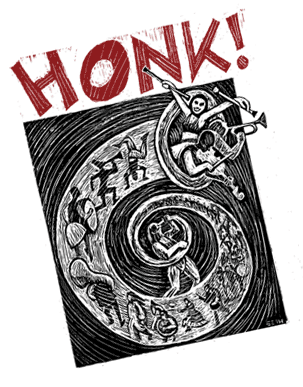
Hanna’s parents were in town Sunday (bringing Lionel to stay) and we T-ed out to Porter Square to check out a yarn shop that Hanna’s mom wanted to visit. When we stepped off the T in Porter Square, we walked right into the midst of the Honk! Festival parade. Bostonist has a gallery of photos if you’re interested in seeing some of the great costumes. It was a beautiful day and all the participants looked like they were having lots of fun.

Hanna and I are both recovering from very bad colds (maybe the dreaded H1N1?!) that had us at half-mast — and sometimes much less — for the better part of two weeks . . . so no more substantial posts for the minute. Watch for a report at the Beehive blog over the next couple of days from a brown-bag talk I attended last week, and next week I should have pictures and notes from our weekend in Burlington, attending the New England Historical Association’s fall conference at the University of Vermont. Until then, it’s back to the catch-up “to do” list . . .

from the neighborhood: green pots

12 Monday Oct 2009

Posted by Anna Clutterbuck-Cook in a sense of place

≈ Leave a comment

Tags

from the neighborhood, outdoors, photos


This is a photograph I took last week of the front stoop of a house that has just been renovated in the neighborhood behind our apartment building.

friday fun: ‘simon’s cat’ video

09 Friday Oct 2009

Posted by Anna Clutterbuck-Cook in media

≈ Leave a comment

Tags

fun, web video

Hanna via Diana tuned me in to this series of animated videos on YouTube. All of you who have cared for a cat will appreciate them! (Click through the embedded video to the YouTube site for more shorts).

from the neighborhood: end the fed?

08 Thursday Oct 2009

Posted by Anna Clutterbuck-Cook in a sense of place

≈ 1 Comment

Tags

from the neighborhood, photos, politics


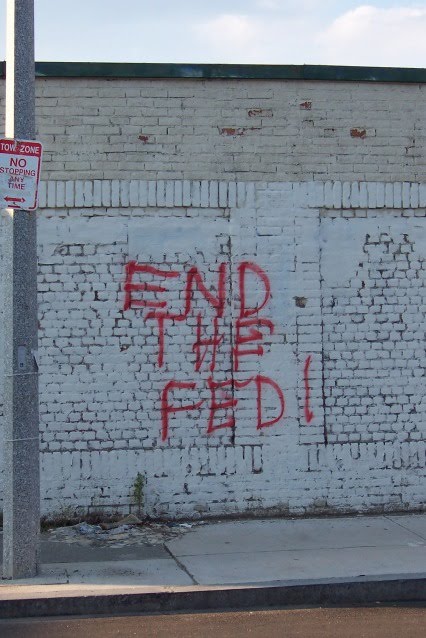
This appeared on one of the walls passed which Hanna and I often walk home from work. We’ve had a lot of conversations about what sort of political statement the artist thought they were making — and whether they understood the ramifications of either, a) abolishing the federal reserve or b) the federal government.

from the neighborhood: demonic scooter

05 Monday Oct 2009

Posted by Anna Clutterbuck-Cook in a sense of place

≈ 1 Comment

Tags

from the neighborhood, fun, photos


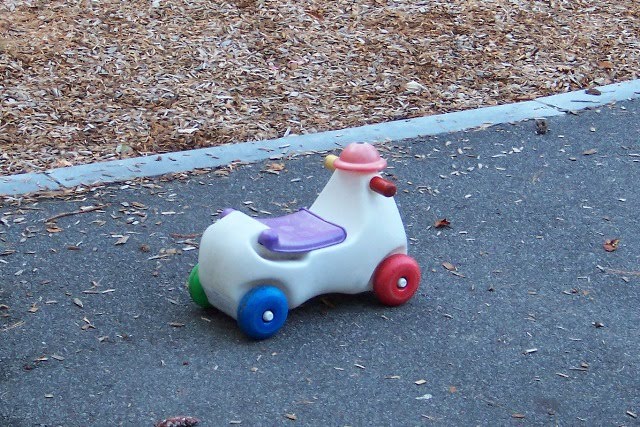
There’s a playground around the corner from our apartment that Hanna and I walk through quite frequently on our daily commute. Therein resides a child’s plastic scooter. We never see any of the numerous children who play in the park actually on the scooter, but whenever we pass by it is in a slightly different location, always looking slightly forelorn. Hanna thinks it’s mostly likely possessed.

← Older posts
Newer posts →
"the past is a wild party; check your preconceptions at the door." ~ Emma Donoghue

Recent Posts

  • medical update 11.11.22
  • medical update 6.4.22
  • medical update 1.16.2022
  • medical update 10.13.2021
  • medical update 8.17.2021

Archives

Categories

Creative Commons License

This work by Anna J. Clutterbuck-Cook is licensed under a Creative Commons Attribution 3.0 Unported License

Meta

  • Create account
  • Log in
  • Entries feed
  • Comments feed
  • WordPress.com

Create a free website or blog at WordPress.com.

  • Subscribe Subscribed
    • the feminist librarian
    • Join 37 other subscribers
    • Already have a WordPress.com account? Log in now.
    • the feminist librarian
    • Subscribe Subscribed
    • Sign up
    • Log in
    • Report this content
    • View site in Reader
    • Manage subscriptions
    • Collapse this bar