• anna j. clutterbuck-cook
  • contact
  • curriculum vitae
  • find me elsewhere
  • marilyn ross memorial book prize

the feminist librarian

the feminist librarian

Category Archives: book reviews

subject/verdict: stuff I’ve been reading in two-sentence reviews [no. 4]

17 Sunday Nov 2013

Posted by Anna Clutterbuck-Cook in book reviews

≈ Leave a comment

Tags

subject verdict

I’m hovering at 10% behind on my GoodReads goal of 104 books for the year, which means I’m on track to accomplish 90% of my annual reading goal (go me!). Here’s what I’ve been reading since the last installment of subject/verdict in mid-August.

Presented in order read.

Haskell, Molly. My Brother, My Sister: Story of a Transformation (Viking, 2013). As readers of this blog are already aware, this is a memoir by film critic Molly Haskell about her experience during her sister’s transition from her gender assigned at birth (male) to her experienced gender (female). I was not impressed.
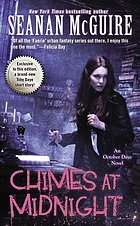
McGuire, Seanan. Chimes at Midnight (DAW Books, 2013). The seventh installment in the October Daye series (my personal favorite of Seanan McGuire’s many projects) centers around the trafficking of faerie fruit and the overthrow of a kingdom. Toby and company naturally save the day, with the introduction of several delightful new characters, including a fae librarian!

Joyce, Kathryn. The Child Catchers: Rescue, Trafficking, and the New Gospel of Adoption (PublicAffairs, 2013). The author of Quiverfull returns to the topic of family formation and religious belief in her latest work on the adoption industry. While The Child Catchers is not a wholesale condemnation of modern adoption practices, it does challenge all of us to cast a critical eye on the rescue narrative that sanctifies adoptive parents and the industry that serves them — often at the expense of children and birth parents.

Erzen, Tanya. Fanpire: The Twilight Saga and the Women Who Love It (Beacon Press, 2012). Erzen is a compassionate and insightful ethnologist of American subcultures, having last cast her eye on the experience of Christian women and men who participate in ex-gay ministries. In Fanpire she explores the fan experience of Stephanie Meyer’s Twilight novels and the associated films, holding us to account for too-easy a dismissal of female fans.

McCarthy, Molly. The Accidental Diarist: A History of the Daily Planner in America (University of Chicago Press, 2013). This excellent cultural and material history of personal record-keeping traces the development of the daily planner from Colonial almanacs through advertisement-laden Wanamaker planners popular into the mid-twentieth century. McCarthy skilfully blends in-depth research with a lively storytelling voice to produce a thought-provoking read.

Baumgardner, Jennifer and Madeline Kunin, eds. We Do! American Leaders Who Believe in Marriage Equality (Akashic Books, 2013). This brief collection of primary source documents (speeches, testimony, op-ed articles, interviews) tours through the history of American political leaders and social activists speaking out in favor of marriage equality. Beginning with a stump speech of Harvey Milk’s from 1977 and President Bill Clinton’s mea culpa regarding DOMA, penned in 2013, this collection would be a useful one for current affairs classes or adult study groups to discuss. Its brevity will be frustrating to the historians (many pieces are heavily excerpted), and it was strangely lacking in gender diversity. Out of 33 pieces, only eight were by women (including two appearances by Hillary Clinton). While the women they picked were undeniably well-spoken, high-profile leaders I can’t help but wonder why the imbalance — women like E.J. Graff and Urvashi Vaid were conspicuously absent. (Full disclosure: Early Reviewer copy from LibraryThing)

Jenkins, Philip. Decade of Nightmares: The End of the Sixties and the Making of the Eighties in America (Oxford University Press, 2006). This history of the long 1970s makes the argument that Reagan’s presidency was not the radical, reactionary break many view it to be but in fact built upon a number of conservative (often fearful) American impulses that have their roots in the decade before. I appreciated his re-examination of what have become historical commonplaces, but felt at times he over-reached the evidence and/or justified the conservative response without fairly considering voices of dissent.
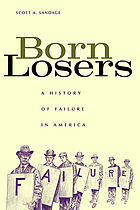
Sandage, Scott. Born Losers: A History of Failure in America (Harvard University Press, 2005). Sandage traces the development of “the loser” as a character type in America, tying it to the nineteenth-century shift from an economy where low-risk conservation of family assets gave way to the ideal of endlessly-upward mobility: the opportunity of great gains also opened up the possibility for extreme loss. As the nineteenth century gave way to the twentieth, Sandage convincingly argues that Americans more and more ascribed economic failure as an innate character flaw rather than an inevitability of the larger system — though individuals would continue to push back against this hegemonic model.

Yglasias, Matthew. The Rent is Too Damn High: What to Do About It and Why It Matters More Than You Think (Simon & Schuster, 2012). This slim e-book makes the argument that most American housing policy — particularly zoning regulations and rent controls — have only conspired to increase rather than decrease the astronomical rents in areas where the majority of Americans are drawn by economic opportunity (Boston, New York, Chicago, L.A., San Francisco…). I remain skeptical of his optimism in the housing market to solve this problem (freed from regulations, he argues, they would build more high-density housing in high-demand areas and help bring the middle class back from the suburbs),  but I appreciate his thoughtful and well-argued analysis.

Roose, Kevin. The Unlikely Disciple: A Sinner’s Semester at America’s Holiest University (Grand Central Publishing, 2009). When, as an undergraduate at Brown University, Roose decided to attend Liberty University as an unconventional off-campus semester many of his family and friends thought he was going to regret that decision: why spend a semester with religious fundamentalist evangelicals? Roose persevered, and wrote a soul-searching and at times quite funny (without being cruel) book about the subject that is generous to its conservative-Christian subjects without, I did not think, ultimately excusing the real harm their values can end up directly or indirectly supporting.

Satel, Sally and Scott Lilienfeld. Brainwashed: The Seductive Appeal of Mindless Neuroscience (Basic Books, 2013). This brief book examines the growing trend of attributing all matter of social phenomenon — from crime to business administration — to brain chemistry as “proved” by fMRI imaging. While fMRI scans have value, the authors argue, too often their highly-qualified results are taken as “proof” of things they prove not at all: their cautionary warning should be well-heeded.

Johnson, Colin. Just Queer Folks: Gender and Sexuality in Rural America (Temple University Press, 2013). Too often, histories of non-normative sexuality focus on urban centers, suggesting that rural America is a place of repression in which few “queer folks” survive — let alone thrive. Johnson re-frames the story of queer American sexuality in the twentieth century with a series of case studies in rural sexual expression, offering us an under-explored piece of the puzzle of human sexual variety across the sweep of time and place.
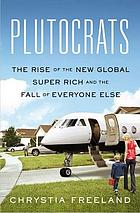
Freeland, Chrystia. Plutocrats: The Rise of the New Global Super-Rich and the Fall of Everyone Else (Penguin: 2012). Canadian economic journalist Chrystia Freeland offers both a window into and critique of the lives of those whose wealth puts them in the 1% of the 1% — and how they understand their position of power and privilege relative to the rest of us. While Plutocrats offers no easy answers to the global problem of hyper-stratification, it does offer a compelling argument that we ignore the accumulation of extreme wealth in the hands of a few at our own peril.

Morgan, Keith, Elizabeth Hope Cushing, and Roger Reed. Community by Design: The Olmsted Firm and the Development of Brookline, Massachusetts (University of Massachusetts Press, 2013). In my haphazard quest to learn more about the history of my adopted habitat, I picked up this volume at the Brookline Public Library: Morgan, Cushing and Reed explore the Olmstead firm’s influence in the development of one of Boston’s oldest and most illustrious “suburb” villages (now surrounded on three sides by the city of Boston itself). More analysis could have been given to the class-consciousness woven into community development in the village, but overall it was a pleasure to get a better sense of how and when the neighborhoods we walk through every day came to be.

Mantel, Henriette, ed. No Kidding: Women Writers on Bypassing Parenthood (Seal Press, 2013). As someone who will not (life-altering unknowns aside) be parenting, I approached this anthology with both interest and trepidation: too often, women are interrogated endlessly (in a way men are not) about their reproductive lives — would this be another wince-inducing platform for the same? Like all anthologies, this one varies wildly from wince-inducing to humorous to insightful; while I didn’t find myself experiencing any new insights, I do appreciate the attempt to normalize non-parents as part of the human family.
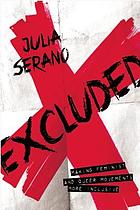
Serano, Julia. Excluded: Making Feminist and Queer Movements More Inclusive (Seal Press, 2013). By now, Julia Serano is on my “automatic buy” list, and her latest work — a compilation of previously-published pieces and new sections elaborating on the arguments those pieces are fumbling toward — was well worth the self-indulgence. While at times her experiences of feminist- and queer-community exclusion made me want to suggest different friends, I also recognize that the identity-based “us” and “them” dynamics she incisively identifies and suggests alternatives to are systemic social justice activism problems.

McGuire, Seanan. Indexing (Kindle Serial, 2013). I gave this foray into novel serialization a try through our Kindle, with wholly satisfactory results. Seanan McGuire’s lighthearted dark-and-heavy-if-you-squint tale of a crime-fighting unit who mop up after fairy tale “memetic incursions” introduces a whole new and compelling cast of characters to her repertoire — looking forward to future installments!

Jordan, Pete. In the City of Bikes: The Story of the Amsterdam Cyclist (Harper Perennial, 2013). When Pete Jordan and his wife, both avid cyclists, move to Amsterdam so Pete can complete an urban planning degree, they fall in love with the city and its cycling culture — Pete’s wife even apprentices as a bike mechanic and eventually opens her own bike shop. In the City of Bikes weaves this personal story together with a fascinating history of cycling culture in Amsterdam — and the Netherlands more broadly: a must-read for any cyclist in your life.

Knight, Sarah Kemble. The Journal of Madam Knight (D. R. Godine, 1971). In 1704, Boston businesswoman Sarah Knight traveled on horseback from Boston to New London, Connecticut, and on to New York City, to settle the estates of her brother and brother-in-law; pon her return she wrote up her experiences in a diary first published in 1825. Knight is one of the subjects of a series of encyclopedia articles I am writing this fall, and her diary was intriguing background research for her biographical entry.

Williams, Susan Reynolds. Alice Morse Earle and the Domestic History of Early America (University of Massachusetts Press, 2012). Another biographical entry for the encyclopedia, Alice Morse Earle was a nineteenth-century historian of American social and material history; Williams her most recent and comprehensive biographer. Despite the “assigned reading” aspect of picking up this title, I enjoyed the thoughtful exploration of a Gilded Age woman writer and the context in which she practice historical research and analysis.

Smith, Fran and Sheila Himmel. Changing the Way We Die: Compassionate End of Life Care and the Hospice Movement (Viva Editions, 2013). This slim volume written by two journalists explores the recent history and current practices of the hospice movement in America: non-profit and (more recently) for-profit organizations that assist individuals and their families experience holistic end-of-life palliative care. As an historian, I longed for deeper analysis of hospice’s emergence in the mid-twentieth century, but overall this is a quick read that offers much food for thought and pointers for further research and contemplation.

Bronski, Michael, Ann Pellegrini, and Michael Amico. “You Can Tell Just By Looking”: and 20 Other Myths About LGBT Life and People (Beacon Press, 2013).  This quick read does not attempt any original or overarching argument, but rather repackages pro-LGBT talking points in plain language myth-and-discussion format, perhaps with the notion of offering a useful reading selection for an adult reading group or Sunday school series. I found the format slightly unwieldy, given the way anti-sexual-diversity scare stories build upon and reinforce one another symbiotically, but appreciate how nuanced and inclusive the authors nevertheless managed to be in their explanatory sections within the necessary limitations of the project.

Weil, Francois. Family Trees: A History of Genealogy in America (Harvard University Press, 2013). If there was one avenue into genealogy that was guaranteed to spark my interest, it would be a cultural historical analysis of the practice of family genealogy in America — and Weil’s detailed study did not disappoint. Weil explores the genealogical practices of Americans from the Colonial period to the late 20th century, neatly walking the tightrope of tension between genealogy-as-pedigree (a practice that seeks to reinforce privilege) and genealogy-as-identity (an assertion of more democratic familial allegiance or curiosity).

Bush, Karen, Louise Machinist and Jean McQuillian. My House, Our House: Living Far Better for Less in a Cooperative Household (St. Lynn’s Press, 2013). This how-to guide tells the story of three women approaching retirement who decided to pool their resources and become householders in common. While their story did not offer me anything I didn’t already know about cooperative housing opportunities and trends, it is always useful to read about cooperative housing schemes that have proven successful — another blueprint to keep in our back pockets for the future.

Whew! That’s all folks … stay tuned in January for the next installment. Meanwhile, back to our regularly scheduled programming.

on dying well [a book and a radio show]

10 Sunday Nov 2013

Posted by Anna Clutterbuck-Cook in book reviews

≈ Leave a comment

Tags

being the change, big ideas, web audio

This past week I received and read an advance review copy of Changing How We Die: Compassionate End of Life Care and the Hospice Movement by Fran Smith and Sheila Himmel (Viva Editions, 2013). The reading involved a lot of spontaneous weeping on public transit, which I tried not to feel ashamed about: Big emotions are pretty appropriate where end-of-life narratives and choices are concerned. I couldn’t even tell you what emotion I was feeling that prompted tears other than BIG — it was joy, grief, surprise, longing, anger, fear, gratitude, all wrapped up in the moment at hand.

My paternal grandfather died at home in hospice care, and the whole family was grateful that they made it possible for him to die well in many respects.

I hadn’t thought about it before reading Changing How We Die, but the modern hospice care  movement– having grown out of the countercultural moment of the 1970s in many ways — shares a lot with the homebirth/midwifery/doula and homeschooling/unschooling movements. No wonder it feels like “of course” to me in many ways: an impulse toward low-intervention, person-centered care; placing the individual (laboring mother, learner, dying person) in the decision-making role; providing mindful, non judgmental support; holistic attention to all aspects of being; a preference for home-based rather than institutional care. I’m curious whether anyone has thought to look at the homebirth/homeschool/hospice movements as a continuum of care across the lifecycle, and what placing these movements side-by-side might teach us about lessons learned and possible future directions.

Food for thought.

Then, the radio came on this morning in time for “On Being” with Krista Tippett and it was an interview with Dr. Ira Byock who works in palliative medicine and hospice care. If you’re interested in the question of how we die — and what it might look like to die well — I highly recommend listening to the podcast or reading the transcript.
Audio here.

Transcript here.

booknotes: my brother, my sister

25 Wednesday Sep 2013

Posted by Anna Clutterbuck-Cook in book reviews

≈ Leave a comment

Tags

feminism, gender and sexuality, memoir

Molly Haskell at a book signing for
My Brother, My Sister (via)

Just before leaving on vacation, I was asked to review the new memoir My Brother, My Sister: A Story of Transformation by Molly Haskell (Houghton Mifflin, 2013). I spent the flight from Boston to PDX reading … and taking increasingly irritated notes. While I didn’t actively seek out this book to review, I had slightly higher hopes for a memoir that promised in its ad copy to be a “candid” and self-critical memoir by a “feminist academic” who not only seeks to describe her own journey to understanding but also to “chart the cultural map … of gender roles and transsexualism.” I had hopes for a memoir that evidenced both better understanding of the trans issues its author attempts to outline for readers — one that hadn’t fallen into some of the most basic traps of our problematic cultural narratives about trans lives.

Part of my disappointment comes from the fact that cis* family members and friends of trans individuals often struggle to get up to speed on trans issues after a loved one opens up about their experience — and there is a need for personal narratives by individuals who have struggled through ignorance and misconception into better understanding. Such stories don’t need to paper over the messy reality of feeling that often accompanies such a journey. I have a friend whose spouse came to the realization of their transness within the last two years, and as a partner my friend struggled with many of the same feelings a major life change will bring: grief over the loss of “before,” fear about what the future will bring, uncertainty about what this change meant for their relationship and family life, sometimes anger at their spouse for being at the epicenter of this upheaval — and for mostly not sharing in the grieving process. Like many trans individuals, the partner was mostly elated and relieved to be finally bringing their self-presentation into alignment with their interior self: to no longer be living a dissonant life. To my friend, whose emotions were much more ambivalent, it often felt like there was no safe or sanctioned place to process their complexity of feeling. With economic barriers to therapy and other social supports often prohibitively high, books like Transitions of the Heart (written by parents of trans and gender-nonconforming children) can help mitigate what could otherwise be intense isolation.

My Brother, My Sister could have been an addition to this small but growing list of literary offerings. In my estimation, it was not.

Let’s begin with the most basic trap of all, the way the memoir’s narrative is structured around and saturated in the physical aspects of transition, most particularly fixated on gender confirmation surgery and Haskell’s assessment of how well or appropriately she believes her sister is presenting as a woman. While acknowledging that authors sometimes have little control over book jacket design, the plain red cover with a youthful photograph of Ellen “before” and a current “after” photograph invites the reader to center Ellen’s appearance and physical transition rather than Haskell’s experience as the cisgendered sister having to assimilate her sibling’s late-in-life changes. A set of photographs at the center of the volume likewise foreground the “before” and “after” images.

As authors like Julia Serano and S. Bear Bergman have pointed out, the narrative of “passing” places the onus on a trans person to conform to the world’s high expectations of gendered behavior rather than demanding that the world accept a person’s self identification regardless of presentation. A trans person — just like any of us — may be a butch or lipstick lesbian, a twink or a jock, a sorority girl or tomboy. Bodies come in all shapes and sizes, and sartorial taste ranges across a field of more-gendered and less-gendered style choices. Historically, we (the public) have required a high level of stereotypical gender performance from trans women — at the same time as we (feminists) blame trans people for perpetuating sexism through that same exploration of femininity.**  Haskell perpetuates this scrutiny by making physical transformation the benchmark of transition, and by dwelling on the surgeries, the clothing choices, the gender-coded vocal and physical mannerisms, and other aspects of her sister’s self-presentation.

While her sister’s pleasures and anxieties around offering up her newly-visible self to the world are understandably preoccupying, Haskell’s perspective is more often one of harsh judgment than it is attempt to follow where her sister leads. She frets that her sister will be unattractive, considers her clothing choices too slutty, and considers anyone who can’t or is unwilling to fit into her neat categories of gender to be somehow at fault. For example, she writes of a trans woman her sister knows, “One man, though convinced he’s a she, refuses to do anything to alter his rough male appearance” (158). As if this “refusal” to care about her appearance somehow invalidates the woman’s self-articulated gender identity. She also offers unsolicited opinions on the femininity of other high-profile trans women:

From photographs, Jennifer [Finney Boylan], being younger and more typically feminine, seems to have made an attractive looking female, while [Jan] Morris by most accounts, before settling into dignified-dowdy, went through a grotesquely awkward wannabe-girl period (122).

I scribbled in the margins “seriously. out. of. line. judgy.”

When Ellen visits Haskell after a period of cloistered transformation, Haskell nervously invites friends over and then grills them afterward on Ellen’s ability to perform femininity: “The verdict … she’s very convincing. I said the hair’s too blond, and Lily and Patty agree, the hair is too blond, but they’re surprised at how good she looks” (146).

I think possibly a large part of my irritation is that I couldn’t find Molly Haskell very likable, as a sister or as a feminist. She’s critical of other women’s appearances, ageist towards both the old (women who might be unable to catch a man) and the young (who are too slutty in appearance and too casual about identity), and hews close to gender expectations. One of her first reactions to her sister’s coming out as trans is to fear that the tech- and number-savvy brother she relied on will no longer be good at computer repair or math. While she sidles up to the notion that this first reaction was unfounded, she never demonstrates for her readers that she has since come to revise her binary thinking when it comes to girl brains and boy brains.

At what might be a low point of the book, she even suggests that Brandon Teena, the trans man who was the subject of the biopic Boys Don’t Cry somehow “asked for it” by dressing in clothing appropriate to his gender and not disclosing his trans status:

Yes, the yahoos were uptight and murderous, but she in some sense invited the violence by taunting their manhood, pulling the wool over their eyes, and acting in bad faith (106).

Yes, she willfully mis-genders him. To fall back on the trope of the deceptive transsexual (who supposedly invites violence through the act of passing) in a throwaway comment, in a book pitching itself as one about understanding trans lives, seems to me a fairly basic mis-step that, again, both Ms. Haskell and her editor should have caught before the manuscript went to press. That they did not suggests neither understood how problematic it was.

Which in turn calls the entire project into question, at least as far as its worth as a positive contribution to trans literature goes.

At the end of the day, I am glad that Molly and her sister have remained in good relationship, and I am glad that Molly gained more understanding of trans experience and trans history than she had when her sister first came out to Molly and her husband. I imagine that, at the end of the day, there are far worse reactions to have had from one’s family upon coming out trans (see: transgender remembrance day). Yet I also wish that Haskell had let her own learning process cook a bit longer before publishing a book on the subject. As it stands, My Brother, My Sister is a tepid-at-best, damaging-at-worst popular memoir that does little to invite a more complex understanding of trans people or sex and gender identity more broadly. I expected better from a self-identified feminist author, although I’m sure trans feminists would laugh at my (cis-privileged) wishful thinking.

For those interested in learning more about trans lives, I would recommend The Lives of Transgender People by Genny Beemyn and Susan Rankin, Whipping Girl by Julia Serano — who has also just published a book on trans-inclusive feminism that I can’t wait to get my hands on — and also Anne Fausto-Sterling’s excellent Sexing the Body.

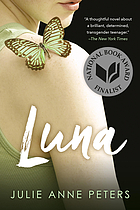
Luna, a young adult novel by Julie Ann Peters, is also an intimate fictional portrait of a sister coming to terms with her siblings trans identity.


*Cis or cissexual refers to individuals whose gender assigned at birth (usually based on external sex characteristics) matches their internal sense of their own physiological sex and gender identity.

**Trans men have, historically, had a very different socio-political experience within both mainstream culture (where they are often rendered invisible) and mainstream feminism (where they are more often embraced while trans women are actively marginalized).

west coast trip [no.1]: portland

21 Saturday Sep 2013

Posted by Anna Clutterbuck-Cook in book reviews

≈ Leave a comment

Tags

photos, travel, west coast

As promised, here are some photos from our two-week trip to Oregon & California. We flew into Portland, Ore., where my brother and sister-in-law live. One of our first stops was Powell’s City of Books, over sixty-eight thousand square feet of new and used titles, as well the in-store coffee shop (pictured above) where we obviously stopped for our morning espresso.

The store map (PDF) offers some sense of scale, although it’s hard to grasp until you actually walk in the door.

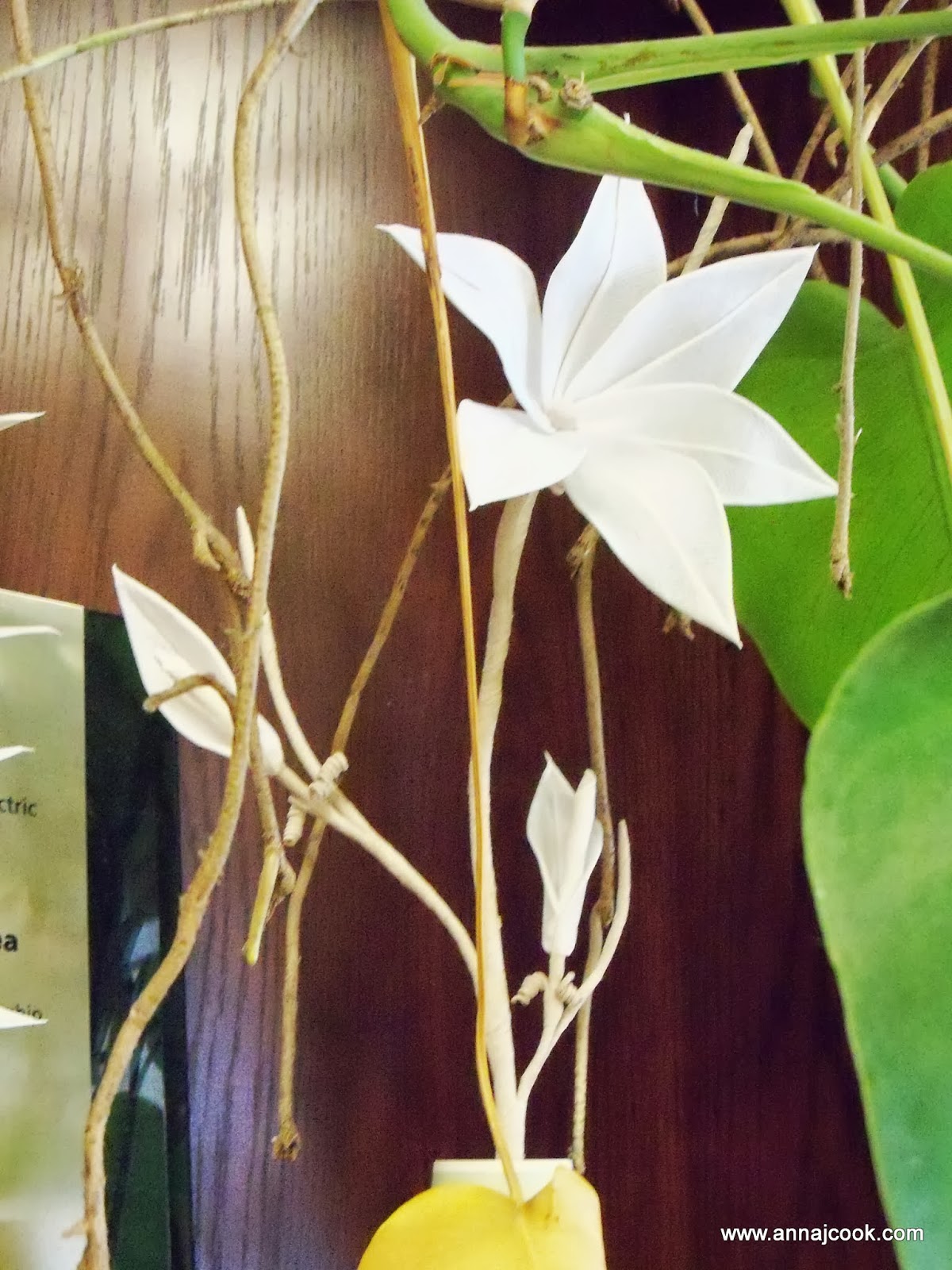
On our first morning, the artist sitting behind Hanna’s left shoulder was constructing paper flowers out of waxed drinking cups. The next day, his handiwork was on display at the cafe counter:

Portland is city full of artists, including my sister-in-law Renee! On the Saturday of Labor Day weekend, Renee was participating in an art fair — painting to advertise an upcoming open studio tour. Hanna, Brian and I wandered the fair and also stopped by to visit with Renee.

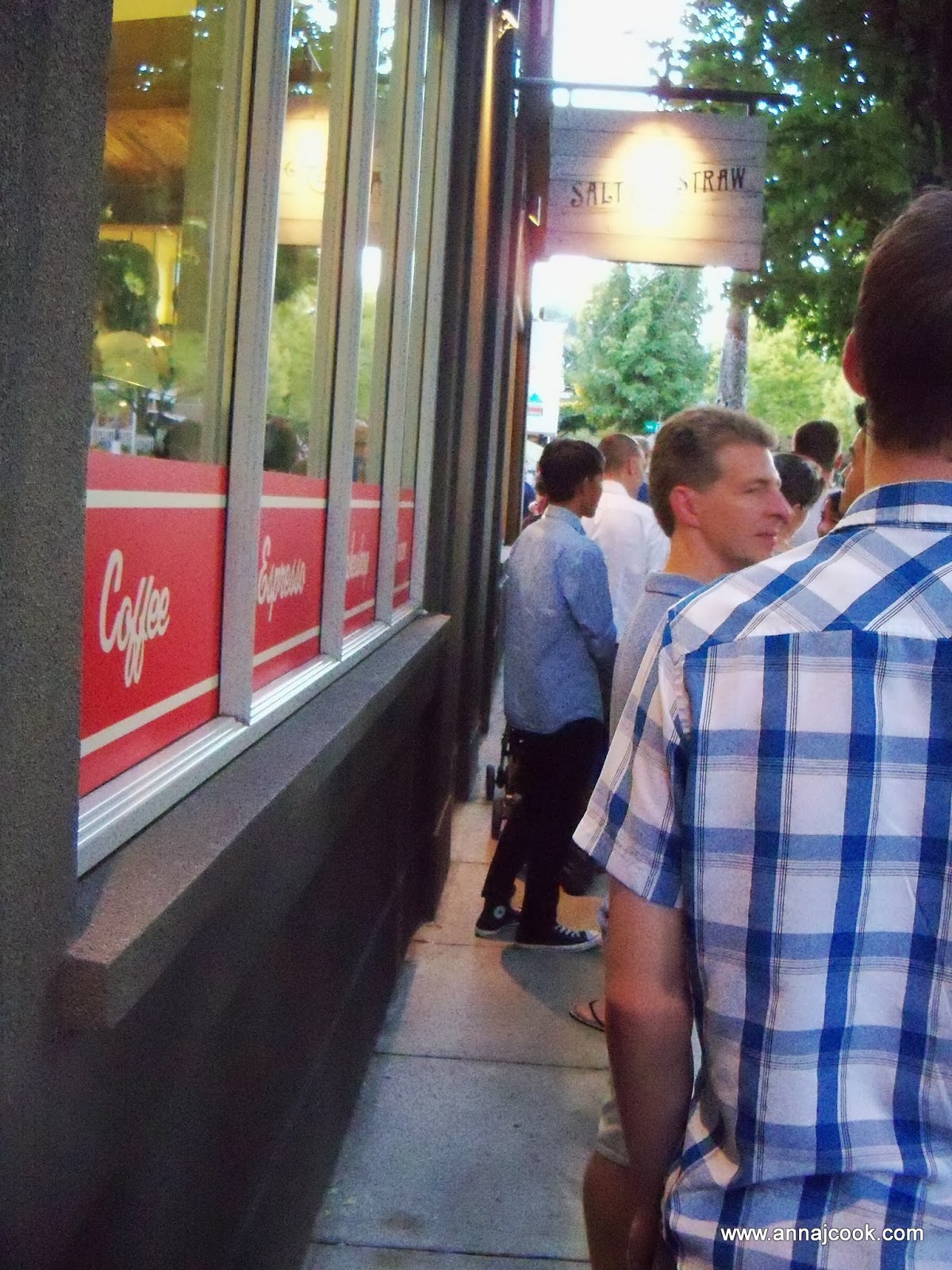
That night, we waited in a long line for the Most Amazing Ice Cream Ever at Salt & Straw on NW 23rd. I had a split cone featuring pear and Gorgonzola and olive oil flavors. Both sound weird, but were incredible.

Sunday, Brian and I drove out the Columbia River Gorge to the Oneonta falls. Labor Day weekend proved a busy time to visit, even though the falls are difficult to get to. In order to reach the actual waterfall, you have to wade through chilly water that was as deep as my rib cage in places!

But first, a logjam …

… which opens up to the ravine cut by centuries of rushing water …

… with the waterfall payoff at the end!

People had left little cairns of river rocks at the base of the falls.

On our last day in Portland, before heading south toward Bend and Ashland, we went to the International Test Garden for roses in Washington Park.

The Tuesday after Labor Day, after Brian had left for his first day teaching middle school art (God bless him!), we rented a car, caffienated up, and headed up over the Mt. Hood pass to central Oregon on the next stage of our travels.

subject/verdict: stuff I’ve been reading in two-sentence reviews [no. 3]

21 Wednesday Aug 2013

Posted by Anna Clutterbuck-Cook in book reviews

≈ Leave a comment

Tags

history, subject verdict

Life has been busy for me since June and I haven’t made much progress on my reading goals for the year. GoodReads is now yelling at me about how I’m ten books (more than a month!) behind schedule. But despite that, I have actually been reading (and writing). So here are a few brief notes to that effect.

For this edition of subject/verdict, I’ll review in reverse chronological order (most recent read book first). Just for kicks.

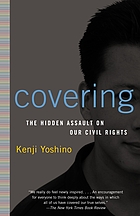
Yoshino, Kenji. Covering: The Hidden Assault on American Civil Rights (Random House, 2006). Part memoir, part legal treatise, Covering explores the nuances of discrimination through the demand that non-normative people “mute” the aspects of themselves deemed socially unacceptable — and the willingness of our court system to give such discrimination (for example employers demanding women wear make-up or firing a woman for “flaunting” her lesbian relationship) a pass. I read this book for the first time in 2006 and it holds up incredibly well seven years later.

Jordan, Mark D. The Ethics of Sex (New dimensions in religious ethics; Blackwell, 2002). A thoughtful historian of Christianity and sexuality, Jordan explores how Christians have spoken about sexual ethics from the earliest days of the church to the present day. The takeaway from this slim little tome is the diversity and historical specificity of Christian teachings on sexuality (that and the fact that masturbation was once considered the gravest form of incest).

Japinga, Lynn. Loyalty and Loss: The Reformed Church in America, 1945-1994 (Historical series of the Reformed Church in America; W.B. Eerdman’s, 2013). Denominational historian (and a former professor turned friend) Lynn Japinga traces out the tensions within and trajectory of the RCA from the postwar era through the turbulent Sixties and Seventies, into the 1990s. Since this was an era that involved much debate over the ordination of women as well as the denominational stance on homosexuality, I obviously found much of interest.

Christiansen, Erik. Channeling the Past: Politicizing History in Postwar America (Studies in American thought and culture; Univ. of Wisconsin Press, 2013). Through a series of case studies, including the History Book Club, television shows Cavalcade of America and You are There, the Freedom Train traveling exhibition, and the Smithsonian Museum of American History re-design, Christiansen explores the way Americans in the 1950s produced and consumed narratives of their past. This is a thoroughly researched and entertaining account of a particular era of American popular history that I highly recommend to fellow history nerds.

Root, Elihu. Insuring the City: The Prudential Center and the Postwar Urban Landscape (Yale Univ. Press, 2012). I’ve been trying to read up on twentieth-century Boston history this year, and Root’s fascinating account of the politics surrounding what is now an iconic Boston landmark — the Prudential Center — was a swift and pleasurable read. I particularly enjoyed the many photographs included that visually document how the neighborhood where I work every day has changed so dramatically in the past seventy years.

Evans, Sara M., editor. Journeys That Opened Up the World: Women, Student Christian Movements, and Social Justice, 1955-1975 (Rutgers Univ. Press, 2003). A book I picked up for my new research project on motive magazine, this is an anthology of personal essays by women who came to social justice activism through the mid-century student Christian movements on college and university campuses. I really appreciate the way this book centers the experience of women and explores how their faith inspired them to engage in progressive social change work and also made that work materially accessible by offering educational and vocational opportunities to aspiring women leaders.

Spirn, Anne Whiston. The Granite Garden: Urban Nature and Human Design (Basic Books, 1984). This was a $1 cart find that meshed well with my self-assigned goal of learning more about Boston and urban history/politics/culture. While it feels a bit dated in some of its examples, I actually found myself feeling slightly nostalgic for a period of time when environmental activism was treated with more serious urgency and hope for meaningful change than it generally is today.

Fine, Michelle and Lois Weis. The Unknown City: Lives of Poor and Working Class Young Adults (Beacon Press, 1998). Based on extensive qualitative interviews with working-poor young adults from Generation X, sociologissts Fine and Weis use their informants voices to explore the gritty realities of gender, race, and poverty in America’s eroding working class economy. One of the most striking observations they make is their white male interviewees resistance to systemic analysis (they preferred to blame women and people of color for their economic woes) — a demographic trend that we have made little headway on in the fifteen years since publication.

Messer, Sarah. Red House: Being a Mostly-Accurate Account of New England’s Oldest Continuously Lived-in House (Viking, 2004). An historically-minded memoir, what at my college would have been termed “creative nonfiction,” Messer’s memoir tells the story of a house on Cape Cod her father and mother purchased and obsessed over — and which became a family member in its own right, despite the lingering sense that the Messers were wrongful inhabitants, having purchased the property away from the descendants of the 17th-century man who first constructed the home. I particularly enjoyed the personal perspective Messer provides on the mid-20th century’s revived interest in historic properties and public history.

Katz, Jonathan Ned. The Invention of Heterosexuality (Plume, 1996). Historian of gay and lesbian life, Katz turns his thoughtful eye on a sexuality we all assume is known but in fact is very rarely studied, or even defined: heterosexuality. Katz was one of the first scholars to point out that the “heterosexual” individual is a fairly recent historical invention, and his mid-90s discussion of the subject is still relevant todBuay.

Swartz, David R. Moral Minority: The Evangelical Left in an Age of Conservatism (Politics and Culture in Modern America; University of Pennsylvania Press, 2012). First in what surely will be a long line of books to end up on my “If only this had come out before I finished my thesis…”, Swartz’s excellent study explores the lives and work of left-leaning Evangelicals during the mid-twentieth century and asks why their early agitation and political influence was ultimately overshadowed by the rise of the religious right. My only critique was its focus on male leadership and only passing discussions of feminism or sexuality — but that just leaves work for the rest of us, right?

Bussel, Rachel Kramer. Best Sex Writing 2013: The State of Today’s Sexual Culture (Cleis Press, 2013). Over the past half-dozen years, I’ve become a big fan of the Best Sex Writing series — even more so than the myriad best erotica collections that come out every year: I like thoughtful sex journalism, which combines thinking (a turn on for me) with sex (also a turn on). What more could a sex nerd desire? Bonus third sentence: you can read my favorite piece from this year’s anthology for free at The Rumpus!

This has been the third edition of subject/verdict. I hope you enjoyed it; I’m sure there will be more bookish things to come during the forth quarter of the year.

subject/verdict: stuff I’ve been reading in two-sentence reviews [no. 2]

14 Friday Jun 2013

Posted by Anna Clutterbuck-Cook in book reviews

≈ Leave a comment

Tags

subject verdict

In which I use my forehead to hold my place while typing.
Like you do.

Here’s another installment of subject/verdict, wherein I discipline myself to be concise in my literary commentary. Since the beginning of April I’ve read the following books.

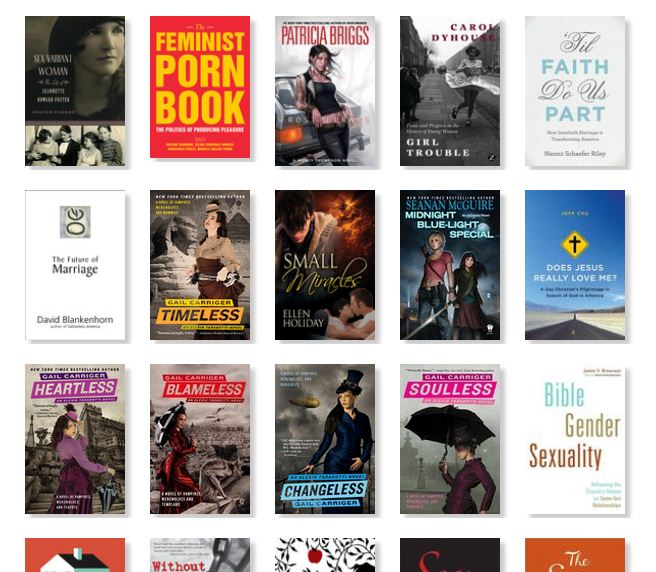
Briggs, Patricia. Frost Burned (Ace Books, 2013). Mercy Thompson Series, #7. The continuing adventures of shapeshifter Mercy Thompson, now married to werewolf Adam Hauptman, as a group of mercenaries kidnap her pack on Thanksgiving Day and Mercy has to call in the assistance of all her human and supernatural allies to get them back. Those of you (like me) who worried the series might grind to a halt with the success of the marriage plot, worry no more — and go enjoy the ever-expanding boundaries of this alternate universe.

Carriger, Gail. The Parasol Protectorate series, #1-5 (Orbit Books, 2009-2012). A delicious steampunk universe of vampires, werewolves, and soulless preternaturals delicately co-existing in Victorian London while soulless spinster Alexia Terribotti juggles social engagements, the attentions of an amorous (or possibly hostile) werewolf, and the friendship of effete vampire — not to mention attempts on her life! These were a rip-roaring read for early summer, and I’m looking forward to picking up the first in her new series, Etiquette & Espionage.

Dyhouse, Carol. Girl Trouble: Panic and Progress in the History of Young Women (Zed Books, 2013). English historian of young women’s lives Carol Dyhouse (Univ. of Sussex) seeks to synthesize over thirty years of research in this brisk survey history, beginning with the moral panic over the mythical “white slave” trade (late 19th-early 20th century) and ending with turn-of-the-twenty-first-century anxieties about the sexualization of young girls. Dyhouse’s aim is breadth (within a British context) rather than depth, and historians of the subject might well bypass this text in favor of Dyhouse’s scholarly work on women, education, and feminism — still, Girl Trouble is an enjoyable read with a useful-looking bibliography. [Received as part of the LibraryThing Early Reviewers giveaway.]

Holiday, Ellen. Small Miracles (Dreamspinners, 2012). A writer friend of ours, whose pen name is Ellen Holiday, has written this charming Cinderella-style piece of m/m erotica novella in which a down-and-out young man runs into a handsome prince at a bar and has to decide whether to let their one-night stand turn into something more lasting — and figure out how to do so on equal terms.

McGuire, Seanan. Midnight Blue-Light Special (Daw, 2013). InCryptids #3. New York’s cryptid population is under threat from zealous … As you’ve figured out by now, I’m back on something of a genre fiction kick, and was delighted to see that Seanan McGuire had a new installment of her InCryptids series out this spring — Midnight did not disappoint!

(Since doing the screencap above, I’ve also been catching up on Seanan McGuire’s short fiction, much of which is available for free download at her website. Definitely worth checking out!)

Passett, Joanne. Sex Variant Woman: The Life of Jeanne Howard Foster (Da Capo, 2008). Jeanne Howard Foster was the first librarian at the Kinsey Institute and author of the first known bibliography of literature featuring themes of passion between women: Sex Variant Women in Literature, first self-published 1956, then re-discovered by the emerging lesbian-feminist movement of the 1970s. This excellent biography is attuned to the incredible revolutions in gender and sexual history which Foster lived through, born in 1895 and living to age eighty-five — she came of age in the era of passionate female friendship, experienced the pathologizing of lesbianism during the interwar years, and in retirement found herself the heroine of a new generation of dykes.

Riley, Naomi Schaefer. ‘Til Faith Do Us Part: How Interfaith Marriage is Transforming America (Oxford University Press, 2013). Though prompted by personal experience within a Jewish-Christian marriage, Riley’s exploration of interfaith marriages is grounded in a nationwide survey she conducted of over two thousand interfaith couples and several hundred in-depth interviews. Overall, I was impressed by her thoughtful analysis and believe the study is a solid contribution to the field, though I was struck by her pessimism and sense of struggle: her overall fear that interfaith marriage will dilute religious traditions and lead to greater unhappiness for couples and less religious identity and grounding for their children. [Received as part of the LibraryThing Early Reviewers giveaway.]

Taormino, Tristan, Celine Parreñas Shimizu, Constance Penley, and Mireille Miller-Youn, editors. The Feminist Porn Book: The Politics of Producing Pleasure (The Feminist Press, 2013). Touted in many reviews as something new in the feminist discourse around moving-image pornography, The Feminist Porn Book actually builds on (and explicitly acknowledges) decades of pro-sexual-explicit-imagery feminist scholarship, activism, and performance. I particularly enjoyed the contributions by Clarissa Smith and Feona Attwood, Sinnamon Love, Dylan Ryan, Ingrid Ryberg, and Tobi Hill-Meyer … though really there wasn’t a weak piece among them (and how often can you say that about anthologies?).

Next up: to finish Best Sex Writing 2013, Born Losers: A History of Failure in America, Journeys that Opened Up the World: Women, Student Christian Movements and Social Justice, 1955-1975 and Moral Minority: The Evangelical Left in the Age of Conservatism. Catch up with my reviews in the next edition of subject/verdict!

live-blog postscript: female and male scholars in ‘the future of marriage’

07 Friday Jun 2013

Posted by Anna Clutterbuck-Cook in book reviews

≈ 2 Comments

Tags

family scholars blog, live-blogging, marriage equality

Welcome to part eight of my live-blog reading of David Blankenhorn’s The Future of Marriage (2007). You can read part one, part two, part three, part four, part five, part six and part seven here. 

As promised, my final installment of this series is a rough-and-ready survey of the treatment of the four key same-sex marriage proponents David Blankenhorn wrestles with in The Future of Marriage, and particularly the way his respect rather suspiciously lines up with the gender division of the four individuals: Evan Wolfson (founder and president of Freedom to Marry) and Jonathan Rauch (journalist; guest scholar at the Brookings Institution) on the one hand; Judith Stacey (sociologist; NYU ) and Stephanie Coontz (historian; Evergreen State College) on the other.

I’m going to break this down super-simply and present you with side-by-side lists of words and phrases used to describe these four individuals. At the end are a few observations about how language contextualizes these people within David B’s narrative.

Evan Wolfson

  • “Executive director … of a group advocating equal marriage rights for same-sex couples”
  • “He had anger and urgency”
  • “With passion”
  • “Offered me hard-headed political analysis”
  • “Evan’s political analysis of the same-sex marriage issue is probably accurate”
  • “Evan is surely right to insist upon the equal dignity of all persons”
  • “For Evan, insofar as I understand his argument…”
  • “My conversation over lunch with…”
  • “Almost everything that Evan says here is wrong”
  • “He has next to nothing to say about what marriage is”
  • “I don’t mean to single out as unusual, or as particularly flawed, this one description of marriage by Evan Wolfson”
  • “My friend Evan Wolfson…”
  • “Evan’s definition [of marriage] is insubstantial to the point of meaninglessness … on the other hand … Evan reveals an understanding that he and his colleagues are seeking to engage and transform a substantial social institution.”
  • “I think I understand [his argument]”
  • “Evan Wolfson, who served as co-counsel … angrily dismissed this line of argument”
  • “When I had lunch with…”
  • “I tried to raise the issue… He could hardly have been less interested…”
  • “Evan sees people who are suffering and wants to help them. As a leader of a grassroots movement, he has spent many years working for a certain kind of social change.”
  • “…it’s also personal. He is gay — one of the ‘them’ in this matter. He is fighting partly for himself, and that accounts for much of his passion.”
  • “Evan is confident that his side, the side of new freedoms, is going to win. He may be right.”
Jonathan Rauch
  • “Jonathan Rauch has a dream. His dream is also a prediction: that permitting same-sex couples to marry will strengthen marriage as a public norm.”
  • “Rauch argues convincingly”
  • “Jonathan Rauch’s Gay Marriage is by far the most precise and serious argument to date in favor of the proposition that marriage supporters should accept gay marriage.”
  • “I’ve met Jonathan a few times, and I admire his integrity and good will.”
  • “How I wish he were right!”
  • “I believe that Jonathan Rauch is fundamentally mistaken…He gets around huge bodies of disconfirming evidence simply by ignoring them.”
  • “Most fundamentally, Jonathan casually glosses over…”
  • “Jonathan Rauch’s rose-colored prediction”
  • “Sunnily predicts”
  • “Jonathan misframes the question”
  • “I agree with him…”
  • “Vigorously insist”
Stephanie Coontz
  • “Historian Stephanie Coontz”
  • “Books of this type [historical surveys] usually suffer from serious shortcomings … Coontz’s Marriage: A History … is a clear example of glossing marriage’s history in a way that is superficial and unsatisfying.”
  • “Has made a career out of arguing that her own philosophical preferences and the laws of historical inevitability are one and the same.”
  • “She consults history and announces”
  • “She reports further researches telling her that marriage has already changed deeply and irreversibly”
  • “Whatever idea Coontz doesn’t like — whatever idea she believes that History has ruled out of bounds — she likens to a cancelled television series”
  • “Stephanie Coontz is also a prominent activist…she co-founded … a group largely devoted to defending the upswing in divorce and unwed childbearing, or at least castigating anyone who speaks against either of these trends.”
  • “Stephanie Coontz declares yet again, with such emphasis”
  • “Stephanie Coontz’s favored, according-to-what-History-requires…”
  • “Stephanie Coontz’s perfunctory assertion”
  • “Coontz is wrong”
  • “What is the basis of Coontz’s wildly inaccurate assertion? It’s hard to be sure, since she rarely bothers with detail and almost never explains her terms…”
  • “Coontz’s apparent belief … is consistent with her general (basically Marxist) belief… But I am only guessing. This particular assertion by Coontz remains a mystery. Someone writing about anthropological research on marriage and yet not really knowing what ‘illegitimacy’ means is like someone writing about art history and not really knowing what ‘nude’ means.”
Judith Stacey
  • “To put it mildly is an unlikely marriage proponent”
  • “She never met a divorce (or a divorce rate) she didn’t like”
  • “…formerly the Barbra Streisand Professor of Contemporary Gender Studies at the University of Southern California — I’m not making that up — Stacey is an activist as well as an intellectual. Her main project is to combine socialism with women’s liberation.”
  • “She casts a friendly eye toward Community China … in a 1979 volume”
  • “Stacey calls for much more ‘family diversity’ … by which she basically means not-marriage”
  • “Judith Stacey has suddenly found her pro-marriage voice … That is, of same-sex marriage.”
  • “For Judith Stacey, the strategic brilliance of campaigning for same-sex marriage … is that advocating the seemingly benign goal of extending marriage’s benefits… [can] help to deconstruct [marriage]… A good day’s work.”
  • “Stacey approvingly quotes”
  • “Stacey reports that her position has carried the day, and she is right about that.
  • “(Stacey is straight.)”
  • “The cause to which Stacey has devoted her entire professional life”
  • “A determined cheerleader for divorce”
  • “Her cause is winning new recruits”
  • “Stacey regards [moderate] talk with bemused disdain”
  • “Let’s call this agenda ‘The Full Stacey'”
  • “The sought-after Staceyan future of economic collectivism combined with radical sexual liberty”
  • “Judith Stacey and her anti-marriage colleagues”
Several things strike me about these four word portraits. 
First, the two men are humanized through personal connection. Not only does David B. know these men personally — he even calls Evan Wolfson “my friend” — but he explicitly and repeatedly acknowledges this within his text. Neither woman is similarly humanized, either because David B. has no personal experience with them or because he wants to make them feel more alien to the reader than the two gay men whose arguments he engages. Intentional or not, the presence and absence of empathy for one’s “enemies” here is striking.
Second, when men engage in activism it’s a noble cause; when women engage in activism it’s suspicious behavior that destroys their credibility in David’s eyes. Notice how Evan Wolfson is “executive director … of a group advocating equal marriage rights for same-sex couples,” a gay man who “sees people who are suffering and wants to help them”? Stephanie Coontz, meanwhile, has the gall to be a “prominant activist … devoted to defending” social trends David B. dislikes, “or at least castigating” those who dare to “speak against” her? And Judith Stacey is “an activist as well as an intellectual” (you say that like it’s an insult!) whose “main project is to combine socialism with women’s liberation” (how dare we!).
Third, I find it interesting to note that personal (male) passion and involvement in grassroots activism is lauded while (female) scholarship, or association with the academy, is scorned. Both men, it is true, are educated authors who are knowledge workers to some extent. Yet as a political advocate and journalist they are not working within the traditional realm of higher education. Coontz and Stacey, meanwhile, have pursued careers in teaching and research at various universities — in addition to their “talking head” appearances and writing for more general audiences. I wonder how much of Blankenhorn’s disgust with their work stems from the fact that they’re women and how much stems from the fact that they’re scholars. 
Fourth, the missing conversation about feminism and marriage might make it clear what stake women like Judith Stacey, Stephanie Coontz, and myself have in revising “traditional” marriage culture. David Blankenhorn utterly fails to engage with the feminist critique and gender analysis of heterosexual marriage that could shed some light on why alternative visions (however pinko-commie they look to him!) might appeal to many of us. Instead, he dismisses feminist critique of marriage practices in a frustrating section on “patriarchal distortion” which basically seeks to argue that marriage isn’t truly sexist — it’s just sexist people that have twisted it the wrong way!
Obviously I believe marriages don’t have to be sexist, but I also don’t believe marriage is somehow fundamentally non-sexist (any more than I believe any human culture is “fundamentally” free of inequality and harm — puh-leeze). 
Finally, one could argue that the disparities in characterization here have less to do with gender than they do with “moderate” vs. “extreme” viewpoints. David B. has picked two men who argue middle-of-the-road, coalition-building advocacy and two women who stand proudly in more radical-leftist intellectual and political space. Perhaps his attitude is not rooted in gender so much as it is in political persuasion? Yet I’d argue that the selection of one’s adversaries — particularly in a book project such as this — is telling. David B. might have as easily picked Dan Savage to scorn and E. J. Graff to admire. He didn’t. He chose these four individuals, a decision I find indicative of deeper attitudes around gender, around knowledge work, around what it means to be an expert scholar and use one’s evidence, about the legitimacy of political advocacy by some versus others. 
And with that, I’m closing the door on The Future of Marriage. Thanks for joining me! Let’s move on now and create a future that encompasses — joyfully! — much more than marriage. Maybe even a little socialist feminism!

‘the future of marriage’ live-blog: determining marriage’s fate & the appendix

30 Thursday May 2013

Posted by Anna Clutterbuck-Cook in book reviews

≈ Leave a comment

Tags

family scholars blog, live-blogging, marriage equality

Welcome to part seven of my live-blog reading of David Blankenhorn’s The Future of Marriage (2007). You can read part one, part two, part three, part four, part five and part six here. 

After reviewing David B.’s “goods in conflict” defense of heteros-only marriage, I’ve rather abruptly found myself done with The Future of Marriage. It’s hard to feel like bothering with the final chapter (“Determining Marriage’s Fate”) or the odd appendix (“Topics in the Anthropology of Kinship”). I mean, it’s pretty clear at this point that Blankenhorn’s historicized understanding of marriage, his beliefs about what “goods” it brings into the world, and what (lesser) “goods” queer equality might bring, and ultimately his erasure of queerly-inclined children (and children raised by queer parents), all do me in.

Still, to be complete, here are a few scattered thoughts about the final sections of The Future of Marriage.

Chapter 8: Determining Marriage’s Fate

This is a chapter with a lot of tables, a lot of data. David B. is making the case for the institution of (a certain type of) marriage as a social and personal good, so he combs through social science data from around the world, attempting to argue that nations with a strong marriage culture do better in a variety of other measures.

The problem, in my mind, is that the numbers don’t really make his case for him. In fact, they often seem to undercut the marriage-is-under-threat narrative he’s attempting to build. The percent of children in the United States in 2000 living with two married parents, for example, is 68.1% — down from 85.2% in 1970. That’s a jump, certainly, but sixty-eight percent still means that over two-thirds of children in the U.S. live in the care of a married couple. 59.7% of children were living with “their own married parents,” by which he presumably means the bio-parents of the child(ren) in question. That means that an overwhelming majority of children living with married parents are living with their own bio-parents (fewer than 10% live in “marriage” households formed through divorce and remarriage, adoption or other means).

Is the glass half full or half empty? I guess it’s all you read the numbers.

And that’s if you buy David B.’s assumptions about married-bio-parent households being a presumed “best state” situation for children to be raised within the bounds of. Which I’ve already pointed out is a far from inevitable conclusion to draw from the available evidence.

My point is this: The United States IS ALREADY a profoundly “marriage culture” nation. We privilege people who obtain “married” status in a variety of subtle and not-so-subtle ways. The fact that the “health” of (a certain type of) marriage culture in the U.S. has dropped, according to Blankenhorn’s composite Index of Marriage’s Institutional Vitality, from 77.6% in 1970 to 62.5% in 2000 seems both extremely understandable, given the cultural upheavals of the last forty years, and not a serious cause for alarm. I would argue what we’re seeing in those numbers is the slipping away of hegemony. The return, in fact, from a unique period of (quasi-imposed, quasi-falsified) cultural uniformity in the postwar era, to a state of affairs much more familiar within American history: contested cultural norms and values. In 1970, as America exited the 1960s, the numbers Blankenhorn cites — marriage rates, intact first marriages, married parenthood, etc. — would still reflect the anomalous period in which the Depression and WWII generations (who’d delayed marriage) and the immediate postwar generation (who hurried it) created the baby boom and the precipitous drop in the average age of marriage for both women and men.

Toward the end of this chapter, we return to the ladyscholar hating as David B. returns to the work of historian Stephanie Coontz whom he has taken a real dislike to. “Stephanie Coontz,” he asserts, “has made a career out of arguing that her own philosophical preferences and the laws of historical inevitability are one in the same” (236). She “consults history and announces that anyone” who thinks families were once stronger than they are now “suffers from a mental disability called ‘nostalgia’ ” (236). I’ve not read The Way We Never Were, Coontz’s seminal social history of 1950s nostalgia, but I’d be extremely surprised if she characterized nostalgia as a “mental disability.” But Blankenhorn is determined to remind us that Coontz is an “activist” (the horror!) and, in fact, is allied with that other evil ladyscholar Judith Stacey, with whom she founded the Council on Contemporary Families, “a group largely devoted to defending the upswing in divorce and unwed childbearing,” as David puts it.

Such a characterization might surprise the CCF, which articulates their mission as one “to provid[e] the press and public with the latest research and best-practice findings about American families,” listing ageing, children and parenting, economic issues, gender and sexuality, health and illness, marriage, partnership and divorce, singles, and work-family issues as all residing under their umbrella of scholarly and political interests. Their mission appears to be responsive rather than prescriptive, reading in part: “the Council’s mission is to enhance the national understanding of how and why contemporary families are changing, what needs and challenges they face, and how these needs can best be met.”

It appears to me that David Blankenhorn has confused “enhancing the national understanding of how and why” with “defending,” and identifying “what needs and challenges” families face and “how these needs can best be met” with blind advocacy.

I think, in the end, we are perhaps running up against a vast gulf in values when it comes to the political and social use of shame and judgement. David B. is upset because those of us at the Coontz-Stacey end of the spectrum see family diversity as both inevitable and neutral. We ask “what do these families, of all shapes, need to thrive — and how to we facilitate them meeting those needs?” David B., on the other hand, presume to know what families need (240-241):

1. A higher success rate for first marriages
2. A lower rate of childbirth outside of marriage (“unwed childbearing”)
3. No “legal redefinition” of marriage
4. Public scrutiny and regulation of the fertility industry [a point I actually agree with him on]
5. A national conversation about “what marriage is.” (Hint: NOT a “private relationship between two individuals”)

Marriage’s “fate” is in our hands … and it’s clear David B. thinks we’re doing bad, bad things to it.

Shame on us.

Appendix: Topics in the Anthropology of Kinship

I’m not exactly sure what this appendix is doing in the book, other than giving David B. a place to dump all of the random stuff he wants to say about non-dyadic, non-monogamous Christian model marriages but couldn’t get into the main text of the book. He reserves particular distaste for polygyny, polyandry, and polyamory which I want to highlight here for its bisexual stereotyping (yup, you read that arightly).

Polyamory is apparently “what’s new” and “hot” for the same-sex marriage crowd these days — those poly folk, so trendy! “Polyamory is tomorrow’s big new idea, being worked out today by creative theorists in academic conferences, advanced support groups, and little journals” (256).

*fans away the fumes of anti-academic disdain*

First of all, the historian in me has to point out that poly is not “tomorrow’s big new idea,” unless it’s a new idea that’s been percolating for at least a hundred and fifty years. Because the folks at Oneida were all over the group marriage thing, no “particular attachments,” blah blah blah. This may be a marginal or minority practice, but it is not some latter-day fad invented by a bunch of post-structuralists in a smokey back room.

Also: advanced support groups? little journals? Say what?

But that’s David just getting started. Because it’s not the academics who are arguing so radically that “the state ‘should have no right to privilege or impose one form of family structure or sexuality over another’ ” (gasp! *clutches pearls*) — it’s us horny bisexuals as well (256-257):

After all, if same-sex marriage becomes normative, on what moral basis could a fair-minded person possibly oppress bisexual polyamorous marriage? Particularly when bisexual persons will be making exactly the same claim as homosexual persons about the need for marriage as a legal institution to accommodate and respect sexual orientation?” (259).

First of all, let me point out that all of these things David B. brings up with such appalled hand-wringing? He’s nothing if not accurate in the sense that I do believe that “marriage as a legal institution [should] accommodate and respect” human sexual variety and diverse family forms. So the whole academic bisexuals will ruin marriage in groups! thing fails to excite me to moral outrage.

But I also want to tease apart the conflation he’s created here between poly folks and bisexual folks.

Yes, polyamorous people may be bisexual. They may form mixed-sex relationships in which some people are bisexual and some are monosexual or otherwise-sexual. Yes, bisexual people may be polyamorous. But being a bisexual person, in the sense that you have the capacity to be sexually desiring of people of your own sex and people of other (not-your-own) sexes, is not the same as desiring or forming a polyamorous relationship.

Being a person in a polyamorous relationship is not the same as being bisexual.

So while I support creating a flexible cultural and legal understanding of marriage that can accommodate — dare I say celebrate! — more-than-two relationships as well as two-person partnerships, that stance on marriage has no direct connection to my sexual orientation as bisexual. Bisexual people, just like monosexual people, experience a wide range of desires and exhibit a wide range of partnership behaviors. We don’t require multiple partners due to our bisexual capacity for desire, anymore than a straight man requires more than one straight woman to satisfy his attraction to both blondes and brunettes, or short as well as tall women, busty and flat-chested. We fall in love with particular people, all of us, and our capacity to love and sexually desire others is only as material to our individual commitments as we want or allow it to be.

So there you have it folks. The Future of Marriage.

I have to say, I hope that future is as expansive as David B. fears it will be.

Next week, I’m going to round out this series with some notes on the treatment of male vs. female proponents of same-sex marriage. Stay tuned!

‘the future of marriage’ live-blog: goods in conflict

23 Thursday May 2013

Posted by Anna Clutterbuck-Cook in book reviews

≈ Leave a comment

Tags

family scholars blog, live-blogging, marriage equality

Welcome to part six of my live-blog reading of David Blankenhorn’s The Future of Marriage (2007). You can read part one, part two, part three, part four and part five here. 

Chapter seven of The Future of Marriage is where we reach the heart of David B.’s case against same-sex marriages achieving widespread cultural and legal legitimacy. I will remind readers at this point that since writing this book — and since his role as an anti-same-sex-marriage witness in the Proposition 8 trial — Blankenhorn has revised his vision of marriage to include same-sex couples. That said, I think a significant number of opponents of same-sex marriage still draw support from his framing here to try and legitimize their position.

Most significantly, I’d argue, they try to draw causal links between same-sex marriage and … whatever it is they fear about the changing norms of married life. While it’s fair to say that these things (same sex marriage and … more open poly relationships, or higher rates of birth control use, or less cultural stigma around divorce, to name a few shocking modern practices) are historically contemporaneous — perhaps even an argument to be made that they are emerge from a deeper shift in sexual mores in the West — it doesn’t follow that a shift in how we understand one of these things (same-sex committed, dyadic relationships) will automatically cause a parallel shift, in some ill-defined way, in how we understand all those other things.

Which brings me to the opening sentence of chapter seven, “Goods in Conflict,” in which David B. asserts that — surprise! — “The central argument for gay marriage is not an argument about marriage” (171). Instead, he argues, we gays are seeking “human dignity” and “basic rights,” and selfishly using marriage as a proxy to reach those ends.

On the one hand, I’m not going to argue that I don’t want human dignity and basic rights (duh), and I agree with him, as I’m sure many LGBT activists do, that marriage as a social institution has become the late-twentieth/early-twenty-first century short-hand for social acceptance of queers — a shorthand that inevitably cannot stand in for enduring, holistic change. As E.J. Graff so poignantly reminded us last week, in many states in this Union we might be able to get married — but we can still be fired for being queer. Continue reading →

‘the future of marriage’ live blog: deinstitutionalize marriage?

14 Tuesday May 2013

Posted by Anna Clutterbuck-Cook in book reviews

≈ 5 Comments

Tags

family scholars blog, live-blogging, marriage equality, married life

Welcome to part five of my live-blog reading of David Blankenhorn’s The Future of Marriage (2007). You can read part one, part two, part three, and part four here. 

Having sorted out what marriage is in chapters 1-5, we move on in the second half of The Future of Marriage to consider what marriage might be in the future. Chapter six (which we will look at today) considers the relationship David B. perceives between supporters of same-sex marriage and those who hope for the demise of marriage as a privileged social institution. Chapter seven outlines Blankenhorn’s key theory about marriage, and same-sex marriage specifically, which is that choices about marriage are choices between two competing “good” options (in Blankenhorn’s mind, the “good” of marrige equality and the “good” of protecting a child’s right to be parented by their biological mother and father). Chapter eight is, then, a call to arms as we are asked to “determine marriage’s fate.” This final chapter is also followed up by a rather odd appendix on forms of kinship which — among other things — perpetuates stereotypes about promiscuous bisexuals. But! All in good time.

Today we’re going to talk about those eeeevil lefty academics — specifically lefty lady academics; more on that later — who are critics of marriage as it has been historically practiced, and yet support marriage equality for same-sex couples. David B. is deeply troubled by what he reads a a disingenuous position on marriage, suggesting that it has damning implications for those who argue that granting same-sex couples equal access to marriage is, in fact, a conservative or pro-marriage-as-institution position. He writes:

Here is my dilemma: With every fiber of my being, I want to affirm the equal dignity of all persons and push for equal treatment under the law. Yet I’m also  marriage nut. I’ve spent most of my professional life arguing that marriage is important and that children need mothers and fathers … I believe that my nightmare can…be expressed as a sociological principle: People who professionally dislike marriage almost always favor gay marriage, [and] ideas that have long been used to attack marriage are now commonly used to support same-sex marriage (128).

Basically, the short version of this chapter is: “While same-sex marriage, per se, is something I’d love to support when I look around at who’s supporting same-sex marriage rights, and their justifications for doing so, I strongly disagree with these individuals’ overall social goals. I suspect that they see same-sex marriage as a means to their nefarious ends — therefore I am deeply uncomfortable supporting marriage equality, though this conclusion makes me sad.”

sad like John Lithgow in Footloose is sad…

Once again, I feel like we’re having the cherry-picking problem. For all the fuss anti-same-sex-marriage folks make about “OMG I’m not bigoted!!” and “Being against same-sex marriage doesn’t mean I’m anti-gay!!” in many instances they seem very willing to paint the marriage equality folks with a massive Paintbrush of Indistinguishable Radical Threat-yness.  I mean, yeah, sure, you’re gonna find people on the marriage equality side who see same-sex marriage as either a band-aid fix (“as long as we privilege married couples, everyone should have equal access to that privilege”) or as a radical challenge to the heteronormative regime — a queering of marriage, as it were, that will hopefully drive a stake through the heart of Marriage of the kind defined by David B. in the previous chapter. As someone who, actually, appreciates both of these arguments, I’m totally willing to own those contingents as playing for my team.

However, I would not make the argument that they’re the only players. We also have Gene Robinson and Andy Sullivan, to take two examples, making much more culturally and theologically conservative arguments for same-sex marriage. It’s not some either-or situation where — gotcha! — the “real” agenda of the marriage equality folks is somehow exposed. We have a range of different motivations here, a range of different personal “lifestyle” choices and political agendas. That we’ve all come together to push for marriage equality doesn’t mean these differences disappear. It just coalition building. That’s how politics works.

David Blankenhorn seems particularly incensed by one specific person who “professionally [dislikes] marriage” while supporting marriage equality: sociology professor Judith Stacey, currently teaching at New York University. She is the author of Unhitched: Love, Marriage, and Family Values from West Hollywood to Western China (2011) and Brave New Families: Stories of Domestic Upheaval in Late Twentieth-century America (1990; 1998). Her own ethnographic research has focused on, for example, kinship patterns among gay men in West Hollywood, and the socio-political relationship between gay rights and rights for polygamous households in the U.S. and South Africa. She earned her M.A. in History from the University of Illinois, her PhD in Sociology from Brandeis, and has taught at U.C. Davis and the University of Southern California.

Why am I playing “who the fuck are you” here? Well, because David B. seems bent on discrediting Stacey through casting doubt upon her professional credentials — and by building her up as some radical feminist marriage-breaker — rather than taking on her critiques of marriage and grappling with them with any seriousness. “Search through all of her writings,” he scorns, “and you’ll find that she never met a divorce (or a divorce rate) she didn’t like” (131). He scoffs at the fact that her chaired position in contemporary gender studies at USC was endowed by Barbra Streisand (“I’m not making that up”!) — or perhaps disapproves of gender studies altogether, it’s unclear. Stacey, we’re told dismissively, “is an activist as well as an intellectual,” who seeks to “combine socialism with women’s liberation” (the horror!), and who in 1979 had an article published that “[cast] a friendly eye toward Communist China” (131). Judith Stacey’s vision of a more pluralistic future — one in which many forms of kinship are honored and included in the fabric of our society, rather than marginalized in favor of what historian Nancy Cott calls “monogamy on a Christian model” — is, indeed, Blankenhorn’s nightmare. One that he fears so much he actually calls it “Staceyan”!

When a feminist academic has a future anti-marriage regime named after her by a self-identified “marriage nut,” she must know she’s arrived.

Eclectic further thoughts on chapter six from my notes:

  • David B. outlines fifteen arguments in favor of same-sex marriage, one of which is that “marriage removes the stigma of non-marriage” (140). I don’t have any major point to make here, I only want to point out that the fact that non-marriage is seen as a “stigma” in our society is one of the key reasons people like Stacey seek to deinstitutionalize (i.e. de-privilege) marriage as a state of being. David B., to my mind, never satisfactorily addresses the question of why marriage should be privileged over other forms of family formation. He just assumes it should be (and thus, “naturally,” always has been).
  • He uses the word intrinsic a lot, as in supporters of same-sex marriage “say that some things that formerly were intrinsic parts of marriage no longer are” (140). Also the word natural, as in “Marriage as a man-woman bond is fundamentally a natural and social [not religious] institution” (159). Words like “intrinsic” and “natural” are red flags to me, falling into the pattern of thinking some historians term “common sense” thinking — that is, something that is so widely assumed in given culture that it doesn’t require explanation or justification, it’s just “common sense.” When David B. points out that “marriage is [no longer] intrinsically connected to sex,” (a debatable point, but for the sake of argument), what I see as an historian is a shift from one “common sense” paradigm to another — not some threat to a previously stable notion. By ascribing naturalness to his preferred way of understanding a phenomenon like marriage, he avoids having to explain or justify his beliefs — they simply are.
  • He brings up the way some people seek to refine notions of monogamy and sexual exclusivity, so that perhaps one can be monogamous (“committed to one person”) while not necessarily being exclusive (“have sex only with that one person”). He terms this a radical disconnection, complaining that “until a moment ago, we had one idea … then we decided to split that idea into a sex part and a commitment part, separate and distinct … Over here is being committed. Over there is being exclusive. What’ll it be for us, honey?” (150). What strikes me is that to Blankenhorn this refining process is a distressing one (he actually uses the word “distressing” here). Whereas I think of such conversations as illuminating and important: what does a word like “monogamous” mean to each person or within each relationship? Isn’t it better to have those “What’ll it be for us, honey?” conversations than not have them? I, at least, feel like the fewer assumptions we make about how another person thinks — even someone we believe we know intimately — the better. I wonder why an activity which I greet with enthusiasm is one which David B. has such a negative reaction to?
  • Returning to the subject of marriage definitions, this one rears its head again and again: “Marriage’s main purpose is to make sure that any child born has two responsible parents…” (153). If only he’d revise this to “[One of] marriage’s main purpose[s] is to make sure…” Then I’d totally be willing to co-sign the sentiment! The historical record shows, I’d agree, that marriage has functioned as a way to formalize parenting responsibilities (and thus children’s responsibilities, I might add) and inheritance rights across generations. But it is neither the only way human beings have enforced parental responsibility, nor the only functional purpose of marriage. The harder he pushes this as the central tenet of marriage, the weaker his pro-marriage case becomes.
  • He derides the notion of separating civil marriage from religious marriage rites, asking rhetorically, “I don’t believe…that marriage will be improved by getting rid of any traces of religious influence, do you?” (161). This profoundly over-simplifies the case that the marriage equality folks are making to separate religious and civil marriage practices. In fact, teasing out civil from religious marriage would act to protect religious diversity in a pluralistic society. Currently, pro-same-sex marriage traditions (to name one pertinent example) are held hostage by civil marriage law that, in turn, was deeply shaped by a specific Christian notion of what marriage is and should be. To loosen this stranglehold of Christian conservatism from civil marriage law would be to protect the religious liberties of those of us whose faith does not, in fact, proscribe same-sex unions out of marriage’s bounds. 
  • “Call me overly sensitive,” he writes, “but I am bothered by the fact that public arguments in favor of gay marriage almost always include a dismissive denunciation of the entire history of marriage as a human institution” (161-162). Well, I’m not going to call him “overly sensitive,” I’m just gonna call him “factually wrong.” Unless by “almost always …a dismissive denunciation” he actually means, “some of the time, in certain situations, some scholars point to the inequalities of marriage as practiced historically in order to call for greater inclusiveness moving forward.” Am I critical of marriage as it was historically practiced? Well, yeah. I’m critical of a lot of history. Human beings have been pretty crap at lovingkindness toward one another. We are past (and often present) masters at the art of being violent, exclusionary assholes. I think he’s confusing “critical of the way human beings have practiced marriage in the past” with wholesale rejection. Again, you can surely find people who believe marriage as a social institution is beyond repair. You can also find many people within that camp who support same-sex marriage rights, as both a stop-gap measure in an imperfect world and as a step toward changing or dismantling a social institution they believe has been damaging to many lives. Their arguments are worth more than derisive rejection. They are also far from representative of people who believe same-sex couples should have the right to marry, and they are surely even further from representative of same-sex couples who are married. Since I venture to guess that — unless you’ve got some weird destroy-from-within guerrilla attack planned — most of us who get gayly married see the socio-cultural tradition of marriage as redeemable, as meaningful. We’ve chosen to marry precisely because marriage as an idea and practice is meaningful to us. So much so that we’ve gone to all of the trouble and expense of … marrying. 
Two closing thoughts for this post. 
First, I’m going to stand firm on both/and ground here and suggest that it is possible to critique the privileging of marriage, certain marriage practices, and some historical meanings of marriage, and also support more inclusive forms of marriage. The thrust of this chapter has been to undermine the case for more inclusive forms of marriage law and practice by associating them with “radical disconnection.” As if we commie feminists with our “Staceyan” notions of a more pluralistic society will usher in a future era of widespread dysfunction and loss of interest in marriage as a social practice. 
I’m just not that concerned. If you look at historical instances in which countercultural groups attempted to dissuade their members from forming “particular attachments,” generally what you find is that the members formed such intimate relationships anyway. Whether we’re talking family life in the Soviet Union or pair bonding in the Oneida community, couples formed and familial attachment proved incredibly strong and resistant to social engineering. Just like the cockeyed notion that the mere possibility of same-sex relationships will somehow cause straight people to lose interest in one another, the notion that other forms of marriage will cause people to lose interest in exclusive pair bonding just doesn’t seem very realistic a scenario. Just as an anecdote, the existence of open relationships has not destroyed my monogamous, exclusive marriage — it’s just meant that my wife and I discussed and discarded the option of an open and/or poly union. I’d say the fact we had that conversation in so many words makes our marriage stronger not weaker.
In sum, a key difference between my view of marriage as a social institution and David Blankenhorn’s is that I believe marriage can be both pluralistic and meaningful, while he believes society must enforce a single hegemonic meaning of marriage in order for it to retain status and power.
Second, I am concerned by an emerging pattern of difference in the way David B. approaches the work of male supporters of same-sex marriage and his treatment of female scholars such as Judith Stacey and historian Stephanie Coontz. While David circumscribes his philosophical differences with individuals like Jonathan Rauch and Evan Wolfson in terms of ongoing friendship (or at least friendly disagreement), his treatment of Stacey and Coontz is openly hostile and seeks to discredit not only their specific ideas on marriage but their standing as scholars in their respective fields. While I am happy to acknowledge that “respected scholar” doesn’t always mean “correct in all things,” or even “individual worthy of my respect” (Niall Ferguson anyone?), the overall impression left here is that respect for one’s opponents is at least partially based on gender. I’ll be putting together a post on this toward the end of my series.
But we’ll leave that on the table for now and move on to chapter seven and David B.’s “goods in conflict” framing of the case for and against same-sex marriage. Stay tuned!
← Older posts
Newer posts →
"the past is a wild party; check your preconceptions at the door." ~ Emma Donoghue

Recent Posts

  • medical update 11.11.22
  • medical update 6.4.22
  • medical update 1.16.2022
  • medical update 10.13.2021
  • medical update 8.17.2021

Archives

Categories

Creative Commons License

This work by Anna J. Clutterbuck-Cook is licensed under a Creative Commons Attribution 3.0 Unported License

Meta

  • Create account
  • Log in
  • Entries feed
  • Comments feed
  • WordPress.com

Create a free website or blog at WordPress.com.

  • Subscribe Subscribed
    • the feminist librarian
    • Join 37 other subscribers
    • Already have a WordPress.com account? Log in now.
    • the feminist librarian
    • Subscribe Subscribed
    • Sign up
    • Log in
    • Report this content
    • View site in Reader
    • Manage subscriptions
    • Collapse this bar