• anna j. clutterbuck-cook
  • contact
  • curriculum vitae
  • find me elsewhere
  • marilyn ross memorial book prize

the feminist librarian

the feminist librarian

Category Archives: think pieces

grown-ups can say "no" too: on consent, touch, and children in public spaces

12 Thursday Aug 2010

Posted by Anna Clutterbuck-Cook in think pieces

≈ 1 Comment

Tags

children, human rights, politics

group hug by celinecelines @ Flickr.com

This post is inspired by a really interesting post/comment thread at The Pursuit of Harpyness about children in public spaces (once again!) and how our behavior toward them and their parents relates to social norms and expectations.

First, some background to the point/observation I want to make.
One of the commenters wrote
, about what was so frustrating about children in public spaces for them,

To give a concrete example, one norm that I find children violate way more than adults has to do with personal space. I really, really don’t like being touched by strangers. Brushing past someone and so on is fine but someone coming up to me and deliberately touching me without my permission is completely not okay with me and generally speaking that syncs with cultural norms so I don’t have to enforce it too much — with *adults*. Children touch people all the time and if I’m in a public space and someone else’s kid starts climbing on me or messing with my things, that’s not okay and it’s ultimately the fault of the parent or caretaker. I don’t feel I should have to explain to a child why they shouldn’t be pulling on my hair. That’s not my job. They need to stop and if their parent won’t stop them, I will, and that’s that.

To which I responded

I do think it’s important to think about how to explain to children that it’s important to ask before touching. Americans are generally schooled to be touch-averse (and above and beyond cultural norms there are people who are personally touch-averse for a variety of reasons) and for children living in American society, it’s important for them to learn that this is a social norm.

Followed by spark, who observed that

I understand that society has evolved so that it’s inappropriate to tell a stranger’s child to stop pulling your hair (baraqiel’s example), but it shouldn’t be. It takes a village etc.

To which I responded

I completely agree with you that it should be acceptable for any person to tell another person (in this case a child) “please stop touching me, it’s making me uncomfortable.” We teach children that they have a right to decline touch that makes them feel uncomfortable and I think it’s perfectly okay for an adult to speak up for themselves in exactly the same way. I see that as showing the child that they (the child) also has permission to determine who touches them and how.

This exchange got me thinking about parents and children — and about women and children especially. About how women are socialized in so many ways to feel that they don’t have the right to bodily autonomy in interpersonal relationships. Especially interpersonal relationships that involve sexual intimacy (rape culture anyone?) and in relationships that involve children. Their own children or anyone else’s. Women — and I realize I’m generalizing here, but the point I’m making is about cultural norms — often feel like the don’t have a right to say no: no to getting pregnant, no to staying pregnant, no to giving birth, no to parenting, no to care-taking. Over and over and over again in our society, women especially are told that these roles are their biological and social destiny.

Consider the example that the commenter, baraqiel, gives: a child coming up to you and somehow invading what you feel is your personal space. And the fact that, somehow, baraqiel feels unable (or at least likely to be socially sanctioned) to tell the child “hey, please don’t touch me.”

We, as a society, try hard (at least in theory!) to teach children that it’s important for them to reject “bad touch,” that they have a right to bodily autonomy and that they can assert that right in public spaces. Negotiating touch is an important skill for all of us to learn, since it’s not an issue that goes away when you become an adult. Young people are far from the only offenders when it comes to different levels of desire for and toleration of interpersonal touch. A society-wide conversation should and could be happening around what it means to physically interact with others, to give and receive informed consent for touch in a variety of everyday situations.

Yet despite this robust discourse (within feminist circles at least) about the importance of consent when it comes to touch, it seems that adults feel powerless to say “no” to children in public spaces. Or defensive and resentful when they are in a position of having to say no. Even when the thing to which they are saying “no” is something which, if done by another adult, they would quite readily say “no” to (i.e. another adult touching their hair uninvited, for example). So the question is: why? Why does it feel so impossible to make a request that a child stop doing something that is freaking you out, invading your space, making you feel uncomfortable in your skin? Why does it seem like the only possible responses are complete inaction or extreme action (i.e. removal of the child from the area completely)?

The more I think about this, the more I see it as an unfortunate, radical extension of the privitization/segregation of children/childhood. The idea that the only “appropriate” adults to interact with a young person in any direct, meaningful way, is the parent or a designated parent-substitute (i.e. teacher, childcare provider). In a pinch. Although even they are often suspect. Children are, in the “normal” course of things, supposed to reside in private, segregated spaces such as homes and schools — not out in the world of every day society. Children, thus, are treated as an Other who because of their segregation need interpretation and mediation — instead of just being in the world, they must be monitored, translated for, guarded, controlled. They have been removed from the human community and set apart — and their introduction into human society is an event, rather than the normal course of business.

As a child not in school during school hours (I did not attend any institution of education until college) I experienced first-hand how upsetting it was to adults that children might move about the world more freely, yet responsibly. You got noticed. And because you were noticed, you were under heightened scrutiny; an oddity.

And because you’re anomalous, you’re treated as an unknown, as Other. Something to be both highly protected/revered and highly suspected/contained. Never just: yourself.

And thus, adults, interacting with these Others somehow feel disempowered: unable to say “no” and also unwilling to say “yes.” (Because who wants to say “yes” when you feel like you’re being coerced, when “yes” is the only option?)

It seems to me like we need a new approach to understanding children in society, a new approach to interacting with these growing, learning beings that fully acknowledges not only their personhood but also our own: that does not require that we interact with them only as two-dimensional caregivers (selflessly giving of ourselves with no ability to set personal boundaries) or keep our distance.

Which really just brings me back to the radical idea that, rather than treating children as a separate species, we treat them as indiividuals who — like many adults! — have specific emotional, physical, or mental needs, but who belong to the human community and can be asked to respect the boundaries of others.

Remember: When you tell a child “that doesn’t feel good to me, please stop” you’re showing them that part of being human is having the ability to set boundaries, to protect yourself. And by expecting them to respect that request teaches them that this is a request you can make that other people have the ability to listen to and respond to that request without the world falling apart. To know that this is an exchange you can have with strangers on the bus, or a grown up at the grocery store (someone who can be polite, yet firm about their needs) is going to help grown them into persons who will, in turn, be able to respect such requests in the future, and make similar requests for themselves.

Giving them the knowledge that they have that agency — the agency to respond to the needs of others with care, and to have their needs met with equal respect — is a powerful feminist act.
wtf; or, anatomy of a blog comment thread

10 Tuesday Aug 2010

Posted by Anna Clutterbuck-Cook in think pieces

≈ 3 Comments

Tags

blogging, gender and sexuality, politics

I’ve been stewing about this comment thread over at emily nagoski :: sex nerd for about a week now, and in an effort to learn something from the process have decided to share my observations with y’all and ask for any tips you might have!

See, I generally enjoy being active in comment threads on topics that excite me. And I also try to cultivate openness to differing viewpoints and a willingness to engage in conversation with people whose beliefs are different (even diametrically opposite from!) my own. To me, conversation with people whose ideas I disagree with (and sometimes even abhor) is a way to cultivate compassion, empathy and lovingkindness. I also find it to be an interesting opportunity to people watch, and gather information on how folks interact, and particularly how they disagree, online. Hanna encourages me to save my energy for more important things than blog thread comment wars, and there are days when I completely agree with her. But I also feel like I do learn from them — even when I’m not sure what, exactly I learn. So I keep coming back to re-engage.

In this particular case, the post in question was on differential desire vis a vis sexual activity in a long-term relationship (an opposite-sex marriage). The husband had written in to a discussion forum asking for advice on how to re-open communication with his wife over relational sex — something they appear to have dramatically different levels of interest in. Emily, the blog author, pitched her response to the question of how the couple could work together to establish better channels of communication and discover where their common ground was in terms of making love. The post is a good one, and I recommend you hop on over if you want the full context of the conversation that followed.

See, the first comment out of the gate was by a man identifying himself as marriagecoach1 / John Wilder (warning: scary man profile!), in which he made the claim that “studies show that 60% of married women with children have their husbands on a starvation diet of sex once a week or less.” Which is, of course, levels of wrong. As Emily pointed out in her response, gently suggesting that “people vary too much to use national statistics to illuminate an individual case.” Girl Detective pointed out that “starvation diet” was a pretty loaded phrase. It implies a power differential in which the wife has power over the husband (the ability to put him on a diet) and also implies that sex “once a week or less” is a negative thing for all men, which — since human beings’ desire for relational sex varies widely by person and context — is a fairly irresponsible assumption to make.

If the desired end result is more pleasurable, relational sex with his wife (what the husband with the original question seemed to desire), then surely the best avenue toward that goal is making the environment as conducive to more sex as possible. Approaching the lower-desire partner with an accusation that they’re controlling their higher-desire partner with a “starvation diet” of sex: maybe not the best opening salvo. Just sayin’.

So, okay: combative commenter, a handful of measured responses. So far so good. Then Mr. Wilder returns further downthread to re-assert his position that “withholding” sex is a power grab.

You are violating marriage vows (well not if you are not married) but for marrieds, you vowed to satisfy the needs of your partner and it is considered unfaithful to those vows when you refuse.

Men get the bulk of their affectional needs met through sex with his wife. If she decides that she does not want to do that then she ought to file for divorce.

The old cliche about: “Behind every great man is a woman” implies that she keeps him centered and content by taking care of his sexual needs.

Ooooh boy. Issues just multiplied. So not only is this man approaching the question of differential desire by framing it as a question of gender (as becomes clear further downthread, he sees this as primarily a question of lower-desire women holding out on higher-desire men), he’s also framing the question as an issue of violating a clause (the “sex clause” if you will) of the heterosexual marriage contract.

This is the point at which I jumped into the frey and posed the question I saw as central to the problem with this kind of advice-giving comment. “How exactly is characterizing the wife as a manipulative bitch who’s using sex as a weapon going to help this couple?” To which he responded

Women bash men because they are not forthcoming with their feelings and yet you acknowledge that this man is really trying for which he should be commended. The wife is refusing to talk to him about it … It is frustrating to hear you women backing up the woman’s right to refuse the man like his wants and needs and desires have no concern. It is emotionally debilitating.

Since communication was Emily’s key theme in the original post … and all of the other commenters were backing her up on this point … we’re clearly having a reading comprehension issue. I also detect strong, strong whiffs of frustrated male privilege here: Mr. Wilder is pissed because he thinks he’s giving in to the “women [who] bash men” (code for “feminist”) by “really trying” to communicate, and instead of getting bountiful sex in return he’s still being told that no person is obligated to meet another person’s sexual needs.

He says “the woman’s right” but all of us were clear on this being a gender-neutral proposition. I pointed this out (“I don’t think partners of any sexual orientation, sex or gender are well served when the conversation about relational sexuality revolves around what is owed/deserved and how withholding the expected amount/type of sex is a ‘violation of marriage vows.'”) which is when the shit really hit the fan

I agree that is not necessarily men against women or women against men but a violation of the covenant of marriage. Sex is an integral part of marriage and yes it is an obligation that you incur when you take marriage vows, I don’t apoogize for that. It might not be politically correct, but I don’t hold with very many politically correct notions. To me, it is a pass on someone’s disloyal behavior.

. . . For the record, I have never had a man demand his right to refuse sex to their women, that is singularly a woman’s notion.

So in a way, it is women against men. I am not dealing with homosexual sex as that is not my area and what they do is up to them.

Religiously-grounded sexism and homophobia for the win!

*headdesk*

How to respond to this sort of comment, gentle readers? Of course (as Hanna so often reminds me!) option one is always simply not to engage. This guy has clearly made the decision to show up on a feminist-friendly, queer-friendly, sex-positive blog and promote ideas about heterosexual marriage with an authoritative air of moral righteousness. He persists on seeing the issue as a power struggle between women and men in which men (as supposedly higher-libido beings) are at the mercy of women. The posturing over not being “politically correct” signals to me that he realizes the other commenters on this blog won’t agree with him, and rather than simply persuasively advocating for his position he hides behind the pre-emptive accusation that anyone who dislikes what he has to say is being “politically correct” (a phrase that invokes, in the popular consciousness, all manner of negative imagery concerning the “thought police” and liberals elites who have the power to force people to self-censor their ideas and expressions for fear of social opprobrium).

He goes on to write

The only ones I hear demanding the right to deny their partners are feminists and so yes, I have a real problem with feminists. I believe in equality but by demanding your right to say no, you are not advocating equality but absolute dominance which makes feminists who espouse such notions rank hyypocrites.

Again: the basic argument this guy has is what I’ll call the Lysistrata gambit, the theory that differential desire in long-term sexual relationships is not a gender-neutral phenomenon with myriad causes and possible solutions, but rather that it is a systematic plot by women to gain power over men by withholding sex. Yeah, sure, once I bring it up he tosses a few sops to the queer community and admits that women may be the hornier member of a hetero couple occasionally (who still couldn’t win Mr. Wilder’s respect since they “complained louder and longer than most men”). But the through-line is clear: women have all the power and men are at their mercy — especially married men whose wives are using a bait-and-switch tactic of luring them into marriage and then changing the rules by deciding they’re no longer interested in relational sex.

In Mr. Wilder’s universe, there is no room for human beings to change, grow, or experience ups and downs in their sexual desires as in all other aspects of their lives. “Many people start out equally with sex but often the woman changes the deal after the fact. That is disnegnious.” To Mr. Wilder, this is sort of like reverse-rape.

For feminists to demand their right to deny it is as offensive to me as me suggesting that a man force a woman to have sex against her will. After all are you not forcing a man not to have sex against his will?

Because “forcing” someone not to touch you or not experience your touch is just the same as violating someone else’s bodily integrity by sexually assaulting them.

Yeah.

*headdesk*

What I finally wrote in response was this

Look, John. Here’s the thing.

You keep writing things like “you still have the obligation” like it’s a universal truth but you’re grounding it in Biblical scripture which is something not everyone in the world chooses as an authoritative text (and which not everyone interprets as you do).

If you don’t want to be in a partnership with someone who believes that partners retain the right, even within marriage, to negotiate sexual intimacy — how, when, with whom, how often, etc. — then awesome! Make that clear to your prospective partners and have that be a deal-breaker. And if your partner decides that’s not the kind of relationship they want, then you have the option of either rethinking your own position (perhaps reaching a compromise between the two of you) or walking away.

NO ONE IS FORCING YOU to be in relationship with people who don’t share your views on human sexuality, marriage, etc. What I object to is your instructional, combative tone and the way in which you are clearly laying out one set of (Biblically-based) rules for everyone.

You can read the full exchange over at ::sex nerd::.

Here’s the thing, o readers … I feel obscurely as if I’ve failed. And I know it’s not my responsibility (nor is it possible) to get this one, clearly rigidly-opinionated person in the blogosphere to suddenly go “aha! I get it! sexual relationships are complicated and there is no one-size-fits-all solution!” just because of some comment I’ve thrown into the mix.

But I find this sort of exchange extremely frustrating because I feel like I offer up these big fluffy eiderdown pillows of inclusion — no one’s saying you can’t live your life your own way! just acknowledge the glorious diversity in the world! — and this other person (Mr. Wilder is but one example of so many!) keeps coming back with what is essentially the same argument: “I will only feel good about life and safe in the world if everyone else conforms to my expectations for correct human behavior!”

Sometimes I just want to be like “grow up already!!”

Not to mention how sad it makes me that people who think this way must not find pleasure in discovering new ways of seeing the world like I do. So much of what I love about my research and about my blogging is the chance I have to experience what the world looks like from new perspectives. To greet those new perspectives not with a feeling of joy at the boundless possibilities of human existence but rather with the intense desire to change all people into replica-yous must be so limiting a life!

Anyway, this is all a very long-winded request for your own stories and tips for engaging in online conversation with people who hold rigid, conservative views. Is it even worth it? If it is, what strategies do you recommend? How do you pick your battles? When do you bow out? What mistakes have you learned from? I’d love to hear from you in comments!

quotes of the day: "the witness stand is a lonely place to lie"

09 Monday Aug 2010

Posted by Anna Clutterbuck-Cook in think pieces

≈ 2 Comments

Tags

gender and sexuality, human rights, politics

via Pam’s House Blend.

Chris Wallace [Fox News]: Where is the right to, you talk about the right to marriage, where is the right to same-sex marriage in the Constitution?

Ted Olsen: Where is the right to interracial marriage in the Constitution, Chris? The Supreme Court has said that marriage, the right to marry a person of your choice is a part of liberty, privacy, association, and spirituality guaranteed to each individual under the Constitution. When you say same-sex marriage, you’re saying a particular type of marriage, which the Supreme Court has looked at marriage and has said that the right to marriage is a fundamental right for all citizens, so you call it interracial marriage and then you can prohibit it? No, the Supreme Court said no. The same thing here. The judge, after hearing three weeks of testimony and a full day of closing arguments and listening to experts from all over the world, concluded that the denial of the right to marry to these individuals in California hurt them and did not advance the cause of opposite-sex marriage. This is what judges are expected to do. It is not judicial activism, it is judicial responsibility in its classic sense.

And

David Boies: Right. Well, it’s easy to sit around and debate and throw around opinions appear– appeal to people’s fear and prejudice, cite studies that either don’t exist or don’t say what you say they do. In a court of law you’ve got to come in and you’ve got to support those opinions. You’ve got to stand up under oath and cross-examination. And what we saw at trial is that it’s very easy for the people who want to deprive gay and lesbian citizens the right to vote, to make all sorts of statements and campaign literature or in debates where they can’t be crossexamined. But when they come into court and they have to support those opinions and they have to defend those opinions under oath and cross-examination, those opinions just melt away. And that’s what happened here. There simply wasn’t any evidence. There weren’t any of those studies. There weren’t any empirical studies. That’s just made up. That’s junk science. And it’s easy to say that on television. But the witness stand is a lonely place to lie. And when you come into court, you can’t do that. And that’s what we proved. We put fear and prejudice on trial, and fear and prejudice lost.

Happy Monday!

because, sadly, ranting didn’t stop the pain

04 Wednesday Aug 2010

Posted by Anna Clutterbuck-Cook in think pieces

≈ 2 Comments

Tags

bigotry, blogging, children

I don’t know why, but for some reason this latest round of judgmental exclusivity over children in public spaces has really gotten to me. It’s not like I haven’t seen it happen before and it’s not like I thought I’d never see it again. I’ve been a kid. I have kids as friends. I have parents as friends. Even though I will likely never have a child myself, I have lived and moved long enough in the world of families-that-include-young-people that my radar is up, reflexively, for the hate that inevitably showers down when those people do something our fucked up family-hating/family-idealizing (you thought these were separate camps in the childfree vs. parenting war? psyche!) feels is out of line.

What’s so painful to me is that I feel like this is so fucking simple — and should be even simpler for people familiar with feminist theories about how these dichotomies work. You can’t win. You choose not (or cannot be) a parent — particularly a mother? You’re vilified. You have kids — with a greater or lesser degree of deliberation? Suddenly a whole new world of discrimination comes crashing down upon you. Both sides of the coin interact with all other forms of prejudice and discrimination like physical and mental health issues, classism, sexism, racism, homophobia, etc.

We’re being played people. The system is fucked and the people who are existing in it can’t win if they play by the rules. And it’s intensely painful to me to see people I love and respect trash each other from both sides instead of working together to dismantle the expectations that surround them. About what it means to be a child. About what it means to be a parent. About what it means to be a family and have a fulfilling life (hint: you don’t have to be a parent to be a healthy, connected grown-up).

This is all by way of a blithering introduction to a few blog posts written in response to the latest in hating (sparked by a post by Mai’a on Feministe which I thought was purposefully combative but no less insightful for it). Most of these came via my friend Molly who happened to mention the blog Blue Milk (thinking+motherhood=feminist) in a post earlier today which sent me link hopping.

Violet @ Beekeeper & Schwartz | Oh dear.

When I was four, my mom’s friend’s husband was talking about how he didn’t like kids on airplanes and you fucking tool, I’m right here. I still hate that guy. And now, whenever I fly with Little Miss Beekeeper, my heart is in my throat for hours at a time even though she’s really well-behaved (and too small not to be, I’d add) even though no one has ever been anything worse than indifferent to her presence.

This, I have to say, makes my chest all tight. Because a part of me dies inside at the thought of four-year-old Violet hearing that asshole and internalizing that hatred of herself, so that now as a grown woman and as a parent she fears that all of the other passengers on the airplane are telegraphing hate toward her and her daughter. If that’s not toxic shit, I don’t know what is.

scatx @ Speaker’s Corner | Feminism/Feministe’s Problem with Mothers?

What is bothering me about this discussion is that for the first time, I saw firsthand on an issue that directly includes me and my life choices the way that feminists can be exclusive. And that was a disappointment for me. That was a HUGE disappointment.

Because part of what draws me to feminism is that most feminist activists are working to make the world more open, more inclusive, not less. So, if you think that I am trying to say that you need to have children, or like children, or whatever, I’m not.

What I am saying is that we live in a society and part of the social contract is that we put up with each other in public spaces, even if that means dealing with children, or poor people, or minorities, or men, or whomever gets under your skin. That’s my point. It’s about a society that includes everyone.

scatx puts her finger, here, on part of what’s so painful to me about these knock-down, drag-out fights over ageism. I came to feminism as someone already acutely aware of ageism (having been a young person who was routinely in spaces not designated especially/solely for children) and I came to feminism in part because of the way this experience exposed me to prejudice and marginalization. I involve myself in feminist politics because I believe in the power of feminist ideas and feminist activism to make the world a better place for all people. And I hate it when shit like this forces me to remember how easy it is for marginalized people to turn around and replicate the bullying and exclusionary behavior they so often have to deal with on the flipside. It’s like having your lover suddenly say something transphobic, or your best friend crack a racist joke.

I get why it happens, but that doesn’t make it easy to acknowledge.

bfp @ flip flopping joy! | last thoughts on motherhood stuff at feministe.

Right now at feministe, people are backtracking. Saying that maybe mai’a isn’t such a bad mother, now that I’ve read more of her posts. But somehow they are coming up with ideas for commenting policies that revolve around “guest bloggers should not assume we know their lives” or “guest bloggers should be more aware of who they are writing for.”

And it’s kind of astonishing to me that the very simple solution of asking questions for context may be a responsibility that commenters can handle quite easily is not really being discussed.

While I believe that a blogger (the same goes for any writer) is responsible for her own work, I am also disturbed by the notion that it is the writer’s responsibility not to offend, rather than the commenters responsibility to be courteous to a guest who has been invited into their space — for the express purpose of introducing new voices into the conversation. It reminds me of the kerfluffle about whether gay actors could play straight roles, and about whether trans folks are responsible for how they are read.

People who step outside of the norm are routinely more scrutinized and held to stricter standards for communicating their views than are people who more or less fit within the mainstream. Someone who expresses a minority viewpoint is more often condemned for their “tone” or for using nonstandard language, for not being and effective ambassador for their point of view. While I’m a long-time advocate of not being obscure for obscurity’s sake, so that you can then feel smug an elitist about being smarter than all the plebeians who fail to understand you (yes, dude in my undergrad creative writing class, I’m thinking of you!) I am also suspicious of people who refuse to engage the minute an idea or the language used to express it goes outside their comfort zone. Particularly if those people then proceed to make fun of the person they’ve refused to listen to for not using BBC English or whatever the benchmark of normality and authority is.

And finally, because Molly brought it up in a comment on my last post about this, let me be clear: I don’t think this is primarily a feminist problem. Like hating on women who are overweight (or women who fit the cultural beauty norms), hating on children/parents (or hating on people who choose not to parent) are wider societal prejudices that, as feminists, I think we should seriously unpack before carrying unthinking into our lives as activists. There are plenty of awesome feminist parents, feminist not-parents, and feminist children out there in the world — and a huge part of modern feminist movement(s) have been about making the world a less hostile place for people who can’t or won’t fulfill the expectations of the ideal, self-sufficient adult. So this isn’t (in my opinion) about feminism, per se being hostile to families or children (or people who don’t parent). It’s about unthinkingly regurgitating the hostility that seeps through out skin as we move through a toxic culture without stopping to think if that’s really the orientation we want to have toward other human beings in the world.

Image: Statue of crying woman @ Flickr.com

"a very disciplined adult is required for paddling to be effective" and other wtf observations

03 Tuesday Aug 2010

Posted by Anna Clutterbuck-Cook in think pieces

≈ Leave a comment

Tags

children, education, human rights

Last week, while looking for something completely different, Hanna stumbled upon this post on corporeal punishment in schools from Teaching Tolerance: A Project of the Southern Poverty Law Center. I realize the post was published in May so that the link is a bit stale, but the comment thread was just too good a MSTing opportunity to pass up. The original post is a call to stop the practice of paddling in schools, which is still legal in twenty states. “Physical punishment is banned in federal prisons and medical facilities. It’s long past time to extend the same protection to our children,” writes the SPLC blogger. All well and good.

It’s the comments that really take the cake in that a number of them refuse to see the problem with being physically violent toward children as a “corrective” measure. Here are a few choice selections

By the fourth comment in, we’ve already resorted to the classic “it worked for me so obviously that’s what’s best for everybody” argument:

When I was young we got paddled in school. I was smart enough to know right and wrong and never once got paddled. My mother taught me better. With that being said, the “emotional” problems I got were only that I needed to behave or I would get paddled. My school did not do it right infront of the class they would take them out into the hallway and do it, but everyone knew what was going on and feared it happening to them. I believe this should still be legal in ALL schools. I can guarantee that children would behave better and, in turn, learn more.

In case a behaviorist argument isn’t swaying the crowd, someone else chimes in to suggest that children are incapable of rational discussion, moral reasoning, or compassion. Oh, and have we mentioned that hitting kids doesn’t do them any harm?

Have you ever tried to reason with a child? They don’t understand the way an adult does. I’ve spanked my seven year old son about 4 times in his life and he’s doing just fine.

But maybe not all children respond the same to physical punishment — perhaps it works better on black children than on white children.

In some cultures little Sally may receive a paddling and her whole life is ruined to where Davonte receives a paddling and it corrects his behavior. What is normal for some may be abnormal to others.

Not everyone is okay with the normalization of violence, as this comment shows

When we physically punish our community’s children, we teach them that it’s okay to hit when we’re angry. It’s okay for a man to hit his wife, okay for a child to hit a peer, okay to kick a dog–okay to use violence instead of dialogue to solve our problems.

To which someone responds with a theory straight out of Dobson.

Ah, but that is why a very disciplined adult is required for paddling to be effective. There is a universe of difference between a visibly angry and aggressive adult taking an object and striking a student with it and a very calm and controlled adult reasonably informing the student that they have done such and such a wrong and that the punishment is a few moments of pain (and I emphasize, it must be a FEW MOMENTS; lingering pain and soreness teaches a child that a reasonable adult inflicts suffering as a form of discipline and that is NOT the proper message) and a slight dose of shame because while the punishment must not be physically very painful, being bent over and spanked like a little child causes shame and shame, used properly and constructively, induces a desire in the child to avoid being shamed and thus, avoid the activity which caused them to be spanked and shamed. This is how a mature well-meaning adult physically disciplines a child for the child’s betterment.

This idea of a dispassionate adult rendering judgment on a child brings us right back to the defining narrative of Evangelical Christianity, with its dispassionate God who causes us intense pain and threatens us with abandonment in the name of our eternal salvation.

Causing human beings shame does not make them better people. Instead, it destroys their sense of themselves and cripples their ability to make meaningful, responsive connections to others. Punitive measures rarely give anyone (child or adult) greater understanding as to why what they have done has caused harm; instead, punishment teaches them to do better next time … and not get caught! As another anti-paddling commenter observes

I think the first thing we need to think about is how kids learn. What are they learing from being spanked or paddled by an adult? That hitting another person is okay? Many pro-spankers feel that pain associated with a behavior will teach a child to not do that behavior again. While that might be true for infants and toddlers, it is not the case for older children. In addition to that, for the pain/behavior association to work, the spanking must be done immediately so that the association is made. I’m thinking this isn’t the case in these schools.

The next thing to think about is what this does for the teacher- do pro-spankers feel that it gives them some sort of power over the kids? It is my opinion that if spanking/paddling a child is the only way you can get respect from children or feel powerful, you might have to work on your teaching skills.

Not that all of the anti-paddlers get full marks for discussion either, considering how quickly the specter of pedophilia come up in relation to spanking

People with SPANKING FETISHES work in occupations that give them access to children like hospitals, schools, boy scouts, etc. and over 2,500 teachers were punished in a 5 year period since 2000 for inappropriate sexual relations with our nation’s school children, and women teachers are sexually preying on children at an increasingly alarming rate, which is why PHYSICAL/CORPORAL PUNISHMENT OF CHILDREN IN SCHOOLS MUST BE ABOLISHED IMMEDIATELY!

While I’d assume at least some of the people who get off on physically assaulting children get off sexually as well as just enjoying the power rush, I also think it’s pretty damn simplistic to assume that all physical contact = sex!

Sadly, the “debate” over whether or not physical violence against children is every okay is nothing new. Americans have been arguing over the place of physical punishment in school since at least the 1840s, when corporeal punishment came under fire from reformers who protested its use against sailors, prisoners, slaves and children. While in America, at least, the slavery issue became a moot point several decades later (although race, as evidenced above, has hardly vanished from the discussion), I’d venture to suggest that violence is still endemic in all of these spaces. And I, like the reformers, raise questions about its appropriateness in any of them.

Image: A Scary Vintage Postcard @ Flickr.com

a few thoughts about "children-are-people" conversations

28 Wednesday Jul 2010

Posted by Anna Clutterbuck-Cook in think pieces

≈ 2 Comments

Tags

children, feminism, human rights


It seems I can’t help myself.

maia @ Feministe wrote a post yesterday about the freedom people in American culture feel to act on their prejudices against young people.

there is this weird thing in western culture, especially n american culture, where people/adults seem to believe that they have a right to discriminate against children.

recently, i was hanging out at a bar, when a friend called and invited me to come hang out for a few drinks and chill time as the sun came up. cool. then, i heard a bit of whispers in the background and the question posed to me: is aza with you?
ummm…what? why? does that matter? …

im not a feminist ( yeah, i said it…shrug). but i dont understand people who claim to be feminist on one hand, and on the other hand think that children should be designated to certain public and private spaces, not mixing in ‘normal’ public areas, such as restaurants, stores, airplanes, etc. cause in us culture, when you create little reservations for children, you are really creating little reservations for mothers. it is the mother who will be sent away to take care of the child. and how is that supporting all women and girls?

The post, as has become predictable in these situations, attracted the good, the bad, and the ugly as far as commenting goes, weighing in with a comment thread that (as of this writing) clocks in at just under 550 separate posts. As Brandann Hill-Mann @ Women’s Rights Blog points out,

There is a conversation that needs to happen, where we discuss how children are part of our society, how they have a right to exist, to take up space. How we are here to protect them and teach them to exist in the adult world because they don’t yet understand how to navigate our world alone. But we can’t really have that conversation, because every time we do, someone has to assert that children just should not be in certain places because children infringe on their rights, ignoring the rights children should have, but don’t.

To demonstrate this, take a look at the wonderful post written by maia at Feministe about how to support parents in public spaces, and the 400+ (at the time of this writing) comments in it that have burst forth with numerous remarks about how children are unholy terrors in restaurants and ruining things for everyone else.

I’ve written about these issues on this blog repeatedly and at first I thought I would just pass this one by — I tried to ignore the comment threads and forget all the crap people were yelling at each other about children (notice how children themselves rarely get to participate in conversations about what would improve their lives or the lives of those around them??). But riding home on the T this afternoon I couldn’t get the hate out of my head, so I’m going to blog a few observations. Maybe that’ll help.

1) The specter of the “entitled” parent needs serious unpacking. I’ll admit right upfront that I’ve used this specter myself. “Oh no,” I’ll reassure someone, “Of course I’m not talking about those parents when I’m talking about children’s rights. I’m talking about the considerate ones. The ones who never get in your way and whose children are always quiet and polite. The ones who never inconvenience us.” The thing is, just like feminism is for bitches, children’s rights are for kids. All kids. Not just for kids whom we think are “acceptable” (as defined by us). As a feminist, I see how people who don’t follow the expected rules for their class of person are considered to be acting “entitled.” Women who expect to be taken seriously — or just take up the same amount of space on a bus. Black men who refuse to back down about something and get handcuffed. A trans woman who requests bathroom privileges and is labeled a troublemaker. “Entitled” behavior is often in the eyes of the beholder — and people who assert their basic human rights in the face of discrimination are often judged by others as acting entitled.

I’m not saying people don’t behave like assholes — we all do, sooner or later. I’m just saying that to fall back on the “entitled yuppie mothers” stereotype to defend your distaste for families in public places is too easy. “Entitlement” needs to be problematized, dissected, looked at with a critical gaze. Next time you think someone is acting out of a sense of “entitlement” think about why, exactly, their behavior seems out of line. My bet is that at least seven times out of ten it’s going to be behavior you’d tolerate (or at least not let color your feelings about a whole class of people) if it was done by someone whom you weren’t pre-disposed to suspect of ruining your day.

2) Where do we get off judging the parenting decisions of others? A few weeks ago, Jessica Valenti blogged about how as a pregnant woman she is suddenly subjected to a much more intense level of scrutiny and intervention than as a non-pregnant person. This scrunity follows parents (especially mothers) into parenthood. Parents and non-parents alike in our culture feel free to offer their own expert opinions on every aspect of parents’ interactions with their children and the way that parents and children interact with the wider world. While, obviously, everyone is entitled to think what they want in their own head (I’ve totally been there — I get as pissed at what I think of as “bad” parenting as the next person), but I’m continually amazed at how presumptuous folks are about airing that critique in public forums. Two things alarm me about this

a) What makes you think you, personally, are in a position to act as judge? I’ll admit upfront that I’m particularly sensitive to the policing of other peoples’ parenting because I come from a family in which my parents made some pretty non-conventional parenting decisions — decisions that, according to a great many people, were seen as borderline abusive. When I was a child, kids were taken away from parents who tried to home-educate them, particularly if those parents were not simply replicating school-at-home lessons. All through my childhood, I experienced the suspicion and policing of adults who did not trust me, my siblings, or my parents, simply because we didn’t follow the conventional rules. When my mother tried to act as a liaison to facilitate our interaction with suspicious adults, she was branded a trouble-maker, a controlling mother. Things were written in our medical records, warning future medical staff to watch out for my mom.

This is all to say, I’ve known first-hand how the judging process works. It makes the judgers feel powerful and the judged feel small. And it has nothing to do with the actual well-being of actual children, since most judgments are made by people who have firm convictions about what is “right” and “wrong” when it comes to raising children — all children — with little or no flexibility of thought when it comes to individual families and individual children.

Next time you see a parenting decision you disagree with, I’d encourage you to imagine at least for a moment (even if you later reject the notion) that this decision was the right decision for this parent with this child.

Which leads me to the second half of this “judge not lest ye be judged” observation: the trump card of the judgers. The “what about the children who are being mistreated!” argument. See, I think a lot of the time this is

b) Self-interest disguised as concern for children. Judging parents in public spaces does not help truly vulnerable children. When parents sense they are being critiqued by others around them, they’re likely — especially if they are already abusing their children — to take the shame they feel out on their children. So by shaming the parent you’re making it worse. Do not intervene in situations where you feel a child is actually being maltreated unless you have the ability to follow up and ensure that that child is actually going to be protected going into the future. I’m assuming most feminists (who are well-versed in issues of domestic violence) understand this principle. Which is why I also sense that a lot of the concern expressed about children (“but what about the bad parents! should they get away with it?”) is actually, again, about our own subjective irritation at people who are different than us.

While I sympathize — who doesn’t feel irritable on occasion? — it’s just not the fucking responsibility of all people at all times to cater to our own individual desires for how the world should be regulated.

3) Feminism is for children as well as for bitches. It was, in part, my experience being policed as a child that facilitated my openness to feminist activism and feminist theory, especially the notion that oppression is intersectional and systemic. That the only way to true change is radical change — change that dismantles the system predicated on power that is power-over (the kyriarchy) and replaces it with with power-with. Power-with being the sort of power that recognizes the authority of experience and skill without creating a world divided between the haves and the have-nots. As Hanna so often reminds me, to depose one privileged group and replace it with another, to critique one set of cultural norms that advantage group A and advocate replacing them with a set of cultural values that advantage group B or C does not change the basic pattern: we’re still stuck in a world with winners and losers. With people who are scrabbling desperately to acquire and hold onto resources and acknowledgement that is (so the kyriarchy tells us) in limited supply. I’m not buying it. I’m not buying that there’s not enough love and care and resources in the world to take care of all people, no matter how broken, no matter how small. But in order to make sure that everyone’s needs are being met, we need to quit playing the winner-loser game. We need to quit turning around once we’ve established our right to exist and shove the next person waiting in line. Instead, as self-proclaimed feminists we should be welcoming them in.

Which is why it’s so hard for me to defend certain parts of the feminist movement (like, say the feminists who claim that ageist prejudice against children doesn’t exist … echoing the those who laugh off feminist concerns about sexism as so second wave already!) Sadie Stein @ Jezebel mocks maia’s post and suggests, in a parting shot, that “ageism” only counts if its legal discrimination, not just social prejudice. If you replaced “ageism” with “sexism” do you honestly think that many feminists would agree with her? Yet her scoffing resistance to understanding children as a vulnerable, disenfranchised group in our society is all too common in the feminist blogosphere.

My advice on how to change all this? (Since I know you’re dying to have unsolicited advice from your friendly future-feminist librarian …)

4) Don’t demand perfection, but do challenge yourself to think twice. We all make snap judgments based on our prejudices and stereotypes about types of people. We all feel intense reactionary hate at the person who takes the last seat on the subway when we want to rest our aching feet, or the parent whose child is fretful and screaming in the checkout line on that afternoon when a migraine is building behind your right eye. I’m not a fan of self-judging, self-guilting, self-blaming, and relentless self-policing. Punishing yourself for being human isn’t going to make the world a better place to live in; it’s just going to make you unhappy, your loved ones miserable, and probably not make those parents and young people you’ve been critiquing a helluva lot happier (unless they’re the nasty sort of people who get off on revenge — in which case perhaps I should exempt them from my ‘all humans deserve respect mantra’?!)

Instead of punishing yourself, acknowledge the feeling. Acknowledge the thought. Let it know it’s been recognized and heard, and that it represents some portion of your self that is trying to care for you in the best way it knows how — however flawed that attempt might be. Accept the feeling into yourself, but don’t let it consume you.

And then move on. Let the feeling go.

Or, if you’re feeling so inclined, consider where it’s coming from, and why you feel so desperately like your own sanity is in the hands of all these other people in the world who, like you, might just be having a rough day.

The best way to dismantle the kyriarcy is by recognizing and taking pleasure in the uniqueness of all beings, one being at a time. Including yourself.

So go forth. Care for yourself. And think twice before judging those around you. Perhaps particularly those who are further out on the margins that you yourself are. Perhaps, if you stopped pushing them away quite so hard, you’d discover that you actually had a lot more in common than you thought at first glance.

Peace, and good night.

journalist discovers children are people, promptly misinterprets data

14 Wednesday Jul 2010

Posted by Anna Clutterbuck-Cook in think pieces

≈ 3 Comments

Tags

children, human rights

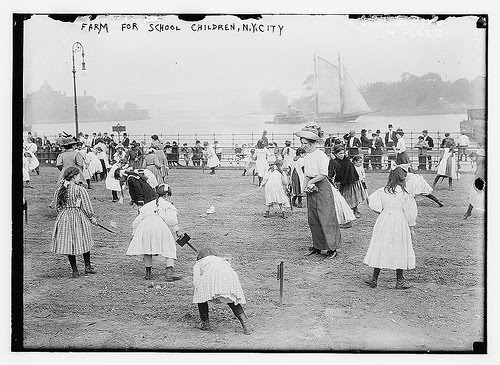
Farm for school children, New York City
Library of Congress’s Photostream @ Flickr.com

Gwynne Watkins @ Salon offers her analysis of a recent “exposé” by Jennifer Senior in the New York magazine on the unrealistic expectations of modern parenting.

“I Love My Children. I Hate My Life.” That’s the cover line on this week’s New York magazine, superimposed on a photo of a beautiful mother and infant in a sun-drenched landscape. Presumably, the mother is loving her child and hating her life. Presumably, we all are.

The whole post is worth reading, since it calls out the bullshit that is our contemporary culture’s obsession with parenting that turns human beings into infinitely perfectible projects — yet refuses to accept Senior’s conclusion, which is that if that “perfect” family life is a lie, all we have left to live on is the fumes of nostalgia.

One particular passage of Watkin’s post, however, sort of hit me in the head like a low-hanging tree-branch. So I’m hijacking it for this blog post so I can ask, once again, why the fuck “children are people too” such a difficult concept for people to grasp.

Like really.

Here’s the passage. Read and digest.

If you’re having a baby for reasons of self-gratification, of course you’re going to be miserable. Becoming a parent is less about enriching your life than it is about up-ending it entirely to make room for another human being. And that’s what Senior’s article is missing: the fact that children are people, and having a child is about forging a relationship. Take this quote from a sociologist Senior interviewed about why parents are so disgruntled: “Middle-class parents spend much more time talking to children, answering questions with questions, and treating each child’s thought as a special contribution. And this is very tiring work.” Funny, that doesn’t sound like work; that sounds like having a conversation. The true reward of parenting isn’t looking back with nostalgia, as Senior concludes; it’s getting to watch a baby turn into a fully realized person. It’s hearing the thoughts and opinions of somebody who didn’t exist until you brought them into the world. It’s a humbling, daunting, awesome experience — and it’s hard enough without the added pressure of making every moment enriching and significant.

So here’s the thing. What I find so disturbing about this passage is the way basic human interactions, when placed in the context of parent-child relationships, are suddenly framed in Senior’s article as an onerous obligation, and joyless demand. And this is seen as so normal, so common-sensical in our culture, that a sociologist seems to think there’s something problematic about asking one person in a committed relationship (parent) to treat the other person in that committed relationship (child) as if their thoughts were worth giving a damn about.

Really?

Really??

Take a minute to switch out “spouse” with “child” in the above passage:

Middle-class couples spend much more time talking to each other, answering questions with questions, and treating each other’s thoughts as a special contributions. And this is very tiring work.

“I love my spouse. I hate my marriage”? If the thought of spending time with your partner, talking together and treating each others’ thoughts with respect felt like tiring, joyless work — drudgery only relieved by the fond memories you had of your courtship or a fleeting weekend getaway — then possibly it’s time to seek out some couples counseling and/or ask yourselves whether this is really a relationship worth being in.

And while you obviously can’t walk out on a dependent child with the same impunity as you can an adult spouse, I’d suggest that it’s not too much of a stretch to stop thinking of children as hobbies or vocations and, you know, remember that you enter into a relationship with them. And that — as with all human relationships — the intrinsic reward of relatedness is the pleasure of getting to know another human being intimately. Learning to see the world through their eyes. Watching them grow and change over time. The pleasure of having conversations together, some of which last a moment and some of which will go on for years. Sharing experiences like the reading of a book, the watching of a movie, attending a concert or art show, cooking dinner and sharing the meal.

“Becoming a parent is less about enriching your life than it is about up-ending it entirely to make room for another human being,” Watkins writes, in her response to Senior. While I agree with her on the basic point that becoming a parent because you expect a child to fulfill your expectations is problematic, I would make a slightly different, possibly more radical argument: rather than juxtaposing “enriching your life” with “up-ending it” to make room for another, I’d suggest that such an up-ending is intrinsically rewarding, even if in none of the ways you initially anticipate. And that is the beauty of the chaotic unpredictability of humanity. If that sort of uncertainty is not your cup of tea, then maybe you should think again about whether you want to have kids. Or whether you want to be in a committed relationship of any kind.

‘Cause that’s kinda the point of being in a relationship.

As someone who has grown from being a dependent child to an adult in relationship with parents who treated her as a human being, I can attest first hand that (as with spousal relationships) recognizing each others’ humanity doesn’t make the experience of living together a panacea. It doesn’t mean we’ve never failed each other, struggled to communicate, lost our tempers, or felt (temporarily, sometimes for months or years at a time) at an impasse. What it does mean is that we aren’t reduced to our socially-assigned roles, and the expectations of behavior that come with those roles. It does mean we have more flexibility to adapt our relationships as the people within them grow and change — because those relationships were formed in the first place specifically to suit our own individual selves. In other words, shifting from the straight-jacket of “perfect madness” parenting to a model of ordinary human relatedness doesn’t solve all of life’s problems.

But it absolutely does open up a realm of possibility that is not possible when one person in the equation is reduced to a project rather than a person. A series of tasks and responsibilities rather than an organic being whose presence you are given the chance to experience.

Which is (surprise, surprise!) more or less the argument that feminists have made for decades about the idealization of heterosexual, monogamous marriage. When you reduce two human beings to their roles of “husband” and “wife,” and punish individuals from deviating from impossible normative standards (or make it exhausting, endless struggle for them to do so), it’s a recipe for disaster. The exact same observation can be made about “parent” and “child.”

Senior’s essay on parenting is the perfect opportunity for the feminist “click” moment, parenting style. It could offer us a chance to assess the way our culture’s idealization of family life dehumanizes children and parents, setting them up in relationships warped by power dynamics that make true intimacy all but unattainable.

Instead, Senior’s “solution,” to the extent that the article posits one, appears to be a band-aid fix that feminists will be very familiar with: the Flanaganian solution of “settling.” Senior’s article seems to suggest that the only options are

a) Playing to win. Pretending to find pleasure in the “perfect madness” of trying to conform to our culture’s ideal of the good parent (in reality, the good mother), thereby driving yourself and everyone around you crazy, but at deriving pleasure from the knowledge that you’re out-parenting all other parents or

b) Calling bullshit and giving up. Re-framing parenting as grim work, rather than a joyful vocation, undertaken out of duty and made bearable by the hope of delayed gratification of nostalgia after the raw experience has long passed. Just give up, Senior’s article ultimately seems to suggest; expecting to experience enduring happiness (gasp!) in your relationships with your children is just unrealistic. Shame on you!

I’m going to go out on a limb here and suggest that this is a false dichotomy, and that the way out of this lose-lose situation is, well, feminism for children. See, both of these “options” still posit that parenting = job rather than parenting = relationship. You can enjoy a job for intrinsic and/or extrinsic rewards (conducting oral history interviews!), or you can dislike a job but feel it’s worthwhile (canvassing before an election), or you can dislike a job but recognize it’s necessary (like doing dishes), but at the end of the day it’s still a job of work.

Why would you choose either of these options when instead you could have interesting relationships with these people who’ve walked (often invited by you!) into your life? Isn’t that one of the most awesome thing about being alive in the world — the chance to get to know and caring about the lives of others?

I say, just quit. Quit your job and go find a relationship. With that person who you’re interested in being intimate with as they grow and discover the full strength of their humanity. Who knew this would be such a radical suggestion?

"autobiography is an exercise in self-forgiveness"; should it always be so?

07 Wednesday Jul 2010

Posted by Anna Clutterbuck-Cook in think pieces

≈ Leave a comment

Tags

books, politics, religion

One of our post-graduation presents for Hanna, one which I also get to enjoy the benefits of, was a subscription to the London Review of Books. The most recent issue includes a review of Christopher Hitchin’s latest book, Hitch 22, a memoir. Hitchins, like other public personalities who trade in sensationalism and putting other people down, is easy to dislike for his self-absorption and snobbery. When the memoir first came out, John Crace @ The Guardian crafted a “digested read” version that played on this propensity and had Hanna and I falling off our chairs with mirth.

I find I have written nothing of my wives, save that they are fortunate to have been married to me, and nothing of my emotional life. That is because I don’t have one. The only feeling I have is of being right, and that has been with me all my life. I would also like to point out that drinking half a bottle of scotch and a bottle of wine a day does not make me an alcoholic. I drink to make other people seem less tedious; something you might consider when reading this.

David Runciman, whose review of Hitch 22 has been made available at the LRB website, offers much the same analysis — though in much more analytical a tone. He observes that Hitchins appears to have cultivated the personality of a “political romantic, as described by early-twentieth-century author Carl Schmitt.

For Schmitt, political romantics are driven not by the quest for pseudo-religious certainty, but by the search for excitement, for the romance of what he calls “the occasion”. They want something, anything, to happen, so that they can feel themselves to be at the heart of things.

The problem with this, morally speaking, is that a romantic whose raison d’etre is not his ideals but “the occasion,” the question of values is irrelavent. Say what you will about the political idealist (and, living with an historian of Northern Irish nationalism I know there’s plenty to say!), at least someone who acts violently for the sake of their convictions is a person who is clear about where they stand. They are willing to claim allegiance to a set of values, and to work (at times to the death) to see those values put into action.

Now there are (to a person of my proclivities towards nonviolent political change) better and worse ways of trying to live out one’s beliefs. But I also believe there is some intrinsic value in having beliefs: in having enough self-awareness that you feel comfortable owning your beliefs, saying “this is where I stand and why.”

You might think that a person who has written, among others, a book titled Why God is Not Great is not shy about taking a personal stand, even a highly controversial one. But being provocative, rhetorically and otherwise, is not necessarily the same thing as being self-revelatory. One can speak highly-charged words while never allowing anyone to see the emotionally-complex human being behind those words. I find other peoples’ interior lives fascinating; my obsession with understanding how other people understand the world around them — how they make meaning of their lives — is what led me to history as a scholarly pursuit. Runciman’s argument about Hitchins, however, is that he has no interior life, or at least not one of which he himself is very aware or willing to share with his readers.

It certainly sounds like it has all been a lot of fun. His has been an enviable life: not just all the drink and the sex and the travel and the comradeship and the minor fame (surely the preferable kind), but also the endless round of excitements and controversies, the feuding and falling-out and grudge-bearing and score-settling, the chat-show put-downs, the dinner party walk-outs, the stand-up rows. Christopher Hitchens has clearly had a great time being Christopher Hitchens. But – and I don’t want to sound too po-faced about this – should anyone’s life be quite so much fun, especially when it is meant to be a kind of political life? Hitchens admits to some regrets, including that he has not been a better father to his children (and by implication a better husband to his wives, though he doesn’t actually say that), but he doesn’t seem to have agonised about it much. In fact, he doesn’t seem to have agonised much about anything. He doesn’t rationalise his political shifts so much as acquiesce in them: if it feels like he has no choice, then he has no choice but to follow his feelings. He has seen his fair share of misery and despair, and may have caused a certain amount of it himself, but it is entirely unclear what this has cost him.

I believe in extending compassion and possibly forgiveness towards oneself in equal measure as toward other human beings — being kind to yourself as you are kind to others is, truly, one of the ways in which we can make the world a more kind, generous, compassionate place. Yet when “autobiography is an exercise in self-forgiveness” (to borrow a phrase Runciman quotes toward the end of his essay) while the autobiographer neglects to extend all but highly conditional forgiveness to anyone else, such self-adoration seems a shallow, fragile thing indeed.

Go enjoy the rest of Runciman’s review, It’s Been a Lot of Fun, over at the London Review.

okay, it’s been a while since a really ranty post …

02 Friday Jul 2010

Posted by Anna Clutterbuck-Cook in think pieces

≈ 4 Comments

Tags

children, feminism, gender and sexuality, human rights

…but I’ve been sitting on this column by Hanna Rosin @ Slate for a while now and I just can’t get the anger out of my bloodstream. So I’m going to blog it out and see if that helps.

Oh, Ms. Rosin. If only you would quit writing stuff that makes me so mad! I really liked your work in God’s Harvard, I did, and although you glossed a bit too, well, glossily, over the non-fundie history of home education and emoted a little too strongly about the cherubic goodness of your subjects — despite the fact they’re happily growing up into the next generation of Dick Cheneys and Karl Roves — I was willing to forgive you the oversight. Write it off as the slightly rose-tinted view of a researcher who has grown close to, and thus a bit fond of, her subject. I mean, we’ve all been there, done that.

But you keep on writing shit about gender that pisses me off. In this case, your post up at Slate’s Double X blog about Dr. Poppa, the pediatric urologist at Cornell University who has been performing cosmetic surgery on babies whose clitorises are deemed “too large.” (See sunday smut no. 27 for my initial reaction.) Rosin is upset by the outrage in the blogosphere, which she believes focuses unduly on the sensational nature of Poppa’s research (“he touches six-year-old girls’ clits!”) and ignores the fact that the good Doctor is trying to reach what in her mind appears to be a positive goal: girls with clits that don’t look like penises (achieved through surgical reduction) and yet still retain the nerves necessary to give the patients sexual pleasure.

To his critics, however, these details [Poppa’s quest for a better clitoroplasty] don’t matter. [Dan] Savage calls this a conspiracy of “out and out homophobia.” He claims the medical establishment pushes these operations because girls with bigger clitorises are more likely to be lesbian. This claim is a stretch; girls with CAH are only slightly more likely to be lesbians or tomboyish when they are young. The vast majority are heterosexual and comfortable as girls. Gender norms have shifted pretty drastically in the 40 years that this operation has been performed, and still more than 95 percent of parents choose it for their children. Why? Because much as Savage might like it to be, the world is not yet a place where most little girls can have a clitoris that looks like a penis and feel entirely at ease. And few parents would want to use their daughter to test that proposition.

I just — I can’t — I’m floored by the the utter wrongness of this as a goal. Aside from the question of trying to regulate children’s sexual orientation and gender presentation (see the coverage of hormone treatments for potentially CAH babies as another, related example of how fearful we are of children who might possibly not conform: don’t try to tell me this isn’t about gender and sexuality policing), Rosin overlooks the fact that we’re talking about medical practitioners who perform potentially debilitating cosmetic surgery on infants.

It’s not that “details don’t matter” (excuse me??) The details fucking matter. The detail, for example, that decisions about what a “normal” clit looks like are aesthetic decisions, made by doctors influenced heavily by cultural norms (see Anne Faustos-Sterling’s Sexing the Body). The detail that this is not surgery the children need in order to be physically healthy or experience sexual pleasure. In fact, it jeopardizes their sexual pleasure so that their genitals will conform.

Now I realize, despite my own aversion to being cut open with sharp instruments, that some people are less freaked out by surgery than I am. And I realize that surgery saves lives. I also recognize the right of adults to alter their bodies, even when not medically necessary, to better suit their vision of how their bodies should look and feel — even if I would not make those same decisions. But children whose bodies are physically healthy should be allowed to grow up without surgical alteration until they are adults and have the cognitive and legal ability to make up their own freakin’ minds. By suggesting that parents who consent to altering their children’s bodies in this way — again: risking their child’s capacity for physical pleasure out of the desire that their bodies visually conform to the gender binary — are saving their children the possibility that their genitals might make them ill-at-ease, Rosin is leaning on mid-20th-century theories about psycho-sexual development (themselves highly homophobic) that suggested children were somehow irreparably damaged by any experience of ambiguity when it comes to their gender or sexual orientation.

Has she not stopped to ask herself whether, maybe, it’s adult fear of nonconformity, rather than young peoples, that is driving this need to surgically alter our children to erase the beautiful variation that is human existence? Isn’t it better to tell and show your child that you think her body beautiful than to make it clear — through imposing upon her painful surgical procedures and years of follow-up medical tests and treatments — that she is somehow not quite “right”? Isn’t it better to make your home a harbor from whatever toxic gender-enforcing messages are out there in the culture than to be the first to rigorously enforce those standards? What object-lesson are you teaching your child here: That it’s important to conform to arbitrary cultural standards no matter the cost? That one must sacrifice pleasure for the sake of superficial appearance? That to be a “girl” or a “woman” one must alter one’s body to fit cultural expectations of what it means to be feminine?

Above all, it sends the message that the person you are when you are born is not okay, that your physical body is not acceptable even if it is pain-free and carries you everywhere you want to go, and gives you pleasurable sensations, digests your food, thinks complex thoughts, learns new skills, experience a full range of emotion, and helps you explore the world with curiosity and joy.

Again, this is not meant to be anti-surgery in cases where surgery can demonstrably improve a patients life. But activists have been pointing out for years that it is beneficial to be patient and allow children to grow into their own sex and gender identities in the fullness of time, before limiting their options prematurely by surgical means.

Rosin’s critique of Poppa’s online critics makes it sound like we’re a bunch of irrational drama queens who are unable to think about children and sex in close textual proximity without losing the ability to reason. I really, really wish she would quit being so fearful that children not surgically modified will be unhappy with their genitals and start asking why we feel such a strong need to police peoples’ genitalia in the first place. If she’s really worried about these children who are going to grow up feeling awkward about their bodies (as an aside: isn’t that really just part of the human condition? who doesn’t feel awkward in their own skin sometimes?) shouldn’t she be using her platform as a nationally-recognized journalist to speak out more forcefully against the conditions that make them so?

There. Rant over. I’m now feeling a bit calmer. And will go home to enjoy the company of my partner, who often despairs at the amount of verbiage I am willing to generate in the name of feminism. Sorry, honey! I think it might be congenital. Maybe they have a surgery to correct it?

evangelicals’ "defining story" = divine child abuse?: some reflections

25 Friday Jun 2010

Posted by Anna Clutterbuck-Cook in think pieces

≈ Leave a comment

Tags

books, religion, thesis

This is a rambling sort of post reflecting on Doug Frank’s recently-released A Gentler God: Breaking Free of the Almighty in the Company of a Human Jesus. Doug is one of the founding faculty members at the Oregon Extension, the community I am researching and writing about for my thesis. I might write a proper book review / booknote about A Gentler God at some point, but for now I want to share a story from my own history of interactions with the church — and Evangelicals particularly — that reading this book reminded me of, and helped me understand in a new light.

Despite growing up in culturally and religiously conservative Western Michigan, I was largely what they call “unchurched” as a child. My paternal grandfather was an ordained minister and professor of New Testament theology at Western Theological Seminary which is affiliated with the Reformed Church in America, a small but mainline protestant denomination. My father was, therefore, a preacher’s kid; my mother — raised by a lapsed Scotch Presbyterian and a Christian Scientist — was sent to Congregational Sunday school as a child and attended confirmation classes but never joined. My parents didn’t have us baptized and pretty much stopped attending church around the time my little brother was born (I was three) because the amount of nurturing they got out of church on Sunday wasn’t worth trying to parent small beings in a child-unfriendly space.

We didn’t return to Hope Church (my father’s childhood RCA congregation) until I was a teenager. We had a few reasons for doing so, including the fact that several of my more conservative, evangelistic friends had attempted to convert me (them: “have you accepted Jesus into your heart?” me: “uh … no.”) and my mother was hoping to inoculate us against fundamentalist, evangelistic theology by giving us a chance to learn the language and messages of Christianity and a scholarly, fairly liberal environment. To give you an idea of what this meant: the congregation had recently gone against denominational practice by ordaining a gay member as a church elder, they had already had a series of women ministers, they had an active pacifist group, and my feminist theology professor at college was a member.

I offer all of this as a preface to the story-story I’m going to tell you, which is about the husband and wife who served as youth group leaders for several years while I was attending Hope Church. This couple were way more theologically fundamentalist-evangelical and socially conservative than the majority of the congregation, and I’m not exactly sure how they landed the position of youth leaders (likely because they volunteered). I did childcare for the family regularly, but used to find myself at loggerheads with them (also regularly) about a number of issues including parenting, feminism, human sexuality, and theology.

And one day at either a youth group meeting or in a Sunday school class they offered — as if it were the best metaphor in the world for God’s love and the power of atonement (Jesus dying for our sins) — the following allegory (I’m paraphrasing from my own memory)

There’s a train full of passengers hurtling down a railroad track toward a bridge that has washed out. God is at the switchboard about to switch the rails so that the train goes onto a side rail (thus saving the passengers). But then suddenly his toddler son (Jesus) wanders out onto the side rail. God has to decide — train full of people or toddler son? And because God is so unselfish, he saves the train full of people rather than his own child.

What. The. Fuck.

That’s what you’re thinking, right? There are just so many things wrong with this story that it sort of stops you dead in your tracks.

This is the story that this couple — with three small children of their own, remember — told with passion and the clear expectation that we would be humbled by the boundless, sacrificial love of God. Whereas, of course, what character in this story is any human being (let alone a child!) going to identify with? The toddler! Whose own parent kills them in order to save a train full of unnamed, faceless persons. What child could possibly fail to be traumatized by a story that tells them the moral “right” is one in which their parent would not save them from death when they had the power to do so?

The take-away message regarding God and Jesus in this story is that God is a violent, murderous parent who has no overriding, irrational love for His own child. It’s a story of divine child abuse. And to me it was absolute crazy-talk.

Well, according to Doug, who describes this very story — or at least the collection of ideas embodied in this story — in the first part of A Gentler God, this is the “defining story” of modern American evangelism. Evangelical Christians, Doug argues, grow up in such close proximity to this story that they have trouble seeing its internal contradictions: the way in which a story that is trotted out to signify God’s boundless love for humanity actually tells a story about extremely conditional love and bloodlust. God demands bloodshed, which is why Jesus is required by God to die for our sins. How can we possibly square this with a God who cares for all of God’s creation unconditionally?

Well, you can’t, which is why Evangelicals (again, according to Doug and other scholars I’ve read) live on some level in perpetual fear of the wrath of an Almighty deity who — but for His willingness to murder his own son — would surely have come after you in vengance.

The story I heard in youth group displaces the personal wrath of God in favor of a fatalistic, mechanical failure — God isn’t causing the train to crash — God simply has to decide between God’s own child and the rest of humanity. But it still does no better at describing a loving, compassionate God — in fact, in my personal opinion it actually reifies the wrongness of the defining narrative by turning Jesus (a full-grown adult who, the Bible if pretty clear, makes the decision to die as a consequence of his actions) into a child who in no way chooses his own death. Instead, this story takes God and shapes Him (definitely “Him”!) into a monstrous parent. This is, I’d argue, even a step beyond the traditional Evangelical God of atonement whose divine sense of justice impersonally demands blood. This isn’t a God overly obsessed with justice at the expense of compassion — but a God who is simply uncaring, sociopathic even.

It appalls me, even all these years later, that this was the narrative of Christianity meant to excite conversion.

A Gentler God gave me a new perspective on the way this story, and its sister-stories in the Evangelical theological landscape, shapes how conservative Christians view their God — and how that view of the divine shapes their interaction with the world around them.

← Older posts
Newer posts →
"the past is a wild party; check your preconceptions at the door." ~ Emma Donoghue

Recent Posts

  • medical update 11.11.22
  • medical update 6.4.22
  • medical update 1.16.2022
  • medical update 10.13.2021
  • medical update 8.17.2021

Archives

Categories

Creative Commons License

This work by Anna J. Clutterbuck-Cook is licensed under a Creative Commons Attribution 3.0 Unported License

Meta

  • Create account
  • Log in
  • Entries feed
  • Comments feed
  • WordPress.com

Create a free website or blog at WordPress.com.

  • Subscribe Subscribed
    • the feminist librarian
    • Join 37 other subscribers
    • Already have a WordPress.com account? Log in now.
    • the feminist librarian
    • Subscribe Subscribed
    • Sign up
    • Log in
    • Report this content
    • View site in Reader
    • Manage subscriptions
    • Collapse this bar