
• anna j. clutterbuck-cook
  • contact
  • curriculum vitae
  • find me elsewhere
  • marilyn ross memorial book prize

the feminist librarian

the feminist librarian

Tag Archives: MHS

changes afoot in jobland (part two): on being employed

18 Saturday Dec 2010

Posted by Anna Clutterbuck-Cook in library life

≈ 2 Comments

Tags

domesticity, human rights, MHS, work-life balance

Massachusetts Historical Society
(December 2008)

This is the promised part two of my post on being hired as the Assistant Reference Librarian at the Massachusetts Historical Society.

Being hired for a modestly-renumerated full-time professional position straight out of graduate school during a recession (one in which there has been a much-reported-on “jobless” recovery no less), and being hired for that job while surrounded by many other fellow graduates and friends who are struggling on the hellish job market was a sobering experience.

Because that’s the sort of person I am. It’s incredibly, incredibly painful for me to accept opportunities that come my way when those opportunities are being offered conditionally. When those opportunities are offered supposedly on merit, due to some particular alchemy of my personal character or skills; when what I am being given — in short — is not being given to others.

I read somewhere recently that folks on the liberal end of the spectrum tend to have personalities that are “intolerant” of inequality. I laughed when I read that, ’cause I practically break out in hives when I feel like good things are being offered to folks based on some external (and, to my mind, inherently flawed) set of expectations concerning who is deserving and who is not.

We all deserve work that is challenging and rewarding. That exercises our abilities and builds new skills. And that provides materially for us and our families.

The fact that I, currently, have at least an approximation of that — and others, including others close to me — do not makes it really hard to meet the future with joyful expectation.I may have mentioned in my last post Brian Hawkins’ observation about being liberal in America: “Ring a bell and I’ll feel guilty for weeks!”

But guilt is unproductive (thank you Tim Wise), so I’ve been trying to focus instead on what it means to take responsibility for being employed in this particular time and place. And here is an (unfinished, ad hoc) compilation of initial observations.

  • Wage-work is not a privilege to be grateful for, but labor we offer in exchange for material gain. While being employable in today’s economy comes in part through social privilege (for more, see below), I think it’s dangerous to start acting as if wage-work ipso facto is a state for which we should be grateful.  Wage-work is something we do, not something that is given to us. Yet in a recession, it’s really easy to start saying to ourselves that we should be grateful to have a job — any job — and that those who employ us deserve our gratitude for hiring us. When we start to believe we should be grateful, we hurt not only ourselves, but also every person who feels pressured to accept and/or remain in wage-work in which they are exploited.
  • The process of being hired is not (solely) about personal qualifications. Most of us know that, despite idealistic talk about meritocracies, we live in a society in which structural inequalities exist and work (often invisibly) to position some of us to greater material advantage than others regardless of our individual abilities. Do I believe I’m qualified for the position I was hired into? Yes. Yet I am far from the only qualified person out there, and the fact I was hired hinged on a complex set of circumstances. I’ve had a lot of folks congratulate me on my new position with language that suggested I had “earned” the offer, that somehow through my efforts I have been rewarded with this position. I call bullshit on that because people who have valuable skills to offer the world remain un- or underemployed. Once we start talking about employment in the language of who deserves and does not deserve wage-work, whose efforts should or should not be rewarded, we’re supporting a way of understanding employment and economic security in terms of those who are “deserving” and those who are “undeserving.” I will not allow my personal circumstances to be employed in narratives that support that understanding.
  • All of my jobs have been “real” jobs. At least one person has suggested that now I have a “real” job … as opposed to the “fake” wage-work I’ve done since I was about nine and started working as a bagger at the college bookstore? As opposed to the “fantasy” wage-work of delivering newspapers? Working retail? Providing assistance to undergraduates as a teaching assistant? To faculty as a research assistant? As opposed to the reference and processing work I’ve done for the past three years as a library and archival assistant? I think the words were thoughtless rather than intentionally demeaning, but the net result was to imply that all of my colleagues who continue to work part-time, non-salaried, sans benefits, under-compensated positions are somehow not “real” workers. Whose labor does not count. In a capitalist economy that relies on such marginalized sources of labor, implying such work isn’t “real” is beyond insulting. And once again: not okay to be insulting to folks while invoking my name.

So my responsibilities (as I see them) as someone who has a reasonably well-respected and well-renumerated position:

  • To understand that I am granted social privilege by virtue of my position rather than through any personal awesomeness … and do what I can to identify and name that privilege, so that it is not invisible.
  • To respect, not look down upon, those folks who are un- or underemployed; to recognize that no individuals should be reduced to their employment status, and not assume that their employment status is a result of their own personal actions/worth (or lack thereof).
  • To advocate for decent working conditions for all, including myself. To remember that critically assessing my own position as a worker and advocating for change when I believe it is warranted can be part of pushing back against inhumane working conditions more generally.

This probably isn’t anything new for those who cut their political teeth in labor activism, or for those who have spent much more time than I have thinking in terms of class and economic disparity, but labor activism should not stop at the simplistic goal of employment. Rather, it needs to continue critically analyzing the place of wage-work in the economy, and the need for economic endeavors to (ultimately) cycle back to support the well-being of us all.

Put like that it sounds hopelessly idealistic. But I really, I only have this to say in response: Intellect and Romance Over Brute Force and Cynicism.
changes afoot in jobland (part one): ms. assistant reference librarian

09 Thursday Dec 2010

Posted by Anna Clutterbuck-Cook in library life

≈ 6 Comments

Tags

MHS, work-life balance

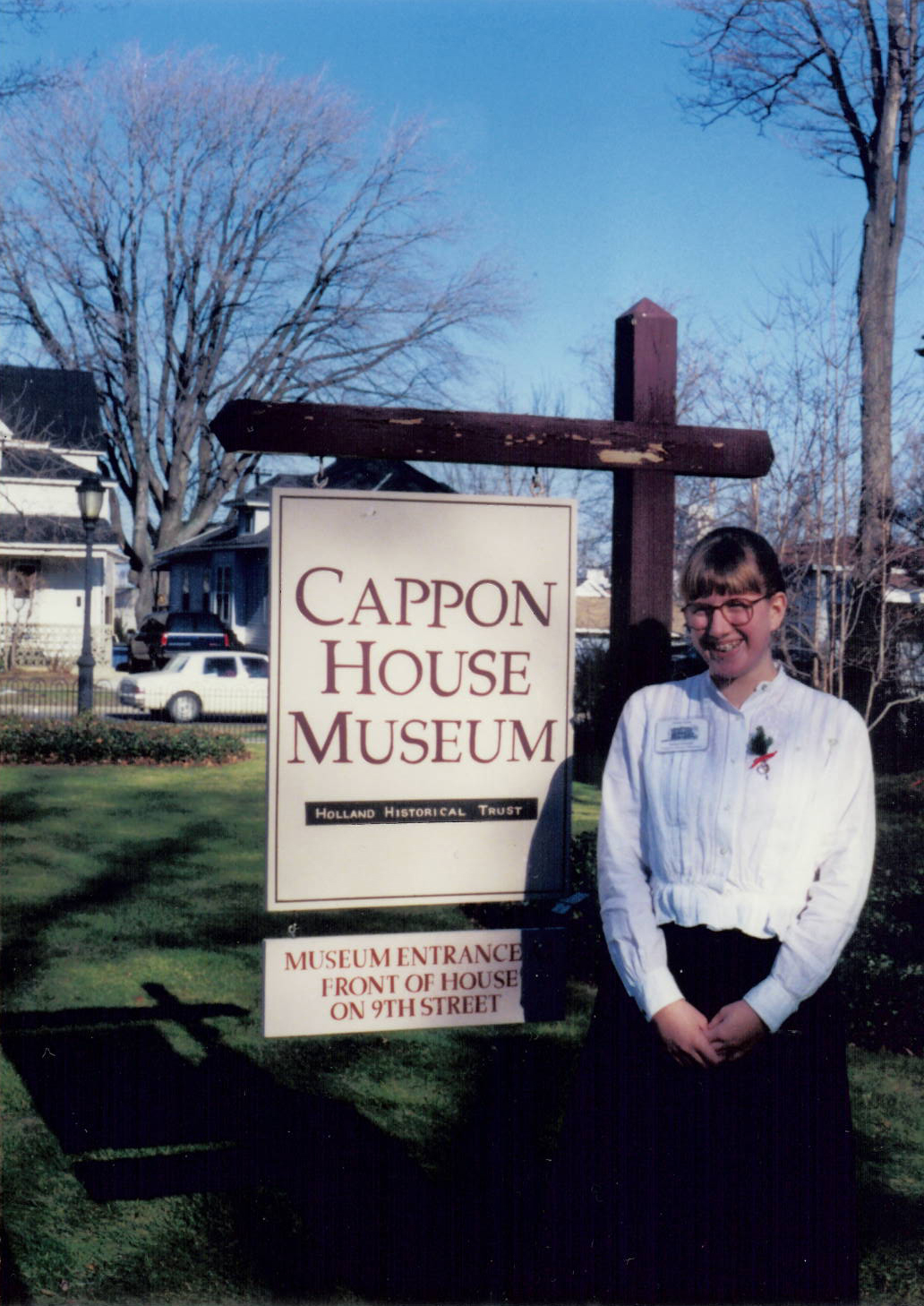
Anna on her first day as a volunteer
circa Fall 1993

Long ago, when I was twelve — almost eighteen years to be exact! — I became the youngest volunteer docent (tour guide) at my hometown’s Cappon House Museum.

Yes, braces, bangs and all.

The Cappon House is the historic home of Holland, Michigan’s first mayor, Isaac Cappon, his first and second wives, and their sixteen children (when I was twelve I loved the bit about the children; today I still do, though for slightly different reasons — lessons in birth control anyone??).  Over the next few years I gave countless tours to senior citizens groups, schoolchildren, and tourists, eventually expanding my responsibilities to include duties at the Holland Museum as well.  By my mid teens I was torn between the childhood desire to become a bookshop owner and novelist or my newfound passion for the field of museum studies and history.

Luckily, I’ve found a way to combine these vocational yearnings of mine: reference librarianship in the world of rare books and manuscript collections.  Most of you are aware that since shortly after moving to Boston in August of 2007 I have worked as part of the Library Reader Services Staff of the Massachusetts Historical Society, an independent research library and (our docents like to inform our visitors) the oldest historical society in the Western Hemisphere, founded in 1791.

For the past three years I’ve worked part-time as a Library Assistant, though my pre-professional status has hardly kept my colleagues from embracing me as part of the team.They’ve been a wonderful group of folks to work with and have contributed to my education as a library student and historian as much as, if not more than, my formal studies.

As of January 1st, the departure of one of those colleagues for a new position at LibraryThing.com is leaving a full-time Assistant Reference Librarian position open which I have been invited to fill. I’m excited to be taking on new responsibilities as well as (hopefully) finding a bit of time to continue developing my knowledge of the collections through the lens of my own particular scholarly interests — watch for a new “object of the month” post in February on the intersection of antifeminism, the red scare, and religion during the 1920s.

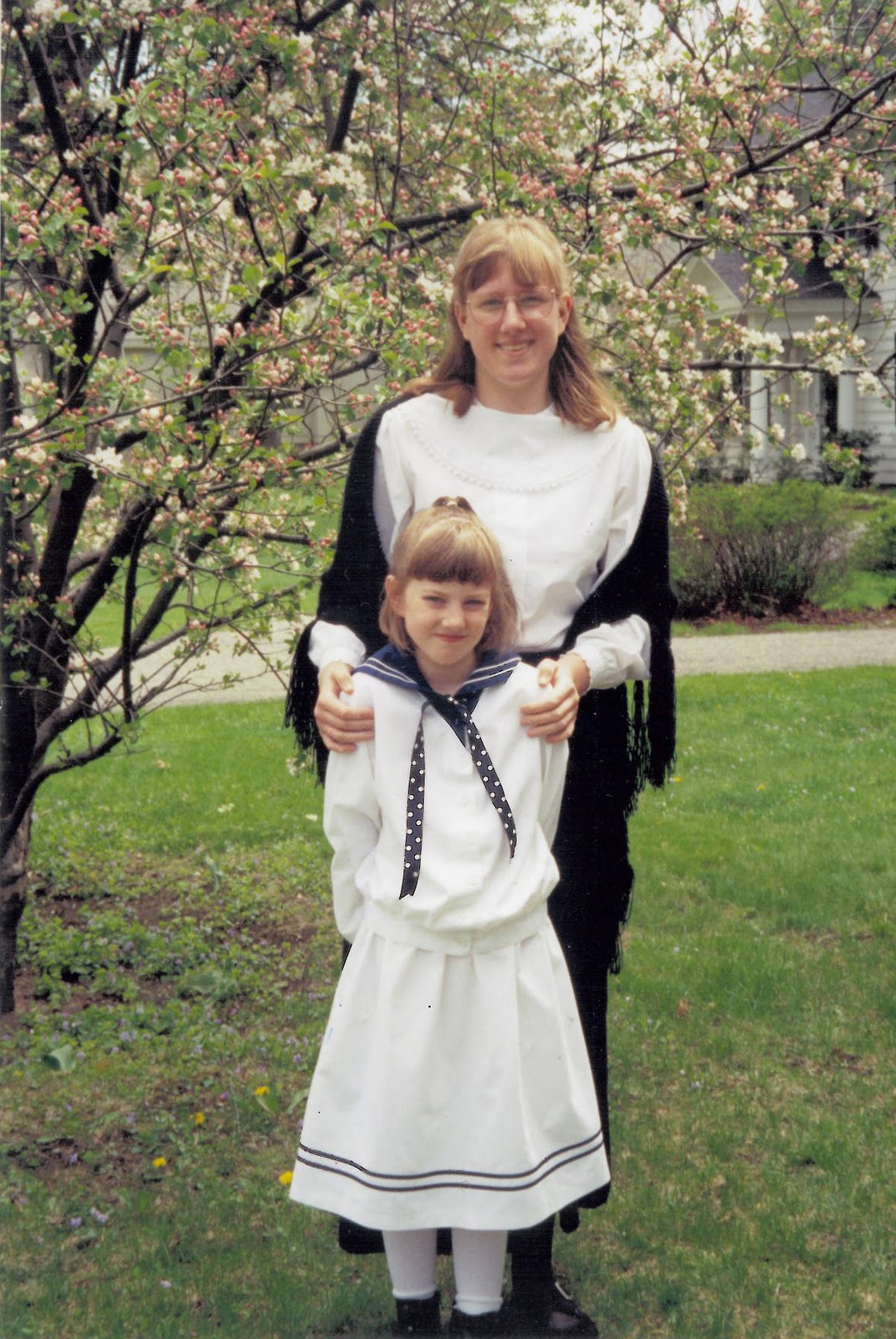
Anna and sister Maggie
circa Spring 1995

Running the risk of sounding like Brian Hawkins in Tales of the City (“Ring a bell and I’ll feel guilty for weeks!”), unexpectedly finding myself offered full-time employment in this economy — when I’d been steeling myself for a long, grueling job search this coming year — leaves me with complicated feelings.  I’m relieved about the financial security, obviously, and excited about the work I’ll be doing. At the same time, I’m acutely aware that many folks with similar resumes and educational background are not in such a privileged position, including many of my fellow graduates from the History/Archives program at Simmons. And I’m not comfortable assuming or accepting that the opportunity I’ve been offered is somehow a one-to-one correlation with my personal accomplishments and abilities. Not that I believe I’m unqualified for the job — I just know many people who are qualified for useful and interesting work are struggling to find it. So look for a “part two” to this blog post in the near future, with some musings about what it means (to me) to be hired during a recession.

In the meantime, long live librarians: the recognized and the unrecognized, the well-rewarded and the under- or unemployed. I am proud to count myself among your number.

“a rash and dreadful act for a woman”: the 1915 woman suffrage parade in Boston

01 Thursday Jul 2010

Posted by Anna Clutterbuck-Cook in my historian hat

≈ Leave a comment

Tags

feminism, history, MHS


A couple of weeks ago I promised to share with all of you the July “object of the month” from the Massachusetts Historical Society, which I selected and wrote the text for. And today it goes live! The item, to refresh your memory, is a 1915 leaflet containing instructions to participants in the October 16 woman suffrage parade held here in Boston. To be entirely self-referential and quote from my own description,

In 1915, male voters in Massachusetts were asked to decide on an amendment to the Massachusetts Constitution that would strike the word “male” from the article that gave men the right to vote. In response to the upcoming vote, the Massachusetts Woman Suffrage Association organized a pro-suffrage parade on Saturday, 16 October 1915, involving some 15,000 marchers and 30 bands. The parade route began at the corner of Massachusetts Avenue and Beacon Street; marchers made their way past the Public Garden, Boston Common, and the State House before proceeding up Tremont Street and Saint James Avenue to Huntington. The parade ended at Mechanics Hall where a pro-suffrage rally was held.

You can see the digital version of the broadside and my accompanying text over at the Massachusetts Historical society website.

image credit: Suffrage parade, New York City, 6 May 1912, made available at Wikimedia Commons; image is in the public domain.

from the archive: anti-suffrage activism in Massachusetts

16 Wednesday Jun 2010

Posted by Anna Clutterbuck-Cook in my historian hat

≈ Leave a comment

Tags

feminism, history, MHS


This week, I’ve been doing some background research on a pro-suffrage parade that the Massachusetts Woman Suffrage Association organized in Boston on October 15, 1915. Here at the Massachusetts Historical Society we hold a leaflet distributed to the marchers which will be our object of the month in July (you’ll see a link here when it goes up!)

While feminism continues to be a controversial political movement these days, only rarely do you hear people voice the now radical-seeming notion that the world would be a better place if women did not have the right to elective franchise. Less than one hundred years ago, however, exactly the opposite was true: women who sought the vote were understood to be the radical troublemakers whose quest for elective franchise would bring disaster: divorce rates would rise, domestic life would become a shambles, and the twin threats of Mormonism and Socialism would converge and destroy modern civilization [1].

As the Massachusetts pro-suffage activists geared up for their parade, the “antis” (as they were known) geared up for a counter-protest. As the Boston Daily Globe reported the day before the parade

In their great “victory” parade tomorrow the Woman Suffragists of Massachusetts, who expect to march with 15,000 in line and 30 bands, must pass on their line of march no less than 100 houses decorated with red roses, the symbol of the antisuffragists, and with banners appealing to the men of the State to vote against votes for women.

Hovering about the line of March, like flying cavalry seeking an opening for flank attack on an enemy column, will be many motor cars decorated with red roses, some of them as large as cabbage heads and mounted on long staffs for stems.

In many hotels maids and matrons will sell red roses and with each will give away a red card bearing an argument against Woman Suffrage.

On the streets some hundreds of boys will sell red roses and give with each a similar card.

Among the crowds that are expected to witness the parade will be many hundreds, and it is hoped by the “antisuffs” many thousands, wearing red roses.

…This is the answer of the No Votes for Women workers among the gentler sex in Massachusetts to the suffragist bid for the ballot through a great parade.

It will constitute the only organized demonstration of the antisuffragists against their sisters of the opposite camp. No effort will be made to interrupt the parade in the smallest degree or to embarrass the paraders by any attacks, direct or indirect, except that silent protect of the blushing roses that is worn on each antisuffrage bosom, be it male or female.[2]

I am struck by the tension in this journalist’s story between portraying the anti-suffrage activists as more demur and ladylike in their approach than “their sisters of the opposite camp” and the undercurrent of threat that surfaces in the martial imagery of the motorcars festooned with red roses “hovering about the line of March, like flying cavalry seeking an opening for flank attack on an enemy column.”[3] Note how the anti-suffrage activists are described as both male and female while the suffrage activists (which included men as well as women, notably a contingent of Harvard students) are described as “woman suffragists” and “sisters.” “Maids and matrons” as well as small boys are said to be distributing protest flowers, which evokes a sense of broad cross-class participation, and the number of 15,000 marchers is contrasted with what is hoped to be 100,000 protestors (the number of roses prepared for distribution).

The referendum on woman suffrage was defeated by a 2-1 margin statewide on November 2nd that year and pro-suffrage activists turned their attention to the nation-wide struggle for the Susan B. Anthony constitutional amendment (to become the 19th amendment to the U.S. Constitution in 1919). Massachusetts was the eighth state to ratify the amendment, the state house of representatives voting by an 185 to 47 margin in support of women’s right to vote.

More to come soon with the July object of the month!

FOOTNOTES

1. Massachusetts Anti-Suffrage Committee. The case against woman suffrage: the most important question on the ballot at the state election, November 2, 1915. Boston: The Committee, 1915.

2. “ANTIS PLAN SILENT DEMONSTRATION AT SUFFRAGE PARADE TOMORROW”
Boston Daily Globe (1872-1922); Oct 15, 1915;
ProQuest Historical Newspapers Boston Globe (1872 – 1927)
pg. 1

3. Hanna points out that this makes the anti-suffrage activists sound like the female mosquito women in China Mieville’s novel The Scar (New York: Ballantine Books, 2002) who descend upon male beings and suck them dry of their vital fluids. “”Like a woman bent double and then bent again against the grain of her bones, crooked and knotted into a stance subtly wrong. Her neck twisted too far and hard, her long bony shoulders thrown back, her flesh worm-white and her huge eyes open very wide, utterly emaciated, her breasts empty skin rags, her arms outstretched like twists of wire. Her legs judder insanely fast as she runs until she falls forward but does not hit the ground, continues towards them, just above the earth, her arms and legs dangling ungainly and predatory as…wings open on her back and take her weight, giant mosquito wings, nacreous paddles shudder into motion with that sudden vibrato whine, moving so fast they cannot be seen, and the terrible woman seems borne towards them below a patch of unclear air” (p. 269).

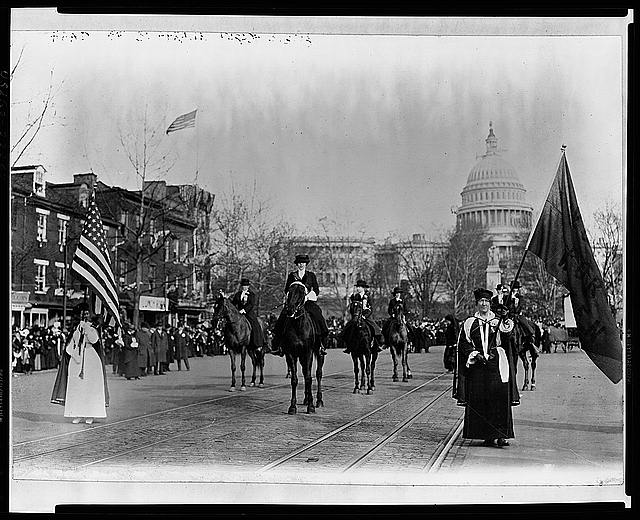
4. image credit: Head of suffrage parade, Washington, D.C.

Quick Hit: "Catholic Exodus"

21 Friday May 2010

Posted by Anna Clutterbuck-Cook in linkspam

≈ Leave a comment

Tags

blogging, boston, history, MHS

I have a lunch talk recap up over at the MHS blog (The Beehive), sharing some of the highlight’s from Alex Goldfeld‘s talk last Friday on the history of Catholics in Boston’s North End neighborhood, and specifically an 1859 incident at the Eliot School over whether Catholic students should be compelled to say Protestant prayers.

Goldfeld argues that this incident and the political rhetoric surrounding it on both sides raised questions about the place of religion in the school system and the role of public schools in the assimilation of immigrants that still have echoes in modern-day debates.

Those of you who are interested can hop on over to The Beehive to read the rest.

from the neighborhood: mhs bouquet

09 Tuesday Feb 2010

Posted by Anna Clutterbuck-Cook in a sense of place

≈ Leave a comment

Tags

from the neighborhood, MHS


Last week, the Massachusetts Historical Society hosted a reception and lecture for a group called the Seminarians. They ordered this gorgeous bouquet of cherry blossoms and red roses and left it behind for us to enjoy. Cut flowers always make me a little sad, but while they last they are lending a much-welcome spot of color to our front foyer.

Quick Hit: America’s Mary Wollstonecraft?

26 Tuesday Jan 2010

Posted by Anna Clutterbuck-Cook in Uncategorized

≈ Leave a comment

Tags

blogging, feminism, history, MHS

I have a new “lunch talk recap” up at the Historical Society’s blog that summarizes Eileen Hunt Botting’s recent talk about nineteenth-century author Hannah Mather Crocker and her Reminiscences and Traditions of Boston. Crocker was the granddaughter of Cotton Mather, a proud daughter of the Revolution, mother of ten children, poet, and author of an 1818 tract, “Observations of the real rights of women, with their appropriate duties, agreeable to Scripture, reason and common sense,” that holds the distinction of being the first book-length work on the subject of women’s rights to be published in America. You can read more over at The Beehive.

Quick Hit: MHS stats for 2009

31 Thursday Dec 2009

Posted by Anna Clutterbuck-Cook in library life

≈ Leave a comment

Tags

MHS

Jeremy reports on the MHS blog that 2009 was an impressive year for the Library Reader Services staff

All told we had over 1,450 researchers visit the library over the course of the year, for a total of 2,851 daily uses. We had over 740 first time visitors this year, a good indication that both our website and our public and educational programs are reaching out to new users. It is also a good indicator that people are still interested in using libraries.

In addition to the people that visited the library in person, our reference staff engaged in over 1,500 email correspondences with researchers seeking assistance, answered 62 posted letters, and fielded over 1,100 reference-related phone calls.

In servicing our researchers the staff made over 13,000 photocopies of MHS documents, and paged over 5,600 call slips. Because researchers can request multiple volumes and/or boxes from manuscript collections on a single call slip, it is difficult to gauge just how many individual items were retrieved and returned to the stacks, but I would wager it is a safe bet to say that it was well over 10,000 items.

If you’re interested in further stats, like where all these researchers came from, click through to the Beehive for his full post.

Quick Hit: The Case of the Slave-Child Med

22 Tuesday Dec 2009

Posted by Anna Clutterbuck-Cook in my historian hat

≈ Leave a comment

Tags

blogging, boston, history, MHS

I have another post up at the Beehive recapping the lunch talk given by MHS fellow Karen Woods Weierman on the 1836 court case, Commonwealth vs. Aves, in which abolitionists in Boston sued a Southern slave-holding family in order to free a 7-year-old girl they had brought North with them while visiting relatives.

Quick Hit: Letters of the Presidents

12 Thursday Nov 2009

Posted by Anna Clutterbuck-Cook in library life

≈ Leave a comment

Tags

blogging, history, librarians, MHS

I have a brief post up on the Beehive describing a talk given my friend and colleague Tracy Potter and her intern, Sarah Desmond, at the MHS on their project documenting the letters written by U.S. Presidents in the Society’s collections. For those of you interested in political history, wander on over and check it out.

← Older posts
Newer posts →
"the past is a wild party; check your preconceptions at the door." ~ Emma Donoghue

Recent Posts

  • medical update 11.11.22
  • medical update 6.4.22
  • medical update 1.16.2022
  • medical update 10.13.2021
  • medical update 8.17.2021

Archives

Categories

Creative Commons License

This work by Anna J. Clutterbuck-Cook is licensed under a Creative Commons Attribution 3.0 Unported License

Meta

  • Create account
  • Log in
  • Entries feed
  • Comments feed
  • WordPress.com

Create a free website or blog at WordPress.com.

  • Subscribe Subscribed
    • the feminist librarian
    • Join 37 other subscribers
    • Already have a WordPress.com account? Log in now.
    • the feminist librarian
    • Subscribe Subscribed
    • Sign up
    • Log in
    • Report this content
    • View site in Reader
    • Manage subscriptions
    • Collapse this bar