• anna j. clutterbuck-cook
  • contact
  • curriculum vitae
  • find me elsewhere
  • marilyn ross memorial book prize

the feminist librarian

the feminist librarian

Tag Archives: politics

"you should call it the doppler effect. then people will shag you."

08 Monday Nov 2010

Posted by Anna Clutterbuck-Cook in think pieces

≈ 2 Comments

Tags

bigotry, blogging, politics

shout and scream by Mindaugas Danys
available at Flickr.com

So this past weekend I was enjoying some stimulating, thoughtful conversation over on Emily Nagoski’s blog about teaching women’s sexuality in higher education. A student in the semester-long class on the subject recently contacted Emily and suggested that the course material was “unintentionally heteronormative.” This provoked an interesting conversation on the comment thread about how to teach the biological aspects of human sexuality to students more comfortable in the world of sociocultural analysis — students who are (rightly) suspicious of simplistic truth claims from the world of hard science, but who are perhaps hastily dismissing an entire way of seeing the world that could be useful, as long as it remains one of many tools we have to increase our understanding.

I digress. If you’re interested in that conversation, you can head over to the original thread.

The thing is, a commenter jumped into the conversation and suggested this student — solely on evidence that they used the word “heteronormativity” was an “unhinged crank,” who “sees ‘heteronormativity in A/C plugs and sockets.” When Emily replied “I know with certainty they are not,” he begged to differ:

Anyone who would accuse the Emily Nagoski I know of ThoughtCrime – excuse me, “heteronormativity” – is nearing the straitjacket stage of gender politics.

The thing is — this guy obviously knows and wants to defend the thoughtfulness and openness of his friend. Both of these impulses are laudable. But I really, really wish we had a Godwin’s Law for references to ThoughtCrime, ThoughtPolice, 1984 and the derogatory use of “politically correct”  and the label of  “language police.” Attempt to invalidate someone’s argument by accusing them of being the thought police? You lose.

Like with Godwin’s Law,  the Feminist Librarian’s Law of Accusations in Place of Honest Reflection, allows that there are instances in which it is legitimate to speak out against genuine instances of attempted censorship or policing of other peoples’ life experience. I believe policing other peoples’ sexualities, identities, bodies, clothing choices, food choices, and yes, even language choices (when it comes to self-identification and description at least) is not okay. It’s their life, not yours. And unless their actions are causing you or other people demonstrable harm (for which you have to show not just claim causal effect), it’s none of your damn business. And if there were actually state-sanctioned censorship going on here, it’s legitimate to challenge it. (Although I’d suggest accusing the proponents of being the “thought police” might not be the best way to get your message concerning freedom of speech across.)

The thing is: No one in this scenario has tried to thought-police anyone.  A student in a class has raised concerns that a class on women’s sexuality is unintentionally perpetuating heteronormative culture. Heteronormativity is not a “thought crime”: it’s the accumulated effect of myriad cultural cues that suggest to us that the normal (and best) form of sexual identity and expression is one in which individuals’ gender matches their assigned sex, that gender expresses itself in only two mutually-exclusive ways (“male” and “female”) and that the most appropriate expression of human sexuality is through opposite-sex pairings.

Far from acting as the Thought Police (who, ahem, had the weight of the government behind them), the student in Emily’s class is raising a question from the margins. Our government supports heteronormativity not its opposite. One cannot literally act as the “thought police” unless one has the power of cultural, political, and/or legal authority behind them.

In my experience, the people who get most often accused of policing other peoples’ thoughts or words are people who are challenging the status quo.  People with no political authority or cultural weight behind them. While the people who respond to those challenges with accusations of language policing and characterizations of the first person’s challenge as a call for “political correctness” are defending the status quo.  They’re skeptical of the first person’s challenge, dismissive of their concerns, and all too ready (as this gentleman has) to label the challenger as a “crank” or “unhinged.”

This is not what Orwell was talking about, people. This is not censorship.  This is just, you know, people bringing up ideas that are outside your comfort zone.

And crying “thought police” just ’cause you’re a little uncomfortable is, shall we say, slightly over-egging the cake.

In my experience, the only goal of this tactic to get the challenger to shut the fuck up by telling them their question-asking is an hysterical over-reaction or a calculated power-play (probably both!). It signals to me that the accuser the doesn’t understand the crucial distinction between the exertion of power-over with the full weight of the Powers That Be behind it and the actions or speech of those who are challenging the Powers That Be the passive or active abuses the often come with those Powers.  It signals to me that the accuser does not care enough about the challenger as a person or about their ideas to give them due consideration, even if that person and their ideas make the accuser uncomfortable.  Reflexive defensiveness: Not. Cool.

Had similar experiences? Discovered ways of dealing with this sort of response effectively? Share in comments!
tuesday morning economics: academia edition

02 Tuesday Nov 2010

Posted by Anna Clutterbuck-Cook in think pieces

≈ 2 Comments

Tags

economics, education, politics

Somewhere in me, I have a post percolating about the way my personal perspective on, and awareness of, economic issues has been subject to a steep learning curve in the last three years since I started graduate school.

In sum, while I had a fairly firm grasp on personal finance and budgeting when I entered graduate school, taking out the student loans necessary for my education, the high cost of living in the Boston metropolitan area, and the experience of bringing my material life together with that of another person for the first time raised new anxieties and questions. Additionally, attending graduate school for a professional degree — not to mention doing so in the context of a recession — means being caught up in a series of explicitly economic propositions. For the first time in my life, I have formed a relationship with education that is, in part, about economics. (More on why this is a new dynamic for me will have to wait for that later post).

I don’t have time, right now, to write at length about these personal experiences. But I do want to draw your attention to a fascinating series of posts over at (once again) Tenured Radical and Historiann about the politics and economics of academic employment.

  • Tenured Radical: Department of Economics: Observations on the Lack of Raises and Thinking Out Of the Box.
  • Historiann: Sister, Can You Spare a Dime?
  • Tenured Radical: Department of Economics II: Organize, Goddamnnit!
  • Historiann: So You Want to Get a PhD in the Humanities?
  • Tenured Radical: Department of Economics III: The Latest on Salaries and Benefits.

With good (read: lively!) comment threads on all of them for further reading. While the discussion here is primarily focused on faculty (teaching and research) positions, the economic climate of higher education inescapably touches those of us in the library field, particularly those who work at said institutions of higher education (not to mention that there are library positions with faculty status and tenure track).  In a more abstract sense, this conversation about the economics of education is a conversation about how to make a living doing intellectual work in fields that are not widely respected by the corporate sector (i.e. history! women’s and gender studies!) and are often seen as peripheral to education of “real” worth (see the catch-22? “real worth” here = financially lucrative; the market is seen as the neutral, unbiased arbiter of social as well as economic value).

So there’s your difficult-yet-worthwhile reading assignment of the week … I promise more pictures of cats and other miscellaneous fluff on Wednesday!

friday fun: Jay Smooth on Christine O’Donnell’s latest campaign ad

08 Friday Oct 2010

Posted by Anna Clutterbuck-Cook in media

≈ 1 Comment

Tags

humor, politics, web video

Hanna and I watched this on Wednesday night and were in tears. ‘Cause really, he says it all. All that is wrong with this ad and all that is wrong with hard-core populism in American politics.

I’m all for a healthy dose of skepticism when it comes to smartness, intelligence, credentials, etc. But I also don’t think “common sense” is good enough, wise enough, to be an indication that we should trust someone with power.

Also: who wants to mess with the space-time continuum? Seriously!

No transcript seems to be available yet, but watch Ill Doctrine for an update on that front.

Happy Friday, folks! Have a good (hopefully three-day) weekend.

no single story is everyone’s story: thoughts on the "it gets better" project

05 Tuesday Oct 2010

Posted by Anna Clutterbuck-Cook in think pieces

≈ 1 Comment

Tags

blogging, gender and sexuality, politics

There’s been buzz around the feminist/queer interwebs about the It Gets Better crowd-sourced YouTube project, in which non-straight, gender-non-conforming folks are asked to film and post their stories about coming of age and leaving shitty adolescent experiences behind for better places.  This project was started by Dan Savage and his husband Terry in response to the recent high-profile suicides by teenagers who were bullied for being, or being seen as, queer.

There have been a number of, I think, valid critiques of the project: its limitations (is “it gets better” all we can offer kids in pain??), the implicit assumptions it makes (that things will get better, that adolescence universally sucks and adulthood is inherently superior).  One of the best breakdowns I’ve seen comes from TempsContreTemps @ (femmephane). Quoting at length, from the ten reasons the project (and specifically Dan and Terry’s contribution) makes her feel uncomfortable

1. The video promotes metro-centric and anti-religious sentiment. By aligning their bullying with the religiosity and “small-town mentality,” Dan and Terry tacitly reinforce the belief (especially rampant in queer communities) that the religious and the rural are more bigoted.

2. The message is wrong. Sometimes it gets better– but a lot of times it doesn’t get any better. Emphasizing that things will improve upon graduation is misleading both to young folks struggling and also to people with privilege who are looking on (or looking away).

3. Telling people that they have to wait for their life to get amazing–to tough it out so that they can be around when life gets amazing– is a violent reassignment of guilt. Dan Savage telling kids that if they don’t survive their teenage years they’re depriving themselves? What kind of ageist garbage is that? This quietly but forcefully suggests that if you don’t survive, if you don’t make it, it’s your own fault. It blames the queer for not being strong enough to get to the rosy, privileged, fantasy.

4. Stories of how your mom finally came around, over-write the present realities of youth. Arguing that in the future, the parts that hurt will be fixed, not only suggests that folks shouldn’t actually inhabit their own suffering but it also suggests that the future is more important. For a lot of folks, it doesn’t matter if your mother might come to love you and your spouse. It matters that right now she does not love you at all.

5. The rhetoric about being accepted by family, encourages folks to come out– even when coming out isn’t a safe idea. There is no infrastructure to catch you when your family reacts poorly. There is no truly benevolent queer family, waiting to catch you, ready to sacrifice so you can thrive. For a lot of folks, coming out doesn’t only mean that your parents will promise to hate your lovers– it means violence, homelessness, abuse.

6. Bar story: vomit. It’s no coincidence that this is the first place where Dan and Terry mention queer space. Codified queer-space, restricted to 21+, w alcohol? Try again.

7. We shouldn’t be talking, we should be listening. Telling our own stories from our incredibly privileged positions, overwrites youth experience.

8. Stories of over-coming adversity: no thank you. Narratives of how life was hard and but now is good, belittle lived pain, imply that a good ending is inevitable, and also undermine the joy and happiness in even bullied kids’ lives.

9. There is actually no path to change in this vision. Promoting the illusion that things just “get better,” enables privileged folks to do nothing and just rely on the imaginary mechanics of the American Dream to fix the world. Fuck that. How can you tell kids it gets better without having the guts to say how.

10. Then we get a baby and go to Paris? WTF? This is a video for rich kids for whom the only violent part of their life is high school. It’s a video for classist, privileged gay folks who think that telling their stories is the best way to help others. Telling folks that their suffering is normal doesn’t reassure them– it homogenizes their experience. It doesn’t make them feel like part of a bigger community, it makes them feel irrelevant.

Plus three (with a little help from my friends)

1. When we treat campaigns like this like they’re revolutionary, they undermine all the really amazing work that the youth already does for itself. Too often in the LGBT world, we are asked to thank our brave queer activist ancestors who made the world safe for us. That does have its place. But queer youth take care of themselves. They nurture and organize and love in order to save themselves and each other. Making famous messages legible as THE messages makes youth-work look minor, haphazard, or unofficial.

2. Campaigns like this lump everyone together. It doesn’t honor or respect the individuals. It turns them into icons. It sends confusing messages that we only attend to folks when their dead– when giving care doesn’t actually take anything out of us.

3. Broadcasting your story into the world, or congratulating others for broadcasting theirs is an anesthetized, misguided approach to connecting. We should help folks feel seen— by trying our hardest to see them.

It has been my experience that people are ashamed to help the folks they see as destitute. They are willing to let someone crash on their sofa for a night if they know that they have a back-up bed, somewhere else. They are happy to provide dinner, so long as they know you would be eating even without their generosity. It seems that if you’ve never been homeless or lost or hungry, if you don’t know what that feels like,  is too embarrassing to give things to people who might die without them– it is humiliating to hand someone the only food they’ve had all week.

You can read the whole thing over at (femmephane).

You can also read the follow-up post there.

And thanks to taniada @ Cynical Idealism for sharing the link on Tumblr and thus bringing it to my attention.

I haven’t been at a computer where I have multimedia access long enough in recent weeks (I can’t watch videos at work; I try to limit my recreational internet time at home) so I haven’t actually watched Dan and Terry’s video.  So this post isn’t really about the project or the specific video. Instead, it’s about the responses to the video; in particular, the frustration expressed by many that this project — particularly since it has Dan Savage’s name on it — has been getting so much attention, and the implications of that attention for folks whose stories don’t fit the narrative of “it gets better.”  As TempsContreTemps writes in her follow-up post:

I wrote my piece as a response to the way that Dan and Terry’s video went viral so quickly. I was thinking about 1) why it was that THAT video was so popular and liked and 2) why the video made me and many of my friends uncomfortable. Also, I wanted to know whether those questions were related. Did it seem so painful because it was so popular? I am not capable of, nor would I want to, destroy Dan and Terry’s message. There are a multitude of ways to be queer. Dan’s isn’t the only voice… and neither is mine.

Instead, I want to complicate the dialogue.

This post illustrates for me the point that so easily gets lost in discussions about whether X or Y representation of movement Z or community Q is accurate or not, privileged or not, silencing or not, worthwhile or not, illuminating, incisive, judgmental, blind, feminist, misogynist, transphobic, racist, ageist, ableist … or not. The point that any one piece of activism can be multiple things at once.  Just as any feminist critic of popular culture knows that a song or a movie or a phenomenon can embody contradictory messages about women, so too can a single piece of activism embody contradictory messages, and cause contradictory effects.

We can (and I think should) get angry at these bits and pieces of activism for not living up to our expectations that people working for social justice be aware of, and attempt to mitigate, their personal biases and blind spots.  In scholarly research, we are (ideally!) trained to situate ourselves self-consciously in relation to our research, and be as honest as possible about the context out of which we analyze our sources, the context out of which we construct our narratives, the context out of which we formulate plans of action. There is no universal context (except for the context of being an oxygen-breathing human being, and even there you might be able to convince me otherwise …) and context matters.  People who don’t exhibit some sort of awareness of their own context in relation to others’ are bumbling at best and willfully ignorant at worst.  And they do deserve to be called on that behavior.

However, too often the echochamber of the internets, or of your given subculture of choice, seems to amplify these critiques to the point at which any meaningful, life-enhancing contribution of the originating act (in this case, the It Gets Better campaign) is denied. The act becomes shameful and the people involved are shamed, all nuance is erased and in the end — in my opinion — the potential for rich, collaborative, transformational work is often lost. All parties involved are often partially responsible for this dynamic — in my experience, it is rarely wholly caused by the critic(s) or the original actor(s) but some combination of failing to listen and failing to respect that human beings are complicated, and often contradictory, and that all of those contradictions deserve a place at the table, in all their messy glory. ‘Cause that’s what life is all about.

So I’m really thankful that TempsContraTemps raised questions about the project in this particular way, and I’m hoping the project (or counter-projects, or spin-off projects, or parallels or out-growths or alternates or reappropriations) benefits from that critique.

Maybe, when I finally have a chance to go watch some of the videos, the representative voices will be as gloriously myriad as I know the queer community to be. And hopefully, each one of those stories will speak to someone else’s heart and let them know they are not quite so alone.

multimedia monday: "sensitivity" and "got-no-sensitivity"

13 Monday Sep 2010

Posted by Anna Clutterbuck-Cook in media

≈ Leave a comment

Tags

politics, web audio, web video

Last week on my tumblr feed, I shared a web video from the awesome Jay Smooth of Ill Doctrine on the political use of the word “sensitivity” in recent weeks. The next day, while I was doing metadata entry at work, I heard this commentary on Fresh Air by linguist Geoff Nunberg about the modern evolution of the work in our political vocabulary.

A full transcript can be found on the NPR website.

Nunberg observes (emphasis mine):

At the outset, the approach seemed to have a lot to recommend it. For one thing, it was easier to persuade people to modify their language than to get them to root out their deep-seated attitudes about race, gender and the rest. And the hope was that if you changed behavior, attitudes would eventually follow. It’s cognitively more efficient to believe the words you’re obliged to say rather than always surrounding them with mental air quotes.

But over the long run, the stress on sensitivities probably set back cultural understanding as much as it advanced it. For one thing, it permits people to blur the distinctions between mere thoughtlessness and antipathies that run deeper in the heart. It’s only insensitive when Michael Steele uses the phrase “honest injun” he probably never gave the expression any thought before. But there’s a moral obtuseness in talking about the insensitivity of carrying a sign that depicts Barack Obama as a witch doctor with a bone through his nose. A lack of sensitivity is the least of that person’s problems.

And while most people are raised to be polite, it turned out not to be such a good idea for institutions to try to impose deference to the sensitivities of certain groups. In response, a lot of people took to pronouncing sensitivity with that mocking tone and derided it under the heading of political correctness.

Points for the turn-of-phrase “moral obtuseness,” which I’m now going to have to find opportunities to use! Meanwhile, I don’t think I have anything super intelligent to say as a response, beyond the fact that it sure as hell is complicated to foster empathy and understanding between people who are divided by fear. I’m always grateful to have NPR out there sharing this sort of long-range perspective, even if they can’t offer any solutions.

librarianship =/= dick-waving contest

02 Thursday Sep 2010

Posted by Anna Clutterbuck-Cook in library life

≈ 3 Comments

Tags

economics, education, politics

Okay, so I gripped about this on Twitter, and then because that wasn’t enough thought about posting it on Tumblr. But then the draft of my tumblr post got way longer than I planned so now it’s going to be a bona fide blog post.

one armed man topples a bookcase (sketch)
by curablefury @ Flickr.com

AndyW @ LISNews appears to be surprised that an MLS degree does not exempt him from plebeian tasks such as checking out books to patrons and staffing the reference desk (instead of holding court in private with “people who have actual reference questions”).

On any given day, I can be standing at the circulation desk side-by-side with a support staff member doing the same thing that they are doing. So long as this arrangement exists, the perception that librarianship does not require an advanced degree will continue to taint the image of the profession.

One response to this state of affairs for any individual with critical thinking skills might be to ask “if the tasks of librarianship do not require an advanced degree, then why are we requiring advanced degrees of librarians”? This is, in fact, a question that has already been asked in comments to AndyW’s piece and no doubt will continue to be a subject of debate. (See, for example, my post from May on this very topic).

AndyW doesn’t ask this question, however. He’s pretty clear on the fact that he likes the status his library science degree grants him — or rather, he wishes that his library science degree would give him the sort of status he imagined it would grant him. (Aside from, presumably, his ability to apply for professional positions which are compensated financially above the paraprofessional and nonprofessional level). He wants the whiff of authority. The deference. The aura of mystery, perhaps? And rubbing elbows with the working, uneducated masses just isn’t cutting it.

It is a disservice to the education, to the degree, and to the profession when the bulk of a librarian’s daily tasks could be performed by someone with a GED. It does not take a master’s degree to place a hold on a book, clear a copier, push in chairs, tell people they are being loud, shelve items, or other similar tasks. When librarians are seen doing this and then told there is an advanced degree requirement, there is a reasoning dissonance that occurs in the outside observer.

Because, you see, it’s all about appearance. About the need to ensure that patrons who are using the library (in ever-increasing numbers) understand Andy’s credentials. What sets him apart. That, while he may be assisting his staff in a time of need, such tasks as reshelving or helping patrons find and check out the books they need to meet their information needs (or thirst for pleasure reading) are generally below him.

As a fellow librarian, may I suggest it would be a professional move to spend less time worrying that observers won’t be able to tell you apart from the paraprofessionals and “someone with a GED” (damn those lowly plebes and their ability to work with books!). To insist on the distinction, particularly in such dismissive terms, is insulting to your staff. Staff who presumably, though lacking credentials, are working in a library for a reason (and it’s probably not because it pays incredibly well). It is also insulting to your patrons: is assisting them — even if it’s simply to point them toward the bathroom or unjamb the photocopier — somehow beneath your dignity? Those “observers” whom you imagine are so obsessed with your credentials are probably, in the end, much more interested in whether their information needs are met promptly, knowledgeably and courteously than they are in whether the person meeting those needs has taken a class in Information Organization. As a commenter on the LISNews site suggested rather pointedly, “Staff who aren’t willing to chip in to do ALL the things to make the library a success aren’t professionals – they are just getting a paycheck.” To seek professional respect by denegrating the work of non- and paraprofessionals whose service unarguably enables a library to function is (to put it bluntly) the behavior of an asshole.

Librarianship is not some giant dick-waving (er, degree-waving) contest. An advanced degree is not a magic, respect-demanding bit of psychic paper. It is, arguably, an outdated method by which certain knowledge workers in the late-19th and early 20th century made the case for their work to be given social status. But that’s a blog post for another day.

In the meantime, I mostly want to say: Way to reinforce the kyriarchy, dude. In a totally uncool sort of way.

sex work vs. trafficking: npr points out the difference

26 Thursday Aug 2010

Posted by Anna Clutterbuck-Cook in media

≈ 1 Comment

Tags

gender and sexuality, human rights, politics

On my commute home yesterday, I happened to catch this story on NPR’s All Things Considered about a letter signed by 17 Sate Attorneys General asking Craigslist to remove its “adult services” section because they believe it helps foster illegal sex work and child trafficking.

A full transcript is provided on the NPR website. What caught my attention was this exchange between Melissa Block, the reporter, and Chris Koster, State Attorney General of Missouri (one of the AGs who signed the letter). Block is trying to nail Koster down on exactly what he find objectionable about adult women voluntarily offering “adult services” online.

BLOCK: I did try to look through some of them today, locally here, and I would assume that some of those ads, at least, would be placed by adult women who are not victims, who, this is their line of work, and they want to promote their services. Am I wrong about that?

Mr. KOSTER: Well, in Missouri, if you and I are on the same page on what you just said, in Missouri, that’s called prostitution. And that’s exactly what we are complaining and have been complaining to Craigslist for quite some time over, that some of these ads are very specific. They are clearly for sex, and Craig Newmark is providing a bulletin board for conduct that frequently violates the laws of the 50 states.

BLOCK: I take your point about these ads promoting prostitution, which is illegal. Wouldn’t that be a little bit different, though, from saying that women are being victimized? One does not necessarily imply the other, I think.

I want to say kudos to NPR and to Melissa Block in particular for pointing out that objecting to something because it is illegal is different from objecting to something because it is “victimizing” the women (or children) involved, and that there is no simple way to tell if the (adult) individuals who post on Craigslist are being exploited or not. The AG blusters on, saying

That’s right. I mean, every single ad that we see on this site, on this link, is not creating a victim. But there are far too many that do, and if you go through any town in America, certainly any town of any size, you’re going to see a large number of ads that would certainly appear as advertisements for prostitution.

Again implying that prostitution = victimization. Unfortunately, a four-and-a-half minute story is not enough to disabuse any listener who agrees with Kloster of this notion, but hopefully Block’s assertion that not all sex work is, de facto exploitation will in some small way help to shift the national conversation away from the sex work = exploitation model and allow us to ask more nuanced questions about how to incorporate, within a decriminalized sex work industry, checks and balances that would help stop human trafficking and exploitation without depriving sex workers of their livelihood.

quick hit: indexed ftw

25 Wednesday Aug 2010

Posted by Anna Clutterbuck-Cook in linkspam

≈ Leave a comment

Tags

children, feminism, human rights, politics

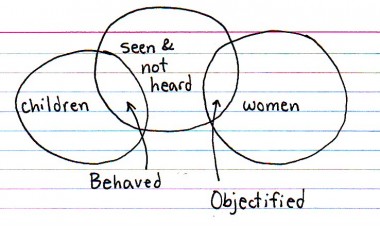
Via my friend Diana comes this great graphic commentary by indexed

Venn diagram showing overlapping circles labelled “children” (left), “seen and not heard” (middle), and “women” (right).

The overlaps read: childen + seen and not heard = behaved, and women + seen and not heard = objectified.

The title of the post at Indexed read don’t let anyone shut you up.

monday morning madness: fluid sexuality and marriage equality

16 Monday Aug 2010

Posted by Anna Clutterbuck-Cook in think pieces

≈ 3 Comments

Tags

bigotry, gender and sexuality, human rights, politics

So after a weekend away from my RSS feeds, I finally got around, this morning, to reading conservative columnist Ross Douthat’s second column on why same-sex couples should be excluded from the institution of marriage. Adam Serwer @ The American Prospect offers his take which covers a lot of the bases. And Douthat’s justifications are so convoluted that I’m not going to try and untangle them here.

But as a queer woman in a lesbian relationship, there were a couple of … let’s call them interesting assumptions Douthat makes about fertility, gender, and marriage relationships that I’d like to briefly respond to.

Douthat realizes that he can’t credibly make the claim that marriage should be limited to couples capable of biological reproduction. As Judge Walker observed in the Prop 8 ruling (and as many other advocates of marriage equality have pointed out), being straight doesn’t equal being capable of, or interested in, bearing and raising children. We don’t ask straight couples to undergo fertility testing in advance of issuing marriage licenses. And we don’t enforce any sort of mandate that married couples produce genetically-related offspring.

So there’s that argument off the table.

But Douthat wants to make that argument anyway. So what he does is suggest that it’s not the physical act of bearing and raising biological children that makes hetero marriage particularly worthy of state sanction: instead, it’s the cultural experience of being heterosexual.

The interplay of fertility, reproductive impulses and gender differences in heterosexual relationships is, for want of a better word, “thick.” All straight relationships are intimately affected by this interplay in ways that gay relationships are not. (And I do mean all straight relationships. Because they’ve grown up and fallen in love as heterosexuals, the infertile straight couple will experience their inability to have children very differently than a same-sex couple does. Similarly, even two eighty-nine-year-old straights, falling in love in the nursing home, will be following relational patterns — and carrying baggage, no doubt, after eighty-nine years of heterosexual life! — laid down by the male-female reproductive difference.) This interplay’s existence is what makes it possible to generalize about the particular challenges of heterosexual relationships, and their particular promise as well. And the fact that this interplay determines how and when and whether the vast majority of new human beings come into the world is what makes it possible to argue — not necessarily convincingly, but at least plausibly! — that both state and society have a stronger interest in the mating rituals of heterosexuals than in those of gays and lesbians.

So it’s not about the capacity to reproduce, it’s about “fall[ing] in love as heterosexuals,” and “carrying baggage … after eighty-nine years of heterosexual life” based on “male-female reproductive difference.”

Obviously, there’s levels of wrong going on here, but the points I want to make are these.

1) As a queer woman, I am affected by the sex and gender norms of our (predominantly) heterosexual society. I was born into a world that expects certain things of girls and certain things of boys. In childhood, we aren’t categorized according to sexual orientation (since children are assumed to be nonsexual, or only latently sexual, beings — a topic for a whole different post) but by gender. Girls who aren’t exclusively straight in their sexual attractions nevertheless find themselves on the recieving end of powerful normalizing pressures concerning what girls/women should do, be, want, etc. This includes the pressure to parent. I think, perhaps, Douthat as a straight man might be underestimating the way in which this pressure affects women, particularly, regardless of their sexual orientations. It’s a gender thing, not a sexual orientation thing.

2) Douthat’s understanding of heterosexual vs. homosexual pairings ignores the experience of everyone else. What about equality for folks who experience sexual fluidity, whose attractions change over the course of their lifetimes? What about trans folks whose experience of society’s gender expectations shifts over the course of their lifetimes? For many of us, the idea that one would experience eighty-nine years of either “heterosexual life” or “lesbian life” (check the box that applies to you) is meaningless. We approach our relationships (no matter the gender of the person we’re relating to) as ourselves, as persons whose sum total of experience doesn’t fit neatly into one category or the other. Douthat’s assumptions concerning the differences between straight folks and queer folks is based on the belief that one’s sexual attractions are either always same-sex or always other-sex, and that these attractions are stable throughout life. This is simply not the case for many people (again, particularly women, which once more leads me to wonder how much Douthat is speaking out of his own personal biases rather than any actual research and reflection).

Thus, Douthat’s distinction between the nature of “thick” heterosexual relationships and (“thin”?) queer ones completely falls apart based upon the lived experience of real human beings.

Finally, I want to tackle Douthat’s parting shot: that omg gay marriage will lead to polygamy:

The claim that gay wedlock will lead inexorably to polygamous marriages or incestuous marriages has never been all that credible, because there just isn’t a plausible constituency in the United States (Europe might be another matter) that’s going to start claiming those rights in the way gays are on the verge of claiming the right to marry one another. But it’s still striking how easily the logic of gay marriage can be extended to encompass all kinds of relationships that we definitely don’t want to call marriages.

I am clearly not the constituency Douthat is writing for in his column, because the question I have for him is: “relationships that we definitely don’t want to call marriage”? Who is this “we” you refer to? Please don’t include me in this claim! ‘Cause I refuse, as a queer woman in favor of marriage equality, to scapegoat polyamorous relationships. I don’t need to make poly relationships the Other (or incestuous relationships for that matter) in order to prove that same-sex monogamous couplings should be sanctioned by civil marriage. I’m for consensual, adult relationship commitments being recognized as marriages. Full stop. If that marriage includes more than two adults, then those adults should all be able to enter into the contract of marriage and have that marriage be recognized by our legal system and honored by society. And if that’s what the case for marriage equality portends, I think we should be proud of that inclusivity.

Fear mongering is just not cool, man.

This time around, even more than in his first post-Prop 8 column, Douthat seems to be transparently arguing that heterosexuals are just better, or deserve to be treated with greater respect, than non-heterosexuals. The whole column is a barely-concealed bid to privilege heterosexual marriages simply on the basis of their being heterosexual.

Bigotry: not so cool either.

grown-ups can say "no" too: on consent, touch, and children in public spaces

12 Thursday Aug 2010

Posted by Anna Clutterbuck-Cook in think pieces

≈ 1 Comment

Tags

children, human rights, politics

group hug by celinecelines @ Flickr.com

This post is inspired by a really interesting post/comment thread at The Pursuit of Harpyness about children in public spaces (once again!) and how our behavior toward them and their parents relates to social norms and expectations.

First, some background to the point/observation I want to make.
One of the commenters wrote
, about what was so frustrating about children in public spaces for them,

To give a concrete example, one norm that I find children violate way more than adults has to do with personal space. I really, really don’t like being touched by strangers. Brushing past someone and so on is fine but someone coming up to me and deliberately touching me without my permission is completely not okay with me and generally speaking that syncs with cultural norms so I don’t have to enforce it too much — with *adults*. Children touch people all the time and if I’m in a public space and someone else’s kid starts climbing on me or messing with my things, that’s not okay and it’s ultimately the fault of the parent or caretaker. I don’t feel I should have to explain to a child why they shouldn’t be pulling on my hair. That’s not my job. They need to stop and if their parent won’t stop them, I will, and that’s that.

To which I responded

I do think it’s important to think about how to explain to children that it’s important to ask before touching. Americans are generally schooled to be touch-averse (and above and beyond cultural norms there are people who are personally touch-averse for a variety of reasons) and for children living in American society, it’s important for them to learn that this is a social norm.

Followed by spark, who observed that

I understand that society has evolved so that it’s inappropriate to tell a stranger’s child to stop pulling your hair (baraqiel’s example), but it shouldn’t be. It takes a village etc.

To which I responded

I completely agree with you that it should be acceptable for any person to tell another person (in this case a child) “please stop touching me, it’s making me uncomfortable.” We teach children that they have a right to decline touch that makes them feel uncomfortable and I think it’s perfectly okay for an adult to speak up for themselves in exactly the same way. I see that as showing the child that they (the child) also has permission to determine who touches them and how.

This exchange got me thinking about parents and children — and about women and children especially. About how women are socialized in so many ways to feel that they don’t have the right to bodily autonomy in interpersonal relationships. Especially interpersonal relationships that involve sexual intimacy (rape culture anyone?) and in relationships that involve children. Their own children or anyone else’s. Women — and I realize I’m generalizing here, but the point I’m making is about cultural norms — often feel like the don’t have a right to say no: no to getting pregnant, no to staying pregnant, no to giving birth, no to parenting, no to care-taking. Over and over and over again in our society, women especially are told that these roles are their biological and social destiny.

Consider the example that the commenter, baraqiel, gives: a child coming up to you and somehow invading what you feel is your personal space. And the fact that, somehow, baraqiel feels unable (or at least likely to be socially sanctioned) to tell the child “hey, please don’t touch me.”

We, as a society, try hard (at least in theory!) to teach children that it’s important for them to reject “bad touch,” that they have a right to bodily autonomy and that they can assert that right in public spaces. Negotiating touch is an important skill for all of us to learn, since it’s not an issue that goes away when you become an adult. Young people are far from the only offenders when it comes to different levels of desire for and toleration of interpersonal touch. A society-wide conversation should and could be happening around what it means to physically interact with others, to give and receive informed consent for touch in a variety of everyday situations.

Yet despite this robust discourse (within feminist circles at least) about the importance of consent when it comes to touch, it seems that adults feel powerless to say “no” to children in public spaces. Or defensive and resentful when they are in a position of having to say no. Even when the thing to which they are saying “no” is something which, if done by another adult, they would quite readily say “no” to (i.e. another adult touching their hair uninvited, for example). So the question is: why? Why does it feel so impossible to make a request that a child stop doing something that is freaking you out, invading your space, making you feel uncomfortable in your skin? Why does it seem like the only possible responses are complete inaction or extreme action (i.e. removal of the child from the area completely)?

The more I think about this, the more I see it as an unfortunate, radical extension of the privitization/segregation of children/childhood. The idea that the only “appropriate” adults to interact with a young person in any direct, meaningful way, is the parent or a designated parent-substitute (i.e. teacher, childcare provider). In a pinch. Although even they are often suspect. Children are, in the “normal” course of things, supposed to reside in private, segregated spaces such as homes and schools — not out in the world of every day society. Children, thus, are treated as an Other who because of their segregation need interpretation and mediation — instead of just being in the world, they must be monitored, translated for, guarded, controlled. They have been removed from the human community and set apart — and their introduction into human society is an event, rather than the normal course of business.

As a child not in school during school hours (I did not attend any institution of education until college) I experienced first-hand how upsetting it was to adults that children might move about the world more freely, yet responsibly. You got noticed. And because you were noticed, you were under heightened scrutiny; an oddity.

And because you’re anomalous, you’re treated as an unknown, as Other. Something to be both highly protected/revered and highly suspected/contained. Never just: yourself.

And thus, adults, interacting with these Others somehow feel disempowered: unable to say “no” and also unwilling to say “yes.” (Because who wants to say “yes” when you feel like you’re being coerced, when “yes” is the only option?)

It seems to me like we need a new approach to understanding children in society, a new approach to interacting with these growing, learning beings that fully acknowledges not only their personhood but also our own: that does not require that we interact with them only as two-dimensional caregivers (selflessly giving of ourselves with no ability to set personal boundaries) or keep our distance.

Which really just brings me back to the radical idea that, rather than treating children as a separate species, we treat them as indiividuals who — like many adults! — have specific emotional, physical, or mental needs, but who belong to the human community and can be asked to respect the boundaries of others.

Remember: When you tell a child “that doesn’t feel good to me, please stop” you’re showing them that part of being human is having the ability to set boundaries, to protect yourself. And by expecting them to respect that request teaches them that this is a request you can make that other people have the ability to listen to and respond to that request without the world falling apart. To know that this is an exchange you can have with strangers on the bus, or a grown up at the grocery store (someone who can be polite, yet firm about their needs) is going to help grown them into persons who will, in turn, be able to respect such requests in the future, and make similar requests for themselves.

Giving them the knowledge that they have that agency — the agency to respond to the needs of others with care, and to have their needs met with equal respect — is a powerful feminist act.

← Older posts
Newer posts →
"the past is a wild party; check your preconceptions at the door." ~ Emma Donoghue

Recent Posts

  • medical update 11.11.22
  • medical update 6.4.22
  • medical update 1.16.2022
  • medical update 10.13.2021
  • medical update 8.17.2021

Archives

Categories

Creative Commons License

This work by Anna J. Clutterbuck-Cook is licensed under a Creative Commons Attribution 3.0 Unported License

Meta

  • Create account
  • Log in
  • Entries feed
  • Comments feed
  • WordPress.com

Create a free website or blog at WordPress.com.

  • Subscribe Subscribed
    • the feminist librarian
    • Join 37 other subscribers
    • Already have a WordPress.com account? Log in now.
    • the feminist librarian
    • Subscribe Subscribed
    • Sign up
    • Log in
    • Report this content
    • View site in Reader
    • Manage subscriptions
    • Collapse this bar