• anna j. clutterbuck-cook
  • contact
  • curriculum vitae
  • find me elsewhere
  • marilyn ross memorial book prize

the feminist librarian

the feminist librarian

Author Archives: Anna Clutterbuck-Cook

the trouble with technical undergarments

27 Friday Jun 2008

Posted by Anna Clutterbuck-Cook in media

≈ 1 Comment

Tags

history, humor


Just heard this story from the StoryCorps oral history project on NPR this morning while riding to work on the T. It’s best listened to on the audio, but you can read a partial transcript at the site as well.

More stories like this . . .

18 Wednesday Jun 2008

Posted by Anna Clutterbuck-Cook in think pieces

≈ 3 Comments

Tags

education

. . . and I might just be driven into teaching out of sheer outrage.

Jon Carroll of the San Francisco Chronicle reports in his June 18 column Trauma Techniques:

One day last month, representative of the California Highway Patrol visited classrooms [in Oceanside, CA] to deliver some bad news: Some classmates of theirs had been killed in traffic accidents. Alcohol apparently was involved. The students, as might be expected, were stunned. Many wept. Some screamed. School stopped as people comforted each other.

Then, a few hours later, the administrators announced that it was all a joke. Well, not a joke – it was an educational experience. The administrators had set up the stunt to make the students understand how very sad death is, and how drinking booze and driving is a bad thing. It was something the students will never forget, the administrators said, and oh how true that is.

[. . .] These are professional educators, and they are comfortable with the following pedagogic theory: Trauma is good for kids. It’s an effective teaching tool. Why not teach American literature the same way? Harpoon a real whale and watch it die – “Moby-Dick” brought to life! They’ll remember that.

[. . .]Have we really forgotten our own teenage years? Grief and death and desperate unhappiness were not strangers to us then. Those dark feelings were fueled in part by a sense of powerlessness. So maybe the children of Oceanside thought they were getting a handle on things – bam, the teachers play a joke. Although, as school Superintendent Larry Perondi said, “We did this in earnest. This was not done to be a prankster.”

Oh, like that makes a difference.

There are so many things wrong with this incident (to paraphrase Dianne Wiest from “Parenthood”) that the more I think about it, the angrier I get. Exactly how many adults did this idea get run passed and approved by in order for this school-wide charade to play out? Even in a smallish school, it would take a fair number. That means there are a lot of grown-ups charged with caring for young people who hold a number of insulting assumptions about them beginning with the belief that unless they are put through false suffering children and young people, categorically, don’t understand the reality of suffering and death.

I guarantee you that there were many, many kids in that school who had already lost parents, lost friends, faced life-threatening illness and injury, the violence of war, or other traumas. Teenagers don’t need adults to playact “real life” for them–they’re already living it just like the Big Kids (who in this instance exercised the sort of poor judgment our society often casually attributes to the young).

Instead of achieving their goal of teaching teens about the dangerous consequences of drinking and driving, I’m betting the adults in that high school taught their students never to trust another word that comes out of their teachers’ mouths from now until graduation day.

Just Back from the Berks

16 Monday Jun 2008

Posted by Anna Clutterbuck-Cook in my historian hat

≈ Leave a comment

Tags

history, simmons, travel


Hi all! I flew in to Boston’s Logan airport at 12:10 this morning, after long delays in the Chicago O’Hare airport on my way home from the 14th Annual Berkshire Conference on the History of Women. The conference was at the University of Minnesota (U of M to the locals although to this Michigander that abbreviation only means one thing). It was a beautiful weekend and the campus–which spans the Mississippi River in the twin cities of Minneapolis/St. Paul–was a stunning location, particularly coming as many of us did from the first sweltering heat wave of the East Coast summer. The building on the left is the Weisman Art Museum, designed by (who would have guessed?) architect Frank Gehry, and perched on the high Eastern bank of the river.

I attended a number of awesome roundtable discussions and seminars, including one on the history of childhood and youth (“Childhood as a Useful Category of Historical Analysis”), one on 1970s popular culture and gender, and one on the history of lesbian and gay families in the 20th century. I also got a chance to catch up with my undergraduate adviser, and enjoyed dinner in Dinkytown with my current program adviser. I even managed to wedge in a visit to the campus bookstore!

The conference gave me some good ideas about possible directions in which to take my thesis research–whichever body of primary sources I end up using, I will certainly be focusing on ideas of experimental education and educational theory (pedagogy) in the mid-twentieth century (1960s and 70s). I am interested in the relationship between new educational practices and political movements such as feminism, environmentalism, peace activism, and radicalism on both the left and the right. Home education is, of course, one form of this experimental education. There are some others–including early women’s studies programs and the Oregon Extension program I attended as an undergraduate–that might also provide fruitful material to explore.

As much as I am resistant to formal academic environments, I can’t deny that it is encouraging and exciting to be around such incredible group of (largely women) scholars who are all researching thought-provoking topics in women’s and gender history. I was honored to have the opportunity to absorb their conversations and look forward to a time when I might more actively participate in the same.

A gaggle of goslings

02 Monday Jun 2008

Posted by Anna Clutterbuck-Cook in a sense of place

≈ Leave a comment

Tags

boston, outdoors

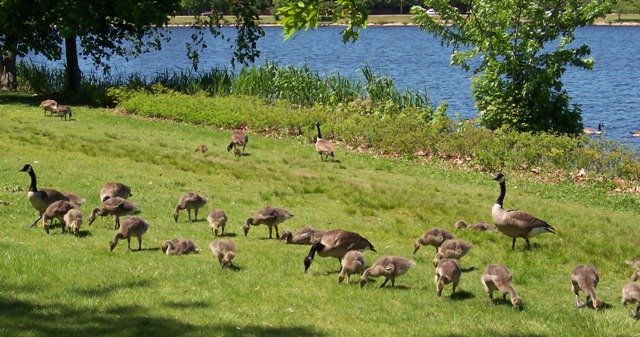
Goslings grow up quickly! Here’s a picture I took last week while out on a walk along the Charles river of a group of geese that look like they’re at least several families worth of goslings hanging out together. Yesterday, Hanna and I saw what looked like the same crowd of them all swimming together in a little inlet . . . I imagine when you have that many geese children all the same age, it’s useful to have other geese parents around to help out!

Now I feel like a Bostonian

30 Friday May 2008

Posted by Anna Clutterbuck-Cook in a sense of place

≈ Leave a comment

Tags

boston, domesticity, humor

As most of you know, I’ve been in the midst of moving out of my Simmons dorm this week, and into an apartment in Allston.* I’m very happy to be done with dorm life, and am already planning meals to cook this weekend!

This morning, I commuted in to work on my new route along with my newest accessory–a hand-me-down mp3 player (not the iPod brand) given to me by Hanna (thanks Hanna!) It even plays NPR! I was very excited. Now I look like all the other Bostonian commuters with their little ear buds in their ears. I guess we’ll all be ready when the aliens come to colonize our brains.

Since my camera and USB cord are lost somewhere in the shuffle of packing, I don’t have any pictures yet of my new digs (it’s all boxes at the point anyway!), so I thought I’d post this MadTV clip instead in honor of my not-iPod mp3 player. Many of you have already seen it (and thanks to Brian and Maggie, of course, who introduced me to it last year), but I showed it to Hanna last night and think it’s still worth a giggle.

More soon . . .

*If anyone who wants/needs my new address hasn’t gotten it, shoot me an email and I’ll gladly provide it. For obvious reasons, I’m not posting it here!

Semester-in-Review: Cataloging

19 Monday May 2008

Posted by Anna Clutterbuck-Cook in library life

≈ Leave a comment

Tags

simmons

Now that the term is over and I’m starting to recover my faculties, I thought I would treat y’all to a taste of the sort of work I was doing over the term. Cataloging (officially known as “Information Organization”), taught by the legendary Candy Schwartz, was a whirlwind introduction to the principles of information organization. One of my favorite segments of the term was actually the final segment, in which we learned how to assign call numbers to books using both the Library of Congress Classification scheme (LCC) and the Dewey Decimal System.

In both systems, you have to find a single way to characterize the nature of the book as you can: what it’s about, what kind of book it is, who it’s by, and so on. In each system, there are complicated rules explaining how you locate and construct the call numbers. We had to practice on lots of pretend titles in each system, and at the very end of the assignment Candy had us assign call numbers to ourselves using both systems. I thought I would walk you through how I created these two call numbers as a way of sharing a little bit about how these systems work.

Both LCC and Dewey are subject-based classification schemes–grouping books about like subjects in the same general area. This is clearly a benefit to browsers, who most often go to the library looking for information on, say, fish breeding. So first, I had to pick a general subject area (an individual person encompasses too many subjects to be classified easily in a single area). I tried to find a subject classification that would capture the dimensions I highlight in this blog (the “feminist librarian-activist” self). In both cases, this turned out to be a women’s studies-type categorization, though the way each system broke down the idea looks a little different.

In the Library of Congress system, you search through the classification index, which is available online to subscribers, for the topic. As many of you probably already know, LC is call number that is made up of a a letter-number combination. In LCC, the “H schedules” are the social sciences, and any number beginning with “HQ” is a topic having to do with “the family, marriage, woman” (’cause, you know, women naturally belong in the same conceptual category as family and marriage). By reading down the table, we construct the following:

HQ (for The Family. Marriage. Woman)
HQ1180 (for Women’s studies. Study and teaching. Research)

Below this general category is

HQ1186.A-Z (alphabetical by region or country, A-Z)

This means we use the letter-number combination (known as a Cutter number, after librarian Charles Cutter) for the geographic region the “book” discusses. I chose the United States as a whole.

HQ1186.U6 (for United States)

Finally, I create a cutter number so that I can alphabetize the book on the shelf by author. This cutter number consists of the first letter of the last name (C), followed by a number from 2-9 that roughly corresponds with the second letter of the name (O).

HQ1186.U6 C7 (by Cook)

So I–or perhaps this blog–could be given the call number of HQ1186.U6 C7, meaning “a resource dealing with women’s studies research and teaching in the United States.”

The Dewey system is similar, but only uses numbers, rather than letter-number combinations, until one reaches the cutter number for authors (again, C7 for Cook). Dewey uses the numbers from 0-999 in groups of 100s (so we talk about “the 100s” or “the 300s” as a unit). The 300s are the social sciences:

300 (Social sciences)

Which are then broken down further,

305 (Social groups)
305.4 (Women)

In Dewey numbers, a decimal point always follows the first three numbers for readability (like the way a phone number, at least in the U.S., is always given in 3-3-4 combination).

305.42 (Social role and status of women)

Since I wanted to specify my interest in feminist history, I added the “09” designation, which is the standard number for “history and geography” that can be added to any subject classification.

305.4209 (for Feminism—history)

At this point in the number construction process, I wanted to specify that this was a book about feminism in the United States. In Dewey, you do this by adding the number for the country (73 for the United States).

305.420973 (for United States)

And finally,

305.420973 C7 (by Cook)

So 305.420973 C7 is a call number meaning “a resource on the history of feminism in the United States.”

While I’m not ready to become a professional cataloger, I have to admit there’s a great deal of satisfaction in puzzling out how to classify and order things (hey, this is the woman who has her personal library arranged by LCC call number). And now, if I ever happen to be turned into a book by a nefarious curse or inadvertent spell, I will have the call numbers to ensure I’m properly shelved.
From the Archives: MHS YouTube Video

16 Friday May 2008

Posted by Anna Clutterbuck-Cook in media

≈ Leave a comment

Tags

history, MHS

The Massachusetts Historical Society (where I work, ahem) was involved in the HBO miniseries based on David McCullough’s biography of John Adams. In conjunction with the television show, we are hosting a small exhibition of correspondence from our extensive collection of Adams family papers. As an experiment, some of the staff put together this short YouTube video, hosted by our head librarian Peter Drummey.

Getting My Legal Fix

15 Thursday May 2008

Posted by Anna Clutterbuck-Cook in think pieces

≈ Leave a comment

Tags

feminism, politics

Last week, when the Michigan Supreme Court upheld the ban on same-sex partner benefits, I was so tired from the end of term I didn’t have the energy to care much (and really, it wasn’t that unexpected). However, this Thursday brings happier news: the California Supreme Court has ruled their own state’s ban on same-sex marriage unconstitutional. The legal junkie in my is having fun perusing some of the coverage. I love it when people (most especially those I agree with!) get snarky in legalese:

Furthermore, the circumstance that the current California statutes assign a different name for the official family relationship of same-sex couples as contrasted with the name for the official family relationship of opposite-sex couples raises constitutional concerns not only under the state constitutional right to marry, but also under the state constitutional equal protection clause. . . the purpose underlying differential treatment of opposite-sex and same-sex couples embodied in California’s current marriage statutes–the interest in retaining the traditional and well-established definition of marriage–cannot properly be viewed as a compelling state interest.

Couldn’t have said it better myself.


Oh, and my favorite legal news story of the week* might be this one:
NPR’s On the Media reported that Scott Bloch, the head of the Office of Special Counsel, whose office was raided this week by the FBI amid allegations of corruption, accused the Bush Administration of “being part of a gay rights conspiracy to persecute him.” Who knew?

(*via the blog Pandagon)

Blockbuster: The Living History Museum

15 Thursday May 2008

Posted by Anna Clutterbuck-Cook in media

≈ Leave a comment

Tags

humor, movies, web video

Courtesy of The Onion

Make Way for Goslings

12 Monday May 2008

Posted by Anna Clutterbuck-Cook in a sense of place

≈ Leave a comment

Tags

boston, outdoors


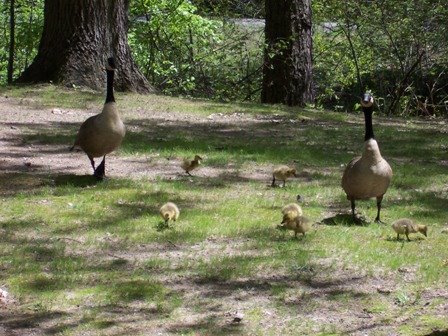
I was walking between the Longwood T stop and North Hall this afternoon, when I happened to spot this family of Canada Geese. Awww . . . .

← Older posts
Newer posts →
"the past is a wild party; check your preconceptions at the door." ~ Emma Donoghue

Recent Posts

  • medical update 11.11.22
  • medical update 6.4.22
  • medical update 1.16.2022
  • medical update 10.13.2021
  • medical update 8.17.2021

Archives

Categories

Creative Commons License

This work by Anna J. Clutterbuck-Cook is licensed under a Creative Commons Attribution 3.0 Unported License

Meta

  • Register
  • Log in
  • Entries feed
  • Comments feed
  • WordPress.com

Blog at WordPress.com.

  • Follow Following
    • the feminist librarian
    • Join 36 other followers
    • Already have a WordPress.com account? Log in now.
    • the feminist librarian
    • Customize
    • Follow Following
    • Sign up
    • Log in
    • Report this content
    • View site in Reader
    • Manage subscriptions
    • Collapse this bar