• anna j. clutterbuck-cook
  • contact
  • curriculum vitae
  • find me elsewhere
  • marilyn ross memorial book prize

the feminist librarian

the feminist librarian

Author Archives: Anna Clutterbuck-Cook

quick hit: babies as mammals

25 Tuesday May 2010

Posted by Anna Clutterbuck-Cook in media

≈ Leave a comment

Tags

children, movies

Via Hanna comes a post from Christine Smallwood @ n+1 about the new documentary Babies, which I posted a trailer for a few months back.

Here are the things that made a theater of moviegoers laugh at a recent screening of Babies:

• Babies suffering, especially sibling-on-sibling violence.

• Tiny Godzilla babies shot from below against a clear blue sky.

• Babies making that face babies make when they poop; also, fart.

• Babies crying. (Note: Babies crying in real life incite terror—what if they cry forever? Audience laughter indicates the faith that crying on film will, before too long—unless the film is a European auteur production—cease. Besides, a baby crying on film presumably stopped crying long ago; a baby crying now must be attended to right now.)

And, hands down, the most popular gag:

• Inter-species slapstick. Including but not limited to: Babies pulling the ears of cats. Babies sticking tiny baby fists into dogs’ mouths. Babies stepping on the faces of baby goats. Babies surrounded by cows. (All related to the previously noted joys of baby suffering, but perhaps more profitably categorized under the rubric of “babies courting danger.” Again, funny on film; not usually funny in real life.)

Smallwood argues that the film is a nature documentary (babies as mammals) rather than a documentary which attempts to tell a human-centered story about what life is actually like for newborn persons around the world. “From whose perspective is Babies made?” she speculates, concluding: “Not the babies. Babies look up from [their mother’s] breast, not across at it. The mother’s face is the object of the baby’s eyes, but the mother’s face is just what the camera hides, again and again.”

In other words, the film apparently attempts to isolate the babies themselves from the world of human relationships in which those children exist so inextricably (and which practically the sole job of infants is to learn how to navigate successfully themselves, since their lives literally depend up them).

Still, I’m intrigued by the film enough that I’ll likely see it on DVD eventually, if not in the theater (independent theater ticket prices here in Boston are through the roof!).

Go read the whole review at n+1.

multimedia monday: earth days

24 Monday May 2010

Posted by Anna Clutterbuck-Cook in media

≈ Leave a comment

Tags

holidays, multimedia monday, politics, thesis

Back in April, Hanna was kind enough to set up the mystical VCR to tape the PBS American Experience documentary on Earth Day, eponymously titled Earth Days so I could watch it as sociopolitical background for my thesis.

You can watch the entire film online at the American Experience website, where they have also made a full transcript available.

I thought they did a particularly thoughtful job selecting the requisite talking heads, choosing a wide range of folks involve in environmental policy and activism from the 1960s through to the present. What I found most fascinating was the way in which environmental activism in the early days (prior to the Reagan administration) was not a strictly partisan issue — controversial in some aspects, yes, but not seen as a Democratic cause (or a Republican cause for that matter).

The most striking part of the film, for me, was the section in which they discuss the commitment brought by the Carter administration to environmental sustainability in the late Seventies, galvanized in part by stagflation and the fuel crisis — and then the Reagan administration’s reversal of all, and more, of the previous decade’s worth of progress toward a more environmentally-friendly America.

Denis Hayes, The Organizer: [Carter] had solar water heaters installed on the White House roof.

President Jimmy Carter (archival): A generation from now, this solar water heater can either be a curiosity, a museum piece, an example of a road not taken, or it can be a small part of one of the greatest ventures ever undertaken by the American people.

Denis Hayes, The Organizer: He gave me the best job of my life running the Federal Solar Energy Research Institute and a budget that increased and doubled every year that I was there and the opportunity to really do some important things.

President Jimmy Carter (archival): The energy crisis has not yet overwhelmed us, but it will if we do not act quickly. It is a problem that we will not be able to solve in the next few years; it is likely to get progressively worse through the rest of this century. We must not be selfish or timid, if we hope to have a decent world for our children and our grandchildren. We simply must balance our demand for energy with our rapidly shrinking resources. By acting now, we can control our future rather than letting the future control us.

Hunter Lovins, The Motivator: Carter, I think, made a fundamental mistake, which was he saw the transition as one of constraint and of one of privation, and of giving up, and of lowered lifestyle.

Denis Hayes, The Organizer: In a period from 1973 to 1980 the price of oil went from $4 a barrel to $30 a barrel. And that clearly was enough to cause the public to support things like fuel efficiency standards for automobiles and other things that would have been inconceivable unless you’d had a crisis.

* * *

Ronald Reagan, Presidential Candidate (archival): They tell us we must learn to live with less, and teach our children that their lives will be less full and prosperous than ours have been, that the America of the coming years will be a place where because of our past excesses, it will be impossible to dream and make those dreams come true. I don’t believe that and I don’t believe you do either. That’s why I am seeking the Presidency. I cannot and will not stand by and see this great country destroy itself. Our leaders attempt to blame their failures on circumstances beyond their control, on false estimates by unknown, unidentifiable experts, who rewrite modern history in an attempt to convince us our high standard of living, a result of thrift and hard work, is somehow selfish extravagance, which we must renounce as we join in sharing scarcity.

* * *

Denis Hayes, The Organizer: For reasons that I just cannot even begin to comprehend, Reagan did his very best to completely shut down the renewable energy effort. In the instance of the institute that I led, he reduced our budget by more the 80%, fired half of the staff and fired all of our contractors, two of whom subsequently went on to win Nobel Prizes. It was just devastating, but for one year we did have within an element a very good energy policy.

Ronald Reagan, Public Service Announcement (archival): It’s morning again in America. And under the leadership of President Reagan our country is prouder, and stronger and better. Why would we ever want to return to the way we were?

Reporter (voice over, archival): The Reagan White House has finally dismantled the last vestiges of the Carter Administration. Workmen have now taken down the solar water heating system installed on the White House roof in 1979.

I highly recommend watching some or all of Earth Days, since (at least for those of us who barely remember the Reagan era, let alone the 1960s and 70s) it gives us a chance to re-imagine the public discourse surrounding environmental issues in ways that don’t lock us into partisan divides — gives us a chance to imagine a time in the not so distant past (and hopefully in the not so distant future) when there was more emphasis on the fact that we’re all in this together, as human beings on a living planet, and partisanship aside sustainability is really the only way forward if care to have a “forward” to be moving toward at all.

sunday smut: links on sex and gender (no. 23)

23 Sunday May 2010

Posted by Anna Clutterbuck-Cook in linkspam

≈ 1 Comment

Tags

gender and sexuality, sunday smut

First up, several posts this week on Sarah Palin’s increased us of the F-word (“feminist,” sadly, not “fuck”)

Tracy Clark-Flory @ Salon tackles the debate ’round the blogosphere about whether Palin deserves to self-identify as such (or whether anyone has the right to judge her worthy or unworthy of it).

Brittany Shoot @ Women’s Rights Blog asks whether “conservative feminist” is an oxymoron, while Michael Tomaskey @ The Guardian describes the use of Susan B. Anthony as a conservative, anti-choice feminist icon.

And via my friend and fellow dual-degree student Colleen comes Janine Giordano @ Religion in American History on the competing collective memories and historical interpretations of Susan B. Anthony’s legacy. “We’re not used to sharing the narrative authority of the history of feminism, or interpretation of the historical record, with ‘conservative feminists.’ But I say we should be happy — in a way — that social history has finally begun to empower social movements outside of the academy.”

It’s not just a question of people arguing over who can or cannot claim the identity “feminist” (my two-second opinion: you get to claim whatever identity you want, but by the same token, I get to say why I do or don’t believe you fit the description). There are, of course, many women (not just Phyllis Schlafly!) who fight tooth and nail to undo the political and cultural work of feminist activists — often in the name of their own enlightened status. Amanda Marcotte @ Pandagon points to the example of columnist Maureen Dowd, who was recently full of faux concern about Supreme Court nominee Elena Kagan’s state of singledom.

Her disingenuous final paragraph really puts the cherry on the mean girl sundae:

Why is there this underlying assumption that Kagan has missed the boat?

I don’t know. It probably has something to do with you perpetuating the narrative. If you don’t like the story of how women can conquer mountains but are nothing without a man, then stop telling that story.

Similarly, Andi Zeisler @ Bitch Blogs nominates writer Caitlin Flanagan for the first ever Bitch Douchebag Decree “All-Star” award, writing

If there’s one thing Flanagan can really type some words on, besides how she hates feminism and how her mommy abandoned her, it’s teen girls and blowjobs. She’s heard a lot of stuff about how teens these days are having hookups and orgies and rainbow parties all over the place. But since Flanagan is perpetually arrested in a time of crinolines and sock hops, when all teens were apparently eunuchs, the idea that girls might actually enjoy exploring their sexuality is both logistically inconvenient and philosophically abhorrent to her.

A nun in Arizona was excommunicated from the Catholic church after making a decision at a Catholic-run hospital that a woman could recieve a life-saving abortion. Nuns can be so frickin’ awesome! The Catholic church hierarchy can be so, so not. Jill @ Feministe meditates on the inhumanity of that decision while David J. Nolan @ RhRealityCheck explains why the decision was actually not in accordance with canon law.

Alexa Kolbi-Molinas (Staff Attorney, ACLU) @ Feministing Community highlights the secular legal issues involved in the case, given that hospitals (religiously-affiliated or not) are required by law in the United States to provide life-saving care.

Not that Arizona isn’t already on a right bender, now that everyone who looks foreign in origin (read: not white) is required to carry identification papers and ethnic studies have been banned. Miriam @ Feministing has more, as does Brittnay Shoot @ Women’s Rights Blog who asks, “when they get rid of ethnic studies is women’s studies next?“

Amanda Marcotte @ Pandagon reports, however, that the future might be brighter than it looks at the moment: young white people care less frightened of immigration than their elders.

People are often spend a whole lot of time and energy criticizing other folks’ sex lives. Thomas Rogers @ Salon writes about Czech twins who are lovers and controversial porn stars, asking what about “twincest” pushes peoples’ buttons and why they can’t stop watching anyway. From Greta Christina @ The Blowfish Blog asks “is it possible to critique rough-sex porn without marginalizing kink?” and Charlie @ Charlie Glickman challenges the sex-positive community to think about the difference between shame, arrogance, and pride.

Young people (girls in particular) are certainly not exempt when it comes to the sex-obsessed gaze of society, and Amanda Hess @ The Sexist muses about the recent outcry over a viral internet video featuring young girls dancing in sexually suggestive ways. She discusses a similar theme when it comes to media coverage of Miss USA pagent winner Rima Fakih.

Sarah Menkedick @ Women’s Rights Blog points out how the Miss USA pagent coverage ties sexism and racism together in a neat package consisting of “a little racism, a little islamophobia, a little hating on immigrants, a little hypocritical outrage at beauty pageant participants who’ve gotten a bit too sexy.” In other words, Miss USA, in a nutshell.

Melissa McEwan @ The Guardian calls out the policing of women’s sexual selves in a slightly different vein, writing about the media coverage of recent allegations by Charlotte Lewis that she, too, was sexually assaulted by director Roman Polanski.

Harris’s concentrated effort to undermine Lewis’s credibility by casting doubt on her character, motives, and integrity is a textbook example of the sort of hostile reception any survivor of sexual assault can expect to receive when coming forward about the crime, no less when the accuser must point a finger at a famous man with powerful friends.

There are those who question why Lewis waited to come forward for so long. Reading Harris’s attack on behalf of his friend Polanski, is it really any wonder why?

The UK is debating whether or not to protect the identity of those accused of sexual assault (victims are already protected by anonymity laws in Britain). Cara @ The Curvature argues that this further perpetuates the myth that false accusations of rape are statistically more likely than false accusations in any other type of crime, and Cruella @ Cruella-blog gives one example of how reporting allegations in the media helped uncover at least on serial rapist’s activities when other victims came forward.

Someone who has been disproportionately in the public eye lately has been, of course, Supreme Court nominee Elena Kagan. My legal junkie crush Dahlia Lithwick @ Slate suggests that the anxious questions being asked about Kagan say more about the fears we have for ourselves than they do about her ability to perform the role of Justice. (Bonus points if you can name the movie the quote she uses as a headline is from).

Brittany Shoot @ Women’s Rights Blog (she either had a busy week or we have super-similar taste in news stories!) brings up another issue with the Kagan coverage: Elena Kagan is Childfree. Get Over It.

And finally, for your feel-good story of the week: Jesus Would Have Gone to Gay Weddings. Michael A. Jones @ The Gay Right’s Blog reports on a group of Catholic priests who are making waves by arguing that Jesus wasn’t a screaming homophobe afterall. That in fact, you know, he might have been cool with the whole same-sex marriage thing. As long as he was put in charge of the wine.

*image credit: Modern Painting of Kiss by Beyond Dreaming @ Flickr.com

PSA: Diplomas are Tools of Satan!!!

22 Saturday May 2010

Posted by Anna Clutterbuck-Cook in media

≈ Leave a comment

Tags

education, humor, photos

Via Hanna comes this awesome sign from the blog Engrish Funny.

Sign reading:

The text on the sign reads:

Diploma Is A Tool of Satan
Diplomas and academic status are Satan’s tools of oppression
To obtain them, students have come slaves to the education systems of the human kingdoms
We are honorable children of God
We need not subject ourselves to their system
….. being affirmed by God.

Thank you all for reading and enjoy your Saturday!

Quick Hit: "Catholic Exodus"

21 Friday May 2010

Posted by Anna Clutterbuck-Cook in linkspam

≈ Leave a comment

Tags

blogging, boston, history, MHS

I have a lunch talk recap up over at the MHS blog (The Beehive), sharing some of the highlight’s from Alex Goldfeld‘s talk last Friday on the history of Catholics in Boston’s North End neighborhood, and specifically an 1859 incident at the Eliot School over whether Catholic students should be compelled to say Protestant prayers.

Goldfeld argues that this incident and the political rhetoric surrounding it on both sides raised questions about the place of religion in the school system and the role of public schools in the assimilation of immigrants that still have echoes in modern-day debates.

Those of you who are interested can hop on over to The Beehive to read the rest.

arbiters of the appropriate? more on kids and public space

20 Thursday May 2010

Posted by Anna Clutterbuck-Cook in think pieces

≈ 3 Comments

Tags

bigotry, children, politics

Irrational Point @ Modus dopens has a great addition to the conversation about why saying you “hate children” is problematic, and why debates about children in public spaces so often miss the mark (on both sides of the chasm!).

She makes a list of thirteen ways she sees people talking about children and/or parents in public spaces that she believes are discriminatory. They’re all worth reading and thinking about as we move through the world (and the internets), but I wanted to highlight a couple of particular ones.

People who think that all fussing, “noisy,” or “socially inappropriate” behaviour is misbehaviour get very little sympathy from me. Children may fuss because they are legitimately upset or uncomfortable. It’s not, like, totally unheard of for adults to raise their voices when they are upset either. Children may be a bit noisy because they have little concept of the noise they make (something which applies to many adults too). Children may display “socially inappropriate” behaviour just because, well they haven’t learned all that stuff yet, what with being little kids and all. Some adults haven’t learned them either.

I think this is particularly important to remember for two reasons.

One is that any one person’s idea of “socially inappropriate,” stopping short of one person attacking another (physically, materially or emotionally) is very subjective. We all have our own options about what kind of behavior crosses the line of what’s public and private. Sure, we can make our opinions known (i.e. “people who talk on their cell phone in the subway drive me crazy!”), and sure we can have conversations about how to share public spaces with others…but assuming we have the right to be the arbiters of what is or is not “appropriate” in public is a huge presumption. IP goes on

Statements of the form “x shouldn’t go out in public if y” make me distinctly uncomfortable because they assume that public spaces somehow belong to the speaker or the speaker’s Kind of People, and they get to decide who uses the public space. No deal. Public spaces get to be used by everybody — the clue is in the word “public.”

Many of the folks who assert their “right” (or at least desire) to be segregated from young people in public spaces are the same folks who speak out stridently against segregation according to race, gender, able-bodiedness and many other ways in which human beings discriminate against each other. I really do hope that we can start moving toward a better understanding of how these debates about where children do and do not belong — and how they should be “controlled” or “behave” when they are there — employ narratives of exclusion (exclusion, I would argue, often based on similar fears of the Other and the desire for social control) strikingly similar to narratives used to justify excluding women from male spaces, men from female spaces, people of color from white spaces and so on.

Which brings me to the second point I want to highlight. Beyond the dangers inherent in trying to arbitrate who does and does not belong in public spaces (you want only people over twenty-one at your wedding? your prerogative), the “I don’t want children in X space” argument is a form of Othering. It moves us away from focusing on a particular human being in a particular situation (whose actions may be an understandable response to situation Y) and instead draws upon our assumptions about children and about how “they” behave in public. The child sobbing in the cart behind you at the grocery store becomes The Child — representing all children, everywhere — who (in our minds) is incapable, simply because they are Child, of behaving “appropriately” (see point one) in public.

As IP points out in comments, musing about the importance of designated quiet spaces (on commuter trains, for example)

When I’ve worked with disabled kids, having a space that’s set aside as a “quiet room” can sometimes be really important. Kids can get too stressed out if there’s lots of noisy shouting and playing, just like adults can. So it’s not like the desire for some quite time is unique to adults, nor is quiet behaviour unique to adults.

The important thing, I think, is not to have entire classes of spaces (eg, restaurants) defined as “quiet” or “for grown-ups”, because that rules out too many people, and isn’t consistent (adults do talk, and laugh and play music in restaurants. Why shouldn’t kids?)

We hear a child screaming and instead of imagining that the child — as one particular human being — may have a good reason for being upset (don’t we all have bad days??) we ascribe the behavior to individual child as a group character trait. We stereotype. And in stereotyping, we lose site of the individual person. We dehumanize. We want this class of thing (Child), which we imagine incapable of any other type of behavior, out of our space where it is disrupting our lives.

And because of this animosity and impulse toward dehumanization on a cultural scale* the child (and by extension, the parents in many cases) cease being able to move through the world as human beings — who have good moments and not-so-good moments, highs and lows — and start bearing the burden of Ambassador for One’s Kind. It’s like being the one guy in a women’s studies class, whom everyone turns to (completely unfairly) for the Male Perspective. Or being the one woman of color. The one queer.

Hey, I’m glad that some people are able and willing to take on this role — and possibly by being a good ambassador help people think twice about their own prejudices and preconceptions. But I don’t think it’s the responsibility of all children and parents to be constantly, 24/7, model citizens.

As IP writes, “People who say ‘I don’t have to want kids…’ are right. You don’t have to want kids. And accommodating kids ain’t the same as saying you have to want to have kids.” Too often, it seems like, this conversation about children in public spaces turns into a mudslinging match over whether or not people who do not wish to be parents or caregivers are lesser human beings, less capable of love and compassion (see my post on the problem with Mother’s Day). People on both “sides” of this supposed dichotomy (“kids are angels” vs. “kids are demons”) fall into this trap. And in my opinion it detracts from the larger human rights issue, which is that children aren’t angels or demons, but simply people with the right to exist in public spaces just like the rest of us.

Sadly, as people have been pointing out in comments over at Modus dopens, all too often these conversations end up devolving into a scrabble for what are (rightly or wrongly) perceived to be precious and limited resources: a quiet park bench, a space on the bus, the attention of a sale’s clerk, right of way on the pavement. As ommenter Ariane writes

I think so much of this subject gets so wound up in the fact that pretty much everyone has been treated very shabbily by someone from a different “camp” at some point. There isn’t a parent who hasn’t been berated unreasonably, there isn’t a person who hasn’t found some other person’s child unbelievably difficult to tolerate, there isn’t a disabled person who hasn’t been treated abysmally, there isn’t a childfree woman who hasn’t been damned for not mothering. It’s so hurtful, it’s really hard not to resent other groups for not copping what you cop, or to remember that they are copping their own tailored abuse.

When we advocates of children’s human rights speak about the importance of treating children as people, often what is heard by skeptical listeners is the message that children and children’s needs are more important than adults (read: more important than them). What skeptics hear instead of “children are people with human rights” is, “children are extra special people who have the right to be the center of attention always and never be asked to treat others with care and compassion.”

I’ve been thinking a lot lately about what to do about this mis-communication. And, to be honest, I’m really not sure there are quick solutions…other than continuing to point out that seeing children as people means being equally critical of both characterizations: the angel-child as well as the demon-child. In my world, there are no “good children” or “bad children”…just “children.”

And, too, I think it’s really, really important to emphasize that the goal is to find a way of sharing our public spaces in a way that enables everyone, as much as possible, to enjoy them, utilize them, move through them — whatever our individual goals are. This is not about taking space away; it should not be about denigrating one set of peoples’ needs in order to elevate another set of people to a position of privilege. The goal is to create a world in which all of us have less occasion to scrabble, feel desperate, freak out, or live in anticipation of being found socially “inappropriate” by another human being.

Some related links:

Irrational Point @ Modus dopens | The whole “I hate kids” thing.

Sybil @ BitchPhD | So, Ok.

Jill @ Feministe | On Hating Kids.

For my own previous posts on this topic, see:

not-so-quick hit: bigotry towards children | 4 may 2010

teaching moment: children are people too | 12 december 2008

children are people: take two | 17 december 2008

and, on a related note, today, I am able | 1 may 2010

*Again: this is not only (or even primarily) about individuals behaving intolerantly toward young people in public, this is about how we as a society talk about children’s presence in public spaces — and how that talk informs how we, as individuals, respond to actual sightings of said children in said public spaces.

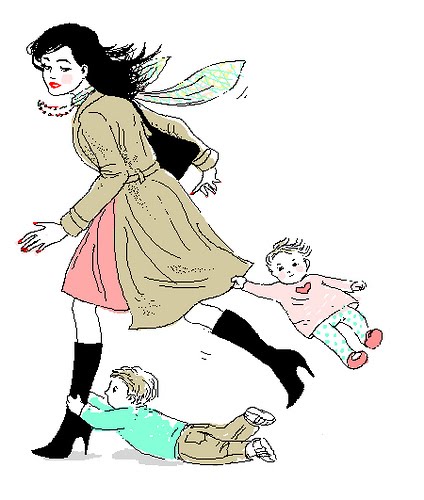
*image credit: mum tries to escape – ELLE # 3, Mar 2010 by pixel endo @ Flickr.com.
from the neighborhood: PSA graffiti

19 Wednesday May 2010

Posted by Anna Clutterbuck-Cook in a sense of place

≈ 2 Comments

Tags

boston, from the neighborhood, photos, random kindness

When Hanna and I arrived at the train station in Lowell a couple of weekends ago, en route to Lunenberg, we happened to spot this helpful message on the side of a traincar.

“Very soon the dead will rise out of their graves.”

I’m not sure if this is meant to be a eschatalogical prediction or a warning about zombie invasion. Either way, I feel the person who painted it with a certain public spiritedness about them.

Possibly, they could have benefitted from the company of whomever offered this bit of advice outside one of the Berklee School of Music buildings near the Massachusetts Historical Society.

“Keep your chin up, old sport.”

un-mother’s day: thoughts on a problematic holiday

18 Tuesday May 2010

Posted by Anna Clutterbuck-Cook in think pieces

≈ 3 Comments

Tags

children, feminism, holidays, politics

There’s a wonderful scene in the British sitcom My Family in which the parents (Ben and Susan) attempt to speak with the parents of a child who is bullying their son. The other parents are having none of it.

“Now we know you think of yourselves as good parents–“ one of them begins to say condescendingly to Ben and Susan.

Susan and Ben look at each other.

“No,” Ben hastily clarifies, “we don’t think of ourselves as good parents. We just think of ourselves as parents.”

It is in that spirit, I offer you the fabulous Anne Lamott @ Salon on why she hates mother’s day

I hate the way the holiday makes all non-mothers, and the daughters of dead mothers, and the mothers of dead or severely damaged children, feel the deepest kind of grief and failure. The non-mothers must sit in their churches, temples, mosques, recovery rooms and pretend to feel good about the day while they are excluded from a holiday that benefits no one but Hallmark and See’s. There is no refuge — not at the horse races, movies, malls, museums. Even the turn-off-your-cellphone announcer is going to open by saying, “Happy Mother’s Day!” You could always hide in a nice seedy bar, I suppose. Or an ER.

* * *

Don’t get me wrong: There were times I could have literally died of love for my son, and I’ve felt stoned on his rich, desperate love for me. But I bristle at the whispered lie that you can know this level of love and self-sacrifice only if you are a parent. We talk about “loving one’s child” as if a child were a mystical unicorn. Ninety-eight percent of American parents secretly feel that if you have not had and raised a child, your capacity for love is somehow diminished. Ninety-eight percent of American parents secretly believe that non-parents cannot possibly know what it is to love unconditionally, to be selfless, to put yourself at risk for the gravest loss. But in my experience, it’s parents who are prone to exhibit terrible self-satisfaction and selfishness, who can raise children as adjuncts, like rooms added on in a remodel. Their children’s value and achievements in the world are reflected glory, necessary for these parents’ self-esteem, and sometimes, for the family’s survival. This is how children’s souls are destroyed.

I encourage you to read the whole piece at Salon.

I’ve written a few blog posts lately about seeing children as people, rather than — as Anne Lamott puts it — “adjuncts” of parental or adult objectives. I believe, as Lamott writes here, that such objectification of young people is destructive to the soul.

But today I’d like to focus — as Lamott does here — on what harm the stories we tell ourselves about parents do to adults. And the particular effect they have on the way we (as a culture) percieve those of us who are (whether by accident or design) not-parents.

And I’ve chosen to use the phrase “not-parents” instead of “childless” or “childfree” deliberately, because I am starting to believe that this narrative of parents vs. not-parents has little to do with children and everything to do with adults. With our cultural assumptions about what it means to be a responsible grown-up human being in the world. I believe it has everything to do with the way adults past a certain age (roughly post-college) are read culturally by those around them, for signs of parent or not-parent status, and judged by a set of cultural assumptions about what it means to lack (or forego) experience of the parenting role.

The assumptions are not pretty.

I’ve become much more aware (often hyperaware) of these constant “non-parent = bad” messages since I’ve been partnered with someone who does not wish to parent. As a child, I wanted to be everyone’s mother: I parented pets, my siblings, my next-door neighbors. I had fantasies about adopting orphans from war-torn Sarajavo, birthing multiple babies I’d hoist on my back and carry with me as I explored the globe. I was an adventurer, a take-charge tomboy (although my parents never employed the word, and bless them didn’t blink when I announced plans to be a princess who was also a lumberjack in the local arts center play) while also being a caretaker and nurturer.

And I was absolutely rewarded, socially, for that behavior. Adults marveled at how “good” I was with children, and trusted me with the responsibility of looking after young ones. I fit the story, so I was slow to challenge it. Plus, my parents have never been pushy with any of us kids about getting married or becoming parents ourselves (thank you Mom and Dad!); I never felt any direct familial pressure to find a partner and somehow acquire offspring for them to grandparent, carry on the family line, or somehow fulfill my destiny as a female-bodied person. But, because I am capable with young people, because I am generally patient with those around me (often to a fault), I can fill that caretaker role people expect of women in the world — even women who are not obviously attached to the children who happen to be in their vicinity. And most of the time, at least on a casual basis, I’m willing.*

So I was sheltered, personally, from the stigma of being a Woman Who Didn’t Want To Be a Mother. But now I see (or at least try to see) the world through Hanna‘s eyes some of the time, and I’ve been thinking a lot more about our culture’s obsession not just with a certain image of young people as Children (to be feared or commodified), but of adults as Parents (who are either “good parents” or “bad parents,” not simply…parents).

Not-parents have no space in this world of Parents and Children. Or rather, their position in the world is analogous to that of the Old Maid in relation to Wife: “life: FAIL.”

I’m speaking here, I want to emphasize, in terms of cultural narratives, not actualities. There have been some amazing not-parents (both women and men) in my life. I will be forever grateful to them for modeling the possibility of having an adult life rich with relationships that does not depend on the role of full-time parent. This is about perceptions and stereotypes, which — although they do not dictate our material realities, do narrow the range of possible stories we have at our disposal when trying to explain our life choices, to ourselves and to others. As Anne Lamott writes: “Ninety-eight percent of American parents secretly feel that if you have not had and raised a child, your capacity for love is somehow diminished.”

I’d argue that many not-parents also believe this about themselves and other not-parents around them, in the same way that women are often each others’ harshest critics when it comes to complying with beauty standards or men punish each other for displays of emotions other than anger. In our culture, to be unaccessorized with children means one is broken in one of the most profound ways a human being can be broken: it means that one’s “capacity for love is somehow diminished.”

Just: NO.

I’m not okay with this story. I am not willing to accept a narrative of humanity that implies my partner — who does not want to be a full-time parent — is somehow broken, that she lacks compassion and the ability to love. It is, quite simply, not true. She has a HUGE heart for the world, sometimes so attuned to its sufferings that I am humbled by her capacity for empathy.

And I’m not okay with a cultural narrative that requires she perform extra cultural work to prove that — despite her decision not to parent — she is, in fact, not broken, not selfish or heartless, or incapable of loving.

These stories we tell each other, which privilege certain relationships and roles over other relationships and roles seems on the surface to be to the advantage of a certain group of people (in this case parents) over another (not-parents), but in the end it only serves to punish all of us for not living up to the ideal Good Parent in the collective imagination, rather than acknowledging that at the end of the day most of us are “just parents,” “just human,” and have at our disposal myriad opportunities to express love and care for others regardless of the kind of relationships with nurture.

Let’s celebrate those qualities, human qualities, that are not contingent on performing certain pre-determined roles (Good Mother, Good Father, Good Child) or being handed certain responsibilities, held to certain expectations, that go with those roles. Let’s instead celebrate the boundless capacity of all of us human beings to engage in loving, nurturing activities throughout our lives.

That’s a celebration I could get behind.

Anne Lamott said it first, and far more eloquently, here.

*As I said in my last post on bigotry towards children, I’m not, at the moment, planning to commit to the full-time parenting thing.

from the neighborhood: sunday in Lunenberg

17 Monday May 2010

Posted by Anna Clutterbuck-Cook in our family

≈ 2 Comments

Tags

domesticity, from the neighborhood, photos

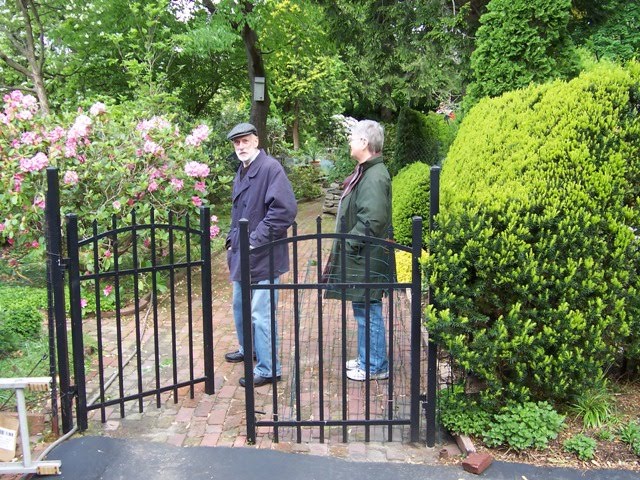
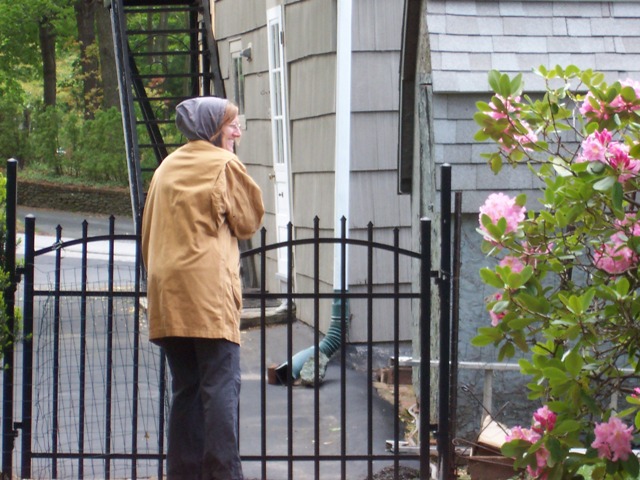
On Mother’s Day, Hanna and I took the train up to Lowell where we met her parents and went visiting in Lunenberg, to the home of a family friend whom Hanna has known all her life.

Estelle served us blueberry muffins and tea and showed us around her gorgeous garden, just beginning to bloom for the summer.

It was a freezing day, despite the sunshine, and I had to borrow one of Linda’s coats to stay warm.

We were sent away with armfuls (literally!) of flowers to leave at Hanna’s grandparents’ graves.

sunday smut: links on sex and gender (no. 22)

16 Sunday May 2010

Posted by Anna Clutterbuck-Cook in linkspam

≈ Leave a comment

Tags

gender and sexuality, sunday smut

Elle @ Sex and the Ivy | Slate: Why is a former sex blogger “rethinking virginity”? ” ‘Rethinking Virginity’ does NOT mean ‘reconsidering virginity’. Not. At. All. I was/am not preaching sexual abstinence (or ANYTHING for that matter). Just, no. Off the bat, let’s get that straight.”

Tracy Clark-Flory @ Salon | Everyone’s an expert in girls’ sex lives. “What’s often lost in the never-ending stream of stories about the latest trend in female sexual culture is the nuance and diversity of individual experience; young women are treated as symbols of the culture at large and spokespeople for their entire generation.”

Amanda Marcotte @ Pandagon | False dichotomies. “The person pushing [the hook-up vs. relationship dichotomy] is trying to imply to women that there is no such thing as a man who can love a woman with sexual experience — and that this can never change, so you have to live with it. Both assertions are wrong.”

Anna North @ Jezebel | Hookups, sex ed, and sparklevamps: Freaking out about teens. “So what’s the solution for these frustrated, allegedly relationship-designed girls? Certainly not actually talking to them. Flanagan scorns the authors of a book on a teen sex party who “centered their attention almost entirely on the perspectives of the students, as though by plumbing the narcissistic reaches of the pubescent mind, one might discover anything beyond the faintest echo of the larger forces that shape adolescent behavior.” Instead, she recommends Testimony, a novel about teen sex by 63-year-old Anita Shreve (“a bona fide grown-up”). “I would encourage every parent of a teenage girl to give her a copy of Testimony,” Flanagan writes — because there’s nothing teenagers like better than older people telling them how they feel.”

Sady Doyle @ The Atlantic | The secret inner life of Laura Bush. “She supports gay marriage; her husband advocated a constitutional amendment banning it. She supports the right to legal abortion; her husband cut off funding to international women’s health clinics that provided it, and appeared to be seriously set on overturning Roe v. Wade. These are human rights issues. And for eight years, she stood more or less silently and idly by….of the many points feminism has made, over the years, one of the more important is that it is inadvisable, and often disastrous, to conceal your own values for the sake of a husband.”

Stephenie Mencimer @ Mother Jones | Why do so many people think Elena Kagan is gay? “You could make a better case that Kagan is simply a celibate workaholic, given the paucity of information that’s leaked out about her personal life thus far…But really, what powerful woman in Washington hasn’t been accused of being a lesbian?”

Anne Bauer @ Salon | My escape from marriage retreat hell. “After a few searches and one furtive cellphone call to a number that only rings, I turn back to John. He’s sitting on the mammoth bed staring out the window, his eyes wide and glassy. ‘There’s no answer,’ I say. ‘I don’t know if they’ll be open at 6. And I don’t dare call the front desk to ask.’ ”

Rachel Hills @ Musings of an Inappropriate Woman | We are all bad feminists, really. “But just because we’re able to make those critiques and ask those questions doesn’t mean we’re not also products of that world…individual women – even feminist women – might continue to engage in behaviours that are oppressive to themselves (or, more problematically, to others), even if on an intellectual level we understand the ways in which our behaviours and desires might have been socially conditioned.”

Greta Christina @ The Blowfish Blog | Why does porn matter? “I think that porn can, and often does, accomplish everything that telling my fantasy accomplished in that consciousness- raising group so many years ago. (Which was, in its own way, a form of porn.) …I think that porn can normalize sex. It can make sex seem more familiar, and less scary. It can remind people that sex is a natural desire, one that all or most of us share. It can remind us that, no matter what our sexual thoughts and desires are, chances are someone else is having them, too.”

Daniel Vivacqua @ Gay Rights Blog (Change.org) | Kristin Chenoweth Defends Straight-for-pay Actors. “Thank you, Miss Chenoweth, for sticking up for us, for being a vocally progressive representative of Christianity, for discouraging closed-mindedness, and for closing by asking Newsweek to publish pieces about, ‘acceptance, love, unity and singing and dancing for all!’ “

Amen. That is all.

*image credit: Hygiene of intimate places, Exklusiv # 80, Sep 2009 by pixel endo @ Flickr.com.
← Older posts
Newer posts →
"the past is a wild party; check your preconceptions at the door." ~ Emma Donoghue

Recent Posts

  • medical update 11.11.22
  • medical update 6.4.22
  • medical update 1.16.2022
  • medical update 10.13.2021
  • medical update 8.17.2021

Archives

Categories

Creative Commons License

This work by Anna J. Clutterbuck-Cook is licensed under a Creative Commons Attribution 3.0 Unported License

Meta

  • Create account
  • Log in
  • Entries feed
  • Comments feed
  • WordPress.com

Create a free website or blog at WordPress.com.

  • Subscribe Subscribed
    • the feminist librarian
    • Join 37 other subscribers
    • Already have a WordPress.com account? Log in now.
    • the feminist librarian
    • Subscribe Subscribed
    • Sign up
    • Log in
    • Report this content
    • View site in Reader
    • Manage subscriptions
    • Collapse this bar