Tags

And for an even more dramatic juxtaposition, here is an 1862 letter from the Goodwin family papers on our Binder Minder copier ready to be photocopied for a researcher unable to visit the Society in person. Talk about oldgasms.

05 Thursday Nov 2009
Posted in a sense of place
Tags
And for an even more dramatic juxtaposition, here is an 1862 letter from the Goodwin family papers on our Binder Minder copier ready to be photocopied for a researcher unable to visit the Society in person. Talk about oldgasms.
04 Wednesday Nov 2009
Posted in book reviews
In my class on archives and collective memory this semester, our final project is a group presentation of one particular case study in how an event or person or activity survives in collective memories over time. My small group chose to focus on female suffrage and the passage of the 19th Amendment. For my portion of the presentation, I am looking at how the American suffragists situated themselves in the context of American history, and subsequently how they moved to consolidate the public memory of suffrage activism in the 1920s and early 1930s.
One of the examples I’ve looked at is the 1927 second volume of history of America, The Rise of American Civilization: The Industrial Era, written by the prolific husband and wife team Charles and Mary Ritter Beard. The Beards’ account of American history was a linear, progressive narrative (as the title suggests); it foregrounded the economic and political contributions of everyday people in contrast to histories that focused on political and social elites. Mary Beard had, herself, been active in the suffrage movement, although she later criticized mid-twentieth-century feminists for focusing too heavily on women’s oppression at the expense of female contributions to “civilization” over the long duree. In The Rise of American Civilization they had the following to say about the push for enfranchisement.
Amid the turbulence connected with this reconstruction in political machinery, woman suffrage was once more brought out of the parlor and the academy, reviving an agitation which, after giving great umbrage to the males of the fuming forties, had died down during the Civil War . . . With a relevancy that could hardly be denied the feminists now asked why the doctrine [of universal suffrage] did not apply to women, only to receive a curt answer from the politicians that sent them flying to the platform to make an appeal to the reasoning of the public at large (562).
This is followed by a description of the state-by-state campaign, the winning of the vote in Western states, and the political tactics of the National Woman Suffrage Association and the National Woman’s Party (go see Iron Jawed Angels). The three-page section ends on the following triumphal note:
In September, 1918, with a congressional election at hand, [President Wilson] went before a joint session of the Senate and the House in person to urge the passage of the national suffrage amendment, yellow with age, as a measure “vital to the winning of the [First World] war.” By June of the following year, the requisite two-thirds vote was assembled and the resolution was sent to the states for ratification. After three-fourths of the commonwealths had approved it, the Nineteenth Amendment was proclaimed in the summer of 1920 a part of the law of the land. The fruit of a hundred years of agitation and social development had finally been garnered.
For the Beards, female suffrage was a naturally-evolving extension of “social development,” a process that extended an ever-increasing body of rights and privileges to Americans. Their worldview seems flawed today, when we harbor deep skepticism about the progressive, linear nature of history and change over time, but I find it noteworthy that they chose to include female suffrage within that picture of social development, however antiquated it may be. I also think it is worth highlighting the Beards’ sense that the battle was won: “the fruit of a hundred years” was now ripe to be plucked by women who chose to exercise their elective franchise. There were activists at the time who challenged this narrow, single-issue concept of turn-of-the-twentieth-century feminist activism — the decision to turn the Nineteenth Amendment into a definitive end point was a deliberate one on the part of Charles and Mary Beard (and it fit well with Mary Beard’s very individualistic notions of women’s power and oppression).
It’s also worth pointing out that there are people today who would agree with the Beards that the right to vote wiped sexism away once and for all, sounding the death knell of feminism (those of use who’ve come after are, as folks so often feel free to inform us, just deluded in our belief that the need for feminist activism remains alive today, nearly a century later). Similarly, there are folks who persist in insinuating (if not outright arguing) that the world might be a better place if women still remained disenfranchised. The suffrage movement might well be the most iconic image of the modern feminist movement, but the ubiquity of its public historical memorializing has hardly brought us to consensus as to its meaning.
03 Tuesday Nov 2009
Posted in a sense of place
Tags

One of the craziest things about working at an institution that’s been around since 1791 (and in its current location since the 1890s) is that old furniture gets put to new twenty-first century uses: this cabinet once used to store the Parkman Papers now houses our staff microwave.
02 Monday Nov 2009
Posted in linkspam
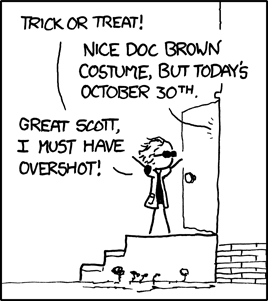 As this posts, I’m somewhere in the air between Michigan and Massachusetts, retracing the route I took last week to visit family and friends. Even though I was vacation, I didn’t entirely tune out the blogosphere. A few things that made it into my Google Reader “share” queue:
The gals at Pursuit of Harpyness point out the importance of the Oxford comma. Are conservative Christians really arguing that “the exclusivity of Christianity as a path to salvation and homosexuality”? Somehow, I think not :)!
However, I don’t think any grammatical errors are responsible for the misinformation about c-sections and (on a lighter note) Halloween candy being bandied about the media; as Stephen Colbert points out, gay marriage appears to be levying a “terrible toll on fact-checking.”
Urban Prankster shares a photograph of a living sculpture project that just makes me imagine lots of blood pooling in lots of heads.
Speaking of heads, here’s a short and helpful college library instructional video on how to print documents at the library while avoiding the zombie horde.
Via Skepchick comes Wondermark’s handy guide to supernatural collective nouns.
My friend Rachel passed on this list of 10 Reasons Why the Quiddich World Cup is the Best College Sporting Event from the Mental Floss blog.
Hope you all had a good Halloween weekend (with lots of appropriately-cursed candy, of course)
*webcomic by xkcd.
01 Sunday Nov 2009
Posted in fandom
With a story from The Onion.
SAN FRANCISCO—After gently unfastening the elastic strap keeping his dearest musings safe from prying eyes, little literary artiste Evan Stansky penned a few more darling thoughts into his clothbound Moleskine notebook Wednesday. “These are much higher quality than the notebooks you find at CVS,” lilted the auteur, who couldn’t be bothered to use—dare it be said—a journal of lesser craftsmanship or pedigree, or one not famously used by such legendary artists as van Gogh and Hemingway. “They’re a little more expensive, but I try to write on both sides so I don’t go through them as quickly.” At press time, the princely scribe was seen finishing his apricot jasmine tea, asking a mere mortal sitting nearby to watch his literary accoutrements, and then prancing off to the Starbucks powder room, light as a feather.
You will most likely not get to read a single word I produce for National Novel Writing Month this year, since now I have woken up to the fact that my possession of dozens of moleskin notebooks means I am vulnerable to satiric lampooning at the slightest whim. But wish me and all the other thousands of participants luck as we forge ahead! I shall report back when it’s all over.
30 Friday Oct 2009
Posted in think pieces
My alma mater, Hope College, has been making minor waves in the news recently due to the administration’s unwillingness to approve an invitation by students to screenwriter Dustin Lance Black (who won an Oscar last year for Milk) to join in a roundtable discussion on human sexuality. Since Hope is a college with strong ties to the Reformed Church in America (RCA), and the denomination — like most Christian denominations — is currently split over the issue of homosexuality, this not really a surprise to anyone who knows the campus: the invitation was bound to be controversial.
 Since the late 1990s (as I was starting to take classes on campus as a teenager), sexuality and gender in the context of Christianity have been a flash point at Hope, much like they are in the wider culture. During the 1998-1999 academic year, when I was taking first-year courses in English and Religion, the campus was rocked by explosive debates over feminism, sexuality, and the place of Christianity in higher education. My own adult political awareness — the decision to identify myself politically as a feminist, and my engagement with the politics of human sexuality — has its roots in that formative adolescent experience. Thankfully, as a seventeen-year-old, I saw faculty, staff (including my own father) and students speak out forcefully against bigotry at the same time that I was witnessing the intolerance that characterizes certain conservative Christian worldviews.
The exhilaration and pain I experienced that school year of 1998-99 profoundly shaped my relationship with Hope: from that point forward, I knew that however supportive and intellectually challenging my professors were (you were awesome, folks!), Hope College as an institution was not interested in championing an open and affirming vision of Christianity or of a broader human community. Because of that, the school has never truly earned my trust or my allegiance. In conversations I’ve had this week with my sister (a current student) and some of her friends, I can see a similar trajectory in the growth of a whole new generation of students.
I know first-hand how painful and personal the politics of these denominational and institutional conflicts can be, and I recognize the powerful sway of conservative donors and the strength of religious convictions — even when I believe those convictions to be theologically misguided and inhumane. It’s complicated, and I’m usually the first to admit that. But damn, Hope. You guys gotta learn. And you really need to quit hiding behind the waffling of the church and the fear of losing donors. ‘Cause you’re sure as hell losing future donors now. Not to mention doing a patently crap job of modeling civil discourse and educated, educative discussion.
How old are we — two? Is it impossible to imagine students having thoughtful conversations about issues they have deep personal convictions or questions about? If they can’t have those conversations on a fucking college campus where can they have them, exactly? Can we please exhibit some mature behavior here and demonstrate that thoughtful people can disagree without chewing each others’ arms off? And can we please, please pause for a moment to consider what sort of message non-conversation is sending? Possibly (shock! horror!) recognize that certain members of the Hope College community, past and present, have felt “hurt and marginalized” by the institutional reluctance to have open conversation? Not talking does not make the scary bad feelings go away. It just puts them (all too often) on the shoulders of people with less political and financial clout. Which is not an unexpected tactic, but still deserves to be called out and identified as the sort of immature abuse of institutional power it is.
I’ve been thinking a lot this week about the folks I know who continue to work and learn in that sort of environment, and I’m sending good vibes their way. I learned ten years ago that I, personally, have limited energy for front-line action in these sorts of political and educational battles. But I deeply respect the people — including many friends and family — who have the guts to keep on speaking up day after day after day in less-than-perfect situations, doing their best to make the next day a little bit better. So thank you all for being there for me, when I was a student, and to all of you — faculty, staff, and students alike — who are continuing to make Hope a place where marginalized folks who are there can, despite the odds, find emotional and intellectual support, and forge a worthwhile learning experience for themselves.
To the folks who didn’t, and aren’t, I realize this probably means little to you, but you are on my shit list and I will see to it in my own behind-the-scenes way that you have as little power to fuck with peoples’ well-being as possible. End of story.
30 Friday Oct 2009
Posted in a sense of place
Tags

My friend and colleague Jeremy refers to this portrait hallway on the third floor of the Massachusetts Historical Society as the “Hogwarts Hallway.” It definitely feels like the portraits are watching you as you make your way through it. I get the feeling that at night, after the building is shut down, the probably take a wander around the other floors to socialize.
29 Thursday Oct 2009
Posted in a sense of place
Tags

This is the first in a series of snapshots I took at the MHS recently, when I happened to have my camera in my bag when I went in to work. (Some of them are a bit blurry or dim, due to not using a flash). This is a shot from the third floor looking down the spiral stair to the reception desk in our first floor lobby.
26 Monday Oct 2009
. . . and choose to share that amusement with all of you.
This morning, I spent several hours on Midwest Airlines aircraft on my journey from Boston to Michigan, during which time I flipped through the complimentary SkyMall catalog provided in my seat pocket — it’s like Sears Roebuck for the 12st century! The sheer randomness and bizarreness of the SkyMall catalog never fails to delight. Here are a few of my favorite from this particular edition.

This young man clearly paused halfway through the conversion to cyberman for a senior-year style photoshoot.
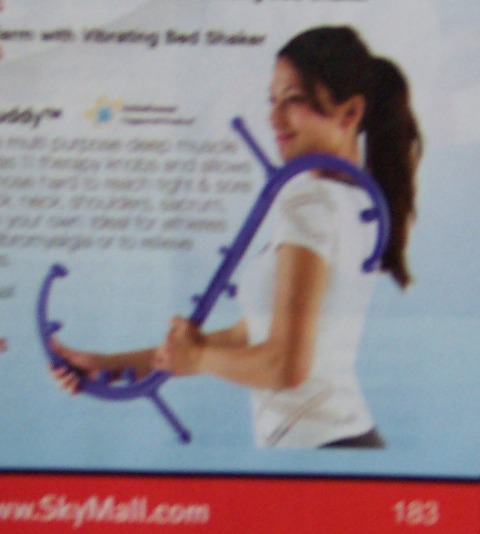
While this item is being sold as a back massager, it is clearly a highly complex sex toy designed for a wild night of orgiastic delight.
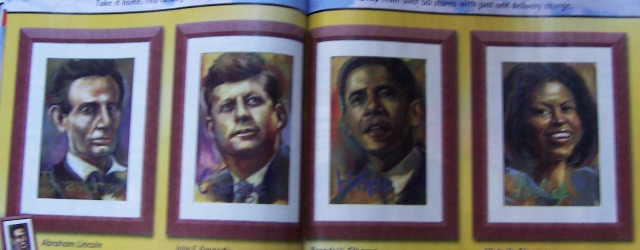
This isn’t exactly hilarious, but since I’m taking a class right now on collective memory, and we’ve talked some about how both Abraham Lincoln and John F. Kennedy have figured in national collective memory over time, I found it interesting that these four images have been selected and placed side by side.
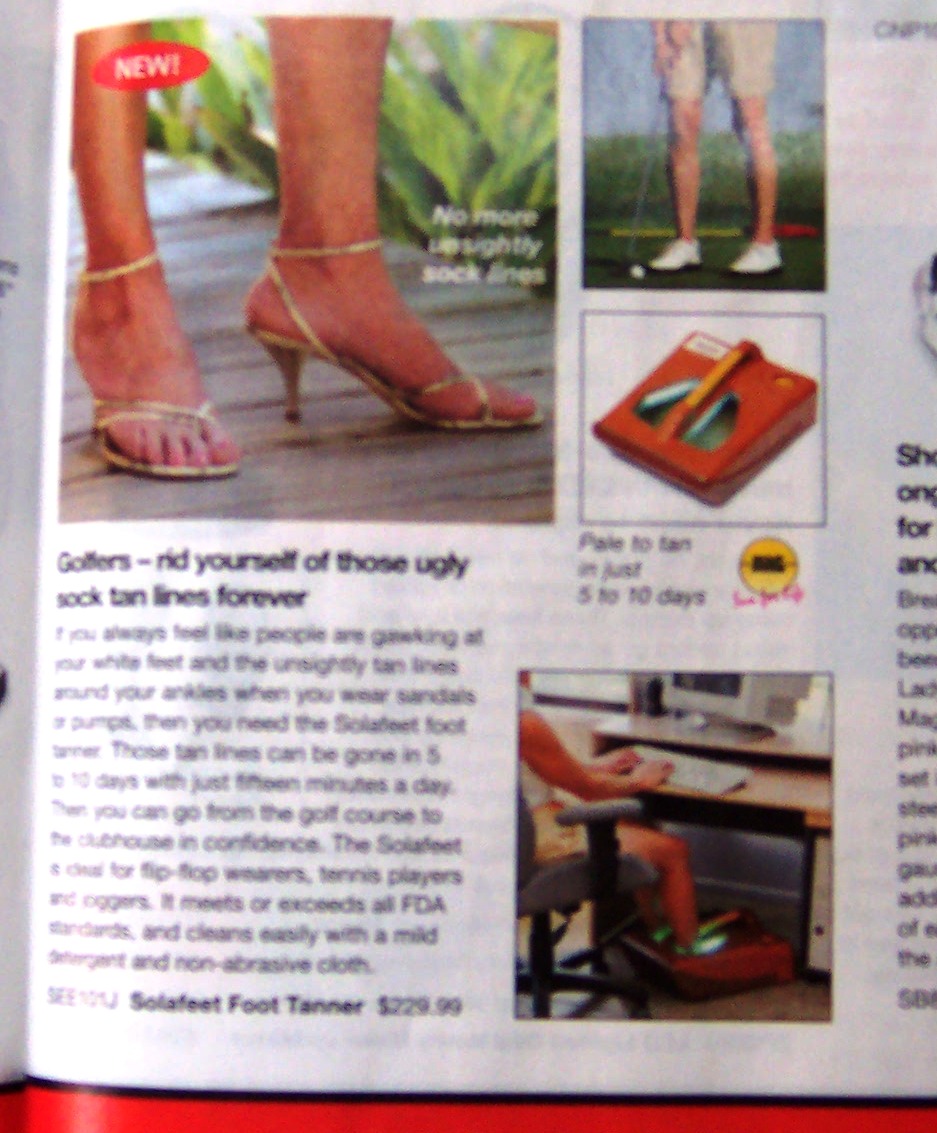
For all of you (I know you are out there!) who worry about unslightly white feet during the summer — worry no more! Thanks to SkyMall, you can order your very own foot-sized tanning bed to make sure your feet are sandle-ready all summer long. (Doesn’t it look like the person’s feet are being melted off in the bottom picture? or is it just me?)
And finally, the creme-de-la-creme . . .
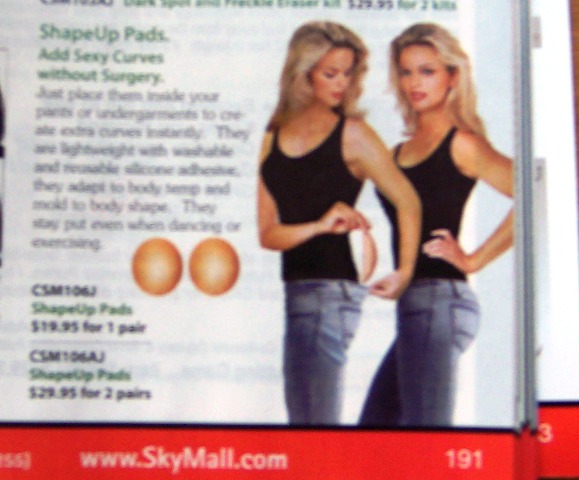
There’s really so much wrong with this particular product that I can’t even begin to do it justice here . . . but let me just point out that I love how the perceived options here are a) a fake, removable ass or b) a fake, surgically-created ass. Not just, you know, your bum au naturale.
Cheerio kiddos; I’ll be checkin’ in as time permits! Now it’s off to cuddle on my parents’ couch with cocoa, cat, and my weekly reading for Collective Memory before the early morning catches up with me.
26 Monday Oct 2009
Posted in linkspam

As this posts, I’ll be in the air somewhere between Boston and Grand Rapids, Michigan, where I’m going for an all-too-brief rendezvous with my parents, youngest sib, a few close friends . . . and of course Toby the cat (see above). Meanwhile, here are a few of the week’s internet finds to keep your brains active!
On a personal note, I’ve been cajoled into participating in National Novel Writing Month (or NaNoWriMo; please repeat seven times fast) in which writers around the globe feverishly churn out prose and log words written with the organization, which tracks the mountain of creative effort expended (no actual skills needed, thankfully, other than the ability to produce a great volume of words — something I have always been fairly adept at). Writing starts November 1st with a goal of 50,000 words (1,666 per day) by the 30th.
Coolest news item of the week: San Francisco now requires composting as well as recycling. While I’m not holding my breath, I’d love to see Boston follow suit!
Least-cool news of the week award is split between the judge in Louisiana who denied a mixed-race couple a marriage license (“I’m not a racist, I just play one on the bench”??) and Jan Moir, the UK columnist, who wrote a truly nasty, homophobic column for the Daily Telegraph and (cool news again) was called out by Stephen Fry, and a record 22,000 others.
Also worth reading was Charlie Brooker’s op-ed in response:
It has been 20 minutes since I’ve read her now-notorious column, and I’m still struggling to absorb the sheer scope of its hateful idiocy. It’s like gazing through a horrid little window into an awesome universe of pure blockheaded spite. Spiralling galaxies of ignorance roll majestically against a backdrop of what looks like dark prejudice, dotted hither and thither with winking stars of snide innuendo.
While we’re on the subject of right-wing wackaloonery, commentator Debbie Schlussel recently got all bent out of shape about (of all things) Disney’s re-design of Tinker Bell’s costume, which she claims “masculinizes” the otherwise appropriately-feminine “nymph.” This gave Jeff over at Alas, a blog, a wonderful opportunity to snark.
Maybe Ms. Schlussel would be happier if everyone lived according to the rules of this 1962 marriage manual, helpfully scanned and annotated by Gwen of Sociological Images.
I am probably not a nice person for finding fundamentalist Christians funny as well as scary — chalk it up to necessary self-protection growing up in a conservative area where my childhood friends were convinced I’d end up in hell because I wasn’t baptized. So on that note — and in celebration of Halloween — a church-sponsored book burning (story via Hanna) that will include translations of the bible (wrong translations obviously) and the face of Jesus which has been spotted on a toilet-stall door at an IKEA in Glasgow (via Melissa at Shakesville).
Hanna’s new group blog, paper not included, is still in the planning stages, but until the official launch of the project, let me share a review she wrote recently of David Wellington’s vampire thriller 99 Coffins, the sequel to 13 Bullets (I guess we’re going for a number theme). I can’t comment yet as I’m not finished with 99, but I thought the first one was great and am still rooting for the protagonist halfway through the second.
And before I sign off, two great library- and archives-themed jokes: the definition of “oldgasm” and a great shelf tag from Hanover, New Hampshire (if you don’t get it right away, read the text out loud).
 the feminist librarian