• anna j. clutterbuck-cook
  • contact
  • curriculum vitae
  • find me elsewhere
  • marilyn ross memorial book prize

the feminist librarian

the feminist librarian

Category Archives: library life

from the archives: reflections on month-the-first

03 Thursday Feb 2011

Posted by Anna Clutterbuck-Cook in library life

≈ 1 Comment

Tags

history, MHS

I’ve been in my new position at the Massachusetts Historical Society for about a month now, and things are still a mix of old and new. In part because I’m still part of the library staff, and the substantial (and most important!) part of my job hasn’t changed: I spend my days helping patrons find the stuff that will help meet, in the jargon of the library science world, their “information needs.” You can read about some of the folks we’ve had in this month over at The Beehive (the MHS blog):

Local Researcher Uses MHS to Populate Wikipedia Pages | 2011-01-28

Our Youngest Researcher | 2011-01-14

Alexander Kluger Presents at Brown Bag Lunch | 2011-01-13

Welcome Short-term Fellow Mary Kelley | 2011-01-12

In addition to my regular duties, I am now the coordinator of the image permissions requests that (surprisingly often!) come in from researchers who are seeking to reproduce photographs, artifacts, documents, maps, etc., in their soon-to-be-published books, articles, online websites, and exhibitions. Soon, I’ll be taking on the the citation permissions as well (when folks write simply to quote an unpublished document rather than visually reproduce it).

For the month February, we’re looking forward to welcoming two new staff members onto the library team, part-time library assistants who will be taking on the responsibilities I held as a part-timer myself. We’re looking forward to being fully-staffed again after six weeks of being down two staff members. More to come as the adventure continues!

changes afoot in jobland (part two): on being employed

18 Saturday Dec 2010

Posted by Anna Clutterbuck-Cook in library life

≈ 2 Comments

Tags

domesticity, human rights, MHS, work-life balance

Massachusetts Historical Society
(December 2008)

This is the promised part two of my post on being hired as the Assistant Reference Librarian at the Massachusetts Historical Society.

Being hired for a modestly-renumerated full-time professional position straight out of graduate school during a recession (one in which there has been a much-reported-on “jobless” recovery no less), and being hired for that job while surrounded by many other fellow graduates and friends who are struggling on the hellish job market was a sobering experience.

Because that’s the sort of person I am. It’s incredibly, incredibly painful for me to accept opportunities that come my way when those opportunities are being offered conditionally. When those opportunities are offered supposedly on merit, due to some particular alchemy of my personal character or skills; when what I am being given — in short — is not being given to others.

I read somewhere recently that folks on the liberal end of the spectrum tend to have personalities that are “intolerant” of inequality. I laughed when I read that, ’cause I practically break out in hives when I feel like good things are being offered to folks based on some external (and, to my mind, inherently flawed) set of expectations concerning who is deserving and who is not.

We all deserve work that is challenging and rewarding. That exercises our abilities and builds new skills. And that provides materially for us and our families.

The fact that I, currently, have at least an approximation of that — and others, including others close to me — do not makes it really hard to meet the future with joyful expectation.I may have mentioned in my last post Brian Hawkins’ observation about being liberal in America: “Ring a bell and I’ll feel guilty for weeks!”

But guilt is unproductive (thank you Tim Wise), so I’ve been trying to focus instead on what it means to take responsibility for being employed in this particular time and place. And here is an (unfinished, ad hoc) compilation of initial observations.

  • Wage-work is not a privilege to be grateful for, but labor we offer in exchange for material gain. While being employable in today’s economy comes in part through social privilege (for more, see below), I think it’s dangerous to start acting as if wage-work ipso facto is a state for which we should be grateful.  Wage-work is something we do, not something that is given to us. Yet in a recession, it’s really easy to start saying to ourselves that we should be grateful to have a job — any job — and that those who employ us deserve our gratitude for hiring us. When we start to believe we should be grateful, we hurt not only ourselves, but also every person who feels pressured to accept and/or remain in wage-work in which they are exploited.
  • The process of being hired is not (solely) about personal qualifications. Most of us know that, despite idealistic talk about meritocracies, we live in a society in which structural inequalities exist and work (often invisibly) to position some of us to greater material advantage than others regardless of our individual abilities. Do I believe I’m qualified for the position I was hired into? Yes. Yet I am far from the only qualified person out there, and the fact I was hired hinged on a complex set of circumstances. I’ve had a lot of folks congratulate me on my new position with language that suggested I had “earned” the offer, that somehow through my efforts I have been rewarded with this position. I call bullshit on that because people who have valuable skills to offer the world remain un- or underemployed. Once we start talking about employment in the language of who deserves and does not deserve wage-work, whose efforts should or should not be rewarded, we’re supporting a way of understanding employment and economic security in terms of those who are “deserving” and those who are “undeserving.” I will not allow my personal circumstances to be employed in narratives that support that understanding.
  • All of my jobs have been “real” jobs. At least one person has suggested that now I have a “real” job … as opposed to the “fake” wage-work I’ve done since I was about nine and started working as a bagger at the college bookstore? As opposed to the “fantasy” wage-work of delivering newspapers? Working retail? Providing assistance to undergraduates as a teaching assistant? To faculty as a research assistant? As opposed to the reference and processing work I’ve done for the past three years as a library and archival assistant? I think the words were thoughtless rather than intentionally demeaning, but the net result was to imply that all of my colleagues who continue to work part-time, non-salaried, sans benefits, under-compensated positions are somehow not “real” workers. Whose labor does not count. In a capitalist economy that relies on such marginalized sources of labor, implying such work isn’t “real” is beyond insulting. And once again: not okay to be insulting to folks while invoking my name.

So my responsibilities (as I see them) as someone who has a reasonably well-respected and well-renumerated position:

  • To understand that I am granted social privilege by virtue of my position rather than through any personal awesomeness … and do what I can to identify and name that privilege, so that it is not invisible.
  • To respect, not look down upon, those folks who are un- or underemployed; to recognize that no individuals should be reduced to their employment status, and not assume that their employment status is a result of their own personal actions/worth (or lack thereof).
  • To advocate for decent working conditions for all, including myself. To remember that critically assessing my own position as a worker and advocating for change when I believe it is warranted can be part of pushing back against inhumane working conditions more generally.

This probably isn’t anything new for those who cut their political teeth in labor activism, or for those who have spent much more time than I have thinking in terms of class and economic disparity, but labor activism should not stop at the simplistic goal of employment. Rather, it needs to continue critically analyzing the place of wage-work in the economy, and the need for economic endeavors to (ultimately) cycle back to support the well-being of us all.

Put like that it sounds hopelessly idealistic. But I really, I only have this to say in response: Intellect and Romance Over Brute Force and Cynicism.

… 28 days later

10 Friday Dec 2010

Posted by Anna Clutterbuck-Cook in library life

≈ 1 Comment

Tags

art, domesticity, simmons

As this post goes live, I will be executing my final presentation for my final class in fulfillment of the requirements for the Master’s in Library Science degree offered by Simmons Graduate School of Information and Library Science (GSLIS). It’s been an … interesting ride.


by dalekhugger

You can check out all the stuff I’ve written about Simmons over the years on this blog by checking out all the posts tagged simmons (imaginative, I know). Don’t think I have a lot more to say at the moment.

Over the next few weeks, look for updates concerning my history thesis, my new job, and (most important!) my celebratory tattoo, chosen as a way to commemorate my entrance into the community of professional librarians (whom I hear are all about tattoos these days; I look on it as a professional investment).

Meanwhile, Hanna and I plan to meet up with fellow class member Gabrielle tomorrow night at M. J. O’Connor’s for some delicious boxty wedges, fish & chips, and a couple of drinks to toast what, I hope, will be the end-for-a-long-while of my tenure as a formal student.*

*I realise my thesis revision technically counts as part of my academic requirements, but frankly it’s on a whole different plane from coursework. The busywork is over and that’s what matter.

changes afoot in jobland (part one): ms. assistant reference librarian

09 Thursday Dec 2010

Posted by Anna Clutterbuck-Cook in library life

≈ 6 Comments

Tags

MHS, work-life balance

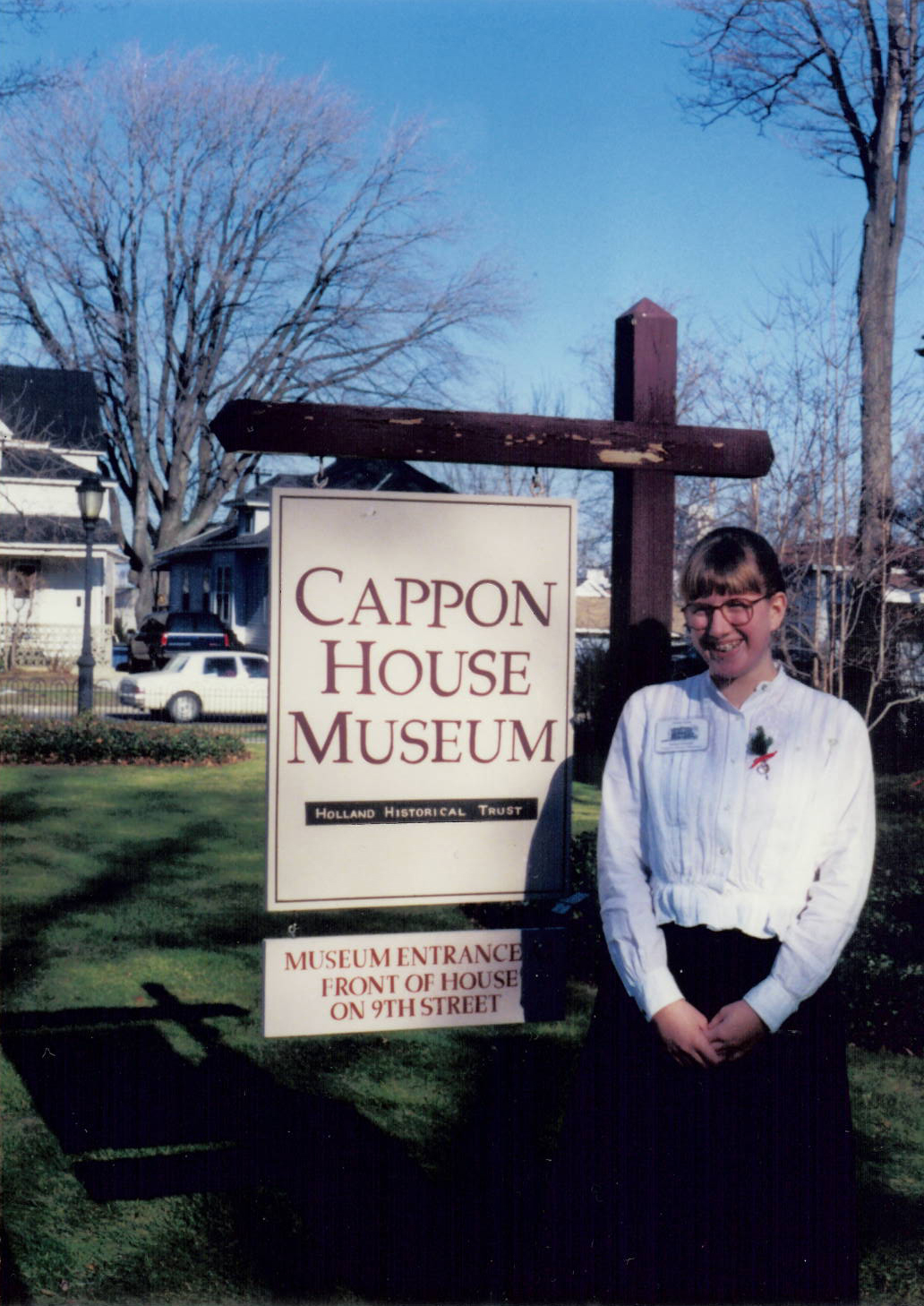
Anna on her first day as a volunteer
circa Fall 1993

Long ago, when I was twelve — almost eighteen years to be exact! — I became the youngest volunteer docent (tour guide) at my hometown’s Cappon House Museum.

Yes, braces, bangs and all.

The Cappon House is the historic home of Holland, Michigan’s first mayor, Isaac Cappon, his first and second wives, and their sixteen children (when I was twelve I loved the bit about the children; today I still do, though for slightly different reasons — lessons in birth control anyone??).  Over the next few years I gave countless tours to senior citizens groups, schoolchildren, and tourists, eventually expanding my responsibilities to include duties at the Holland Museum as well.  By my mid teens I was torn between the childhood desire to become a bookshop owner and novelist or my newfound passion for the field of museum studies and history.

Luckily, I’ve found a way to combine these vocational yearnings of mine: reference librarianship in the world of rare books and manuscript collections.  Most of you are aware that since shortly after moving to Boston in August of 2007 I have worked as part of the Library Reader Services Staff of the Massachusetts Historical Society, an independent research library and (our docents like to inform our visitors) the oldest historical society in the Western Hemisphere, founded in 1791.

For the past three years I’ve worked part-time as a Library Assistant, though my pre-professional status has hardly kept my colleagues from embracing me as part of the team.They’ve been a wonderful group of folks to work with and have contributed to my education as a library student and historian as much as, if not more than, my formal studies.

As of January 1st, the departure of one of those colleagues for a new position at LibraryThing.com is leaving a full-time Assistant Reference Librarian position open which I have been invited to fill. I’m excited to be taking on new responsibilities as well as (hopefully) finding a bit of time to continue developing my knowledge of the collections through the lens of my own particular scholarly interests — watch for a new “object of the month” post in February on the intersection of antifeminism, the red scare, and religion during the 1920s.

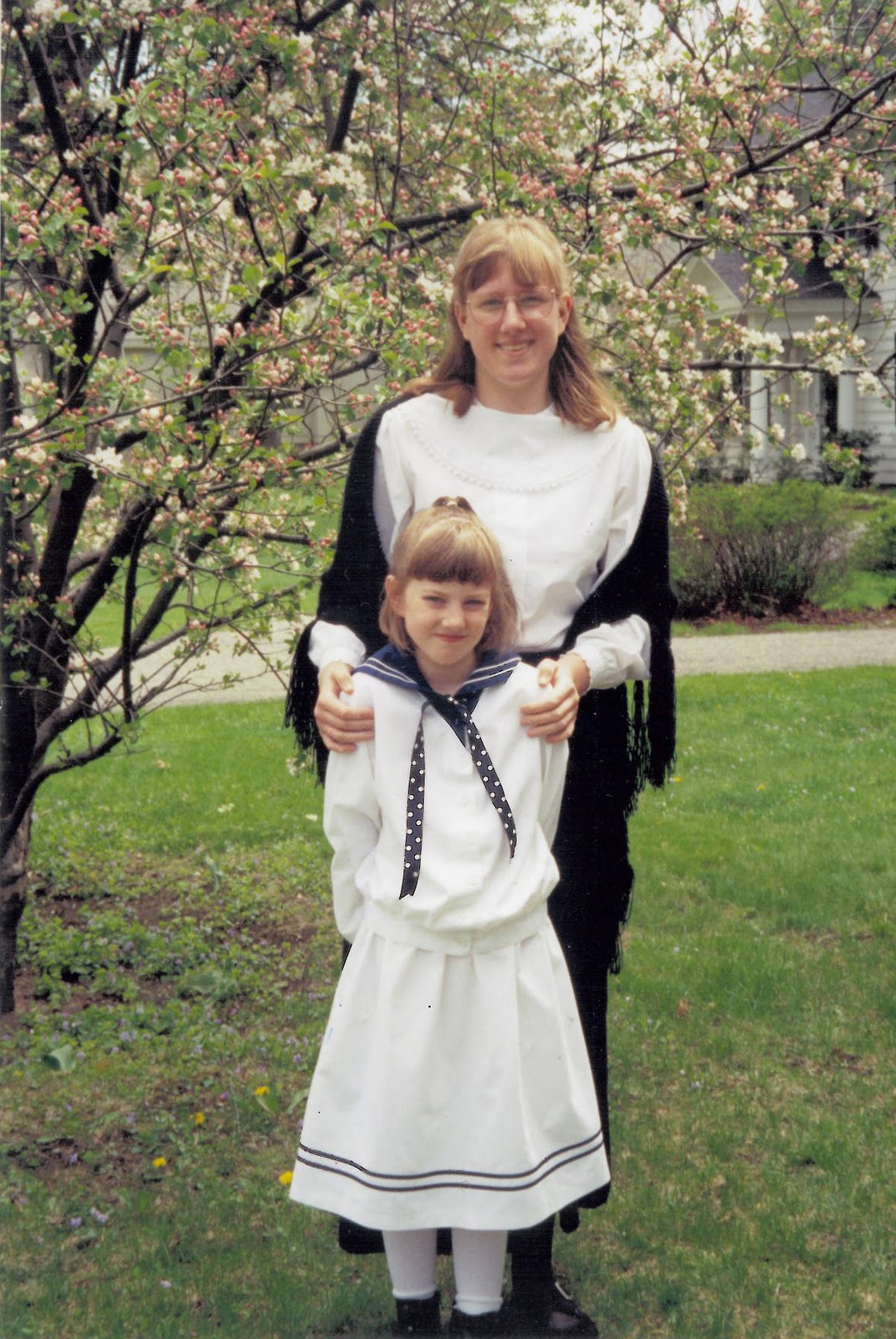
Anna and sister Maggie
circa Spring 1995

Running the risk of sounding like Brian Hawkins in Tales of the City (“Ring a bell and I’ll feel guilty for weeks!”), unexpectedly finding myself offered full-time employment in this economy — when I’d been steeling myself for a long, grueling job search this coming year — leaves me with complicated feelings.  I’m relieved about the financial security, obviously, and excited about the work I’ll be doing. At the same time, I’m acutely aware that many folks with similar resumes and educational background are not in such a privileged position, including many of my fellow graduates from the History/Archives program at Simmons. And I’m not comfortable assuming or accepting that the opportunity I’ve been offered is somehow a one-to-one correlation with my personal accomplishments and abilities. Not that I believe I’m unqualified for the job — I just know many people who are qualified for useful and interesting work are struggling to find it. So look for a “part two” to this blog post in the near future, with some musings about what it means (to me) to be hired during a recession.

In the meantime, long live librarians: the recognized and the unrecognized, the well-rewarded and the under- or unemployed. I am proud to count myself among your number.

from the archives: making archival images accessible online

24 Wednesday Nov 2010

Posted by Anna Clutterbuck-Cook in library life

≈ Leave a comment

Tags

archivists, history, northeastern

Last week, I finally finished the scanning and metadata entry project I began over a year and a half ago at Northeastern: Two photo albums and a scrapbook compiled between the 1890s-1920s by Marjorie Bouvé, a young Boston woman who founded a school of physical education. The photographs and scrapbooks document her adolescence and college education (she attended Bradford Academy and Smith College), and her work as a teacher. Hopefully, hopefully, early in 2011, I’ll be able to link to the interactive database containing all the images and records I created.

Nearly 2,000 of them.

But for now, I thought I’d give you a taste of what it means to create what we in the archives world call “digital surrogates” of archival images. Partly ’cause I think it’s interesting. Partly ’cause I took a phone call from a gentleman this week at the Massachusetts Historical Society who didn’t understand why all our records weren’t just digitized and up online (as our Collections Services director would say: “if you see it online, it wasn’t elves that put it up there!”).

So what does it mean to enter metadata for each digital image we create? Well, here’s a sample record I pulled from the database, which is the metadata (the information about the creation and content of the image) associated with one page of a letter in Marjorie’s scrapbook.  You sill see from the file name that this is the ninth item cataloged from page one of volume four from the Marjorie Bouvé papers (collection M89).


m89_s4p001v009b\.jpg

Item separated from m89_s4p001v005. Item related to m89_s4p001v008.
Letter to members of the Rainy Day Club from M. Anagnos, 20 August 1892.
Aganos, M.
Perkins Institution and Massachusetts Asylum for the Blind
Marjorie Bouvé Papers (M89), Box 1
1892-08-20
2010-10-23
Copyright Northeastern University
Haidt, Marie
3215 x 4073 pixels
7.75 x 10.0 inches
Social Stationary
Boston (Mass.)
South Boston (Mass.)
Correspondence — Massachusetts — Boston
Correspondence — Massachusetts — South Boston
Scrapbooks
Social stationary
Aganos, M.
Bouvé, Marjorie, 1879-1970
Caverly, Edith L.
Eaton, Alice
Kelly, Edith A.
Smith, Lillian
Smith, Marion E.
Wilkins, Christel W. 
Perkins Institution and Massachusetts Asylum for the Blind 
BookEye 3 A1AJC
400dpi2010-07-21
B001927
m89_s4p001v009

This record is in XML (eXtensible Markup Language) and can be read by a variety of web-based display programs (at Northeastern, we use a content management system called Greenstone).The information I enter, and enclose in tags) allows the content management system to display the images and the information about them in a prettier, user-friendly format. See, for example, the images in the Freedom House Collectionwhich Hanna (and a team of others) worked on a few years ago.

Some of the information is generated automatically by Greenstone, but all of the data in the file set you see here was entered by me.  Fingers crossed it all pays off in the end, when y’all get to flip through a digitized version of some pretty cool turn-of-the-twentieth-century pictures and ephemera … all from the comfort of your very own personal computers.

28 days from now …

14 Sunday Nov 2010

Posted by Anna Clutterbuck-Cook in library life

≈ 3 Comments

Tags

simmons

…it’ll be Ms. Future Feminist Librarian-Activist thank you very much!

This post was going to go up yesterday, but a combination of illness, homework, and holiday scheduling conspired against that. So … one day late, here’s what I have to say.

A month from now (Friday, December 10th) I’ll be finishing up my final class in the Simmons College GSLIS program, seven semesters (and one summer class) after I began the program in Fall 2007. In January, if all goes well, I’ll have an officially-conferred Master’s in Library Science. My Master’s in History won’t be complete until May, and yet … this still feels like at least a partial milestone.

I’m sure I’ll have more thoughts about this transition, being the sort of person who always has more thoughts. Mostly, right now I have these preliminary observations.

  • Graduate school did not fundamentally alter my love-hate relationship with institutions of higher learning and formal education in general. If anything, it amplified those feelings, and the tension between them, to an uncomfortable degree.
  • At the same time, graduate school has fairly fundamentally altered my relationship to academic work. In undergrad, I tried as much as possible to take classes for the love of learning, and throw myself with good faith into the content of every course.  In graduate school, I was much more selective about where I directed my energies. The jury is still out on whether one or the other of these is a preferred approach.
  • Librarians, as a group of professionals, are unquestionably awesome 
  • I am less than convinced that library school is the best way to approach training professional librarians.

But for now, I’m looking forward to what comes next, including my first tattoo (details to follow), winter vacation, my thesis revision (yes, I’m daunted, but also excited to pick it up again), and a wee bit more time with my girlfriend.

And now it’s back to work.

from the archive: the "celebrated Regan Water Curtain"

12 Tuesday Oct 2010

Posted by Anna Clutterbuck-Cook in library life

≈ Leave a comment

Tags

archivists, fun, history, northeastern

I’m cataloging images from the Marjorie Bouve scrapbooks this afternoon, and ran across a theater program from Tremont Theatre (Boston, Mass), 1909, which trumpeted themselves as “the safest theatre in Boston,” being equipped with “three celebrated Regan Water Curtains which are positive in their action. Also an asbestos curtain.” Obviously, this required a thirty-second search through Google to find out what, exactly, a “water curtain” might be. The image on the right shows the water curtain in action, as pictured in Public Opinon, vol 29 (January – December 1905).

This technique of fire containment was patented by Chief Regan of the Boston fire department as a method of keeping fires from leaping from building to building and also from destabilizing the front of buildings. As the Public Opinion describes:

The fire department can cope with the average fire when it is no higher than the sixth floor, but above that all that is needed to have a second Baltimore fire is a high wind and an outbreak. Tie fire would leap from building to building, say above the sixth floor, and we should see a long row of buildings in the great financial centers, with all their tops burning and the bottom floors intact. This may be remote, or it may not be, but, as fire insurance men know, it must be figured in the table of insurance rates. The Regan water

curtain is designed to prevent flames from leaping across a street and the front of a building from warping by heat. On the eighth floor and on the fifteenth floor, on the Broadway side of the Manhattan Life Building, 3 1/2-inch pipes were connected with the city water system in the street. The nozzles of the pipe were split into three tiny slots, so that the stream spread into fine spray. This system of pipes stretched across the front wall of the building made a canopy of water, covered the front of the building, and ran off in great streams for a block up and down the curb of Broadway.

So there’s your history tidbit for the day. Don’t you feel more informed?

librarianship =/= dick-waving contest

02 Thursday Sep 2010

Posted by Anna Clutterbuck-Cook in library life

≈ 3 Comments

Tags

economics, education, politics

Okay, so I gripped about this on Twitter, and then because that wasn’t enough thought about posting it on Tumblr. But then the draft of my tumblr post got way longer than I planned so now it’s going to be a bona fide blog post.

one armed man topples a bookcase (sketch)
by curablefury @ Flickr.com

AndyW @ LISNews appears to be surprised that an MLS degree does not exempt him from plebeian tasks such as checking out books to patrons and staffing the reference desk (instead of holding court in private with “people who have actual reference questions”).

On any given day, I can be standing at the circulation desk side-by-side with a support staff member doing the same thing that they are doing. So long as this arrangement exists, the perception that librarianship does not require an advanced degree will continue to taint the image of the profession.

One response to this state of affairs for any individual with critical thinking skills might be to ask “if the tasks of librarianship do not require an advanced degree, then why are we requiring advanced degrees of librarians”? This is, in fact, a question that has already been asked in comments to AndyW’s piece and no doubt will continue to be a subject of debate. (See, for example, my post from May on this very topic).

AndyW doesn’t ask this question, however. He’s pretty clear on the fact that he likes the status his library science degree grants him — or rather, he wishes that his library science degree would give him the sort of status he imagined it would grant him. (Aside from, presumably, his ability to apply for professional positions which are compensated financially above the paraprofessional and nonprofessional level). He wants the whiff of authority. The deference. The aura of mystery, perhaps? And rubbing elbows with the working, uneducated masses just isn’t cutting it.

It is a disservice to the education, to the degree, and to the profession when the bulk of a librarian’s daily tasks could be performed by someone with a GED. It does not take a master’s degree to place a hold on a book, clear a copier, push in chairs, tell people they are being loud, shelve items, or other similar tasks. When librarians are seen doing this and then told there is an advanced degree requirement, there is a reasoning dissonance that occurs in the outside observer.

Because, you see, it’s all about appearance. About the need to ensure that patrons who are using the library (in ever-increasing numbers) understand Andy’s credentials. What sets him apart. That, while he may be assisting his staff in a time of need, such tasks as reshelving or helping patrons find and check out the books they need to meet their information needs (or thirst for pleasure reading) are generally below him.

As a fellow librarian, may I suggest it would be a professional move to spend less time worrying that observers won’t be able to tell you apart from the paraprofessionals and “someone with a GED” (damn those lowly plebes and their ability to work with books!). To insist on the distinction, particularly in such dismissive terms, is insulting to your staff. Staff who presumably, though lacking credentials, are working in a library for a reason (and it’s probably not because it pays incredibly well). It is also insulting to your patrons: is assisting them — even if it’s simply to point them toward the bathroom or unjamb the photocopier — somehow beneath your dignity? Those “observers” whom you imagine are so obsessed with your credentials are probably, in the end, much more interested in whether their information needs are met promptly, knowledgeably and courteously than they are in whether the person meeting those needs has taken a class in Information Organization. As a commenter on the LISNews site suggested rather pointedly, “Staff who aren’t willing to chip in to do ALL the things to make the library a success aren’t professionals – they are just getting a paycheck.” To seek professional respect by denegrating the work of non- and paraprofessionals whose service unarguably enables a library to function is (to put it bluntly) the behavior of an asshole.

Librarianship is not some giant dick-waving (er, degree-waving) contest. An advanced degree is not a magic, respect-demanding bit of psychic paper. It is, arguably, an outdated method by which certain knowledge workers in the late-19th and early 20th century made the case for their work to be given social status. But that’s a blog post for another day.

In the meantime, I mostly want to say: Way to reinforce the kyriarchy, dude. In a totally uncool sort of way.


from the archive: new collections

11 Wednesday Aug 2010

Posted by Anna Clutterbuck-Cook in library life

≈ Leave a comment

Tags

archivists, hanna, northeastern

It’s been a while since I put up a post about the work Hanna and I do during our regular working hours as librarian/archivists at Northeastern, Countway Medical Library, and the Massachusetts Historical Society (we both work independently at Countway and the MHS and then job share a position at Northeastern with one other woman).


Hanna and I have both recently finished processing new collections at Northeastern — “processing” being the archive-speak term for taking newly-acquired collections, organizing them, doing what we can to preserve them, and then making them accessible to the public. For each collection, Northeastern has a “finding aid” that details the scope and content of the collection, and provides some basic historical background on the person or organization.

One of the things I really like about my job at Northeastern is that we actively collect materials from under-represented communities and social justice organizations in the Boston area — specifically the queer community, the Latina/Latino community, Chinese and African-American communities.

Hanna recently completed processing 14 boxes of records from Fenway Health, the community health center where she and I both receive our primary care. The staff there are preternaturally awesome and we suspect that they may come from a race of highly advanced alien beings who have made it their mission to provide high-quality healthcare to the human beings on this woeful little planet that can’t get their act together to make universal healthcare a human right (Doctors Without Interstellar Borders?) You can check out the press release Hanna put together or the finding guide to the records if you’re interested in how these materials are organized and made available for researchers.

My collection was a much more modest two boxes, the papers of Keri Lynn Duran, an AIDS / HIV activist and educator, Keri Duran, who herself was diagnosed with AIDS and died in 1995 at the age of 32, after six years of organizing, protesting and educating. After working with materials that mostly date from the nineteenth-century and earlier at the MHS (although the Historical Society is still actively collecting), it was a little disconcerting to be arranging material from someone whose life and work encompassed such recent events. Her personal journals, I thought, were particularly illuminating in describing her health struggles and her anger about the slow political response as she and her friends were dying. You can read the finding guide online at the NU website.

Even though a lot of the material in both of these collections is widely available to the public now (journal articles on AIDS, public health pamphlets, brochures on artificial insemination, etc.) and may not seem very historically relevant, they are already historical in that they help to document a particular moment in the history of the queer community, in public health care, and activism surrounding AIDS / HIV. And hopefully — if we archivists do our jobs right! — these materials will now be around for decades to come, so that 200+ years down the road (when the events of the 1990s are as far behind us as the events of the Revolutionary War are to us today) these documents will still be here for historians of the future to access and recreate our stories from.

comic of the week

31 Saturday Jul 2010

Posted by Anna Clutterbuck-Cook in library life

≈ Leave a comment

Tags

humor

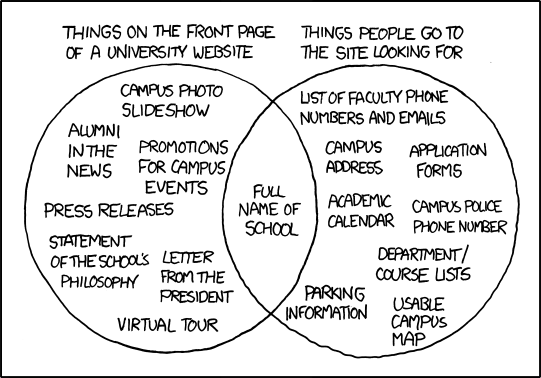
From the always-on-pitch xkcd.


Presented without further comment.

← Older posts
Newer posts →
"the past is a wild party; check your preconceptions at the door." ~ Emma Donoghue

Recent Posts

  • medical update 11.11.22
  • medical update 6.4.22
  • medical update 1.16.2022
  • medical update 10.13.2021
  • medical update 8.17.2021

Archives

Categories

Creative Commons License

This work by Anna J. Clutterbuck-Cook is licensed under a Creative Commons Attribution 3.0 Unported License

Meta

  • Create account
  • Log in
  • Entries feed
  • Comments feed
  • WordPress.com

Blog at WordPress.com.

  • Subscribe Subscribed
    • the feminist librarian
    • Join 37 other subscribers
    • Already have a WordPress.com account? Log in now.
    • the feminist librarian
    • Subscribe Subscribed
    • Sign up
    • Log in
    • Report this content
    • View site in Reader
    • Manage subscriptions
    • Collapse this bar