• anna j. clutterbuck-cook
  • contact
  • curriculum vitae
  • find me elsewhere
  • marilyn ross memorial book prize

the feminist librarian

the feminist librarian

Category Archives: linkspam

sunday smut: links on sex and gender (no. 20)

02 Sunday May 2010

Posted by Anna Clutterbuck-Cook in linkspam

≈ 1 Comment

Tags

gender and sexuality, sunday smut

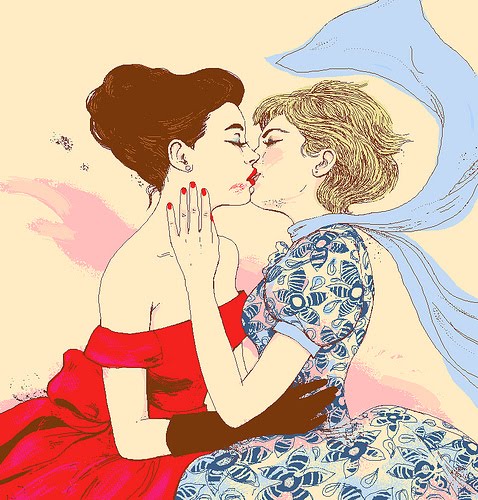
Incidentally, I am totally in love with this illustration (above) . . . I keep searching for nice pictures of women lovers on Flickr and this is the first time a search has actually yielded something I liked well enough to put on the Sunday Smut list. It’s an illustration for an article on lesbians in the Polish magazine Wysokie Obcasy (“High Heels”) which to my mind makes it even more awesome.

Speaking of women getting a little personal, there was a lot of angst this week about women showing emotion publically. Deborah Orr & Anne Perkins @ The Guardian both take women to task for such “feminine” displays of emotion as crying and giggling and sharing personal stories. Orr writes scathlingly of actress Gwyneth Paltrow’s recent disclosure that sometimes she cries at work while Anne Perkins derides female politicians for sharing personal anecdotes and giggling, suggesting “let’s keep the personal out of politics.” Aside from the obvious sexist double standard of equating femaleness with excessive emotion (who decides what’s excessive anyway??) I find it particularly offensive that Perkins co-opts the personal-political dyad of the feminist movement, in effect calling in coded language for the rejection of feminist sensibilities in political spaces. The suggestion that things associated with women are “unserious” is really irresponsible. And stupid to boot. Like me, Whitney Teal @ Women’s Rights Blog objected to this sudden hate on emotion, asking is crying at work so wrong? And in an article on “the art of confession,” Emily Gould @ New York Magazine points out that personal confessions are recieved differently by the public, depending on whether the confessor is male or female

If a woman writes about herself, she’s a narcissist. If a man does the same, he’s describing the human condition. But people seem to evaluate your work based on how much they relate to it, so it’s like, well, who’s the narcissist?

Jill @ Feminist deconstructs the cultural narratives surrounding the publication of Harvard Law School student Stephanie Grace’s racist email, pointing out that

Why should you be able not only to have the freedom to raise whatever issue you want, but also have the privilege to do so without offending anyone? That simply is not how the world works — ideas, as they say, have consequences, and part of the consequences of raising controversial (or idiotic) arguments is that people will become annoyed, angry or offended. I don’t think that people have a right to not be offended, but you also definitely do not have a right to demand that other people accept without emotion whatever ridiculous or hateful argument you make.

I think this story ties in with the story I wrote about earlier this week involving the desire of homophobic petition signers to keep their identity secret for fear they would have to have “uncomfortable conversations” with people who did not share their views. Freedom of speech does not mean you have the right to speak up without anyone disagreeing with you, people! Just like protection from violence and harassment does not equal never having to have a tense conversation about politics. Grow up already, people!*

So possibly, the Washington Times should not be surprised when people get a little, well, emotional in response to an editorial (yes, as in written-by-and-endorsed-by-the-Times) titled “Discrimination Is Necessary: Subjecting Kids to Weirdos Undermines Decency” (I mean, really, can you get any more appallingly bigoted? in a major print publication? wtf?) Via CaitieCat @ Shakeville comes an open letter in response to the editoral which I highly recommend reading: “Let’s talk about the consequences of teaching children that cruelty is acceptable as long as the victim is ‘not normal.'” Another open letter on the subject of transphobia at the national level comes from Autumn Sandeen @ Pandagon who writes about her experience in the hands of law enforcement after being arrested for protesting DADT outside the White House.

Also on the subject of transphobia, and its intersections with other types of bigotry, Kate Borstein @ Out reflects on the outrage over a recently-released film titled Ticked-Off Trannies With Knives, while intersectionality of another sort is the subject of a thoughtful, open-ended discussion between Latoya and Thea @ Racialicious. Not being a fan of any sort of oppression olympics (people who claim “my pain is more exquisite than your pain!” as a way of shutting someone up), I highly recommend the piece, even though it doesn’t offer simple solutions.

Women and breasts were also a popular topic this week, perhaps a side effect of the much-discussed “boobquake” protest? The protest’s originator, Jennifer McCreight @ The Guardian entertained us with what she learned from her quasi-scientific experiment; Amanda Hess @ The Sexist interviewed blogger C.l. Minou (The Second Awakening) about breast augmentation and feminine beauty standards while Rebecca @ The Thang Blog shares a conversation she had with her dad (a civil rights lawyer) about the possibility of getting herself arrested while going topless in public.

Two adoption-related blog posts this week, one from Harriet Jacobs @ Fugitivus, speaking out passionately in defense of her belief that adoption is always the second-best option, and Jill @ Feministe writes in defense of single fathers’ parental rights.

In other “think of the children!” news, Sinclair @Sugarbutch Chronicles shares some thoughts on why sex education is still a radical, controversial act and Margaret Eby @ Salon suggest that, despite hysteria in certain quarters preteen girls are not yet harlots. (Sad! Because “harlot” is an underutilized word).

Hanna Seligson @ The Wall Street Journal reports on the emerging ritual of pre-planned marriage proposals, where couples stage a proposal as if it were a surprise, even though they have had extensive discussions beforehand. I’m gonna admit right up front I don’t understand this: if you want to have an engagement party, awesome! But why stage this fake surprise where the man — and in hetero couples it always seems to be the man — “pops the question” to the woman, and she feigns surprise? Seligson has some intriguing theories, even though I’m not sure I agree with her in the final analysis.

And finally, congrats to Feministing’s founder Jessica and her partner Andrew who are expecting their first child on election day this November. I hope for you a nice, long bubble of privacy as you adjust to being a new iteration of your family together.

*Hanna points out that it is unclear whether the email (and original remarks) were intended to be between friends or sent out to a more public audience — say a study group — and how they ended up being made public. Jill’s point, however, is that having become public for whatever reason, the email is a legitimate subject of debate, as is Ms. Grace’s reasoning re: race and its implications for her legal work.

*image credit: kiss – illustration for an article about sex, Wysokie Obcasy #20 (523) 16 May 2009 made available by pixel endo @ Flickr.com.

reading and gender: a couple of links

26 Monday Apr 2010

Posted by Anna Clutterbuck-Cook in linkspam

≈ Leave a comment

Tags

books, feminism, masculinity

Thanks to Hanna, I have a couple of book-and-gender-related links to share with you this afternoon, despite the fact I haven’t spent much time on the internet in the last few days.

George @ Bookninja shares a recent variation on the narrative-that-won’t-die, the libelous fiction (pun intended) that men don’t read. While admittedly I am not male-bodied, male-identified or even very butch or masculinely inclined, I know guys. And the guys I know read. At least, the guys I know read or don’t read in equal proportion to the women I know who read or don’t read. Their maleness has nothing to do with their interest (or lack thereof) in the printed word.

As an historian, I find it fascinating that our current cultural narrative around books and reading (possibly even writing?) is that it is a feminine pursuit: back in the late 18th century, polemicists fretted about girls being exposed to works of literature, particularly fiction, as fiction was seen as inherently libidinous in nature and might lead them to masturbation (Thomas Laqueur, Solitary Sex). In the 19th century, people worried about the power of a gothic romance to encourage girls’ imprudent liaisons (recall Catherine in Jane Austen’s Northanger Abbey?) and later on feared that too much reading led to neglect of household chores (Lydia Maria Child). By the late 19th and early 20th century, mental exertion (particularly reading and writing) caused concern among advice-givers to both women and men: Charlotte Perkins Gilman was, famously, denied writing and reading as part of her treatment for postpartum depression; male academics and clergymen fretted that their chosen professions doomed them to a life of effeminacy and poor health (Gail Bederman, Manliness & Civilization).

So, somehow, by the twentieth century, “manliness” and the life of the mind had evolved — at least in the humanities (as opposed to the sciences) — into something that was both the province of women as well as a threat to the health of “civilized” human beings, regardless of gender.

And now, today, we have folks wringing their hands over a culture of masculinity that discourages being smart, articulate, literary (except, perhaps, if you can use language to bully others in the manner of public intellectuals like Christopher Hitchens and Richard Dawkins — thus proving your uber-manliness by the way in which you wield language as a weapon with which to take down your opponents*). Whole books are written about encouraging literacy and reading among boys, and websites devoted to the subject exist on the internet.

My point is that this story we tell ourselves, about how boys (and the men who these boys become) are not readers, or only readers of very specific genres — technical manuals, graphic novels, thrillers for example — is just that: a story. It’s fiction. Or at the very least, it’s a sociological truth that we’ve mostly created through our formulation of what’s “manly” in our culture, and reinforcing that every chance we get.**

So where does this association of genders (masculine and feminine) with certain types of literary behavior fit in with this second story Hanna found me from Sharon Bakar @ bibliobibuli on a new “women concept” bookstore that just opened in Malaysia? As Bakar observes

I don’t like the cliched assumptions that women should like certain things whether in terms of decor (usually frilly, flowery pink things) or in the choice of books. The concept of women’s bookshops is nothing new, but around the globe most have been independents which promoted feminist and/or lesbian thought.

I’m with Bakar on this one. Women’s bookstores historically (and here we’re talking 1970s-present) have been associated with the underground feminist/separatist culture that grew up around the surge in feminist activism and lesbian visibility in the mid-twentieth century across the globe (and particularly in the West). These cultural institutions obviously have a long and complicated history, given that they often promoted the work of activists and artists who had no outlet in the mainstream (in my mind a positive) while also, at times, fostering a separatist, essentialist feminism that perpetuates bigotry in various forms (in my mind an obvious negative). While safe(r) spaces for the marginalized folks are, I would argue, absolutely essential, it’s also important to keep alive the conversation about how (in creating those spaces) whom we are excluding and why. And for what purpose.

A “women’s concept store” that — according to the news item Bakar links to — highlights “chick lit” (itself a problematic category!) and wedding stationary is a far cry from that sort of separate space. Space that by its very existence challenged (and occasionally continues to challenge) our assumptions about sex, sexuality, and gender. Instead, this space seems more like the homosocial spaces of yore, which reinforce oppositional gender stereotypes. In this instance, possibly reinforcing the stereotype that bookshops are for women, while dudes go off and do, well, more manly things.

Presumably not-with-books.

*I make no claim that women do not, also, use words to bully: I think it happens all the time. However, I do think men are encouraged in our culture to equate being “smart” with taking down the competition in a way that women, possibly, are not.

**Again, this is a story about guys and reading, but we could just as easily write a story about women and the gendered way they are marketed certain types of literature and not others: I’m a fan of graphic novels, for example, despite the fact that graphic novels and comic books are often seen as the province of boys, and in need of a make-over in order to appeal to girls.

sunday smut: links on sex and gender (no. 19)

25 Sunday Apr 2010

Posted by Anna Clutterbuck-Cook in linkspam

≈ Leave a comment

Tags

gender and sexuality, sunday smut

Just the links this weekend, folks!

Amy Romano @ Science & Sensibility | Why my first year blogging has changed how I see everything.

Ampersand @ Alas, a Blog | If you can’t switch to vegetarian, switch to chicken.

Amanda Hess @ The Sexist | With Great Cleavage Comes Great Responsibility.

Two posts from awesome sex blogger Greta Christina @ The Blowfish Blog | After You, My Dear Alphonse (on why speaking up for what you want in bed is not selfish) and Mis-Matched Libidos: Can Mixed Marriages Ever Work? (on why Dan Savage’s advice to couples with mis-matched libidos is lacking).

Melissa McEwan @ Shakesville | Two Days in the Life of Fatty Fatastrophe (on being shamed by one’s doctor about weight).

Gala @ Gala Darling | xox (on why slut-shaming and virgin-shaming are wrong). Via Spiffy @ Hippyish.

Also on the subject of virgins and whores: J Maureen Henderson @ Bitch Blogs | The Young and The Feckless: Casual Sex Meets Cognitive Dissonance.

Tracy Clark-Flory @ Salon | Viagra for women: The quest for the perfect orgasm.

Nancy Keenan @ Blog for Choice | Nancy Keenan Responds to Newsweek Article on Young Pro-Choice Activists (more on the question of young progressives/liberals/people generally and social responsibility later this week if I can carve out the time).

Annaham @ Tiger Beatdown | LADYPALOOZA PRESENTS! How Amanda Palmer Lost a Fan, or, My Own Private Backlash (more about internet bullying than Amanda Palmer, but don’t click through if you’d rather avoid someone being pissed at Neil Gaiman’s fiancee. just sayin’).

And finally, with amused befuddlement, I offer you Emily Votruba @ n+1 | Is Anal Sex Fair to Women? (complete with helpful comparative chart!)

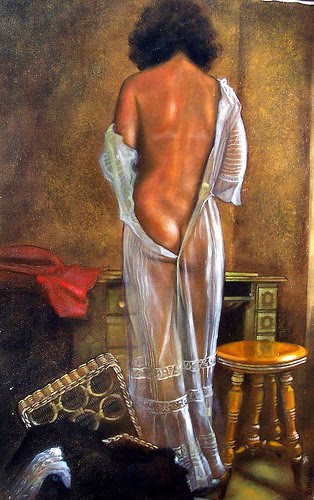
*image credit: Nude sheer by Bruce Mayer made available @ Flickr.com by V-Rider.

sunday smut: links on sex and gender (no. 18)

18 Sunday Apr 2010

Posted by Anna Clutterbuck-Cook in linkspam

≈ Leave a comment

Tags

gender and sexuality, links list, sunday smut


Divisions within sex and gender activism seem to have been in the virtual air this week across the feminist blogosphere. Yesterday, I linked to a few posts [discussing the use of trigger warnings]. That topic definitely took up a lot of bandwidth this week which, depending on how you want to look at it, either provided an opportunity for fruitful debate on the use of such warnings or simply upped the pageview stats of the original controvertista Susannah Breslin @ True/Slant. I’d like to think that even if it did the latter, it also prompted the former to net good effect.

Meanwhile, Ope Bukola @ Racialicious was observing another dust-up in the blogosphere, this time around the question of power and race within feminist activism.

Likewise, a number of blogs on my feeds covered the story of a British clothing chain, Primark, that has pulled padded bras for preteens after an outcry from consumer groups, many of whom took offense at the early “sexualization” of girls. Columnist Laurie Penny @ Guardian (clearly a young writer to watch closely!)argues that this is another misguided attempt by adults to police young peoples’ sexuality.

Padded bras for preteens are not the problem. The problem is a culture of prosthetic, commodified female sexual performance, a culture which morally posturing politicians appear to deem perfectly acceptable as long as it is not ‘premature’. By assuming that sexuality can only ever be imposed upon girl children, campaigns to ‘let girls be girls’ ignore the fact that late capitalism refuses to let women be women – at any age.

While I believe there’s a role for parents to play in creating a safe haven for children and teens to explore their own sexuality at their own pace, at least somewhat sheltered from the media and peer culture, I agree with Penny that yanking consumer products from the shelf is not the best way to do so.

Also at The Guardian, Corinna Ferguson asks “do teenagers have the human right to consensual sexual activity?” In my own opinion, the answer you’re looking for is yes. But, as Ms. Ferguson points out, the legal framework for adolescent consent in the UK is tangled at best.

While we’re on the subject of sex (although it’s hard to escape in these weekly posts for obvious reasons!), rabbitwhite @ sexgenderbody poses another question: what is sex? “As I counted cocks in order to lull myself to sleep, it inevitably got fuzzy. Did that one time in the cab count? Was there actual peen in vag penetration? This seem to stem from protecting the precious hymen, that invisible piece of skin elevated to such importance. That was what mattered right?”

Essin’ Em @ Sexuality Happens, meanwhile, voices frustration at the way physical issues and situational stress have recently lowered her sex drive, frustrating her and her partner, Q, as they struggle to adapt.

Is it any wonder that my sex drive seems to have taken a vacation? No, but it pisses me off.

Why? Because I LIKE sex. In my head, I still want to have it 6-10 times a week like we used to. I see Q, and she’s so hot, so sexy, so much deliciousness and I want her all the time. But physically, my sex drive has gone out the window.

Do we have sex? Yes, although definitely not as frequently, and not for as long of sessions. Do I wish we had more? Again…my head says yesyesyesyesyses, my body say whatever.

Sending good thoughts toward both Ess and Q in hopes that they find some less frustrating solutions soon.

Cara @ The Curvature ponders the importance of consent in everyday situations, not just when it comes to sex. Does it matter when you tell your hairdresser you don’t want shampoo and she goes ahead with the soap anyway, thinking she’s doing you a favor?

Last week, I posted a couple of links to feminist blogs discussing the advent of “male studies” as the Manly answer to the wussy discipline of Men’s Studies. A few more post on the topic for those who enjoy the horror: Amanda Hess @ The Sexist offers some helpful answers to pro-male-studies comments that have come her way since she wrote about the story; Pema Levy @ Women’s Rights Blog points out that for a discipline attempting to exist without reference to other disciplines, male studies seems to have a lot to say about feminism and women’s studies; and frau sally benz @ Feministe suggests 4 Ways NOT to Argue for Male Studies.

On a lighter, though no less amusing, note, guest blogger David Dismore @ Sociological Images offers a fascinating meditation on the rhetoric of suffragist postcards sent out in the early 20th century to secure the pro-suffrage vote.

To the delight of humorless feminist bloggers everywhere, Feministe will be hosting its annual Next Top Troll competition, in which odious, clueless, meanspirited, and often nonsensical comments left on Feministe posts are paraded by in a series of brackets and readers are asked to vote for their favorite troll, with explanations as to what tipped their vote in the comments (often well worth the read!)

And closing on an up note, Pilgrim Soul @ The Pursuit of Harpyness brings us the cheering news that the Obama Administration is moving to enforce hospital visitation rights for folks who wish to designate non-family members as their primary relationships. Obviously this is in part about queer families, but also includes the examples of religious folks who may wish the company of others in their order, or those with no close kin who wish to designate a close friend. Would be nice to see a bit more legal pressure put on institutions to recognize the variety of human relationships that exist in the modern world.

*image credit: gay art… by painting512 @ Flickr.com.

quick hit: feminist cognitive dissonance

13 Tuesday Apr 2010

Posted by Anna Clutterbuck-Cook in linkspam

≈ Leave a comment

Tags

feminism, gender and sexuality, politics

So just last Saturday, I blogged about wrestling with how to live out feminist values in the real world. Then yesterday, Amanda Hess @ The Sexist wrote about what she calls “feminist cognitive dissonance,” or the fact that

a simple awareness of feminist issues can’t magically negate the power of the culture in which we live. Here, validation is still dispensed based on how well you conform to the ideal.

Some of us desire that validation more than others, or need to conform in some places in order to, say, keep our jobs in order to pay rent — while completely disregarding them in others (say in the privacy of our own bedrooms). Complicated shit.

Hess quotes from a piece on the difficulty of giving good sex advice in a fucked up culture.

Nagoski [Hess writes] notes that “most of the time it takes more than normalizing statistics to liberate someone from the burden of fear.” In other words, simple awareness that our cultural ideal has been hoodwinking women into hating ourselves isn’t enough to make us stop. “What can an educator provide? Sadly, most often it’s advice about how to conform more to the cultural lie. Which makes me feel like a fraud,” she writes. “It’s like trying to send the message that weight doesn’t matter, and then giving dieting tips.”

You can check out the rest of the post at The Sexist under the title of Female Orgasms, Skinny Girls, and Feminist Cognitive Dissonance.

sunday smut: links on sex and gender (no. 17)

11 Sunday Apr 2010

Posted by Anna Clutterbuck-Cook in linkspam

≈ 2 Comments

Tags

gender and sexuality, sunday smut

Sunday rolls around once more, and with it fun stuff on sex and gender for your weekend leisure reading!

As I catch up on my reading and put this list together, mostly supervising the reading room at work, the MHS is hosting a conference, Margaret Fuller and Her Circles, in honor of the 200th anniversary of Margaret Fuller’s birth (23 May 1810). In conjunction, we have also mounted an exhibit, “A More Interior Revolution”: Elizabeth Peabody, Margaret Fuller, and the Women of the American Renaissance, open to the public Monday-Saturday, 1-4pm through June 30th. If you’re in the Boston area, come on by and check it out!

Lori @ Feministing offers us an alternate advice column in response to a young woman in Vermont who wrote to Dear Wendy asking what to do about the fact that everyone calls her a slut, and on the way by links to a recent piece by Chloe Angyal @ The Huffington Post reflecting on why media literacy won’t solve the problem of women and girls’ negative body image: “Fashion models, [the girls surveyed believe], are too skinny, unrealistic, and look unhealthy and sick. And yet 48% wish they could look just like them. This is, to state the obvious, a serious problem. It’s one thing to want to be beautiful for beauty’s sake. It’s quite another to want to be unhealthy for beauty’s sake.”

Teen mom celebrity Bristol Palin has recorded an anti-teen-parenthood PSA message that has been criticized by many feminist bloggers (among them Roxann MtJoy @ Women’s Rights Blog) as a message that basically comes across as “only rich, privileged kids like me should have sex.” What I think is fascinating is that Palin is voicing (though in a bizarre, through-the-looking-glass way) what many feminist bloggers have pointed out: that she had a robust support system that enabled her to carry her pregnancy to term and become a teen parent without many of the long-term negative effects that her less-privileged peers can suffer. Yet she rather than speak out for reproductive justice so that all girls and women have the same ability to choose parenthood she did (if they want to), she shames less-privileged girls for having sexual desires and acting on them. No points.

Anat Shenker-Osorio @ RhRealityCheck reflects on the problem with understanding sex (“what bodies are”) and gender (“what bodies do”) as distinct and oppositional categories (male/female) when in reality — biologically as well as culturally — they are often somewhere in the muddled middle. “It’s too long been standard practice to enforce a one-to-one relationship, to dismiss any divergence between sex, gender identity and even sexual orientation as some kind of problematic aberration. In fact, deviation from the mean is an interesting, useful and common aspect of humans in our forms and functions.”

Amy Romano @ Our Bodies, Our Blog writes about the unequal treatment meted out by professional associations, the legal system, and the general public towards midwives and OB/GYNs. While midwives live under constant threat of having their ability to practice curtailed or revoked with the slightest whiff of malpractice, doctors who performed a c-section on a woman who was not pregnant have faced little in the way of professional consequences.

On a similar note, Miriam @ Radical Doula calls our attention to the website “My OB Said WHAT?!?” which encourages women whose care providers (whether nurses, OB/GYNS, or midwives) has said off-the-wall shit to them during prenatal care, labor and delivery, and post-partum care. For example

“The baby can’t do that. You haven’t had a cervix check.” -L&D nurse absentmindedly while reviewing papers, to mother with a history of fast labors, when the mother stated “The baby is coming” 20 minutes after arriving in the hospital. The baby was crowning.

I particularly enjoyed this one because the exact same thing happened to my mother (who also had fast labors) when she went to the hospital to give birth to my brother twenty-six years ago. Like babies and mothers’ bodies somehow wait for the nurses to check all the little boxes in the appropriate order before getting on with things!

Harriet Jacobs @ Fugitivus has a brief post up on what it means to be a “fat acceptance” blog, and I appreciated the way she articulates the difference between telling your own story and judging others.

Do you want to talk about your own body image issues? That is awesome. Do you want to talk about the “obesity epidemic” and how if people would just eat X while dancing in a circle with Y and clapping their hands for Tinkerbell they would win the anti-gravity BMI trophy of HAPPINESS? You don’t get to do that here. Everybody gets to be the size and shape they are, everybody gets to eat how they want here, and nobody here gets to tell them they have to change, or there’s something wrong with them.

I still haven’t formulated a comment policy for my own blog, mostly out of laziness (too little traffic to make it an issue 99% of the time), but when I see stuff like this I realize I should sit down one of these days and really articulate what I believe to be civil discourse. Not pushing your own shit onto others, even (most especially?) strangers on the internet, is definitely one such criteria.

Feminist bloggers the blogosphere over squealed with glee over the news that a group of scholars disappointed in the multifaceted, intersectional gender analysis that is women’s studies, men’s studies, and gender studies, have established a new discipline that they call “male studies.” Tracy Clark-Flory @ Salon describes the group’s position and expresses sadness that their oppositional stance toward feminism could prove counterproductive for thoughtful gender analysis. Sady & Amanda @ Sexist/Tiger Beatdown rap about what this says about the state of gender politics and Amanda Hess (who can’t seem to stop giggling about this) offers some possible names for consideration as appointments to future male studies departments.

In a similar vein, figleaf @ Figleaf’s Real Adult Sex reflects on why anti-feminists are so worried that women’s advancement means men’s downfall. “Summary: A highly-exasperated reflection on the embarrassing, sometimes embarrassingly earnest, anti-feminist belief that if the playing field is leveled men can can’t compete with women.”

And finally, this week, on a thoughtful note, this column passed along to me by Hanna from The Guardian in which Denis Campbell @ The Guardian discusses the complicated ethics of transatlantic surrogacy and adoption. In the words of one couple, “I resent people saying that British couples who resort to surrogacy are buying babies abroad. We didn’t buy Harriet: she’s not picked off a shelf. She’s not a ‘designer baby’.”

*image credit: Snake on a Naked Woman made available by lucy10 @ Flickr.com.

quick hit: america’s earliest sex survey

05 Monday Apr 2010

Posted by Anna Clutterbuck-Cook in linkspam

≈ Leave a comment

Tags

feminism, gender and sexuality, history

The latest issue of the Stanford Magazine (April/May 2010) carries an awesome, thought-provoking article about the earliest-known sex survey that documents the habits and attitudes of American women around the turn of the twentieth century.

In 1973, historian Carl Degler was combing the University archives, gathering research for a book on the history of the family. Sifting through the papers of Dr. Clelia Duel Mosher, who taught in Stanford’s hygiene department around the turn of the 20th century, he came across a mysteriously bound file. Degler nearly put it aside, figuring it was a manuscript for one of Mosher’s published works, mostly statistical treatises on women’s height, strength and menstruation. But instead, he recalls, “I opened it up and there were these questionnaires”— questionnaires upon which dozens of women, most born before 1870, had inscribed their most intimate thoughts.

In other words, it was a sex survey. A Victorian sex survey. It is the earliest known study of its type, long preceding, for example, the 1947 and 1953 Kinsey Reports, whose oldest female respondents were born in the 1890s. The Mosher Survey recorded not only women’s sexual habits and appetites, but also their thinking about spousal relationships, children and contraception. Perhaps, it hinted, Victorian women weren’t so Victorian after all.

Continue reading The Sex Scholar, by Kara Platoni in the Stanford Magazine.

sunday smut: links on sex and gender (no. 16)

04 Sunday Apr 2010

Posted by Anna Clutterbuck-Cook in linkspam

≈ Leave a comment

Tags

gender and sexuality, sunday smut

Let’s see what the feeds brought in this week . . .

Last week, Miriam @ Feministing pointed us toward the shortlist for the LAMDA awards, while also highlighting the problem with having specific categories for gay/lesbian/bi/trans fiction and nonfiction.

A bigger problem can be found in Baltimore, Maryland where the Catholic Archdiocese is suing the city for the right to continue false advertising tactics that encourage women seeking abortion care to crisis pregnancy centers which do not offer abortion services or referrals. As SarahMC @ The Pursuit of Harpyness quips, “I thought ‘Thou shalt not bear false witness’ was a component of Christianity.” Looks like maybe not.

Another way of exerting control over women’s bodies can come through cultural assumptions about how our bodies work. Over at RhRealityCheck, sex educator Heather Corinna unpacks some of the cultural myths about the visibility of sexual activity (or lack thereof) on the bodies of women and girls.

Which pairs nicely with Jill’s piece @ Feministe about how strange it is that being pro-sex gets you attacked for being anti-sex (yes really). She takes on the rape apologetics of a college columnist at American University and makes yet another strong argument for why framing rape as mostly a “misunderstanding” or “miscommunication” between two people ignores the act of violence that those who commit rape engage in. (Trigger warning)

It’s scary to think that someone could initially say no, then change their minds and say yes, and then say that they meant “no” all along. And that’s the picture that rape apologists paint: A fun, drunken night, and the next day the cops are at your door.

But that’s not how this really works.

Most on-campus rapists don’t identify as rapists, but they do realize that they are forcing women into unwanted sex . . . I find it really helpful to actually think through, fully, an acquaintance-rape scenario as they more typically happen . . .

. . . You’re engaging in some sexual activity with someone, and they start to pull back or their body stiffens, and they say “no.” When you look at their face, they look scared. Do you continue anyway?

You’re engaging in some sexual activity and then they say “stop” or “no.” If they say “no” or “stop” or they yell, do you keep going? If they cry, you keep going? If they try to push you away, do you keep going?

You’re engaging in some sexual activity, and the person you’re with says to stop. Do you threaten them in order to convince them to have sex with you?. . .

Go read the whole thing, and bookmark it for the next time you need something to point skeptics toward.

Also on the subject of young people and sexual agency, Laura Penny @ The Guardian offers a powerful op-ed piece on the way youth sexual subjectivity is co-opted by adult agendas. “For young women in particular, a double standard is in place. We are pitied for growing up amid media encouraging erotic availability, but we are also portrayed as wanton strumpets, vomiting our worthless GCSEs into drains with our knickers around our knees, especially if we are “girls from deprived areas”. Nowhere is there the idea that young women might have their own minds.”

Not only young people, of course, but a myriad of other folks who don’t fit our cultural ideal of acceptable sexual hotness are relentlessly policed when it comes to personal agency. Chloe @ Feministing follows up on her post about the show Ugly Betty with another post titled “Beautiful girls are bitchy and ugly girls are nice.” Chloe has also offered some great reflections on fucking dating while feminist, in follow-up to Jaclyn Friedman’s interview with Amanda Hess @ The Sexist. Jaclyn has clearly provoked a lot of thought among those of us in the feminist blogosphere about the role of feminism in our personal lives and relationships.

Melissa McEwan of Shakesville, meanwhile, guest blogs at Sociological Images about the fat shaming in the television show “Jamie Oliver’s Food Revolution.” While I don’t think there’s anything wrong with media that demonstrates how to cook nutritious meals that are simple, tasty, inexpensive, I think it’s important to critique shows that buy into the cultural myth that people who do not conform to our cultural standards of thinness are automatically unhealthy, lazy and immoral. And it sounds like this particular show carries those messages in spades.

If you can’t view the video, here’s a quick summary: Headless fatties? Check. Enormous food stock footage? Check. OHNOES Obesity Crisis TM? Check. Being fat is ugly? Check. Fat people are lazy? Check. Fat people are stupid? Check. Fat people are sick? Check. DEATHFAT? Check. Mother-blaming for fat kids? Check. Fat as a moral failure? Check. Religious shaming of fat? Check. Fat people don’t have “the tools” to not be fat? Check. Fat people need a skinny savior? Checkity-check-check!

I want to note that there is, buried somewhere beneath the 10 metric fucktons of fat-shaming (and not an incidental dose of misogyny, for good measure), information about healthful eating (e.g. not eating any fresh veg, ever, isn’t good for anyone), but this is information that could be delivered without a scene in which a mother of four whose husband is gone three weeks a month is told that she’s killing her children while she’s weeping at her kitchen table.

The premiere episode has absolutely zero structural critique, not even a passing comment about the reason that millions of mothers feed their kids processed foods is because it’s cheap and fast, which is a pretty good solution for people who are short on money and time.

I don’t know about you, but I think it’s pretty immoral to spend your time shaming folks about individual choices while ignoring the structural forces that limit their range of choices, not to mention ignoring the ways in which our assumptions about health are (partially if not wholly) culturally constructed rather than set in stone.

Also on the subject of visual representation, some Holocaust scholars are disputing the legitimacy of including images of lesbians in a holocaust memorial highlighting homosexual victims of the Nazi regime. Arguing that persecution of lesbian women was “not comparable” to that of gay men, and that using an image of two women on the memorial (as part of a rotating series of videos depicting same-sex couples kissing) “distorts history.” While I think it is a legitimate scholarly point to make, that because of mid-century understandings of sexual orientation and gender men were disproportionately targeted, lesbians were hardly free to express their sexuality without punishment (see Aimee and Jaguar).

Also on the subject of queer history, Simon Callow, writing for The Guardian, muses about a new history claiming to tell the tale of “gay icons through the ages,” which instead fails to engage critically in the historical debate over how valid it is, exactly, to read our own understandings of sexuality back into the past

As David Halperin points out in One Hundred Years of Homosexuality (Routledge), it is virtually meaningless to compare the experience of a New Guinean youth who, in order to reinforce his masculinity, daily ingests the semen of his elders, to that of a young gay man in Manhattan who is heavily into fellatio. Both involve sex between men, but the nature of the participation is radically different. Such questions are fundamental to any overview of gay history, but they do not seem to have come within Ambrose’s remit.

Similar questions about changing conceptions of human sexuality plagued the characters of the web comic Cat and Girl earlier this week (thanks to Hanna for the link), as one character doesn’t understand the word “cisgendered,” and another has to explain. It made me think again about how vocabulary has been changing so quickly within the gender and sexuality field, and how to communicate why changing how we speak matters, even though it is by its very nature a never-ending process of transformation (language, ideally, changes as we change to better meet our needs as human beings).

And finally, on a lighter note: “President Obama—Our First Gay President?” Hendrik Hertzberg @ The New Yorker News Desk thinks not, but offers his own nominee for who might have been, at least by the Bill Clinton/Toni Morrison standard.

*image credit: Nude Lady with Drink by dave11198 @ Flickr.com.

quick hit: idzie on "gaps" in education

03 Saturday Apr 2010

Posted by Anna Clutterbuck-Cook in linkspam

≈ Leave a comment

Tags

education

Blogger Idzie over at I’m Unschooled. Yes, I Can Write has a piece up about the idea that home education or unschooling is problematic because people who don’t go to school run a greater risk of suffering from “gaps” in their knowledge. She writes

This [fear] strikes me as coming from such a very schooly mindset: a mindset that says that schools have the answer. That everything chosen for the school curriculum is Important, and MUST be learned at some point or other for the learner to be a properly functioning member of society! It comes from a presumption that the government [or the authority, I would add, behind a private school — whether religious or non-religious] knows everything that’s essential knowledge for every human being. And it comes from the belief that there IS one essential body of knowledge out there to be learned!

. . .

As far as I’m concerned, a healthy community is made up of many people with many different skills, experiences, and knowledge bases. The things that are important for each individual to learn are those important to that individual. The idea of “gaps in knowledge” at all is pretty ridiculous, actually, when everyone can agree that there is a colossal amount of information out there. No one can hope to absorb any more than a tiny fraction of the accumulated knowledge available to them, so everyone no matter what their education will have “gaps”! It’s just a matter of whether the knowledge you do have is of your own choosing, knowledge that is meaningful and worthwhile to you, or whether it’s chosen by someone else, and forced down your throat “for your own good”.

Check out the whole post over at Idzie’s blog.

quick hit: favorite april fool’s post

02 Friday Apr 2010

Posted by Anna Clutterbuck-Cook in linkspam

≈ Leave a comment

Tags

blogging, feminism, humor

Well, to be honest my favorite April Fool’s Day joke might have been Google Translate for Animals (thanks to my sister, Maggie, for bringing this to my attention via Twitter).

But a close second of the day was Amanda Marcotte’s Sex Tips for Feminists. Parodying the dating advice of faux sex-positive feminist spokeswomen like Laura Sessions Stepp and the Independent Women’s Forum, Amanda offers some guidence to those feminists who have “settled” for a man who might (let’s say) be a tad suspicious of her political inclinations. What, oh, what is a girl to do if she wants to have her man and her feminism too?

Talking about feminism. There’s no need to do this. Obviously, this seems hard to avoid, since it’s an important part of your life, until you realize that you don’t really need to talk to your man-child much at all. The vast majority of comments you make should affirm what he’s said or be sexy talk, though you’re obviously okay if what you say has to be said in the shortest but most ladylike way possible. “Not to nag, but perhaps you shouldn’t step on that rattlesnake,” is okay under most deadly circumstances.

But don’t worry! If you feel bottled up, that’s why god invented blogging. You can spill all that stuff on your blog, and don’t forget that you’re allowed to talk to your friends on nights when he’s doing something else and isn’t any the wiser.

Books. Being a feminist, you probably have a lot of these, and many of them have man-child-startling titles that could provoke unpleasant discussions, which as you know are strictly forbidden. But don’t worry. Your best friend here is one of those fat markers, the kind you use when labeling boxes. With a few quick edits of the cover, even the most forbidding feminist tomes can seem like sexily unthreatening, empowerful even. Don’t forget that men-children can get antsy if women are more successful than them! But your friend the marker plus some ingenuity can do a quick un-sexing of most female authors’ names.

Enjoy the whole post over at Pandagon.

← Older posts
Newer posts →
"the past is a wild party; check your preconceptions at the door." ~ Emma Donoghue

Recent Posts

  • medical update 11.11.22
  • medical update 6.4.22
  • medical update 1.16.2022
  • medical update 10.13.2021
  • medical update 8.17.2021

Archives

Categories

Creative Commons License

This work by Anna J. Clutterbuck-Cook is licensed under a Creative Commons Attribution 3.0 Unported License

Meta

  • Create account
  • Log in
  • Entries feed
  • Comments feed
  • WordPress.com

Create a free website or blog at WordPress.com.

  • Subscribe Subscribed
    • the feminist librarian
    • Join 37 other subscribers
    • Already have a WordPress.com account? Log in now.
    • the feminist librarian
    • Subscribe Subscribed
    • Sign up
    • Log in
    • Report this content
    • View site in Reader
    • Manage subscriptions
    • Collapse this bar