• anna j. clutterbuck-cook
  • contact
  • curriculum vitae
  • find me elsewhere
  • marilyn ross memorial book prize

the feminist librarian

the feminist librarian

Category Archives: linkspam

stuff I’ve been reading: weekend links

13 Saturday Jun 2009

Posted by Anna Clutterbuck-Cook in linkspam

≈ Leave a comment

Tags

children, feminism, gender and sexuality

I’m off to the first of my all-day Saturday summer session class (LIS488: Technology for Information Professionals). I leave you with a short list of some of the stuff I’ve been reading online the last couple of weeks.

Back at the end of May, Hanna sent me this column by William Zinsser at the Powells’ Book Blog. “the national epidemic that’s most on my mind right now,” Zinsser writes, “isn’t swine flu. It’s the slow death of sequential thinking. My students, especially younger ones, go out on a story and come back with a million notes and a million quotes and absolutely no idea what the story is.” Having just finished a year’s stint as a teaching assistant with undergraduate students, I definitely sympathize with his sense that students are very reluctant to make an original argument (or, as Zinsser puts it, tell a coherent story). Yet in unoriginal contrarian fashion, Zinsser locates the cause of this “epidemic” in new technology — a model of causality that seems to me simplistic and potentially even entirely wrong. Online environments, for example, can be sites for quick-hit, disconnected thoughts and responses that have little or no through-line. They can also provide platforms for the rich interlinking of ideas and dialogue in a way that sustains dynamic, thoughtful conversation. Check out his post and see what you think.

Jesse, over at Pandagon, blogged about the conservative outrage that apparently erupted online when Google decided, on June 6th, to use their logo to commemorate the 25th birthday of the computer game Tetris instead of the 65th anniversary of D-Day. Aside from being an amusing opportunity to snark about conspiracy-minded conservatives, I think it’s a really good example of a way of thinking that seems much more prevalent on the right than the left (although, to be fair, I’ve spent much more time, geographically, around hard-right conservatives than I have around hard-left liberals): the inability to separate out their own personal preferences or ethical decisions from the preferences or decisions of the society at large. So much conservative social policy seems aimed at protecting themselves from people who have different priorities and preferences from their own — as if the mere existence of different-thinking and differently-acting people threatens their own survival. As Jesse writes, “If these fine Americans find themselves unable to handle the fact that Google may not at all times reflect their particular preferences in logo design, may I recommend using the power of the market to use any of the other dozen search engines available.” Instead, conservative folks seem to feel so besieged by non-conservative values that they’ve forgotten they have the power to “just say no,” get up and walk away.

Thanks to my mother, Janet, for passing along Ellen Goodman’s editorial about Dr. Tiller’s murder (and for being unequivocally pro-choice; I don’t take it for granted Mom!). I haven’t been able to formulate a coherent response to William Saletan’s column kinda-sorta supporting abortion access in the wake of Dr. Tiller’s assassination, while at the same time drawing moral parallels between Tiller’s medical practice and the convictions that drove his killer to murder — but Amanda Marcotte’s latest edition of the RhRealityCheck podcast helped clarify some of what I found so problematic about his language. It’s a really strong episode of the series, and includes not only a round-up of evidence of the broad anti-choice vendetta against Dr. Tiller, but also a kick-ass interview with sex educator Heather Corinna about post-abstinence-only sexuality education that provides a nice counterpoint to extremist violence and bigotry.

Rebecca Traister’s husband, Aaron, offers a witty reflection on his adjustment to stay-at-home parenting, and what it felt like to shift from parenting as a “break” from “real life” as an employed adult to realizing parenting was his life for the foreseeable future, and a necessary contribution to his family’s economic survival. I, selfishly perhaps, haven’t been able to spare a lot of emotional energy for digesting economic news lately, but the women’s studies scholar and feminist in me is really interested by the way in which material economic circumstances seem to be prompting critical re-evaluation of concepts like masculinity and work in pro-feminist ways. Also: points for describing the pregnant Rebecca (with, I can only assume, her blessing) a “giant breadwinning turtle woman.”

On the question of children and our cultural conceptions of children and childhood, yesterday morning Hanna sent me Ann Billson’s column from the Guardian online about the meaning of children in horror/thriller films:

For us non-parents, children in real life are frequently “just there” like that, buzzing around just below our radar, occasionally getting our attention by screaming, whereas children in science fiction or action movies tend to be vital narrative devices, not so much characters in their own right . . . In thriller terms, children are shorthand for something to be preserved at all costs, and we’re expected to take it on trust that one sprog is worth a hundred adults.

I would argue that, in real life, there is a huge and meaningful middle ground between seeing children as “just there” unless they hit the radar in negative terms, and seeing them as worth one hundred adults put together . . . but Billson’s analysis of the way young people are used as characters in certain genre films is certainly thought-provoking. As Hanna pointed out, Billson collapses together the treatment of children from infants to teenagers with little differentiation, a move that seems problematic for her purpose of character analysis since obviously a fourteen-year-old teen means very different things to us, culturally, than a newborn infant or toddler.

Hanna also passed on a Guardian op-ed about the murder of a museum guard at Washington, D.C.’s holocaust museum this past Wednesday. It’s a thoughtful piece that is much more articulate than I feel I could be about the need to reject both hatred and reactionary violence against those who hate — and seek a broader, more humanistic response to acts of terrorism that affirm the essential interdependence of the worlds’ human beings.

And finally, because all good things come in threes, another Guardian article — this time, hilarious columnist Stuart Jeffries on how the rich pretend they’re toughing out the recession: “Are you seriously telling me that you aren’t worrying about how your Jerusalem artichokes are faring in the new vegetable plot dug by your Lithuanian au pair at the back of your five-figure designer minimalist garden? (Don’t pretend you aren’t.)”

Quick Hit: "Someone you raise" vs. "something you have"

06 Saturday Jun 2009

Posted by Anna Clutterbuck-Cook in linkspam

≈ Leave a comment

Tags

children, feminism, gender and sexuality, politics

In response to a blog post up at Feministe on radio shock jocks leveling insults at gender-nonconforming children, commenter preying mantis writes,

“I always have a hard time with stories like this one, because I just can’t understand why. What’s the point of terrorizing children?” [–Jill, in the original post]

I think it goes back to the “someone you raise” vs. “something you have” attitudes people have towards children. If you’re raising your kids with the idea that your job is to bring up a happy, healthy person capable of independent functioning and a successful life of their own with as little unnecessary baggage as possible, there’s pretty much zero point to engaging in abusive behavior toward them.

If you’re raising your kids with the idea that they exist for your benefit, they’re your property, and/or their primary function is to act as a status symbol for you, you’re probably going to feel entitled to act against their best interests to a much greater degree. If you see them as a reflection or extension of yourself, and you’re deeply invested in gender roles, you’re more likely to take it personally if your children fail to be sufficiently masculine or feminine, especially if they do it in public.

The question of adult attitudes toward young people — especially the children in their care — is obviously a complicated one, with lots of nuance and complexity dependent on particular situations. But I really like the way she articulates the distinction between these two attitudes and the quality of the interactions that follow from them.

Quick Hit: I <3 Katha Pollitt

04 Thursday Jun 2009

Posted by Anna Clutterbuck-Cook in linkspam

≈ 1 Comment

Tags

feminism

As I believe I’ve said before on this blog, I’ve long been deeply skeptical of the so-called generational schism between “second wave” and “third wave” feminist thinkers and activists. A lot of ink (and maybe even a little blood!) has been spilled over the supposed age-based animosity between younger feminists and their elders. It’s a narrative that neatly fits into American conceptions of coming-of-age rebellion and feeds the media need for drama (preferably drama with the possibility of naked mud wrestling!)

Well, Katha Pollitt, over at The Nation deconstructs this story of parents, grandparents, and children intractably at odds, in her column Subject to Debate.

Can we please stop talking about feminism as if it is mothers and daughters fighting about clothes? Second wave: you’re going out in that? Third wave: just drink your herbal tea and leave me alone! Media commentators love to reduce everything about women to catfights about sex, so it’s not surprising that this belittling and historically inaccurate way of looking at the women’s movement–angry prudes versus drunken sluts–has recently taken on new life, including among feminists. Writing on DoubleX
.com, the new Slate spinoff for women, the redoubtable Linda Hirshman delivered a sweeping attack on younger feminists for irresponsible partying, as chronicled on Jezebel.com, a Gawker-family blog devoted to “Celebrity, Sex, Fashion for Women. Without Airbrushing.” Likewise, a silly “debate” over whether Sex and the Single Girl did more for women than The Feminine Mystique followed the release of Jennifer Scanlon’s Bad Girls Go Everywhere: The Life of Helen Gurley Brown. As Naomi Wolf wrote in the Washington Post, “The stereotype of feminists as asexual, hirsute Amazons in Birkenstocks that has reigned on campus for the past two decades has been replaced by a breezy vision of hip, smart young women who will take a date to the right-on, woman-friendly sex shop Babeland.” Pick your caricature.

What’s wrong with parsing feminism along a mother/daughter divide? Everything.

She obviously can’t tackle in a single column all of the ways this “mother/daughter divide” is inaccurate — but I think she makes a great start. You can read the whole thing here.

via Courtney @ Feministing.

a few links: lengthy quotation edition

31 Sunday May 2009

Posted by Anna Clutterbuck-Cook in linkspam

≈ Leave a comment

This Saturday, I bring you a few of the things from the week with some choice quotations rather than my own analysis, largely because I don’t have the brain capacity to provide any. Although there’s one story I’m so frustrated and weirded out by, I’m going to blog separately about it — so watch for that in the next couple of days.

First up, student barrister and mother Clare Gould, blogging at the f-word, a UK-based feminist blog, offers a witty and incisive critique of a popular series of British books that offer advice on how to raise boys.

Every newspaper and news bulletin is full of the problems that the parent of a boy will encounter. Raised suicide rates, drug abuse, criminality, sexual violence, poor exam results – it’s hardly surprising that parents want a magic pill. The problem was now personal to me. A few short months before, as I lay in the ultrasound suite in the hospital looking at my squirming baby son inside my belly, I found myself wondering how I would manage with what suddenly looked like a complex conundrum rather than a child.

. . .

Perhaps such myths and gender tales are comforting. Long engrained and part of the fabric of many’s parenting and upbringing, they are a comfortable rock in a changing world. They play to a fear that equality has gone ‘too far’. My feminist nature revolts however. I can’t find the science. I certainly can’t find the smoking gun. I can’t stomach the stereotypical assumptions. I can’t bear to see my children caged in gender stereotypes that limit both sexes as human beings. I want change but I also want something revolutionary. For once I would like to hear someone say the (apparently) unsayable – that perhaps at the root of it, men and women really aren’t all that different at all.

Then, on her weekly podcast over at RhRealityCheck, Amanda Marcotte interviews Aspen Baker, a “pro-voice” abortion activist, about her views on how to change the discourse surrounding women’s bodies and choices. I can’t quote the text extensively, because the audio has not been transcribed, but I will say I am continually fascinated by the way the contemporary pro-choice movement is percieved as resistence to women’s personal (and complicated) experiences of abortion when historically the campaign for meaningful access to abortion options has come directly out of women’s lived experience of reproductive decisions. While Baker’s work sounds spot-on in terms of giving women individual support, I think Amanda rightly pushes her to explain why she feels the need to separate herself from pro-choice activism.

And thirdly, the (disturbingly titled) Happy Days blog on the New York Times website, Simon Critchley offers a post on the usefulness of thinking that reminded me of Alain de Botton’s meditations on status anxiety.

An issue that came up in many of the comments was the relation between contemplation and action and the privilege that I seem to give to the former over the latter. Firstly, I would respond that contemplation is action (there is nothing passive about thinking) and action is sometimes contemplative (where I do not simply lose myself in thoughtless action, but think along with the act I undertake). But I concede that where Rousseau, Beckett or Melville might find this feeling for existence in bodily stillness, others might find it in vigorous physical activity. Nietzsche once said that all truly great thoughts are conceived while walking.

Hope you’re all having a restful weekend. The weather here in Boston the past couple of days has (despite dire predictions) been gorgeous.

Quick Hit: Feminism, YA booklists, and troublesome authors

22 Friday May 2009

Posted by Anna Clutterbuck-Cook in linkspam

≈ Leave a comment

Tags

books, feminism

MK blogged about creating booklists for her school library, and how she ran into trouble when it came time to categorize Meg Cabot. I promised is she blogged it, I’d link it, so here’s the post. Check it out and leave her booklist category suggestions in the comments!

stuff and things to read

22 Friday May 2009

Posted by Anna Clutterbuck-Cook in linkspam

≈ 1 Comment

Tags

children, feminism

Been a slow couple of weeks for the blog; I’ve realizes that the energy of the semester bleeds over into my blog posts and then post-semester I somehow can’t gather the momentum to write original content very coherently for a while. But here are some ‘net links for stuff I’ve been reading in the meantime.

Once more, with feeling: the sexist world of Twilight from the pages of Ms. Magazine. (And ’cause I used the title, Hanna will now absolutely require me to watch the Buffy episode).

My friend mk, a fellow fledgling librarian, wrote a nice post over on the YALSA blog about the fuzzy line between business and pleasure reading for those of us in the words and ideas business.

If you know any women age 60-75 who might be interested in participating in a survey on women’s sexuality, point them toward this post on Our Bodies, Our Blog.

I’ve been thinking a lot about language and the way it creates insider/outsider groups, whether it’s the language of a particular academic discipline (say library science) or the language of a political movement (say feminism). I might be blogging my own thoughts later on, but in the meantime Questioning Transphobia (here followed by here) and canonball at Feministing Community have thoughtful posts on the subject.

When Hanna sent me the link to this article at the Guardian last week, I took one look at the headline and knew I didn’t have enough energy to enumerate its faults and logical fallacies as they should properly be enumerated: “Sex, drink and fashion. Is this the new face of American feminism?” Luckily, Jessica at Feministing offers a concise smackdown.

Meanwhile, as if blogging while at work weren’t proof enough of my adult-onset inability to pay meaningful attention to any one thing for long periods of time, Hanna has instructed me to bone up on my multitasking skills and forwarded this helpful article on the art as homework.

The latest addition to my expansive reading list (thanks to Hanna for the link) is The Philosophical Baby, by Alison Gopnik. From an interview with the author:

One of the ideas in the book is that children are like the R&D department of the human species. They’re the ones who are always learning about the world. But if you’re always learning, imagining, and finding out, you need a kind of freedom that you don’t have if you’re actually making things happen in the world. And when you’re making things happen, it helps if those actions are based on all of the things you have learned and imagined. The way that evolution seems to have solved this problem is by giving us this period of childhood where we don’t have to do anything, where we are completely useless. We’re free to explore the physical world, as well as possible worlds through imaginative play. And when we’re adults, we can use that information to actually change the world.

I suggested to Hanna that, actually, this sounded an awful lot like the two of us, and that perhaps one of the unheralded qualities of the graduate student mind was our ability to access the learning and imagining skills we used so tirelessly as small units.

links: queue clean-up (2nd edition)

13 Wednesday May 2009

Posted by Anna Clutterbuck-Cook in linkspam

≈ Leave a comment

It’s the week after the end of term and I’ve been collecting links for the past few weeks that somehow never made it live. Therefore, before they go entirely stale (if they haven’t already), here’s the short-and-sweet version.

Most recent first: Julia Serano guest-blogs at Feministing on why the up-coming revision of the DSM matters.

via the bog Sex in the Public Square, I found two more astute commentaries on the legal proscription of sexual expression by teens and elders: an op-ed by author Judith Levine (Harmful to Minors)about the media and legal hype surrounding “sexting” and a post by Dr. Marty Klein at his blog Sexual Intelligence about the attempt to make sexual consent of folks over sixty legally impossible in Massachusetts.

JoAnn Wypijewski at The Nation also muses about how the “sexting” hysteria says much more about adult interest in quashing teenage expressions of pleasure then it does about legitimate concerns regarding lasting damage to personal reputations.

In other legal news, Dahlia Lithwick returns with a tribute to Justice Souter on the occasion of his retirement: “Justice Souter, a man who may have looked on the surface like he preferred books to people, but in reality, and perhaps unbeknownst even to himself, always put people first.”

Amanda over at Pandagon writes about the politics of selecting a Supreme Court justice: “And ‘activist judge’ is code for ‘thinks women are people’ “

In a truly surreal turn of cultural events, AlterNet reports that among some straight men, parenting has become the exclusive province of gay folks.

And in other personal-is-political news: Feministing’s Jessica Valenti on her upcoming marriage and being called a “ball-cutting cybersuccubus”.

That’s all I’ve got for now. Looking forward to a bit more blog-reading and thoughtful writing in the next few weeks. Once my brain has re-booted itself.

Quick Hit: Unschooling could save the world?

06 Wednesday May 2009

Posted by Anna Clutterbuck-Cook in linkspam

≈ Leave a comment

Tags

education


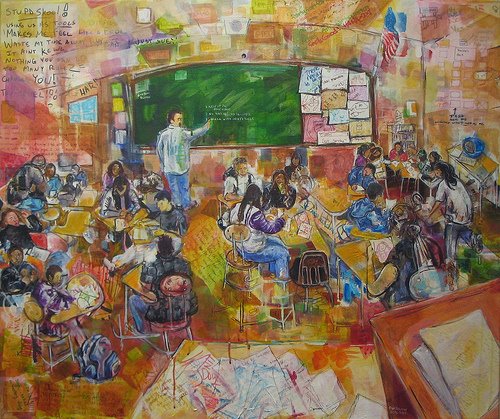
As I am in the midst of finishing a seminar paper on Carl Rogers’ 1969 book Freedom to Learn: A Vision of What Education Might Become, my friend Joseph forwarded me this link to Dave Pollard’s review of a new book, 101 Reasons Why I am an Unschooler, written by blogger P.S. Pirro (whose blog feeds are now definitely on my iGoogle page). Pollard begins his review by an account of his own experience with self-directed learning during his adolescence, and then writes of Pirro’s book:

PS presents 50 reasons why schooling is, in every imaginable way, bad for us and our society, and then 50 reasons why unschooling, which she defines as “learning without formal curriculum, timelines, grades or coercion; learning in freedom” is the natural way to learn. She argues that we are indoctrinated from the age of five to cede our time, our freedoms, and what we pay attention to, to the will of the State, so that we are ‘prepared’ for a work world of wage slavery and obedience to authority. We are deliberately not taught anything that would allow us to be self-sufficient in society. And in the factory environment of the school, where teachers need to ‘manage’ thirty students or more, ethics and the politics of power is left up, from our earliest and most vulnerable years, to the bullies and other young damaged psychopaths among our peers, to teach us in their grotesquely warped way. As PS explains, it is in every way a prison system.

Unschooling, by contrast, starts with the realization that you ‘own’ your time, and have the opportunity and responsibility to use it in ways that are meaningful and stimulating for you. When you have this opportunity, you just naturally learn a great deal, about things you care about, things that will inevitably be useful to you in making a life and a living. Your learning environment is the whole world, and you learn what and when you want, undirected by curricula, textbooks, alarm clocks and school bells. You develop deep peer relationships around areas of common interest, once you’re allowed to explore and discover what those areas of interest are. And the Internet and online gaming allow you to make those relationships anywhere in the world, to draw on the brightest experts on the planet, and to communicate powerfully with like-minded, curious people of every age, culture and ideology.

Many people argue that unschooling will only work for the very brightest and most self-disciplined children. On the contrary, I think we are all perfectly suited to unschooling until the school system begins to beat the love of learning, the ability to self-manage, curiosity, imagination and critical thinking out of us. By the time we have reached the third grade it becomes much more difficult, and my success in unschooling in twelfth grade was, I will agree, due to my above-average intelligence and initiative — most of my intellectually-crippled peers just couldn’t manage by that time without the strictures they’d become accustomed to. They had long ago lost the desire to learn, and to think for themselves.

I would quibble with his “my above-average intelligence and initiative” explanation for his unschooling success; the answer to why he thrived and others did not in a more unstructured learning environment was likely way more complicated than “I was smarter.” I don’t think anyone truly loses the desire or ability to learn and think in a self-directed fashion.

Rather, I would argue, it just takes some people longer than others to reclaim that desire — and they have to decide they want to reclaim it in the first place. Folks in the home education community have long recognized that there is a “deschooling” period for kids that often lasts in direct proportion to the amount of time they have been in institutional schools before they bounce back and learn to pay attention to their own desires again. This can take patience and often looks, according to conventional standards of educational achievement, like failure. However, I would urge all of us to consider the possibility that in fact it is not: that in fact, it is the beginning of a radical new definition of success.

The book is now on my summer reading list, a move I can now happily begin to justify as “thesis-related” instead of pure obsession. Then again, as unschoolers remind us, pure obsession is often the best justification.

Image (c) Todd Berman @ flickr.

A few more links on bodies

22 Wednesday Apr 2009

Posted by Anna Clutterbuck-Cook in linkspam

≈ 3 Comments

Tags

feminism, gender and sexuality

A couple of weeks ago, I rounded up a few links on policing “imperfect” bodies (women’s bodies in particular). Here are a few more.

Watching the blogosphere coverage of Susan Boyle’s performance on the Britain’s Got Talent television show has been an a thought-provoking and often intensely discomforting experience (as was watching the video itself, though she does indeed have a gorgeous voice and sings with her whole body). Here are blog posts and threads I found particularly spot-on with regards to what’s off about the hype.

1) The Pursuit of Harpyness asks whether Susan Boyle’s performance at Britain’s Got Talent and the freak-show aspect of media coverage surrounding it is “Heartwarming or Heartbreaking?”

2) via radishette: What he said. Nailed it.

3) Courtney Martin writes: “I don’t think the majority of us are really willing to look at the ugly scripts in our heads, the fat discrimination, the self-hate (oh so relate to our merciless judgment of others),” that the popularity of the Susan Boyle video draws out.

And then: I’ve written a lot about how ageism hurts young people, and specifically about the American obsession with teen sexuality. Now here’s a story about Massachusetts attempting to legislate against elder expressions of sexuality. The legislation is ostensibly to protect elders and disabled individuals from exploitation (a laudable goal), but has been carelessly and broadly worded. Not cool adopted state.

*Image (c) ria hills @ flickr.

Quick Hit: Children’s Issues are Feminist Issues

22 Wednesday Apr 2009

Posted by Anna Clutterbuck-Cook in linkspam

≈ Leave a comment

Tags

children, education, feminism, masculinity

Two links on bullying that came across my rss feeds lately remind me again about how integral children’s experience and childhood spaces are to the struggle against power-over hierarchical relationships (i.e. the kyriarchy.)

First, via Feministe and Feministing, stories of two boys who killed themselves as a result of bullying that hinged on homophobic and sexist taunts: Carl Joseph Walker-Hoover and Jaheem Herrera.

Partly in response to these stories, as well as her own experience, Antigone over at punkassblog declares “If We Have Kids, We’re Homeschooling“:

Based on the number of people that had to live through bullying, and the complete lack of any systematic effort to stop it, I’m calling bullshit, hard. Public school does not properly socialize anyone, it teaches children to become bullies, victims, or learn the nifty trick of “not my problem”. That is not a socialization I want to give my kids at all.

Home education isn’t the only possible solution to this type of situation (and indeed, will like not shield kids from bullying entirely — though it can serve as a life-saving buffer for some), but I think Antigone’s “I’m calling bullshit” is an important impulse. Systemic violence is not okay, regardless of where it happens and to whom it happens. Children — who spend much of their time segregated from the general population — often suffer from the same discrimination as marginalized adults (sexism, racism, classism, homophobia, ableism, etc.) while they are simultaneously less able to name and combat it — because they lack the (developmental and experiential) perspective of adults and the resources and agency of adults.

Many children must — through lack of individual choice or material options — return to these hostile situations day after day after day where oversight by adults is inadequate at best and indifferent at worst. This is not acceptable. And I see calling bullshit on the intensely hostile world in which our children (who will grow up to be caretakers of our world and of us in our elder-hood, whether or not we are parents ourselves!) as integral to the feminist project.

← Older posts
Newer posts →
"the past is a wild party; check your preconceptions at the door." ~ Emma Donoghue

Recent Posts

  • medical update 11.11.22
  • medical update 6.4.22
  • medical update 1.16.2022
  • medical update 10.13.2021
  • medical update 8.17.2021

Archives

Categories

Creative Commons License

This work by Anna J. Clutterbuck-Cook is licensed under a Creative Commons Attribution 3.0 Unported License

Meta

  • Register
  • Log in
  • Entries feed
  • Comments feed
  • WordPress.com

Create a free website or blog at WordPress.com.

  • Follow Following
    • the feminist librarian
    • Join 36 other followers
    • Already have a WordPress.com account? Log in now.
    • the feminist librarian
    • Customize
    • Follow Following
    • Sign up
    • Log in
    • Report this content
    • View site in Reader
    • Manage subscriptions
    • Collapse this bar