• anna j. clutterbuck-cook
  • contact
  • curriculum vitae
  • find me elsewhere
  • marilyn ross memorial book prize

the feminist librarian

the feminist librarian

Category Archives: my historian hat

from the archives: anti-suffrage gossip

31 Thursday Oct 2013

Posted by Anna Clutterbuck-Cook in my historian hat

≈ 1 Comment

Tags

feminism, history, MHS, politics

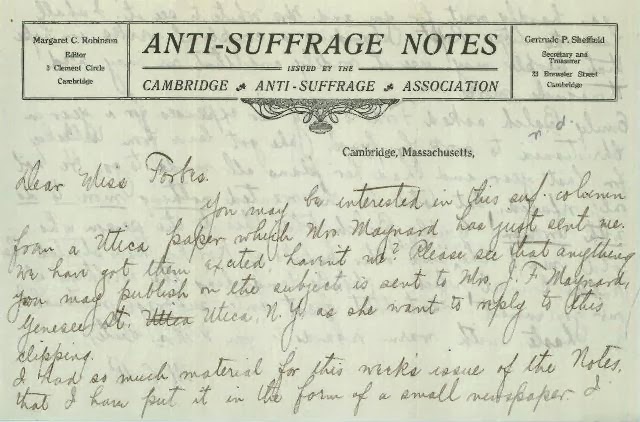
I had a blog post up yesterday at The Beehive (the Massachusetts Historical Society blog) sharing an item from our collections authored by anti-suffrage activist Margaret C. Robinson:

Margaret C. Robinson to Mary Bowditch Forbes, [1917],
Mary Bowditch Forbes Papers, Massachusetts Historical Society,

I didn’t include a full transcript of the item in my final blog post, but I thought readers here might be amused. So before or after you read my post contextualizing the item, here is the full letter. Margaret Robinson’s note (pictured above) reads:

[n.d.]

Dear Miss Forbes.

You may be interested in this suf. column from a Utica paper which Mrs. Maynard has just sent me. We have got them excited haven’t we? Please see that anything you may publish on the subject is sent to Mrs. J.F. Maynard, Genesee St., Utlca Utica, N.Y. as she want[s] to reply to this clipping.

I had such material for this week’s issue of the [Anti-Suffrage] Notes, that I have put it in the form of a small newspaper. I can hardly wait for you and Mrs. White to see it. I shall have the type left standing a couple of weeks in hope that people may use it widely and that we may need thousands more.

Emily Balch asked Ford to pay her expenses for a year in Christianin to work for peace. She got leave from Wellesley for last year and had her plans all made to go. He not only refused but told her he wanted nothing more to do with women! Emily Balch told this to the person who told me! She ^(Miss Balch) and other pupils of Rosika [Schwimmer] have started the People’s Council which is openly demanding the overthrow of our government! Isn’t that great anti-suffrage material?

In haste, with warm regards to you & Mrs. White,

M.C.R.

In addition to what I write at the Beehive, I think I particularly enjoy the image of Robinson being so excited about the latest edition of her newsletter that she’s going to leave the type set to print even more copies once the initial run is fully distributed. If I ever track down a copy of that particular document I’ll be sure to share it here at the feminist librarian!

the "duck and cover" gambit, circa 1969

04 Sunday Aug 2013

Posted by Anna Clutterbuck-Cook in my historian hat

≈ 3 Comments

Tags

feminism, history, motive

For fun and scholarly research today, I’m reading the March/April 1969 issue of motive magazine — a special issue dedicated to what was then called the women’s liberation movement. As you might expect, it’s all a bit dated in the best possible way — and they’ve got some great pieces in there: on sexism in psychology, an analysis of women’s magazines and consumer culture, and an article by Del Martin and Phyllis Lyon on lesbians and anti-gay discrimination. Also lovely woodcut illustrations and some passionate poetry to boot.

The final piece in the issue is an editorial by motive editor B.J. Stiles. It’s a fairly defensive piece for what to my twenty-first century eye is a fairly middle-of-the-road collection of feminist texts, including one on deconstructing masculinity written from the perspective of a man. B.J. opens the piece joking at length about how this particular issue came about because motive hired a young woman onto the staff, “fresh from college–attractive, articulate, hip, our femme fatale in residence. She stimulated male fantasies, fulfilled ordered (magazine subscription ones, that is), participated in editorial conferences…and worked cheap. (In earlier times, we might have even said that she became ‘one of the boys’.)”

Given that Stiles himself later came out as gay, I imagine some of this locker room humor is defensive — not only against what he argues is the “anti-male” thrust of the issue, but also protective covering in relation to the discussion around homosexuality that appears in its pages. So I’m not (yet) ready to argue this hostility towards feminism turned out to be a pattern for Stiles.

However, what struck me was the opening lines of the piece, which read as follows:

In full knowledge that the admission of the following qualifies me for the VWLM’s “Male Chauvinist-of-the-month Award” and will undoubtedly result in one more elaborate hex from guest editor Joanne Cooke [the femme fatale of above], a few musings on women’s (and men’s) liberation.

 Here we have, circa 1969, a beautiful specimen of what John Scalzi recently called the “I fully expect abuse” gambit, which I think of as the “duck and cover” gambit. This is when a person from a socially privileged group (in this instance, a man) offers up thoughts on a subject which they feel defensive about, generally because people from a socially disadvantaged group (in this instance, women) have raised questions about the status which make the writer/speaker uncomfortable.  Because the writer/speaker is about to say something from their position of privilege which they suspect will confirm the suspicions of their detractors or otherwise be unpopular, they preface their statement with something to the effect of, “I know you’re going to [insert violent action] to me for saying this, but…” as if to imply their bravery at refusing to be silenced and voice some Important Truth anyway.

Oh the courage it takes to be …. in the majority.

With the weight of … major social and legal institutions behind you.

As my friend Fannie wrote last year, this is an all too familiar reflex in the twenty-first century feminist blogosphere … and apparently has a long and ignoble history going back at least half a century.

Well done, guys. Well done.

marriage equality and female suffrage: step by step change

15 Wednesday May 2013

Posted by Anna Clutterbuck-Cook in my historian hat

≈ Leave a comment

Tags

history, marriage equality, politics

So I haven’t written anything about the recent state-level victories in the push for equal marriage rights for same-sex couples. But congratulations Rhode Island, Delaware, and Minnesota! We have friends in all three states who are feeling better about their country now, because their state legislatures have chosen to be more welcoming in the face of family diversity and human sexual diversity. I can only hope this trend continues.

And of course we’re all waiting on tenterhooks for the DOMA ruling to be handed down by the end of the term.

As a historian, I’ve been watching the concurrent process of state-level victories and the DOMA challenge mindful of the way past struggles over the expansion of citizenship and constitutional protections have similarly progressed in fits and starts across our federated landscape.

Consider these two infographics:

(via)
(via)


I don’t have any Big Important Thoughts about this process at the moment, except to say that I think people who argue we should leave the process to the states ignore the important role that our national government plays protecting the rights of minority populations … and that people who are eagerly pushing for a national right to same-sex marriage sometimes ignore the symbiotic relationship between state and federal rights campaigns.

When this is all over, there will be a PhD dissertation in a comparative treatment of the woman suffrage and marriage equality campaigns (victories?!).

Addendum: It occurred to me, on my morning commute, that another parallel between the woman suffrage campaign and the marriage equality campaign is that both are specific issue campaigns that brought a diverse coalition of people with wide-ranging agendas together on one thing they could agree to push for. They are also both comparatively narrow victories that leave some folks unprotected (African-American women in the South; trans folks in many states) and run the risk of making it seem like all inequalities for a certain class of people have been swept away in a single moment.

The 19th Amendment, as we know nearly a century later, did not erase sexism and misogyny from our national landscape; marriage equality will not erase heterocentrism and anti-gay discrimination (as E.J. Graff points out in the link above). We would do well to remember that, even as we move forward in celebration.

"in their graves because of false modesty"? [neha spring 2012]

24 Tuesday Apr 2012

Posted by Anna Clutterbuck-Cook in my historian hat

≈ Leave a comment

Tags

gender and sexuality, history, professional gigs, science, the body, writing

This past Saturday, I presented a paper at the spring meeting of the New England Historical Association (NEHA) at Rivier College in Nashua, New Hampshire. You can check out the full text of the presentation here: “In Their Graves Because of False Modesty?”: An Allegation of Sexual Assault in Boston, 1914-1915 (PDF, via DropBox).

The paper was my first attempt to pull together a research project I’m working on into a coherent narrative. The research concerns a mysterious deposition I stumbled upon in the Godfrey Lowell Cabot Papers at the Massachusetts Historical Society. As I write in the opening paragraphs:

Mediated, it is true, by the framework of legal testimony, the narrative voice of the deposition is nevertheless an active one. [Nellie] Keefe [the deposed] describes herself purposefully seeking medical treatment and intervening in that treatment when it goes contrary to her expectations. She positions herself as a consumer of medical services, with the ability to select a treatment plan with which she feels comfortable, rather than the passive recipient of medical care with which she is uncomfortable — from a medical professional whose authority she should not, or cannot, challenge. She evokes the spectre of sexual aggression by describing how Dr. Underhill “turned the light out [and] inserted his finger in my vagina,” yet ultimately circumscribes Underhill’s actions by indicating that she successfully ordered him to stop.

To the modern reader, the deposition feels both remarkably contemporary, yet also deeply embedded in an historically-specific set of social and medical expectations surrounding patient-doctor interactions. While Keefe’s self-reported actions make clear that she was dissatisfied with Underhill’s professionalism, she also indicates that Dr. Underhill was similarly dissatisfied with her performance of the role as patient. “During the treatments he would pull the blanket off me and I would pull it on again and he would pull it off again leaving me stark naked,” she testified, vividly illustrating the battle between patient and doctor over the circumstances under which Keefe’s treatment should proceed. Keefe was clearly unhappy with Dr. Underhill’s methods, yet returned to his office multiple times to try and negotiate a more satisfactory interaction. What appears at first to be a straightforward account of a doctor’s unprofessional conduct is, I would argue, a more complicated document containing multiple and uncertain meanings.

You can download the full paper from DropBox.

Like my past appearances at NEHA, it was great to spend a morning talking history with a diverse and encouraging group of practicing historians from all over New England. I particularly enjoyed the presentation of my co-panelist Allison Hepler (University of Maine, Farmington), whose research into the life of “Communist hussy librarian” Mary Knowles not only paralleled my own project in unexpected ways, but also gave me a certain amount of professional pride (who wouldn’t want to be known as a “Community hussy librarian”?!).

While we had very little time for Q & A at the session, I had warm words of encouragement from folks for the continuation of my research. What questions and reflections I did field helped clarify how I might move forward from here. I’m particularly motivated to explore the network of female friendships and associations that seem to be such a central part of the Keefe-Underhill case. Time to roll up my sleeves and get to work exercising my reference and historical research skills!

quick hit: queer community archives in california since 1950

29 Thursday Mar 2012

Posted by Anna Clutterbuck-Cook in my historian hat

≈ Leave a comment

Tags

friends, gender and sexuality, history, librarians, oral history

more about Diana

On March 19th our good friend (and Hanna’s former roomie) Diana Kiyo Wakimoto became the first PhD candidate in the Queensland University of Technology and San Jose State University’s joint  Gateway PhD Program to reach the point of making a final seminar presentation before revisions and submission of dissertation research. Congratulations Diana!

Her topic, queer community archives in California since 1950, makes her research a valuable contribution to the fields of library science/archives, queer history, and queer activism. And of obvious interest to the folks who read a blog titled “the feminist librarian.” Happily, she’s made her final presentation slides and the text of her talk available over at her blog, The Waki Librarian. In her own words:

For many decades, the records that have been forgotten are those of the queer communities, which were not collected by institutional archives. In response to this neglect, community groups created their own archives to collect and preserve their records (Barriault, 2009a; Flinn & Stevens, 2009; Fullwood, 2009). Without the activism shown by the pioneers who created these personal collections and community archives, much of the record of the queer community organizations, movements, and individuals would have been lost. Multiple queer community archives have been created in California to combat the historical neglect and silencing of queer voices in institutional archives. My thesis focuses on the little studied area of the histories of these queer community archives in California and their relationships to institutional archives. 

… As archivists continue to debate the role of the archivist as a professional, this study lends support to the scholars and practitioners who see the archivist as an activist and a non-neutral player in the construction of history and community identities. It bears repeating that without the activists and archivists within the queer communities who saved records and completed oral history projects, much of the record of the communities’ histories would have been lost. Therefore activism is important to saving records of the past and the archives profession must act to ensure a diversity of voices are found in the archives. We could learn much from the community archivists and volunteers about connecting with community members and creating archives and spaces that reflect community needs and interests.

Congratulations, Diana, and I can’t wait to read the final dissertation in full! 

quick hit: belfast project oral history lawsuit

30 Friday Dec 2011

Posted by Anna Clutterbuck-Cook in my historian hat

≈ Leave a comment

Tags

history, human rights, npr, oral history

via

Earlier this year, the British Government requested the audio recordings and transcripts of interviews from a Boston College-based oral history project documenting the history of conflict in Northern Ireland. The oral history narrators who participated in the project originally granted interviews on the condition (agreed to in writing) that the interviews remain sealed until after their death. English officials are arguing that the interviews are required as part of an ongoing criminal investigation and claiming that the United States government is under treaty obligation to obtain the materials from BC and hand them over.

After initially resisting the request, Boston College appears to be on the brink of complying with a Judge’s order to hand over select interviews. This decision not only represents a breach of promises made to human beings whose lives (and the lives of countless others) will now be under renewed threat, but will have a widespread chilling effect on the practice of oral history in situations where, perhaps, the oral historical record is particularly vital: sites of conflict where normal modes of documentation are lost or never created.

You can listen to an interview with the former director of the Belfast Project, Ed Moloney, on WBUR’s Radio Boston.

You can read more about the lawsuit at Boston College Subpoena News (a blog set up to follow the story, which is unaffiliated with BC), as well as access many of the publicaly-available legal documents related to the case.

Neither the Oral History Association nor the American Historical Association have weighed in on this issue recently — at least that I can find — although the AHA did acknowledge back in May that the issues are “murky” and raise complex ethical questions about the practice of oral historical research.

thank yous: thesis edition

24 Thursday Nov 2011

Posted by Anna Clutterbuck-Cook in my historian hat

≈ Leave a comment

Tags

holidays, thesis

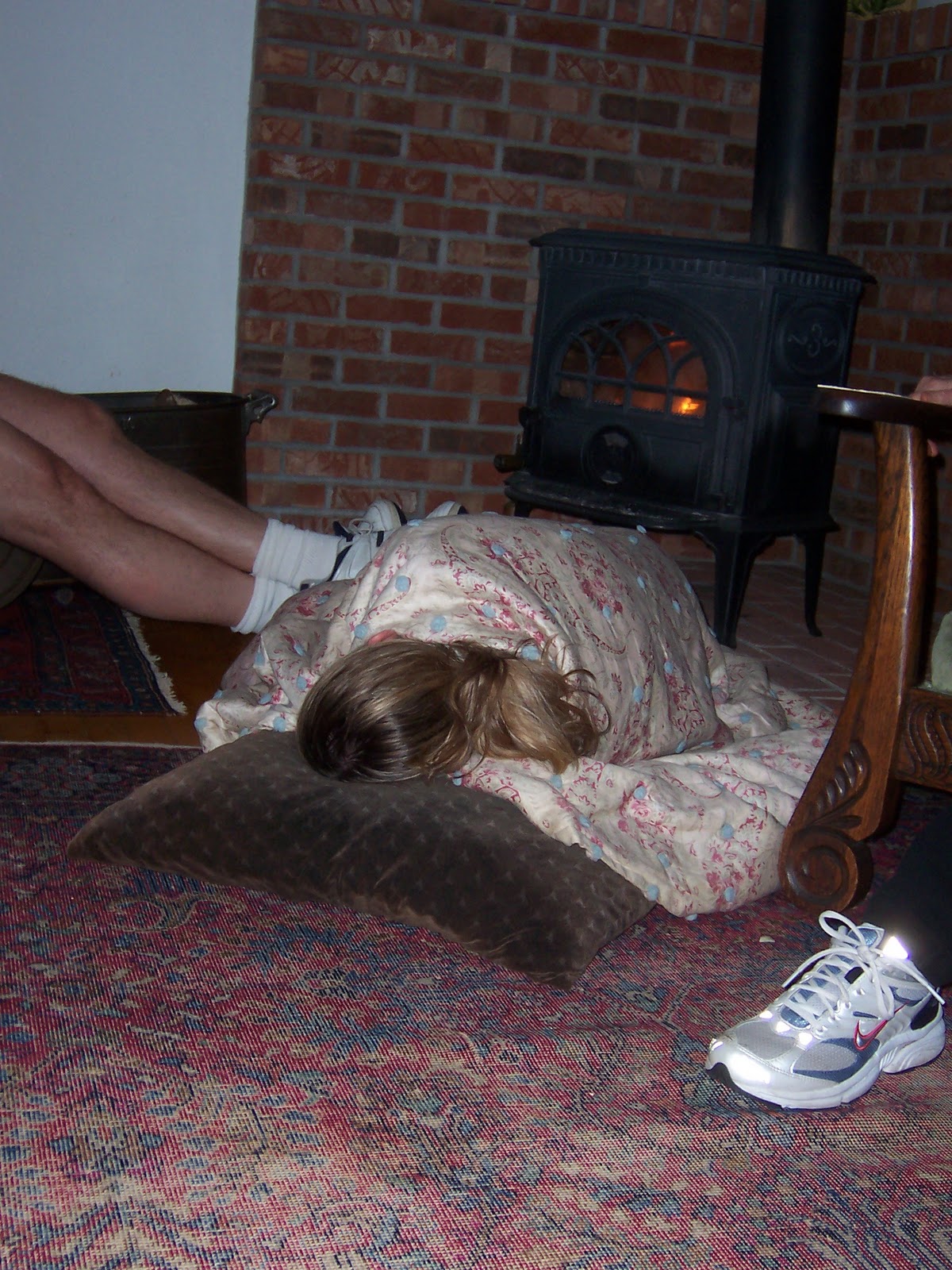
Maggie + wood stove (October 2004)
photograph by Anna

One of the most enjoyable parts of writing my Master’s thesis was pulling together the acknowledgments. Since it’s unlikely everyone who appears therein will read the thesis in full [PDF], I’m reproducing the acknowledgments here. 

It should go without saying this is far from everything I have to be thankful for this year, but it’s a damn good starting place. 

May your holiday weekend be peaceful and content, wherever and with whomever you may be.

As a reader, I often turn first to the acknowledgments when evaluating a book.  It is here that one gets a true sense of the solitary author working in a densely-woven web of social and intellectual relationships, one that often fades into the background with an author’s solitary byline.  For while it is accurate to say that I crafted this thesis myself, and that the analysis herein is my own, the thinking and writing I have done over the past three years would not have been possible without the myriad conversations, generous support, timely encouragement, articles and books shared by my friends, family, and colleagues. As my partner, Hanna, points out, “alone” is not the same as “lonely,” and although I have written this work alone, many, many people deserve the credit for making sure that I seldom felt lonely or worked in intellectual isolation.

O.E. class of  ’75

Without my oral historical narrators, of course, I would have no primary source material to analyze and thus no story to tell.  My gratitude belongs first and foremost, then, to Sam and Pat Alvord, Randy Balmer, Doug and Marj Frank, Mark Evans, Anne Foley, Alison and Phil Kling, Rebecca McCurdy, Sogn Mill-Scout, Paul Norton, Jim Titus, and Randy Wright for sharing their memories of the Oregon Extension and the contents of their personal archives.  Particular thanks are due to the folks at Lincoln for hosting me during my research trip in March, 2010, when we recorded the majority of our oral history interviews. Thank you also to Doug Frank and Sam Alvord giving me access to administrative records and personal papers from the early years of the program; to alumni Phil Kling, for sharing notes, papers, and other ephemera from his student days; and to Alison Kling and Jim Titus for generously sharing their photographs from the early years.

My thesis advisers, Laura Prieto and Sarah Leonard, have been invaluable and professional support throughout the research and writing process. It was my [admissions] interview with Laura back in July 2006 that convinced me I would be able to complete the research I had in mind under the auspices of Simmons’ History Department. She has been unfailingly supportive throughout my tenure at Simmons, giving my research notes and early drafts careful and insightful readings.  Any remaining weaknesses in my thinking and writing are, needless to say, my own responsibility. Sarah, meanwhile, deserves particular thanks for allowing me to hijack her seminar in Modern European History in order to write a paper on American psychologist Carl Rogers, one of the influential educational philosophers whose work inspired the Oregon Extension’s founders.  Her passion for intellectual history and the dedication with which she approaches her vocation are almost enough to make me reconsider the teaching profession.

Boston skyline across the Fenway Gardens
(December 2007)

I would like to remember the late Allen Smith who developed and taught a course in oral history at Simmons Graduate School of Information and Library Science, and whom I was privileged to study under during his final semester of teaching. His work at Simmons College paved my way with the Institutional Review Board, whose familiarity with oral history research saved me the anxiety and frustration many oral historians face when applying to do human subject research. I also wish to thank Gail Matthews DeNatale, oral historian and former faculty member at Simmons, whose experience and advice helped to shape my thesis proposal in its early stages.

Reaching backward in time to my undergraduate years at Hope College, I wish to recognize my colleagues on the Aradia Research Project, as well as the Aradians themselves, who served as my hands-on introduction to feminist-minded oral history and ethnographic research and who encouraged my enduring interest in the experience of those who live in intentional community.

The outstanding faculty of my alma mater, Hope College, were in many ways responsible for taking the enthusiastic autodidact I was at age seventeen and encouraging me to direct and hone that passion into something I could honestly consider a craft and a vocation. Poet and creative writing teacher Jackie Bartley first opened the door to creative nonfiction to me, suggesting that dedicated research and analytical writing could use the power of the particular to connect us to the universal.  It was Jackie who first suggested I consider attending the Oregon Extension. Thanks is also due to Lynn Japinga for introducing me to oral history methods during a summer spent transcribing her oral history interviews with Reformed Church clergy, as well her determination to offer classes in feminist theology in an often-hostile academic environment. Without her introduction to religious history, I might not have paid such close attention to the nuances of
religious thought and practice at Lincoln. My undergraduate adviser, historian Jeanne Petit, taught my first history class (20th Century American Women’s History) and was the first to suggest I consider graduate school. She has since become a colleague and a friend. I must also extend my gratitude to Natalie Dykstra for her friendship and enthusiasm, for her love of Boston, and for teaching a course on autobiography that was – hands down – one of the most electrifying intellectual experiences of my college career. Her training in the interpretation of personal narratives has stood me in good stead throughout the research and writing of this thesis.

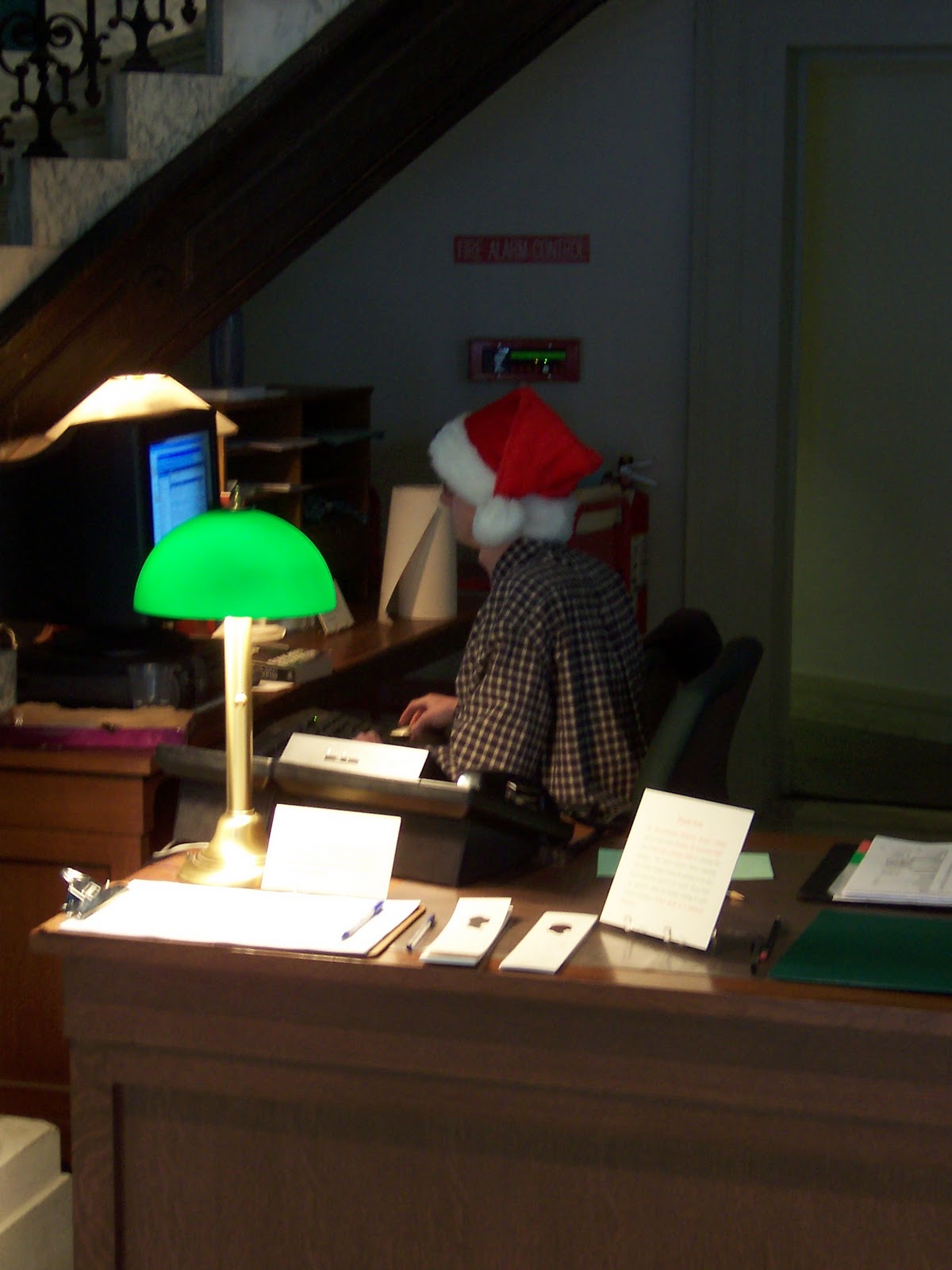
Former colleague Jeremy Dibbell
(December 2007)

I must recognize my colleagues at the Massachusetts Historical Society, particularly past and present members of the Library Reader Services department, who have been unblinking in their support of my research – including covering for me while I spent two weeks out West doing fieldwork. It is impossible to say how grateful I have been these past four years to work at an institution that recognizes my labor as an historian as well as a reference librarian.

I would like to thank colleague Aiden Graham for offering to loan me recording equipment, and for timely technical advice including helping me figure out how to wiretap my phone for long-distance interviews. Thanks, also, to Linnea Johnson and the GSLIS Tech Lab for the loan of a netbook that would otherwise have cost me hundreds of dollars this poor graduate student didn’t have.  The Simmons College Student Research Fund, likewise, awarded me a travel grant that helped alleviate the financial burden of my fieldwork in Oregon. Valerie Beaudrault’s assistance in the Office of Sponsored Programs ensured that my application for funds was complete and submitted in a timely fashion.

My father and mapmaker extraordinaire, Mark Cook, is responsible for the beautiful customcreated maps that grace the pages of this thesis: without him, my visual representations of the Oregon Extension as a geographic place would have been awkward and, in all likelihood, inaccurate. My mother, too, has my undying gratitude for first introducing me to the work of John Holt, Ivan Illich, A.S. Neill, and other activists in the free school movement of the 1960s and 1970s, as well as to the history of intentional communities and their intersection with child-rearing and educational practice. Moral and intellectual support and good-humored camaraderie came in full measure from two founding members of the Secret Feminist Cabal, Ashley Minerva LeClerc and Laura Cutter, and from fellow oral historian, kick-ass librarian Diana Wakimoto. Y’all rock.

A slightly different form of support came from Geraldine, the feline member of our household, who took a keen interest in my work and sat on my notes, on the keyboard, and occasionally on my hands in order to ensure that work never took precedence over chin-scratching and the dispensing of kitty treats.

Finally, a few words for Hanna, who stoically endures my mania for American countercultures, Christian subcultures, and the history of utopian thought. Thanks for flying solo for two weeks while I was off collecting interviews in Southern Oregon, for taping useful PBS documentaries, for forwarding promising book reviews, for teasing me about garish 1970s cover art. Thanks for the proof-reading, the cheer-leading, the bottomless supplies of tea, wine, and baked goods. Thank you for letting me cry on your shoulder and for pointing out (quite rightly) that if I didn’t finish this project I would always wonder.

Thanks for helping me keep it all in perspective.

I moved to Boston in 2007 to write this thesis, not fall in love. I found you here, sweetheart, so in the end I did both.
our bodies, ourselves @ forty (+ me!)

05 Wednesday Oct 2011

Posted by Anna Clutterbuck-Cook in my historian hat

≈ 5 Comments

Tags

being the change, gender and sexuality, history, human rights, the body, whoniverse

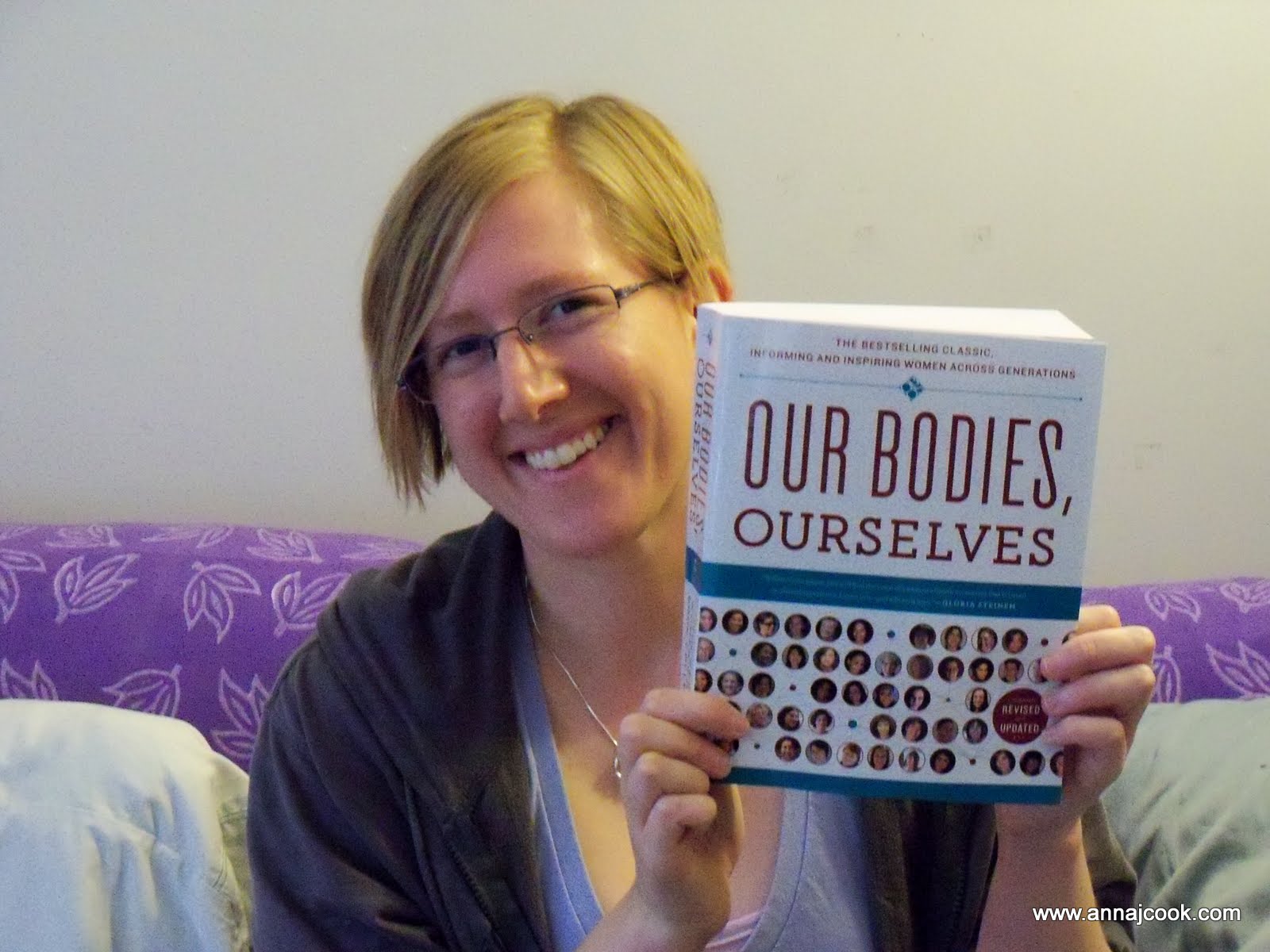
(photo by Hanna)

The feminist classic, Our Bodies, Ourselves, turns forty this year and has just been issued in a revised edition that was multiple years in the making. How do I know this? Because I got to be a part of the process! Long-time readers might remember when I posted a call for participants in the revision process back in January 2010. Well, in addition to broadcasting the call I also submitted my own name to the editors and was invited to join them in a virtual focus group discussion on intimate relationships. This conversation eventually turned into the “Relationships” chapter in the new edition, and many of the passages that didn’t make it into that chapter have been used in other sections — I found bits and pieces from my contributions in the chapters on sexual orientation and on sexuality, for example.*

my contributor’s copy, signed by the editorial team!
(photo by Hanna)

I don’t think I can adequately convey to you how proud I am to be a part of the OBOS project. My mother’s battered copy of Our Bodies, Ourselves was my constant companion through adolescence and, among other things, was my first exposure to explicitly feminist analysis, my first exposure to the idea of same-sex relationships, and my introduction to masturbation and how to do it. One of the first things I did when I moved out to Boston in 2007 was to visit the Schlesinger library at Radcliffe and browse the records of the Boston Women’s Health Book Collective — the group that put together the first mimeographed edition of OBOS back in 1970. It’s an incredible honor to have had the opportunity to add my perspective to the myriad other voices that have been part of this international endeavor throughout the past forty years.

It’s so strange to see your own words on the printed page…

This past Saturday, women from around the globe gathered here at Boston University for a symposium in honor of the new edition. I wasn’t able to make the gathering because of a scheduling conflict (and, frankly, because it sounded like a long day with too many new people to make small talk with!) … but I’m looking forward to checking out the web video of the talks once those go up online. If/when they become available, I’ll be sure to post a link here!

Here’s hoping that OBOS (and I!) will be around in another forty years to celebrate eighty incredible years of women teaching and learning one another about their bodies, their sexuality, their relationships, their values, and their lives.

Update: Thanks to OBOS for mentioning this post in their introduction to the Relationships chapter online! Welcome to anyone who’s come to visit the feminist librarian via their link. You are most welcome.

*It’s standard OBOS practice to keep all of the in-text quotations anonymous in order to protect contributors’ privacy. For the “Relationships” chapter we all chose pseudonyms; if you know me and you care to figure it out you’ll be able to identify me through my bio at the beginning of the chapter.

in which I’m unexpectedly proud…

23 Saturday Jul 2011

Posted by Anna Clutterbuck-Cook in my historian hat

≈ 1 Comment

Tags

education, simmons, thesis

… to receive this in today’s post:

My work simply would not have been possible without the generosity of everyone who shared their oral histories and personal papers with me. Thank you, everyone! My work simply would not have been possible without the generosity of everyone who shared their oral histories and personal papers with me. Thank you, everyone! And I promise I will get over my bashfulness and post a link to the PDF of my thesis tomorrow over at the OE Oral History project blog.

UPDATE: Here is the post: how to live: the oregon extension as experiment in living, 1964–1980 [thesis]. A link to the PDF in DropBox can be found after the jump.

from the archives: the 1920s culture war

08 Tuesday Feb 2011

Posted by Anna Clutterbuck-Cook in my historian hat

≈ Leave a comment

Tags

feminism, MHS, politics, religion

Over at the Massachusetts Historical Society website, the object of the month for February 2011 is an item I selected and wrote up. The object is a letter from a conservative Nebraska clergyman to an anticommunist, antifeminist political activist who lived in Massachusetts. Reverand Birmingham wrote Margaret Robinson in hopes that the two might work together to combat the evils of women’s higher education:

In May of 1923, conservative evangelical minister, author, and lecturer Thomas M. C. Birmingham saw a brief announcement in an Omaha newspaper, describing a lecture given by Margaret C. Robinson, president of the Massachusetts Public Interests League, on the “radical propaganda” Robinson and her fellow activists believed was being disseminated in women’s colleges.

Professors at women’s colleges such as Bryn Mawr, Smith, and Wellesley, Robinson argued, were turning “wholesome American girl[s]” away from patriotism and the Constitution, preaching “Communist sex standards,” calling the literal truth of the Bible into question, and exposing young women to the theories of Freud and Marx.  As a result, unsuspecting parents sent their daughters off to college and watched in horror as their child was transformed into “an undesirable type of citizen.”

This message resonated with Birmingham, who wrote to Robinson, suggesting that the two activists might find “mutual helpfulness” in an alliance to “stamp out radicalism.”

You can read the rest of my write-up and a full transcript of the two-page letter over at the MHS object of the month page.

The MHS is known for its 18th and 19th Century American holdings, and it has long had a reputation for holding documents related to the New England elite. Part of what I’m trying to bring to my work as a reference librarian is greater knowledge of the ways in which the MHS collections can inform research in less-obvious areas (i.e. my own areas of interest!) such as the history of sexuality, the history of gender, history of activism (left, right, and center) and 20th-century subjects. 

I picked this letter a few months ago to research and write up because I think it’s valuable to remember that folks like those in the Tea Party movement are not the first populist conservative activists to wrestle with their more progressive adversaries over what it means to be an American and what exactly constitutes American values. I’m also fascinated by antifeminist women and how they understand themselves in relation to gender and women’s rights movements. Female activists who campaigned against feminism while deploying tactics and rhetoric similar to their feminist contemporaries can further our understanding of how individuals understand their own gender identity and how gender roles relate to the state and social order.

Anyway. Hop on over to the MHS website and check out the whole thing.

← Older posts
Newer posts →
"the past is a wild party; check your preconceptions at the door." ~ Emma Donoghue

Recent Posts

  • medical update 11.11.22
  • medical update 6.4.22
  • medical update 1.16.2022
  • medical update 10.13.2021
  • medical update 8.17.2021

Archives

Categories

Creative Commons License

This work by Anna J. Clutterbuck-Cook is licensed under a Creative Commons Attribution 3.0 Unported License

Meta

  • Create account
  • Log in
  • Entries feed
  • Comments feed
  • WordPress.com

Blog at WordPress.com.

  • Subscribe Subscribed
    • the feminist librarian
    • Join 37 other subscribers
    • Already have a WordPress.com account? Log in now.
    • the feminist librarian
    • Subscribe Subscribed
    • Sign up
    • Log in
    • Report this content
    • View site in Reader
    • Manage subscriptions
    • Collapse this bar