• anna j. clutterbuck-cook
  • contact
  • curriculum vitae
  • find me elsewhere
  • marilyn ross memorial book prize

the feminist librarian

the feminist librarian

Category Archives: my historian hat

how to evaluate our elders: some preliminary thoughts as an historian

25 Tuesday Jan 2011

Posted by Anna Clutterbuck-Cook in my historian hat

≈ 1 Comment

Tags

bigotry, feminism, gender and sexuality, history

Gloria Steinem and two other editors of Ms. Magazine
ca. 1970s

As an historian, I spend a not-inconsiderable amount of time thinking about how we (in the present) evaulate the actions and words of our elders. Whether the person in question is still alive, or whether they have been dead for generations, individual words and actions are inescapably bound by the historic time and place in which they happened. We are creatures of history, not outside of it. Which is not to say that human beings of the past should not be held accountable for the damage they have often — so very often — wrought. Acknowledging, for example, that the majority of citizens in the Colonies did not believe women should have the vote, or that slaves were entitled to be counted as citizens (or even, radical idea, freed from bondage) does not preclude us from judging disenfranchisement and slavery as morally wrong. Understanding that a certain belief was simply “common sense” at the time does not exculpate those who accepted that “common sense” understanding from the responsibility of answering for the pain said belief caused others.

But given that, how, exactly, are we to judge the beliefs and actions of the past? By what criteria do we evaluate historically-situated words and deeds?

These questions often come up in my fields of historical interest, since I focus on the history of feminist activism, the history of countercultures, and the history of sexual identities and sexual practice. All of these areas of human activity regularly challenge us to define “right” and “wrong,” think about issues of human rights and social justice, and to understand the personal consequences of bigotry and prejudice.

I was thinking about these questions last week because Cara of The Curvature wrote a post over at her Tumblr blog about Gloria Steinem and transphobia. Cara recently picked up a copy Steinem’s anthology of writings, Outrageous Acts and Everyday Rebellions (1995) and in her post is specifically responding to an essay on “transsexualism” (originally written in 1977) in which Steinem writes in extremely negative terms about transsexual identity in general and gender confirmation surgery in particular. She portrays trans women as men masquarading falsely as women, and supports policies — popular at the time — excluding trans women from “women only” spaces. In her post, Cara called the Steinem out for her bigotry.

When I left a comment querying about the historical context of the original piece and saying that I hoped Steinem had since changed her views on the subject (feminist and even mainstream understanding of trans* issues has altered significantly since 1977 and even 1995), Cara wrote in response:

Of course, 15-16 years have passed since [the anthology], so it is possible that her views have changed since then, and one would hope that they have. But at the same time, I really don’t think that her views changing really count for much? I mean, admittedly as a cis person my thoughts on the matter don’t really count for all that much, either, but. I’d say she not only owes an apology, but a lot of work to address the harm that those views have done to the trans community over the decades, including the harm that the feminist movement has specifically done to trans people, especially trans women. Like, you know, this. Which has resulted in deaths. Or cis feminists keeping trans women out of domestic violence shelters and rape crisis centers, which has caused deaths. Etc. Clearly, she was not only complicit in that, but an active promoter of it.

I should admit up-front that I haven’t read this particular essay of Steinem’s in years — if, indeed, I’ve read it at all.  As a teenager, I know I owned a copy of Outrageous Acts and read much of its contents. If I did read “Transsexualism” as a sixteen-year-old, I likely would have passively accepted Steinem’s characterization of gender confirmation surgery as “mutiliation.” It took me into my mid-twenties (helped by lots of reading and some trans-identified friends) for me to revisit my adolescent judgement that surgical body alterations were inherently physically and psychologically damaging. And I’m sure the fact that the 1970s-era feminist writings I read as a teenager (and throughout much of college) did little to challenge my prejudice and encourage me to critically examine my judgmental views. The transphobia within the feminist movement then and now is not okay and absolutely should be called out at every opportunity.

Yet while I agree with the fact that Steinem’s past views did, indeed, contribute to a hostile climate for trans* folks that continues to this day, I’m troubled by the idea that someone’s ability to change over time into a less bigoted person doesn’t “really count for much.”  Since I don’t know the specifics in this particular case, I won’t venture to comment on Steinem’s current beliefs concerning trans identities. Perhaps she continues to believe what she wrote in 1977 and it is for precisely this reason that she included the piece in her 1995 anthology. The thing is, this post isn’t really about Steinem’s transphobia, past or present, anyway. Instead, I am using it as a single example of the kind of dilemma that confronts those of us in social justice activism daily: How to make sense of, and judge, the quality and importance of change over time.

At the time Steinem wrote her 1977 essay, many (likely most) women who identified as feminists were not welcoming of trans women. Trans identity was misunderstood, feared, vilified; trans women were judged and found wanting as women.  Many feminists as well as non-feminists in the mid-twentieth century viewed sex and gender identity as innate, as fixed, and binary (you were either female or male, with no middle ground). Folks who transitioned from their assigned sex/gender identity to the sex/gender identity which they felt comfortable with were understood to be changing their sex, rather than confirmed outwardly the identity that they had had all along. There are still people who think this way, although during the past fifty years many people have challenged the correctness and helpfulness of those ideas — particularly for the trans* folks whose lives are most directly affected by such rigid and binary modes of thought. We now have new ways of understanding trans identities, and yet Steinem’s words from 1977 remain in stasis, on the printed page. So the question becomes: what do we do with them now? In the present?

As an historian and a feminist, here are some of the questions this particular case study (if you will) raises in my mind, in no particular order:

  • What is the responsibility of an author like Steinem to annotate her earlier writings (say, in an anthology such as Outrageous Acts) to distance her present self from her past views?
  • If Steinem did choose to annotate her earlier writings, what sort of annotation would be effective? Should she refuse to republish the piece? Write a critical introduction? Place it in historical context?
  • What would it mean to place the piece in historical context … do we need to understand it in the context of feminist writing? medical theories? queer activism? mainstream understandings of sex and gender identity? Steinem’s other work? What, in other words, are the relevent bodies of literature that contextualize this piece?
  • Does context matter from an ethical standpoint and if so, how?
  • Who is responsible for making that judgment call — feminists? trans folks? human rights activists? historians?
  • If Steinem’s views were not atypical for the time, at the time, what sort of responsibility does she bear today as an individual for holding them? (Clearly she does — we all have choices — but what sort of responsibility?) How do we understand a single voice in relation to a larger, collective, discourse?
  • Is it responsible for us, as critics, to take her work and judge it in isolation from her contemporaries?
  • If Steinem does bear individual responsibility, what would it look like for her to own up to that responsibility? (Cara suggests some avenues in her response above; there are likely many other approaches)
  • Does her position as a high-profile feminist activist alter the level of her responsibility for holding even typical views concerning gender identity?

This is just the list I put together on my commute home last week; I’m sure there are other questions to be asked.

This is the sort of challenge that ensures historians (as well as activists) will never be without work to do!

from the archive: "queen everett"

16 Thursday Dec 2010

Posted by Anna Clutterbuck-Cook in my historian hat

≈ 1 Comment

Tags

archivists, masculinity, northeastern, photos

One of the things I love about working in an archive is the serendipity: the way a search for something else entirely can lead you into a gem of a story that takes you in a whole new direction. This certainly isn’t unique to the archival world — but it’s something that historians and archivists tend to start talking about together when they’re in the same room long enough!

Earlier this week, while hunting down the location of a photograph we had scanned several years ago at Northeastern but failed to properly identify, I was going through a folder of images from Northeastern’s annual Winter Carnival from the 1960s and 70s. Many of the photographs were of the individuals nominated for the position of Winter Carnival Queen — sort of the spring term equivalent of a Homecoming Queen. Lots of 8 x 10 glossies of young women posed alone and in groups, in winter coats throwing snowballs, in ball gowns and (in the case of the girls who won) a sparkling tiara.

Then I came to a small yellowed clipping that featured a photograph of the five young women nominated in 1971 … and the young man, Everett Nau, who had been crowned the Winter Carnival Queen of 1970. The brief caption to the photograph read (in part)

NAU GOOD LUCK GIRLS … Everett Nau, last year’s Winter Carnival Queen, bestows his best wishes upon this year’s recently selected finalists (all girls if you’ll notice). … In this year’s campaign, the judges ruled it mandatory that the contestants be of the female gender.

Well, how could I possibly leave it at that?

So I did a little digging, and here (gentle readers) is what I found out about Everett Nau (class of ’71) and his reign as Winter Carnival Queen of 1970.

Nominees for Winter Queen, 1971
Linda Clare, Kathy McCarthy, Marie Petralia,
Delio Pio, and Everett Nau
(image in Northeastern’s Historical Photographs digital collection)

Nau was an Education major, member of the campus ROTC, columnist for the student newspaper, self-identified as “moderate-right” in political leanings … and also self-identified as male-gendered person.

It appears that Everett’s original nomination barely caused a stir on Northeastern’s campus — most likely because the nominee himself seemed to view the event as something of a lark. The campus newspaper, Northeastern News, offered a full-page spread of photographs showcasing the five nominees on 23 January 1970 (page 5); Everett — like all the other candidates — is shown in a formal head-and-shoulders portrait and more informal poses.  It is in these informal shots that Everett’s gender is highlighted — whereas the women’s photographs bear a resemblance to fashion photographs, Everett is pictured dressed in his ROTC uniform, rifle in hand: we are clearly meant to read him as masculine.  Yet at that moment, this masculinity did not seem to be a barrier to nomination.

And a few weeks later, it was not a barrier to being crowned Winter Carnival Queen.

Once he’d actually been crowned, “Queen Everett” became a bit of an overnight sensation, the Northeastern News reported (13 February 1970).  He was interviewed by newspapers and radio shows nationwide and appearing in news stories as far away as Paris. The 6′ 5″ newlywed (as the newspaper described him) was invited to appear on a game show called To Tell the Truth in which a panel of four celebrities were challenged to identify the true “Queen Everett” among a group of three men (the real Everett and two imposters).

While Nau’s gender was seen as something of an oddity in the context of the Winter Carnival Queen competition, what is striking to a modern-day reader of the newspaper coverage is that his nomination and crowning were not portrayed at the time as any sort of deliberate attempt to disrupt conventional gender roles. Nau’s gender or sexuality is not questioned, and it is only in the aftermath that male candidates are ruled ineligible.

I’ve been unable thus far to find any record of why the post-facto changes in the competition rules were made; I’d be really interested to know who felt Nau’s presence was a threat and why. In the midst of a turbulent year of student protests, women’s liberation, antiwar activism and other upheavals, Nau was hardly positioning himself as a radical — his column for the student paper regularly admonished his fellow students for their disruptive activities (and, as I said, self-identified as “moderate-right” in his politics).  This was not some gender-bending longhair out to mock the system.  Which makes makes me that much more inclined to believe that the subsequent rule changes had much more to do with peoples’ underlying discomfort with cross-gender categorization than Nau as some sort of radical.

Amazing what lengths we will go to preserve the binary gender system.

“a rash and dreadful act for a woman”: the 1915 woman suffrage parade in Boston

01 Thursday Jul 2010

Posted by Anna Clutterbuck-Cook in my historian hat

≈ Leave a comment

Tags

feminism, history, MHS


A couple of weeks ago I promised to share with all of you the July “object of the month” from the Massachusetts Historical Society, which I selected and wrote the text for. And today it goes live! The item, to refresh your memory, is a 1915 leaflet containing instructions to participants in the October 16 woman suffrage parade held here in Boston. To be entirely self-referential and quote from my own description,

In 1915, male voters in Massachusetts were asked to decide on an amendment to the Massachusetts Constitution that would strike the word “male” from the article that gave men the right to vote. In response to the upcoming vote, the Massachusetts Woman Suffrage Association organized a pro-suffrage parade on Saturday, 16 October 1915, involving some 15,000 marchers and 30 bands. The parade route began at the corner of Massachusetts Avenue and Beacon Street; marchers made their way past the Public Garden, Boston Common, and the State House before proceeding up Tremont Street and Saint James Avenue to Huntington. The parade ended at Mechanics Hall where a pro-suffrage rally was held.

You can see the digital version of the broadside and my accompanying text over at the Massachusetts Historical society website.

image credit: Suffrage parade, New York City, 6 May 1912, made available at Wikimedia Commons; image is in the public domain.

from the archive: anti-suffrage activism in Massachusetts

16 Wednesday Jun 2010

Posted by Anna Clutterbuck-Cook in my historian hat

≈ Leave a comment

Tags

feminism, history, MHS


This week, I’ve been doing some background research on a pro-suffrage parade that the Massachusetts Woman Suffrage Association organized in Boston on October 15, 1915. Here at the Massachusetts Historical Society we hold a leaflet distributed to the marchers which will be our object of the month in July (you’ll see a link here when it goes up!)

While feminism continues to be a controversial political movement these days, only rarely do you hear people voice the now radical-seeming notion that the world would be a better place if women did not have the right to elective franchise. Less than one hundred years ago, however, exactly the opposite was true: women who sought the vote were understood to be the radical troublemakers whose quest for elective franchise would bring disaster: divorce rates would rise, domestic life would become a shambles, and the twin threats of Mormonism and Socialism would converge and destroy modern civilization [1].

As the Massachusetts pro-suffage activists geared up for their parade, the “antis” (as they were known) geared up for a counter-protest. As the Boston Daily Globe reported the day before the parade

In their great “victory” parade tomorrow the Woman Suffragists of Massachusetts, who expect to march with 15,000 in line and 30 bands, must pass on their line of march no less than 100 houses decorated with red roses, the symbol of the antisuffragists, and with banners appealing to the men of the State to vote against votes for women.

Hovering about the line of March, like flying cavalry seeking an opening for flank attack on an enemy column, will be many motor cars decorated with red roses, some of them as large as cabbage heads and mounted on long staffs for stems.

In many hotels maids and matrons will sell red roses and with each will give away a red card bearing an argument against Woman Suffrage.

On the streets some hundreds of boys will sell red roses and give with each a similar card.

Among the crowds that are expected to witness the parade will be many hundreds, and it is hoped by the “antisuffs” many thousands, wearing red roses.

…This is the answer of the No Votes for Women workers among the gentler sex in Massachusetts to the suffragist bid for the ballot through a great parade.

It will constitute the only organized demonstration of the antisuffragists against their sisters of the opposite camp. No effort will be made to interrupt the parade in the smallest degree or to embarrass the paraders by any attacks, direct or indirect, except that silent protect of the blushing roses that is worn on each antisuffrage bosom, be it male or female.[2]

I am struck by the tension in this journalist’s story between portraying the anti-suffrage activists as more demur and ladylike in their approach than “their sisters of the opposite camp” and the undercurrent of threat that surfaces in the martial imagery of the motorcars festooned with red roses “hovering about the line of March, like flying cavalry seeking an opening for flank attack on an enemy column.”[3] Note how the anti-suffrage activists are described as both male and female while the suffrage activists (which included men as well as women, notably a contingent of Harvard students) are described as “woman suffragists” and “sisters.” “Maids and matrons” as well as small boys are said to be distributing protest flowers, which evokes a sense of broad cross-class participation, and the number of 15,000 marchers is contrasted with what is hoped to be 100,000 protestors (the number of roses prepared for distribution).

The referendum on woman suffrage was defeated by a 2-1 margin statewide on November 2nd that year and pro-suffrage activists turned their attention to the nation-wide struggle for the Susan B. Anthony constitutional amendment (to become the 19th amendment to the U.S. Constitution in 1919). Massachusetts was the eighth state to ratify the amendment, the state house of representatives voting by an 185 to 47 margin in support of women’s right to vote.

More to come soon with the July object of the month!

FOOTNOTES

1. Massachusetts Anti-Suffrage Committee. The case against woman suffrage: the most important question on the ballot at the state election, November 2, 1915. Boston: The Committee, 1915.

2. “ANTIS PLAN SILENT DEMONSTRATION AT SUFFRAGE PARADE TOMORROW”
Boston Daily Globe (1872-1922); Oct 15, 1915;
ProQuest Historical Newspapers Boston Globe (1872 – 1927)
pg. 1

3. Hanna points out that this makes the anti-suffrage activists sound like the female mosquito women in China Mieville’s novel The Scar (New York: Ballantine Books, 2002) who descend upon male beings and suck them dry of their vital fluids. “”Like a woman bent double and then bent again against the grain of her bones, crooked and knotted into a stance subtly wrong. Her neck twisted too far and hard, her long bony shoulders thrown back, her flesh worm-white and her huge eyes open very wide, utterly emaciated, her breasts empty skin rags, her arms outstretched like twists of wire. Her legs judder insanely fast as she runs until she falls forward but does not hit the ground, continues towards them, just above the earth, her arms and legs dangling ungainly and predatory as…wings open on her back and take her weight, giant mosquito wings, nacreous paddles shudder into motion with that sudden vibrato whine, moving so fast they cannot be seen, and the terrible woman seems borne towards them below a patch of unclear air” (p. 269).

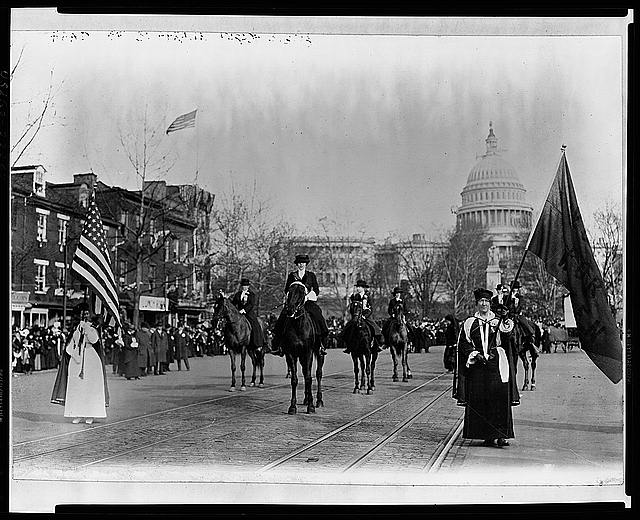
4. image credit: Head of suffrage parade, Washington, D.C.

small announcement: thesis blog goes live

10 Thursday Jun 2010

Posted by Anna Clutterbuck-Cook in my historian hat

≈ Leave a comment

Tags

blogging, simmons, thesis


For those of you who are involved with or otherwise interested in my thesis research, I have established a second blog through which to stay connected with my oral history narrators and keep folks updated on my research activities. The blog can be found at

oeoralhist.blogspot.com

Eventually, I hope the blog will become a gateway for access to the oral history interview recordings and transcripts that I plan to make available online through the Internet Archive. For right now, it’s a bare-bones operation explaining the purpose of the project, how to participate, and where the project now stands.

I’ll continue to post related booknotes and more personal observations here at the FFLA as well, but wanted to make all of you aware that this other resource is out there and that I will be using it down the road as the main portal for making my research available online.

theatrical amusements, circa. 1910s

02 Wednesday Jun 2010

Posted by Anna Clutterbuck-Cook in my historian hat

≈ 2 Comments

Tags

archivists, fun, history, northeastern

So as longtime readers are aware, I’ve been working for the past year or so on a scrapbook digitization project at Northeastern University’s Archives and Special Collections. I started at Northeastern in the fall of 2008 as a processing intern and have been there in one capacity or another since (I was just recently hired as a part-time Archives Assistant, in which capacity I get paid to do reference work and processing). Anyway, the scrapbook thing has been a very very part-time gig, but lots of fun because I get to look at photographs of young women doing turn-of-the-(twentieth)-century calisthenics in woolen jumpsuits and read turn-of-the-(twentieth)-century recipes for flapjacks.

Incidentally, if anyone knows what it meant to “go fussing” in 1910s-era Boston (as in: “I went out fussing at least once this past weekend”), let me know! Thus far, my investigations in slang dictionaries have failed.

So back to the content of Marjorie Bouve’s scrapbooks. This past week, I reached a run of playbills for dramas, operas, musical comedies and other theatrical entertainments engaged at Boston theatres from during the first few years of the twentieth century. I don’t have anything particularly insightful and/or deconstructionist to say about these — not being a theatre historian — but I did want to highlight a couple of gems for your amusement.

I was attempting to catalog these playbills in the scrapbook for our online database, and ran across one with no cover, simply the cast list and synopsis of acts, which read thusly (courtesy of Google Books)

A search through Google for “spoopju land” (I mean really, how many can there be??) landed me this little gem by Mssrs. Gustav Luders and Frank Pixley, published in 1901.

With the following table of contents

The other intriguing play was one called “A Messanger from Mars,” which I happened to show to Hanna (who also works at Northeastern). She said it sounded familiar so I did a search and came up with this New York Times story covering the premier of the show in London 23 November 1899.

The London production starred the same actor, Charles Hawtrey, who performed in the touring production Marjorie Bouve saw in Boston in 1903. Hawtrey later went on to star in the 1913 silent film version, which is what was niggling at Hanna’s memory when she saw the title.

Every so often, I step back from idle exploratory searches like this — searches that took me about naught-five seconds to perform at my workstation while I was waiting for my database to back up the data I’d entered — and remember that time Before The Internets (yes, I’m definitely old enough to remember B.T.I.) when this kind of thing would have required, at bare minimum, a trip to the local public library or (in this case) upstairs to the regular research library stacks, where you’d hope they had something in a book somewhere about one of these plays. An index to twentieth-century American theater that would point you toward the writer, which in turn might (if you were lucky) point you toward the actual play. Eventually.

It’s hard to hate Google too much, despite their octopoidal presence, when they make it possible to explore these works from anywhere you have access to the world wide web.

"i think i might be gay…now what do I do?"

29 Thursday Apr 2010

Posted by Anna Clutterbuck-Cook in my historian hat

≈ 1 Comment

Tags

gender and sexuality, history, northeastern

At one of my places of work, Northeastern University Archives & Special Collections, I’m in the early stages of processing the papers of Keri Lynn Duran (1962-1995), an AIDS activist and educator. On Tuesday, I came across two pamphlets from the mid-90s titled “I think I might be gay…now what do I do?: A Pamphlet for Young Men” and the corresponding “I think I might be lesbian…now what do I do?” (you can see updated versions of these — lesbian and gay — online at Advocates for Youth).

My reading of these was quite possibly colored by the fact I’d spent the afternoon reading literature on AIDS prevention and clinical drug trials . . . but I was struck by the muted tone of the pamphlets. They were in no way irresponsible or shaming: the text was affirming of non-straight sexuality, encouraged young people not to be pressured into settling on a single sexual identity, acknowledged the homophobia they may encounter, and provided additional resources.

But what I felt was missing was, you know, joy.

I’m far from the first person to suggest that our cultural attitudes toward the sexuality of children and young adults yo-yos back and forth from the clinical to the hysterical, from “just the facts” to “omg! think of the children!” without a lot of room left for pleasure. For embracing human sexual intimacy as one of the great joys in life. (See, for example, Jessica Fields, Judith Levine and Heather Corinna for starters.) And I understand the urge — particularly in the age of lethal sexually-transmitted diseases — to take a public health approach and deluge young people entering sexual maturity with the information to protect themselves from these infections (as well as from unintended pregnancy, physical and emotional abuse, etc.). But in dumping all of this cautionary information on top of them, while freaking out every two seconds about their sex lives (it constantly amazes me how much adults in the media enjoy speculating about the sex lives of youngsters), we somehow forget to talk about how freakin’ awesome sex is.

And I’m not talking about how “hot” or “sexy” sex is — as in “girls gone wild,” performative sex. I’m talking about, you know, why all of us everyday folks (the people who don’t look like the models in Vogue or GQ) enjoy sexual intimacy with our partners. We don’t talk about why sexual intimacy is, at the end of the day, worth pursuing if engaging in sexual activity truly entails all the risks we tell young people it entails: a broken heart, a viral infection, an unplanned pregnancy, possible death.

I believe this is because our culture views young people as sexually insatiable. We assume they’re perpetually horny. And we assume that, being horny, surrounded by other equally-horny teenagers, they automatically (magically?) know how to access all of the enthusiastic, joyful, athletic (dare we say “innovative, bordering on the avant garde”?) sex they want whenever and with whomever. We somehow (I guess?) imagine that young people have access to the language to talk about their desires, their loves, what turns them on, who turns them on, how to act on those feelings even though I doubt that picture of adolescence is one most people remember from their own teenage years.

Or possibly we don’t invoke pleasure, joy, and desire in these conversations because we often still struggle to articulate them for ourselves — let alone feel confident enough to speak of them to young people with less experience and even more questions than ourselves.

This silence makes me sad. Growing up, it seems to me, is scary enough without adults constantly taking it upon themselves to remind young people just how scary it is. Again, these pamphlets were providing encouraging information to young people they assumed were already struggling. And none of their advice seems, to me, particularly misplaced. They’re not wrong in what they do provide. But . . .

I just wish the answer to “now what do I do?” (for all teens, regardless of orientation) could be a little less like a public service announcement and a little more, well, more confident in teens ability to grow into their adult sexuality with grace — stumbling along the way, to be sure (we’re all human, after all, teenagers too) — but with generosity, tenderness, energy, creativity, passion, resilience, intelligence, and joy. Backed up by the message that we’re available in the background to listen, converse, support, and provide information and resources whenever they might need them.

But really, we shouldn’t forget to mention the joy.

from the archives: "to lady patrons"

31 Wednesday Mar 2010

Posted by Anna Clutterbuck-Cook in my historian hat

≈ 4 Comments

Tags

archivists, boston, history, northeastern

Working on my digitization project yesterday, I came across this announcement printed in a theater program for a production of Shakespeare’s King Henry V performed at the Hollis St. Theatre here in Boston in April of 1901.

TO LADY PATRONS

The established rule at the Hollis St. Theatre, requiring ladies to remove their hats, bonnets, or other head-dress while witnessing the performance, applies to all parts of the auditorium, including the boxes and loges. It is essential to the comfort and convenience of all of our patrons in general that this rule be strictly enforced.

Ladies who are unwilling or unable to conform to the rule are earnestly requested to leave the Theatre without delay, and to recieve the price of their ticket at the box office.

I’m sure someone who knows a great deal more about theater history than I do could talk at more length about the shift in attitudes this represents in the cultural acceptance of women attending the theater and, bless me, being encouraged to sit in a public space with bare heads! I think my favorite bit is the “earnestly requested,” as it has such a polite imploring tone. Contrast that with the “turn off your cell phone” announcements today, which are so often couched in cajoling humor. Not that one method is better or worse, but I do think it says something about the audience that the managers of the theater expected their plea to be taken seriously.

researcher @ work: pictures from Oregon

13 Saturday Mar 2010

Posted by Anna Clutterbuck-Cook in my historian hat

≈ Leave a comment

Tags

photos, thesis, travel

It’s Friday afternoon at the end of week one and I’ve taken a break from the 1970s to drive three miles up the road to the Green Springs Inn, where the coffee is horrid and the marionberry pie is superb . . . and most importantly, where I can enjoy internet connectivity indoors instead of perched on a park bench in the snow outside the local one-room schoolhouse!

Here is one of the five cabins that house students during the fall, and visitors year round; this is the cabin I stayed in as a student (taken from the porch of the cabin I am renting on this trip); I was in the tiny room next to the woodshed that looks like a mudroom because it was until they modified it to house a fifth student! Everyone here is grateful for the snow because they’ve had such a dry winter thus far that there is talk of fire season starting in April — months ahead of the expected timetable.

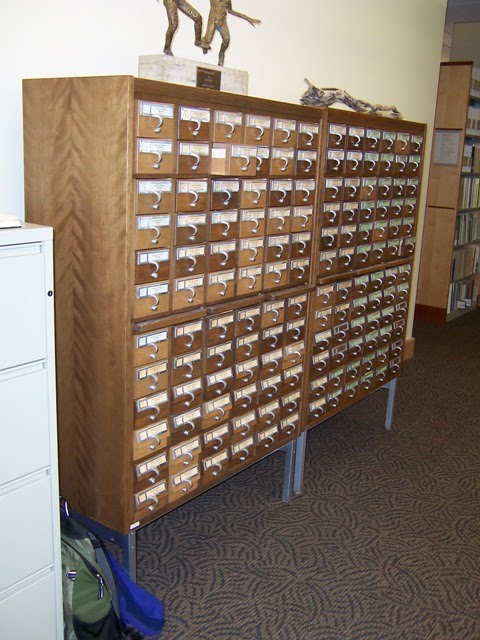
On Wednesday, I drove twenty-one miles down into the valley along Highway 66 (state highway, not the famous Route 66) to the town of Ashland, Oregon. How could you not love a town that proclaims “Libraries: The Heart of Our Community”? I was certainly smitten, which is why I stopped to take this photograph. I was on my way to the Ashland Public Library in any event, to see what they offer in terms of local history resources (not a lot in published form, it turns out). The reference desk was very courteous all the same, and the women staffing it were able to direct me to the Southern Oregon University’s Hannon Library, wherein is housed a a card catalog index of the Ashland Daily Tidings (the local newspaper). Yet another helpful reference librarian (yay reference librarians!) ushered me into a dark corner (metaphorically speaking) wherein was located this wonderful analog card catalog — yup, they really do still exist!

Sadly, the Daily Tidings (or whomever indexed it) did not see fit to print any stories about the Oregon Extension directly, but I did find a few stories from the late Sixties about the influx of hippies (yes, indexed under “hippies”) from the Bay Area. The locals seemed mostly perplexed rather than truly offended; they must have grown inured soon enough since by 1970 all references to hippies per se vanished. I plan to go back armed with the names of particular local communes and investigate some more tomorrow.

The folks here have been warmly welcoming and generous with their time and their records. My historians heart warms with a frisson of excitement at being able to go through “unprocessed” (in archives-speak) materials related to the early years of the OE, but it’s also a little terrifying to be entrusted with file boxes of other folks’ papers like this.

John Linton, one of the professors here (who arrived in 1981 and is thus, for now, outside the scope of my oral history project…in the future that may change!) has wandered by a couple of times and on his way past exhorts me to “do good work!” I’ll do my best, guys! You’re definitely giving me lots of great stuff to work with. Now I just have to live up to it!

On to week #2…

"by my word this is surprising news"

08 Friday Jan 2010

Posted by Anna Clutterbuck-Cook in my historian hat

≈ Leave a comment

Tags

blogging, history, humor

The city of Westerminster (UK) is serializing the diary of a nineteenth-century wharf clerk, Nathaniel Bryceson, online with the appropriate daily entries for the year 1846. His entries for the 4th and 5th of January, for example, read:

Morning, went to Tillman’s Coffee House, Tottenham Court Road, to read newspaper. From there to the Old Bailey to see preparations for the execution of Martha Browning tomorrow. After dinner took walk with Ann Fox across Westminster Bridge to Horsemonger Lane County Gaol, to see if any preparations were being made for the execution of Samuel Quennell tomorrow, but such was not the case. Returned back over Westminster Bridge, through St James’s Park, and continued walk through the Green and Hyde Parks. There rested ourselves on an old seat opposite one of the gates. Returned home through Oxford Street. Granny Shepard bought me a pair of worsted stockings for 1s 2d. Ann gave me a shilling off what she owes Granny, leaving only 8d unpaid.

followed the next day by Bryceson’s descriptions of the executions,

This morning at 8 o’clock the woman Martha Browning expiated her crime on the scaffold in the Old Bailey, for the murder of Elizabeth Mundell on the 1st of December last. The culprit showed great presence of mind on the occasion and ascended the gallows with a firm and steady step, and without any assistance. The body was cut down at 9 o’clock and Calcraft, the executioner, took his departure from Newgate to Horsemonger Lane County Gaol to offer his services for a similar occasion, namely to put in force the sentence of the law against Samuel Quennell for the murder of a shipmate, by shooting him in Kennington Lane. The execution took place on the top of the Prison over the front gates precisely at 10 o’clock. The culprit behaved himself becomingly on so solemn an occasion and ascended the scaffold without assistance. Remarks: this is the first execution of a female that I ever recollect in my time, also the first at Horsemonger Lane, and likewise the first time that two executions took place in the one day, to my recollection.

The transcribed diary entries are augmented by visual images from the period and places described in the entries, as well as occasional editor’s notes.

Information about Nathaniel’s life, the diary as a physical object, and the digital project, can be found at the City of Westminster Archives Centre website.

via Londonist.

← Older posts
Newer posts →
"the past is a wild party; check your preconceptions at the door." ~ Emma Donoghue

Recent Posts

  • medical update 11.11.22
  • medical update 6.4.22
  • medical update 1.16.2022
  • medical update 10.13.2021
  • medical update 8.17.2021

Archives

Categories

Creative Commons License

This work by Anna J. Clutterbuck-Cook is licensed under a Creative Commons Attribution 3.0 Unported License

Meta

  • Create account
  • Log in
  • Entries feed
  • Comments feed
  • WordPress.com

Blog at WordPress.com.

  • Subscribe Subscribed
    • the feminist librarian
    • Join 37 other subscribers
    • Already have a WordPress.com account? Log in now.
    • the feminist librarian
    • Subscribe Subscribed
    • Sign up
    • Log in
    • Report this content
    • View site in Reader
    • Manage subscriptions
    • Collapse this bar