• anna j. clutterbuck-cook
  • contact
  • curriculum vitae
  • find me elsewhere
  • marilyn ross memorial book prize

the feminist librarian

the feminist librarian

Category Archives: think pieces

In praise of context

14 Sunday Jun 2009

Posted by Anna Clutterbuck-Cook in think pieces

≈ 2 Comments

Tags

books, gender and sexuality, librarians, politics

So far this month, two articles on a Milwaukee-area book-banning (and potential book-burning) kerfluffle have come across my virtual desk — a piece from the ALA website, and a more recent article from the books page of the Guardian. Particular points should be awarded to the Guardian, I feel, for their deadpan quotation of some of the more hyperbolic charges made by the Christian Civil Liberties Union about the threat certain young adult novels pose to the good citizens of West Bend, Wisconsin, simply by remaining accessible in the public library (more below). As the ALA reports:

Milwaukee-area citizen Robert C. Braun of the Christian Civil Liberties Union (CCLU) distributed at the meeting copies of a claim for damages he and three other plaintiffs filed April 28 with the city; the complainants seek the right to publicly burn or destroy by another means the library’s copy of Baby Be-Bop. The claim also demands $120,000 in compensatory damages ($30,000 per plaintiff) for being exposed to the book in a library display, and the resignation of West Bend Mayor Kristine Deiss for “allow[ing] this book to be viewed by the public.”

This claim follows unsuccessful attempts by area citizens to get the library trustees to remove the offending material from the library: in a June 2 vote of 9-0, the trustees decided to “maintain the young-adult collection as is ‘without removing, relocating, labeling, or otherwise restricting access’ to any titles.”

As Allison Flood at the Guardian reports in more detail, the offending title which the CCLU wishes to publically burn (publically burn!!!) is a young adult novel that deals with issues of nonstraight sexuality and violence inspired by homophobia and racism:

The offending book is Francesca Lia Block’s Baby Be-Bop, a young adult novel in which a boy, struggling with his homosexuality, is beaten up by a homophobic gang. The complaint, which according to the American Library Association also demands $120,000 (£72,000) in compensatory damages for being exposed to the book in a display at West Bend Community Memorial Library, was lodged by four men from the Christian Civil Liberties Union.

Their suit says that “the plaintiffs, all of whom are elderly, claim their mental and emotional well-being was damaged by this book at the library,” and that it contains derogatory language that could “put one’s life in possible jeopardy, adults and children alike.”

“The word ‘faggot’ is very derogatory and slanderous to all males,” the suit continues. “Using the word ‘Nigger’ is dangerously offensive, disrespectful to all people. These words can permeate violence.” The suit also claims that the book “constitutes a hate crime, and that it degrades the community”.

While I haven’t read this particular work by Francesca Lia Block, I have read others and Block’s characters are often struggling in very messy ways with marginalization, poverty, their own complicated sexualities, and histories as perpetrators or victims of violence in one form or another. Her work, while often lyrical, is not for the faint-of-heart. It has never particularly spoken to me, but as an author she commands a wide audience of teens and adults who find her characters compelling.

What I find interesting about this lawsuit — based, at least, on these two news stories — is the way in which the CCLU has (1) adopted the language of the political left to frame their complaint and (2) the way in which they conflate hateful actions with descriptions of hateful actions. While I suspect that what traumatizes the offended parties is Block’s affirmative depiction of characters with nonstraight sexual identities, and possibly (knowing her other works) instances of drug use, sex scenes, and the old standby, vulgar language, instead they claim to be concerned about the use of words such as “faggot” and “nigger.” This isn’t necessarily a surprising tactic, since the radical right has increasingly adopted leftist rhetoric in their effort to shift the culture wars in their favor.

What I find more stunning is their apparently inability to understand (or, possibly, their tactical decision to ignore) the difference between an actual, material act of violence or an act of speech that supports that violence and a work of fiction that depicts the reality of bigotry and violence in the lives of marginalized youth. Children face daily abuse at the hands of bullies for perceived or actual gender and sexual nonconformity; a novelist like Block, who depicts that violence in her work of fiction, is describing the reality of our children’s lives rather than advocating such abuse. If uttering the word “faggot” actually constituted a hate crime regardless of context, we would be incapable of speaking out against the use of that language by individuals who actually seek to do harm.

While this conflation of thought or depiction with actual illegal violent crime is not unique to the Right (Exhibit A: the campaign by some feminist activists during the 1980s to have pornography treated as violence against women, whether or not actual individuals had been harmed in the making of the piece), it seems to me that it displays a legalistic, overly-simplistic, atomized way of thinking that is more prevalent among conservatives than it is among those on the left. Another example that comes to mind is the approach of the MPAA rating board in assigning ratings to American films (see This Film is Not Yet Rated), and the members’ obsession with individual words or acts of sexual contact, rather than overall message conveyed. I find myself wondering if this is strategic blindness or an actual belief that a word or activity, devoid of its overall context, has a constant and unwavering effect (whether positive or negative).

As an historian (among other things) I have to cry foul and point out that context, while certainly not everything counts for a hell of a lot — and as a librarian-in-training (among other things) I have to point out that words themselves are never, ever “hate crimes.” Words are just words: it’s what we do with them that makes all the difference in the world. Francesca Lia Block has done many beautiful things with the words available to her, and in my opinion her work is the opposite of a hate crime: it has made the world a better place.

Photo credit: “Mercy! Books Burning” (c) Catherine Jamieson @ flickr.

"Did You Know?": Am I crazy or is this xenophobic?

13 Saturday Jun 2009

Posted by Anna Clutterbuck-Cook in think pieces

≈ 2 Comments

Tags

education, politics, simmons, web video

This web video pops up in my Simmons library science courses at least once a semester and, predictably, it turned up again today in the first session of my technology course.

Reactions in class were divided between, well, me and everyone else who spoke up.

Watching the video this time around, in the context of other reading I’ve been doing about conservative fears of a European “demographic winter” and non-Western population growth, I couldn’t shake the feeling that the way this data was presented had a certain element of xenophobia — specifically fear about the U.S. being overtaken intellectually and economically by Asian countries like India and China.

I was also struck by the way it frames achievement by conventional educational terms (for example, IQ scores and the concept of education as job training). The fear of non-American young people “out performing” American students has a long history in the American discourse about education (think of Cold War anxieties about Soviet students with higher test scores than American students). Watching the video in light of these two contexts (fearmongering demographic debates and anxiety about academic performance on the international stage) makes me distinctly uncomfortable about the way this data is presented and the way it is offered, for the most part uncritically, in our library science classes as a wake-up call for the future of information organization.

The other students in class seemed to think I was reading the film too negatively, and offered an alternative reading to the effect of, “look how much human potential we have in the world — let’s make the most of it!” Yet at the same time, they, too, were voicing competitive anxieties about how Americans can’t afford to rest easy in the assumption they have the technological advantage — an anxiety that I feel buys into an “us vs. them” framework that can slide into, well, xenophobia and isolationism. Particularly in a period of economic constraint.

Thoughts?

Repro rights for geese?

02 Tuesday Jun 2009

Posted by Anna Clutterbuck-Cook in think pieces

≈ 1 Comment

Tags

boston, feminism

Last spring, Hanna and I had lots of fun on gosling spotting on our frequent walks along the Charles esplanade. As April came to a close and we cruised into May, we were looking forward to more baby geeses! Except . . . none were to be found. We were confused. Had we forgotten when the hatchlings appeared? We were worried. Was some virus wiping out the populations of Canadian geese? Except we saw plenty of adult geese and adult ducks all over the city, so some sort of bird pandemic didn’t seem to be the case.

Then, finally, we stumbled onto the answer in a Boston Globe article. Among the tactics city officials are using to keep the goose population down is an effort to keep eggs from hatching by coating them in corn oil, which according to the Canada Goose Hall of Shame website is called “egg addling” and is considered by many animal rights organizations to be a favorable alternative than slaughter or gassing. Which, okay, I can kinda buy. But after a couple of weeks of stewing about the story Hanna and I keep coming back to it and feeling peeved. It seems stingy of us humans to aggressively control the population of birds in our public parks just because we don’t like walking in bird poo; the geese have a right to enjoy our green spaces as much as we do! And while I’m, you know, for family planning I’m not for coercive population control measures — don’t geese have reproductive rights too? And don’t those reproductive rights include not having their eggs destroyed without their consent? I ask this sort of tongue-in-cheek, but not entirely . . . how are we as feminists committed to reproductive rights and justice to think about population control of non-human species?

In which I am completely baffled

01 Monday Jun 2009

Posted by Anna Clutterbuck-Cook in think pieces

≈ 1 Comment

Tags

children, education, gender and sexuality, politics

According to the New York Times, hugging is the new scourge of American teenage social conventions.

Now, okay, in my experience the NYT tends to blow its “life & style” reporting totally out of proportion: whether it’s women’s communities or sexuality, or the supposed life and times of the American Teenager, their discussion of current trends is heavily skewed toward creating a sensational story rather than accurately narrating peoples lives. I realize I should just expect this and blow it off, but sometimes it really gets under my skin, and this is one of those times.

I mean, last I checked, hugging — as long as it’s wanted, affectionate touch — was a relatively harmless way to spend one’s time. It’s usually indicative of positive, rather than negative, social interactions. But clearly, I was being naive.

A measure of how rapidly the ritual is spreading is that some students complain of peer pressure to hug to fit in. And schools from Hillsdale, N.J., to Bend, Ore., wary in a litigious era about sexual harassment or improper touching — or citing hallway clogging and late arrivals to class — have banned hugging or imposed a three-second rule.

Parents, who grew up in a generation more likely to use the handshake, the low-five or the high-five, are often baffled by the close physical contact. “It’s a wordless custom, from what I’ve observed,” wrote Beth J. Harpaz, the mother of two boys, 11 and 16, and a parenting columnist for The Associated Press, in a new book, “13 Is the New 18.”

“And there doesn’t seem to be any other overt way in which they acknowledge knowing each other,” she continued, describing the scene at her older son’s school in Manhattan. “No hi, no smile, no wave, no high-five — just the hug. Witnessing this interaction always makes me feel like I am a tourist in a country where I do not know the customs and cannot speak the language.”

. . .

Comforting as the hug may be, principals across the country have clamped down. “Touching and physical contact is very dangerous territory,” said Noreen Hajinlian, the principal of George G. White School, a junior high school in Hillsdale, N.J., who banned hugging two years ago. “It was needless hugging — they are in the hallways before they go to class. It wasn’t a greeting. It was happening all day.”

And just in case you thought (as I do, actually, despite protestations to the contrary) this was yet another instance of old fogies being unhealthily interested in, and hysterical about, the cultural expressions of youth,

There are, too, some young critics of hugging.

Amy Heaton, a freshman at Bethesda-Chevy Chase High School in Bethesda, Md., said casual social hugging seemed disingenuous to her. “Hugging is more common in my opinion in people who act like friends,” she said. “It’s like air-kissing. It’s really superficial.”

Read the entire article here.

There are many layers of wrong about the way this story is being narrated, one of which is the way it is being reported as a newsworthy phenomenon in the first place. Conventions of touch change over time and from culture to culture; as one letter to the editor pointed out, in Europe teenagers tend to show more casual physical affection with each other than American teenagers have, at least historically. People who work with immigrant and exchange students can tell you that young people who come to America from certain parts of the globe — Europe, Latin America — are surprised by what the perceive as the lack of physical affection between their American peers, while young people from other cultures — for example, Japan — have higher expectations of personal space, and find Americans to be physically intrusive.

While an international, historical perspective can understandably get lost in a fluffy news story, much more upsetting to me, in terms of media perceptions of young people, is the way adolescent physical contact is portrayed as problematic. There are three facets to this, all of which I find fascinating and extremely frustrating.

1. “Touching and physical contact is very dangerous territory.” I’m most floored by the way this article totally fails to meaningfully distinguish between erotic and non-erotic touch, and also by the way it implicitly equates erotic touch with “very dangerous territory.” This isn’t unexpected, given adult hysteria about teenage sexuality, but nevertheless it pisses me off. The students in this article, who have a complex understanding of different kinds of touch and what social and personal meanings they carry, come across as vastly more mature than the school officials who hint at promiscuity. Rather than respond by clamping down, I’d say this is a perfect opportunity to open conversations about how people can communicate about wanted and unwanted touch, and respect each others’ preferences for the same.

2. “If somebody were to not hug someone, to never hug anybody, people might be just a little wary of them and think they are weird or peculiar.” Closely related to the spectre of sexual harassment is the possibility of bullying (which is very real) that gets invoked as a reason to curtail physical contact. This is lazy thinking, lazy educating, and lazy supervising. If you’re worried about bullying, then get serious about reducing the abuse of power exercised by some students over others, and protecting the vulnerable students so that they don’t live their lives in fear. Imposing arbitrary limits on touch will not make the problem go away, it will just shift it elsewhere — possibly somewhere less visible than the school hallway.

3. “To maintain an atmosphere of academic seriousness.” This is the most laughably transparent exercise of adult power in the interest of social control. I realize I’m prone to seeing schools as sites of institutional power and violence but oh, please. Touch and positive relationships are antithetical to both intellectual endeavors and “seriousness”? Some of the adults in this story need to re-think their priorities a little. As one letter-writer suggests, “those principals need to lighten up and give kids a chance to work out for themselves what is “needless” and what is important.”

No one asked me what to make of this ‘trend’ but I’m going to offer my two cents anyway (isn’t that what blogs are for?): I think young folks today are pretty much the same creatures we human beings have always been. That is, creatures capable of inefficiency, frivolity, social ineptness, and cruelty — and also creatures who by and large crave meaningful relationships with one another that include physical affection. I’d argue that casual touch, both inside and outside spaces of education, is not a distraction from learning or a trivial meaningless fad — but rather a valuable pathway toward discovering what kinds of physical intimacy feel good and communicate effectively what we desire to communicate. Instead of cracking down on physical affection, help young people find language to effectively express their desires.

Mother’s Day (Un)observed

11 Monday May 2009

Posted by Anna Clutterbuck-Cook in think pieces

≈ 3 Comments

Tags

domesticity, family, holidays, michigan

My mother, from whom I seem to have inherited an allergic reaction to formal, mainstream holidays/occasions of any sort, has never been very interested in celebrating Mother’s Day. It was such a non-event in my childhood that I suggested a few days ago we take Hanna’s parents out to lunch on Sunday and couldn’t understand why she nearly had a heart attack: I had forgotten that everyone and their mother (not to mention their third cousin twice removed) would probably have the same idea, on account of the holiday.

But of course, the fact that the holiday itself hasn’t meant a lot to me, or my parents, doesn’t mean that we don’t mean a lot to each other. So in a celebratory spirit (hey! it’s the end of the semester!), I thought I’d give my mom a shout out for a few of the things that (in my opinion) make her a great parent.

5. Good art supplies. My mother, who got her start in education working with preschoolers in the Greenville, Michigan, Headstart program during the 1960s, has always appreciated the importance of decent materials for creative endeavors. One of my memories from early childhood is the regular trip to the art store to replace the heavily-used colors in our Prismicolor pencil set. We always had scissors that cut, glue that stuck, pens that weren’t dried out, and enough paper for whatever projects we had a mind to pursue.

4. Sharp knives. In some ways the same principle as above: my mother’s argument was always that rather than remove sharp objects from the reach of children, you helped them learn how to use them safely. Hence the swiss army knives we all got the Christmas we were six years old. And the lessons in using the microwave, stove, kitchen knives, washer and dryer, and the power tools. More broadly, I appreciate that Mom and Dad were focused on helping us acquire the skills we wanted or needed to be independent actors in the world, from the days when we were very, very small.

3. Books. There’s a reason that the sound of someone reading aloud, whether in person, on the radio, or a book on tape, has an instantaneously soothing effect almost regardless of what it is they are reading — as Hanna says, “they could be reading the phone book and I’d still be happy to listen to them.” Thanks, Mom, for reading, reading, reading, and surrounding us with books. My life is so much the richer for it.

2. Never asking what I planned to do with a Women’s Studies or Library Science degree. Majoring in Women’s Studies as an undergrad, I got to hear lots of colleagues tell stories about parents who didn’t understand what possible use the degree would be in the “real world.” I have always been grateful that I never had stories of my own to swap in this regard. Likewise, it’s amazing to me how many folks I’ve met since moving to Boston whose parents were skeptical about the utility of a library science degree — or even more simply, of their child’s desire to go into the field and spend their life with books, manuscripts, etc. My parents (closet librarians at heart, I feel) never blinked at the decision, and at times express more enthusiasm than I can muster at the possibilities for my future career!

1. Trust. Above all, I’m incredibly grateful for the way in which my parents have trusted all of us kids to find our way in the world, and to find (and create) living spaces, new relationships, and learning and work environments in which we will, ultimately, thrive. That confidence is humbling and the older I am, the more I appreciate how rare a gift it has been.

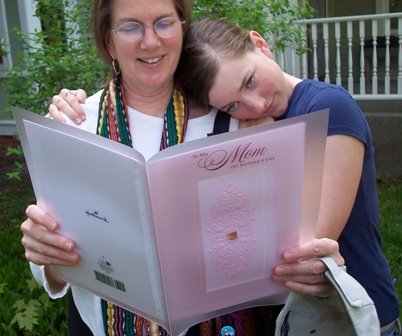
(Apologies to Mom and sister Maggie for re-using this tongue-in-cheek photograph; it was taken on Mother’s Day, 2005, incidentally the same day I graduated from Hope College.  The card was a joke from Maggie to Mom. The scarf my mother is wearing is, in my opinion, one of her more lovely fashion accessories).

"all of me, why not take all of me?"

01 Friday May 2009

Posted by Anna Clutterbuck-Cook in think pieces

≈ 3 Comments

Tags

feminism, masculinity, sexuality

Two further examples for the annals of “patriarchy hurts men, too.”

I’ll be honest. I became a card-carrying member of the feminist party (hehe) when I realized there were still people around who thought I should do and be certain things and not do or be certain other things on account of my being a girl. There’s nothing — bar threats to the health and wellbeing of my people — that makes me dig my heels in faster than someone telling me I “should” or “shouldn’t” in any way, shape, or form. At that point (late teens) I wasn’t thinking much about the way the guys I knew were also injured by the sexist “shoulds” and “shouldn’ts” that pervade our cultural milieu.

But it doesn’t take a degree in gender studies to realize that if women and girls are being told “be this,” then men and boys are being told “be that,” and that this sort of oppositional, essentialist conception of gender roles [1] sucks ass for everyone concerned. Not only do women and girls suffer from inequality based on sex and gender — guys struggle daily against the straight jacket conception of masculinity that limits their ability to be fully human actors in the world. One of the things I take great pleasure in as a feminist is that I have a usable worldview that not only allows but actually supports my desire to see men and boys as more than brainless sexbots driven by the desire to draw blood and get laid. Which, given the number of men and boys in my life (“hi guys! you’re awesome!”) really makes my life a helluva lot easier.

Not that I don’t believe that folks who don’t explicitly identify as “feminist” are incapable of seeing men as human beings. But I do believe that an ability to think critically about the messages that our various cultures send us about gender — and in this case, specifically what it means to be a guy — is an essential human skill. And one that does not come easily to folks who aren’t at least open to thinking about things from a feminist perspective.

See, when people don’t question the “common sense” notions of masculinity and femininity that dominate popular culture (not to mention being actively defended by conservative voices) then stupid shit like this happens:

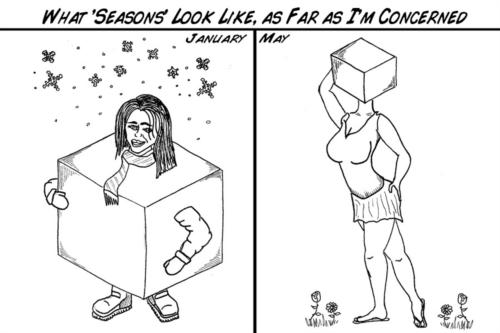
This editorial cartoon, drawn by Harvard Crimson cartoonist “Samual L. Clemens” was featured this week on the Crimson’s website (h/t to MK via twitter for the link). It employs, with no sense of critical self-awareness or commentary, the sort of ideas about women and their bodies that feminist activists have objected to since, well, forever. (Fun historical factoid: at the turn of the twentieth century, male patrons at the reading room of the British Museum protested the admittance of women scholars on the grounds that their female bodies were so distracting that male researchers wouldn’t be able to get any work done [2]) But I want to lay aside what this cartoon says about the worth of women in the cartoonist’s eyes (as MK pointed out, “It’s like wearing a big sign that says WOMEN: PLEASE AVOID ME AT ALL COSTS.”) and suggest we consider for a moment what this image says about the worth of men [3].

The take-away message of this cartoon about straight guys is that they are incapable of (and uninterested in) seeing the people to whom they are attracted sexually as whole persons. If a woman is bundled up in winter clothes, their bodies might as well not exist; if a woman is dressed in form-fitting, skin-baring clothes, then their head (read: personhood) disappears from view. This is a trope of male sexuality so prevalent that a lot of women have bought into this narrative of how men’s sexuality works, as evidenced by the calls for a “return to modesty” by a number of prominent women writers and activists [4]. In this view, dudes are incapable of integrating their physical, sexual desire for others into an understanding of other human beings as more than a useful means to the end of sexual gratification. I call bullshit. I call bullshit on the idea that men are incapable of caring about the women they are attracted to as whole persons: as incredibly sexy, active, physical presences and as human beings with thoughts, feelings, and distinct personalities. Regardless of the time of year, and regardless of what said object of desire is wearing at the moment she happens to cross their flightpath.

Mr. Clemens, do yourself a favor. Go out into the balmy spring day, enjoy people-watching, and enjoy every bit of the people you see: all the way from head to toe. And consider how awesome it might be if you could get to know them as actual human beings instead of just passing, headless bodies. See if practicing that sort of mindfulness doesn’t expand your horizons.  And maybe prompt you to question the messages you’ve been getting about your sexuality and gender. 

The other story that caught my eye this week and made me think, “gee, we live in a culture with absolutely respect for men and boys as human beings,” was the word spread around the blogosphere that the New York Times review of the recently-released summer comedy “17 Again” contained the following caution: “17 Again” is rated PG-13 (Parents strongly cautioned). Girls are particularly cautioned.

I have not seen the film, and it’s not the sort of movie I’m generally eager to see anyway, so the point I want to make has nothing to do with the actual content of the film. The point is: why “girls particularly”? Assuming there is something potentially objectionable in the movie, wouldn’t a parent have cause to be equally concerned about their sons as their daughters being exposed to it? If, indeed, the objectionable content has some sort of gender-related ickyness (say, sexual violence against women, or sexual humor, or nudity, or whatever else people think fragile girlminds are incapable to taking in without severe trauma) . . . shouldn’t we be equally concerned about exposing boys to such experiences?

As commenter SarahMC over at Pandagon pointed out, the implicit message of warning girls specifically against seeing the film is: “Girls should not be exposed to cinematic depictions of misogyny. Boys, however, get extra butter on their popcorn w/ every ticket purchased.”

This gender-specific warning, like the Crimson cartoon, not only turns on the paternalistic view of women and girls Jessica Valenti recently described in her latest book The Purity Myth — it, like the cartoon — uncritically accepts a caricature of masculinity that assumes men either enjoy, are oblivious to, or untouched by misogyny.

Not. true. Spread the word.

UPDATE: MK offers her own response to The Crimson.  

* * * Endnotes * * *

[1] oppositional, essentialist conceptions of gender mean, in plain English, that the categories of “male” and “female,” and the people who fall into these two categories are seen as 1) opposite from each other in temperament, social roles, etc., based on their gender and 2) that these states of being are natural due to our biological sex.
[2] Hoberman, Ruth. ‘Women in the British museum reading room during the late-nineteenth and early twentieth centuries: From quasi- to counterpublic.’
Feminist Studies, vol.28 no.3 (Fall 2002), 489-512.
[3] I am assuming, given the pseudonym, that the imagined perspective in the cartoon is supposed to be that of a dude.
[4] See, for starters, Wendy Shalit’s
A Return to Modesty and Girls Gone Mild,, Laura Sessions Stepp’s Unhooked: How Young Women Pursue Sex, Delay Love, and Lose at Both.

In which I declare my love for Dahlia Lithwick

28 Tuesday Apr 2009

Posted by Anna Clutterbuck-Cook in think pieces

≈ 1 Comment

Tags

children, feminism

The final weeks of the semester have officially made me incapable of composing even simple links lists, so the blog post ideas are piling up. But in an hour between classes in which to occupy myself catching up on my rss feeds, this post by fellow West Michigan feminist Rita tipped me off to Dahlia Lithwick’s recent column on Redding v. Safford Unified School District, Search Me: The Supreme Court is neither hot nor bothered about strip searches.

Now, I am an amateur SCOTUS junkie who also happens (ahem) to be a feminist interested in children’s rights, women’s sexuality and embodiment. So when the Supreme Court hears oral arguments on the legality of strip-searching a 13-year-old whose classmate had intimated she was in possession of (gasp!) ibuprofen, it’s like being handed an oreo cheesecake ice cream sundae. When Dahlia Lithwick weighs in with her very own account of the proceedings, it’s like adding fudge sauce, whipped cream, and graham cracker crumble to the top. To whit:

Editorialists and pundits have found much to hate in what happened to Savana Redding. Yet the court today finds much to admire. And even if you were never a 13-year-old girl yourself, if you have a daughter or niece, you might see the humiliation in pulling a middle-school honor student with no history of disciplinary problems out of class, based on an uncorroborated tip that she was handing out prescription ibuprofen. You might think it traumatic that she was forced to strip down to her underclothes and pull her bra and underwear out and shake them in front of two female school employees. No drugs were found. But even those justices lacking a daughter, a niece, or a uterus had access to an amicus brief in this case documenting the fact that student strip searches “can result in serious emotional damage” and that student victims of strip searches “often cannot concentrate in school, and, in many cases, transfer or even drop out.” Savana Redding, herself a data point, described the search as “the most humiliating experience” of her life. Then she dropped out of school. And five years later, at age 19, she gets to listen in on oral argument in Porky’s 3: The Supreme Court Says “Panties.”

. . .

Yet in recent years, the high court has slowly chipped away at the privacy rights of students—frequently based on the rationale that there were drugs!!! Somewhere in America!!! Drugs!!! Creating danger!!! (This led an annoyed Justice Ruth Bader Ginsburg to dissent in a recent case that the court was peddling “nightmarish images of out-of-control flatware, livestock run amok, and colliding tubas” to justify drug tests for any student with a pulse. )

Today’s argument features an astounding colloquy between Matthew Wright, the school district’s lawyer, and Justice Antonin Scalia, who cannot understand why “black marker pencils” are also considered contraband. “Well, for sniffing!” answers Wright. “They sniff them?” asks Scalia, delightedly. “Really?”

. . .

Nobody but Ginsburg seems to comprehend that the only locker rooms in which teenage girls strut around, bored but fabulous in their underwear, are to be found in porno movies. For the rest of us, the middle-school locker room was a place for hastily removing our bras without taking off our T-shirts.

Her penultimate observation? “Evidently teenage nakedness is only a problem when the children choose to be naked.”

Dahlia Lithwick, I am yours forever.

Seriously. Go enjoy the whole thing.

Conversation in the Blogosphere

20 Monday Apr 2009

Posted by Anna Clutterbuck-Cook in think pieces

≈ Leave a comment

Tags

blogging, feminism, gender and sexuality

Many of you who read my blog don’t necessarily spend a lot of time in the “feminist blogosphere,” I know . . . so the heated, often polarized, conversations that have been happening in that virtual space over the last couple of weeks are possibly completely off your radar. But to me they have been important. They have encouraged me to be mindful about how I interact with others in virtual spaces — on this blog and in comment threads on other blogs. They have challenged me to think about how to be open to learning in a spirit of humility while also refusing to let others set the terms of my own participation in the world of feminist activism.

I’m still thinking about what all of these conversations mean to me in terms of this blog and in terms of my participation in online communities generally. And I don’t feel ready, quite yet, to offer my own composed thoughts on the subject. I thought, therefore, that I would round up a few posts that have spoken to me on the issue of interpersonal conversation and debate and share them with you:

Miriam Perez, at Radical Doula, writes about why she blogs and why she refuses to be bullied into silence in relation to this conversation about comment threads and transphobia at Feministing.

(For further background, you can see this earlier Feministing post for links).

Rachel, at the Feminist Agenda, muses about a dynamic I try to keep in mind when participating in the blogosphere, both as a way to check my own defensiveness and as a way of understanding others’.

On a related note, MK asks when is comment-thread engagement worth the fight?

Mandolin, over at Alas, a Blog, writes about disliking “competitive conversation.” As someone who likewise finds oppositional debate both exhausting and unproductive, I really appreciate the distinction she draws between collaborative discussion of divisive issues and debate that is polarized.

More to come (hopefully) as the semester winds down and I have more time to think about the nature of this particular virtual space in relation to activism, online communities, and my daily life.

File this one under "patriarchy* hurts men too."

13 Monday Apr 2009

Posted by Anna Clutterbuck-Cook in think pieces

≈ 1 Comment

Tags

children, feminism, masculinity

Stupid headlines like this irritate the hell out of me:

This was a story in the Boston Metro (free transit newspaper) today that Hanna and I noticed while riding the T out to Harvard Square. The entire text of the article reads as follows:

China’s budding gender gap — inspired by decades of one-child-per-family law, and the resulting rise in baby-girl abortions and infanticides — could develop into an increase in violent crimes, a new study reports.

With 32 million more young men than women, and the imbalance only growing, sociologists worry about a coming spike in crime, when men take out their frustrations on an increasingly wealthy population.

The report paints a grim picture for a modernizing China. “If you’ve got highly sexed young men, there is a concern that they will all get together and, with high levels of testosterone, there may be a real risk, that they will go out and commit crimes,” lecturer Therese Hesketh told the AP.

I was particularly charmed by the boxed quote attributed to “Researchers” (names please? the title of this report? anything that would reliably enable readers to fact-check the study**?) which read: “Nothing can be done now to prevent this.”

Because, you know, dudes are just violent animals without wives to keep them in check.

I dunno, people. I personally have faith that guys in China may find another, less violent, solution to the dearth of women.

*or “sexism” or “kyriarchy” if you prefer.  


**A little searching on the internet tracked the study I’m assuming they refer to back to the British Medical Journal. 

Wednesday Reflections on WAM!2009

08 Wednesday Apr 2009

Posted by Anna Clutterbuck-Cook in think pieces

≈ 1 Comment

Tags

feminism, gender and sexuality, politics

A week (plus) after WAM!2009, I’m finally getting around to blogging a few reflections. This was my second year attending WAM! Last year I went as a volunteer; this time I paid my way and wandered around the Stata center free of responsibility. It’s an awesome conference for feminist people-spotting and in general spending time talking about all that stuff I spend my time thinking about virtually 24/7 (in some form or another) with people who are as obsessed as I am. Either we aren’t as crazy as we likely all feel most of the time, or there are a lot of us crazies wandering free on the streets — frankly, I’m not sure which is the more appealing option!

I’ve learned over the years that my stamina for conference sessions is limited: I reach “critical mass” when it comes to new and stimulating ideas fairly rapidly. So I limited my participation to two panel discussions and an informal lunch caucus — and came away with lots to think about!  

The panels I attended on Saturday were “In/Out of Focus, Broadening a Feminist Lens: Gender, Non-Conformity and the Media” and “Feminist Blogging: From Journalism to Activism in Election Years and Beyond.” Between the two panels, I joined an informal group of conference-goers at a lunch caucus to discuss “feminist sex ed.” This lunchtime event, which I only found out about on the day of the conference, was both inspiring and dispiriting. On the one hand, it’s awesome to hear from those in the diverse world of sexuality education (from schoolteachers to community organizers to college professors and sisters looking for resources to pass on to their younger siblings) about the work they are doing. On the other, it’s frustrating to hear how much misinformation, legal restriction, community fear, and lack of resources and time limit possibilities.

One of the things that really struck me in the lunch caucus was folks’ resistance to “co-ed” (non-gender-exclusive) sexuality education. As I have argued previously, the problem with sex-segregation in educational spaces is that young people who do not identify as male or female, or do not feel comfortable in environments in which everyone is presumed to be the “same” in some way based on sex/gender, are marginalized. I think it is particularly problematic in sexuality education, since the ostensible reason for separation is so that (hetero) girls and (hetero) boys won’t be subject to scrutiny and embarrassment in front of other-sex folks. But this presumption of increased safety and comfort in single-sex environments breaks down for anyone who is not straight or gender-conforming.

As Jessica Fields has documented in her book Risky Lessons, women and girls do face a disproportionate amount of misogynist harassment in sexuality education settings that often goes unchallenged. Yet I’m hesitant to accept that sex-segregation is the way to go in addressing this problem. If nothing else, because it reinforces the sexist idea that men and boys are naturally disrespectful, misogynist pigs for whom containment is the best strategy. A far healthier (and feminist!) approach, it seems to me, would be to tackle the problem of sexism and respect head-on. It should be our collective responsibility to make sex education spaces safe and affirming for every person — regardless of sex, gender, or sexual orientation.

This question of gender-segregated space and who is included was also a major topic of discussion in the first panel I attended “In/Out of Focus,” since the topic was gender-nonconformity. This was the panel I was most excited about attending at the outset, since the line-up included one of my favorite feminist authors and one of my favorite feminist bloggers. And it did not disappoint! 

What the reality of gender-nonconformity means for “women-only” spaces is far from settled, even in feminist spheres (as a recent thread on gender-neutral restrooms at Feministing amply illustrated).  I thought both the panel and the audience members who participated in conversation gave a lot of nuanced and valuable perspectives on how conversations about sex and gender in feminism can take place without fear or bigotry.  Miriam Perez (see “favorite feminist blogger” above) talked about the need to be mindful of whom we are including when we use words like “women” or “female,” and who we are excluding with that same language.  While no one is asking feminism to expunge the word “woman” from its reasons for being, it is also important to remember (as one of the panelists — Julia Serano? — pointed out) that “feminism and women are strongly related but not analogous.”  Even among a group of folks who identify in the feminine spectrum, it’s important to remember that not all of us have identical experiences of womanhood.  
The Q&A portion of this session was particularly strong, some of which Jill live-blogged over at Feministe.   You can also see live tweets from the session at Twitter #wam09gnc (oh, the crazy things one can do on the ‘net!). 
My final panel of the day, “Feminist Blogging,” introduced me to more new bloggers to add to my feminist-themed iGoogle pages (yes pages), and was a lively, reflective session on the lessons learned from the 2008 election about the interaction between the blogosphere and corporate media, between blogging and activism.  The conversaion also highlighted, for me, the way so many bloggers are able, through their blogs, to integrate their various life-works (parenting, employment, personal projects and passions, hobbies) in a web presence that somehow encompasses — or at least touches upon — all aspects of their personhood.  
The “Feminist Blogging” session helped me think, in a new way, about why keeping this blog has been so important to me over the last two years: As I make my way through graduate school, I often feel overwhelmed trying to find a path that will bring together the things that I care about into some sort of meaningful life and life’s work.  This blog is one of the few public spaces where I can mix and match freely, shuffling and re-shuffling the various bits until the balance feels right and the relationships between thoughts and experiences are clarified.  It’s an awesome privilege, and one which I am hopeful is mirroring the (albeit) messier “real world” version.

  
See the WAM!2009 conference site for a links list to further conference coverage.

← Older posts
Newer posts →
"the past is a wild party; check your preconceptions at the door." ~ Emma Donoghue

Recent Posts

  • medical update 11.11.22
  • medical update 6.4.22
  • medical update 1.16.2022
  • medical update 10.13.2021
  • medical update 8.17.2021

Archives

Categories

Creative Commons License

This work by Anna J. Clutterbuck-Cook is licensed under a Creative Commons Attribution 3.0 Unported License

Meta

  • Register
  • Log in
  • Entries feed
  • Comments feed
  • WordPress.com

Create a free website or blog at WordPress.com.

  • Follow Following
    • the feminist librarian
    • Join 36 other followers
    • Already have a WordPress.com account? Log in now.
    • the feminist librarian
    • Customize
    • Follow Following
    • Sign up
    • Log in
    • Report this content
    • View site in Reader
    • Manage subscriptions
    • Collapse this bar