• anna j. clutterbuck-cook
  • contact
  • curriculum vitae
  • find me elsewhere
  • marilyn ross memorial book prize

the feminist librarian

the feminist librarian

Category Archives: think pieces

tuesday morning economics: academia edition

02 Tuesday Nov 2010

Posted by Anna Clutterbuck-Cook in think pieces

≈ 2 Comments

Tags

economics, education, politics

Somewhere in me, I have a post percolating about the way my personal perspective on, and awareness of, economic issues has been subject to a steep learning curve in the last three years since I started graduate school.

In sum, while I had a fairly firm grasp on personal finance and budgeting when I entered graduate school, taking out the student loans necessary for my education, the high cost of living in the Boston metropolitan area, and the experience of bringing my material life together with that of another person for the first time raised new anxieties and questions. Additionally, attending graduate school for a professional degree — not to mention doing so in the context of a recession — means being caught up in a series of explicitly economic propositions. For the first time in my life, I have formed a relationship with education that is, in part, about economics. (More on why this is a new dynamic for me will have to wait for that later post).

I don’t have time, right now, to write at length about these personal experiences. But I do want to draw your attention to a fascinating series of posts over at (once again) Tenured Radical and Historiann about the politics and economics of academic employment.

  • Tenured Radical: Department of Economics: Observations on the Lack of Raises and Thinking Out Of the Box.
  • Historiann: Sister, Can You Spare a Dime?
  • Tenured Radical: Department of Economics II: Organize, Goddamnnit!
  • Historiann: So You Want to Get a PhD in the Humanities?
  • Tenured Radical: Department of Economics III: The Latest on Salaries and Benefits.

With good (read: lively!) comment threads on all of them for further reading. While the discussion here is primarily focused on faculty (teaching and research) positions, the economic climate of higher education inescapably touches those of us in the library field, particularly those who work at said institutions of higher education (not to mention that there are library positions with faculty status and tenure track).  In a more abstract sense, this conversation about the economics of education is a conversation about how to make a living doing intellectual work in fields that are not widely respected by the corporate sector (i.e. history! women’s and gender studies!) and are often seen as peripheral to education of “real” worth (see the catch-22? “real worth” here = financially lucrative; the market is seen as the neutral, unbiased arbiter of social as well as economic value).

So there’s your difficult-yet-worthwhile reading assignment of the week … I promise more pictures of cats and other miscellaneous fluff on Wednesday!

"genitals as signifiers": when birth is a "social emergency"

07 Thursday Oct 2010

Posted by Anna Clutterbuck-Cook in think pieces

≈ 6 Comments

Tags

books, children, human rights, sexual identity, sexuality

Yesterday I started reading Katrina Karkazis’ book Fixing Sex: Intersex, Medical Authority, and Lived Experience (2008).  Based on ethnographic research and review of the existing literature, Fixing Sex traces the twentieth-century medical treatment of individuals whom the medical profession identifies as “intersex.” Part one of the book discusses the understanding of, and treatment for, intersex conditions in the past — with a focus on the late twentieth century — and Part Two explores the decision-making process for children who are born with what doctors feel are sex and/or gender atypical bodies. Since Karkazis draws heavily on interviews she conducted with the parents of diagnosed children and adults who had been treated for various conditions, I’m excited about getting into this second half of her study, which I have just started this afternoon.

What I really wanted to share with you in this post, though, is several paragraphs from the first chapter of Part Two in which Karkazis describes the way myriad ways in which children born with no immediately apparent sex identity are experienced as a matter of “social urgency” by their parents and the medical community. I realize it’s kinda academic and somewhat heavy on the specialized terminology. But I think she’s packing some pretty important stuff into these paragraphs (pp. 95-97). Reading this narrative, I just felt an overwhelming sadness in my chest for these tiny persons whose very being is somehow construed as problematic — who cannot be incorporated into the human community, it seems — because they lack a clear “girl” or “boy” box in which to be situated.

No sooner than a baby is born its sex is announced by the attending clinician, based on an inspection and understanding of the external genitalia as either male or female. The process of sex identification at birth is one in which genitals are granted the power of synecdochic representation. Genitals, and the sex designation to which they give rise, create gender expectations for almost every aspect of an individual’s life. Not only are they usually the sole factor of sex determination but they are also assumed to correspond with fully and uniformly differentiated internal sex organs and are further charged with the task of signifying and predicting gender (whether identity, role, or behavior) and even sexuality. Put another way, if a baby is labeled “female” at birth, it is assumed that that person will grow up to understand herself as a woman, to dress and act like a woman, and to desire and have sex with men. Because this is the usual course of events, it is assumed natural. At birth genitals are thus viewed as symbolically and literally revealing the truth of gender.

At no time are the connections between genitals and gender more evident than when the genitalia of an infant either do not signal or else missignal sex. In these instances, atypical or, in clinical terms, ambiguous genitals are seen not as the representation of sex, but as the signal of a misinterpretation of sex. Without legible genitals, and thus without an evident or stable sex, an infant with “ambiguous” genitals flutters not simply between sexes but between genders and sexualities: such infants are neither readily male nor female, neither masculine nor feminine, and consequently neither readily homosexual nor heterosexual. So-called ambiguity is posited as the ground of sexual and gendered difference: a prediscursive, precultural dimension of bodiliness rather than an effect of a social system that requires a binary and incommensurate set of two sexes.

In other words, the body is seen as problematic and wrong because it fails to match our expected (and culturally-created) binary categories, rather than such a situation causing us to reconsider our categories that fail to take into account the existence of bodies that do not readily fit into them.

Bodies with atypical or conflicting biological markers are troublesome because they disturb the social body; they also disrupt the process of determining an infant’s place in the world. Gender-atypical genitals (and bodies) create anxieties about the borders of properly gendered subjects and a desire to reaffirm those borders. In a culture that requires clear gender division — a culture in which, to paraphrase Michel Foucault, we truly need a true sex — gender-atypical bodies threaten an entire system of laws, rights, responsibilities, and privileges built on the notions of discrete and binary gender.

As a result, clinicians often rush to stabilize the sex of infants with intersex diagnoses. The urgency of this undertaking, to which parents no doubt contribute, all too often overrides the joy of the birth, as an infant may be whisked away for medical tests before the parents have had any chance to bond with their baby. Parents may be discouraged from naming their baby before a gender assignment is made. To avoid using gendered pronouns, clinical caregivers may refer to the newborn as “the baby.” Because the announcement of sex is usually considered a prerequisite to naming a child, which is in turn a prerequisite to filing a legal notice of the birth, there is a sense in which biology determines — or confuses — a newborn’s entire social and legal identity. Physically alive but denied a sex and a name, the infant has no social existence. Personhood depends on gender assignment.

This might seem like a somewhat silly comparison, but for some reason scenario — in addition to making me almost physically ill at the thought of newborns being kept from their parents and made to undergo invasive tests — reminds me of our new kitty, whom we adopted last weekend from a foster home. We know the cat is female from the rescue organization, but we have not yet settled on a name. This hasn’t stopped us from lavishing love and attention upon our kitty, showering her with endearments and otherwise trying to let her know in no uncertain terms that she is now part of our family.  While I understand that, in our culture, most names are imbued with gender, terms of endearment (“sweetheart,” “love,” “darling”) are pretty universal — and with a preverbal infant it’s the tone not the words that matter anyway. It’s the sound of a familiar voice and the warmth it conveys that matter. The fact that the adults in this scenario seem to have lost sight of this due to being wrapped up in their own cultural anxieties makes me sick to my stomach.

Monica Cole, whose daughter has CAH, describes living with this uncertainty after the birth of her baby: “The doctor said we needed an ultrasound to determine our baby’s internal sex organs, and a genetic test, which could take a week. Well, how could we not know the gender of our baby for a week? I had a hard time not being able to say ‘he’ or ‘she’ and ‘baby’ was so distant. The hospital had only blue-striped or pink-striped baby hats, and the nurse asked which we would like to use. I picked a blue hat and decided to use a male pronoun. The nurses followed our lead of what pronoun to use, but they also placed both an ‘I’m a boy’ and ‘I’m a girl’ cards on the baby tub.

“How could we not know the gender of our baby for a week?” Cole’s question is posed as if the answer is self-evident: it was impossible for her, and the hospital staff that surrounded their family, to allow the child to exist without categorizing it. The trappings of the hospital stay (the birth announcements, the labeling of the baby “tub,” the hats — all of these were predicated on a gender binary; there was no third — let alone forth, fifth, sixth — option).

The birth of a baby with an intersex diagnosis is thus considered a social emergency in which medical experts are called on to intervene. The entire process could be understood as what the anthropologist Victor Turner has called a “social drama” with four stages: breach, crisis, redressive action, and reintegration. The breach or schism in the social order caused by the birth of a baby with atypical genitals (and this no obvious gender assignment) produces a crisis that must be addressed because it threatens social norms. The redressive action is the culturally defined process through which gender is assigned. Although not all parties may agree about the correct gender assignment for a particular infant all agree that the resolution of indeterminate sex is necessary [emphasis mine], and thus some accept a particular decision as final simply to bring about closure. Reintegration eliminates the original breach that precipitated the crisis. Treatment decisions remove biological or phenotypic atypicality, recreated a particular gendered world.

As this chapter and the next will reveal, clinicians and parents typically share the same goal, though their opinions on how to attain it may be diametrically opposed: to use the best medical technologies available to adapt the infant to life within the binary gender model; living as much as possible as a “normal” male or female.

It’s not that I didn’t understand that gender anxiety exists, or that the desire to sort individuals into a binary gender system is extremely compelling in our culture. I am not particularly surprised by this description of events. This does not mean that it fails to distress me. What appalled me about this passage was the degree to which none of the adults in this situation seem capable to stepping back and letting the situation be a non-emergency. In most of these instances, a healthy child has been born. This child is not in pain; this child is not suffering from something that could threaten their existence. There is no need for immediate medical intervention in order for this infant human being to survive. So can’t we all celebrate this new life? Can’t we welcome this tiny new person into the human family? Does a person really require a gender identity in order to be welcomed and cherished and loved for who they are?

As evidenced by Karkazis’ account, it appears that they do. And that, in turn, seems like a pretty sick commentary on the relative importance of human beings vs. categories in our culture.

What I can’t help thinking as I read Fixing Sex is what sort of birth experience these children would have if, instead of a general consensus that they must be made to conform these children were simply welcomed? What if, instead of confirming the parents’ likely anxieties about the sex atypical nature of their child, clinicians were able to calm parents down and encourage them to get to know their child as an individual rather than as a “he” or a “she”? I can’t help thinking that this would be a phenomenal place of strength out of which a child would have the best possible opportunity to thrive and become themselves in the world, rather than being taught — physically, emotionally, and socially — from the first moments of birth that conformity is a priority, regardless of the cost.

no single story is everyone’s story: thoughts on the "it gets better" project

05 Tuesday Oct 2010

Posted by Anna Clutterbuck-Cook in think pieces

≈ 1 Comment

Tags

blogging, gender and sexuality, politics

There’s been buzz around the feminist/queer interwebs about the It Gets Better crowd-sourced YouTube project, in which non-straight, gender-non-conforming folks are asked to film and post their stories about coming of age and leaving shitty adolescent experiences behind for better places.  This project was started by Dan Savage and his husband Terry in response to the recent high-profile suicides by teenagers who were bullied for being, or being seen as, queer.

There have been a number of, I think, valid critiques of the project: its limitations (is “it gets better” all we can offer kids in pain??), the implicit assumptions it makes (that things will get better, that adolescence universally sucks and adulthood is inherently superior).  One of the best breakdowns I’ve seen comes from TempsContreTemps @ (femmephane). Quoting at length, from the ten reasons the project (and specifically Dan and Terry’s contribution) makes her feel uncomfortable

1. The video promotes metro-centric and anti-religious sentiment. By aligning their bullying with the religiosity and “small-town mentality,” Dan and Terry tacitly reinforce the belief (especially rampant in queer communities) that the religious and the rural are more bigoted.

2. The message is wrong. Sometimes it gets better– but a lot of times it doesn’t get any better. Emphasizing that things will improve upon graduation is misleading both to young folks struggling and also to people with privilege who are looking on (or looking away).

3. Telling people that they have to wait for their life to get amazing–to tough it out so that they can be around when life gets amazing– is a violent reassignment of guilt. Dan Savage telling kids that if they don’t survive their teenage years they’re depriving themselves? What kind of ageist garbage is that? This quietly but forcefully suggests that if you don’t survive, if you don’t make it, it’s your own fault. It blames the queer for not being strong enough to get to the rosy, privileged, fantasy.

4. Stories of how your mom finally came around, over-write the present realities of youth. Arguing that in the future, the parts that hurt will be fixed, not only suggests that folks shouldn’t actually inhabit their own suffering but it also suggests that the future is more important. For a lot of folks, it doesn’t matter if your mother might come to love you and your spouse. It matters that right now she does not love you at all.

5. The rhetoric about being accepted by family, encourages folks to come out– even when coming out isn’t a safe idea. There is no infrastructure to catch you when your family reacts poorly. There is no truly benevolent queer family, waiting to catch you, ready to sacrifice so you can thrive. For a lot of folks, coming out doesn’t only mean that your parents will promise to hate your lovers– it means violence, homelessness, abuse.

6. Bar story: vomit. It’s no coincidence that this is the first place where Dan and Terry mention queer space. Codified queer-space, restricted to 21+, w alcohol? Try again.

7. We shouldn’t be talking, we should be listening. Telling our own stories from our incredibly privileged positions, overwrites youth experience.

8. Stories of over-coming adversity: no thank you. Narratives of how life was hard and but now is good, belittle lived pain, imply that a good ending is inevitable, and also undermine the joy and happiness in even bullied kids’ lives.

9. There is actually no path to change in this vision. Promoting the illusion that things just “get better,” enables privileged folks to do nothing and just rely on the imaginary mechanics of the American Dream to fix the world. Fuck that. How can you tell kids it gets better without having the guts to say how.

10. Then we get a baby and go to Paris? WTF? This is a video for rich kids for whom the only violent part of their life is high school. It’s a video for classist, privileged gay folks who think that telling their stories is the best way to help others. Telling folks that their suffering is normal doesn’t reassure them– it homogenizes their experience. It doesn’t make them feel like part of a bigger community, it makes them feel irrelevant.

Plus three (with a little help from my friends)

1. When we treat campaigns like this like they’re revolutionary, they undermine all the really amazing work that the youth already does for itself. Too often in the LGBT world, we are asked to thank our brave queer activist ancestors who made the world safe for us. That does have its place. But queer youth take care of themselves. They nurture and organize and love in order to save themselves and each other. Making famous messages legible as THE messages makes youth-work look minor, haphazard, or unofficial.

2. Campaigns like this lump everyone together. It doesn’t honor or respect the individuals. It turns them into icons. It sends confusing messages that we only attend to folks when their dead– when giving care doesn’t actually take anything out of us.

3. Broadcasting your story into the world, or congratulating others for broadcasting theirs is an anesthetized, misguided approach to connecting. We should help folks feel seen— by trying our hardest to see them.

It has been my experience that people are ashamed to help the folks they see as destitute. They are willing to let someone crash on their sofa for a night if they know that they have a back-up bed, somewhere else. They are happy to provide dinner, so long as they know you would be eating even without their generosity. It seems that if you’ve never been homeless or lost or hungry, if you don’t know what that feels like,  is too embarrassing to give things to people who might die without them– it is humiliating to hand someone the only food they’ve had all week.

You can read the whole thing over at (femmephane).

You can also read the follow-up post there.

And thanks to taniada @ Cynical Idealism for sharing the link on Tumblr and thus bringing it to my attention.

I haven’t been at a computer where I have multimedia access long enough in recent weeks (I can’t watch videos at work; I try to limit my recreational internet time at home) so I haven’t actually watched Dan and Terry’s video.  So this post isn’t really about the project or the specific video. Instead, it’s about the responses to the video; in particular, the frustration expressed by many that this project — particularly since it has Dan Savage’s name on it — has been getting so much attention, and the implications of that attention for folks whose stories don’t fit the narrative of “it gets better.”  As TempsContreTemps writes in her follow-up post:

I wrote my piece as a response to the way that Dan and Terry’s video went viral so quickly. I was thinking about 1) why it was that THAT video was so popular and liked and 2) why the video made me and many of my friends uncomfortable. Also, I wanted to know whether those questions were related. Did it seem so painful because it was so popular? I am not capable of, nor would I want to, destroy Dan and Terry’s message. There are a multitude of ways to be queer. Dan’s isn’t the only voice… and neither is mine.

Instead, I want to complicate the dialogue.

This post illustrates for me the point that so easily gets lost in discussions about whether X or Y representation of movement Z or community Q is accurate or not, privileged or not, silencing or not, worthwhile or not, illuminating, incisive, judgmental, blind, feminist, misogynist, transphobic, racist, ageist, ableist … or not. The point that any one piece of activism can be multiple things at once.  Just as any feminist critic of popular culture knows that a song or a movie or a phenomenon can embody contradictory messages about women, so too can a single piece of activism embody contradictory messages, and cause contradictory effects.

We can (and I think should) get angry at these bits and pieces of activism for not living up to our expectations that people working for social justice be aware of, and attempt to mitigate, their personal biases and blind spots.  In scholarly research, we are (ideally!) trained to situate ourselves self-consciously in relation to our research, and be as honest as possible about the context out of which we analyze our sources, the context out of which we construct our narratives, the context out of which we formulate plans of action. There is no universal context (except for the context of being an oxygen-breathing human being, and even there you might be able to convince me otherwise …) and context matters.  People who don’t exhibit some sort of awareness of their own context in relation to others’ are bumbling at best and willfully ignorant at worst.  And they do deserve to be called on that behavior.

However, too often the echochamber of the internets, or of your given subculture of choice, seems to amplify these critiques to the point at which any meaningful, life-enhancing contribution of the originating act (in this case, the It Gets Better campaign) is denied. The act becomes shameful and the people involved are shamed, all nuance is erased and in the end — in my opinion — the potential for rich, collaborative, transformational work is often lost. All parties involved are often partially responsible for this dynamic — in my experience, it is rarely wholly caused by the critic(s) or the original actor(s) but some combination of failing to listen and failing to respect that human beings are complicated, and often contradictory, and that all of those contradictions deserve a place at the table, in all their messy glory. ‘Cause that’s what life is all about.

So I’m really thankful that TempsContraTemps raised questions about the project in this particular way, and I’m hoping the project (or counter-projects, or spin-off projects, or parallels or out-growths or alternates or reappropriations) benefits from that critique.

Maybe, when I finally have a chance to go watch some of the videos, the representative voices will be as gloriously myriad as I know the queer community to be. And hopefully, each one of those stories will speak to someone else’s heart and let them know they are not quite so alone.

perhaps we overthought this?: preliminary reflections on higher ed, queer folks, my alma mater

02 Saturday Oct 2010

Posted by Anna Clutterbuck-Cook in think pieces

≈ Leave a comment

Tags

education, gender and sexuality, hope college

So I just finished reading the executive summary (PDF) of Campus Pride’s 2010 report on the status of higher education for lesbian, gay, bisexual and transgender people. I’m hoping to get my hands on the full report, but I can’t afford to purchase it for the $25.00 cover price at the moment, and it’s proving a little tricky to inter-library loan. So for the moment, the executive summary’s all I have to work with. Along with this really interesting interview on NPR with lead author Sue Rankin, which is what tuned me into the report in the first place (audio + transcript available at NPR).

This report has been getting a lot of media attention following the suicide of Rutger’s student, Tyler Clementi, who was apparently the subject of bullying and harassment by fellow students in part because of his same-sex relationships. It is surprising to many people — across the political spectrum I gather — that college campuses in general might be hostile places for non-straight and gender-non-conforming. On NPR Sue Rankin herself put it this way when interviewed by Morning Edition’s Ari Shapiro (emphasis mine):

Prof. RANKIN: One of the major findings that was surprising to me, actually -after 33 years of doing this – that one-third of the students, faculty and staff that participated indicated they had seriously considered leaving the institution.

SHAPIRO: Is that a result of bullying or just a place where they don’t necessarily feel comfortable being themselves? How does that play out?

Prof. RANKIN: We identify it as being climate. And climate includes things like discrimination and harassment. We asked not only what they experienced but how they experienced it. An interesting piece that complements, I guess, this particular unfortunate event at Rutgers, is that a lot of this is now happening in cyberspace, which may lead to the possibility of them being outed and then harassed in some way.

SHAPIRO: What are the other consequences of this kind of bullying?

Prof. RANKIN: We find that there are higher depression rates among LGBT students who don’t have support on their college campuses.

SHAPIRO: You say LGBT – Lesbian, gay, bisexual, transgender.

Prof. RANKIN: Yes. We find that students who are out in high school are actually returning to a more closeted space when they come to college. They have to…

SHAPIRO: Really?

Prof. RANKIN: …yeah – reopen those doors for themselves, because they’re afraid of what may happen if they have a roommate who is not supportive. So the importance of having visible resources on a college campus to assist students, I think, is tantamount. And right now only 7 percent of our institutions offer that.

SHAPIRO: Only seven percent of colleges have resources for lesbian and gay students?
Prof. RANKIN: That’s correct.

You can read the rest of Rankin’s interview at NPR.

Since I haven’t yet read the full report, I will simply offer a couple of tentative observations based on the executive summary.

The first is that, as regular readers of my blog will know, I have first-hand experience with campus climates that are hostile to queer students. Many of the folks who are active in trying to change the climate on Hope’s campus, as well as more distant observers of the anti-queer bigotry there have operated under the assumption that much of the hostility stems from the religious beliefs of influential members of the community and the Reformed Church of America (RCA), the denomination out of which the college originated and still maintains close ties. While the expression of and explicit justification for anti-gay sentiment on campus at Hope is unquestionably religious in its nature, this report is a caution not to treat Hope College as some sort of ultra-conservative outlier, completely out of touch with the mainstream world of higher education.  On the contrary, it appears from the personal stories and statistics in the report that Hope College’s struggles with harassment, bullying and other subtle forms of hostility and non-support for non-straight, gender-nonconforming folks is (sadly) much more mainstream that it would be nice to believe.

The second is the emphasis the report places on both the intersectionality of marginalization (non-straight, gender-nonconforming students who were not white, for example, experienced greater degrees of harassment and reported overall higher levels of negative experience than their white counterparts) and the importance of not becoming wedded to rigid identity categories when researching, reporting, and attempting to mitigate the negative campus climate for queer folks.  As the authors write in their executive summary when suggesting future “best practices”:

In the demographic section of the monograph we discuss the power of language in the LGBTQQ community and, therefore, encourage the use of language that extends beyond the binaries in all of the recommended potential best practices. As reflected in the results [of the survey], many participants did not fit the socially-constructed definitions of gender identity, sexual identity, and gender expression. Their comments suggested they are either pathologized or forced to develop a “different” sense of identity. In shaping our outlook, language instills and reinforces cultural values, thereby helping to maintain social hierarchies. While definitions facilitate discussion and the sharing of information, terminology remains subject to both cultural contexts and individual interpretation. As a result, the terminology that people use to describe themselves and their communities is often not universally accepted by everyone within these communities. Therefore, our overall recommendation is that we value the voices of those within our campus communities and use language that reflects their unique experience (p. 15 of the summary).

As a feminist activist and scholar of feminist and sexuality activism, I deal with the thorny question of identity language all the time. It is easy enough to respect the identity language people choose for themselves (just ask and honor their preferences!); it is much more complicated when one is trying to understand how collective identities emerge and transform over time.  One of the questions I ask myself often is whether collective identities always, by definition, end up excluding and/or marginalizing people. That is, can they only exist by virtue of defining themselves against other collective identities?  Hanna often argues this position, and I am hard-pressed — when looking at identity communities in practice — to disagree with her.  Human groups too often base their collective self-understanding on exclusion. 

I don’t, however, believe this is necessary for forming a meaningful sense of self-in-relation-to-others, and I see the way forward (towards creating a less hostile climate for non-conforming folks) as being a path towards community identity that is based on inclusion and the honoring of individual experience and voices, rather than exclusion and the silencing of individual self-understanding.  I’ll be interested to see, when/if I get my hands on the full report, where CampusPride’s researchers go with this issue of language, identity, and community.

quick hit: men + books

30 Thursday Sep 2010

Posted by Anna Clutterbuck-Cook in think pieces

≈ Leave a comment

Tags

books, masculinity


My friend Danika @ The Lesbrarian alerted me to this blog post at The New Yorker: What We Talk About When We Talk About Men Not Reading by Macy Halford @ The Book Bench. The post was written in response to a recent article in Publisher’s Weekly about the body count in the publishing industry: the fact that there are more women in the book trade then men. They speculate, “does the lack of men in publishing hurt the industry?” meaning, does the higher proportion of women in publishing mean that fewer books of interest to men will be published? (queue hand-wringing).


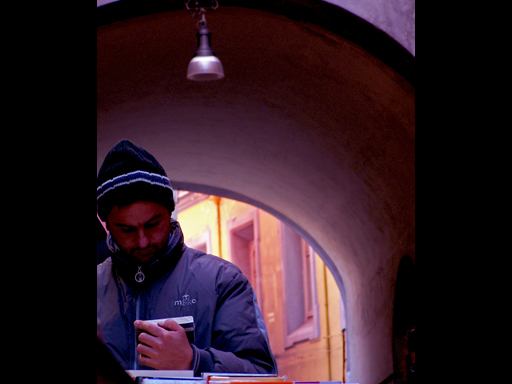
Man watching books
by Davide Rappucci @ Flickr.com

This anxiety, of course, could be situated within the context of conservative fears that feminism and/or economic and political gains for women equals a loss for men (as if it were a zero-sum game).  More specifically, though, Halford situates this article within late-twentieth century anxieties about whether boys and men, in fact, read books — and if they do, what kind of books they read. 

The article does nod at the problems of low pay and “gendered jobs” (and doesn’t nod at the fact that there are indeed many books “for men” published each year), but if we’re going to continue having this conversation, and it seems that we are, I think we should stop conflating the issues, of which there are four, at least:

  1. Reading practices among men.
  2. What gets published and what doesn’t (and the reasoning behind it).
  3. Low-paying, dead-end entry-level jobs in publishing (and the structuring of the entire industry).
  4. Women being willing to take these jobs and men not being willing and/or senior editors’ hiring practices.
Each of these needs more serious investigation before we can draw any conclusions, but I’m fairly certain that, however low reading rates among men are, the blame for them can’t be laid at the feet of the army of female assistants. So let’s stop talking about them as if they could.
A couple of observations I would add to Halford’s (really good) list of things we need to think about when we think about boys and men reading. 

The first is the fact that these conversations about boys and men reading are curiously separated from the conversations about men writing, and that both of these conversations about men + books are ahistorical.  With all the brouhaha recently surrounding Jonathan Franzen’s place in the American literary scene and the way we gender writing (by style, by genre, by level of “serious” literary merit), it seems clear to me that as a culture we sex-type the activities of writing and reading, expecting different types of writing and reading from individual people based on their gender.  Yet most of these conversations in the mainstream media take as a common sense fact that male and female human beings approach these activities differently, rather than questioning the belief that one’s sex, gender, and (implicitly) perhaps one’s sexuality shapes one’s reading and writing habits. In scholarly terms, this is known as “denaturalization”: taking something that we assume to be “natural” or “innate” and examining how and why we have come to this belief, and whether it is, in fact, true according to the evidence.

A little awareness of historical change over time might aid the cause of this denaturalization. Today, for example, it is “common sense” that men prefer non-fiction to fiction; in the late 18th and early 19th century fiction was considered dangerous for women’s physical and moral well-being. Reading was coded as a masculine activity; now it is coded feminine.  The fact that we have seen a shift over time in our understanding of how reading and gender relate suggests that what we believe to be true about men and their relationship (or non-relationship) to books and reading is at least in part culturally constructed.

Which leads me to my second observation: the fact that the assumption underlying the majority of these stories about men + books is that books for “men” and books for “women” are two distinct categories. Or, at the very least, that they are highly differentiated: perhaps overlapping a bit in the muddy middle, but on the whole make up an industry that is sex-typed by shelves of books for “him” and shelves of books for “her.” If we didn’t believe that gender mattered in relation to reading habits, then there would be no cause for alarm about the gender of the people involved in making publishing decisions — aside from a concern about economic inequality.

What if, instead of being preoccupied about the gender of the people choosing books, we asked (for example) about their expertise in certain fields of nonfiction and literature? Their depth or breadth of knowledge about (for example) science fiction and fantasy literature? graphic novels? genre romances? nonfiction military histories? science journalism? I have known women and men who read and enjoy all of these categories of printed matter, and who are knowledgeable about current trends. 

Yet despite our own anecdotal experience (which, I admit, cannot stand in place of solid social science analysis) that the individual men and boys in our lives do, in fact, read — and read across a great variety of publication type, writing style, and subject matter — the idea that men and women approach reading differently is a powerful narrative because gender in our culture is a powerful organizing narrative.  We take for granted that men and women are innately different, and so it makes “sense” according to our narrative of the world that women and men would read differently, and read different things.  Sadly (or happily, depending on your point of view!) the fact that this is a powerful story that we tell ourselves, and that it makes sense does not also make it right or useful. 

I just finished reading a book on brain organization theory by sociomedical scientist Rebecca Jordan-Young called Brain Storm: The Flaws in the Science of Sex Differences. I plan to write up a booknote on Brain Storm once I’ve digested it a little more, but for now the point I want to make is this: the scientific evidence we currently have to support the commonplace idea that male and female brains are differently organized (and thus process the world, including books and reading) differently because of their sex is weak at best and often poorly-conducted and poorly-reported science. This is not to say differences in brain organization have been categorically disproved — it simply means that there is no solid evidence to support what most Americans understand to be proven fact. 

Which brings me back to men + books. Since we’re primed to believe there’s a difference between men and women when it comes to reading habits, we see statistics like the gender imbalance in the publishing industry and it fits with our expectations concerning men and reading to interpret that imbalance as somehow related to men’s (supposed) disinterest in books, or interest in different books than those women are interested in. We construct a gender-based explanations, rather than stopping to ask a) if the imbalance is problematic, and b) if so, how is it problematic? rather than assuming we already know.

family leave: some reflections the workplace and relationship care

25 Saturday Sep 2010

Posted by Anna Clutterbuck-Cook in think pieces

≈ Leave a comment

Tags

children, feminism, work-life balance

Earlier this week I shared a personal essay on the feminist librarian reads by Nathan Hegedus, an American man living with his Swedish wife and two young children in Sweden. The essay describes the culture of parental leave and childcare in Sweden, his own changing relationship to the idea of family leave, and the way the Swedish economy has adapted to government-mandated leave time for parents with young children. While I don’t think top-down enforcement of new norms is always the best way to go, in this case the passing of legislation meant that the workplace was forced to adapt to the modern reality that workers do not exist in a vacuum, and that sometimes the needs of families require job flexibility. The fact that employers providing family leave time are actually following the law means that both employers and employees are supported in creating an environment in which workers are guaranteed leave (and their jobs upon return) and employers are encouraged to find solutions to the question of staffing while their regular employees are away caring for family members.

The working world has adjusted accordingly. Most companies seem to fill parental-leave vacancies with short-term contracts, and these seem to function as good tryouts for permanent employment. It all feels pretty organic in a globalized world of flat organizations and gender equality, of employees who are not locked into one assignment or skill set.

. . . If you had asked me in, say, 2001, if I would ever take a long paternity leave, I would have answered, “Yeah, sure,” because I was a liberal guy—but then ignored my own answer because I was also an ambitious, career-driven type. Then I married a Swede, and we moved to a small town outside New York City that was close to no family or friends. Out of necessity, and my wife’s Swedish expectations, I got deeply involved in our upcoming baby’s life, though probably still no more than many American dads-to-be. We had a rough ride. My wife had bad doctors and a bad back, and we lived in a house covered with lead paint and infested with bats, rats, and bedbugs. It all began to seem overwhelming. In the end, almost more than my wife, I pushed for the move to Sweden, to the promise of parental leave, shorter work days, five weeks of vacation, and unlimited paid sick days if your kid falls ill.

Still, the prospect of telling my boss I wanted to take paternity leave paralyzed me for weeks. Surely I would get fired for taking six months off. Or I would return to a job cleaning the bathrooms with pencil erasers. I think I chickened out completely and just sent an e-mail. But my supervisors took my leave as a matter of course. I have small children; hence, I was likely to take paternity leave of some sort.

While Hegedus is focused here on the needs of parents with young children, and the social change providing these parents with support has wrought in Sweden, I think it’s important to think about how the lessons learned in Sweden (and other countries with strong social welfare policy) can be applied beyond the realm of parenting and care of young children. The elder-care of parents, for example, which will become an increasing issue as the baby boomer generation ages and the social safety net enjoyed by many of their parents no longer exists. The care of spouses and partners with mental or physical health issues, for another, is important to recognize.

The needs of parents and dependent children are (superficially, I would argue) an “easy sell” in a culture that pretends to champion young people and their caregivers. Yet the creation of an economic culture that successfully supports the well-being of workers (and, thus, increases productivity and the potential for innovation) needs to include all of us, whether we have the responsibility to care for dependents or not. Advocating such comprehensive change in the way we think about “work” vs. “life” as a society also puts an end to the parents-vs-non-parents friction that develops, in feminist circles at least, when we begin to talk about support for working parents. Single people and people with no children often feel like this conversation privileges the “choice” of people with children by allowing them extra time away from work that, as persons who will never have children, they are not offered. As parenting is increasingly seen as a freely-chosen lifestyle (rightly or wrongly), parental leave becomes yet one more policy issue dividing caregivers of the young from others. 

Instead of running with this limited view of “parental leave,” we need to start talking more holistically about care and the needs of all human beings to give and recieve care, regardless of age, of physical or mental ability, or of their position within family systems. And we need to think about how that care can be incorporated into (and ultimately benefit, or at least not weaken) the modern work environment that dictates so much of the rhythm of our daily lives.

further thoughts: "birth rape" and feminist policing (the curvature)

21 Tuesday Sep 2010

Posted by Anna Clutterbuck-Cook in think pieces

≈ Leave a comment

Tags

children, feminism, gender and sexuality

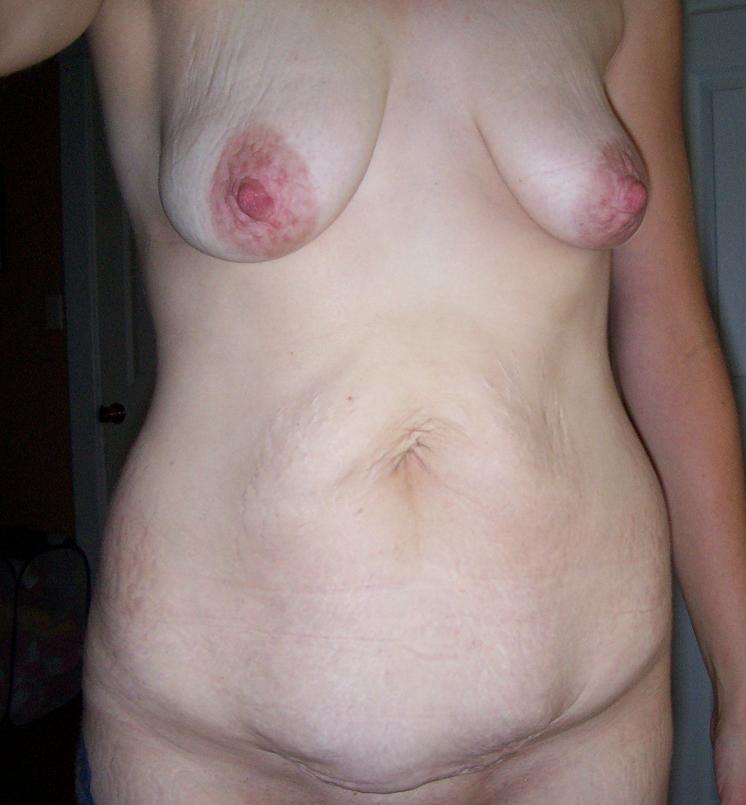
An anyonymous woman's postpartum body, posing nude. Image from The Shape of a Mother.Note/disclaimer: This post was written last Saturday, following which I had several really good conversations with friends about feminism, exclusion, inclusion, and language. To those of you who were involved: this post doesn’t reflect those conversations and how they have helped me think about some of these issues in new ways! Maybe I’ll write a “part two” one of these days, but for now I’m leaving this one as-is …

There’s a good conversation going on in comments over at The Curvature about the concept of “birth rape” and why some feminist activists are resistant to acknowledging the way violations of bodily integrity during pregnancy and birth are often experienced by women as a form of sexual violence.

Cara’s original post is a brilliant, articulate response to several previous posts from within the feminist blogosphere that expressed discomfort with the term “birth rape.” To which Cara responds,

Birth rape describes the experience of women and pregnant people of other genders having their bodies violated and penetrated without their consent in the process of giving birth, usually though not always through the forcible insertion of hands or medical tools into the vagina or anus without consent, and frequently with explicit non-consent. Victims are often physically held down, told to shut up, ignored when they scream or cry or plead, threatened, and/or called names as their bodies are violated. Just as survivors of other forms of rape, birth rape survivors experience physical and emotional trauma, often rising to the level of PTSD — only compounded by the general lack of recognition that birth rape is real, and the frequent guilt at having such trauma associated with their new child coming into the world.

In other words, birth rape is a term used to describe a specific form of rape that is committed in a birthing context, without the use of a penis.

. . . When women come forward and start saying “I was raped,” when they find the power to use that word to describe their own experiences and open up to share their trauma with the world, responding with “no you weren’t” — with whole blog posts about the subject, in fact — is about the worst possible way that a person can do feminism.

. . . Telling other survivors that their experiences of violation aren’t real enough, and just weren’t sexual enough of all things, to use our special fancy word is wrong. And if this is how the word “rape” is going to be used against other survivors of abuses of power and abuses of bodily autonomy and violations of self — as a weapon, like it is right now — then I don’t want it. If the word rape doesn’t include all of those victims of violence that it needs to include, we need a better word. If the word rape is so fragile that we must minimize the horrific experiences of some survivors, the violence they lived through, and the violations they felt in order to protect it, we need a better word. And when the major response to a somewhat mainstream conversation about birth rape is quibbles about words rather than compassion and organizing, we need a much, much better feminism to become the dominant one.

You can read the whole thing over at The Curvature. And I highly recommend that you do, since it’s passionate and just the sort of inclusive feminist thinking that brought me into activist feminism in the first place.

I asked in comments, “What on earth do we gain from telling them their experience doesn’t count?? I really don’t get the prickly reaction to this language.” To which commenter lauredhel responded

I think that to really understand the reaction, one needs to look at the broader picture of mother-exclusion in this particular brand of Feminism. Once you’ve had a kid, you’re ripe for the exclusions – it’s ok to keep you out of feminist organising because kids are all complicated and loud and annoying, it’s cool to dismiss you as ‘merely’ a ‘m(u)(o)mmy blogger’ and not politically relevant, it’s fine for you to be excluded from public spaces (with a hefty dose of Feminist shaming for your temerity in having a child-accompanied life outside the domestic and playgroup sphere), and you need to lie back and think of England when doctors are doing their thing, because it’s for your own good, dear, you made your motherbed, now lie in it and don’t get too uppity while the real feminists are talking. As soon as you make it clear that that fetus is staying put and coming out of you, you’re out of the club.

It’s not that I’ve never thought before about the way our culture devalues the bodily autonomy of pregnant women and denies the personhood of birthing mothers — but I think this conversation around the recognition of birth-related sexual violence is a striking example of the way in which certain contingents within feminist activism resist including women who are pregnant, birthing, and mothers within the movement — resist incorporating their particular concerns. Instead, they parrot back the misogyny of mainstream culture which simultaneously idealizes motherhood and hates on actual mothers and children. There are complicated reasons for this (as my friend Laura Cutter so eloquently pointed out in a guest post recently).

But the fact that it’s complicated is not license to just give up. Rather, I think the complexity of the issue invites us to examine the way in which feminists (no more or less than anyone else!) can sometimes use the language and concepts that have given them voice as tools to turn around and silence other people.

Which is, to put it simply, not cool.

When the strength of our self-identities and political activism lies in denying other folks a place at the table, it’s time to re-examine the way our actions reflect our core values. I became a vocal, self-identified feminist in order to advocate for a world where there is less policing of gender and sexuality, not more. I work every day to practice radical acceptance of the rich diversity of being-in-the-world practiced by those around me, and to protect the ability of all people to feel safe, at home, and loved in the bodies and lives that give them well-being. That, to me, is what feminism is about.

*Image credit: Bittersweet (Anonymous) from The Shape of a Mother.

"people are DESPERATE to be told what they’re like": discuss

16 Thursday Sep 2010

Posted by Anna Clutterbuck-Cook in think pieces

≈ 3 Comments

Tags

blogging, education, feminism, gender and sexuality

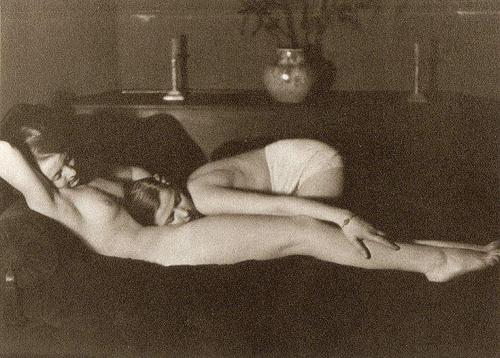
Vintage Erotic from Queerest of Them All @ Tumblr.com

Over the past couple of weeks, I’ve been having a slow conversation-in-comments with Emily Nagoski over at ::sex nerd:: about human sexuality, sex research, and the classification of human sexual experience in the two general categories of female-bodied and male-bodied individuals.

The original post Emily wrote is about the problem of asserting sameness across sex/gender identity when it comes to human sexuality. From her position as a sexuality educator, specifically working with undergraduate women at Smith College, Nagoski highlights the ways in which a narrative of sameness works culturally to erase the experience of people who have don’t have the “sexual hardware” of the default human (a man)

Treating women’s sexuality as though it’s “the same” as men’s, in the social world and in science, results in women feeling broken and ashamed.

As in: We should want sex as much as and in the same way that men do. We should be able to have orgasms the way men do – as quickly, in diverse situations, and through intercourse. Our sexual orientation should be the same. Our responsiveness should be the same. Our fantasies. Our porn. Our feelings about our bodies. I mean, where does it end? You might as well be saying women should have penises.

You can read the whole post over at Emily’s blog.

There are a lot of really awesome aspects to this argument, chief among them that asserting that different bodies respond differently to sexual stimulus is a great step away from the monoculture of “sexy” that our culture is currently saturated with. I also like the way it grounds physical sexual experience in the body, and encourages folks to learn about how their bodies work as a way of gaining a better understanding of their own sexuality.

It also pulls us away from the default understanding of sexual arousal as something that is primarily experienced by people with male bodies and hormonal profiles. It helps clear the ground for women to assert their sexuality without shame and without requiring them to mimic a type of sexuality they do not feel in order to be taken seriously as sexual subject.

From a personal perspective, I will say that one of the most valuable learning experiences in my early career as a sexual being was finding a second-hand copy of Shere Hite’s 1976 report of women’s sexuality in which she quotes long excerpts from questionnaires in which women describe in detail the diversity of their sexual desires, fantasies, physical arousal and relational experiences. Pages and pages and pages of women describing, in minute detail, how they masturbated, what sexual positions worked and didn’t work for them, what kind of touch they liked, whom they enjoyed making love with and how. Since the publication of Hite’s research, questions have been raised about the scientific rigor of her methodology — but to me the power of the book is not in its statistical validity, but in the individual voices that disseminate a type of information that is incredibly difficult, even in this era of the internet, to obtain: how actual people in the actual real world get off? what makes them horny? what fantasies do they carry in their innermost souls? what sensations push them over the edge? It seems so simple, banal almost, and yet there can be radical power in seeking the answer to those questions.

So what’s my problem with the emphasis on “difference”? It’s the fact that that human sexual difference is framed using a binary sex/gender system that simply doesn’t work for a lot of people. What about people with a “female” hormone profile who have penises? What about folks whose sexual arousal cycles seem to be spontaneous despite having a clit? And what about us cis-gendered women who, despite being accepted by the medical and social world as “female” and “feminine” just don’t see ourselves very well represented in the narratives of female sexuality that are out there? It feels to me like we’re rejecting one set of restrictive categories for another set of restrictive categories that just aren’t going to be very helpful to any of us in the long run.

We’re still going to end up feeling shamed, just for different reasons: maybe it’ll be okay not to be sexual in the same way as boys, but now we’ll feel the pressure to be sexy the same way as girls.

What gets lost is the question of how to be sexy like ourselves.

When I raised this issue in comments, Emily pointed out that scientifically-speaking, studying a species that reproduces sexually (as we do) means that it does make a certain amount of sense to examine the human population as one that is made up of two basic iterations (male and female). I get that talking scientific data is different from talking about cultural perceptions, but I also believe that the two interact in ways we often cannot even see. I also think that the language and results of scientific studies get misinterpreted by the media and the general public, and often translated into sound bites that end up supporting pre-existing notions of sex and gender difference: employed in making truth claims far beyond the scope of the original researchers’ work.

Emily also suggested that using the female/male categories as a launching-point to discuss sexual diversity is a useful educational tool.

You don’t want women to be told they’re like men, but you also don’t want them to be told they’re like women.

That’s fair enough, actually, since people just vary (though men vary around one standard and women vary, more widely, around a different one). But my experience has been that people WANT – no, they’re fuckin’ DESPERATE – to be told what they are like. They want a category. They can’t cope without one. And since we’re a sexually reproducing species with males and females, the man/woman split is a natural-seeming division. It’s a comfortable couch for radical information.

So here’s my question to y’all. Do you want a category?

I’m curious. Because, see, I really, really don’t want to be told what I’m like. I have what’s probably an unhealthy aversion to being categorized. Do I like to run into stories that mirror my experience? Yeah, sure! It was an incredible experience to read Lisa Diamond’s book on sexual fluidity and finally hear the women she interviewed putting into words thoughts and feelings and physical experiences I had known intimately but did not have the language to articulate. But for me, it is enough to know that there are other like-minded or like-experienced people out there in the world. As soon as those beings start being grouped and generalizations are made about them, I develop a twitch.

I’m curious what responses other people have to this discussion of difference and categories, the comfort of categories and the danger that categorization will lead to marginalization or erasure. What have your experiences around descriptions of “female” and “male” sexuality been? Are there particular categories that resonate particularly strongly with you, that have been of use to you in better knowing and expressing your sexuality? Have other people tried to categorize you in ways you feel are just plain wrong? What cultural and/or scientific narratives were at work creating and enforcing those categorizations?

monday morning madness: fluid sexuality and marriage equality

16 Monday Aug 2010

Posted by Anna Clutterbuck-Cook in think pieces

≈ 3 Comments

Tags

bigotry, gender and sexuality, human rights, politics

So after a weekend away from my RSS feeds, I finally got around, this morning, to reading conservative columnist Ross Douthat’s second column on why same-sex couples should be excluded from the institution of marriage. Adam Serwer @ The American Prospect offers his take which covers a lot of the bases. And Douthat’s justifications are so convoluted that I’m not going to try and untangle them here.

But as a queer woman in a lesbian relationship, there were a couple of … let’s call them interesting assumptions Douthat makes about fertility, gender, and marriage relationships that I’d like to briefly respond to.

Douthat realizes that he can’t credibly make the claim that marriage should be limited to couples capable of biological reproduction. As Judge Walker observed in the Prop 8 ruling (and as many other advocates of marriage equality have pointed out), being straight doesn’t equal being capable of, or interested in, bearing and raising children. We don’t ask straight couples to undergo fertility testing in advance of issuing marriage licenses. And we don’t enforce any sort of mandate that married couples produce genetically-related offspring.

So there’s that argument off the table.

But Douthat wants to make that argument anyway. So what he does is suggest that it’s not the physical act of bearing and raising biological children that makes hetero marriage particularly worthy of state sanction: instead, it’s the cultural experience of being heterosexual.

The interplay of fertility, reproductive impulses and gender differences in heterosexual relationships is, for want of a better word, “thick.” All straight relationships are intimately affected by this interplay in ways that gay relationships are not. (And I do mean all straight relationships. Because they’ve grown up and fallen in love as heterosexuals, the infertile straight couple will experience their inability to have children very differently than a same-sex couple does. Similarly, even two eighty-nine-year-old straights, falling in love in the nursing home, will be following relational patterns — and carrying baggage, no doubt, after eighty-nine years of heterosexual life! — laid down by the male-female reproductive difference.) This interplay’s existence is what makes it possible to generalize about the particular challenges of heterosexual relationships, and their particular promise as well. And the fact that this interplay determines how and when and whether the vast majority of new human beings come into the world is what makes it possible to argue — not necessarily convincingly, but at least plausibly! — that both state and society have a stronger interest in the mating rituals of heterosexuals than in those of gays and lesbians.

So it’s not about the capacity to reproduce, it’s about “fall[ing] in love as heterosexuals,” and “carrying baggage … after eighty-nine years of heterosexual life” based on “male-female reproductive difference.”

Obviously, there’s levels of wrong going on here, but the points I want to make are these.

1) As a queer woman, I am affected by the sex and gender norms of our (predominantly) heterosexual society. I was born into a world that expects certain things of girls and certain things of boys. In childhood, we aren’t categorized according to sexual orientation (since children are assumed to be nonsexual, or only latently sexual, beings — a topic for a whole different post) but by gender. Girls who aren’t exclusively straight in their sexual attractions nevertheless find themselves on the recieving end of powerful normalizing pressures concerning what girls/women should do, be, want, etc. This includes the pressure to parent. I think, perhaps, Douthat as a straight man might be underestimating the way in which this pressure affects women, particularly, regardless of their sexual orientations. It’s a gender thing, not a sexual orientation thing.

2) Douthat’s understanding of heterosexual vs. homosexual pairings ignores the experience of everyone else. What about equality for folks who experience sexual fluidity, whose attractions change over the course of their lifetimes? What about trans folks whose experience of society’s gender expectations shifts over the course of their lifetimes? For many of us, the idea that one would experience eighty-nine years of either “heterosexual life” or “lesbian life” (check the box that applies to you) is meaningless. We approach our relationships (no matter the gender of the person we’re relating to) as ourselves, as persons whose sum total of experience doesn’t fit neatly into one category or the other. Douthat’s assumptions concerning the differences between straight folks and queer folks is based on the belief that one’s sexual attractions are either always same-sex or always other-sex, and that these attractions are stable throughout life. This is simply not the case for many people (again, particularly women, which once more leads me to wonder how much Douthat is speaking out of his own personal biases rather than any actual research and reflection).

Thus, Douthat’s distinction between the nature of “thick” heterosexual relationships and (“thin”?) queer ones completely falls apart based upon the lived experience of real human beings.

Finally, I want to tackle Douthat’s parting shot: that omg gay marriage will lead to polygamy:

The claim that gay wedlock will lead inexorably to polygamous marriages or incestuous marriages has never been all that credible, because there just isn’t a plausible constituency in the United States (Europe might be another matter) that’s going to start claiming those rights in the way gays are on the verge of claiming the right to marry one another. But it’s still striking how easily the logic of gay marriage can be extended to encompass all kinds of relationships that we definitely don’t want to call marriages.

I am clearly not the constituency Douthat is writing for in his column, because the question I have for him is: “relationships that we definitely don’t want to call marriage”? Who is this “we” you refer to? Please don’t include me in this claim! ‘Cause I refuse, as a queer woman in favor of marriage equality, to scapegoat polyamorous relationships. I don’t need to make poly relationships the Other (or incestuous relationships for that matter) in order to prove that same-sex monogamous couplings should be sanctioned by civil marriage. I’m for consensual, adult relationship commitments being recognized as marriages. Full stop. If that marriage includes more than two adults, then those adults should all be able to enter into the contract of marriage and have that marriage be recognized by our legal system and honored by society. And if that’s what the case for marriage equality portends, I think we should be proud of that inclusivity.

Fear mongering is just not cool, man.

This time around, even more than in his first post-Prop 8 column, Douthat seems to be transparently arguing that heterosexuals are just better, or deserve to be treated with greater respect, than non-heterosexuals. The whole column is a barely-concealed bid to privilege heterosexual marriages simply on the basis of their being heterosexual.

Bigotry: not so cool either.

friday fun: marginalia

13 Friday Aug 2010

Posted by Anna Clutterbuck-Cook in think pieces

≈ Leave a comment

Tags

books, boston, family, fun

Hanna and I are headed across the river to Cambridge this evening to have dinner with our good friends Laura and Ashley at Veggie Planet in Harvard Square.

In honor of this rare bout of sociability, I’m going to share with you one of Laura’s favorite poems: Billy Collins’ “Marginalia” (from Sailing Around the Room: New and Selected Poems).

Sometimes the notes are ferocious,
skirmishes against the author
raging along the borders of every page
in tiny black script.
If I could just get my hands on you,
Kierkegaard, or Conor Cruise O’Brien,
they seem to say,
I would bolt the door and beat some logic into your head.

Other comments are more offhand, dismissive –
“Nonsense.” “Please!” “HA!!” –
that kind of thing.
I remember once looking up from my reading,
my thumb as a bookmark,
trying to imagine what the person must look like
why wrote “Don’t be a ninny”
alongside a paragraph in The Life of Emily Dickinson.

Students are more modest
needing to leave only their splayed footprints
along the shore of the page.
One scrawls “Metaphor” next to a stanza of Eliot’s.
Another notes the presence of “Irony”
fifty times outside the paragraphs of A Modest Proposal.

Or they are fans who cheer from the empty bleachers,
Hands cupped around their mouths.
“Absolutely,” they shout
to Duns Scotus and James Baldwin.
“Yes.” “Bull’s-eye.” “My man!”
Check marks, asterisks, and exclamation points
rain down along the sidelines.

And if you have managed to graduate from college
without ever having written “Man vs. Nature”
in a margin, perhaps now
is the time to take one step forward.

We have all seized the white perimeter as our own
and reached for a pen if only to show
we did not just laze in an armchair turning pages;
we pressed a thought into the wayside,
planted an impression along the verge.

Even Irish monks in their cold scriptoria
jotted along the borders of the Gospels
brief asides about the pains of copying,
a bird signing near their window,
or the sunlight that illuminated their page-
anonymous men catching a ride into the future
on a vessel more lasting than themselves.

And you have not read Joshua Reynolds,
they say, until you have read him
enwreathed with Blake’s furious scribbling.

Yet the one I think of most often,
the one that dangles from me like a locket,
was written in the copy of Catcher in the Rye
I borrowed from the local library
one slow, hot summer.
I was just beginning high school then,
reading books on a davenport in my parents’ living room,
and I cannot tell you
how vastly my loneliness was deepened,
how poignant and amplified the world before me seemed,
when I found on one page

A few greasy looking smears
and next to them, written in soft pencil-
by a beautiful girl, I could tell,
whom I would never meet-
“Pardon the egg salad stains, but I’m in love.”

To download an audio version of this poem, or see other works by Billy Collins, head on over to the billy collins website.

← Older posts
Newer posts →
"the past is a wild party; check your preconceptions at the door." ~ Emma Donoghue

Recent Posts

  • medical update 11.11.22
  • medical update 6.4.22
  • medical update 1.16.2022
  • medical update 10.13.2021
  • medical update 8.17.2021

Archives

Categories

Creative Commons License

This work by Anna J. Clutterbuck-Cook is licensed under a Creative Commons Attribution 3.0 Unported License

Meta

  • Create account
  • Log in
  • Entries feed
  • Comments feed
  • WordPress.com

Create a free website or blog at WordPress.com.

  • Subscribe Subscribed
    • the feminist librarian
    • Join 37 other subscribers
    • Already have a WordPress.com account? Log in now.
    • the feminist librarian
    • Subscribe Subscribed
    • Sign up
    • Log in
    • Report this content
    • View site in Reader
    • Manage subscriptions
    • Collapse this bar