• anna j. clutterbuck-cook
  • contact
  • curriculum vitae
  • find me elsewhere
  • marilyn ross memorial book prize

the feminist librarian

the feminist librarian

Tag Archives: archivists

from the archive: "the librarian’s image"

28 Monday Jun 2010

Posted by Anna Clutterbuck-Cook in library life

≈ 1 Comment

Tags

archivists, humor, northeastern, politics

I’m processing a collection at Northeastern donated by Michael Meltsner, one of the faculty at the School of Law. On an op-ed page from the New York Times, 13 October 2003, I came across the following letter to the editor.

To the Editor:

Your Oct. 9 Arts pages article about the librarian action figure modeled on Nancy Pearl referred to librarians who found the figure offensive as the ”humorless reaches of librarianship.” A number of my colleagues have taken offense at being described as such. We are opposed to the action figure not because we are ”humorless” but because it perpetuates a stereotype that is demeaning to our profession.

Perhaps public librarians are not directly affected by the dowdy librarian stereotype, but as law librarians we provide library services to some of the most prestigious firms in the country and must maintain a professional image.

The librarian doll with the ”amazing push-button shushing action” damages the professional image that we have worked so hard to achieve.

TANIA DANIELSON

Port Washington, N.Y., Oct. 9, 2003

I think it’s the second to last paragraph that really takes the cake. I’m fascinated by the way it combines a total lack of willingness to enjoy the light-hearted, self-depricating humor embodied by the action figure — not to mention the way the action figure is an ironic commentary on the stereotype she’s unhappy with — and professional snobbery at the expense of public librarianship. I mean really: who in their right mind disses public librarians? I guess now we have our answer!

Given that this was a random letter to the New York Times from seven years ago, I’m not really out to slam Ms. Danielson for what I sincerely hope are now outdated sentiments! But I was really impressed by the elitism this letter was saturated with, and I’m amusing myself on this stifling hot Monday in June by re-posting it here.

theatrical amusements, circa. 1910s

02 Wednesday Jun 2010

Posted by Anna Clutterbuck-Cook in my historian hat

≈ 2 Comments

Tags

archivists, fun, history, northeastern

So as longtime readers are aware, I’ve been working for the past year or so on a scrapbook digitization project at Northeastern University’s Archives and Special Collections. I started at Northeastern in the fall of 2008 as a processing intern and have been there in one capacity or another since (I was just recently hired as a part-time Archives Assistant, in which capacity I get paid to do reference work and processing). Anyway, the scrapbook thing has been a very very part-time gig, but lots of fun because I get to look at photographs of young women doing turn-of-the-(twentieth)-century calisthenics in woolen jumpsuits and read turn-of-the-(twentieth)-century recipes for flapjacks.

Incidentally, if anyone knows what it meant to “go fussing” in 1910s-era Boston (as in: “I went out fussing at least once this past weekend”), let me know! Thus far, my investigations in slang dictionaries have failed.

So back to the content of Marjorie Bouve’s scrapbooks. This past week, I reached a run of playbills for dramas, operas, musical comedies and other theatrical entertainments engaged at Boston theatres from during the first few years of the twentieth century. I don’t have anything particularly insightful and/or deconstructionist to say about these — not being a theatre historian — but I did want to highlight a couple of gems for your amusement.

I was attempting to catalog these playbills in the scrapbook for our online database, and ran across one with no cover, simply the cast list and synopsis of acts, which read thusly (courtesy of Google Books)

A search through Google for “spoopju land” (I mean really, how many can there be??) landed me this little gem by Mssrs. Gustav Luders and Frank Pixley, published in 1901.

With the following table of contents

The other intriguing play was one called “A Messanger from Mars,” which I happened to show to Hanna (who also works at Northeastern). She said it sounded familiar so I did a search and came up with this New York Times story covering the premier of the show in London 23 November 1899.

The London production starred the same actor, Charles Hawtrey, who performed in the touring production Marjorie Bouve saw in Boston in 1903. Hawtrey later went on to star in the 1913 silent film version, which is what was niggling at Hanna’s memory when she saw the title.

Every so often, I step back from idle exploratory searches like this — searches that took me about naught-five seconds to perform at my workstation while I was waiting for my database to back up the data I’d entered — and remember that time Before The Internets (yes, I’m definitely old enough to remember B.T.I.) when this kind of thing would have required, at bare minimum, a trip to the local public library or (in this case) upstairs to the regular research library stacks, where you’d hope they had something in a book somewhere about one of these plays. An index to twentieth-century American theater that would point you toward the writer, which in turn might (if you were lucky) point you toward the actual play. Eventually.

It’s hard to hate Google too much, despite their octopoidal presence, when they make it possible to explore these works from anywhere you have access to the world wide web.

from the archives: "to lady patrons"

31 Wednesday Mar 2010

Posted by Anna Clutterbuck-Cook in my historian hat

≈ 4 Comments

Tags

archivists, boston, history, northeastern

Working on my digitization project yesterday, I came across this announcement printed in a theater program for a production of Shakespeare’s King Henry V performed at the Hollis St. Theatre here in Boston in April of 1901.

TO LADY PATRONS

The established rule at the Hollis St. Theatre, requiring ladies to remove their hats, bonnets, or other head-dress while witnessing the performance, applies to all parts of the auditorium, including the boxes and loges. It is essential to the comfort and convenience of all of our patrons in general that this rule be strictly enforced.

Ladies who are unwilling or unable to conform to the rule are earnestly requested to leave the Theatre without delay, and to recieve the price of their ticket at the box office.

I’m sure someone who knows a great deal more about theater history than I do could talk at more length about the shift in attitudes this represents in the cultural acceptance of women attending the theater and, bless me, being encouraged to sit in a public space with bare heads! I think my favorite bit is the “earnestly requested,” as it has such a polite imploring tone. Contrast that with the “turn off your cell phone” announcements today, which are so often couched in cajoling humor. Not that one method is better or worse, but I do think it says something about the audience that the managers of the theater expected their plea to be taken seriously.

From the Archives: Creating a digital collection

04 Thursday Jun 2009

Posted by Anna Clutterbuck-Cook in library life

≈ 1 Comment

Tags

archivists, history, northeastern, photos

Two weeks ago, I started my new part-time job at Northeastern’s Archives & Special Collections (where I interned this past academic year). The project I’ve been asked to complete is the creation of a digital collection that gives researchers virtual access to a series of scrapbooks put together at the turn of the twentieth century by Marjorie Bouve, a Boston University alumna and founder of Northeastern’s Bouve School of Physical Education. This involves scanning each page of the scrapbooks and then cropping each TIF image file so that we have both a full-page image and individual images of each photograph of item on the page. Thus, I spent seven hours Tuesday doing this:


Once all of the images have been created, we have to enter all of the “metadata” (library-speak for “information about information”) into our database and customize the interface Northeastern uses to show their digital collections, an open source software program called Greenstone. Hanna worked tirelessly on the last Northeastern project, the Freedom House Photographs, which you can view online to get a feel for what the end product may look like.

Since this is a scrapbook collection, and we are hoping to emulate the feeling of looking at individual scrapbook pages to a limited extent (sans fancy software like the British Library uses for their prize collections) we’re looking to do something similar to what Simmons College did with the scrapbooks of one of their own alumni, Ruth Mitchell Wunderly, also a fun collection to flip through.

Next time I do some scanning on Northeastern’s spiffy book scanner, I’ll take my digital camera and get some shots of the contraption in action — it’s pretty awesome, despite the fact it reminds me of the radial x-ray machine they use at my dentist’s office.

Looking Back/Looking Forward: Internship

09 Friday Jan 2009

Posted by Anna Clutterbuck-Cook in library life

≈ Leave a comment

Tags

archivists, history, northeastern, simmons

As we enter 2009 — and before I get lost once again in the maze of a busy academic schedule — I thought I’d post a few items on the projects I completed this fall and the projects that are up for the spring semester.

My tenure as an intern at Northeastern University’s Archives will continue through the spring, this time as an official internship requirement for my second archives class at Simmons. Just today, I published the last finding aid for the small collections I processed this fall to make them available for research. In addition to my first, miniscule collection the Albert Hale Waite papers, I also processed the collection of Milburn Devenney, a social worker and AIDS/HIV activist from the Boston area, documents related to the history of Northeastern’s Disability Resource Center and course notes from the history department’s Western Civilization class.

Next week I will begin work on a much larger collection, the Carmen A. Pola papers. Ms. Pola is a Boston-area community activist who worked for a number of different social justice organizations such as Roxbury Unites for Families and Children and the Puerto Rican Festival. She served in the administration of Boston mayor Ray Flynn during the 1980s. We have over thirty boxes of unprocessed documents and photographs that I will be responsible for organizing so that researchers will have meaningful access to the contents of the collection. Wish me luck and watch for the results sometime this summer!

First online finding aid!

05 Friday Sep 2008

Posted by Anna Clutterbuck-Cook in library life

≈ Leave a comment

Tags

archivists, history, northeastern, simmons


This morning I finished and published my first online archival finding aid as part of my internship at Northeastern Archives. It involved a lot of fancy footwork with Microsoft Word macros and Dreamweaver . . . but the important thing in the end was that it worked and the papers of one Albert Hale Waite (graduate of Northeastern’s School of Law, class of 1933) are now fully processed and accessible for research. You can view the finding aid for Mr. Waite here.

More Pics from the DCR

25 Thursday Oct 2007

Posted by Anna Clutterbuck-Cook in library life

≈ Leave a comment

Tags

archivists, DCR, photos, simmons

I had my camera with me at the Department of Conservation and Recreation yesterday (see previous post), so here’s another batch of pictures of the various cool map details I came across. I took these mostly ’cause Dad’s so interested in the cartography (and then I get interested too . . .). At least get a look at the compass rose that, I swear, was done by a drafter on LSD!

DCR2

(click on the image to view the album)

Inside the Internship

04 Thursday Oct 2007

Posted by Anna Clutterbuck-Cook in library life

≈ Leave a comment

Tags

archivists, DCR, history, photos, simmons

I spent the morning today at the Department of Conservation and Recreation (DCR), my internship site for the Intro to Archives class I am taking this fall. I am working for the plans archivist at the DCR organizing and indexing a series of approximately 300 land plans (maps) which record the acquisition of lands by the Metropolitan Parks Commission in the late 1890s. Many of these plans originate from the firm of Olmsted, Olmsted and Eliot, the famous landscape architects.
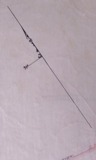
Here is a detail from one of the maps I worked with today:


The plans, most over 100 years old, have seen heavy use and are fragile. Their edges have been torn and taped with scotch and masking tape, or repaired with bits of paper and other materials. My supervisor, Judy, is hoping to assess what we have and what the preservation needs are so that the department can apply for grant money to fund conservation work for the plans (which, she tells me, runs something like $500/sheet). Meanwhile, to make the plans accessible and to ensure that a minimal amount of damage is done as they are handled in the future, I am putting them in folders and creating a digital index in Excel.

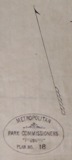
The hand-drawn detail is full of fascinating variety. For example, compare these three directional markers, which appear on the maps to denote North:

While I have not had the time to do any background research on the individuals involved in the surveying and execution of these plans, I did find this little tidbit when I compared the maps with the accession records (which give information about when the archive acquired which plans). One 1901 duplicate of an original survey map was done by an I.C. Rogers:

In the accession book, the entry notes that the plan was made by “Miss Rogers.” So apparently, I.C. Rogers was a woman (and the only identification of that kind I have run across; all others are noted in the records simply by last name). This I may have to pursue . . .

You can see larger versions of these photos, and more, in the DCR album at Picasa.

Internship Assignment

20 Thursday Sep 2007

Posted by Anna Clutterbuck-Cook in library life

≈ Leave a comment

Tags

archivists, DCR, history, simmons


Today, I was given my internship assignment for Intro to Archives. I will be working at the Massachusetts Department of Recreation and Conservation (which means I will finally learn how to spell “Massachusetts” correctly!), the governmental organization which oversees many of the natural areas in the state, including the Walden Pond Reservation, which I visited on Monday.

For my internship, I will be working under the DCR Plans Archivist to arrange and describe one of two collections (there are two interns assigned to this site) they have of architectural and engineering plans, land surveys and maps that provide information on the properties and structures held and administered by the DCR.


". . .but the people working there are fairly nice."

15 Saturday Sep 2007

Posted by Anna Clutterbuck-Cook in library life

≈ Leave a comment

Tags

archivists, feminism, history, librarians, simmons


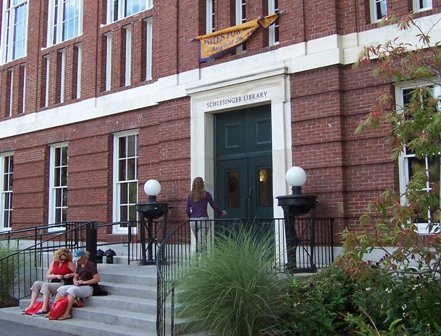
Today, I took a field trip to Cambridge to visit the Schlesinger Library at the Radcliffe Institute, one of the largest repositories of archival material on women’s history in the United States. The impetus for the visit was an assignment for my Archives class, in which I had to visit an archive and describe the experience. However, I admit that enjoyed the very personal pleasure–perhaps more aptly described as “reverential awe”– of simply by being in the same space where so much of the history (or herstory as many feminists would insist!) I care about is preserved, and the historical work I value done.

(Note: In the photograph above, the banner above the library’s main entrance reads “Votes for Women!” in the suffragist colors of violet and gold).

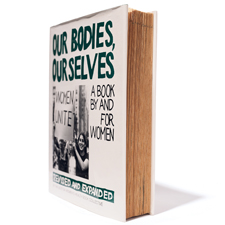
Aside from the pilgrimage aspect of the visit, I actually chose the Schlesinger because they are the repository for the Boston Women’s Health Book Collective records. (The BWHBC is the collective that wrote–and continue to update–the classic book Our Bodies, Ourselves, and are feminist advocates on a variety of women’s health issues worldwide). Our Bodies, Ourselves was one of my earliest, most comprehensive, and unabashedly feminist forms of sexual education and it remains near and dear to my heart (as well as close at hand on my reference shelf). I was interested in seeing some of their earliest manuscripts and gleaning what I could about the collective consciousness-raising process that had led them to publish the first edition of Our Bodies, Ourselves–then called Women and Their Bodies: A Course–which sold for 75 cents in 1970, and was intended as a working study guide for women’s health workshops.

The original publication was fun to browse through, permeated as it was with the language and political ethos of the women’s liberation movement which had given it birth. The first chapter of the 1970 edition, for example, is titled “Women, Medicine, and Capitalism”; a later chapter on abortion describes the hurdles unmarried women face when seeking birth control. A footnote highlights a single clinic in Boston where women–regardless of marital status–can obtain birth control no questions asked. The authors of the chapter observe: “this program is financed by the federal government, but the people working there are fairly nice.”

The most fascinating folder of material I read through was a collection of newspaper clippings and letters detailing the backlash to Our Bodies, Ourselves in the late 70s and early 80s when, apparently, it was being used quite widely in high schools as part of the health curriculum! In this age of abstinence-only education, it’s amazing to me that OBOS ever made it into high school libraries, let alone the curriculum. One teacher from Pennsylvania wrote the collective and described in detail how her students (ages 14-18) had used the book as part of a human sexuality class, including their sophisticated interactions with a pro-life activist who insisted on coming to the class and speaking on abortion. Another letter, written to a high school librarian in 1978, was from a pediatric doctor with teenage daughters who lauded the librarian for her defense of the book and observed:

Young people are far better served by the combination of access to all valid knowledge, even if at variance with parental thought, and the opportunity to discuss this openly with concerned and mature adults.

On the other side of the controversy, of course, were outraged parents and organizations such as the Moral Majority, which sent leaflets to its members detailing (in their minds) unacceptable sexual and political content of the book. One man was quoted in a 1981 newspaper clipping: “I am challenging [defenders] of this book to walk into church and read material out of Women, Our Bodies, Ourselves [sic]”–clearly expecting his audience to be shocked by the idea (though I rather like the image myself).

While this particular trip to the archives was a self-contained event for the purpose of a class assignment, I chose the content with an eye to my interest in feminist activism around sex and sexuality education, and who knows–these records may continue to play a role in my graduate education as I begin the task of designing the project for my history thesis.

Newer posts →
"the past is a wild party; check your preconceptions at the door." ~ Emma Donoghue

Recent Posts

  • medical update 11.11.22
  • medical update 6.4.22
  • medical update 1.16.2022
  • medical update 10.13.2021
  • medical update 8.17.2021

Archives

Categories

Creative Commons License

This work by Anna J. Clutterbuck-Cook is licensed under a Creative Commons Attribution 3.0 Unported License

Meta

  • Create account
  • Log in
  • Entries feed
  • Comments feed
  • WordPress.com

Blog at WordPress.com.

  • Subscribe Subscribed
    • the feminist librarian
    • Join 37 other subscribers
    • Already have a WordPress.com account? Log in now.
    • the feminist librarian
    • Subscribe Subscribed
    • Sign up
    • Log in
    • Report this content
    • View site in Reader
    • Manage subscriptions
    • Collapse this bar