• anna j. clutterbuck-cook
  • contact
  • curriculum vitae
  • find me elsewhere
  • marilyn ross memorial book prize

the feminist librarian

the feminist librarian

Tag Archives: children

okay, it’s been a while since a really ranty post …

02 Friday Jul 2010

Posted by Anna Clutterbuck-Cook in think pieces

≈ 4 Comments

Tags

children, feminism, gender and sexuality, human rights

…but I’ve been sitting on this column by Hanna Rosin @ Slate for a while now and I just can’t get the anger out of my bloodstream. So I’m going to blog it out and see if that helps.

Oh, Ms. Rosin. If only you would quit writing stuff that makes me so mad! I really liked your work in God’s Harvard, I did, and although you glossed a bit too, well, glossily, over the non-fundie history of home education and emoted a little too strongly about the cherubic goodness of your subjects — despite the fact they’re happily growing up into the next generation of Dick Cheneys and Karl Roves — I was willing to forgive you the oversight. Write it off as the slightly rose-tinted view of a researcher who has grown close to, and thus a bit fond of, her subject. I mean, we’ve all been there, done that.

But you keep on writing shit about gender that pisses me off. In this case, your post up at Slate’s Double X blog about Dr. Poppa, the pediatric urologist at Cornell University who has been performing cosmetic surgery on babies whose clitorises are deemed “too large.” (See sunday smut no. 27 for my initial reaction.) Rosin is upset by the outrage in the blogosphere, which she believes focuses unduly on the sensational nature of Poppa’s research (“he touches six-year-old girls’ clits!”) and ignores the fact that the good Doctor is trying to reach what in her mind appears to be a positive goal: girls with clits that don’t look like penises (achieved through surgical reduction) and yet still retain the nerves necessary to give the patients sexual pleasure.

To his critics, however, these details [Poppa’s quest for a better clitoroplasty] don’t matter. [Dan] Savage calls this a conspiracy of “out and out homophobia.” He claims the medical establishment pushes these operations because girls with bigger clitorises are more likely to be lesbian. This claim is a stretch; girls with CAH are only slightly more likely to be lesbians or tomboyish when they are young. The vast majority are heterosexual and comfortable as girls. Gender norms have shifted pretty drastically in the 40 years that this operation has been performed, and still more than 95 percent of parents choose it for their children. Why? Because much as Savage might like it to be, the world is not yet a place where most little girls can have a clitoris that looks like a penis and feel entirely at ease. And few parents would want to use their daughter to test that proposition.

I just — I can’t — I’m floored by the the utter wrongness of this as a goal. Aside from the question of trying to regulate children’s sexual orientation and gender presentation (see the coverage of hormone treatments for potentially CAH babies as another, related example of how fearful we are of children who might possibly not conform: don’t try to tell me this isn’t about gender and sexuality policing), Rosin overlooks the fact that we’re talking about medical practitioners who perform potentially debilitating cosmetic surgery on infants.

It’s not that “details don’t matter” (excuse me??) The details fucking matter. The detail, for example, that decisions about what a “normal” clit looks like are aesthetic decisions, made by doctors influenced heavily by cultural norms (see Anne Faustos-Sterling’s Sexing the Body). The detail that this is not surgery the children need in order to be physically healthy or experience sexual pleasure. In fact, it jeopardizes their sexual pleasure so that their genitals will conform.

Now I realize, despite my own aversion to being cut open with sharp instruments, that some people are less freaked out by surgery than I am. And I realize that surgery saves lives. I also recognize the right of adults to alter their bodies, even when not medically necessary, to better suit their vision of how their bodies should look and feel — even if I would not make those same decisions. But children whose bodies are physically healthy should be allowed to grow up without surgical alteration until they are adults and have the cognitive and legal ability to make up their own freakin’ minds. By suggesting that parents who consent to altering their children’s bodies in this way — again: risking their child’s capacity for physical pleasure out of the desire that their bodies visually conform to the gender binary — are saving their children the possibility that their genitals might make them ill-at-ease, Rosin is leaning on mid-20th-century theories about psycho-sexual development (themselves highly homophobic) that suggested children were somehow irreparably damaged by any experience of ambiguity when it comes to their gender or sexual orientation.

Has she not stopped to ask herself whether, maybe, it’s adult fear of nonconformity, rather than young peoples, that is driving this need to surgically alter our children to erase the beautiful variation that is human existence? Isn’t it better to tell and show your child that you think her body beautiful than to make it clear — through imposing upon her painful surgical procedures and years of follow-up medical tests and treatments — that she is somehow not quite “right”? Isn’t it better to make your home a harbor from whatever toxic gender-enforcing messages are out there in the culture than to be the first to rigorously enforce those standards? What object-lesson are you teaching your child here: That it’s important to conform to arbitrary cultural standards no matter the cost? That one must sacrifice pleasure for the sake of superficial appearance? That to be a “girl” or a “woman” one must alter one’s body to fit cultural expectations of what it means to be feminine?

Above all, it sends the message that the person you are when you are born is not okay, that your physical body is not acceptable even if it is pain-free and carries you everywhere you want to go, and gives you pleasurable sensations, digests your food, thinks complex thoughts, learns new skills, experience a full range of emotion, and helps you explore the world with curiosity and joy.

Again, this is not meant to be anti-surgery in cases where surgery can demonstrably improve a patients life. But activists have been pointing out for years that it is beneficial to be patient and allow children to grow into their own sex and gender identities in the fullness of time, before limiting their options prematurely by surgical means.

Rosin’s critique of Poppa’s online critics makes it sound like we’re a bunch of irrational drama queens who are unable to think about children and sex in close textual proximity without losing the ability to reason. I really, really wish she would quit being so fearful that children not surgically modified will be unhappy with their genitals and start asking why we feel such a strong need to police peoples’ genitalia in the first place. If she’s really worried about these children who are going to grow up feeling awkward about their bodies (as an aside: isn’t that really just part of the human condition? who doesn’t feel awkward in their own skin sometimes?) shouldn’t she be using her platform as a nationally-recognized journalist to speak out more forcefully against the conditions that make them so?

There. Rant over. I’m now feeling a bit calmer. And will go home to enjoy the company of my partner, who often despairs at the amount of verbiage I am willing to generate in the name of feminism. Sorry, honey! I think it might be congenital. Maybe they have a surgery to correct it?

espresso AND a puppy: the consequences of free-range children?

30 Wednesday Jun 2010

Posted by Anna Clutterbuck-Cook in media

≈ 3 Comments

Tags

children, humor, politics

Via my friend Laura comes this warning from a coffee shop in L.A., posted online at The Consumerist.


I’m going to admit up front I find this funny. I think it’s a fairly light-hearted way to ask parents to be aware of their children in public, crowded spaces. And remind them not to assume that baristas and/or store clerks and/or other customers are available for free childcare. As a person who used to work at Barnes & Noble, I’ve experienced first-hand the frustration of adults who came in with the clear intention of dumping their kids in the children’s area and then going to meet their friends for an extended coffee klatch at the Starbucks across the store. It’s one thing to believe that “it takes a village to raise a child” (I do believe young people are our collective responsibility) and another thing to demand that “the village” suddenly add childcare to their list of work-related responsibilities.

There’s a big difference between asking a barista to politely take an order for chocolate milk from a three-year-old and asking them to supervise a gaggle of small people roughousing on the coffeehouse furniture. As Laura said to me in a follow-up email,

Whenever people ask me to take care of their children, I try to make it clear that they may not like the results. After thinking through this child-hate controversy for a long time (via your blog and elsewhere), I have come up with [the point that] us haters don’t actually hate children, we hate the parents. The parents who don’t respect their children or other people enough to to teach/guide/discipline their children within responsible boundaries. My own personal experience with this is primarily in stores and on the T [Boston subway], both places where it can be dangerous not to monitor children. Plus, I think most everyone could do with a teaching moment on respect, politeness, and kindness, and I think it’s a real problem that some parents think their children can’t learn it, or it will be stifling to their creative spirit to learn it. I mean, children are smart, you can teach them appropriateness in different circumstances.

To go back to the episode of My Family I wrote about for mother’s day, when Ben and Susan (the parents) are trying to speak with another couple about that couple’s son’s bullying behavior toward Ben and Susan’s youngest child. The parents of the bully are self-proclaimed advocates of “free range” children, which in their minds equates to being completely hands-off and allowing their child to run rough-shod over other young people. I have first-hand experience with this kind of parenting philosophy, which basically assumes that children should work out problems among themselves. What I find suspicious about this philosophy is that a) the parents espousing it are more often then not the parents of children who benefit from the playground hierarchy, rather than parents of victims; and b) it side-steps the question of how children are going to learn — particularly in a culture that’s so age-segregated as ours, where children spend the majority of their time with their age-mates — the skills to mediate and problem-solve. These are skills even adults with years of practice struggle with, and yet we assume children will magically acquire them?

I sense a disconnect.

Which is why I come back to observation “a”: radically hands-off parents* are more often than not bullies themselves, advantage-takers who are more than willing to step over others more vulnerable then themselves (whether it’s a polite stranger they cut in front of in the coffee line, or a colleague at work they systematically undermine, or a spouse whom they bully Hyacinthe style). They believe the world is a cut-throat, take-no-prisoners place in which their children will need to learn how to come out on top if they are to survive.

I realize I’ve wandered far away from “espresso and a puppy” here. I think what’s fascinating to me about the question of attended/unattended children in public spaces (and the related question of what type of “attending” said children require) is that rarely do we stop to assess what the stakeholders in the situation really need and how we might best arrange our public spaces in order to accommodate those needs. And I use the rather social-sciencey term “stakeholder” here as an umbrella term that encompasses all people involved: coffee shop employees, customers with children, customers without children, customers who are children … how often do we stop and ask, when there is a perception of a problem (i.e. unattended children) what the actual problem is, and how it might be fixed. It’s a possibility that rowdy, neglected children are symptomatic of something deeper, and that requiring children to be “attended” won’t necessarily fix that issue — which will manifest in some other way down the road.

Still, points to the sign-creators for naming the symptom at least — if not the cure. And doing it in a fairly benign fashion at that, with a clear sense of humor. I particularly appreciate that the consequences of the percieved problem, in this case, are couched in terms of consequences for the parents (your kid’s gonna learn the word “fuck”! and acquire a taste for coffee!) rather than abuse toward the children themselves, who are still learning, growing, and practicing what it means to be part of the social fabric of the world.

*Again, to be distinguished from parents who respect their children as human beings and care for them with unconditional love, something that is often also referred to as “free range parenting.” That’s a post for another day.

"with all due respect, small children"

23 Wednesday Jun 2010

Posted by Anna Clutterbuck-Cook in book reviews

≈ 2 Comments

Tags

children, gender and sexuality

Let’s face it, we all have our favorite books from childhood. (I hesitate to call them “children’s books” because so many authors who write books children enjoy resist being ghettoized and too many children read books originally written for grown-up audiences). And let’s admit we are completely partisan about our golden oldies. I, for example, tend to evaluate any scholarly or reference work on children’s fiction by flipping to the index and discovering whether Arthur Ransome merits an entry. If not? You have to talk awfully fast if you want me to buy it. If Edward Eager is discussed your chances are upped, and Michelle Magorian is really required reading in anything purporting to discuss young adult lit.

Which brings me to this recent op-ed by Alison Flood @ The Guardian. The children of England recently voted Eoin Colfer’s Artemis Fowl, the first in a series featuring a young supergenius antihero. Flood disagrees. “With all due respect, small children,” she writes, “your choice of the admittedly excellent Artemis Fowl as the ‘Puffin of Puffins’ is deranged and wrong. It should clearly be MY choice: Goodnight Mister Tom.”

I also adored Magorian’s Back Home, another story of an evacuee. Rusty is sent to America, and the drama plays out around her return to England to a world and a family who feel like strangers. Anyone else remember that one? I loved the bit where Rusty escapes from boarding school to decorate her own little cabin in the woods.

But Goodnight Mister Tom is better. It should have been the Puffin of Puffins, and I think it has a good claim to be the children’s book of children’s books. (Now that’d be a fun vote, although we may have to exclude anything published after I graduated to grown-up books, else I’ll only get upset again.) I’m imagining that all you discerning adult readers will agree with me about Goodnight Mister Tom being the top Puffin – but please let me know either way. And I’ll try not to cry if you disagree.

I’m not going to weigh in on whether or not Goodnight Mr. Tom should or should not be the top Puffin — to me, book choices are personal, idiosyncratic things. My passion for particular books has (I suspect) less to do with any objective artistry — if any objective measure of artistry exists — than it is tangled up with where I was when I read the book (Our Arcadia) what questions I was asking about life (The Solace of Leaving Early), whom I read and shared the book with (The Blue Sword) and more often than not a single scene — a single passage — a single sentence — that seared itself into my psyche forever simply because it spoke to me. The rest of the book might be a shit book. I might never read it again except to open it up to that passage and remind myself once again why I fell in love so irrevocably with the text.

So here’s what I wanted to say about Michelle Magorian, ’cause I adore her too, and then I’ll open up the comment thread to any of you who feel like sharing your own well-worn favorites from childhood: I’d love to hear about the books you loved and why you loved them.

So: Magorian. Alison Flood leaves off Magorian’s third novel, Not a Swan which is difficult to find (unlike the other two) and, in the United State at least, out of print* (which accounts for, apologies, the sucky cover art image). But my public library had a copy in the young adult section, and I discovered it when I was about twelve. And promptly fell in love. Set during the waning days of the Second World War, in an English seaside town, it’s the story of a sheltered seventeen-year-old schoolgirl, Rose, who longs to be a writer.

There’s a whole long list of plot elements that combined to make this a story that enthralled me (I vividly remember, fifteen years later, the feeling of staying up until 3:00am to finish it because I could not put it down). It was an historical novel (1) set in England (2) during the Second World War (3). It was about an adolescent girl who rebelled against conventional expectations about what young ladies should be (4) and do (5), craved adult independence (6) and wanted to be a writer (6). There was the best friend, pregnant out of wedlock (7) whose birth scene — without giving too much away — was quite possibly what precipitated my adolescent interest in midwifery. There’s an historical mystery (8) involving archival documents (hidden diaries) and above all, there was Alec (9), the bookshop owner (10) who hires Rose as his shop assistant and encourages her in her writing.

And (11) there was sex. Gorgeous, glorious, enthusiastic sex. Tame, to be sure, by the standards of adult erotica, but still pretty damn steamy. Not a Swan, I would argue, is one of a slim, slim handful of novels written for young adults that embraces adolescent sexuality without shaming. Again, without giving details away, I will be forever grateful that one of the first genuinely “YA” novels I read was essentially a story about a young woman claiming her right to enjoy her sexuality on her own terms. (Actually, by my count, at least four women, all in very different circumstances, yet all asserting their independence and their right to happiness and sexual pleasure).

Depending on your perspective on human sexuality and the whole women-as-humans thing, you could say this was the beginning of my coming into myself as an adult woman who embraced feminism and the potential for joy in sexual relationships — or you could see it as the beginning of my long, slow decline into the life of a slutty teen-age bibliophile. Either way, there really was no turning back.

So take it away readers — what books do you enjoy championing and why?

*woodscolt in comments alerted me to the fact that in the UK Not a Swan has been republished under the title A Little Love Song. Thanks woodscolt!

in which I have some thoughts on men, pregnancy, and parenting

03 Thursday Jun 2010

Posted by Anna Clutterbuck-Cook in think pieces

≈ 4 Comments

Tags

children, feminism, gender and sexuality, masculinity

There have been a couple stories in the news lately revolving around men and procreation that have caught my eye in the last couple of weeks, and due to the phenomenon known as “needing something to post about today” I thought I’d throw them together in a post and share a few thoughts about them — or, more accurately, about the cultural narratives and expectations about men and manhood they represent.

The first is a post by Mary Elizabeth Williams @ Salon that provocatively asks whether “men have a right to choose an abortion,” or, more accurately how much right they have to decide when and how to become a parent. Although she links to a story by Stephanie Fairyington @ Elle in which a man named George Bruell tried to pressure his girlfriend to have an abortion after she unexpectedly got pregnant after the couple (he thought) had agreed they didn’t want to have children.

The Elle article contains a lot of crap from anti-feminist “men’s rights activists” whose entire goal seems to be the struggle to free men from relational responsibilities supposedly forced upon their freewheeling selves by scheming women and their dependent children. Although updated for the 21st century, this is a narrative surprisingly reminiscent of virulently misogynistic views of women and families found in 1950s and 60s-era diatribes by men who were as unhappy with the postwar mythology of the Father Knows Best lifestyle as feminists, but rather than blame institutionalized sexism they blamed women and women’s essentially domestic, acquisitive nature that required men to work long hours to support a suburban lifestyle.

Like these postwar misogynists, the “men’s rights activists” in this story are not interested in dismantling sexist structures that warp expectations of heterosexual relationships; they’re not interested in fighting for better reproductive justice for all — they already think women have all the power and they feel aggrieved. As Fairyington writes of Mel Feit, head of the National Center for Men,

Feit’s list of grievances range from sexist social standards — why should men still be expected to foot the bill on dates? Why is crying or showing weakness verboten for them? — to what he considers discrimination enforced by the state: men’s lack of reproductive rights combined with unfair child support laws. “Reproductive choice isn’t a fundamental right if it’s only limited to people who have internal reproductive systems,” Feit says. “If it only applies to women, it’s a limited right and that weakens it.” In his view, Planned Parenthood’s motto — “Every child a wanted child” — should apply to both people who make the baby.

Most of these arguments, taken individually, are issues feminist have championed for years. The insidious problem with these grievances is not that (most of them) are inaccurate but that they are not connected to any analysis of the cultural construction of gender or understanding of institutionalized sexism. Or an awareness of how — in our culture — gender operates dualistically and women are disproportionately vulnerable in a world where patriarchal structures are still the default. This doesn’t mean patriarchy doesn’t hurt men too — as feminists, male and female, remind us continually — but it does mean that deconstructing masculinity and the expectations of men and manhood must be done with an awareness of women’s position in the here-and-now-society. Men’s rights activists seem to imply that somehow women, as a group, are (for example) forcing them to pay for dates, whereas most feminists wound point to our cultural construction of manliness that associates male power and sexual appeal with economic power to such an extent that feminist calls for an end to gendered dating expectations are usually met with anxious speculation about how feminists are trying to emasculate men. Ditto on the issue of crying and/or showing weakness.

Women as a group, in other words, are not these guys’ biggest enemy. Their enemy is anyone (male or female) who supports oppositional, essentialist gender roles.

But back to the question of men, pregnancy and “choice.” Here’s what I have to say about men and the “right to choose.”

1) The final decision whether or not to have an abortion is always the pregnant woman’s. Like any medical procedure, it is the patient who needs to have the final say about what happens to her body. End of story. Obviously, this happens in the context of a medical profession in which doctors (ideally) advise patients about the full range of options available to them. Ideally a pregnant woman trying to decide whether to carry an unplanned or dangerous pregnancy to term would consult with her partner, family, friends, trusted religious adviser, therapist — whomever she needs to help her make the best decision given the choices available. But at the end of the day, it’s her body and therefore her decision to make. If the pregnant person is male-identified or in part male bodied, then the decision would be his. This isn’t a gender-bias, it’s a question of bodily integrity and who has a say about what happens or doesn’t happen to your body.

2) Apart from abortion, men have as many options for preventing parenthood as women. If you don’t want to get pregnant at a given time, with a given partner, take steps to prevent it. Men are not at the mercy of women in this arena. Here are some of the ways male-bodied persons can prevent pregnancy.

a) refrain from sexual activity that could result in pregnancy such as penetrative penis-in-vagina sex with women, or other types of sexual activity in which your sperm risks getting on or in a woman’s vagina. The plus side to this method of pregnancy prevention is that it might encourage you to realize how many other types of sexual activity are out there to enjoy, either on your own or with a partner. One totally risk-free option for anyone who’s bisexual is deciding you’re only going to have sex with other men — no chance of pregnancy there! Cunnilingus is another way to enjoy your partners body with no chance of sperm + egg = pregnancy. Look on this as a change to experiment and discover new forms of sexual pleasure.

b) use various types of birth control which hopefully you are already familiar with when it comes to prevention of sexually transmitted diseases. there’s sadly no birth control pill yet on the market for men, but in the meantime you have condoms which are pretty damn reliable when used correctly and consistently. If you’re sure you never want to have children, you can always decide to get a vasectomy which solves the accidental pregnancy problem in all but extremely rare cases and puts the choice of pregnancy prevention squarely in your hands.

c) this should go without saying but usually it doesn’t, so I’m going to say it: COMMUNICATION is incredibly important to a satisfying sex life, and that includes doing everything you can to make sure you and your partners are on the same page when it comes to babymaking. Obviously, in situations like Bruell’s story above, communication failed and people are now stuck with the messy real-life consequences. But good communication upfront can certainly prevent a great deal of messy post facto problems, just like securing enthusiastic consent to sexual activity helps prevent instances of sexual assault.

Finally, 3) While difficult, I do think it’s viable (and not anti-feminist or anti-child) to create a legal framework for men to surrender parental rights and responsibilities up-front if a sexual partner with whom they are no longer involved decides to carry a pregnancy to term. As feminists, we have argued that it is the best-case scenario for parents and children when all children are wanted — when parenthood is a role enthusiastically chosen and when children are cared for both by their primary caregivers and by society as a whole. Women who do not choose abortion have the option to surrender the child they birth either to an adoptive family or to the state system. This often isn’t an ideal situation for the child, but it is a legal framework that recognizes that mothers sometimes feel the task of parenting to be beyond them.

There’s a whole tangle of social and legal issues here relating to competing visions of a social welfare state and the responsibility of society as a whole to enable primary caregivers to parent — but for the moment, let’s assume the birth parent has chosen not to parent and wants to hand that responsibility over to someone else. Mothers who give birth can choose to surrender their parental rights and responsibilities legally, and I believe men should have similar legal options.

I just wish the men who are advocating for them wouldn’t ask for them in a way that is hostile to women’s basic right to bodily integrity and decisions surrounding their physical person. It shows a pretty stunning lack of awareness of reproductive rights and justice issues that Feit and company really ought to be engaged in, or at least aware of. Instead, they seem to have adopted the rhetoric of women’s rights in much the same way Sarah Palin has taken to using the language of feminism — to peddle a toxic tangle of misplaced misogynist resentment that lashes out at vulnerable targets rather than working to dismantle the sociocultural structures that constrain us all.

* * *

The second story comes from Amelia Hill @ The Guardian (hat tip to Hanna for the link). I knew we were in trouble from the opening sentence, “Expecting men to take an active role in their partner’s pregnancy and attend the birth of their children can deskill them as potential fathers and damage paternal bonding, an expert has claimed.” While I’m not an anti-intellectual, and I believe in the value of expertise (our highly complex modern world necessitates a certain amount of specialization), I’m always skeptical when an “expert” claims to have the final word on how a certain activity is going to affect complex human beings.

The disappointment and feeling of failure experienced by men expecting to have an intimate and proactive role as their baby gestates, only to find their function is largely one of passive support for their partner, can cause emotional shutdown, according to Dr Jonathan Ives, head of the Centre for Biomedical Ethics at the University of Birmingham.

“Having begun the fathering role already feeling a failure may destroy his confidence,” Ives said. “It can then be very difficult for him to regain faith in himself once the baby is born and move from that passive state to being a proactive father. His role in the family is no longer clear to him. He effectively becomes deskilled as a parent and this can lead to problems bonding with the child.”

Oh, I have so many issues with this way of understanding parenthood! “Support” for a pregnant partner is somehow the opposite of being “intimate” and active? Men are somehow incapable of grasping that their pre-natal and post-partum roles will, like women’s, be different? Men as a general rule have so little self-confidence that being asked to do something like being present and supporting during pregnancy might actually destroy their ability to parent? And I have to say I’m baffled by the assumption that this feeling of inadequacy is unique to fathers — it’s always been my understanding that most parents, regardless of gender, feel profoundly inadequate for the task at hand.

And this might actually be a good thing, as the article (thankfully!) goes on to point out.

Adrienne Burgess, head of research at the Fatherhood Institute, said: “That experience of helplessness that Ives is saying is so dangerous, is, in fact, the perfect preparation for fatherhood: there are times as a parent when you can’t do anything to help your baby, when it’s crying all night and can’t be soothed. Part of being a parent is being there for your partner and child without doing anything except providing love.”

I just really want to emphasize what Burgess says here, because I think it highlights the chasm that exists between the neotraditional conception of masculinity and fatherhood that relies on rigid separation of male and female duties and a conception of masculinity and fatherhood that, well, relies on the notion that men are human beings capable of a full range of human responses. In the neotraditional version of masculinity, men must be protected at all costs from being made to feel helpless, from being (in a word) emasculated. Helplessness sets them up for “failure” and failure is so shameful and world-ending that men must avoid it at all costs — up to and including the cost of not being present to their partner during pregnancy and at their child’s birth.

In the men-as-humans model that Burgess puts forward, however, helplessness is simply part of the human condition, a run-of-the-mill part of parenting and family life. That we’ve elevated the power of parents (fathers perhaps particularly?) to such Godlike heights that the notion that inability to change the course of events necessarily equals “failure” is stunning to me. To argue that men should be encouraged to avoid the parts of family life that entail helplessness is, in my mind, a wildly unhelpful (at best) perhaps even unethically negligent (at worst) recommendation. It is akin to arguing that if a friend or family member is diagnosed with incurable cancer you should just quit spending time with them because you can’t do anything to cure them.

More often than not, it’s our simple presence — loving, nonjudgmental, patient presence — in the lives of others that is what matters. This is a skill that all of us could do well to hone, whether we are parents or children, spouses or partners, friends or extended family members. It is a skill that should be genderless, and one which we would do well to encourage all soon-to-be parents to practice with one another and, once the child arrives — by birth or other means — with that child as well.

quick hit: babies as mammals

25 Tuesday May 2010

Posted by Anna Clutterbuck-Cook in media

≈ Leave a comment

Tags

children, movies

Via Hanna comes a post from Christine Smallwood @ n+1 about the new documentary Babies, which I posted a trailer for a few months back.

Here are the things that made a theater of moviegoers laugh at a recent screening of Babies:

• Babies suffering, especially sibling-on-sibling violence.

• Tiny Godzilla babies shot from below against a clear blue sky.

• Babies making that face babies make when they poop; also, fart.

• Babies crying. (Note: Babies crying in real life incite terror—what if they cry forever? Audience laughter indicates the faith that crying on film will, before too long—unless the film is a European auteur production—cease. Besides, a baby crying on film presumably stopped crying long ago; a baby crying now must be attended to right now.)

And, hands down, the most popular gag:

• Inter-species slapstick. Including but not limited to: Babies pulling the ears of cats. Babies sticking tiny baby fists into dogs’ mouths. Babies stepping on the faces of baby goats. Babies surrounded by cows. (All related to the previously noted joys of baby suffering, but perhaps more profitably categorized under the rubric of “babies courting danger.” Again, funny on film; not usually funny in real life.)

Smallwood argues that the film is a nature documentary (babies as mammals) rather than a documentary which attempts to tell a human-centered story about what life is actually like for newborn persons around the world. “From whose perspective is Babies made?” she speculates, concluding: “Not the babies. Babies look up from [their mother’s] breast, not across at it. The mother’s face is the object of the baby’s eyes, but the mother’s face is just what the camera hides, again and again.”

In other words, the film apparently attempts to isolate the babies themselves from the world of human relationships in which those children exist so inextricably (and which practically the sole job of infants is to learn how to navigate successfully themselves, since their lives literally depend up them).

Still, I’m intrigued by the film enough that I’ll likely see it on DVD eventually, if not in the theater (independent theater ticket prices here in Boston are through the roof!).

Go read the whole review at n+1.

arbiters of the appropriate? more on kids and public space

20 Thursday May 2010

Posted by Anna Clutterbuck-Cook in think pieces

≈ 3 Comments

Tags

bigotry, children, politics

Irrational Point @ Modus dopens has a great addition to the conversation about why saying you “hate children” is problematic, and why debates about children in public spaces so often miss the mark (on both sides of the chasm!).

She makes a list of thirteen ways she sees people talking about children and/or parents in public spaces that she believes are discriminatory. They’re all worth reading and thinking about as we move through the world (and the internets), but I wanted to highlight a couple of particular ones.

People who think that all fussing, “noisy,” or “socially inappropriate” behaviour is misbehaviour get very little sympathy from me. Children may fuss because they are legitimately upset or uncomfortable. It’s not, like, totally unheard of for adults to raise their voices when they are upset either. Children may be a bit noisy because they have little concept of the noise they make (something which applies to many adults too). Children may display “socially inappropriate” behaviour just because, well they haven’t learned all that stuff yet, what with being little kids and all. Some adults haven’t learned them either.

I think this is particularly important to remember for two reasons.

One is that any one person’s idea of “socially inappropriate,” stopping short of one person attacking another (physically, materially or emotionally) is very subjective. We all have our own options about what kind of behavior crosses the line of what’s public and private. Sure, we can make our opinions known (i.e. “people who talk on their cell phone in the subway drive me crazy!”), and sure we can have conversations about how to share public spaces with others…but assuming we have the right to be the arbiters of what is or is not “appropriate” in public is a huge presumption. IP goes on

Statements of the form “x shouldn’t go out in public if y” make me distinctly uncomfortable because they assume that public spaces somehow belong to the speaker or the speaker’s Kind of People, and they get to decide who uses the public space. No deal. Public spaces get to be used by everybody — the clue is in the word “public.”

Many of the folks who assert their “right” (or at least desire) to be segregated from young people in public spaces are the same folks who speak out stridently against segregation according to race, gender, able-bodiedness and many other ways in which human beings discriminate against each other. I really do hope that we can start moving toward a better understanding of how these debates about where children do and do not belong — and how they should be “controlled” or “behave” when they are there — employ narratives of exclusion (exclusion, I would argue, often based on similar fears of the Other and the desire for social control) strikingly similar to narratives used to justify excluding women from male spaces, men from female spaces, people of color from white spaces and so on.

Which brings me to the second point I want to highlight. Beyond the dangers inherent in trying to arbitrate who does and does not belong in public spaces (you want only people over twenty-one at your wedding? your prerogative), the “I don’t want children in X space” argument is a form of Othering. It moves us away from focusing on a particular human being in a particular situation (whose actions may be an understandable response to situation Y) and instead draws upon our assumptions about children and about how “they” behave in public. The child sobbing in the cart behind you at the grocery store becomes The Child — representing all children, everywhere — who (in our minds) is incapable, simply because they are Child, of behaving “appropriately” (see point one) in public.

As IP points out in comments, musing about the importance of designated quiet spaces (on commuter trains, for example)

When I’ve worked with disabled kids, having a space that’s set aside as a “quiet room” can sometimes be really important. Kids can get too stressed out if there’s lots of noisy shouting and playing, just like adults can. So it’s not like the desire for some quite time is unique to adults, nor is quiet behaviour unique to adults.

The important thing, I think, is not to have entire classes of spaces (eg, restaurants) defined as “quiet” or “for grown-ups”, because that rules out too many people, and isn’t consistent (adults do talk, and laugh and play music in restaurants. Why shouldn’t kids?)

We hear a child screaming and instead of imagining that the child — as one particular human being — may have a good reason for being upset (don’t we all have bad days??) we ascribe the behavior to individual child as a group character trait. We stereotype. And in stereotyping, we lose site of the individual person. We dehumanize. We want this class of thing (Child), which we imagine incapable of any other type of behavior, out of our space where it is disrupting our lives.

And because of this animosity and impulse toward dehumanization on a cultural scale* the child (and by extension, the parents in many cases) cease being able to move through the world as human beings — who have good moments and not-so-good moments, highs and lows — and start bearing the burden of Ambassador for One’s Kind. It’s like being the one guy in a women’s studies class, whom everyone turns to (completely unfairly) for the Male Perspective. Or being the one woman of color. The one queer.

Hey, I’m glad that some people are able and willing to take on this role — and possibly by being a good ambassador help people think twice about their own prejudices and preconceptions. But I don’t think it’s the responsibility of all children and parents to be constantly, 24/7, model citizens.

As IP writes, “People who say ‘I don’t have to want kids…’ are right. You don’t have to want kids. And accommodating kids ain’t the same as saying you have to want to have kids.” Too often, it seems like, this conversation about children in public spaces turns into a mudslinging match over whether or not people who do not wish to be parents or caregivers are lesser human beings, less capable of love and compassion (see my post on the problem with Mother’s Day). People on both “sides” of this supposed dichotomy (“kids are angels” vs. “kids are demons”) fall into this trap. And in my opinion it detracts from the larger human rights issue, which is that children aren’t angels or demons, but simply people with the right to exist in public spaces just like the rest of us.

Sadly, as people have been pointing out in comments over at Modus dopens, all too often these conversations end up devolving into a scrabble for what are (rightly or wrongly) perceived to be precious and limited resources: a quiet park bench, a space on the bus, the attention of a sale’s clerk, right of way on the pavement. As ommenter Ariane writes

I think so much of this subject gets so wound up in the fact that pretty much everyone has been treated very shabbily by someone from a different “camp” at some point. There isn’t a parent who hasn’t been berated unreasonably, there isn’t a person who hasn’t found some other person’s child unbelievably difficult to tolerate, there isn’t a disabled person who hasn’t been treated abysmally, there isn’t a childfree woman who hasn’t been damned for not mothering. It’s so hurtful, it’s really hard not to resent other groups for not copping what you cop, or to remember that they are copping their own tailored abuse.

When we advocates of children’s human rights speak about the importance of treating children as people, often what is heard by skeptical listeners is the message that children and children’s needs are more important than adults (read: more important than them). What skeptics hear instead of “children are people with human rights” is, “children are extra special people who have the right to be the center of attention always and never be asked to treat others with care and compassion.”

I’ve been thinking a lot lately about what to do about this mis-communication. And, to be honest, I’m really not sure there are quick solutions…other than continuing to point out that seeing children as people means being equally critical of both characterizations: the angel-child as well as the demon-child. In my world, there are no “good children” or “bad children”…just “children.”

And, too, I think it’s really, really important to emphasize that the goal is to find a way of sharing our public spaces in a way that enables everyone, as much as possible, to enjoy them, utilize them, move through them — whatever our individual goals are. This is not about taking space away; it should not be about denigrating one set of peoples’ needs in order to elevate another set of people to a position of privilege. The goal is to create a world in which all of us have less occasion to scrabble, feel desperate, freak out, or live in anticipation of being found socially “inappropriate” by another human being.

Some related links:

Irrational Point @ Modus dopens | The whole “I hate kids” thing.

Sybil @ BitchPhD | So, Ok.

Jill @ Feministe | On Hating Kids.

For my own previous posts on this topic, see:

not-so-quick hit: bigotry towards children | 4 may 2010

teaching moment: children are people too | 12 december 2008

children are people: take two | 17 december 2008

and, on a related note, today, I am able | 1 may 2010

*Again: this is not only (or even primarily) about individuals behaving intolerantly toward young people in public, this is about how we as a society talk about children’s presence in public spaces — and how that talk informs how we, as individuals, respond to actual sightings of said children in said public spaces.

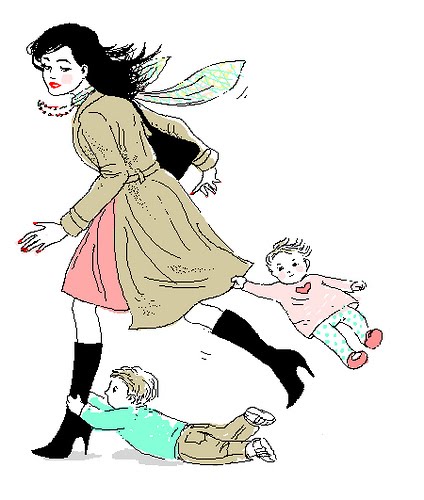
*image credit: mum tries to escape – ELLE # 3, Mar 2010 by pixel endo @ Flickr.com.

un-mother’s day: thoughts on a problematic holiday

18 Tuesday May 2010

Posted by Anna Clutterbuck-Cook in think pieces

≈ 3 Comments

Tags

children, feminism, holidays, politics

There’s a wonderful scene in the British sitcom My Family in which the parents (Ben and Susan) attempt to speak with the parents of a child who is bullying their son. The other parents are having none of it.

“Now we know you think of yourselves as good parents–“ one of them begins to say condescendingly to Ben and Susan.

Susan and Ben look at each other.

“No,” Ben hastily clarifies, “we don’t think of ourselves as good parents. We just think of ourselves as parents.”

It is in that spirit, I offer you the fabulous Anne Lamott @ Salon on why she hates mother’s day

I hate the way the holiday makes all non-mothers, and the daughters of dead mothers, and the mothers of dead or severely damaged children, feel the deepest kind of grief and failure. The non-mothers must sit in their churches, temples, mosques, recovery rooms and pretend to feel good about the day while they are excluded from a holiday that benefits no one but Hallmark and See’s. There is no refuge — not at the horse races, movies, malls, museums. Even the turn-off-your-cellphone announcer is going to open by saying, “Happy Mother’s Day!” You could always hide in a nice seedy bar, I suppose. Or an ER.

* * *

Don’t get me wrong: There were times I could have literally died of love for my son, and I’ve felt stoned on his rich, desperate love for me. But I bristle at the whispered lie that you can know this level of love and self-sacrifice only if you are a parent. We talk about “loving one’s child” as if a child were a mystical unicorn. Ninety-eight percent of American parents secretly feel that if you have not had and raised a child, your capacity for love is somehow diminished. Ninety-eight percent of American parents secretly believe that non-parents cannot possibly know what it is to love unconditionally, to be selfless, to put yourself at risk for the gravest loss. But in my experience, it’s parents who are prone to exhibit terrible self-satisfaction and selfishness, who can raise children as adjuncts, like rooms added on in a remodel. Their children’s value and achievements in the world are reflected glory, necessary for these parents’ self-esteem, and sometimes, for the family’s survival. This is how children’s souls are destroyed.

I encourage you to read the whole piece at Salon.

I’ve written a few blog posts lately about seeing children as people, rather than — as Anne Lamott puts it — “adjuncts” of parental or adult objectives. I believe, as Lamott writes here, that such objectification of young people is destructive to the soul.

But today I’d like to focus — as Lamott does here — on what harm the stories we tell ourselves about parents do to adults. And the particular effect they have on the way we (as a culture) percieve those of us who are (whether by accident or design) not-parents.

And I’ve chosen to use the phrase “not-parents” instead of “childless” or “childfree” deliberately, because I am starting to believe that this narrative of parents vs. not-parents has little to do with children and everything to do with adults. With our cultural assumptions about what it means to be a responsible grown-up human being in the world. I believe it has everything to do with the way adults past a certain age (roughly post-college) are read culturally by those around them, for signs of parent or not-parent status, and judged by a set of cultural assumptions about what it means to lack (or forego) experience of the parenting role.

The assumptions are not pretty.

I’ve become much more aware (often hyperaware) of these constant “non-parent = bad” messages since I’ve been partnered with someone who does not wish to parent. As a child, I wanted to be everyone’s mother: I parented pets, my siblings, my next-door neighbors. I had fantasies about adopting orphans from war-torn Sarajavo, birthing multiple babies I’d hoist on my back and carry with me as I explored the globe. I was an adventurer, a take-charge tomboy (although my parents never employed the word, and bless them didn’t blink when I announced plans to be a princess who was also a lumberjack in the local arts center play) while also being a caretaker and nurturer.

And I was absolutely rewarded, socially, for that behavior. Adults marveled at how “good” I was with children, and trusted me with the responsibility of looking after young ones. I fit the story, so I was slow to challenge it. Plus, my parents have never been pushy with any of us kids about getting married or becoming parents ourselves (thank you Mom and Dad!); I never felt any direct familial pressure to find a partner and somehow acquire offspring for them to grandparent, carry on the family line, or somehow fulfill my destiny as a female-bodied person. But, because I am capable with young people, because I am generally patient with those around me (often to a fault), I can fill that caretaker role people expect of women in the world — even women who are not obviously attached to the children who happen to be in their vicinity. And most of the time, at least on a casual basis, I’m willing.*

So I was sheltered, personally, from the stigma of being a Woman Who Didn’t Want To Be a Mother. But now I see (or at least try to see) the world through Hanna‘s eyes some of the time, and I’ve been thinking a lot more about our culture’s obsession not just with a certain image of young people as Children (to be feared or commodified), but of adults as Parents (who are either “good parents” or “bad parents,” not simply…parents).

Not-parents have no space in this world of Parents and Children. Or rather, their position in the world is analogous to that of the Old Maid in relation to Wife: “life: FAIL.”

I’m speaking here, I want to emphasize, in terms of cultural narratives, not actualities. There have been some amazing not-parents (both women and men) in my life. I will be forever grateful to them for modeling the possibility of having an adult life rich with relationships that does not depend on the role of full-time parent. This is about perceptions and stereotypes, which — although they do not dictate our material realities, do narrow the range of possible stories we have at our disposal when trying to explain our life choices, to ourselves and to others. As Anne Lamott writes: “Ninety-eight percent of American parents secretly feel that if you have not had and raised a child, your capacity for love is somehow diminished.”

I’d argue that many not-parents also believe this about themselves and other not-parents around them, in the same way that women are often each others’ harshest critics when it comes to complying with beauty standards or men punish each other for displays of emotions other than anger. In our culture, to be unaccessorized with children means one is broken in one of the most profound ways a human being can be broken: it means that one’s “capacity for love is somehow diminished.”

Just: NO.

I’m not okay with this story. I am not willing to accept a narrative of humanity that implies my partner — who does not want to be a full-time parent — is somehow broken, that she lacks compassion and the ability to love. It is, quite simply, not true. She has a HUGE heart for the world, sometimes so attuned to its sufferings that I am humbled by her capacity for empathy.

And I’m not okay with a cultural narrative that requires she perform extra cultural work to prove that — despite her decision not to parent — she is, in fact, not broken, not selfish or heartless, or incapable of loving.

These stories we tell each other, which privilege certain relationships and roles over other relationships and roles seems on the surface to be to the advantage of a certain group of people (in this case parents) over another (not-parents), but in the end it only serves to punish all of us for not living up to the ideal Good Parent in the collective imagination, rather than acknowledging that at the end of the day most of us are “just parents,” “just human,” and have at our disposal myriad opportunities to express love and care for others regardless of the kind of relationships with nurture.

Let’s celebrate those qualities, human qualities, that are not contingent on performing certain pre-determined roles (Good Mother, Good Father, Good Child) or being handed certain responsibilities, held to certain expectations, that go with those roles. Let’s instead celebrate the boundless capacity of all of us human beings to engage in loving, nurturing activities throughout our lives.

That’s a celebration I could get behind.

Anne Lamott said it first, and far more eloquently, here.

*As I said in my last post on bigotry towards children, I’m not, at the moment, planning to commit to the full-time parenting thing.

quick hit: infant morality

11 Tuesday May 2010

Posted by Anna Clutterbuck-Cook in linkspam

≈ Leave a comment

Tags

children, human rights

Tangentially related to my post last week about treating children as people, Paul Bloom @ The New York Times Magazine discusses current research into how human beings acquire morality (or if they are born wired, so to speak, with a sense of justice and injustice)

Morality, then, is a synthesis of the biological and the cultural, of the unlearned, the discovered and the invented. Babies possess certain moral foundations — the capacity and willingness to judge the actions of others, some sense of justice, gut responses to altruism and nastiness. Regardless of how smart we are, if we didn’t start with this basic apparatus, we would be nothing more than amoral agents, ruthlessly driven to pursue our self-interest. But our capacities as babies are sharply limited. It is the insights of rational individuals that make a truly universal and unselfish morality something that our species can aspire to.

I don’t necessarily agree with all of the ways he defines moral and immoral sentiments and actions, but it is an interesting overview of some of the more recent theories vis a vis how we construct a mutually agreed upon moral framework in which to operate as a human society.

not-so-quick hit: bigotry towards children

04 Tuesday May 2010

Posted by Anna Clutterbuck-Cook in think pieces

≈ 7 Comments

Tags

bigotry, children, feminism

Via Molly @ first the egg comes a passionate articulation of the right of children to be treated as human beings, rather than as a subspecies to be “liked” or “not liked” en masse. Sybil Vane @ Bitch PhD writes

Now, maybe I meet someone who doesn’t necessarily dislike Little V in a personal way but who is “not really a kid person.” And here I mean not necessarily someone who doesn’t want to have kids or who doesn’t have any experience being around kids or someone who lives a lifestyle that doesn’t produce any exposure to kids. I mean someone who is expressive about a “I don’t really like kids” attitude or a “I hate going to restaurants or museums where kids are making noise” attitude or a “of course it’s fine for other people to have kids but I don’t want to be around them” attitude. This sort of thing is a deal-breaker for me. I’ve gotten pretty rigid about it in recent years as I become more assured in my certainty that it’s an anti-feminist attitude and you suck if you hold it. Kids are a vulnerable, disempowered, inevitable portion of the human community and you do not get to “not like” them or to wish that weren’t a part of your public space. Not allowed. I invite you to swap out “kids” for any other disempowered community in the above phrases (“women,” “schizophrenics,” “hispanics,” “the blind”) and notice what an asshole you sound like.

You can read the whole post over at BitchPhD.

I’ve blogged about this before (last year in what turned into a two-part post here and here and in passing on Saturday in my blog against disableism post).

The first time I wrote about it, I realized I was coming down hard on someone who sounded like an asshole in comments (they’d left a post on my blog calling young people “feral, shrieking little carpet apes”). But I was largely unprepared for the backlash I got on the post, where people resisted mightily the possibility that there might be parallels between dehumanizing children (based on age) and dehumanizing other segments of society based on other group characteristics (such as race, national origin, gender, etc.). People made all sorts of assumptions about my socioeconomic status, my personal background, my status as a parent, and suggested that being an advocate of children’s humanity is only the province of privileged, solipsistic white mothers with ivy league educations.

So let me be clear, here. I’m not a parent. At this point, it’s unlikely that I will ever be a parent. The reasons for this are personal, relational, ethical, sociopolitical and economic in nature — too complicated to delve into in this post. But the point is: not a parent. And to tell you the truth (contrary to popular opinion re: women and infants) I’m okay with that.

There was a time (I won’t lie) when my fondest dream (at age nine) was to set up an orphanage with my best friend and spend my days nurturing a vast brood of Anne Shirleys who otherwise would not have caring adults to call their own. But I’ve grown and changed, tried quasi-parenting for a while (I spent a year as a live-in childcare provider), and realized that is not where my primary interest lies.

There are even days when I’m not just “okay” but incredibly relieved by the idea that I will never — unforeseen crises not withstanding — be the 24/7 primary caregiver of a young person. Even with a willing and able partner, that job seems prohibitively daunting. Particularly in a culture where meaningful support for caregivers (of the elderly as well as the young) is so thin on the ground.

But the point is: none of these personal decisions or experiences absolve me from the responsibility of including children in the human community. They don’t absolve me from the responsibility of treating them with the same courtesy and respect with which I expect folks to treat me, and with which I treat adult members of the human community. As Molly writes @ first the egg

I actually am not “a kid person” in any normal sense of the term — I’m not that whipped up about children just because they’re children, I’m generally much more interested in a puppy or kitten…or adult person…or this here computer screen…than a baby I don’t know personally — but they’re people.

The awesome thing about this is, in my experience, that young people thrive on being taken seriously. On being treated with a straight-ass, no bullshit attitude. Speaking from my own remembered experience as a child, I had zero interest in being fawned and fussed over, having my personal space invaded by adults who thought of themselves as “liking children” and were subsequently pissed when I failed to delight in their cosseting.

I wanted to be taken seriously, to be leveled with, and to be given a seat at the table with all the adults around me who discussed interesting and complicated things, had wicked skills for creating things and exploring the world, and who might possibly share that experience with me.

It’s true that children, by virtue of their still-developing brains and bodies, do not always meet the requirements set forth by our culture’s model of ideal able-ness and imagined self-sufficiency . . . but then, as I pointed out last Saturday, neither do we. Children need help meeting their material needs, need spaces and resources to explore the world and gain material, cognitive, and emotional skills to become more independent. Not every adult is prepared to provide on-the-ground assistance to children in this way, just like not every adult provides eldercare around the clock. But as members of the human community, citizens of the world, we can recognize that all of us matter — and treat those whose paths we cross accordingly.

And the sooner, the more ardently, we can impress upon young people that they matter just as much as the next person, the more likely it is that those young people will grow into older people who — no matter how privileged, how able, they become — will remember that their able-ness is not what imbues them with worth: it is their membership in the human community. Just as that membership in the human community grants the person sitting next to them on the subway, or standing in line behind them at the coffee shop, or playing on the swings at the park, intrinsic worth.

And hopefully, just maybe, this belief in the worth of humanity will make the world a richer, more compassionate, less threatening, less defensive, more bountiful world to live in for us all.

*image credit: Christmas Day Morning by Carl Larsson @ the Carl Larsson Gallery.

k.a.p.t: children as commodities

14 Wednesday Apr 2010

Posted by Anna Clutterbuck-Cook in think pieces

≈ Leave a comment

Tags

children, politics

Reminder: Kids Are People Too.

I often suspect that our outwardly child-centric culture (the one that obsessively tracks celebrity “baby bumps” and coos over the latest convert to parenthood, the one that freaks out when couples try to limit family size or seek permanent pregnancy prevention through surgery) is actually deeply allergic to the concept that children are, in fact, not accessories but actual human beings. I’ve argued before that our obsessive adoration of all things “cute” and child-like actually points toward a callous disregard for the actual lives of actual small human beings.

The recent case of a Tennessee mother returning her adoptive son to Russia with a note saying she no longer wanted to parent him (“I’ll remember you all in therapy!”) has given us an opportunity to consider a whole tangled web of complicated ethical issues such as the moral ins and outs of international adoption and the lack of structural support for parents with children they feel unequipped to care for. However, as Pilgrim Soul @ The Pursuit of Harpyness points out, it also suggests the level to which our culture has accepted the commodification model of parenting.

My question, you see, is this: what is our culture teaching people if they are consistently displaying the signs of believing that child rearing and child care is some kind of consumer lifestyle in which they will metaphorically purchase happiness by “selflessly” devoting themselves to a child? That the care of children is not viewed as a collective responsibility but rather an optional joy, and when it turns out that the experience isn’t joyful, that it’s too hard, you just, you know, go back to the store. Complain about the service you received. Call it a day. What happens or doesn’t happen to these kids when they are basically unwanted, no one talks about. That’s somebody else’s problem.

This manifests in more ways than clueless Tennessee women putting foreign children unaccompanied on planes. It manifests in the fact that foster care systems are often a disgrace, that school systems are a low funding priority, and that this country, for example, doesn’t have a functioning health care system to support people who do parent children of the non-Wheatabix-cereal-box-beauty commercial variety. These attitudes, I’m saying, have consequences. Generation after generation of these kids suffer both emotionally and materially from our habit of demanding certain habits from them, and no one really gives a shit. When was the last time you heard a politician get on his high horse about seriously reforming child services, and I mean, not in a “those social workers must be fired” kind of way, but in a “let’s have a conversation about whether this is the kind of society we want to be” way?

Go read the whole post @ Harpyness, since it’s totally worth it. And now I have to get back to polishing a presentation for Saturday’s conference.

← Older posts
Newer posts →
"the past is a wild party; check your preconceptions at the door." ~ Emma Donoghue

Recent Posts

  • medical update 11.11.22
  • medical update 6.4.22
  • medical update 1.16.2022
  • medical update 10.13.2021
  • medical update 8.17.2021

Archives

Categories

Creative Commons License

This work by Anna J. Clutterbuck-Cook is licensed under a Creative Commons Attribution 3.0 Unported License

Meta

  • Create account
  • Log in
  • Entries feed
  • Comments feed
  • WordPress.com

Blog at WordPress.com.

  • Subscribe Subscribed
    • the feminist librarian
    • Join 37 other subscribers
    • Already have a WordPress.com account? Log in now.
    • the feminist librarian
    • Subscribe Subscribed
    • Sign up
    • Log in
    • Report this content
    • View site in Reader
    • Manage subscriptions
    • Collapse this bar