• anna j. clutterbuck-cook
  • contact
  • curriculum vitae
  • find me elsewhere
  • marilyn ross memorial book prize

the feminist librarian

the feminist librarian

Tag Archives: feminism

A few of my favorite (feminist) things

13 Friday Feb 2009

Posted by Anna Clutterbuck-Cook in book reviews

≈ 1 Comment

Tags

feminism, gender and sexuality

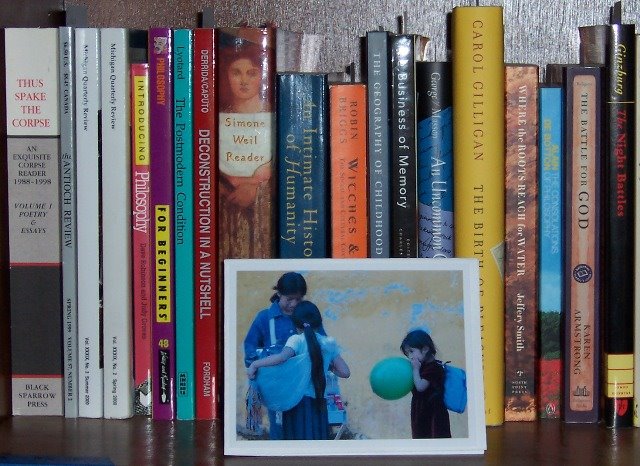
In honor of V-Day this year, the Feminist Review is doing a favorite feminist book photo contest. I was tempted to contribute, but since my number-one, all-time favorite feminist read is Our Bodies, Ourselves, I figured the picture would really best be done as a calender girls shot. And I will not be getting naked on the internet, even discreetly naked, until I have 1) a heck of a lot more job security — like, permanent feminist-friendly job security 😉 — and, 2) someone like Willy Ronis offers to do the photo shoot.

So as a second-best offer, here is a top five list. I say “a” top five list, since there are probably others I could have composed. I picked these for diversity of period, genre, and sentimental value. And they’re not in hierarchical best-worst/worst-best order: I’ve taken a page from Nick Hornby’s High Fidelity, and arranged them autobiographically.

1) Pippi Longstocking, by Astrid Lindgren (1945). There are many other children’s books I could have named here, with similarly awesome girl characters in them. But Pippi will always hold a special place in my heart. Maybe it was the fact that she, like I, never seemed to see the point of attending school — even if it meant you got summer vacation! She was bold, imaginative, physically daring, generous to her neighbors, and never let older people push her around simply because they were bigger or older than she. I also hold Pippilotta Delicatessa Windowshade Mackrelmint Ephraimsdaughter Longstocking responsible for my childhood desire (which still occasionally manifests itself) to be a redhead.

2) Our Bodies, Ourselves, by the Boston Women’s Health Book Collective (1970, and many subsequent editions). As promised above, a little about why I’d choose this book as my favorite feminist read: I think of this book as my introduction to modern political feminism. I first read my mother’s copy as a young adolescent, and I can’t think of a better way to learn about the possibilities of my (nascent) adult body than through the lens of the women’s health movement. This book was my introduction to my anatomy; to the experience of pregnancy and feminist parenting; to options for abortion and contraception; to masturbation; to the ways in which adults negotiate sexual relationships (both hetero and same-sex); to the concept of collective political action for social change. Out Bodies, Ourselves endures — from my perspective — as a feminist text because it foregrounds women’s voices in all their complexity. The book collective discovered, even in its earliest incarnations, that the best way to gather intelligence about how women experienced their bodies was to ask them. This remains, to me, the central tenant of any feminist practice: begin with the premise that each woman (and, yes, each human being) is the best authority on her own subjective experience.

3) The Seneca Falls Declaration, by Elizabeth Cady Stanton (1848). No, this is not really, strictly speaking, a book. But it’s one of the first primary source documents I read during my college-era women’s studies experience, and at seventeen I remember being absolutely blown away by how current it felt. How simple its demands seemed to be, and how little the goals of feminist activists had changed since 1848. Of course now, a decade further in my historical studies and feminist consciousness, I can add layers of critical awareness to this reaction — but I won’t ever forget the mix of awe and anger I felt when I read the Declaration for the first time and realized the long legacy of activism I could choose to claim as my own.

4) In Our Time: Memoir of a Revolution, by Susan Brownmiller (2000). From the heady days of consciousness-raising groups in the New Left, to the divisive, bitter turmoil surrounding anti-pornography campaigns in the early 1980s, Brownmiller’s deeply personal chronicle of the Women’s Movement came out just as I was struggling to find my voice, politically, as a feminist, on a conservative midwestern college campus. I devoured In Our Time with a passionate nostalgia for the political daring ideological radicalism, the daily intensity of Movement relationships, and the sense of possibility for revolutionary change Brownmiller describes. Even with a more circumspect, historical perspective, this first-person account of mid-century feminist activism remains a great read and a valuable resource.

5) Whipping Girl: A Transsexual Woman on Sexism and the Scapegoating of Femininity, by Julia Serano (2007). There have been some great recent works on feminism in the past ten years, many of which grace my shelves. However, few of them have rocked my world as brilliantly as Whipping Girl, Julia Serano’s collection of essays on sex and gender from both a trans and feminist perspective. I am absolutely blown away by her ability to take dense ideas about the biological and cultural experiences of sex and gender and make them understandable and politically compelling. Even though much of the book is an argument for awareness of trans issues within feminism, it is also the best nuts-and-bolts articulation of how sexism works — and harms people of all sexes and genders — that I have read in recent years.

Womyn’s Land (Take Three)

09 Monday Feb 2009

Posted by Anna Clutterbuck-Cook in think pieces

≈ Leave a comment

Tags

feminism, gender and sexuality, guest post

My friend Linda Smith, who is a resident at Hawk Hill Community Land Trust and was a part of the Aradia oral history project (see post one), read my thoughts on the recent article about lesbian communities in the New York Times. (See post one and post two here.) She wrote me an email in response, which I am posting here with her permission. Thanks Linda!

Hi Anna,

Nice to hear from you! I just read your blog entries on the article in the NY Times. I too hope there will be more “conversation between generations of women who are intrigued by the idea of communal life, and spark creative, contemporary approaches to experiments in living that will help our elders and youngers improvise lives worth living.”

For me, as a feminist in the 70’s, separatism was a strategy not a political position or a life style. I think it is sometimes important for women (or blacks, or other oppressed peoples) to separate from the oppressive culture in order to discover who we are apart from the stereotypes imposed on us. To contact our own power and source of being. Remaining separate and at odds with the dominant culture isn’t the goal. Most of us involved in feminist consciousness raising and women-only groups in the 70’s have chosen to act out our truth in the world. To contribute to the culture and the evolution of our species. This is a spiritual question for me. One of the major problems in the world today is the false belief that individuals and groups are in fact separate – we are all connected, men/women, Jews/Christians/Muslims, and all living beings.

I think a healthy community grows organically and changes with the times. I live on an environmentally protected landtrust. There are five households and six lesbians living here. We are not a commune – we have no community buildings and do not share our income. In many ways our community includes our neighbors and the surrounding environment. We do not own our land but have 99 year leases. By signing our leases we agreed to specific “covenants” designed to protect this land, the waterways, and all the creatures living here. There have been many changes in the world since the first lesbian land groups formed. If younger women (or perhaps men, or ?) are going to come and take care of this land after we are gone we’ll have to be more flexible and learn from each other as you suggest! At Hawk Hill, as far as I’m concerned, it’s really about the land, all the creatures living here, and our relationships to these and each other – not about lesbian separatism.

Thanks for you thoughtfulness.
Linda

Booknotes: Therese Philosophe

07 Saturday Feb 2009

Posted by Anna Clutterbuck-Cook in book reviews

≈ 5 Comments

Tags

feminism, gender and sexuality, history, simmons

Last Tuesday, in my intellectual history class (“The Modern Imaginary”), we discussed Therese Philosophe, a bawdy, “forbidden best-seller” of pre-revolutionary France. The novella is an erotic novel and philosophic treatise in which the titular character, a young woman named Therese, recounts her sexual and philosophic coming-of-age to her present lover, the unnamed Count. Not having previously read any one complete example of Enlightenment-era pornography, I had few pre-conceptions about the genre when I sat down to read Therese.

This is an anonymously-written work, published in 1740s, tentatively attributed to a marquis named Jean-Baptiste de Boyer and was a runaway best-seller, according to translator Robert Darnton. Yet even though the author is likely male, and his understanding of the pleasures of sexual activity is definitely phallo-centric, the novel presents us with a complex, possibly even (early) feminist, understanding of sexuality. The novel is told from the point of view of a woman who discovers that sexual fantasy and sexual activity (whether alone or with a partner) can be a “healthful” and deeply gratifying part of her life. Sexual activity is assumed to be pleasureable for both women and men, and there is little differentiation between how women and men experience that pleasure, at least physically. Women, as well as men, for example, are encouraged to masturbate. At the same time, the characters acknowledge the material vulnerability of women who engage in heterosexual activity: the fear of pregnancy and death in childbirth; potential loss of social standing which will threaten their ability to contract a financially stable marriage. Therese and her mentors negotiate with their sexual partners over what sexual activities are acceptable given these real-world constraints, and those conversations serve as both philosophical debates and integral to the erotic encounters themselves.

Some of the students in the class were skeptical that this text constituted “intellectual history,” and in addition there was a lot of resistance to reading the sexually-explicit passages as necessary or integral to the intellectual importance of the work. Their impulse was to argue that either the smut was a ploy to sell the philosophy, or the philosophy was an excuse to write the smut. Either way, they considered the sex was gratuitous to the historic or intellectual importance of the piece. I would actually argue the opposite. In Therese Philosophe, it’s not the sex or the philosophy that are the “real” reason for the novel’s existence — it’s the sex and the philosophy. Both are necessary to make the story work. More importantly, I would argue that it’s not just the philosophy that works better because of the sex, but the sex that works better because of the philosophy.

Reading this one example made me curious to sample more 18th-century erotica and see how gender and sexual negotiation are portrayed. Is Therese an exceptional voice? And is is possible to uncover why her story was so compelling to the readers who purchased it is such great numbers that it became a best-seller? I am also fascinated by the similarities, as well as the differences, I see between how human sexuality and sexual relations are portrayed in Therese and how they are written in modern-day erotica. Perhaps that project can be thesis number three or four . . . !

Cross-posted @ feministing community.

Womyn’s Land (Take Two)

04 Wednesday Feb 2009

Posted by Anna Clutterbuck-Cook in think pieces

≈ Leave a comment

Tags

feminism, gender and sexuality

I didn’t have any big, new reactions after reading the New York Times article about lesbian communities. It felt a bit superficial and simplistic to me, but most newspaper articles on subjects one cares deeply about seem reductive. It turns out that some of the women I met in the course of our oral history project were interviewed for the piece. I spoke with one woman yesterday who’d spoken with them and reported that the collective response to the finished piece was, predictably, mixed. Meanwhile, the article has, also predictably, been fodder for debate on some of the blogs I regularly read. I particularly wanted to highlight a post up at the new blog In Persuit of Harpyness, What We Should Talk About When We Talk About Lesbian Separatism. In reflecting on both the article and the conversation generated about it, the blogger writes:

As a feminist it is my job to recognize that such experiences exist, that it is important to listen to the women who lived through them, and not try to shame them or make their choices about mine. It is important to listen because they have something to contribute to my feminism, these lesbian separatists.

. . . I can cut their critics some slack, but only a little. Sometimes, when I am in the heat of an internet argument, I start to forget how much of my devotion to feminism is rooted in good old boring ordinary compassion. Because I am a person who enjoys talking about ideas abstractly, I can sympathize with those who want to synthesize the contributions of these women . . .

But those discussions, they aren’t the whole truth of the matter. They aren’t about the women themselves. And though I’m always going to keep talking about feminism abstractly, I often wish everyone would keep their eyes on the ball.

As someone who has spent time on womyn-only land, and has listened extensively to the life stories of the women who were kind enough to let us ask nosy questions about their lives as lesbians and as feminists, I think this post gets to the heart of the matter here. Communal living arrangements, sort of like feminist thinking and activism, is a response to a particular historical context and personal experiences, and like feminism communal living is an organic, fluid project that constantly grows and changes to meet new challenges. Hopefully, the New York Times article will spark conversation between generations of women who are intrigued by the idea of communal life, and spark creative, contemporary approaches to experiments in living that will help our elders and youngers improvise lives worth living.

Womyn’s Land in the NYT

02 Monday Feb 2009

Posted by Anna Clutterbuck-Cook in think pieces

≈ 4 Comments

Tags

feminism, gender and sexuality, hope college

I don’t have time right now to write a longer reflection on this article in the New York Times about lesbian communities and women-only land — but I wanted to post a link to it because it quotes my women’s studies professor and from undergrad, Jane Dickie, with whom I collaborated on an oral history project involving a group of women who have ended up living on a women-only land trust in Missouri.* As Joseph (who forwarded the link to me) says, “it’s the first time I’ve ever read the NYT and gone, ‘Hey! I’ve met that person!’ and it is kind of a strange feeling.”

Miriam, over at feministing, has already posted her reflections on the story and on the phenomenon of lesbian communities. If I have any Big Thoughts after sitting down to read the piece, I’ll be sure to follow up with a “take two.”

*You can read about the research project we did in the essay “The Heirs of Aradia, Daughter of Diana: Community in the Second and Third Wave” published in the Journal of Lesbian Studies (vol 9, no. 1/2, 2005) also published as Lesbian Communities: Festivals, RVs, and the Internet, edited by Esther Rothblum; also in “Responding to Aradia: Young Feminists Encounter the Second Wave” by Leslie Aronson, Adrienne Bailey, Anna Cook, Jane Dickie, Bethany Martin, and Elizabeth Sturrus, published in Iris: A Journal for Women (issue 47, Fall/Winter 2003).

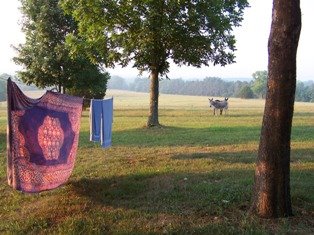
Image from Hawk Hill Community Land Trust, Missouri, Summer 2005 (personal photo)

Alas, a Blog: Christina Hoff Sommers

31 Saturday Jan 2009

Posted by Anna Clutterbuck-Cook in linkspam

≈ Leave a comment

Tags

feminism

Ampersand, over at Alas, a Blog, is doing a fun and informative series of deconstructions of a recent talk given by faux feminist Christina Hoff Sommers. I’ll be updating this list as the series continues, but for now here are the first four posts.

Response to Christina Hoff Sommers, part 1: Ovulars instead of Seminars?

Response to Christina Hoff Sommers, Part 2: Do Feminists Hate Men?

Cathy Young responds to me regarding feminist hatred of men.

Response to Christina Hoff Sommers, part 3: Truths and Lies

And the world gets a little better . . .

29 Thursday Jan 2009

Posted by Anna Clutterbuck-Cook in life writing

≈ Leave a comment

Tags

feminism, politics, random kindness

So I don’t think the Obama administration is the Second Coming of Jesus Christ or anything, but I have to say the tension that has existed for the last eight years somewhere down near my uterus un-knotted a just wee small bit when I saw the juxtaposition of these two pictures.

Also: to the undergraduate standing in front of me in the coffee line who turned around after paying to say to me, “I saw you reading Feministe just now and I was so encouraged!” — it’s so nice to know there are other people out there in the real world who feel encouraged by the same things I do! You totally made my day.

Quick Link: "Politically Incorrect"

29 Thursday Jan 2009

Posted by Anna Clutterbuck-Cook in linkspam

≈ Leave a comment

Tags

feminism, politics

Nettle Syrup, over at Feministing Community, has a post up about the problem with people getting off on proclaiming how “politically incorrect” they are. This is something that really irritates me as well. As a commenter, Sandra, in the thread points out:

Political correctness means taking into consideration that not all of the world falls into the same category as you. It means taking the time to be inclusive. How are these bad things?

I understand that some people, particularly people who enjoy misusing their positions of institutional or political power, can use progressive or liberal — even feminist — ideals just as easily as they can conservative, reactionary ideals in manipulative, coercive ways. Yet the ability of any idea to be misused does not invalidate it wholesale, and doesn’t mean we should dismiss it out of hand.

Pre-emptively calling yourself “politically incorrect” before making a statement you expect will be offensive to someone you are speaking with, is tacky at best and a smoke screen for bigotry at worst. It’s an offensive attempt to neutralize any critique (no matter how legitimate) by framing all disagreement with the statement that follows as humorless legalism.* It was nice to see someone else take the time to call “foul!”

*The connotation, accurate or not, the term “politically correct” has acquired.

‘Tis the season for lists

27 Tuesday Jan 2009

Posted by Anna Clutterbuck-Cook in linkspam

≈ 7 Comments

Tags

feminism, fun

Something about the end-of-the-old-year / beginning-of-the-new year seems to inspire people to list creation. Or perhaps it’s the proliferation of awards ceremonies in the entertainment industry. Anyway, I’ve been coming across a profusion of lists in the last couple of weeks, and thought I’d post a few here: a list of lists, if you will. And yes, this blog being what it is, it’s a feminist-centric sort of list.

There’s a list of the “Top 100” gender studies blogs over at BachelorsDegreeOnline. As with any such list, it includes blogs I read regularly and enjoy, blogs I’ll now have to check out, and some blogs I’m not sure should have been included in the “feminism category.” I really take issue with the idea, for example, that it’s possible these days to have a “a distinctly anti-male” yet “pro-feminist point of view.” Granted, feminist movements have always included those people who insist on blaming men as individuals for patriarchy and sexism — but I personally don’t think that it should be recognized as feminism.

In response to the above list, Fourth Wave Feminism is compiling an alternative list of “Radical/WOC/Alternative/Global” feminist blogs which will also be fun to explore.

Last week, Hanna forwarded me an article from the Guardian naming the favourite female renegades of five women in cinema.

The bloggers over at Evil Slutopia their top ten priorities for the Obama administration when it comes to reproductive health: “Here’s our top 10, with lots of links. We want it all.”

Why does it have to be either/or . . .?

26 Monday Jan 2009

Posted by Anna Clutterbuck-Cook in think pieces

≈ 1 Comment

Tags

feminism, gender and sexuality

. . . Can’t it be both/and?

Meghan O’Rourke, over at Slate’s xx factor blog has a post up, The Sexual Fluidity of Women about this weekend’s article on sexuality research and women’s desire in the New York Times Magazine. In the post, O’Rourke argues that the implicit question of the article is this: “Are contemporary women doomed to experience a schism between what their bodies lust for and their minds tell them they want?”

Don’t you just love it when questions and answers are framed in terms of what “women” (as a single corporate entity) experience or desire? The article itself, which appears to be an interesting round-up of contemporary research of women’s sexuality (I’ll have to sit down and read it more carefully when I have the time — alas, assigned reading takes priority this morning), poses the tiresome “what do women want?” question . . . as if we, as a some inexplicable half of the human species, are a problem to be solved. Women (unlike men, the question implicitly suggests): They’re so complicated and confusing! They confuse us with their sexuality!! Isn’t the answer to the question “what do women want?” self-evidently “each one of us wants something slightly different”? While I’m glad people now recognize that generalizations about human sexuality made from studying primarily male subjects is inadequate, redressing the problem by making generalizations about “women” doesn’t seem like a very useful response.

I also do not understand why it’s useful to recycle the body/mind dichotomy when talking about sexual desire and experience. Regardless of gender, sexual orientation, or any other factor you can think of. Our bodies and our minds desire different things in different contexts, at different points in our lives. In my experience (in sex as well as elsewhere) it’s quite possible to desire two seemingly contradictory things at the same time — without losing your mind or your integrity. Framing a so-called dissonance between physical arousal and self-reported desire (an example O’Rourke highlights from the article) as a “schism” imagines that, just because our bodies and minds operate on different levels simultaneously, they are in opposition to one another — why should this be the case? Sexuality is beautifully complicated. Human beings are beautifully complex. In sex, as in everything else, our Selves — both body and mind — act and react in an ever-shifting composition of ways that scientific studies will likely never be able to fully document and explain.

For other bloggers’ thoughts (updated as I find them):

Bethany L. @ feministing community
StreetScholar @ feministing community
Elizabeth @ sex in the public square
Amanda @ pandagon
Jill @ feministe, cross-posted at yes means yes
Courtney @ feministing
Figleaf @ real adult sex
Vanessa @ alternet

← Older posts
Newer posts →
"the past is a wild party; check your preconceptions at the door." ~ Emma Donoghue

Recent Posts

  • medical update 11.11.22
  • medical update 6.4.22
  • medical update 1.16.2022
  • medical update 10.13.2021
  • medical update 8.17.2021

Archives

Categories

Creative Commons License

This work by Anna J. Clutterbuck-Cook is licensed under a Creative Commons Attribution 3.0 Unported License

Meta

  • Create account
  • Log in
  • Entries feed
  • Comments feed
  • WordPress.com

Blog at WordPress.com.

  • Subscribe Subscribed
    • the feminist librarian
    • Join 37 other subscribers
    • Already have a WordPress.com account? Log in now.
    • the feminist librarian
    • Subscribe Subscribed
    • Sign up
    • Log in
    • Report this content
    • View site in Reader
    • Manage subscriptions
    • Collapse this bar