• anna j. clutterbuck-cook
  • contact
  • curriculum vitae
  • find me elsewhere
  • marilyn ross memorial book prize

the feminist librarian

the feminist librarian

Tag Archives: feminism

Why I Go to Art Museums

30 Tuesday Oct 2007

Posted by Anna Clutterbuck-Cook in a sense of place

≈ Leave a comment

Tags

feminism, fun, photos, travel

On Sunday, Bethany, Patrick and I went out for brunch at the Kitchenette and then made our way to the Metropolitan Museum of Fine Art, when I almost got to live one of my childhood fantasies of being Claudia Kincaid in From the Mixed-Up Files of Mrs. Basil E. Frankweiler, who runs away from home with her brother Jamie. The two manage to hide themselves away in the Metropolitan Museum of Art and solve a mystery involving a statue possibly carved by Michaelangelo. It involves adventure, museums, and archival research–what’s not to like?
As incisive as the Guerrilla Girls may be in their critique of the fine art world’s lack of support for women artists, I still think one of the best things about visiting art museums is the women one finds on display. The variety of women’s bodies is absolutely stunning in comparison to the visual representations of women in our daily media. Their very multiplicity attests to the volatile nature of standards of beauty throughout history and across the world, from era to era and culture to culture.

For example, on this particular visit I was fascinated to see a 1661 Dutch painting, Visit to the Nursery, which shows a couple presenting their newborn to relatives. The mother holding the infant is dressed, but you can clearly see the gap in the front of her bodice, suggesting she is ready to nurse her child at any moment, despite the formality of the scene.

Another picture I was enchanted by (Mom, this one’s especially for you) was this portrait of a “mad” woman, Malle Babbe, which the museum describes as “in the style of Frans Hals.” She is posed with an owl on her shoulder, which apparently symbolized foolish or “vulgar” behavior in the seventeenth century. I like the fact that “wise old owls” were once thought to be exactly the opposite.
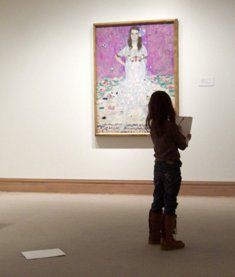
And finally, in a modern art gallery, I came across this painting (forgive me, but I forgot to note the painter and title; I will remedy that when I have the time) which I have always liked because of the juxtaposition of the very “feminine” colors and floral motifs with the girl’s confident pose and forthright stare. On the floor below the painting was a child or about eight, carefully drawing a copy of the portrait in her sketchbook. I hope she pays way more attention to what the art museums have to say about the beauty of the human form than she does to the monotonous version of “femininity” being pedaled by our consumer culture.

You can see all my pictures from the Met at Picasa.
Barnes & Noble Memorial Post: Teen Reads

20 Saturday Oct 2007

Posted by Anna Clutterbuck-Cook in book reviews

≈ Leave a comment

Tags

bn, feminism

Today was my last day at Barnes & Noble, and I thought I’d celebrate by highlighting some of the great books I read this year from the Barnes & Noble’s teen section, which is where I find some of the most interesting and enjoyable books. So here is a lightly annotated list of some of my favorite young adult reads from the past 17 months.

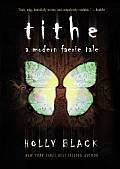
  • Tithe, by Holly Black. This gritty urban fantasy is about a girl who discovers she’s a changeling, and finds herself struggling to save herself and her friends from the violence of an amoral faery world that is all too real. And it’s the first in a series: c’mon Holly, write a fourth!
  • Nick and Norah’s Infinite Playlist, by Rachel Cohn & David Levithan. A girl and a guy both on the rebound from problematic relationships meet at a concert and spend the night wandering Manhattan (and possibly falling in love).
  • S.E.X.: The all-you-need-to-know progressive sexuality guide to get you through high school and college, by Heather Corinna. Okay, it’s not fiction, but it’s a great read all the same. In my dream world, every school system in the country would be using this for their sex ed program.
  • Wicked Lovely, by Melisa Marr. Another modern fairytale about a girl who discovers she is gifted (or cursed) with the magical power to heal the world of faery . . . but at what personal cost?
  • Actually, anything by David Levithan, though my favorite (aside from Nick & Norah) is The Realm of Possibility, a series of interconnected narrative poems about a group of friends at a high school and their network of relationships, romantic, platonic, and every shade in between.
  • This is All: The Pillow Book of Cordelia Kenn, by Aiden Chambers. I thought the end of this novel was a cop-out, but the rest is a voluble, maddening, tender and fascinating account of a young woman’s coming of age and her maturing relationships.
  • Runaways, by Brian K. Vaughn, et. al. Teenage superheros/heroines come into their powers and discover their parents are plotting to take over the world. Fun graphic novels that play confidently with the genre (and have some kick-ass young women as characters).
  • The Mislaid Magician; or, Ten Years After: Being the Private Correspondence Between Two Prominent Families Regarding a Scandal Touching the Highest Levels of Government and the Security of the Realm, by Patricia C. Wrede & Carolyn Stevermere. Besides deserving an award for Longest Title Ever, this third book in the Sorcery & Cecelia series provided me with one of the best quotes of last year: “The most unsettling result of this adventure is that we find ourselves in possession of a superfluous child.”
  • The Book Thief, by Marcus Zusak. A story about a foster child, an accordian player, a Jew in hiding, some stolen books, Germany in the midst of the Second World War, and the way human beings respond to overwhelming crises–all narrated by the compelling character of Death. It’s hard to describe, so I just tell people to read the first paragraph and see if they can resist being hooked.

(images all snagged from Powell’s online store)

". . .but the people working there are fairly nice."

15 Saturday Sep 2007

Posted by Anna Clutterbuck-Cook in library life

≈ Leave a comment

Tags

archivists, feminism, history, librarians, simmons


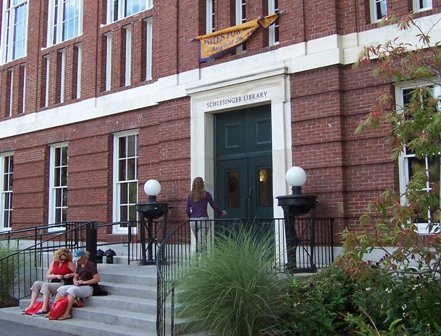
Today, I took a field trip to Cambridge to visit the Schlesinger Library at the Radcliffe Institute, one of the largest repositories of archival material on women’s history in the United States. The impetus for the visit was an assignment for my Archives class, in which I had to visit an archive and describe the experience. However, I admit that enjoyed the very personal pleasure–perhaps more aptly described as “reverential awe”– of simply by being in the same space where so much of the history (or herstory as many feminists would insist!) I care about is preserved, and the historical work I value done.

(Note: In the photograph above, the banner above the library’s main entrance reads “Votes for Women!” in the suffragist colors of violet and gold).

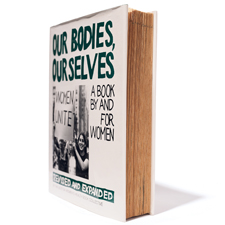
Aside from the pilgrimage aspect of the visit, I actually chose the Schlesinger because they are the repository for the Boston Women’s Health Book Collective records. (The BWHBC is the collective that wrote–and continue to update–the classic book Our Bodies, Ourselves, and are feminist advocates on a variety of women’s health issues worldwide). Our Bodies, Ourselves was one of my earliest, most comprehensive, and unabashedly feminist forms of sexual education and it remains near and dear to my heart (as well as close at hand on my reference shelf). I was interested in seeing some of their earliest manuscripts and gleaning what I could about the collective consciousness-raising process that had led them to publish the first edition of Our Bodies, Ourselves–then called Women and Their Bodies: A Course–which sold for 75 cents in 1970, and was intended as a working study guide for women’s health workshops.

The original publication was fun to browse through, permeated as it was with the language and political ethos of the women’s liberation movement which had given it birth. The first chapter of the 1970 edition, for example, is titled “Women, Medicine, and Capitalism”; a later chapter on abortion describes the hurdles unmarried women face when seeking birth control. A footnote highlights a single clinic in Boston where women–regardless of marital status–can obtain birth control no questions asked. The authors of the chapter observe: “this program is financed by the federal government, but the people working there are fairly nice.”

The most fascinating folder of material I read through was a collection of newspaper clippings and letters detailing the backlash to Our Bodies, Ourselves in the late 70s and early 80s when, apparently, it was being used quite widely in high schools as part of the health curriculum! In this age of abstinence-only education, it’s amazing to me that OBOS ever made it into high school libraries, let alone the curriculum. One teacher from Pennsylvania wrote the collective and described in detail how her students (ages 14-18) had used the book as part of a human sexuality class, including their sophisticated interactions with a pro-life activist who insisted on coming to the class and speaking on abortion. Another letter, written to a high school librarian in 1978, was from a pediatric doctor with teenage daughters who lauded the librarian for her defense of the book and observed:

Young people are far better served by the combination of access to all valid knowledge, even if at variance with parental thought, and the opportunity to discuss this openly with concerned and mature adults.

On the other side of the controversy, of course, were outraged parents and organizations such as the Moral Majority, which sent leaflets to its members detailing (in their minds) unacceptable sexual and political content of the book. One man was quoted in a 1981 newspaper clipping: “I am challenging [defenders] of this book to walk into church and read material out of Women, Our Bodies, Ourselves [sic]”–clearly expecting his audience to be shocked by the idea (though I rather like the image myself).

While this particular trip to the archives was a self-contained event for the purpose of a class assignment, I chose the content with an eye to my interest in feminist activism around sex and sexuality education, and who knows–these records may continue to play a role in my graduate education as I begin the task of designing the project for my history thesis.

Radical Librarians

15 Sunday Jul 2007

Posted by Anna Clutterbuck-Cook in library life

≈ Leave a comment

Tags

feminism, history, librarians


In my application to Simmons last year, I wrote that “as a scholar at heart, I am also committed to working for social change,” and that a degree in library science would enable me to “translate my knowledge of radical pedagogy and feminism into hands-on activism.” Becoming a librarian and historian will, I firmly believe, “make it possible for me to bring together all my commitments–to education, feminism, and history–in a vocation that is both intellectually rigorous and politically engaged.”

This is a vocation I came to through my life-long need to be surrounded by the printed word (physically as well as intellectually), and the realization that I was happier in libraries and bookstores than almost anywhere else in the world. Maureen Corrigan wrote in her memoir Leave Me Alone, I’m Reading that “like so many bookworms, I was timid and introspective, and yet reading, my earliest refuge from the unknown world, made me want to venture out into it, instead of sticking with my own kind” (xxiii). No one I know would call me “timid,” but I do have a tendency to be introspective, absorbed in my interior life. Books are an integral part of this interior landscape of mine. Yet like Maureen Corrigan, I find they fuel my curiosity, empathy, and determination to be a part of the living, breathing exterior world. The library seems the perfect solution, a balance between the privacy of books and the engagement of political activism.

Turns out (at least according to the New York Times) I’m riding the wave of a generational trend. In July 8th issue of the newspaper, they ran an article called A Hipper Crowd of Hushers that breaks the “news” that we bibliophiles have known for a damn long time: librarians are an awesome people.

(P.S. Thanks to the several friends who brought this article to my attention!)

American Activism(s)

02 Monday Jul 2007

Posted by Anna Clutterbuck-Cook in book reviews

≈ Leave a comment

Tags

bn, feminism, politics


My colleague at Barnes & Noble, Tony, who runs the music department, has decided to set up a display in my honor come August, when I am abandoning the store and moving East. I was asked to come up with a theme. After some consideration, I picked (for obvious reasons) the theme of political rabble-rousers in twentieth century American history. The movies must be fiction (no documentaries), but be based on actual true-life people or events. It’s a completely subjective list of movies that I have enjoyed, and from which I learned something about our collective history.

In order of historical period, they are:

1. Newsies (1992)*
2. Iron-Jawed Angels (2004)
3. Reds (1981)
4. Entertaining Angels (1996)
5. Cradle Will Rock (1999)
6. Dash and Lilly (1999)
7. Good Night & Good Luck (2005)
8. Kinsey (2004)
9. Norma Rae (1979)
10. North Country (2005)

They are all worth watching . . . so add them to your Netflix queue!

*be warned, this is a (thoroughly enjoyable) Disney musical about the newsboy strike of 1899–okay, almost the 20th century–so if your taste doesn’t run to musicals, this may not be your first choice!

Reproductive Justice

13 Sunday May 2007

Posted by Anna Clutterbuck-Cook in think pieces

≈ Leave a comment

Tags

feminism, politics


I bought my copy of the most recent issue of off our backs this week, and it turned out to be an entire issue dedicated to “reproductive justice.” The concept of reproductive justice, it turns out, is a way to re-vision the depth and breadth of what we have conventionally thought of as “reproductive rights” or even more narrowly, “pro-choice” advocacy. It focuses not only on or legal access to reproductive choice, but also on the social and economic inequalities that make those “rights” the privilege of those with power and resources.

Loretta Ross, one of the guest editors of the issue, and a member of the SisterSong Women of Color Reproductive Health Collective, defines reproductive justice this way:

  • the right to have a child;
  • the right not to have a child;
  • the right to parent the children we have
  • the right to control our own birthing options

Her article does a beautiful job of broadening the conversation surrounding reproductive and sexual rights, calling on us to articulate the overarching values that lead us to a pro-choice position. “Reproductive justice,” she writes, “focuses on the ends [rather than the means]: better lives for women, healthier families, and sustainable communities.” Thinking in terms of reproductive justice “draws attention to cultural and socio-economic inequalities because everyone does not have equal opportunity to participate in society’s cultural discourses or public policy and economic values, such as abortion, midwifery, or mothering.”

I read Ross’ article, “Understanding Reproductive Justice: Transforming the Pro-Choice Movement,” just a few days after reading a lovely essay, “Being a Radical Doula,” by a Maria Perez, a young woman who works as a doula supporting women during pregnancy, childbirth, and early motherhood. In “Being a Radical Doula,” Perez articulates the fundamental connection between her pro-choice politics and her passion for working with pregnant and birthing women.

Both of these articles came across my desk just when I needed them, after several long weeks of going back and forth with anti-abortion folks about the abortion ban. It’s wonderful to know there are other people out there working hard to create a world in which reproductive justice is a basic human right for all.

And I keep thinking . . . perhaps in my grannyhood, I’ll become a radical, activist midwife myself!

Feminist Activism After Gonzales

29 Sunday Apr 2007

Posted by Anna Clutterbuck-Cook in think pieces

≈ Leave a comment

Tags

feminism, politics

It’s been an intense couple of weeks, from the feminist-activist perspective. Since the April 18th Supreme Court ruling (Gonzalez v. Carhart) upholding–with a 5-4 majority–the 2003 “partial birth” abortion ban, I’ve been giving myself a crash refresher course in the theory and politics of women’s right to reproductive choice–including the “basic human right to decide what to do about a pregnancy” (see “Is There Life After Roe?” by Frances Kissling).

The ruling, while not unexpected, still felt like a punch in the gut when it came down. It is dismissive of scientific evidence, medical consensus, women’s right to bodily integrity, and the centrality of family planning in women’s equal participation in society. It upholds a shoddy law that is constitutionally vague (there is no medical procedure known as “partial birth abortion”) and based on congressional “findings” with which the majority of the governments own expert witnessess disagreed. The anti-feminism, implicit and explicit, in the majority opinion made me (and many of my friends) feel almost personally physically violated.

The one bright spot, legally and morally speaking, was Justice Ruth Bader Ginsburg’s powerful dissent, which rooted its argument in a feminist ethic of women’s right to participate in the right “to participate equally in the economic and social life of the Nation.” Check out this awesome article describing how it could become the basis for future pro-choice law.

Serendipitously, a couple of weeks before the ruling was handed down, I got involved in the on-line community around feministing, a feminist blog. It’s been my first experience actively participating in on-line discussions (and at times the learning curve has been a little steep!), and it was incredibly helpful for my continued sanity that I was connected to the people who read and wrote on Feministing as the news was breaking. They have helped me to channel my rage into small, daily acts of useful protest. They even convinced me to phone my congressional representatives and ask them to support the Freedom of Choice Act (FOCA), now pending in both houses, which would protect women’s legal right to abortion. Those of you who know how much I hate/am terrified by the telephone will understand what a step that was!

All this political activity and feminist discussion has been a good reminder that, as I am sorting through career possibilities in the next few years, I need to be conscious about integrating my love of books and scholarship with my passion for feminist activism. Political involvement, and the community of (at least partially) like-minded individuals I become closer to as a result of being politically engaged, are necessary for my sanity and help me stay excited and hopeful about the future.

*and many thanks to all the Feministing bloggers and readers for pointing me toward most of the articles linked to this post.

Newer posts →
"the past is a wild party; check your preconceptions at the door." ~ Emma Donoghue

Recent Posts

  • medical update 11.11.22
  • medical update 6.4.22
  • medical update 1.16.2022
  • medical update 10.13.2021
  • medical update 8.17.2021

Archives

Categories

Creative Commons License

This work by Anna J. Clutterbuck-Cook is licensed under a Creative Commons Attribution 3.0 Unported License

Meta

  • Create account
  • Log in
  • Entries feed
  • Comments feed
  • WordPress.com

Blog at WordPress.com.

  • Subscribe Subscribed
    • the feminist librarian
    • Join 37 other subscribers
    • Already have a WordPress.com account? Log in now.
    • the feminist librarian
    • Subscribe Subscribed
    • Sign up
    • Log in
    • Report this content
    • View site in Reader
    • Manage subscriptions
    • Collapse this bar