• anna j. clutterbuck-cook
  • contact
  • curriculum vitae
  • find me elsewhere
  • marilyn ross memorial book prize

the feminist librarian

the feminist librarian

Tag Archives: feminism

booknotes: beyond (straight and gay) marriage

15 Wednesday Dec 2010

Posted by Anna Clutterbuck-Cook in book reviews

≈ Leave a comment

Tags

children, feminism, gender and sexuality, human rights, work-life balance

This booknote is part two of Saturday’s booknote, which discussed a book called Red Families v. Blue Families. Click through to the first one if you want a bit of context for what I write below.

Red Families, by Naomi Cahn and June Carbone discussed the changing demographic landscape in America through the context of changes in family formation and related those changes to the legal and political landscape. They then laid out what they believed to be a way forward: a path which combines (or attempts to strike a balance between) the values of “red families” and “blue families.” See my review of that book to learn what I found unsatisfactory about their solutions.

Nancy Polikoff’s Beyond (Straight and Gay) Marriage: Valuing All Families Under the Law (Boston: Beacon Press, 2008) similarly tackles the question of the changing socioeconomic and cultural landscape of family formation in the United States and details the way in which our network of legal and social policy has failed to re-form in response, leaving us with laws and policies that fail to address the needs of all of the nation’s families.

The keyword here is “all.” The key phrase is “valuing all families.” Polikoff argues that by continuing to privilege married couples and their blood (and adopted) dependents/kin, the law discriminates against all family forms (straight as well as queer) which do not revolve around marriage. While she acknowledges the importances of marriage equality as a civil rights issue (all consenting adults should, by right, have access to marriage as a social institution), she points out that even if marriage were equally available to straight and same-sex couples, many types of families would continue to be excluded from accessing the economic and legal benefits currently provided to citizens exclusively or primarily through the apparatus of marriage. Polikoff argues for replacing the marriage-as-gateway model with a system that would

  1. Separate marriage from the myriad economic and legal benefits and rights to which it now controls access. Marriage would continue to be an option, one which — if chosen — would trigger a cascade of economic and legal benefits for the family members which the marriage recognizes (much like it does today). However it would cease to be the sole method for obtaining those economic and legal benefits. “Marriage is not a choice,” she writes, “if it’s the only way to achieve economic well-being and peace of mind” (133).
  2. Provide robust legal alternatives to marriage for all family forms, not just those organized around sexually-intimate couples. These alternatives would allow families to establish legally-recognized interdependent relationships that would give them access to the important resources and rights which our society currently only provides to married couples and their dependents.

Polikoff describes in detail the types of rights and benefits now associated exclusively with marriage. By my reading, these rights and benefits fall roughly into two categories.

  • Recognition of economic interdependency through tax benefits, social security benefits and access to health insurance and other work-related compensation benefits currently extended (with few exceptions) only to married couples and their dependents
  • Recognition of the unpaid care that families provide one another through nurturing dependents and intimate partners, providing material support when family members are ill or otherwise temporarily (or permanently) disabled, and the need to protect family members’ ability to provide that care when necessary — for example through family leave at a place of employment, or the ability to make healthcare decisions for an incapacitated family member.

When taken together, these two clusters of legal rights and benefits work to support family structures in the valuable work they do to counterbalance the vulnerability of individuals as they move through their lives: families act materially and emotively to protect members from potential suffering due to job loss, physical or mental ill-health, emotional loss, and ease the stress of major and minor life transitions.

To the extent that families provide these forms of care, it is in the interest of the state to support their activities because if families were not there to care for individuals, the economic and social burden would fall to the community as a whole (taxpayers) as represented by the state and social service agencies. Thus, it is not only a matter of social values, but also in the state’s economic and political interest to support (value) all family forms that fulfill these functions for their members, regardless of what shape these familie units take.

Which brings me back to the way in which Polikoff’s “valuing all families” approach ultimately serves us so much better than the policy solutions put forward by Cahn and Carbone in Red Families v. Blue Families.  Polikoff steps outside of the constraints imposed by assuming that families will form around a sexually-intimate dyad, including those pairings in her vision but not excluding all of those who do not fit within its bounds. She doesn’t enumerate the specific kinds of families that would count within this vision — leaving it up to us to imagine the myriad possibilities.

Which is precisely the point: when we stop playing gatekeeper — when we stop judging certain types of family formation over others — we can begin to truly value the work that family members do. We can begin to value (through law) the roles and actions rather than the naming who can and cannot fulfill those roles. Rather than seeking families with a “mother,” a “father” and “children,” for example, we can start thinking in terms of “adult interdependent relationships,” (with two or more individuals involved) in terms of “caregivers” (those caring for dependents) and “dependents” (children, those made temporarily dependent through illness or disability). And we can begin to formulate family policies that support the work that these relationships do in promoting health and wellness for all beings.

I’ll end this (somewhat rambling) review with a quotation from early in Beyond (Straight and Gay) Marriage. It is a definition of “family” written in 1973 by the American Home Economics Association.

1973.

By the American Home Economics Association.

I want you to think about these two things while you read the definition.

[A family is] two or more people who share resources, share responsibility for decisions, share values and goals, and have commitments to one another over time. The family is that climate that one “comes home to” and it is this network of sharing and commitments that most accurately describes the family unit, regardless of blood, legal ties, adoption or marriage (33).

I hope that this is the understanding of family that as a society we will eventually realize serves all of us best.


booknotes: red families v. blue families

11 Saturday Dec 2010

Posted by Anna Clutterbuck-Cook in book reviews

≈ Leave a comment

Tags

children, feminism, human rights, work-life balance

I read two books this past week on the intersection of family law, the conservative/liberal political divide, and quality of life in this country. One was the recently-released Red Families v. Blue Families: Legal Polarization and the Creation of Culture, co-authored by Naomi Cahn and June Carbone (New York: Oxford University Press, 2010).  The other was a slightly older, but no less relevent, book by Nancy D. Polikoff, Beyond (Straight and Gay) Marriage: Valuing All Families Under the Law (Boston: Beacon Press, 2008). Reading them in quick succession, I naturally saw connections between the two arguments as well as the relative strengths and weaknesses of each. I initially thought I’d do a joint review, but found I had too much to say (cough cough) … so here is part one, with a follow-up scheduled for next Wednesday.

For part two (Politkoff) click here.

Politkoff, Cahn and Carbone all begin with the same basic premise. That is the demographic fact that, over the past fifty years or so, the way Americans interdependent relationships has changed dramatically. The reasons for this can be attributed to a variety of socioeconomic and cultural factors, but no matter the reasons why it is happening, the end result is that the system of laws and public policies that in the past served to support those relationships are no longer effectively doing the job they were meant to do. 

Both books also come to an essentially liberal-moderate conclusion, with Polikoff trending in a slightly more liberal-radical direction and Cahn/Carbone attempting some sort of “middle” ground. Possibly because I am at heart a radical in my thinking (read: I’m most satisfied with solutions that get at the root of inequality, rather than attempt cosmetic changes to a broken system; I’m skeptical of compromise with folks who refuse to recognize a common humanity), I found Polikoff’s proposals much more compelling than those made by Cahn/Carbone, although I do think both books are worth reading — or at least skimming! — if you are involved on any level with activism or scholarship around the place of family and human relationships under the law.

I’ll begin with Red Families v. Blue Families. Authors Cahn and Carbone, both legal scholars, attempt to describe the reoganization of families structures in terms of the “red state” and “blue state” divide. That is, they connect conservative (red) political values with one set of beliefs and practices related to family formation and liberal (blue) political values with another set of beliefs and practices.  Using demographic statistics (such as number of births to teenage and unwed mothers, divorce rates, contraceptive use and abortion rates), they attempt to make connections between the types of family practices in conservative areas vs. liberal areas and the beliefs held in those areas concerning public policy and family law (i.e. divorce and custody law, access to birth control and abortion, marriage incentives and marriage equality).

The strength of this book is in the way Cahn and Carbone describe the socioeconomic pressures that have effected the rapid change in family-formation patterns. To oversimplify dramatically, the shift from an industrial economy to a social services and knowledge economy has increased the need for human capital (higher education, training, etc.) which the “blue” families have adapted to by delaying marriage and, in particular, child-bearing and rearing until after advanced education and establishing their careers. They “combine public tolerance with private discipline” when it comes to sexual activities, pushing (for example) to destigmatize sexually-active teenagers while ensuring access to contraception and counseling their own children to delay sexual activity. Meanwhile,  “red” families are materially challenged by the changing economy just as their blue counterparts. However, they have responded in moral rather than practical terms, redoubling their efforts to tie sexuality to marriage. This, the authors argue, often leaves them at an educational economic disadvantage (unless the wage-worker husband is in a high enough income bracket to support his family, a situation which is possible for fewer and fewer families nation-wide).

Red Families is at its strongest when showing the disconnect between conservative policy positions concerning issues like marriage, contraception and abortion and the damaging real-life effect of such policies when put into practice. In the chapters on abortion and contraception, for example, the authors show how conservative family policies usually work to disadvantage the economically marginal (teenagers, the poor, non-white families) by making the tools to manage their sexual health and childbearing unaffordable or otherwise inaccessible.  This is nothing new to those of us who follow the work of reproductive justice activists and feminist activists, but nevertheless I’m heartened to see it articulated in the context of a book on public policy. Likewise, the final chapter on “retooling the foundation” of our post-industrial economy to recognize the fact that workers are also family members is a useful starting point for thinking about how we might implement new (public and private) policies to support both types of families as they seek to integrate work and relationship obligations.

Yet ultimately, I found Cahn and Carbone’s argument about the geographic breakdown of family patterns overly simplistic and their solutions problematic.  Here are a few reasons:

1) As someone who grew up in a “red” area of the country (Michigan as a state swings Democrat in national elections, but the West Michigan county where I lived, and many of those around it, swing consistently Republican) I am troubled by the assertion that Americans are organizing themselves geographically along political lines, and that because of this a federated, localized approach to family policy is acceptable. Family law issues often intersect with human and civil rights issues, for example women’s access to reproductive health care and the right of queer couples to the same marriage rights as straight couples. These are basic citizenship rights not rights that should be determined by local norms. Beyond that basic philosophical issue, there are three practical issues with a localized approach:

  • When the approach is local, the most vulnerable will continue to suffer. Why? Because the economically and socially marginal are the least mobile citizens: the poor, the young, those without supportive family and friendship networks. In short, the folks who are already unable to access the resources available under the current system to establish economically secure families. They are the ones who won’t be able to relocate to a more queer-friendly region, won’t be able to cross state lines to secure an abortion or contraception, and will be the least likely to challenge discriminatory practices through the courts or political system.
  • Cahn and Cohen overemphasize regional homogeneity. If basic rights around family formation and support are determined locally, what happens to those who are in the political and social minority in any given region? To be sure, there are “blue” families in even the most crimson areas in this country. Not all of them can, want (or should have to) relocate to more colbolt areas in order to live the family lives of their choosing. This is the de facto situation for many of us now and it is not satisfactory.
  • This is an increasingly mobile population. Our economy increasingly depends on mobility, not to mention that our culture encourages travel and relocation over the course of our lives. If the rules governing family life become more regionalized over time, then the issues already faced by same-sex couples will extend to more and more families: what happens when certain relationships are recognized in one region and then a family moves (say due to a professional or educational opportunity) to a region where their family is no longer recognized or supported?

2) Cahn and Carbone fail to question the assumption that marriage between two adults as the basis for family formation is an ideal that should be encouraged. They see this as a point of common ground between “red” and “blue” families, an premise that I believe to be unhelpful in terms of constructing useful solutions that better the lives of all people, regardless of their desire to enter into marriage relationships as a gateway to family formation. (For more on this idea, see part two of this review.)

3) Following from this preference for marriage, Cahn and Carbone decidedly do not believe that all avenues toward family formation, or types of families formed, are equal. While willing to extend the practice of marriage to adult pairs, regardless of sex or gender, they ignore the needs of many families that do not fit this slightly-tweaked version of the old two-parents-plus-children family ideal. For example

  • Young parents. Following from their preference for “blue family” strategies, Cahn and Carbone are critical of those who choose to marry and have children at young ages. They see nothing wrong with discouraging teenagers and young adults from marrying and forming families. In support of this argument, they cite the statistical likelihood that such “young” marriages will fail and that children born within those families (or to young mothers) are more likely to be economically and educationally disadvantaged.  Alternatively, they could argue for greater social and cultural support for young people who choose to form families and bear children. The fact that they disparage those who do so is ageism and really set my teeth on edge.
  • Non-dyadic family units. Um, where are the poly relationships? The family groups not formed around sexual relationships and/or childrearing? I was really frustrated by the way Cahn and Carbone failed to address the needs of families that don’t fit into this model. I realize that these families are a political hot potato when it comes to seeking compromise across the political divide — poly relationships are routinely marginalized in arguments for gay marriage (how often have you heard “two consenting adults” as a catchphrase?) because, I assume, the left wants to dissassociate from discussions of polygamy. But this is not a valid excuse when we’re talking about the need to recognize the social value of all committed, consensual, mutually-sustaining relationships.
  • Following on from this last point, family formation =/= childrearing.  Belonging, as I do, to a family that will likely not include children, I was particularly aware of the way in which Cahn and Carbone repeatedly used phrases like “family formation” and “starting a family” to mean “having a baby” (either through adoption or birth).  This is an erasure of any family of two or more people that does not include, either by accident or design, providing for children. It’s terminology that’s simple to fix and the fact that the authors chose not to, or didn’t realize the implications of their wording, bothered me.

So what’s the work-around for these problems? Stay tuned for the next installment, where I’ll discuss the far more satisfactory Beyond (Straight and Gay) Marriage, in which author Nancy Polikoff descibes how our legal system could retool family law to accommodate the full range of interdependent relationships we form, decoupling marriage (which would remain a religious and cultural marker of commitment) from legal and economic rights.

movienotes: life with father (1947)

07 Tuesday Dec 2010

Posted by Anna Clutterbuck-Cook in media

≈ 2 Comments

Tags

feminism, masculinity, movies, politics, web video

Last night, Hanna and I took a couple of hours out of our evening to screen the 1947 William Powell / Irene Dunn film Life With Father. Why did we do this? We were looking for something holiday-centric (Holiday Inn, Miracle on 34th Street) but came up dry … and decided to give this a try instead. While I can’t say it was an unqualified “win,” I definitely found myself fascinated by the entire package for a variety of reasons.

First, the original trailer.

This film is wrong on so many levels I’m only going to hit the highlights in hopes of encouraging you to check it out. Why? Because I think films from previous eras, much like our own, are fascinating windows into the normative pressures of certain periods in time.

In this case, the way in which American cinema in the postwar era was enlisted to construct a certain narrative of gender, of family, of class, and of the American past. This film is further complicated by the fact that it is a costume drama: it employees the collective memory of/nostalgia for a bygone era — in this case, a particular understanding of upper-middle-class New York City in the 1880s.

So, a few observations.

1) According to this film, men make and understand money while women spend money without any ability to understand finance. The titular father of the film (played by William Powell) is a banker and supports his wife and four sons in a luxurious townhouse complete with servants. Nevertheless, he and his wife (Irene Dunn) constantly bicker about the household budget which “mother” is incapable of managing in the manner which her husband believes is appropriate. Some of the best comic exchanges in the movie, in fact, revolve around Father attempting to get Mother to explain how she has spent the money he has given her, and Mother attempting earnestly to account for her purchases. This trope of gender differentiation is employed for comic value without ever being challenged. Neverthess, it’s fascinating to watch how blatently the paternalism is.

2) The whole movie is worth watching for the scene where Father explains to Jr. all he needs to know about women. When the eldest son falls in love with a young Elizabeth Taylor (only three years after her breakout role in National Velvet) Father takes him aside to explain a thing or two about women. What follows is instruction in how to avoid women’s advances, what to do when they cry, and a stern dismissal of Jr.’s (veiled) questions concerning heterosexual relations. I wish I had been taking notes at the time, because it really was self-parodying.

3) Making and breaking your promises is totally manly as long as you think your wife is dying. The central conflict in the film is, for reasons that defy my understanding, that Father has never been baptized and Mother is convinced this means their marriage is invalid and that he will go to hell.  So she extracts promises from him to be baptized, all of which he breaks until (spoiler) the very end, of course, when he finally capitulates and the whole family goes off together in a horse-drawn cab into the happily-ever-after. The thing that struck me was the fact that every time Father promises to be baptized, he is inevitably extending the promise as a way to get Mother to do something (or stop doing something) he wants (or doesn’t want) … including die. Then, when the situation ceases to irritate him, or distress him, he immediately retracts the promise.  It made me think of Toad of Toad Hall in the Wind in the Willows protesting, “Oh, in there! I would have said anything in there!”

4) Women (and to some extent children) care only about men as providers. This is an extention of the first point about women and math: the narrative of the entire film, to some extent, could be read in terms of consumption. The children want new clothes and toys. The mother wants jewelry. The household must be provided for. Friends come to the city to go shopping. And Father, above all, spends the entire film fretting about how much his family is spending of “his” money. The entire household, he feels (and often says — though perhaps not in so many words) should be arranged around his needs and desires as the wage-earner. And instead, his life is “controlled” by his wife and children who spend all his money and disrupt his peace, giving him very little gratitude in return. This resentment was at the forefront of postwar gender politics, and I don’t think it’s a mistake that this narrative is so blatant. I’d argue it says more about the era in which it was made than the era it was made about.

5) Religion is the sphere of women and children. Similar to the narrative of money and gender, the narrative of religion and gender is at once drawing upon 19th-century notions of women’s particular piety and purity and twentieth-century, postwar perceptions of religion as a particularly feminine practice.  The central tension in the film revolves around the discovery that Father has never been baptized (into the Episcopal Church … the main rift in the film appears to be between Methodists and Episcopalians; any holy rollers or other non-mainstream, and/or non-protestant religious groups, including Catholics, are entirely absent).  Mother is appalled and distressed by this revelation, fearing for her husband’s immortal soul as well as for the sanctity of their marriage.  Father insists that baptism is a formality, a waste of time, and resists the pressure of his wife for most of the two hours before finally surrendering to her desires and thus restoring unity back to the household.

The centrality of religious practice — if not the more personalized faith we’ve become used to in recent years — is startling to see on the big screen, incorporated into the narrative of what it means to be a White, middle-class, urban family.

That’s about all I’ve got at the moment. You can check the film out on Netflix streaming or free through the Internet Archive’s Moving Image Archive: Feature Films collection.

happy thanksgiving day, one and all

25 Thursday Nov 2010

Posted by Anna Clutterbuck-Cook in our family

≈ Leave a comment

Tags

domesticity, family, feminism, holidays


Mostly, this year, I’m thankful for a long weekend at home with Hanna and Geraldine. As I’m typing this, we’re hanging out on the couch with half an eye toward the Thanksgiving day parade, catching up on our leisure reading and looking forward to the arrival of our friend Ashley for tofurky dinner.

And ’cause this is the Future Feminist Librarian-Activist, I wanted to note that I woke up this morning to the voice on WGBH (our local NPR station) saying, “It’s Thanksgiving morning, and your work in the kitchen is almost done Moms!” ’cause clearly “Moms” are the only people capable of putting together a Thanksgiving meal. (As Hanna said, “Well, in my house it was always my dad!”)

And it might just be because I don’t often watch network television, and rarely morning television — not to mention on a treacly American holiday — but wow. The narratives of consumption, “family,” all revolving around gender roles, is front and center. In a train-wreaky sort of way.

Not that the Macy’s Thanksgiving Day Parade has ever been about anything but consumption. But it’s fascinating to see how that’s all packaged in the mainstream, completely bland-yet-powerful cultural frames of family (Victoria’s Secret models gushing about the newfound bliss of motherhood), nationalism (yes, for those of you who were listening, Colin Quinn did liken the parade to the Nuremberg Rallies) and relentless consumption. Also, this is the first time in a while I’ve actually been witness to a critical mass of commercials aimed at the twelve-and-under set and crivens! It’s one thing to read about the aggressive gender-segregated marketing of children’s toys (see booknote on Delusions of Gender)? It’s another thing entirely to actually see it first-hand for three hours. I think on some level it’s the sort of stuff I believe intellectually is out there, but I don’t believe-believe people are really that actively and nakedly endorsing stereotypes.

But no: it’s there, front and center. Amazing. I feel like I should be taking notes on the language used to shape meaning of the day and the way in which the parade (apparently) perfectly “captures the essence” of whatever this day is about in our collective imagination.

Huh. I didn’t start this post as a rant. So I guess I’ll stop there and go back to enjoying the day. Particularly the work of Sir Terry Pratchett, whose existence in the world has brought us passages such as this, from his latest Tiffany Aching novel, I Shall Wear Midnight.

And what are my weapons? [Tiffany] thought. And the answer came to her instantly: pride. Oh, you hear them say it’s a sin; you hear them say it goes before a fall. And that can’t be true. The blacksmith prides himself on a good weld … We pride ourselves on making a good history of our lives, a good story to be told.

And I also have fear — the fear that I will let others down — and because I have fear I will overcome that fear. I will not disgrace those who have trained me.

And I have trust, even though I am not sure what it is that I am trusting.

“Pride, fear, and trust,” she said aloud. And in front of her the four candles streamed fire, as if driven by the wind, and for a moment she was certain, in the rush of light, that the figure of an old witch was melting into the stone. “Oh, yes,” said Tiffany. “And I have fire.”

Enjoy your rest, wherever you are, and then carry on with pride, fear, trust, and fire. Doing whatever it is you are called to do.

booknotes: delusions of gender

22 Monday Nov 2010

Posted by Anna Clutterbuck-Cook in book reviews

≈ 1 Comment

Tags

children, feminism

Continuing my meander through recent literature on gender and neuroscience (see booknotes on Sexing the Body, Brain Storm, and Fixing Sex), this week I finally got around to reading Delusions of Gender: How Our Minds, Society, and Neurosexism Create Difference (2010) by Cordelia Fine.

Written for a more popular audience than Brain Storm or Fizing Sex, Fine’s Delusions of Gender has been popping up in the mainstream media more than either of these titles, despite the fact that they all revolve around similar issues: at the most basic level, how sociocultural contexts (“nurture”) influence “nature,” or those things that we consider to be somehow innate and fixed (and somehow knowable) within the body. Specifically those things which we identify as relating to gender and sexuality.

In Delusions, Fine reviews both popular and academic literature that purports to describe the way in which human brains a wired differently based on the sex of the person in question: the ever-popular idea that there is somehow a “hard-wired” or “innate” gender difference and that, despite our best intentions at gender-neutrality or equality, men and women will forever and always constitute two distinct (usually opposite) groups of humans. Sometimes, these differences are seen as so extreme that men and women find it impossible to communicate, to learn in the same classrooms (men are good at math while women are good at language?), to share the same tasks (doing laundry might lower men’s testosterone levels to dangerous extremes, while the same task gives women an oxytocin high?), or inhabit the same planet (perhaps, as Futurama‘s “When Aliens Attack” episode suggests, men are really from Omicron Persei 8 and women are from Omicron Persei 9?).

Fine’s purpose in reviewing this literature is, by and large, to point out the ways in which the claims of these writers draw on faulty data: poorly-designed studies, studies that do not provide evidence for the authors’ claims, studies that, in fact, suggest the opposite of what the authors claim, and studies with very limited generalizability.  Further, she explores what the evidence is actually telling us about gender difference (more below) and challenges us to consider how we, as human beings, lose out when neurosexism (the claim of immutable gender difference) continues to enjoy great popular support and to inform policy decisions, such as the push for single-sex education.

None of Fine’s conclusions will be a great revelation to those with a background in any social science discipline, particularly those interested in the sociocultural forces that shape gender and sexuality.  However, I found her psychological and neurobiological perspective extremely helpful in illuminating the way in which powerful cultural stereotypes inform our subconscious and unconscious behaviors and identities even when our concious minds resist those messages. When faced with evidence of behaviors that don’t match up with our conscious intentions, human beings often resort to the “biology as fallback” position. That is, if I tell my son it’s okay for boys to play with dolls and he still eschews them for trucks or the tool set, then there must be an “evolutionary or divine” reason for that behavior. If career women are “opting out” of successful careers to be a primary parent, or coming home from work to do the emotional heavy lifting in the family, it must be because they’re “wired” to be nurturers, while men are not.

The problem is, the data don’t support these conclusions — there is no reliable evidence that women’s brains are inevitably better at caretaking, while men’s brains like trucks and solving construction problems. So: if evolution isn’t our fallback option, what might better explain these behavioral differences?

The answer, according to Fine, lies in the way our organic beings (including our brains) interact with the environment around us — not just the natural physical environment (i.e. what hormones we’re exposed to in utero) but or sociocultural environment as well.

Take a look around. The gender inequality that you see is in your mind. So are the cultural beliefs about gender that are so familiar to us all. They are in that messy tangle if mental associations that interact with social context. Out of this interaction emerges your self-perception, your interests, your values, your behavior, even your abilities. Gender can become salient in the environment in many ways: an imbalance of the sexes in a group, a commercial, a comment by a colleague, a query about sex on a form, perhaps also a pronoun, the sign on a restroom door, the feel of a skirt, the awareness of one’s own body. When the context activates gendered associations, that tangle serves as a barrier to nonstereotypical self-perceptions, concerns, emotions, sense of belonging, and behavior — and more readily allows what is traditionally expected of the sexes (235-236).

So despite our individual best intentions, Fine argues, we are at least in part held hostage by our environment — we are adaptable creatures, constantly negotiating that balance between our conscious ideals and those actions and self-presentations that will protect us from negative feedback, from marginalization, and threaten (on a very basic level) our survival.

So far, so good: the personal is political, as any well-schooled feminist activist can tell you.

Yet it doesn’t stop there, because Fine’s most crucial argument is still just around the corner.

The fluidity of the self and the mind is impressive and is in continual cahoots with the environment … Nor is gender inequality just part of our minds — it is also an inextricable part of our biology. We tend to think of the chain of command passing from genes, to hormones, to brain, to environment. … Yet most developmental scientists will tell you that one-way arrows of causality are so last century. The circuits of the brain are quite literally a product of your physical, social, and cultural environment, as well as your behavior and thoughts. What we experience and do create neural activity that can alter the brain (236).

We are, in other words, permeable organisms, highly attuned to our environment (in all senses of the word), constantly calibrating ourselves to thrive and survive within that particular context. And if the context we are attempting to thrive in is on that expects oppositional, gender-essentialist behavior, then not only our conscious minds, but our very corporeal bodies, respond to that expectation and alter ourselves accordingly. It’s not nurture building on nature, but rather nature and nurture twined together in a constant feedback loop, informing and reforming one another in a neverending cycle of change.

“When researchers look for sex differences in the brain or in the mind,” Fine concludes, “they are hunting an ever-moving target. Both are in continuous interaction with the social context” (236).

One final observation before I close this post, and that is to highlight the way Delusions reminds us not to underestimate our children. Fine spends quite a bit of time dissecting the evidence of gender difference observed (both in formal studies and anecdotally) in infants and very young children. This is because, for obvious reasons, researchers often seek data concerning brain differences in very young humans — humans, it is supposed, who have had very limited exposure to sociocultural influences that would shape their beliefs or behavior. Thus, gender-progressive parents who seek to encourage a full range of emotional expression and activities in their children (regardless of assigned sex), often express despair when confronted with daughters who are obsessed with dressing in pink (and only pink): if the parents have encouraged the child to try a full range of clothing colors and the three-year-old settles on princess pink, the argument goes, the child must then be expressing her “true” (natural) self.

Not so fast.

This conclusion, I would argue (drawing on Fine’s text), both over- and underestimates children. It overestimates the power of children to resist the power of cultural stereotypes and peer pressure at the same time that it underestimates the intelligence-gathering abilities of children, who are primed in the early years of their lives to figure out, above all, how to survive. And when you are part of a social species, as human beings are, then your survival — on a fundamental level — depends on the speed and accuracy of your ability to gather and analyze social data, and to understand how to adapt yourself to social situation X in order to maximize your changes of survival.

And remember: despite the fact that, as an infant, your primary caregivers are (if you’re incredibly, incredibly lucky) loving, supportive parents, you can’t depend upon your parents: you have to negotiate survival in a chaotic, appallingly complex social environment beyond the doors of your parental home. How do you do this? You gather information constantly and attempt to make sense of it. You have to figure out how the world works because if you fail to understand the rules of the game, then you will die.

Nonconformity? Self-expression? Living on the margins? Those all take a back burner.  I’m not talking ideal scenario here — ideally, survival and self-expression, survival and nonconformity, these would not be mutually exclusive. But we’ve created a world, dear readers, in which they often are.

And kids: they are smart enough to figure this out.

And being disinclined to die, they conform.

This isn’t “hard-wired” gender difference. This isn’t stupidity. This is romper-room street smarts.

So what do we do about this?

Quite simply: we have to create a better culture: one in which kids don’t have to choose between conformity or death. And we need to remember that this has to happen on a huge big cosmic scale. Not that our little single-family, daily interventions don’t help (as I was typing this, for example, Hanna sent me over to EPBOT to voice my support, as a female Star Wars fan, for a nine-year-old girl who’s being bullied for taking a Star Wars water bottle for school … ’cause apparently SW ain’t for girls). Those small-scale interventions give kids (not to mention the rest of us) the space to consciously resist those subconscious and unconcious pressures. But unless we effect larger sociocultural change, we will continue to operate — to use Fine’s phrase — with “half-changed minds.”  And our bodies will continue to bear the scars of gender stereotyping.

movienotes: holiday (1938)

10 Wednesday Nov 2010

Posted by Anna Clutterbuck-Cook in media

≈ 2 Comments

Tags

feminism, history, movies

Doris Nolan (Julia Seton), Cary Grant (Johnny Case) and
Katherine Hepburn (Linda Seton) in a publicity shot for Holiday (1938).

On Monday, when Hanna and I were both home sick from work and self-medicating by streaming video through our Netflix account I suggested we watch a Katherine Hepburn film and Hanna found us the 1938 Cary Grant / Katherine Hepburn romantic comedy Holiday.

In a nutshell, this is a classic “man engaged to wrong woman eventually finds the right woman who’s been under his nose the whole time.”  Thirty-year-old self-made businessman Johnny Case (Grant) becomes hastily engaged to Julia Seton (Julia Nolan) the daughter of a wealthy banking magnate while on vacation at Lake Placid. When he turns up at his intended’s house mansion to meet the family of his future bride he finds Julia’s black sheep elder sister, Linda, with whom he experience an immediate rapport.  The remainder of the movie is spent waiting for Johnny to realize that Julia’s vision of their future life together (in which he will follow in her father’s footsteps) and his own dream of quitting business and traveling the world are incompatible. And that (surprise, surprise!) Linda’s rebellious desire to escape the family fortune and see the world might suit him much better.

If I ever end up, in a future life, becoming an historian of American cinema, I can imagine quite happily building my scholarly career with a close analysis of 1930s and 40s romantic comedies and dramas, particularly those written around the characters played by actors such as Bette Davis and Katherine Hepburn.  These films fascinate me with their willingness to ask, through plot and character exposition, what it means for men and women to form egalitarian relationships (see for example All About Eve and Woman of the Year). They also openly explore issues of money, work, and class in a way that modern romantic comedies and dramas mostly fail to do.  In most television and films today, characters’ lifestyles and purported wagework rarely match up in reality. In Holiday, we are looking at the lifestyles of the rich and famous, yes, but the question of money and values is front-and-center within the plot in what I thought were some fascinating ways.

In Jennifer Pozner’s book on reality television, Reality Bites Back, which I reviewed a couple of weeks ago, she observes that much of reality TV involves the double-edged sword of American culture’s obsession with wealth: we are encouraged to ridicule and despise the rich while simultaneously coveting what they have and the lives they lead.  In Holiday, the main character, Johnny Case, essentially spends the entire film deciding between two relationships with money and work life. He is on the verge of closing a business deal that could either secure him a job at his future father-in-law’s bank (where he could make even more money and be the type of businessman his fiancee desires him to be) OR he could take “early retirement” and use the money to travel and explore the world while he still has the energy (as he puts it) to do so, and to discover what he wants from life.  He’s been working, he tells Mr. Seton, since he was ten years old, and he wants a change.

While this fantasy of a Grand Tour is, essentially, the sort of life of leisure open to men of Mr. Seton’s wealth, Seton himself despises the idea as positively un-American, a childish attitude that his daughter needs to school out of the future son-in-law. When one is wealthy, it seems, the only acceptable way to use that wealth is to use it to create more. 

Linda, despite the fact she is also the daughter of Mr. Seton, has rejected this attitude toward money. Instead, she encourages Johnny (and, at first, her sister with whom she vicariously identifies) to escape the family and travel.  In a way, she plays a proto manic pixie dream girl (a common role for Hepburn, although seldom with as little independent agency as she has in Holiday). We see Linda almost entirely within the confines of the former children’s play room — the only place in the Seton mansion she says she feels at home. In the play room, she and her younger brother Ned (who has retreated into the helpless infancy of an alcoholic) invite Johnny and his middle-class friends to join them in reliving the antics of their youth: gymnastics, music, puppet theater. Linda’s separation from the adult world of her father and younger sister is in part self-imposed, but it also seems she has been typecast as a permanent dependent: there are frequent allusions to “doctor’s orders” and “headaches” and “rest.”  Elder sister, in this instance, has not become a parent in the absence of her mother (who has long since died) but has rather retreated to childhood.

Linda and Johnny finally do escape the Setons and (as the viewer anticipated from the opening moments of the film) run away together to see the world. We are left, at the end, to imagine for ourselves how their lives played out from there — one assumes in a very “un-American,” Bohemian fashion. Though Linda has promised to return one day to rescue, in turn, her brother from his stultifying fate.  Father and daughter (Julia), it seems, are left to enjoy their shallow, yet unimpeachably American (read: earned not inherited), riches.

sunday smut: tumblr highlights (no. 6) | late-blooming lesbian edition

31 Sunday Oct 2010

Posted by Anna Clutterbuck-Cook in linkspam

≈ Leave a comment

Tags

feminism, gender and sexuality, sunday smut, tumblr

Last Friday, on tumblr, I shared a story about late-blooming lesbians by lisala @ That Gay Blog. Among other things, she wrote about the work of researcher Lisa Diamond, whose book Sexual Fluidity was instrumental in my own process of finding language to communicate the nature of my of sexual attractions. Although I don’t tend to think about myself as a “late-blooming” lesbian so much as I do a late bloomer in the relational sexuality department (I entered my first sexual relationship at age twenty-eight), I do think my sexual desires needed the catalyst of a specific person in order to really catch fire. And sans that particular person, I felt like my evidence for same-sex desire was weak. (My evidence for opposite-sex desire was similarly weak, but our culture doesn’t demand proof of heterosexuality in the same way that it demands proof of queer sexuality.) This catalyst concept was what the quote I shared on tumblr was all about:

Diamond notes often “women who may have always thought that other women were beautiful and attractive would, at some point later in life, actually fall in love with a woman, and that experience vaulted those attractions from something minor to something hugely significant.” Professor Diamond adds that “it wasn’t that they’d been repressing their true selves before; it was that without the context of an actual relationship, the little glimmers of occasional fantasies or feelings just weren’t that significant.”

Emphasis mine. Again, you can read the whole post over at That Gay Blog.

One of the lovely things about tumblr blogging, I’m finding, is that people are more likely to share (reblog) and comment upon the quotes I post there than they are (generally speaking) to come and comment on this blog. It’s fun to see, via the “like” and “reblog” options, where the stories and ideas that are meaningful to me travel through social network of tumblr followers + their followers + their followers and so on down the line.

On this post, some of the bloggers who re-blogged the Diamond quote added their own two cents:

this is kind of how i feel right now.

I find this somewhat relevant to my own sexuality. The idea that having never been in a relationship with a girl doesn’t make me “less bi” was a long time coming.

I think I might be a late-blooming lesbian. I wish I had realised this before entering a serious relationship with a man.

I can see it happening.

Omg That’s So True =O 

This quote just informed me I will become a lesbian later in life. 

oh hey, i might become a lesbian at some point. since i aesthetically find women’s bodies more attractive than men’s…that doesn’t surprise me at all actually.

 It’s a fascinating medium, to see all of the ever-so-slightly-different reactions passed along, amended, and added to.

Everyone have a great Sunday and best wishes for the week ahead.

booknotes: reality bites back

29 Friday Oct 2010

Posted by Anna Clutterbuck-Cook in book reviews

≈ 1 Comment

Tags

arts and culture, feminism

I have to begin this review with a disclaimer: I have virtually no first-hand experience with the type of reality television discussed in Jennifer Pozner’s Reality Bites Back: The Troubling Truth about Guilty Pleasure TV.  This has been through both accident and purposeful avoidance. On the accident side, I didn’t grow up with a lot of television around, and (The West Wing aside) TV has never been a very social experience for me.  Therefore my exposure to it has been primarily through advertisements, grocery-store checkout magazine headlines, second-hand reports and cultural analysis.

Why have I avoided reality television? My parents can tell you that public humiliation and social deception has always made me acutely uncomfortable: when we used to watch romantic comedies when I was younger, plot elements that revolved around social lies (Roxanne, The Truth About Cats and Dogs) — no matter how benign and ultimately happy-ending they turned out to be — sent me running to the other room in discomfort. I didn’t like the idea of even a fictional character’s emotional manipulation. So the prospect of watching any show that was actually constructed around such false social interactions involving real people had zero appeal. Add to that formula the heteronormative gender roles that are portrayed and reinforced in these shows, and my personal anti-manipulation bias was bolstered by political critique.

This is all to say that when Seal press sent me an advance review copy of Reality Bites Back last week I had a lot of pre-formed cultural skepticism and personal discomfort concerning the premise of reality television.  And I imagine this book struck me differently than it would a devotee of American Idol or The Amazing Race or come across to those of you who remember watching (for example) the first season of Survivor or The Bachelor with your buddies in high school or roommates in college. 

Jennifer Pozner is a media critic and educator specializing in media literacy.  She is the founder and executive director of Women in Media & News, which promotes the increased participation of women in media creation and analysis.  Thus, Reality Bites Back is the work of someone who is deeply immersed in media as a creator of content, a passionate consumer, and an astute critic of the ways in which media inform our political and personal lives — on both a conscious and subconscious level. In her introduction, Pozner describes the decline in media literacy and critical analysis around reality television shows that she has over the past decade, as she tours college campuses and speaks about the messages that reality television sends to viewers.  While students in the early 2000s were critically aware of the constructed nature of reality programming — a phenomenon that had only recently been widely adopted by the big networks and was getting a lot of press — young people today have grown up with much more of the genre in their media diet and (Pozner argues) their “critical responses to gendered, raced messages within media ‘texts’ … seems to have suffered as a result” (30). “The Millennial Generation,” she writes, “seems to be getting more cynical (‘Of course it’s all bullshit, but it’s funny. Whatever.’) but less skeptical. This kind of mind-set makes advertisers salivate” (31).

The goal of Reality Bites Back is, in part, to re-energize the critical faculties of reality television viewers, so that they become less susceptible to the poisonous narratives of gender, sexuality, race, and class that reality television producers are peddling.  Pozner reminds us that reality television producers — far from neutrally capturing how people interact with one another — aggressively shape the stories that are told on-screen about how human beings behave. And these stories reinforce what we already “know” about women, men, heterosexuals, queer folks, people of color, poor people, rich people, and so forth.  They are brain candy in part because they tell us familiar stories about the world, rather than challenging our pre-conceptions about how folks behave. Stories like:

  • Romance and love is exclusively the province of white heterosexuals.
  • Romance and love are signified by providing (if you’re a man) and consuming (if you’re a woman) brand-name products.
  • Single women, no matter their social and financial circumstances, are desperate for male validation and will quit their jobs, submit to public humiliation, and accept the attentions of any man they are presented with.
  • Single, married, with or without children, women are seen as selfish, controlling, untrustworthy, desperate, pathetic individuals whose only worth is derived from their ability to meet draconian expectations of physical perfection and sexual availability.
  • Men must be rich in order to be eligible for (hetero) relationships, and their wealth is the only thing that matters: criminal records, histories of domestic abuse, on-screen abuse of female cast members are rewarded.
  • Men who treat women contestants as independent persons worthy of actual human-to-human interaction are rebuked by on-screen experts.
  • Poverty is an individual, not a structural problem, best alleviated through on-screen charity and gifts of various brand-name products.

And each of these stories has numerous side-plots and context-specific iterations.

Above all, Pozner argues, reality television programs are hour-long product placement advertisements, their primary raison d’etre being the income generated by advertiser revenue. These shows are indeed market-generated, as producers would have us believe — but the “market” is not the audience who tune in to the programs, but the advertisers who pay to have their products relentlessly shilled in situations that viewers do not read as advertisements. These programs — like most advertisements — contain the not-so-sub subtext that the best way to achieve the good life in America today (understood in the context of reality television a life of wealthy, socially conservative conformity) is by maxing out your credit card and purchasing it.

As an historian, I feel compelled to point out that this permicious blend of consumerism, competition, and capitalizing on economic and social desperation is hardly new.  It’s not really within the scope of the book Pozner set out to write to provide historical analysis, so I don’t think the book is remiss in not providing it. Nontheless, I found myself thinking of potential historical comparisons and desiring some sort of historically-situated analysis that looked beyond anti-feminist backlash, media mergers, and the current recession.

One comparison that comes to mind, for example, are the Depression-era dance marathons, in which desperate couples vied for prize-money while contest sponsors walked away with the cash. As the entry at HistoryLink explains

Dance marathons opened with as great a fanfare as the promoter’s press agents could muster. Each major promoter had a stable of dancers (known as horses, since they could last the distance) he could count on to carry his event. These professionals (often out-of-work vaudevillians who could sing and banter and thus provide the evening entertainment that was a feature of most marathons) traveled at the promoter’s expense and were “in” on the performative nature of the contests (including the fact that the outcomes were usually manipulated or at least loosely fixed).

Known euphemistically as “experienced couples” (The Billboard, April 14, 1934, p. 43), professionals did their best to blend in with the hopeful (often desperate) amateurs. For all contestants, participation in a dance marathon meant a roof over their heads and plentiful food, both scarce during the 1930s. President Herbert Hoover’s promised prosperity “just around the corner” eluded most Americans, but dance marathon contestants hung their hopes on the prize money lurking at the end of the contest’s final grind.

…Medical services were available to contestants, usually within full view of the audience. Physicians tended blisters, deloused dancers, disqualified and treated any collapsed dancer, tended sprains, and so on. “Cot Nights,” in which the beds from the rest areas were pulled out into public view so the audience could watch the contestants even during their brief private moments, were also popular. The more a marathon special event allowed the audience to penetrate the contestants’ emotional experience, the larger crowd it attracted.

You can read the whole article over at HistoryLink.org.

The heady mix of consumerism, voyeurism and exploitation, in other words, is not unique to our era, nor is it an invention of reality television creators. However, the fact that exploitation and backlash is unoriginal  hardly exempts it from critical analysis — just like the fact that a show is being sold as fluffy, lighthearted “fun” escapism doesn’t mean with should turn off our critical filters.

The tie-in website for the book, RealityBitesBackBook.com, contains links to a whole series of essays and excerpts if you’re interested in checking Pozner’s work out in more detail before trotting over to your library and/or bookstore of choice and obtaining a copy to read in full.

some monday links

18 Monday Oct 2010

Posted by Anna Clutterbuck-Cook in linkspam

≈ Leave a comment

Tags

domesticity, feminism, gender and sexuality, photos

‘Cause it’s apparently one of those periods when blog posts aren’t so easy in the writing.

Hanna has some photos up from the past couple of weekends over at …fly over me, evil angel …, for those of you who follow this blog at least in part because you know us in not-net-life and would like to see what we’re up to when not blogging.


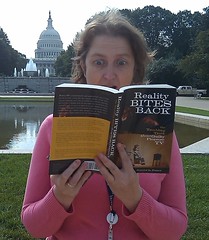
Me reading, by Hanna E. Clutterbuck, 2010-10

She also wrote a wonderful two-part post (part one, part two) on Dr. Who for a friend of mine who recently requested some good introductory episodes from the earlier incarnations of the Doctor.

If you’re on tumblr (or even if you’re not), there are some awesome blogs to follow. Namely beautiful portals if you (like me) are in to liminal spaces; fuck yeah tattoos if (like me) you are in the process of considering how to design the tattoo of your dreams — or you just like beautiful ink; and lesbian outlaw because her tagline is “separate from the government, beyond the police.” And also ’cause she posts lots of great stuff.

Via our friend Rebecca came this great illustrated explanation of the four levels of social entrapment (“This person is seemingly immune to awkwardness and once they latch onto you, you are not allowed to leave until they are done with you.”) at the blog Hyperbole and a Half.

For those of you who are at all familiar with the site Feministing and know that Jessica Valenti and her husband Andrew recently became parents through a pretty traumatic pregnancy and birth experience, I hope you’ve seen that their daughter Layla finally came home from the neonatal intensive care unit (warning: pictures of incredibly tiny baby human after the jump). I really hope they’re getting some quiet time to be together as a family.

There’s been a flurry of posts up this past week or so in the feminist blogosphere on “fucking while feminist”: what that means, exactly, and how people live out their own particular iterations. I may or may not have an actual post in my about this (I actually think being feminist in my political identity and using feminism as an analytical tool has a pretty profound effect on my sexuality and sexual related-ness … but I’m not sure how to talk about it yet). In the meantime, one of my favorite responses has been by Garland Gray guest-blogging over at Tiger Beatdown on how his feminism informs his experience of fucking other men:

Over time, I realized that if I was committed to working toward a world where gender variance was celebrated, where getting fucked wasn’t viewed as something shameful or disempowering, I was going to have to start voting with my dick.

This isn’t simply high-minded “the personal is political” sexual activism. If a dude thinks that he is powerful because he doesn’t get fucked, and you are weak and shameful for getting fucked, you really and truly don’t want to let him fuck you. Sex is about respect, and letting someone inside you without respect is a bad idea. No matter what position I am in, I follow this cardinal rule: If someone needs to be in control, it should be the person getting fucked. I fuck while feminist by insisting that there is nothing submissive about getting fucked. Accepting the standard bullshit narrative of “penetration as dominance” or “penetration as corruption” is ridiculous and arbitrary. It is just as easy to see penetration as submission. A part of your body is inside of me. If you don’t play by my rules, I MIGHT NOT GIVE IT BACK.

 And finally, Tenured Radical and Historiann had a series of thoughtful posts + comment threads up recently at their respective blogs about single-sex (women’s) colleges. I haven’t had the time nor been in the mental space recently to really sit down and digest them, but here are the links.

  • Tenured Radical: Not Equal Opportunity, But Every Opportunity: An Argument for Single-Sex Education
  • Historiann: From the Department of WTF?
  • Tenured Radical: Feminism’s Unfinished Agenda: If Women Have Equal Opportunity, Why Are the Outcomes So Very Unequal?
  • Historiann: Women’s Education, Part II
  • Tenured Radical: What Is Our Work? Towards a Feminist Future in Education
  • Historiann: Women’s Education, Part III
  • Historiann: Why Must Women’s Colleges Exist? A Personal Reflection

Thirty-second commentary: As someone who 1) worked at a men’s college for a semester, 2) attends a graduate school attached to a women-only undergraduate college, and 3) is a feminist and historian of feminist activism and education, I find the question of single-sex education incredibly complicated. There are compelling (mostly, to my mind, historical and individual) arguments for the worth of women-only space, but I can’t get away from the question of sex and gender varience, and the problem that once you start policing the boundaries of space by saying “women only” or “men only” you’re reinforcing a world in which the gender binary is a fundamental organizing principle … a principle that I believe is antithetical to the values of feminist theory and practice.

And because it’s out there and thus needs to be shared: Episcopal bishop Gene Robinson has contributed to the It Gets Better project. I’ve linked before to a lot of really good commentary on the problems with the project, but none of those problems erase the fact that people are telling their own personal stories of Growing Up While Queer, and that each individual story is a powerful testament to the infinite possibilities that exist for each of us as we grow and change.

Enjoy the week ahead!

booknotes: brain storm

06 Wednesday Oct 2010

Posted by Anna Clutterbuck-Cook in book reviews

≈ 1 Comment

Tags

feminism, human rights, science

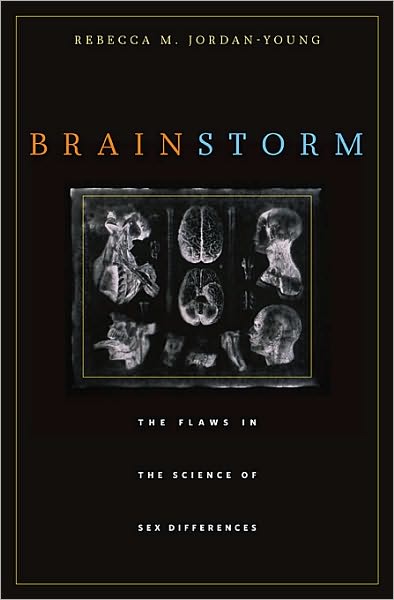
This past week I devoured a book Hanna found for me on the new books wall at the library: Brain Storm: The Flaws in the Science of Sex Differences, by Rebecca Jordan-Young, a sociomedical scientist currently teaching at Barnard College. The book is a systematic survey and assessment of the quality of the scientific research that has been used over the past fifty years in support of the theory that male and female brains are innately different because of different patterns of hormone exposure during gestation.

While the research in this area is inconsistent at best, and methodologically flawed at worse, the idea of sex-typed “brain organization” which pre-disposes men and women to gendered “masculine” and “feminine” behaviors has become widely popularized common sense knowledge, justifying everything from the intrusive medical treatment and scrutiny of gender- and sex-variant people to the dismissal of concerns about social structures that may support gender inequality (if men are “naturally” more interested in careers, and women are “naturally” more interested in caring for children, then no amount of social policy — the argument goes — will alter this predisposition).

Jordan-Young’s goal in Brain Storm is not to argue against the scientific exploration of sex and gender development, but rather to suggest that the science we currently rely upon to support the assertions of sex difference are problematic.  She argues that an “epistemology of ignorance” characterizes the work of scientists who do research on brain organization. That is, these scientists purposefully ignore (because they assume it is irrelevant) any potential sociocultural explanations for the gendered behavior of their subjects, attributing the differences they do discover on atypical, early hormone exposure rather than on the complicated interaction between “nature” and culture. They assume this sociocultural evidence is irrelevant because they expect to find sex-typed differences, and expect those differences to be explained by early physiological sex-differentiation. They have closed the door on alternate (and ultimately, at least according to the strength of available evidence, more compelling) explanations.

This book is far too dense to adequately condense its major ideas into one short booknote; I encourage all of you interested in this area of research to read the whole book, since Jordan-Young’s explanations of how these scientific studies have been generated are really useful as a window into understanding how to better interpret research findings. Regardless of your philosophical position on the physiological origins of sex and gender variety, Brain Storm will help you become a better consumer of the evidence out there that is currently used to support that network of ideas.

To give you a flavor for the type of material covered in Brain Storm, here are a few excerpts.

From “Chapter Six: Masculine and Feminine Sexuality”, which explores how researchers have defined “masculine” and “feminine” sexuality in their research and findings.  Jordan-Young points out that during the 1950s-1970s, when brain organization theory was taking hold in the scientific community, immense changes took place in the cultural perception of what “masculine” and “feminine” sexuality looked like, and how it “naturally” expressed itself.  The scientific literature, however, largely ignores these historical shifts, treating these categories as uncomplicated notions that do not need to be explicitly defined.

Surprisingly, against this backdrop of change [the sexual revolution], most brain organization researchers have used the common term feminine sexuality through more than four decades as though it is absolutely self-evident and unproblematic. But the ground has been shifting under their feet. While ideas and practices associated with “normal” sexuality changed in the broader world during those decades, the transformation of masculine and feminine sexuality was just as dramatic [yet unacknowledged] in the studies that are intended to determine how male and female sexual natures develop.

In brief, from the late 1960s until around 1980, brain organization researchers relied on a model of human sexuality that sharply divided masculine and feminine sexual natures … Things began to change in the early 1980s. In the most general way, scientists continued to assert that early exposure to “masculinizing” hormones make sexual development either more masculine or less feminine, and their preoccupation with sexual orientation intensified. But a closer look at the specific behaviors coded as masculine or feminine in the later studies shows some surprising and very important differences from the first period. In particular, masturbation, genital arousal, and sex with multiple partners came to be understood as “commonsense” features of feminine sexuality, even though these had earlier been read as clear signs of masculinization (pp. 113-114).

In “Chapter Seven: Sexual Orienteering,” Jordan-Young tackles the jaw-droppingly simplistic approach brain organization researchers continue to take toward sexual orientation, despite increasing acknowledgment across a wide range of scholarly fields that sexual identity and orientation highly subjective, often subject to change over time, and are inextricably wrapped up in both “nature” and culture.

To Dr. A and Dr. N, who are among the mos influential scientists in the world studying biological influence on human sexuality, subjects who gave equivocal or contradictory answers to questions about sexual orientation are either being obstructive or confused. Ironically, Dr. A’s admonition to “listen to the subject” ends up being qualified by “if they’re consistent.” Dr. A doesn’t consider the possibility that subjects’ hedging and ambiguity reflect meaningful complexity — that the phenomenon of sexual orientation is complex and sometimes ambiguous. Instead, he thinks of sexual orientation as a simple categorical trait — the objections of modern intellectuals and old cranks like Alfred Kinsey not withstanding, you can sort people into discrete types. In this view, subjects who don’t fit the profile are simply lying, or perhaps more charitably, self-deluded.

While other scientists vigorously debate what sexual orientation is and how best to measure it, brain organization researchers almost never address the fundamental questions involved. The majority of studies linking early hormone exposures with human sexuality have focused primarily or exclusively on sexual orientation — yet most brain organization studies that are “about” sexual orientation have not defined sexual orientation at all, or have used vague and contradictory definitions that often do not agree with the measures scientists have used (p. 145-146).

It was particularly revelatory for me to realize the (obvious once you’re looking for it) point that the most basic ways of sorting groups of people according to orientation can matter, both when it comes to grouping people for the purposes of research and for the purposes of understanding populations in more cultural/social frameworks.

For example, does your definition group people according to the gender of the people whom they are attracted to (men or women)? Or does your definition arrange people according to whether their attractions are same-sex or opposite sex? Both of these definitions, obviously, beg the question of what to do with people who do not fit a binary schema — but for the moment let’s pause here.

If you arrange people on a heterosexual/homosexual schema, you’re grouping them by same-sex vs. other-sex attractions. That is, gay and lesbian people will be in one group, straight women and men in the other. And research designed to explain these categories would look for sameness within the groups and difference between them. You would presume that straight men and women had certain markers of sameness, while queer folks had similar profiles.

Most brain organization research uses the heterosexual/homosexual schema when it comes to structuring their research populations (i.e. they have a “straight” population and a “gay/lesbian” population, and yet their research questions and theories actually follow the people-attracted-to-men vs. people-attracted-to-women model. They assume that individuals who are attracted to men (gay men, straight women) will have markers of sameness, and individuals who are attracted to women (straight men, lesbians) will have markers of sameness — and that these two groups, when compared, will show patterns of difference.

The distinctions seem slight at first, but actually matter a great deal when it comes to structuring a research study or understanding how we make sense of the world, about what we expect of certain groups of people, and what assumptions those expectations rest upon.

The most painful sections of the book to read, at least for me, were the sections that dealt directly with research around intersex conditions, most prominently girls and women with CAH (congenital adrenal hyperplasia). Since brain organization researchers are interested in the effect of hormones on brain development, they have obviously sought out populations known to have had atypical hormone exposure. They then study these individuals for “signs” of sex/gender/sexuality atypicality — “atypical” usually meaning, as the above excerpts show, “contrary to researchers’ culturally-shaped assumptions about gendered behavior.” In “Chapter Nine: Taking Context Seriously,” Jordan-Young uses the example of CAH studies to show how the tunnel vision approach of brain organization researchers has led them to ignore powerful evidence that sociocultural context matters when it comes to sex and gender identity. Not necessarily to the exclusion of hormonal or other “natural” influences, but in ways that simply should not be ignored by scientists who are attempting to test their hypothesis.

No brain organization research, for example, takes into account the fact that the sexual feelings and activities, the self-identity of their CAH subjects is inevitably influenced by the fact that these girls and women are subject to intense scrutiny and intervention — both social and medical — from birth into adulthood. They are expected to behave atypically, and monitored rigorously and anxiously by parents and medical professionals in hopes they will be “normal.” Their bodies are often treated to invasive “normalizing” surgeries and examined regularly. They are asked to perform certain sexual acts, such as masturbation, under supervision, and until very recently little or no thought was given to the actual quality of their sexual experiences and feelings about their own bodies and sexuality — all that mattered was intervening in their lives in the hope that they could be shepherded toward “normal” sex/gender/sexual identities (read: straight person presenting and identifying as female).

To me, this sort of anxiety surrounding gender identity and sexual orientation, as well as the simplistic notion that male/female heterosexual = best possible outcome for all people is just incredibly sad. It’s a very sad testament to the lack of imagination among medical professionals and the general populace that human variation is not only okay, but might actually be the best possible outcome.

I don’t really have any concluding thoughts about this book other than that it’s definitely a keeper, and I urge you all to at least be aware of its existence in the world, should you find yourself in need of a comprehensive survey of brain organization research. It also has an extensive bibliography that can point you in all sorts of branching directions … next up on my list, for example, is Katrina Karkazis’ 2008 book Fixing Sex: Intersex, Medical Authority, and Lived Experience.

Happy reading!

← Older posts
Newer posts →
"the past is a wild party; check your preconceptions at the door." ~ Emma Donoghue

Recent Posts

  • medical update 11.11.22
  • medical update 6.4.22
  • medical update 1.16.2022
  • medical update 10.13.2021
  • medical update 8.17.2021

Archives

Categories

Creative Commons License

This work by Anna J. Clutterbuck-Cook is licensed under a Creative Commons Attribution 3.0 Unported License

Meta

  • Create account
  • Log in
  • Entries feed
  • Comments feed
  • WordPress.com

Blog at WordPress.com.

  • Subscribe Subscribed
    • the feminist librarian
    • Join 37 other subscribers
    • Already have a WordPress.com account? Log in now.
    • the feminist librarian
    • Subscribe Subscribed
    • Sign up
    • Log in
    • Report this content
    • View site in Reader
    • Manage subscriptions
    • Collapse this bar