• anna j. clutterbuck-cook
  • contact
  • curriculum vitae
  • find me elsewhere
  • marilyn ross memorial book prize

the feminist librarian

the feminist librarian

Tag Archives: gender and sexuality

quick hit: "oh, inversion. how I shake my fist at you"!

24 Saturday Jul 2010

Posted by Anna Clutterbuck-Cook in linkspam

≈ Leave a comment

Tags

books, feminism, gender and sexuality, masculinity

Danika @ The Lesbrary has a fun post up sharing notes from a conversation between herself and a friend Cass about Radclyffe Hall’s The Well of Loneliness (1928).

C[ass]: The term ‘homosexuality,’ while in use in 1928, didn’t yet have its modern definition or its now understood division from gender. Inversion, on the other hand, completly tied sexual orientation to one’s gender and gender expression. A person labelled female at birth could not, by defition, be an invert without displaying masculine traits and masculine leanings. Therefore, in order to be a novel ABOUT inversion, Stephen has to be masculine. If we are using our modern lens here, then we can agree that, despite her masculinity, Stephen is not automatically male. The fact that her parents gave her a traditionally male name is out of her control. Lots of girls who continue to identify as women like to dress in pants rather than dresses because they are easier to walk and play in. Looking “like a man” or being masculine doesn’t make a person a man.

The conversation with her father is trickier, but if she has a crush on a girl, and thinks that only men and women can have relationships together, it’s logical that she would want to be a man in order to be happily in love with a woman.

D[anika]: True, but coming from a modern perspective, that assumes that you are by default the gender you were assigned at birth and only the opposite if there is overwhelming evidence. We don’t have overwhelming evidence that Stephen would identify as a man, but we have a lot less evidence than there is for Stephen identifying as a woman. She can’t stand to even be around women, except the ones she falls in love with.

That makes sense, but it isn’t just around having a partner that Stephen is frustrated at being labelled a girl. In fact, as some point she said “Being a girl ruins everything” (not an exact quote)

C: […] [H]er gender and gender expression can be on the trans-masculine spectrum without her necessarily being trans. In 1928(ish), being a girl DID ruin everything!

I think you are the gender you understand yourself to be, but sadly I can’t ask Stephen. 😉

Check out the whole thing at The Lesbrary (and if you enjoy part one, then check out part two posted by Cass @ Bounjour, Cass!).

friday fun: homophobes not welcome!

23 Friday Jul 2010

Posted by Anna Clutterbuck-Cook in our family

≈ Leave a comment

Tags

feminism, gender and sexuality, humor

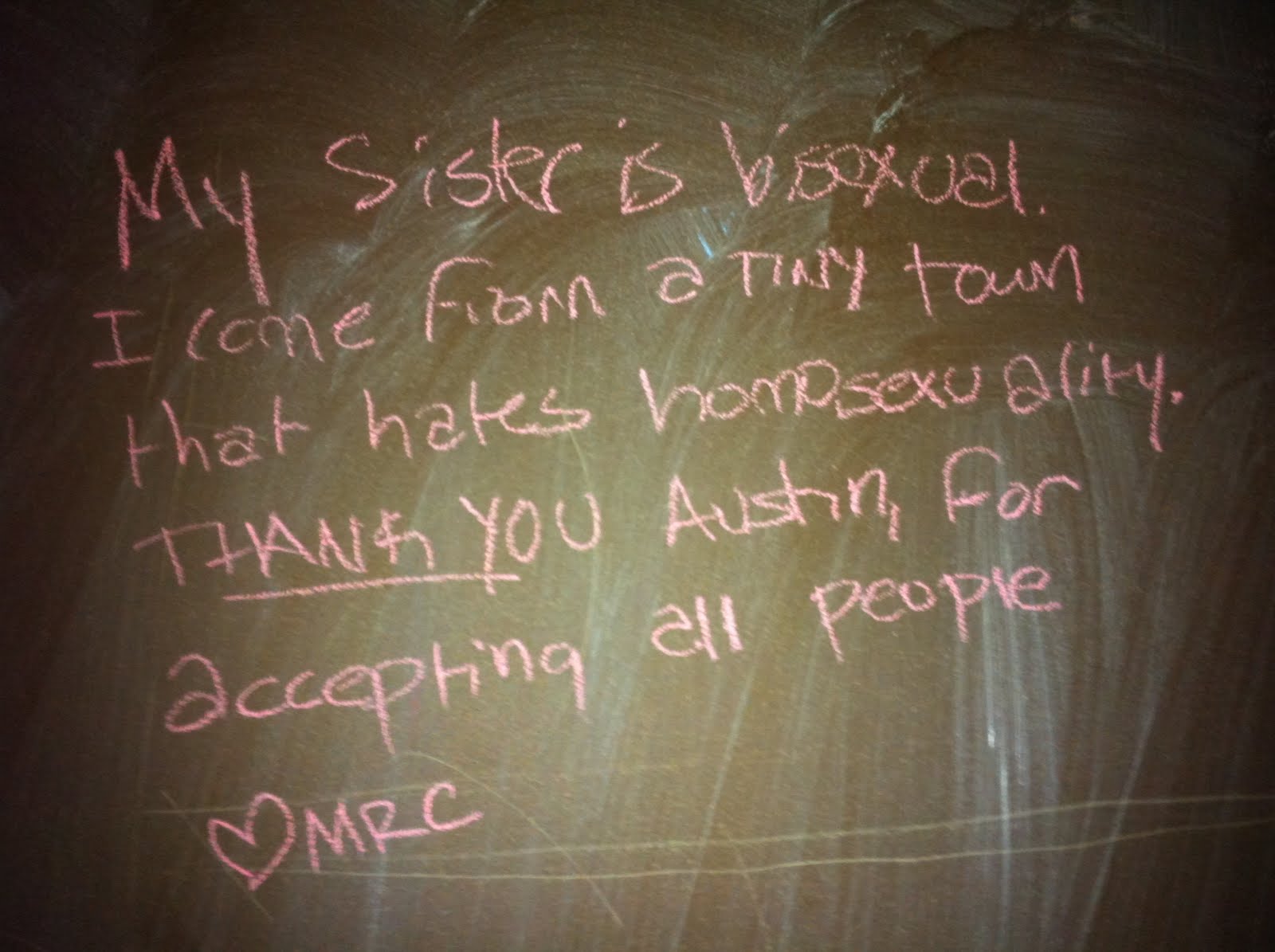
As previously mentioned, my sister and her boyfriend just moved to Austin, Texas and by all accounts it is an awesome place. Here’s something that makes it a little more awesome. I’ll let my sister tell the story.

I wrote this in a bathroom at a cafe a week ago on a chalkboard (meant for customer use).

blackboard reads: My sister is bisexual. I come from a tiny town that hates homosexuality. THANK YOU, Austin for accepting all people [heart] MRC.

Today, I went back. Under is someone wrote, “well, we don’t really support homophobes, so you’re welcome.”

I thought that was a grand response.

Happy Friday everyone. Spread the love :).

in love with new blogs: Emily Nagoski :: sex nerd ::

22 Thursday Jul 2010

Posted by Anna Clutterbuck-Cook in linkspam

≈ Leave a comment

Tags

blogging, feminism, gender and sexuality, in love with new blogs

I’m really bad about updating my blogroll regularly, but I do have this exponentially growing list of blogs I follow on Google Reader. So I thought I might do a weekly (posted on Thursday) series for a while called “in love with new blogs” in which I highlight some of the bloggers and blogs I think y’all might be interested in.

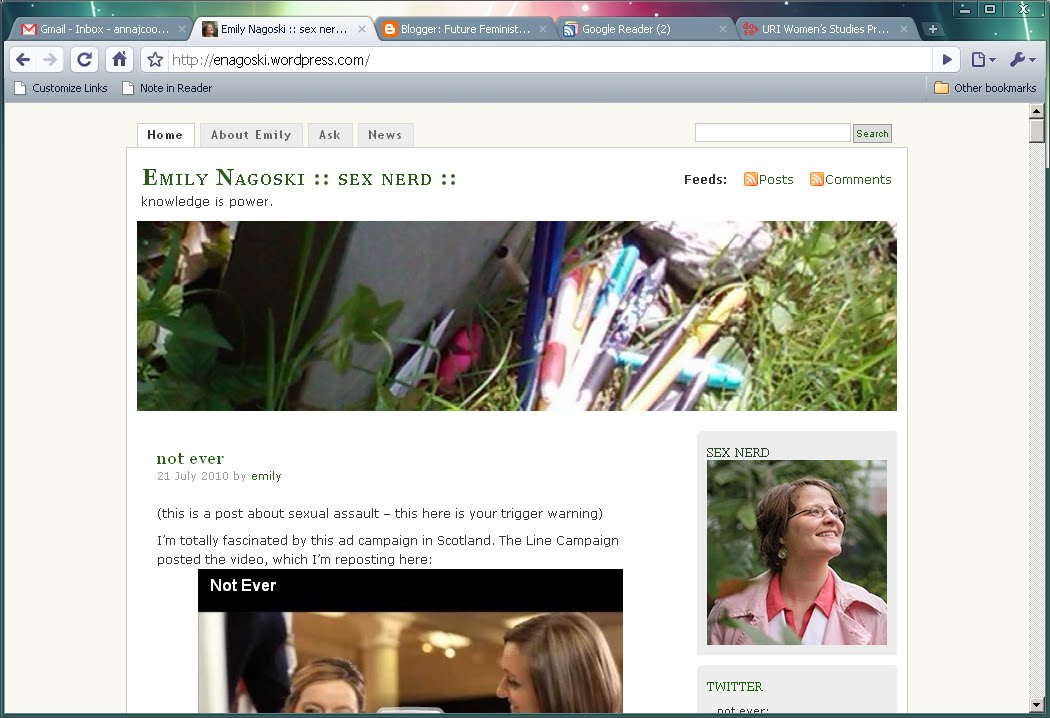
And I’m going to start with one I recently discovered (or possibly re-discovered; it looks familiar so I know I’ve come across it before but why oh why did I not subscribe to its RSS feed then?? because this blog is awesome!): Emily Nagoski ::sex nerd::

Emily Nagoski is a health educator who lives in Northampton, Massachusetts and works at Smith College. In her own words

In 2006, she completed a Ph.D. in Health Behavior with a concentration in Human Sexuality. She also holds a MS in Counseling Psychology and a BA in Psychology with minors in Cognitive Science and Philosophy. She’s worked for well over a decade in the field of sexuality education and has grown into an impassioned advocate for social justice through sexual fulfillment. Politically progressive and unapologetically atheistic, Emily has strong opinions and a big vocabulary, and she’s determined to use both to make the world a better place for human sexual expression.

And maybe in another ten years I will have a job (somewhat) like hers! ‘Cause damn, that sounds like fun.

Emily Nagoski ::sex nerd:: offers one post a day, roughly speaking, on the subject of human sexuality. Combination sex column, opinion column and ideas-in-progress space, this looks to be a great (and often funny!) resource for sexuality information.

A few recent posts to give you a flavor of her style.

differential desire.

So look, I’m going to say this thing, and you’re going to listen and believe me because… I don’t know, why would you believe me if you haven’t believed it from anyone else? Because I’m clever and have a PhD and things? No, you’ll believe me because it’s just true. Because in the patient corners of your heart, you’ve ALWAYS known it’s true. It’s this:

You’re not broken. You are whole. And there is hope.

You might be stuck. You might be exhausted. You might be depressed, anxious, worn out by the demands your caring makes on you, and in desperate, dire need of renewal. You might be tired of feeling like you need to defend yourself. You might wish that, just for a little while, someone else would defend you and protect you so that you could lower your guard and just be. Just for a while.

Those are circumstances, they’re not YOU. YOU are okay. You are whole. There exists inside you a sexuality that protects you by withdrawing until times are propitious.

I completely get how terribly frustrating it can be that your partner’s body feels like times are propitious right now, while your body is still wary. And it’s even worse because the more ready your partner’s body seems, the more wary your body becomes. It is The Suck, Like Woah, for both of you.

But it’s in there, your sexuality. It’s part of you, as much as your skin and your heartbeat and your vocabulary. It’s there. It’s waiting. You’re okay. Just because you’ve had no call to use the word “calefacient” or “perfervid” lately doesn’t mean it’s not longer available to you. Should the opportunity arise, there it will be, ready, waiting. Like the fire brigade. Like a best friend.

There’s a bunch of stuff you can try to create propitious circumstances.

read the rest here.

what I got wrong about LUGs.

Now imagine you’re a person who’s always identified as straight and then you come to college and you meet this amazing person who happens to be the same gender and you just fall head over heels, even though you never even imagined being in a same-sex relationship before… are your feelings less genuine simply because they might not have occurred in a less inclusive environment?

Should you choose NOT to get into a relationship this person you’re attracted to, on the grounds that you might not be attracted to that person under other circumstances?

Is the only REAL love a love that would thrive even in a hostile, hateful landscape? Only if you can love through being egged and threatened on the street is your love real?

That’s not the standard we set for straight relationships or relationships that look heteronormative.

I can totally see where the resentment would come from, and yet… I can’t bring myself to judge a person’s individual, internal, emotional experience on the basis of its political import. How could *I* know whether or not someone really loves someone else? Can I tell from the outside whether she’s a “real lesbian” or “just experimenting?” If it not my relationship, is it any of my business?

read the rest here.

how to fall in love (if you’re fictional).

With so many barriers lowered these days, it’s hard to generate compelling and original reasons for your hero and heroine NOT to get together. I think sci fi romance, vamp stories, werewolf stories, shapeshifter stories are so popular because you can invent all kinds of rules about how risky it is for a human to mate with a whatever or who knows. And historicals, where you can use the rules of society that USED to keep people apart but don’t anymore.

Dorothy Sayers needed three novels – two of them VERY long – to disentangle her hero and heroine from their stigma. He saved her life; it’s a problem. 5 years later he allowed her to risk it, thus giving her life back to her. Her “Greater Than Themselves”? Detection, murder investigations and, under that, the truth at all costs. Her big “They Know” scene takes place in a punt on the Isis in Oxford, where they both went to school and which represents intellectual refuge from the discord and bitterness of the human world.

Me, I like writing Reunited Lovers stories because the stigma is built in: one of them done the other one wrong, enough that they split up. How are they ever going to fix it? But whatever brought them together in the first place makes a perfect Greater Than Themselves.

So now you know the trick to falling in love if you’re fictional.

read the rest here. I say she made extra bonus points there for the Dorothy Sayers reference.

Sometimes, she’s a little women’s sexuality is different and more complicated than men’s! for my taste, but I think the overall advice she gives about being open to more fluid, expansive definitions of sexuality and sexual activity is good so I’m willing to at least go along for the ride and keep reading.

reconsidering twilight fans: a couple of links

20 Tuesday Jul 2010

Posted by Anna Clutterbuck-Cook in linkspam

≈ 2 Comments

Tags

books, feminism, gender and sexuality


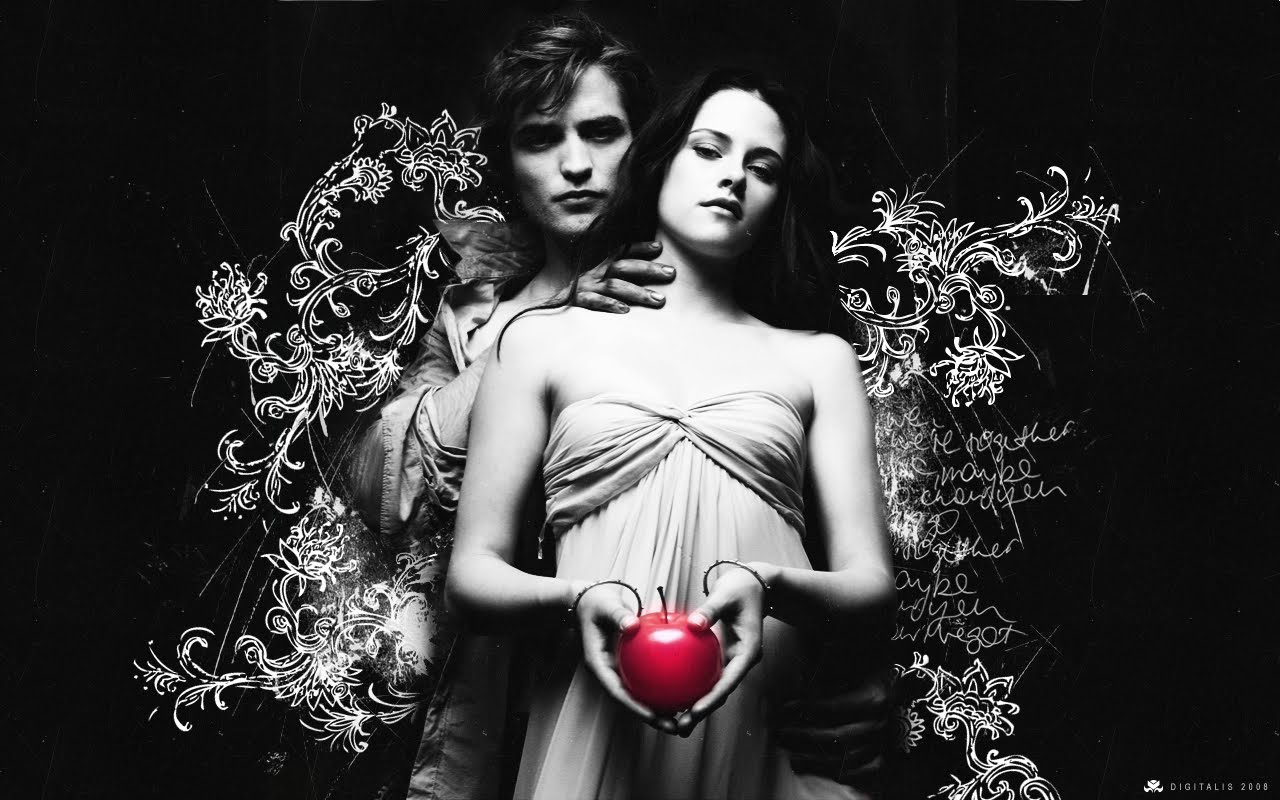
Feminists have a complicated relationship with the Twilight series and fandom, as I have previously documented on this blog. this morning, I’d like to share a couple of items that challenge us to remember that, however retrograde and problematic the series and its surrounding franchise are in terms of gender and sexuality, writing off the fandom as gullible or unenlightened is hardly helpful and (I would argue) hardly feminist.

First, Mathilda Gregory @ The Guardian (thanks to Hanna for the link) reminds us that fans are not necessarily passively imbibing the narratives handed to them — and it’s insulting to the fans (primarily teenage girls and women) to assume they are.

Has there ever been a franchise whose fan base has been so maligned? It’s starting to feel like some of the male critics of Twilight are just uneasy that, for once, something that isn’t aimed at them is getting such a big slice of the zeitgeist.

Meanwhile, instead of defending the film, some feminists aren’t happy either because of Bella’s passivity and the tale’s theme of abstinence before marriage. Well, OK, author Stephanie Meyer’s devout Mormonism does give weight to that reading of the text. But it’s not really as simple as that. We can presume a lot about the author’s intent, but that’s not necessarily the message the films’ fans are taking away from it.

The second story, from Amanda Marcotte @ RhRealityCheck comes in the form of a podcast interview with Tanya Erzen about the contours of Twilight fandom. Check out the podcast or, if you can’t access audio on your computer, this recent essay by Erzen @ The Revealer about the religion of Twilight fans. Here’s an excerpt.

In my interviews and survey of 3,000 fans, the majority express sometimes contradictory beliefs in the supernatural while asserting adherence to traditional religious institutions. Yet, while Twilight won’t replace organized religion, it reflects a longing for sacred and extraordinary experiences in everyday life that are perhaps missing in traditional religious venues. In pilgrimages to Forks, Washington, the setting for the books (in July 2009 alone, 16,000 fans trekked to Forks like supplicants at a holy site, more than the total number of visitors in 2008), fans indulge the fantasy that a supernatural world exists alongside our own, searching for vampires in the woods and lingering outside the re-imagined home of Bella. Rather than fueling interest in vampirism, a concern among some Christian critics of the books, the series provides what Laderman calls “myths that provide profound and practical fulfillment in a chaotic and unfulfilling world.” It’s also impossible to separate these moments of spiritual enchantment from the Twilight franchise, which ceaselessly offers consumption to women and girls as a way to retain the feelings of belonging, romance and enchantment. There are Edward and Bella Barbie dolls, lip venom, calendars, video games, graphic novels, and fangs cleverly promoted and eagerly purchased at conventions and online stores. Yet, the shrines attest to the way fans also transform these objects into something personally vital within the messy entanglements of commerce and enchantment.

The impulse of a lot of feminists (including myself!) is to act to protect young women from narratives we think are abusive by arming them with the skills to deconstruct the Twilight series’ sexism and anti-sex messages. However, to assume that young women don’t have those skills simply because they have appropriated the stories and continue to enjoy them smacks of misogyny. That is, it plays on the stereotype that women (and young women particularly) are shallow, flighty, clueless and particularly vulnerable to outside influences. That their sense of themselves as persons worthy of respect, as persons smart enough to challenge the messages they’re being fed by the media, is uniquely endangered. As Susan Douglas has pointed out recently, there are reasons to be concerned about assertions that young women don’t need feminism. But it is also important to make sure that feminism does not become as didactic and authoritarian as the sexist culture we’re challenging: exchanging one power-over system with another does not a revolution make.

So I’d argue: be wary of attempts to deride Twilight fans because of their age and/or their gender. And be aware of how criticism of fans — even if it’s not explicitly sexist — trades on negative and stereotypical constructions of femininity. Like criticizing Hot Girls for being Hot rather than criticizing the culture that rewards them for meeting gendered expectations, making teenagers feel shamed for their reading and viewing choices does little to support their sense of agency and critical self-awareness that (I believe) so essential to feminist consciousness.

sunday smut: links on sex and gender (no. 29)

18 Sunday Jul 2010

Posted by Anna Clutterbuck-Cook in linkspam

≈ 1 Comment

Tags

gender and sexuality, sunday smut

I’m back this week, and I know at least a couple of people missed this list ’cause they wrote and told me so! How cool is that?

Lindsey june 101 by Ron Gibson @ Flickr.com

Anyways, here’s a bunch of stuff that’s been accumulating since the weekend of the 4th out there on the internets, and which I hope you’ll find yourself hooked by (at least a link or two).

On the family values front

While I was gone on vacation, Bristol Palin and once and future beau Levi Johnston announced their re-engagement on the cover of Us magazine. Amber Benfer @ Salon contemplates the way the celebrity family’s story matches up (or doesn’t) with the narrative conservative America wants to tell about teen sex, marriage, and parenting.

Annette Bening and Julianne Moore co-star in “The Kids Are All Right,” a “Guess Who’s Coming To Dinner” for the queer family age, in which Bening and Moore’s two teenage children bring their biological father (played by Mark Ruffalo) home for dinner. David Edelstein @ Fresh Air offers a glowing review and Sarah Seltzer @ RhRealityCheck weighs in on the film’s limitations.

When women are pregnant, they often discover that the normal rules of personal space cease to apply, as Jessica Valenti of Feministing documents on her own personal site. “Stop touching my stomach without my permission. It’s presumptuous and it creeps me out. You wouldn’t touch a non-pregnant person’s belly without asking, so what makes you think it’s okay to just lay hands on mine?”

Sarah @ Feministing Community shares her own personal experience with the fundamentalist Quiverfull movement and challenges feminists to educate themselves on the contours of this rapidly-growing conservative counterculture, rather than just toss off scornful comments.

Dodai Stewart @ Jezebel suggests that a recent story about an interracial couple who have twins with differing skin tones is a useful object lesson in how race is culturally constructed.

Feminism is for everybody (even Hot GirlsTM!)

I’ve been reading a lot of awesome stuff lately about appearance policing and sexism/misogyny. Is it something in the air y’all?

The story about Olivia Munn and sexism and The Daily Show, which I didn’t have the energy to blog about (although I tried several times to write something from scratch and failed), has really brought out a lot of awesome posts about the difference between hating on someone ’cause they’re HotTM and calling out individual (Munn) or collective (TDS) actions that actively or passively support a system that is sexist or using power in other unhealthy ways.

For starters, there’s Amanda Hess @ The Sexist and Sady @ Tiger Beatdown (both such Very Awesome LadiesTM) talking about criticism of comedian Olivia Munn for her participation in sexist culture. And for being HotTM. Amanda: Consent and Manipulation in Olivia Munn’s Playboy Shoot Amanda: Feminism is for Bitches Sady: The Munn Paradox Amanda: Women as Gatekeepers of Sex – and Sexism. I can’t emphasize enough how worthwhile it is to read all of these posts in full, but it comes down to this: as feminists, we should call out sexism as it hurts everyone, even those who we think are enabling it, even those who benefit from it.

Not everyone sees it that way, though, specifically Emily Gould @ Slate who has a history of making controversial statements about feminists, charging feminists with being overcome by jealousy. Shelby Knox @ Feministe observes that Gloud might possibly have been purposefully misconstruing the situation for page views; Amanda Marcotte @ Pandagon writes about the difficulty of blogging on body issues, and why Gould’s attack on feminist media for critiquing harmful cultural norms is so counterproductive.

See, Hot GirlsTM totally can’t win, as this post from @ Jezebel points out. “It’s not that we want or need Angelina [Jolie] to do a romcom. The universe is a much better place with her sneering, running, jumping, doing her own stunts and gunning down fools. But doesn’t calling her ‘too forceful’ imply that love is for the weak? Don’t we all have a little bit of a swooning romantic in us as well as a smidge of ass-kicker? And what the hell does it mean to be ‘too strong’ for romance?”

You don’t even have to be a Hot GirlTM to get be caught in a lose-lose type situation, as Lilly @Jezebel points out in her personal story of sartorial humiliation while serving ice cream. The post struck such a chord that it garnered Jezebel’s comment of the day (COTD) award with this list of instructions for women who find themselves shamed by the appearance police.

Silvana @ Tiger Beatdown leaps into the frey with a post about judging other peoples’ appearance. “When I hear, tights are not pants, or you should wear pantyhose to court, or I wouldn’t wear X cut of a shirt because it doesn’t look good on me, I think, who made these rules? Why are we following them? Why do we passively subscribe to an aesthetic system that requires us to daily fulfill the twin obligations of being ‘respectful’ by not doing anything out of the ordinary and looking as thin and ‘feminine’ as we can muster? I want fashion to be less about making other people comfortable, and more about personal expression and art. There is too much hierarchy. It is too top-down, from a murky top with too many leaders with too many conflicting messages.”

“She asked for it” — Not!

Of course, sexual assault skeptics rely on appearance policing big time as a way to legitimize victim-blaming (if it’s okay to police peoples’ appearance, then it follows on some level that it’s okay to punish them for inappropriate dress and behavior). Alex DiBranco @ Women’s Rights Blog points our attention toward a new PSA campaign in Scotland that points out the absurdity of laying the blame for rape on the behavior of the victim (rather than, you know, on the behavior of the perpetrator).

Amanda Hess @ The Sexist points out the problem with “hoping it’s not true” when it comes to allegations of sexual assault by someone you respect. “When we ‘hope it’s not true’ … We’re not hoping that our criminal justice system works to convict the guilty and acquit the innocent. We’re hoping that the person who reported the sexual assault is a liar. We’re hoping that people who claim to be victims of sexual assault are all lying, that it never really happens. We’re hoping, in the end, that bad things do happen — to good men who are victimized by bad women.” Seriously. Go read the whole thing.

Via Amanda Hess comes this post by Sarah M. @ Change Happens on why “drunk sex” isn’t really that easily confused with rape, and we shouldn’t pretend that it is. “Clearly people are sometimes going to get drunk and have sex. And the presence of alcohol in someone’s bloodstream does not automatically make it rape. But there’s a spectrum of intoxication. If someone is physically impaired by their drinking (or drug use), you can tell. They are getting sick, their body is limp, they’re not able to communicate clearly with you. It’s a common sense situation. If it’s less obvious, you know they have been drinking but you’re not sure how much and they seem OK, that’s where communication is key, and honestly—if it’s unclear how drunk your partner is and you feel conflicted, then maybe just play it safe and don’t do it. Instincts are there for a reason.”

If you’re a child and your parent asks you to do things like pose naked and talk about your sexuality which make you feel uncomfortable but you do them ’cause it’s your Dad and you don’t want to say no, and then those images and words are turned into artwork and made accessible for the whole world to see — do you have a right to say “no”?

Obvious answer: yes (Carolyn @ Carolyn Gage). Answer given by a lot of folks out there in the world (’cause the world is fucked): not if it’s art (Irin Carmon @Jezebel). More to come on this next week, in a still-being-written blog post about archival ethics and issues of consent.

IrrationalPoint @ queergeeks offers a succinct example of how consent and nonconsent works, starting in childhood, when bullies don’t listen to the voices of children who try and stand up for themselves.

Feminism is for everybody!

Courtney @ From Austin to A&M explains why being “apolitical” doesn’t stop you from perpetuating sexism.

A lesson that the folks over at The Daily Show could apparently stand to learn (or remind themselves of). Amanda Hess @ The Sexist explains.

Possibly also Whoopi Goldberg, who recently fell into the Ill Doctrine trap of having the “is he a racist” conversation rather than the “what he said was racist conversation. @ Bitch Blogs explains.

Feminism (in my oh-so-humble opinion) is all about treating every human being like, well, a human being, instead of a ‘bot created to fill a certain social role. zack @ The New Gay calls out straight women for expecting gay men to fill such a social role, rather than treating him as, you know, an individual.

Feminism is even for menfolk! Greta Christina @ The Blowfish Blog lays some feminist hate on the straightjacket expectations of masculinity and then explains why laying on the feminist hate matters, and might actually make the world a better place for all those wonderful menfolk we feminists love so much.

Which isn’t to say that being a feminist and, like, making that change in the world is at all easy. Harriet J @ Fugitivus explains in great, now I hate everybody.

Oh help!

This post has become MAMMOTH! and I still have stuff to share … damn it. Oh, well, I’m going to call it quits there for this week and see if I can’t work a few other things into actual legitimate blog posts.

Meanwhile, I’ll sign off with this story from Richard Knox @ NPR about a psychologist who has been studying marriage proposals on YouTube. Have fun, y’all! And I’ll be back with more.
sunday smut: links on sex and gender (no. 28)

04 Sunday Jul 2010

Posted by Anna Clutterbuck-Cook in linkspam

≈ Leave a comment

Tags

gender and sexuality, sunday smut

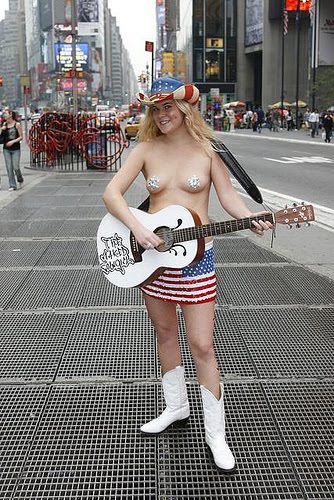
Because who could possibly resist gaudy patriotism like this on the 4th of July weekend? Not me!

In other, much more serious news (*ahem*), Amanda Hess & Courtney Stoker @ The Sexist talk about the highs and lows of being a feminist geek, and how to make dudely subcultures more inclusive, while Julia (also @ The Sexist) discusses how fanfic can serve as the gateway to kink (third video from the top).

The Youth and Media Policy Working Group Initiative @ Berkman Center for Internet and Society (Harvard University) offer up a paper (available in PDF) on “addresses legal and practical issues related to the practice colloquially known as sexting.” You can read a press release and download the paper at their website. I haven’t had a chance to peruse it, but it looks to be a good resource for folks doing research and/or advocacy in this area.

Thomas @ Yes Means Yes wrote a short post this week reminding us all that physical response to sexual stimulation does not equal consent: our bodies respond with arousal whether we desire the contact or not. What does this mean? Only enthusiastic participation can really equal consent, and that’s the golden standard we all need to be looking for in our partners.

Everyone, it seems, has opinions on whether women should breastfeed their children, for how long, under what circumstances, and the depths of “bad mother”-dome they will sink if they push the envelope on any of these parameters. Rowan Pelling @ The Telegraph (UK) describes the no-win situation

The last time I wrote on the topic, saying in the mildest terms that while I subscribed to the view that breast was best it was counter-productive to bully women on the topic, I received a torrent of abusive mail. Several people suggested that I should not have reproduced if I “couldn’t be bothered” to feed the baby myself, while one New Man denounced my laziness, saying piously that he had “made sure my wife persevered for our child’s good”. I had a vision of his poor spouse weeping with cracked nipples, while he chained her to the nursing chair.

Over @ first the egg, Molly shares her toddler’s expertise on childbirth, as well as he boundless curiousity for how babies are grown and birthed. “In the car later he was annoyed with himself because he knew that the cord provides food through the blood but couldn’t remember about oxygen: ‘What else does it do?,’ he asked urgently. Then he said he’d tell [his teacher] about the oxygen thing the next day. This child takes his duties as childbirth educator seriously, people.”

Endocrinologist Dr. Marian New is experimenting with the use of hormone therapy for pregnant women to reduce incidences of congenital adrenal hyperplasia(CAH) in female fetuses. CAH has been linked by some to a greater incidence of infertility, intersexuality, “masculine” behaviors, bisexuality, and even (gasp!) lesbianism. Kelsey Wallace @ Bitch Blogs feels this warrants the latest proclaimation of a douchebag decree for en utero gender norm enforcement! For those interested the more science-heavy details of New’s experimental treatments see: Alice Dreger, Ellen K. Feder, Anne Tamar-Mattis @ Bioethics Forum, Preventing Homosexuality (and Uppity Women) in the Womb? and an update by the same authors: Prenatal Dex.

In other drug-related news, the FDA recently declined to approve Flibanserin, a drug that is supposed to increase sexual desire in pre-menopausal women. While a number of feminists have vocally opposed the medicalization of sexual desire, Dr. Marty Klein @ Sexual Intelligence asks what is accomplished by denying the drug to women for whom a medical fix might improve their quality of life. “There’s something unseemly about activists — self-described feminists, sexual health advocates, whatever –working so hard to prevent a drug from coming to market because its creators might manipulate and confuse possible consumers.”

We might say we believe in gender equality, but do our values and our actions really reflect such a claim? As SarahMC @ The Pursuit of Harpyness, equality in theory but not in practice seems to be the order of the day according to a recently-released Pew Research survey of twenty-two nations worldwide.

Elena Kagan refused to backpedal her opposition to “don’t ask, don’t tell,” according to Michael Jones @ The Gay Rights Blog, and the always-worth-reading Dahlia Lithwick @ Slate offers her take on Kagan’s nomination process, reporting how senators worried that the Court might impose a Communist regime of forced vegetables for all if Kagan is approved, while Kagan herself woos her audience with her wit and wisdom as all the justices who’ve gone before her haunt the Senate floor. Which, in the end, turned out to be a poor tactic for the opposition, since most Americans are pretty happy with what Thurgood Marshall accomplished for civil rights.

In other Supreme Court-related news, SCOTUS handed down a ruling at the end of the 2009-2010 term supporting schools’ rights to require all school-endorsed student groups to be open to all. The specific case argued involved a law school that refused official recognition to a Christian student group because they required all members to sign a statement of faith upon joining, the articles of which included condemning non-straight sexuality as sinful.

Speaking of sinful behavior, Sinclair @ Sugarbutch Chronicles tackles the question of whether enjoying porn that features sexual orientations other than your own is exploitative. Short answer: No. Slightly longer answer: It’s not the consumption of pornography or erotica that is a measure of your exploitative behavior, it’s how you actually treat actual people whose sexual orientations and predilections differ from yours.

In other words: Let that erotica increase your reserve of lovingkindness toward all beings!

And with that, I’m going to sign off and go enjoy me some fireworks. Or maybe just an episode of two of American Dad!

Happy 4th everyone!

image credit: _MG_0880.JPG by DINO212 @ Flickr.com.

okay, it’s been a while since a really ranty post …

02 Friday Jul 2010

Posted by Anna Clutterbuck-Cook in think pieces

≈ 4 Comments

Tags

children, feminism, gender and sexuality, human rights

…but I’ve been sitting on this column by Hanna Rosin @ Slate for a while now and I just can’t get the anger out of my bloodstream. So I’m going to blog it out and see if that helps.

Oh, Ms. Rosin. If only you would quit writing stuff that makes me so mad! I really liked your work in God’s Harvard, I did, and although you glossed a bit too, well, glossily, over the non-fundie history of home education and emoted a little too strongly about the cherubic goodness of your subjects — despite the fact they’re happily growing up into the next generation of Dick Cheneys and Karl Roves — I was willing to forgive you the oversight. Write it off as the slightly rose-tinted view of a researcher who has grown close to, and thus a bit fond of, her subject. I mean, we’ve all been there, done that.

But you keep on writing shit about gender that pisses me off. In this case, your post up at Slate’s Double X blog about Dr. Poppa, the pediatric urologist at Cornell University who has been performing cosmetic surgery on babies whose clitorises are deemed “too large.” (See sunday smut no. 27 for my initial reaction.) Rosin is upset by the outrage in the blogosphere, which she believes focuses unduly on the sensational nature of Poppa’s research (“he touches six-year-old girls’ clits!”) and ignores the fact that the good Doctor is trying to reach what in her mind appears to be a positive goal: girls with clits that don’t look like penises (achieved through surgical reduction) and yet still retain the nerves necessary to give the patients sexual pleasure.

To his critics, however, these details [Poppa’s quest for a better clitoroplasty] don’t matter. [Dan] Savage calls this a conspiracy of “out and out homophobia.” He claims the medical establishment pushes these operations because girls with bigger clitorises are more likely to be lesbian. This claim is a stretch; girls with CAH are only slightly more likely to be lesbians or tomboyish when they are young. The vast majority are heterosexual and comfortable as girls. Gender norms have shifted pretty drastically in the 40 years that this operation has been performed, and still more than 95 percent of parents choose it for their children. Why? Because much as Savage might like it to be, the world is not yet a place where most little girls can have a clitoris that looks like a penis and feel entirely at ease. And few parents would want to use their daughter to test that proposition.

I just — I can’t — I’m floored by the the utter wrongness of this as a goal. Aside from the question of trying to regulate children’s sexual orientation and gender presentation (see the coverage of hormone treatments for potentially CAH babies as another, related example of how fearful we are of children who might possibly not conform: don’t try to tell me this isn’t about gender and sexuality policing), Rosin overlooks the fact that we’re talking about medical practitioners who perform potentially debilitating cosmetic surgery on infants.

It’s not that “details don’t matter” (excuse me??) The details fucking matter. The detail, for example, that decisions about what a “normal” clit looks like are aesthetic decisions, made by doctors influenced heavily by cultural norms (see Anne Faustos-Sterling’s Sexing the Body). The detail that this is not surgery the children need in order to be physically healthy or experience sexual pleasure. In fact, it jeopardizes their sexual pleasure so that their genitals will conform.

Now I realize, despite my own aversion to being cut open with sharp instruments, that some people are less freaked out by surgery than I am. And I realize that surgery saves lives. I also recognize the right of adults to alter their bodies, even when not medically necessary, to better suit their vision of how their bodies should look and feel — even if I would not make those same decisions. But children whose bodies are physically healthy should be allowed to grow up without surgical alteration until they are adults and have the cognitive and legal ability to make up their own freakin’ minds. By suggesting that parents who consent to altering their children’s bodies in this way — again: risking their child’s capacity for physical pleasure out of the desire that their bodies visually conform to the gender binary — are saving their children the possibility that their genitals might make them ill-at-ease, Rosin is leaning on mid-20th-century theories about psycho-sexual development (themselves highly homophobic) that suggested children were somehow irreparably damaged by any experience of ambiguity when it comes to their gender or sexual orientation.

Has she not stopped to ask herself whether, maybe, it’s adult fear of nonconformity, rather than young peoples, that is driving this need to surgically alter our children to erase the beautiful variation that is human existence? Isn’t it better to tell and show your child that you think her body beautiful than to make it clear — through imposing upon her painful surgical procedures and years of follow-up medical tests and treatments — that she is somehow not quite “right”? Isn’t it better to make your home a harbor from whatever toxic gender-enforcing messages are out there in the culture than to be the first to rigorously enforce those standards? What object-lesson are you teaching your child here: That it’s important to conform to arbitrary cultural standards no matter the cost? That one must sacrifice pleasure for the sake of superficial appearance? That to be a “girl” or a “woman” one must alter one’s body to fit cultural expectations of what it means to be feminine?

Above all, it sends the message that the person you are when you are born is not okay, that your physical body is not acceptable even if it is pain-free and carries you everywhere you want to go, and gives you pleasurable sensations, digests your food, thinks complex thoughts, learns new skills, experience a full range of emotion, and helps you explore the world with curiosity and joy.

Again, this is not meant to be anti-surgery in cases where surgery can demonstrably improve a patients life. But activists have been pointing out for years that it is beneficial to be patient and allow children to grow into their own sex and gender identities in the fullness of time, before limiting their options prematurely by surgical means.

Rosin’s critique of Poppa’s online critics makes it sound like we’re a bunch of irrational drama queens who are unable to think about children and sex in close textual proximity without losing the ability to reason. I really, really wish she would quit being so fearful that children not surgically modified will be unhappy with their genitals and start asking why we feel such a strong need to police peoples’ genitalia in the first place. If she’s really worried about these children who are going to grow up feeling awkward about their bodies (as an aside: isn’t that really just part of the human condition? who doesn’t feel awkward in their own skin sometimes?) shouldn’t she be using her platform as a nationally-recognized journalist to speak out more forcefully against the conditions that make them so?

There. Rant over. I’m now feeling a bit calmer. And will go home to enjoy the company of my partner, who often despairs at the amount of verbiage I am willing to generate in the name of feminism. Sorry, honey! I think it might be congenital. Maybe they have a surgery to correct it?

sunday smut: links on sex and gender (no. 28)

27 Sunday Jun 2010

Posted by Anna Clutterbuck-Cook in linkspam

≈ Leave a comment

Tags

gender and sexuality, sunday smut

A quiet week in Lake Woebegone, folks … maybe everyone was laid low by the heat? Or busy watching the World Cup? Anyways, here’s a handful of links that jumped out from my feeds these past seven days.

First, a pretty picture (nsfw) which I was unable to use for today’s illustration (damn people protecting their online content!!)

Amanda Marcotte @ Pandagon | How I Stopped Being A Slut, And Learned To Cash Massive Book Advances. “There are some obstacles to overcome. The largest is obviously my boyfriend, who is all about me getting lucrative book deals, but is concerned that the necessary thesis—that my wanton feminist ways have left me loveless and manless—could be construed as insulting to him. I’ve tossed around the idea of kicking him out and only seeing him on the sly, but the cats have raised objections to this, having grown quite fond of him after living with him for most of their lives.”

Aviva Dove-Viebahn @ Ms. Magazine Blog | How to Lose Your Virginity: An Interview with Therese Shechter. “Up until a certain age, you’re not supposed to be sexually active, and then you cross some invisible threshold and suddenly everyone is supposed to be having sex … And I have met so many people that aren’t and feel terrible. Not personally feel terrible—they’re making decisions about their lives—but feel terrible culturally. Like, God forbid anyone should find out about this.”

Miriam @ Feministing | Defining queer virginity. “…But for queer folks, the boundaries are less defined. When two women have sex, when have they ‘done it’? What about two men? What about two genderqueer or trans folks? Is it about penetration, or about orgasms, or nudity, or oral sex? When you expand your ideas of sexuality beyond the confines of straightness, things are more open.”

Amanda Hess @ The Sexist | Talking Sex, With Kink Educators and Anti-Porn Activists. “Since co-founding KinkForAll, Maymay has encountered some complications that don’t figure into his spreadsheets—which is why, even if there’s no live action onstage, he tapes every gathering. ‘I record myself because some people like to say I’m a pedophile, and since I’m not really a pedophile, it helps when they see video of me not being a pedophile,’ he says. ‘I’m like, “Actually, I was just showing a Google doc on the screen.”‘”

Molly @ first the egg | review: The Business of Being Born. “A little over 16 minutes into the film, an adorable doctor explains why doctors tend to prefer the flat-on-the-back-in-bed position and why that’s not okay. This part is just fantastic; I do wish every ‘parent-to-be’ would watch these two minutes.”

Miriam @ Radical Doula | New radical birth magazine: SQUAT.

and, for those looking for comment threads to wile away some time on …

erica @ Feministe | What kind of mirror did your mom make you look at your vagina with? “All this measures up very differently when I hear friends’ stories about how they only really learned about sex in their twenties, or thought that by only having oral, or anal sex they could still remain virgins. So, to expand my horizons a little, I asked everyone I knew to contribute their virginity and/or their how they learned about the birds & the bees stories. They’ll be going up all this week starting later today.”

image credit: La Grande Danse macabre des vifs by Martin Van Maele (1863–1926), made available @ Wikimedia Commons.

quick hit: more reasons to choose "queer"

24 Thursday Jun 2010

Posted by Anna Clutterbuck-Cook in linkspam

≈ Leave a comment

Tags

feminism, gender and sexuality

Miriam @ Feministing takes up the question of “queer” as an identifier in a post from last week, What’s the difference between lesbian and queer? and invites readers to share in comments what the word means for them and what words they use to speak about their identity.

From my perspective, there are two main reasons to use queer as an identifier. Queer is not as specific as words like lesbian or gay, and it does not explain exactly either your gender or the gender of your partner.

Lesbian implies pretty clearly that you are a woman who partners with other women. You might identify as genderqueer, trans or gender non-conforming, so that kind of specificity might not fit well. Or you might partner with people across the gender spectrum.

If someone partners with people across the gender spectrum, “bisexual” may not feel appropriate because it implies there are just two genders (bi meaning two). Additionally, if a person might not identify themselves with a binary gender (male or female) then a term like lesbian or gay might feel limiting.

Queer is an umbrella term, it really implies “not straight” more than it implies what exactly someone’s sexuality might be. It’s also a political term and many people use it as such, to imply a particular set of political beliefs alongside their orientation.

You can read the whole post at Feministing as well as the comment thread, which is where a lot of the conversation takes place.

"with all due respect, small children"

23 Wednesday Jun 2010

Posted by Anna Clutterbuck-Cook in book reviews

≈ 2 Comments

Tags

children, gender and sexuality

Let’s face it, we all have our favorite books from childhood. (I hesitate to call them “children’s books” because so many authors who write books children enjoy resist being ghettoized and too many children read books originally written for grown-up audiences). And let’s admit we are completely partisan about our golden oldies. I, for example, tend to evaluate any scholarly or reference work on children’s fiction by flipping to the index and discovering whether Arthur Ransome merits an entry. If not? You have to talk awfully fast if you want me to buy it. If Edward Eager is discussed your chances are upped, and Michelle Magorian is really required reading in anything purporting to discuss young adult lit.

Which brings me to this recent op-ed by Alison Flood @ The Guardian. The children of England recently voted Eoin Colfer’s Artemis Fowl, the first in a series featuring a young supergenius antihero. Flood disagrees. “With all due respect, small children,” she writes, “your choice of the admittedly excellent Artemis Fowl as the ‘Puffin of Puffins’ is deranged and wrong. It should clearly be MY choice: Goodnight Mister Tom.”

I also adored Magorian’s Back Home, another story of an evacuee. Rusty is sent to America, and the drama plays out around her return to England to a world and a family who feel like strangers. Anyone else remember that one? I loved the bit where Rusty escapes from boarding school to decorate her own little cabin in the woods.

But Goodnight Mister Tom is better. It should have been the Puffin of Puffins, and I think it has a good claim to be the children’s book of children’s books. (Now that’d be a fun vote, although we may have to exclude anything published after I graduated to grown-up books, else I’ll only get upset again.) I’m imagining that all you discerning adult readers will agree with me about Goodnight Mister Tom being the top Puffin – but please let me know either way. And I’ll try not to cry if you disagree.

I’m not going to weigh in on whether or not Goodnight Mr. Tom should or should not be the top Puffin — to me, book choices are personal, idiosyncratic things. My passion for particular books has (I suspect) less to do with any objective artistry — if any objective measure of artistry exists — than it is tangled up with where I was when I read the book (Our Arcadia) what questions I was asking about life (The Solace of Leaving Early), whom I read and shared the book with (The Blue Sword) and more often than not a single scene — a single passage — a single sentence — that seared itself into my psyche forever simply because it spoke to me. The rest of the book might be a shit book. I might never read it again except to open it up to that passage and remind myself once again why I fell in love so irrevocably with the text.

So here’s what I wanted to say about Michelle Magorian, ’cause I adore her too, and then I’ll open up the comment thread to any of you who feel like sharing your own well-worn favorites from childhood: I’d love to hear about the books you loved and why you loved them.

So: Magorian. Alison Flood leaves off Magorian’s third novel, Not a Swan which is difficult to find (unlike the other two) and, in the United State at least, out of print* (which accounts for, apologies, the sucky cover art image). But my public library had a copy in the young adult section, and I discovered it when I was about twelve. And promptly fell in love. Set during the waning days of the Second World War, in an English seaside town, it’s the story of a sheltered seventeen-year-old schoolgirl, Rose, who longs to be a writer.

There’s a whole long list of plot elements that combined to make this a story that enthralled me (I vividly remember, fifteen years later, the feeling of staying up until 3:00am to finish it because I could not put it down). It was an historical novel (1) set in England (2) during the Second World War (3). It was about an adolescent girl who rebelled against conventional expectations about what young ladies should be (4) and do (5), craved adult independence (6) and wanted to be a writer (6). There was the best friend, pregnant out of wedlock (7) whose birth scene — without giving too much away — was quite possibly what precipitated my adolescent interest in midwifery. There’s an historical mystery (8) involving archival documents (hidden diaries) and above all, there was Alec (9), the bookshop owner (10) who hires Rose as his shop assistant and encourages her in her writing.

And (11) there was sex. Gorgeous, glorious, enthusiastic sex. Tame, to be sure, by the standards of adult erotica, but still pretty damn steamy. Not a Swan, I would argue, is one of a slim, slim handful of novels written for young adults that embraces adolescent sexuality without shaming. Again, without giving details away, I will be forever grateful that one of the first genuinely “YA” novels I read was essentially a story about a young woman claiming her right to enjoy her sexuality on her own terms. (Actually, by my count, at least four women, all in very different circumstances, yet all asserting their independence and their right to happiness and sexual pleasure).

Depending on your perspective on human sexuality and the whole women-as-humans thing, you could say this was the beginning of my coming into myself as an adult woman who embraced feminism and the potential for joy in sexual relationships — or you could see it as the beginning of my long, slow decline into the life of a slutty teen-age bibliophile. Either way, there really was no turning back.

So take it away readers — what books do you enjoy championing and why?

*woodscolt in comments alerted me to the fact that in the UK Not a Swan has been republished under the title A Little Love Song. Thanks woodscolt!

← Older posts
Newer posts →
"the past is a wild party; check your preconceptions at the door." ~ Emma Donoghue

Recent Posts

  • medical update 11.11.22
  • medical update 6.4.22
  • medical update 1.16.2022
  • medical update 10.13.2021
  • medical update 8.17.2021

Archives

Categories

Creative Commons License

This work by Anna J. Clutterbuck-Cook is licensed under a Creative Commons Attribution 3.0 Unported License

Meta

  • Create account
  • Log in
  • Entries feed
  • Comments feed
  • WordPress.com

Create a free website or blog at WordPress.com.

  • Subscribe Subscribed
    • the feminist librarian
    • Join 37 other subscribers
    • Already have a WordPress.com account? Log in now.
    • the feminist librarian
    • Subscribe Subscribed
    • Sign up
    • Log in
    • Report this content
    • View site in Reader
    • Manage subscriptions
    • Collapse this bar