• anna j. clutterbuck-cook
  • contact
  • curriculum vitae
  • find me elsewhere
  • marilyn ross memorial book prize

the feminist librarian

the feminist librarian

Tag Archives: gender and sexuality

sunday smut: links on sex and gender (no. 19)

25 Sunday Apr 2010

Posted by Anna Clutterbuck-Cook in linkspam

≈ Leave a comment

Tags

gender and sexuality, sunday smut

Just the links this weekend, folks!

Amy Romano @ Science & Sensibility | Why my first year blogging has changed how I see everything.

Ampersand @ Alas, a Blog | If you can’t switch to vegetarian, switch to chicken.

Amanda Hess @ The Sexist | With Great Cleavage Comes Great Responsibility.

Two posts from awesome sex blogger Greta Christina @ The Blowfish Blog | After You, My Dear Alphonse (on why speaking up for what you want in bed is not selfish) and Mis-Matched Libidos: Can Mixed Marriages Ever Work? (on why Dan Savage’s advice to couples with mis-matched libidos is lacking).

Melissa McEwan @ Shakesville | Two Days in the Life of Fatty Fatastrophe (on being shamed by one’s doctor about weight).

Gala @ Gala Darling | xox (on why slut-shaming and virgin-shaming are wrong). Via Spiffy @ Hippyish.

Also on the subject of virgins and whores: J Maureen Henderson @ Bitch Blogs | The Young and The Feckless: Casual Sex Meets Cognitive Dissonance.

Tracy Clark-Flory @ Salon | Viagra for women: The quest for the perfect orgasm.

Nancy Keenan @ Blog for Choice | Nancy Keenan Responds to Newsweek Article on Young Pro-Choice Activists (more on the question of young progressives/liberals/people generally and social responsibility later this week if I can carve out the time).

Annaham @ Tiger Beatdown | LADYPALOOZA PRESENTS! How Amanda Palmer Lost a Fan, or, My Own Private Backlash (more about internet bullying than Amanda Palmer, but don’t click through if you’d rather avoid someone being pissed at Neil Gaiman’s fiancee. just sayin’).

And finally, with amused befuddlement, I offer you Emily Votruba @ n+1 | Is Anal Sex Fair to Women? (complete with helpful comparative chart!)

*image credit: Nude sheer by Bruce Mayer made available @ Flickr.com by V-Rider.

sunday smut: links on sex and gender (no. 18)

18 Sunday Apr 2010

Posted by Anna Clutterbuck-Cook in linkspam

≈ Leave a comment

Tags

gender and sexuality, links list, sunday smut


Divisions within sex and gender activism seem to have been in the virtual air this week across the feminist blogosphere. Yesterday, I linked to a few posts [discussing the use of trigger warnings]. That topic definitely took up a lot of bandwidth this week which, depending on how you want to look at it, either provided an opportunity for fruitful debate on the use of such warnings or simply upped the pageview stats of the original controvertista Susannah Breslin @ True/Slant. I’d like to think that even if it did the latter, it also prompted the former to net good effect.

Meanwhile, Ope Bukola @ Racialicious was observing another dust-up in the blogosphere, this time around the question of power and race within feminist activism.

Likewise, a number of blogs on my feeds covered the story of a British clothing chain, Primark, that has pulled padded bras for preteens after an outcry from consumer groups, many of whom took offense at the early “sexualization” of girls. Columnist Laurie Penny @ Guardian (clearly a young writer to watch closely!)argues that this is another misguided attempt by adults to police young peoples’ sexuality.

Padded bras for preteens are not the problem. The problem is a culture of prosthetic, commodified female sexual performance, a culture which morally posturing politicians appear to deem perfectly acceptable as long as it is not ‘premature’. By assuming that sexuality can only ever be imposed upon girl children, campaigns to ‘let girls be girls’ ignore the fact that late capitalism refuses to let women be women – at any age.

While I believe there’s a role for parents to play in creating a safe haven for children and teens to explore their own sexuality at their own pace, at least somewhat sheltered from the media and peer culture, I agree with Penny that yanking consumer products from the shelf is not the best way to do so.

Also at The Guardian, Corinna Ferguson asks “do teenagers have the human right to consensual sexual activity?” In my own opinion, the answer you’re looking for is yes. But, as Ms. Ferguson points out, the legal framework for adolescent consent in the UK is tangled at best.

While we’re on the subject of sex (although it’s hard to escape in these weekly posts for obvious reasons!), rabbitwhite @ sexgenderbody poses another question: what is sex? “As I counted cocks in order to lull myself to sleep, it inevitably got fuzzy. Did that one time in the cab count? Was there actual peen in vag penetration? This seem to stem from protecting the precious hymen, that invisible piece of skin elevated to such importance. That was what mattered right?”

Essin’ Em @ Sexuality Happens, meanwhile, voices frustration at the way physical issues and situational stress have recently lowered her sex drive, frustrating her and her partner, Q, as they struggle to adapt.

Is it any wonder that my sex drive seems to have taken a vacation? No, but it pisses me off.

Why? Because I LIKE sex. In my head, I still want to have it 6-10 times a week like we used to. I see Q, and she’s so hot, so sexy, so much deliciousness and I want her all the time. But physically, my sex drive has gone out the window.

Do we have sex? Yes, although definitely not as frequently, and not for as long of sessions. Do I wish we had more? Again…my head says yesyesyesyesyses, my body say whatever.

Sending good thoughts toward both Ess and Q in hopes that they find some less frustrating solutions soon.

Cara @ The Curvature ponders the importance of consent in everyday situations, not just when it comes to sex. Does it matter when you tell your hairdresser you don’t want shampoo and she goes ahead with the soap anyway, thinking she’s doing you a favor?

Last week, I posted a couple of links to feminist blogs discussing the advent of “male studies” as the Manly answer to the wussy discipline of Men’s Studies. A few more post on the topic for those who enjoy the horror: Amanda Hess @ The Sexist offers some helpful answers to pro-male-studies comments that have come her way since she wrote about the story; Pema Levy @ Women’s Rights Blog points out that for a discipline attempting to exist without reference to other disciplines, male studies seems to have a lot to say about feminism and women’s studies; and frau sally benz @ Feministe suggests 4 Ways NOT to Argue for Male Studies.

On a lighter, though no less amusing, note, guest blogger David Dismore @ Sociological Images offers a fascinating meditation on the rhetoric of suffragist postcards sent out in the early 20th century to secure the pro-suffrage vote.

To the delight of humorless feminist bloggers everywhere, Feministe will be hosting its annual Next Top Troll competition, in which odious, clueless, meanspirited, and often nonsensical comments left on Feministe posts are paraded by in a series of brackets and readers are asked to vote for their favorite troll, with explanations as to what tipped their vote in the comments (often well worth the read!)

And closing on an up note, Pilgrim Soul @ The Pursuit of Harpyness brings us the cheering news that the Obama Administration is moving to enforce hospital visitation rights for folks who wish to designate non-family members as their primary relationships. Obviously this is in part about queer families, but also includes the examples of religious folks who may wish the company of others in their order, or those with no close kin who wish to designate a close friend. Would be nice to see a bit more legal pressure put on institutions to recognize the variety of human relationships that exist in the modern world.

*image credit: gay art… by painting512 @ Flickr.com.

quick hit: feminist cognitive dissonance

13 Tuesday Apr 2010

Posted by Anna Clutterbuck-Cook in linkspam

≈ Leave a comment

Tags

feminism, gender and sexuality, politics

So just last Saturday, I blogged about wrestling with how to live out feminist values in the real world. Then yesterday, Amanda Hess @ The Sexist wrote about what she calls “feminist cognitive dissonance,” or the fact that

a simple awareness of feminist issues can’t magically negate the power of the culture in which we live. Here, validation is still dispensed based on how well you conform to the ideal.

Some of us desire that validation more than others, or need to conform in some places in order to, say, keep our jobs in order to pay rent — while completely disregarding them in others (say in the privacy of our own bedrooms). Complicated shit.

Hess quotes from a piece on the difficulty of giving good sex advice in a fucked up culture.

Nagoski [Hess writes] notes that “most of the time it takes more than normalizing statistics to liberate someone from the burden of fear.” In other words, simple awareness that our cultural ideal has been hoodwinking women into hating ourselves isn’t enough to make us stop. “What can an educator provide? Sadly, most often it’s advice about how to conform more to the cultural lie. Which makes me feel like a fraud,” she writes. “It’s like trying to send the message that weight doesn’t matter, and then giving dieting tips.”

You can check out the rest of the post at The Sexist under the title of Female Orgasms, Skinny Girls, and Feminist Cognitive Dissonance.

sunday smut: links on sex and gender (no. 17)

11 Sunday Apr 2010

Posted by Anna Clutterbuck-Cook in linkspam

≈ 2 Comments

Tags

gender and sexuality, sunday smut

Sunday rolls around once more, and with it fun stuff on sex and gender for your weekend leisure reading!

As I catch up on my reading and put this list together, mostly supervising the reading room at work, the MHS is hosting a conference, Margaret Fuller and Her Circles, in honor of the 200th anniversary of Margaret Fuller’s birth (23 May 1810). In conjunction, we have also mounted an exhibit, “A More Interior Revolution”: Elizabeth Peabody, Margaret Fuller, and the Women of the American Renaissance, open to the public Monday-Saturday, 1-4pm through June 30th. If you’re in the Boston area, come on by and check it out!

Lori @ Feministing offers us an alternate advice column in response to a young woman in Vermont who wrote to Dear Wendy asking what to do about the fact that everyone calls her a slut, and on the way by links to a recent piece by Chloe Angyal @ The Huffington Post reflecting on why media literacy won’t solve the problem of women and girls’ negative body image: “Fashion models, [the girls surveyed believe], are too skinny, unrealistic, and look unhealthy and sick. And yet 48% wish they could look just like them. This is, to state the obvious, a serious problem. It’s one thing to want to be beautiful for beauty’s sake. It’s quite another to want to be unhealthy for beauty’s sake.”

Teen mom celebrity Bristol Palin has recorded an anti-teen-parenthood PSA message that has been criticized by many feminist bloggers (among them Roxann MtJoy @ Women’s Rights Blog) as a message that basically comes across as “only rich, privileged kids like me should have sex.” What I think is fascinating is that Palin is voicing (though in a bizarre, through-the-looking-glass way) what many feminist bloggers have pointed out: that she had a robust support system that enabled her to carry her pregnancy to term and become a teen parent without many of the long-term negative effects that her less-privileged peers can suffer. Yet she rather than speak out for reproductive justice so that all girls and women have the same ability to choose parenthood she did (if they want to), she shames less-privileged girls for having sexual desires and acting on them. No points.

Anat Shenker-Osorio @ RhRealityCheck reflects on the problem with understanding sex (“what bodies are”) and gender (“what bodies do”) as distinct and oppositional categories (male/female) when in reality — biologically as well as culturally — they are often somewhere in the muddled middle. “It’s too long been standard practice to enforce a one-to-one relationship, to dismiss any divergence between sex, gender identity and even sexual orientation as some kind of problematic aberration. In fact, deviation from the mean is an interesting, useful and common aspect of humans in our forms and functions.”

Amy Romano @ Our Bodies, Our Blog writes about the unequal treatment meted out by professional associations, the legal system, and the general public towards midwives and OB/GYNs. While midwives live under constant threat of having their ability to practice curtailed or revoked with the slightest whiff of malpractice, doctors who performed a c-section on a woman who was not pregnant have faced little in the way of professional consequences.

On a similar note, Miriam @ Radical Doula calls our attention to the website “My OB Said WHAT?!?” which encourages women whose care providers (whether nurses, OB/GYNS, or midwives) has said off-the-wall shit to them during prenatal care, labor and delivery, and post-partum care. For example

“The baby can’t do that. You haven’t had a cervix check.” -L&D nurse absentmindedly while reviewing papers, to mother with a history of fast labors, when the mother stated “The baby is coming” 20 minutes after arriving in the hospital. The baby was crowning.

I particularly enjoyed this one because the exact same thing happened to my mother (who also had fast labors) when she went to the hospital to give birth to my brother twenty-six years ago. Like babies and mothers’ bodies somehow wait for the nurses to check all the little boxes in the appropriate order before getting on with things!

Harriet Jacobs @ Fugitivus has a brief post up on what it means to be a “fat acceptance” blog, and I appreciated the way she articulates the difference between telling your own story and judging others.

Do you want to talk about your own body image issues? That is awesome. Do you want to talk about the “obesity epidemic” and how if people would just eat X while dancing in a circle with Y and clapping their hands for Tinkerbell they would win the anti-gravity BMI trophy of HAPPINESS? You don’t get to do that here. Everybody gets to be the size and shape they are, everybody gets to eat how they want here, and nobody here gets to tell them they have to change, or there’s something wrong with them.

I still haven’t formulated a comment policy for my own blog, mostly out of laziness (too little traffic to make it an issue 99% of the time), but when I see stuff like this I realize I should sit down one of these days and really articulate what I believe to be civil discourse. Not pushing your own shit onto others, even (most especially?) strangers on the internet, is definitely one such criteria.

Feminist bloggers the blogosphere over squealed with glee over the news that a group of scholars disappointed in the multifaceted, intersectional gender analysis that is women’s studies, men’s studies, and gender studies, have established a new discipline that they call “male studies.” Tracy Clark-Flory @ Salon describes the group’s position and expresses sadness that their oppositional stance toward feminism could prove counterproductive for thoughtful gender analysis. Sady & Amanda @ Sexist/Tiger Beatdown rap about what this says about the state of gender politics and Amanda Hess (who can’t seem to stop giggling about this) offers some possible names for consideration as appointments to future male studies departments.

In a similar vein, figleaf @ Figleaf’s Real Adult Sex reflects on why anti-feminists are so worried that women’s advancement means men’s downfall. “Summary: A highly-exasperated reflection on the embarrassing, sometimes embarrassingly earnest, anti-feminist belief that if the playing field is leveled men can can’t compete with women.”

And finally, this week, on a thoughtful note, this column passed along to me by Hanna from The Guardian in which Denis Campbell @ The Guardian discusses the complicated ethics of transatlantic surrogacy and adoption. In the words of one couple, “I resent people saying that British couples who resort to surrogacy are buying babies abroad. We didn’t buy Harriet: she’s not picked off a shelf. She’s not a ‘designer baby’.”

*image credit: Snake on a Naked Woman made available by lucy10 @ Flickr.com.

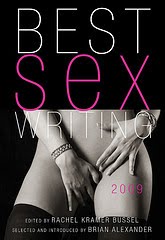
booknotes: best sex writing 2009

08 Thursday Apr 2010

Posted by Anna Clutterbuck-Cook in book reviews

≈ Leave a comment

Tags

gender and sexuality

So apparently, Best Sex Writing 2010 just came out and I’m a year behind. But I picked up Best Sex Writing 2009 at Powell’s in Portland when I was there shopping with the birthday money my brother and his girlfriend had given me (thanks Brian and Renee!). I didn’t realize until after I’d gotten the book home that the woman whose torso is pictured on the cover has no navel which is freaky and probably means she is actually an alien from outer space, or possibly a genetically engineered human like Luke Smith. Which is a little not okay (and now I can’t stop noticing it), but does not detract from the essays within, which gather together awesome writing on sex from the past few years and bring it together for all of us to enjoy in one single place.

This anthology works well as a pick-and-choose anthology: you can read it from cover to cover or you can dip in and read whatever piece intrigues you at the time. The pieces included are sometimes erotic by not erotica — this is not a collection of fiction designed to arouse the reader. Rather, it’s nonfiction reporting, personal narrative, science writing, and opinion pieces that take as their central topic something related to the messy subject of human sexuality. In “An Open Letter to the Bush Administration,” dominatrix Mistress Morgana Maye writes the (then) commander in chief to complain that his gratuitous use of force is driving away business: her clients lose their taste for domination when real-life humiliation of prisoners in Iraq is plastered all over the nightly news. In “Silver Balling,” Stacey D’Erasmo recounts her humorous and inconclusive quest to discover the definitive meaning of sex-related slang term a friend tosses off during a phone conversation. On a more serious note, Don Vaughn reports on the sexual problems as a common (yet under-acknowledged) effect of PTSD, while Amanda Robb explores the Purity Ball phenomenon and Keegan Hamilton reports on how the “oldest profession” has gone 2.0.

One of the funniest (and also saddest) pieces in the book, Hanna and I agreed, was Dan Vebber’s “Sex Is the Most Stressful Thing in the Universe,” in which Vebber describes losing his virginity in college with his soon-to-be-ex-girlfriend Molly (names have been changed).

Beginning with her phone call, and throughout our quest to purchase birth control, Molly’s constant mantra was “We’ve got to get this over with.” Is there any sentence in the English language that conveys less passion or romance? Thanks to the last moments leading up to our attempt at sex, Molly provided me with at least one: “Just so you know, this is going to be really painful for me, and I’m probably going to be bleeding all over the place.” This final sweet nothing imparted, and the fortress of contraception having been built (including Molly’s mood-killing-last-minute dash behind a closed bathroom door so she could put the sponge in), it was finally time for me to get a boner and fuck my way into adulthood. Three, two, one…go!

Needless to say, the encounter went down hill from there. It’s a great piece of writing, though also painful in that it so clearly illuminates the need so many of us have for a less competitive, performance-based conception of sexual intimacy (and here I mean “performance” as in “quick! ace this pop quiz!!” rather than improvisational jam session). Molly’s reaction to her boyfriend’s failure to “perform” in the expected manly fashion illustrates once again how Patriarchy Hurts Men Too: if women are supposed to dislike sex, find it “really painful” and “bleed all over the place” the first time, dudes are supposed to be perpetually oversexed and ready to penetrate said women at any moment, in any circumstance, or they’re somehow less-than men.

Anyway, this was a great anthology for airplane and airport reading (yes, really) because it had short pieces that I could pick up and put down as I boarded planes, listened for boarding calls at the gate, took naps on the long transcontinental flights, and so on. They’d also make great selections to read before bed if you know you’re only going to be able to stay awake for 5-10 pages before your eyes start to droop . . . I don’t know about you, but sometimes I’m more in the mood for something short and nonfictional than I am for something that requires me to invest in — and keep track of — the lives of multiple fictional characters. I’m definitely keeping my eye out for 2010 and look forward to what personal and political revelations the contributors have had this year.

quick hit: america’s earliest sex survey

05 Monday Apr 2010

Posted by Anna Clutterbuck-Cook in linkspam

≈ Leave a comment

Tags

feminism, gender and sexuality, history

The latest issue of the Stanford Magazine (April/May 2010) carries an awesome, thought-provoking article about the earliest-known sex survey that documents the habits and attitudes of American women around the turn of the twentieth century.

In 1973, historian Carl Degler was combing the University archives, gathering research for a book on the history of the family. Sifting through the papers of Dr. Clelia Duel Mosher, who taught in Stanford’s hygiene department around the turn of the 20th century, he came across a mysteriously bound file. Degler nearly put it aside, figuring it was a manuscript for one of Mosher’s published works, mostly statistical treatises on women’s height, strength and menstruation. But instead, he recalls, “I opened it up and there were these questionnaires”— questionnaires upon which dozens of women, most born before 1870, had inscribed their most intimate thoughts.

In other words, it was a sex survey. A Victorian sex survey. It is the earliest known study of its type, long preceding, for example, the 1947 and 1953 Kinsey Reports, whose oldest female respondents were born in the 1890s. The Mosher Survey recorded not only women’s sexual habits and appetites, but also their thinking about spousal relationships, children and contraception. Perhaps, it hinted, Victorian women weren’t so Victorian after all.

Continue reading The Sex Scholar, by Kara Platoni in the Stanford Magazine.

sunday smut: links on sex and gender (no. 16)

04 Sunday Apr 2010

Posted by Anna Clutterbuck-Cook in linkspam

≈ Leave a comment

Tags

gender and sexuality, sunday smut

Let’s see what the feeds brought in this week . . .

Last week, Miriam @ Feministing pointed us toward the shortlist for the LAMDA awards, while also highlighting the problem with having specific categories for gay/lesbian/bi/trans fiction and nonfiction.

A bigger problem can be found in Baltimore, Maryland where the Catholic Archdiocese is suing the city for the right to continue false advertising tactics that encourage women seeking abortion care to crisis pregnancy centers which do not offer abortion services or referrals. As SarahMC @ The Pursuit of Harpyness quips, “I thought ‘Thou shalt not bear false witness’ was a component of Christianity.” Looks like maybe not.

Another way of exerting control over women’s bodies can come through cultural assumptions about how our bodies work. Over at RhRealityCheck, sex educator Heather Corinna unpacks some of the cultural myths about the visibility of sexual activity (or lack thereof) on the bodies of women and girls.

Which pairs nicely with Jill’s piece @ Feministe about how strange it is that being pro-sex gets you attacked for being anti-sex (yes really). She takes on the rape apologetics of a college columnist at American University and makes yet another strong argument for why framing rape as mostly a “misunderstanding” or “miscommunication” between two people ignores the act of violence that those who commit rape engage in. (Trigger warning)

It’s scary to think that someone could initially say no, then change their minds and say yes, and then say that they meant “no” all along. And that’s the picture that rape apologists paint: A fun, drunken night, and the next day the cops are at your door.

But that’s not how this really works.

Most on-campus rapists don’t identify as rapists, but they do realize that they are forcing women into unwanted sex . . . I find it really helpful to actually think through, fully, an acquaintance-rape scenario as they more typically happen . . .

. . . You’re engaging in some sexual activity with someone, and they start to pull back or their body stiffens, and they say “no.” When you look at their face, they look scared. Do you continue anyway?

You’re engaging in some sexual activity and then they say “stop” or “no.” If they say “no” or “stop” or they yell, do you keep going? If they cry, you keep going? If they try to push you away, do you keep going?

You’re engaging in some sexual activity, and the person you’re with says to stop. Do you threaten them in order to convince them to have sex with you?. . .

Go read the whole thing, and bookmark it for the next time you need something to point skeptics toward.

Also on the subject of young people and sexual agency, Laura Penny @ The Guardian offers a powerful op-ed piece on the way youth sexual subjectivity is co-opted by adult agendas. “For young women in particular, a double standard is in place. We are pitied for growing up amid media encouraging erotic availability, but we are also portrayed as wanton strumpets, vomiting our worthless GCSEs into drains with our knickers around our knees, especially if we are “girls from deprived areas”. Nowhere is there the idea that young women might have their own minds.”

Not only young people, of course, but a myriad of other folks who don’t fit our cultural ideal of acceptable sexual hotness are relentlessly policed when it comes to personal agency. Chloe @ Feministing follows up on her post about the show Ugly Betty with another post titled “Beautiful girls are bitchy and ugly girls are nice.” Chloe has also offered some great reflections on fucking dating while feminist, in follow-up to Jaclyn Friedman’s interview with Amanda Hess @ The Sexist. Jaclyn has clearly provoked a lot of thought among those of us in the feminist blogosphere about the role of feminism in our personal lives and relationships.

Melissa McEwan of Shakesville, meanwhile, guest blogs at Sociological Images about the fat shaming in the television show “Jamie Oliver’s Food Revolution.” While I don’t think there’s anything wrong with media that demonstrates how to cook nutritious meals that are simple, tasty, inexpensive, I think it’s important to critique shows that buy into the cultural myth that people who do not conform to our cultural standards of thinness are automatically unhealthy, lazy and immoral. And it sounds like this particular show carries those messages in spades.

If you can’t view the video, here’s a quick summary: Headless fatties? Check. Enormous food stock footage? Check. OHNOES Obesity Crisis TM? Check. Being fat is ugly? Check. Fat people are lazy? Check. Fat people are stupid? Check. Fat people are sick? Check. DEATHFAT? Check. Mother-blaming for fat kids? Check. Fat as a moral failure? Check. Religious shaming of fat? Check. Fat people don’t have “the tools” to not be fat? Check. Fat people need a skinny savior? Checkity-check-check!

I want to note that there is, buried somewhere beneath the 10 metric fucktons of fat-shaming (and not an incidental dose of misogyny, for good measure), information about healthful eating (e.g. not eating any fresh veg, ever, isn’t good for anyone), but this is information that could be delivered without a scene in which a mother of four whose husband is gone three weeks a month is told that she’s killing her children while she’s weeping at her kitchen table.

The premiere episode has absolutely zero structural critique, not even a passing comment about the reason that millions of mothers feed their kids processed foods is because it’s cheap and fast, which is a pretty good solution for people who are short on money and time.

I don’t know about you, but I think it’s pretty immoral to spend your time shaming folks about individual choices while ignoring the structural forces that limit their range of choices, not to mention ignoring the ways in which our assumptions about health are (partially if not wholly) culturally constructed rather than set in stone.

Also on the subject of visual representation, some Holocaust scholars are disputing the legitimacy of including images of lesbians in a holocaust memorial highlighting homosexual victims of the Nazi regime. Arguing that persecution of lesbian women was “not comparable” to that of gay men, and that using an image of two women on the memorial (as part of a rotating series of videos depicting same-sex couples kissing) “distorts history.” While I think it is a legitimate scholarly point to make, that because of mid-century understandings of sexual orientation and gender men were disproportionately targeted, lesbians were hardly free to express their sexuality without punishment (see Aimee and Jaguar).

Also on the subject of queer history, Simon Callow, writing for The Guardian, muses about a new history claiming to tell the tale of “gay icons through the ages,” which instead fails to engage critically in the historical debate over how valid it is, exactly, to read our own understandings of sexuality back into the past

As David Halperin points out in One Hundred Years of Homosexuality (Routledge), it is virtually meaningless to compare the experience of a New Guinean youth who, in order to reinforce his masculinity, daily ingests the semen of his elders, to that of a young gay man in Manhattan who is heavily into fellatio. Both involve sex between men, but the nature of the participation is radically different. Such questions are fundamental to any overview of gay history, but they do not seem to have come within Ambrose’s remit.

Similar questions about changing conceptions of human sexuality plagued the characters of the web comic Cat and Girl earlier this week (thanks to Hanna for the link), as one character doesn’t understand the word “cisgendered,” and another has to explain. It made me think again about how vocabulary has been changing so quickly within the gender and sexuality field, and how to communicate why changing how we speak matters, even though it is by its very nature a never-ending process of transformation (language, ideally, changes as we change to better meet our needs as human beings).

And finally, on a lighter note: “President Obama—Our First Gay President?” Hendrik Hertzberg @ The New Yorker News Desk thinks not, but offers his own nominee for who might have been, at least by the Bill Clinton/Toni Morrison standard.

*image credit: Nude Lady with Drink by dave11198 @ Flickr.com.

sunday smut: links on sex and gender (no. 15)

28 Sunday Mar 2010

Posted by Anna Clutterbuck-Cook in linkspam

≈ Leave a comment

Tags

gender and sexuality, sunday smut

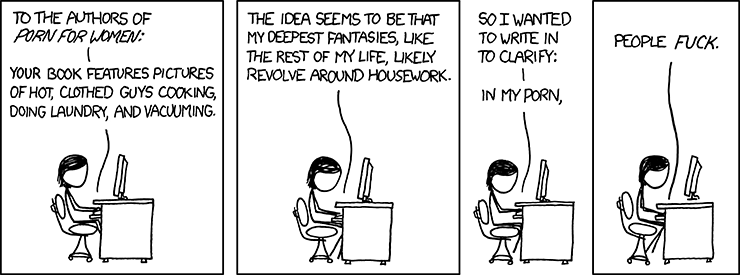
Because when you can start out a links list on sex and gender with an xkcd comic like this, why wouldn’t you?

Since this is the cleaning-up-my-feeds-from-Oregon edition, this is gonna just be authors, titles and selected quotes folks. I’m trying to get my blogging feet under me again (not to mention my work feet, in-school feet, and domestic-life feet), so posts might be a little more sluggish than usual in the coming weeks. Maybe even the next few months, depending on work schedules and how the writing of my thesis (eek!) goes, so bear with me. I promise I’ll try not to disappear entirely. But the one-a-day rate I’ve been posting this past six months will probably not be possible in the immediate future.

Amanda Hess @ The Sexist | Deconstructing Rape Myths: On Short Skirts (On Lesbians). “If she’s out in a same-sex couple that’s perceived as insufficiently feminine, she’ll get negative attention. If she’s out in a same-sex couple that’s perceived as fuckable by the standards of some heterosexual male passerby, she’ll get negative sexual attention.”

Amanda Marcotte @ Pandagon | Women chasing, men running. “suggesting that couples that are living together are generally stuck in the she’s chasing/he’s running mode doesn’t make a lot of sense to me.”

Amanda Hess @ The Sexist | College Sex Columnist on Masturbation, Money Shots, and Scandalized Grandmothers. “Over the past couple of months, Hill has heard from the haters (‘Can you tell me how talking about masturbating is ‘progress’ in female journalism?’), lovers (‘THIS ROCKS SO MUCH’), and one student who wrote in opposing Hill’s column because her grandmother read it one time and became overwhelmed by the column’s impolite subject matter. Seriously.

Thomas @ Yes Means Yes | Review: Guyland. “I don’t think Kimmel’s assertions about Guyland bear being generalized. But as long as I read them as critiques of a subculture, of Dude/Bro, I thought they were very good.”

Also by Thomas @ Yes Means Yes | Affirmative Consent as Legal Standard? “If two people lean in to kiss each other at the same time and stick their tongues in each other’s mouths, I think we can be pretty clear on consent.” (Long and complex, but worth reading if you care about how to support better legal and cultural expectations about consensual sex).

Natasha Curson @ The Guardian | Trans people still miss out on equality. “If you were to decide, for your own comfort and wellbeing, that you wanted to present at work as one gender two days a week, and another for the rest of the week, the law does not provide for you, and only the most enlightened of employers are likely to support you. But why shouldn’t someone be able to do that, if they feel comfortable enough with themselves to want to be visible?”

Susie Bright @ Susie Bright’s Journal | My Little Runaways – What You Won’t See in the Movie. “Let me make something clear that the movie only hints at: The Runaways band would not have happened, could not have been conceived, without the Underground Dyke Punk Groupie Slut culture that stretched from the San Fernando Valley to the bowels of Orange County.”

Greta Christina @ The Blowfish Blog | Some Evolving Thoughts About Weight and Sex. “A huge amount of my libido right now is focused on the changes my body is going through, and the ways it’s different from what it was before. Which is understandable: things that are in flux get more attention than things that are in relative stasis. But this has had the unfortunate effect of making me feel weirdly disconnected from my body and my sexuality of the past.”

Rebecca @ The Thang Blog | Talking to highschoolers (about being trans). “I did have one student ask, ‘So, if you did get…the surgery, and you like women…how would you have sex after?’ One of the other students waved her fingers in front of his face, which made me laugh.”

Roxann MtJoy @ Women’s Rights Blog | Panel Says Pregnant Women Don’t Have the Right to Refuse Surgery. “Personally, I would think that since a pregnant woman is still a human being, she should still have all of the rights of any other human being in this country. I would be wrong.”

Chloe @ Feministing | Pretty ugly: Can we please stop pretending that beautiful women aren’t beautiful? “So, what does it mean when even the ‘ugly’ women on our screens are conventionally beautiful? Firstly, it means that the bar for female beauty is being set higher than ever: if Tina Fey, Lea Michele and America Ferrera are ‘ugly,’ what hope is there for the rest of us? It also means that we’re being told one thing and sold another.”

Ashley Sayeau @ Salon | Help! My Daughter’s a Girly Girl. “I would never have imagined that I would essentially live in the Disney palace, forced by my daughter to talk in “a handsome voice” and mostly about getting married or mopping the kitchen. “Cinderella loves tidying up!” she frequently proclaims.”

Courtney E. Martin @ The American Prospect | A Manifesta Revisited. “They made it okay to be feminist and funny (this had always been the case, of course, but I’d been duped).”

Tracy Clark-Flory @ Salon | Sexual shame is so hot right now. “As I see it, young women have fully proved that we can have one-night stands, hear us roar — and maybe we’re beginning to also allow ourselves more nuanced feelings about our hookups.”

Marty Klein @ Sexual Intelligence | Court Finally Limits Persecution of Teen Sexuality. “These parents are heroes for insisting that the government doesn’t own their kids’ bodies or sexuality.”

Hadley Freeman @ The Guardian | Why everyone deserves to go to their high school prom. “When McMillen protested, saying “I won’t pretend ‘I’m not gay’ and brought in the lawyers, the school cancelled the prom. ‘Thanks for ruining my senior year,’ one classmate sneered.”

S @ The F-word | Painful Vagina? Your Poor Husband! “I am convinced that a young man of my age, complaining of serious sexual dysfunction and pain, would not have been treated in the same way. Firstly because in an otherwise healthy young male, loss of sexual function would rightly be seen as devastating (whereas for me it was treated as a mild difficulty), and furthermore because I do not think these doctors would assume a man was being ‘over-emotional’ or was suffering from a psychological problem rather than a physical one.”

G.L. Morrison @ SexIs | Labels and Street Signs: Navigating Gender & Orientation in the Global Village and Cyber-ghettos. “Should I define myself (gender and orientation) by what I am, what I am doing, who I am doing it with? If I were sleeping with multiple men or looking for male partners I would call myself bisexual (though I wouldn’t believe it) to protect other lesbians from the advances of men wanting to be ‘the next exception to the rule.'”

Amanda Hess @ The Sexist (can you tell she’s my new blog crush?) | Why Rape Isn’t One Big Misunderstanding. “Researchers then asked the men how they know when a woman is refusing sex. The men indicated that women also often rely on body language and euphemism to relay their lack of consent. Interestingly, even though the men professed to favoring the exact same tactics, they attributed these devices to the way that ‘women are.'”

Greta Christina @ The Blowfish Blog | Closeted Politicians and Bi Invisibility. “It’s occurring to me that it might make more sense to talk about right-wing homophobic politicians who are secretly having sex with same-sex partners . . . instead of talking about right-wing homophobic politicians who are secretly gay.”

Amanda Hess @ The Sexist (see?) | Fucking While Feminist, With Jaclyn Friedman. “A couple of guys were shocked that I like to play various games in bed, because I’m a feminist. That’s always really interesting to me. I’m always like, ‘Are you kidding me? The feminists I know are the craziest women in bed you can find!’ Those are the moments where I feel like a one-woman feminist PR machine.”

And before this post gets more unwieldy than it already is, I leave you with Shaker Maud @ Shakesville | On Being a Woman, Not a “Female.” “Referring to women as ‘females’ defines them solely in terms of gender, denying them any other attributes of personhood, and specifically denies them womanhood, marking that as a condition which is the speaker’s to confer or withhold based on their list of qualifications.”


sunday smut: links on sex and gender (no. 14)

07 Sunday Mar 2010

Posted by Anna Clutterbuck-Cook in linkspam

≈ 1 Comment

Tags

gender and sexuality, sunday smut

This’ll be your last Sunday Smut list until I return from Oregon, so watch for no. 15 to appear on March 28th. In the interim, you’ll be on your own when it comes to the latest sex and gender related gossip in the blogosphere.

This week, to start us off, we have dueling videos: made-of-awesome and made-of-misogyny (not to mention misandry). On the pro-side we have a “That’s Gay!” segment posted by lisa @ Sociological Images that lampoons the discomfort surrounding Johnny Weir’s appearance at the Olympic games (“is Johnny Weir too gay for figureskating? . . . Wait. Is that even possible?”). On the con side, we have a PSA video produced by the socially conservative sexuality education organization SexReally posted by Jos @ Feministing (and just about every other feminist blog). It indulges in a whole host of harmful stereotypes, not the least of which is the idea that all men are sexual animals whom women must protect themselves from via safer sex practices.

Elsewhere, SKM @ Shakesville shares Johnny Weir’s response to critics (web video + partial transcript).

There’s been a lot of talk this week about the current state of sexism in popular culture, and how certain practices are being marketed to women as feminist when, possibly they aren’t all that different from traditional notions of how “nice girls” ought to feel and behave. Susan J. Douglas @ In These Times asks whether sexism is being sold to women as “empowerment”; Jessica Grose @ Slate’s DoubleX muses about cycles of slut shaming and the powerful cultural taboos over casual sex (Rachel @ The Feminist Agenda weighs in); Lucy Mangan @ The Guardian musters a quality rant on how Helen Fielding and her character Bridget Jones “destroyed my 20s”; and finally, Charlotte Raven @ The Guardian reviews several new books of feminism and culture, and suggests that it’s time for more women to become re-politicized about their position in society: “In the 50s, as now, the early gains of feminism had been squandered by a generation who thought it unglamorous and inhibiting.”

A new report shows that sexually-active Americans know alarmingly little about pregnancy prevention and how to protect themselves from sexually transmitted infections. Amie Newman @ RhReality Check reports the cold, hard facts, while Amanda Hess @ The Sexist offers us sex ed, Microsoft Paint edition.

Over @ The Lesbian Lifestyle, goldstardyke announced the winners of this years Lezzie Awards in blogging; of the blogs I follow, Feministing.com won in the category of Best Lesbian Feminist/Political Blog and Essin’ Em’s Sexuality Happens was a Runner Up in the category of Sex/Short Story/Erotica.

Congratulations are also due to Samhita @ Feministing, who has been chosen by the members of Feministing’s collective as the first to fill the rotating position of Executive Editor.

Cara @ The Curvature offers a powerful and scathing analysis of the recent report on sexual assault on college campuses and the continued failure of officials to respond meaningfully or create a climate in which victims of sexual violence are willing to come forward and report. Her argument is nuanced and worth digesting in full, but a few choice quotations (bold emphasis mine):

This idea that some rapes are Really Bad Rapes, and other rapes are Eh, Not That Big of a Deal Rapes, is incredibly damaging — especially when the only kinds of rapes that count as Really Bad Rapes are the kinds that are the least common — and also incredibly pervasive. Some rapes are more violent than others, but the bottom line is that rape is rape.

Saying that there are “middle” rape cases, that involve miscommunication and mutual intoxication, first of all, is patently false. Rape does not occur because of “miscommunication” — it just doesn’t. It occurs because of one party’s decision to ignore, disengage from, and/or reject communication. The idea that there are hoards of rapists out there “accidentally” raping is absurd on its face. But even if it was true, it results in a no less responsible rapist. If you don’t want to rape someone, you make sure that the other party is enthusiastically and meaningfully consenting. If you fail to do that and rape someone, there was no accident involved — just the likely and logical outcome of a conscious choice to disregard the bodily autonomy and safety of another person.

. . .

Here is where the overarching problem with schools’ disciplinary procedures, as well as the problem with how we as a society evaluate rape in general, comes to light. We spend more time looking at how the rapist thought about the event, rather than what the rapist actually did. We spend more time thinking about how the rapist might have meant things differently, rather than looking at the violence and oppression the rapist actually enacted. And we give more credence to the rapist’s intent than to the victim’s trauma and sense of violation.

And there can simply be no justice for rape victims when the first order of business is always to consider how the rapist feels.

Read the entire post at The Curvature.

Also (sadly) in the annals of rape culture Melissa McEwan @ Shakesville reports on a columnist who claims women joggers who desire solitary exercise are asking to be raped and murdered.

The Women’s Collections Roundtable of the Society of American Archivists reports that the awesome Women and Social Movements online collection is free for the month of March in celebration of women’s history month.

While Heather Corinna conducts a study on attitudes and experiences of casual sex, Sady and Amanda @ The Sexist ask is hook-up culture eating our brains?

Via SFSignal (thanks to Hanna for the tip), Lambda Literary announces a new webzine devoted to book reviews, author interviews and more.

And finally, a slightly dated (from last August) post from mlawski @ Overthinking It making the case that Strong Female Characters ™ are actually detrimental to the feminist cause. I should note that this post prompted a lively discussion in our household due to the classification of Leia in Star Wars as a modified Damsel in Distress ™. Hanna argues that mlawski is cherry-picking examples and thus destroying her case; I bow to Hanna’s mastery of the history of genre film in general and Star Wars in particular while maintaining that mlawski’s identification of a trend and its weaknessness is still valid. I leave it to my readers to decide for themselves.

*image credit: painting of sleeping nude by afewfigsstudio @ Flickr.com

quick hit: Heather Corinna’s casual sex survey

06 Saturday Mar 2010

Posted by Anna Clutterbuck-Cook in linkspam

≈ 1 Comment

Tags

call to participate, feminism, gender and sexuality

via aag

The awesome sexuality educator and activist Heather Corinna, recently interviewed by Chloe @ Feministing, is conducting a survey on attitudes toward, and experiences of, casual sex. The survey is web-based, anonymous, and takes about 20-40 minutes to complete (depending on the speed of your computer and how much you want to write in the open-ended questions). Anyone over the age of sixteen who has ever had a sexual experience involving another person (so anything other than masturbation) is encouraged to respond.

http://www.surveymonkey.com/s/S97WR6H

Heather Corinna is trying to gather information on multigenerational attitudes toward casual (not in the context of a commited relationship) sex and how those who engage in casual sexual encounters feel about those experiences. The current media panic about young adult “hook up” culture focuses almost exclusively on heterosexual white women and assumes that casual sexual encounters are threatening to young women’s sexual pleasure and ability to form (if desired) more lasting relationships. Corinna hopes to provide a more nuanced perspective of the actual practice of casual sex without the burden of these moralistic assumptions. As Corinna herself writes:

There’s a lot of buzz right now about “hooking up,” the newest term for casual sex, though casual sex isn’t new at all — nor does it only belong to the current generation, despite often being presented that way. Unlike a lot of the buzz out there, I’m not interested in telling anyone how to have sex or in presenting any one kind of sex as the one ” best way.” I’m just looking for what’s real, both in sexual attitudes and personal experiences.

Rather, I’m doing this study to try and gather data on multigenerational experiences and attitudes with/about casual sex so as to discover and present a more diverse, realistic and non-prescriptive picture of people’s sex lives and ideas about sex. The data will ideally be used for publication, but your answers are completely anonymous and will only be used anonymously.

Since the study will be most informative if the respondants are drawn from a diversity of political, cultural, generational, etc., background, I encourage you to take the survey and pass it along to anyone you feel comfortable introducing the project to. Yes, this includes your socially conservative grandmother, your teenage brother, or your Church pastor.

← Older posts
Newer posts →
"the past is a wild party; check your preconceptions at the door." ~ Emma Donoghue

Recent Posts

  • medical update 11.11.22
  • medical update 6.4.22
  • medical update 1.16.2022
  • medical update 10.13.2021
  • medical update 8.17.2021

Archives

Categories

Creative Commons License

This work by Anna J. Clutterbuck-Cook is licensed under a Creative Commons Attribution 3.0 Unported License

Meta

  • Create account
  • Log in
  • Entries feed
  • Comments feed
  • WordPress.com

Create a free website or blog at WordPress.com.

  • Subscribe Subscribed
    • the feminist librarian
    • Join 37 other subscribers
    • Already have a WordPress.com account? Log in now.
    • the feminist librarian
    • Subscribe Subscribed
    • Sign up
    • Log in
    • Report this content
    • View site in Reader
    • Manage subscriptions
    • Collapse this bar