• anna j. clutterbuck-cook
  • contact
  • curriculum vitae
  • find me elsewhere
  • marilyn ross memorial book prize

the feminist librarian

the feminist librarian

Tag Archives: gender and sexuality

mary daly: a shortish post and links

09 Saturday Jan 2010

Posted by Anna Clutterbuck-Cook in think pieces

≈ Leave a comment

Tags

feminism, gender and sexuality

You’ve probably heard or read by now that radical feminist theologian Mary Daly died this past week at the age of eighty-one.

Reflections on her life and work abound on my RSS feeds. See Feministe, Feministing, Feminist Law Professors, figleaf, Hippyish, Questioning Transphobia, Shakesville, and Women’s Space for a sample of the range of responses that are being generated out there on the interwebs.

I first came across Daly in a class on Christian feminism in which we were assigned part of her seminal (pun intended) work, Beyond God the Father, one of the first texts in modern feminist theology to systematically condemn the patriarchal underpinnings of Christian thought and practice. About ten years ago (my how time flies!) I drew on some of her later writing for undergraduate paper on the important work of feminists who assert different starting points, different roots (hence the term “radical”) than those provided by mainstream culture. Whether we agree or disagree with Daly’s conclusions, I believe her impulse to jettison that which she found harmful to women’s health and well-being is a useful example. Particularly for feminists who come from a religious background (which I sort of did and didn’t — my family wasn’t religious, but the community and college I lived and learned in was, so my experience of anti-feminism often came through the lens of religious belief), Daly’s early work can really resonate. Sady @ Tiger Beatdown (via Questioning Transphobia) has written a beautiful and astute analysis of Daly’s effect in her life from this perspective — one that also wrestles with the perennial issue of how to come to terms with the unsavory opinions of a person who, at one time, inspired you to positive, transformative action.

Unless a published retraction of her transphobia and other acts of privilege manages to surface, absolution will not come to the legacy of Mary Daly. None of this means that she was not important, or that she didn’t have anything to say: she was, she did, and it is a damn shame that her work is currently so obscure. She was important to me: I probably wouldn’t be a feminist without her influence. But I probably wouldn’t have been such a bad feminist without her influence, either. Like many people before her, she’s left the world as a human being, and remains with us now only as a legacy. It’s an important legacy – because of its accomplishment, because of its uniqueness, because of its tremendous potential to harm – that we cannot, and should not, ignore.

I never read — let alone made sense of — enough of Daly’s later work to reflect meaningfully here on the racism and transphobia expressed in her writing that justifiably angers so many folks. What is will say is that Daly’s writing (even I remember this) was incredibly solipsistic: she seems to have become increasingly enamored with the world of her own imagination, in which she alone battled the powers of patriarchal darkness beset on all sides by enemies. For people who struggle all their life as outsiders of one sort of another, injured deeply by their fellow human-beings, I feel that this is an all-too-common human failing, however inexcusable it may be in the final analysis. While Daly herself bore responsibility in the end for her own actions, we also, collectively, bear some measure responsibility for sustaining a world in which a tenured professor felt so threatened that she stopped listening to her critics — even when they had important perspectives to offer.

I thus have fond memories of her work and what it meant to me, even as I stand critically wary of her later myopia, self-aggrandizement and posturing. Jill @ Feministe comes closest to giving voice to my own response to Daly’s life and work when she writes “She was a foremother, but one who eventually revealed herself unprepared to embrace all of her children (especially the ones who failed to look or think like her). . . May she rest easy, and may the rest of us learn from her good works and leave her bad ones to dust.”
booknotes: echo in the bone

05 Tuesday Jan 2010

Posted by Anna Clutterbuck-Cook in book reviews

≈ 1 Comment

Tags

books, feminism, gender and sexuality, masculinity

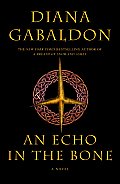
It’s been a while since I wrote a proper “booknotes” post, but this weekend while Hanna was away in Maine I finally hunkered down and read Diana Gabaldon’s latest installment in the epic Outlander cycle (now clocking in at seven volumes each seven hundred to one thousand pages in hardcover), Echo in the Bone. (Warning: mild series spoilers ahead).

I was first introduced to Outlander under its British title, Cross Stitch in Aberdeen by my Glaswegian roommate, Vicki, who is (or at least was) an adoring fan. For those of you who aren’t familiar with the series, it centers on the relationship between Claire Beauchamp, a Second World War nurse, who accidentally time-travels back to eighteenth-century Jacobite Scotland and — also somewhat accidentally — marries a young Scottish fugitive named Jamie Fraser. The first book revolves around Claire’s attempts to return to her own time (1950s England) and the husband she left behind, while at the same time she finds herself falling passionately in love with Jamie. Without giving all the ins and outs of the romance and drama away, the saga weaves its way across Europe and America, the eighteenth and the twentieth century, and has expanded to encompass multiple generations of the Beauchamp-Fraser family and a sprawling cast of secondary characters. The science fiction / time-travel aspect of the narrative — while integral to the plot in many respects — also takes firm second-place to the political and personal dramas in which the characters get caught up as they move from one space/time context to the other.

An Echo in the Bone is a solid installment in the ongoing series, though Gabaladon’s expansive cast of characters has become increasingly difficult for her to manage — or at times hard for readers to follow, particularly if you don’t have the time to sit down and read the book in a marathon session (I tried the chapter-before-bed method during term-time and eventually gave up, setting it aside for vacation). There was speculation around the publication of A Breath of Snow and Ashes the sixth book would be the final volume, or be followed by a prequel or spin-off story, but she’s apparently decided to continue spinning the main narrative out, as Bone not only comprises of 800-plus pages of story but also ends with several cliff-hangers that I doubt will just be allowed to die. I have a slightly mixed feeling about this, since there was something bittersweet about reading Ashes as a final installment . . . but since Cross Stitch/Outlander was originally meant to be a one-off fantasy novel, Gabaldon fans have (I imagine, anyway) long since grown used to the idea that her sagas will inevitably be longer than originally predicted.

I’ve talked to a few friends who’ve had trouble with the sex and gender roles in the series — trouble enough that they’ve quit reading the books altogether. And as this is a blog with “feminist” in the title I figured I’d take a minute to reflect on how sex and gender (as well as sexual orientation) seems to play out in the series overall. Speaking for myself, I really had to make my peace with the series in this regard: I was really upset with the power dynamics between Claire and Jamie in the first book and by some of the sexual violence that went largely uncriticized within the stories. Gabaldon’s characters also have a really annoying habit of talking in gender essentialisms (i.e. “men are all X” and/or “women are all Y”). Most of the hetero relationships in the story (which is virtually all of them) are very male-as-protector and woman-as-nurturer. It’s explained away, in part, as historical accuracy (that is, Jamie as an eighteenth-century man has learned to think in certain ways about marriage, about sex, and so forth), and to be fair over the course of the series characters’ opinions are challenged and do change. However, certain behaviors continue to be explained away as grounded in innate characteristics based in sex, an explanation I find just as unsatisfactory in fiction as I do in real life. It seems to me a mark of lazy thinking on the part of the character and (by implication) their creator.

The violent sex and sexual violence are a bit more difficult to gloss over and/or explain away by historical context. I haven’t spoken to anyone who’s a survivor of sexual abuse or violence who’s tried the series, but I imagine that the graphic descriptions of rape and sexual violence could be unpleasant and/or impossible to read. One of the best parts of the series, at least in my mind, is Gabaldon’s penchant for writing erotic and and often light-hearted sex scenes (I was, in fact, disappointed that the most recent installment featured relatively few); the downside is that if you’re not into the kind of sex her characters are into, it can be difficult to make it through the graphic descriptions without feeling a bit icky about the relationship dynamics. Personally, though a few of the early scenes had me cursing and tossing the paperback edition of Cross Stitch across my dorm room, in the end I made the decision to let the characters have what is clearly a pleasurable and consensual sexual relationship without judgment from me.

Be warned, also, that the arch-villain in the first few books is a sadist with a taste for sexual violence, both hetero- and homosexual (he seems to fixate on individuals regardless of gender; both Jamie and Claire are assaulted by him in various contexts, with Jamie suffering the worst of the abuse). While Gabaldon (possibly in recompense?) has since written at least one gay male character who is one of the good guys — and actually features in his own series of stand-alone short stories — I was wary at first to have same-sex sex so closely associated with rape.

And as a final note, I’ve never been particularly irritated with historical fiction that plays lightly with the actual historical record, but those who care deeply about either eighteenth-century European or American history may be frustrated with the melange of historical detail and fiction that Gabaldon brings together for her time-traveling romps through the era.

My ultimate advice? Don’t take them too seriously, let the characters win you over, and have a great time.

sunday smut: links on sex and gender (no. 5)

03 Sunday Jan 2010

Posted by Anna Clutterbuck-Cook in linkspam

≈ Leave a comment

Tags

gender and sexuality, sunday smut

“The more time women are compelled to spend fighting their own bodies, the less they have to fight for anything else.” Michelle Goldberg ponders the rise of surgical alterations of women’s bodies during what I guess we’ve decided to term “the aughts,” suggesting that we’re not much further ahead at dispelling the beauty myth than we were in 1991. In fact, we might be much further behind.

“The Bush years may have been one of the worst times for those of us interested in gender equality.” Suzanne Reisman also has some sober reflections about what the past ten years have wraught, along with a few things she’s grateful for (and more reflections promised in January).

“If you don’t want to be accused of indecent exposure and ‘traumatising’ young children, cover up or install curtains.” Carnal Nation reports that a man in Virginia was convicted of “indecent exposure” for being naked in his own home.

“It is inaccurate to view all sexual activity among young people as intrinsically negative.” Carnal Nation reports on a new study from the University of Alberta that suggests a positive relationship between emotional maturity and satisfying sexual experiences. While I have questions about who’s defining “mature” vs. “immature” I appreciate that the researchers are pushing back against the idea that all young people are unprepared to be sexually active.

“I clearly remember the sexual anxiety from my undergraduate days. For one thing, I had no real idea of what my sexual needs were; I knew they weren’t being met, but I tried not to think about it because I didn’t even know where to start, so thinking about how I wasn’t getting what I wanted just made me feel awkward and confused.” Clarisse Thorn writes about BDSM, radical feminism, and sexual availability. She also notes that the post is “a bit feminist-theoretical.” For those whom such words cause hives, you have been warned.

“Birth films tend to be very romantic or absolutely terrifying. I wanted to juxtapose real and fake births and let people make up their own minds, and I wanted to make it funny, because the subject can be so intense.” Film-maker and childbirth educator Vicki Elson discusses Laboring Under An Illusion, which explores the way childbirth is depicted on television in sitcoms, dramas, “reality” television, and documentaries.

“Because seriously, what’s more fun than thinking of virgin/whore visuals?!” Jessica Valenti’s latest book, The Purity Myth is going to be reworked as a documentary.

“Clearly, the objection to strawberries is that they’re so pleasurable, and someone on food stamps is viewed as someone who doesn’t deserve even the smallest pleasures.” Amanda Marcotte writes about economies of pleasure, and the way in which Americans — and social/sexual conservatives more specifically — view pleasure as something to be “earned” and “granted” by some sort of authority, and pleasures which are free and private (sex), or which are viewed as unearned (a marijuana high) are treated with suspicion and folks who engage in them often downright vilified.

“This was a bad policy that had a good point at the heart of it. The loss of troops from vital places is an important point to ponder — but a policy that targets women, whether intended to do so or not, isn’t the way to get the mission accomplished.” Brandann Hill-Mann at the Women’s Rights Blog discusses the recent news story about a General in Iraq who was court-marshaling women who became pregnant serving under him (and, where applicable, their sexual partners).

“Modeling for Playgirl doesn’t make Levi a model for decorous fatherhood, but it’s hardly enough to strip him of his right to help make decisions about his son’s life.” Emily Bazelon discusses why Bristol Palin should not be awarded sole custody of her son Tripp.

“Why, today alone I have endangered my 15-week-old fetus by taking a warm bath, painting my nails green, eating Parmesan cheese that I’m not SURE was pasteurized, and struggling to install a new cable box . . .!” A pregnant woman writes to Lenore at the blog Free Range Kids to ask “How about a companion website: Free-Range Fetus?” as a way of counteracting the culture of perfectionism that currently pervades every aspect of reproduction, from pre-conception through post-college parenting.

And finally, Elyse at Skepchick asks “What information do you wish you had about sex back in the day? What information do you wish you had about sex now?” The comments make great food for New Year’s thought.

*image credit: nude aqua by linda boucher @ Flickr.

holland, hope, and homosexuality: some reflections

30 Wednesday Dec 2009

Posted by Anna Clutterbuck-Cook in think pieces

≈ Leave a comment

Tags

gender and sexuality, hope college, michigan, politics

Just before Christmas my friend Rachel sent me a recent column by screenwriter Dustin Lance Black about his experience filming in Holland, Michigan (my hometown) and being invited to speak at Hope College (my alma mater). As I wrote here in October, Black was extended and invitation to speak at the college and then the invitation was withdrawn by the administration. Later arrangements were made for Black to speak at an off-campus venue.

Black’s column, reflecting on his experience in Holland and at Hope is clearly written in a well-meaning spirit of reconciliation in a situation where hurt feelings abounded. It is also written from the personal perspective of an outsider who visited Holland for a short period of time to do a specific project and became tangled up in one chapter of the ongoing saga that is West Michigan’s religious, social and political conservatism. More specifically, he walked into a situation colored indelibly by Hope College’s struggle to decide where it stands in relation to the Reformed Church in America, a denomination currently divided (as most mainline Christian denominations are) in regards to their official stance and everyday practice concerning sexual orientation.

Unfortunately, I think Black, with the myopia of a visitor — misses the mark when it comes to understanding the particular context for — and history of — his own slice of experience in West Michigan and with Hope College. He characterizes Holland (a metropolitan area of roughly 95,000) as a “small Midwestern town” and describes his encounters with the local populace as if his presence was somehow a catalyst for the city and college to wrestle with issues of sexual orientation that they had heretofore complacently ignored. “I don’t think the town was homophobic,” he writes, “I think they had simply never discussed gay rights openly before, and here I was, an interloper, threatening to thrust this hot-button issue into their community.”

Well . . . yes and no. Clearly, I have my moments of profound antagonism toward the conservatism of place and people that characterizes the West Michigan region. There are reasons I felt it necessary to become a self-identified feminist, reasons that I decided to move elsewhere for graduate school, and reasons I will think long and hard before supporting my alma mater financially or otherwise. There have been times when I experienced the majority culture of West Michigan like a physical weight on my chest, an asthma attack waiting to happen.

Yet on the other hand, I think it’s important — and I speak here as a feminist, as someone who’s bisexual and in a same-sex relationship, and as a Midwesterner — to resist the easy dichotomy of “Midwest” versus “coast,” and “small town” versus “urban” that become stand-ins for talking about political and social conservatism and liberalism. West Michigan was where I became the person I am today partly in spite of yet just as much because of the people around me: West Michigan’s politics and majority culture are conservative, but that conservatism does not thrive in a vacuum free of liberal, leftist pushback. West Michigan conservatism is perennially contested by those who disagree with the premises of a conservative Church and Republican party politics. (Consider, for example, that my senior project in the Women’s Studies program at Hope was a multi-year group research project on a predominantly lesbian, feminist organization and community that thrived in West Michigan during the 1970s and early 1980s.) I would argue that Black served less as a catalyst for new awakening and more as the latest spark to reignite the antagonism between these two indigenous forces: dominant culture and counter-culture.

Those outsider-sparks can serve as personal awakenings, sure: it was a similar series of events in 1998 that were my own adult initiation into the world of feminist and LGBT politics — but I think the important thing to remember is that even if the immediate impetus for such community reflection comes from outside, myriad resources with which to challenge the conservative status quo are rooted deep in local, Midwestern soil.

I grew up a crazy-ass liberal in what (as Black points out) is the most Republican-leaning county in Michigan — yet I found a tenacious network of like-minded folks within that community who have helped me to grow, often to thrive, and always to explore a world beyond the boundaries of fear-driven, narrow-minded conservatism. And many of those people hail from (and continue to live in more or less uneasy relationship with) the very groups of folks that Black imagines to be so well-meaning yet clueless about queer politics. Among the folks who helped me grow into the woman I am today are Holland natives, Hope College faculty and staff, and deeply religious folks whose Christianity informs their political liberalism.

And those folks deserve to reside in the “small Midwestern town” of our collective imagination just as much as (if not more than) those who resort to fear and exclusion.

Quick Hit: Transgender Basics (Video)

29 Tuesday Dec 2009

Posted by Anna Clutterbuck-Cook in media

≈ Leave a comment

Tags

feminism, gender and sexuality, web video

This video from the Gender Identity Project has been making the rounds on the blogs I read regularly; I finally had twenty minutes last night (and a computer with sound!) to sit down and watch it.

I’m fairly new to the subtleties of transgender identity, and while I enjoy reading feminist theory (can’t say often enough how much Julia Serano’s Whipping Girl helped me wrap my brain around trans issues) a lot of people I know just aren’t that into it, and trying to explain the current connotations of sex vs. gender — not to mention what people mean when they start talking “trans” — can leave me feeling inept. I really like how this video breaks it down without using too much insider language while at the same time not talking down to their audience. Definitely something to keep in the “resources” file.

Jos at Feministing reports that, as of yet, there is no transcript available, but tnat a volunteer is working on one. Hope it will soon be available through the GIP website, if you are interested in and/or need one.

sunday smut: links list on sex and gender (no. 4)

20 Sunday Dec 2009

Posted by Anna Clutterbuck-Cook in linkspam

≈ Leave a comment

Tags

gender and sexuality, sunday smut

News flash: women no longer have “hymens” but “vaginal coronas.” Why, you may ask? Ann Bartow @ Feminist Law Professors explains.

While the idea of re-naming the hymen has a certain amount of political merit, I’d say the same does not hold true for calling the vagina a “baby-making hole” (aside from being clunky, it’s factually inaccurate people!). Check out the sex education book that used this term at beyond birds and bees (via aag, who provides the book illustrations for the visually-inclined).

Artist Zina Saunders is doing a series of portraits of “long-standing gay couples” in response to New York state’s recent failure to pass a gay marriage bill.

I’m equal parts gleeful and creeped out by this story of the “ex-gay” organization Exodus International severing ties with a Michigan-based affiliate after allegations of homoerotic abuse. Most puzzling to me is why any group would name itself “Corduroy Stones” (outside of the emo rock band context) and what that could possibly have to do with sexual orientation therapy.

Ann at Feministing offers yet another perspective on the abusive relationship dynamics of New Moon, pointing out the normalization of violence in the Native American community depicted in the book and film.

On Wednesday, Jessica, also at Feministing, solicited peoples’ stories about Women’s and Gender Studies programs in an open comments thread.

I enjoyed Hanna Rosin’s book God’s Harvard which I reviewed here a couple of years ago. However, sometimes her op-ed pieces cause in me a “what the fuck?!” sort of reaction. For example, her recent ruminations on her husband’s behavior in the kitchen, titled The Rise of the Kitchen Bitch. As my friend Joseph sarcastically commented, “I so appreciate her writing a piece about men doing more cooking and describing them as bare-fisted, potty mouthed, and (my favorite) testosterone-fueled assholes.” I mean, really, I could spend paragraphs dissecting harmful class- and gender-based assumptions being made in these two sentences alone:

I first heard this term in Sandra Tsing Loh’s recent Atlantic story about her divorce. She used it to describe a friend’s husband who was anal and fussy and altogether too feminine—he belonged to an online fennel club, for God’s sake.

While we’re on the subject of harmful stereotyping, Dr. Marty Klein describes how our cultural terror of online sexual predators effects the ability of consenting adults to role-play sexual fantasies online in “Fantasy On Trial (Again)”

In an instance of entirely tone-deaf wording, the BBC online forum “have your say” published a piece this week it titled “Should homosexuals face execution?” (since changed to “Should Uganda debate gay execution?“) The simple answer to that, boys and girls, is no. The more nuanced answer is fuck no. (via Cruella-blog). Journalists and the public complained, and the BBC has since apologized. Hanna and I have been debating between ourselves the effectiveness and legitimacy of the headline; she thinks the first version got the response the BBC wanted, I think the second is more accurate. Either way, it’s an interesting case-study for how these international issues are framed and reported on by media outlets.

In another instance of media framing, I’ve been seeing various iterations of this headline the past few days: “topless teen causes auto accident” or, as DigitalSpy.uk put it, “breast-flashing teen hit by car.” A New Zealand teenager who was dared to flash oncoming traffic was fined for supposedly distracting one driver so badly that he veered off the road and ran her down. Okay: flashing traffic is possibly not the brightest idea going (akin to mooning someone out the window of your car, right?: stupid prank) But I’m irritated by the way no one is asking why a woman’s breasts were so distracting to a driver that he hit her with the car — and if, indeed, that’s the case, why it’s somehow her fault and not his.

Lots of folks weighed in on a recent study that concluded young people who engage in casual sexual encounters do not necessarily experience adverse effects. Brandann Hill-Mann @ Women’s Rights Blog announced “this just in: sex isn’t going to destroy you!“; Thomas @ Yes Means Yes wrote about “the absence of harm“; Amanda Marcotte, writing @ Double X concludes that “the kids are downright boring.”

And finally: speaking of sex, as opening lines go, Rachel Kramer Bussel definitely takes the cupcake this week with “I lack sexual restraint. Philosophically, I don’t see the point in it.”

*Image credit: PICT1897 by Always Rain @ Flickr.

sunday smut: links list on sex and gender (no. 3)

13 Sunday Dec 2009

Posted by Anna Clutterbuck-Cook in linkspam

≈ Leave a comment

Tags

gender and sexuality, sunday smut

The links list in which I indulge my interest in things sex and gender related that I’ve read around the internet.

First off, from the fabulous Fug Girls comes this PSA: “EVERYONE’S VAGINA IS FINE. WORRY ABOUT THE CLOGS.” Best advice in, like, forever. Although I doubt clogs really need worrying about either. Mostly, I find they’re pretty low-maintenance footwear.

Can someone explain to me why “sexting” somehow more lewd and/or potentially dangerous than writing love letters or having flirty phonecalls? I don’t get it. Emily Bazelon over at Slate suggests there might be some truth under the hysteria while Ani DiBranco over at the Women’s Rights Blog asks whether “sexting” is the biggest problem facing teenage women.


(Personally, I think maybe we should be worrying about that giant octopus off the coast instead. . . but that could be me).

I have a few links related to trans issues this week. First up is Laurie Penny over at the UK-based F-word argues for the death of transphobic feminism in Moving towards solidarity. “Not a single person on this planet is born a woman,” she writes, “Becoming a woman, for those who willingly or unwillingly undertake the process, is torturous, magical, bewildering – and intensely political.”

Next comes Helen G over at Questioning Transphobia has a post up about “psychiatry’s civil war,” or the politics of revising the Diagnostics and Statistics Manual (currently in-process), particularly when it comes to gender identity.

And finally, on a similar — and no less contentious note — The Bilerco Project published an opinion piece this week by Ronald Gold in which he took a stance against the concept of “transgender,” going so far as to question the very existence of trans folks (obviously very hurtful to people for whom this is lived experience). The post has since been removed. These situations are, I think, complicated, emotionally fraught for everyone involved and I don’t know enough about this one to pass my own personal judgment on the rightness or wrongness of pulling the piece. But what I actually want to link to this morning is the original response written by Bil Browning (founder of the Project) about why he decided to publish Gold’s piece in the first place, which I found thought-provoking as an example of how to handle these struggles over what does and does not appear in (online) print.

Liz Kukura @ RhReality Check and Rose @ Feministing wonder about the validity and usefulness of “generational divide” talk around reproductive rights.

Also on the subject of reproductive rights, Michelle Goldberg at The American Prospect reports on a case before the European Court of Human Rights that has the potential to recognize women’s universal human right to reproductive freedom.

On the opposite side of the political spectrum, anti-choice activists increasingly invoke the concept of “choice” to bolster their own political aims. Amanda Marcotte over at RhRealityCheck weighs in on the trend.

Two stories on public breastfeeding this week, one from sexgenderbody about a Target store in Michigan (oh, the shame!) that called the cops when a woman refused to stop feeding her daughter (Woman’s Rights Blog also weighs in) and another from Her Bad Mother at BlogHer about ads in Chicago proclaiming breasfeeding “tacky”. Her Bad Mother writes:

This question should be settled, as settled as not refusing to serve same-sex couples in restaurants, or ensuring that public places are accessible to disabled persons. You have every right to be discomfited by public breastfeeding. You just don’t – or shouldn’t (depending upon what state or province we’re talking about) – have the right to protest or disparage it publicly.

Well . . . um, yeah, actually I believe you do have a right to “protest or disparage” it (although, please, people, get over it already). What you do NOT (or should not) have the right to do is discriminate by such methods as requiring someone to feed their infant in a restroom (ew!) or calling the fucking police when someone engages in a perfectly legal activity. This is why many nursing mothers and advocates have started pressing for legislation specifically protecting their right to feed their children in public. Because apparently it’s something they can’t take for granted.

Essin’ Em at Sexuality Happens muses about whether it’s always important or necessary to come out (and, conversely, why straight, monogamous, “vanilla” folks never feel the pressure to come out about their own sexual proclivities).

Why do we have this default of “you should only come out/express your sexuality if you’re not the norm?” I mean, really, what’s wrong either with no one having come out, or having everyone come out? Why is it so specific?

Also on the subject of language and communication, Hanna mused at …fly over me, evil angel… about the power of words, and what happens when people shift from highly emotive words like “rape” to (possibly technically more accurate but nonetheless distancing) phrases like “sexual- and gender-based violence.”

Lisa at Sociological Images offers a lovely set of real-life portraits of phone sex workers, juxtaposed with images taken from phone sex adverts (nsfw).

And finally, on a mildly celebratory note, congrats this week to the Episcopalian church here in America which just elected its second openly gay Bishop. See the New York Times and The Guardian for more.

*image credit: Ture Ekroos, posted at The Art Department by way of the Tor.com Cthulu art thread.

this may be the only appropriate response

12 Saturday Dec 2009

Posted by Anna Clutterbuck-Cook in think pieces

≈ 3 Comments

Tags

gender and sexuality

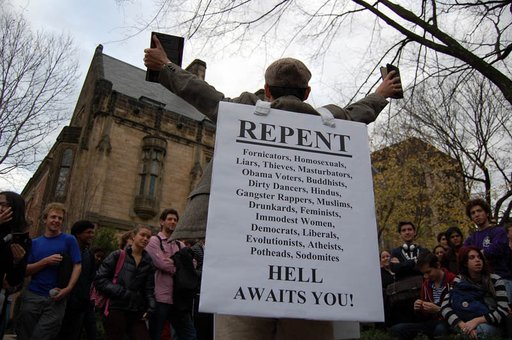
Just before I got in the car on Tuesday to drive down to my digital archives class in New Haven, this story from the Yale Daily News came across my feeds via Melissa McEwan @ Shakesville. A young evangelical street preacher, Jesse Morrell, has been preaching repentance on and around Yale’s campus wearing a sandwich board that delineates twenty activities he considers sinful: fornicating, homosexuality, lying, stealing, masturbating, voting for Obama, practicing Buddhism, dirty dancing (does anyone know what this entails, exactly?), practicing Hinduism, singing “gangster rap,” practicing Islam, drinking, being a feminist, being an immodest woman, being a Democrat, being a liberal, believing in evolution, not believing in God, smoking pot, and having anal sex.

Holy shit is that a lot of thoroughly enjoyable activities to avoid!


Hanna did the math and pointed out that we’re guilty of at least fourteen out of twenty already, so probably at this point our eternal salvation — at least in this guy’s heaven — is a long-lost cause. (Sounds like a boring place anyway — I mean, no immodest women or questioning the existence of God? what would we do for fun??) Those devils in hell had better be ready! Do you think we should shoot for a perfect score?

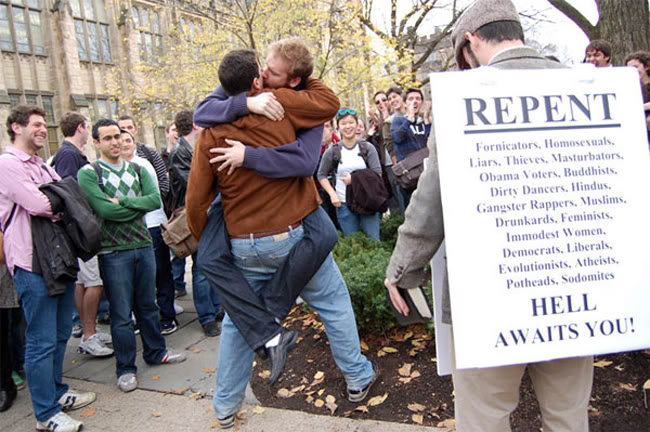
At least two of the bystanders thought such a plan might be worthwhile, and wasted no time in checking off at least one item on the list.


I think this might just be my favorite protest action of the week. It seems like the only appropriate response, really, to hellfire and brimstone preaching: the assertion of passion, pleasure, and the human capacity for finding joy in physical intimacy. It absolutely gets the point across by refusing to enter into the terms of the debate and, through action, offering an alternative vision of the world.

Now let’s see . . . I’d better get busy practicing my dirty dancing moves!

wrong wrong wrong wrong wrong

03 Thursday Dec 2009

Posted by Anna Clutterbuck-Cook in think pieces

≈ Leave a comment

Tags

education, feminism, gender and sexuality, the body

This story is a little old (Inside Higher Ed carried the story on 20 November), but I can’t stop thinking about the levels of wrong involved, so I’m hauling it out in order to be pissed about them, and to enumerate them in public. Nothing like a blog to get things off your chest!

First up, here’s the low-down on what happened, according to Inside Higher Ed:

More than two dozen seniors at Lincoln University, in Oxford, Pa., are in danger of not being able to graduate this spring — not because they’re under disciplinary probation or haven’t fulfilled the requirements of their majors, but because they were obese as freshmen.

All had body mass index (BMI) scores above 30 — the U.S. Department of Health and Human Services’ threshold for obesity — when they arrived on campus in the fall of 2006, but none have taken college-sanctioned steps to show they’ve lost weight or at least tried. They’re in the historically black university’s first graduating class required to either have a BMI below 30 or to take “Fitness for Life,” a one semester class that mixes exercise, nutritional instruction and discussion of the risks of obesity.

Now, there is a long tradition of colleges having physical health and well-being requirements as part of students’ general course of study — my undergraduate college, for one, had such a requirement (more on this below). While I have opinions about what definition of “health and well-being” a given school promotes, I see nothing egregious about encouraging students to be physically active and health-conscious, and giving them the information they need to make decisions about self-care and health care (for example: a component on patient advocacy might not go amiss!)

Singling individual students out, based solely on their body mass index (BMI) is something wholly different and wholly fucked up. As Kate Harding over at Salon wrote in You Must be Thin to Graduate

Like most such debates, [the Lincoln University story is] being framed quite simplistically — as a matter of public health vs. individual freedoms — with a number of important questions going unasked. Such as: Does BMI actually give a clear indication of an individual’s fitness level? No, for a number of reasons — e.g., BMI is only meant to give a general idea of weight distribution across a population; a large amount of muscle mass can make a person with relatively little body fat technically obese (Lincoln also uses waist measurements in an effort to weed these people out); and above all, fitness and fatness are not mutually exclusive.

On that last point, consider that Lincoln students are given the option of testing out of the class. If a number of students with BMIs over 30 can demonstrate a level of fitness that would make the course redundant, that should tell you right there that targeting fat people for remedial phys ed is discriminatory bullshit. If Lincoln wants to make a certain fitness level a general requirement for graduation, then blatant ableism aside, I guess that’s its prerogative. But why not test people irrespective of weight, and offer the course to those who are demonstrably unfit, rather than starting with the deeply flawed assumption that fat people are ignorant about physical activity, while everyone who falls below the obesity threshold is already sufficiently active?

I would add to what Harding says here (which I think is pretty much right on target) by pointing out that not only is this policy targeting people seen by our culture as overweight, it is ignoring people whose health is in jeopardy because of disordered eating or other health issues that put them below a body weight that would help them optimally flourish. Not to mention people who look and weigh a “normal” weight according to our culturally-conditioned filters, but who may be struggling with life-threatening conditions, either diagnosed or un-. Or whose quality of life is chronically undercut by a disordered relationship with food, exercise, and/or their own physical embodiment. (I speak from the perspective of someone for whom what I ate on a given day often during undergrad often had more bearing on my mood than any academic performance).

A fellow Women’s Studies major in my undergraduate program did her senior-year project on our own health class requirement (one that was expected of all students, regardless of physical health or body type), showing how obsessed the supposedly holistic curriculum was with thinness, and how it often exacerbated the disordered eating and exercise patterns of students already prone to obsessive or self-destructive behaviors. While modifications were made in the course curriculum to include resources on eating disorders and the dangers of being undernourished, when I took the class as a senior in 2005 the in-class message was blatantly and repeatedly the following:

1) As a college student you are surrounded by opportunities and pressures to make bad decisions about what to eat, with “bad decisions” primarily meaning “deciding to eat fatty foods.

2) As a college student, you are also surrounded by opportunities and pressures not to exercise, and therefore,

3) Between the lack of exercise and the fatty foods, unless you maintain constant vigilance you will become fat and unhealthy.

4) Oh, and by the way it’s also not good to be too skinny and if you think you might have an eating disorder contact the counseling center.

I have a beloved sister and several close friends with diagnosed eating disorders. Most of the women I know (myself included) have chronic — though less-than-clinically-critical — disordered relationships with food and our bodies. I can name half a dozen women who put off, or simply refuse to meet with, health professionals because they know that the first thing the doctor will see — regardless of their overall health — is how much they weigh. All health recommendations will be filtered through the doctor’s personal perception of whether the woman (or man) standing in front of him (or her) meets our cultural standard of “thin.” (Yes, I mean “cultural standard” not “science-based”; go read Courtney Martin’s Perfect Girls, Starving Daughters.)

Beyond arguments about the relationship between physical health and body weight, I think it’s critically important to highlight, bold, capitalize and underline the following: WEIGHT IS NOT A SIGN OF MORAL AND PROFESSIONAL FITNESS. People who suffer from physical or mental illness and disability are fully capable of completing programs of higher education and finding work in which they excel. To screen college students by weight and place an extra academic burden upon students deemed physically unfit is NOT OKAY.

To reiterate what Harding said in her piece at Salon, this should not be framed as a a case of individual rights versus collective well-being: neither is being furthered here by this policy. Helping young people to grow into compassionate, self-aware individuals who will (hopefully) have the generosity of spirit to make the world a better place should never, at any time, involve publicly punishing them for their physical appearance, health, or athletic capacity. Goodness knows, if they fail to meet the narrow standards of physical perfection demanded by our culture students already know before they hit college exactly, precisely, where they have failed at unattainable goal of effortless perfection. The last thing in the world they need is one more voice — this time with the weight of institutional authority — telling them they are less-than-worthy. Ceasing to harass them achieves the double goal of protecting individual rights to personal privacy while simultaneously making the case for a vision of the common good that encompasses all of our imperfect humanity, not just those who magically mystically meet the current physical ideal.

Quick Hit: Congrats Arin!

02 Wednesday Dec 2009

Posted by Anna Clutterbuck-Cook in linkspam

≈ Leave a comment

Tags

education, family, gender and sexuality, hope college, michigan

Back in October I wrote a post venting about the immaturity exhibited by the administration of my alma mater over a student-issued invitation to screenwriter Dustin Lance Black to speak at the college in conjunction with a screening of his film Milk. Via my Dad (and our hometown newspaper) comes the news that after a long delay and a change of venue, the talk will be held at an off-campus location.

Hope College is not involved with the event.

“Although the college did not choose to invite Mr. Black to speak in an open forum on campus, the film ‘Milk’ raises a variety of moral and social issues and questions,” school spokesman Tom Renner said. “Many of these and other challenging issues have been and will continue to be discussed in a variety of college courses and in other events on campus.”

Hope College student Arin Fisher is among those in the grassroots group Hope Is Ready, which is sponsoring the event.

“Hope Is Ready is just a group of concerned students, faculty, staff and community members who want Hope to know that we as a community are more than ready to discuss questions about the LGBT community, the church and any other relevant issue,” Fisher said.

I’d just like to say congratulations to my sister Maggie’s friend Arin (quoted above), whom I know has been working hard for this all semester long. Hope College is a better place for having you there, and I hope at some point down the road they recognize that!

Hope you all have fun at the screening.

← Older posts
Newer posts →
"the past is a wild party; check your preconceptions at the door." ~ Emma Donoghue

Recent Posts

  • medical update 11.11.22
  • medical update 6.4.22
  • medical update 1.16.2022
  • medical update 10.13.2021
  • medical update 8.17.2021

Archives

Categories

Creative Commons License

This work by Anna J. Clutterbuck-Cook is licensed under a Creative Commons Attribution 3.0 Unported License

Meta

  • Create account
  • Log in
  • Entries feed
  • Comments feed
  • WordPress.com

Create a free website or blog at WordPress.com.

  • Subscribe Subscribed
    • the feminist librarian
    • Join 37 other subscribers
    • Already have a WordPress.com account? Log in now.
    • the feminist librarian
    • Subscribe Subscribed
    • Sign up
    • Log in
    • Report this content
    • View site in Reader
    • Manage subscriptions
    • Collapse this bar