Recently, I’ve been thinking a lot about representation of teen sexuality, particularly in young adult literature, and what those representations say about how adults interpret, fear, and attempt to contain teen access to erotic material. In the course of this research, I’ve become aware of the dearth of male narrators in young adult novels that revolve around romantic and sexual relationships. 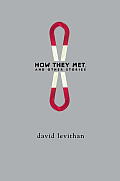 There are exceptions of course, such as the work of David Levithan, one of my oft-cited favorite authors who has just come out with a new collection of love-themed short stories, many of which are narrated by boys. But the majority of YA literature about relationships is written about young women.
There are reasons for this, of course, many having to do with the way American adults have come to understand American teenagers: girls, the narrative goes, are primarily interested in love, while boys are on the lookout for sex. Social science research, not to mention the flesh-and-blood boys and men in my life, leave me disinclined to believe that male human beings are any less interested in, or capable of, forming intimate human relationships than female human beings. Therefore, I’ve been on the lookout for books that actually describe adolescent romance and sexual exploration from a guy perspective (if any of you have favorites, please leave them in the comments!).
At this point in my thought and research process, two relatively new novels aimed at the adolescent set and narrated by boys landed on my bedside table. Both of them are narratives of teen parenthood, though these narratives unfold in very different settings and contain radically different messages about what it means to take on the adult responsibility of fatherhood.
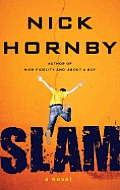 Slam, by Nick Hornby, is a contemporary story about a fifteen-year-old named Sam whose girlfriend of a few brief weeks, Alicia, gets pregnant after the pair fail to use their birth control correctly. When Alicia decides to carry the pregnancy to term, Sam struggles to incorporate his impending parenthood into the life he has hitherto only hazily planned.
While I adore Nick Hornby’s nonfiction, I have always had difficulty getting into his fiction, and have, I admit, never actually finished a Hornby novel (an approach to reading that he himself advocates quite persuasively in the introduction to his second volume of essays). However, from my incomplete experience, it seems to me that Sam, the protagonist of Slam, bears an intense resemblance to a the lead characters in other Hornby novels, the only difference being his younger age. He moves through the narrative in a fog of befuddlement, more acted upon than acting, a message reinforced by sequences in which he is mysteriously transported forward in time, where he is suddenly thrust into his parental role without the faintest idea what is expected of him. While Sam genuinely comes to love his son, and do his best to support Alicia, the overall effect of the tale is Cautionary with a capital P: have sex with your girlfriend and the next thing you know, she could be Pregnant and you could become a Parent.
There is truth to this message, of course–it is, and should be, Alicia’s decision whether or not to go through with the pregnancy (though there is, sadly, little real discussion between the two about their options). Yet I couldn’t help feeling that Hornby was, well, doing his bit to prop up the stereotype of adolescents as impulsive, hormone-driven beings incapable of a) using birth control, b) knowing and listening to their own instincts. The real tragedy of the story, to me, is not that the pair end up having to deal with an unplanned pregnancy, but that their sexual relationship has little to do with the feelings they have for each other. Alicia’s motives for sexual intimacy appear largely driven by unresolved issues with her ex-boyfriend. Sam, for his part, ignores his intuitive sense that he’s not ready: “When I’d worked out what was going on, it didn’t feel right,” he tells us, “There were three of us in her bedroom that night, me, her and him, and I decided that because it was my first time, I’d prefer to keep the numbers down” (44). Yet he fails to act on this self-awareness, and ends up a father.
 Jake, the protagonist in Robin McKinley’s latest novel, Dragonhaven, also ends up a parent–though in this instance it is the result of acting on his instincts rather than ignoring them. Dragonhaven is roughly contemporary, but set in an America in which dragons are an extant species kept on reservations and largely invisible to the human public. On his first solo overnight trek into the park (as son of the park director, he’s grown up on the reservation) Jake stumbles upon a mother dragon murdered by a poacher and commits the federal crime of rescuing the one dragonlet still alive. I doubt that Robin McKinley was writing Dragonhaven as a story about teen fatherhood, but since I picked it up at the same time as I was reading Slam, what jumped out at me from its pages (aside from the realization that I will happily read anything she ever writes) is that it is, in part, a coming-of-age story about a teenage boy who, overnight, becomes a parent.
When Jake adopts the dragonlet, whom he names Lois, the illegal nature of the act–combined with the fact that the orphan bonds with him in lieu of her dead mother–means that Jake is the primary parent of a very needy infant. He has other residents on the reservation to support him, but the fact remains that Jake is the one responsible for feeding, cleaning, nurturing this totally dependent infant creature. And as Lois grows, he’s also the parent who has to learn how to let her become her own, independent being.
This isn’t a book primarily about sexuality or romantic relationships–though they aren’t entirely absent from the plot–but I was struck nonetheless with the portrait of adolescence Dragonhaven presents, juxtaposed against the fogged-in bumbling awareness of the teenagers in Slam–particularly Sam, the teenage boy. Throughout Slam, Sam’s behavior is subtly contrasted with Alicia’s, and Sam’s immaturity and inability to comprehend what Alicia is experiencing–as his girlfriend, as a pregnant woman, and later as young mother–are integral to his character development.
Dragonhaven, meanwhile, refuses this stereotypical “teenage boys are idiots” frame of reference. Jake is a boy, yes, but he’s first and foremost a person struggling to come to terms with the overwhelming responsibility that circumstance has presented him with. It’s a responsibility that, more often than not, resembles our conception of new motherhood: the sporadic sleep schedule, the inescapable necessity of being physically tied to a dependent infant, and over-riding all the discomfort and exhaustion, Jake’s irrational adoration and urge to protect his charge. If, at times, he appears a little slow at connecting the dots, the reason is not his age or his hormones, but rather circumstance: he’s a sleep-deprived new parent. No one, over the course of the novel, ever suggests he is less ready, able, or willing to take on the responsibility just because he’s a boy.
I’d like to think that some of Jack’s self-possession, even in the face of such unexpected and life-altering experiences, comes from his home-based (or, in this case, reservation-based) education and childhood experience. He’s spent his life in community with adults who, while they make allowances for youth, also forget to talk “down” to the few children at Dragonhaven. Unlike Sam, Jake hasn’t learned what it means to be a teenage boy by our cultural standards–instead, he’s learned what it means to be a human being who cares the vulnerable beings (animal orphans, children, dragons) who cross his path. Regardless of where Jake’s compassion, self-awareness and responsibility comes from, however, I think Dragonhaven is a thoughtful (and fun and fantastical!) story about a young man learning, however quirkily, what it means to be a parent.
And I think it has a lot of respect for teenage boys and their ability to be human beings.

 The American Library Association released their list of 2009 award winners today, and Neil Gaiman’s most recent book for middle grade readers (or readers of any age who know where to find the best fiction around), The Graveyard Book, topped this list as this year’s Newbery gold medalist. (Insert amazed and delighted swearing here). For once, I’ve actually read the winner prior to its, well, winning, and enjoyed it very much. In a creepy-crawly sort of way. Congrats Mr. Gaiman!


 the feminist librarian