• anna j. clutterbuck-cook
  • contact
  • curriculum vitae
  • find me elsewhere
  • marilyn ross memorial book prize

the feminist librarian

the feminist librarian

Tag Archives: human rights

booknotes: birth matters

02 Friday Sep 2011

Posted by Anna Clutterbuck-Cook in book reviews

≈ Leave a comment

Tags

books, children, feminism, human rights, sexuality

I must have hallucinated starting the review of this book, because I have a clear memory of doing so but now cannot find the draft anywhere. Och, well. We’ll just have to begin again.

I need to admit upfront that I’m an entirely biased reviewer of anything Ina May Gaskin writes. My mother’s copy of Spiritual Midwifery was, along with Our Bodies, Ourselves, one of my adolescent introductions to feminism, as well as to female bodies and the amazing things they’re capable of. I think what Gaskin and the other midwives at The Farm have been doing for the past forty years is hands-down one of the most awesome things to come out of the 1960s, the women’s health movement, and feminist activism. So when my friend Molly offered up Ina May Gaskin’s Birth Matters: A Midwife’s Manifesta (New York: Seven Stories Press, 2011) as one of the reading options for her GoodReads reading group on feminist pregnancy, birth, and parenting, I jumped at the chance.

UPDATE: You can read Molly’s review over at first the egg.

That having been said, I also approached the Gaskin’s memoir with some trepidation: how would her work and her writing come across in a new book, one that would be impossible to read through the filter of “that’s just how they talked about things back in the 70s…”? I was a little bit worried about being let down, much in the same way one’s favorite books from childhood often feel a bit tarnished upon re-reading.

My fears, however, were (mostly) all for naught. Birth Matters is highly readable, compelling, contemporary, and unapologetically feminist in its approach to the political and cultural barriers to high-quality pregnancy, birth, and parent-and-child care in our society. “The way a culture treats women in birth is a good indicator of how well women and their contributions to society are valued and honored,” Gaskin argues in chapter one, “The Importance of Birth and Birth Stories”:

My intention in this book is not to persuade those women who want to avoid pregnancy to change their minds — far from it. But I do want to convince even women with no interest in motherhood that the right to a positive and safe birth is just as important as the right to choose whether or not to have a child (7).

She gently points out that the often bitter divisions between parents and non-parents is an unhelpful model for making our world a better place for all humanity: “It is time for feminists to realize that pitting the needs of nonmothers against those of mothers is a way of weakening — not strengthening — women. Women should not lose their human rights when they become mothers” (41). Beyond looking at women and mothers, she articulates what I think should be shouted from the rooftops by us all: that the way we welcome children into the world speaks volumes about how we value humanity — and as such, birth matters to all of us simply because we are part of that human community. The way we were welcomed into the world and cared for as infants and children is part of that story, even if we don’t ever plan on becoming parents ourselves.

Gaskin has been in the enviable (for most midwives) position of enjoying strong, positive working relationships with practicing OB/GYN physicians throughout her tenure as a midwife at The Farm, and her belief in the ability of medical doctors and lay or nurse-midwives to work together to foster positive birth experiences for families is evident throughout the book. I really appreciated the way she highlighted the work of medical doctors who trust birthing parents’ bodies and offer their expertise without trying to direct the process or fueling fear of the body’s work during pregnancy. Yes, sometimes life-threatening complications develop during pregnancy and birth — but too often in our culture we attempt medical interventions in childbirth that end up being detrimental to the health and well-being of both infants and their birth parents. Gaskin offers an alternative vision of how birth practices can be (and have for the nearly three thousand births Gaskin and her team have overseen in the forty years between 1970-2010). Indeed, it is the outcomes of Gaskin’s practice that will likely be most compelling for skeptics of out-of-hospital childbirth: of the 2,844 births attended at the Farm 94.7% were completed at home with a maternal death rate of 0% and a neonatal death rate of 1.7 deaths per 1,000 births. The Farm’s rate for c-sections stands at 1.7% which nation-wide hovers between 30-50% (far exceeding the World Health Organization’s recommendation of 5-10% of all births*).

Most of what Ina May Gaskin has to say will sound familiar to anyone who has read recent books on pregnancy and birth, particularly Born in the USA by Marsden Wagner and Pushed by Jennifer Block (I highly recommend them both). However, there is some valuable material here that even those familiar with the arguments for the midwifery model of care will likely be interested in. Interspersed throughout are birth narratives written by women who have given birth at The Farm. From my point of view, there can never be too many birth narratives out there for us to draw upon. It’s particularly useful to read how different each person’s story is, even though they have made some of the same basic choices about the type of care they want to receive. I was also glad to see a chapter on sexuality and childbirth — something I wish Gaskin had done more with. The midwives at the farm have long advocated for sexual interaction between a laboring woman and her partner(s) as a way of facilitating a less painful, more effective labor. The idea of “orgasmic childbirth” might seem obscene to some, idealistic to others, but even if you don’t want to think about childbirth itself as a sexual experience, I think Gaskin has some important points to make about the way medicalizing childbirth (treating it as an illness) has removed women’s bodies and their physical presence — sexual and otherwise — from the active birth process.

My one frustration with Birth Matters is the consistency with which Gaskin’s language choices and examples reinforce the assumption that all birthing takes place within the context of heterosexual, gender-normative lives. The birth parent is consistently a woman/mother and is never identifiably partnered with a woman, although in several stories it is unclear whether the birth parent is single or has a partner. This seemed like an odd oversight for someone who is otherwise so clearly open to the possibility that families come in many shapes and sizes. At times, Gaskin also over-simplifies the history of midwifery and falls into the trap of romanticizing the sacred feminine and female bodies — something that makes me slightly uncomfortable since I try to avoid essentializing femininity/femaleness. I’d recommend, as a supplement to reading this, the wonderful essay “The Manly Art of Pregnancy,” by j wallace (found in Gender Outlaws: The Next Generation, edited by S. Bear Bergman and Kate Bornstein, 2010) which just might be my favorite thing written about pregnancy ever. And I would hope that future editions of this work acknowledge more overtly that people with many different sex and gender identities and family contexts become pregnant and wish to give birth in supportive, low-intervention settings such as The Farm.

The final verdict: Read this book if you care about the cultural and political contexts in which we come into the world, and if you question — even a little bit — the medicalization of pregnancy and childbirth that has become the norm in our country at this point in history. Gaskin’s memoir-manifesta is a beautiful testament to how there is a different way — not just in the future, but here and now.

*See the WHO report The Global Numbers and Costs of Additionally Needed and Unnecessary Caesarean Sections Performed per Year: Overuse as a Barrier to Universal Coverage [PDF]

booknotes: helping teens stop violence

05 Friday Aug 2011

Posted by Anna Clutterbuck-Cook in book reviews

≈ 1 Comment

Tags

children, education, gender and sexuality, human rights, politics, racialization

My latest early reviewer book from LibraryThing was the 20th anniversary edition of Allan Creighton and Paul Kivel’s Helping Teens Stop Violence, Build Community, and Stand for Justice (Alameda, CA: Hunter House, 2011). The authors have worked together in the field of violence prevention and social justice activism since the mid-1970s. This book is a workbook for adults seeking to work with young people, specifically teenagers, to identify and combat the various types of institutional and cultural injustice they encounter in their lives. “Professional literature about adolescents, social-service priorities, and funding trends all [emphasize] programs that [build] self-esteem,” the authors observe. “Many youth workers convey to young people that if they just had higher self-esteem, they could overcome any obstacle and succeed at anything they set out to do,” ignoring the institutionalized, systemic injustices young people as well as adults face in securing life necessities and building a satisfying life for themselves and their families (60). We do a grave disservice to youth, the authors argue, by implying that if they are struggling it is largely because of personal failure when, in fact, the problem is an imbalance of power:

Our problem [when we were young people ourselves] was not based on low self-esteem or any of the other psychologically defined problems. Rather, we had no real power over our lives. Without power to protect ourselves, we were constantly restricted, disrespected, and abused by adults. Everywhere we went, adults had the authority to decide how we should dress, where we could be, and who we could be with. They decided our future through daily decisions including discipline, records, diagnoses, arrests, report cards, evaluations, and allowences, or just by ignoring, interrupting, or neglecting us.(60-61)

The imbalance, of course, is not just one of age but also intersects with many other inequalities from which adults also suffer: poverty, sexism, racism, religious bigotry, discrimination based on disability and sexual orientation or gender identity … the list is a long and familiar one. Creighton and Kivel call on adult allies to work with youth in identifying these power imbalances and combat them. Those who benefit from inequality seek to divide the attention and alliances of those who are struggling to get by under oppressive systems. By forging networks of support among ourselves at the bottom of the inequality pyramid, the authors suggest, we can more effectively enact lasting social change as well as survive in present day far-less-than-optimal conditions.

Since the book is designed primarily as a workbook for group trainings, those who are reading Helping Teens Stop Violence outside of that context may find themselves skimming a bit and taking note of various exercises for later usefulness, rather than reading in a straightforward manner. I found myself skipping around quite a bit, once I’d read the introduction and gathered the gist of the authors’ perspective and approach. Some general impressions:

  • The authors have made an effort throughout to discuss the ways in which different types of injustice overlap and interact, so that even though (for example) a given chapter may be about “class” the exercises continually push us to think about how things like race, sexual orientation, immigrant status, etc., shape our class identities and economic opportunities.
  • As someone who is continually frustrated with the invisibility of ageism in our culture — even among groups of people willing to discuss and dismantle other “isms” such as sexism and racism, or address homophobia and access issues for folks with disabilities — I was really excited to see the first few chapters devoted to age-based discrimination, and exercises designed to get adults remembering their own teenage years and the lack of agency they had as young people in a world controlled by adults.
  • The authors emphasize the fluidity of what they call “target” and “non-target” categories (i.e. various types of social privilege), reminding us that our social status and agency is highly dependent on context and can change as the context changes — so that each of us have experienced both being part of a target group and being part of a non-target (privileged) group at various points in our lives.
  • Even without using this book as a workbook with a group, as it was intended, the various exercises often contain useful suggestions for how to intervene in situations where you see oppression happening in order to name it and (hopefully) stop the cycle of violence from continuing.
  • They also offer some good guidelines for having constructive and saf(er) discussions about difficult topics, recognizing that “we have all been hurt in various ways and have had lots of experience of not being listened to well, so we have developed a billion ways to protect ourselves from getting close to each other and becoming vulnerable to further hurt” (170). By structuring discussions in ways that may seem a bit stilted at first, groups can build enough trust by which they can have productive conversations about prejudice, violence, and institutionalized inequality.

Helping Teens Stop Violence will obviously be most useful to those who have immediate practical application for its suggested exercises and the resources listed in the back of the book (though I found their resource lists a rather odd mix, with curious gaps — particularly when it comes to the available literature on violence in education and violence against youth). However, it’s a worthwhile read for anyone who is interested in the practical aspects of social justice work at the grassroots level, and who is interested in thinking a bit more deeply about the way in which our culture has institutionalized ageism and systematically disenfranchises young people and children.

booknotes: queer (in)justice

30 Thursday Jun 2011

Posted by Anna Clutterbuck-Cook in book reviews

≈ Leave a comment

Tags

books, feminism, gender and sexuality, human rights, masculinity, politics

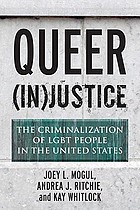
The third installment in Beacon Press’s Queer Action/Queer Ideas series, edited by Michael Bronski, Queer (In)justice: The Criminalization of LGBT People in the United States is co-authored by law professor Joey L. Mogul, police misconduct attorney Andrea J. Ritchie, and community organizer Kay Whitlock. Hanna saw it on the new book wall at the library and correctly ascertained it was the sort of title I’d be interested in. So she brought it home, I read it, and now I’m gonna blog about it.

Queer (In)justices is far more than an examination of the ways in which our legal system polices “deviant” gender and sexuality qua gender and sexuality. Yes, the authors look at the laws and policing practices related specifically to penalizing folks who engage in (publicly or privately) non-heteronormative sexual practices, or whose appearance suggests that they identify outside the gender/sex/sexuality binary. However, their analysis goes much deeper than these targeted laws. Instead, they argue that “the policing of sex and gender ‘deviance’ is central to notions of crime, and serves both as a tool of race-based law enforcement and as an independent basis for punishment” (xiii). In other words, notions about the relationship between non-normative sex and gender expression and criminality influence the way in which the legal system treats people perceived to be queer whether or not they are caught in the system specifically because of sex- or gender related policing. As they argue:

As queer identities substituted for individual perverse acts [in the late nineteenth century]  the process of criminalizing sexual and gender nonconformity was facilitated through the construction of ever-shifting and evolving archetypal narratives [of deviance]. Rooted in historical representations of Indigenous peoples, people of color, and poor people as intrinsically deviant, fueled and deployed by mass media and cultural institutions, these narratives now permeate virtually every aspect of the criminal legal system (19).

They make a compelling case for us to question the usefulness of narrowing our focus specifically on anti-gay laws, and on enacting new laws seeking to protect LGBT people from homophobia … particularly when the very law enforcement officials meant to ensure those laws are respected are among the primary culprits when it comes to bigotry and violence around sexual and gender nonconformity.  In chapters on gender and sex policing on the street, in the courtroom , in prison, and in uneven police responses to violence against LGBT people, we see how presumptions of criminality systematically influence how queer people are treated in the context of the legal system, whether they are perpetrators, victims, or both. They make the particularly important point that, regardless of what laws are officially on the books, “police and other law enforcement agents are given considerable latitude in deciding which laws to enforce, how to enforce them, and which people to target for law enforcement” (48).*

Being queer, or being perceived as queer can cause law enforcement officials to treat individuals as criminally guilty whether or not they actually are — and can bring harsher punishments (when compared to those perceived as straight and gender conforming) when those individuals are sentenced. Likewise, criminal behavior is often associated — implicitly or explicitly — with sexual depravity. Using examples that will be familiar to anti-sexual harassment or anti-sexual violence activists, Mogul, Ritchie, and Whitlock describe how individuals known or perceived to be queer are treated by law enforcement officials as if they are incapable of being victims of sexual violence. They describe victims of same-sex domestic violence who themselves were put in jail or ruled incapable of being abused because of their orientation or gender identity.

Ultimately, Queer (In)justice argues that LGBT activists must take a much more comprehensive approach to their agitation for change within the framework of law and law enforcement. While much of the mainstream LGBT work in this area in recent years has involved the quest to enact anti-discrimination and anti-hate crime legislation, and to grant same-sex couples the right to marry, Mogul, Ritchie, and Whitlock point out that a much broader cultural shift within law enforcement must take place in order for such changes in the law to have an on-the-ground effect. As they write, “The hate crime framework is … compromised by placing primary responsibility for preventing violence in the hands of a criminal legal system that is itself responsible for much LGBT violence” (129). We would do well, they seem to be pointing out, to pay closer attention to the experiences of those most vulnerable to police brutality, discrimination and abuse sanctioned by the legal system, and persecution based on presumptive criminality … not just because of their sexual identity, but because their mere presence as a non-conforming body evokes powerful notions of danger and violence whether or not these reactions are warranted in specific instances. Comprehensive reform is needed before the passage of laws will have real-world implications for the majority of the LGBT population.

Queer (In)justice is a must-read for anyone who wants to re-consider the current LGBT approach to legal reform.

*This point is exactly why I am uneasy with Jim Wallis’ argument that police force is preferable to military force. Wallis’ assumption that police only use force when it is necessary to enforce agreed-upon laws ignores all of the situations in which law enforcement officials abuse the power vested in them … something which, as a person who works in anti-poverty and anti-racism circles, Wallis ought to know full well.

quick hit: SCOTUS on young peoples’ free speech rights

28 Tuesday Jun 2011

Posted by Anna Clutterbuck-Cook in linkspam

≈ 2 Comments

Tags

children, human rights, politics

I’m in Michigan for a whirlwind visit to attend my brother and sister-in-law’s wedding celebration. I thought I might have fun photos to share with you today, but not yet. Instead, I’ll post this story that I heard on National Public Radio this afternoon.

The Supreme Court on Monday struck down a California law banning the sale of violent video games to children, saying it ran afoul of the First Amendment right to free speech.

In one of the most closely watched cases this term, in a 7-to-2 vote, the justices said governments did not have the authority to “restrict the ideas to which children may be exposed.”

I was struck, when I heard the story on All Things Considered, that the issue was being framed as a free-speech issue. That is, that children have a constitutional right to information…even if its information we find disturbing and wish to protect them from on a legal level.

This may be the first (and only!!) time I find myself agreeing with Antonin Scalia:

Writing for the majority, Justice Antonin Scalia said the country has no tradition of restricting depictions of violence for children. He said California’s law did not meet a high legal bar to infringe on the First Amendment or the rights of parents to determine what’s best for their children.

Note that parents still have the authority to determine what their children can and cannot access; it’s just that the government cannot legislate one particular type of parental values for all children.

The article goes on to note:

Although regulating children’s access to depictions of sex has long been established, Scalia said there was no such tradition in the United States in relation to violence. He pointed to violence in the original depiction of many popular children’s fairy tales like Hansel and Gretel, Cinderella and Snow White.

“Certainly the books we give children to read — or read to them when they are younger — contain no shortage of gore,” Scalia added.

Read the whole thing over at NPR.

While I agree with Scalia that as a society we routinely expose children to a high level of violent stories and imagery (not to mention leaving them vulnerable to actual physical and emotional violence), I think it’s interesting that the question of restricting access to sexual materials was left unquestioned. If children have a constitutional right to play first-person shooters, don’t they also have a constitutional right to see images of people making love, if that is what they wish to do? (Most young children are probably more interested in violence than sex … but for the sake of legal consistency they should be allowed either).

I have a lot of questions about the nuances of this ruling, and no time in the next 48 hours to do any background reading. But I’ll let you know if there are further developments!

thoughts on the death of a man

02 Monday May 2011

Posted by Anna Clutterbuck-Cook in think pieces

≈ 1 Comment

Tags

human rights, politics

Hanna and I woke up this morning to near-ceaseless NPR coverage of Osama Bin Laden’s death during an American military raid on his compund in Pakistan. I have a lot of ill-formed thoughts here, and reading through the blog posts that have gone up over night on the topic is making me rather sick to my stomach so this is not destined to be the most cogent of blog posts. But with all of the media speculation about what this means for the “war on terror” and with the coverage of celebrations of death that seem to be taking place across the United States, I feel compelled to point out

a human being died last night.

Yes, he was a sick and twisted person who was responsible (directly and indirectly) for the suffering of thousands upon thousands of other people.

Kind of like we, as a nation, are responsible for the suffering of thousands upon thousands of people due to the two wars we started ten years ago in retribution for the suffering we held this man responsible for.

And now here we are celebrating death in the streets.

I’m just not comfortable with that.

The first thing my mind presented to me this morning when I heard the news was a memory of hearing, ten years ago this coming October, that the United States had begun bombing Afghanistan in retaliation for 9/11. I was huddled around a campfire on a beach in Oregon among a group of folks with whom, for the past month, I’d been reading about the horrific things human beings do to one another in wartime.

It’s hard to imagine bombing or invasion is the way to solve the pain of loss or to drive away the fear of vulnerability when the first thing that comes to mind is the seige of Sarajevo or the violence of South African apartheid or the war of attrition that is (to this day) taking place between Israel and Palestine.

It’s equally hard for me to imagine that assassinating Osama Bin Laden will bring any sort of political or personal resolution to the violence of the past decade (and beyond).

A human being died last night.

The world that he (and we) created remains. There is still suffering, there is still inequality, there is still anger … there will still be violence.

Adding to that violence will not make us safe.

And the purposeful killing any human being should never lead to dancing in the streets.

UPDATE: My friend eskenosen @ kai ho logos sarx egeneto has put it much more eloquently than I ever could:

I mourn with those who still mourn, after 10 years, the absence of their friends, coworkers, and family members. I understand those who celebrate the death of bin Laden as long-awaited justice.

But I also grieve for our nation, that instead of crying out to God in our shock and horror, we cried for bombs, for guns, for shock and awe. That a human has died, and people sing in the streets.

booknotes: making it legal

24 Thursday Feb 2011

Posted by Anna Clutterbuck-Cook in book reviews

≈ Leave a comment

Tags

books, gender and sexuality, human rights, politics

Through LibraryThing‘s Early Reviewer program I was sent an advance review copy of the second edition of NOLO’s Making It Legal: A Guide to Same-Sex Marriage, Domestic Partnerships & Civil Unions, by attorneys Frederick Hertz and Emily Doskow (Berkeley, CA: NOLO, 2009; 2011). The book aims to be a practical nuts-and-bolts guide for same-sex couples considering marriage. It offers a whirlwind tour of the history of same-sex marriage, the current international and domestic context for such marriages, and the nitty-gritty of marriage and divorce laws as they apply to all couples — as well as specific advice for same-sex couples who are considering forming legal relationships.

The authors go beyond describing legal rights and obligations and also discuss political activism and the emotional and sociocultural meaning — and potential downsides — of marriage commitments. Hertz, who appears to be the primary author of the text, describes himself as a cautious in his advice to couples seeking to enter marriage. “I’m often branded an antimarriage lawyer,” he ruefully admits, “because I tend to focus on the risks and downsides of this powerfully attractive institution.” He points out that “the legal structures of conventional marriage and the patchwork of nonrecognition by other jurisdictions create fairly serious legal problems for many couples, and it is just plain unwise for anyone to get married without understanding the potential risks and benefits” (3).

As someone in a lesbian relationship, and as someone who has actually discussed marriage with my partner, I found a lot of the practical legal information in this text helpful. Particularly useful are the state-by-state charts detailing what options, rights, and responsibilities same-sex couples have when entering into formal partnership agreements in different states. Hanna and I are fortunate enough to live in Massachusetts, one of the states that currently allows us to marry and enjoy all of the same state benefits as heterosexual married couples. However, these benefits do not extend to the federal level, nor would that marriage be considered valid in a number of other states (including my home state of Michigan) — that’s where the “nonrecognition” issue comes in. This means, practically, that same-sex marriage can be a bureaucratic headache. For example — since it’s that time of year — married same-sex couples in the state of Massachusetts file a joint tax return at the state level … but are single for the purposes of their federal tax returns. Which means creating a mock joint federal tax return and using those numbers for the state level returns. Even more tax paperwork — the joy!

And if we ever moved across state lines for work or family need (or hell, for the pleasure of it) then the state we moved to would get to determine whether we were married or not, based on their own local laws. Not to mention if we decided to move internationally.

I found Making It Legal at its most annoying when it shifted away from describing the practial ramifications of same-sex partnership options (both forming and dissolving those partnerships) and attempted to tackle the other aspects of marriage, such as “applying logic to picking a partner.” Wtf? Dude! You’re not a trained marriage counselor so back the fuck off!

On the whole, though, it was a highly readable guide to the legal landscape, and one which I definitely plan on consulting as Hanna and I move forward with the business of making our relationship into a long-term reality … however we decide to formally recognize it.

booknotes: the self-organized revolution

10 Thursday Feb 2011

Posted by Anna Clutterbuck-Cook in book reviews

≈ 2 Comments

Tags

children, education, human rights, politics

The other day, while I was tracking down an errant citation for my thesis I happened to stumble upon the fact that an historian of education (and education alternatives activist) whom I greatly admire had put out a collection of essays on education activism in 2008 that I had somehow missed. So needless to say I ordered a copy. In The Self-Organizing Revolution: Common Principles of the Education Alternatives Movement (Brandon, VT: Holistic Education Press, 2008), author Ron Miller considers a variety of “education alternatives” (home-based education, Waldorf and Montessori schools, free schools, etc.) and suggests that although they have historically been resistent to collectively identifying as a movement in fact practitioners and advocates do have a common set of core principles.

The principles Miller identifies are:

  • Respect for every person, including children (human rights)
  • Balance (openness rather than fixed ideology)
  • Decentralization of authority (human scale democracy)
  • Non-interference between political, cultural, and economic spheres of society
  • A holistic or integrative perspective

To me, it is interesting to think about how these five principles or perspectives on humanity, social organization, and human growth, articulate a particular subculture that stretches across different educational counter-cultures (i.e. the home education movement) but doesn’t wholly define any one of them. There are home educators out there who in no way subscribe to this vision of how education could or should be. There are public school teachers who struggle within the confines of institutional education to live out a form of education that fits this paradigm. I appreciate how Miller is trying to build bridges between segments of a very heterogeneous bunch of folks (what was that about herding cats again?)

I’m particularly pleased to see the way he foregrounds the issue of human rights and children’s rights. “Rather than treating individuals as a means to some culturally determined end (such as national pride or global economic dominance),” he writes, “this perspective insists that every human being is an end in oneself” (48). Decentralization of authority and the principle of noninterference follow from this first principle: in order to ensure that the needs of individuals are not subsumed by the interests of the state or the interests of corporations, education must be dis-entangled from government and for-profit enterprise.

This is not to say Miller believes that the government should not play any role in ensuring that all individuals have access to educational opportunities. Only that he does not believe the government should dictate what should be in the curriculum and how it should be taught. I am not particularly persuaded by his vision of voluntary community-run charities to fund educational programs. But I see in it the seeds of a new way of thinking about funding education: A future system that operated more like the National Endowment for the Humanities, perhaps, than like No Child Left Behind.

This is definitely a book written for movement “insiders” — folks who already have at least some working knowledge of pedagogical theories and practices, the major thinkers in counter-cultural education, and the recent history of educational alternatives. If you weren’t familiar with the work of people like John Holt or know at least a thumbnail version of the history of Montessori education the book might feel pretty shallow and cursory to you. Even I would have appreciated a bit more fleshing out of Miller’s vision of what a human-right-centered education would look like. Other historian-activists such as Joel Spring (Wheels in the Head) and Clive Harber (Schooling as Violence) have written a much greater length about possible models for an alterntiave to the national-military-industrial model we’re currently stuck with and flailing to sustain.

You can read selections of Miller’s work — including some of the essays that make up this book — online at Paths of Learning.

blog for choice: on the privilege of having real choices

21 Friday Jan 2011

Posted by Anna Clutterbuck-Cook in think pieces

≈ Leave a comment

Tags

blog for choice, feminism, human rights, politics, religion

Today is Blog for Choice Day 2011 in which folks around the blogosphere take a moment to write about abortion access and reproductive justice. You can read my previous contributions for 2008 (the radical idea that I am a person) and 2010 (the radical act of trusting others) by clicking through. This year’s prompt was: “Given the anti-choice gains in the states and Congress, are you concerned about choice in 2011?”

It’s a tricky word: “choice.”

I believe that human beings always have choices, and thus we must always make choices. Most of the time, we make those choices, decisions, based on complex internal and external equations of risk vs. benefit, right vs. wrong — equations we often aren’t fully aware of laying out and solving before we say: “this. this is my choice.”

Yet we move through the world making choices. Some small (what to wear to work today; what to have for breakfast) and some large (whether to speak up when a colleague bullies you; whether or not to carry an unplanned pregnancy to term).

Philosophically and ethically speaking, I’m a big supporter of the concept of “choice” and the recognition that people are moral agents constantly making moral choices. Even in situations where there seem to be few or no options — or no good options — left. As I wrote last year, one of the most radical acts we can choose to perform on this earth is the act of trusting other human beings (even those we do not know and have no control or influence over) to make decisions about what is right (and moral) for them.

Yet the language of “choice” can also be used as a weapon, as a judgment. “Whatever; that’s their choice”; “They’ve made their bed, let them lie in it.” With increasing frequency, I hear the language and concept of “choice” being used in ways that punish those with the least agency, the fewest options, and those who are facing the highest cost for exercising their decision-making abilities. I see people being punished for brazenly acting as though they had moral agency, as if they expected the people around them to trust them to make moral choices for themselves and their families.

You see, while everyone has the ability to exercise their freedom of choice, only some people are considered worthy enough to actually exercise that ability without being judged. Rich, white, straight folks to be exact. People with enough material autonomy to act independently (and thus privately), without needing to rely on extensive formal and informal support networks to actually access the resources they need to follow through on the moral decisions they have made.

You need help and support to follow through on your choices? You need some public assistance to raise the child you decided to give birth to? You need your health insurance to cover that abortion you decided was best for your family? You need affordable daycare? A job with flexibility in order to balance the demands of care-giving and career?

Fuck you: Having kids was just a “lifestyle choice” … why should we as a society help you out?

Fuck you: You “chose” to have sex when you know the only completely reliable method of birth control is abstinence. If you can’t afford to pay out of pocket for an abortion? Tough.

As I said, it’s a tricky word: “choice.”

The pro-choice movement has been advocating for decades now that we recognize women as moral decision-makers when it comes to their reproductive health and choices. This is all well and good, but I think it’s important to realize that those who are anti-choice, anti-abortion, anti-reproductive justice are perfectly willing to recognize that women can make choices.  Anti-choice politicians and activists just want to make sure that we lack the ability to follow through on those choices in a meaningful way.

So you bet I’m “concerned about choice” this year, as I am every year. I’m concerned at the way our culture and our political system seem unable (or more likely, I suspect, unwilling) to take a long, hard look at the way in which we collectively constrain access to meaningful choices for the majority of the population. Particularly the way we target already-vulnerable populations and strip away their ability to be moral decision-makers who can actually act on their decisions in ways that promote well-being. Children and adolescents, people of color, people living below the poverty line or on severely limited incomes, immigrants, people without health insurance, folks without job security, folks in non-hetero-normative families. As a nation, we should be making it possible for all of these folks to make — and follow through on — moral choices for themselves and their families.

Instead, we seem hell-bent on stripping those abilities away even further. And I see the rhetoric of “choice” in some ways aiding and abetting that evisceration. Because, after all, if someone is “free” to “choose” … then what do they need from us?

It’s the responsibility of those of us who are pro-choice on abortion and reproductive health to articulate what people do need to follow through on their choices. Because if we don’t, we might have a “choice” … but not much of a chance to act on it.

changes afoot in jobland (part two): on being employed

18 Saturday Dec 2010

Posted by Anna Clutterbuck-Cook in library life

≈ 2 Comments

Tags

domesticity, human rights, MHS, work-life balance

Massachusetts Historical Society
(December 2008)

This is the promised part two of my post on being hired as the Assistant Reference Librarian at the Massachusetts Historical Society.

Being hired for a modestly-renumerated full-time professional position straight out of graduate school during a recession (one in which there has been a much-reported-on “jobless” recovery no less), and being hired for that job while surrounded by many other fellow graduates and friends who are struggling on the hellish job market was a sobering experience.

Because that’s the sort of person I am. It’s incredibly, incredibly painful for me to accept opportunities that come my way when those opportunities are being offered conditionally. When those opportunities are offered supposedly on merit, due to some particular alchemy of my personal character or skills; when what I am being given — in short — is not being given to others.

I read somewhere recently that folks on the liberal end of the spectrum tend to have personalities that are “intolerant” of inequality. I laughed when I read that, ’cause I practically break out in hives when I feel like good things are being offered to folks based on some external (and, to my mind, inherently flawed) set of expectations concerning who is deserving and who is not.

We all deserve work that is challenging and rewarding. That exercises our abilities and builds new skills. And that provides materially for us and our families.

The fact that I, currently, have at least an approximation of that — and others, including others close to me — do not makes it really hard to meet the future with joyful expectation.I may have mentioned in my last post Brian Hawkins’ observation about being liberal in America: “Ring a bell and I’ll feel guilty for weeks!”

But guilt is unproductive (thank you Tim Wise), so I’ve been trying to focus instead on what it means to take responsibility for being employed in this particular time and place. And here is an (unfinished, ad hoc) compilation of initial observations.

  • Wage-work is not a privilege to be grateful for, but labor we offer in exchange for material gain. While being employable in today’s economy comes in part through social privilege (for more, see below), I think it’s dangerous to start acting as if wage-work ipso facto is a state for which we should be grateful.  Wage-work is something we do, not something that is given to us. Yet in a recession, it’s really easy to start saying to ourselves that we should be grateful to have a job — any job — and that those who employ us deserve our gratitude for hiring us. When we start to believe we should be grateful, we hurt not only ourselves, but also every person who feels pressured to accept and/or remain in wage-work in which they are exploited.
  • The process of being hired is not (solely) about personal qualifications. Most of us know that, despite idealistic talk about meritocracies, we live in a society in which structural inequalities exist and work (often invisibly) to position some of us to greater material advantage than others regardless of our individual abilities. Do I believe I’m qualified for the position I was hired into? Yes. Yet I am far from the only qualified person out there, and the fact I was hired hinged on a complex set of circumstances. I’ve had a lot of folks congratulate me on my new position with language that suggested I had “earned” the offer, that somehow through my efforts I have been rewarded with this position. I call bullshit on that because people who have valuable skills to offer the world remain un- or underemployed. Once we start talking about employment in the language of who deserves and does not deserve wage-work, whose efforts should or should not be rewarded, we’re supporting a way of understanding employment and economic security in terms of those who are “deserving” and those who are “undeserving.” I will not allow my personal circumstances to be employed in narratives that support that understanding.
  • All of my jobs have been “real” jobs. At least one person has suggested that now I have a “real” job … as opposed to the “fake” wage-work I’ve done since I was about nine and started working as a bagger at the college bookstore? As opposed to the “fantasy” wage-work of delivering newspapers? Working retail? Providing assistance to undergraduates as a teaching assistant? To faculty as a research assistant? As opposed to the reference and processing work I’ve done for the past three years as a library and archival assistant? I think the words were thoughtless rather than intentionally demeaning, but the net result was to imply that all of my colleagues who continue to work part-time, non-salaried, sans benefits, under-compensated positions are somehow not “real” workers. Whose labor does not count. In a capitalist economy that relies on such marginalized sources of labor, implying such work isn’t “real” is beyond insulting. And once again: not okay to be insulting to folks while invoking my name.

So my responsibilities (as I see them) as someone who has a reasonably well-respected and well-renumerated position:

  • To understand that I am granted social privilege by virtue of my position rather than through any personal awesomeness … and do what I can to identify and name that privilege, so that it is not invisible.
  • To respect, not look down upon, those folks who are un- or underemployed; to recognize that no individuals should be reduced to their employment status, and not assume that their employment status is a result of their own personal actions/worth (or lack thereof).
  • To advocate for decent working conditions for all, including myself. To remember that critically assessing my own position as a worker and advocating for change when I believe it is warranted can be part of pushing back against inhumane working conditions more generally.

This probably isn’t anything new for those who cut their political teeth in labor activism, or for those who have spent much more time than I have thinking in terms of class and economic disparity, but labor activism should not stop at the simplistic goal of employment. Rather, it needs to continue critically analyzing the place of wage-work in the economy, and the need for economic endeavors to (ultimately) cycle back to support the well-being of us all.

Put like that it sounds hopelessly idealistic. But I really, I only have this to say in response: Intellect and Romance Over Brute Force and Cynicism.

booknotes: beyond (straight and gay) marriage

15 Wednesday Dec 2010

Posted by Anna Clutterbuck-Cook in book reviews

≈ Leave a comment

Tags

children, feminism, gender and sexuality, human rights, work-life balance

This booknote is part two of Saturday’s booknote, which discussed a book called Red Families v. Blue Families. Click through to the first one if you want a bit of context for what I write below.

Red Families, by Naomi Cahn and June Carbone discussed the changing demographic landscape in America through the context of changes in family formation and related those changes to the legal and political landscape. They then laid out what they believed to be a way forward: a path which combines (or attempts to strike a balance between) the values of “red families” and “blue families.” See my review of that book to learn what I found unsatisfactory about their solutions.

Nancy Polikoff’s Beyond (Straight and Gay) Marriage: Valuing All Families Under the Law (Boston: Beacon Press, 2008) similarly tackles the question of the changing socioeconomic and cultural landscape of family formation in the United States and details the way in which our network of legal and social policy has failed to re-form in response, leaving us with laws and policies that fail to address the needs of all of the nation’s families.

The keyword here is “all.” The key phrase is “valuing all families.” Polikoff argues that by continuing to privilege married couples and their blood (and adopted) dependents/kin, the law discriminates against all family forms (straight as well as queer) which do not revolve around marriage. While she acknowledges the importances of marriage equality as a civil rights issue (all consenting adults should, by right, have access to marriage as a social institution), she points out that even if marriage were equally available to straight and same-sex couples, many types of families would continue to be excluded from accessing the economic and legal benefits currently provided to citizens exclusively or primarily through the apparatus of marriage. Polikoff argues for replacing the marriage-as-gateway model with a system that would

  1. Separate marriage from the myriad economic and legal benefits and rights to which it now controls access. Marriage would continue to be an option, one which — if chosen — would trigger a cascade of economic and legal benefits for the family members which the marriage recognizes (much like it does today). However it would cease to be the sole method for obtaining those economic and legal benefits. “Marriage is not a choice,” she writes, “if it’s the only way to achieve economic well-being and peace of mind” (133).
  2. Provide robust legal alternatives to marriage for all family forms, not just those organized around sexually-intimate couples. These alternatives would allow families to establish legally-recognized interdependent relationships that would give them access to the important resources and rights which our society currently only provides to married couples and their dependents.

Polikoff describes in detail the types of rights and benefits now associated exclusively with marriage. By my reading, these rights and benefits fall roughly into two categories.

  • Recognition of economic interdependency through tax benefits, social security benefits and access to health insurance and other work-related compensation benefits currently extended (with few exceptions) only to married couples and their dependents
  • Recognition of the unpaid care that families provide one another through nurturing dependents and intimate partners, providing material support when family members are ill or otherwise temporarily (or permanently) disabled, and the need to protect family members’ ability to provide that care when necessary — for example through family leave at a place of employment, or the ability to make healthcare decisions for an incapacitated family member.

When taken together, these two clusters of legal rights and benefits work to support family structures in the valuable work they do to counterbalance the vulnerability of individuals as they move through their lives: families act materially and emotively to protect members from potential suffering due to job loss, physical or mental ill-health, emotional loss, and ease the stress of major and minor life transitions.

To the extent that families provide these forms of care, it is in the interest of the state to support their activities because if families were not there to care for individuals, the economic and social burden would fall to the community as a whole (taxpayers) as represented by the state and social service agencies. Thus, it is not only a matter of social values, but also in the state’s economic and political interest to support (value) all family forms that fulfill these functions for their members, regardless of what shape these familie units take.

Which brings me back to the way in which Polikoff’s “valuing all families” approach ultimately serves us so much better than the policy solutions put forward by Cahn and Carbone in Red Families v. Blue Families.  Polikoff steps outside of the constraints imposed by assuming that families will form around a sexually-intimate dyad, including those pairings in her vision but not excluding all of those who do not fit within its bounds. She doesn’t enumerate the specific kinds of families that would count within this vision — leaving it up to us to imagine the myriad possibilities.

Which is precisely the point: when we stop playing gatekeeper — when we stop judging certain types of family formation over others — we can begin to truly value the work that family members do. We can begin to value (through law) the roles and actions rather than the naming who can and cannot fulfill those roles. Rather than seeking families with a “mother,” a “father” and “children,” for example, we can start thinking in terms of “adult interdependent relationships,” (with two or more individuals involved) in terms of “caregivers” (those caring for dependents) and “dependents” (children, those made temporarily dependent through illness or disability). And we can begin to formulate family policies that support the work that these relationships do in promoting health and wellness for all beings.

I’ll end this (somewhat rambling) review with a quotation from early in Beyond (Straight and Gay) Marriage. It is a definition of “family” written in 1973 by the American Home Economics Association.

1973.

By the American Home Economics Association.

I want you to think about these two things while you read the definition.

[A family is] two or more people who share resources, share responsibility for decisions, share values and goals, and have commitments to one another over time. The family is that climate that one “comes home to” and it is this network of sharing and commitments that most accurately describes the family unit, regardless of blood, legal ties, adoption or marriage (33).

I hope that this is the understanding of family that as a society we will eventually realize serves all of us best.

← Older posts
Newer posts →
"the past is a wild party; check your preconceptions at the door." ~ Emma Donoghue

Recent Posts

  • medical update 11.11.22
  • medical update 6.4.22
  • medical update 1.16.2022
  • medical update 10.13.2021
  • medical update 8.17.2021

Archives

Categories

Creative Commons License

This work by Anna J. Clutterbuck-Cook is licensed under a Creative Commons Attribution 3.0 Unported License

Meta

  • Create account
  • Log in
  • Entries feed
  • Comments feed
  • WordPress.com

Blog at WordPress.com.

  • Subscribe Subscribed
    • the feminist librarian
    • Join 37 other subscribers
    • Already have a WordPress.com account? Log in now.
    • the feminist librarian
    • Subscribe Subscribed
    • Sign up
    • Log in
    • Report this content
    • View site in Reader
    • Manage subscriptions
    • Collapse this bar