• anna j. clutterbuck-cook
  • contact
  • curriculum vitae
  • find me elsewhere
  • marilyn ross memorial book prize

the feminist librarian

the feminist librarian

Tag Archives: human rights

quotes of the day: "the witness stand is a lonely place to lie"

09 Monday Aug 2010

Posted by Anna Clutterbuck-Cook in think pieces

≈ 2 Comments

Tags

gender and sexuality, human rights, politics

via Pam’s House Blend.

Chris Wallace [Fox News]: Where is the right to, you talk about the right to marriage, where is the right to same-sex marriage in the Constitution?

Ted Olsen: Where is the right to interracial marriage in the Constitution, Chris? The Supreme Court has said that marriage, the right to marry a person of your choice is a part of liberty, privacy, association, and spirituality guaranteed to each individual under the Constitution. When you say same-sex marriage, you’re saying a particular type of marriage, which the Supreme Court has looked at marriage and has said that the right to marriage is a fundamental right for all citizens, so you call it interracial marriage and then you can prohibit it? No, the Supreme Court said no. The same thing here. The judge, after hearing three weeks of testimony and a full day of closing arguments and listening to experts from all over the world, concluded that the denial of the right to marry to these individuals in California hurt them and did not advance the cause of opposite-sex marriage. This is what judges are expected to do. It is not judicial activism, it is judicial responsibility in its classic sense.

And

David Boies: Right. Well, it’s easy to sit around and debate and throw around opinions appear– appeal to people’s fear and prejudice, cite studies that either don’t exist or don’t say what you say they do. In a court of law you’ve got to come in and you’ve got to support those opinions. You’ve got to stand up under oath and cross-examination. And what we saw at trial is that it’s very easy for the people who want to deprive gay and lesbian citizens the right to vote, to make all sorts of statements and campaign literature or in debates where they can’t be crossexamined. But when they come into court and they have to support those opinions and they have to defend those opinions under oath and cross-examination, those opinions just melt away. And that’s what happened here. There simply wasn’t any evidence. There weren’t any of those studies. There weren’t any empirical studies. That’s just made up. That’s junk science. And it’s easy to say that on television. But the witness stand is a lonely place to lie. And when you come into court, you can’t do that. And that’s what we proved. We put fear and prejudice on trial, and fear and prejudice lost.

Happy Monday!

"a very disciplined adult is required for paddling to be effective" and other wtf observations

03 Tuesday Aug 2010

Posted by Anna Clutterbuck-Cook in think pieces

≈ Leave a comment

Tags

children, education, human rights

Last week, while looking for something completely different, Hanna stumbled upon this post on corporeal punishment in schools from Teaching Tolerance: A Project of the Southern Poverty Law Center. I realize the post was published in May so that the link is a bit stale, but the comment thread was just too good a MSTing opportunity to pass up. The original post is a call to stop the practice of paddling in schools, which is still legal in twenty states. “Physical punishment is banned in federal prisons and medical facilities. It’s long past time to extend the same protection to our children,” writes the SPLC blogger. All well and good.

It’s the comments that really take the cake in that a number of them refuse to see the problem with being physically violent toward children as a “corrective” measure. Here are a few choice selections

By the fourth comment in, we’ve already resorted to the classic “it worked for me so obviously that’s what’s best for everybody” argument:

When I was young we got paddled in school. I was smart enough to know right and wrong and never once got paddled. My mother taught me better. With that being said, the “emotional” problems I got were only that I needed to behave or I would get paddled. My school did not do it right infront of the class they would take them out into the hallway and do it, but everyone knew what was going on and feared it happening to them. I believe this should still be legal in ALL schools. I can guarantee that children would behave better and, in turn, learn more.

In case a behaviorist argument isn’t swaying the crowd, someone else chimes in to suggest that children are incapable of rational discussion, moral reasoning, or compassion. Oh, and have we mentioned that hitting kids doesn’t do them any harm?

Have you ever tried to reason with a child? They don’t understand the way an adult does. I’ve spanked my seven year old son about 4 times in his life and he’s doing just fine.

But maybe not all children respond the same to physical punishment — perhaps it works better on black children than on white children.

In some cultures little Sally may receive a paddling and her whole life is ruined to where Davonte receives a paddling and it corrects his behavior. What is normal for some may be abnormal to others.

Not everyone is okay with the normalization of violence, as this comment shows

When we physically punish our community’s children, we teach them that it’s okay to hit when we’re angry. It’s okay for a man to hit his wife, okay for a child to hit a peer, okay to kick a dog–okay to use violence instead of dialogue to solve our problems.

To which someone responds with a theory straight out of Dobson.

Ah, but that is why a very disciplined adult is required for paddling to be effective. There is a universe of difference between a visibly angry and aggressive adult taking an object and striking a student with it and a very calm and controlled adult reasonably informing the student that they have done such and such a wrong and that the punishment is a few moments of pain (and I emphasize, it must be a FEW MOMENTS; lingering pain and soreness teaches a child that a reasonable adult inflicts suffering as a form of discipline and that is NOT the proper message) and a slight dose of shame because while the punishment must not be physically very painful, being bent over and spanked like a little child causes shame and shame, used properly and constructively, induces a desire in the child to avoid being shamed and thus, avoid the activity which caused them to be spanked and shamed. This is how a mature well-meaning adult physically disciplines a child for the child’s betterment.

This idea of a dispassionate adult rendering judgment on a child brings us right back to the defining narrative of Evangelical Christianity, with its dispassionate God who causes us intense pain and threatens us with abandonment in the name of our eternal salvation.

Causing human beings shame does not make them better people. Instead, it destroys their sense of themselves and cripples their ability to make meaningful, responsive connections to others. Punitive measures rarely give anyone (child or adult) greater understanding as to why what they have done has caused harm; instead, punishment teaches them to do better next time … and not get caught! As another anti-paddling commenter observes

I think the first thing we need to think about is how kids learn. What are they learing from being spanked or paddled by an adult? That hitting another person is okay? Many pro-spankers feel that pain associated with a behavior will teach a child to not do that behavior again. While that might be true for infants and toddlers, it is not the case for older children. In addition to that, for the pain/behavior association to work, the spanking must be done immediately so that the association is made. I’m thinking this isn’t the case in these schools.

The next thing to think about is what this does for the teacher- do pro-spankers feel that it gives them some sort of power over the kids? It is my opinion that if spanking/paddling a child is the only way you can get respect from children or feel powerful, you might have to work on your teaching skills.

Not that all of the anti-paddlers get full marks for discussion either, considering how quickly the specter of pedophilia come up in relation to spanking

People with SPANKING FETISHES work in occupations that give them access to children like hospitals, schools, boy scouts, etc. and over 2,500 teachers were punished in a 5 year period since 2000 for inappropriate sexual relations with our nation’s school children, and women teachers are sexually preying on children at an increasingly alarming rate, which is why PHYSICAL/CORPORAL PUNISHMENT OF CHILDREN IN SCHOOLS MUST BE ABOLISHED IMMEDIATELY!

While I’d assume at least some of the people who get off on physically assaulting children get off sexually as well as just enjoying the power rush, I also think it’s pretty damn simplistic to assume that all physical contact = sex!

Sadly, the “debate” over whether or not physical violence against children is every okay is nothing new. Americans have been arguing over the place of physical punishment in school since at least the 1840s, when corporeal punishment came under fire from reformers who protested its use against sailors, prisoners, slaves and children. While in America, at least, the slavery issue became a moot point several decades later (although race, as evidenced above, has hardly vanished from the discussion), I’d venture to suggest that violence is still endemic in all of these spaces. And I, like the reformers, raise questions about its appropriateness in any of them.

Image: A Scary Vintage Postcard @ Flickr.com

a few thoughts about "children-are-people" conversations

28 Wednesday Jul 2010

Posted by Anna Clutterbuck-Cook in think pieces

≈ 2 Comments

Tags

children, feminism, human rights


It seems I can’t help myself.

maia @ Feministe wrote a post yesterday about the freedom people in American culture feel to act on their prejudices against young people.

there is this weird thing in western culture, especially n american culture, where people/adults seem to believe that they have a right to discriminate against children.

recently, i was hanging out at a bar, when a friend called and invited me to come hang out for a few drinks and chill time as the sun came up. cool. then, i heard a bit of whispers in the background and the question posed to me: is aza with you?
ummm…what? why? does that matter? …

im not a feminist ( yeah, i said it…shrug). but i dont understand people who claim to be feminist on one hand, and on the other hand think that children should be designated to certain public and private spaces, not mixing in ‘normal’ public areas, such as restaurants, stores, airplanes, etc. cause in us culture, when you create little reservations for children, you are really creating little reservations for mothers. it is the mother who will be sent away to take care of the child. and how is that supporting all women and girls?

The post, as has become predictable in these situations, attracted the good, the bad, and the ugly as far as commenting goes, weighing in with a comment thread that (as of this writing) clocks in at just under 550 separate posts. As Brandann Hill-Mann @ Women’s Rights Blog points out,

There is a conversation that needs to happen, where we discuss how children are part of our society, how they have a right to exist, to take up space. How we are here to protect them and teach them to exist in the adult world because they don’t yet understand how to navigate our world alone. But we can’t really have that conversation, because every time we do, someone has to assert that children just should not be in certain places because children infringe on their rights, ignoring the rights children should have, but don’t.

To demonstrate this, take a look at the wonderful post written by maia at Feministe about how to support parents in public spaces, and the 400+ (at the time of this writing) comments in it that have burst forth with numerous remarks about how children are unholy terrors in restaurants and ruining things for everyone else.

I’ve written about these issues on this blog repeatedly and at first I thought I would just pass this one by — I tried to ignore the comment threads and forget all the crap people were yelling at each other about children (notice how children themselves rarely get to participate in conversations about what would improve their lives or the lives of those around them??). But riding home on the T this afternoon I couldn’t get the hate out of my head, so I’m going to blog a few observations. Maybe that’ll help.

1) The specter of the “entitled” parent needs serious unpacking. I’ll admit right upfront that I’ve used this specter myself. “Oh no,” I’ll reassure someone, “Of course I’m not talking about those parents when I’m talking about children’s rights. I’m talking about the considerate ones. The ones who never get in your way and whose children are always quiet and polite. The ones who never inconvenience us.” The thing is, just like feminism is for bitches, children’s rights are for kids. All kids. Not just for kids whom we think are “acceptable” (as defined by us). As a feminist, I see how people who don’t follow the expected rules for their class of person are considered to be acting “entitled.” Women who expect to be taken seriously — or just take up the same amount of space on a bus. Black men who refuse to back down about something and get handcuffed. A trans woman who requests bathroom privileges and is labeled a troublemaker. “Entitled” behavior is often in the eyes of the beholder — and people who assert their basic human rights in the face of discrimination are often judged by others as acting entitled.

I’m not saying people don’t behave like assholes — we all do, sooner or later. I’m just saying that to fall back on the “entitled yuppie mothers” stereotype to defend your distaste for families in public places is too easy. “Entitlement” needs to be problematized, dissected, looked at with a critical gaze. Next time you think someone is acting out of a sense of “entitlement” think about why, exactly, their behavior seems out of line. My bet is that at least seven times out of ten it’s going to be behavior you’d tolerate (or at least not let color your feelings about a whole class of people) if it was done by someone whom you weren’t pre-disposed to suspect of ruining your day.

2) Where do we get off judging the parenting decisions of others? A few weeks ago, Jessica Valenti blogged about how as a pregnant woman she is suddenly subjected to a much more intense level of scrutiny and intervention than as a non-pregnant person. This scrunity follows parents (especially mothers) into parenthood. Parents and non-parents alike in our culture feel free to offer their own expert opinions on every aspect of parents’ interactions with their children and the way that parents and children interact with the wider world. While, obviously, everyone is entitled to think what they want in their own head (I’ve totally been there — I get as pissed at what I think of as “bad” parenting as the next person), but I’m continually amazed at how presumptuous folks are about airing that critique in public forums. Two things alarm me about this

a) What makes you think you, personally, are in a position to act as judge? I’ll admit upfront that I’m particularly sensitive to the policing of other peoples’ parenting because I come from a family in which my parents made some pretty non-conventional parenting decisions — decisions that, according to a great many people, were seen as borderline abusive. When I was a child, kids were taken away from parents who tried to home-educate them, particularly if those parents were not simply replicating school-at-home lessons. All through my childhood, I experienced the suspicion and policing of adults who did not trust me, my siblings, or my parents, simply because we didn’t follow the conventional rules. When my mother tried to act as a liaison to facilitate our interaction with suspicious adults, she was branded a trouble-maker, a controlling mother. Things were written in our medical records, warning future medical staff to watch out for my mom.

This is all to say, I’ve known first-hand how the judging process works. It makes the judgers feel powerful and the judged feel small. And it has nothing to do with the actual well-being of actual children, since most judgments are made by people who have firm convictions about what is “right” and “wrong” when it comes to raising children — all children — with little or no flexibility of thought when it comes to individual families and individual children.

Next time you see a parenting decision you disagree with, I’d encourage you to imagine at least for a moment (even if you later reject the notion) that this decision was the right decision for this parent with this child.

Which leads me to the second half of this “judge not lest ye be judged” observation: the trump card of the judgers. The “what about the children who are being mistreated!” argument. See, I think a lot of the time this is

b) Self-interest disguised as concern for children. Judging parents in public spaces does not help truly vulnerable children. When parents sense they are being critiqued by others around them, they’re likely — especially if they are already abusing their children — to take the shame they feel out on their children. So by shaming the parent you’re making it worse. Do not intervene in situations where you feel a child is actually being maltreated unless you have the ability to follow up and ensure that that child is actually going to be protected going into the future. I’m assuming most feminists (who are well-versed in issues of domestic violence) understand this principle. Which is why I also sense that a lot of the concern expressed about children (“but what about the bad parents! should they get away with it?”) is actually, again, about our own subjective irritation at people who are different than us.

While I sympathize — who doesn’t feel irritable on occasion? — it’s just not the fucking responsibility of all people at all times to cater to our own individual desires for how the world should be regulated.

3) Feminism is for children as well as for bitches. It was, in part, my experience being policed as a child that facilitated my openness to feminist activism and feminist theory, especially the notion that oppression is intersectional and systemic. That the only way to true change is radical change — change that dismantles the system predicated on power that is power-over (the kyriarchy) and replaces it with with power-with. Power-with being the sort of power that recognizes the authority of experience and skill without creating a world divided between the haves and the have-nots. As Hanna so often reminds me, to depose one privileged group and replace it with another, to critique one set of cultural norms that advantage group A and advocate replacing them with a set of cultural values that advantage group B or C does not change the basic pattern: we’re still stuck in a world with winners and losers. With people who are scrabbling desperately to acquire and hold onto resources and acknowledgement that is (so the kyriarchy tells us) in limited supply. I’m not buying it. I’m not buying that there’s not enough love and care and resources in the world to take care of all people, no matter how broken, no matter how small. But in order to make sure that everyone’s needs are being met, we need to quit playing the winner-loser game. We need to quit turning around once we’ve established our right to exist and shove the next person waiting in line. Instead, as self-proclaimed feminists we should be welcoming them in.

Which is why it’s so hard for me to defend certain parts of the feminist movement (like, say the feminists who claim that ageist prejudice against children doesn’t exist … echoing the those who laugh off feminist concerns about sexism as so second wave already!) Sadie Stein @ Jezebel mocks maia’s post and suggests, in a parting shot, that “ageism” only counts if its legal discrimination, not just social prejudice. If you replaced “ageism” with “sexism” do you honestly think that many feminists would agree with her? Yet her scoffing resistance to understanding children as a vulnerable, disenfranchised group in our society is all too common in the feminist blogosphere.

My advice on how to change all this? (Since I know you’re dying to have unsolicited advice from your friendly future-feminist librarian …)

4) Don’t demand perfection, but do challenge yourself to think twice. We all make snap judgments based on our prejudices and stereotypes about types of people. We all feel intense reactionary hate at the person who takes the last seat on the subway when we want to rest our aching feet, or the parent whose child is fretful and screaming in the checkout line on that afternoon when a migraine is building behind your right eye. I’m not a fan of self-judging, self-guilting, self-blaming, and relentless self-policing. Punishing yourself for being human isn’t going to make the world a better place to live in; it’s just going to make you unhappy, your loved ones miserable, and probably not make those parents and young people you’ve been critiquing a helluva lot happier (unless they’re the nasty sort of people who get off on revenge — in which case perhaps I should exempt them from my ‘all humans deserve respect mantra’?!)

Instead of punishing yourself, acknowledge the feeling. Acknowledge the thought. Let it know it’s been recognized and heard, and that it represents some portion of your self that is trying to care for you in the best way it knows how — however flawed that attempt might be. Accept the feeling into yourself, but don’t let it consume you.

And then move on. Let the feeling go.

Or, if you’re feeling so inclined, consider where it’s coming from, and why you feel so desperately like your own sanity is in the hands of all these other people in the world who, like you, might just be having a rough day.

The best way to dismantle the kyriarcy is by recognizing and taking pleasure in the uniqueness of all beings, one being at a time. Including yourself.

So go forth. Care for yourself. And think twice before judging those around you. Perhaps particularly those who are further out on the margins that you yourself are. Perhaps, if you stopped pushing them away quite so hard, you’d discover that you actually had a lot more in common than you thought at first glance.

Peace, and good night.

journalist discovers children are people, promptly misinterprets data

14 Wednesday Jul 2010

Posted by Anna Clutterbuck-Cook in think pieces

≈ 3 Comments

Tags

children, human rights

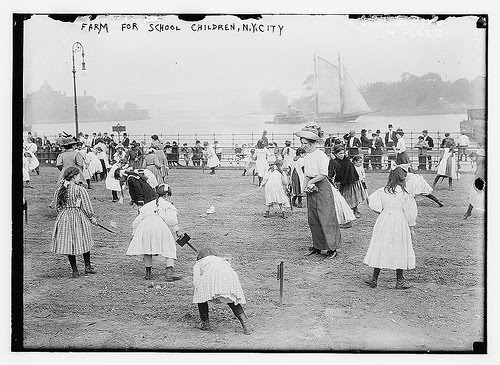
Farm for school children, New York City
Library of Congress’s Photostream @ Flickr.com

Gwynne Watkins @ Salon offers her analysis of a recent “exposé” by Jennifer Senior in the New York magazine on the unrealistic expectations of modern parenting.

“I Love My Children. I Hate My Life.” That’s the cover line on this week’s New York magazine, superimposed on a photo of a beautiful mother and infant in a sun-drenched landscape. Presumably, the mother is loving her child and hating her life. Presumably, we all are.

The whole post is worth reading, since it calls out the bullshit that is our contemporary culture’s obsession with parenting that turns human beings into infinitely perfectible projects — yet refuses to accept Senior’s conclusion, which is that if that “perfect” family life is a lie, all we have left to live on is the fumes of nostalgia.

One particular passage of Watkin’s post, however, sort of hit me in the head like a low-hanging tree-branch. So I’m hijacking it for this blog post so I can ask, once again, why the fuck “children are people too” such a difficult concept for people to grasp.

Like really.

Here’s the passage. Read and digest.

If you’re having a baby for reasons of self-gratification, of course you’re going to be miserable. Becoming a parent is less about enriching your life than it is about up-ending it entirely to make room for another human being. And that’s what Senior’s article is missing: the fact that children are people, and having a child is about forging a relationship. Take this quote from a sociologist Senior interviewed about why parents are so disgruntled: “Middle-class parents spend much more time talking to children, answering questions with questions, and treating each child’s thought as a special contribution. And this is very tiring work.” Funny, that doesn’t sound like work; that sounds like having a conversation. The true reward of parenting isn’t looking back with nostalgia, as Senior concludes; it’s getting to watch a baby turn into a fully realized person. It’s hearing the thoughts and opinions of somebody who didn’t exist until you brought them into the world. It’s a humbling, daunting, awesome experience — and it’s hard enough without the added pressure of making every moment enriching and significant.

So here’s the thing. What I find so disturbing about this passage is the way basic human interactions, when placed in the context of parent-child relationships, are suddenly framed in Senior’s article as an onerous obligation, and joyless demand. And this is seen as so normal, so common-sensical in our culture, that a sociologist seems to think there’s something problematic about asking one person in a committed relationship (parent) to treat the other person in that committed relationship (child) as if their thoughts were worth giving a damn about.

Really?

Really??

Take a minute to switch out “spouse” with “child” in the above passage:

Middle-class couples spend much more time talking to each other, answering questions with questions, and treating each other’s thoughts as a special contributions. And this is very tiring work.

“I love my spouse. I hate my marriage”? If the thought of spending time with your partner, talking together and treating each others’ thoughts with respect felt like tiring, joyless work — drudgery only relieved by the fond memories you had of your courtship or a fleeting weekend getaway — then possibly it’s time to seek out some couples counseling and/or ask yourselves whether this is really a relationship worth being in.

And while you obviously can’t walk out on a dependent child with the same impunity as you can an adult spouse, I’d suggest that it’s not too much of a stretch to stop thinking of children as hobbies or vocations and, you know, remember that you enter into a relationship with them. And that — as with all human relationships — the intrinsic reward of relatedness is the pleasure of getting to know another human being intimately. Learning to see the world through their eyes. Watching them grow and change over time. The pleasure of having conversations together, some of which last a moment and some of which will go on for years. Sharing experiences like the reading of a book, the watching of a movie, attending a concert or art show, cooking dinner and sharing the meal.

“Becoming a parent is less about enriching your life than it is about up-ending it entirely to make room for another human being,” Watkins writes, in her response to Senior. While I agree with her on the basic point that becoming a parent because you expect a child to fulfill your expectations is problematic, I would make a slightly different, possibly more radical argument: rather than juxtaposing “enriching your life” with “up-ending it” to make room for another, I’d suggest that such an up-ending is intrinsically rewarding, even if in none of the ways you initially anticipate. And that is the beauty of the chaotic unpredictability of humanity. If that sort of uncertainty is not your cup of tea, then maybe you should think again about whether you want to have kids. Or whether you want to be in a committed relationship of any kind.

‘Cause that’s kinda the point of being in a relationship.

As someone who has grown from being a dependent child to an adult in relationship with parents who treated her as a human being, I can attest first hand that (as with spousal relationships) recognizing each others’ humanity doesn’t make the experience of living together a panacea. It doesn’t mean we’ve never failed each other, struggled to communicate, lost our tempers, or felt (temporarily, sometimes for months or years at a time) at an impasse. What it does mean is that we aren’t reduced to our socially-assigned roles, and the expectations of behavior that come with those roles. It does mean we have more flexibility to adapt our relationships as the people within them grow and change — because those relationships were formed in the first place specifically to suit our own individual selves. In other words, shifting from the straight-jacket of “perfect madness” parenting to a model of ordinary human relatedness doesn’t solve all of life’s problems.

But it absolutely does open up a realm of possibility that is not possible when one person in the equation is reduced to a project rather than a person. A series of tasks and responsibilities rather than an organic being whose presence you are given the chance to experience.

Which is (surprise, surprise!) more or less the argument that feminists have made for decades about the idealization of heterosexual, monogamous marriage. When you reduce two human beings to their roles of “husband” and “wife,” and punish individuals from deviating from impossible normative standards (or make it exhausting, endless struggle for them to do so), it’s a recipe for disaster. The exact same observation can be made about “parent” and “child.”

Senior’s essay on parenting is the perfect opportunity for the feminist “click” moment, parenting style. It could offer us a chance to assess the way our culture’s idealization of family life dehumanizes children and parents, setting them up in relationships warped by power dynamics that make true intimacy all but unattainable.

Instead, Senior’s “solution,” to the extent that the article posits one, appears to be a band-aid fix that feminists will be very familiar with: the Flanaganian solution of “settling.” Senior’s article seems to suggest that the only options are

a) Playing to win. Pretending to find pleasure in the “perfect madness” of trying to conform to our culture’s ideal of the good parent (in reality, the good mother), thereby driving yourself and everyone around you crazy, but at deriving pleasure from the knowledge that you’re out-parenting all other parents or

b) Calling bullshit and giving up. Re-framing parenting as grim work, rather than a joyful vocation, undertaken out of duty and made bearable by the hope of delayed gratification of nostalgia after the raw experience has long passed. Just give up, Senior’s article ultimately seems to suggest; expecting to experience enduring happiness (gasp!) in your relationships with your children is just unrealistic. Shame on you!

I’m going to go out on a limb here and suggest that this is a false dichotomy, and that the way out of this lose-lose situation is, well, feminism for children. See, both of these “options” still posit that parenting = job rather than parenting = relationship. You can enjoy a job for intrinsic and/or extrinsic rewards (conducting oral history interviews!), or you can dislike a job but feel it’s worthwhile (canvassing before an election), or you can dislike a job but recognize it’s necessary (like doing dishes), but at the end of the day it’s still a job of work.

Why would you choose either of these options when instead you could have interesting relationships with these people who’ve walked (often invited by you!) into your life? Isn’t that one of the most awesome thing about being alive in the world — the chance to get to know and caring about the lives of others?

I say, just quit. Quit your job and go find a relationship. With that person who you’re interested in being intimate with as they grow and discover the full strength of their humanity. Who knew this would be such a radical suggestion?

okay, it’s been a while since a really ranty post …

02 Friday Jul 2010

Posted by Anna Clutterbuck-Cook in think pieces

≈ 4 Comments

Tags

children, feminism, gender and sexuality, human rights

…but I’ve been sitting on this column by Hanna Rosin @ Slate for a while now and I just can’t get the anger out of my bloodstream. So I’m going to blog it out and see if that helps.

Oh, Ms. Rosin. If only you would quit writing stuff that makes me so mad! I really liked your work in God’s Harvard, I did, and although you glossed a bit too, well, glossily, over the non-fundie history of home education and emoted a little too strongly about the cherubic goodness of your subjects — despite the fact they’re happily growing up into the next generation of Dick Cheneys and Karl Roves — I was willing to forgive you the oversight. Write it off as the slightly rose-tinted view of a researcher who has grown close to, and thus a bit fond of, her subject. I mean, we’ve all been there, done that.

But you keep on writing shit about gender that pisses me off. In this case, your post up at Slate’s Double X blog about Dr. Poppa, the pediatric urologist at Cornell University who has been performing cosmetic surgery on babies whose clitorises are deemed “too large.” (See sunday smut no. 27 for my initial reaction.) Rosin is upset by the outrage in the blogosphere, which she believes focuses unduly on the sensational nature of Poppa’s research (“he touches six-year-old girls’ clits!”) and ignores the fact that the good Doctor is trying to reach what in her mind appears to be a positive goal: girls with clits that don’t look like penises (achieved through surgical reduction) and yet still retain the nerves necessary to give the patients sexual pleasure.

To his critics, however, these details [Poppa’s quest for a better clitoroplasty] don’t matter. [Dan] Savage calls this a conspiracy of “out and out homophobia.” He claims the medical establishment pushes these operations because girls with bigger clitorises are more likely to be lesbian. This claim is a stretch; girls with CAH are only slightly more likely to be lesbians or tomboyish when they are young. The vast majority are heterosexual and comfortable as girls. Gender norms have shifted pretty drastically in the 40 years that this operation has been performed, and still more than 95 percent of parents choose it for their children. Why? Because much as Savage might like it to be, the world is not yet a place where most little girls can have a clitoris that looks like a penis and feel entirely at ease. And few parents would want to use their daughter to test that proposition.

I just — I can’t — I’m floored by the the utter wrongness of this as a goal. Aside from the question of trying to regulate children’s sexual orientation and gender presentation (see the coverage of hormone treatments for potentially CAH babies as another, related example of how fearful we are of children who might possibly not conform: don’t try to tell me this isn’t about gender and sexuality policing), Rosin overlooks the fact that we’re talking about medical practitioners who perform potentially debilitating cosmetic surgery on infants.

It’s not that “details don’t matter” (excuse me??) The details fucking matter. The detail, for example, that decisions about what a “normal” clit looks like are aesthetic decisions, made by doctors influenced heavily by cultural norms (see Anne Faustos-Sterling’s Sexing the Body). The detail that this is not surgery the children need in order to be physically healthy or experience sexual pleasure. In fact, it jeopardizes their sexual pleasure so that their genitals will conform.

Now I realize, despite my own aversion to being cut open with sharp instruments, that some people are less freaked out by surgery than I am. And I realize that surgery saves lives. I also recognize the right of adults to alter their bodies, even when not medically necessary, to better suit their vision of how their bodies should look and feel — even if I would not make those same decisions. But children whose bodies are physically healthy should be allowed to grow up without surgical alteration until they are adults and have the cognitive and legal ability to make up their own freakin’ minds. By suggesting that parents who consent to altering their children’s bodies in this way — again: risking their child’s capacity for physical pleasure out of the desire that their bodies visually conform to the gender binary — are saving their children the possibility that their genitals might make them ill-at-ease, Rosin is leaning on mid-20th-century theories about psycho-sexual development (themselves highly homophobic) that suggested children were somehow irreparably damaged by any experience of ambiguity when it comes to their gender or sexual orientation.

Has she not stopped to ask herself whether, maybe, it’s adult fear of nonconformity, rather than young peoples, that is driving this need to surgically alter our children to erase the beautiful variation that is human existence? Isn’t it better to tell and show your child that you think her body beautiful than to make it clear — through imposing upon her painful surgical procedures and years of follow-up medical tests and treatments — that she is somehow not quite “right”? Isn’t it better to make your home a harbor from whatever toxic gender-enforcing messages are out there in the culture than to be the first to rigorously enforce those standards? What object-lesson are you teaching your child here: That it’s important to conform to arbitrary cultural standards no matter the cost? That one must sacrifice pleasure for the sake of superficial appearance? That to be a “girl” or a “woman” one must alter one’s body to fit cultural expectations of what it means to be feminine?

Above all, it sends the message that the person you are when you are born is not okay, that your physical body is not acceptable even if it is pain-free and carries you everywhere you want to go, and gives you pleasurable sensations, digests your food, thinks complex thoughts, learns new skills, experience a full range of emotion, and helps you explore the world with curiosity and joy.

Again, this is not meant to be anti-surgery in cases where surgery can demonstrably improve a patients life. But activists have been pointing out for years that it is beneficial to be patient and allow children to grow into their own sex and gender identities in the fullness of time, before limiting their options prematurely by surgical means.

Rosin’s critique of Poppa’s online critics makes it sound like we’re a bunch of irrational drama queens who are unable to think about children and sex in close textual proximity without losing the ability to reason. I really, really wish she would quit being so fearful that children not surgically modified will be unhappy with their genitals and start asking why we feel such a strong need to police peoples’ genitalia in the first place. If she’s really worried about these children who are going to grow up feeling awkward about their bodies (as an aside: isn’t that really just part of the human condition? who doesn’t feel awkward in their own skin sometimes?) shouldn’t she be using her platform as a nationally-recognized journalist to speak out more forcefully against the conditions that make them so?

There. Rant over. I’m now feeling a bit calmer. And will go home to enjoy the company of my partner, who often despairs at the amount of verbiage I am willing to generate in the name of feminism. Sorry, honey! I think it might be congenital. Maybe they have a surgery to correct it?

quick hit: infant morality

11 Tuesday May 2010

Posted by Anna Clutterbuck-Cook in linkspam

≈ Leave a comment

Tags

children, human rights

Tangentially related to my post last week about treating children as people, Paul Bloom @ The New York Times Magazine discusses current research into how human beings acquire morality (or if they are born wired, so to speak, with a sense of justice and injustice)

Morality, then, is a synthesis of the biological and the cultural, of the unlearned, the discovered and the invented. Babies possess certain moral foundations — the capacity and willingness to judge the actions of others, some sense of justice, gut responses to altruism and nastiness. Regardless of how smart we are, if we didn’t start with this basic apparatus, we would be nothing more than amoral agents, ruthlessly driven to pursue our self-interest. But our capacities as babies are sharply limited. It is the insights of rational individuals that make a truly universal and unselfish morality something that our species can aspire to.

I don’t necessarily agree with all of the ways he defines moral and immoral sentiments and actions, but it is an interesting overview of some of the more recent theories vis a vis how we construct a mutually agreed upon moral framework in which to operate as a human society.

alma mater update: in other unsurprising news…

08 Saturday May 2010

Posted by Anna Clutterbuck-Cook in think pieces

≈ 2 Comments

Tags

bigotry, education, gender and sexuality, hope college, human rights, michigan

Here’s the promised update re: Hope College and its Institutional Statement on Homosexuality, which I wrote about on Thursday.

The group Hope Is Ready, which has been one of those petitioning to have the statement withdrawn by the Board of Trustees, shared (through their Facebook page; apologies if this means you can’t follow the link) the following letter from Hope College President James Bultman yesterday afternoon.

May 7, 2010

Dear Members of Hope is Ready:

Thank you for your interest in Hope College and for the time and effort committed to sharing your concerns with the Board of Trustees. Your insights were helpful in our discussions. Those elected to hold the college in their trust have thoughtfully, thoroughly, and prayerfully considered your petition.

Relative to your petition, the Trustees have taken these actions:

1. The Board of Trustees denied your request to remove the 1995 Institutional Statement on Homosexuality

2. The Board of Trustees appointed a Trustee committee to expand the college’s 1995 position statement in the larger context of all human sexuality in such a way that the Hope community is called to a renewed encounter with the clear, demanding, and healing biblical witness regarding human sexuality.

The college’s current position on homosexuality is based on its interpretation of scripture. It is recognized that well-intentioned Christians may disagree on scriptural interpretation. Still, humbly and respectfully, the college aligns itself in its interpretation with is founding denomination, the Reformed Church in America, the orthodox Christian Church throughout the ages, and other Christian colleges and universities.

On behalf of the Hope College Board of Trustees, I thank you for your concern for the college we love and respectfully ask that you accept these decisions in the spirit with which they are rendered.

Cordially,

James E. Bultman
President

In short, it basically says nothing that hasn’t already been said, and the fact it was up on the web by 2:33pm yesterday afternoon makes it pretty clear that the Board of Trustees didn’t spend much time deliberating on their course of action.

Sad, despiriting, but unsurprising.

I’ll be thinking today about all those folks in the Hope College community — many of whom I’ve known my whole life — who do not think this way, and who work hard everyday to make sure the official college position is not the only one that gets heard.

I said in my letter to the Board, and I’m going to repeat it here: to tell any person that being sexual and making positive, fully consensual, sexually intimate connections with another human being is destructive to their spiritual well-being is an act of violence. To codify such a belief in an institutional statement makes it institutionalized bigotry, giving that belief the authority of college administration that has the power to materially effect the lives of students and employees.

I absolutely believe that such an act of violence runs counter to the Christian message that we are all called to increase joy, practice love, and work toward wholeness in the world. I don’t see how this decision by Hope’s Board of Trustees does any of that. So it sure as hell doesn’t seem very Christian to me.

*image credit: Hope College Voorhees Hall, made available through the public relations office website.

quick hit: general theory of individuality

08 Saturday May 2010

Posted by Anna Clutterbuck-Cook in linkspam

≈ Leave a comment

Tags

human rights, politics

Hat tip to my friend Joseph for sharing this article with my on Google Reader earlier in the week. Davis Barash @ The Chronicle of Higher Education asks why scientists have historically shied away from acknowledging and exploring the reality of the individuality of organisms.

One of the unspoken secrets in basic scientific research, from anthropology to zoology (with intervening stops at physiology, political science, psychology, psychiatry, and sociology) is that, nearly always, individuals turn out to be different from one another, and that—to an extent rarely admitted and virtually never pursued—scientific generalizations tend to hush up those differences. It can be argued that that is what generalizations are: statements that apply to a larger class of phenomena and must, by definition, do violence to individuality. But since science seeks to explain observed phenomena, it should also be able to explain the granular particularity of such phenomena. In fact, generalities lose potency if they occur at the cost of artificially leveling otherwise significant features of reality.

* * *

The current dearth of “individuality theory” may thus reflect the fact that, until recently, advances in applying evolutionary biology to human behavior have been almost entirely the work of biologists, who typically have given individuality short shrift. By contrast, psychologists—stimulated in part by the early work of Darwin’s cousin, Francis Galton—have generally been more receptive to individual differences, with anthropologists occupying a more or less intermediate position (although with no small amount of individual differences!). Perhaps the growing involvement of the latter disciplines in attempts to flesh out a truly evolutionary theory of human nature will result in fuller incorporation of behavioral individuality.

Western science since Aristotle has sought to identify and understand classes of phenomena, looking beyond the particular to organize knowledge into general categories. Accordingly, my request for greater attention to individual differences may seem strangely retrograde. Maybe the best way to justify so perverse a preoccupation is to substitute individual differences for the famed question about climbing mountains: Why study individual differences? Because they are there.

You can check the whole piece out over at the Chronicle of Higher Education, and I think it’s well worth the read.

today, I am able

01 Saturday May 2010

Posted by Anna Clutterbuck-Cook in think pieces

≈ Leave a comment

Tags

bigotry, blogging, human rights

I learned earlier this week via Brilliant Mind, Broken Body that today, in addition to being my parents’ wedding anniversary, is blogging against disablism day out there (out here?) in the blogosphere.

Blogging Against Disablism Day, May 1st 2010

At first, I wasn’t going to participate because I don’t think of myself as having a disability: I’m basically physically healthy and mobile, have never been diagnosed with cognitive or emotive impairments, and am mostly able to move through life on a day-to-day basis without special equipment, medication, or modification of my surroundings.

But then I thought a little more about the words “disability” and “ability,” and what they mean as we move through our daily lives. And realized I have some thoughts on the subject I want to share. (As I type these words, I can feel the rippling echoes of non-surprise from friends and relations emanating out across the internets).

So here’s what I’d like to talk about this day of blogging against disablism/ableism (depending on which side of the pond you’re on): the fact that, today, I am able, but I have not always been able, and I certainly won’t always be so.

And what that awareness, the fact of moving through the world as a person who is able (today), means to me.

As an historian, I am trained to be aware of changes over time, and of the ever-changing nature of “common sense,” of our understanding of the world around us and the categories in which we put things. Including things that we imagine to be immutable. In short, our understanding of what it means to be “able” and “dis-able” is fluid and contextual, rather than fixed. When we speak of ourselves or someone else being “disabled,” we conjure up in our minds, in collective understanding, what it means to be “able,” what it means to embody or emulate able-ness.

This is not to say that disability is an illusion. To me, disabilities are a complicated mix of self and society. They are made up of the gaps between the desires we have as individuals to be and live a certain way and the cognitive, emotional, and physical resources we have to fulfill those desires. They are made up of the gaps between the pressure we are under to be and live a certain way, and the resources we have to meet those expectations.*

But nevertheless, I think it’s incredibly important to remember how much we define “disability” by measuring individual people against our vision of “ability” — and how much “ability” is, in turn, defined in this day and age, but the ideal of a physically healthy (dare I say “flawless”), cognitively efficient and rational, and emotionally “well-adjusted.” That is to say a a youthful adult capable of being an efficient worker whose personal needs are such that minimal (if any) adjustments need to be made by the people or social and physical structures around them as they move through the world.

The “able” person in convenient. The “able” person is economically productive, appears entirely self-sufficient (an illusion, as every human being in modern society is in some measure dependent on other human beings), is uncomplaining, intellectually adept without being challenging, with a healthy respect for the Powers That Be.

Ableism is structural and cultural acceptance of this model.

Ableism means policing each other and policing ourselves to ensure that we continue to accept and strive toward that model of able-ness.

Ableism means that we punish each other and ourselves for failing to approximate this ideal of able-ness in our everyday lives.

When I move through the world thinking to myself “today, I am able,” I am trying to remember that ableism exists: that the messages I am inundated with, the pressures I feel, pushing me towards approximating that ideal are culturally created rather than immutable. That I have the freedom to accept or reject those expectations (though rejecting them does not come without social penalty, since we all police one another in this regard). That I can choose whether I police myself or other people according to those standards.

And here’s the kicker. Today, I am able. Today, I can more or less approximate able-ness. I am mostly physically healthy (and what physical ailments I suffer from, there are corrections and cures readily available to me). I am young (but not too young), and have socially-acceptable skills and aptitudes which give me access to respected institutions of learning and places of employment. I am able to meet the expectations of my employers and other people who hold positions of authority in my world, and can tailor my social demeanor in ways that make me unobtrusive and outwardly inoffensive to the majority of people.

But all of these things: they’re just luck of the draw. They’re highly contingent, fluid, liable to shift beneath my feet. Someday, inevitably, I will become less able to decide whether or not to approximate able-ness. Because I will lose my ability to approximate. The choice will be taken away.

In a blog post last year concerning the dehumanization of children in the feminist blogosphere, I quoted historian Gerda Lerner, who reflects, in her book of essays Why History Matters, on why all human beings should care about hate and discrimination in myriad forms. She writes

All of us, ultimately, will join one of the most despised and abused groups in our society–the old and the sick (17).

What does it mean, to me, to move through through the world with the awareness that I am (only temporarily) able? That I am (only temporarily) acceptable to those in power? It means that I carry with me an awareness of, and gratitude for, the way in which my able-bodiedness gives me access to the world in myriad ways. It means I am aware of the contingency of that access.

And, in what might seem to many of you a counter-intuitive leap of faith, the knowledge that I will lose access someday, no matter how much I scramble to preserve it, frees me from the existential anxiety of that failure.

Knowing already that I will means that it’s untenable to build my sense of self-worth on the foundations of able-bodied privilege, for if I do that, then knowledge of my worth will vanish the minute I develop a debilitating illness, lose my hearing or eyesight, lose mobility, experience diminished stamina, flexibility, memory — all of the things that (as an adult) I have come to take more or less for granted.

Knowing that we will all fail, in the end, to measure up to the imagined ideal of able-ness means that it is unconscionable for me to police and punish others for likewise falling short. Their humanity is so much more than their emulation of an impossible norm.

When I was a teenager, and attended church for a few years, there was a woman there whose son was struggling in the school system. He’d had been diagnosed with various social and learning disabilities and she was really anxious about his future growing into an adult who had to fend for himself. She tried hard to remember, she said, the words of the prophet Micah (6:8). I’m not usually prone to quoting the Bible, but I think this one is worth sharing

He hath shewed thee, O man, what is good;
and what doth the LORD require of thee,
but to do justly, and to love mercy,
and to walk humbly with thy God?

The Powers That Be in the world work hard encouraging us to forget that this is all that is required. That to be a worthy person, what counts is to be just, merciful, and humble. That everything else is, in the end, mere details.

And while we live every day with the reality of a world that forces us (in some measure) to comply with the expectations of the Ideal of Ableness, we can refuse to be held hostage by that ideal: we can name it, and recognize the limits of its power, and choose to focus instead on calling out and correcting injustice (including injustices wrought upon ourselves), on rewarding acts of mercy and compassion (including our own), and encouraging (and practicing) humility: the realization that, in the end, we are all unable to make it alone.

Today, I am able. Tomorrow, I will be no longer. But I will still be a person of worth. And so will you.

*What we do to bridge those gaps is likewise complicated, and not the subject of this post. I just want to say here that while I believe we in some measure construct disability and ability through cultural narratives, I absolutely do not mean to imply that medication, psychotherapy, and other personal solutions have no place. They are of incredible help to many people, and I have family and friends for whom such solutions have been essential to their wellbeing.

Newer posts →
"the past is a wild party; check your preconceptions at the door." ~ Emma Donoghue

Recent Posts

  • medical update 11.11.22
  • medical update 6.4.22
  • medical update 1.16.2022
  • medical update 10.13.2021
  • medical update 8.17.2021

Archives

Categories

Creative Commons License

This work by Anna J. Clutterbuck-Cook is licensed under a Creative Commons Attribution 3.0 Unported License

Meta

  • Create account
  • Log in
  • Entries feed
  • Comments feed
  • WordPress.com

Blog at WordPress.com.

  • Subscribe Subscribed
    • the feminist librarian
    • Join 37 other subscribers
    • Already have a WordPress.com account? Log in now.
    • the feminist librarian
    • Subscribe Subscribed
    • Sign up
    • Log in
    • Report this content
    • View site in Reader
    • Manage subscriptions
    • Collapse this bar