• anna j. clutterbuck-cook
  • contact
  • curriculum vitae
  • find me elsewhere
  • marilyn ross memorial book prize

the feminist librarian

the feminist librarian

Tag Archives: masculinity

in which I have some thoughts on men, pregnancy, and parenting

03 Thursday Jun 2010

Posted by Anna Clutterbuck-Cook in think pieces

≈ 4 Comments

Tags

children, feminism, gender and sexuality, masculinity

There have been a couple stories in the news lately revolving around men and procreation that have caught my eye in the last couple of weeks, and due to the phenomenon known as “needing something to post about today” I thought I’d throw them together in a post and share a few thoughts about them — or, more accurately, about the cultural narratives and expectations about men and manhood they represent.

The first is a post by Mary Elizabeth Williams @ Salon that provocatively asks whether “men have a right to choose an abortion,” or, more accurately how much right they have to decide when and how to become a parent. Although she links to a story by Stephanie Fairyington @ Elle in which a man named George Bruell tried to pressure his girlfriend to have an abortion after she unexpectedly got pregnant after the couple (he thought) had agreed they didn’t want to have children.

The Elle article contains a lot of crap from anti-feminist “men’s rights activists” whose entire goal seems to be the struggle to free men from relational responsibilities supposedly forced upon their freewheeling selves by scheming women and their dependent children. Although updated for the 21st century, this is a narrative surprisingly reminiscent of virulently misogynistic views of women and families found in 1950s and 60s-era diatribes by men who were as unhappy with the postwar mythology of the Father Knows Best lifestyle as feminists, but rather than blame institutionalized sexism they blamed women and women’s essentially domestic, acquisitive nature that required men to work long hours to support a suburban lifestyle.

Like these postwar misogynists, the “men’s rights activists” in this story are not interested in dismantling sexist structures that warp expectations of heterosexual relationships; they’re not interested in fighting for better reproductive justice for all — they already think women have all the power and they feel aggrieved. As Fairyington writes of Mel Feit, head of the National Center for Men,

Feit’s list of grievances range from sexist social standards — why should men still be expected to foot the bill on dates? Why is crying or showing weakness verboten for them? — to what he considers discrimination enforced by the state: men’s lack of reproductive rights combined with unfair child support laws. “Reproductive choice isn’t a fundamental right if it’s only limited to people who have internal reproductive systems,” Feit says. “If it only applies to women, it’s a limited right and that weakens it.” In his view, Planned Parenthood’s motto — “Every child a wanted child” — should apply to both people who make the baby.

Most of these arguments, taken individually, are issues feminist have championed for years. The insidious problem with these grievances is not that (most of them) are inaccurate but that they are not connected to any analysis of the cultural construction of gender or understanding of institutionalized sexism. Or an awareness of how — in our culture — gender operates dualistically and women are disproportionately vulnerable in a world where patriarchal structures are still the default. This doesn’t mean patriarchy doesn’t hurt men too — as feminists, male and female, remind us continually — but it does mean that deconstructing masculinity and the expectations of men and manhood must be done with an awareness of women’s position in the here-and-now-society. Men’s rights activists seem to imply that somehow women, as a group, are (for example) forcing them to pay for dates, whereas most feminists wound point to our cultural construction of manliness that associates male power and sexual appeal with economic power to such an extent that feminist calls for an end to gendered dating expectations are usually met with anxious speculation about how feminists are trying to emasculate men. Ditto on the issue of crying and/or showing weakness.

Women as a group, in other words, are not these guys’ biggest enemy. Their enemy is anyone (male or female) who supports oppositional, essentialist gender roles.

But back to the question of men, pregnancy and “choice.” Here’s what I have to say about men and the “right to choose.”

1) The final decision whether or not to have an abortion is always the pregnant woman’s. Like any medical procedure, it is the patient who needs to have the final say about what happens to her body. End of story. Obviously, this happens in the context of a medical profession in which doctors (ideally) advise patients about the full range of options available to them. Ideally a pregnant woman trying to decide whether to carry an unplanned or dangerous pregnancy to term would consult with her partner, family, friends, trusted religious adviser, therapist — whomever she needs to help her make the best decision given the choices available. But at the end of the day, it’s her body and therefore her decision to make. If the pregnant person is male-identified or in part male bodied, then the decision would be his. This isn’t a gender-bias, it’s a question of bodily integrity and who has a say about what happens or doesn’t happen to your body.

2) Apart from abortion, men have as many options for preventing parenthood as women. If you don’t want to get pregnant at a given time, with a given partner, take steps to prevent it. Men are not at the mercy of women in this arena. Here are some of the ways male-bodied persons can prevent pregnancy.

a) refrain from sexual activity that could result in pregnancy such as penetrative penis-in-vagina sex with women, or other types of sexual activity in which your sperm risks getting on or in a woman’s vagina. The plus side to this method of pregnancy prevention is that it might encourage you to realize how many other types of sexual activity are out there to enjoy, either on your own or with a partner. One totally risk-free option for anyone who’s bisexual is deciding you’re only going to have sex with other men — no chance of pregnancy there! Cunnilingus is another way to enjoy your partners body with no chance of sperm + egg = pregnancy. Look on this as a change to experiment and discover new forms of sexual pleasure.

b) use various types of birth control which hopefully you are already familiar with when it comes to prevention of sexually transmitted diseases. there’s sadly no birth control pill yet on the market for men, but in the meantime you have condoms which are pretty damn reliable when used correctly and consistently. If you’re sure you never want to have children, you can always decide to get a vasectomy which solves the accidental pregnancy problem in all but extremely rare cases and puts the choice of pregnancy prevention squarely in your hands.

c) this should go without saying but usually it doesn’t, so I’m going to say it: COMMUNICATION is incredibly important to a satisfying sex life, and that includes doing everything you can to make sure you and your partners are on the same page when it comes to babymaking. Obviously, in situations like Bruell’s story above, communication failed and people are now stuck with the messy real-life consequences. But good communication upfront can certainly prevent a great deal of messy post facto problems, just like securing enthusiastic consent to sexual activity helps prevent instances of sexual assault.

Finally, 3) While difficult, I do think it’s viable (and not anti-feminist or anti-child) to create a legal framework for men to surrender parental rights and responsibilities up-front if a sexual partner with whom they are no longer involved decides to carry a pregnancy to term. As feminists, we have argued that it is the best-case scenario for parents and children when all children are wanted — when parenthood is a role enthusiastically chosen and when children are cared for both by their primary caregivers and by society as a whole. Women who do not choose abortion have the option to surrender the child they birth either to an adoptive family or to the state system. This often isn’t an ideal situation for the child, but it is a legal framework that recognizes that mothers sometimes feel the task of parenting to be beyond them.

There’s a whole tangle of social and legal issues here relating to competing visions of a social welfare state and the responsibility of society as a whole to enable primary caregivers to parent — but for the moment, let’s assume the birth parent has chosen not to parent and wants to hand that responsibility over to someone else. Mothers who give birth can choose to surrender their parental rights and responsibilities legally, and I believe men should have similar legal options.

I just wish the men who are advocating for them wouldn’t ask for them in a way that is hostile to women’s basic right to bodily integrity and decisions surrounding their physical person. It shows a pretty stunning lack of awareness of reproductive rights and justice issues that Feit and company really ought to be engaged in, or at least aware of. Instead, they seem to have adopted the rhetoric of women’s rights in much the same way Sarah Palin has taken to using the language of feminism — to peddle a toxic tangle of misplaced misogynist resentment that lashes out at vulnerable targets rather than working to dismantle the sociocultural structures that constrain us all.

* * *

The second story comes from Amelia Hill @ The Guardian (hat tip to Hanna for the link). I knew we were in trouble from the opening sentence, “Expecting men to take an active role in their partner’s pregnancy and attend the birth of their children can deskill them as potential fathers and damage paternal bonding, an expert has claimed.” While I’m not an anti-intellectual, and I believe in the value of expertise (our highly complex modern world necessitates a certain amount of specialization), I’m always skeptical when an “expert” claims to have the final word on how a certain activity is going to affect complex human beings.

The disappointment and feeling of failure experienced by men expecting to have an intimate and proactive role as their baby gestates, only to find their function is largely one of passive support for their partner, can cause emotional shutdown, according to Dr Jonathan Ives, head of the Centre for Biomedical Ethics at the University of Birmingham.

“Having begun the fathering role already feeling a failure may destroy his confidence,” Ives said. “It can then be very difficult for him to regain faith in himself once the baby is born and move from that passive state to being a proactive father. His role in the family is no longer clear to him. He effectively becomes deskilled as a parent and this can lead to problems bonding with the child.”

Oh, I have so many issues with this way of understanding parenthood! “Support” for a pregnant partner is somehow the opposite of being “intimate” and active? Men are somehow incapable of grasping that their pre-natal and post-partum roles will, like women’s, be different? Men as a general rule have so little self-confidence that being asked to do something like being present and supporting during pregnancy might actually destroy their ability to parent? And I have to say I’m baffled by the assumption that this feeling of inadequacy is unique to fathers — it’s always been my understanding that most parents, regardless of gender, feel profoundly inadequate for the task at hand.

And this might actually be a good thing, as the article (thankfully!) goes on to point out.

Adrienne Burgess, head of research at the Fatherhood Institute, said: “That experience of helplessness that Ives is saying is so dangerous, is, in fact, the perfect preparation for fatherhood: there are times as a parent when you can’t do anything to help your baby, when it’s crying all night and can’t be soothed. Part of being a parent is being there for your partner and child without doing anything except providing love.”

I just really want to emphasize what Burgess says here, because I think it highlights the chasm that exists between the neotraditional conception of masculinity and fatherhood that relies on rigid separation of male and female duties and a conception of masculinity and fatherhood that, well, relies on the notion that men are human beings capable of a full range of human responses. In the neotraditional version of masculinity, men must be protected at all costs from being made to feel helpless, from being (in a word) emasculated. Helplessness sets them up for “failure” and failure is so shameful and world-ending that men must avoid it at all costs — up to and including the cost of not being present to their partner during pregnancy and at their child’s birth.

In the men-as-humans model that Burgess puts forward, however, helplessness is simply part of the human condition, a run-of-the-mill part of parenting and family life. That we’ve elevated the power of parents (fathers perhaps particularly?) to such Godlike heights that the notion that inability to change the course of events necessarily equals “failure” is stunning to me. To argue that men should be encouraged to avoid the parts of family life that entail helplessness is, in my mind, a wildly unhelpful (at best) perhaps even unethically negligent (at worst) recommendation. It is akin to arguing that if a friend or family member is diagnosed with incurable cancer you should just quit spending time with them because you can’t do anything to cure them.

More often than not, it’s our simple presence — loving, nonjudgmental, patient presence — in the lives of others that is what matters. This is a skill that all of us could do well to hone, whether we are parents or children, spouses or partners, friends or extended family members. It is a skill that should be genderless, and one which we would do well to encourage all soon-to-be parents to practice with one another and, once the child arrives — by birth or other means — with that child as well.

reading and gender: a couple of links

26 Monday Apr 2010

Posted by Anna Clutterbuck-Cook in linkspam

≈ Leave a comment

Tags

books, feminism, masculinity

Thanks to Hanna, I have a couple of book-and-gender-related links to share with you this afternoon, despite the fact I haven’t spent much time on the internet in the last few days.

George @ Bookninja shares a recent variation on the narrative-that-won’t-die, the libelous fiction (pun intended) that men don’t read. While admittedly I am not male-bodied, male-identified or even very butch or masculinely inclined, I know guys. And the guys I know read. At least, the guys I know read or don’t read in equal proportion to the women I know who read or don’t read. Their maleness has nothing to do with their interest (or lack thereof) in the printed word.

As an historian, I find it fascinating that our current cultural narrative around books and reading (possibly even writing?) is that it is a feminine pursuit: back in the late 18th century, polemicists fretted about girls being exposed to works of literature, particularly fiction, as fiction was seen as inherently libidinous in nature and might lead them to masturbation (Thomas Laqueur, Solitary Sex). In the 19th century, people worried about the power of a gothic romance to encourage girls’ imprudent liaisons (recall Catherine in Jane Austen’s Northanger Abbey?) and later on feared that too much reading led to neglect of household chores (Lydia Maria Child). By the late 19th and early 20th century, mental exertion (particularly reading and writing) caused concern among advice-givers to both women and men: Charlotte Perkins Gilman was, famously, denied writing and reading as part of her treatment for postpartum depression; male academics and clergymen fretted that their chosen professions doomed them to a life of effeminacy and poor health (Gail Bederman, Manliness & Civilization).

So, somehow, by the twentieth century, “manliness” and the life of the mind had evolved — at least in the humanities (as opposed to the sciences) — into something that was both the province of women as well as a threat to the health of “civilized” human beings, regardless of gender.

And now, today, we have folks wringing their hands over a culture of masculinity that discourages being smart, articulate, literary (except, perhaps, if you can use language to bully others in the manner of public intellectuals like Christopher Hitchens and Richard Dawkins — thus proving your uber-manliness by the way in which you wield language as a weapon with which to take down your opponents*). Whole books are written about encouraging literacy and reading among boys, and websites devoted to the subject exist on the internet.

My point is that this story we tell ourselves, about how boys (and the men who these boys become) are not readers, or only readers of very specific genres — technical manuals, graphic novels, thrillers for example — is just that: a story. It’s fiction. Or at the very least, it’s a sociological truth that we’ve mostly created through our formulation of what’s “manly” in our culture, and reinforcing that every chance we get.**

So where does this association of genders (masculine and feminine) with certain types of literary behavior fit in with this second story Hanna found me from Sharon Bakar @ bibliobibuli on a new “women concept” bookstore that just opened in Malaysia? As Bakar observes

I don’t like the cliched assumptions that women should like certain things whether in terms of decor (usually frilly, flowery pink things) or in the choice of books. The concept of women’s bookshops is nothing new, but around the globe most have been independents which promoted feminist and/or lesbian thought.

I’m with Bakar on this one. Women’s bookstores historically (and here we’re talking 1970s-present) have been associated with the underground feminist/separatist culture that grew up around the surge in feminist activism and lesbian visibility in the mid-twentieth century across the globe (and particularly in the West). These cultural institutions obviously have a long and complicated history, given that they often promoted the work of activists and artists who had no outlet in the mainstream (in my mind a positive) while also, at times, fostering a separatist, essentialist feminism that perpetuates bigotry in various forms (in my mind an obvious negative). While safe(r) spaces for the marginalized folks are, I would argue, absolutely essential, it’s also important to keep alive the conversation about how (in creating those spaces) whom we are excluding and why. And for what purpose.

A “women’s concept store” that — according to the news item Bakar links to — highlights “chick lit” (itself a problematic category!) and wedding stationary is a far cry from that sort of separate space. Space that by its very existence challenged (and occasionally continues to challenge) our assumptions about sex, sexuality, and gender. Instead, this space seems more like the homosocial spaces of yore, which reinforce oppositional gender stereotypes. In this instance, possibly reinforcing the stereotype that bookshops are for women, while dudes go off and do, well, more manly things.

Presumably not-with-books.

*I make no claim that women do not, also, use words to bully: I think it happens all the time. However, I do think men are encouraged in our culture to equate being “smart” with taking down the competition in a way that women, possibly, are not.

**Again, this is a story about guys and reading, but we could just as easily write a story about women and the gendered way they are marketed certain types of literature and not others: I’m a fan of graphic novels, for example, despite the fact that graphic novels and comic books are often seen as the province of boys, and in need of a make-over in order to appeal to girls.

in which I offer some (solicited) advice

04 Thursday Mar 2010

Posted by Anna Clutterbuck-Cook in think pieces

≈ 6 Comments

Tags

blogging, feminism, masculinity, politics


Max @ Feministing Community posed a question last week which I was unable to respond to directly in comments (site malfunction). So instead, since I thought his question was an interesting one, I’m offering a response in the form of a post here on my own blog.

I recently got into a debate on Facebook with a woman who identifies very strongly as anti-feminist and who argues that 90% of what feminism does is detrimental to society. Although she advocates for gender equality and stiffer penalties against those whose commit violence against women, she considers most of the movement to be ridiculous. She also had this to say:

“I’m not marginalized anymore. I am a woman. I do not fucking belong to a marginalized group anymore.”

I just want to know how, as a man and therefore a member of the privileged class, I should go about tackling these issues appropriately. I mean, if she says she is not marginalized as a woman, it would be very paternalistic of me to deny her lived experienced.

There is the argument that I should not engage in these arguments at all for this reason. I’m mindful of some recent cases where members of a privileged class claimed to advocate for a minority’s rights but completely ignored their voices and thus further marginalized them. However, it also didn’t feel right to just ignore the very powerful anti-feminism, since I believe that feminism is very, very important to our society.

So what should I do in future cases like this one? Would the differing levels of privilege mean I should simply back away from this topic? Or was I right to engage her as long as I was careful to respect her lived experience?

Hi Max!

Hope you don’t mind that I’ve taken your question and turned it into a post on my own blog. I hopped on over to the Community blog from my Google Reader to respond to your question for a couple of reasons, and then the comment feature was disabled so I thought I would write back here.

First of all, I sympathize with the frustration that comes from trying to have debates with anti-feminists online, particularly women whose response to your arguments is “well, I haven’t experienced oppression as a woman and therefore this power imbalance you talk about doesn’t exist.” I’m not sure I can offer you any advice that will help you change this person’s mind (or the next person’s mind). I’ve had very little success in changing minds, at least in the short-term. In my experience, it’s only extended, personal relationships that have caused people to revisit their values and change over time. But reading your question I did have a couple of observations I wanted to share. Observations that might help you, at least, articulate your own beliefs in a way that doesn’t make you feel like you’re being paternalistic.

I’m most concerned about the fact that you don’t seem comfortable speaking from a feminist position because you’re a guy. You write that, as a man, you are “therefore a member of the privileged class.” Well, yes and no. Yes, you have certain privileges because you move about the world in a male body. And clearly, the framework of feminism has helped you be more aware of the way society confers those privileges on you. Kudos for paying attention to that. But there are ways in which binary, oppositional gender roles rigidly confine you as well. Think about the reasons you identify as a feminist or as pro-feminist. Not just because of how it might create a better future for the women you care about, but also because of how it might create a better world for you and other men.* You write that you believe feminism is “very, very important to our society.” Think about why it’s very, very important to you. That way, you are grounding your argument in your own lived experience of gender roles and their limitations, rather than talking about women’s experience in the abstract.

You write that “there is the argument that I should not engage in these arguments at all” because you, as a man, are in a position of privilege relative to women. I realize that is one way of looking at things that many feminists, particularly feminists in the mid-twentieth-century, articulated. And I think they often had valid personal reasons for making that claim. There is certainly a discussion to be had about whether or not it’s appropriate to make a time/place for women to discuss their experience as women. But if you were having a discussion with a self-identified anti-feminist on Facebook, I’d argue that you have every right to assert your feminist beliefs in response to her anti-feminist ones, regardless of your own gender. You weren’t walking into a space that was defined as for women only and asserting your right to speak authoritatively on feminist politics; you were engaging in a debate in an online networking space that was not specifically designated as women-only space (a concept I recognize is, itself, deeply problematic). I really encourage you, if you identify as a feminist or pro-feminist, to speak up for your beliefs. They are yours, and the fact of your gender doesn’t make you a less legitimate feminist (I realize not all feminist women agree with me here, but for what it’s worth I don’t think being a feminist is gender-specific).

Just because I’m a woman doesn’t mean that I necessarily have a right to make more abstract claims about gender oppression than you do — like you, I am constrained by the authority of my own experience. I can choose to make more abstract arguments about how institutionalized oppression works, but in making those arguments I’m in the same position you are: I am speaking beyond my own direct experience. Other women can (and have) stepped in and contradicted those arguments, refusing to accept my interpretation of how sexism works (or that it even exists!).

So, speaking as a fellow feminist, I’d like to say thanks for speaking and trying to refute anti-feminist rhetoric! I hope that you keep on talking while staying mindful of the power dynamics at play between people whose experience of privilege and marginalization are often radically different.

Peace,
Anna

booknotes: "we’ll want the breasts exposed, and yet covered."

12 Friday Feb 2010

Posted by Anna Clutterbuck-Cook in book reviews

≈ Leave a comment

Tags

feminism, gender and sexuality, history, masculinity, thesis

I love the things I can pick up and read in the name of thesis research. Take, for example, Elizabeth Fraterrigo’s Playboy and the Making of the Good Life in Modern America (New York: Oxford U.P., 2009). I saw the book by chance on the shelf at Borders a few weeks ago and while I would have read it eventually anyway (what’s not to like? sex! gender! money! drama!), I realized after pondering for a day or two that I could consider it background research on American postwar culture. So off to the library I trundled. (Or rather, off to the online catalog I clicked, forthwith to inter-library loan a copy through the Brookline Public Library).

And Ms. Fraterrigo did not disappoint. This dissertation-turned-book is a richly researched yet highly readable account of Hugh Hefner’s self-re-invention as the playboy of his dreams, a life he carved out for himself with relentless hard work and not a little luck after the dissolution of his youthful marriage and a series of unsatisfying desk jobs. Hefner, Fraterrigo convincingly argues, took various cultural elements in already in play (dissatisfaction with suburbia, anxiety about masculinity and women’s increased visibility in previously male spaces, a rise in consumer spending, postwar debates about what constituted the “good life,” and the scientific examination of human sexuality) and packaged them in a highly-successful formula that catapulted him to the top of a cultural and financial empire.

She draws two fascinating (if superficially unlikely) comparisons between Hefner and women writers of his day. First, she suggests a commonality in thought between Hefner and early feminist rhetorician Betty Friedan (author of The Feminine Mystique). Both Friedan and Hefner drew on their own personal experience to build a critique of the hegemonic postwar culture and its emphasis on the middle class, suburban nuclear family. In response to an unsatisfying homelife, both championed participation in the capitalist economy (as both worker and consumer) as a potential route to self-realization (see pp. 26-36).

Second, Fraterrigo points out the striking parallels between the ideal woman as articulated by Hefner in the page of Playboy (and in real life by the women who worked as Bunnies in the Playboy clubs) and Helen Gurley Brown’s “Single Girl,” found in the pages of Sex and the Single Girl first published in 1962. Both Hefner and Brown managed to carve out a place for singledom and pre-marital sex in culture dominated by the value of marriage and family. Yet they did so in ways that in no way challenged the status quo of inequitable gender relations or the notion of gender complimentarity (the idea that men and women “naturally” perform different, though complimentary, roles in society).

Brown’s Single Girl fit easily into the harmonious system of gender roles supported by Hefner. She made few demands on the male pocketbook [unlike a wife], aside from accepting the occasional gift or evening on the town, and instead made her own way as a working girl. Like the playboy, she strove to work hard and play hard too; yet she had no pretensions about achieving much power or earning vast sums of money through her role in the workplace. Instead, she accepted her marginal economic position and limited job prospects with a smile on her well-made-up face. Though she may not have enjoyed the same degree of autonomy and plentitude as the playboy, the Single Girl shared his sensibilities . . . [she] was both a handmaiden in the liberalization of sexual attitudes in the 1960s and the ascent of a consumer-oriented singles culture (132-33).

As the Swinging Sixties gave way to the cultural and counter-cultural revolutions of the early 1970s, Hefner found his idealized Playboy — once a symbol of avant garde youthful revolt against the status quo — derided by both men and women of the Movement cultures who critiqued his unabashed materialism and stubborn support of strictly segregated gender roles. He was taken aback by the “aggressive chicks” of the women’s liberation movement who pointed out that structural inequalities and oppositional gender typing (the strict separation of “masculine” and “feminine”) left women in a systematic disadvantage. Despite Hefner’s (and Playboy‘s) support of such feminist causes as women’s right to sexual expression, sex outside of marriage, access to abortion, and women’s participation in the workforce, he seems — according to Fraterrigo at least — to have balked at re-imagining a world in which the division of gender roles was less strictly dictated than it had been in the decades of his youth.

In this, Hefner is far from alone to judge by the continued popularity of “complementarian” arguments for “traditional” feminine and masculine roles among various conservative groups and even in some feminist circles — yet I am perennially puzzled by the amount of fear and resistance appeals to loosen gender-based expectations routinely encounter. While beyond the scope of Fraterrigo’s deftly-woven narrative about Playboy and the postwar culture of freewheeling consumerism it helped to legitimate, it is certainly a question which Playboy encourages us to ask: What, exactly, is at stake for individuals who defend complementary gender roles? The women’s liberationists of the 1970s thought they had the answer: unfettered male access to women’s bodies and the uncomplaining domestic support of housewives and secretaries. Fraterrigo’s tale, however, suggests that the answer is — while still containing those elements — far more complex (and more interesting!) than it appears at first glance.

booknotes: echo in the bone

05 Tuesday Jan 2010

Posted by Anna Clutterbuck-Cook in book reviews

≈ 1 Comment

Tags

books, feminism, gender and sexuality, masculinity

It’s been a while since I wrote a proper “booknotes” post, but this weekend while Hanna was away in Maine I finally hunkered down and read Diana Gabaldon’s latest installment in the epic Outlander cycle (now clocking in at seven volumes each seven hundred to one thousand pages in hardcover), Echo in the Bone. (Warning: mild series spoilers ahead).

I was first introduced to Outlander under its British title, Cross Stitch in Aberdeen by my Glaswegian roommate, Vicki, who is (or at least was) an adoring fan. For those of you who aren’t familiar with the series, it centers on the relationship between Claire Beauchamp, a Second World War nurse, who accidentally time-travels back to eighteenth-century Jacobite Scotland and — also somewhat accidentally — marries a young Scottish fugitive named Jamie Fraser. The first book revolves around Claire’s attempts to return to her own time (1950s England) and the husband she left behind, while at the same time she finds herself falling passionately in love with Jamie. Without giving all the ins and outs of the romance and drama away, the saga weaves its way across Europe and America, the eighteenth and the twentieth century, and has expanded to encompass multiple generations of the Beauchamp-Fraser family and a sprawling cast of secondary characters. The science fiction / time-travel aspect of the narrative — while integral to the plot in many respects — also takes firm second-place to the political and personal dramas in which the characters get caught up as they move from one space/time context to the other.

An Echo in the Bone is a solid installment in the ongoing series, though Gabaladon’s expansive cast of characters has become increasingly difficult for her to manage — or at times hard for readers to follow, particularly if you don’t have the time to sit down and read the book in a marathon session (I tried the chapter-before-bed method during term-time and eventually gave up, setting it aside for vacation). There was speculation around the publication of A Breath of Snow and Ashes the sixth book would be the final volume, or be followed by a prequel or spin-off story, but she’s apparently decided to continue spinning the main narrative out, as Bone not only comprises of 800-plus pages of story but also ends with several cliff-hangers that I doubt will just be allowed to die. I have a slightly mixed feeling about this, since there was something bittersweet about reading Ashes as a final installment . . . but since Cross Stitch/Outlander was originally meant to be a one-off fantasy novel, Gabaldon fans have (I imagine, anyway) long since grown used to the idea that her sagas will inevitably be longer than originally predicted.

I’ve talked to a few friends who’ve had trouble with the sex and gender roles in the series — trouble enough that they’ve quit reading the books altogether. And as this is a blog with “feminist” in the title I figured I’d take a minute to reflect on how sex and gender (as well as sexual orientation) seems to play out in the series overall. Speaking for myself, I really had to make my peace with the series in this regard: I was really upset with the power dynamics between Claire and Jamie in the first book and by some of the sexual violence that went largely uncriticized within the stories. Gabaldon’s characters also have a really annoying habit of talking in gender essentialisms (i.e. “men are all X” and/or “women are all Y”). Most of the hetero relationships in the story (which is virtually all of them) are very male-as-protector and woman-as-nurturer. It’s explained away, in part, as historical accuracy (that is, Jamie as an eighteenth-century man has learned to think in certain ways about marriage, about sex, and so forth), and to be fair over the course of the series characters’ opinions are challenged and do change. However, certain behaviors continue to be explained away as grounded in innate characteristics based in sex, an explanation I find just as unsatisfactory in fiction as I do in real life. It seems to me a mark of lazy thinking on the part of the character and (by implication) their creator.

The violent sex and sexual violence are a bit more difficult to gloss over and/or explain away by historical context. I haven’t spoken to anyone who’s a survivor of sexual abuse or violence who’s tried the series, but I imagine that the graphic descriptions of rape and sexual violence could be unpleasant and/or impossible to read. One of the best parts of the series, at least in my mind, is Gabaldon’s penchant for writing erotic and and often light-hearted sex scenes (I was, in fact, disappointed that the most recent installment featured relatively few); the downside is that if you’re not into the kind of sex her characters are into, it can be difficult to make it through the graphic descriptions without feeling a bit icky about the relationship dynamics. Personally, though a few of the early scenes had me cursing and tossing the paperback edition of Cross Stitch across my dorm room, in the end I made the decision to let the characters have what is clearly a pleasurable and consensual sexual relationship without judgment from me.

Be warned, also, that the arch-villain in the first few books is a sadist with a taste for sexual violence, both hetero- and homosexual (he seems to fixate on individuals regardless of gender; both Jamie and Claire are assaulted by him in various contexts, with Jamie suffering the worst of the abuse). While Gabaldon (possibly in recompense?) has since written at least one gay male character who is one of the good guys — and actually features in his own series of stand-alone short stories — I was wary at first to have same-sex sex so closely associated with rape.

And as a final note, I’ve never been particularly irritated with historical fiction that plays lightly with the actual historical record, but those who care deeply about either eighteenth-century European or American history may be frustrated with the melange of historical detail and fiction that Gabaldon brings together for her time-traveling romps through the era.

My ultimate advice? Don’t take them too seriously, let the characters win you over, and have a great time.

"all of me, why not take all of me?"

01 Friday May 2009

Posted by Anna Clutterbuck-Cook in think pieces

≈ 3 Comments

Tags

feminism, masculinity, sexuality

Two further examples for the annals of “patriarchy hurts men, too.”

I’ll be honest. I became a card-carrying member of the feminist party (hehe) when I realized there were still people around who thought I should do and be certain things and not do or be certain other things on account of my being a girl. There’s nothing — bar threats to the health and wellbeing of my people — that makes me dig my heels in faster than someone telling me I “should” or “shouldn’t” in any way, shape, or form. At that point (late teens) I wasn’t thinking much about the way the guys I knew were also injured by the sexist “shoulds” and “shouldn’ts” that pervade our cultural milieu.

But it doesn’t take a degree in gender studies to realize that if women and girls are being told “be this,” then men and boys are being told “be that,” and that this sort of oppositional, essentialist conception of gender roles [1] sucks ass for everyone concerned. Not only do women and girls suffer from inequality based on sex and gender — guys struggle daily against the straight jacket conception of masculinity that limits their ability to be fully human actors in the world. One of the things I take great pleasure in as a feminist is that I have a usable worldview that not only allows but actually supports my desire to see men and boys as more than brainless sexbots driven by the desire to draw blood and get laid. Which, given the number of men and boys in my life (“hi guys! you’re awesome!”) really makes my life a helluva lot easier.

Not that I don’t believe that folks who don’t explicitly identify as “feminist” are incapable of seeing men as human beings. But I do believe that an ability to think critically about the messages that our various cultures send us about gender — and in this case, specifically what it means to be a guy — is an essential human skill. And one that does not come easily to folks who aren’t at least open to thinking about things from a feminist perspective.

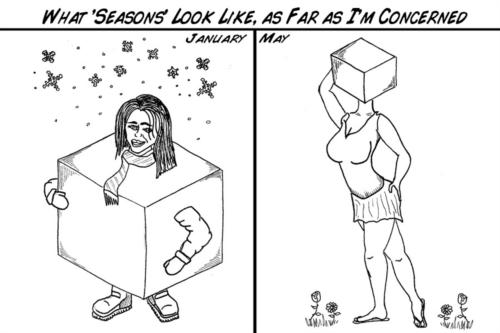
See, when people don’t question the “common sense” notions of masculinity and femininity that dominate popular culture (not to mention being actively defended by conservative voices) then stupid shit like this happens:

This editorial cartoon, drawn by Harvard Crimson cartoonist “Samual L. Clemens” was featured this week on the Crimson’s website (h/t to MK via twitter for the link). It employs, with no sense of critical self-awareness or commentary, the sort of ideas about women and their bodies that feminist activists have objected to since, well, forever. (Fun historical factoid: at the turn of the twentieth century, male patrons at the reading room of the British Museum protested the admittance of women scholars on the grounds that their female bodies were so distracting that male researchers wouldn’t be able to get any work done [2]) But I want to lay aside what this cartoon says about the worth of women in the cartoonist’s eyes (as MK pointed out, “It’s like wearing a big sign that says WOMEN: PLEASE AVOID ME AT ALL COSTS.”) and suggest we consider for a moment what this image says about the worth of men [3].

The take-away message of this cartoon about straight guys is that they are incapable of (and uninterested in) seeing the people to whom they are attracted sexually as whole persons. If a woman is bundled up in winter clothes, their bodies might as well not exist; if a woman is dressed in form-fitting, skin-baring clothes, then their head (read: personhood) disappears from view. This is a trope of male sexuality so prevalent that a lot of women have bought into this narrative of how men’s sexuality works, as evidenced by the calls for a “return to modesty” by a number of prominent women writers and activists [4]. In this view, dudes are incapable of integrating their physical, sexual desire for others into an understanding of other human beings as more than a useful means to the end of sexual gratification. I call bullshit. I call bullshit on the idea that men are incapable of caring about the women they are attracted to as whole persons: as incredibly sexy, active, physical presences and as human beings with thoughts, feelings, and distinct personalities. Regardless of the time of year, and regardless of what said object of desire is wearing at the moment she happens to cross their flightpath.

Mr. Clemens, do yourself a favor. Go out into the balmy spring day, enjoy people-watching, and enjoy every bit of the people you see: all the way from head to toe. And consider how awesome it might be if you could get to know them as actual human beings instead of just passing, headless bodies. See if practicing that sort of mindfulness doesn’t expand your horizons.  And maybe prompt you to question the messages you’ve been getting about your sexuality and gender. 

The other story that caught my eye this week and made me think, “gee, we live in a culture with absolutely respect for men and boys as human beings,” was the word spread around the blogosphere that the New York Times review of the recently-released summer comedy “17 Again” contained the following caution: “17 Again” is rated PG-13 (Parents strongly cautioned). Girls are particularly cautioned.

I have not seen the film, and it’s not the sort of movie I’m generally eager to see anyway, so the point I want to make has nothing to do with the actual content of the film. The point is: why “girls particularly”? Assuming there is something potentially objectionable in the movie, wouldn’t a parent have cause to be equally concerned about their sons as their daughters being exposed to it? If, indeed, the objectionable content has some sort of gender-related ickyness (say, sexual violence against women, or sexual humor, or nudity, or whatever else people think fragile girlminds are incapable to taking in without severe trauma) . . . shouldn’t we be equally concerned about exposing boys to such experiences?

As commenter SarahMC over at Pandagon pointed out, the implicit message of warning girls specifically against seeing the film is: “Girls should not be exposed to cinematic depictions of misogyny. Boys, however, get extra butter on their popcorn w/ every ticket purchased.”

This gender-specific warning, like the Crimson cartoon, not only turns on the paternalistic view of women and girls Jessica Valenti recently described in her latest book The Purity Myth — it, like the cartoon — uncritically accepts a caricature of masculinity that assumes men either enjoy, are oblivious to, or untouched by misogyny.

Not. true. Spread the word.

UPDATE: MK offers her own response to The Crimson.  

* * * Endnotes * * *

[1] oppositional, essentialist conceptions of gender mean, in plain English, that the categories of “male” and “female,” and the people who fall into these two categories are seen as 1) opposite from each other in temperament, social roles, etc., based on their gender and 2) that these states of being are natural due to our biological sex.
[2] Hoberman, Ruth. ‘Women in the British museum reading room during the late-nineteenth and early twentieth centuries: From quasi- to counterpublic.’
Feminist Studies, vol.28 no.3 (Fall 2002), 489-512.
[3] I am assuming, given the pseudonym, that the imagined perspective in the cartoon is supposed to be that of a dude.
[4] See, for starters, Wendy Shalit’s
A Return to Modesty and Girls Gone Mild,, Laura Sessions Stepp’s Unhooked: How Young Women Pursue Sex, Delay Love, and Lose at Both.

Quick Hit: Children’s Issues are Feminist Issues

22 Wednesday Apr 2009

Posted by Anna Clutterbuck-Cook in linkspam

≈ Leave a comment

Tags

children, education, feminism, masculinity

Two links on bullying that came across my rss feeds lately remind me again about how integral children’s experience and childhood spaces are to the struggle against power-over hierarchical relationships (i.e. the kyriarchy.)

First, via Feministe and Feministing, stories of two boys who killed themselves as a result of bullying that hinged on homophobic and sexist taunts: Carl Joseph Walker-Hoover and Jaheem Herrera.

Partly in response to these stories, as well as her own experience, Antigone over at punkassblog declares “If We Have Kids, We’re Homeschooling“:

Based on the number of people that had to live through bullying, and the complete lack of any systematic effort to stop it, I’m calling bullshit, hard. Public school does not properly socialize anyone, it teaches children to become bullies, victims, or learn the nifty trick of “not my problem”. That is not a socialization I want to give my kids at all.

Home education isn’t the only possible solution to this type of situation (and indeed, will like not shield kids from bullying entirely — though it can serve as a life-saving buffer for some), but I think Antigone’s “I’m calling bullshit” is an important impulse. Systemic violence is not okay, regardless of where it happens and to whom it happens. Children — who spend much of their time segregated from the general population — often suffer from the same discrimination as marginalized adults (sexism, racism, classism, homophobia, ableism, etc.) while they are simultaneously less able to name and combat it — because they lack the (developmental and experiential) perspective of adults and the resources and agency of adults.

Many children must — through lack of individual choice or material options — return to these hostile situations day after day after day where oversight by adults is inadequate at best and indifferent at worst. This is not acceptable. And I see calling bullshit on the intensely hostile world in which our children (who will grow up to be caretakers of our world and of us in our elder-hood, whether or not we are parents ourselves!) as integral to the feminist project.

File this one under "patriarchy* hurts men too."

13 Monday Apr 2009

Posted by Anna Clutterbuck-Cook in think pieces

≈ 1 Comment

Tags

children, feminism, masculinity

Stupid headlines like this irritate the hell out of me:

This was a story in the Boston Metro (free transit newspaper) today that Hanna and I noticed while riding the T out to Harvard Square. The entire text of the article reads as follows:

China’s budding gender gap — inspired by decades of one-child-per-family law, and the resulting rise in baby-girl abortions and infanticides — could develop into an increase in violent crimes, a new study reports.

With 32 million more young men than women, and the imbalance only growing, sociologists worry about a coming spike in crime, when men take out their frustrations on an increasingly wealthy population.

The report paints a grim picture for a modernizing China. “If you’ve got highly sexed young men, there is a concern that they will all get together and, with high levels of testosterone, there may be a real risk, that they will go out and commit crimes,” lecturer Therese Hesketh told the AP.

I was particularly charmed by the boxed quote attributed to “Researchers” (names please? the title of this report? anything that would reliably enable readers to fact-check the study**?) which read: “Nothing can be done now to prevent this.”

Because, you know, dudes are just violent animals without wives to keep them in check.

I dunno, people. I personally have faith that guys in China may find another, less violent, solution to the dearth of women.

*or “sexism” or “kyriarchy” if you prefer.  


**A little searching on the internet tracked the study I’m assuming they refer to back to the British Medical Journal. 

Booknotes: Guyland

16 Tuesday Sep 2008

Posted by Anna Clutterbuck-Cook in book reviews

≈ Leave a comment

Tags

feminism, masculinity, sociology

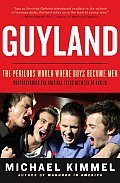
Over the weekend, I read Michael Kimmel’s recently-released book on the sociology of young adult masculinity: Guyland: The Perilous World Where Boys Become Men. As an undergraduate, I had the privilege of meeting Kimmel when he was in the process of his research for this book, and I really enjoyed listening to him talk about men, masculinity, and feminism. So I’ve been looking forward to reading the finish product.

My response, however, is mixed. Partly, I suspect, I am in a poor position to judge the accuracy of his narrative about normative masculinity in 16-26-year-old young adult culture. The men I am closest to eschew and/or are disqualified from the hetero, privileged, masculine identity he describes; I was never a resident on an American college campus, so always had a certain amount of distance from undergraduate norms; and I never negotiated the dating-relationship scene as a student. So while I recognize some of the features of the landscape Kimmel describes, I suspect there are nuances to, and gaps in, his argument that I am missing. However, I’ll share a couple of observations.

What Kimmel is describing — though perhaps he doesn’t underline this enough — is the normative culture of elite (male, white) power and privilege that all of us, regardless of gender, race, economic class, sexual orientation, contend with. Whether we are marginalized by it, choose to reject it, or are forced to interact with it, it is one part of the American landscape that does shape adolescent and young adult experience for many young people in powerful ways.

One of the most important things feminism has done for women in the last half century is to open up the possibilities for what it means to be female and feminine. There is still work to be done, to be sure. But as Kimmel points out, when he asks college-age women today what it means to be “feminine” their answers are as varied as their lives. No comparable political and cultural sea-change has taken place for men, maleness, and masculinity. Young men still come of age in a world where what it means to “be a man” is rigidly defined, the boundaries of acceptable behavior carefully policed: whether they are in or outside those boundaries, they are still judged by them.

I am familiar with the power of normative cultural expectations, and largely agree with Kimmel about their harmful effects. If his portrait of American guyhood is accurate, then there is cause for concern. What disappointed me in Guyland was the lack of creative thinking about what a new and more varied understanding of male adulthood might look like. While he pays lip-service to the value of queer sexualities and relationships, and counter-cultural resistance to the “guyland” paradigm, alternative masculinities exist on the edge of Kimmel’s narrative. He often falls back on vague notions of “responsibility”, on the need for young people — young men particularly — to “grow up, settle down, get a life” (p. 15). What it means to take responsibility or “settle down” is left to the reader to interpret — although in his examples it often seems to mean the job-marriage-house-kids markers which characterize the very notions of masculinity he sets out to criticize.

American parents are faulted for both hovering “overinvolvement” with and of neglectful “absentee parenting” of their children. Both of these notions bear further examination, since I would argue parent-child relationships aren’t best characterized by how much but what kind of involvement they represent. Similarly, the chapter on pornography suffers from a failure to adequately articulate what type of erotic materials he’s writing about, although he does have some interesting observations about possible generational differences when it comes to making meaning of sexual imagery.

Overall, while I appreciate Kimmel’s perspective as a sociologist, and his ability to describe the powerful social norms of masculinity, I hope that Guyland is only the beginning of a much-needed conversation about how young men can (and are!) re-inventing masculinity for themselves in the 21st century in ways that make life better for us all.

Newer posts →
"the past is a wild party; check your preconceptions at the door." ~ Emma Donoghue

Recent Posts

  • medical update 11.11.22
  • medical update 6.4.22
  • medical update 1.16.2022
  • medical update 10.13.2021
  • medical update 8.17.2021

Archives

Categories

Creative Commons License

This work by Anna J. Clutterbuck-Cook is licensed under a Creative Commons Attribution 3.0 Unported License

Meta

  • Create account
  • Log in
  • Entries feed
  • Comments feed
  • WordPress.com

Create a free website or blog at WordPress.com.

  • Subscribe Subscribed
    • the feminist librarian
    • Join 37 other subscribers
    • Already have a WordPress.com account? Log in now.
    • the feminist librarian
    • Subscribe Subscribed
    • Sign up
    • Log in
    • Report this content
    • View site in Reader
    • Manage subscriptions
    • Collapse this bar