• anna j. clutterbuck-cook
  • contact
  • curriculum vitae
  • find me elsewhere
  • marilyn ross memorial book prize

the feminist librarian

the feminist librarian

Tag Archives: politics

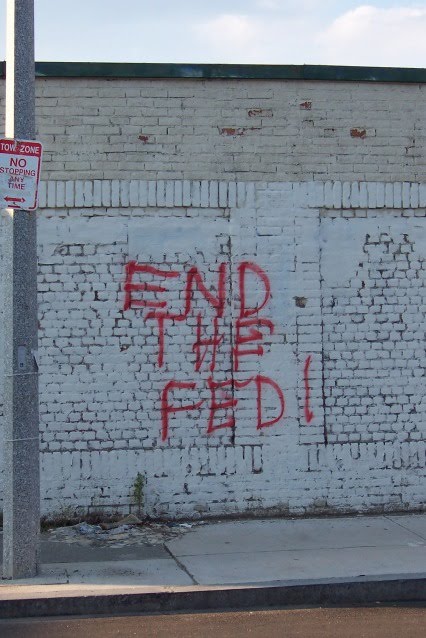
from the neighborhood: end the fed?

08 Thursday Oct 2009

Posted by Anna Clutterbuck-Cook in a sense of place

≈ 1 Comment

Tags

from the neighborhood, photos, politics


This appeared on one of the walls passed which Hanna and I often walk home from work. We’ve had a lot of conversations about what sort of political statement the artist thought they were making — and whether they understood the ramifications of either, a) abolishing the federal reserve or b) the federal government.

On the Syllabus: Man For Himself

25 Friday Sep 2009

Posted by Anna Clutterbuck-Cook in book reviews

≈ Leave a comment

Tags

history, politics, thesis

This week for my independent study, I finally sat down and finished Erich Fromm’s 1947 treatise on humanistic ethics: Man For Himself: An Inquiry into the Psychology of Ethics. Erich Fromm, a prolific writer on psychology, philosophy, politics, and ethics, clearly can’t be adequately represented by a small excerpt from one published work . . . but I thought I would, nevertheless, give you a flavor of his thinking by sharing a passage from Man for Himself in which he responds to one of the criticisms of his humanistic philosophy which foregrounds the capacity (“potentiality”) of human beings: that is, “what about the problem of evil?”

“The opponents of humanistic ethics,” he writes, “claim that man’s [1] nature is such as to make him inclined to be hostile to his fellow man, to be envious and jealous, and to be lazy, unless he is curbed by fear. Many representatives of humanistic ethics [have] met this challenge by insisting that man is inherently good and that destructiveness is not an integral part of his nature” (213). As Fromm points out, this leaves us with the problem of what destructiveness and where it comes from, if we reject it as an inherent part of human nature (since, self-evidently, human beings demonstrate a capacity for violence).

Our first step in approaching the problem of destructiveness is to differentiate between two kinds of hate: rational, “reactive” and irrational “character-conditioned” hate [2]. Reactive, rational hate is a person’s reaction to a threat to his own or another person’s freedom, life, or ideas. Its premise is a respect for life . Rational hate has an important biological function: it is the affective equivalent of action serving the protection of life; it comes into existence as a reaction to vital threats, and it ceases to exist when the threat has been removed; it is not the opposite but the concomitant of the striving for life [which Fromm believes is the most fundamental human drive].

Character-conditioned hate is different in quality. It is a character trait, a continuous readiness to hate, lingering within the person who is hostile rather than reacting to a stimulus from without . . . [a phenomenon] of such magnitude that the dualistic theory of love and hate as the two fundamental forces [of human life] seems to fit the facts. (216-17, emphasis in the original).

Fromm asks then (somewhat rhetorically) whether, given the evidence, he is forced to concede that theories maintaining destructiveness is a fundamental part of human nature (he uses Freud’s work as an example) are, indeed, correct. No, he responds to himself, he is not. He posits that both capacities (creativity and destruction) are present in human beings as potentialities which need certain conditions to manifest; furthermore, he argues that the capacity for productive, life-promoting creativity, is a primary capacity, whereas the capacity for destruction is secondary, realized only when the conditions for the primary are not met:

Both the primary and the secondary potentialities are part of the nature of an organism . . . the “secondary” potentiality comes into manifest existence only in the case of abnormal, pathogenic conditions. . . . man is not necessarily evil but becomes evil only if the proper conditions of his growth and development are lacking. The evil has no independent existence of its own, it is the absence of good, the result of the failure to realize life (219-20).

While I am skeptical about the division between rational/irrational used here, and find Fromm’s reliance on psychoanalytic language frustrating at times, his basic concept of human beings has a lot of (ahem) potential for re-imagining our most basic assumptions concerning human nature.

In the wake of the Second World War, many people — across diverse fields of inquiry — were wrestling with the question of what “human nature” was — and could be — with a sense of great urgency. Fromm offers us one such example; I’ll look forward to sharing more with you in the weeks to come.

~~~footnotes~~~

[1] after my post on Goodman last week, it is worth noting that Fromm specifically, in the introduction to Man for Himself, defines his use of the word “man” as a universal pronoun for “human being.”

[2] Fromm uses “character” in a very specific sense, elaborated on elsewhere in the book and in his other work, and here is indicating a basic orientation toward life versus a reaction to a specific incident.

Quick Hit: ‘Time poverty’

06 Monday Jul 2009

Posted by Anna Clutterbuck-Cook in think pieces

≈ Leave a comment

Tags

boston, domesticity, politics

Following a luxurious three-day weekend away from work and school, it seems appropriate to post this link from AlterNet, “Slow Down: How Our Fast-Paced World Is Making Us Sick,” in which Linda Buzzell argues that ‘time poverty’ is endemic in contemporary culture:

Time poverty is now a recognized psychological and social stressor. In a speeded-up, highly complex society, there just isn’t enough time for everything: our demanding jobs, our interlocking bureaucratic responsibilities (taxes, insurance, legal issues), our loved one, kids, our community (including the rest of nature), plus commuting and keeping up with traditional media and endless 24/7 online communications. Constantly rushing to keep up as we inevitably fall further behind, we find ourselves destroying not only our own health, but our habitat and the habitat of the people, plants and animals with whom we share the planet.

Juggling two part-time jobs, a library science class, thesis preparation, and home life this summer has given me a lot of opportunity to think about the importance of fighting against the relentless pressure to be “productive” by external standards, and to fill my life with activities our culture assigns value to — rather than the activities that I actually find pleasurable, nourishing and productive in a deep life-affirming sense of creating a life worth living.

I don’t necessarily buy into the idea that those activities necessarily take place out-of-doors, away from technology, but I also recognize the importance of remembering that information technology is a resource not an entity demanding my constant attention or embodying some inherent moral value (positive or negative). I’ve realized over the last two years in graduate school that as someone going into library & information services, information overwhelm and the pressure to be plugged into sources of information 24/7 is going to be a constant pressure in my working life, and it will be important to establish boundaries — to make sure there are places in my life where that tidal wave of sensory input is not allowed to intrude — times and spaces where I have time for reflection, reconnection, and restoration.

Quick Hit: SCOTUS 8-1 against strip search of teen

25 Thursday Jun 2009

Posted by Anna Clutterbuck-Cook in linkspam

≈ 1 Comment

Tags

children, education, feminism, politics, scotus junkie

Speaking of teens, schools, and power relationships . . .

This morning, the United States Supreme Court ruled 8-1 in favor of Savana Redding, a young woman who was strip-searched at her middle school after being accused by a fellow student of being in possession of over-the-counter ibuprofen (which were banned by school regulation).

Redding, who now attends college, was 13 when officials at Safford Middle School ordered her to remove her clothes and shake out her underwear because they were looking for pills — the equivalent of two Advils. The district bans prescription and over-the-counter drugs and the school was acting on a tip from another student.

“What was missing from the suspected facts that pointed to Savana was any indication of danger to the students from the power of the drugs or their quantity, and any reason to suppose that Savana was carrying pills in her underwear,” Justice David Souter wrote in the majority opinion. “We think that the combination of these deficiencies was fatal to finding the search reasonable.”

Earlier this year, I posted a link to Dahlia Lithwick’s column following the oral arguments . . . I look forward to any further thoughts she might have in the wake of this decision.

Teens, schools, and power relations

25 Thursday Jun 2009

Posted by Anna Clutterbuck-Cook in think pieces

≈ 3 Comments

Tags

children, education, politics

Two recent stories out of the UK on young people in school environments have got me thinking (once again) about the way in which educational spaces are often much less spaces for genuine learning than they are spaces in which unequal power relationships between young people (students) and adult people (administrators and teachers) play out in mutually destructive ways.

First, a short piece from the “odd news” section of the UK-based website digitalspy on a school in somerset that banned snogging (kissing) on school grounds. Students who are caught “in the act” will be suspended from school. While the short piece at digitalspy gives no reason for the ban, a local Somerset paper reports the impetus behind the ban was a full-frontal snog witnessed by the headmaster. This type of reaction to students public displays of affection is reminiscent of the recent New York Times’ breathless report on the hugging “trend” in American schools. While there may be legitimate reasons for asking students to refrain from heavy or prolonged making-out on school grounds, an all-out ban seems like overkill destined to provide one more reason for students to (perhaps legitimately in this case!) believe adults are completely barmy.

In a more serious and lengthy report yesterday morning on the BBC news hour, I heard a story about online “cyber-bullying” of teachers by their pupils:

Teachers have always had to put up with personal jibes from kids.

Until very recently, however, malicious gossip and snide remarks have mostly been confined to the corridors or lunch queues.

But now with the explosion of websites like ratemyteachers.co.uk and bebo.com, teachers are suddenly finding themselves mocked in cyberspace, resulting in plunging morale and even threats to quit the profession.

. . .

Ms Wallis [a senior teacher from Cornwall] claims that the site is seriously damaging trust between students and teaching staff.

“When you’re facing a class five times a day, with 30 children at a time, and you don’t know who has actually written these things, you become far more guarded in everything you do.

“And the bottom line is you lose all trust in the students you’ve got sitting in front of you.”

What struck me about the report was the way students were portrayed as the bullies with the power to destroy teachers’ emotional well-being and reputation. Obviously mean-spirited gossip is hurtful, and adults are not invulnerable to personal slurs just because they originate from people younger than themselves. Bullying is not confined to childhood spaces, and can cross generational boundaries. Yet the journalists covering this story seemed oblivious of the complex power dynamics at play in an educational institution — power dynamics that privilege adult authority, embodied by teachers and administrators, over the authority of young people. Teachers in a classroom exercise the right to pass judgment on students in contexts that have real-life consequences for a child’s future (this is especially true in a school system, such as in the UK, with national curriculum and testing standards). And while some of the “rating” comments are cruel, the reasons for poor ratings are not necessarily just kids having a bit of fun at the teacher’s expense. As one student interviewed reflected,

“I know one teacher who I think is really rude,” says a 15-year-old boy at Haydon School in Pinner, north west London. “But there’s no-one who can tell him that so, in a way, if they look at the site, it’s good because they can change their attitude.”

In a school environment that operates on a top-down, hierarchical model, students may have no (or very few) opportunities to make their voices heard — or more importantly feel they are taken seriously when they do speak up — without fear of retribution . . . except anonymously, online. Another student interviewed said she didn’t feel bad about the negative comments she had posted online. “I rated my worst teachers,” she told the BBC, “I said they were rubbish and didn’t teach me anything.” The fact that children have found alternate ways to communicate with the world about their academic experiences is not necessarily “bullying” — it may simply be providing us with a more balanced picture of what young peoples’ lived experiences in school are actually like. I doubt it will lead to any serious soul-searching on the part of those invested in an hierarchical academic system, but it will certainly be interesting to see how the struggle plays out.

Movienote & Quick Hit: Frost/Nixon & Nixon-Nixon

24 Wednesday Jun 2009

Posted by Anna Clutterbuck-Cook in media

≈ Leave a comment

Tags

history, movies, politics

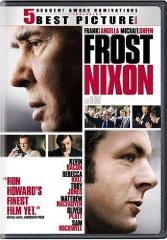
Yesterday, Hanna and I finally got around to watching the film adaptation of Peter Morgan’s 2006 stage play Frost/Nixon. Both the play and the film starred a perpetually startled-looking Michael Sheen as British talk show host David Frost and Frank Langella as a very sleepy-sounding Richard Nixon. The drama centers on an actual historical event: David Frost’s interviews with Nixon, broadcast in 1977, two years after Nixon resigned the presidency. It was a compelling film, paced very much as I imagine the original stage play ran, and aside from the two main actors sported several cameos by folks I enjoy, such as Oliver Platt and Matthew Macfadyen (disconcertingly blond). Since I know very little about the Nixon presidency or his political demise, beyond the broad brush strokes of our collective historical memory, the film has made me curious to check out the original interviews and compare the fictionalized version with the actual footage. Possibly more later if I (or Hanna) remain motivated enough to track them down.

Coincidentally, yesterday also saw the opening up of over 150 hours of tape and 30,000 pages of documents previously unavailable to the public by the Nixon Presidential Library. These new materials contain some choice sound bites concerning Nixon’s views on abortion and interracial relationships.

“There are times when an abortion is necessary. I know that. When you have a black and a white,” he told an aide, before adding, “Or a rape.”

As elle over at Shakesville points out (as do virtually all the feminist blogs I regularly read), interracial relationships are in no way shape or form analogous to rape . . . the first being, you know, a relationship and the other being a specific act of violence. The fact that this was the first circumstance that came to Nixon’s mind in 1973 as a situation warranting abortion — before he even thought to mention sexual violence, almost as an afterthought — is a fascinating example of the way he made sense of both race and abortion.

Anyway. May all the Nixon historians out there have fun and do good work with these new resources, many of which have been made available online.

LIS488 Current Awareness: mixi and cultural identity

20 Saturday Jun 2009

Posted by Anna Clutterbuck-Cook in library life

≈ 1 Comment

Tags

blogging, politics, simmons

For my summer-session library science course, LIS488: Technology for Information Professionals we are required to contribute weekly “current awareness” posts to the course website sharing a news story in the technology world we feel has bearing on our in-class discussions, assignments, and the library and information science profession. I thought I would cross-post my entries here, just for kicks, so ya’ll can get a sense what this grad school thing is all about.

Week 1 – Insider/outsider dynamics in web 2.0 networking

This week, Latoya Peterson, at the blog Racialicious, posted her conference notes from a presentation about the Japanese social networking site mixi. The presentation explored the way the user interface on mixi reinforces concepts of racial and ethnic boundaries in Japan. Like Facebook, mixi’s user interface provides individuals with the opportunity to identify themselves through various tools. However, rather than free-form text boxes, the site provides a series of drop-down menus that limit user options to pre-determined identity categories. As Peterson writes:

Komaki’s conclusion is that mixi, through use of drop downs and choices, reinforces the ideas and boundaries of Japan, and shows a preference to those born within Japan proper. Many people who live in Japan and have done so for their entire lives have their “otherness” reinforced by mixi. In his paper (currently unpublished) Komaki explains how through the choices provided to users, mixi encourages assimilation and rewards users that “fit in” with the established idea of what Japan should be.

Komaki’s presentation reminds us that, while the social networking potential of internet technology — particularly “web 2.0” technology — contains the potential for greater democratization of knowledge creation and information sharing, the human beings who create and share this content bring with them all of the same prejudices of their non-virtual lives.

As a blogger, I have seen first-hand the way in which online social spaces simultaneously open up and constrain interactions and conversations around issues of identity, of belonging and exclusion, of who is an insider, who is an outsider, and how insiders/outsiders are identified and treated in virtual space.

On the one hand, anonymity can be a powerful resource online, where individuals are able to write posts and comment on political issues (for example) without the constraint of being judged by superficial identity markers such as skin color, age, or accent. They are able to connect with individuals who share their experiences or interests, try out new ideas, and speak up about their experiences in ways that could, previously, have jeopardized them socially and materially. Various platforms for researching and discussing human sexuality, for example, can be found online where teenagers can access it without the embarrassment of requesting assistance from an adult or being told their curiosity is inappropriate.

At the same time, there can be enormous pressure to self-identify in virtual communities by the usual social indicators; individual participants in online communities or online discussions are often challenged in their right to speak on certain topics or be vocal in certain online forums based on what is known (or, often, assumed) about their real-world identities. We are socialized to categorize people based on certain characteristics and when this information is lacking (such as on blog post comment threads in which people otherwise unknown to each other are interacting) folks often scramble to fill in the missing pieces of information either through making assumptions about the writer’s personal identity and history or through demanding that the writer’s identity be clarified before they are respected (if an insider) or dismissed (as an outsider) in the context of a given debate.

Those of us in the field of library and information science need to be wary of narratives that paint technology, particularly “web 2.0” social networking technology, as a panacea for fully-participatory, democratic knowledge-sharing. We must pay close attention to the ways in which new technologies re-inscribe existing inequalities and exclusionary patterns of social behavior into the very tools used to migrate human interaction from face-to-face encounters into virtual spaces.

Quick Hit(s): More on book-burning story

16 Tuesday Jun 2009

Posted by Anna Clutterbuck-Cook in linkspam

≈ Leave a comment

Tags

books, politics

Some further web commentary on the Wisconsin book-burning kerfluffle:

Burning Issue @ shakesville.

These folks have a lot to learn about civil liberties, not to mention a lot about Christianity, too.

Stamps, Bookburning, and Depth of Field @ Neil Gaiman’s Journal.

The sad thing is that these twerps are wasting the time and money of a town and its librarians with a nuisance suit. Well, that and giving sane Christians a bad name while doing their best to widdle all over the first amendment. You don’t burn books. And, well, you don’t sue for your right to burn a library book you don’t like. (And that’s not just because if you win, that means that people you don’t like now have the right to burn your books.)

. . . As I said on twitter, whatever side the “Christian Civil Liberties Union” is on, I’m now on the other one.

I’ll add more links to commentary here as I run across it and time and inclination allow, so check back if you’re interested.

UPDATE: More from Neil Gaiman @ More on Stamps and Bookburning:

And these two [emails] follow up from the Wisconsin would-be librarybookburners who feel that the existence of Francesa Lia Block books threatens their health and safety…

UPDATE: YALSA (young adult library services association) offers suggestions for Unburning Baby Be-Bop.

In praise of context

14 Sunday Jun 2009

Posted by Anna Clutterbuck-Cook in think pieces

≈ 2 Comments

Tags

books, gender and sexuality, librarians, politics

So far this month, two articles on a Milwaukee-area book-banning (and potential book-burning) kerfluffle have come across my virtual desk — a piece from the ALA website, and a more recent article from the books page of the Guardian. Particular points should be awarded to the Guardian, I feel, for their deadpan quotation of some of the more hyperbolic charges made by the Christian Civil Liberties Union about the threat certain young adult novels pose to the good citizens of West Bend, Wisconsin, simply by remaining accessible in the public library (more below). As the ALA reports:

Milwaukee-area citizen Robert C. Braun of the Christian Civil Liberties Union (CCLU) distributed at the meeting copies of a claim for damages he and three other plaintiffs filed April 28 with the city; the complainants seek the right to publicly burn or destroy by another means the library’s copy of Baby Be-Bop. The claim also demands $120,000 in compensatory damages ($30,000 per plaintiff) for being exposed to the book in a library display, and the resignation of West Bend Mayor Kristine Deiss for “allow[ing] this book to be viewed by the public.”

This claim follows unsuccessful attempts by area citizens to get the library trustees to remove the offending material from the library: in a June 2 vote of 9-0, the trustees decided to “maintain the young-adult collection as is ‘without removing, relocating, labeling, or otherwise restricting access’ to any titles.”

As Allison Flood at the Guardian reports in more detail, the offending title which the CCLU wishes to publically burn (publically burn!!!) is a young adult novel that deals with issues of nonstraight sexuality and violence inspired by homophobia and racism:

The offending book is Francesca Lia Block’s Baby Be-Bop, a young adult novel in which a boy, struggling with his homosexuality, is beaten up by a homophobic gang. The complaint, which according to the American Library Association also demands $120,000 (£72,000) in compensatory damages for being exposed to the book in a display at West Bend Community Memorial Library, was lodged by four men from the Christian Civil Liberties Union.

Their suit says that “the plaintiffs, all of whom are elderly, claim their mental and emotional well-being was damaged by this book at the library,” and that it contains derogatory language that could “put one’s life in possible jeopardy, adults and children alike.”

“The word ‘faggot’ is very derogatory and slanderous to all males,” the suit continues. “Using the word ‘Nigger’ is dangerously offensive, disrespectful to all people. These words can permeate violence.” The suit also claims that the book “constitutes a hate crime, and that it degrades the community”.

While I haven’t read this particular work by Francesca Lia Block, I have read others and Block’s characters are often struggling in very messy ways with marginalization, poverty, their own complicated sexualities, and histories as perpetrators or victims of violence in one form or another. Her work, while often lyrical, is not for the faint-of-heart. It has never particularly spoken to me, but as an author she commands a wide audience of teens and adults who find her characters compelling.

What I find interesting about this lawsuit — based, at least, on these two news stories — is the way in which the CCLU has (1) adopted the language of the political left to frame their complaint and (2) the way in which they conflate hateful actions with descriptions of hateful actions. While I suspect that what traumatizes the offended parties is Block’s affirmative depiction of characters with nonstraight sexual identities, and possibly (knowing her other works) instances of drug use, sex scenes, and the old standby, vulgar language, instead they claim to be concerned about the use of words such as “faggot” and “nigger.” This isn’t necessarily a surprising tactic, since the radical right has increasingly adopted leftist rhetoric in their effort to shift the culture wars in their favor.

What I find more stunning is their apparently inability to understand (or, possibly, their tactical decision to ignore) the difference between an actual, material act of violence or an act of speech that supports that violence and a work of fiction that depicts the reality of bigotry and violence in the lives of marginalized youth. Children face daily abuse at the hands of bullies for perceived or actual gender and sexual nonconformity; a novelist like Block, who depicts that violence in her work of fiction, is describing the reality of our children’s lives rather than advocating such abuse. If uttering the word “faggot” actually constituted a hate crime regardless of context, we would be incapable of speaking out against the use of that language by individuals who actually seek to do harm.

While this conflation of thought or depiction with actual illegal violent crime is not unique to the Right (Exhibit A: the campaign by some feminist activists during the 1980s to have pornography treated as violence against women, whether or not actual individuals had been harmed in the making of the piece), it seems to me that it displays a legalistic, overly-simplistic, atomized way of thinking that is more prevalent among conservatives than it is among those on the left. Another example that comes to mind is the approach of the MPAA rating board in assigning ratings to American films (see This Film is Not Yet Rated), and the members’ obsession with individual words or acts of sexual contact, rather than overall message conveyed. I find myself wondering if this is strategic blindness or an actual belief that a word or activity, devoid of its overall context, has a constant and unwavering effect (whether positive or negative).

As an historian (among other things) I have to cry foul and point out that context, while certainly not everything counts for a hell of a lot — and as a librarian-in-training (among other things) I have to point out that words themselves are never, ever “hate crimes.” Words are just words: it’s what we do with them that makes all the difference in the world. Francesca Lia Block has done many beautiful things with the words available to her, and in my opinion her work is the opposite of a hate crime: it has made the world a better place.

Photo credit: “Mercy! Books Burning” (c) Catherine Jamieson @ flickr.

"Did You Know?": Am I crazy or is this xenophobic?

13 Saturday Jun 2009

Posted by Anna Clutterbuck-Cook in think pieces

≈ 2 Comments

Tags

education, politics, simmons, web video

This web video pops up in my Simmons library science courses at least once a semester and, predictably, it turned up again today in the first session of my technology course.

Reactions in class were divided between, well, me and everyone else who spoke up.

Watching the video this time around, in the context of other reading I’ve been doing about conservative fears of a European “demographic winter” and non-Western population growth, I couldn’t shake the feeling that the way this data was presented had a certain element of xenophobia — specifically fear about the U.S. being overtaken intellectually and economically by Asian countries like India and China.

I was also struck by the way it frames achievement by conventional educational terms (for example, IQ scores and the concept of education as job training). The fear of non-American young people “out performing” American students has a long history in the American discourse about education (think of Cold War anxieties about Soviet students with higher test scores than American students). Watching the video in light of these two contexts (fearmongering demographic debates and anxiety about academic performance on the international stage) makes me distinctly uncomfortable about the way this data is presented and the way it is offered, for the most part uncritically, in our library science classes as a wake-up call for the future of information organization.

The other students in class seemed to think I was reading the film too negatively, and offered an alternative reading to the effect of, “look how much human potential we have in the world — let’s make the most of it!” Yet at the same time, they, too, were voicing competitive anxieties about how Americans can’t afford to rest easy in the assumption they have the technological advantage — an anxiety that I feel buys into an “us vs. them” framework that can slide into, well, xenophobia and isolationism. Particularly in a period of economic constraint.

Thoughts?

← Older posts
Newer posts →
"the past is a wild party; check your preconceptions at the door." ~ Emma Donoghue

Recent Posts

  • medical update 11.11.22
  • medical update 6.4.22
  • medical update 1.16.2022
  • medical update 10.13.2021
  • medical update 8.17.2021

Archives

Categories

Creative Commons License

This work by Anna J. Clutterbuck-Cook is licensed under a Creative Commons Attribution 3.0 Unported License

Meta

  • Create account
  • Log in
  • Entries feed
  • Comments feed
  • WordPress.com

Create a free website or blog at WordPress.com.

  • Subscribe Subscribed
    • the feminist librarian
    • Join 37 other subscribers
    • Already have a WordPress.com account? Log in now.
    • the feminist librarian
    • Subscribe Subscribed
    • Sign up
    • Log in
    • Report this content
    • View site in Reader
    • Manage subscriptions
    • Collapse this bar