• anna j. clutterbuck-cook
  • contact
  • curriculum vitae
  • find me elsewhere
  • marilyn ross memorial book prize

the feminist librarian

the feminist librarian

Tag Archives: politics

from the archive: if only she had lived to see the A.C.A…

26 Tuesday Nov 2013

Posted by Anna Clutterbuck-Cook in my historian hat

≈ Leave a comment

Tags

history, MHS, politics

I’m working on a blog post about children’s health diaries in MHS collections and I came across the following in a letter from Dr. Mary Putnam to Helen C. Morgan, 10 December 1923:

Tell me how [Carter, Helen’s son] is and what you do, and don’t work too hard. I don’t see how Peggy gets her health insurance! Two companies turned me down, without looking at me, because I have had grippe twice! I decided to be satisfied with accident!*

Ninety years later, on 10 December 2013, a pediatrician like Mary, buying health insurance on her own, would be protected from denial of coverage based on pre-existing conditions.The Affordable Healthcare Act is far from perfect, but I’m surely glad that we’re better able to provide for many more Mary Putnams of this world so that they no longer have to be “satisfied with accident.”

Now let’s fix the coverage gap so that everyone can access healthcare when they need it, without going bankrupt.

*Mary Putnam to Helen C. Morgan, 10 December 1923, Allen H. Morgan Papers, Massachusetts Historical Society.

from the archives: anti-suffrage gossip

31 Thursday Oct 2013

Posted by Anna Clutterbuck-Cook in my historian hat

≈ 1 Comment

Tags

feminism, history, MHS, politics

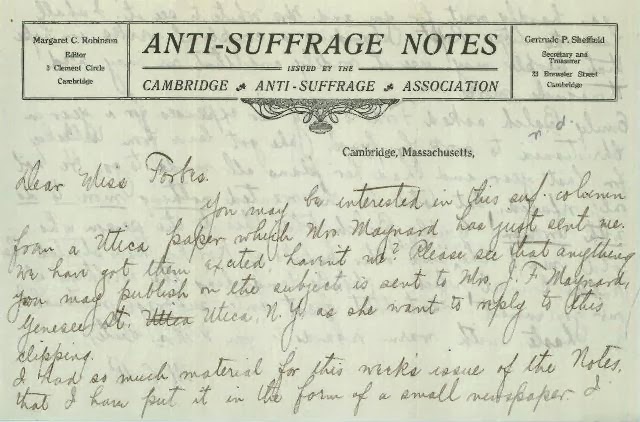
I had a blog post up yesterday at The Beehive (the Massachusetts Historical Society blog) sharing an item from our collections authored by anti-suffrage activist Margaret C. Robinson:

Margaret C. Robinson to Mary Bowditch Forbes, [1917],
Mary Bowditch Forbes Papers, Massachusetts Historical Society,

I didn’t include a full transcript of the item in my final blog post, but I thought readers here might be amused. So before or after you read my post contextualizing the item, here is the full letter. Margaret Robinson’s note (pictured above) reads:

[n.d.]

Dear Miss Forbes.

You may be interested in this suf. column from a Utica paper which Mrs. Maynard has just sent me. We have got them excited haven’t we? Please see that anything you may publish on the subject is sent to Mrs. J.F. Maynard, Genesee St., Utlca Utica, N.Y. as she want[s] to reply to this clipping.

I had such material for this week’s issue of the [Anti-Suffrage] Notes, that I have put it in the form of a small newspaper. I can hardly wait for you and Mrs. White to see it. I shall have the type left standing a couple of weeks in hope that people may use it widely and that we may need thousands more.

Emily Balch asked Ford to pay her expenses for a year in Christianin to work for peace. She got leave from Wellesley for last year and had her plans all made to go. He not only refused but told her he wanted nothing more to do with women! Emily Balch told this to the person who told me! She ^(Miss Balch) and other pupils of Rosika [Schwimmer] have started the People’s Council which is openly demanding the overthrow of our government! Isn’t that great anti-suffrage material?

In haste, with warm regards to you & Mrs. White,

M.C.R.

In addition to what I write at the Beehive, I think I particularly enjoy the image of Robinson being so excited about the latest edition of her newsletter that she’s going to leave the type set to print even more copies once the initial run is fully distributed. If I ever track down a copy of that particular document I’ll be sure to share it here at the feminist librarian!

in praise of obamacare [because experience]

01 Tuesday Oct 2013

Posted by Anna Clutterbuck-Cook in think pieces

≈ Leave a comment

Tags

boston, politics

As we are all well aware by now (unless you’ve been living in a media blackout), the Affordable Care Act-mandated healthcare exchanges — the websites that will enable uninsured folks and people paying for individual plans to enroll in health insurance plans and gain access to government subsidies — open today.

Much has been written about the political right’s hysteria about the ACA, or Obamacare, and their effort to deter the eligible from using these exchanges to gain access to affordable medical services. For the past few weeks the freak-out has only gotten worse.

So I thought, on this auspicious day of an important piece of the Obamacare roll-out, I’d offer up a big “thank you!” for my own experience with Obamacare’s more local predecessor, Romneycare.

When I moved to Massachusetts in 2007, I had been paying independently for health insurance since graduating from college in 2005 and becoming ineligible for my parents’ workplace-sponsored healthcare coverage. I paid to extend that coverage for several months through COBRA at the price, if memory serves, over $300/month. As that cost was unsustainable, even living in my parents’ household, I switched to a catastrophic-coverage plan through Michigan’s Blue Cross, Blue Shield. The monthly payments weren’t too bad, about $50, but the deductibles were so high that I was paying out of pocket for all of the routine, preventative care that I actually needed: primary care, medications (I’m on several ongoing prescriptions), as well as dental and eye care. Actually, before moving to Massachusetts, I had never had coverage for dental, or eye care. I was used to paying $90-180 per appointment for regular dental cleanings.

Mental health care, too, was something that my family had never had coverage for — counseling appointments were strictly out of pocket, if we were lucky reimbursable through the flexible spending account (FSA) my parents paid into every year.

Between 2005-2007 I worked a number of part-time positions for between $7-10 per hour. My last pre-library school job was at Barnes & Noble where I worked 15-30 hours/week for minimum wage. I started there at $7.50/hour and when I quit the job to take a position at the Massachusetts Historical Society I was making around $9.00/hour.

At the MHS I earned $14.00/hour, which was more than I’d ever made in my life. But at 21 hours/week only came to roughly $15,300/year … before taxes. In order to buy into the Simmons-sponsored student health plan, I would have had to take out additional student loans to cover the premiums.

Thankfully, as a part-time graduate student I qualified for the Massachusetts state-subsidized healthcare program. After submitting an application, providing proof of income and lack of insurance options through work, and waiting for the bureaucracy to churn away I was approved for Commonwealth Care. Hanna was also approved as well, after many years of being uninsured during periods of low- and unemployment in states without comprehensive health insurance programs.

bDuring the rest of my part-time employment/graduate student days — until I transitioned to full-time professional employment with work-sponsored healthcare coverage — I had Commonwealth Care to thank for access to a primary care provider, to eye- and dental care (for which I paid only co-pays for the first time in my life) and, wonder of wonders and miracle of miracles mental health coverage.

Let me repeat this for you:

For the cost of between $0-$100/month in premiums, and $0-20/visit in co-payments, scaled as our income changed, Hanna and I had access to comprehensive medical care. Thanks to Romneycare. 

Between 2007-2011, while we pieced together part-time work for living expenses and shouldered the burden of student loans to cover tuition, we had the peace of mind that our medical needs wouldn’t go by the wayside due to our inability to pay.

our awesome health center

Romneycare paid for us to go for our annual physicals and our ladybit exams.

Romneycare paid for my thyroid medication and all of Hanna’s prescriptions, sometimes with no co-pay.

Romneycare gave Hanna access to psychiatric and counseling services when she needed them to combat depression.

Romneycare brought us eye exams and low-cost prescription lenses.

Romneycare funded dental cleanings, x-rays, and repair work.

There’s been a lot of talk about how young adults, supposedly healthy, have little incentive to engage in these health insurance marketplaces. Yet there are plenty of young adults out there who have chronic health conditions (or are working to prevent chronic health conditions toward which they would otherwise be trending). Apart from anything else, how many of us need glasses or contacts? Despite America’s love affair with youthful bodies, young bodies are not always healthier bodies. And the struggles of those bodies are not always within our powers to ameliorate or eliminate without access to health care professionals.

I can’t create the synthetic hormones that make up for my lack of a functioning thyroid.

I can’t grind the glass to create the lenses that allow me to work and drive safely.

I can’t manage my migraines without assistance from my primary care provider.

Hanna needs ongoing support to navigate her depression and anxiety.

We’ve both, in the past two years, needed diagnostic tests and physical therapy to prevent chronic injury.

In 2011 we both transitioned into professional positions that offered robust health plans as part of the benefits package. Today, we pay roughly $120/month (pre-tax) in premiums through our employers to continue our access to medical, mental, dental, and eye care. Most appointments come at a $15-20 co-pay; prescriptions are $5-20 per refill. We are able to utilize flex spending accounts, and thanks to a strong union, Hanna’s co-payments annually top out at $135 for her wage bracket.

Last year we were reimbursed about $800 by Harvard for prescriptions and co-payments.

I haven’t done the math for all our medical services, but without insurance our counseling appointments alone would cost $10,800 as billed … about 2/3 what we pay in rent annually.

While we’re lucky to have workplaces that offer these benefits, it’s also reassuring to know — in this age of uncertain employment — that if one or the other of us needs Commonwealth Care again, it will be there to access. I’ve referred friends the program. And I’m glad to know that many, many others in the state of Massachusetts have been able to access care like we did, supported by our tax dollars.

(According to one subsidy calculator, if Hanna and I needed to purchase
private insurance, even at our current income we’d get $900 annually
in federal subsidies to help make that more affordable.)

This coming year, I’m going to feel a little bit better about being an American citizen in a nation where people in Michigan, Texas, Oregon, and elsewhere can access care also.

Supported by our tax dollars.

I believe this is (the beginning of) government as it could and should be.

Thank you, Obamacare, for taking a step in the right direction.

being friends with…humans

08 Thursday Aug 2013

Posted by Anna Clutterbuck-Cook in think pieces

≈ 8 Comments

Tags

children, family, feminism, politics, the personal is political

I realize writing commentary about a New York Times ladypiece is picking low-hanging fruit, but I have a sinus headache and it’s too early to go to bed, so here we are.

If you missed it, Time magazine ran a story last week about people women who choose not to parent and the apparently glamorous, self-centered, satisfying lives we lead. As Tracie Egan Morrissey wryly pointed out at Jezebel, the write-up was framed in such a way as to ensure that even non-parenting women are wrapped into the narrative of the “batshit mommy war”:

Perhaps you thought that not having children left you untethered. Wrong! Time has roped you into it, with some inflammatory quotes that will get all the mothers in the world to hiss at you brazen hussies and your childfree existences.

Most of us non-parenting ladies knew already we didn’t get to opt out of that one, but thank you Time magazine for pointing it out once again so hysterically.

Meanwhile, KJ Dell’Antonia riffed off this piece at the NYT Motherload blog (tagline: “adventures in parenting,” as if we needed reminding that care for children is understood to be women’s work) by asking the question “can parents stay friends with the childfree?” She excerpts liberally from the Time piece, starting with:

Any national discussion about the struggle to reconcile womanhood with modernity tends to begin and end with one subject: parenting. Even Sheryl Sandberg’s “Lean In,” a book focused on encouraging women’s professional development, devotes a large chunk of its take-home advice to balancing work and family, presuming that, like its author, ambitious women will have both.

Dell’Antonia herself then reflects:

As a parent myself, I don’t read my tendency to gravitate toward fellow mothers as judgment — I read it as practical. Fellow parents are more likely to understand if I bail on dinner because of a sudden teacher conference, and their eyes are less likely to glaze over if my preoccupation at that dinner is more temper tantrums than, say, the right way to temper chocolate (which might once have held my interest for hours). In fact, I’d argue that it’s win-win.

So I have some thoughts. Obviously, or I wouldn’t be writing this post.

Y’all know, if you’ve spent any time on this blog, that I come at this issue from the perspective of someone deeply invested in remaking the world into a place where families and family care-work is genuinely respected and incorporated into daily life, where children and their carers aren’t ghettoized or put on a (false) pedestal while actually being treated like shit. This (probably radical, feminist, maybe a bit queer) political agenda informs how I think about most public discussions about parenting, not-parenting, work and family life, and how the current organization of our economy and social life constrains the choices we have in these areas.

I also come at this conversation from the perspective of someone who is currently, and will likely remain, partnered but non-parenting. I’ve written elsewhere about the factors going into that decision, which like any major decision is born of inner desires, practical realities, and the needs and desires of those the decision-maker is in close relationship with.

Here are my thoughts.

First, Dell’Antonia directs her question only to mothers:

Do we, as women who are also mothers, judge women who are not? And if we do, do we do it overtly or subconsciously — or just by excluding and including people in our lives based on proximity and similarity without realizing that the path of least resistance is one that, for a parent like me, includes mainly friends who are piloting similar family boats?

What strikes me about this framing of the question is the notion that parents and non-parents are two different species, two different tribes, without “proximity and similarity,” that only fellow parents are “piloting similar family boats.” I notice this a lot in writing about work-life and work-family issues, in discussions about women’s decision-making around work, relationships, reproduction.

I reject this false dichotomy between parents and not-parents. Yes, obviously, parenting changes you — just like any major life experience changes you. But I reject the notion that there’s something about parenting that makes it impossible to communicate with individuals who have not yet (or never plan to) cross that divide. I see a similar dichotomy set up between single and married women (and yes, it’s most often women). It has a kernel of truth, but gets set up as a means to divide people and pit them against one another. To constantly re-inscribe the supposed differences between not-parents and parents suggests that we must be in competition, that our needs and desires must be set against one another, in opposition. When in reality, our needs as humans are more similar than they are different.

Which brings me to my next point: not-parents have families too. Notice how, in the Time piece, “parenting” in the first sentence turns into “family” in the second — with the suggestion that somehow only parents struggle with the competing responsibilities of work and home life? Hanna and I, and our cats, are a family unit. We belong to a wider family circle of parents and parents-in-law, sisters and brothers and siblings-in-law, grandparents, cousins, nieces and nephews, and extended relationship.

We also, like parents, have this thing called “home” and a life therein, where shit happens. Shit like laundry and cooking (or not-cooking because you haven’t had the energy to go grocery shopping). Shit like getting sick, or caring for a sick spouse, or negotiating with the vet to find an appointment time that you can make before or after work, or on the weekends. Parenting people are not the only ones who’ve had to cancel a dinner date at the last minute — or would understand the necessity of doing so, to take Ms. Dell’Antonia’s example from above. If parents truly are cutting off their not-parent friends because they pre-emptively imagine there’s no longer anything to talk about well … that seems a damned shame to me. I really like my parenting friends, and I gotta say we find plenty to talk about and enjoy together.

Which brings me to my final point, which is when the fuck did friendship become a matter of sameness? Again, I get that it helps to have common interests and experiences, common values and goals. But I also feel like there’s something — a big something — to be said for curiosity, empathetic listening, and learning. I’d never heard of Doctor Who before I met Hanna, and tonight while I’m writing this blog post we’re re-watching “Rose” and talking about how awesome it is as a series re-boot. We didn’t meet as fellow fans, but I was open to discovering something new.

The same could be said about parenting and not-parenting people learning how to talk about their lives (and ask questions about their friends’ lives) in ways that don’t automatically assume that there will be no common ground, or that just because you haven’t had experience Zed you can’t be interested or contribute to a discussion on the topic.

It’s a pretty fucked-up version of identity politics to assume the only meaningful relationships you can have are with those who’ve had your specific set of life experiences.

reality check [mcdonald’s style]

17 Wednesday Jul 2013

Posted by Anna Clutterbuck-Cook in think pieces

≈ Leave a comment

Tags

economics, politics, the personal is political, why be judgy?, work-life balance

(via Lawyers, Guns, and Money)

It’s hot here, as it is pretty much everywhere in the States right now, and I had an iced latte this afternoon to see me through my evening shift … so sleep isn’t coming. Solution: blogging.

I Tumblr-ed & Tweeted the link to this story earlier in the evening, but laying awake in the dark I was doing the math so here’s an expanded/comparison version.

The sample monthly budget above is courtesy of McDonald’s corporation, composed by mad ferrets working for snails in their corporate offices as a teaching aide for their minimum-wage earning employees. See employees! Living in poverty is easy! All ya gotta do is plan.

As the author of the post linked above, Robyn Pennacchia, points out this budget exists in a fantasy where things like food, gas, and heat don’t cost anything — or perhaps, can be squeezed out of that $27/day “spending money goal” at the bottom of the table? She writes:

You may think that most of these minimum wage earners are teenagers. Well, 87.9% of minimum wage earners are over the age of 20. 28% of those people are parents trying to raise a kid on this budget. That is not a good thing for our future and it is not a good thing for our economy. In order for the economy to thrive, people have to be able to buy things. All the money going to people at the top does not help us. 

I don’t want to live in any kind of dog-eat-dog Ayn Rand erotic fantasy. Human beings are worth more than that. Anyone who works 40 hours a week (nevermind 74 hours) ought be able to take care of all the basic necessities in life. Corporations shouldn’t be able to pay their workers nothing, keep all of the profits to themselves, and expect taxpayers to make up the difference with social programs. It’s not fair to the workers, and it’s not fair to any of us.

Pennacchia has the (shockingly not-shocking) national stats; I thought I’d throw a little cold-water reality on the ferrets’ fantasy budget by comparing it to what Hanna and I actually have to spend on the necessities listed above. Line by line. (I said I’d had too much coffee!)

  • Savings …… $500.00

The number above is wholly comprised of 401(k) with-holdings and the money we set aside to pay Hanna’s self-employment tax in April. Some of that we get to keep, thanks to deductions, but it’s not exactly secure savings. We’d put some by in our slush fund earlier this year, but that went to the cats’ vet bills in June.

I’m not saying all this in a poor-us fashion, I’m pointing out: $100.00/month in “savings” for someone making minimum wage probably isn’t going into a retirement plan. It’s likely in the sock drawer until they need to drive across the state to the only Planned Parenthood offering affordable healthcare services.

  • Mortgage/Rent …… $1295.00
We pay for a 1-bedroom in a cheapish part of Boston. I get that Boston is one of the most expensive real estate markets in the United States, but when I first moved here I was working a retail job at Barnes & Noble that paid $9.00/hour. That’s only $0.75 more than the minimum wage. The idea of anyone making that level of income being able to afford a rent, let alone buy a house, is pretty laughable from where I and my compatriots are sitting. If you’re putting aside $100.00/month you’re not accruing anywhere near enough for a downpayment.
  • Car Payment Transportation …… $175.00
I got this number by adding together our monthly T pass expenditure (about $30/each), our monthly Zipcar membership ($75) and my Hubway membership ($7/month), with a bit of cushion for additional Zipcar fees when we need the car for more trip than usual (like to the vet). 
If we lived in the more affordable real estate zones around Boston (i.e. a place where someone might be able to rent a studio apartment for $600.00/month. Maybe. Then we’d be adding in commuter rail fees or car maintenance, insurance, parking, gas. We’ve done the math, and it pretty quickly starts to cancel out any savings otherwise realized.
  • Car/Home Insurance Student Loans …… $430.00
So we don’t have to pay insurance for a car (which we don’t have) or a home (which we don’t own), but we do have to pay a percentage on our brains. While we have relatively affordable student loan payments through the federal Income-Based Repayment plan, that’s still a not-inconsiderable chunk of our income every month. Which might otherwise go toward that retirement TDA or eventual home ownership. Just sayin’.
  • Health Insurance …… $225.00
Hanna and I are both generously insured through our workplaces, with plan that are not only paid for pre-tax (the equivalent of a 20% reduction in premiums) but subsidized by our employers. Harvard University even reimburses us Hanna’s copayments after she reaches $135/year (no small perk when you’re talking about regular physical therapy or mental health treatments at $15/visit). 
I was on my parents COBRA insurance for a couple of years out of college, and independent Blue Cross/Blue Shield catastrophic-emergency-only insurance a couple of years after that, before moving to Massachusetts and being poor enough to qualify for their state-subsidized insurance plans (thank you Ted Kennedy!). I know how even $225.00/month for a family of two is a deal.
  • Heating Gas …… $30.00
Our heat is electric (see below), and our water comes included with the rent — but we have a gas stove and pay monthly for that, to the tune of $20-30/month. More in the winter when we’re baking, less in the summer when we’re too sleep deprived to cook in our non-air-conditioned apartment (which of course means we spend more on prepared meals…).
  • Cable/Phone/Internet …… $70.00
We get the have-a-television cable package for about $18/month, internet for $32, and a land-line for $28. I also maintain my old AT&T cell phone on a pay-as-you-go plan that costs us about $100/year in top-up fees.
I don’t think we need to go over, once again, why services like the internet and phones are basic necessities for even those who are homeless and poverty-stricken; without connectivity it is impossible to conduct business in the world, be taken seriously by potential employers, or — hell — just enjoy your downtime with crap movies. 
  • Electric …… $62.00
We actually do pretty well with our electricity, no that we pay a flat monthly fee that averages out the winter highs (over $200.00) and the summer lows that come from inefficient electric heat. We pay slightly more for wind power, though the differential is pennies at our level. I wish we had the option for solar, since our apartment building gets direct afternoon sun that could really dial the meter back if taken advantage of.
  • Other …. ???
“Other”? By which you mean … food ($800.00)? Or work-appropriate clothing (~$600.00 annually)? Professional development ($500 so far this year)? Union dues ($380 annually; and no complaints from this quarter)? 
The compost collective we pay into for $20/month?
Oh, I suppose you could mean Netflix at $7.99/month…
…and yeah, you probably look askance, McDonald’s, at the $4.00 latte I bought this afternoon which is fueling this late-night verbiage.
  • Monthly Expenses Total …… $2,562.00
Or 2.03 times what that McDonald’s employee working 74 freakin’ hours per week is supposed to be living on. 
You’ll notice I haven’t included anything as luxurious in here as weekend trip to Maine to visit the in-laws (about $300.00 for a car rental plus gas) or fun activities like a movie or the purchase of a used book.
On the one hand, I’m grateful that both of us have found work with employers who value and foster our skills, who encourage our professional growth, who offer generous benefits, and who compensate us within the range of professional respectability. Our household income of about $3,625/month net last year* is a solid cushion above the minimum $2,525/month supposedly required by a household of two adults to get by in our county.
On the other hand, I’m appalled that — as a nation — we continue to ignore the reality that is the increased cost of living well or even just securely. And that we continue to individualize a social problem — pretending that just teaching people struggling to get by on what is patently not enough to craft and stick to a budget is somehow going to solve the problem of poverty.
The only thing that will solve poverty is better-paying employment and a strong social safety net.
And now I’m going to return to staring at the ceiling and listening to the cat hunt mosquitoes in the dark.
*I took our Adjusted Gross Income from our joint state tax form, reduced it by 20% to account for tax with-holdings, and divided by twelve. Our AGI was $54,369.00 in 2012.

bodies, state power, personhood [thoughts]

14 Sunday Jul 2013

Posted by Anna Clutterbuck-Cook in think pieces

≈ Leave a comment

Tags

politics, the personal is political

Hanna and I woke up this morning to the news that George Zimmerman has been found “not guilty” of the murder of Trayvon Martin in Florida.

I haven’t followed the trial closely — only what we heard on NPR, and the coverage by bloggers I follow regularly — so this is not a post about what happened and why. Others much more eloquent will do a better job articulating that (see the bottom of this post for updates as I read and link to them).

What I want to say is this:

On June 26th, the Supreme Court of the United States issued a ruling about same-sex marriage that affirmed my dignity as a woman who has married another woman. I didn’t need the approval of the Supreme Court to recognize that my marriage is valid. At the same time, there was something profound and powerful about an official state body affirming that my citizenship rights should not be abridged.

The day before, the same institution decided the Voting Rights Act was no longer relevant — because apparently the poor, powerless, and marginalized don’t need additional protections from the powerful and power-hungry to ensure their basic rights and well-being.

And the power-hungry immediately rose to the challenge and began abridging the right to vote.

In the weeks that have followed, we’ve watched the Texas legislature ram through legal restrictions on women’s access to basic health and reproductive services. Women in that fine state (Molly Ivins would be proud), including elected officials, worked hard to stop the further curtailment of women’s agency and meaningful ability to determine their own reproductive lives.

The legislation was passed.

Simultaneously, Mr. Zimmerman was on trial for the murder of a young black teenager, Trayvon Martin, whose sole crime was walking while black. I don’t know on what grounds the jury acquitted Zimmerman — although I’m sure I’ll find out in the days to come. I wasn’t gunning for Zimmerman’s blood — I don’t think further violence, state-sanctioned or not, is ever the answer. But when I heard on the radio this morning that the jury had found Zimmerman Not Guilty of murder or manslaughter, my first thought was this: that the verdict represents the opposite of Windsor. It’s the erasure of the personhood of Trayvon Martin by the powers that be and by our collective racism.

For if Zimmerman is Not Guilty of having killed Trayvon Martin, who is?

Are we saying murder didn’t take place?

Are we saying it was a justified killing?

Are we saying, regardless, that we simply don’t care?

I won’t speak for anyone who knew Trayvon Martin personally, but for myself I can imagine that more than any punishment George Zimmerman may have faced upon a guilty verdict, hearing the jury speak his guilt for Trayvon’s murder in so many words — affirming Trayvon Martin’s right not to be dead and the violation of that right which took place when George Zimmerman shot him — would have been a powerful step towards truth and reconciliation. It would have been a group of fellow citizens, speaking with the authority of the state, standing up and saying this is wrong.

That didn’t happen.

All of these events are profound and immediate reminders of the effect that state power can have, for good or ill, in supporting, affirming, protecting … or erasing, negating, denying, the personhood of some people (queers, people with uteruses, non-whites, youth, the poor) in the interest of preserving the rights of the powerful not to ever feel afraid or threatened by those whom they don’t understand or dislike.

If the Windsor and Perry decisions reminded me of the positive power of state and majority power, Texas and Florida have done their damnedest these past two weeks to remind me of its dangerous perils.

UPDATES [LINKS]:

Brittney Cooper @ Salon | White supremacy, meet Black rage (2013-07-14).

Though much of the mainstream media who have covered this case have convinced themselves that race did not play a role in this trial, a Black kid is dead because being young, Black, and male, and wearing a hoodie in the rain is apparently a crime punishable by death.

James Baldwin @ The Progressive | A Letter to My Nephew (1962-12). via @jsmooth995

This innocent country set you down in a ghetto in which, in fact, it intended that you should perish. Let me spell out precisely what I mean by that for the heart of the matter is here and the crux of my dispute with my country. You were born where you were born and faced the future that you faced because you were black and for no other reason. The limits to your ambition were thus expected to be settled. You were born into a society which spelled out with brutal clarity and in as many ways as possible that you were a worthless human being. 

Ta-Nehisi Coates @ The Atlantic | Trayvon Martin and the Irony of American Justice (2013-07-15).

In trying to assess the the killing of Trayvon Martin by George Zimmerman, two seemingly conflicted truths emerge for me. The first is that based on the case presented by the state, and based on Florida law, George Zimmerman should not have been convicted of second degree murder or manslaughter. The second is that the killing of Trayvon Martin is a profound injustice. 

*note: I apologize for originally mis-spelling Trayvon’s name with an “e”. Not enough coffee. Corrected.

while reading windsor [friday night thoughts]

29 Saturday Jun 2013

Posted by Anna Clutterbuck-Cook in think pieces

≈ Leave a comment

Tags

doma, marriage equality, married life, politics, scotus junkie, the personal is political

Things have all been a bit hectic since Wednesday morning, and what with one thing and another I’m just getting around to reading the full text of United States v. Windsor this evening. Scalia’s dissent is as wonderful as everyone’s been saying it is, and I feel the visual representation of his feels might look something like Paul Rudd’s hissy fit in Wet Hot American Summer (with Justice Ruth Bader Ginsberg standing by in the role of Janeane Garofalo, of course):

But all joking aside, there is another aspect to this landmark decision, apart from the opportunities for comedy and even just the straightforward legal-political victory which is the end of DOMA and the practical inequalities it enacted. And that is the fact that, as a bisexual woman married to my wife in the state of Massachusetts, there is something incredibly personal and incredibly powerful about reading a majority opinion written by the Supreme Court of the United States not only affirming my equal rights as a married citizen, but affirming our rights as sexual citizens not to be devalued because of our same-sex relationships.

It’s not like my marriage was somehow lesser, or invalid, while DOMA was still the law of the land. I don’t need the government to approve of my behaviors or relationship choices in order for me to feel like they were (are) the right ones for me.

But sociopolitical marginalization, cultural erasure, and silencing happen when our voices are not heard, or listened to, in the halls of power. The majority opinion in Windsor is one small instance of feeling myself fairly and fully represented — honored, even — in a document issued by the highest court in the land. So often, national debate on issues that have direct bearing in my lived experience — women’s health, sexism, student loans, labor rights, environmental sustainability — feel like they are discussed in some bizarre vacuum by people whose lives are vastly different from my own, and who have made no honest effort to understand (much less honor) what my life is like and what would make it better.

Then, every once in a while, someone (in this case a group of someones) with a great deal of power and authority hauls it up from their toes and produces something like this:

DOMA’s principal effect is to identify a subset of state-sanctioned marriages and make them unequal. The principal purpose is to impose inequality, not for other reasons like governmental efficiency. Responsibilities, as well as rights, enhance the dignity and integrity of the person. And DOMA contrives to deprive some couples married under the laws of their State, but not other couples, of both rights and responsibilities. By creating two contradictory marriage regimes within the same State, DOMA forces same-sex couples to live as married for the purpose of state law but unmarried for the purpose of federal law, thus diminishing the stability and predictability of basic personal relations the State has found it proper to acknowledge and protect. By this dynamic DOMA undermines both the public and private significance of state-sanctioned same-sex marriages; for it tells those couples, and all the world, that their otherwise valid marriages are unworthy of federal recognition. This places same-sex couples in an unstable position of being in a second-tier marriage. The differentiation demeans the couple, whose moral and sexual choices the Constitution protects, see Lawrence, 539 U. S. 558, and whose relationship the State has sought to dignify. And it humiliates tens of thousands of children now being raised by same-sex couples. The law in question makes it even more difficult for the children to understand the integrity and closeness of their own family and its concord with other families in their community and in their daily lives. (Windsor, 22-23; emphasis mine).

For a reminder of just how awesome — in the classical sense of the world — the use of such language is in relation to our rights as non-straight sexual citizens, go and read E.J. Graff’s personal-historical look back over the last half-century of political movement on other-than-heterosexual rights.

The court is far from perfect — as evidenced by its Voting Rights ruling on Tuesday — and the affirmation of queer folk as fully part of the national community is far from complete. But I am all for recognizing the gains as well as the losses, and this is — for all that we’ve become nearly blase about same-sex marriage these past months, cock-sure that DOMA was going to fall — this still is a pretty amazing, even breath-taking gain on the side of humanity.

yep, I’m pro-porn. like I’m pro-fiction and pro-food.

16 Sunday Jun 2013

Posted by Anna Clutterbuck-Cook in think pieces

≈ 5 Comments

Tags

feminism, politics, sexuality, smut

Having just submitted my first work of original erotica for consideration for a Cleis Press anthology, I decided it was apropos to work out the writerly shakes by posting a bit of a rant about the recurring moral panic around pornography.

This is what a pornographer looks like.

That is, the idea that a body of work (sexually-explicit material created with at least a partial intention to arouse the consumer) might be studied using diverse methods of data collection and analysis, a wide range of primary source material within the genre, and theoretical lenses, adding to our body of knowledge about the human condition or the world we inhabit.

Last night as I was going through my RSS feeds, I noticed that The Guardian has discovered that some scholars study porn and that others object to the idea that porn can be studied as one studies, say, English poetry, American history, or cellular biology.

And they’ve discovered that some of those scholars who study porn have decided to start a journal dedicated to the subject (PDF), to be published by Routledge starting in 2014, and that anti-porn activists have accused these journal editors of being “biased” and “pro-porn”:

The journal, which announced its call for papers a month ago, and will be published by Routledge next year, marks a turning point in the academic study and treatment of pornography. It is the first peer-reviewed journal dedicated to the subject and its editors – Feona Attwood, professor of cultural studies at Middlesex University, and Clarissa Smith, a reader in sexual cultures at Sunderland University – say it will offer a fresh cross-disciplinary approach and provide a focus for researchers working on porn.

However, a petition accusing the journal of bias, and demanding that Routledge either change its editorial board or rename it “Pro-Porn Studies” has attracted 888 signatures, including from senior academics in North America and Europe, people working with the victims of sexual and domestic violence and health professionals.

Gail Dines, a British professor of sociology at Wheelock College, Boston, and the author of Pornland, said that, while it was vital that pornography was studied and research published, she had grave concerns about the editorial direction of the journal.

Some of you may remember Gail Dines from my 2012 series on her Boston University appearance along with Carol Queen at a screening of The Price of Pleasure. It’s my personal opinion that she does nothing to enhance the discussion around the ethics of sexually explicit material because her own position has become so dogmatic that she is uninterested in genuine conversation with those who think about pornography in more nuanced ways.

I’m honestly kind of creeped out that she teaches and lives here in the same city I do. But that’s life.

I want to offer two inter-related thoughts about the anti-porn faction’s framing of Porn Studies as biased because it’s “pro porn.”

1) Pornography is a genre, nothing more. “Pornography” is the word we use to describe sexually-explicit materials, most often visual materials, created or used at least partially for the purpose of arousal. Pornography is a genre, just like fiction or poetry is a genre. We can talk about porn being unethically or shoddily made, or we can talk about porn that didn’t do it for us — I’m honestly not that into Longfellow’s epic poems or anything by Ian McEwan. I think Phillip Pullman let his atheist agenda impede good storytelling toward the end of His Dark Materials and after reading a couple of reviews of Lionel Shriver’s latest it sounds to me like she’s given in to unacceptable fat hatred.

But that doesn’t mean I’m “anti-poetry” or “anti-fiction,” and I certainly wouldn’t accuse my father-in-law who loves Ian McEwan of “pro-fiction” bias because he loves an author whose characters give me hives.

This is the sort of nuance that Feona Attwood, Clarissa Smith, Tristan Taormino, Violet Blue, and the others involved in Porn Studies, scholarship on pornography, and creating porn are advocating. There’s crap porn out there, I don’t think anyone is denying that — though like with fiction we’re all going to disagree on what constitutes “crap.” (As librarian Nancy Pearl once reminded her readers, one reader’s bad sex award-worthy scene is another person’s hottest fantasy.) There is also unethical porn, which “pro-porn” feminists have been vigorously discussing and working to advocate for decades — for the most recent discussions, check out The Feminist Porn Book and associated website.

If I had to sum up what I see as the “pro-porn” feminist stance on bad and exploitative porn, it would be the following: make better porn, and empower workers in the porn industry (including your own, if you’re a porn creator) to demand (and achieve) non-exploitative working conditions.

Dines and company, on the other hand — apparently over eight hundred people! — don’t see porn as a genre. They see porn as a single, monochromatic thing which in its entirety is harmful. They see pornography as a public health harm much like smoking while the Porn Studies folks see it more like pastry or even alcohol. Inhalation of smoke increases your risk of cancer; there’s nothing you can really do to make smoking healthy. Eating a brioche, on the other hand, or enjoying a glass of wine at dinner or a cocktail at a party is not per se a self-destructive activity. It’s all about how individuals relate to the food or drink. Do you eat compulsively? Do you shop at a bakery that sells stale rolls? Pays its employees under the counter with no benefits? Are you using whiskey to mask your depression? Has the chardonnay you opened last week gone off in the interim? Wine tastings and French pastry-making classes abound in our neighborhood, testament to the fact that people see alcohol and baked goods as two classes of foodstuffs that can be made well or poorly on a number of levels.

Which brings me to point number two…

2) Scholars are nerds, and we’re generally passionate about our subjects of study. You say “pro-porn” like it’s a bad thing. If pornography is a genre, like poetry or fiction, then it stands to reason that the people who  choose to study it — to build a scholarly career out of studying it — and/or are creating it are “pro” the genre. Don’t we want them to be? Accusing a pornographer or porn scholar of being “pro-porn” is like complaining Seanan McGuire is “pro-fantasy fiction” or the people on “America’s Test Kitchen” are “pro-food.”

Uh … yes? You’re point being…?

Back in the 18th century, there was, in fact, a moral panic about the effects of reading fiction — particularly its effects on girls and women (we’re flightly like that). Fiction, of any sort, inflamed the imagination and the imagination turned to sex. Reading fiction, in other words, led straight to masturbation and other lewd behaviors.

When I listen very long to those who protest against the production of porn, any porn, regardless of the context of creation, quality of production, or content, I admit that they sound about as shrill as the eighteenth-century moralizers with their warnings about how reading fiction leads to depravity.

It’s disappointing to me that so many people continue to take them seriously, instead of re-framing pornography as a genre like any other … one which we can choose to shape and reshape as we please. And study endlessly, like we study Shakespeare’s corpus or Buffy or the human genome.

"homosexual marriage?" (1953) & "the gay guide to wedded bliss" (2013)

26 Sunday May 2013

Posted by Anna Clutterbuck-Cook in think pieces

≈ 1 Comment

Tags

books, gender and sexuality, marriage equality, politics

(via)

This weekend, I’m reading several chapters of Tracy Baim’s Gay Press, Gay Power: The Growth of LGBT Community Newspapers in America (Prairie Ave. Productions/Windy City Media, 2012) for the New England Archivists LGBTQ Issues Roundtable quarterly discussion group (say that five times fast). One of the best things about the book is that between each chapter comes a long section of press clippings illustrating some of the publications, articles, and events they discuss in the text. Paging through one such section I noticed the cover pictured above.

Many opponents of same-sex marriage talk as if the quest for marriage equality is some latter-day issue invented around 1995 by activist judges. Even some queer rights activists assume that the push for marriage rights either came out of the AIDS crisis of the eighties (which certainly gave it a boost), and/or is a domestication of the movement — something palatable for mainstream America to swallow (also a partial truth). In light of those attitudes, I think it’s interesting to see that as early as 1953 — sixty years ago — the LGBT community was exploring the question of same-sex marriage.

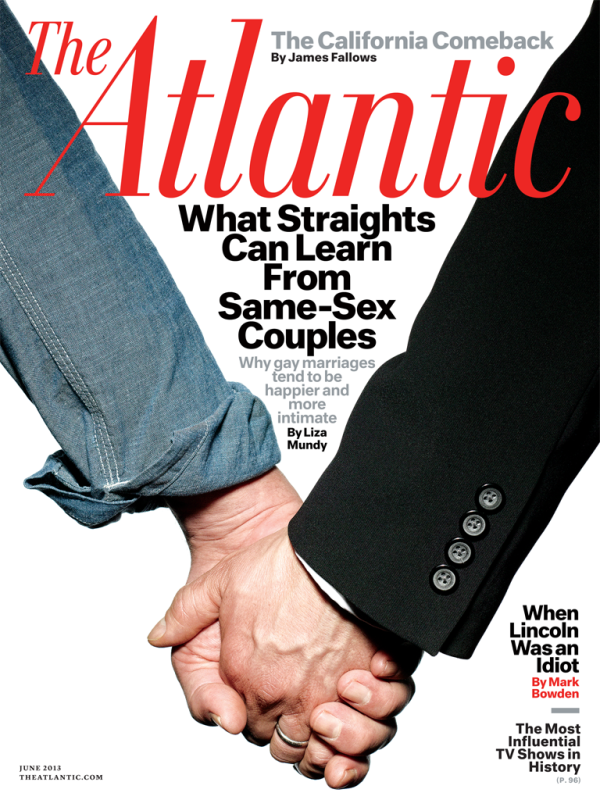
Relatedly, anyone else notice the cover story in the latest issue of The Atlantic?

In “The Gay Guide to Wedded Bliss,” Liza Mundy asks, “What can gay and lesbian couples teach straight ones about living in harmony?” and “What if same-sex marriage does change marriage, but primarily for the better?” She points out (as many feminists and queer folks have been doing for, um, decades):

Same-sex spouses, who cannot divide their labor based on preexisting gender norms, must approach marriage differently than their heterosexual peers. From sex to fighting, from child-rearing to chores, they must hammer out every last detail of domestic life without falling back on assumptions about who will do what. In this regard, they provide an example that can be enlightening to all couples. Critics warn of an institution rendered “genderless.” But if a genderless marriage is a marriage in which the wife is not automatically expected to be responsible for school forms and child care and dinner preparation and birthday parties and midnight feedings and holiday shopping, I think it’s fair to say that many heterosexual women would cry “Bring it on!”

I have to say, painting a picture of same-sex couples “hammering out” our domestic lives makes it sound like we’re drawing up intensive prenups and chore charts. Perhaps some people do (and if it helps you, go for it)! In my experience, it’s more just the freedom from falling into cultural patterns of “wives cook, husbands wash up” (my grandparents’ pattern), or “husbands wash the car and mow the lawn, wives do laundry and remember family birthdays.” In our case, we’re also aided by the fact that both sets of (hetero) parents were mindfully and/or of necessity non-traditional in their spousal roles — something that I think is often overlooked when people ask why some relationships are more egalitarian than others: parental modeling! (Perhaps because, sadly, it’s still a rarity.)

I have grumbles about The Atlantic penning this article as if it’s a possibility that’s just occurred to them — what queer folk might have something to offer the wider world! And I’m also slightly irritated (paradoxically, it seems) for the framing of marriage equality as a “control group” for heterosexual marriage. Um — don’t we get to simply exist without being one half of a scientific experiment.

Also, what’s up with the sudden resurgence in mainstream articles hauling up the myth of “lesbian bed death” from the murky depths? First last week’s woefully glossy and irritating NYT magazine article on female arousal, and now this, where a researcher suggests that the “lesbians [in her study] may have had so much intimacy already that they didn’t need sex to get it.”

… O_O

That suggestion implies a) that women use sex to gain intimacy or they don’t need it and therefore, b) there may be such a thing as “so much intimacy” that you kill your sex life.

O_O …

This is just such a limited understanding of the role of sex in human life that I can’t even.

But I’m also struck by the fact that a publication as culturally staid, if not hard-core conservative, as The Atlantic, has published such an article — a mere sixty years after the August 1953 issue of ONE Magazine was held for three weeks by the post office while they tried to determine whether it was violating U.S. obscenity laws.

Anyway. Have you read the Atlantic piece? If so, what did you think of it?

marriage equality and female suffrage: step by step change

15 Wednesday May 2013

Posted by Anna Clutterbuck-Cook in my historian hat

≈ Leave a comment

Tags

history, marriage equality, politics

So I haven’t written anything about the recent state-level victories in the push for equal marriage rights for same-sex couples. But congratulations Rhode Island, Delaware, and Minnesota! We have friends in all three states who are feeling better about their country now, because their state legislatures have chosen to be more welcoming in the face of family diversity and human sexual diversity. I can only hope this trend continues.

And of course we’re all waiting on tenterhooks for the DOMA ruling to be handed down by the end of the term.

As a historian, I’ve been watching the concurrent process of state-level victories and the DOMA challenge mindful of the way past struggles over the expansion of citizenship and constitutional protections have similarly progressed in fits and starts across our federated landscape.

Consider these two infographics:

(via)
(via)


I don’t have any Big Important Thoughts about this process at the moment, except to say that I think people who argue we should leave the process to the states ignore the important role that our national government plays protecting the rights of minority populations … and that people who are eagerly pushing for a national right to same-sex marriage sometimes ignore the symbiotic relationship between state and federal rights campaigns.

When this is all over, there will be a PhD dissertation in a comparative treatment of the woman suffrage and marriage equality campaigns (victories?!).

Addendum: It occurred to me, on my morning commute, that another parallel between the woman suffrage campaign and the marriage equality campaign is that both are specific issue campaigns that brought a diverse coalition of people with wide-ranging agendas together on one thing they could agree to push for. They are also both comparatively narrow victories that leave some folks unprotected (African-American women in the South; trans folks in many states) and run the risk of making it seem like all inequalities for a certain class of people have been swept away in a single moment.

The 19th Amendment, as we know nearly a century later, did not erase sexism and misogyny from our national landscape; marriage equality will not erase heterocentrism and anti-gay discrimination (as E.J. Graff points out in the link above). We would do well to remember that, even as we move forward in celebration.

← Older posts
Newer posts →
"the past is a wild party; check your preconceptions at the door." ~ Emma Donoghue

Recent Posts

  • medical update 11.11.22
  • medical update 6.4.22
  • medical update 1.16.2022
  • medical update 10.13.2021
  • medical update 8.17.2021

Archives

Categories

Creative Commons License

This work by Anna J. Clutterbuck-Cook is licensed under a Creative Commons Attribution 3.0 Unported License

Meta

  • Create account
  • Log in
  • Entries feed
  • Comments feed
  • WordPress.com

Create a free website or blog at WordPress.com.

  • Subscribe Subscribed
    • the feminist librarian
    • Join 37 other subscribers
    • Already have a WordPress.com account? Log in now.
    • the feminist librarian
    • Subscribe Subscribed
    • Sign up
    • Log in
    • Report this content
    • View site in Reader
    • Manage subscriptions
    • Collapse this bar