• anna j. clutterbuck-cook
  • contact
  • curriculum vitae
  • find me elsewhere
  • marilyn ross memorial book prize

the feminist librarian

the feminist librarian

Tag Archives: politics

a few more thoughts + cats and flowers

20 Saturday Apr 2013

Posted by Anna Clutterbuck-Cook in think pieces

≈ 9 Comments

Tags

boston, cat blogging, family, photos, politics, the personal is political

kumquats and plants in the kitchen window

Hanna and I are both finding today much more difficult, emotionally, than yesterday. Yesterday was a day of waiting: between 6am and about 7pm we were asked to stay indoors and essentially nothing happened apart from rampant media speculation.

Then at around eight in the evening, law enforcement officials caught the young man they were looking for hiding in a boat in Watertown.

He was taken to the hospital, injured, and will not be read his Miranda rights before being questioned.

this day needed flowers, so I went out and took pictures

Let me say, first, that I am grateful no more blood was spilled; no more life lost. I am glad that whatever threat this young man and his brother, killed in the chase, represented to the world is no more. I support preventing harm. I also support holding people responsible for their actions, though not through execution, so if Dzhokhar Tsarnaev is, in fact, responsible for the marathon bombings I hope he is tried and a just verdict rendered. I also understand why many, many people are angry and afraid — and why their first reaction is the desire for vengeance.

It’s just that I rarely think we should act on our first reactions, or even our second. Perhaps our third or forth thoughts ought to be listened to, but sometimes we must practice patience longer than that. And Hanna and I find ourselves dispirited by the amount of anger and vitriol being spewed across the Internet toward this wounded teenager who — presuming they have the right man — did monstrous things, but is also currently alone, in pain, and no doubt terrified.

magnolias outside our apartment building

We’ve had people tell us we are monstrous ourselves for trying to practice empathy for both victims and perpetrators simultaneously; for suggesting that just because someone has done evil deeds does not mean they deserve questionably legal treatment or abuse. Suffering is sometimes necessary, but never justified, never right. And I question the wisdom of wishing it hatefully upon another human being, even if he himself has allegedly inflicted vast amounts of suffering upon others.

We do not wish to become a mirror to the very violence we profess to abhor.

teazle in the sun

I realize I am a minority voice, at this moment, and that my desire to practice nonviolence is no doubt seen by many as foolish, a position born of privilege.

Perhaps this is so. I am a Bostonian: I work half a mile from Copley Square, the marathon finish line, and live in a neighborhood just across the river from Watertown. I am not speaking from a place of geographical abstraction from the events of yesterday. Yet I was lucky enough that everyone I knew running the marathon escaped unscathed; I did not spend yesterday with tanks or SWAT teams in my street.

But I believe it is part of what I can offer, in these troubling days: mindfulness, and attention to the fact that all of us are flawed and broken. That law enforcement can make mistakes and act violently, that the civil rights of murderers should not be treated lightly, and that even those who inflict suffering can suffer in turn.

I have been trying hard (and believe me — it is a discipline) to hold all those suffering, and all those struggling to make ethical decisions right now, in my thoughts and in my heart.

May we all move forward toward less hate and suffering.
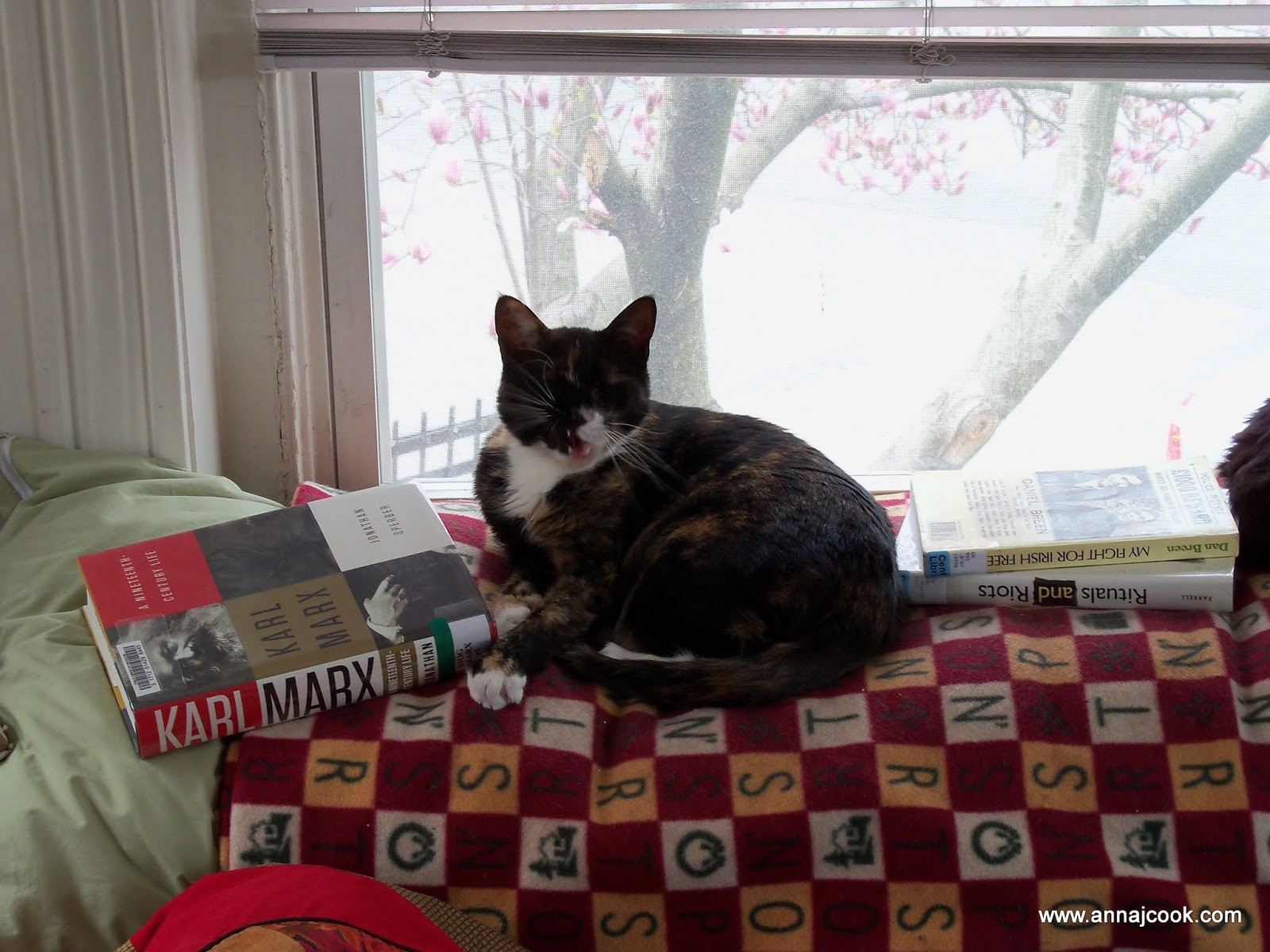
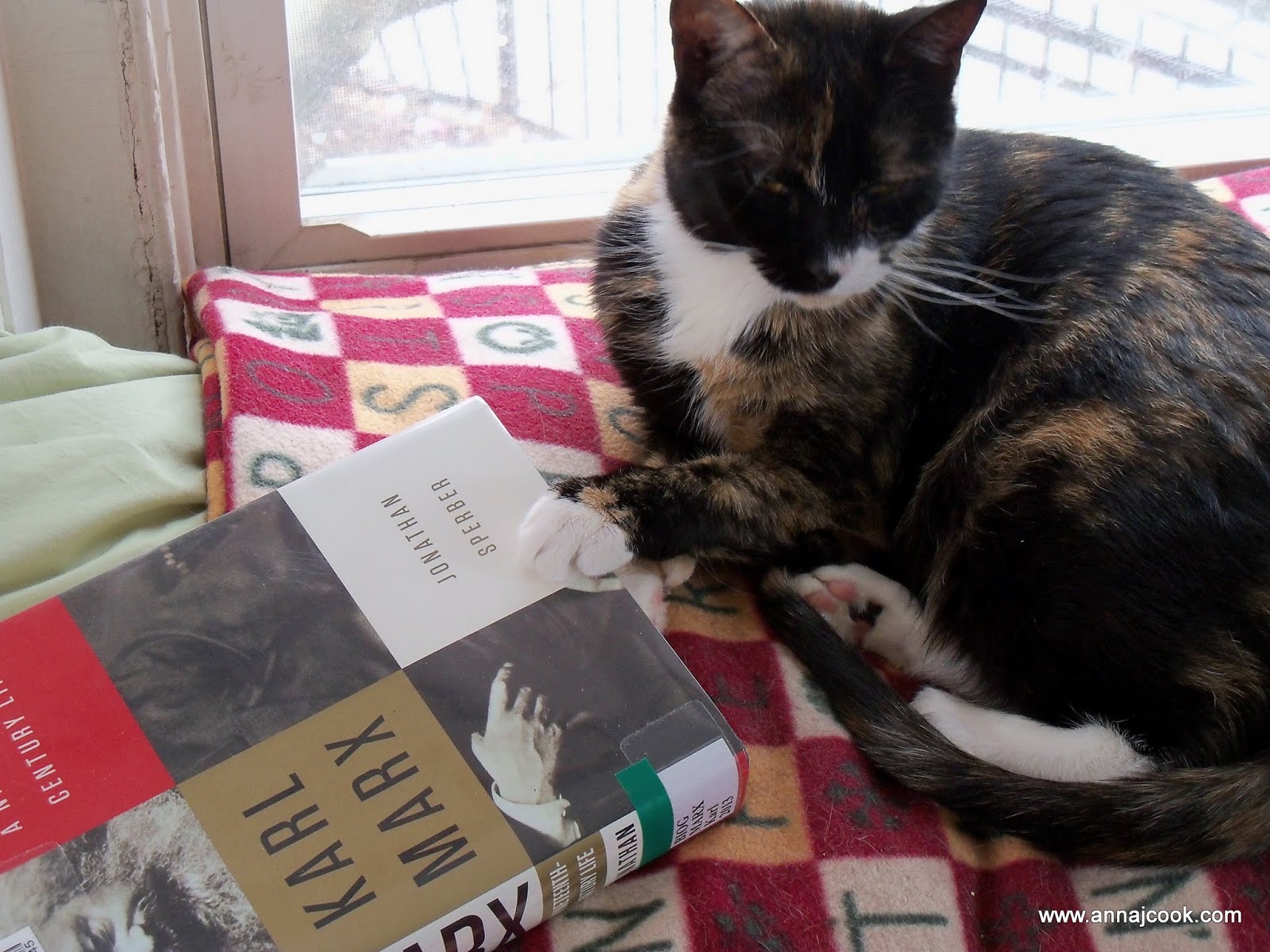
And obviously, more kittens.

 And books.
some thoughts

19 Friday Apr 2013

Posted by Anna Clutterbuck-Cook in think pieces

≈ Leave a comment

Tags

boston, domesticity, family, politics, the personal is political

flowering trees on the Charles River esplanade (May 2012)

Shortly before midnight last night Hanna and I started getting automated calls from Harvard University (Hanna works in their medical library) alerting staff to security concerns around MIT and in Cambridge and Allston-Brighton. Between midnight and six this morning we had maybe ten to a dozen such calls, making for a fitful night of interrupted sleep — as helicopters droned overhead and sirens wailed in the night air.

A phone call just before six announced the University closed for the day; when WBUR clicked on at six o’clock, we heard our neighborhood of Allston-Brighton was one of the communities in lock-down, with residents asked not to leave their homes, and all public transit was suspended until further notice.

As most of you have probably heard by now, during the night two young men robbed a convenience store near MIT and shot an MIT security guard who attempted to intervene. The two suspects in the robbery — now believed to be the suspects sought in relation to the Monday bombings at the Boston marathon — escaped in a hijacked SUV to Watertown where there was an exchange of gunfire and some explosives thrown from the vehicle. One of the young men was shot by law enforcement officers and died in hospital. The other is still at large — hence the city-wide shutdown as police attempt to track him down.

Hanna and I will be at home today. We are safe, with our cats, and the weather is beautiful. There is a coffee cake baking in the oven as I write this post.

The media, including NPR, are all going wild with speculations and scraps of information, so I’d like to take this opportunity to ask everyone to exercise patience as we wait. Patience, and hopeful intention that violence will not begat more violence.

Initially, people — at least three of them — died in the bomb blasts on Monday; the first act of violence. Over one hundred were injured, and currently struggling to heal.

One of those hundred-plus injured was a young man from Saudi Arabia whose ethnicity and presence at the scene of the blasts (“running while Saudi”) led to further acts of violence: instead of being offered help and care for his injuries he was tackled to the ground, his apartment searched aggressively by investigators. It took them hours to clarify that he was not a suspect while the media coverage ran with the story of Islamic terrorists — our favorite scapegoat du jour.

Then we had a high school track star, also darker skinned, who was the media’s latest potential threat. His crime was, also, existing in public while young and male and not White.

Now we have these two young men, reportedly Chechen (the original Caucasians!), whose actions — taken in a metropolitan area on edge — have begat more violence. Obviously, their killing of the MIT security guard was wrong, and their actions in the wake of being caught in the midst of a robbery are only furthering the damage done.

But I worry about the way in which they’re being so strongly linked to the marathon bombings.

I worry about the fact that one of the men — said to be brothers — has already been killed, in turn, by law enforcement.

I worry about what investigators, in their drive to find the bombers, will do in haste and violently.

I worry about the violence that may come from individuals and families that feel cornered.

While it is plausible, certainly, that these two young men from the 7-11 robbery were somehow involved in Monday’s bombings, let’s imagine for a second that they were not. Let’s imagine they were out on a Thursday night and decided to rob a store (poor plan, but hardly an act of terrorism). Because they had guns, when they got caught by a guard one of them panicked and shot — and killed. Now, of course, they’re in deep shit on a number of levels, so the panic escalates … and things get worse from there.

Again, perhaps the investigators have the right people. And regardless, even unconnected to the bombings, the young man still alive has participated in violence that warrants his arrest and trial for murder.

But I am skeptical enough of state power and the abuse of authority — and the mobthink that happens when a community reacts defensively against a (real or perceived) threat — that I will spend the day worried. And probably many days to come.

Today, I am going to try and hold in my thoughts all of the people caught up in this outbreak of violence. My hope is that we can prove the terrorists of the Boston marathon wrong by not becoming the world they sought to create: one in which violence begats violence and, exponentially, the trauma rises. My hope is that we will work with determination not to respond with force that mirrors the violence of those who maimed and killed less than a week ago.

I’d like to feel proud of my country and my adoptive city in a way I wasn’t, so much, in the wake of 9/11 when our response was to go bomb Afghanistan and then start a war with Iraq.

So I will try to sit with hopeful intention, and work toward building a better — less violent — world.

BREAKING: new zealand lawmakers burst into song upon enacting marriage equality

17 Wednesday Apr 2013

Posted by Anna Clutterbuck-Cook in linkspam

≈ 4 Comments

Tags

family scholars blog, marriage equality, politics, web video

(thanks to Hanna for the link!)

 On Wednesday, local time, the New Zealand House of Commons Representatives passed a bill allowing same-sex marriage (they have had civil unions for same-sex couples since 2005).

Upon declaration of the passage of the bill, the chamber burst into song. Here is a video, which I think is adorable and absolutely made my day.

Congratulations New Zealanders of all sexual identities and relationship types!

cross-posted at the family scholars blog.

movienotes: footloose and flashdance

16 Tuesday Apr 2013

Posted by Anna Clutterbuck-Cook in media

≈ 2 Comments

Tags

friends, gender and sexuality, movies, politics

This weekend, Hanna and I had a 1980s dance (movie) party with friends A’Llyn, Nathan, and their 1-year-old sprog who — if his living room moves were any indication — is going to grow up to be the next generation’s Ren McCormack. We watched Footloose (1984), which has stood up surprisingly well, and Flashdance (1983), which has very much not — although maybe I shouldn’t talk since I never saw it in the actual 1980s and this was my first viewing. But those in the audience who had seen it as children confirmed that from an adult perspective it was even creepier than they remembered!

A few observations about first Footloose and then Flashdance. Spoilers below, fairly obviously, if you care.

Footloose I first saw at some point in my pre-adolescent period. The two things I remembered most vividly were John Lithgow’s performance as the small-town pastor (whom child-me loved to hate) and the scene where Lori Singer, playing the preacher’s daughter, climbs between her friend’s car and her boyfriend’s truck while they’re driving down a two-lane highway. It’s a scene meant to impress upon us that Ariel (Singer) is a thrill-seeking teenager, but mostly just terrifies me every time I have to watch it! Still, as I said above Footloose still has charm and, think time around, I was struck by a few things I hadn’t noticed, or experienced differently, as a child.

  • John Lithgow’s pastor, Rev. Moore is less fire-and-brimstone than he is sad as a character. In fact, we took to referring to him as “sad John Lithgow” every time he showed up in a scene. The film-makers couldn’t seem to decide whether they wanted to make him a petty tyrant or a fearful father … and ended up trying to go for both with only middling success.
  • Kevin Bacon’s Ren is, like, the most polite Big City Rebel ever. Seriously. He wears a suit and tie to school on his first day, and when he decides to enlist the high school seniors to defy the town prohibition against dancing he … wears the suit and tie to a town council meeting and reads a speech in defense of their case. He refuses to smoke pot, even when a local bad boy foists a joint on him, and chills with his little cousins. 
  • Domestic and intimate partner violence get a look-in, although not much of a mention. On the one hand, we have John Lithgow’s character smacking his daughter across the cheek for talking back to him (probably part of what cemented him in my childhood head as an Evil Character). On the other, we have Ariel’s truck-driving boyfriend who beats her up when she breaks up with him. She takes a pipe out of the back of his truck and smashes his windshield and headlights. He gives her a bloody nose and a black eye. The situation is clearly being set up as the negative contrast to Ariel’s eventual relationship with Ren, but it’s also treated like a weird side-point that’s never substantively addressed.
  • The teenagers get a surprising amount of support from the surrounding adults — for a town where supposedly dancing is Of The Evil. Ren’s mother is fired from her job at one point because her son is causing trouble, and the relatives they’re staying with get momentarily judgy. But, like, the mill owner Ren works for after school offers his building for the dance, and Mrs. Moore sticks up for her daughter and the other students at a couple of key points. 
  • Reverand Moore draws the line a burning books from the library, which is sweet but also makes his prohibition against dancing as a sin nonsensical. He’s set up at the beginning of the film as the Big Baddie, only to emerge toward the end as one of the primary advocates for the teens. It’s disconcerting.
  • And Ren McCormack has more chemistry with his new BFF, Willard, than he ever has with Ariel. The scenes where Ren is teaching Willard to dance have more spark in them than any other scene in the film, frankly, and I’m started to find that there is no fan fiction fleshing this romance out on AO3. Fan writers, you’ve let me down!

So overall, Footloose is dated and cheesy — but aged surprisingly well.

The same can most decidedly not be said for Flashdance, which sadly starts out with the promising fact that its female lead, Jennifer Beals plays a welder named Alex Owens who — in addition to holding down a solid, skilled (and I’d bet unionized) working-class job — dreams of successfully applying to the Pittsburgh Conservatory of Dance. Even the fact that Alex moonlights as an “exotic dancer” (but OMG not a stripper!!) wouldn’t on the face of it be enough to kill the film — this could have been one of your predictable “triumph over obstacles”-cum-marriage-plot movies, wherein the girl wins the guy and the chance to study ballet at the school of her dreams.

But.

BUT.

  • There’s this small problem with the love interest being her boss at the building site where she’s working. And, like, a major stalker with the world’s creepiest vibe ever. Starting with the fact that he approaches her at work the day after having seen her dance at the dive bar where she works. So, you know, his interest in her as a person has this double creeptastic factor of “I’ve seen you dance practically naked and I thought that was hot, wanna date?” blended with, “I’m your boss and I’ve just disclosed to you, on the job where I’m supervising you, that I showed up to watch you dance practically naked and I thought that was hot and want to date you.”
  • Ms. Owens (yay feminism!) tells him quite firmly no, she doesn’t date the boss. So he follows her home from the site at night in his car, while she’s riding her bike, and propositions her again. When she insists she doesn’t date the boss he fires her so they can do on a date together the following night.
  • Although she blows him off, she apparently thinks better of it ’cause the following night they’re on a date!
  • And on that “first date” there’s this truly excitingly horrible you-can’t-look-away-from-it scene wherein Alex takes Mr. Manager back to her (loft porn!) apartment for pizza and walks back into the living area in a black negligee and grey warm-up sweater (see DVD cover photo) and proceeds to take her bra off from under her sweatshirt. Our entire audience sort of couldn’t believe it was happening. Not that slutting it up for your partner isn’t fun sometimes, but this was a first date with a stalker boss and the whole thing felt way too close to a professional strip tease. (Needless to say, they proceed to have sex.)
  • Long story short, she continues to perform sexually for him (and I’m framing it like this deliberately — all of their private interludes are echoes of her on-stage performances) and lo and behold he has connections at the Conservatory. So he makes a few calls and she gets an audition!
  • Although Alex protests, nominally, over the wheeling and dealing, in the end she goes to the audition anyway and presumably wins a spot in the Conservatory. We never actually get to find out, since the closing shots are of her making out with her sugar daddy.
I think what was so frustratingly, jaw-droppingly bad about Flashdance was that with a few tweaks it could have been a charming, though obviously cliched, romantic comedy. Make the love interest someone other than her boss. Make him someone who didn’t proposition her after seeing her perform. Make it clearer what dancing means to her, and dis-entangle the patronage from the romantic relationship. Could her boss at the construction site see her perform and, oh, incidentally, know someone who knows someone … without sex being used as such overt currency? So it was like two degrees away from being a movie that was meh but not actually cringe-inducing, and ended up just being bad. No cookies, people. No cookies.
Next time around, I think we’re gonna go with Alien and Terminator.

adventures in being (gay) married: filing our tax returns

15 Monday Apr 2013

Posted by Anna Clutterbuck-Cook in think pieces

≈ Leave a comment

Tags

married life, politics

As we were married in September, this was our first tax year filing as (gay) married folks instead of white bread single people. And basically, it’s a mess. It’s such a mess that when you Google “same sex marriage tax filing” or similar, you get directed to a bunch of information by sites like H&R Block and TurboTax that describe the situation and basically end up saying, “We don’t exactly know — but it’s complicated.”

So I thought I’d share a little about our process: how it worked, what my frustrations (as the preparer for our household) were, and how we actually came out in the tax department as a (gay) married couple versus what the numbers would have been like had we been possessed of more, shall we say, diverse anatomy.

(via)

THE PROCESS:

We talked to a bunch of people, and poked around online, and basically it boiled down to this:

1. We each had to prepare and file federal tax returns “as if” single, because thanks to DOMA the federal government thinks we are single — or is at least legally bound not to recognize our marital status.

2. Then, we had to prepare a third federal tax return as a married couple — but not file it. This return provided the calculations for completing…

3. … our forth form, the state return, for which we could file as married (because we are). We could have chosen “married, filing jointly” or “married, filing separately.” This year, we chose to file jointly. To be certain whether this was the optimal choice, we would have had to complete two additional forms and I just didn’t have it in me.

So once we’d gathered all the necessary forms and numbers (W-2s, 1099-Misc, 1098-Es, proof of health insurance, professional expenses, etc.) it was time to get started.

I chose to go with TurboTax again, as I have for the past five years or more, mostly because I’m familiar with the interface and I didn’t want one more new variable to work with. I use the online version, Free Federal and Basic editions (we had to use Basic for Hanna’s federal and our joint return because some of Hanna’s income is technically self-employment income).

TurboTax does offer a desktop edition that, they claim, can streamline all of this same-sex marriage filing hijinks, but I was wary of upselling — if you’ve ever used TurboTax, you’ll know they take every opportunity to promote the next level of service / additional products that add to your bill. We could have saved some fees this way, so if we’re still in DOMAland next year, I’ll probably go with the desktop version.

In order to file while (gay) married online you have to open three separate accounts: one for each of your federal returns, and one for the married state return. Each of these will entail fees based on the level of complexity of your return. For ours, we paid for one Free Federal ($32.99) and two Basic ($56.98), for a total of $146.95.

Remember: TurboTax charges for preparing not filing your taxes, so in all cases you’ll be paying the fees for both federal and tax forms, even if though you will not be filing half the returns prepared.

As a straight-married couple, we would have paid only $56.98 to file a joint return through TurboTax online.

I won’t go through the step-by-step of entering your information — y’all know how to do this. TurboTax is occasionally over-helpful, occasionally under-helpful when it comes to the same-sex marriage situation. The interface repeatedly reminded me not to file the “dummy” state and federal returns, but when it came time to actually file them, I had to check and double-check and force them to let me “print to file by mail” the returns we weren’t actually filing. There was no option to simply not file due to being gay married. And, as I pointed out above, even though there’s no need to prepare or file individual state returns, TurboTax wouldn’t let us not prepare them alongside our individual federal returns (an option which would have saved us about $65.00).

So that was the TurboTax experience; what about the actual tax cost/benefit of being gay married?

THE NUMBERS:

Without getting into the tedious details, Hanna and I — as a couple — made a little over $54,000.00 this year as a household. I brought in slightly more and Hanna slightly less, a fact that only really matters (since we pool all our earnings in shared accounts) because at some point our marital status could determine which tax bracket we fall into — and if DOMA is still in place, we won’t be able to take advantage of that marriage entitlement.

For example, according to Wikipedia, as a single person (my federal legal status under DOMA), my tax rate jumps from 15% to 25% once my annual income is above $36,250 — which it will be for the 2013 tax year. As a married couple, our tax rate would stay at 15% until our combined income rose above $72,500. This difference was established back when the majority of married couples had one earner (usually the husband) who brought in the primary income, while the other earner (usually the wife) brought in supplementary income. It’s an attempt to recognize that a married wage-earner with dependents to support, even if only a spouse with a lower income, often has more cost-of-living expenses than a single person: that $36k or $76k per annum has to go further.

Of course, at the level of income Hanna and I are bringing it, we aren’t seeing a yawning chasm between what we would have paid and what we actually paid. Between deductions for student loan interest payments, retirement savings, and health insurance premiums, the difference between our federal “as married” and “single” tax returns amounted to about $200.00.

In other words, without DOMA on the books we probably could have bought that armchair from IKEA we’ve got our eye on.

According to TurboTax, our “effective tax rate” (once all our deductions and credits are taken into account) as a married couple would have been 7.66%. Hanna’s “as single” effective tax rate this year was 6.08% this year and mine was 9.09%. Basically, for our household, filing as married would be the most accurate reflection of the fact that our financial resources are pooled, supporting two adults (and two cats!) equally rather than one individual and another individual

There are people who argue that such marriage-based tax benefits (or, for some, “penalties”) should be abolished. They certainly have a case to make. But the point is that under current tax law and DOMA, Hanna and I are treated differently from other married couples solely on the basis of our sex.

politics, pornography, and combating queer isolation

28 Thursday Mar 2013

Posted by Anna Clutterbuck-Cook in think pieces

≈ Leave a comment

Tags

education, family scholars blog, gender and sexuality, politics, smut

cross-posted from the family scholars blog.

Conner Habib, an actor who performs in gay male pornographic films, was recently invited by a student group at Corning Community College (Corning, NY) to speak on sex and culture. When the college president found out that Habib, in addition to being a thoughtful and articulate human being, had appeared in erotic film, she took steps to cancel Habib’s talk and has apparently moved to further obstruct attempts to host the talk in a non-college-sponsored locale.

Habib has written an excellent piece about his own perspective on these events which can be read in full over at BuzzFeed. In the essay he reflects on the place pornographic materials have in mitigating the isolation sexual minorities can experience, particularly in rural areas. He writes:

Where I grew up, just outside of Allentown, PA, I watched, right through my adolescence into adulthood and early college years, while straight people paired off and experienced sex. They were able to engage with a basic aspect of human life that seemed unavailable and distant to me. Unlike today, there was no discussion about gay marriage, nor were there many gay characters on TV. But even if there had been, neither would have rounded out my experience as a man with homosexual feelings because so many of those feelings were — unsurprisingly for a young man — sexual. Gay sex was a lonely venture. It wasn’t easy to find, and was only mentioned in slurs and the butt of jokes. … Whether I bought it from the adult video store or, later, downloaded it, gay porn helped me encounter positive images of gay men enjoying the act of sex. Gay porn was a window into gay sexuality that was free of shame and guilt, and revealed a different world where sex wasn’t a lonely prospect, confined to the shadows or just my imagination.

Habib describes how, being a man of Arab descent, he receives fan mail from gay men in Middle Eastern countries who “[express] gratitude and relief for my having portrayed gay sex in a positive light on camera.”

Continue reading →

booknotes: from the courtroom to the altar

21 Thursday Mar 2013

Posted by Anna Clutterbuck-Cook in book reviews

≈ Leave a comment

Tags

gender and sexuality, history, marriage equality, politics, scotus junkie

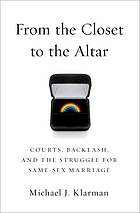
I have book review out in the most recent issue of NEHA News (Spring 2013, vol. 39), the bi-annual newsletter of the New England Historical Association. This time, the title is Michael J. Klarman’s From the Closet to the Altar: Courts, Backlash, and the Struggle for Same-Sex Marriage (New York: Oxford University Press, 2012). You can read the full review in the PDF version of the newsletter, but here’s a snippet to whet your appetite:

In his most recent work, legal historian Michael J. Klarman (Harvard Law School) turns his attention from the role of the courts in ending racial segregation (From Jim Crow to Civil Rights: Brown v. Board and the Civil Rights Movement) to the history of gay rights activism — specifically the legal struggle around same-sex marriage. Klarman explores how gay marriage emerged as a key marker for both pro- and anti-gay sentiment, and assesses “the costs and benefits of gay marriage litigation” as a path toward greater social justice. As a scholar of Constitutional history, Klarman is particularly keen to understand the role of judicial opinion and court action in changing public sentiment (and, conversely, the role of public sentiment
or action in changing judicial reasoning or decisions). 

You can read the whole thing thanks to NEHA’s willingness to make their newsletter available online for free!

fun with amicus briefs! [doma & the supremes]

11 Monday Mar 2013

Posted by Anna Clutterbuck-Cook in think pieces

≈ 2 Comments

Tags

children, doma, family scholars blog, gender and sexuality, marriage equality, politics, religion, scotus junkie

cross-posted from the family scholars blog.

http://lesbianweddings.tumblr.com/post/12741646344
(via)

Thanks to Amy’s recent post that linked to John Culhane’s piece on the importance of amicus briefs, I spent a nerdy afternoon this past weekend browsing through some of the many briefs submitted to the U.S. Supreme Court in relation to the two same-sex marriage cases that will be reviewed by the court this session. They are all available to read in PDF at the American Bar Association’s website; you can also find a list at the SCOTUSblog. I thought I’d share a few highlights with you. Of particular interest to the folks at Family Scholars might be the brief submitted jointly by the Family Equality Council, Colage, Our Family Coalition, Gay, Lesbian, and Straight Education Network, the Center on Children and Families,  the Child Rights Project, and Sarah Gogin. Together, they seek to represent the children raised by same-sex parents as well as young people who experience same-sex desire as they look toward a future forming adult relationships. They begin:

The voices of children raised by same-sex parents — those who live every day within the family structure at the heart of these lawsuits — are too often unheard in debates about same-sex couples and marriage. Their stories are too often missing from discussions of “traditional” families or “family values,” and their personal experience too often discounted as irrelegant. Although those who oppose marriage for same-sex couples frequently make assumptions about the quality of the children’s family lives, the children themselves are rarely asked to explain what they actually experience.

Throughout the brief, they foreground the voices of young people who are growing up with LGBT parents, and their list of “authorities” (the brief equivalent of a bibliography) offers a valuable starting point for thosee interested in learning more about the experience of people who have grown up within LGBT households. As the brief asserts,

Although the Proponents [of Proposition 8] claim an interest in stabilizing the American family structure, the elimination of marriage for same-sex couples in California and the refusal to recognize valid married couples on the federal level have the exact opposite effect. Placing an official stamp of governmental opprobrium on the relationships of same-sex parents instead serves to stigmatize and de-legitimize the relationships, and, as a result, the children themselves.

Not to mention, the children of our nation who will grow into adult same-sex desires and relationships:

By officially sanctioning their exclusion from marriage and placing existing marriages of same-sex couples in the singular position of being “not marriages” for federal law, these measures exacerbate feelings of hopelessness about the future and perpetual “different-ness” that many LGBT youth already feel and discourage them from aspiring to full participation in civic life.

As an historian, I was also pleased to see both the Organization of American Historians (OAH) and the American Historical Association  (AHA) had filed briefs discussing the history of marriage law in the United States. The AHA draws on the scholarship of its professional membership to make several key arguments: that the federal government has historically deferred to state law when determining marital status; that the meaning of marriage is not limited to procreation; that marriage practices have changed over time, and that this is a strength not a weakness of marriage as a social institution. From their summary of the arguments:

Control of marital status is reserved to the states in our federal system. Marriage has always been understood as a civil contract embodying a couple’s free consent to join in long-lasting intimate and economic union. In authorizing marriage, states turn a couple’s vows into a legal status, thus protecting the couple’s bond and aiming moreover to advance general social and economic welfare. Throughout U.S. history, states have valued marriage as a means to benefit society. Seeing multiple purposes in marriage, states have encouraged maritally-based households as advantages to public good, whether or not minor children are present, and without regard to biological relationships of descent. …For two centuries before 1996, state marital diversity reigned, along with serious inter-state contestation, without Congress stepping in to create marital “uniformity” for federal purposes. Congress never took a position on a marital eligibility question pre-emptively so as to discredit a policy choice that a state might make. Before DOMA, federal agencies assessed marriage validity by consulting the relevant state laws. In historical perspective, DOMA appears as an attempt by Congress to single out particular state-licensed marriages for disfavored treatment.

The OHA, in a brief filed with the American Studies Association, takes up a slightly different aspect of the case.  They outline the history of discrimination towards sexual minorities in the United States, and pointing toward legal precedent for taking history into account when assessing the full weight of discriminatory practice:

As professional organizations devoted to the study of American history and culture, amici are not before the Court to advocate a particular legal doctrine or standard. But they wish to advise the court that the historical record is clear. Gay men and lesbians in America have been subjected to generations of intense, irrational, and often violent discrimination, commencing as soon as they emerged as a group into American public consciousness and continuing today.

The NAACP Legal Defense & Educational Fund reminds the court of its historic role in guaranteeing equal protection rights to all citizens, asserting that “The role of the courts is to safeguard the rights of historically subordinated groups by applying heightened scrutiny to laws like DOMA, that disadvantage them as a class.”

And finally, it was also heartening to see a number of briefs from religious organizations supporting marriage equality, including one filed on behalf of a truly heartwarming number of faith traditions: the Bishops Of The Episcopal Church In The States Of California, Connecticut, Iowa, Maine, Maryland, Massachusetts, New Hampshire, New York, Vermont, and Washington and The District Of Columbia; The Jewish Theological Seminary Of America; Manhattan Conference Of The Metropolitan New York Synod Of The Evangelical Lutheran Church In America; The Rabbinical Assembly; The Reconstructionist Rabbinical Association; Reconstructionist Rabbinical College; Rabbi Akiva Herzfeld Of Shaarey Tphiloh; The Union For Reform Judaism; Unitarian Universalist Association; United Church Of Christ; The United Synagogue Of Conservative Judaism; Affirmation; Covenant Network Of Presbyterians; Friends For Lesbian, Gay, Bisexual, Transgender, And Queer Concerns; Methodist Federation For Social Action; More Light Presbyterians; Presbyterian Welcome; Reconciling Ministries Network; Reconciling Works: Lutherans For Full Participation; and Religious Institute, Inc. (yes really!). Their premise is:

Americans are a religious people, but diversely so. Religious adherents differ on contentious issues, and religious bodies have themselves evolved and disagreed over time — on marriage as well as other civil rights and social issues. In view of that history and the wide range of modern religious thought on same-sex unions, it would be a mistake to elevate any one view on marriage above all others as the “Christian” or “religious” view. Indeed, it would be constitutionally inappropriate, because civil marriage is a secular institution … and the Constitution bars the government from favoring certain religious views over others … Religious freedom means that all voices may contribute to our national conversation, but particular religious perspectives on marriage cannot be permitted to control civil recognition of marriage for all.

These highlights represent just a handful of the perspectives filed with the court, and I encourage all of you to go explore on your own — and share what briefs spoke to you, and why, in comments.

quick hit: american sociological association on same-sex parenting and child outcomes

01 Friday Mar 2013

Posted by Anna Clutterbuck-Cook in linkspam

≈ Leave a comment

Tags

children, family scholars blog, gender and sexuality, politics, scotus junkie, sociology

cross-posted at the family scholars blog.

via Religion Dispatches.

The American Sociological Association has filed an amicus brief in the Proposition 8 case pending before the U.S. Supreme Court strongly supporting marriage equality as a positive step for child well-being. They also offer an extensive critique of the Regnerus study used in other amicus briefs as support for upholding the ban on same-sex marriage.

You can read the entire 32-page brief here (PDF) and Peter Montgomery at Religion Dispatches, above, discusses the critique of the Regnerus study specifically, with lengthy excerpts.

Here, I thought I would share the succinct conclusion from the brief itself:

The social science consensus is both conclusive and clear: children fare just as well when they are raised by same-sex parents as when they are raised by opposite sex parents. This consensus holds true across a wide range of child outcome indicators and is supported by numerous nationally representative studies. Accordingly, assuming that either DOMA or Proposition 8 has any effect on whether children are raised by opposite-sex or same-sex parents, there is no basis to prefer opposite-sex parents over same-sex parents and neither DOMA nor Proposition 8 is justified. The research supports the conclusion that extension of marriage rights to same-sex couples has the potential to improve child wellbeing insofar as the institution of marriage may provide social and legal support to families and enhances family stability, key drivers of positive child outcomes. The Regnerus study and other studies relied on by BLAG, the Proposition 8 Proponents, and their amici provide no basis for their arguments, because they do not directly examine the wellbeing of children raised by same-sex parents These studies therefore do not undermine the consensus from the social science research and do not establish a “common sense” basis for DOMA or Proposition 8.

While I would be the first to agree that just because something is said by a professional organization that doesn’t make it true (exhibit A: the classification of homosexuality as a pathological disorder), it is true that professional consensus backed up by a body of literature that consistently demonstrates a set of outcomes requires an equally strong body of evidence to refute. And the anti-equality spokespeople are not offering up that body of evidence.

I encourage those interested to at least skim through the ASA brief.

movienotes: les miserables

22 Tuesday Jan 2013

Posted by Anna Clutterbuck-Cook in media

≈ 2 Comments

Tags

fanfic, feminism, history, movies, politics

I have some book reviews I need to write for books I’ve read this month, and a third “why I write fic” post in the queue, but I just got back from a weekend with my sister in the beautiful Austin, Texas, and my brain can’t seem to form coherent-yet-complex thoughts. So instead, I’m going to offer up a few observations about the film version of Les Miserables that I saw in the theater the weekend before last.

Javert (Crowe) and Valjean (Jackman)

I saw the musical once before, live, when I was in London in January of 2004. My principle memories at the time involve enjoying the music (I’m a life-long musical theatre fan, so a good musical will always win me over in the end), being distracted by the book I’d picked up that day and brought with me to read during intermission (The Time-Traveler’s Wife), and my surprise at the fact that the emotional-relational through-line for the story is not the second act marriage-plot between Marius and Cosette but the connection forged between Jean Valjean and Inspector Javert. It is their dance of power, desperation, obsession, compassion, forgiveness, and despair that drive the plot from start to finish. Hugo’s novel is that 19th century classic the Social Problems Novel and, and is — I’m sure I am far from the first to remark upon this! — a queer choice for musical theatre.

Fantine (Hathaway) selling her hair.

A few thoughts in no particular order:

  • Women, work and society. The film version of Les Mis had some really interesting (largely visual) observations to make about women and work. There’s Fantine, Anne Hathaway’s character, who is working in a factory to pay for her daughter’s care. Rumored to be a slut, and punished by the foreman for being a single mother, she’s cast onto the streets and sells her hair, teeth, and sex before succumbing to consumption. Her daughter, Cosette, has been boarded out as a laborer herself, working for a couple running an inn (the buffoonish and cruel Thenardiers). While Cosette is rescued by Valjean and ascends to the middle class through marriage (one could argue a certain kind of “wage work” in its own right, certainly an economic decision), her age-mate Eponine Thenardier — abused by her parents and pining after Cosette’s lover — cross-dresses as a boy to join the revolution and ultimately dies on the barricade. On the periphery of the story drift prostitutes, beggars, and female religious who serve as nurses and also offer refuge for Jean Valjean at various points throughout the story. When the student revolutionaries are shot by French soldiers, the uprising put down, it is women who are left to scrub down the blood-filled streets. Overall, Les Mis hammers home in multiple ways the limited options for the vast majority of women in 19th century France. True, there were limited options for most people living in France at that time — but this film adaptation does a good job of highlighting the way women’s sex/gender limited them in particular ways.
  • Futility of revolutionary action? Throughout, the film/musical has a deeply ambivalent relationship to the politics of its student revolutionaries. Marius’s boyfriend Enjolras is a charismatic and idealistic young Parisian student who, with a group of peers, orchestrates a violent rebellion (based on a real historical incident) that ultimately fails and leaves everyone — save Marius, rescued by Jean Valjean for his adopted daughter’s sake — dead. In Hugo’s world, the violence of the state (personified by Javert; more below) is responsible for the wretchedness of virtually every character in the story, but political action is depicted as ultimately futile and deadly. Yet the film ends with a triumphant reprise of the rebels call to arms, with Fantine, Valjean, and all of the dead students waving tricolor flags high above the Parisian skyline. Have they … won? And if so, how? Is the film meant to suggest revolutionary action is ever-needed? If the next generation (Marius and Cosette) have retreated into bourgeois respectability — Marius’ father welcomes them in with open arms and throws a lavish party for their wedding — should this be considered a win? For whom? I have read some reviews that suggest Hugo’s narrative points toward interpersonal love triumphing over political action (again, more below) but if that is the thrust of the plot it is an unsatisfying one: many people, even many “deserving” poor, die or are left in desperate poverty despite benevolence (and occasionally actual care) extended to them by others. If I had to guess, I’d hazard that Hugo might imagine that all attempts to improve the human condition on a large scale are doomed to failure, and that one-to-one interactions are our only — and ultimately futile — recourse.
  • Letting go of the next generation. As I wrote above, my first impressions of Les Mis is that it is a story about parents and letting go. Fantine, first, must let go of Cosette in order to provide for her (by going to work and leaving her with the innkeepers), and then ultimately must let her go when she dies and entrusts her to Valjean, a man she barely knows. She cannot know what her daughter’s future holds — for good or ill — and yet must depart. And then in the second act Valjean must let go of Cosette when she falls in love with Marius. While at first this loss is painful to him, and he tries to leave  the country with Cosette in tow, when he intercepts a letter from Marius to Cosette he regrets his actions and rescues Marius from the barricades. After the two children are engaged to be married, Valjean — his duty to his daughter complete, now she is in another man’s care — he departs to a monastery to die. We also have, of course, all of the children who die: Eponine and the students, including a young street urchin named Gavroche who is the first casualty of the day. The adults may believe these young peoples’ actions are foolish and futile, dangerous even, but the young people ultimately must forge their own paths.
  • The central romance in the story is between Valjean and Javert. So, okay, you don’t have to read their relationship as one long exercise in Unresolved Sexual Tension – but I certainly found it much more satisfying than the Marius/Cosette situation, let me tell you. Inspector Javert spends decades in pursuit of Valjean, obsessed with the man and fascinated/repulsed by the notion that the “criminal” Valjean (imprisoned for stealing a loaf of bread) could ever be anything other than a criminal. Valjean, whose religious conversion shortly after he is paroled helps him rebuild his life, tries to model a more nuanced morality for Javert (while, you know, evading re-arrest!) — and in the penultimate scene he succeeds. Given the opportunity to kill or capture Valjean, whom he has tracked into the Parisian sewers, Javert lets Valjean go. And is so shattered by his decision to let the rule of law go in the interest of human compassion that he commits suicide.
  • Oh, and the acting. I was really impressed with everyone in this cast, all of whom seemed to really be throwing themselves into their work both musically and acting-wise. At times, Hugh Jackman and Russell Crowe really seemed to be struggling with the score which surprised me — since I know Jackman, at least, is a strong singer. But I think that might have been a function of recording the songs live on-set rather than in a recording studio before or after the shoot. And Helena Bonham Carter and Sacha Baron Cohen as the odious Thenardiers were delightfully campy, offering some of the only comic relief around — and even then, theirs is a story that has a pretty tragic side if you linger more than a moment or two). 
And that’s all I got, folks. If you’re musical theater fans or fans of the Victorian “social problem” novel, I’d highly recommend seeing the film — preferably in the theatre since it truly is a spectacle of a movie musical. I know some people were really frustrated by the filming — the tendency to frame actors in the corner of the screen, or incompletely, but I actually like that technique for the way it makes you notice the composition of the shot, makes you realize a visual image is being constructed for you, rather than allowing you to feel you’re simply immersed in the action. Artifice, in this instance I would argue, works well with the musical genre.
← Older posts
Newer posts →
"the past is a wild party; check your preconceptions at the door." ~ Emma Donoghue

Recent Posts

  • medical update 11.11.22
  • medical update 6.4.22
  • medical update 1.16.2022
  • medical update 10.13.2021
  • medical update 8.17.2021

Archives

Categories

Creative Commons License

This work by Anna J. Clutterbuck-Cook is licensed under a Creative Commons Attribution 3.0 Unported License

Meta

  • Create account
  • Log in
  • Entries feed
  • Comments feed
  • WordPress.com

Blog at WordPress.com.

  • Subscribe Subscribed
    • the feminist librarian
    • Join 37 other subscribers
    • Already have a WordPress.com account? Log in now.
    • the feminist librarian
    • Subscribe Subscribed
    • Sign up
    • Log in
    • Report this content
    • View site in Reader
    • Manage subscriptions
    • Collapse this bar