• anna j. clutterbuck-cook
  • contact
  • curriculum vitae
  • find me elsewhere
  • marilyn ross memorial book prize

the feminist librarian

the feminist librarian

Tag Archives: religion

booksnotes: straight to jesus

02 Monday Aug 2010

Posted by Anna Clutterbuck-Cook in book reviews

≈ Leave a comment

Tags

gender and sexuality, religion

In which I review another one of what Hanna calls my “scary books.” This time, Tanya Erzen’s Straight to Jesus: Sexual and Christian Conversions in the Ex-Gay Movement. After hearing Tanya Erzen talk about her recent work on the religious experiences of Twilight fans on RhRealityCheck, I tracked down Erzen’s earlier work (originally her dissertation) based on a year-long ethnographic research project on New Hope, the United States’ oldest ex-gay ministry.

Straight to Jesus documents the personal experiences of those within the ex-gay movement and places their ideologies and practices within the context of the context of the religious, political and psychotherapeutic frameworks within which the ex-gay movement has come of age. Erzen argues that while gay rights advocates and the politicized Christian Right have become polarized over the question of whether sexual orientation is fixed or changeable, most ex-gay-identified individuals and their support networks resist the politicization of their sexual lives and instead focus on the spiritual transformation they experience through ex-gay programming. Just as Evangelical Christianity believes in the need for sinner to continually be born again and experience renewal in their relationship with Christ, so to (Erzen argues) ex-gay ministries see the process of becoming ex-gay as an ongoing cycle of confession and rededication which Erzen has termed “queer conversion.” She explains that

Although the political goals of the ex-gay movement and queer activists are radically distinct, by accepting that a person’s behavior and desire will not necessarily correspond with their new ex-gay identity or religious identity, ex-gay men and women enact a queer concept of sexuality (14).

What I found most fascinating in the book was the relationship between performing gender and straight sexuality. The gender and sexuality theorists of the ex-gay movement are, by and large, working with mid-twentieth century concepts of gender and sexual identity which associate homosexuality in men with what they see as effeminacy and homosexuality in women with characteristics they consider to be “butch” (like an interest in car repair). They also read male homosexuality as entirely physical — destined, regardless of the desire of the individuals involved to be a series of anonymous hook-ups — and lesbianism as entirely emotionally-driven — by its very nature “emotionally cannibalistic” because the women, rather than desiring each other sexually (women! wanting sex! don’t be ridiculous!), want to be one another (152).

Following this logic — that homosexuality is caused by a weak identification with one’s assigned gender — the ex-gay movement has incorporated lessons on gender performance into its therapeutic agenda. Women are taught to apply makeup and select clothing, men are taught how to interact with other men in a platonic fashion and play manly sports. In one particularly bizarre (to me, anyway!) exercise, the residents of New Hope’s “steps out” of homosexuality program are brought together with straight men and instructed to interview the straight men about how, essentially, to perform straight masculinity. Questions include “what physical aspect of the opposite sex turns you on?” and “Can a man ever fully understand a woman?” (108).

This approach essentially inverts the basic liberal-progressive concept of sex and gender, in which sex (one’s physical sex characteristics and sexual orientation) are biologically determined and “gender” refers to all of the ways we make meaning of those sexual differences, and the cultural roles we are expected to inhabit. Within the ex-gay movement, gender is the primary marker of identity, and deviating from the assigned gender roles of one’s sex is damaging to the very core of one’s identity — as opposed to one’s sexuality, which is seen as primarily about actions rather than core identity. (Obviously, there are lots of nuances and challenges to the sex/gender division within liberal-progressive circles, but I think the basic distinction here is valid, particularly when characterizing the mainstream liberal position).

I’m not particularly opposed to seeing sexuality as more mutable — indeed, many people within feminist, queer, pro-gay circles have been arguing for years that sexuality is much less set-in-cement than the simplistic biology-based way of understanding sexuality that the gay rights movement has so often chose (for strategic reasons) to emphasize. What seems harmful to me about the ex-gay position concerning sex and gender, however, is that they demand such rigid conformity when it comes to gender performance. This signals to me a fear of human diversity that will, in the end, become self-defeating … since human beings are, and (in my opinion) will continue to be a gloriously heterogeneous, both in sexual orientation and gender expression. To tell people who believe their non-straight sexual orientation and non-conforming gender identity endangers their relationship with God and Jesus is — to me — an act of violence. It is another instance in which the Evangelical God-as-abusive-parent narrative surfaces in a way that offers short-term relief (you can struggle with homosexual desires and not be exiled permanently from God’s love!) but ultimately the anguish of being judged and found wanting at the very core of your being.

"the scandal of our own non-necessity"

08 Thursday Jul 2010

Posted by Anna Clutterbuck-Cook in book reviews

≈ Leave a comment

Tags

politics, religion

On Tuesday, I posted a quote from Terry Eagleton’s On Evil. To risk appearing completely enthralled by Eagleton’s prose (which I admit are difficult not to delight in), today I’m sharing a passage from Holy Terror (Oxford: Oxford U.P., 2005), which Hanna recently finished and handed off to me.

I’ve talked briefly in a couple of recent posts about the meditation practice of metta, or “lovingkindness,” the Buddhist practice of extending intentions for well-being, peace, and and end to suffering toward all beings in the world. Even beings we do not like very much (or at all). Even ourselves. A friend of mine recently suggested this is similar to the Christian practice of “radical welcome” or “radical acceptence.” Both distinguish loving beings qua beings, so to speak, from loving individual beings in a more particular sense. I believe both types of caring — the more impersonal, unconditional love extended to all, and the particular liking of certain persons — are important. But I also believe that liking people, in a genuine way, really only takes root within the more disinterested, impartial sea of radical acceptence, or radical love.

Last week, I came across a passage in Holy Terror that speaks to the power of radical love. (Eagleton speaks from his background as a Catholic Christian, though I don’t believe the ideas need to be limited to Christian theology.)

Dionysus [in Euripides’ play The Baccae] offers men and women precious time off from their burdensome existence under the political law. We have seen already that such carnivalisque interludes are in the interests of the governing powers rather than an affort to them. As Olivia observes in Twelfth Night, there is no slander in an allowed Fool, no harm in jesters so long as they are licensed. When transgression is ordained, deviancy becomes the norm and the demonic finds itself redundant. This is why the devil finds himself with empty hands in the postmodern world. If Jesus’s law is light, however, it is not only because he, too, comes to relieve the labouring poor of their afflictions, but because God commands nothing more of his people than that they should allow him to love them.* Because he is the Other who neither lacks nor desires, unlike the Lacanian variety, he needs nothing from others, and his law is consequently free of neurotic compulsion and paranoid possessiveness. Ironically, it is God’s transcendence — the fact that he [sic] is complete in himself, has no need of the world, and created it out of love rather than need — that allows him to go so easy on his creatures.

God himself has the necessity of law, in that his being is not contingent. But this law, once again, is the law of love — for since nothing apart from God needs to exist, whatever does exist does so gratuitously, as a result of his unmotivated generousity. To say that things were created out of nothing means that they did not have to come about. The did not follow inexorably from some precedent, as elements of a causal or logical chain. Creation, in Alain Badiou’s terms, is an “event,” not a dreary necessity. The cosmos could quite easily never have happened. Instead, God could have devoted his considerable talents to, say, figuring out how to create square circles …

… Since religious fundamentalism is among other things an inability to accept contingency, the universe itself is a persuasive argument against such a creed. What fundamentalism finds hard to stomach is that nothing whatsoever needs to exist, least of all ourselves. For St Augustine, the fact that human beings are “created” means their being is shot through with non-being. Like modernist works of art, we are riddled from end to end with the scandal of our own non-necessity (p. 32-33).

*All bold passages are my emphasis, rather than Eagleton’s.

I am bewitched by Eagleton’s final passage here: “we are riddled from end to end with the scandal of our own non-necessity.” Why? Because our impracticality is the foundation upon which unconditional love is built: we do not have to be useful to be loved, we simply have to be. And this, indeed, is a radical claim.

A fuller meditation on both On Evil and Holy Terror will (knock on wood) be in a forthcoming booknote.

"autobiography is an exercise in self-forgiveness"; should it always be so?

07 Wednesday Jul 2010

Posted by Anna Clutterbuck-Cook in think pieces

≈ Leave a comment

Tags

books, politics, religion

One of our post-graduation presents for Hanna, one which I also get to enjoy the benefits of, was a subscription to the London Review of Books. The most recent issue includes a review of Christopher Hitchin’s latest book, Hitch 22, a memoir. Hitchins, like other public personalities who trade in sensationalism and putting other people down, is easy to dislike for his self-absorption and snobbery. When the memoir first came out, John Crace @ The Guardian crafted a “digested read” version that played on this propensity and had Hanna and I falling off our chairs with mirth.

I find I have written nothing of my wives, save that they are fortunate to have been married to me, and nothing of my emotional life. That is because I don’t have one. The only feeling I have is of being right, and that has been with me all my life. I would also like to point out that drinking half a bottle of scotch and a bottle of wine a day does not make me an alcoholic. I drink to make other people seem less tedious; something you might consider when reading this.

David Runciman, whose review of Hitch 22 has been made available at the LRB website, offers much the same analysis — though in much more analytical a tone. He observes that Hitchins appears to have cultivated the personality of a “political romantic, as described by early-twentieth-century author Carl Schmitt.

For Schmitt, political romantics are driven not by the quest for pseudo-religious certainty, but by the search for excitement, for the romance of what he calls “the occasion”. They want something, anything, to happen, so that they can feel themselves to be at the heart of things.

The problem with this, morally speaking, is that a romantic whose raison d’etre is not his ideals but “the occasion,” the question of values is irrelavent. Say what you will about the political idealist (and, living with an historian of Northern Irish nationalism I know there’s plenty to say!), at least someone who acts violently for the sake of their convictions is a person who is clear about where they stand. They are willing to claim allegiance to a set of values, and to work (at times to the death) to see those values put into action.

Now there are (to a person of my proclivities towards nonviolent political change) better and worse ways of trying to live out one’s beliefs. But I also believe there is some intrinsic value in having beliefs: in having enough self-awareness that you feel comfortable owning your beliefs, saying “this is where I stand and why.”

You might think that a person who has written, among others, a book titled Why God is Not Great is not shy about taking a personal stand, even a highly controversial one. But being provocative, rhetorically and otherwise, is not necessarily the same thing as being self-revelatory. One can speak highly-charged words while never allowing anyone to see the emotionally-complex human being behind those words. I find other peoples’ interior lives fascinating; my obsession with understanding how other people understand the world around them — how they make meaning of their lives — is what led me to history as a scholarly pursuit. Runciman’s argument about Hitchins, however, is that he has no interior life, or at least not one of which he himself is very aware or willing to share with his readers.

It certainly sounds like it has all been a lot of fun. His has been an enviable life: not just all the drink and the sex and the travel and the comradeship and the minor fame (surely the preferable kind), but also the endless round of excitements and controversies, the feuding and falling-out and grudge-bearing and score-settling, the chat-show put-downs, the dinner party walk-outs, the stand-up rows. Christopher Hitchens has clearly had a great time being Christopher Hitchens. But – and I don’t want to sound too po-faced about this – should anyone’s life be quite so much fun, especially when it is meant to be a kind of political life? Hitchens admits to some regrets, including that he has not been a better father to his children (and by implication a better husband to his wives, though he doesn’t actually say that), but he doesn’t seem to have agonised about it much. In fact, he doesn’t seem to have agonised much about anything. He doesn’t rationalise his political shifts so much as acquiesce in them: if it feels like he has no choice, then he has no choice but to follow his feelings. He has seen his fair share of misery and despair, and may have caused a certain amount of it himself, but it is entirely unclear what this has cost him.

I believe in extending compassion and possibly forgiveness towards oneself in equal measure as toward other human beings — being kind to yourself as you are kind to others is, truly, one of the ways in which we can make the world a more kind, generous, compassionate place. Yet when “autobiography is an exercise in self-forgiveness” (to borrow a phrase Runciman quotes toward the end of his essay) while the autobiographer neglects to extend all but highly conditional forgiveness to anyone else, such self-adoration seems a shallow, fragile thing indeed.

Go enjoy the rest of Runciman’s review, It’s Been a Lot of Fun, over at the London Review.

terry eagleton on the secret lives of children

06 Tuesday Jul 2010

Posted by Anna Clutterbuck-Cook in book reviews

≈ Leave a comment

Tags

children, politics, religion

I recently picked up Terry Eagleton’s book On Evil (New Haven: Yale U.P., 2010). I might at some point write a fuller “booknote” about the volume, and a related Eagleton book, Holy Terror (2005), which I am also reading. However, in light of some of my recent posts on children as people, I thought some of my readers might enjoy the following passage from the first chapter of On Evil.

We are ready to believe all kinds of sinister things about children, since they seem like a half-alien race in our midst. Since they do not work, it is not clear what they are for. They do not have sex, although perhaps they are keeping quiet about this too. They have the uncanniness of things which resemble us in some ways but not in others. It is not hard to fantasize that they are collectively conspiring against us, in the manner of John Wyndham’s fable The Midwich Cuckoos. Because children are not fully part of the social game, they can be seen as innocent; but for just the same reason they can be regarded as the spawn of Satan (2).

Setting aside the question of whether or not what he’s describing vis a vis actual children holds true — and whether, if it does hold true, to what extent such a situation is culturally created or “natural” — I think it’s fascinating to consider how strong our cultural perception of its reality is: children are read uas “other,” whether in the Romantics innocent ur-human sense or in the sense of Golding’s barely-repressed savage, “uncivilized” amoral bestiality.

evangelicals’ "defining story" = divine child abuse?: some reflections

25 Friday Jun 2010

Posted by Anna Clutterbuck-Cook in think pieces

≈ Leave a comment

Tags

books, religion, thesis

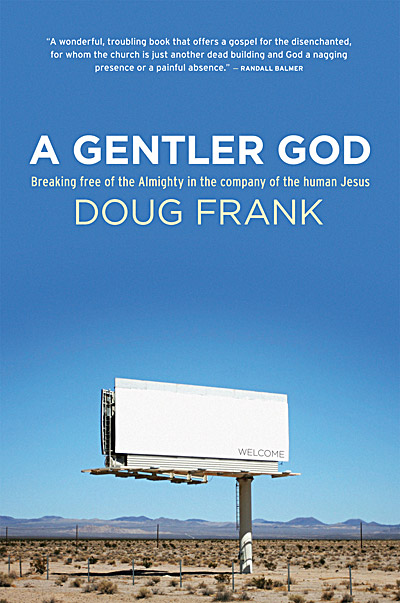
This is a rambling sort of post reflecting on Doug Frank’s recently-released A Gentler God: Breaking Free of the Almighty in the Company of a Human Jesus. Doug is one of the founding faculty members at the Oregon Extension, the community I am researching and writing about for my thesis. I might write a proper book review / booknote about A Gentler God at some point, but for now I want to share a story from my own history of interactions with the church — and Evangelicals particularly — that reading this book reminded me of, and helped me understand in a new light.

Despite growing up in culturally and religiously conservative Western Michigan, I was largely what they call “unchurched” as a child. My paternal grandfather was an ordained minister and professor of New Testament theology at Western Theological Seminary which is affiliated with the Reformed Church in America, a small but mainline protestant denomination. My father was, therefore, a preacher’s kid; my mother — raised by a lapsed Scotch Presbyterian and a Christian Scientist — was sent to Congregational Sunday school as a child and attended confirmation classes but never joined. My parents didn’t have us baptized and pretty much stopped attending church around the time my little brother was born (I was three) because the amount of nurturing they got out of church on Sunday wasn’t worth trying to parent small beings in a child-unfriendly space.

We didn’t return to Hope Church (my father’s childhood RCA congregation) until I was a teenager. We had a few reasons for doing so, including the fact that several of my more conservative, evangelistic friends had attempted to convert me (them: “have you accepted Jesus into your heart?” me: “uh … no.”) and my mother was hoping to inoculate us against fundamentalist, evangelistic theology by giving us a chance to learn the language and messages of Christianity and a scholarly, fairly liberal environment. To give you an idea of what this meant: the congregation had recently gone against denominational practice by ordaining a gay member as a church elder, they had already had a series of women ministers, they had an active pacifist group, and my feminist theology professor at college was a member.

I offer all of this as a preface to the story-story I’m going to tell you, which is about the husband and wife who served as youth group leaders for several years while I was attending Hope Church. This couple were way more theologically fundamentalist-evangelical and socially conservative than the majority of the congregation, and I’m not exactly sure how they landed the position of youth leaders (likely because they volunteered). I did childcare for the family regularly, but used to find myself at loggerheads with them (also regularly) about a number of issues including parenting, feminism, human sexuality, and theology.

And one day at either a youth group meeting or in a Sunday school class they offered — as if it were the best metaphor in the world for God’s love and the power of atonement (Jesus dying for our sins) — the following allegory (I’m paraphrasing from my own memory)

There’s a train full of passengers hurtling down a railroad track toward a bridge that has washed out. God is at the switchboard about to switch the rails so that the train goes onto a side rail (thus saving the passengers). But then suddenly his toddler son (Jesus) wanders out onto the side rail. God has to decide — train full of people or toddler son? And because God is so unselfish, he saves the train full of people rather than his own child.

What. The. Fuck.

That’s what you’re thinking, right? There are just so many things wrong with this story that it sort of stops you dead in your tracks.

This is the story that this couple — with three small children of their own, remember — told with passion and the clear expectation that we would be humbled by the boundless, sacrificial love of God. Whereas, of course, what character in this story is any human being (let alone a child!) going to identify with? The toddler! Whose own parent kills them in order to save a train full of unnamed, faceless persons. What child could possibly fail to be traumatized by a story that tells them the moral “right” is one in which their parent would not save them from death when they had the power to do so?

The take-away message regarding God and Jesus in this story is that God is a violent, murderous parent who has no overriding, irrational love for His own child. It’s a story of divine child abuse. And to me it was absolute crazy-talk.

Well, according to Doug, who describes this very story — or at least the collection of ideas embodied in this story — in the first part of A Gentler God, this is the “defining story” of modern American evangelism. Evangelical Christians, Doug argues, grow up in such close proximity to this story that they have trouble seeing its internal contradictions: the way in which a story that is trotted out to signify God’s boundless love for humanity actually tells a story about extremely conditional love and bloodlust. God demands bloodshed, which is why Jesus is required by God to die for our sins. How can we possibly square this with a God who cares for all of God’s creation unconditionally?

Well, you can’t, which is why Evangelicals (again, according to Doug and other scholars I’ve read) live on some level in perpetual fear of the wrath of an Almighty deity who — but for His willingness to murder his own son — would surely have come after you in vengance.

The story I heard in youth group displaces the personal wrath of God in favor of a fatalistic, mechanical failure — God isn’t causing the train to crash — God simply has to decide between God’s own child and the rest of humanity. But it still does no better at describing a loving, compassionate God — in fact, in my personal opinion it actually reifies the wrongness of the defining narrative by turning Jesus (a full-grown adult who, the Bible if pretty clear, makes the decision to die as a consequence of his actions) into a child who in no way chooses his own death. Instead, this story takes God and shapes Him (definitely “Him”!) into a monstrous parent. This is, I’d argue, even a step beyond the traditional Evangelical God of atonement whose divine sense of justice impersonally demands blood. This isn’t a God overly obsessed with justice at the expense of compassion — but a God who is simply uncaring, sociopathic even.

It appalls me, even all these years later, that this was the narrative of Christianity meant to excite conversion.

A Gentler God gave me a new perspective on the way this story, and its sister-stories in the Evangelical theological landscape, shapes how conservative Christians view their God — and how that view of the divine shapes their interaction with the world around them.

booknotes: so late, so soon

06 Tuesday Apr 2010

Posted by Anna Clutterbuck-Cook in book reviews

≈ Leave a comment

Tags

history, memoir, religion, thesis

Immersed as I have been in thesis research, I haven’t been doing so much actual book reading lately, at least of the kind that can be encapsulated in “booknotes” posts. But while I was on my travels out west in March, I read a couple of books I thought it would be worth mentioning here. And here’s the first.

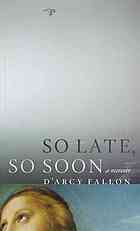
I found D’Arcy Fallon’s memoir, So Late, So Soon when I did an internet search (yes, using Google) for information related to Lighthouse Ranch, a Christian commune in northern California that one of my oral history narrators mentioned visiting as part of an Oregon Extension field trip in the mid-1970s. Fallon joined the commune after arriving there as a hitch-hiking teenager in the early Seventies, drawn in by the commune’s sense of order and purpose, eventually marrying a fellow communard and remaining with the community for three years, despite the increasing dissonance she felt between her own inclinations and the expectations of the commune’s leaders about her role as a Christian, as a woman, and as a member of the community.

Now a professor of composition and creative nonfiction a the University of Colorado, Fallon tells her story with lyrical compassion; although the depression and oppression she felt in her latter days as part of Lighthouse Ranch is palpable, she also manages to convey a clear understanding of why her younger self might have sought out this type of community, at this point in her life, and the difficult of extricating herself once she had become immersed. The book has brevity (I read it on one leg of my flight from Boston to Portland, Oregon) and offers rich details that give us insight into a particular subculture within the counterculture: that of the Jesus Freaks who adopted much of the outward, material culture of the hippies and melded it with a sometimes dogmatic adherence to Christian doctrine, theology, and religious practice. Anyone with an interest in either the counterculture of the era or in the dynamics of religious communities (communal or otherwise) will likely find it an interesting read.

feminist values: commenting on comments

01 Thursday Apr 2010

Posted by Anna Clutterbuck-Cook in think pieces

≈ 2 Comments

Tags

blogging, education, feminism, religion

Just before I left for Oregon, I got into a conversation with a commenter, aHuman, on my post about discussing feminism with anti feminists. The conversation got interrupted by my research trip, but this past week after I came home I stumbled across a comment thread at Feministe that touched on an issue similar to one that aHuman brought up toward the end of our exchange: what is the nature of a feminist value system?

More specifically, aHuman responded to an analogy I made about “feminist” being an umbrella concept kind of like “Christian,” in that self-identified feminists don’t necessarily agree with every single other feminist, yet they share a few core tenets (for more, see the comment thread). In response, aHuman wrote

I find it very revealing that you draw parallels between feminism and Christianity. Well there are very good reasons for why religion is kept strictly out of politics and law in all western democracies (certainly the USA). So I’d like to call for an equal treatment under the constitution of feminism with all other religions. That meaning mostly, that anyone can be a member and believe in it or not, but it cannot and should not have any say in politics or education.

Religions are belief systems, not a theory and not an academic discipline.

Actually I’m not that harsh with feminism. I don’t classify it as a belief system but as a political ideology. If anything, I’d compare it with Marxism. Either way, it certainly is not an academic discipline or even a theory.

And this underlines my point about the radical members of feminism. If feminism was an academic discipline or a scientific theory, then those radicals would have been treated far more harshly and critically than they have been. They would have never had enough attention to get a public voice.

There is a lot to unpack in this comment, obviously. For starters, in order to determine whether feminism is a “belief system,” “theory” or “academic discipline” we’d have to decide what we meant by each of those terms and whether they were mutually exclusive. I have no final word on this, but I do have a very personal response that has to do with how I think about feminism (my primary political identity) in relation to my academic work, and how I think about feminism in relation to metaphysical belief systems (religion). And I’m going to try and share some of them. But first, I offer a second comment from Jill over at Feministe who was responding to a commenter in the comment thread of a blog post on dating while feminist. The commenter asked

It’s an interesting point. Is feminism even more integral to feminists than their culture and their religion (or lack thereof)?

And Jill replies

I’m sure the answer to that question differs from feminist to feminist. For me, my culture and my religious beliefs have probably shaped me as a person more than or at least as much as feminism has. But when I’m looking for a partner, shared values vis a vis feminism are much, much more important to me than shared cultural or religious backgrounds/beliefs. Feminism is distinct from other opinions or traditions that I hold because it is a lens that I choose to use to view and pick apart and critique the world around me. It is, for me, the way in which I can maintain my sanity in a place that often feels really fundamentally unfair and ass-backwards. I need a partner to be able to understand that.

I particularly like Jill’s description of the feminist lens as what she chooses “to use to view and pick apart and critique the world around me. It is, for me, the way in which I can maintain my sanity.” I like it because, for me, this was why conscious, political feminism (a conscious critique of cultural frameworks and social structures, as opposed to my childhood “girls and boys are equally capable, worthy human beings” feminism) spoke to me as a teenager. I could feel what was wrong, but I didn’t have the language to articulate it effectively, particularly in the face of conservative Christian adults who were arguing that queer sexuality was immoral and women should be subservient to men, at least spiritually if not materially. Feminist theory provided me with a language to talk about these feelings, and a political framework through which to try and change what was making the world feel (on the worst days) uninhabitable.

My very first academic class that specifically incorporated feminist theory was an intro level theology class on Christian Feminism, taught by a member of my liberal arts college’s Religion department (mostly Reformed, protestant Christian theology and history, although with some ecumenical and world religion offerings). Because of this, I’ve always been kind of taken aback by people who suggest that feminism is a religion. I heard a conservative Catholic faculty member — at a different institution — once argue that feminists couldn’t possibly be Christian because they held heretical religious views that were oppositional to Christian values. However, most of the self-identified feminists I’ve known personally over the years would identify themselves as religious — and often that religious identity is distinct from their feminist identity (that is, when asked about their spirituality, they would say they are Christian or Jewish or Muslim, or Wiccan, agnostic or atheist — not Feminist).

Feminism, as a lens through which to understand the world, does not attempt to answer questions about the metaphysical realm (what happens to us after death, whether there is a God, etc.). Feminist theology, regardless of the religious tradition from whence it springs, tackles these questions from a feminist perspective — but it is not in itself a spiritual orientation toward the world. Or, at least, I have not yet come upon a feminist who understands it as such. Feminism, as a analytical tool, attempts to understand how women and men are constrained by various cultural assumptions of sex and gender; as a political movement, feminism seeks to counter inequalities between human beings related to sex and gender (as well as supporting a wider range of intersecting issues such as race, disability, age, etc.) It is a values system, in that feminists make certain judgments about what is right/wrong, healthy/unhealthy, moral/immoral (whatever terms you choose). For example, feminists belief that human beings should all be valued equally. That is a value judgment.

However, it is not an inherently religious value judgment: one could make such an argument without drawing on any metaphysical beliefs whatsoever.

When it comes to my feminist self and my academic self, I would say that feminism informs my academic work, and is often the subject of my academic work, although the methodologies that I use depend on the project at hand. aHuman suggests that religion (and feminism, if it is treated as a religion) has no place in schools, yet I would point out that the study of religion and theology are both important academic disciplines, as are political science and philosophy. All of these disciplines understand the world through a particular framework (or frameworks), and yet all of them are seen as legitimate fields of academic study. Feminism, to my mind, falls into this category of something that can both be studied and serve as an analytical framework through which to study other subjects. In this way, it is similar to, say, postmodern philosophy, liberal economic theory, or Marxist theory. So I disagree with aHuman that feminism is something ill-suited to intellectual inquiry or academic research.

Returning to Jill’s reflections on the primacy of feminist values, or a feminist orientation toward the world, I am reminded of a paper I had to write in undergrad for our mandatory Senior Seminar (a capstone seminar that was supposed to help all final-year students integrate faith, scholarship, and vocation) in which I basically argued that I hold religious practice accountable to my feminist beliefs: that is, in my worldview, feminist humanism trumps religion. I don’t care (at least not a lot) whether someone chooses “feminist” as a political identity — but if they’re not acting in ways I believe reflect a fundamental belief that women (and all human beings, no matter how marginal) are human beings worthy of our care and attention as fellow persons, then I’m not okay with that. The same goes for any other religious or political philosophy: does it incorporate a conscious critique of power relations and a belief in the worth of all human beings? If not, I’m out.

In that way, yes. Feminism, both as a theoretical framework and as a political stance, trumps my religious/spiritual beliefs and also my cultural background as a core part of my identity. At the same time (bear with me) I’d also argue it’s somewhat incidental: an accident of time and place. While I believe that culture is a powerful force in shaping our identities, I am not enough of a postmodern purist to argue that we bring nothing unique of ourselves into the world. Feminism, as I encountered it, spoke to me, my Self. It suggested a world in which I could thrive. And I have yet to encounter another theory or movement for social change that offered a similar world: a world in which I was invited to be my Self, in the company of other Selves. This includes religion, which often demands of us not compassion and attention to valuing individual human beings, but policing behavior and judgment that diminishes Selves and our connection to God (if you believe in God) or the metaphysical world.

This isn’t to say I believe feminism is the “final word,” as in a closed, finished philosophy — it is ever-evolving in both theory and practice, and I feel I continue to grow with it. But I will say that feminism is my starting place. And so far, it hasn’t disappointed.

booknotes: right (part one)

25 Thursday Feb 2010

Posted by Anna Clutterbuck-Cook in book reviews

≈ Leave a comment

Tags

education, photos, politics, religion

Jona Frank’s recent work of photojournalism, Right: Portraits from the Evangelical Ivy League, uses images to explore the world of Patrick Henry College. Patrick Henry is a four-year college founded in 2000 by Michael Ferris specifically to be “the Christian equivelant of the Ivy League,” as journalist Hanna Rosin writes in her introduction.

I discovered Right through this photo essay at Mother Jones (if you’re interested in seeing some of the images from the book) and since I’ve read Hanna Rosin’s earlier book on the subject — and am fascinated with home education and the Christian right generally — I knew I had to check out the book. Despite the fact Hanna looked askance when I brought it home.

This is actually going to be a two-part review. The second part focuses on a lengthy quotation from one of the student interviews; watch for that coming in a couple of days. Here, I’d like to make a couple observations about the way in which the photographer and two essayists (Hanna Rosin and Colin Westerbeck) approach their subject.

I am not practiced in visual analysis, and therefore feel slightly out of my depth in reviewing a book composed largely of images. The photographs are largely composed, rather than action shots, and highlight individual students, some of whom are photographed multiple times and several of whom were interviewed, with their responses providing text for the book.

I was left with the distinct feeling that the photographer and contributors (Rosin and Westerbeck) had missed an opportunity to really unpack some of the complexity of their subject. This is a frequent frustration I have with treatments of both the modern home education movement and recent American religious history: that both get characterized in broad strokes with little attention to nuance, and taken at once too seriously as a potential threat to mainstream society and treated gingerly as mysterious outliers rather than human beings with real effect on our world.

Rosin, as I have pointed out before, consistently collapses all home educators under the umbrella of Christian evangelical right-wing homeschooling — a lack of distinction that does a disservice both to the practice of home education and to the specific experience of those who home educate for explicitly Christian reasons. “The homeschooling movement,” she writes, for example, “is full of nostalgia for a prelapsarian age, before the Pull or even sewing machines. The result is that sometimes families seem frozen in an indeterminate earlier time” (9). While skepticism about the effects of modernity and industrialization on human life is certainly present in some homeschooling families, on the political left as well as the political right, I would argue that it is reductionist to speak of The Homeschooling Movement as a singular entity with one philosophical orientation toward technological and social change.

Likewise, I was struck by the wariness that Frank brought to her project, as voiced in her own narrative essay toward the end of the book.  She describes the difficulty of creating portraits of young people groomed for public service and intensely conscious of the image they are projecting in the outside world. She then turns to the uneasiness that the self-assurance of these young people engenders in her.

Elisa, in her trench coat, is self-assured and ready . . . One month after this photo was taken, she will be married, her name changed, school will be over, and she will be in her life, on her path. She’s done everything right. Yet when I look at that picture, I feel concern for her. It all seems so fast and she seems so young. But herein lies my fascination with the sense of assuredness these kids possess. Maybe she is not so young. Maybe she is tired of waiting.

The assuredness confuses me. I had vague notions that I would marry and have a family when I was twenty-two, but both were far off. What I wanted was exploration, travel, stories, youth hostels and road trips, part-time jobs and film school. Before commitment I yearned for freedom. This is part of being young in America, or so I believed, until I went to Patrick Henry (143).

I appreciate Frank’s candidness about her own complex response to the different path to adulthood that Patrick Henry students have taken: home educated young people, particularly those who come from families that take a critical stance to mainstream American culture (regardless of political orientation) often do reject notions of adolescence that are so ingrained in the American psyche that they seem commonsensical. For example, the idea that adolescence and young adulthood are “naturally” a period of rebellion and freedom from “commitment” — and that somehow that lack of commitment to experiences that are coded “adult” experiences (marriage, parenthood, careers) is crucial to identity formation.

I would argue, instead, that it is an experience perhaps crucial to a certain kind of identity formation. One with think of as natural, perhaps inevitable.  The normal state of being. Home-educated young people often make the world aware, simply by their presence, how much of what we take to be “normal” is, in fact, a product of particular decisions about childcare, education, and the expected path to full participation in society. As a feminist, I really do believe in the personal and political are interconnected.Certainly there are connections to be made between the chosen life path of Patrick Henry students and their (by and large, although not monolitic) right-wing politics. Yet the correlation is far from uniform. We can, after all, be just as self-assured about following life trajectory wholly at odds with the ideals that Patrick Henry students espouse.

Who knows. Maybe there’s a book to be written there somewhere. Maybe someday I’ll end up writing it myself.

Jesus Camp Grows Up

26 Monday Nov 2007

Posted by Anna Clutterbuck-Cook in book reviews

≈ Leave a comment

Tags

education, politics, religion

I spent part of this weekend reading God’s Harvard: A Christian College on a Mission to Save America, by Hanna Rosin. The book centers on Patrick Henry College, founded in 2000 by Michael Ferris, the fundi-gelical conservative Christian activist best known for his work leading the Homeschool Legal Defense Association. (Like it or not, he’s one of the reasons people like me got to have the childhood we got to have . . . even if our home education didn’t have quite the results Ferris is looking for!)

God’s Harvard tells a story that is the natural extension of the 2005 documentary Jesus Camp, which explored Christian evangelical culture as experienced by children ages 7-13. We’ve leapt over the mid-teen years, and are now introduced to an academically elite group of Christian homeschoolers ready to enter college. You can check out an early draft of a chapter from God’s Harvard, “God and Country”, which was published by Hanna Rosin in the New Yorker (27 June 2005).

As usual, it is extremely irritating to have “homeschooling” become conflated with conservative Christian homeschooling with barely an acknowledgment. John Holt (whose papers have just been donated to the Boston Public Library!!) and the free school movement are mentioned only in passing, rolled into the early history of “the movement” in such a way that it’s never clear there are other ways families choose to home educate besides plunking kids down in front of intelligent design videos, drilling them in the tenets of Christian nationalism, and preaching the evils of toxic popular culture, all the while enforcing dress codes and “courtship” standards.

At the same time, I always find an outsider’s perspective on homeschooler cultures fascinating; Rosin’s narrative is an ever-shifting mosaic of the familiar and the alien. Whether secular or sectarian, home-educated kids tend to have close relationships with their siblings and parents, be skeptical of mainstream culture and education, and enter their young adulthood with a disconcerting mix of maturity and naivete.

“Homeschooling families,” Rosin writes, “tend to judge each other by their views on structure and authority; the Patrick Henry families tend to fall on the strict end of that scale. Homeschool families have no school communities or obvious support system, so they tend to group around gurus or schools of thought” (90). The problem is, the only examples she gives are of the Patrick Henry variety, not the hippie home-educator “free schools, free people” types. Proof, I suppose, of our dwindling numbers. Rosin reports, with numbers similar to those in Jesus Camp, that of the estimated 1-1.5 million home educators (unclear whether she’s talking families or young people), a whopping 80% identify themselves as “evangelical Christian” (62).

Clearly, we home-educated feminists are outnumbered by the evangelicals; I guess we’ll just have to raise a little more hell!

Further Reading about the Religious Right

Here are a few other fascinating books on the subject of conservative Christian counterculture from the last few years.

1. Kingdom Coming: The Rise of Christian Nationalism, by Michelle Goldberg provides a good introduction to the political dimensions of the current conservative Christian counterculture.
2. American Facists: The Christian Right and the War on America, by Chris Hedges provides less journalism and more philosophy than Goldberg, suggesting parallels between current Christian political thought and twentieth-century European fascism.
3. Monkey Girl: Evolution, Education, Religion, and the Battle for America’s Soul, by Edward Humes and
4. The Kitzmiller v. Dover decision, which is brilliantly and lucidly written by Judge Jones, both document the recent ruling against the teaching of intelligent design in Dover, Pennsylvania schools.
5. God On Trial: Dispatches from America’s Religious Battlefields, by Peter Irons (I haven’t read this one yet, but it looks good!) provides historical-legal context for the current struggle over the relationship between religion and government.
6. Jon Krakauer’s Under the Banner of Heaven: A Story of Violent Faith goes beyond its story of Mormon fundamentalism to explore the thin line between faith and madness.
7. The Battle for God, by historian of religion Karen Armstrong, is a dense personal favorite, charting the rise of religious fundamentalism as a response to the modern era.

*Images from www.powells.com and www.amazon.com

Newer posts →
"the past is a wild party; check your preconceptions at the door." ~ Emma Donoghue

Recent Posts

  • medical update 11.11.22
  • medical update 6.4.22
  • medical update 1.16.2022
  • medical update 10.13.2021
  • medical update 8.17.2021

Archives

Categories

Creative Commons License

This work by Anna J. Clutterbuck-Cook is licensed under a Creative Commons Attribution 3.0 Unported License

Meta

  • Create account
  • Log in
  • Entries feed
  • Comments feed
  • WordPress.com

Create a free website or blog at WordPress.com.

  • Subscribe Subscribed
    • the feminist librarian
    • Join 37 other subscribers
    • Already have a WordPress.com account? Log in now.
    • the feminist librarian
    • Subscribe Subscribed
    • Sign up
    • Log in
    • Report this content
    • View site in Reader
    • Manage subscriptions
    • Collapse this bar