• anna j. clutterbuck-cook
  • contact
  • curriculum vitae
  • find me elsewhere
  • marilyn ross memorial book prize

the feminist librarian

the feminist librarian

Monthly Archives: May 2013

‘the future of marriage’ live-blog: determining marriage’s fate & the appendix

30 Thursday May 2013

Posted by Anna Clutterbuck-Cook in book reviews

≈ Leave a comment

Tags

family scholars blog, live-blogging, marriage equality

Welcome to part seven of my live-blog reading of David Blankenhorn’s The Future of Marriage (2007). You can read part one, part two, part three, part four, part five and part six here. 

After reviewing David B.’s “goods in conflict” defense of heteros-only marriage, I’ve rather abruptly found myself done with The Future of Marriage. It’s hard to feel like bothering with the final chapter (“Determining Marriage’s Fate”) or the odd appendix (“Topics in the Anthropology of Kinship”). I mean, it’s pretty clear at this point that Blankenhorn’s historicized understanding of marriage, his beliefs about what “goods” it brings into the world, and what (lesser) “goods” queer equality might bring, and ultimately his erasure of queerly-inclined children (and children raised by queer parents), all do me in.

Still, to be complete, here are a few scattered thoughts about the final sections of The Future of Marriage.

Chapter 8: Determining Marriage’s Fate

This is a chapter with a lot of tables, a lot of data. David B. is making the case for the institution of (a certain type of) marriage as a social and personal good, so he combs through social science data from around the world, attempting to argue that nations with a strong marriage culture do better in a variety of other measures.

The problem, in my mind, is that the numbers don’t really make his case for him. In fact, they often seem to undercut the marriage-is-under-threat narrative he’s attempting to build. The percent of children in the United States in 2000 living with two married parents, for example, is 68.1% — down from 85.2% in 1970. That’s a jump, certainly, but sixty-eight percent still means that over two-thirds of children in the U.S. live in the care of a married couple. 59.7% of children were living with “their own married parents,” by which he presumably means the bio-parents of the child(ren) in question. That means that an overwhelming majority of children living with married parents are living with their own bio-parents (fewer than 10% live in “marriage” households formed through divorce and remarriage, adoption or other means).

Is the glass half full or half empty? I guess it’s all you read the numbers.

And that’s if you buy David B.’s assumptions about married-bio-parent households being a presumed “best state” situation for children to be raised within the bounds of. Which I’ve already pointed out is a far from inevitable conclusion to draw from the available evidence.

My point is this: The United States IS ALREADY a profoundly “marriage culture” nation. We privilege people who obtain “married” status in a variety of subtle and not-so-subtle ways. The fact that the “health” of (a certain type of) marriage culture in the U.S. has dropped, according to Blankenhorn’s composite Index of Marriage’s Institutional Vitality, from 77.6% in 1970 to 62.5% in 2000 seems both extremely understandable, given the cultural upheavals of the last forty years, and not a serious cause for alarm. I would argue what we’re seeing in those numbers is the slipping away of hegemony. The return, in fact, from a unique period of (quasi-imposed, quasi-falsified) cultural uniformity in the postwar era, to a state of affairs much more familiar within American history: contested cultural norms and values. In 1970, as America exited the 1960s, the numbers Blankenhorn cites — marriage rates, intact first marriages, married parenthood, etc. — would still reflect the anomalous period in which the Depression and WWII generations (who’d delayed marriage) and the immediate postwar generation (who hurried it) created the baby boom and the precipitous drop in the average age of marriage for both women and men.

Toward the end of this chapter, we return to the ladyscholar hating as David B. returns to the work of historian Stephanie Coontz whom he has taken a real dislike to. “Stephanie Coontz,” he asserts, “has made a career out of arguing that her own philosophical preferences and the laws of historical inevitability are one in the same” (236). She “consults history and announces that anyone” who thinks families were once stronger than they are now “suffers from a mental disability called ‘nostalgia’ ” (236). I’ve not read The Way We Never Were, Coontz’s seminal social history of 1950s nostalgia, but I’d be extremely surprised if she characterized nostalgia as a “mental disability.” But Blankenhorn is determined to remind us that Coontz is an “activist” (the horror!) and, in fact, is allied with that other evil ladyscholar Judith Stacey, with whom she founded the Council on Contemporary Families, “a group largely devoted to defending the upswing in divorce and unwed childbearing,” as David puts it.

Such a characterization might surprise the CCF, which articulates their mission as one “to provid[e] the press and public with the latest research and best-practice findings about American families,” listing ageing, children and parenting, economic issues, gender and sexuality, health and illness, marriage, partnership and divorce, singles, and work-family issues as all residing under their umbrella of scholarly and political interests. Their mission appears to be responsive rather than prescriptive, reading in part: “the Council’s mission is to enhance the national understanding of how and why contemporary families are changing, what needs and challenges they face, and how these needs can best be met.”

It appears to me that David Blankenhorn has confused “enhancing the national understanding of how and why” with “defending,” and identifying “what needs and challenges” families face and “how these needs can best be met” with blind advocacy.

I think, in the end, we are perhaps running up against a vast gulf in values when it comes to the political and social use of shame and judgement. David B. is upset because those of us at the Coontz-Stacey end of the spectrum see family diversity as both inevitable and neutral. We ask “what do these families, of all shapes, need to thrive — and how to we facilitate them meeting those needs?” David B., on the other hand, presume to know what families need (240-241):

1. A higher success rate for first marriages
2. A lower rate of childbirth outside of marriage (“unwed childbearing”)
3. No “legal redefinition” of marriage
4. Public scrutiny and regulation of the fertility industry [a point I actually agree with him on]
5. A national conversation about “what marriage is.” (Hint: NOT a “private relationship between two individuals”)

Marriage’s “fate” is in our hands … and it’s clear David B. thinks we’re doing bad, bad things to it.

Shame on us.

Appendix: Topics in the Anthropology of Kinship

I’m not exactly sure what this appendix is doing in the book, other than giving David B. a place to dump all of the random stuff he wants to say about non-dyadic, non-monogamous Christian model marriages but couldn’t get into the main text of the book. He reserves particular distaste for polygyny, polyandry, and polyamory which I want to highlight here for its bisexual stereotyping (yup, you read that arightly).

Polyamory is apparently “what’s new” and “hot” for the same-sex marriage crowd these days — those poly folk, so trendy! “Polyamory is tomorrow’s big new idea, being worked out today by creative theorists in academic conferences, advanced support groups, and little journals” (256).

*fans away the fumes of anti-academic disdain*

First of all, the historian in me has to point out that poly is not “tomorrow’s big new idea,” unless it’s a new idea that’s been percolating for at least a hundred and fifty years. Because the folks at Oneida were all over the group marriage thing, no “particular attachments,” blah blah blah. This may be a marginal or minority practice, but it is not some latter-day fad invented by a bunch of post-structuralists in a smokey back room.

Also: advanced support groups? little journals? Say what?

But that’s David just getting started. Because it’s not the academics who are arguing so radically that “the state ‘should have no right to privilege or impose one form of family structure or sexuality over another’ ” (gasp! *clutches pearls*) — it’s us horny bisexuals as well (256-257):

After all, if same-sex marriage becomes normative, on what moral basis could a fair-minded person possibly oppress bisexual polyamorous marriage? Particularly when bisexual persons will be making exactly the same claim as homosexual persons about the need for marriage as a legal institution to accommodate and respect sexual orientation?” (259).

First of all, let me point out that all of these things David B. brings up with such appalled hand-wringing? He’s nothing if not accurate in the sense that I do believe that “marriage as a legal institution [should] accommodate and respect” human sexual variety and diverse family forms. So the whole academic bisexuals will ruin marriage in groups! thing fails to excite me to moral outrage.

But I also want to tease apart the conflation he’s created here between poly folks and bisexual folks.

Yes, polyamorous people may be bisexual. They may form mixed-sex relationships in which some people are bisexual and some are monosexual or otherwise-sexual. Yes, bisexual people may be polyamorous. But being a bisexual person, in the sense that you have the capacity to be sexually desiring of people of your own sex and people of other (not-your-own) sexes, is not the same as desiring or forming a polyamorous relationship.

Being a person in a polyamorous relationship is not the same as being bisexual.

So while I support creating a flexible cultural and legal understanding of marriage that can accommodate — dare I say celebrate! — more-than-two relationships as well as two-person partnerships, that stance on marriage has no direct connection to my sexual orientation as bisexual. Bisexual people, just like monosexual people, experience a wide range of desires and exhibit a wide range of partnership behaviors. We don’t require multiple partners due to our bisexual capacity for desire, anymore than a straight man requires more than one straight woman to satisfy his attraction to both blondes and brunettes, or short as well as tall women, busty and flat-chested. We fall in love with particular people, all of us, and our capacity to love and sexually desire others is only as material to our individual commitments as we want or allow it to be.

So there you have it folks. The Future of Marriage.

I have to say, I hope that future is as expansive as David B. fears it will be.

Next week, I’m going to round out this series with some notes on the treatment of male vs. female proponents of same-sex marriage. Stay tuned!

adventures in "allergy-free" eating

28 Tuesday May 2013

Posted by Anna Clutterbuck-Cook in our family

≈ Leave a comment

Tags

domesticity, food

For the past month, Hanna’s been following a diagnostic diet prescribed by her nutritionist in hopes that they’ll be able to identify, without more intrusive testing, the source of some persistent symptoms she’s been having. We suspect gluten, but the diet starts with no assumptions. So we’ve had to temporarily eliminate lactose and legumes and soy as well as certain fruits and vegetables (and we’re already functionally vegetarians, so no meat, poultry, or fish per usual). Worst of all is avoiding chocolate (!). But we’ve been making do — and even making some fun alternate food discoveries.

A few observations.

  • Of the non-dairy “cheese” options available, we’ve enjoyed the almond-based ones over tapioca or rice.
  • Who knew there were so many awesome non-wheat flours? Even if you’re not required by dietary restrictions to use them, you should definitely try spelt, rice, oat, and quinoa flours. Oat flour is particularly tasty for cookies, and quinoa flour gives baked goods a delicious nutty flavor (I’ve 
  • Coconut-based ice cream is very tasty, regardless of whether you need to avoid lactose. Particularly when you live a five-minute bike ride away from FoMu.
  • Likewise, coconut milk makes delicious home-made custard.
  • Omelets make good substantive meals morning, noon, and night! (Even if they turn into egg scramble because you fumble the flipping).
  • Pancakes, particularly Joy the Baker’s cornmeal-molasses cakes, can be easily modified to be “allergy-free”; we substituted maple syrup or sorghum syrup for the molasses and rice flour plus a tablespoon of cornstarch for the all purpose flour. Voila!
  • Most gluten-, soy-, and dairy-free alternatives are more expensive than the more popular ingredients and products. This probably goes without saying, but I think it’s worth highlighting here. Hanna and I are, luckily, in a position to follow this diet without a great deal of inconvenience: We live in a location with multiple Whole Foods and local co-op options for these alternative ingredients. e can switch to buying rice or quinoa flour at $2-plus per pound instead of wheat flour. We can buy more eggs to bolster our protein intake. We can buy maple syrup instead of honey or molasses. We can (occasionally!) buy a loaf of store-made gluten-free bread at $6.99/loaf rather than wheat bread at half that price. When we don’t want to cook after a long day at work, we can order $40.00 worth of vegetarian sushi or Thai food (no wheat or dairy products) instead of a $12 pizza or a burger at McDonald’s. If it turns out we have to dig in and figure out how to let go of one or more class of food for the long haul, we will hopefully find ways to make it more affordable. But in the meantime, we don’t have to worry about penny-pinching. Not everyone with food allergies is so fortunate.
  • Gluten-free cookbooks, magazines, and blogs are prone to preachy-ness. It’s trendy right now to go gluten-free, and while we’re finding it undeniably useful to be able to take advantage of the products, restaurants, and ingredients available because of this … it’s not exactly an inviting atmosphere when you’re not convinced that going gluten-free will solve all your health problems, the world’s political problems, plus make you live forever.
I won’t bore you with the ins and outs of sorting our kitchen out, but I’ll close this post by sharing a recipe for rice salad I invented this week and we quite enjoyed.

IMPROMPTU MAPLE-MUSTARD RICE SALAD

Mix together:
1 cup cherry tomatoes, halved
2 persian cucumbers, diced
1 cup English peas
1 large sweet potato, diced, sauteed in olive oil and fresh thyme
1.5 cups cooked rice (we used a wild rice mix)

Toss thoroughly with dressing:
1 part olive oil
1 part maple syrup
1 part dijon mustard
2 parts balsamic vinegar
salt, to taste

Chill overnight to combine flavors.

"homosexual marriage?" (1953) & "the gay guide to wedded bliss" (2013)

26 Sunday May 2013

Posted by Anna Clutterbuck-Cook in think pieces

≈ 1 Comment

Tags

books, gender and sexuality, marriage equality, politics

(via)

This weekend, I’m reading several chapters of Tracy Baim’s Gay Press, Gay Power: The Growth of LGBT Community Newspapers in America (Prairie Ave. Productions/Windy City Media, 2012) for the New England Archivists LGBTQ Issues Roundtable quarterly discussion group (say that five times fast). One of the best things about the book is that between each chapter comes a long section of press clippings illustrating some of the publications, articles, and events they discuss in the text. Paging through one such section I noticed the cover pictured above.

Many opponents of same-sex marriage talk as if the quest for marriage equality is some latter-day issue invented around 1995 by activist judges. Even some queer rights activists assume that the push for marriage rights either came out of the AIDS crisis of the eighties (which certainly gave it a boost), and/or is a domestication of the movement — something palatable for mainstream America to swallow (also a partial truth). In light of those attitudes, I think it’s interesting to see that as early as 1953 — sixty years ago — the LGBT community was exploring the question of same-sex marriage.

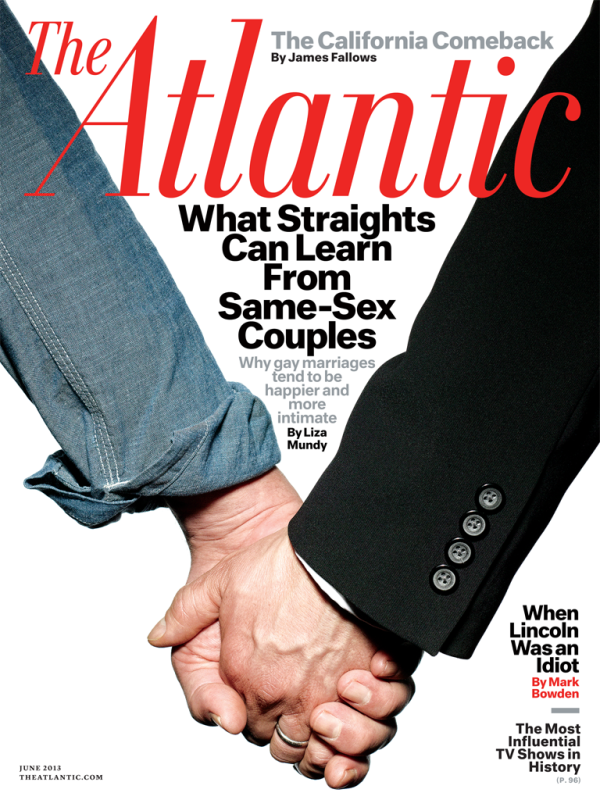
Relatedly, anyone else notice the cover story in the latest issue of The Atlantic?

In “The Gay Guide to Wedded Bliss,” Liza Mundy asks, “What can gay and lesbian couples teach straight ones about living in harmony?” and “What if same-sex marriage does change marriage, but primarily for the better?” She points out (as many feminists and queer folks have been doing for, um, decades):

Same-sex spouses, who cannot divide their labor based on preexisting gender norms, must approach marriage differently than their heterosexual peers. From sex to fighting, from child-rearing to chores, they must hammer out every last detail of domestic life without falling back on assumptions about who will do what. In this regard, they provide an example that can be enlightening to all couples. Critics warn of an institution rendered “genderless.” But if a genderless marriage is a marriage in which the wife is not automatically expected to be responsible for school forms and child care and dinner preparation and birthday parties and midnight feedings and holiday shopping, I think it’s fair to say that many heterosexual women would cry “Bring it on!”

I have to say, painting a picture of same-sex couples “hammering out” our domestic lives makes it sound like we’re drawing up intensive prenups and chore charts. Perhaps some people do (and if it helps you, go for it)! In my experience, it’s more just the freedom from falling into cultural patterns of “wives cook, husbands wash up” (my grandparents’ pattern), or “husbands wash the car and mow the lawn, wives do laundry and remember family birthdays.” In our case, we’re also aided by the fact that both sets of (hetero) parents were mindfully and/or of necessity non-traditional in their spousal roles — something that I think is often overlooked when people ask why some relationships are more egalitarian than others: parental modeling! (Perhaps because, sadly, it’s still a rarity.)

I have grumbles about The Atlantic penning this article as if it’s a possibility that’s just occurred to them — what queer folk might have something to offer the wider world! And I’m also slightly irritated (paradoxically, it seems) for the framing of marriage equality as a “control group” for heterosexual marriage. Um — don’t we get to simply exist without being one half of a scientific experiment.

Also, what’s up with the sudden resurgence in mainstream articles hauling up the myth of “lesbian bed death” from the murky depths? First last week’s woefully glossy and irritating NYT magazine article on female arousal, and now this, where a researcher suggests that the “lesbians [in her study] may have had so much intimacy already that they didn’t need sex to get it.”

… O_O

That suggestion implies a) that women use sex to gain intimacy or they don’t need it and therefore, b) there may be such a thing as “so much intimacy” that you kill your sex life.

O_O …

This is just such a limited understanding of the role of sex in human life that I can’t even.

But I’m also struck by the fact that a publication as culturally staid, if not hard-core conservative, as The Atlantic, has published such an article — a mere sixty years after the August 1953 issue of ONE Magazine was held for three weeks by the post office while they tried to determine whether it was violating U.S. obscenity laws.

Anyway. Have you read the Atlantic piece? If so, what did you think of it?

‘the future of marriage’ live-blog: goods in conflict

23 Thursday May 2013

Posted by Anna Clutterbuck-Cook in book reviews

≈ Leave a comment

Tags

family scholars blog, live-blogging, marriage equality

Welcome to part six of my live-blog reading of David Blankenhorn’s The Future of Marriage (2007). You can read part one, part two, part three, part four and part five here. 

Chapter seven of The Future of Marriage is where we reach the heart of David B.’s case against same-sex marriages achieving widespread cultural and legal legitimacy. I will remind readers at this point that since writing this book — and since his role as an anti-same-sex-marriage witness in the Proposition 8 trial — Blankenhorn has revised his vision of marriage to include same-sex couples. That said, I think a significant number of opponents of same-sex marriage still draw support from his framing here to try and legitimize their position.

Most significantly, I’d argue, they try to draw causal links between same-sex marriage and … whatever it is they fear about the changing norms of married life. While it’s fair to say that these things (same sex marriage and … more open poly relationships, or higher rates of birth control use, or less cultural stigma around divorce, to name a few shocking modern practices) are historically contemporaneous — perhaps even an argument to be made that they are emerge from a deeper shift in sexual mores in the West — it doesn’t follow that a shift in how we understand one of these things (same-sex committed, dyadic relationships) will automatically cause a parallel shift, in some ill-defined way, in how we understand all those other things.

Which brings me to the opening sentence of chapter seven, “Goods in Conflict,” in which David B. asserts that — surprise! — “The central argument for gay marriage is not an argument about marriage” (171). Instead, he argues, we gays are seeking “human dignity” and “basic rights,” and selfishly using marriage as a proxy to reach those ends.

On the one hand, I’m not going to argue that I don’t want human dignity and basic rights (duh), and I agree with him, as I’m sure many LGBT activists do, that marriage as a social institution has become the late-twentieth/early-twenty-first century short-hand for social acceptance of queers — a shorthand that inevitably cannot stand in for enduring, holistic change. As E.J. Graff so poignantly reminded us last week, in many states in this Union we might be able to get married — but we can still be fired for being queer. Continue reading →

from the neighborhood: arnold arboretum

19 Sunday May 2013

Posted by Anna Clutterbuck-Cook in a sense of place

≈ 1 Comment

Tags

boston, family, friends, fun, photos

Me on a knit-bombed bench, Arnold Arboretum (photo by Joseph)

This weekend, my friend Joseph is in town from Michigan, where he works at Arrowhead Alpines and recently published a book on plant breeding at home (aka plantsex!). Obviously, we spent at least some of the weekend exploring plant-y things in the Boston area, including a glorious visit to Arnold Arboretum.

I hadn’t been to the Arb since maybe 2008? I’m absolutely not going to leave it so long before I go back.

It was a perfect half-cloudy day to wander around experimenting with nature photography.

Next time, though, I’m gonna bring a book and a thermos of tea and settle in for a long afternoon of reading out-doors. Maybe in this tree …

Joseph was super-excited to see this dove tree, planted in 1904; he says it’s the oldest dove tree in the United States (the earliest tree we saw was a bonsai started in the late 1700s!)

The azaleas were blooming everywhere in all shades from white to deep fuschia. These were a salmon red, though the camera made them come out pink.

As were the lilacs…

I’m looking forward to chilling by this lake sometime soon with my wife and a picnic from the Harvest Co-op.

from the neighborhood: "sunshine and delightful"!

16 Thursday May 2013

Posted by Anna Clutterbuck-Cook in our family

≈ Leave a comment

Tags

cat blogging, domesticity, from the neighborhood, photos

A couple of weeks ago, I bought a rose for Hanna from a woman who sells flowers along the street between work and the T station.

I stopped at the soon-to-be-closing City Housewares store to pick up a jar to keep it in. The clerk I always chat with, when I shop there, suggested that I’d better be ready to tell my wife what I wanted for supper when I brought it home.

Hanna’s actual first response was, “Are you breaking up with me?!”

I think we had pasta salad for supper. ‘Twas very tasty.

The cats were unimpressed (although Teazle later discovered a taste for rose leaves and we had to move the flower to higher ground).
They have been busy enjoying the spring weather, which Accuweather recently informed us was “Sunshine and delightful.”
The cats are making the most out of the “kitty shelf” we constructed from pillows and blankets along the back of the couch.

Although sometimes Teazle loses track of her back end…

We have a friend in town this weekend, so expect light posting for the next ten days or so — I promise I’ll be back on board with The Future of Marriage in due course, and likely more cat photos.

Because I’ve become the crazy lesbian cat lady who will haunt your Internet for evermore …

marriage equality and female suffrage: step by step change

15 Wednesday May 2013

Posted by Anna Clutterbuck-Cook in my historian hat

≈ Leave a comment

Tags

history, marriage equality, politics

So I haven’t written anything about the recent state-level victories in the push for equal marriage rights for same-sex couples. But congratulations Rhode Island, Delaware, and Minnesota! We have friends in all three states who are feeling better about their country now, because their state legislatures have chosen to be more welcoming in the face of family diversity and human sexual diversity. I can only hope this trend continues.

And of course we’re all waiting on tenterhooks for the DOMA ruling to be handed down by the end of the term.

As a historian, I’ve been watching the concurrent process of state-level victories and the DOMA challenge mindful of the way past struggles over the expansion of citizenship and constitutional protections have similarly progressed in fits and starts across our federated landscape.

Consider these two infographics:

(via)
(via)


I don’t have any Big Important Thoughts about this process at the moment, except to say that I think people who argue we should leave the process to the states ignore the important role that our national government plays protecting the rights of minority populations … and that people who are eagerly pushing for a national right to same-sex marriage sometimes ignore the symbiotic relationship between state and federal rights campaigns.

When this is all over, there will be a PhD dissertation in a comparative treatment of the woman suffrage and marriage equality campaigns (victories?!).

Addendum: It occurred to me, on my morning commute, that another parallel between the woman suffrage campaign and the marriage equality campaign is that both are specific issue campaigns that brought a diverse coalition of people with wide-ranging agendas together on one thing they could agree to push for. They are also both comparatively narrow victories that leave some folks unprotected (African-American women in the South; trans folks in many states) and run the risk of making it seem like all inequalities for a certain class of people have been swept away in a single moment.

The 19th Amendment, as we know nearly a century later, did not erase sexism and misogyny from our national landscape; marriage equality will not erase heterocentrism and anti-gay discrimination (as E.J. Graff points out in the link above). We would do well to remember that, even as we move forward in celebration.

‘the future of marriage’ live blog: deinstitutionalize marriage?

14 Tuesday May 2013

Posted by Anna Clutterbuck-Cook in book reviews

≈ 5 Comments

Tags

family scholars blog, live-blogging, marriage equality, married life

Welcome to part five of my live-blog reading of David Blankenhorn’s The Future of Marriage (2007). You can read part one, part two, part three, and part four here. 

Having sorted out what marriage is in chapters 1-5, we move on in the second half of The Future of Marriage to consider what marriage might be in the future. Chapter six (which we will look at today) considers the relationship David B. perceives between supporters of same-sex marriage and those who hope for the demise of marriage as a privileged social institution. Chapter seven outlines Blankenhorn’s key theory about marriage, and same-sex marriage specifically, which is that choices about marriage are choices between two competing “good” options (in Blankenhorn’s mind, the “good” of marrige equality and the “good” of protecting a child’s right to be parented by their biological mother and father). Chapter eight is, then, a call to arms as we are asked to “determine marriage’s fate.” This final chapter is also followed up by a rather odd appendix on forms of kinship which — among other things — perpetuates stereotypes about promiscuous bisexuals. But! All in good time.

Today we’re going to talk about those eeeevil lefty academics — specifically lefty lady academics; more on that later — who are critics of marriage as it has been historically practiced, and yet support marriage equality for same-sex couples. David B. is deeply troubled by what he reads a a disingenuous position on marriage, suggesting that it has damning implications for those who argue that granting same-sex couples equal access to marriage is, in fact, a conservative or pro-marriage-as-institution position. He writes:

Here is my dilemma: With every fiber of my being, I want to affirm the equal dignity of all persons and push for equal treatment under the law. Yet I’m also  marriage nut. I’ve spent most of my professional life arguing that marriage is important and that children need mothers and fathers … I believe that my nightmare can…be expressed as a sociological principle: People who professionally dislike marriage almost always favor gay marriage, [and] ideas that have long been used to attack marriage are now commonly used to support same-sex marriage (128).

Basically, the short version of this chapter is: “While same-sex marriage, per se, is something I’d love to support when I look around at who’s supporting same-sex marriage rights, and their justifications for doing so, I strongly disagree with these individuals’ overall social goals. I suspect that they see same-sex marriage as a means to their nefarious ends — therefore I am deeply uncomfortable supporting marriage equality, though this conclusion makes me sad.”

sad like John Lithgow in Footloose is sad…

Once again, I feel like we’re having the cherry-picking problem. For all the fuss anti-same-sex-marriage folks make about “OMG I’m not bigoted!!” and “Being against same-sex marriage doesn’t mean I’m anti-gay!!” in many instances they seem very willing to paint the marriage equality folks with a massive Paintbrush of Indistinguishable Radical Threat-yness.  I mean, yeah, sure, you’re gonna find people on the marriage equality side who see same-sex marriage as either a band-aid fix (“as long as we privilege married couples, everyone should have equal access to that privilege”) or as a radical challenge to the heteronormative regime — a queering of marriage, as it were, that will hopefully drive a stake through the heart of Marriage of the kind defined by David B. in the previous chapter. As someone who, actually, appreciates both of these arguments, I’m totally willing to own those contingents as playing for my team.

However, I would not make the argument that they’re the only players. We also have Gene Robinson and Andy Sullivan, to take two examples, making much more culturally and theologically conservative arguments for same-sex marriage. It’s not some either-or situation where — gotcha! — the “real” agenda of the marriage equality folks is somehow exposed. We have a range of different motivations here, a range of different personal “lifestyle” choices and political agendas. That we’ve all come together to push for marriage equality doesn’t mean these differences disappear. It just coalition building. That’s how politics works.

David Blankenhorn seems particularly incensed by one specific person who “professionally [dislikes] marriage” while supporting marriage equality: sociology professor Judith Stacey, currently teaching at New York University. She is the author of Unhitched: Love, Marriage, and Family Values from West Hollywood to Western China (2011) and Brave New Families: Stories of Domestic Upheaval in Late Twentieth-century America (1990; 1998). Her own ethnographic research has focused on, for example, kinship patterns among gay men in West Hollywood, and the socio-political relationship between gay rights and rights for polygamous households in the U.S. and South Africa. She earned her M.A. in History from the University of Illinois, her PhD in Sociology from Brandeis, and has taught at U.C. Davis and the University of Southern California.

Why am I playing “who the fuck are you” here? Well, because David B. seems bent on discrediting Stacey through casting doubt upon her professional credentials — and by building her up as some radical feminist marriage-breaker — rather than taking on her critiques of marriage and grappling with them with any seriousness. “Search through all of her writings,” he scorns, “and you’ll find that she never met a divorce (or a divorce rate) she didn’t like” (131). He scoffs at the fact that her chaired position in contemporary gender studies at USC was endowed by Barbra Streisand (“I’m not making that up”!) — or perhaps disapproves of gender studies altogether, it’s unclear. Stacey, we’re told dismissively, “is an activist as well as an intellectual,” who seeks to “combine socialism with women’s liberation” (the horror!), and who in 1979 had an article published that “[cast] a friendly eye toward Communist China” (131). Judith Stacey’s vision of a more pluralistic future — one in which many forms of kinship are honored and included in the fabric of our society, rather than marginalized in favor of what historian Nancy Cott calls “monogamy on a Christian model” — is, indeed, Blankenhorn’s nightmare. One that he fears so much he actually calls it “Staceyan”!

When a feminist academic has a future anti-marriage regime named after her by a self-identified “marriage nut,” she must know she’s arrived.

Eclectic further thoughts on chapter six from my notes:

  • David B. outlines fifteen arguments in favor of same-sex marriage, one of which is that “marriage removes the stigma of non-marriage” (140). I don’t have any major point to make here, I only want to point out that the fact that non-marriage is seen as a “stigma” in our society is one of the key reasons people like Stacey seek to deinstitutionalize (i.e. de-privilege) marriage as a state of being. David B., to my mind, never satisfactorily addresses the question of why marriage should be privileged over other forms of family formation. He just assumes it should be (and thus, “naturally,” always has been).
  • He uses the word intrinsic a lot, as in supporters of same-sex marriage “say that some things that formerly were intrinsic parts of marriage no longer are” (140). Also the word natural, as in “Marriage as a man-woman bond is fundamentally a natural and social [not religious] institution” (159). Words like “intrinsic” and “natural” are red flags to me, falling into the pattern of thinking some historians term “common sense” thinking — that is, something that is so widely assumed in given culture that it doesn’t require explanation or justification, it’s just “common sense.” When David B. points out that “marriage is [no longer] intrinsically connected to sex,” (a debatable point, but for the sake of argument), what I see as an historian is a shift from one “common sense” paradigm to another — not some threat to a previously stable notion. By ascribing naturalness to his preferred way of understanding a phenomenon like marriage, he avoids having to explain or justify his beliefs — they simply are.
  • He brings up the way some people seek to refine notions of monogamy and sexual exclusivity, so that perhaps one can be monogamous (“committed to one person”) while not necessarily being exclusive (“have sex only with that one person”). He terms this a radical disconnection, complaining that “until a moment ago, we had one idea … then we decided to split that idea into a sex part and a commitment part, separate and distinct … Over here is being committed. Over there is being exclusive. What’ll it be for us, honey?” (150). What strikes me is that to Blankenhorn this refining process is a distressing one (he actually uses the word “distressing” here). Whereas I think of such conversations as illuminating and important: what does a word like “monogamous” mean to each person or within each relationship? Isn’t it better to have those “What’ll it be for us, honey?” conversations than not have them? I, at least, feel like the fewer assumptions we make about how another person thinks — even someone we believe we know intimately — the better. I wonder why an activity which I greet with enthusiasm is one which David B. has such a negative reaction to?
  • Returning to the subject of marriage definitions, this one rears its head again and again: “Marriage’s main purpose is to make sure that any child born has two responsible parents…” (153). If only he’d revise this to “[One of] marriage’s main purpose[s] is to make sure…” Then I’d totally be willing to co-sign the sentiment! The historical record shows, I’d agree, that marriage has functioned as a way to formalize parenting responsibilities (and thus children’s responsibilities, I might add) and inheritance rights across generations. But it is neither the only way human beings have enforced parental responsibility, nor the only functional purpose of marriage. The harder he pushes this as the central tenet of marriage, the weaker his pro-marriage case becomes.
  • He derides the notion of separating civil marriage from religious marriage rites, asking rhetorically, “I don’t believe…that marriage will be improved by getting rid of any traces of religious influence, do you?” (161). This profoundly over-simplifies the case that the marriage equality folks are making to separate religious and civil marriage practices. In fact, teasing out civil from religious marriage would act to protect religious diversity in a pluralistic society. Currently, pro-same-sex marriage traditions (to name one pertinent example) are held hostage by civil marriage law that, in turn, was deeply shaped by a specific Christian notion of what marriage is and should be. To loosen this stranglehold of Christian conservatism from civil marriage law would be to protect the religious liberties of those of us whose faith does not, in fact, proscribe same-sex unions out of marriage’s bounds. 
  • “Call me overly sensitive,” he writes, “but I am bothered by the fact that public arguments in favor of gay marriage almost always include a dismissive denunciation of the entire history of marriage as a human institution” (161-162). Well, I’m not going to call him “overly sensitive,” I’m just gonna call him “factually wrong.” Unless by “almost always …a dismissive denunciation” he actually means, “some of the time, in certain situations, some scholars point to the inequalities of marriage as practiced historically in order to call for greater inclusiveness moving forward.” Am I critical of marriage as it was historically practiced? Well, yeah. I’m critical of a lot of history. Human beings have been pretty crap at lovingkindness toward one another. We are past (and often present) masters at the art of being violent, exclusionary assholes. I think he’s confusing “critical of the way human beings have practiced marriage in the past” with wholesale rejection. Again, you can surely find people who believe marriage as a social institution is beyond repair. You can also find many people within that camp who support same-sex marriage rights, as both a stop-gap measure in an imperfect world and as a step toward changing or dismantling a social institution they believe has been damaging to many lives. Their arguments are worth more than derisive rejection. They are also far from representative of people who believe same-sex couples should have the right to marry, and they are surely even further from representative of same-sex couples who are married. Since I venture to guess that — unless you’ve got some weird destroy-from-within guerrilla attack planned — most of us who get gayly married see the socio-cultural tradition of marriage as redeemable, as meaningful. We’ve chosen to marry precisely because marriage as an idea and practice is meaningful to us. So much so that we’ve gone to all of the trouble and expense of … marrying. 
Two closing thoughts for this post. 
First, I’m going to stand firm on both/and ground here and suggest that it is possible to critique the privileging of marriage, certain marriage practices, and some historical meanings of marriage, and also support more inclusive forms of marriage. The thrust of this chapter has been to undermine the case for more inclusive forms of marriage law and practice by associating them with “radical disconnection.” As if we commie feminists with our “Staceyan” notions of a more pluralistic society will usher in a future era of widespread dysfunction and loss of interest in marriage as a social practice. 
I’m just not that concerned. If you look at historical instances in which countercultural groups attempted to dissuade their members from forming “particular attachments,” generally what you find is that the members formed such intimate relationships anyway. Whether we’re talking family life in the Soviet Union or pair bonding in the Oneida community, couples formed and familial attachment proved incredibly strong and resistant to social engineering. Just like the cockeyed notion that the mere possibility of same-sex relationships will somehow cause straight people to lose interest in one another, the notion that other forms of marriage will cause people to lose interest in exclusive pair bonding just doesn’t seem very realistic a scenario. Just as an anecdote, the existence of open relationships has not destroyed my monogamous, exclusive marriage — it’s just meant that my wife and I discussed and discarded the option of an open and/or poly union. I’d say the fact we had that conversation in so many words makes our marriage stronger not weaker.
In sum, a key difference between my view of marriage as a social institution and David Blankenhorn’s is that I believe marriage can be both pluralistic and meaningful, while he believes society must enforce a single hegemonic meaning of marriage in order for it to retain status and power.
Second, I am concerned by an emerging pattern of difference in the way David B. approaches the work of male supporters of same-sex marriage and his treatment of female scholars such as Judith Stacey and historian Stephanie Coontz. While David circumscribes his philosophical differences with individuals like Jonathan Rauch and Evan Wolfson in terms of ongoing friendship (or at least friendly disagreement), his treatment of Stacey and Coontz is openly hostile and seeks to discredit not only their specific ideas on marriage but their standing as scholars in their respective fields. While I am happy to acknowledge that “respected scholar” doesn’t always mean “correct in all things,” or even “individual worthy of my respect” (Niall Ferguson anyone?), the overall impression left here is that respect for one’s opponents is at least partially based on gender. I’ll be putting together a post on this toward the end of my series.
But we’ll leave that on the table for now and move on to chapter seven and David B.’s “goods in conflict” framing of the case for and against same-sex marriage. Stay tuned!

biking in boston: my first week using hubway

11 Saturday May 2013

Posted by Anna Clutterbuck-Cook in a sense of place

≈ 3 Comments

Tags

boston, domesticity

This is the second year of Boston’s point-to-point bike share program, Hubway, and while Hanna and I were merely bystanders as it got up and running last year, this season I decided to take the program out for a spin. Happily, just as I was weighing the cost/benefit of Hubway’s $85 annual membership*, they rolled out a new monthly plan for $20 — so I thought, what the hell! and signed up.

(via)

Here’s how it works. You sign up via the website and are sent a key that allows you to unlock bicycles at dozens of locations in the Boston metropolitan area. Then you can ride the bike to any of the other locations and lock it back up (no need to return to the original check-out station). Any ride under 30 minutes is included in the subscription plan, and additional time is charged in increasing increments to discourage long-term rentals.

I got my key last Saturday (after signing up on Thursday — quick work, Hubway!) and activated it online. I bought myself a bike helmet on Sunday (at REI for $35 … did you know you can get helmets now that cost $180?! are they made of titanium?) and was ready to go!

My initial observations are as follows…

PROS

  • Super-easy to access, if the stations are near where you live/work/travel. The Hubway folks re-distribute bikes throughout the day, so you can be fairly confident that bicycles will be available to unlock and/or spaces will be available for you to dock a borrowed bike (though more on that below). All you have to do is insert your key to unlock the bike, adjust the seat, and you’re off!
  • I like the handlebar carry rack, which comes equipped with an elastic band to hold one’s shoulder bag or shopping in place. I’ve used it to carry my messenger bag, a cloth tote full of groceries, and bag of potting soil. 
  • Door-to-door, biking is as fast as taking the subway from home to work. With a much lower chance of motion-sickness (although you lose the reading time). I usually plan 35-50 minutes door-to-door on the T, and by bike it takes me roughly half and hour from unlock to docking.
  • Exercise! I love forms of exercise that double up as “getting shit done,” which is what walking and biking can do when combined with running errands or the morning/evening commute. So the fact that I can replace the (faster than walking) subway rides with equally-speedy biking is a nifty solution.
  • We have a really tiny apartment, with absolutely no place to store a bike except maybe in the bathtub (which would mean no more showers, which would suck). So being able to access communal bikes is a wonderful space-saver. Like Zipcar, which we’ve participated in since 2007, Hubway offers the convenience of transportation without the maintenance or storage. 
  • Relatively affordable at the annual membership fee … I took 13 trips in the past week, for a total of 3 hours, 23 minutes; that extrapolates into less than a penny per minute and an average of $0.16/trip.
CONS
  • The half-hour limit is going to determine whether Hubway works for you, particularly if you live further from your workplace than Hanna and I do (about three miles) — unless you can station hop your way to work, cycling to one station (say) halfway to work, swapping bikes, and riding the rest of the way. Obviously, you can keep the bike for longer, but this adds to the monthly and/or annual cost. I had one commute to work this week where I dropped something from my bag and had to circle back for it, ultimately putting me forty-three seconds above the 30 minute ride and adding $1.50 to my bill. 
  • Occasionally I’ve come across full stands which means I cannot dock my bike in that location. Luckily, this hasn’t been a deal-breaker so far — but I can see how it might be frustrating if it happens a lot in locations where I want/need to be. It could also put you over your 30 minute window if you had to search for another location to lock up. Completely empty racks are also an inconvenience since they mean walking to another stand (some are 1/2-1 mile apart). I’ll be tracking this full/empty phenomenon to see how often it happens, and how it alters my use patterns.
  • The bike design is clunky. They’re making an all-purpose utility bike, not a touring or long-distance bike, I get that. And it has to fit as many bodies as possible. But I still find them kind of awkward and heavy to handle. 
  • They only have three gears, and the three gears they have are about a notch too easy for my taste. The first gear is so low (high?) that it isn’t really usable except on extreme uphills; the third gear is still easy enough that if you’re on even the slightest downward slope it’s not worth pedaling. A bit more power would be nice to have.
  • Adjusting the seat every time is kind of a pain, although I’m sure I’ll get used to what notch I need them at. I feel like I’ve spent the week getting them just a little too high or a little too low. And sometimes they seem to tilt forward a bit, so my ass is always sliding off the seat.
  • City traffic! Gosh-oh-golly, I grew up learning to bike along spacious town boulevards and rural roads. This whole dedicated bike lane business and high volume bike/car traffic during the morning commute is a whole different world. I’m glad I can (mostly) get from point A to point B on side streets, avoiding the main thoroughfares — and Hanna breathes a sigh of relief as well.

In sum, I’m glad I signed up and will probably roll the trial month into an annual deal this year to see how it goes. Stay tuned for further adventures.

*I was pleased to see that the City of Boston is subsidizing memberships for eligible low-income riders.

‘the future of marriage’ live-blog: what marriage is

09 Thursday May 2013

Posted by Anna Clutterbuck-Cook in book reviews

≈ Leave a comment

Tags

family scholars blog, live-blogging, marriage equality, married life

Welcome to part four of my live-blog reading of David Blankenhorn’s The Future of Marriage (2007). You can read part one, part two and part three here. 

We began The Future of Marriage by asking “What is marriage?” Despite acknowledging that “there is no single, universally accepted definition of marriage” (11; emphasis his), David B. seems hellbent on coming up with just such a definition. Without one, he seems to feel, all of our discussions about marriage law — and particularly the desire to be more inclusive in American society regarding what forms marriage and family might legitimately take — are specious.

So in chapter five, after our exploration of definitions he feels are too vague or over-inclusive, our romp through prehistory, and our case-study exploration of Mesopotamia and the Trobriand islands, we circle back around to the question of defining marriage. But this time rather than posing a question, David B. is offering and answer: the chapter title is “What Marriage Is.”

The chapter opens:

In all or nearly all human societies, marriage is socially approved sexual intercourse between a woman and a man, conceived as both a personal relationship and as an institution, primarily such that any children resulting from the union are — and are understood by society to be — emotionally, morally, practically, and legally affiliated with both of the parents (92). 

This is David’s working definition of what marriage is. He goes on to argue that it is “a way of living rooted in the fundamental physiological and biochemical adaptation of our species … constantly evolving … [yet it] also reflects one idea that does not change: For every child, a mother and a father” (92).

This definition of marriage has obvious implications for the legitimacy of marriage in the lives of couples like myself and my wife: how does it include marriages within which no children are biologically procreated between the two spouses? how does it include marriages with children wherein the parents are of the same sex and/or gender? However, before we get to that part of David B.’s thought process (he does address those issues later in the chapter), I’d like to point out a few things about this definition qua definition.

  • To claim that in all times and in all places there is one idea about marriage that does not change is an awfully big claim. Certainly, scholars are fond of grand claims; that doesn’t mean we aren’t also vulnerable to having our grand claims deflated when those claims rest upon a shaky scaffolding of evidence. And in this instance, the scaffolding isn’t a whole lot: a survey of contentious evopsych literature and two geo-temporal locations in which marriage was practiced in two very different ways, but both included childcare on some level.
  • Following from the broad scope of the claim comes the fairly random/convenient selection of child-rearing as the core concept behind marriage. Based on Blankenhorn’s own examples,we could just as easily make the argument that the core concept of marriage was to regulate sexual activity, to formalize extended family relationships into the next generation, or celebrate the pair-bond of a couple by the larger community. All of these features were present in both cases, so why pick the mother-father-childcare option? To my understanding, most historians exploring the history of marriage and family life would identify a cluster of concepts and behaviors around which marriage circles, some aspects rising to the fore in certain eras or cultures, others in a different period among another group of people. I don’t think anyone (well, probably someone, but certainly not any mainstream theorist) would deny that for most cultures throughout history the provision of care for the young (and the elderly!) is an important feature of family life. And marriage has often been a vehicle for securing familial structures for the following generation(s). It doesn’t follow, however, that we can therefore reduce the meaning of marriage to parent-provision. We actually provide parents (and other care-givers) for children in multiple ways, only some of which involve marriage. Adoption, fostering, recognition of bastards, even prison, all have served to provide children with some sort of care (however lacking) until they are old enough to start earning their own keep.
  • Finally, I just want to note this question of providing children with both “a mother and a father.” David B. clearly believes that children have a right not only to know their biological origins — that is, which two persons (and probably under what circumstances) provided the sperm and egg from which the child was formed — but also to be raised by both biological parents. This is a multi-level claim that I am uncertain can be adequately dealt with in the context of a conversation about marriage, since it raises issues that are not contingent upon marriage. 
    • We certainly have, in modern America since the 1970s, a strong tradition of privileging the right of a birth parent(s) with presumptive legal rights: unless a birth mother specifically surrenders her parental rights, and often the biological father a well, they are — barring proven abuse — the adults responsible for the welfare of the child. This is irrespective of any marital relationship between the two parents. So independent of marriage a child is entitled to their biological parents unless other provisions for parentage have been made. And even then, there is a strong movement toward ensuring a child access to the information surrounding their biological origins in instances where they are not raised by their biological parents. 
    • But David B. is going beyond the right of a child to know; he’s making the argument that children have a right to be functionally parented by both biological parents — and that marriage between the two bio parents is both the primary and the best vehicle for such an activity. I won’t argue with him that, in modern America at least, this is the dominant model for parenting. Statistically speaking, it appears that the majority of children are growing up in households in which the primary care-giving adults are also their biological and legal parents. Arguing that this is the best model, in a universal sense — the model most likely to result in child well-being — is a much more complicated discussion. Blankenhorn has, thus far in The Future of Marriage, not made a convincing case (or, really, any case at all) for the married bio-parent model being superior to all other models, and explained on what grounds such an argument might rest.

What are the implications of this definition of marriage for same-sex couples who are (or desire to be) married? And where does such a definition leave couples who are not planning (or are unable) to procreate and/or parent? Blankenhorn ignores the demographic of female-male couples who are not directly procreating (they still fit within his model of male-female parents in type if not in functional fact) and focuses on the case for same-sex couple inclusion within this definition of marriage. I’m not going to tackle every point he makes inthis chapter, but two facets of his argument struck me:

  • He argues that “the leading proponents of same-sex marriage in the United States today … studiously avoid any implication that marriage is connected to sex. Instead, they insist that marriage is an abstract and radically non-physical ‘relationship’ that is separate and apart from, you know, what people do in the bedroom” (92). Ahem. Well, first of all, I gotta say my wife and I don’t always do it in the bedroom, but … wait, what? Did he actually just make the argument that LGBT rights activists have separated sex from marriage?? …. o_O. I think this is an example of fairly serious mis-interpretation if not intentional mis-construction of the pro-marriage equality case. Here are a few observations that spring to mind:
    • Most egregiously, the charge that LGBT folks avoid speaking about sex in the context of their primary intimate relationships ignores the context of virulent and systemic discrimination we’ve experienced, historically, when we dare to speak about same-sex sexuality in public. I’m going to repeat that: Arguing that it is lesbian and gay couples and their allies who are primarily responsible for erasing “the bedroom” from definitions of marriage is an argument born of heteronormative privilege. 
    • How often do heterosexual couples talk about their sex lives in the context of public marriage-related proceedings? I recently came across a reference in another book on marriage to a (heterosexual) couple whose marriage vows had included the promise to be one another’s “lovers” — wording that many wedding guests had felt inappropriate to the occasion. I rather suspect this is a situation wherein David B. is holding such conversations to a double-standard of sexual transparency, suspicious that same-sex relationships are not sufficiently sexual to be considered marriages (which I have to say has got to be a first in terms of charges leveled at the queer community!) and thus we need to prove our sexual credentials in order to truly belong. While straight sex is just assumed.
    • Wait … who exactly is making these arguments? I want names, dates, quotations, and citations. More than cherry-picked courtroom definitions (which are often designed to be flexible and contextual, because that’s how our legal system works), I want evidence that there’s some sort of systematic campaign on the part of same-sex marriage proponents to de-couple sexual intimacy from marriage.
    • Finally, a word in support of my asexual friends and others for whom sexual intimacy is actually not a central component of their marriage relationship(s): Arguing that not all marriages include sexual intimacy is not equal to claiming that sexual intimacy is outside the bounds of marriage, or somehow not central to most marital relationships. For many, I daresay most, married people, sexual intimacy is (or has been, or will be) a component of married life. But that’s not the same as requiring sexual intimacy to be a part of married life. Just like procreation and/or parenting is a part of married life for many people (I think I saw a number recently that claimed about 80% of all married couples raise children together?) but isn’t a requirement to marriage. We don’t ask couples seeking a marriage license whether they are sexually active together and/or whether they intend to procreate. People who argue that sexual activity with one’s partner is not an essential part of marriage are likely arguing simply that: sex is not a required component of marriage. That is not the same as removing sexual intimacy from our cultural understanding of what many or most marriages encompass.
  • Why all the angst over a “big umbrella” definition of marriage that can encompass many more (religiously- or subculturally- or even individually-specific) definitions within it? Because David believes that in order for marriage to be viable it must be a strong social institution with a widely agreed upon meaning. He writes: “I can never assume that another person shares my view … [a clear, centralized definition of marriage] establishes an ‘ought’ not just for me alone, but for everyone who is or wants to be part of the institution, including (I have good reason to believe) the person I will marry” (98). Excuse me while I get out the sad trombone … because this particular concern that we have definitions we can count on meaning the same thing to all people without actually clarifying with the people in question in so many words strikes me as a profoundly majority-culture presumption. Maybe it’s because I grew up in many ways a minority within a majority culture. My immediate family (and later myself, as an individual) differed in our values in many ways from the families and institutions around us. I never got to assume people held the same values I did. I always had to clarify, converse, ask. Communication is a good thing, and should be happening between partners as they decide whether or not to marry. To take David B.’s example (97-98), if “fidelity” to one person means only ever having sex with your marital partner, and to the other person it means the spouse being your primary relationship but includes sexual experiences with others — well, then you’ve got to discuss that and decide how to come to a meeting of minds and hearts on the subject (or go your separate ways). David B. seems to be rather appalled by this diversity in human relationship organization; I just see it as an opportunity for important clarifying conversation.
As we turn to chapter six, “Deinstitutionalize Marriage?” this question of shared assumptions looms large. Blankenhorn fears that big tent definitions of meaning within a pluralistic society will lead to a weakening of smaller-group understandings and thus to a loss of marriage as a key life event within our culture (something he obviously views as a negative thing). He also (circa 2007) views proponents of same-sex marriage as primarily interested in this pluralization (or, as he frames it, “deinstitutionalization”) of marriage, and perhaps using marriage equality campaigns as a Trojan horse approach to bringing about the downfall of marriage-as-institution once and for all.
I’ll be exploring those fears next time! Stay tuned.
← Older posts
"the past is a wild party; check your preconceptions at the door." ~ Emma Donoghue

Recent Posts

  • medical update 11.11.22
  • medical update 6.4.22
  • medical update 1.16.2022
  • medical update 10.13.2021
  • medical update 8.17.2021

Archives

Categories

Creative Commons License

This work by Anna J. Clutterbuck-Cook is licensed under a Creative Commons Attribution 3.0 Unported License

Meta

  • Create account
  • Log in
  • Entries feed
  • Comments feed
  • WordPress.com

Create a free website or blog at WordPress.com.

  • Subscribe Subscribed
    • the feminist librarian
    • Join 37 other subscribers
    • Already have a WordPress.com account? Log in now.
    • the feminist librarian
    • Subscribe Subscribed
    • Sign up
    • Log in
    • Report this content
    • View site in Reader
    • Manage subscriptions
    • Collapse this bar