• anna j. clutterbuck-cook
  • contact
  • curriculum vitae
  • find me elsewhere
  • marilyn ross memorial book prize

the feminist librarian

the feminist librarian

Author Archives: Anna Clutterbuck-Cook

The Snow Storm (Boston, 2007)

22 Saturday Dec 2007

Posted by Anna Clutterbuck-Cook in a sense of place

≈ Leave a comment

Tags

boston, photos

Announced by all the trumpets of the sky,
Arrives the snow; and, driving o’er the fields,
seems nowhere to alight: the whited air
Hides hills and woods, the river, and the heaven,
And veils the farm-house at the garden’s end.
The sled and traveler stopped, the courier’s feet
Delayed, all friends shut out, the housemates sit
Around the radiant fireplace, enclosed
In a tumultuous privacy of storm.

–From “The Snow-storm” (1847) by R. W. Emerson

Let it Snow . . .

13 Thursday Dec 2007

Posted by Anna Clutterbuck-Cook in a sense of place

≈ 1 Comment

Tags

boston, outdoors, photos

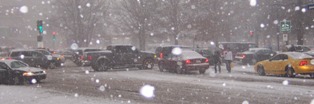
So today was going to be my last class of the semester (History Methods), but that snowstorm which has been making its way across the States has finally reached the Atlantic, and Boston has decided it can’t handle a little snow. Everyone and their thrice removed cousins are shutting down and getting a head start on their commute home. Here’s what the street outside the res campus looked like at 2:30 this afternoon:

So sadly (and I mean this genuinely), we were not able to hold our discussion about “Where is history headed now?” and eat the chocolate-chip-raisin-oatmeal cookies our professor promised us.

At the same time, I’ve got Glen Miller’s In the Christmas Mood on the stereo and I’m sitting in my room with a mug of hot chocolate watching the snow from indoors . . . what’s not to like about that?

Merry almost Christmas everyone . . .

Golden Compass: Feminist Theology?

12 Wednesday Dec 2007

Posted by Anna Clutterbuck-Cook in think pieces

≈ 1 Comment

Tags

books, feminism, movies, politics

. . . Not if you see it on the big screen, at least according to Hanna Rosin’s review, “How Hollywood Saved God” in The Atlantic Monthly.

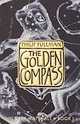
While I am very much looking forward to seeing the movie adaptation of The Golden Compass, by Philip Pullman, on the big screen this weekend (my first movie in the theater since . . . um . . . well, before I came to Boston, I swear on both volumes of my Shorter OED) it’s been interesting to hear some of the debate about the film, the books, and their treatment of religious issues. While I’m not sure I would go so far as to label it a “controversy,” as it was billed on this morning’s “On Point” discussion on NPR, it does seem to have stirred up a little, shall we say, dust in Catholic and Evangelical circles.

In the books on the other hand . . .

“On Point” actually had some extremely thoughtful guests (Ms. Rosin among them) who were discussing the theological themes in both His Dark Materials, the book trilogy, and the movie-makers decisions to elide most of the deeper re-workings of Biblical and spiritual themes. Professor of Religion Stephen Prothero won my heart with his passionate defense of literature as a way for young people to explore the Big Questions and engage in meaning-making for themselves, as well as his delight in Lyra, the series’ protagonist, as a feminist heroine:

My daughters get dressed up as Hermione for Halloween and for the Harry Potter parties, and you know Hermione is a wonderful character but she’s sort of carrying the water for Harry Potter, who gets to be the hero . . . and I love that about the books [that Lyra gets to be the heroine]. I think it’s wonderful to tell girls to question authority, to make a little trouble, to be suspicious when people talk in God’s name as if God is speaking to them through an earphone.

Even more radical, of course, is Pullman’s project of writing an “alternative Genesis” with Lyra as a new Eve whose initiation into sexual awareness is the catalyst for redemption. The narrative is an explicit “response to the church,” Rosin points out, drawing on her interviews with Pullman himself, “this idea of patriarchy and misogyny and the idea that she should be Eve, and she should re-write the story of Eve.”

“And I would argue,” Prothero follows up, “that what we have there is something quite like feminist theology . . . that we shouldn’t be thinking about God as this old man with a beard in the sky . . . why do we have to have the woman be the villain here? Why can’t she be the hero?” Amen.

Plus, I hear that seeing the daemons on screen is worth the price of a ticket. So see you at the theater!

As an aside: My one reservation about the books, incidentally, is the way they are being marketed–much like the Harry Potter books–to a pre-teen audience when they are actually much more dense and in some ways more frightening, than Rowling’s series.

Also, Tom Stoppard wrote one of the early screenplays–wouldn’t you love to have seen that version??!

Need to Footle*?

02 Sunday Dec 2007

Posted by Anna Clutterbuck-Cook in linkspam

≈ Leave a comment

Tags

fun

My friend Hanna passed along this deadly website to me this morning, and I have already used it for many valuable minutes of procrastination. It’s one of those play-a-game-to-defeat-world-hunger sites, and the particular gimmick is that you get to guess what words mean! If you are as excited about this as I am, then I know why we are friends. If not, we can still be friends (I don’t mind).

Today, I learned the meaning of the following wonderful words:

scofflaw = repeat offender

paraph = flourish after signature
supernal = celestial

viviparous = producing live offspring

saponaceous = soapy

fruticose = shrubby
sibylline = prophetic

suspire = sigh

dipsomania = alcoholism

roily = turbid

Hanna also suggests that you enliven the game by trying to remember why you know the meaning of certain words. Why, for example, did I know that “abaca” is a word for “manila hemp”?

The semester’s almost over!

*footle = waste time

Jesus Camp Grows Up

26 Monday Nov 2007

Posted by Anna Clutterbuck-Cook in book reviews

≈ Leave a comment

Tags

education, politics, religion

I spent part of this weekend reading God’s Harvard: A Christian College on a Mission to Save America, by Hanna Rosin. The book centers on Patrick Henry College, founded in 2000 by Michael Ferris, the fundi-gelical conservative Christian activist best known for his work leading the Homeschool Legal Defense Association. (Like it or not, he’s one of the reasons people like me got to have the childhood we got to have . . . even if our home education didn’t have quite the results Ferris is looking for!)

God’s Harvard tells a story that is the natural extension of the 2005 documentary Jesus Camp, which explored Christian evangelical culture as experienced by children ages 7-13. We’ve leapt over the mid-teen years, and are now introduced to an academically elite group of Christian homeschoolers ready to enter college. You can check out an early draft of a chapter from God’s Harvard, “God and Country”, which was published by Hanna Rosin in the New Yorker (27 June 2005).

As usual, it is extremely irritating to have “homeschooling” become conflated with conservative Christian homeschooling with barely an acknowledgment. John Holt (whose papers have just been donated to the Boston Public Library!!) and the free school movement are mentioned only in passing, rolled into the early history of “the movement” in such a way that it’s never clear there are other ways families choose to home educate besides plunking kids down in front of intelligent design videos, drilling them in the tenets of Christian nationalism, and preaching the evils of toxic popular culture, all the while enforcing dress codes and “courtship” standards.

At the same time, I always find an outsider’s perspective on homeschooler cultures fascinating; Rosin’s narrative is an ever-shifting mosaic of the familiar and the alien. Whether secular or sectarian, home-educated kids tend to have close relationships with their siblings and parents, be skeptical of mainstream culture and education, and enter their young adulthood with a disconcerting mix of maturity and naivete.

“Homeschooling families,” Rosin writes, “tend to judge each other by their views on structure and authority; the Patrick Henry families tend to fall on the strict end of that scale. Homeschool families have no school communities or obvious support system, so they tend to group around gurus or schools of thought” (90). The problem is, the only examples she gives are of the Patrick Henry variety, not the hippie home-educator “free schools, free people” types. Proof, I suppose, of our dwindling numbers. Rosin reports, with numbers similar to those in Jesus Camp, that of the estimated 1-1.5 million home educators (unclear whether she’s talking families or young people), a whopping 80% identify themselves as “evangelical Christian” (62).

Clearly, we home-educated feminists are outnumbered by the evangelicals; I guess we’ll just have to raise a little more hell!

Further Reading about the Religious Right

Here are a few other fascinating books on the subject of conservative Christian counterculture from the last few years.

1. Kingdom Coming: The Rise of Christian Nationalism, by Michelle Goldberg provides a good introduction to the political dimensions of the current conservative Christian counterculture.
2. American Facists: The Christian Right and the War on America, by Chris Hedges provides less journalism and more philosophy than Goldberg, suggesting parallels between current Christian political thought and twentieth-century European fascism.
3. Monkey Girl: Evolution, Education, Religion, and the Battle for America’s Soul, by Edward Humes and
4. The Kitzmiller v. Dover decision, which is brilliantly and lucidly written by Judge Jones, both document the recent ruling against the teaching of intelligent design in Dover, Pennsylvania schools.
5. God On Trial: Dispatches from America’s Religious Battlefields, by Peter Irons (I haven’t read this one yet, but it looks good!) provides historical-legal context for the current struggle over the relationship between religion and government.
6. Jon Krakauer’s Under the Banner of Heaven: A Story of Violent Faith goes beyond its story of Mormon fundamentalism to explore the thin line between faith and madness.
7. The Battle for God, by historian of religion Karen Armstrong, is a dense personal favorite, charting the rise of religious fundamentalism as a response to the modern era.

*Images from www.powells.com and www.amazon.com
Thanksgiving on Middlesex Fells

24 Saturday Nov 2007

Posted by Anna Clutterbuck-Cook in a sense of place

≈ Leave a comment

Tags

fun, holidays, outdoors, photos, travel

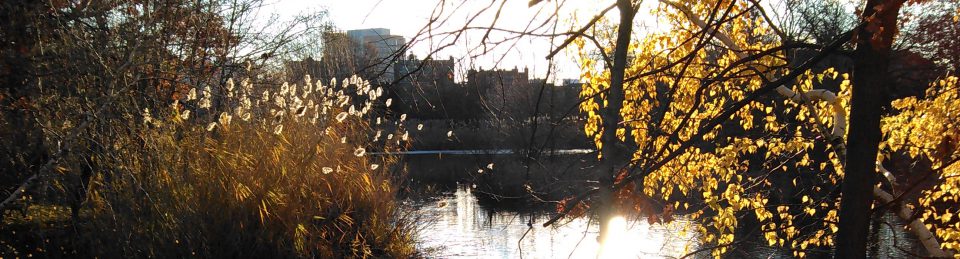
Over Thanksgiving weekend, I decided to take a mini-vacation from Boston proper, and spent a night at the Friendly Crossways hostel outside Harvard, Massachusetts (the small town, not the University), and then drive to Middlesex Fells Reservation for a hike around the system of reservoirs which supply water for the town of Winchester. Yes! I said drive! I rented a car and was vehicularly mobile (a word I just made up) for the first time in three months. It was both extremely harrowing (in the dark) and giddily liberating (in the daytime).

The hostel was comfortably bare-bones and dark and quiet, in a way only rural areas can be. And Middlesex Fells was beautiful and abundantly populated with people and their dogs. I am not exaggerating when I say virtually every party of walkers had more or more four-legged companions. One woman even exclaimed when she passed me on the path, “You’re walking without a dog?!” as if it were an alien concept.

The photographs can be seen above or in larger format at picasa.

A Student at Work

20 Tuesday Nov 2007

Posted by Anna Clutterbuck-Cook in life writing

≈ Leave a comment

Tags

domesticity, simmons

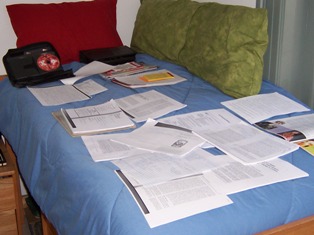
Hope you all have a lovely Thanksgiving week. I am actually looking forward, as geeky as this sounds, to having the mental and actual space to spread out my research papers and do a bit of writing. I have two papers due the week following the break, and they will take up most of my time. The way I organize my papers is by laying all the research out on the bed, desk, floor . . . anywhere there is space. So things start to look pretty chaotic when I am in the middle of a writing project!

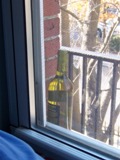
As a late-night after-writing treat, I have discovered that the screen on my window opens, and that the ledge outside the window is just the right width to hold a wine bottle! So I am able to chill my wine, sans fridge, during the autumn months . . . I just have to be careful to bring it inside to drink before the temperature drops below freezing at night!

Who Will Comfort Toffle?

19 Monday Nov 2007

Posted by Anna Clutterbuck-Cook in book reviews

≈ Leave a comment

Tags

art, boston, random acts of kindness

The Boston Bookfair on Friday was lots of fun, though everything I was remotely interested in exceeded my price range by at least hundreds and often thousands of dollars. There was a lovely photography book with black and white 1950s-era images of the Lake District; a medieval manuscript treatise on medicine, illustrated in full color; a pre-suffrage publication by a minister from Indiana arguing on a Biblical basis for women’s right to vote; and a fascinating early obstetrics text by the dude who was responsible for switching the standard birthing position from upright to horizontal (for which he ought to have been flayed).

Children’s books, of course, were wonderful to browse. I found a copy of Four Little Kittens ($75.00), which three generations of Cooks will remember, and several E. Nesbits in first edition (priced at in the hundreds).

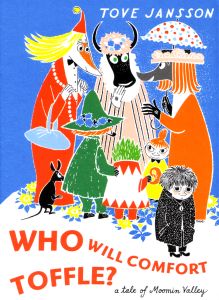
The most charming new find was a book by Tove Jansson, Finnish author of the Moomin Troll series, Who Will Comfort Toffle? This is the story of Toffle, who is afraid and alone, and his quest for a friend, so that he will not be so scared anymore. One day, he finds a bottle floating on the water and inside is a message from a person named Miffle, who is also scared and lonely. Toffle sets off on a quest to find Miffle, so that they can comfort each other. Of course, the implicit gender roles are knight-and-lady stereotypes, but the pictures were totally charming.

*Images from One More River and The Moomin Trove respectively.

From the (Microfiche) Archives

17 Saturday Nov 2007

Posted by Anna Clutterbuck-Cook in my historian hat

≈ Leave a comment

Tags

education, history, simmons


I am working on a paper right now on the educational philosophy and practice in the utopian Oneida Community, which existed in New York state from 1848-1881 as a religious commune and continues to this day as a company manufacturing housewares. As part of this research, I visited Boston College’s O’Neill library, which has a microfiche collection of the community’s newspaper, the Oneida Circular. Microfiche is a pain to read–I have been known to get both migraine headaches and severely motion sickness–but the content it enables researchers access to is often excessively diverting.

The Circular functioned as both a venue for the community to evangelize to an external audience and as sort of community newsletter. They seem to have freely culled news items from other publications, usually unattributed, and also share miscellany from the life of the community, such as a note that “the wheat that was stored in the can-shop is nearly all saved, and but slightly injured” (1). Here are some oddments that I discovered while in the midst of “serious” research.

A large lithographic “View of the First American Railway Train” is on exhibition in the Library. It shows simply a line of old-fashioned stage-coach bodies connected together, and placed on car-wheels. Each vehicle contains six solid-looking gentlemen with stove-pipe hats; and their sharp noses and chins are all after the same pattern. The brakeman sits comfortably on the driver’s seat with an iron lever in his hands (2).

Seneca Lake is frozen over and people skate from one end to the other. This has never happened before within the memory of white men (3).

Answers to correspondence: “J. Y., Rochester, N.Y.–We should probably have to deny your request for admission as we are full. In any case, very much more acquaintance with you would be necessary. Our Community is not of the nature of a cooperative union, but of a church.” (4).

[The] cuttle-fish of the European coast are dwarfed by comparison with some from the coast of Newfoundland. In the American Journal of Science and Art for Feb., Prof. Verrill gives an account of a specimen which became entangled in herring-nets near St. John’s, Newfoundland, and was secured after a severe battle. The body was nearly seven feet long with eight arms covered with suckers each six feet in length . . . (5).

We feel warrented in advocating romping girls. They seldom fail to make healthy, happy, useful and not un-refined women. Do let us have more of them! (6)

Notes:
(1) 1 March 1875, p. 69
(2) 1 March 1875, p. 70
(3) 1 March 1875, p. 72
(4) Ibid.
(5) Ibid.
(6) 1 March 1875, p. 70

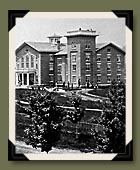
Image found at the Oneida Community Mansion House website.

Fun With Old Things

16 Friday Nov 2007

Posted by Anna Clutterbuck-Cook in library life

≈ Leave a comment

Tags

books, boston, fun, history, MHS

Tonight, I am headed to the Boston International Antiquarian Book Fair to admire, well, antiquarian books, manuscripts, and prints, in an atmosphere of bibliomaniacal excitement. A group of us are headed down after work, and my friend Hanna is meeting us there. If I buy anything I’ll report back with pictures! I doubt anything will be in my price-range (<$25) though. Oh, well, it's fun to window shop!

I also thought I’d share this link from the MHS website. It’s our monthly object of the month, which a number of archives have started doing as a way to increase the visibility of their holdings online, and give people a taste of what sort of resources archives have to offer. MIT also has a fun collection on their site.

In the MHS collection, I particularly like the entry showcasing eleven-year-old Sara Putman’s dairy, with an account of her 1862 visit to the aquarial gardens, which was an early Boston aquarium.

Everyone have a good weekend!

← Older posts
Newer posts →
"the past is a wild party; check your preconceptions at the door." ~ Emma Donoghue

Recent Posts

  • medical update 11.11.22
  • medical update 6.4.22
  • medical update 1.16.2022
  • medical update 10.13.2021
  • medical update 8.17.2021

Archives

Categories

Creative Commons License

This work by Anna J. Clutterbuck-Cook is licensed under a Creative Commons Attribution 3.0 Unported License

Meta

  • Create account
  • Log in
  • Entries feed
  • Comments feed
  • WordPress.com

Blog at WordPress.com.

  • Subscribe Subscribed
    • the feminist librarian
    • Join 37 other subscribers
    • Already have a WordPress.com account? Log in now.
    • the feminist librarian
    • Subscribe Subscribed
    • Sign up
    • Log in
    • Report this content
    • View site in Reader
    • Manage subscriptions
    • Collapse this bar