• anna j. clutterbuck-cook
  • contact
  • curriculum vitae
  • find me elsewhere
  • marilyn ross memorial book prize

the feminist librarian

the feminist librarian

Author Archives: Anna Clutterbuck-Cook

jean cook, in memorium

20 Thursday Mar 2014

Posted by Anna Clutterbuck-Cook in our family

≈ 3 Comments

Tags

michigan

My grandmother’s funeral is today, and of course what can you possibly say about a person who — until late Monday afternoon — has always been a part of the world while you were alive within it? The earliest memory I have that can be attached to a specific period in time is of staying with Grandma Cook while my mother was in labor for the birth of my brother, Brian. I was just shy of three years old. 

So there are any number of stories I could tell about my growing up in relationship to her, grandmother and granddaughter, two people who didn’t always agree. The story I want to share today, though, is one that can be told in her own words. For, like a good historian and archivist, I saved the document (in an archival box!) and was able to locate it on Friday as Hanna and I were packing to leave on this journey.

This is the letter my grandmother wrote me when she learned that Hanna and I were together as a couple — the event that was, for most people in my life, my coming out moment as a person with bisexual desires. Reading it over, my political-critical self notices limitations, but I will refrain in the here and now from pointing them out. What I hope comes through in this very human document is its author’s overwhelming impulse to “only connect.”

 9 Nov. 2009
Dear Anna, 
It was so very nice to see you on your visit home. I know there were many people to see in your short time. Also, perhaps you caught up on a little needed rest. That is what ‘coming home’ is all about once you have left.
On Sat. evening your Mom and Dad shared with me your loving relationship with Hannah [sic]. There are just a few things I want to share with and about you.
First of all, Anna, there is no more beautiful relationship in life than when two people fall in love. I am so happy that you have found that love. Your grandfather believed firmly that relationship is the most important aspect in life. It sometimes means putting aside your morality code or other norms society has established for itself.
Anna, you have always been a person who has challenged some of life’s “norms.” No doubt sometimes it was just a reaction but perhaps other times with thoughtful research and decision making. To not live in denial of your sexual orientation has been an admirable step in knowing just who you are. You come from a family that has always known inclusiveness in whatever form it make take. Know that you are surrounded with love and acceptance for all that you are and will still become.
I don’t know what your relationship with God is – that is between you and God. However, I truly believe that at times God does choose certain individuals to [bear crosses?] in our society — whether it be for peace and justice, sexual discrimination or whatever the societal cause may be. You have shown such strength in accepting the recognition of who and what you are that I know you will be a [wholesome?] advocate of others less confident than yourself.
Remember always that behind you is a loving, supportive family. We trust that your relationship with Hannah will fill the deep love in your heart.
Your grandmother who loves you always

deathtime reading list

17 Monday Mar 2014

Posted by Anna Clutterbuck-Cook in our family

≈ Leave a comment

Tags

books

On our drive to Michigan, I kept thinking about what I could do besides be here with my grandmother, as we gathered to help her through the final days of her life. And what I kept coming back to was reading aloud.

Ours has long been a family of reading together, and there is something about the experience of being read to that I think cues being cared for in a very deep part of our psyche or soul. It is also something that Hanna and I share; one of the most effective ways for us to help her back down from a bad spell of anxiety is to put on old cassette-tape recordings of her father reading aloud, like he used to do when she was small.

So when I got to Holland on Sunday morning, I stopped off at my parents’ house before going to Grandma’s and picked up an armful of books. Here is what I have read so far:

Springtime in Noisy Village by Astrid Lindgren

The Sailor Dog by Margaret Wise Brown

Bread and Jam for Frances by Russell Hoban

Miss Rumphuis by Barbara Cooney

half a dozen chapters from The Lion, the Witch, and the Wardrobe by C.S. Lewis

and the opening chapters of The Voyage of the Dawn Treader also by C.S. Lewis

The text probably isn’t that important, though I’ve been conscious as I’ve been reading about themes of exploration and home-coming, of journeys into the unknown, and of familiar family tales. The act being read to has helped calm everyone through the ups and downs of this process.

It’s made me think about what stories I will want for myself, someday, to help with the journey on.

the season of the dying grandmothers

16 Sunday Mar 2014

Posted by Anna Clutterbuck-Cook in our family

≈ Leave a comment

Tags

michigan, travel

moon + venus. norridgewock, maine.

Hanna and I are back in Michigan.

My grandmother had a stroke on Tuesday afternoon and at first they thought it was minor, but internal bleeding developed at the hospital and she slipped into a coma on Tuesday night. My family was able to bring her home Wednesday evening, so that she can die in the home she and my grandfather shared during the majority of their marriage, until his death in 2007. It is a space that has been the hub in the wheel of the paternal side of my family for my entire life.

As I type this, I am sitting next to her bed in the living room. All the children and grandchildren and their spouses have gathered, along with a few close friends,  and my grandmother’s golden retriever who circles around everyone, keeping track.

It is cold here, with ice still on the lake that we can see out the front windows. Snow banks are deep alongside the steep drive that leads from the road to my grandmother’s house, which stands on a small rise. Out behind the house is a once-landscaped gulch with a creek running through it that, in the spring, will become carpeted with daffodils.

We are entangled with our own watchful waiting right now, but I know others among you are also wrestling with life transitions and trauma. My thoughts are also with all of you, whatever your life-changes and stressors may be.

It is good to be here, and I am grateful to all of those in my life who made it possible for Hanna and I to travel on such short notice. Thank you all.

random access blogging

10 Monday Mar 2014

Posted by Anna Clutterbuck-Cook in Uncategorized

≈ Leave a comment

Tags

books, boston, domesticity, travel, vermont

Montague Bookmill, interior (December 2012)

I’m in the final stages of writing my conference paper, a week behind my self-imposed deadline. So no book review this week. I did, though, get a chance to read Violet Blue’s Smart Girl’s Guide to Porn (Cleis, 2006) this morning over breakfast, which I recommend for those interested in moving-picture porn. I personally have never done much with the genre, in large part because my interest in porn generally stops where the pay wall begins, and I’m not as willing to weed through the dross for the gold as I am with fan fiction. But Blue’s slim guide is a great introduction and guidebook full of suggestions for getting the most, well, bang for your buck in a feminist-aware sort of way.

The reason I had Smart Girl’s was that Hanna and I spent yesterday on a field trip to Montague Bookmill for lunch with friends, and then a subsidiary field trip to Brattleboro, Vermont, for weekly shopping at the Brattleboro Food Co-op. At the co-op, I spotted a gardening display featuring my friend Joseph’s book on plant breeding!

It is so much fun to know people who write books and publish them.

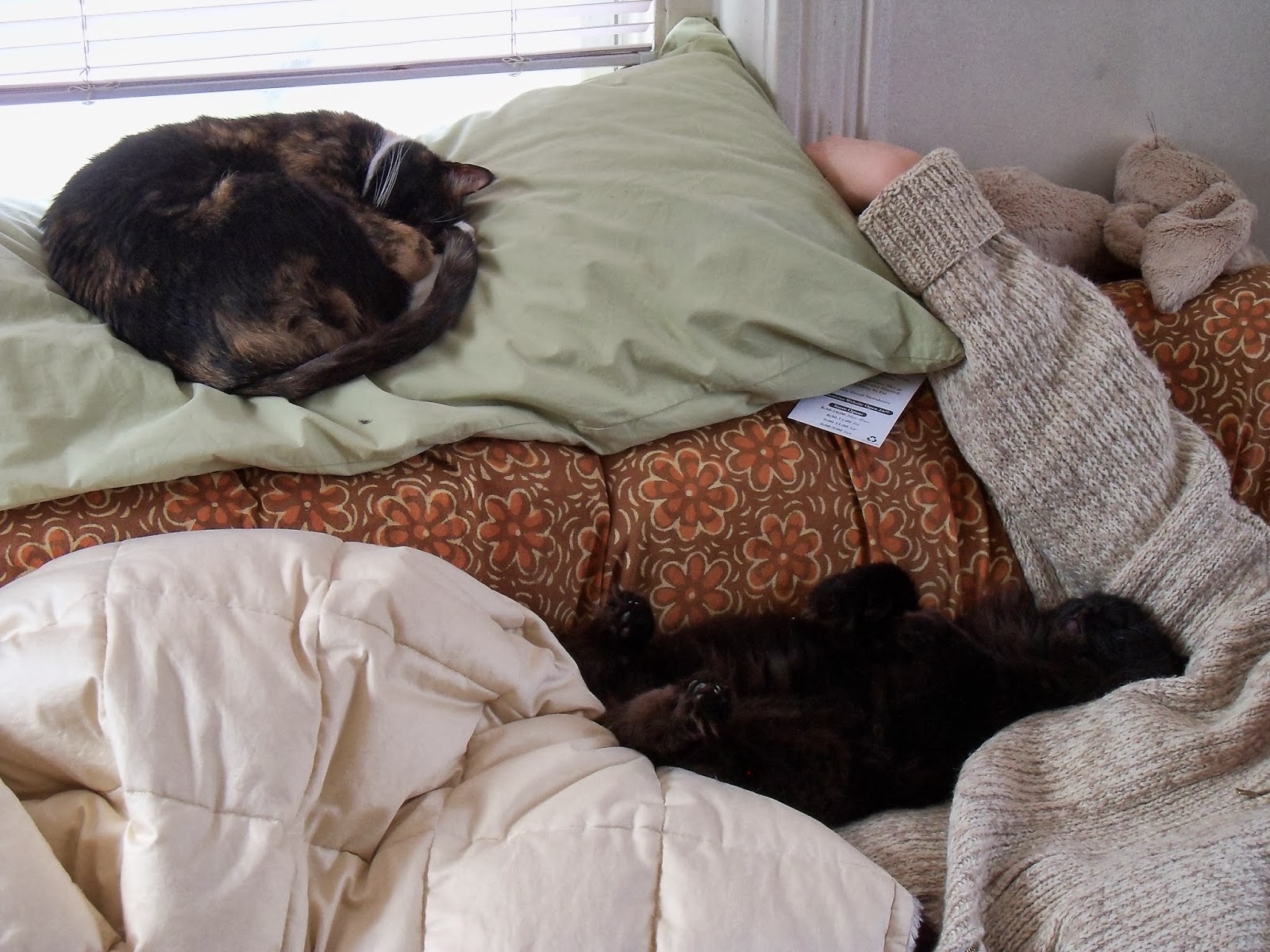
Spring is just around the corner here in Boston. I feel I can say this despite the fact that I’m typing this hunkered down under two comforters and as many cats because today, for the first time since November, we were able go the whole day without turning on the electric heaters. A real milestone.

Plus, I went out yesterday in just a heavy sweater. Liberating!

(And I can tell I’ve reached adulthood because my major concern is not how early I can get away with running around barefoot, but rather whether or not warmer spring temperatures will balance out the cold-weather electric bills before a new twelve-month cycle of payments begins.)

The “not renewing” notice to our current landlords is sitting on the table by my messenger bag ready to go in the morning’s mail. We have until March 31st to decide, but we talked it over on Friday and realized there was no point in waiting until the last minute: we know we’re ready for somewhere new. My colleagues are all gunning for us to move to Jamaica Plain, a serious contender, though we’re open to a broad swath of Boston within a three-mile radius of the Fenway where we both work. It’s an adventure, our first joint search for a home. I think of it as our “going to housekeeping” moment.

Though of course this spring marks the sixth anniversary of my moving in to this space.

The longest I’ve lived anywhere except my childhood home.

The rest of the month is busy for us, with both of us attending (with duties) New England Archivists and then the following weekend me presenting at the Biennial Boston College Conference on Religion and History (that paper I’m a week behind in finishing). I’m looking forward to celebrating my birthday on the 30th as a way to mark the end of a hectic season!

I hope all of you are well; and to everyone whom I owe an email (there are about half a dozen of you, I know!) please know I haven’t forgotten you and letters will be forthcoming once we’re on the other side of conference sessions and such.

wednesday cat blogging [photo post]

05 Wednesday Mar 2014

Posted by Anna Clutterbuck-Cook in our family

≈ Leave a comment

Tags

cat blogging, photos

Teazle’s latest favored place to sleep is in the box where Hanna keeps her knickers. She has to jump up onto the shelf above and then worm her way into the box. It’s a process we shamelessly mock her for.

Gerry, meanwhile, clearly feels relaxed enough these days to do a dead bunny impression. She slept this way for a good half hour on Sunday, effectively trapping me on the couch!

Sunday was definitely a day for snoozing.

Hope everyone’s week is going well and that y’all are staying warm. We’re definitely ready for spring!

booknotes: for people, not for profit

03 Monday Mar 2014

Posted by Anna Clutterbuck-Cook in book reviews

≈ Leave a comment

Tags

boston, gender and sexuality, history

A few weeks ago, I was hunting for information on the Fenway Interagency Group (FIG), a coalition of neighborhood organizations that came together during the early 1970s in the Fenway neighborhood of Boston as background for a blog post I’m writing for the MHS. Thanks to full-text searching on Google Books, that search led me to Thomas Martorelli’s For People, Not For Profit: A History of Fenway Health’s First Forty Years (AuthorHouse, 2012). Hanna and I have been using Fenway Health, originally Fenway Community Health Center, as our “healthcare home” since 2009. We stumbled into it on the recommendation of a friend and, from the inside out, have slowly become more aware of its national and international renown in the fields of community-based, culturally-competent healthcare — particularly within the fields of lesbian, gay, bisexual, and more recently trans* healthcare.

For People, Not For Profit is an institutional history written from an insider’s loving perspective: Martorelli is former chair of the Fenway Board of Directors. Nonetheless, he doesn’t paper over the growing pains of an organization that grew from an all-volunteer collective of health activists into the established health and research center it is today. Like many activist groups that formed during the idealism of the late Sixties and early Seventies, Fenway Community Health Center initially relied on volunteer labor, with collective decision-making processes and interminable meetings. It offered walk-in clinics for target populations — namely women, gay men, and the elderly residents of the neighborhood. As it grew into a non-profit organization with a paid staff, successive directors arrived to find finances on shakey footing and physical space in chronic shortfall.

It was the AIDS/HIV crisis during the 1980s that became the fire that forged modern Fenway Health; already positioned to serve the gay male population of Boston, Fenway staff were on the front lines of the epidemic providing innovative care and conducting ground-breaking research that helped develop treatments to extend and enhance the lives of those with HIV and AIDS. Simultaneously, Fenway was also offering education and resources to single women and women with female partners on the options for getting pregnant (alternative insemination), and working with feminist-minded area women’s health organizations to reach women across the sexual orientation spectrum who might benefit from community health education and services. In the past decade, Fenway has also become a leader in providing respectful and effective care for members of the trans* community as well.

Martorelli documents each phase of Fenway’s growth in a series of chronologically-arranged chapters, each of which contain a section on care, education, advocacy, and leadership. Lengthy excerpts from interviews with key players provide insights into how people involved in Fenway’s various programs and projects view their work in historical and social context.

Future historians of queer experience and the history of medicine will have more work to do telling the story of Fenway Health in wider historical context; thankfully, the historical records of Fenway Community Health Center have been donated to Northeastern University’s archives and special collections (where Hanna had a hand in processing them in 2010!) and are available for research. When these historians get to work — and I hope some of them are already digging in! — For People, Not for Profit will be a valuable starting point for more in-depth studies that focus on specific aspects of the Fenway Health project, as well as explorations of Fenway’s participation in the tumultuous landscape of queer activism, AIDS/HIV politics and care, and the rich story of Boston’s neighborhood-based activism.

Meanwhile, Martorelli’s book has given me valuable background for my own participation in the Fenway Health project as a volunteer on the consumer/community advisory board. I’m grateful that such a resource is available — and am developing librarian-ish plans to make it (and other Fenway publications) more visible and available to the patients who utilize Fenway’s services.

booknotes: new deal & american way of poverty

24 Monday Feb 2014

Posted by Anna Clutterbuck-Cook in book reviews

≈ Leave a comment

Tags

economics, history, politics


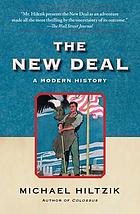
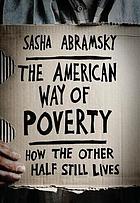
I read Michael Hiltzik’a The New Deal: A Modern History (Free Press, 2011) and Sasha Abramsky’s The American Way of Poverty: How the Other Half Still Lives (Nation Books, 2013) in tandem, leading to a very strange stereovision of America’s twentieth-century successes and failures in delivering basic material security to its people. Hiltzik, whose reporting I first encountered last fall around the Obamacare rollout, offers us a detailed case history of the incomplete construction of America’s social safety net, while Abramsky details the ways in which even that open-weave net has been slashed and burned since the 1970s. Taken together, the two volumes chart a twentieth-century history of callous uncaring for the economically vulnerable, with a brief burst of effort during the Great Depression, and then again in the postwar era when America’s affluence made it seem, temporarily, like poverty could be eradicated without asking the other other half to give up that much, if anything. Did you know that during the Great Depression, relief workers were making the case that giving cash to people in poverty, no strings attached, was the most effective way to stimulate the economy and help them put their lives back together? And we act like we’ve just discovered that poor people are actually the experts on their own lives. Can you imagine a world where Richard Nixon floated the idea of a guaranteed universal income for every American? Because it existed. Briefly. It’s both refreshing to recover these histories of (dare I say it) socialist activism in American life, and also a real downer to realize that in every era political realists tempered their radical inclinations to better the well-being of Americans because they knew they would only be able to win lesser concessions from those who held the political power (and financial resources).

Hiltzik’s New Deal is straightforward political and economic history. In a sweeping chronological narrative he charts the Roosevelt administration’s efforts to resolve the crises of the Great Depression (banking, housing, jobs, food) from Roosevelt’s inauguration through to the eve of WWII. The story he tells is Washington-centric, a tale of New Deal politicians, those in their employ, and their adversaries. Those looking for a more grassroots narrative of the Great Depression and the effect of New Deal policies and programs should look elsewhere — but Hiltzik does provide a useful sense of the real politik required to push through programs such as Social Security. While those on the left wanted guaranteed pensions for all elder Americans, the program as finally designed — as we know it today — tied payouts to lifetime earnings:

The program’s near-total dependence on enrollee contributions has been both a blessing and a curse. (Economists consider the employer’s payments to be employee contributions under another guise, on the theory that if the employer tax were not levied the money would flow to the workers as wages instead.) Although the contributory element makes the program’s financing regressive — that is, wealthier Americans pay a smaller portion of their income than lower-paid workers to support a program of broad social utility — it has also helped protect it from political attack by giving its enrollees what appears to be a concrete stake in its survival (251).

In many ways, Saul Abramsky picks up where Hiltzik’s narrative leaves off, exploring American poverty and economic insecurity as it has manifested since the mid-twentieth century and the War on Poverty efforts of the ebullient 1960s and early 70s. The American Way of Poverty is a difficult book to read, in that it ruthlessly reminds us that we are all one or two or a series of three, four, five, instances of bad luck of poor decision-making away from material ruin. In a society that has only ever grudgingly supported social safety nets — and then only for the “deserving” poor. As the rich grow richer, we talk about slashing social security benefits, refuse to extend Medicaid to our nation’s poorest regions, and continue to see the socialized guarantee basic material security (health care, food, shelter, education, and work) as the flower-strewn path to slothful dependency.

As someone who believes that a life lived in basic faith that human beings seek to be creative in community with one another (recognizing there will be a few who take advantage of this trust) far outweighs the toxicity of a life lived on the premise that human beings require shock prods and chains to squeeze labor and “productivity” out of their souls, I found Abramsky’s reminder of how few Americans share my values possible to read only in small doses. Particularly (ironically enough) the final sections in which he offers solutions for the various problems of endemic poverty: a guaranteed minimum income, socializing the costs of higher education, reinvestment in Social Security, national healthcare, renewed support for unionization, a laundry list of practical steps toward a society oriented toward benefiting all not just the plutocratic few. That such a simple, modest list of steps toward the lessening of human suffering seems politically impossible leaves one with a creeping sense of apathetic despair.

I won’t stop at the apathy, of course (I suppose maybe not “of course”, but I’ve imbibed enough lefty theology in my time to believe that a meaningful life involves struggling for justice even when the possibility of success is vanishingly small). But it’s shocking every time to re-realize how willing we are to throw some people under the bus so the “right” sort of people can keep on hoarding the resources for themselves. And how we narrate those acts of violence as inevitable, natural, as “freedom” and “choice,” as the neutral forces of the universe, simply the way things are rather than the way we’ve decided things will be. Reading histories like Hiltzik’s are a good reminder that our present has been shaped by our past, and that the past is made up of concrete actions taken up by human beings. Human beings who could have made different decisions, taking us along different paths.

We always have choices. I do hope that, collectively, we can make ones that benefit the vulnerable, the marginalized, the trapped, and dehumanized, so that they too are free to make meaningful choices about their own lives.


unfinished thoughts about putting down roots

21 Friday Feb 2014

Posted by Anna Clutterbuck-Cook in a sense of place

≈ Leave a comment

Tags

boston, domesticity, hanna, move2014

The Fens from Charlesgate, Boston
(December 2007)

As we lay the groundwork for locating and moving to a new apartment, and possibly a new neighborhood of Boston, later this year, I’ve been thinking a lot about what it means for Hanna and I to be putting down roots in this city. We both moved here for graduate school and have stayed for the professional opportunities Boston’s cultural institutions have offered. Moving within the city — out of the apartment Hanna originally selected with her grad school roommate — feels like choosing or re-choosing the city as a place we want to live in, make a life in.

I find myself inhabiting the city with new eyes and new investment. I’m no longer thinking about it as a space I move through as an observer. Rather, I’ve become a participant. Although I’m still learning what it means to me to participate in the life of this city that has become our chosen home.

A short list of things I’ve (we’ve) been doing that feel like part of that learning process:

  • Walking, biking, taking public transit. Hanna and I are both committed to using the city “at ground level” if we’re going to be living in it. We map the neighborhoods by foot and measure our progress in coffee shops passed. While I don’t think owning a car precludes one from belonging to the city (clearly many drivers are Bostonians!) not having a car means we’re more reliant on public infrastructure within the core urban area, and that space and time get measured differently. By necessity, we need to shop for groceries, pick up our library books, visit our doctor’s office, meet up with friends, get our hair cut, all within a three-mile radius and ideally between point A (home) and point B (work). This is a fundamentally different way of experiencing the geography of one’s life than when life requires daily driving — I lived the first twenty-seven years of my life in a car-dependent town, so I’ve experienced this shift first-hand.
  • Supporting local non-profit organizations. It probably says something fundamental about our socioeconomic backgrounds that as soon as Hanna and I reached a sustainable level of income and could start thinking about charitable donations, the first thing we did was become members of our two local NPR/PBS networks (WGBH and WBUR). It was reflexive: this is what adults do. Yes, National Public Radio is a nationwide network, but each station is local too. We wake up to the local weather forecast and enjoy the broadcasts of America’s Test Kitchen (filmed in studios next door to one of our favorite coffee shops!). We currently give (tiny!) monthly gifts to WGBH, WBUR, and Classical New England, all of which broadcast out of the Boston metropolitan area. We’ve also chosen to provide ongoing support to Black Cat Rescue, our favorite no-kill foster cat program here in Massachusetts and the Greater Boston Food Bank. I’m also starting to get involved on a volunteer basis with our community health center, Fenway Health, which provides nationally-renowned health services to LGBT folks, women, at-risk teenagers, and the elderly of the Fenway neighborhood and greater Boston.
  • Relying on local non-profit organizations. There’s a lot of high-level philanthropy around Boston, including at the institution where I work, and I’ve been thinking a lot lately about the notion of “charitable giving” and the distance it implies between those who selflessly give to those in need. That kind of giving (hopefully with no strings attached) obviously has its place, but I also like the immediacy and intimacy of providing support for those whose services we need now, or in the future: our health center, our public library, the social safety net. I’ve been doing a lot of research lately into housing programs here in Boston, both grass-roots advocacy organizations and government-funded programming. In doing so, I’ve have the opportunity to reflect on the importance of using as well as passively supporting social services of various kinds. Even though Hanna and I are (at least temporarily) middle class professionals, it seems important to me to know how my city cares for the marginalized; how we could be cared for if we became marginalized.
  • Learning local history. When in doubt, turn to books! I’ve been reading, reading, reading up on the history of the Boston area and learning how its past has shaped our present and will continue to shape our future in the decades to come. 
What are the ways that you’ve gotten to know the place(s) where you (have) live(d)? What components need to be in place for you to feel like you belong to and are invested in a place, a community?

romance & inequality: migraine listening

18 Tuesday Feb 2014

Posted by Anna Clutterbuck-Cook in Uncategorized

≈ Leave a comment

Tags

books, boston, gender and sexuality, web audio

I was going to write a joint book review this weekend of The American Way of Poverty and The New Deal: A Modern History, both of which I’ve read in the past month. But then I got socked with a two-day migraine, the kind that comes around about once a season and has me making friends with the toilet bowl, the ice pack, dark, dark rooms, and narcotics.

So writing didn’t happen. But to distract myself from the pain, listening did.

I started with this most enjoyable hour of On Point discussing the romance novel industry. It had surprisingly little condescension, and although I would have liked some acknowledgement of non-hetero markets and amateur writers (*kof*kof*fanfiction*kof*kof*), overall it was a thoughtful reflection on the enduring popularity of narratives that center around relationship formation.

Then I moved on to Boston and socioeconomic inequality, which has been in the news a lot recently due to the nationwide media attention and due to the fact we have a new mayor (Marty Walsh) assuming office who was elected in part because of his working-class background and pledge to make Boston more affordable for those of us not in the 1%.

And finally, an hour of the Diane Rehm show devoted to gay rights in “law and sports” (an opportunistic conglomeration if I ever saw one!). I can’t say I learned anything new during this hour, but did appreciate the articulate presence of the Department of Justice’s Stephen Delery (emphasis mine):

REHM

10:12:01
And you have the National Organization for Marriage, Brian Brown, the group’s president, saying, “The changes being proposed here to a process as universally relevant as the criminal justice system serve as a potent reminder of why it’s simply a lie to say that redefining marriage does not affect everyone in society.”

DELERY

10:12:37
Well, I do think, Diane, that, as the Supreme Court recognized in Windsor, the Defense of Marriage Act had real consequences for real people by denying a whole range of benefits to people in the course of many federal programs. Some of these programs are critical to people who need them for health insurance, for example.

DELERY

10:13:01
And so, if you look at what the agencies have done over the last few months, the same-sex marriages are now recognized for all federal tax purposes, including filing joint returns. Spousal benefits are now available to military service members who are serving overseas. Health insurance is available for same-sex spouses of federal employees.

DELERY

10:13:24
And citizens who are in same-sex marriages can now sponsor their spouses for immigration benefits. And the list goes on. All of these things are federal benefits, provided under federal law, and the agencies, like the Department of Justice, have concluded, following the Supreme Court, that the marriages that are lawful where they’re performed should be recognized for these purposes.

I hope y’all have a good week ahead, and — health willing! — I’ll be back next Monday with the promised book reviews.

booknotes: the hub’s metropolis

10 Monday Feb 2014

Posted by Anna Clutterbuck-Cook in book reviews

≈ 2 Comments

Tags

boston, history, move2014

Now that Hanna and I are new-apartment-hunting in earnest, my situational interest in the history of Boston’s development has come to have immediate real-world applicability as we look across the landscape of our greater metropolitan area for areas that might be affordable yet still within the walkable urban core. My latest reading in this area was particularly enjoyable in this way, as James O’Connell’s The Hub’s Metropolis: Greater Boston’s Development from Railroad Suburbs to Smart Growth (MIT Press, 2013) ends each chapter with concrete, extant examples of each phase he writes about. Guidebook-style he describes three-to-five locations or routes whereby one can explore the  nineteenth-century country retreats of the Boston gentry, the postwar automobile suburbs, or the sites of “smart growth” and the greening of Boston in this newest phase of regional planning. O’Connell (and his ever-patient wife) might be the only people whose idea of a good time is to visit surviving examples of 1980s strip malls, but I enjoyed reading about his enthusiasm nonetheless!

The Hub’s Metropolis sketches out, in roughly chronological order, the development of the Boston metropolitan region from 1800 to the present day, beginning when Boston was largely confined to the Shawmut peninsula and connected to surrounding villages in only tenuous trading and regional economic relationships. Prior to the railroad, people generally lived within walking distance of where they labored on a daily basis; deep into the twentieth century this held true for working-class families. (Only since the 1980s have the inner suburbs become locations for the impoverished and working poor who can no longer afford to live in the rapidly-gentrifying core of America’s largest cities.) One of the most interesting tidbits of information I learned from O’Connell is that the human tolerance for a daily commute has remained more or less static at 45 minutes and urban historians can trace the growth of cities out from business nodes based on transportation options. When people generally walked to work, residences were within 2.5 miles of their places of business. When streetcars and trains, and later the automobile pushed outward from that radius exponentially as workers were able to travel further and further in the same window of time.

Of course, now we’re coming full circle in the sense that “walkable urbanism” is the new hip thing. Hanna and I are both committed to finding an apartment within that 45 minute walking radius (for us 2.5-3 miles) from the neighborhood where we engage in our wage-work. Interestingly, we come to such a lifestyle from opposite ends of the spectrum: I grew up in a family where my father was a ten-minute walk from work and seek to replicate that sense of accessibility, while Hanna grew up an hour’s drive from most amenities and never wants to return to such an extreme rural mode of life. We currently live in what used to be a streetcar suburb of Boston, about four miles out from the Statehouse on Beacon Hill; our neighborhood of Allston was developed in the early 1900s as the streetcars made it possible for middle- and working-class families to escape inner-city tenements for newer apartment buildings further away from the noxious industries that clustered around the waterfront (or put them within walking distance of Brighton’s slaughterhouses and railroad yards). As we start looking at apartments within the old suburbs (Jamaica Plain, Roxbury, Brookline, Allston/Brighton) we’ll be crossing paths trod by generations of Boston workers before us.

← Older posts
Newer posts →
"the past is a wild party; check your preconceptions at the door." ~ Emma Donoghue

Recent Posts

  • medical update 11.11.22
  • medical update 6.4.22
  • medical update 1.16.2022
  • medical update 10.13.2021
  • medical update 8.17.2021

Archives

Categories

Creative Commons License

This work by Anna J. Clutterbuck-Cook is licensed under a Creative Commons Attribution 3.0 Unported License

Meta

  • Create account
  • Log in
  • Entries feed
  • Comments feed
  • WordPress.com

Create a free website or blog at WordPress.com.

  • Subscribe Subscribed
    • the feminist librarian
    • Join 37 other subscribers
    • Already have a WordPress.com account? Log in now.
    • the feminist librarian
    • Subscribe Subscribed
    • Sign up
    • Log in
    • Report this content
    • View site in Reader
    • Manage subscriptions
    • Collapse this bar