• anna j. clutterbuck-cook
  • contact
  • curriculum vitae
  • find me elsewhere
  • marilyn ross memorial book prize

the feminist librarian

the feminist librarian

Author Archives: Anna Clutterbuck-Cook

here’s hoping [for the downfall of #doma]

26 Wednesday Jun 2013

Posted by Anna Clutterbuck-Cook in think pieces

≈ 1 Comment

Tags

doma, marriage equality, married life, scotus junkie

photograph by Laura Wulf

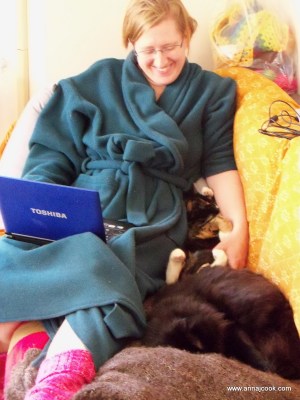
Hanna and I worked out last night that this week marks the fourth anniversary of our officially becoming a couple, in that intimate, couple-y, sharing-a-bed-ahem sort of way.

I’m enough of a Supreme Court junkie to find it somewhat appropriate that this is also the week (and the day and nearly the hour) when SCOTUS will be handing down their rulings on the DOMA and Proposition 8 cases.

Here’s hoping we’ll be able to file a joint tax return next year.

Here’s hoping that after 10 o’clock this morning we’ll be one babystep (babyleap?) closer to queer folk being fully recognized as the legal and social citizens that we rightfully are of these here United States.

And then we’ll turn around and keep on working toward the next shuffle forward.

tattoo no. 3

25 Tuesday Jun 2013

Posted by Anna Clutterbuck-Cook in life writing

≈ Leave a comment

Tags

art, domesticity, family, hanna

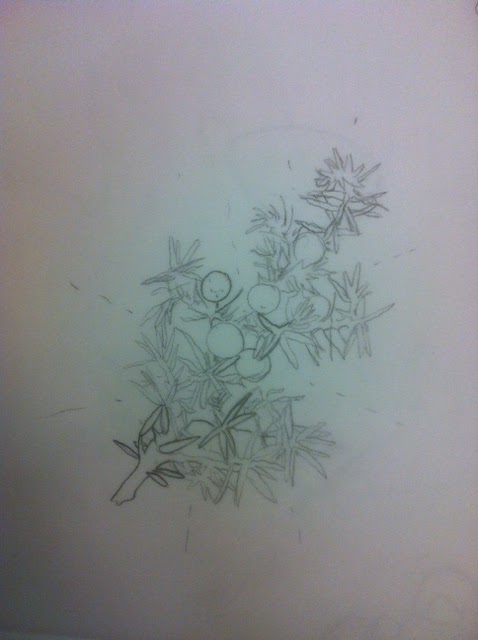
artwork by Thomas Gustanis

Even in the midst of this Boston heatwave, I’m starting to get excited about the appointment Hanna and I have tomorrow for our new tattoos! They will be, respectively, her fourth and my third pieces — and our first projects with our new tattoo artist, Thomas Gustanis, the husband of one of Hanna’s colleagues at the Center for the History of Medicine.

We were excited to discover Thomas was building his tattoo portfolio, as our previous artist — Ellen Murphy — left the Boston area to work at Red Rocket in New York City.

*sad face*

But! Life (and tattoo art) move on, so we’re looking forward to building on the addiction that Ellen jump-started with Thomas’ developing style.

I had my first tattoo inked to mark the completion of my graduate degrees in January 2011.

Along with Hanna, I had my second tattoo inked in celebration of our marriage in August 2012.

When the opportunity to have a third tattoo completed arose I did not have an obvious design in mind, although I new I wanted something organic. After sitting with some possible designs and placements, I’ve settled on the lovely juniper branch Thomas sketched out (above), to be inked on the back of my right shoulder. The smell of juniper in the heat of summer sunshine is one of my strongest scent-memories from childhood: it grew as wild ground cover around the cottage in Leelanau, Michigan where my family vacationed every summer, and was also a pervasive scent in Bend, Oregon, where we regularly visited my maternal grandparents when I was young. Northern Michigan and Central Oregon are both deep parts of my geographically-rooted self, and I chose this tattoo to ground those spaces and memories within my bodily self.

It was only after I had selected the tattoo subject and finalized the design with Thomas that my grandmother, Marilyn, died in Bend. But I will be sitting for the tattoo tomorrow afternoon in her memory, and in thanks for the way she helped make Oregon a part of my Homeland.

stuff that may be keeping me from blogging (as much) this summer

21 Friday Jun 2013

Posted by Anna Clutterbuck-Cook in life writing

≈ Leave a comment

Tags

being the change, blogging, domesticity, history, work-life balance

During the past few weeks, I’ve been reading stories on the internets about which I have Thoughts and Feels, but for which I have very little (if any) time or energy to blog about. Non-internet stuff has been happening, in that way that takes attention and emotional-mental-logistical energy. In that way that takes up all the brainspace and physical time/space otherwise filled up with typing words that become blog posts.

canoes on the Charles River lagoons, 2008

So blogging might be a little slower around here than it has been in the past few months. Here’s a run-down of some of the things I’ll be doing when not seen in this space:

  • I’ve been getting back into some personal (not-for-work) history research in the cracks between my other obligations. I’m on what we call in the business a “fishing expedition” looking for a project that will yield something interesting and original on the crossroads of gender, sexuality, and religion within the Christian left during the 1950s-1980s (focusing on the early 1970s). My starting point is the Methodist Student Movement publication motive magazine (1941-1972), outspoken on issues such as poverty, civil rights, and cold war politics, the staff of motive experienced a decline in denominational support when they published an issue on women’s liberation in 1969 through to the final two issues, published independent of the church, on gay men’s liberation and lesbian/feminism. My current line of questioning circles around why Christian theology provided a robust vocabulary for speaking about some leftist issues — but seems to have failed its young activists on feminist and queer issues. I’m keeping busy reading motive, some personal papers of its editors, and surveying the secondary literature … a few hours a week, stolen when I can.
  • Against my better (or perhaps simply more self-centered) judgement, I’ve been Getting Involved at work with some advocacy issues related to organizational transparency and employee benefits restructuring. As a small non-profit cultural institution (we employ a staff of about fifty) we’re facing some post-2008 financial fallout that requires reduction in benefits. Questions about how decisions have been (and will be) made, and how employees will (or will not) be involved in the process are a live concern. I’ve been tapped to be part of a staff advisory group, and volunteered to be on a retirement planning committee. If any of you have reading suggestions for good books or articles about worker advocacy in the non-profit, non-unionized workplace I’m happily taking suggestions!
  • General workplace busyness during the summer season, which is when many of our fellowship recipients make time to visit the library to conduct their research, and casual visitors in Boston on holiday make an appearance.
  • For the past two months, Hanna has been working her way through an allergy identification diet which has demanded particular attention to cooking and a lot of learning-on-the-fly about alternate ingredients. So far, the likely suspect is gluten intolerance, which will require a reorganization of the kitchen, our shopping & cooking patterns, and all that jazz. Do you know how hard it is to find non-preachy gluten-free cookery books?
  • I’ve been trying to spend more time reading offline and doing other non-internet activities, particularly on the weekend. Some of those things I’ve blogged about in my book review posts. I’m also enjoying such things as The London Review of Books, The Lesbian Connection, Bitch magazine, and back issues of our various professional journal subscriptions (The American Historical Review and Library Journal and Oral History Review and so forth). 
  • Biking means less time to read offline while commuting. As whingey as this sounds, biking more to and from work reduces my leisure reading time by as much as five hours per week — a not insubstantial amount!
  • I’ve been seeing a wonderful uptick in personal emails over the past few months, as long-distance friendships have evolved from blog-based to email-based exchanges. This is a positive development, in my personal opinion, but also means that much of my writing and discretionary intellectual energy gets pulled in the direction of one-to-one conversations rather than blog posts sent out into the aether.
  • And yep, I’m still fiction (and fan-fiction writing)! For example, the piece of erotica I submitted last weekend, and the series I’m adding to on a weekly basis over at AO3.

And finally, as a reminder, you can generally see/catch me on Twitter (@feministlib) if you’re curious about what I’ve been reading and thinking about in 140 characters per notion. Also, emails (feministlibrarian [at] gmail [dot] com) will usually rouse me (see second-to-last-bullet-point above) since I love correspondence.

In the meantime — hope y’all are doing well and have kick-ass summer plans. I’m sure we’ll see one another around!

yep, I’m pro-porn. like I’m pro-fiction and pro-food.

16 Sunday Jun 2013

Posted by Anna Clutterbuck-Cook in think pieces

≈ 5 Comments

Tags

feminism, politics, sexuality, smut

Having just submitted my first work of original erotica for consideration for a Cleis Press anthology, I decided it was apropos to work out the writerly shakes by posting a bit of a rant about the recurring moral panic around pornography.

This is what a pornographer looks like.

That is, the idea that a body of work (sexually-explicit material created with at least a partial intention to arouse the consumer) might be studied using diverse methods of data collection and analysis, a wide range of primary source material within the genre, and theoretical lenses, adding to our body of knowledge about the human condition or the world we inhabit.

Last night as I was going through my RSS feeds, I noticed that The Guardian has discovered that some scholars study porn and that others object to the idea that porn can be studied as one studies, say, English poetry, American history, or cellular biology.

And they’ve discovered that some of those scholars who study porn have decided to start a journal dedicated to the subject (PDF), to be published by Routledge starting in 2014, and that anti-porn activists have accused these journal editors of being “biased” and “pro-porn”:

The journal, which announced its call for papers a month ago, and will be published by Routledge next year, marks a turning point in the academic study and treatment of pornography. It is the first peer-reviewed journal dedicated to the subject and its editors – Feona Attwood, professor of cultural studies at Middlesex University, and Clarissa Smith, a reader in sexual cultures at Sunderland University – say it will offer a fresh cross-disciplinary approach and provide a focus for researchers working on porn.

However, a petition accusing the journal of bias, and demanding that Routledge either change its editorial board or rename it “Pro-Porn Studies” has attracted 888 signatures, including from senior academics in North America and Europe, people working with the victims of sexual and domestic violence and health professionals.

Gail Dines, a British professor of sociology at Wheelock College, Boston, and the author of Pornland, said that, while it was vital that pornography was studied and research published, she had grave concerns about the editorial direction of the journal.

Some of you may remember Gail Dines from my 2012 series on her Boston University appearance along with Carol Queen at a screening of The Price of Pleasure. It’s my personal opinion that she does nothing to enhance the discussion around the ethics of sexually explicit material because her own position has become so dogmatic that she is uninterested in genuine conversation with those who think about pornography in more nuanced ways.

I’m honestly kind of creeped out that she teaches and lives here in the same city I do. But that’s life.

I want to offer two inter-related thoughts about the anti-porn faction’s framing of Porn Studies as biased because it’s “pro porn.”

1) Pornography is a genre, nothing more. “Pornography” is the word we use to describe sexually-explicit materials, most often visual materials, created or used at least partially for the purpose of arousal. Pornography is a genre, just like fiction or poetry is a genre. We can talk about porn being unethically or shoddily made, or we can talk about porn that didn’t do it for us — I’m honestly not that into Longfellow’s epic poems or anything by Ian McEwan. I think Phillip Pullman let his atheist agenda impede good storytelling toward the end of His Dark Materials and after reading a couple of reviews of Lionel Shriver’s latest it sounds to me like she’s given in to unacceptable fat hatred.

But that doesn’t mean I’m “anti-poetry” or “anti-fiction,” and I certainly wouldn’t accuse my father-in-law who loves Ian McEwan of “pro-fiction” bias because he loves an author whose characters give me hives.

This is the sort of nuance that Feona Attwood, Clarissa Smith, Tristan Taormino, Violet Blue, and the others involved in Porn Studies, scholarship on pornography, and creating porn are advocating. There’s crap porn out there, I don’t think anyone is denying that — though like with fiction we’re all going to disagree on what constitutes “crap.” (As librarian Nancy Pearl once reminded her readers, one reader’s bad sex award-worthy scene is another person’s hottest fantasy.) There is also unethical porn, which “pro-porn” feminists have been vigorously discussing and working to advocate for decades — for the most recent discussions, check out The Feminist Porn Book and associated website.

If I had to sum up what I see as the “pro-porn” feminist stance on bad and exploitative porn, it would be the following: make better porn, and empower workers in the porn industry (including your own, if you’re a porn creator) to demand (and achieve) non-exploitative working conditions.

Dines and company, on the other hand — apparently over eight hundred people! — don’t see porn as a genre. They see porn as a single, monochromatic thing which in its entirety is harmful. They see pornography as a public health harm much like smoking while the Porn Studies folks see it more like pastry or even alcohol. Inhalation of smoke increases your risk of cancer; there’s nothing you can really do to make smoking healthy. Eating a brioche, on the other hand, or enjoying a glass of wine at dinner or a cocktail at a party is not per se a self-destructive activity. It’s all about how individuals relate to the food or drink. Do you eat compulsively? Do you shop at a bakery that sells stale rolls? Pays its employees under the counter with no benefits? Are you using whiskey to mask your depression? Has the chardonnay you opened last week gone off in the interim? Wine tastings and French pastry-making classes abound in our neighborhood, testament to the fact that people see alcohol and baked goods as two classes of foodstuffs that can be made well or poorly on a number of levels.

Which brings me to point number two…

2) Scholars are nerds, and we’re generally passionate about our subjects of study. You say “pro-porn” like it’s a bad thing. If pornography is a genre, like poetry or fiction, then it stands to reason that the people who  choose to study it — to build a scholarly career out of studying it — and/or are creating it are “pro” the genre. Don’t we want them to be? Accusing a pornographer or porn scholar of being “pro-porn” is like complaining Seanan McGuire is “pro-fantasy fiction” or the people on “America’s Test Kitchen” are “pro-food.”

Uh … yes? You’re point being…?

Back in the 18th century, there was, in fact, a moral panic about the effects of reading fiction — particularly its effects on girls and women (we’re flightly like that). Fiction, of any sort, inflamed the imagination and the imagination turned to sex. Reading fiction, in other words, led straight to masturbation and other lewd behaviors.

When I listen very long to those who protest against the production of porn, any porn, regardless of the context of creation, quality of production, or content, I admit that they sound about as shrill as the eighteenth-century moralizers with their warnings about how reading fiction leads to depravity.

It’s disappointing to me that so many people continue to take them seriously, instead of re-framing pornography as a genre like any other … one which we can choose to shape and reshape as we please. And study endlessly, like we study Shakespeare’s corpus or Buffy or the human genome.

"not specially interesting to the eye": trollope on boston

15 Saturday Jun 2013

Posted by Anna Clutterbuck-Cook in a sense of place

≈ Leave a comment

Tags

books, boston, history

Boston from Georges Island, 2007

Hanna and I picked up a copy of Trollope the Traveller: Selections from Anthony Trollope’s Travel Writings edited by Graham Handley (Ivan R. Dee, 1993) on the $1 cart at the Brookline Booksmith this morning. While we were reading in the park, Hanna found and read aloud the following from Trollope’s 1862 two-volume travelogue North America, describing his travels across the continent in 1861. The eminent Victorian author had this to say about Boston:

Boston is not in itself a fine city, but it is a very pleasant city. They say that the harbour is very grand and very beautiful. It certainly is not so fine as that of Portland [, Maine] in a nautical point of view, and as certainly it is not as beautiful. It is the entrance from the sea into Boston of which people say so much; but I did not think it quite worthy of all I had heard. In such matters, however, much depends on the peculiar light in which the scenery is seen. And evening light is generally the best for all landscapes; and I did not see the entrance to Boston harbour by an evening light. It was not the beauty of the harbour of which I thought the most; but of the tea that had been sunk there, and of all that came of that successful speculation. Few towns now standing have a right to be more proud of their antecedents than Boston.

But as I have said, [Boston] is not specially interesting to the eye — what new town, or even what simply adult town, can be so? There is an Athenaeum, and a State Hall, and a fashionable street — Beacon Street, very like Picadilly as it runs along the Green Park, — and there is the Green Park opposite to this Picadilly, called Boston Common. Beacon Street and Boston Common are very pleasant. Excellent houses there are, and large churches, and enormous hotels; but of such things are these a man can write nothing that is worth the reading. The traveller who desires to tell his experience of North America must write of people rather than things.

I love how dismissive he is of the city “pish tosh,” you can hear him grumbling, “hardly worth writing home about!”

Lagoon on the Charles River Esplanade, looking toward Boston, 2007

subject/verdict: stuff I’ve been reading in two-sentence reviews [no. 2]

14 Friday Jun 2013

Posted by Anna Clutterbuck-Cook in book reviews

≈ Leave a comment

Tags

subject verdict

In which I use my forehead to hold my place while typing.
Like you do.

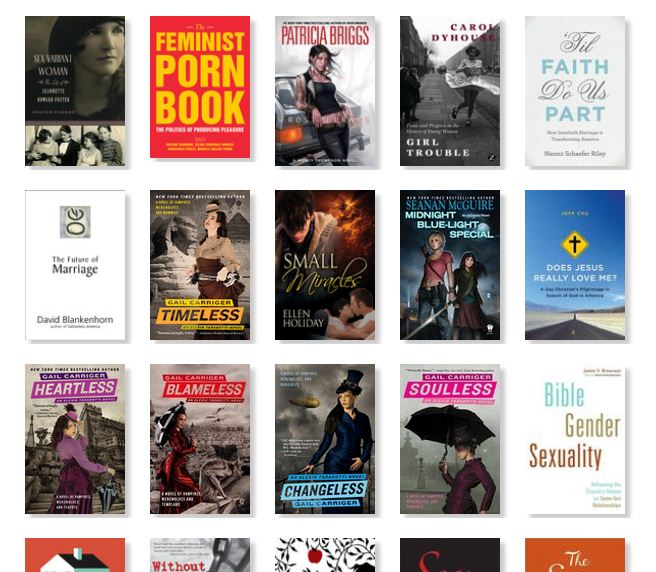
Here’s another installment of subject/verdict, wherein I discipline myself to be concise in my literary commentary. Since the beginning of April I’ve read the following books.

Briggs, Patricia. Frost Burned (Ace Books, 2013). Mercy Thompson Series, #7. The continuing adventures of shapeshifter Mercy Thompson, now married to werewolf Adam Hauptman, as a group of mercenaries kidnap her pack on Thanksgiving Day and Mercy has to call in the assistance of all her human and supernatural allies to get them back. Those of you (like me) who worried the series might grind to a halt with the success of the marriage plot, worry no more — and go enjoy the ever-expanding boundaries of this alternate universe.

Carriger, Gail. The Parasol Protectorate series, #1-5 (Orbit Books, 2009-2012). A delicious steampunk universe of vampires, werewolves, and soulless preternaturals delicately co-existing in Victorian London while soulless spinster Alexia Terribotti juggles social engagements, the attentions of an amorous (or possibly hostile) werewolf, and the friendship of effete vampire — not to mention attempts on her life! These were a rip-roaring read for early summer, and I’m looking forward to picking up the first in her new series, Etiquette & Espionage.

Dyhouse, Carol. Girl Trouble: Panic and Progress in the History of Young Women (Zed Books, 2013). English historian of young women’s lives Carol Dyhouse (Univ. of Sussex) seeks to synthesize over thirty years of research in this brisk survey history, beginning with the moral panic over the mythical “white slave” trade (late 19th-early 20th century) and ending with turn-of-the-twenty-first-century anxieties about the sexualization of young girls. Dyhouse’s aim is breadth (within a British context) rather than depth, and historians of the subject might well bypass this text in favor of Dyhouse’s scholarly work on women, education, and feminism — still, Girl Trouble is an enjoyable read with a useful-looking bibliography. [Received as part of the LibraryThing Early Reviewers giveaway.]

Holiday, Ellen. Small Miracles (Dreamspinners, 2012). A writer friend of ours, whose pen name is Ellen Holiday, has written this charming Cinderella-style piece of m/m erotica novella in which a down-and-out young man runs into a handsome prince at a bar and has to decide whether to let their one-night stand turn into something more lasting — and figure out how to do so on equal terms.

McGuire, Seanan. Midnight Blue-Light Special (Daw, 2013). InCryptids #3. New York’s cryptid population is under threat from zealous … As you’ve figured out by now, I’m back on something of a genre fiction kick, and was delighted to see that Seanan McGuire had a new installment of her InCryptids series out this spring — Midnight did not disappoint!

(Since doing the screencap above, I’ve also been catching up on Seanan McGuire’s short fiction, much of which is available for free download at her website. Definitely worth checking out!)

Passett, Joanne. Sex Variant Woman: The Life of Jeanne Howard Foster (Da Capo, 2008). Jeanne Howard Foster was the first librarian at the Kinsey Institute and author of the first known bibliography of literature featuring themes of passion between women: Sex Variant Women in Literature, first self-published 1956, then re-discovered by the emerging lesbian-feminist movement of the 1970s. This excellent biography is attuned to the incredible revolutions in gender and sexual history which Foster lived through, born in 1895 and living to age eighty-five — she came of age in the era of passionate female friendship, experienced the pathologizing of lesbianism during the interwar years, and in retirement found herself the heroine of a new generation of dykes.

Riley, Naomi Schaefer. ‘Til Faith Do Us Part: How Interfaith Marriage is Transforming America (Oxford University Press, 2013). Though prompted by personal experience within a Jewish-Christian marriage, Riley’s exploration of interfaith marriages is grounded in a nationwide survey she conducted of over two thousand interfaith couples and several hundred in-depth interviews. Overall, I was impressed by her thoughtful analysis and believe the study is a solid contribution to the field, though I was struck by her pessimism and sense of struggle: her overall fear that interfaith marriage will dilute religious traditions and lead to greater unhappiness for couples and less religious identity and grounding for their children. [Received as part of the LibraryThing Early Reviewers giveaway.]

Taormino, Tristan, Celine Parreñas Shimizu, Constance Penley, and Mireille Miller-Youn, editors. The Feminist Porn Book: The Politics of Producing Pleasure (The Feminist Press, 2013). Touted in many reviews as something new in the feminist discourse around moving-image pornography, The Feminist Porn Book actually builds on (and explicitly acknowledges) decades of pro-sexual-explicit-imagery feminist scholarship, activism, and performance. I particularly enjoyed the contributions by Clarissa Smith and Feona Attwood, Sinnamon Love, Dylan Ryan, Ingrid Ryberg, and Tobi Hill-Meyer … though really there wasn’t a weak piece among them (and how often can you say that about anthologies?).

Next up: to finish Best Sex Writing 2013, Born Losers: A History of Failure in America, Journeys that Opened Up the World: Women, Student Christian Movements and Social Justice, 1955-1975 and Moral Minority: The Evangelical Left in the Age of Conservatism. Catch up with my reviews in the next edition of subject/verdict!

bright colors on an (emotionally) stormy weekend [photo post]

11 Tuesday Jun 2013

Posted by Anna Clutterbuck-Cook in a sense of place

≈ 4 Comments

Tags

cat blogging, domesticity, family, photos


My maternal grandmother, Marilyn Coe Ross, died this past Saturday. It was both not unexpected and terribly sudden. Her health had been fragile for a number of years — just enough time for us all to get used to the fact that her health was fragile and yet she remained with us, in a kind of fragile stasis.

It became the new normal, as they say. Until this weekend when a sudden aneurysm brought her body to a halt. I got the phone call from my mother at the end of (for a series of unrelated reasons) what turned out to be an emotionally exhausting Saturday.

I have a post full of thoughts about my grandmother, a fellow book lover, writer, and (volunteer) librarian, which I will be sharing when things are less raw.

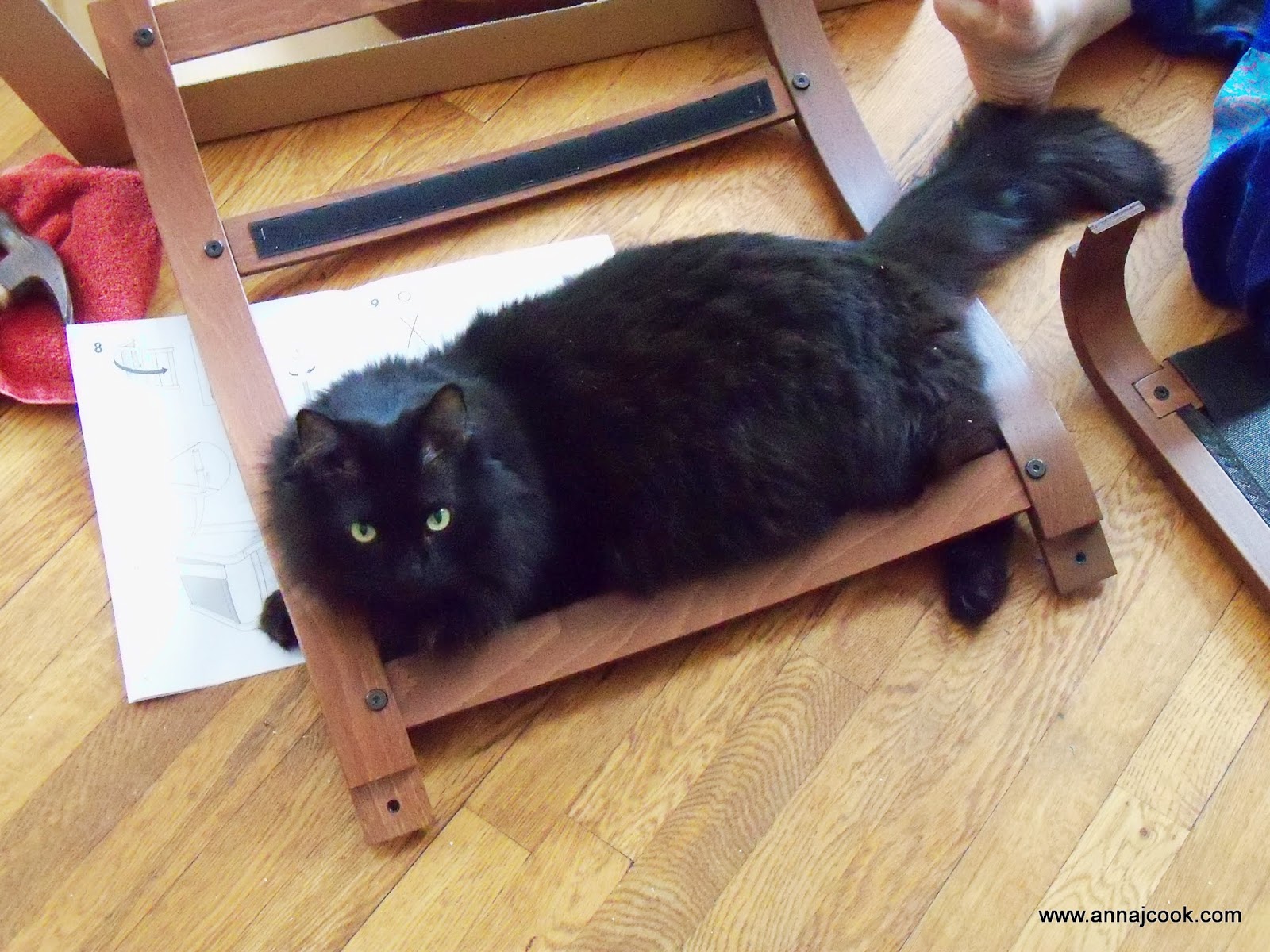
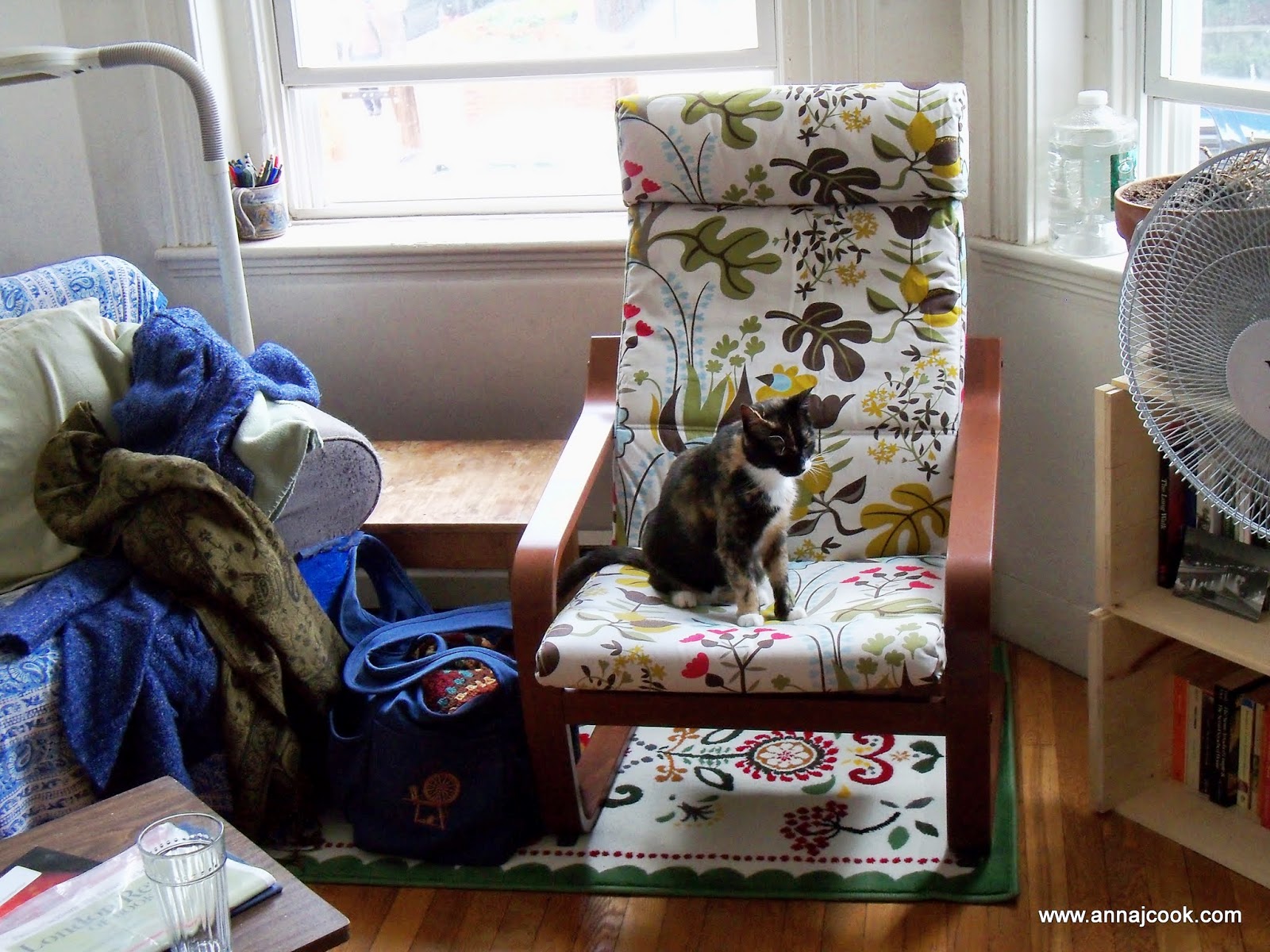
This is a post about how, following our exhausting Saturday, Hanna and I decided we needed to bring some color back into this campaign before the weekend beat us. So we forged ahead with a pre-planned trip to IKEA for a new chair for the living room and came back with this:

Hanna says it must be something to do with her Finnish genes; I have no excuse.

Geraldine, per usual, felt the need to be in on the action in a very present sort of way as we put the chair together.

Teazle was initially suspicious of the new furniture, but within a fairly short period of time made it her own.

After furniture construction, I went out to buy chips at the CVS down the block and decided on suddenly obstinate impulse to follow through on my recent threat to dye my hair again.

Purple seemed like a good plan, though in the end it’s come out more magenta.

I might go for tricolor next time, now that I’ve got the hang of it. Although I wish I could just use my mother-in-laws organic indigo dye, since the chemical stuff is not something I feel very comfortable using or disposing of!

I hope all of you had some good moments this past weekend and are looking ahead to a productive second week of June.

live-blog postscript: female and male scholars in ‘the future of marriage’

07 Friday Jun 2013

Posted by Anna Clutterbuck-Cook in book reviews

≈ 2 Comments

Tags

family scholars blog, live-blogging, marriage equality

Welcome to part eight of my live-blog reading of David Blankenhorn’s The Future of Marriage (2007). You can read part one, part two, part three, part four, part five, part six and part seven here. 

As promised, my final installment of this series is a rough-and-ready survey of the treatment of the four key same-sex marriage proponents David Blankenhorn wrestles with in The Future of Marriage, and particularly the way his respect rather suspiciously lines up with the gender division of the four individuals: Evan Wolfson (founder and president of Freedom to Marry) and Jonathan Rauch (journalist; guest scholar at the Brookings Institution) on the one hand; Judith Stacey (sociologist; NYU ) and Stephanie Coontz (historian; Evergreen State College) on the other.

I’m going to break this down super-simply and present you with side-by-side lists of words and phrases used to describe these four individuals. At the end are a few observations about how language contextualizes these people within David B’s narrative.

Evan Wolfson

  • “Executive director … of a group advocating equal marriage rights for same-sex couples”
  • “He had anger and urgency”
  • “With passion”
  • “Offered me hard-headed political analysis”
  • “Evan’s political analysis of the same-sex marriage issue is probably accurate”
  • “Evan is surely right to insist upon the equal dignity of all persons”
  • “For Evan, insofar as I understand his argument…”
  • “My conversation over lunch with…”
  • “Almost everything that Evan says here is wrong”
  • “He has next to nothing to say about what marriage is”
  • “I don’t mean to single out as unusual, or as particularly flawed, this one description of marriage by Evan Wolfson”
  • “My friend Evan Wolfson…”
  • “Evan’s definition [of marriage] is insubstantial to the point of meaninglessness … on the other hand … Evan reveals an understanding that he and his colleagues are seeking to engage and transform a substantial social institution.”
  • “I think I understand [his argument]”
  • “Evan Wolfson, who served as co-counsel … angrily dismissed this line of argument”
  • “When I had lunch with…”
  • “I tried to raise the issue… He could hardly have been less interested…”
  • “Evan sees people who are suffering and wants to help them. As a leader of a grassroots movement, he has spent many years working for a certain kind of social change.”
  • “…it’s also personal. He is gay — one of the ‘them’ in this matter. He is fighting partly for himself, and that accounts for much of his passion.”
  • “Evan is confident that his side, the side of new freedoms, is going to win. He may be right.”
Jonathan Rauch
  • “Jonathan Rauch has a dream. His dream is also a prediction: that permitting same-sex couples to marry will strengthen marriage as a public norm.”
  • “Rauch argues convincingly”
  • “Jonathan Rauch’s Gay Marriage is by far the most precise and serious argument to date in favor of the proposition that marriage supporters should accept gay marriage.”
  • “I’ve met Jonathan a few times, and I admire his integrity and good will.”
  • “How I wish he were right!”
  • “I believe that Jonathan Rauch is fundamentally mistaken…He gets around huge bodies of disconfirming evidence simply by ignoring them.”
  • “Most fundamentally, Jonathan casually glosses over…”
  • “Jonathan Rauch’s rose-colored prediction”
  • “Sunnily predicts”
  • “Jonathan misframes the question”
  • “I agree with him…”
  • “Vigorously insist”
Stephanie Coontz
  • “Historian Stephanie Coontz”
  • “Books of this type [historical surveys] usually suffer from serious shortcomings … Coontz’s Marriage: A History … is a clear example of glossing marriage’s history in a way that is superficial and unsatisfying.”
  • “Has made a career out of arguing that her own philosophical preferences and the laws of historical inevitability are one and the same.”
  • “She consults history and announces”
  • “She reports further researches telling her that marriage has already changed deeply and irreversibly”
  • “Whatever idea Coontz doesn’t like — whatever idea she believes that History has ruled out of bounds — she likens to a cancelled television series”
  • “Stephanie Coontz is also a prominent activist…she co-founded … a group largely devoted to defending the upswing in divorce and unwed childbearing, or at least castigating anyone who speaks against either of these trends.”
  • “Stephanie Coontz declares yet again, with such emphasis”
  • “Stephanie Coontz’s favored, according-to-what-History-requires…”
  • “Stephanie Coontz’s perfunctory assertion”
  • “Coontz is wrong”
  • “What is the basis of Coontz’s wildly inaccurate assertion? It’s hard to be sure, since she rarely bothers with detail and almost never explains her terms…”
  • “Coontz’s apparent belief … is consistent with her general (basically Marxist) belief… But I am only guessing. This particular assertion by Coontz remains a mystery. Someone writing about anthropological research on marriage and yet not really knowing what ‘illegitimacy’ means is like someone writing about art history and not really knowing what ‘nude’ means.”
Judith Stacey
  • “To put it mildly is an unlikely marriage proponent”
  • “She never met a divorce (or a divorce rate) she didn’t like”
  • “…formerly the Barbra Streisand Professor of Contemporary Gender Studies at the University of Southern California — I’m not making that up — Stacey is an activist as well as an intellectual. Her main project is to combine socialism with women’s liberation.”
  • “She casts a friendly eye toward Community China … in a 1979 volume”
  • “Stacey calls for much more ‘family diversity’ … by which she basically means not-marriage”
  • “Judith Stacey has suddenly found her pro-marriage voice … That is, of same-sex marriage.”
  • “For Judith Stacey, the strategic brilliance of campaigning for same-sex marriage … is that advocating the seemingly benign goal of extending marriage’s benefits… [can] help to deconstruct [marriage]… A good day’s work.”
  • “Stacey approvingly quotes”
  • “Stacey reports that her position has carried the day, and she is right about that.
  • “(Stacey is straight.)”
  • “The cause to which Stacey has devoted her entire professional life”
  • “A determined cheerleader for divorce”
  • “Her cause is winning new recruits”
  • “Stacey regards [moderate] talk with bemused disdain”
  • “Let’s call this agenda ‘The Full Stacey'”
  • “The sought-after Staceyan future of economic collectivism combined with radical sexual liberty”
  • “Judith Stacey and her anti-marriage colleagues”
Several things strike me about these four word portraits. 
First, the two men are humanized through personal connection. Not only does David B. know these men personally — he even calls Evan Wolfson “my friend” — but he explicitly and repeatedly acknowledges this within his text. Neither woman is similarly humanized, either because David B. has no personal experience with them or because he wants to make them feel more alien to the reader than the two gay men whose arguments he engages. Intentional or not, the presence and absence of empathy for one’s “enemies” here is striking.
Second, when men engage in activism it’s a noble cause; when women engage in activism it’s suspicious behavior that destroys their credibility in David’s eyes. Notice how Evan Wolfson is “executive director … of a group advocating equal marriage rights for same-sex couples,” a gay man who “sees people who are suffering and wants to help them”? Stephanie Coontz, meanwhile, has the gall to be a “prominant activist … devoted to defending” social trends David B. dislikes, “or at least castigating” those who dare to “speak against” her? And Judith Stacey is “an activist as well as an intellectual” (you say that like it’s an insult!) whose “main project is to combine socialism with women’s liberation” (how dare we!).
Third, I find it interesting to note that personal (male) passion and involvement in grassroots activism is lauded while (female) scholarship, or association with the academy, is scorned. Both men, it is true, are educated authors who are knowledge workers to some extent. Yet as a political advocate and journalist they are not working within the traditional realm of higher education. Coontz and Stacey, meanwhile, have pursued careers in teaching and research at various universities — in addition to their “talking head” appearances and writing for more general audiences. I wonder how much of Blankenhorn’s disgust with their work stems from the fact that they’re women and how much stems from the fact that they’re scholars. 
Fourth, the missing conversation about feminism and marriage might make it clear what stake women like Judith Stacey, Stephanie Coontz, and myself have in revising “traditional” marriage culture. David Blankenhorn utterly fails to engage with the feminist critique and gender analysis of heterosexual marriage that could shed some light on why alternative visions (however pinko-commie they look to him!) might appeal to many of us. Instead, he dismisses feminist critique of marriage practices in a frustrating section on “patriarchal distortion” which basically seeks to argue that marriage isn’t truly sexist — it’s just sexist people that have twisted it the wrong way!
Obviously I believe marriages don’t have to be sexist, but I also don’t believe marriage is somehow fundamentally non-sexist (any more than I believe any human culture is “fundamentally” free of inequality and harm — puh-leeze). 
Finally, one could argue that the disparities in characterization here have less to do with gender than they do with “moderate” vs. “extreme” viewpoints. David B. has picked two men who argue middle-of-the-road, coalition-building advocacy and two women who stand proudly in more radical-leftist intellectual and political space. Perhaps his attitude is not rooted in gender so much as it is in political persuasion? Yet I’d argue that the selection of one’s adversaries — particularly in a book project such as this — is telling. David B. might have as easily picked Dan Savage to scorn and E. J. Graff to admire. He didn’t. He chose these four individuals, a decision I find indicative of deeper attitudes around gender, around knowledge work, around what it means to be an expert scholar and use one’s evidence, about the legitimacy of political advocacy by some versus others. 
And with that, I’m closing the door on The Future of Marriage. Thanks for joining me! Let’s move on now and create a future that encompasses — joyfully! — much more than marriage. Maybe even a little socialist feminism!

post eleventy-hundred: nerd blessings

01 Saturday Jun 2013

Posted by Anna Clutterbuck-Cook in think pieces

≈ Leave a comment

Tags

being the change, blogging, fun, random kindness, thankfulness

Today, after making a trek to Harvard’s library privileges office in the middle of the first heat wave of the summer to apply for spousal library privileges (what could be nerdier than that?) I finally made the time to watch Wil Wheaton’s message to a baby nerd, which Hanna sent to me several weeks ago via the Mary Sue.

I thought it was appropriate to share as my 1100th post here at the feminist librarian.

Stay cool, everyone, and spend some time this weekend loving your favorite things as hard as you can.

‘the future of marriage’ live-blog: determining marriage’s fate & the appendix

30 Thursday May 2013

Posted by Anna Clutterbuck-Cook in book reviews

≈ Leave a comment

Tags

family scholars blog, live-blogging, marriage equality

Welcome to part seven of my live-blog reading of David Blankenhorn’s The Future of Marriage (2007). You can read part one, part two, part three, part four, part five and part six here. 

After reviewing David B.’s “goods in conflict” defense of heteros-only marriage, I’ve rather abruptly found myself done with The Future of Marriage. It’s hard to feel like bothering with the final chapter (“Determining Marriage’s Fate”) or the odd appendix (“Topics in the Anthropology of Kinship”). I mean, it’s pretty clear at this point that Blankenhorn’s historicized understanding of marriage, his beliefs about what “goods” it brings into the world, and what (lesser) “goods” queer equality might bring, and ultimately his erasure of queerly-inclined children (and children raised by queer parents), all do me in.

Still, to be complete, here are a few scattered thoughts about the final sections of The Future of Marriage.

Chapter 8: Determining Marriage’s Fate

This is a chapter with a lot of tables, a lot of data. David B. is making the case for the institution of (a certain type of) marriage as a social and personal good, so he combs through social science data from around the world, attempting to argue that nations with a strong marriage culture do better in a variety of other measures.

The problem, in my mind, is that the numbers don’t really make his case for him. In fact, they often seem to undercut the marriage-is-under-threat narrative he’s attempting to build. The percent of children in the United States in 2000 living with two married parents, for example, is 68.1% — down from 85.2% in 1970. That’s a jump, certainly, but sixty-eight percent still means that over two-thirds of children in the U.S. live in the care of a married couple. 59.7% of children were living with “their own married parents,” by which he presumably means the bio-parents of the child(ren) in question. That means that an overwhelming majority of children living with married parents are living with their own bio-parents (fewer than 10% live in “marriage” households formed through divorce and remarriage, adoption or other means).

Is the glass half full or half empty? I guess it’s all you read the numbers.

And that’s if you buy David B.’s assumptions about married-bio-parent households being a presumed “best state” situation for children to be raised within the bounds of. Which I’ve already pointed out is a far from inevitable conclusion to draw from the available evidence.

My point is this: The United States IS ALREADY a profoundly “marriage culture” nation. We privilege people who obtain “married” status in a variety of subtle and not-so-subtle ways. The fact that the “health” of (a certain type of) marriage culture in the U.S. has dropped, according to Blankenhorn’s composite Index of Marriage’s Institutional Vitality, from 77.6% in 1970 to 62.5% in 2000 seems both extremely understandable, given the cultural upheavals of the last forty years, and not a serious cause for alarm. I would argue what we’re seeing in those numbers is the slipping away of hegemony. The return, in fact, from a unique period of (quasi-imposed, quasi-falsified) cultural uniformity in the postwar era, to a state of affairs much more familiar within American history: contested cultural norms and values. In 1970, as America exited the 1960s, the numbers Blankenhorn cites — marriage rates, intact first marriages, married parenthood, etc. — would still reflect the anomalous period in which the Depression and WWII generations (who’d delayed marriage) and the immediate postwar generation (who hurried it) created the baby boom and the precipitous drop in the average age of marriage for both women and men.

Toward the end of this chapter, we return to the ladyscholar hating as David B. returns to the work of historian Stephanie Coontz whom he has taken a real dislike to. “Stephanie Coontz,” he asserts, “has made a career out of arguing that her own philosophical preferences and the laws of historical inevitability are one in the same” (236). She “consults history and announces that anyone” who thinks families were once stronger than they are now “suffers from a mental disability called ‘nostalgia’ ” (236). I’ve not read The Way We Never Were, Coontz’s seminal social history of 1950s nostalgia, but I’d be extremely surprised if she characterized nostalgia as a “mental disability.” But Blankenhorn is determined to remind us that Coontz is an “activist” (the horror!) and, in fact, is allied with that other evil ladyscholar Judith Stacey, with whom she founded the Council on Contemporary Families, “a group largely devoted to defending the upswing in divorce and unwed childbearing,” as David puts it.

Such a characterization might surprise the CCF, which articulates their mission as one “to provid[e] the press and public with the latest research and best-practice findings about American families,” listing ageing, children and parenting, economic issues, gender and sexuality, health and illness, marriage, partnership and divorce, singles, and work-family issues as all residing under their umbrella of scholarly and political interests. Their mission appears to be responsive rather than prescriptive, reading in part: “the Council’s mission is to enhance the national understanding of how and why contemporary families are changing, what needs and challenges they face, and how these needs can best be met.”

It appears to me that David Blankenhorn has confused “enhancing the national understanding of how and why” with “defending,” and identifying “what needs and challenges” families face and “how these needs can best be met” with blind advocacy.

I think, in the end, we are perhaps running up against a vast gulf in values when it comes to the political and social use of shame and judgement. David B. is upset because those of us at the Coontz-Stacey end of the spectrum see family diversity as both inevitable and neutral. We ask “what do these families, of all shapes, need to thrive — and how to we facilitate them meeting those needs?” David B., on the other hand, presume to know what families need (240-241):

1. A higher success rate for first marriages
2. A lower rate of childbirth outside of marriage (“unwed childbearing”)
3. No “legal redefinition” of marriage
4. Public scrutiny and regulation of the fertility industry [a point I actually agree with him on]
5. A national conversation about “what marriage is.” (Hint: NOT a “private relationship between two individuals”)

Marriage’s “fate” is in our hands … and it’s clear David B. thinks we’re doing bad, bad things to it.

Shame on us.

Appendix: Topics in the Anthropology of Kinship

I’m not exactly sure what this appendix is doing in the book, other than giving David B. a place to dump all of the random stuff he wants to say about non-dyadic, non-monogamous Christian model marriages but couldn’t get into the main text of the book. He reserves particular distaste for polygyny, polyandry, and polyamory which I want to highlight here for its bisexual stereotyping (yup, you read that arightly).

Polyamory is apparently “what’s new” and “hot” for the same-sex marriage crowd these days — those poly folk, so trendy! “Polyamory is tomorrow’s big new idea, being worked out today by creative theorists in academic conferences, advanced support groups, and little journals” (256).

*fans away the fumes of anti-academic disdain*

First of all, the historian in me has to point out that poly is not “tomorrow’s big new idea,” unless it’s a new idea that’s been percolating for at least a hundred and fifty years. Because the folks at Oneida were all over the group marriage thing, no “particular attachments,” blah blah blah. This may be a marginal or minority practice, but it is not some latter-day fad invented by a bunch of post-structuralists in a smokey back room.

Also: advanced support groups? little journals? Say what?

But that’s David just getting started. Because it’s not the academics who are arguing so radically that “the state ‘should have no right to privilege or impose one form of family structure or sexuality over another’ ” (gasp! *clutches pearls*) — it’s us horny bisexuals as well (256-257):

After all, if same-sex marriage becomes normative, on what moral basis could a fair-minded person possibly oppress bisexual polyamorous marriage? Particularly when bisexual persons will be making exactly the same claim as homosexual persons about the need for marriage as a legal institution to accommodate and respect sexual orientation?” (259).

First of all, let me point out that all of these things David B. brings up with such appalled hand-wringing? He’s nothing if not accurate in the sense that I do believe that “marriage as a legal institution [should] accommodate and respect” human sexual variety and diverse family forms. So the whole academic bisexuals will ruin marriage in groups! thing fails to excite me to moral outrage.

But I also want to tease apart the conflation he’s created here between poly folks and bisexual folks.

Yes, polyamorous people may be bisexual. They may form mixed-sex relationships in which some people are bisexual and some are monosexual or otherwise-sexual. Yes, bisexual people may be polyamorous. But being a bisexual person, in the sense that you have the capacity to be sexually desiring of people of your own sex and people of other (not-your-own) sexes, is not the same as desiring or forming a polyamorous relationship.

Being a person in a polyamorous relationship is not the same as being bisexual.

So while I support creating a flexible cultural and legal understanding of marriage that can accommodate — dare I say celebrate! — more-than-two relationships as well as two-person partnerships, that stance on marriage has no direct connection to my sexual orientation as bisexual. Bisexual people, just like monosexual people, experience a wide range of desires and exhibit a wide range of partnership behaviors. We don’t require multiple partners due to our bisexual capacity for desire, anymore than a straight man requires more than one straight woman to satisfy his attraction to both blondes and brunettes, or short as well as tall women, busty and flat-chested. We fall in love with particular people, all of us, and our capacity to love and sexually desire others is only as material to our individual commitments as we want or allow it to be.

So there you have it folks. The Future of Marriage.

I have to say, I hope that future is as expansive as David B. fears it will be.

Next week, I’m going to round out this series with some notes on the treatment of male vs. female proponents of same-sex marriage. Stay tuned!

← Older posts
Newer posts →
"the past is a wild party; check your preconceptions at the door." ~ Emma Donoghue

Recent Posts

  • medical update 11.11.22
  • medical update 6.4.22
  • medical update 1.16.2022
  • medical update 10.13.2021
  • medical update 8.17.2021

Archives

Categories

Creative Commons License

This work by Anna J. Clutterbuck-Cook is licensed under a Creative Commons Attribution 3.0 Unported License

Meta

  • Register
  • Log in
  • Entries feed
  • Comments feed
  • WordPress.com

Create a free website or blog at WordPress.com.

  • Follow Following
    • the feminist librarian
    • Join 36 other followers
    • Already have a WordPress.com account? Log in now.
    • the feminist librarian
    • Customize
    • Follow Following
    • Sign up
    • Log in
    • Report this content
    • View site in Reader
    • Manage subscriptions
    • Collapse this bar