• anna j. clutterbuck-cook
  • contact
  • curriculum vitae
  • find me elsewhere
  • marilyn ross memorial book prize

the feminist librarian

the feminist librarian

Author Archives: Anna Clutterbuck-Cook

multimedia monday: gaming can make a better world

18 Monday Jul 2011

Posted by Anna Clutterbuck-Cook in media

≈ Leave a comment

Tags

web video

Via On the Media.

(If you click on “share” you can enable subtitles in a variety of languages; TED is awesome).

Some excepts (courtesy of OTM):

So an epic win is an outcome that is so extraordinarily positive, you had no idea it was even possible until you achieved it. And when you get there, you are shocked to discover what you’re truly capable of. And this is the face that we need to see on millions of problem solvers all over the world, as we try to tackle the obstacles of the next century. When we’re in game worlds, I believe that many of us become the best version of ourselves, the most likely to stick with a problem as long as it takes, to get up after failure and try again. In real life, when we face failure, when we confront obstacles, we often don’t feel that way. We feel anxious, maybe depressed, frustrated or cynical. We never have those feelings when we’re playing games. Whenever you show up in one of these online games, especially in World of Warcraft, there are lots and lots of different characters who are willing to trust you with a world-saving mission, right away. But not just any mission, it’s a mission that is perfectly matched with your current level in the game, but it is on the, the verge of what you’re capable of, so you have to try hard. There’s no unemployment in World of Warcraft. There’s always something specific and important to be done. And there are also tons of collaborators ready to work with you to achieve your epic mission. Now, the problem with collaborative online environments like World of Warcraft, it’s so satisfying, we decide to spend all our time in these game worlds. So, so far, collectively, all the World of Warcraft gamers have spent 5.93 million years solving the virtual problems of Azeroth. Now, to put that in context, 5.93 million years ago was when our earliest primate human ancestors stood up. So when we talk about how much time we’re currently investing in playing games, the only way it makes sense is to talk about time at the magnitude of human evolution, which is an extraordinary thing. But it’s also apt, because it turns out that by spending all this time playing games we’re actually changing what we are capable of as human beings. We’re evolving to be a more collaborative and hearty species.

The four potentially world-saving characteristics of hardcore gamers:

The first is urgent optimism. Urgent optimism is the desire to act immediately to tackle an obstacle, combined with the belief that we have a reasonable hope of success. Gamers always believe that an epic win is possible and that it’s always worth trying, and trying now. Okay. Gamers are virtuosos at weaving a tight social fabric. There’s a lot of interesting research that shows that we like people better after we play a game with them, even if they’ve beaten us badly. And the reason is it takes a lot of trust to play a game with someone. We trust that they will spend their time with us, that they will play by the same rules, value the same goal, they’ll stay with the game until it’s over. And so, playing a game together actually builds up bonds and trust and cooperation, and build stronger social relationships, as a result. Blissful productivity, I love it. You know, there is a reason why the average World of Warcraft gamer plays for 22 hours a week. It’s because we know when we’re playing a game that we’re actually happier working hard than we are relaxing. And gamers are willing to work hard all the time, if they’re given the right work. Finally, epic meaning. Gamers love to be attached to awe-inspiring missions. They have compiled more information about World of Warcraft on the Internet than any other topic covered on any other wiki in the world. They are building an epic knowledge [LAUGHS] resource about the World of Warcraft. Okay, so these are four superpowers that add up to one thing. Gamers believe that they are individually capable of changing the world. And the only problem is they believe that they are capable of changing virtual worlds and not the real world. That’s the problem that I’m trying to solve.

Watch the whole thing. It’s totally worth it. I’m actually wondering if there isn’t some comperable discussion to be had about fan communities … talk about blissful productivity and tight social fabric! … but that’s a post for another day.
by special request from the birthday boy

17 Sunday Jul 2011

Posted by Anna Clutterbuck-Cook in our family

≈ 1 Comment

Tags

british isles, family, outdoors, photos, travel

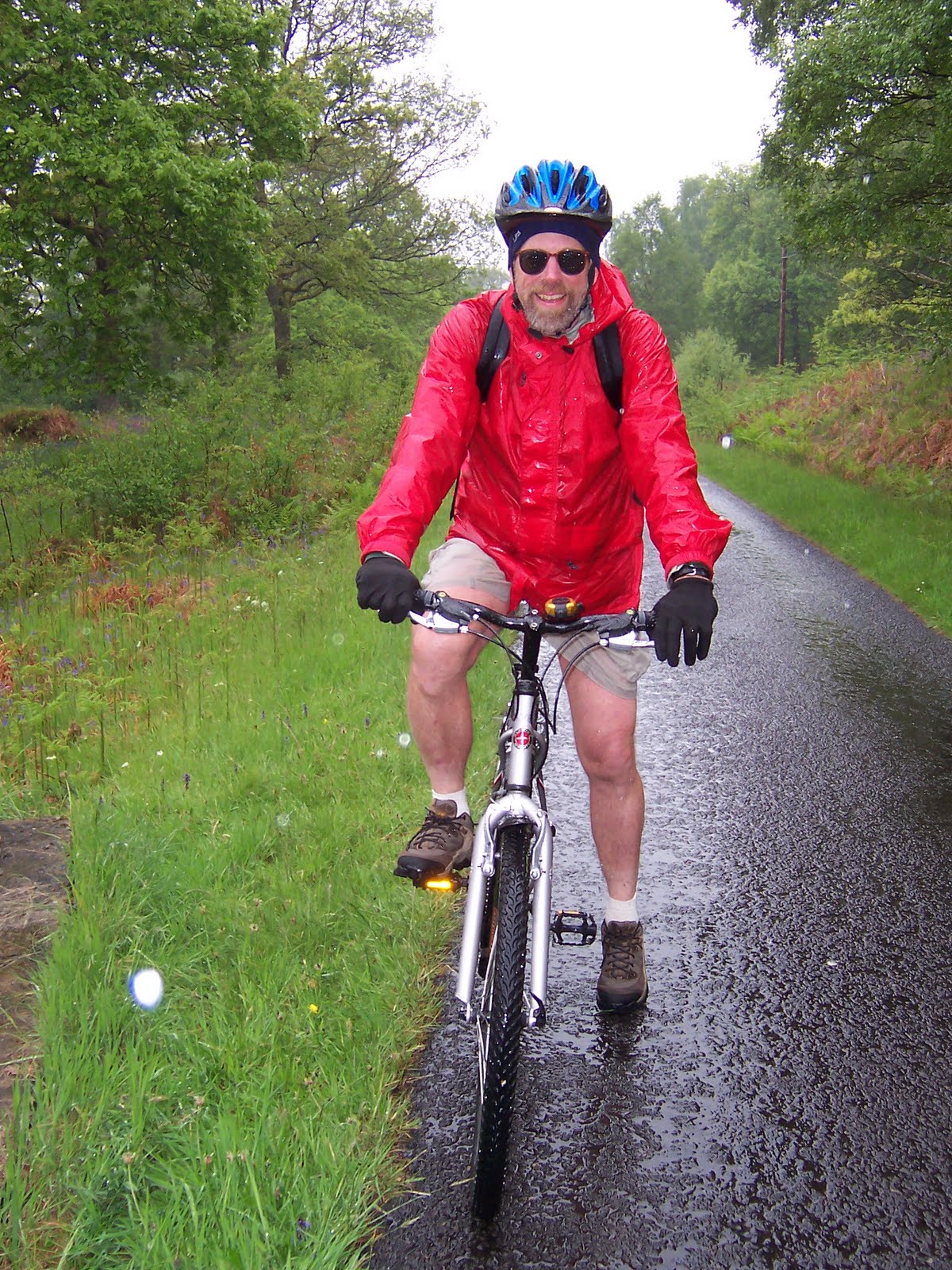
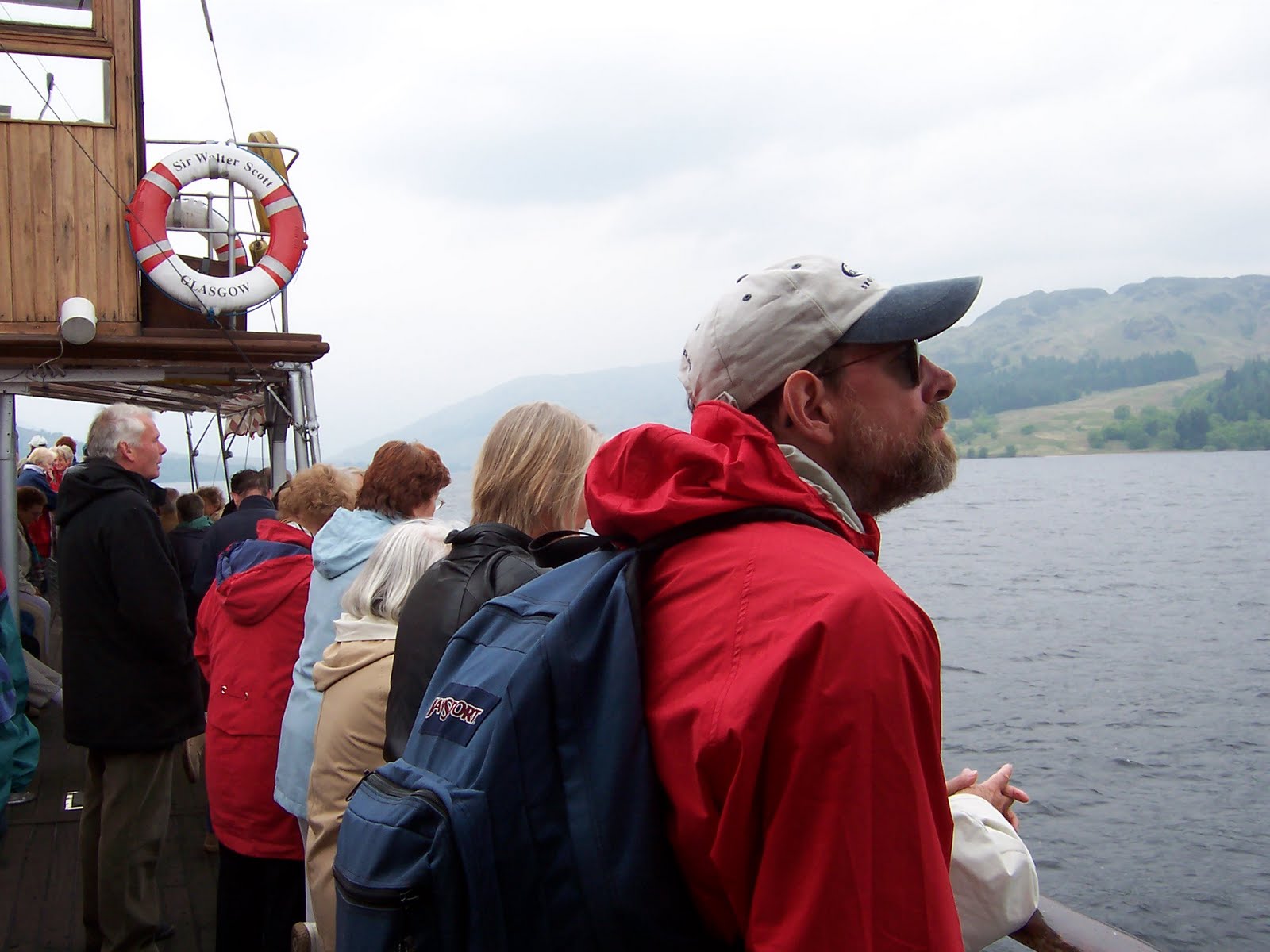
Dad suggested I share these pictures from a bike ride we took together around Loch Katrine in The Trossachs, Scotland on May 2004. It was at the tail end of a trip during which we had gorgeous weather. I’m not complaining about that, since it allowed us to complete the West Highland Way on foot without getting drenched. But the rain caught up with us on this particular day.

Loch Katrine is a water source for the city of Glasgow, so the only
boat allowed on the lake is the Sir Walter Scott steam launch.
It’s eerily quiet, whether you are riding it or watching from the shore.
You rent cycles and can ride the ferry across the loch,
then cycle back to where you started.
This is where the rain caught up with us.
You can see, if you look closely, the raindrops on the surface of the loch.
We made it back in time for afternoon tea,
and to watch the launch return!

And a lovely couple who worked at the site gave us a ride back to Stirling, saving us the cost of a cab fare.

60 @ 60? Make that 100 @ 60!

17 Sunday Jul 2011

Posted by Anna Clutterbuck-Cook in our family

≈ 1 Comment

Tags

holidays, michigan, outdoors, photos

I turned thirty this year which means my dad turns sixty. Today is his birthday.

Happy Birthday Dad!

He celebrated this weekend by cycling in the Holland Hundred, a one hundred mile bicycle tour sponsored by the Macatawa Cycling Club.

My family members know that bicycling generally isn’t my thing (though I’m thinking of getting in on Boston’s new point-to-point bike rental initiative), but — knock on wood — I hope my genes and physical activity will get me to my sixtieth birthday in good enough shape that I could bicycle a hundred miles in a day if I wanted to. With a little training, at least.

Here’s to many more happy and active returns of the day.

booknotes: the clamorgans

15 Friday Jul 2011

Posted by Anna Clutterbuck-Cook in Uncategorized

≈ Leave a comment

Tags

books, history, racial identity

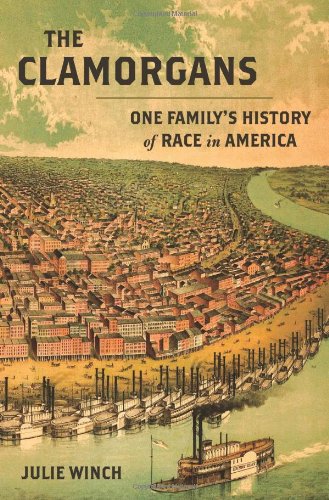
Last week, I picked up an advanced review copy of Julie Winch’s The Clamorgans: One Family’s History of Race in America (New York: Hill and Wang, 2011) from the free book cart at work. It was a relatively quick, though also a bit daunting, read. Winch, an historian based at the University of Massachusetts – Boston, focuses on the “lives and genealogies” of African-Americans in the Revolutionary War era and the period of the Early Republic. Her previous books focus on elite black families and individuals in Philadelphia; in The Clamorgans she turns her attention to a multiracial family based in St. Louis, beginning in the decades before the Louisiana Purchase (1803) and navigating its labyrinthian way to the mid-twentieth century.

The Clamorgan clan, at least as Winch documents it, began with a French entrepeneur (read: shady financial speculator) named Jacques Clamorgan in the 1780s, who settled in St. Louis when it was still (nominally) part of the Spanish empire. He had a number of children by three different women, all of whom were black and during one point during their lives were enslaved (some owned by Jacques himself). From this root, Winch traces in exhaustively-documented detail the fates of the descendents of this family tree. She is aided by the fact that Jacques Clamorgan was a litigious man who turned to the courts whenever he was unhappy with how his affairs (financial and familial) had been settled … and that his children and grandchildren and great-grandchildren followed suit. Jacques died in the early 1800s with extensive land claims, which he had finessed from the Spanish administrators, left unresolved following the Louisiana Purchase and the entrance of St. Louis and its environs into the expanding boundaries of the United States. For subsequent generations, these land claims became the promise of riches they turned to again and again whenever their (rapidly rising and falling) fortunes waivered.

The Clamorgan story is one not only of economic and social class but, inevitably, also a story of race, since all of Jacques Clamorgan’s descendents were in some measure mixed race, and often able to “pass” as white or of Native American ancestory. In a period where black and white society was so sharply divided, the relative ease of each Clamorgan descendent to move with ease in and out of white and black communities directed effected their economic and social fortunes. Some Clamorgans chose (or had no option other than) to rise to the top of the black elite in St. Louis or other locales around North and Central America. Other branches of the family were light-skinned enough that they attempted to cross the racial divide and pass themselves and their children off as “white,” usually for specific social and economic advancement (access to “white” jobs, schools, and neighborhoods).

The strength of this book is the sheer volume of research Winch has undertaken (I imagine with a bevy of student assistants and a very good data management system, though I could be mistaken!). Through the minute details offered up in court documents, newspaper columns, census records, and other archival sources Winch opens a window for readers onto the gritty details of how one specific American family struggled to gain a viable foothold in the volatile economic climate of the nineteenth century. Anyone who claims that our “addiction” to credit or predatory lending is an invention of our current epoch really just exposes themselves as a poor student of economic history: lines of credit, properties bought and sold on speculation, double-dealing lawyers — all of these make more than cameo appearances in The Clamorgans saga.

What I found myself wishing for more of, as both a reader-for-pleasure and an historian, was more analysis  and context. Winch provides us with a rich narrative of one family’s history … what I wanted to know was how their journey up and down the economic ladder and back and forth across the color line fit into broader national patterns. Was their story typical? Atypical? How so? Was their recourse to the law usual for the time and place in which they lived, or did it set them apart? What contribution does the Clamorgan family story make to our understanding of how race and class (and to a lesser extent, though indubitably present, gender) function in American society? How do all of the details Winch has uncovered about the Clamorgan clan inform the work of other historians on these topics? Do they fit into previous hypotheses about how social categories functioned during this period, or do they challenge those interpretations in new ways? It was this historiographical discussion that I found myself missing. I hope that historians who utilize Winch’s work in the future will be able to fill this gap in the scholarship.

Final verdict: Incredibly useful for historians who are studying this period or topics related to the history of race and class in America … engaging for anyone else who is willing to put in the effort to keep the sprawling clan Clamorgan straight for however long it takes to read the book!

30 @ 30: questions of identity [#1]

13 Wednesday Jul 2011

Posted by Anna Clutterbuck-Cook in life writing

≈ 1 Comment

Tags

history, thirty at thirty

Glen Nevis, Inverness-shire, Scotland (May 2004)

When I was seventeen I enrolled in a college writing course the title of which was Questions of Identity. It was a required course intended to teach incoming first-year students what was expected of in terms of written work during their college years, but each faculty member was allowed a fair amount of autonomy in terms of content. My professor (for whom I harbored a major schoolgirl crush) framed it in terms of memoir. We read Annie Dillard’s An American Childhood and Tobias Wolf’s This Boy’s Life (I still remember the bit about the beaver in the attic). We read creative nonfiction essays about everything from the Holocaust to Italian cookery. We wrote autobiographical essays.

I loved it so much, I turned around and took another class from the same professor the following semester, where I wrote more memoir, and the semester after that as well.

What strikes me, looking back on the content of those essays is what the subjects of those papers reveal about my primary question(s) of identity. They were not questions of sex or gender, of religion or race … though I’m sure one could find markers of these aspects of identity throughout, they were not the categories I was then thinking in. I was simultaneously taking Christian Feminism and Feminist Theology, so sex and gender, sexual orientation and religion were very much on the table … but not what preoccupied me when it came to identity. I already took for granted being a feminist; sexual orientation was puzzling but not a burning concern. By 1998 I’d pretty much given up on the church, though I found theology a powerful language with which to discuss human rights and justice.

I didn’t choose these subjects to write about in English class. What I chose to write about, primarily, was friendship, family, and my experience with home education. Looking back, I would argue that these essays all implicitly explore how the experience of home education helped shape the nature of my closest relationships. As a teenager, I was working hard to establish relationships outside my primary kinship network (which I planned to maintain, but was ready to expand beyond). And I wasn’t particularly sure how — or, more particularly, how to do it well.

Two of my major papers during that academic year hinged on an examination of intense friendships — one a intimate childhood friendship that had ended painfully, another a portrait of a young man I had worked with the summer before and felt both attraction toward and irritation over. The following autumn brought a third paper that was a profile of my then-closest friend, a young man with whom I carried on a passionate correspondence (yes, these were the days when pen-pals actually used pens). I also authored two papers specifically about the history of home education — my own family’s experience and the broader movement — as well as pieces about my childhood family life and one paper for which I shadowed a friend who attended the local Christian high school.

Home education played a central role in all three friendship essays. The childhood friendship (looking back I would argue this was my first romantic female friendship) was with a girl from another family that home educated and our two families were extremely close until I was in my early teens. I made connections with my pen-friend (still a good friend today) through a long-distance homeschool writing group, and the man for whom I harbored complicated love-hate feelings was a grown homeschooler. Part of the attraction I had for him was the seduction of being close to someone seven years older than I who was an adult, but had had a (superficially) similar childhood experience to mine. While I didn’t necessarily conceptualize it this way at the time, looking back I would argue that part of the work these papers were doing was helping me to understand  how central my experience as a homeschooler had been to my childhood, and how central it would continue to be as I moved into adulthood. Would it color the relationships I formed? Would it be easier for me to form bonds with people who, like me, had grown up outside of institutional education? Would the experience of college alter my identity as a homeschooler, and if so what would that mean? What was my relationship as an individual to the larger (and wildly heterogeneous) community of other home-schooled people? To what extent did being a home-educated person make me “weird” or cause communication or cultural translation problems with my fellow students at college and the faculty under whom I studied? How would I be able to move into a culture (college) where I was no longer surrounded by like-minded individuals (fellow homeschoolers) and still retain those aspects of my identity that I felt were important?

When I was a young child my mother once asked me how many children  I thought were homeschooled like us. “Oh, about half,” I told her, after a moments consideration. This was an accurate reflection of the proportion of people we interacted with regularly who were home-educated or in more traditional situations. In other words, as a young child I assumed that my experience was normal. As I grew older and faced the skepticism and suspicion and saw friends approaching learning in radically different ways from my own family, I came to understand that our family’s choices were very different from those of the dominant culture. I realized that home education was something that marked me as an outsider. Those things that we feel mark us as different (from the implicit norm) are a more conscious part of our identity than those things that seem normal.

By the time I was seventeen, home education had become a self-conscious part of my identity, but also one that was precarious as I moved into college coursework. It became a project to understand what, exactly, that part of my identity meant to who I was as a whole person, and what it meant in terms of my relationship to others.

In some ways, this exploration is still ongoing. I don’t think it is a mistake that Hanna is also a grown homeschooler: in some ways our experiences were quite different, but nonetheless it is a part of our growing up that neither of us has to explain to the other, or defend to the other as an insider speaking to an outsider. While I’ve had close friendships over the years with people who never homeschooled, I continue to feel a particular kinship with those who have. And, as the subject of my Master’s thesis shows, my consideration of educational alternatives has continued to be central to my identity as a thinker and academic.

At the same time, the anxiety that attended my written exploration of my education and its connection to my intimate relationship bonds has abated considerably. I still think about how my growing up has shaped the person I’ve become (a lot!), but then I think a lot about most things in my life. It’s just the way I work. I still have a special place in my heart for home-based education, and feel that spark of automatic affiliation with folks who are homeschooled or homeschooling. Yet it isn’t so present in my life as it once was. At seventeen, it would have been one of the primary ways I introduced myself to others; now, new acquaintances often know me for months or years before, depending on the conversations we have, the topic arises. At seventeen, I likely would have felt unable to be known to others if home education remained undiscussed. At thirty, I am more relaxed about letting my personal history weave itself in to present-day narratives in its own time.

Recently, I’ve been thinking about what it would be like to mentor younger folks in the home education community; and I still have that oral history project with grown homeschoolers I’d love to complete! We’ll see in the next thirty, sixty, or ninety years how much it continues to play a role in my life.

You can read more about my reflections about home education in this interview I gave over at I’m Unschooled. Yes, I can Write.

multimedia monday: history of the menstrual cup

11 Monday Jul 2011

Posted by Anna Clutterbuck-Cook in media

≈ Leave a comment

Tags

history, multimedia monday, web video

via Tenured Radical.

Just a quick disclaimer: I personally use and love the menstrual cup, which is our house is referred to as “the horrendous device.” But before that I used and thanked the Goddess every month for tampons. So while I will happily share my positive experience with the menstrual cup I am not judgy about other peoples’ preferences if they happen to differ from my own. Bodies are all different!

harpy fortnight: can’t believe it’s july! edition

10 Sunday Jul 2011

Posted by Anna Clutterbuck-Cook in linkspam

≈ Leave a comment

Tags

harpyness

god, this just makes me want to watch Angels in America again

The last few weeks have been a bit rocky over at The Pursuit of Harpyness as we were dealing with some nasty malware that took out no fewer than three of my work computers and several other personal computers of the Harpy team … not for good, but certain a pain in the ass. Thanks to blogger foureleven’s husband we are today virus free and back to our regular blogging schedule. My contributions since June 19 have included the following:

  • Three more installments of the Live-Blogging “Feminism For Real” series: A Slam On Feminism in Academia, The Feminist Existential Crisis (Dark Child Remix), and Medicine Bundle of Contradictions.
  • For a Thursday Night Trivia post, I wrote about some of my favorite mystery series and threw open the comment thread for readers to share their own suggestions for whodunit reading during the summer months. There might have to be a second installment, since I forgot to mention Dorothy Gilman and Tasha Alexander!
  • Following Dominique Strauss-Kahn’s release, I put up a quick post linking to some responses around the feminist blogosphere. Can’t say I have any more coherent response to this than I did back then; other people have been much more articulate. Now if only Dahlia Lithwick would weigh in!
  • I wrote a long and tortured response to reading Wendy Shalit’s A Return to Modesty in which I tried to acknowledge her critique of a one-size-fits-all sexual mainstream while also critiquing her one-size-fits-all fix to the problems she identified.

I’m obviously not the only one being harpylike these days: BeckySharper gives some kudos to the NYPD, SarahMC has a few words about the American justice system vis a vis the Casey Anthony verdict (did anyone else miss that this was a thing until last week?), Marie Anelle offers “mental hallucinations” in honor of Canada Day, and Michelle Dean (via BeckySharper) writes about the creep that is Princess Diana fanfic.

Do come join the party!

30 @ 30: series introduction

06 Wednesday Jul 2011

Posted by Anna Clutterbuck-Cook in life writing

≈ 2 Comments

Tags

blogging, thirty at thirty

So back at the end of March I threatened more posts about turning thirty. I’ve finally decided to follow through on that threat (promise?) with a series of posts I’m going to call “30 @ 30.”

I’ve been thinking a lot these passed few months about the discourses surrounding childhood and adulthood, the supposed merits or limitations of each phase of life, and the markers of maturity or immaturity our culture fixates on (having a “real” job, being financially independent, owning a house, marrying and having children, etc.). At first I was thinking about writing a pair of posts talking about why being a child isn’t all it’s cracked up to be (in response to those who complain about how adult life sucks) and about the reasons I’m glad to be an adult and don’t auto-dread being called “ma’am” or turning forty.

But that seemed, in the end, too negative. And destined to make friends of mine who have more conflicted feelings about adulthood pissy. So instead, I’m going to try and write a series of posts reflecting on how my own thought and experience has evolved between my childhood and my (as-of-now) adulthood. Not necessarily in a better/worse way, but in more of a continuity-and-change way. Because that’s the sort of person I am: I tend to emphasize the constants while also thinking about the way the external manifestation of those constants can radically change over time. Maybe along the way I’ll discover some of the subjects on which my thought and experience has changed dramatically over the years. Some topics I plan to explore (in no particular order of importance):

  • food tastes
  • sexuality
  • pornography and feminism
  • favorite fictional characters
  • physical movement
  • gender
  • identity and labels
  • asking “why”
  • the internet
  • friendship
  • urban living
  • England
  • wearing jeans
  • coffee
  • french kissing
  • body modification
  • school
  • money
  • travel
  • work / vocation
  • children and childcare

Stop by each Wednesday for series installments. This is also part of my attempt to haul this blog back into being more diverse than a book  and fic review space. As enjoyable as that is (and I plan to continue, no mistake!), I’ve missed more narrative and personal writing.

booknotes: stuff I’ve been reading

05 Tuesday Jul 2011

Posted by Anna Clutterbuck-Cook in book reviews

≈ 1 Comment

Tags

subject verdict

Given my recent travels and the reading time sitting on the airplane affords, my “to be reviewed” pile of books has grown to a critical mass … right when I find myself with a bit less time than I had in the spring to write blog posts. So rather than let the responses I had grow stale, I thought I’d do one massive round-up of “stuff I’ve been reading” to welcome you back from the holiday weekend.

Here goes.
The Pledge: A History of the Pledge of Allegiance by Jeffrey Owen Jones and Peter Meyer (New York: Thomas Dunne, 2010). This is a highly readable, entertaining account of how the pledge of allegiance first came to be written in the 1890s and how, over the course of the twentieth century, it went from being essentially a marketing gimmick for a children’s magazine hoping to sell American flags to school children to an activity so enshrined in our national political landscape that questioning it can lead to serious penalties. The one failing of the authors is that, despite chronicaling — quite critically (and rightly so)! — all of the ways in which the pledge has been used as a weapon, they end up affirming the pledge as an activity that creates unity. When they’ve just spent an entire book documenting how it does exactly the opposite. As someone who doesn’t know the pledge and never recited it growing up, I can’t say I feel less American for the lack — and I was offended by the implication that learning the pledge is an essential part of growing up in the United States. In the end, though, I’m glad I read it for the history if not the agenda.

Packing for Mars: The Curious Science of Life in the Void by Mary Roach (New York: W.W. Norton, 2010). Having read Bonk when it first came out, I have to say I firmly believe that Mary Roach is one of the most hilarious science writers on the planet. In this book, she tackles the science behind human survival in space … from the psychological effects of long-term isolation with a small group of fellow crew members to the logistics of bodily elimination … from the question of sex in space (is it possible?) to what kills space travelers when something goes wrong upon re-entry. Roach is the kid in your college class who was always willing to ask the potentially stupid-sounding questions most of us were too self-conscious to ask, and as a result gets some of the best (and funniest) answers to her queries. Which she then shares with us. Even if you don’t think the science of space travel is for you, pick up this book and read the first chapter before giving it a miss.

Changed For Good: A Feminist History of the Broadway Musical by Stacey Ellen Wolf (New York: Oxford University Press, 2011). Wolf takes us through a rolicking, thoughtful tour of American musical theatre (1950s-present), using the recent nation-wide hit Wicked as her beginning and end-point, exploring how the conventions of twentieth-century musical theatre are re-appropriated in Wicked to tell what she argues is a female-centric and potentially “queer” (lesbian) story. As someone who grew up steeped in the musical theatre she writes about, it was a pleasure to explore the history of musicals from this perspective. Wolf obviously knows her musical theatre, and I enjoyed learning from someone who has more intimate knowledge of the form than I do. I would have been interested in more use of audience/fan interpretations and re-appropriations, particularly of the musicals whose narratives seem to be fairly hostile to female characters (Man of La Mancha), or portray women as passive (as in Phantom of the Opera). While Wolf talks about the fan culture around Wicked in depth, she draws primarily on critical reviews to discuss the reception of her other examples. I missed any in-depth discussion of the female characters in Rent which Wolf mentioned as influential but never discussed in detail — perhaps because it has been treated at length elsewhere.
I also quibbled with some of her readings of Wicked, but mainly because I read Maguire’s novel before the musical came out, and so my interpretation of the musical relies heavily on my history with the original text. Wolf’s analysis might have been strengthened if she had drawn upon the original novel and asked by certain choices were made in the adaption of the book to the musical stage. For example, she argues that Elphaba (the Wicked Witch) is not portrayed as either a physically disabled Other or an ethnic Other in the musical … whereas in the novel, she is quite clearly written as an Other who is marked by what others interpret as physical deformity. Her green skin, far from being just coloring, renders her sensitive to water to the extent she must bathe in buttermilk, and there is some suggestion that her genitalia is non-normative. While I understand Wolf’s decision to focus on the musical adaptation I feel she missed an opportunity to discuss why certain production decisions were made (I would argue for the sake of mainstream popularity).
His Majesty’s Dragon (Temeraire, Book #1) by Naomi Novik (New York: Dell Ray, 2006). A friend of ours has loaned us the first five installments in Naomi Novik’s Temeraire series, of which the sixth volume is due out this summer. Set in an alternate universe, the world of these novels is that of Regency England and the Napoelonic Wars … only with dragons. Imagine Jane Austen crossed with Horatio Hornblower with a dash of Anne McCaffrey’s Pern universe and you’ve got His Majesty’s Dragon. Though the series, I hasten to say, does not feel derivitive in the least. Temeraire (the main dragon-protagonist) has the most compellingly charming literary voice I’ve come across in ages. I’m only to book three so far (Black Powder War ) but have been thoroughly enjoying the ride.
Conspiracy of Kings by Megan Whelan Turner (New York: Greenwillow, 2010). I somehow missed that this book — the fourth in Turner’s Thief series — came out last year until the last issue of LibraryJournal did a spread on “crossover” young adult fiction — that is, YA lit that people over the age of eighteen also enjoy. (I personally don’t get the division … I’ve known adults all my life who read fiction marketed to teens, but I guess it’s a new thing to talk about in library circles.)  Don’t want to risk spoliers, but suffice to say this latest installment didn’t disappoint. It picks up shortly after book three (The King of Attolia) left off and is told from the point of view of Sophos, heir to the kingdom of Sounis, whom we first met in book one (The Thief) but who has never been center-stage to the drama. I was at first disappointed that Eugenides and the Queen of Attolia (the two characters who are center stage in books two and three) did not get more air time, but Sophos’ story didn’t disappoint … and intersected in some unexpected ways with the lives of Eugenides, the Queen of Attolia, and the Queen of Eddis.

Jane of Lantern Hill by L.M. Montgomery (1937). Who among us failed to go through an L. M. Montgomery phase? Okay, some of you might have skipped it. But I didn’t. I knew Anne of Green Gables since before I could properly read myself, but when I was twelve a friend of mine sat me down and introduced me to the full canon of Montgomery’s work … oh, the romantic agony of it! I fell hard for Emily of New Moon, Kilmeny of the Orchard, for Blue Castle and Along the Shore. Somehow, though, I neglected to read Jane of Lantern Hill and when Hanna found out recently about my dirty little secret she set out to rectify the situation as quickly as possible! It’s the same mix of homoeroticism (“kindred spirits” indeed), sneering rich relatives, fantasies about un-broken families and domesticity (at some points verring toward the disturbingly oedipal!), and salvation-via-rural living, specifically on Prince Edward Island, that we all know and love.

booknotes: queer (in)justice

30 Thursday Jun 2011

Posted by Anna Clutterbuck-Cook in book reviews

≈ Leave a comment

Tags

books, feminism, gender and sexuality, human rights, masculinity, politics

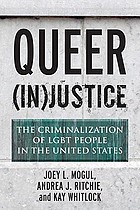
The third installment in Beacon Press’s Queer Action/Queer Ideas series, edited by Michael Bronski, Queer (In)justice: The Criminalization of LGBT People in the United States is co-authored by law professor Joey L. Mogul, police misconduct attorney Andrea J. Ritchie, and community organizer Kay Whitlock. Hanna saw it on the new book wall at the library and correctly ascertained it was the sort of title I’d be interested in. So she brought it home, I read it, and now I’m gonna blog about it.

Queer (In)justices is far more than an examination of the ways in which our legal system polices “deviant” gender and sexuality qua gender and sexuality. Yes, the authors look at the laws and policing practices related specifically to penalizing folks who engage in (publicly or privately) non-heteronormative sexual practices, or whose appearance suggests that they identify outside the gender/sex/sexuality binary. However, their analysis goes much deeper than these targeted laws. Instead, they argue that “the policing of sex and gender ‘deviance’ is central to notions of crime, and serves both as a tool of race-based law enforcement and as an independent basis for punishment” (xiii). In other words, notions about the relationship between non-normative sex and gender expression and criminality influence the way in which the legal system treats people perceived to be queer whether or not they are caught in the system specifically because of sex- or gender related policing. As they argue:

As queer identities substituted for individual perverse acts [in the late nineteenth century]  the process of criminalizing sexual and gender nonconformity was facilitated through the construction of ever-shifting and evolving archetypal narratives [of deviance]. Rooted in historical representations of Indigenous peoples, people of color, and poor people as intrinsically deviant, fueled and deployed by mass media and cultural institutions, these narratives now permeate virtually every aspect of the criminal legal system (19).

They make a compelling case for us to question the usefulness of narrowing our focus specifically on anti-gay laws, and on enacting new laws seeking to protect LGBT people from homophobia … particularly when the very law enforcement officials meant to ensure those laws are respected are among the primary culprits when it comes to bigotry and violence around sexual and gender nonconformity.  In chapters on gender and sex policing on the street, in the courtroom , in prison, and in uneven police responses to violence against LGBT people, we see how presumptions of criminality systematically influence how queer people are treated in the context of the legal system, whether they are perpetrators, victims, or both. They make the particularly important point that, regardless of what laws are officially on the books, “police and other law enforcement agents are given considerable latitude in deciding which laws to enforce, how to enforce them, and which people to target for law enforcement” (48).*

Being queer, or being perceived as queer can cause law enforcement officials to treat individuals as criminally guilty whether or not they actually are — and can bring harsher punishments (when compared to those perceived as straight and gender conforming) when those individuals are sentenced. Likewise, criminal behavior is often associated — implicitly or explicitly — with sexual depravity. Using examples that will be familiar to anti-sexual harassment or anti-sexual violence activists, Mogul, Ritchie, and Whitlock describe how individuals known or perceived to be queer are treated by law enforcement officials as if they are incapable of being victims of sexual violence. They describe victims of same-sex domestic violence who themselves were put in jail or ruled incapable of being abused because of their orientation or gender identity.

Ultimately, Queer (In)justice argues that LGBT activists must take a much more comprehensive approach to their agitation for change within the framework of law and law enforcement. While much of the mainstream LGBT work in this area in recent years has involved the quest to enact anti-discrimination and anti-hate crime legislation, and to grant same-sex couples the right to marry, Mogul, Ritchie, and Whitlock point out that a much broader cultural shift within law enforcement must take place in order for such changes in the law to have an on-the-ground effect. As they write, “The hate crime framework is … compromised by placing primary responsibility for preventing violence in the hands of a criminal legal system that is itself responsible for much LGBT violence” (129). We would do well, they seem to be pointing out, to pay closer attention to the experiences of those most vulnerable to police brutality, discrimination and abuse sanctioned by the legal system, and persecution based on presumptive criminality … not just because of their sexual identity, but because their mere presence as a non-conforming body evokes powerful notions of danger and violence whether or not these reactions are warranted in specific instances. Comprehensive reform is needed before the passage of laws will have real-world implications for the majority of the LGBT population.

Queer (In)justice is a must-read for anyone who wants to re-consider the current LGBT approach to legal reform.

*This point is exactly why I am uneasy with Jim Wallis’ argument that police force is preferable to military force. Wallis’ assumption that police only use force when it is necessary to enforce agreed-upon laws ignores all of the situations in which law enforcement officials abuse the power vested in them … something which, as a person who works in anti-poverty and anti-racism circles, Wallis ought to know full well.

← Older posts
Newer posts →
"the past is a wild party; check your preconceptions at the door." ~ Emma Donoghue

Recent Posts

  • medical update 11.11.22
  • medical update 6.4.22
  • medical update 1.16.2022
  • medical update 10.13.2021
  • medical update 8.17.2021

Archives

Categories

Creative Commons License

This work by Anna J. Clutterbuck-Cook is licensed under a Creative Commons Attribution 3.0 Unported License

Meta

  • Register
  • Log in
  • Entries feed
  • Comments feed
  • WordPress.com

Blog at WordPress.com.

  • Follow Following
    • the feminist librarian
    • Join 36 other followers
    • Already have a WordPress.com account? Log in now.
    • the feminist librarian
    • Customize
    • Follow Following
    • Sign up
    • Log in
    • Report this content
    • View site in Reader
    • Manage subscriptions
    • Collapse this bar