• anna j. clutterbuck-cook
  • contact
  • curriculum vitae
  • find me elsewhere
  • marilyn ross memorial book prize

the feminist librarian

the feminist librarian

Author Archives: Anna Clutterbuck-Cook

sunday links list: my friends write good stuff edition

21 Sunday Nov 2010

Posted by Anna Clutterbuck-Cook in linkspam

≈ Leave a comment

Tags

friends

via Into the TARDIS

This isn’t really, properly speaking, a “Sunday smut” list, seeing as not all of my friends have a filthy mind like I do. But they’ve been writing some good stuff lately, and I thought I’d share (and hopefully encourage a little blog hopping in my readers).

Hanna @ … fly over me, evil angel … composed a two-parter on the three episodes that comprise season one of the new Sherlock: “Catch you …” and “… later.” Pay particular attention to the awesome point she makes in the second half about the character of Holmes and the elusiveness of his emotional life.

What I think is interesting in the new Sherlock is how detached Sherlock has become. The Brett Holmes was distanced, uninvolved — but never unemotional. He had a sense of humor (albeit occasionally a peculiar one), a great deal of pride in his skill and accomplishments, a keen sense of class distinction, an ear for music, and rather snobby tastes in food and wine if I remember rightly. My point here in assembling this rather mongrel list is that Holmes never came across in the original Doyle stories as suffering from any kind of psychiatric condition: yeah, he was a bit weird, but it’s mostly the kind of weird you can write off as being genuine Victorian gentleman weirdness. (This is the same kind of weirdness that comes across with the father of the family in Doctor Who‘s “Tooth and Claw” episode, written off by the Doctor with, “I just thought you were happy!”)

This Sherlock is a little bit beyond that — this is sort of like what would happen if you took Conan Doyle’s Sherlock, crossed him with Cracker, and then added some of the late Prime Suspect Jane Tennison. He is not only distant, he is actually removed. We don’t know why — I would imagine speculation runs rife in fandom — but there are, presumably, reasons.

Tasha @ Natasha Curson – a trans history) has two pieces up that I like, one on the language we use to talk about trans issues, and one on body modification surgery. From the first post:

Ultimately, we all want to be ourselves and to be able, as  far as possible, to express ourselves freely. For trans people getting to that point can be a very difficult journey. I’m still on my journey, and it took me decades just to get on the right road. Many people struggle, or don’t make it at all. So where does this leave us when it comes to labels/names/words? I think labels can empower when we use them ourselves, or when others use them about us respectfully and affirmatively. If they are used in order to limit the ambition of others, or to direct hate towards them, the effect can be incredibly powerful.

Also on the subject of personal experience and the naming thereof, Minerva @ Hypomnemata offers some thoughts on emotional and physical intimacy in a post In Which the Gloves Come Decidedly OFF!

In a way, my asexuality has only made this habit more clear.  I spend so much of my time saying what I won’t do, that I’ve lost sight of figuring out what I will do or what I do want.  It’s rather ridiculous actually, since I make it a habit of telling people not to do what I’m doing, namely self-limiting.  I’m not sure how accurate my perceptions are, but I feel like this is a trend that’s not under-represented within the asexual community.  I see a lot of blog posts about the ways in which we are different from sexuals, the ways we won’t engage in intimacy, but I haven’t heard much about the ways in which we will.  Where are the discussions about our expressions of intimacy, the concrete nitty-gritty of what asexual relationship intimacy looks (would look) like, and not just in a theoretical fashion?

Diana @ The Waki Librarian has good thoughts to share on the relationship between academic discourse and professional conversations. While she’s talking specifically about the library-and-archives field, I’d say the same balancing act can be found around any area of interest: what is the relationship, in the end, between theory and practice, and how do we — as individuals and as colleagues in a given field — understand, articulate, and utilize that relationship?

For me, yes, there are differences between academic discourse and professional discourse that occurs via social media, but that doesn’t mean that there can’t and shouldn’t be overlap between the two discourses. I’m an academic and do quite a bit of research and writing in the formal, traditional academic model. It’s a very important discourse. Research is important for producing the kind of quality evidence available to use as a basis for decision-making and to further develop theory and models in our field. It is important to be able to write your results up in an article in such a way that it withstands peer-review and can be used as a credible source. No one, I think, would deny that. But it doesn’t do one lick of good just sitting in an article that few people will ever read–especially in our field which is an applied, practical, professional field. Keeping an academic discourse cloistered is silly and inhibits good ideas from spreading. I adore the intellectual stimulation of academia (and the excuse to do research), but I really don’t enjoy the concept (and practice) of academia as a world and conversation set apart from every other conversation happening in our field.

And my friend Lola @ Oh, My Sainted Aunt (her recently-launched tumblr blog), offers this gem of people-on-the-street observations

Overheard at the Museum:

Visitor [looking at photographs from 1918 influenza pandemic]: “I didn’t know they had an influenza epidemic in the 1600s.”

Well, I didn’t know they had photography either. Everyone learned something new today

Hope you’re having a lovely weekend … I don’t know about you, but I’m psyched for a nice long Thanksgiving holiday. Hanna and I are taking Tuesday afternoon through Sunday off from work, and plan to enjoy every damn minute of it.

trans day of remembrance

20 Saturday Nov 2010

Posted by Anna Clutterbuck-Cook in think pieces

≈ Leave a comment

Tags

bigotry, gender and sexuality, human rights

Today is the 12th Annual International Transgender Day of Remembrance, on which folks around the world take time to remember those who have died as a result of anti-transgender hatred or prejudice.

For most of this week, I didn’t think I had anything to offer for today — at least here on this blog. Being involved in feminist politics, and caring about intersectionality, I’ve become increasingly more aware of trans issues over the past decade or so.  Particularly in the last few years, I’ve come to know as personal friends a couple of people who self-identify as trans in one way or another.  And — in the way of such things — as the issue became more concrete (in the shape of people whom I crossed paths with in daily life) in my life, the once-abstract theoretical and political issues began to matter in a way they had not before. But I don’t have anything very profound or original to offer when it comes to memorializing the dead.

But I’ve been thinking a lot lately about gender, sex, and body policing, and I realized this week that that sort of community policing has a lot to do with anti-transgender hatred and prejudice, and the violence that hatred and prejudice can beget. So today, for Transgender Remembrance Day, I want to write about the importance of understanding about how personal opinions about other peoples’ bodies, when expressed in the world (and enforced through a variety of sociocultural mechanisms) aren’t just assholery, insecurity, or stupidity. Well, yeah, they are. They’re the opinions of stupid, insecure assholes. But in the past, much more than now, I think I believed it was in the power of people to just blow off stupid, ill-informed opinions. Sure, they hurt. Sure, they should not have been said. But you can’t control what other people think or say (still true) so … in the past I’ve focused on how to make those asshole opinions matter less to the individuals who were being bullied, harassed, ridiculed.

And all of that is as good as far as it goes.

But recently, I’ve been thinking way more about the collective power of body policing, and how combating it on an individual level just isn’t enough.  We need to connect the dots as much as possible between everyday, individual acts of body policing (passing judgment on whether someone picked out the right shirt, whether they should lose a few pounds, whether they “pass” as their chosen gender, whether X act is appropriate for their gender identity) and a culture that normalizes that pressure to conform to such an extent that folks who are prone to violence feel justified in exerting physical and emotional force in order to exact “correct” behavior from their victims.

We all make snap judgments about our fellow human beings. We’re socialized to do so: it’s part of the process of making sense of an otherwise untenably chaotic world. And I’m sure a certain amount of that categorization activity is necessary for us to function successfully as organisms in our environment.

But today, I’d like to point out that not all interpersonal judgments are necessary for our (physical and social) survival. Assessing whether someone’s likely to be an abuser? Probably a good skill to have. Passing judgment on whether or not someone made “good” or “bad” decisions about how to dress this morning? Whether their food or exercise choices are healthy? Questioning their self-identified gender or sexual orientation? Making them feel somehow dirty or wrong for being who they are in the world … when who they are is hurting exactly no one?

It’s just not cool. And it helps to perpetuate a culture in which we make it our business to police the gender and sexual identity of those around us, according to our own personal understanding of what boundaries should and shouldn’t be crossed. And that includes the personal understanding of those of us who think queerness is cool and the gender binary is passe AND those who think that any deviation from gender essentialist, heteronormative world is a fucking nightmare. And will resort to violence in order to protect themselves, and those around them, from it.

So next time you find yourself judging someone else’s identity or self-expression? Take a deep breath and think twice. I’d like to believe each time we do that, we make the world a little less violent than it otherwise would have been.

And maybe, collectively, we can stop so many people from dying just because someone stupid found their existence offensive.

photo of the day: queen elizabeth + guns!

18 Thursday Nov 2010

Posted by Anna Clutterbuck-Cook in fandom

≈ 1 Comment

Tags

movies, whoniverse

I refuse to become one of those bloggers who constantly apologizes for the occasional radio silence … so I trust you all to understand it’s that time of the semester and chalk the lack of posts up to a busy work and academic schedule.

Meanwhile, I never followed through on my promise (threat?) to post more pictures of the women of Who last Friday. So in lieu of that, for now, some first impressions of the recently-released (here in the U.S. for those of us plebes who can’t afford BBC America) Season 5 of Dr. Who.  Hanna and I got the first disk in the mail and watched it last night.

(Hanna’s planning a post on these episodes next week: watch this space for a link)

Mild spoilers below for those who haven’t seen “The Eleventh Hour” and “The Beast Below.”

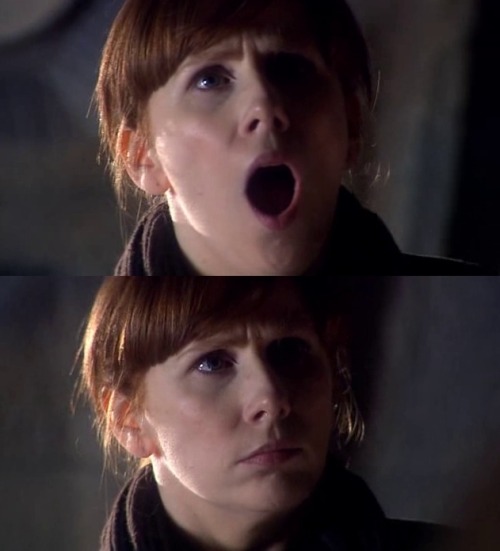
In short, my feelings are something like this:

Queen Elizabeth the Tenth (Sophie Okonedo), Starship UK
The Beast Below

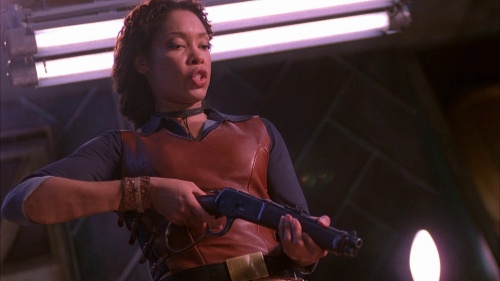
Which definitely suggested to me that someone on the writing team had been watching this:

Zoe (Gina Torres), Firefly

Queen Elizabeth X was just maybe my favorite thing about the first two episodes.

Although I admit partly this is because I’m kinda waiting to get more of a feel for the Eleventh Doctor and his companion, Ms. Pond.

They seem to be trying to get around the breaking-in period with the new companion by doing a sort of time-traveler’s-wife number on her; not entirely sure how it’s working out, but it seems to have given her an edge in terms of not letting the Doctor bully her.

I’d love to see her and Donna work together (are you listening Mr. Moffett?), since I think Donna could offer her some advice on how to refine her instincts vis a vis the Doctor into something sharper and more effective.

Both episodes had lots of energy and I’m really liking the steampunk look of the repaired (regenerated? healed?) Tardis.

I felt like there was something essentially unsound about the premise of “The Beast Below” (5.2) but I have to think about it more before I can articulate it.Something flawed in the psychological manipulation in which only two choices are presented: to remember (and die) or forget (and comply). Particularly in the case of the Queen, who seems to have convinced herself she must perpetually forget and remember and forget and remember over and over again.

I’m also hazy on why the “beast” would eat those very adult citizens who chose to remember and protest. If it has enough agency to refuse to eat the children who have been chosen as sacrifices, why would it accept the very adult humans who could be its allies?

So yeah: I’m left with niggling questions.

But I’m a fan of the Queen … and her cape … and her guns.

28 days from now …

14 Sunday Nov 2010

Posted by Anna Clutterbuck-Cook in library life

≈ 3 Comments

Tags

simmons

…it’ll be Ms. Future Feminist Librarian-Activist thank you very much!

This post was going to go up yesterday, but a combination of illness, homework, and holiday scheduling conspired against that. So … one day late, here’s what I have to say.

A month from now (Friday, December 10th) I’ll be finishing up my final class in the Simmons College GSLIS program, seven semesters (and one summer class) after I began the program in Fall 2007. In January, if all goes well, I’ll have an officially-conferred Master’s in Library Science. My Master’s in History won’t be complete until May, and yet … this still feels like at least a partial milestone.

I’m sure I’ll have more thoughts about this transition, being the sort of person who always has more thoughts. Mostly, right now I have these preliminary observations.

  • Graduate school did not fundamentally alter my love-hate relationship with institutions of higher learning and formal education in general. If anything, it amplified those feelings, and the tension between them, to an uncomfortable degree.
  • At the same time, graduate school has fairly fundamentally altered my relationship to academic work. In undergrad, I tried as much as possible to take classes for the love of learning, and throw myself with good faith into the content of every course.  In graduate school, I was much more selective about where I directed my energies. The jury is still out on whether one or the other of these is a preferred approach.
  • Librarians, as a group of professionals, are unquestionably awesome 
  • I am less than convinced that library school is the best way to approach training professional librarians.

But for now, I’m looking forward to what comes next, including my first tattoo (details to follow), winter vacation, my thesis revision (yes, I’m daunted, but also excited to pick it up again), and a wee bit more time with my girlfriend.

And now it’s back to work.

movienotes: holiday (1938)

10 Wednesday Nov 2010

Posted by Anna Clutterbuck-Cook in media

≈ 2 Comments

Tags

feminism, history, movies

Doris Nolan (Julia Seton), Cary Grant (Johnny Case) and
Katherine Hepburn (Linda Seton) in a publicity shot for Holiday (1938).

On Monday, when Hanna and I were both home sick from work and self-medicating by streaming video through our Netflix account I suggested we watch a Katherine Hepburn film and Hanna found us the 1938 Cary Grant / Katherine Hepburn romantic comedy Holiday.

In a nutshell, this is a classic “man engaged to wrong woman eventually finds the right woman who’s been under his nose the whole time.”  Thirty-year-old self-made businessman Johnny Case (Grant) becomes hastily engaged to Julia Seton (Julia Nolan) the daughter of a wealthy banking magnate while on vacation at Lake Placid. When he turns up at his intended’s house mansion to meet the family of his future bride he finds Julia’s black sheep elder sister, Linda, with whom he experience an immediate rapport.  The remainder of the movie is spent waiting for Johnny to realize that Julia’s vision of their future life together (in which he will follow in her father’s footsteps) and his own dream of quitting business and traveling the world are incompatible. And that (surprise, surprise!) Linda’s rebellious desire to escape the family fortune and see the world might suit him much better.

If I ever end up, in a future life, becoming an historian of American cinema, I can imagine quite happily building my scholarly career with a close analysis of 1930s and 40s romantic comedies and dramas, particularly those written around the characters played by actors such as Bette Davis and Katherine Hepburn.  These films fascinate me with their willingness to ask, through plot and character exposition, what it means for men and women to form egalitarian relationships (see for example All About Eve and Woman of the Year). They also openly explore issues of money, work, and class in a way that modern romantic comedies and dramas mostly fail to do.  In most television and films today, characters’ lifestyles and purported wagework rarely match up in reality. In Holiday, we are looking at the lifestyles of the rich and famous, yes, but the question of money and values is front-and-center within the plot in what I thought were some fascinating ways.

In Jennifer Pozner’s book on reality television, Reality Bites Back, which I reviewed a couple of weeks ago, she observes that much of reality TV involves the double-edged sword of American culture’s obsession with wealth: we are encouraged to ridicule and despise the rich while simultaneously coveting what they have and the lives they lead.  In Holiday, the main character, Johnny Case, essentially spends the entire film deciding between two relationships with money and work life. He is on the verge of closing a business deal that could either secure him a job at his future father-in-law’s bank (where he could make even more money and be the type of businessman his fiancee desires him to be) OR he could take “early retirement” and use the money to travel and explore the world while he still has the energy (as he puts it) to do so, and to discover what he wants from life.  He’s been working, he tells Mr. Seton, since he was ten years old, and he wants a change.

While this fantasy of a Grand Tour is, essentially, the sort of life of leisure open to men of Mr. Seton’s wealth, Seton himself despises the idea as positively un-American, a childish attitude that his daughter needs to school out of the future son-in-law. When one is wealthy, it seems, the only acceptable way to use that wealth is to use it to create more. 

Linda, despite the fact she is also the daughter of Mr. Seton, has rejected this attitude toward money. Instead, she encourages Johnny (and, at first, her sister with whom she vicariously identifies) to escape the family and travel.  In a way, she plays a proto manic pixie dream girl (a common role for Hepburn, although seldom with as little independent agency as she has in Holiday). We see Linda almost entirely within the confines of the former children’s play room — the only place in the Seton mansion she says she feels at home. In the play room, she and her younger brother Ned (who has retreated into the helpless infancy of an alcoholic) invite Johnny and his middle-class friends to join them in reliving the antics of their youth: gymnastics, music, puppet theater. Linda’s separation from the adult world of her father and younger sister is in part self-imposed, but it also seems she has been typecast as a permanent dependent: there are frequent allusions to “doctor’s orders” and “headaches” and “rest.”  Elder sister, in this instance, has not become a parent in the absence of her mother (who has long since died) but has rather retreated to childhood.

Linda and Johnny finally do escape the Setons and (as the viewer anticipated from the opening moments of the film) run away together to see the world. We are left, at the end, to imagine for ourselves how their lives played out from there — one assumes in a very “un-American,” Bohemian fashion. Though Linda has promised to return one day to rescue, in turn, her brother from his stultifying fate.  Father and daughter (Julia), it seems, are left to enjoy their shallow, yet unimpeachably American (read: earned not inherited), riches.

call for participation: study of engaged couples

09 Tuesday Nov 2010

Posted by Anna Clutterbuck-Cook in linkspam

≈ Leave a comment

Tags

call to participate

Essin’ Em over at Sexuality Happens brought my attention to a study being done of couples who intend to get married within the next year. The researcher writes:

I am looking for volunteers for a study of attitudes towards marriage and parenthood among engaged couples. The study consists of a 25-30 minute online survey. To qualify for the study, you must be 20-35 years old, live in the U.S., and plan to marry or have a commitment ceremony within the next 365 days. You and your romantic partner must not have children, and this must be the first marriage for both of you.

The sex/gender of the individuals in the couple do not matter; no mention is made in the call for participants about poly relationships, but if you’re in one and otherwise fit the bill I’d encourage you to contact the researcher and offer yourselves as part of the sample. The more diverse the sample population, the more interesting the end result will be.

You can read a bit more about the study (and get contact details) over at Sexuality Happens.

"you should call it the doppler effect. then people will shag you."

08 Monday Nov 2010

Posted by Anna Clutterbuck-Cook in think pieces

≈ 2 Comments

Tags

bigotry, blogging, politics

shout and scream by Mindaugas Danys
available at Flickr.com

So this past weekend I was enjoying some stimulating, thoughtful conversation over on Emily Nagoski’s blog about teaching women’s sexuality in higher education. A student in the semester-long class on the subject recently contacted Emily and suggested that the course material was “unintentionally heteronormative.” This provoked an interesting conversation on the comment thread about how to teach the biological aspects of human sexuality to students more comfortable in the world of sociocultural analysis — students who are (rightly) suspicious of simplistic truth claims from the world of hard science, but who are perhaps hastily dismissing an entire way of seeing the world that could be useful, as long as it remains one of many tools we have to increase our understanding.

I digress. If you’re interested in that conversation, you can head over to the original thread.

The thing is, a commenter jumped into the conversation and suggested this student — solely on evidence that they used the word “heteronormativity” was an “unhinged crank,” who “sees ‘heteronormativity in A/C plugs and sockets.” When Emily replied “I know with certainty they are not,” he begged to differ:

Anyone who would accuse the Emily Nagoski I know of ThoughtCrime – excuse me, “heteronormativity” – is nearing the straitjacket stage of gender politics.

The thing is — this guy obviously knows and wants to defend the thoughtfulness and openness of his friend. Both of these impulses are laudable. But I really, really wish we had a Godwin’s Law for references to ThoughtCrime, ThoughtPolice, 1984 and the derogatory use of “politically correct”  and the label of  “language police.” Attempt to invalidate someone’s argument by accusing them of being the thought police? You lose.

Like with Godwin’s Law,  the Feminist Librarian’s Law of Accusations in Place of Honest Reflection, allows that there are instances in which it is legitimate to speak out against genuine instances of attempted censorship or policing of other peoples’ life experience. I believe policing other peoples’ sexualities, identities, bodies, clothing choices, food choices, and yes, even language choices (when it comes to self-identification and description at least) is not okay. It’s their life, not yours. And unless their actions are causing you or other people demonstrable harm (for which you have to show not just claim causal effect), it’s none of your damn business. And if there were actually state-sanctioned censorship going on here, it’s legitimate to challenge it. (Although I’d suggest accusing the proponents of being the “thought police” might not be the best way to get your message concerning freedom of speech across.)

The thing is: No one in this scenario has tried to thought-police anyone.  A student in a class has raised concerns that a class on women’s sexuality is unintentionally perpetuating heteronormative culture. Heteronormativity is not a “thought crime”: it’s the accumulated effect of myriad cultural cues that suggest to us that the normal (and best) form of sexual identity and expression is one in which individuals’ gender matches their assigned sex, that gender expresses itself in only two mutually-exclusive ways (“male” and “female”) and that the most appropriate expression of human sexuality is through opposite-sex pairings.

Far from acting as the Thought Police (who, ahem, had the weight of the government behind them), the student in Emily’s class is raising a question from the margins. Our government supports heteronormativity not its opposite. One cannot literally act as the “thought police” unless one has the power of cultural, political, and/or legal authority behind them.

In my experience, the people who get most often accused of policing other peoples’ thoughts or words are people who are challenging the status quo.  People with no political authority or cultural weight behind them. While the people who respond to those challenges with accusations of language policing and characterizations of the first person’s challenge as a call for “political correctness” are defending the status quo.  They’re skeptical of the first person’s challenge, dismissive of their concerns, and all too ready (as this gentleman has) to label the challenger as a “crank” or “unhinged.”

This is not what Orwell was talking about, people. This is not censorship.  This is just, you know, people bringing up ideas that are outside your comfort zone.

And crying “thought police” just ’cause you’re a little uncomfortable is, shall we say, slightly over-egging the cake.

In my experience, the only goal of this tactic to get the challenger to shut the fuck up by telling them their question-asking is an hysterical over-reaction or a calculated power-play (probably both!). It signals to me that the accuser the doesn’t understand the crucial distinction between the exertion of power-over with the full weight of the Powers That Be behind it and the actions or speech of those who are challenging the Powers That Be the passive or active abuses the often come with those Powers.  It signals to me that the accuser does not care enough about the challenger as a person or about their ideas to give them due consideration, even if that person and their ideas make the accuser uncomfortable.  Reflexive defensiveness: Not. Cool.

Had similar experiences? Discovered ways of dealing with this sort of response effectively? Share in comments!

sunday smut: tumblr highlights (no. 7)

07 Sunday Nov 2010

Posted by Anna Clutterbuck-Cook in linkspam

≈ Leave a comment

Tags

sunday smut, tumblr

Mostly, I’m posting some highlights this week so I have an excuse to share this picture with you. It makes me smile every time I look at it.

There were some wonderful posts this week on reaching outside ourselves with compassion and non-judgment. Since Hanna’s meditation homework for the week (she’s taking a series of classes on the eightfold path) was to only speak words which were “kind, true, and necessary,” I thought it would be appropriate to highlight the work of folks who are encouraging us in that direction.

Amanda Marcotte @ Pandagon mused on political dynamics of the bile directed at so-called “hipsters.”

What’s fascinating to me is that these narratives are so evocative in our culture, and the consequence of that is that the group being bashed as smug and elitist—hipsters, liberals—is assumed to be the ones that have to do the compromising and apologizing. The mainstream narrative in our culture is that hipsters have all these privileges of good taste and pleasure (which is impugned into money, though statistically, I’m guessing they’re no more or less middle class than their traditional bashers), and therefore they’re the ones who need to be taken down a peg, even though in the real world, the people bashed as “smug hipsters” are hardly exempt from being treated like shit for who they are, which is one reason they shun living in rural and suburban communities where they’ll be excluded and choose to live in urban areas where they can find people they get along with.

Read more at The Narrative of Inauthenticity.

Anna @ FWD/Forward writes about how the world-at-large continues to presume that only able-bodied folks participate in real life activities … until someone with disabilities has the temerity to ask to be included in everyday life.

What I end up getting out of this story is that the burden of pushing for something to be accessible pretty much consistently falls on people with disabilities themselves. We have to ask because no program, no building, no website, will be willingly designed with the idea that people with disabilities are part of a broader target audience. Only websites, buildings, and programs aimed right at people with disabilities will do so. (Until laws are passed, of course. And even then the law will be only grudgingly followed.)

Accessibility is often treated like a favour that non-disabled people do for (or even to) disabled people, one that is given out of the goodness of one’s heart. It’s an individual’s problem to bring up, and the solution is for individuals to come up with.

…We don’t act like putting a door in the front of our building is a favour we are doing. We assume that doors are necessary. And yet, people treat having a ramp to that door as a favour they are doing, when the ramp serves the same purpose: it allows people to come inside.

Read more at Accessibility is Not an Individual Problem.

Rachel @ The Feminist Agenda talks about how effortless it is to write with respect about transgender folks.

None of these things appear to have required a superhuman effort on the author’s part. None of this required arduous editing and rewriting. Perhaps this is because the author appears to have simply approached the story as if it were about a real human being, deserving of just treatment and human compassion.

I propose that this approach could serve as a model to guide you in your coverage of news stories involving transgender people. Just think of them as humans, and treat them with the kind of respect that you want to be treated with. I promise you, it’s not that hard.

Read more at How It’s Done.

Anna North @ Jezebel reflects on what it means to parent a child whose appearance or behavior is deemed “weird” by the majority of society.

…sadly, being a “weird” kid doesn’t always turn out so great. The father of bullying victim Asher Brown said of his son, “He was very different. He’s not the type of kid that would try to wear the newest clothes or try to do the coolest thing. He was an individual.” And for this, Brown was tormented until he committed suicide. Of course, some kids who act differently from the rest are embraced — but unfortunately, some suffer.

That doesn’t mean Asher Brown’s parents should have made him dress differently, any more than they should have made him pretend to be straight. The people who need to change are the perpetrators, not the victims of bullying. But at the same time, let’s not pretend that being the “weird” kid at school is easy. Parents need to support their kids’ individuality, but they also need to watch out for signs of bullying, and teach kids to talk to an adult if it happens. And, unfortunately, they may need to advocate strenuously for their kids’s safety, because schools don’t seem all that good at doing this on their own.

Read more at Should Parents Let Their Kids Act “Weird”?

Tumblr blogger lucy @happy monsters shared the following thought, which I will include here in its entirety.

Instead of judging someone, calling them slut or whore or dumbass or jerk or whatever, isn’t it easier to tell yourself you simply don’t understand their lifestyle and let it go? I’m something I used to dislike, only because I used to be ignorant. And now I understand. People have different lives and different upbringings, make different choices, like different things; to each and everyone of them their decisions are just as justified as yours are to you.

Next time you call someone a bad word, remember that there is someone out there who’s just as willing to judge you for what you do because they don’t know you. Then you complain about judgmental people? No one wants to be a bad person, honestly, but they’re deemed so by people who don’t understand them. No one. Furthermore, people are governed by emotions most of the time, just as much as you are yourself, so try walking in someone else’s shoes for once. Strong emotions almost always hinder rationality, just because you are more sober than someone at a given time doesn’t mean you’re any better at handling things.

I need to remember this, even if I’m not making sense, even if none of this is true. Because so far it’s working and I’m beginning to empathize with everyone around me better. Long way to go, though. Long way to go.

Check out the rest of lucy’s blog at happymonsters.tumblr.com.

And finally, Lisa Factora-Borchers @ My Ecdysis has written a follow-up post to her beautiful (and oft-cited) explanation of the term “kyriarchy” in which she challenges a recent mis-use of the term in an article published in The Guardian. The Guardian author suggested the term was about “individual liberation.” Lisa writes

The purpose and measure of kyriarchy – and feminism in general – is not to increase our time at the microphone so we can more accurately assign BLAME. The purpose and measure of kyriarchy is to further understand the power and crippling tendencies of the human race to push, torture, and minimize others. It is in our nature to try and become “lord” or “master” in our communities, to exert a “power-over” someone else. Kyriarchy does not exist to give us tools to further imprison ourselves by blaming our environment, upbringing, or social caste. It is the opposite. Kyriarchy exists to give us tools to liberate ourselves by understanding the shifting powers of oppression. It is not about passing the megaphone to men so they can be included in the oppression olympics. Simply check-marking our gender, sex, race, ablity, class, citizenship, skin color and other pieces of identity will not free us from the social ills of our stratified society. Kyriarchy is not the newly minted alarm clock to wake us up to what’s wrong. It exists to radically implement our finest strategies to deconstruct our personal and political powers for the liberation of self and community. For self AND community.

Which is why I so vehemently disagree with Hodgson who believes that the most helpful piece of kyriarchy is “its emphasis on individual liberation…”

Please indulge my own theory-making right now: There’s no such thing as liberation if the word ‘individual’ precedes it.

I cannot speak for Elisabeth Schussler Fiorenza. I cannot pretend to even guess what Hodgson herself means in writing that phrase “individual liberation.” However, in the spirit of feminist theology, in the spirit of radical understanding of power, I would argue with 100% confidence that the absolute LAST thing that kyriarchy strives for is individual liberation. Solely pursuing your own liberation often comes at the expense of others. That’s not liberation, that’s mainstream feminism.

Read more at Truthout About Kyriarchy: An Open Letter To “Feminist” Writers, Bloggers, and Journalists.

saturday survey: librarians, archivists and historians as activists

06 Saturday Nov 2010

Posted by Anna Clutterbuck-Cook in linkspam

≈ Leave a comment

Tags

archivists, call to participate, history, librarians

My history adviser, Laura Prieto, alerted me to this survey being done on librarians, archivists and historians as activists in preparation for a conference paper to be delivered at a meeting at the University of Dundee, Scotland, in December. From the solicitation email:

If you are a historian or archivist, broadly defined, and you consider yourself an activist, we invite you to fill out a survey about your experiences. The definition of “activist” that we are using is “an especially active, vigorous advocate of a cause, esp. a political cause.” This survey is being collected for a study of historians and archivists as activists. The survey explores the ways in which people participate as activists and the consequences for their employers and themselves. We anticipate this survey will take approximately 20 minutes to complete.

Although the email only indicates archivists and historians, the actual questions about occupation include “librarian.”

The researchers doing the study are:

Bea Hardy, Interim Dean of University Libraries
College of William and Mary
Williamsburg, VA

Sonia Yaco, Special Collections Librarian and University Archivist
Old Dominion University
Norfolk, VA

If you feel you fit the bill and have twenty minutes to spare, help bolster their sample size!

UPDATE: Again, the survey can be found online here: https://forms.wm.edu/997. I neglected to put the link in earlier due to my lack of black tea and the earliness of the Saturday-morning hour :). Thanks to Hanna for alerting me!

friday fun: the women of who

05 Friday Nov 2010

Posted by Anna Clutterbuck-Cook in media

≈ 2 Comments

Tags

movies, photos, tumblr, whoniverse


I promised you cat pictures this week and failed to deliver … but I have a half hour left here at the front desk of the MHS this rainy, windy, dreary Thursday afternoon and I decided to prepare some beautiful pictures courtesy of the whospam tumblr blog and whoniverse tumblr blog for your Friday edification and pleasure.

Mercy Hartigan (Dervla Kirwan) in The Next Doctor
the Fifth Doctor (Peter Davison) and his real-life daughter Georgia Moffett
who plays the titular character, Jenny, in The Doctor’s Daughter.
Sally Sparrow (Carey Mulligan) in Blink
Nancy (Florence Hoath) from The Doctor Dances
Sarah Jane Smith (Elisabeth Sladen), Sarah Jane Adventures

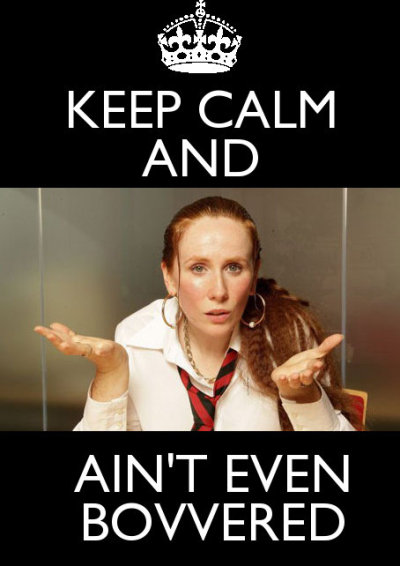
Donna Noble (Catherine Tate)
Gwen Cooper (Eve Myles), Torchwood

Obviously incomplete. Have any favorite gals I missed? Leave suggestions for next Friday in comments (and picture links if you have any particular images in mind!).

Happy Guy Fawkes Day, everyone … enjoy your weekend!

← Older posts
Newer posts →
"the past is a wild party; check your preconceptions at the door." ~ Emma Donoghue

Recent Posts

  • medical update 11.11.22
  • medical update 6.4.22
  • medical update 1.16.2022
  • medical update 10.13.2021
  • medical update 8.17.2021

Archives

Categories

Creative Commons License

This work by Anna J. Clutterbuck-Cook is licensed under a Creative Commons Attribution 3.0 Unported License

Meta

  • Register
  • Log in
  • Entries feed
  • Comments feed
  • WordPress.com

Blog at WordPress.com.

  • Follow Following
    • the feminist librarian
    • Join 36 other followers
    • Already have a WordPress.com account? Log in now.
    • the feminist librarian
    • Customize
    • Follow Following
    • Sign up
    • Log in
    • Report this content
    • View site in Reader
    • Manage subscriptions
    • Collapse this bar