• anna j. clutterbuck-cook
  • contact
  • curriculum vitae
  • find me elsewhere
  • marilyn ross memorial book prize

the feminist librarian

the feminist librarian

Author Archives: Anna Clutterbuck-Cook

a word about words, unschooling edition

09 Thursday Dec 2010

Posted by Anna Clutterbuck-Cook in think pieces

≈ Leave a comment

Tags

blogging, education

After a discussion with Hanna last night about unschooling vs. homeschooling vs. home-based education (as vocabulary choices and as philosophies), I wanted to clarify a couple of things re: word choice in my blog posts about nontraditional learning.

We were talking about the language I used in my recently-published interview as a “grown unschooler.”

In my life, I tend to use all three of these terms (and variations thereof) to talk about myself and my life experience. As a child, I used “homeschooling” because that was predominantly what my parents used. As a teenager I discovered “unschooling” as a term to differentiate more child-directed forms of homeschooling from those which sought to replicate school-at-home (this usage dates back to the 1970s), and found it more usefully described my particular experience of homeschooling — particularly as a way to distinguish myself from the majority of homeschooled teenagers in my area who were politically, socially, and pedagogically conservative.

More recently, since I’ve been doing scholarly reading and writing on the subject of education, learning, schooling, and pedagogy, I’ve become more varied and more deliberate in my choice of words to describe learning and teaching experiences. In my academic writing, I tend to use the word “school” to mean formal, institution-based educational experiences specifically — while “education” means learning and teaching experiences in a broader sense. Learning, of course, can take place even when deliberately-planned educative environments and/or experiences are absent. But home-based education is, usually, planned. Even if to the extent that parents have chosen to allow their children to grow outside of the default option which, in our culture, is formal schooling (public or private).

“Unschooling.” It’s an unsatisfactory word to me for a couple of reasons. One is the prefix “un” which right away gets us into negative territory. Instead of being for something (home-based education; learner-directed education) we’re defining ourselves against something (institutional school). The second, related, issue is that it still frames learning as something to do with school — even if set up as school’s opposite.

In fact, I think — and I imagine most self-identified unschoolers would agree — that learning and education are much, much bigger than mere school or its opposite. Learning can take place in, but is not bound by, formal schooling or deliberate educational activities. So these days, I try to move away from “school” terms as much as possible when I describe my own learning background pre-college.

At the same time, I continue to use all of these words, depending on the audience, the context, and the topic. I’m happy to accept the label “unschooler” when it allows me to talk about my experience outside of school; I’ll use “homeschool” or “home-based education” when that seems like the most useful choice. At the end of the day, I believe words are what we make of them — words are tools — and the more and the more varied the words we have at our disposal to describe our experience (and, most importantly, the more willing we are to be flexible in our language use) the better-equipped I think we are to articulate our being-in-the-world in all its myriad permutations.

"negotiation and compromise": reflections on my childhood outside of school

08 Wednesday Dec 2010

Posted by Anna Clutterbuck-Cook in life writing

≈ 5 Comments

Tags

children, domesticity, education, family, human rights, work-life balance

It seems fitting, in this last week of formal coursework in pursuit of my Master’s in Library Science, that I take some time out to reflect on a very different experience: that of growing up for the first seventeen years of my life outside of formal institutions of schooling. Those of you who follow my blog probably know that cultures of schooling, education, and learning are a topic of scholarly and personal concern to me. As I wrote on Saturday, Idzie @ I’m Unschooled. Yes I Can Write is running a series of interviews with grown unschoolers about their experience learning outside of school. I took some time out from wrapping up my coursework last week (read: spent time procrastinating like it was going out of style!) to respond to her questions. And yesterday Idzie published my responses.



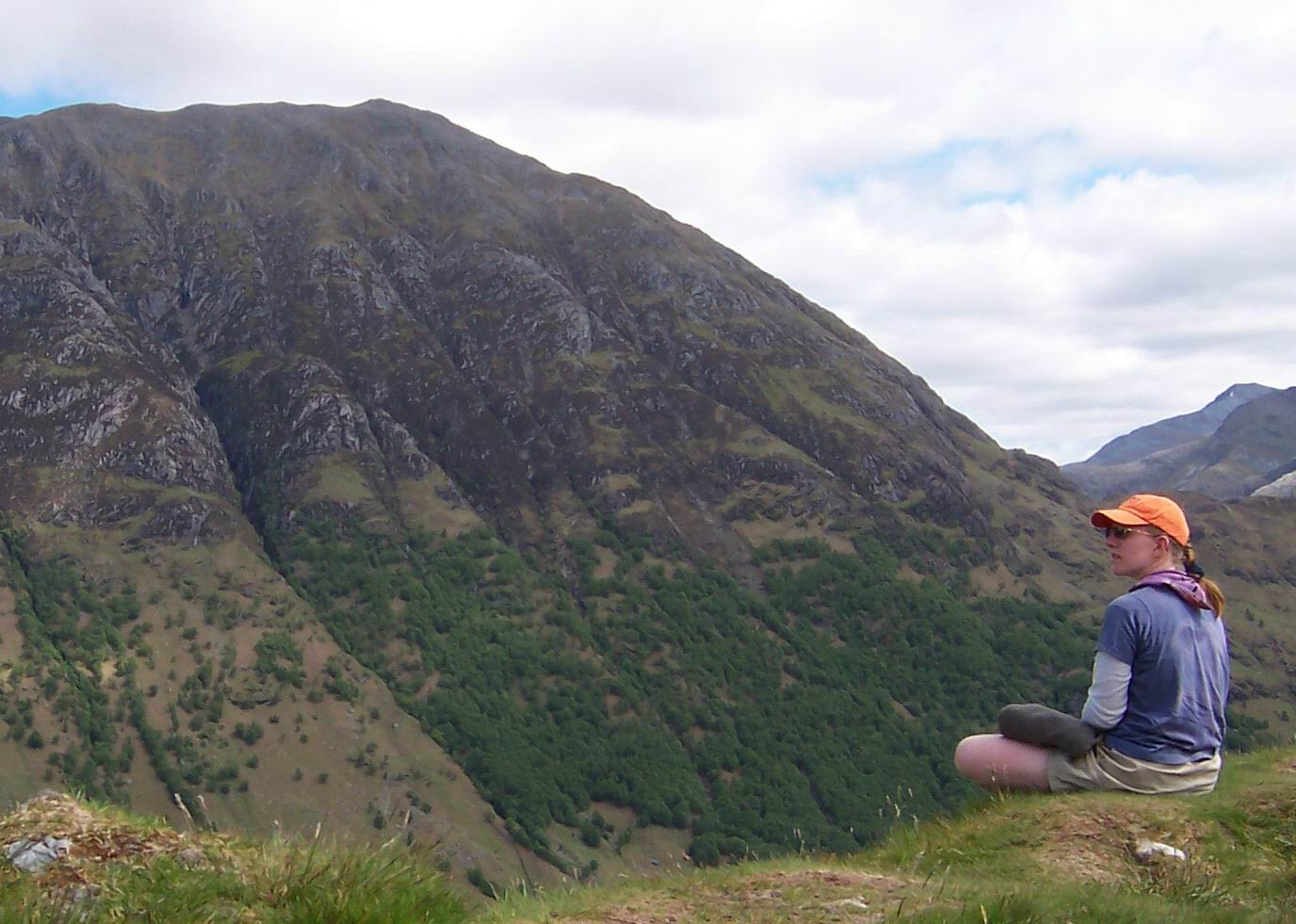
Glen Nevis, West Highlands, Scotland (May 2004)

Since I thought many of my readers would be interested in my responses, I’m cross-posting what I wrote here. But if you enjoy what you read, do check out Idzie’s blog since she publishes lots of awesome stuff — and promises an ongoing series of similar interviews.

The Basics

When did you become an unschooler?
birth (1981) and/or first year I was school age (1987)

How long have you/did you unschool?
Difficult question! I still think of myself as practicing the values of unschooling, even though I have had interactions with formal education and its institutions. I did not attend grade or secondary school at all (though my siblings did to varying degrees). I began taking courses at the college where my father worked when I was seventeen and continued there part time through 2005; until 2002 I was not a degree-seeking student, though I did take the courses for credit. During the seven years I pursued undergraduate coursework, I did lots of other things too, like work and travel. Since completing my B.A. I’ve moved on to graduate school (more below). However, I still feel very much an unschooler at heart.

How old are you now?
29, nearly 30.

The Decision to Unschool

If your parents chose unschooling, do you know how/why they made that decision?
My mother was, I think, the initiator of home-based education, since she was the primary at-home parent and also very interested in child development and early childhood education. She always preferred non-interventionist approaches, and when it came time to think about schooling for us kids she felt we were doing really well in our current environment — and that the schooling opportunities in our area were too conventional for our family’s needs. My father was completely on board with it, even though he usually took a back seat with the home-life arranging, given he was the parent with a full-time job.

My parents are not categorically opposed to working with formal institutions of learning. My father works at Hope College (where I eventually attended classes) and my siblings both expressed a desire to do some measure of formal schooling during their teen years. My brother attended some courses at the local public school, although he never enrolled as a degree-seeking student, and my sister went full-time to public high school. But the focus throughout was what worked best for our family as a whole and for each of us kids individually.

The Best and Worst

What do you think the best thing about unschooling is?
Speaking from the point of view of a unschooled child (rather than an unschooling parent), I would say that the experience of unschooling helped me to remain confident in myself: confident that I had the ability to learn new ideas and skills when I need them, confident I could find meaningful ways to occupy myself without a strict schedule, confident that I could navigate the world and find help when I needed it from people with particular expertise, or whom I had caring relationships with.

The worldview of unschoolers draws (in my opinion) on a specific understanding of human nature that is at odds with the beliefs of the dominant culture. In order to really practice unschooling, you have to trust in the human being to be interested in the world, to seek situations (physical, social, intellectual) in which that being will thrive in community with other beings. You have to trust that the being themselves — not external authorities — are the best source of information about what the being needs to thrive. Not to say that external feedback and expertise isn’t helpful — it’s often crucial. But at the end of the day, the individual themselves is the best authority on, well, themselves. And on what they need to feel nourished.

In society as a whole, children aren’t trusted to have that kind of knowledge about themselves. In part because children do often think and communicate in different ways than adults, given their stage of development, so children’s self-knowledge is often difficult for adults to access. But it’s there if we know how and where to look! And unschooling teaches us to cultivate that awareness in ourselves and others.

What do you think the worst (or most difficult) thing about unschooling is?
The most stressful thing about practicing unschooling in our culture is that it really is fundamentally counter-cultural. It challenges many of the hidden assumptions of our society about human nature, the nature of children, the purpose of education, the meaning of the “good life,” and so forth. I, personally, think people who unschool are on a much healthier track (by and large) than people who do not, because of their values and their orientation toward the world and the rest of humanity. But there’s definitely a cultural dissonance between the life we wish to lead as unschoolers, and the world in which we have to carve a space for ourselves beyond our families. It requires constant negotiation and compromise.

Beyond High School

Did you decide to go/are you going to college or university? If so, could you talk a bit about that experience?
I did go to college, both undergraduate and (currently) a graduate program. It’s always difficult to talk “a bit” about the experience, since my interest as an historian in counter-cultural education means I spent a lot of my waking moments thinking about the culture of institutional schooling, of teaching and learning, and about how “education” is framed in our contemporary cultural debates.

Casting my mind back to age seventeen, when I enrolled in my first college course — a first-year writing course — I remember how thrilling it was to be engaged in writing and thinking about ideas. At that point I wanted to be a creative writer and developed an enormous crush on my professor, a poet and photographer who had that rare ability to read one’s writing and discern what you meant to say, even if your early drafts were hopelessly muddled. At the same time, I felt like a foreign exchange student, struggling to assimilate to the academic culture that was invisible to most of my classmates. I cold be exhausting and isolating. The fact I was a politically and culturally progressive-radical student on a campus dominated by politically and culturally conservative students didn’t help to bridge the gap between me and conventionally-schooled peers. Nor did the fact I was a part-time, commuter student on a campus dominated by full-time, resident students.

I did not struggle with the coursework much at all. In the early years, I took courses that interested me without a thought toward graduation. Later on, when I was fulfilling requirements, I did take classes that were in subjects not of my instinctive interest (I wept through a one-month class in statistics, for example) … but by conventional measures (i.e., grades) I succeeded in conventional education despite my lack of formal training up to that point. And undergraduate college unquestionably opened doors for me — intellectually, socially, geographically — that might have been more difficult to open otherwise. I had access to off-campus programs and study abroad opportunities; I had faculty-student research opportunities and professors who I connected with and library resources, etc. The same can be said, to some extent, for my graduate work. The classes themselves have often been frustrating, inefficient, etc. But given the organization of our culture’s learning resources at institutions of education, it’s difficult to piece together a similar experience without being an enrolled student.

Difficult, but not impossible.

I never completely made peace with the structured nature of academic semesters, graded projects, competitive learning, being judged by external rather than internal expectations. It stressed me out on a pretty deep level; makes me feel like I’m complicit in a system that rewards some at the expense of the rest. which is something I have problems with, even if (especially if??) I’m one of those who gets rewarded. It’s complicated. I’m definitely looking forward to being done with formal academics for a while after I complete my current program (a dual-degree in library science and history).

Money Earning and Work

Are you currently earning money in any way?
Yes.

What jobs/ways of earning money do you, and have you, had?
Oh, gosh. I’ve been earning money since I was about nine. I started working seasonally for my father at the college bookstore he manages for pocket money and stayed there on and off throughout college. I also worked at a local children’s bookstore and a branch of Barnes & Noble. I did childcare as a teenager and worked one year as a nanny. I’ve served as teaching and research assistants for a number of college faculty. I spent a semester working as an office assistant for a study abroad program. I’ve also done a number of work-for-food-and-lodging type situations, sometimes in combination with other paid work and sometimes for short stints alone … like the month I spent at a women’s land trust in Missouri the summer after graduating from college.

When I moved to Boston, I was hired as a library assistant at the Massachusetts Historical Society, an independent research library in Boston that holds rare books and manuscript materials. It’s a wonderful way of being connected to a scholarly community without being tied to a college or university setting. For the past three years, I’ve worked there part time along with other part-time employment (in the field) and internships. I was just recently offered a promotion to full-time with enough wages and benefits to support remaining in Boston for the next few years, as my partner and I would like to do. It pays modestly well, and is definitely the type of work I was hoping to find when I began graduate school in library science.

Have you found work that’s fulfilling and enjoyable?
I won’t pretend that my partner and I don’t struggle with the question of balancing the need to earn wages to support ourselves in the short and long term. My partner, who also learned outside of school for much of her life (until going to public high school) resists, as do I, a culture that equates paid employment with identity and fulfillment. On the one hand, I do believe in seeking out ways to earn a living doing what you love … but I also resist creating a situation in which my life is defined by the work I do, or dictated by it. So that’s an ongoing balancing act. Even without children to care for, I find myself more and more appalled at how little flexibility our modern workplaces have for the rhythms of personal and family life.

Have you found that unschooling has had an impact on how hard or easy it is to get jobs or earn money?
This is a tricky question. I was very privileged in that I had a chance to work in the “family business” as a child and teenager prior to getting other jobs. Not being in school meant, too, that I could work in positions that school schedules could not accommodate easily, and gain really good work experience even before I started college. I had extensive volunteer experience, too, that filled out my resume. Another privilege was the fact that my father’s job at the college meant I got tuition benefits and could take classes without applying for a degree. By the time I petitioned to be a degree-seeking student I had a strong enough academic record they waived the requirements of national test scores or a high school diploma (a stumbling block for some unschoolers seeking to enter higher education). I have not felt limited by my lack of formal schooling pre-college. I do wish, sometimes, I had been braver about seeking alternatives to college and post-graduate schooling. I was tired of the effort it takes to forge the nonconventional path. And there are days when I’m not proud of that.

Do you feel that unschooling has had an impact on what methods of earning money or jobs you’re drawn to?
In a word: yes. In a few more words, I would argue that the worldview lying behind (my understanding of) unschooling supports de-emphasizing wage-work as either the primary mode of self-identification or as a measure of self-worth. Since unschooling encourages self-reliance and independence, being able to support myself — or, now, to contribute to the financial security of my newly-formed family — is a part of how I measure my success. However, it is one small part of my self-evaluation, all of which comes down to challenging myself to live in accordance with my values. Which would take a lot more than this questionnaire to explicate in depth! But in short, they can be summed up with the belief that all that 1) all life is of value, and 2) all that is required of humanity is “to do justice, love kindness and walk humbly.” (The original quote comes from the Christian Old Testament, Micah 6:8, and reads “walk humbly with God,” but I prefer leaving the question of whom or what one walks with up to the listener!)

General

What impact do you feel unschooling has had on your life?
The experience of growing up outside of the mainstream educational system colors virtually everything I do and the way I understand the world. I think it particularly shapes how I understand myself in relation to the mainstream culture and ways of thinking and being in the world. My family didn’t opt out of the mainstream to the extent that some unschooling families do: we had a television, we lived in an urban environment, we had friends who were schooled and so forth. We weren’t insulated from the mainstream and from the outside — except for the fact that we didn’t attend school — our family didn’t look that radical. But we were pretty damn radical anyway! So what I learned, growing up, was that individuals and families have choices. We can stand apart from some of the mainstream “common sense” beliefs about how people should grow and learn, what it means to be a functioning adult, what it means to be a family — but we don’t have to seek “purity” in pursuit of that. We can pick and choose, appropriate, make our own meanings of things, piecing together a life out of what we find to be beautiful and useful. It’s sort of a steampunk ethos, I guess.

If you could go back in time, is there anything about your learning/educational journey that you’d change?
I really wish I had been able to find practical alternatives to graduate school that gave me the same opportunities in the library/scholarly fields I’m interested in. Unfortunately library and archives training in the US takes place in the context of higher education, and most living-wage positions with opportunities for professional growth require an MLS.

If you were to have children, would you choose to unschool them?
I just recently read a blog post by Molly @ first the egg called parenting as holding the space in which she talks about how she and her husband don’t practice according to any particular parenting philosophy but that she’s come to realize that the way they parent is akin to the way in which doulas are trained to “hold the space” for women in labor. She writes, “the basic idea is that a calm, focused, loving person can protect a space in which the laboring/birthing person can do what she needs to do.” I think this is a really nice one-line description of what parents can and should provide their children — regardless of whether the decide they want (or are practically able) to unschool their children.

My partner and I are pretty sure we are not going to be parents, for a complex constellation of reasons. I won’t speak for her in this instance, but in my case I don’t want to have children unless I am able to unschool them — in spirit if not by actually keeping them out of institutional education altogether. I don’t want to take on a responsibility that I don’t have the resources — emotional, logistical, financial — to really follow through on according to my values. And my values would demand giving that small person in my care as much calm, focused loving as I could — and trying to surround them with adults and other young people who could support me, my partner, and our child(ren) in that endeavor. And right now we aren’t in a place to do that.

Advice

What advice would you give to teens looking to leave high school? What advice would you give to someone looking to skip, or to drop out of, college or university?
Since I didn’t ever leave high school and eventually ended up completing university and going on to do post-graduate work, I’m not sure how much I can speak to this. However, I would say this: in my experience, it pays to reject either/or thinking and be creative about how you use your available resources.

What advice would you give to unschooling parents (or parents looking into unschooling)?
In addition to what I wrote above about “holding the space,” I think it’s important — with all childcare, but particularly with unschooling — to emphasize that the choices you make about family life effect outcomes. That may sound elementary, but I’ve seen a lot of nominally “unschooling” or homeschooling families where the parents really, really want their kids to look and act like, and hold the same values, as their conventionally-schooled peers. Or even worse, they expect them to be conventional-PLUS: they think that unschooling their kids are going to make them even more successful than their peers by all the mainstream cultural standards.

It’s not an impossible goal … and it’s not that I think having goals and accomplishing them is a bad thing. But the “conventional-plus” approach to unschooling is, to my mind, a really impoverished approach … because it leaves behind the really radical aspect of unschooling, which is to question the foundational values of American culture concerning human nature, what it means to be a successful human being, what you need to thrive in the world, and how human relationships facilitate that process. If I had to offer advice in a nutshell to unschooling parents, it would be: Expect different outcomes — and try not to be afraid of them. Be clear about what your own values for “the good life” are and share them with your children, and then let your kids develop their own values from that foundation.

Also, don’t encourage your kids to see mainstream culture or conventional schooling as evil. There are good people who teach in schools, there are good people who send their children there, and there are children who thrive despite the many problems of institutional schooling. I’ve seen too many unschooling families turn their personal and familial choices into an “us vs. them” negativity that doesn’t encourage building alliances, accessing resources, and remembering to seek out support and learning in even the most unexpected places. Encourage your kids to remain open-minded about the mainstream, even as you challenge them to engage with it critically.

Is there anything else you’d like to talk about or add?
I think I’ve already said way more than is reasonable in terms of a blog post, so I’ll leave it there. Thanks so much for the opportunity to share my thoughts on being a grown unschooler and I look forward to reading what others have to say in response to these questions!

movienotes: life with father (1947)

07 Tuesday Dec 2010

Posted by Anna Clutterbuck-Cook in media

≈ 2 Comments

Tags

feminism, masculinity, movies, politics, web video

Last night, Hanna and I took a couple of hours out of our evening to screen the 1947 William Powell / Irene Dunn film Life With Father. Why did we do this? We were looking for something holiday-centric (Holiday Inn, Miracle on 34th Street) but came up dry … and decided to give this a try instead. While I can’t say it was an unqualified “win,” I definitely found myself fascinated by the entire package for a variety of reasons.

First, the original trailer.

This film is wrong on so many levels I’m only going to hit the highlights in hopes of encouraging you to check it out. Why? Because I think films from previous eras, much like our own, are fascinating windows into the normative pressures of certain periods in time.

In this case, the way in which American cinema in the postwar era was enlisted to construct a certain narrative of gender, of family, of class, and of the American past. This film is further complicated by the fact that it is a costume drama: it employees the collective memory of/nostalgia for a bygone era — in this case, a particular understanding of upper-middle-class New York City in the 1880s.

So, a few observations.

1) According to this film, men make and understand money while women spend money without any ability to understand finance. The titular father of the film (played by William Powell) is a banker and supports his wife and four sons in a luxurious townhouse complete with servants. Nevertheless, he and his wife (Irene Dunn) constantly bicker about the household budget which “mother” is incapable of managing in the manner which her husband believes is appropriate. Some of the best comic exchanges in the movie, in fact, revolve around Father attempting to get Mother to explain how she has spent the money he has given her, and Mother attempting earnestly to account for her purchases. This trope of gender differentiation is employed for comic value without ever being challenged. Neverthess, it’s fascinating to watch how blatently the paternalism is.

2) The whole movie is worth watching for the scene where Father explains to Jr. all he needs to know about women. When the eldest son falls in love with a young Elizabeth Taylor (only three years after her breakout role in National Velvet) Father takes him aside to explain a thing or two about women. What follows is instruction in how to avoid women’s advances, what to do when they cry, and a stern dismissal of Jr.’s (veiled) questions concerning heterosexual relations. I wish I had been taking notes at the time, because it really was self-parodying.

3) Making and breaking your promises is totally manly as long as you think your wife is dying. The central conflict in the film is, for reasons that defy my understanding, that Father has never been baptized and Mother is convinced this means their marriage is invalid and that he will go to hell.  So she extracts promises from him to be baptized, all of which he breaks until (spoiler) the very end, of course, when he finally capitulates and the whole family goes off together in a horse-drawn cab into the happily-ever-after. The thing that struck me was the fact that every time Father promises to be baptized, he is inevitably extending the promise as a way to get Mother to do something (or stop doing something) he wants (or doesn’t want) … including die. Then, when the situation ceases to irritate him, or distress him, he immediately retracts the promise.  It made me think of Toad of Toad Hall in the Wind in the Willows protesting, “Oh, in there! I would have said anything in there!”

4) Women (and to some extent children) care only about men as providers. This is an extention of the first point about women and math: the narrative of the entire film, to some extent, could be read in terms of consumption. The children want new clothes and toys. The mother wants jewelry. The household must be provided for. Friends come to the city to go shopping. And Father, above all, spends the entire film fretting about how much his family is spending of “his” money. The entire household, he feels (and often says — though perhaps not in so many words) should be arranged around his needs and desires as the wage-earner. And instead, his life is “controlled” by his wife and children who spend all his money and disrupt his peace, giving him very little gratitude in return. This resentment was at the forefront of postwar gender politics, and I don’t think it’s a mistake that this narrative is so blatant. I’d argue it says more about the era in which it was made than the era it was made about.

5) Religion is the sphere of women and children. Similar to the narrative of money and gender, the narrative of religion and gender is at once drawing upon 19th-century notions of women’s particular piety and purity and twentieth-century, postwar perceptions of religion as a particularly feminine practice.  The central tension in the film revolves around the discovery that Father has never been baptized (into the Episcopal Church … the main rift in the film appears to be between Methodists and Episcopalians; any holy rollers or other non-mainstream, and/or non-protestant religious groups, including Catholics, are entirely absent).  Mother is appalled and distressed by this revelation, fearing for her husband’s immortal soul as well as for the sanctity of their marriage.  Father insists that baptism is a formality, a waste of time, and resists the pressure of his wife for most of the two hours before finally surrendering to her desires and thus restoring unity back to the household.

The centrality of religious practice — if not the more personalized faith we’ve become used to in recent years — is startling to see on the big screen, incorporated into the narrative of what it means to be a White, middle-class, urban family.

That’s about all I’ve got at the moment. You can check the film out on Netflix streaming or free through the Internet Archive’s Moving Image Archive: Feature Films collection.

sunday smut: much-delayed women of who no. 2

05 Sunday Dec 2010

Posted by Anna Clutterbuck-Cook in linkspam

≈ Leave a comment

Tags

fun, movies, photos, whoniverse

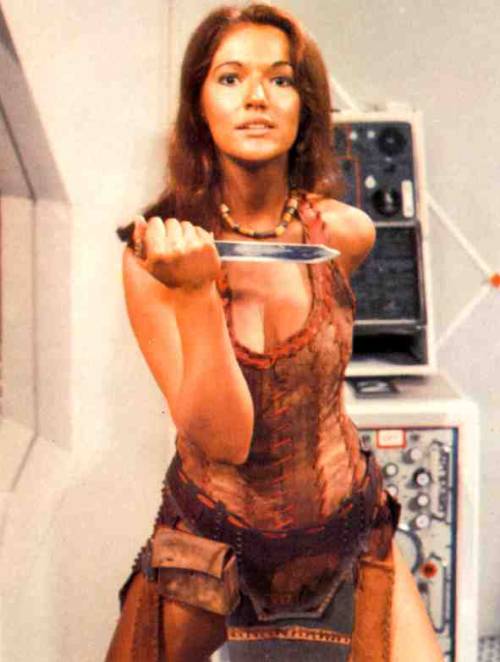
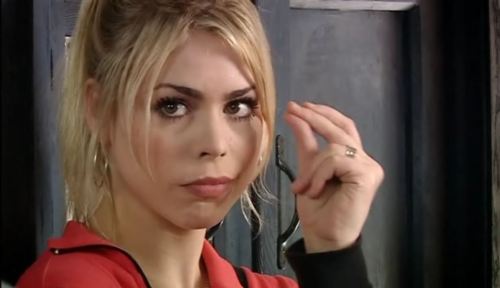
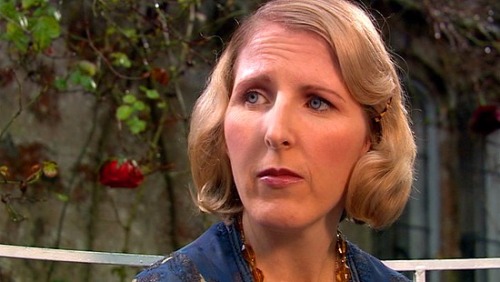
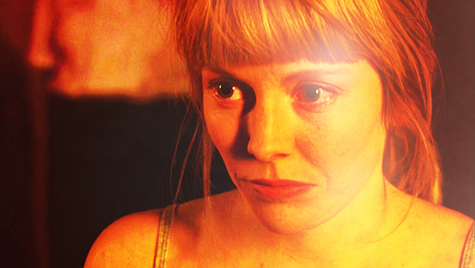
I promised more Women of Dr. Who pictures a few weeks ago and then got busy with other things — plus Tumblr kinda failed me for a bit, not posting any inspiring stuff. But now I’m back with more lovelies for your Sunday viewing pleasure.


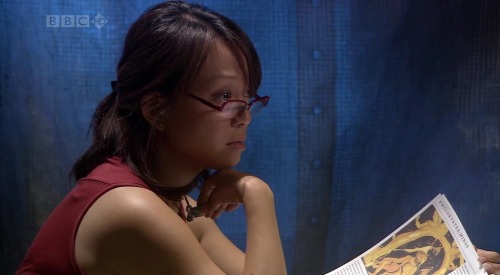
Leela (Louise Jameson)


Romana (Mary Tamm) with the Doctor (Tom Baker)
in The Armageddon Factor.


Rose (Billy Piper) in The Long Game.


Agatha Christie (Fanella Wollgar) in
“The Unicorn and the Wasp” (new series 4.7)
Freema Agyeman (Martha Jones)
and David Tennant (10th Dr.)
Jackie Tyler (Camille Coduri) and Mickey Smith (Noel Clarke) in
“Aliens of London” (new series 1.4)
Lucy Saxon (Alexandra Moen)
Toshiko Sato (Naoko Mori) from Torchwood
Amy Pond (Karen Gillan) with fiance Rory Williams (Arthur Darvill)
in “The Vampires of Venice” (new series 5.6)

All photos drawn from whoniverse, fuckyeahdrwho, karengillanlover, aimeesgonnaaim and whospam tumblr blogs.

You can see last week’s installment here.
I couldn’t find any satisfactory pictures of River Song … but the minute I do I’ll add them to the queue for the next installment.

Have a lovely Sunday … Hanna and I and a few of our fellow Whovians are off to the Brattle Theater in Cambridge tonight for a big-screen viewing of “The End of Time.” Hooray!

quick hit: interviews with grown unschoolers

04 Saturday Dec 2010

Posted by Anna Clutterbuck-Cook in linkspam

≈ 3 Comments

Tags

call to participate, children, education

Blogger Idzie @ I’m Unschooled. Yes, I Can Write is running a new (and hopefully ongoing) series of interviews with grown unschoolers. I sent her my responses on Saturday and look for a post later this week sharing what I wrote (and cross-linking with her blog).  In the meantime, here’s the first of the published interviews with one Hanna Thompson, as Idzie writes, is a “world traveler and aspiring medical doctor.”A few excerpts:

Have you found that unschooling has had an impact on how hard or easy it is to get jobs or earn money?
It’s much easier being unschooled to find a job than if I was attending school. One reason is that with unschooling you actually have time to have a job, and I’ve found that my interpersonal skills which I attribute to unschooling, have made me very marketable in the jobs that I’m working.

What impact do you feel unschooling has had on your life?
My unschooling experience has taught me to follow my passion without restraint. The freedom of this type of education has given me the time to explore interests and form concrete ideas about what I want to achieve.

What advice would you give to unschooling parents (or parents looking into unschooling)?
Unschooling is about helping your child grow and expand their horizons, institutionalized schooling is about prolonging childhood indefinitely, so be your child’s facilitator, get involved with them, find opportunities for them, and let them pursue their own. Just let them grow.

You can check out the whole response at Idzie’s blog and look for more installments in the future.

Also, if any of you reading this are or have been unschoolers, do participate in the series! You can find the original call for responses and the blank questionnaire by clicking through.

saturday smut: missing Aberdeen (and winter snow)

04 Saturday Dec 2010

Posted by Anna Clutterbuck-Cook in a sense of place

≈ Leave a comment

Tags

british isles, family, outdoors, photos

As I’m writing this it’s Friday night of a really long, long week … the penultimate week of my semester in which all my projects were wrapping up and life just generally felt like one damn thing after another.

And then I found these lovely photographs made available online at The Scotsman (Edinburgh), snapshots taken by Scots from around the country documenting the wild winter weather they’ve been having in Britain this week. Since it’s December 3rd here in Boston and we’ve yet to see a single flake of snow (though the forecasters promise some Monday), I’m going to indulge in a little winter weather photo porn.

Enjoy!

Kildrummy, Aberdeenshire (by Darren)
Balerno (by Alan Macmillan)
Christmas Fair, Princes Street Gardens, Edinburgh (by Sarah McPhee)
Newtongrange (by S. Robert)
Sheep in the Borders (John Peters)

Click through to see all the rest in four parts at The Scotsman’s website.

in praise of do-nothing days

29 Monday Nov 2010

Posted by Anna Clutterbuck-Cook in our family

≈ Leave a comment

Tags

domesticity, hanna, photos

Hanna and I spent Thanksgiving vacation at home this year, in Boston. We didn’t travel and for the most part we didn’t plan to do a lot of stuff. Between last Tuesday afternoon and Sunday night we just … spent time together. And it was good. It’s the first vacation of that kind I’ve had, really, since moving to Boston. At least for that duration. It can be hard, sometimes, to purposefully do “nothing” … nothing that counts as productivity, that is. Of course we did stuff. And even in those moments when we weren’t baking, reading, cleaning, talking, watching movies, surfing the ‘net for pretty pictures … even in those moments of true idleness, we were doing something: we were being. Together. And it was good.

Hope y’all had a good vacation as well; I’m sure I’ll get my hand back into blogging soon enough.

UPDATE: For more photographs from our long weekend, see Hanna’s most recent post at …fly over me, evil angel ….

happy thanksgiving day, one and all

25 Thursday Nov 2010

Posted by Anna Clutterbuck-Cook in our family

≈ Leave a comment

Tags

domesticity, family, feminism, holidays


Mostly, this year, I’m thankful for a long weekend at home with Hanna and Geraldine. As I’m typing this, we’re hanging out on the couch with half an eye toward the Thanksgiving day parade, catching up on our leisure reading and looking forward to the arrival of our friend Ashley for tofurky dinner.

And ’cause this is the Future Feminist Librarian-Activist, I wanted to note that I woke up this morning to the voice on WGBH (our local NPR station) saying, “It’s Thanksgiving morning, and your work in the kitchen is almost done Moms!” ’cause clearly “Moms” are the only people capable of putting together a Thanksgiving meal. (As Hanna said, “Well, in my house it was always my dad!”)

And it might just be because I don’t often watch network television, and rarely morning television — not to mention on a treacly American holiday — but wow. The narratives of consumption, “family,” all revolving around gender roles, is front and center. In a train-wreaky sort of way.

Not that the Macy’s Thanksgiving Day Parade has ever been about anything but consumption. But it’s fascinating to see how that’s all packaged in the mainstream, completely bland-yet-powerful cultural frames of family (Victoria’s Secret models gushing about the newfound bliss of motherhood), nationalism (yes, for those of you who were listening, Colin Quinn did liken the parade to the Nuremberg Rallies) and relentless consumption. Also, this is the first time in a while I’ve actually been witness to a critical mass of commercials aimed at the twelve-and-under set and crivens! It’s one thing to read about the aggressive gender-segregated marketing of children’s toys (see booknote on Delusions of Gender)? It’s another thing entirely to actually see it first-hand for three hours. I think on some level it’s the sort of stuff I believe intellectually is out there, but I don’t believe-believe people are really that actively and nakedly endorsing stereotypes.

But no: it’s there, front and center. Amazing. I feel like I should be taking notes on the language used to shape meaning of the day and the way in which the parade (apparently) perfectly “captures the essence” of whatever this day is about in our collective imagination.

Huh. I didn’t start this post as a rant. So I guess I’ll stop there and go back to enjoying the day. Particularly the work of Sir Terry Pratchett, whose existence in the world has brought us passages such as this, from his latest Tiffany Aching novel, I Shall Wear Midnight.

And what are my weapons? [Tiffany] thought. And the answer came to her instantly: pride. Oh, you hear them say it’s a sin; you hear them say it goes before a fall. And that can’t be true. The blacksmith prides himself on a good weld … We pride ourselves on making a good history of our lives, a good story to be told.

And I also have fear — the fear that I will let others down — and because I have fear I will overcome that fear. I will not disgrace those who have trained me.

And I have trust, even though I am not sure what it is that I am trusting.

“Pride, fear, and trust,” she said aloud. And in front of her the four candles streamed fire, as if driven by the wind, and for a moment she was certain, in the rush of light, that the figure of an old witch was melting into the stone. “Oh, yes,” said Tiffany. “And I have fire.”

Enjoy your rest, wherever you are, and then carry on with pride, fear, trust, and fire. Doing whatever it is you are called to do.

from the archives: making archival images accessible online

24 Wednesday Nov 2010

Posted by Anna Clutterbuck-Cook in library life

≈ Leave a comment

Tags

archivists, history, northeastern

Last week, I finally finished the scanning and metadata entry project I began over a year and a half ago at Northeastern: Two photo albums and a scrapbook compiled between the 1890s-1920s by Marjorie Bouvé, a young Boston woman who founded a school of physical education. The photographs and scrapbooks document her adolescence and college education (she attended Bradford Academy and Smith College), and her work as a teacher. Hopefully, hopefully, early in 2011, I’ll be able to link to the interactive database containing all the images and records I created.

Nearly 2,000 of them.

But for now, I thought I’d give you a taste of what it means to create what we in the archives world call “digital surrogates” of archival images. Partly ’cause I think it’s interesting. Partly ’cause I took a phone call from a gentleman this week at the Massachusetts Historical Society who didn’t understand why all our records weren’t just digitized and up online (as our Collections Services director would say: “if you see it online, it wasn’t elves that put it up there!”).

So what does it mean to enter metadata for each digital image we create? Well, here’s a sample record I pulled from the database, which is the metadata (the information about the creation and content of the image) associated with one page of a letter in Marjorie’s scrapbook.  You sill see from the file name that this is the ninth item cataloged from page one of volume four from the Marjorie Bouvé papers (collection M89).


m89_s4p001v009b\.jpg

Item separated from m89_s4p001v005. Item related to m89_s4p001v008.
Letter to members of the Rainy Day Club from M. Anagnos, 20 August 1892.
Aganos, M.
Perkins Institution and Massachusetts Asylum for the Blind
Marjorie Bouvé Papers (M89), Box 1
1892-08-20
2010-10-23
Copyright Northeastern University
Haidt, Marie
3215 x 4073 pixels
7.75 x 10.0 inches
Social Stationary
Boston (Mass.)
South Boston (Mass.)
Correspondence — Massachusetts — Boston
Correspondence — Massachusetts — South Boston
Scrapbooks
Social stationary
Aganos, M.
Bouvé, Marjorie, 1879-1970
Caverly, Edith L.
Eaton, Alice
Kelly, Edith A.
Smith, Lillian
Smith, Marion E.
Wilkins, Christel W. 
Perkins Institution and Massachusetts Asylum for the Blind 
BookEye 3 A1AJC
400dpi2010-07-21
B001927
m89_s4p001v009

This record is in XML (eXtensible Markup Language) and can be read by a variety of web-based display programs (at Northeastern, we use a content management system called Greenstone).The information I enter, and enclose in tags) allows the content management system to display the images and the information about them in a prettier, user-friendly format. See, for example, the images in the Freedom House Collectionwhich Hanna (and a team of others) worked on a few years ago.

Some of the information is generated automatically by Greenstone, but all of the data in the file set you see here was entered by me.  Fingers crossed it all pays off in the end, when y’all get to flip through a digitized version of some pretty cool turn-of-the-twentieth-century pictures and ephemera … all from the comfort of your very own personal computers.

booknotes: delusions of gender

22 Monday Nov 2010

Posted by Anna Clutterbuck-Cook in book reviews

≈ 1 Comment

Tags

children, feminism

Continuing my meander through recent literature on gender and neuroscience (see booknotes on Sexing the Body, Brain Storm, and Fixing Sex), this week I finally got around to reading Delusions of Gender: How Our Minds, Society, and Neurosexism Create Difference (2010) by Cordelia Fine.

Written for a more popular audience than Brain Storm or Fizing Sex, Fine’s Delusions of Gender has been popping up in the mainstream media more than either of these titles, despite the fact that they all revolve around similar issues: at the most basic level, how sociocultural contexts (“nurture”) influence “nature,” or those things that we consider to be somehow innate and fixed (and somehow knowable) within the body. Specifically those things which we identify as relating to gender and sexuality.

In Delusions, Fine reviews both popular and academic literature that purports to describe the way in which human brains a wired differently based on the sex of the person in question: the ever-popular idea that there is somehow a “hard-wired” or “innate” gender difference and that, despite our best intentions at gender-neutrality or equality, men and women will forever and always constitute two distinct (usually opposite) groups of humans. Sometimes, these differences are seen as so extreme that men and women find it impossible to communicate, to learn in the same classrooms (men are good at math while women are good at language?), to share the same tasks (doing laundry might lower men’s testosterone levels to dangerous extremes, while the same task gives women an oxytocin high?), or inhabit the same planet (perhaps, as Futurama‘s “When Aliens Attack” episode suggests, men are really from Omicron Persei 8 and women are from Omicron Persei 9?).

Fine’s purpose in reviewing this literature is, by and large, to point out the ways in which the claims of these writers draw on faulty data: poorly-designed studies, studies that do not provide evidence for the authors’ claims, studies that, in fact, suggest the opposite of what the authors claim, and studies with very limited generalizability.  Further, she explores what the evidence is actually telling us about gender difference (more below) and challenges us to consider how we, as human beings, lose out when neurosexism (the claim of immutable gender difference) continues to enjoy great popular support and to inform policy decisions, such as the push for single-sex education.

None of Fine’s conclusions will be a great revelation to those with a background in any social science discipline, particularly those interested in the sociocultural forces that shape gender and sexuality.  However, I found her psychological and neurobiological perspective extremely helpful in illuminating the way in which powerful cultural stereotypes inform our subconscious and unconscious behaviors and identities even when our concious minds resist those messages. When faced with evidence of behaviors that don’t match up with our conscious intentions, human beings often resort to the “biology as fallback” position. That is, if I tell my son it’s okay for boys to play with dolls and he still eschews them for trucks or the tool set, then there must be an “evolutionary or divine” reason for that behavior. If career women are “opting out” of successful careers to be a primary parent, or coming home from work to do the emotional heavy lifting in the family, it must be because they’re “wired” to be nurturers, while men are not.

The problem is, the data don’t support these conclusions — there is no reliable evidence that women’s brains are inevitably better at caretaking, while men’s brains like trucks and solving construction problems. So: if evolution isn’t our fallback option, what might better explain these behavioral differences?

The answer, according to Fine, lies in the way our organic beings (including our brains) interact with the environment around us — not just the natural physical environment (i.e. what hormones we’re exposed to in utero) but or sociocultural environment as well.

Take a look around. The gender inequality that you see is in your mind. So are the cultural beliefs about gender that are so familiar to us all. They are in that messy tangle if mental associations that interact with social context. Out of this interaction emerges your self-perception, your interests, your values, your behavior, even your abilities. Gender can become salient in the environment in many ways: an imbalance of the sexes in a group, a commercial, a comment by a colleague, a query about sex on a form, perhaps also a pronoun, the sign on a restroom door, the feel of a skirt, the awareness of one’s own body. When the context activates gendered associations, that tangle serves as a barrier to nonstereotypical self-perceptions, concerns, emotions, sense of belonging, and behavior — and more readily allows what is traditionally expected of the sexes (235-236).

So despite our individual best intentions, Fine argues, we are at least in part held hostage by our environment — we are adaptable creatures, constantly negotiating that balance between our conscious ideals and those actions and self-presentations that will protect us from negative feedback, from marginalization, and threaten (on a very basic level) our survival.

So far, so good: the personal is political, as any well-schooled feminist activist can tell you.

Yet it doesn’t stop there, because Fine’s most crucial argument is still just around the corner.

The fluidity of the self and the mind is impressive and is in continual cahoots with the environment … Nor is gender inequality just part of our minds — it is also an inextricable part of our biology. We tend to think of the chain of command passing from genes, to hormones, to brain, to environment. … Yet most developmental scientists will tell you that one-way arrows of causality are so last century. The circuits of the brain are quite literally a product of your physical, social, and cultural environment, as well as your behavior and thoughts. What we experience and do create neural activity that can alter the brain (236).

We are, in other words, permeable organisms, highly attuned to our environment (in all senses of the word), constantly calibrating ourselves to thrive and survive within that particular context. And if the context we are attempting to thrive in is on that expects oppositional, gender-essentialist behavior, then not only our conscious minds, but our very corporeal bodies, respond to that expectation and alter ourselves accordingly. It’s not nurture building on nature, but rather nature and nurture twined together in a constant feedback loop, informing and reforming one another in a neverending cycle of change.

“When researchers look for sex differences in the brain or in the mind,” Fine concludes, “they are hunting an ever-moving target. Both are in continuous interaction with the social context” (236).

One final observation before I close this post, and that is to highlight the way Delusions reminds us not to underestimate our children. Fine spends quite a bit of time dissecting the evidence of gender difference observed (both in formal studies and anecdotally) in infants and very young children. This is because, for obvious reasons, researchers often seek data concerning brain differences in very young humans — humans, it is supposed, who have had very limited exposure to sociocultural influences that would shape their beliefs or behavior. Thus, gender-progressive parents who seek to encourage a full range of emotional expression and activities in their children (regardless of assigned sex), often express despair when confronted with daughters who are obsessed with dressing in pink (and only pink): if the parents have encouraged the child to try a full range of clothing colors and the three-year-old settles on princess pink, the argument goes, the child must then be expressing her “true” (natural) self.

Not so fast.

This conclusion, I would argue (drawing on Fine’s text), both over- and underestimates children. It overestimates the power of children to resist the power of cultural stereotypes and peer pressure at the same time that it underestimates the intelligence-gathering abilities of children, who are primed in the early years of their lives to figure out, above all, how to survive. And when you are part of a social species, as human beings are, then your survival — on a fundamental level — depends on the speed and accuracy of your ability to gather and analyze social data, and to understand how to adapt yourself to social situation X in order to maximize your changes of survival.

And remember: despite the fact that, as an infant, your primary caregivers are (if you’re incredibly, incredibly lucky) loving, supportive parents, you can’t depend upon your parents: you have to negotiate survival in a chaotic, appallingly complex social environment beyond the doors of your parental home. How do you do this? You gather information constantly and attempt to make sense of it. You have to figure out how the world works because if you fail to understand the rules of the game, then you will die.

Nonconformity? Self-expression? Living on the margins? Those all take a back burner.  I’m not talking ideal scenario here — ideally, survival and self-expression, survival and nonconformity, these would not be mutually exclusive. But we’ve created a world, dear readers, in which they often are.

And kids: they are smart enough to figure this out.

And being disinclined to die, they conform.

This isn’t “hard-wired” gender difference. This isn’t stupidity. This is romper-room street smarts.

So what do we do about this?

Quite simply: we have to create a better culture: one in which kids don’t have to choose between conformity or death. And we need to remember that this has to happen on a huge big cosmic scale. Not that our little single-family, daily interventions don’t help (as I was typing this, for example, Hanna sent me over to EPBOT to voice my support, as a female Star Wars fan, for a nine-year-old girl who’s being bullied for taking a Star Wars water bottle for school … ’cause apparently SW ain’t for girls). Those small-scale interventions give kids (not to mention the rest of us) the space to consciously resist those subconscious and unconcious pressures. But unless we effect larger sociocultural change, we will continue to operate — to use Fine’s phrase — with “half-changed minds.”  And our bodies will continue to bear the scars of gender stereotyping.

← Older posts
Newer posts →
"the past is a wild party; check your preconceptions at the door." ~ Emma Donoghue

Recent Posts

  • medical update 11.11.22
  • medical update 6.4.22
  • medical update 1.16.2022
  • medical update 10.13.2021
  • medical update 8.17.2021

Archives

Categories

Creative Commons License

This work by Anna J. Clutterbuck-Cook is licensed under a Creative Commons Attribution 3.0 Unported License

Meta

  • Register
  • Log in
  • Entries feed
  • Comments feed
  • WordPress.com

Blog at WordPress.com.

  • Follow Following
    • the feminist librarian
    • Join 36 other followers
    • Already have a WordPress.com account? Log in now.
    • the feminist librarian
    • Customize
    • Follow Following
    • Sign up
    • Log in
    • Report this content
    • View site in Reader
    • Manage subscriptions
    • Collapse this bar