• anna j. clutterbuck-cook
  • contact
  • curriculum vitae
  • find me elsewhere
  • marilyn ross memorial book prize

the feminist librarian

the feminist librarian

Author Archives: Anna Clutterbuck-Cook

from the neighborhood: colors from maine

15 Wednesday Sep 2010

Posted by Anna Clutterbuck-Cook in a sense of place

≈ Leave a comment

Tags

family, maine, photos


Fresh tomatoes from Kevin and Linda’s garden.


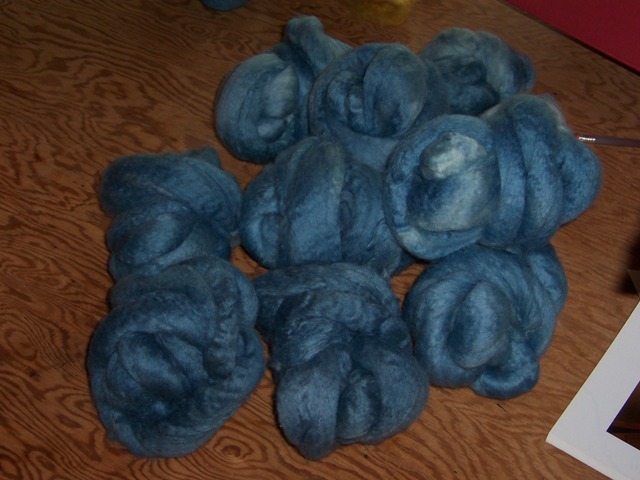
Balls of carded fiber, dyed with home-grown indigo by Linda.


After hurricane Earl blew through, we had a gorgeous weekend.

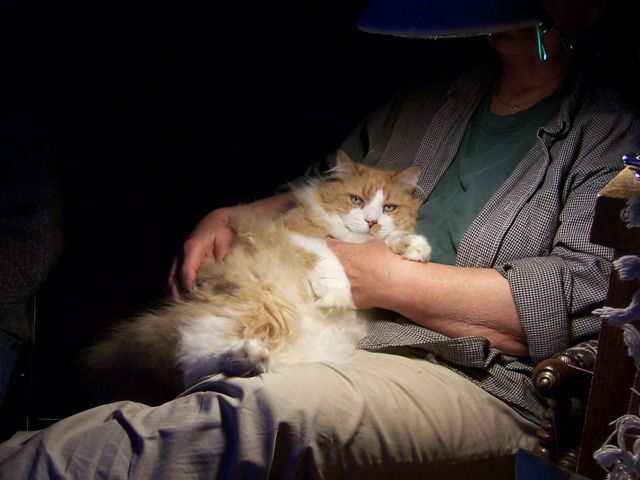
Monty the cat on Linda's lap
Monty is suspicious of visitors, but braved our presence to spend a few minutes on Linda’s lap Sunday evening while we were watching movies.

Hope y’all are having a good week; happy 15th of September … in six more days it will officially be fall. Maybe next time we head north, there will be some red and orange color in the trees.

multimedia monday: "sensitivity" and "got-no-sensitivity"

13 Monday Sep 2010

Posted by Anna Clutterbuck-Cook in media

≈ Leave a comment

Tags

politics, web audio, web video

Last week on my tumblr feed, I shared a web video from the awesome Jay Smooth of Ill Doctrine on the political use of the word “sensitivity” in recent weeks. The next day, while I was doing metadata entry at work, I heard this commentary on Fresh Air by linguist Geoff Nunberg about the modern evolution of the work in our political vocabulary.

A full transcript can be found on the NPR website.

Nunberg observes (emphasis mine):

At the outset, the approach seemed to have a lot to recommend it. For one thing, it was easier to persuade people to modify their language than to get them to root out their deep-seated attitudes about race, gender and the rest. And the hope was that if you changed behavior, attitudes would eventually follow. It’s cognitively more efficient to believe the words you’re obliged to say rather than always surrounding them with mental air quotes.

But over the long run, the stress on sensitivities probably set back cultural understanding as much as it advanced it. For one thing, it permits people to blur the distinctions between mere thoughtlessness and antipathies that run deeper in the heart. It’s only insensitive when Michael Steele uses the phrase “honest injun” he probably never gave the expression any thought before. But there’s a moral obtuseness in talking about the insensitivity of carrying a sign that depicts Barack Obama as a witch doctor with a bone through his nose. A lack of sensitivity is the least of that person’s problems.

And while most people are raised to be polite, it turned out not to be such a good idea for institutions to try to impose deference to the sensitivities of certain groups. In response, a lot of people took to pronouncing sensitivity with that mocking tone and derided it under the heading of political correctness.

Points for the turn-of-phrase “moral obtuseness,” which I’m now going to have to find opportunities to use! Meanwhile, I don’t think I have anything super intelligent to say as a response, beyond the fact that it sure as hell is complicated to foster empathy and understanding between people who are divided by fear. I’m always grateful to have NPR out there sharing this sort of long-range perspective, even if they can’t offer any solutions.

sunday smut: tumblr highlights (no. 1)

12 Sunday Sep 2010

Posted by Anna Clutterbuck-Cook in linkspam

≈ Leave a comment

Tags

gender and sexuality, sunday smut, tumblr

Gouache Nude Painting by Armando Martires
made available at Flickr.com

As I dive into the semester, here’s a sampling of stories I shared on my tumblr blog, the feminist librarian reads, this past week. Here are a few samplings from the past week … head on over to tumblr for more!

What Comes After the Gender Binary by Marissa @ This Is Hysteria!

“This is not the first time that I’ve seen somebody think that when I talk about eliminating the gender binary that I envision a world of uniform androgyny.

What the elimination of the gender binary means to me is that people can be as masculine or feminine as they like. But the performance of masculinity or femininity is not compulsory depending on sex. Being masculine in some respects would not put femininity out of bounds for you, and vice-versa. Gender could be played with, freely, without social sanction.

That is, there would be more variety in gender expression, not less. Instead of black and white, we would have a rainbow, not a homogenous mass of grey.”

kinky by Emily Nagoski @ ::sex nerd::

“Sex positivity is part of it. Kinky folks have often had to take a long, hard look at sexuality – their own and the world’s – and come to the conclusion that their own desires are actually completely FINE, in the context of consenting adults, and that people who don’t agree with them (a) can go fuck themselves and (b) are probably suffering from that self-imposed moralizing and narrowly conscribed ideas about sexual expression, and are therefore to be pitied.

That combination of I-pity-you and you-can-go fuck-yourself rings very true to me. I appreciate both the empathy and the lack of tolerance for bullshit.”

Gender divide a myth, says expert by Amelia Hill @ The Guardian

“[Cordelia] Fine is unabashed. ‘There are sex differences in the brain. There are also large sex differences in who does what and who achieves what,’ she says. ‘It would make sense if these facts were connected in some way, and perhaps they are. But when we follow the trail of contemporary science we discover a surprising number of gaps, assumptions, inconsistencies, poor methodologies and leaps of faith.’

Combing through the latest research in psychology and neuroscience, Fine concludes that ‘the sheer complexity of the brain lends itself beautifully to overinterpretation and precipitous conclusions. It’s a compelling story that offers a neat, satisfying explanation, and justification, of the status quo.’ Fine warns that ‘brain facts’ about the sexes – in fact, stereotypes with a veneer of credibility – are worming their way into apparently scientific books.”

Read the rest over at my tumblr blog.

work+school+life: launching year four

09 Thursday Sep 2010

Posted by Anna Clutterbuck-Cook in a sense of place

≈ Leave a comment

Tags

domesticity, education, family, history, librarians, simmons

The Leonard P. Zakim Bunker Hill Memorial Bridge (Boston, MA), by garreyf.
Made available at Flickr.com.

It’s the week after Labor Day and thus that time of year again … to look back and look forward and wonder when that third year (that seemed so speedy-fast and incredibly filled with eventfulness at the same time) slid by and to wonder what the year ahead is going to bring.

Hard to believe this is the third anniversary, already, of my move to Boston. (See my post from the end of year one and from year two here). With the hectic nature of the last two weeks (punctuated by several severe migraine-grade headaches), I can’t say that I’ve had a lot of time to reflect meaningfully on the question of whether I feel more authentically “Bostonian” now than I did at this point last year, when I was still very much on the fence. But here I still am, and here Hanna and I are likely to stay for at least the medium term (job opportunities willing!). I admit, in my heart of hearts, to longing for the Pacific Northwest now and again, since it has always felt like something of my second home — and both of us have close friends and family ties there. But the possibility of such a cross-country move is in the distant world of future possibilities, alongside Hanna’s equally important lifelong desire to live, for at least a time, in England. For now, our life is here.

And a jam-packed-full life it is at the minute!

Hanna, who graduated with her MA (History) and MS (Library Science) last December, is working as a processing archivist at the Countway Medical Library at Harvard and as an archives assistant at Northeastern (a position I now share with her). She’s working on studying for her GRE, with plans to pursue her PhD in Irish History, and in her spare time can be found blogging both at …fly over me, evil angel… and her recently-created companion tumblr feed, evil angel. I suggest to any of you reading this that you check out both if what you’re looking for are all the most entertaining links on current events in Britain/Ireland, in the world of books, libraries and archives, and genre fiction/film. As she regularly points out, Hanna’s RSS feeds are way more diverse than mine, and I always end up learning the most random and interesting things!

I’m in my final semester of work for my Library Science degree, and taking two classes: one on archives management and the other on the curation of digital materials. While both classes promise to be useful for my future work as a librarian, I’m definitely ready to be finished with formal schooling. Being a student makes me claustrophobic, prone to migraines, and depressed; it also tends to sap the pleasure out of the pursuit of learning, which I adore, and on the whole seems to be an unhealthy sort of thing for me to engage in. A bad match, personality-wise, I’ve discovered. Ironically even more so when the learning is intended to be of professional use rather than something I do because I find it intrinsically valuable (as with my history research).

To celebrate the completion of my degree, I am making plans to get my first tattoo. While I have yet to settle on a design, we discovered a kick-ass artist at Chameleon when Hanna got own inaugural tattoo (a Dr. Who question mark) over the summer, a joint birthday present from me and our friend Diana. I have two or three conceptual ideas in the pipeline right now, although I think for numero uno it might be one of the boats from Swallows and Amazons. My friend Ashley counsels that tattoos should be symbolic enough to be re-interpreted over time, wise words that make me hesitate to use something so pictoral. But I’m sitting with the image for the next few months to see how it feels, and then we’ll go from there! (If it all goes well, I’ll have to start thinking about what to get when I turn in the final draft of my thesis!)

Speaking of my thesis, the draft is away in the hands of my readers and will likely not be completed until next spring, although final deadlines are still in high-level negotiations. There are some arguments for finishing it this fall, but for quality-of-life reasons, and for quality-of-thesis reasons the handwriting is on my own personal wall that this isn’t going to happen. I don’t want to be miserable and over-extended for four months, which in turn will make my girlfriend feel miserable and over-extended as she tries to mop up my tears, soothe my migraines, and manage all of the things I simply won’t have time for. So we’re shooting for May, 2011 presently. Which is actually the term I originally projected I’d graduate (I’m making progress: it took my seven years for the B.A., so four years for the double Masters’ degrees ain’t shabby!)

Meanwhile, I’m working at my beloved Massachusetts Historical Society (from whence I am writing this) and also at Northeastern, as previously mentioned, where I tag-team a position as archives assistant with Hanna. My latest project is 20.65 cubic feet of records from Northeastern University’s cooperative education program, dating from the mid-1970s to the present. Lots of folders of interdepartmental memos and committee meeting minutes, not to mention all the internal dramas to which any organization is prone. I should also (fingers crossed!) finally be wrapping up, this October, the Marjorie Bouve scrapbook digitization project. We still don’t have a firm idea for how to display the images and information for users, but as soon as we have anything up and running I’ll be sure to link it here.

That’s all going to keep me more than busy enough, although I’m definitely looking forward to an October visit from my parents, over the Columbus Day weekend, and to some new blogging projects (i.e. the continuation of reading the (lesbian) classics with Danika the Lesbrarian; my copy of Beth Goobie’s Hello Groin arrived in the post just this morning!). Meanwhile, I’m looking forward to staying in touch with y’all via the usual modes, posting here when I can, and tumblr when I can’t.

And maybe, some time later in the fall or early next spring, you’ll see that we’ve finally taken the plunge and adopted a cat like we keep talking about doing. If we do, you’ll be some of the first people to know (’cause who can resist cute cat photos; I know I can’t!)

Best wishes for a lovely early autumn to you all, wherever you may be, and you’ll be hearing from me soon enough.

Peace,
Anna

librarianship =/= dick-waving contest

02 Thursday Sep 2010

Posted by Anna Clutterbuck-Cook in library life

≈ 3 Comments

Tags

economics, education, politics

Okay, so I gripped about this on Twitter, and then because that wasn’t enough thought about posting it on Tumblr. But then the draft of my tumblr post got way longer than I planned so now it’s going to be a bona fide blog post.

one armed man topples a bookcase (sketch)
by curablefury @ Flickr.com

AndyW @ LISNews appears to be surprised that an MLS degree does not exempt him from plebeian tasks such as checking out books to patrons and staffing the reference desk (instead of holding court in private with “people who have actual reference questions”).

On any given day, I can be standing at the circulation desk side-by-side with a support staff member doing the same thing that they are doing. So long as this arrangement exists, the perception that librarianship does not require an advanced degree will continue to taint the image of the profession.

One response to this state of affairs for any individual with critical thinking skills might be to ask “if the tasks of librarianship do not require an advanced degree, then why are we requiring advanced degrees of librarians”? This is, in fact, a question that has already been asked in comments to AndyW’s piece and no doubt will continue to be a subject of debate. (See, for example, my post from May on this very topic).

AndyW doesn’t ask this question, however. He’s pretty clear on the fact that he likes the status his library science degree grants him — or rather, he wishes that his library science degree would give him the sort of status he imagined it would grant him. (Aside from, presumably, his ability to apply for professional positions which are compensated financially above the paraprofessional and nonprofessional level). He wants the whiff of authority. The deference. The aura of mystery, perhaps? And rubbing elbows with the working, uneducated masses just isn’t cutting it.

It is a disservice to the education, to the degree, and to the profession when the bulk of a librarian’s daily tasks could be performed by someone with a GED. It does not take a master’s degree to place a hold on a book, clear a copier, push in chairs, tell people they are being loud, shelve items, or other similar tasks. When librarians are seen doing this and then told there is an advanced degree requirement, there is a reasoning dissonance that occurs in the outside observer.

Because, you see, it’s all about appearance. About the need to ensure that patrons who are using the library (in ever-increasing numbers) understand Andy’s credentials. What sets him apart. That, while he may be assisting his staff in a time of need, such tasks as reshelving or helping patrons find and check out the books they need to meet their information needs (or thirst for pleasure reading) are generally below him.

As a fellow librarian, may I suggest it would be a professional move to spend less time worrying that observers won’t be able to tell you apart from the paraprofessionals and “someone with a GED” (damn those lowly plebes and their ability to work with books!). To insist on the distinction, particularly in such dismissive terms, is insulting to your staff. Staff who presumably, though lacking credentials, are working in a library for a reason (and it’s probably not because it pays incredibly well). It is also insulting to your patrons: is assisting them — even if it’s simply to point them toward the bathroom or unjamb the photocopier — somehow beneath your dignity? Those “observers” whom you imagine are so obsessed with your credentials are probably, in the end, much more interested in whether their information needs are met promptly, knowledgeably and courteously than they are in whether the person meeting those needs has taken a class in Information Organization. As a commenter on the LISNews site suggested rather pointedly, “Staff who aren’t willing to chip in to do ALL the things to make the library a success aren’t professionals – they are just getting a paycheck.” To seek professional respect by denegrating the work of non- and paraprofessionals whose service unarguably enables a library to function is (to put it bluntly) the behavior of an asshole.

Librarianship is not some giant dick-waving (er, degree-waving) contest. An advanced degree is not a magic, respect-demanding bit of psychic paper. It is, arguably, an outdated method by which certain knowledge workers in the late-19th and early 20th century made the case for their work to be given social status. But that’s a blog post for another day.

In the meantime, I mostly want to say: Way to reinforce the kyriarchy, dude. In a totally uncool sort of way.

off to maine (my thesis draft is complete)!

02 Thursday Sep 2010

Posted by Anna Clutterbuck-Cook in our family

≈ Leave a comment

Tags

family, holidays, maine, thesis, travel

Kevin and Linda Clutterbuck’s garden, Norridgewock, Maine
July, 2010; photograph by Anna Cook

This week, right in the middle of a heat wave here in Boston and between a two-day migraine headache and the start of fall semester classes, I decided my first full draft was as done as it was going to be. I closed the files, saved them to my USB drive, and tomorrow morning will print two copies and drop them off in the mailboxes of my first and second readers.

The draft comprises an introduction (context and methods) and three chapters. It clocks in at 98 pages, which is longer than my adviser will like but shorter than the final draft is likely to be. I feel very proud to have written those 98 pages over the past twelve weeks, however rough they may be (and believe me, some sections are rough).

What happens from here? Well, first Hanna and I are going — hurricane Earl permitting! — to spend Labor Day weekend free of labor at her parents’ home in central Maine (see above).

Then, my readers will look over and comment on the rough draft and my adviser and I will sit down and plan out the timetable for my final version. There are some constituents voting for a final draft to be submitted in September, and some in the May completion camp. I myself am divided, but leaning toward May for both personal and scholastic reasons. I’ll keep you posted.

Meanwhile, I’m pleased that this phase of the project — which at times felt endless verging on the hopeless (Hanna will testify to the tears involved) — is over and the next phase can begin. I’ve always been a bigger fan of revision than I have of the initial, terrifying draft.

Cross-posted from my oregon extension oral history project blog.

$1 review: wise parenthood

31 Tuesday Aug 2010

Posted by Anna Clutterbuck-Cook in book reviews

≈ Leave a comment

Tags

children, feminism, gender and sexuality

$1 reviews are posts about books I find (or Hanna finds for me) on the $1 used book carts at the bookstores we visit around Boston.

Marie Stopes in her laboratory, 1904
Image made available through Wikimedia Commons

Last weekend, when my mother was here on a visit, Hanna and I took her to Brattle Book Store near the Boston Common to shop the glorious $1 and $3 book carts which they keep in the empty lot next door. There, much to my feminist sex geek delight, I found a copy of Marie Stopes’ 1918 classic Wise Parenthood (“The Treatise on Birth Control for Married People. A Practical Sequel to ‘Married Love'”) for a mere $1.00! By the time the twenty-first edition (my edition) appeared, the book had gone through sixty-eight printings and 626 thousand copies were in circulation.

Much to my everlasting sadness, I neglected to buy a copy of Married Love when I saw it at an antique mall last fall in Michigan — only going so far as to follow my mother around the shop reading hilarious passages aloud to her and giggling obnoxiously. So I have not read the the companion volume to Wise Parenthood. I thought I’d share this passage, however, since to at least it presages the current conversation about modern parenthood/reproduction as a conscious decision that a couple makes, as opposed to something that just “naturally” happens to opposite-sex couples when they enjoy an active sex life.

Nature herself provided that men and women should delight in meeting. Given a loving married pair in normal health, and unsophisticated in any way, there is seldom any lack of children around them after they have been wedded for some years. This is what is still described as the ‘natural’ condition of affairs, and in these days of sophistication in so-called ‘civilization,’ some reformers urge a return to Nature and an unregulated birth-rate.

If, however, the course of ‘nature’ is allowed to run unguided, babies come in general too quickly for the resources of most, and particularly of city-dwelling, families, and the parents as well as the children consequently suffer. Wide parents therefore guide nature, and control the conception of the desired children so as to space them in the way best adjusted to what health, wealth, and happiness they have to give. The object of this book is to tell prospective parents how best to do this, and to hand on to them in a concise form what help science can give on this vital subject.

Barrier methods, such as the sponge, rubber cervical caps, and condoms are covered, as are methods such as “coitus interruptus,” nursing after birth, and the “safe period” (the rhythm method). I like this objection Stopes raises to coitus interruptus:

The great majority of women whose husbands practise this method suffer very fundamentally as a result of the reiterated stirring-up of local nervous excitement which is deprived of its natural physiological resolution. Of the far-reaching effects on the woman’s entire organism of the lack of a proper [vaginal?] orgasm, which is generally the result of this method, this is not the place to speak … [however] the local support and nerve-soothing contact which are supplied mutually to both when the act is completed normally are destroyed.

She was also not a fan of “metal instruments” (a veiled reference to surgical abortion techniques?) and was firm in the advice that one should “NEVER PUT INTO THE VAGINA CHEMICALS YOU WOULD NOT PUT IN THE MOUTH.” which seems like fairly solid advice on the whole, particularly considered in the light of the era’s encouragement that women use such substances as lysol, carbolic acid as douching fluids.

Here’s hoping I can find a volume of Married Love on the $1 carts soon!

sunday smut on hiatus (sort of)

29 Sunday Aug 2010

Posted by Anna Clutterbuck-Cook in linkspam

≈ Leave a comment

Tags

gender and sexuality, sunday smut, tumblr

Vintage smut from the tumblr blog queerest of them all.

There have been Developments since I last posted a Sunday Smut list, namely that I’ve started a tumblr blog, the feminist librarian reads, at which I am posting, throughout the week, the links and excerpts that used to pile up in Google Reader and overwhelm me by Thursday or Friday as I began to compile the Sunday Smut list. As I explained on Monday, the tumblr posts feed into a static page here at the FFLA.

In the meantime, I’ve discerned that the next few weeks are going to be stressful and hectic around the FFLA headquarters, between the end of the summer (wrapping up my thesis draft!), a trip to Maine, and the start of the fall semester. Once things settle down, I plan to revisit the whole question of the Sunday Smut list, but in the meantime enjoy this charming photograph, check out my tumblr links, and savor the waning days of summer.

reading the (lesbian) classics: annie on my mind

28 Saturday Aug 2010

Posted by Anna Clutterbuck-Cook in book reviews

≈ 1 Comment

Tags

blogging, gender and sexuality, guest post, reading lesbian classics

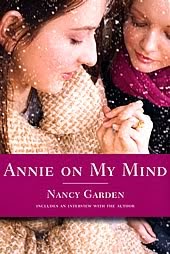
Welcome to the first installment of a new series, “reading the (lesbian) classics,” in which Danika Ellis of The Lesbrary and I read our way in a very haphazard manner through queer literature (our method is basically picking out the books that sound like a fun time and taking it from there!) and chat about it, and then post our conversations on the interwebs. So here’s the first installment. This time around, we read Annie On My Mind, by Nancy Garden, first published in 1982.

Warning! Mild plot spoilers ahead for those of you who care!

Anna: So [rubs hands together] … how shall we begin our conversation?

Danika: I’m not sure, I feel like I must have forgotten half the book… might as well start with first impressions and just see where it leads us.

Anna: [laughs] Had you ever read it before?

Danika: I have, once before. I remember when I first read AOMM I thought there was something a little bit off about their relationship. And now I think I know what bothered me. I don’t know if it’s because it’s set in the 80s, or if it’s Nancy Garden’s writing, but they both seem a lot younger than what they’re supposed to be.

Anna: Yes! They’re supposed to be, like, headed for college and they act like they’re in middle school.

Danika: I know it’s in a sort of self-conscious “girls our age aren’t supposed to do this” way, but I still liked it a lot better once I started thinking of them as 13-year-olds instead of 17-year-olds. And it’s not just them: even her little brother seems at least 4 years younger than his given age! And her classmates!

Anna: Yeah. I don’t think I noticed it so much when I was younger, because I read it when I was about thirteen myself? It was about the only lesbian YA novel my library had (early to mid-90s). To be fair, that was before the real boom in queer YA fiction. AOMM was probably one of the few available. And not a bad one to have if you’re only going to have one (no one dies!) … but yeah, I agree with you that, especially this time around I was left thinking, “wow, and these are supposed to be seniors?”

It’s not even Annie’s imaginary world … it’s more the school politics and so on. Like, no one has a real sense of a world beyond the microcosm of the prep school.

Danika: Yeah, the ear-piercing! Again, I was thinking “Well, maybe it’s just because this was 30 years ago…?” But it definitely seemed a bit off

Anna: Part of it probably is the era … and the fact that Nancy Garden was probably, on some level, harkening back to her own teen years which would have been in, what, the 1950s? 60s? When maybe ear piercing was more risque?

Danika: Aaah, yeah, that might have been part of it.
Anna: I also wondered if maybe part of it was an attempt to make the drama center around something other than the fact that Liza was discovering her sexuality? So she invented another drama about the prep school that seemed kind of forced?

Danika: Maybe, but it turns into it being about her sexuality anyway.

Anna: True.

Danika: I remember when I first read AOMM I thought the girls’ meeting seemed really forced. And I definitely agree with that the second time around. The singing, the sudden friendship… again, it’s the sort of way children interact, not teenagers.

Anna: Yeah — teenagers are more self-aware, and self … restrained? I made instant best friends with kids in art class when I was, maybe, six! Not when I was seventeen. At seventeen I was like, well, maybe going for coffee after class and see how that goes. But since NG wanted the girls not to be at the same school, she had to find a way for them to run into each other.

Danika: Still, I think she could have done better than “Don’t stop [singing]. Please.” “Oh, you startled me!” That just sounds really forced.

Anna: I’d forgotten how much class is an implicit part of the story. The way Annie comes from a “bad” part of town and everything.

Danika: I forgot that, too!

Anna: I was thinking, vis a vis reactions to queer teens, that it was interesting that Liza’s sexuality was more controversial in her upper-class world than it seems to be in Annie’s world.

Danika: Yes, because everything was controversial in Liza’s little world. The ear-piercing I guess was supposed to highlight that, but it seemed odd anyway. The only question with Annie was whether she was going to tell her family or not, so I don’t think we ever see how her school would have handled it, but presumably they have more important things to worry about.

Anna: It would have been irrelevent in Annie’s school (I’m assuming); no one cared about her there. I got the sense she was nervous about telling her parents, but her family was portrayed as fairly accepting and encouraging. I got the sense that they would have been baffled and maybe a little worried or hurt, but there wouldn’t have been all the drama that Liza had in her family and at the school.

It was interesting to me how it was almost reversed … or maybe that’s not quite what I’m thinking of. But today, we think of urban upper-middle-class folks as fairly cool about queer sexualities, etc. Whereas we think of lower-class people as reactionaries. Culturally. And in this story, the opposite was the case. I doubt those stereotypes would hold up [in real life], but it’s interesting that she chose to write it like that.

Danika: That is the framework we generally use. But Liza’s privilege paralyzed her. Her school was so caught up in itself that no one could step out of line. It was a weird relation between them.

Anna: Yeah. Maybe I’m just too midwestern to understand the world of elite prep schools!

Danika: Yes, it was really weird seeing into that strange boxed-off world.

On a slightly different note, I was writing down some thoughts as I went, and on page 49 of my version, I thought Garden was foreshadowing the reaction to her coming out. It was when the parents found out about the ear-piercing, and the mom is pretty accepting, but the dad freaks out. So it surprised me later when he was actually really great about it.

Anna: Good point. I was really intrigued by a number of the adults in the story, actually … and the way in which adults were portrayed in relation to the young people.

Danika: How so?

Anna: Well, I was impressed that the adults at the hearing were not portrayed as monoliths, as monsters, and that a couple were standing up to the schoolmistress, even if for their own reasons. And I thought it was an interesting (and positive) choice to give the girls such human mentors, themselves lesbians of an elder generation.

Danika: Yeah, that’s very true. The thing that stuck with me most about AOMM has always been the teacher couple (oops, spoilers).

Anna: (warning! warning!)

Danika: Actually, the thing that stuck with me the most was their book collection. Lesbian books inside my lesbian book! Wow! Their presence really made the story. (The teachers, not the books.)

Anna: I agree about the teachers. In contrast to the caricatured headmistress and the reactive parents, the two teachers came across really human, but also kind and supportive, generous, and sheltering without being controlling. I wondered in my notes whether this was a conscious attempt to counteract the specter of the gay/lesbian predator?

And yeah, it was fascinating to have the books play such a role in a couple of key scenes … from what I’ve heard from queer people of earlier generations, that was often the case! that they first discovered language for who they were from books … all the more reason to be a librarian-advocate for lgbtq teens!

Danika: Aaah, I hadn’t considered that! Of course! Because the lesbian teachers were fantastic teachers. If I may quote my favourite line from the dad’s reaction (though he goes on to say he doesn’t think gay people can be truly happy), “Oh, look. What difference does it make if a couple of teachers are lesbians? Those two are damn good teachers and good people, too, as far as I know.” I mean, wow! Surprise acceptance!

Anna: Hehe. Yeah, exactly. Because there’s that interesting conversation between the girls and the teachers. after the teachers have been fired. where the women acknowledge that if they don’t press charges, they should be able to get good references … because the school won’t want to admit that they fired the women for being lesbian … but they also fear for their ability to be hired if they were really out. So a real catch-22.

Since we’ve talked a lot about where the story felt kind of forced … one of the ways in which I was really impressed with it was the fact that it a) had a couple of really sweet scenes in which the girls clearly make love, even if off-screen (so to speak), and b) that this is really seen as 100% a good thing, despite what happened with their teachers. Their sexual exploration doesn’t spell doom for them as individuals or for their relationship. I don’t think many YA romances with straight couples were that whole-heartedly enthusiastic about young love back in the late 1970s … Even Judy Blume’s Forever, despite the positive sexual experience, ends with the relationship ending.

Danika: That’s true. It’s a bit of a bittersweet book, because Liza gets suspended, nearly expelled for being gay, the teachers get fired, and we know the whole time that they end up drifting apart after they leave for university. But it’s also a lot more positive than most of the queer books (YA or not) available at the time. They do end up together at the end, and there’s a lot of support of same-sex love. I also liked reading it for all the tropes and patterns that young queer love, young closeted love takes. Like how you could totally tell they were in love with each other before they knew. Like the classic game of “how much physical contact can we have before it means something?” (shoulders touching, hand holding, etc.)

Anna: Yes! Which I feel like is something that is still confusing to kids (or perhaps I only speak for myself) … since you’re trained, culturally, to expect that opposite-sex intereactions are laden, but not same-sex ones, so you aren’t so self-conscious and things kind of sneak up on you way more than with opposite-sex relationships.

Oh, and it was also nice that neither of them really “went straight”. Annie was pretty sure she was gay, and Liza wasn’t sure, but was definitely leaning towards accepting it.

Anna: I agree! That actually seemed a little dated (in a nice way?) to me, since I feel like if this book had been written today, you’d get this whole “am I bi? am I gay? am I just questioning?” thing going on. Which is absent entirely: Liza comes to the realization she’s “gay” full-stop.

Danika: That’s true, it definitely has that all-or-nothing mentality that we’ve (thankfully) shaken off a little more by now

(Oh, wait, I take it back: Annie did try to be straight! Back when she was younger. In her words: “It was ridiculous.” That made me laugh.)

They are super cute when they are together and happy.

Anna: Yeah, and as you say there was that added element of the reader being “in the know” in part because Liza’s spoilered it for us at the very beginning with the framing narrative.

What do you think of the function of the framing narrative as a literary device? Do you think it adds anything to the narrative that we kind of know it ends badly (at least in the short-term) before the story begins?

Danika: I was pondering that the whole book. I kind of get why she did it, because she needed the drama to keep the story moving through the happy couple parts, but it did add this element of doom that, frankly, no queer book really needs any more of. I guess it works overall, because we get the (spoilerspoiler) happily ever after following the long(ish) separation and we process it with Liza as she processes (and processing is a classic lesbian thing to do), but I’m a little divided on it. What did you think?

Anna: Hmm. Tough question. Retrospective narratives can sometimes work pretty well, but I agree with you that the last thing any queer teen book needs is more angst! That’s why I adore David Levithan’s work so much — his love stories are so ebullient. As a kid, I always felt like the way Liza blamed herself for the punishment exacted on the teachers (or, more accurately, for having made love in their home while she was house-sitting … what the hell was so shameful about that?) was really exaggerated. Like, shouldn’t she have been pissed at the secretary who had the vendetta? And the schoolmistress, etc.? But maybe that’s a personality thing — I always had an over-developed sense of self-righteousness as a child 🙂

Danika: Ah, I loved Boy Meets Boy for that! It’s like a combination of cotton candy and sinking into a hot tub. It’s just so refreshing to read a happy queer love story. I still want my lesbian version of that.

Anna: Totally! I feel like YA lesbian fiction is still waiting for its Daniel Levithan (if you have any recommendations, I’d love to hear them!)

Danika: I don’t know of anything quite so positive, though I have read some good ones. Hello, Groin by Beth Goobie is my favourite.

Well, I can see why they were a little ashamed. In the teachers’ bed…? That’s bad taste. What I couldn’t see, though, was why they opened the door! They didn’t have to answer! -sigh- The secretary was definitely over-the-top. The absolute poision she was spitting out was painful to read.

Anna: … I guess. I did a lot of house-sitting in high school and college and I always slept in the homeowner’s bed (clean sheets, granted) so it didn’t feel so weird to me. but that wasn’t in the deal Liza made with the teachers, so I guess that is a little different. Oh, totally with the door! [headdesk] Why oh why did she have to answer????

Danika: Especially before getting dressed!

Anna: Despite the secretary’s religiously-motivated poison, I was actually surprised by how little religious conservatives and the religious right as a force opposed to sexual expression appeared in the novel (contrasting, again, with the way it figures in some Levithan stories) … I think that’s another way this dates the story, since it was set just as that force was gathering.

Danika: True, I mean, when she faces the commitee/council/whatever that was, they basically say “Hey, this is none of our business”, which is pretty good for the circumstances.

Anna: Yeah, I think it’s interesting how the battle-lines are drawn ever-so-slightly differently than we’re used to in our generation. The religious element not quite so strong, the class element more so. Being queer still being a threat to one’s overall reputation/status even in secular society. (Not saying that’s totally gone away, but you wouldn’t think in Liza’s New York or at MIT it would be an issue!)

Danika: Hmmm, yeah, I can see that…

Honestly, I’m kind of surprised Liza wanted the school to survive. I know she has sentimental attachment to it, but even before they knew she was queer, Poindexter (go to love that name) was absolutely heinous, from the patronizing way of talking to running the meetings when Liza was supposed to be running them.

Anna: Yes. Again, another way in which they seemed young for their age. By 17, you’d think she’d have more perspective. I can see a younger child being invested in the school that had been a second home, but most seventeen-year-olds I’ve known (including myself!) are a bit more jaded!

Danika: Very true. By 17 I had distrust for all authority, definitely including my school.

I don’t know if you read my review and conversation about Well of Loneliness, but I saw a couple of comparisons between it and AOMM that surprised me.

Anna: Do tell!

Danika: Well, for one, both the protagonists were horrified at people hating them being gay, because they both felt that their love was the “best part” of themselves, or some variation on that. Also, both have a scene with the couple being happy that is described as an “illusion”. It’s just funny because WoL is mentioned in AOMM as part of the teachers’ book collection.

Anna: Yes, it was fun to see the lesbian classics appear on their shelves 🙂

Danika: Especially Patience & Sarah, because Liza and Annie read it, and this time I have, too!

Anna: I read once an essay that was talking about how generations of queer folks locate themselves in history through alternate means than family ties, since so many of them don’t come from families where the parents are themselves queer — and literature was one way.

Danika: That’s exactly why I feel that queer lit is so important. It is a foundation to the queer community.

Any last thoughts?

Anna: Not that I can think of — other than that I really enjoyed the chance to re-read this with someone else, and I’d totally be up for doing it again!

Cross-posted at: Danika @ The Lesbrary | Annie On My Mind Conversation.

Watch for the next installment in reading the (lesbian) classics sometime in late September of early October! At Danika’s suggestion, we’re reading Hello, Groin, by Beth Goobie (2006). We thought we could use the book as a chance to consider where lesbian YA fiction has come since the “early days.”

sex work vs. trafficking: npr points out the difference

26 Thursday Aug 2010

Posted by Anna Clutterbuck-Cook in media

≈ 1 Comment

Tags

gender and sexuality, human rights, politics

On my commute home yesterday, I happened to catch this story on NPR’s All Things Considered about a letter signed by 17 Sate Attorneys General asking Craigslist to remove its “adult services” section because they believe it helps foster illegal sex work and child trafficking.

A full transcript is provided on the NPR website. What caught my attention was this exchange between Melissa Block, the reporter, and Chris Koster, State Attorney General of Missouri (one of the AGs who signed the letter). Block is trying to nail Koster down on exactly what he find objectionable about adult women voluntarily offering “adult services” online.

BLOCK: I did try to look through some of them today, locally here, and I would assume that some of those ads, at least, would be placed by adult women who are not victims, who, this is their line of work, and they want to promote their services. Am I wrong about that?

Mr. KOSTER: Well, in Missouri, if you and I are on the same page on what you just said, in Missouri, that’s called prostitution. And that’s exactly what we are complaining and have been complaining to Craigslist for quite some time over, that some of these ads are very specific. They are clearly for sex, and Craig Newmark is providing a bulletin board for conduct that frequently violates the laws of the 50 states.

BLOCK: I take your point about these ads promoting prostitution, which is illegal. Wouldn’t that be a little bit different, though, from saying that women are being victimized? One does not necessarily imply the other, I think.

I want to say kudos to NPR and to Melissa Block in particular for pointing out that objecting to something because it is illegal is different from objecting to something because it is “victimizing” the women (or children) involved, and that there is no simple way to tell if the (adult) individuals who post on Craigslist are being exploited or not. The AG blusters on, saying

That’s right. I mean, every single ad that we see on this site, on this link, is not creating a victim. But there are far too many that do, and if you go through any town in America, certainly any town of any size, you’re going to see a large number of ads that would certainly appear as advertisements for prostitution.

Again implying that prostitution = victimization. Unfortunately, a four-and-a-half minute story is not enough to disabuse any listener who agrees with Kloster of this notion, but hopefully Block’s assertion that not all sex work is, de facto exploitation will in some small way help to shift the national conversation away from the sex work = exploitation model and allow us to ask more nuanced questions about how to incorporate, within a decriminalized sex work industry, checks and balances that would help stop human trafficking and exploitation without depriving sex workers of their livelihood.

← Older posts
Newer posts →
"the past is a wild party; check your preconceptions at the door." ~ Emma Donoghue

Recent Posts

  • medical update 11.11.22
  • medical update 6.4.22
  • medical update 1.16.2022
  • medical update 10.13.2021
  • medical update 8.17.2021

Archives

Categories

Creative Commons License

This work by Anna J. Clutterbuck-Cook is licensed under a Creative Commons Attribution 3.0 Unported License

Meta

  • Register
  • Log in
  • Entries feed
  • Comments feed
  • WordPress.com

Create a free website or blog at WordPress.com.

  • Follow Following
    • the feminist librarian
    • Join 36 other followers
    • Already have a WordPress.com account? Log in now.
    • the feminist librarian
    • Customize
    • Follow Following
    • Sign up
    • Log in
    • Report this content
    • View site in Reader
    • Manage subscriptions
    • Collapse this bar