• anna j. clutterbuck-cook
  • contact
  • curriculum vitae
  • find me elsewhere
  • marilyn ross memorial book prize

the feminist librarian

the feminist librarian

Author Archives: Anna Clutterbuck-Cook

quick hit: indexed ftw

25 Wednesday Aug 2010

Posted by Anna Clutterbuck-Cook in linkspam

≈ Leave a comment

Tags

children, feminism, human rights, politics

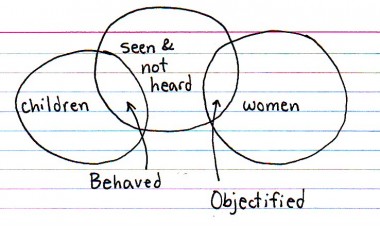
Via my friend Diana comes this great graphic commentary by indexed

Venn diagram showing overlapping circles labelled “children” (left), “seen and not heard” (middle), and “women” (right).

The overlaps read: childen + seen and not heard = behaved, and women + seen and not heard = objectified.

The title of the post at Indexed read don’t let anyone shut you up.

the feminist librarian reads: new tumblr resource

23 Monday Aug 2010

Posted by Anna Clutterbuck-Cook in admin

≈ Leave a comment

Tags

blogging, tumblr


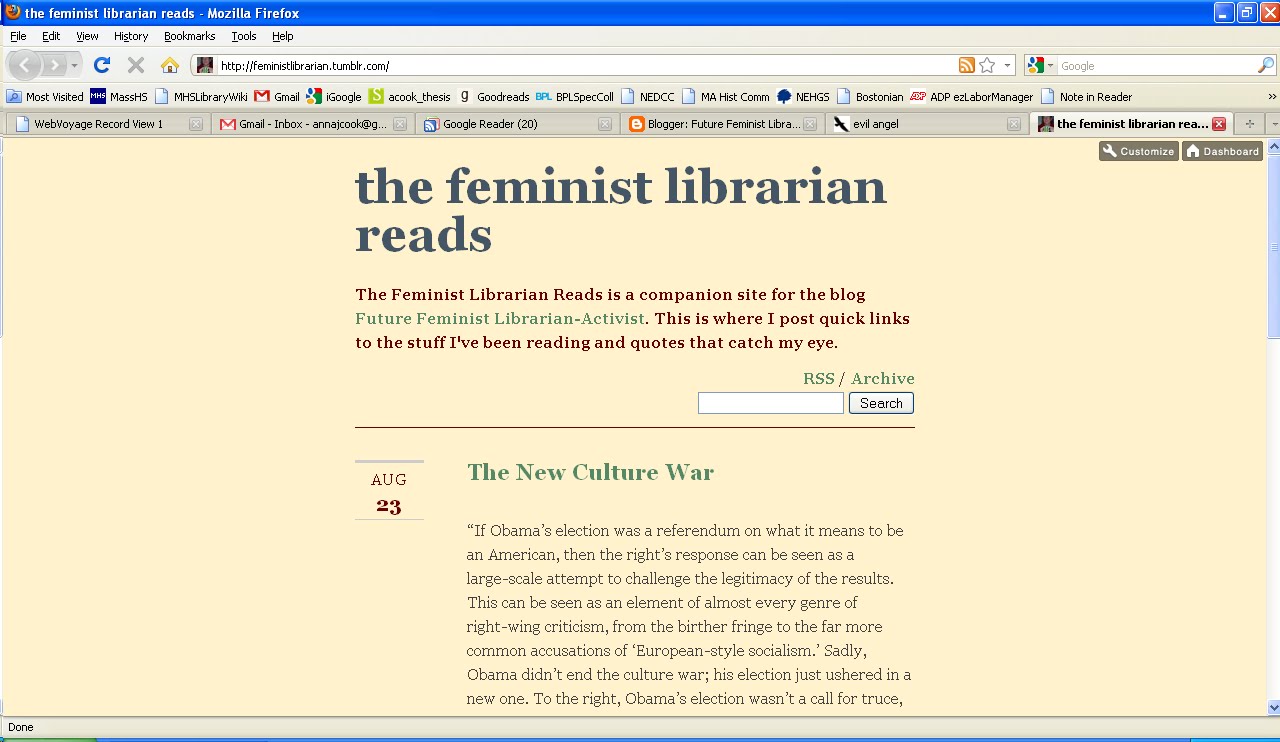
Inspired by Hanna, and her new tumblr mini blog evil angel, I’ve started up a tumblr account of my own called the feminist librarian reads. This is going to be the place where I post links and short snippets from blog posts and other web-based items that catch my eye. It may or may not replace the sunday smut list, which can be surprisingly time-consuming to put together at the end of every week! Although I’d miss putting together the commentary and finding sexy pictures. Maybe I’ll just post the sexy pictures instead :).

Anyhow … you can check out the tumblr blog two ways.

1) I’ve set up a feed so that it posts directly to a static page on this blog. A link to the feminist librarian reads can now be found as one of the links along the top of the page.

2) You can follow the tumblr blog directly with your RSS aggregator, etc., over at feministlibrarian.tumblr.com.

Enjoy your new toy for this rainy Monday afternoon. I may or may not be posting very heavily here at the Future Feminist between now and labor day weekend. I have a thesis draft to wrap up and send to my readers, and then Hanna and I are headed north to enjoy the long weekend with her folks. So in the meantime, you can catch a peek at what I’m checking out online and I’ll try to be back more regularly when the new academic years rolls around!

booknotes: fast girls

20 Friday Aug 2010

Posted by Anna Clutterbuck-Cook in book reviews

≈ 2 Comments

Tags

gender and sexuality, smut

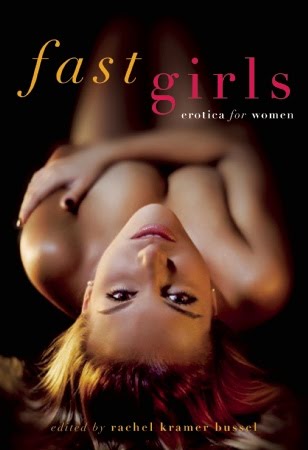
So I volunteered to review a copy of Rachel Kramer Bussel’s latest anthology, Fast Girls: Erotica for Women. Because let’s fact it: who doesn’t want a free book of erotic short stories sent to them? I mean, I’m a bibliophile, a feminist, and a sex nerd. It really it wasn’t an option to say no!

The thing is, as soon as I’d said “Oh, yes, please! Send me a copy!” and the book was on its way, I remembered this thing that librarian Nancy Pearl once wrote about erotica: that one of the places to go when you’re in the mood for something steamy is the stories that someone else has identified as the worst erotica of all time (I’m paraphrasing here, because my copy of Book Lust is on a shelf in my parents’ house back in Michigan). Because for every person who thinks that story is the libido-killer of the century, there’s going to be another who thinks that it’s the hottest sex scene they’ve ever read, and they’ll drop it halfway through to go find their significant other(s) in order to get their temperature back down to normal.

I’m a relativist when it comes to arts and culture (not so much when it comes to ethics and human rights): “good” art? “good” writing? who says there’s one right way of doing it! And human sexuality, particularly, seems like an area ripe for radical democracy: the best way to create “good” erotica in my book is simply to create it. Which is why I’m a big fan of erotic fan fiction and other amateur outlets for lustful creativity.

Which is a long-winded way of saying: dilemma. How the fuck are you supposed to review a book of erotica in any sort of meaningful fashion when my favorite story is likely to be someone else’s worst nightmare — or I might overlook the one scene that, for someone out there, is likely to make the whole book worthwhile?

I realize this is a dilemma faced for the reviewer of any book. But it seems uniquely acute when it comes to reviewing porn. Maybe because porn is so particular. And maybe also because, well, to it’s hard to talk about without giving slightly more … intimate details as to your own particular tastes. “I really liked the scene in Tristan Taormino’s ‘Winter, Summer’ where the narrator gets felt up at a bar by a butch she’s just picked up at the pool table”? “I went fever-hot all over sitting in the subway reading the penultimate bondage scene in D.L. King’s ‘Let’s Dance'”? “I must have some serious power issues, ’cause Ms. Bussel’s ‘Whore Complex’ resulted in the need for a new pair of knickers”?

See? It’s all slightly embarrassing, a little too clit-on-your-sleeve for my taste. So rather than attempt to pass judgment on the book qua book I’ll simply offer this: I’m am happy to live in a world in which erotica for women, Fast Girls included, exists. It makes my feminist heart proud that right here, right now, we are part of a culture that — despite its many, many shortcomings — includes a space for women writers who want to write smut to write it. And to get published. It warms my heart (and other bits of my anatomy) that not only are we women writing and published erotic texts — that is, texts written explicitly for the purpose of arousal — we’re writing and publishing erotic texts in which women have sexual agency. In which women identify and court (or just plain come on to) the objects of their lust. In which women take charge of the sexual encounter. In which women feel free to choose partners of any sex and pursue them expressly for the purpose of sexual pleasure. In which, sometimes, women explicitly consent to relinquish control because chosen powerlessness. So I don’t really have a stake in what porn you read (or whether, really, you have any personal interest in porn at all). But I encourage you all to revel in the fact that we have such literature available to us, in all its myriad flavors.

Fast Girls is now available to purchase and can be found online at Amazon, Powell’s and other online vendors. Rachel’s website provides a whole array of links to the online bookshop of your choice.

in love with new blogs: Blue Milk

19 Thursday Aug 2010

Posted by Anna Clutterbuck-Cook in linkspam

≈ 2 Comments

Tags

children, feminism, in love with new blogs


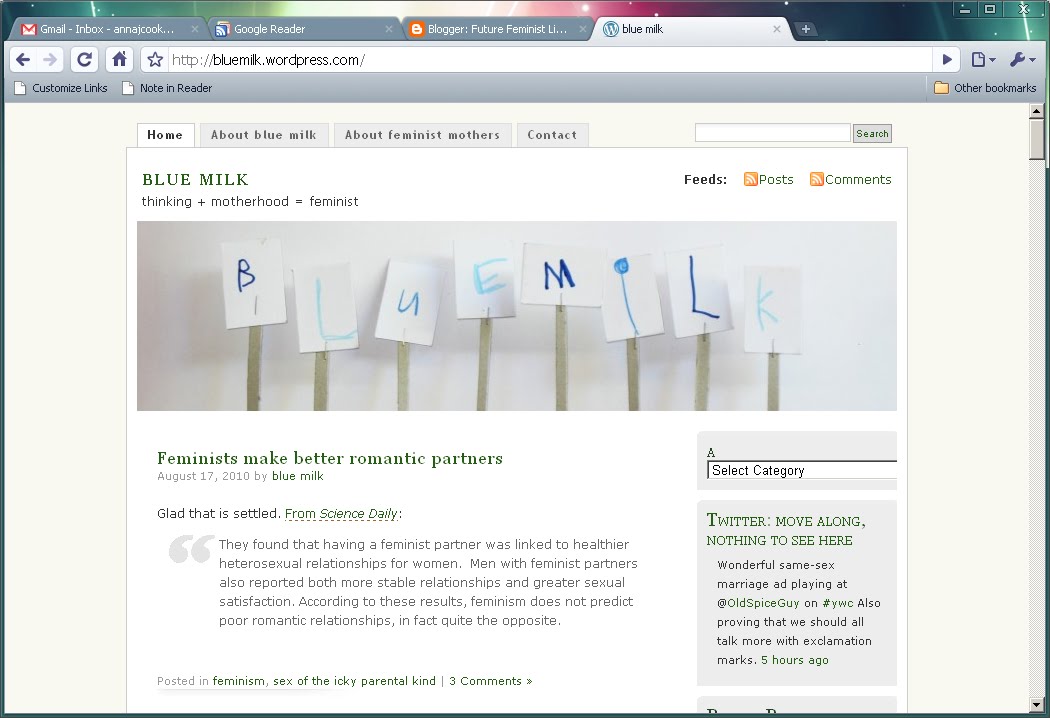
This week, I bring you blue milk, an Australian-based blog on things feminist and things parent+child related. As the blog tagline puts it: “thinking + motherhood = feminist.” We are also offered the following image of the blog author.


I discovered blue milk a few weeks ago, thanks to my friend and fellow blogger Molly @ first the egg. Why read it? Because it challenges the notion that involved parenting = “perfect” parenting, and that involved parenting (read: involved mothering) is somehow antithetical to feminist consciousness. Some examples.

From On the backs of other women.

I initially thought this little post was going to be about community. About how much I have come to cherish the school community particularly, that we are now a part of, and how some mothers at my daughter’s preschool have been saving my arse lately, over and over again, and for pretty much nothing in return. But the big fat gender factor tells me that this post isn’t actually about ‘community’.

Discounting the teachers at the Montessori preschool and the kids’ father, it takes the efforts of five other people caring for our two children to allow me to be at work three days a week. Pick-ups and drop-offs and naps and cuddles and dinners and baths. Only one of those five are paid for it, and all of them are women.

From Guest Post: Being a feminist and raising ‘a lad’ (from her “10 questions about feminist motherhood” series). Answers from Matari.

1. How would you describe your feminism in one sentence? When did you become a feminist? Was it before or after you became a mother?
I became a feminist at the age of 11 when I was abused by my stepfather. I learnt to call myself a feminist when I realised that as a woman, my abuse was nothing unusual and, in fact, represented the lack of power that women have in our society.

2. What has surprised you most about motherhood?
How attached I was to my son as soon as he was born – I almost expected to be able to fit him into my schedule and carry on as before. But no, that was not the case AT ALL – I instantly became responsible for a little life that, if was injured in any way, would affect me for the rest of my life.

3. How has your feminism changed over time? What is the impact of motherhood on your feminism?
My feminism became more entrenched, as – with every other event in my life,- I recognised that as a mother I would (again) be a marginalised woman, exacerbated by being a single parent.

From Why attachment parenting NEEDS feminism.

This is probably the right time to admit that not only am I an attachment parenting type – our children are co-sleepers, including the older one who is now five years old; I breastfeed the toddler; and we have more slings than vehicles in our house – but for the record, I am also a mother who works part of each week outside the home. I have been separating from our toddler since before he was a year old. And to be perfectly honest, Wootan’s advice doesn’t really rattle me. I have done my share of soul-searching over the last five years about being a working mother and I feel confident that our decisions have been good ones, and what’s more, that the children are ok too. But I know Wootan’s position will distress many other women in my position; I know a few years ago it would have thrown me for a loop. And while I am sure Wootan is a very caring doctor, anyone who makes a statement like that, about how women should live their lives, deserves a little scrutiny.

And for those of you who aren’t so interested in the politics of parenting, but possibly interested in the politics of parenthood (and non-parenthood) in our society, from The politics of nappy buckets.

But how insulting is the prioritising of working families to people without children? Don’t they consider themselves part of family too? Aren’t they contributing to the community? Don’t they have the right to some priority in policy planning and fiscal generosities? The term ‘working families’ creates an unnecessary division, an us and a them. It undermines the goodwill people without children might otherwise feel towards people with children. Sure, raising children contributes to a ‘social benefit’ that all of society enjoys, and its costly for the individuals raising those children, but telling everyone you’re prioritising ‘working families’ must surely niggle away at the cohesiveness of parents and non-parents. It also makes women feel like their only value is in childbearing. Although, ‘deliberately barren’ is such a ludicrous term, such an unfortunately revealing comment on the right-wing agenda that however hurtful it is to women it is also kind of soothing to see Heffernan and those like him exposed so badly.

Enjoy! And see you next week for another installment of in love with new blogs.

quick hit: defending one’s manhood

18 Wednesday Aug 2010

Posted by Anna Clutterbuck-Cook in linkspam

≈ Leave a comment

Tags

feminism, humor, masculinity

My colleague, Jeremy, receives the print edition of The Atlantic magazine and I happened to notice, yesterday, the following query and response on the back page of the most recent issue (September 2010), in Jeffrey Goldberg’s “What’s Your Problem?” column.

I’ve noticed that The Atlantic has become very anti-male lately. My proof lies in recent articles by Sandra Tsing Loh, Caitlin Flanagan, and of course Hanna Rosin, whose July/August cover story, “The End of Men,” argued that men will no longer be necessary as our economy changes. How do you protect your manhood while working at a magazine that is so hostile to men?

P. W., Chicago, Ill.

Dear P. W.,

I take active countermeasures to protect myself against the rampant feminization of The Atlantic. For instance, I eat only what I kill, except for sandwiches from Potbelly, which are killed by someone else. I also chop down the trees that provide the paper on which this magazine is printed, using only an extremely dull axe and my signature bad-ass attitude. Other prophylactic measures I employ include hiring Chuck Norris as a guest blogger, and then firing him, by fax, for being insufficiently manly; and using actual prophylaxis, in the form of a full-body condom I wear to protect myself from the effects of airborne estrogen. I also refuse to participate in the mandatory office-wide “All Guys Have to Wear Jimmy Choos on Fridays” morale-building exercise. And though I was ultimately forced to appear in The Atlantic’s staging of The Vagina Monologues, I purposefully delivered an indifferent performance as Eve Ensler’s labia.

As a feminist, I feel honor-bound to point out that Sandra Tsing Loh, Caitlin Flanagan, and Hanna Rosin are, in fact, often very anti-man (the scene from Parenthood where Dianne Wiest’s character says to her daughter, just as her young son walks into the room, “Men are such jerks!” comes to mind) they are often anti-woman as well. Or rather, they tend to subscribe to very gender-essentialist concepts of what it means to be a man or a woman, neither of which serve human beings all that well.

The idea that being anti-male, anti-manhood, and “hostile to men” are all roughly equivalent positions is a fallacy anyway. As a feminist, I’m fairly anti-“womanhood” (since womanhood, in our culture, is a very specific type of cultural performance) and yet hardly anti-women or hostile to women as human beings. Nor do I have a problem with female-bodied persons.

Which is all to say, I love the way Goldberg plays up all the stereotypes of masculinity in his response. Because really, it’s about the level of attention all of those articles — and the concern they seem to have sparked — deserve.

a few things on education

17 Tuesday Aug 2010

Posted by Anna Clutterbuck-Cook in linkspam

≈ Leave a comment

Tags

education

Rural school children, San Augustine County, Texas, April 1943
Library of Congress Photostream @ Flickr.com.

There’ve been a handful of stories coming across my feeds the past few weeks on the subject of education and culture; none of them have inspired me to a full-length blog post, but I wanted to share them with you anyway. So here’s a round-up of links with some snippets. Enjoy!

Idzie @ I’m Unschooled. Yes I Can Write | The Myth of “Social Awkwardness” Among Homeschoolers & Unschoolers.

I have seen absolutely no difference [generally] between homeschoolers, unschoolers, public schoolers, or private schoolers, EXCEPT that the unschoolers who do have to work harder with social stuff are generally far more confident, far more aware of their worth, whereas the schooled people are often made to think that they’re losers, that they’re uncool, so have serious feelings of worthlessness. Really? That’s what school has to offer kids that you’re so upset un/homeschoolers are missing out on: making anyone who doesn’t fit a very narrow definition of normal feel like they’re a failure??

eastsidekate @ Shakesville | College: The solution to everything.

Creating jobs is not about intelligence or education. It’s about having enough money to pay someone to do something. And :drumroll:…. having money is not exclusively a function of being educated, intelligent, good-smelling, or anything else, really. Of course, if we argue that wealth is solely a function of merit (as measured by education, which we assume is a function of intelligence), then yeah, it’s pretty much axiomatic that a more educated populace will create more jobs.

If we realize that some folks who have a lot of money and power to burn aren’t necessarily deserving of such, the wheels fall off in a hurry.

Richard Jeffrey Newman @ Alas, a Blog | The Politics of Education.

The content of education is always, always, political and there will always be someone somewhere who thinks her or his perspective has been left out of what children are taught, to their detriment as individuals and to the detriment of society as a whole. Independently of that, though, I am a big believer in trying to find as many ways as possible to include as many perspectives as possible in the classroom, not to make the point that they are all equally valid, but to make the point that the more informed we are about those perspectives, even the ones that have been shown to be invalid, the more responsible and accountable we are likely to be in our own perspectives.

Janine Giordano @ Religion in American Culture | Teaching Sexuality and Religion.

[The] student … complained to the Department Chair of Religious Studies that the professor was encouraging and expecting students to apply (Catholic) Natural Moral Law as their understanding of natural law. “I didn’t go to Notre Dame for a reason,” he signed. The professor’s email to his students, also apprehended by the local newspaper, did claim that “none of what I have said here depends upon religion,” alongside an unqualified encouragement to apply (Catholic) Natural Moral Law within their own adult thinking.

And, ’cause I’m starting to think about what the next scholastic endeavor will be after library school … sexademic @ The Sexademic | So You Want to Be a Sex Educator (“Sexademics do it theoretically”).

monday morning madness: fluid sexuality and marriage equality

16 Monday Aug 2010

Posted by Anna Clutterbuck-Cook in think pieces

≈ 3 Comments

Tags

bigotry, gender and sexuality, human rights, politics

So after a weekend away from my RSS feeds, I finally got around, this morning, to reading conservative columnist Ross Douthat’s second column on why same-sex couples should be excluded from the institution of marriage. Adam Serwer @ The American Prospect offers his take which covers a lot of the bases. And Douthat’s justifications are so convoluted that I’m not going to try and untangle them here.

But as a queer woman in a lesbian relationship, there were a couple of … let’s call them interesting assumptions Douthat makes about fertility, gender, and marriage relationships that I’d like to briefly respond to.

Douthat realizes that he can’t credibly make the claim that marriage should be limited to couples capable of biological reproduction. As Judge Walker observed in the Prop 8 ruling (and as many other advocates of marriage equality have pointed out), being straight doesn’t equal being capable of, or interested in, bearing and raising children. We don’t ask straight couples to undergo fertility testing in advance of issuing marriage licenses. And we don’t enforce any sort of mandate that married couples produce genetically-related offspring.

So there’s that argument off the table.

But Douthat wants to make that argument anyway. So what he does is suggest that it’s not the physical act of bearing and raising biological children that makes hetero marriage particularly worthy of state sanction: instead, it’s the cultural experience of being heterosexual.

The interplay of fertility, reproductive impulses and gender differences in heterosexual relationships is, for want of a better word, “thick.” All straight relationships are intimately affected by this interplay in ways that gay relationships are not. (And I do mean all straight relationships. Because they’ve grown up and fallen in love as heterosexuals, the infertile straight couple will experience their inability to have children very differently than a same-sex couple does. Similarly, even two eighty-nine-year-old straights, falling in love in the nursing home, will be following relational patterns — and carrying baggage, no doubt, after eighty-nine years of heterosexual life! — laid down by the male-female reproductive difference.) This interplay’s existence is what makes it possible to generalize about the particular challenges of heterosexual relationships, and their particular promise as well. And the fact that this interplay determines how and when and whether the vast majority of new human beings come into the world is what makes it possible to argue — not necessarily convincingly, but at least plausibly! — that both state and society have a stronger interest in the mating rituals of heterosexuals than in those of gays and lesbians.

So it’s not about the capacity to reproduce, it’s about “fall[ing] in love as heterosexuals,” and “carrying baggage … after eighty-nine years of heterosexual life” based on “male-female reproductive difference.”

Obviously, there’s levels of wrong going on here, but the points I want to make are these.

1) As a queer woman, I am affected by the sex and gender norms of our (predominantly) heterosexual society. I was born into a world that expects certain things of girls and certain things of boys. In childhood, we aren’t categorized according to sexual orientation (since children are assumed to be nonsexual, or only latently sexual, beings — a topic for a whole different post) but by gender. Girls who aren’t exclusively straight in their sexual attractions nevertheless find themselves on the recieving end of powerful normalizing pressures concerning what girls/women should do, be, want, etc. This includes the pressure to parent. I think, perhaps, Douthat as a straight man might be underestimating the way in which this pressure affects women, particularly, regardless of their sexual orientations. It’s a gender thing, not a sexual orientation thing.

2) Douthat’s understanding of heterosexual vs. homosexual pairings ignores the experience of everyone else. What about equality for folks who experience sexual fluidity, whose attractions change over the course of their lifetimes? What about trans folks whose experience of society’s gender expectations shifts over the course of their lifetimes? For many of us, the idea that one would experience eighty-nine years of either “heterosexual life” or “lesbian life” (check the box that applies to you) is meaningless. We approach our relationships (no matter the gender of the person we’re relating to) as ourselves, as persons whose sum total of experience doesn’t fit neatly into one category or the other. Douthat’s assumptions concerning the differences between straight folks and queer folks is based on the belief that one’s sexual attractions are either always same-sex or always other-sex, and that these attractions are stable throughout life. This is simply not the case for many people (again, particularly women, which once more leads me to wonder how much Douthat is speaking out of his own personal biases rather than any actual research and reflection).

Thus, Douthat’s distinction between the nature of “thick” heterosexual relationships and (“thin”?) queer ones completely falls apart based upon the lived experience of real human beings.

Finally, I want to tackle Douthat’s parting shot: that omg gay marriage will lead to polygamy:

The claim that gay wedlock will lead inexorably to polygamous marriages or incestuous marriages has never been all that credible, because there just isn’t a plausible constituency in the United States (Europe might be another matter) that’s going to start claiming those rights in the way gays are on the verge of claiming the right to marry one another. But it’s still striking how easily the logic of gay marriage can be extended to encompass all kinds of relationships that we definitely don’t want to call marriages.

I am clearly not the constituency Douthat is writing for in his column, because the question I have for him is: “relationships that we definitely don’t want to call marriage”? Who is this “we” you refer to? Please don’t include me in this claim! ‘Cause I refuse, as a queer woman in favor of marriage equality, to scapegoat polyamorous relationships. I don’t need to make poly relationships the Other (or incestuous relationships for that matter) in order to prove that same-sex monogamous couplings should be sanctioned by civil marriage. I’m for consensual, adult relationship commitments being recognized as marriages. Full stop. If that marriage includes more than two adults, then those adults should all be able to enter into the contract of marriage and have that marriage be recognized by our legal system and honored by society. And if that’s what the case for marriage equality portends, I think we should be proud of that inclusivity.

Fear mongering is just not cool, man.

This time around, even more than in his first post-Prop 8 column, Douthat seems to be transparently arguing that heterosexuals are just better, or deserve to be treated with greater respect, than non-heterosexuals. The whole column is a barely-concealed bid to privilege heterosexual marriages simply on the basis of their being heterosexual.

Bigotry: not so cool either.

sunday smut: links on sex and gender (no. 33)

15 Sunday Aug 2010

Posted by Anna Clutterbuck-Cook in linkspam

≈ Leave a comment

Tags

gender and sexuality, sunday smut

Just the links this week, folks!

Also, please note that I’ll be taking a long weekend away from posting next week as my mother is in town … but Sunday Smut will be back the following weekend!

On Prop 8 ruling:

Cristian Asher @ Gay Rights Blog | Round Three in the Marriage Equality Wars.

Adam Serwer @ The American Prospect | Douthat On Prop. 8.

Amanda Marcotte @ Pandagon | Gay marriage and the patriarchy shell game.

Lisala @ That Gay Blog | A Rebuttal to Shulman.

Roxann MtJoy @ Women’s Rights Blog | Op-Ed Claims Marriage Is About Protecting Ladies, Not Love.

Will Neville @ RhRealityCheck | Prop 8 and the Future of Sex Ed.

Dana Rudolph @ Gay Rights Blog | American Bar Association Endorses Marriage Equality.

Ampersand @ Alas, a Blog | The Funniest Bits of Judge Walker’s Refusal To Stay Same-Sex Marriages.

The entire text of the Prop 8 ruling not enough for you? You can access all of the documentary evidence submitted at trial online. Oh god, the geekery overload!

Other news:

Emily Nagoski @ ::sex nerd:: | banging the effeminate drum.

Sadie Stein @ Jezebel | Pretty Women, Manly Jobs: We Do Hate You Because You’re Beautiful [Beauty Myth].

Rose @ Feministing | Why I’m skeptical about “negotiated infidelity” (comments are worth checking out if you’re interested in sexual ethics).

Lisa Wade @ Jezebel | Where Are Fashion’s Gender Neutral Clothes? [Clothes].

Ann Friedman @ The American Prospect | All Politics is Identity Politics.

Tracy Clark-Flory @ Salon | Massachusetts’ strict maternity leave ruling.

C.L. Minou @ Tiger Beatdown | Left Behind: About the Failures of Feminism.

rabbitwhite @ sexgenderbody | What I’ve Learned about Sex from Asexuality.

June Carbone and Naomi Cahn @ Jezebel | Chelsea/Marc vs. Bristol/Levi: Whose Kids Will Fare Better? [Family Values] (on the economics of parenting in the 21st century).

Elizabeth Kissling @ Ms. Magazine | The Leap from Younger Puberty to Fat Shaming.

Amie Newman @ RhRealityCheck | Does Refusing a C-section = Child Abuse?

Sharkfu @ Feministing | Notes from a bitch…a pondering on religious institutions….

Mitch Wagner @ tor.com | Heinlein: Forward-looking diversity advocate or sexist bigot? Yes.

Stacie Ponder @ Final Girl | A Waste of Time (or; why not to bother with the lesbian vampires).

Steerforth @ The Age of Uncertainty | Jolly Queer (from which this week’s illustration is drawn).

friday fun: marginalia

13 Friday Aug 2010

Posted by Anna Clutterbuck-Cook in think pieces

≈ Leave a comment

Tags

books, boston, family, fun

Hanna and I are headed across the river to Cambridge this evening to have dinner with our good friends Laura and Ashley at Veggie Planet in Harvard Square.

In honor of this rare bout of sociability, I’m going to share with you one of Laura’s favorite poems: Billy Collins’ “Marginalia” (from Sailing Around the Room: New and Selected Poems).

Sometimes the notes are ferocious,
skirmishes against the author
raging along the borders of every page
in tiny black script.
If I could just get my hands on you,
Kierkegaard, or Conor Cruise O’Brien,
they seem to say,
I would bolt the door and beat some logic into your head.

Other comments are more offhand, dismissive –
“Nonsense.” “Please!” “HA!!” –
that kind of thing.
I remember once looking up from my reading,
my thumb as a bookmark,
trying to imagine what the person must look like
why wrote “Don’t be a ninny”
alongside a paragraph in The Life of Emily Dickinson.

Students are more modest
needing to leave only their splayed footprints
along the shore of the page.
One scrawls “Metaphor” next to a stanza of Eliot’s.
Another notes the presence of “Irony”
fifty times outside the paragraphs of A Modest Proposal.

Or they are fans who cheer from the empty bleachers,
Hands cupped around their mouths.
“Absolutely,” they shout
to Duns Scotus and James Baldwin.
“Yes.” “Bull’s-eye.” “My man!”
Check marks, asterisks, and exclamation points
rain down along the sidelines.

And if you have managed to graduate from college
without ever having written “Man vs. Nature”
in a margin, perhaps now
is the time to take one step forward.

We have all seized the white perimeter as our own
and reached for a pen if only to show
we did not just laze in an armchair turning pages;
we pressed a thought into the wayside,
planted an impression along the verge.

Even Irish monks in their cold scriptoria
jotted along the borders of the Gospels
brief asides about the pains of copying,
a bird signing near their window,
or the sunlight that illuminated their page-
anonymous men catching a ride into the future
on a vessel more lasting than themselves.

And you have not read Joshua Reynolds,
they say, until you have read him
enwreathed with Blake’s furious scribbling.

Yet the one I think of most often,
the one that dangles from me like a locket,
was written in the copy of Catcher in the Rye
I borrowed from the local library
one slow, hot summer.
I was just beginning high school then,
reading books on a davenport in my parents’ living room,
and I cannot tell you
how vastly my loneliness was deepened,
how poignant and amplified the world before me seemed,
when I found on one page

A few greasy looking smears
and next to them, written in soft pencil-
by a beautiful girl, I could tell,
whom I would never meet-
“Pardon the egg salad stains, but I’m in love.”

To download an audio version of this poem, or see other works by Billy Collins, head on over to the billy collins website.

grown-ups can say "no" too: on consent, touch, and children in public spaces

12 Thursday Aug 2010

Posted by Anna Clutterbuck-Cook in think pieces

≈ 1 Comment

Tags

children, human rights, politics

group hug by celinecelines @ Flickr.com

This post is inspired by a really interesting post/comment thread at The Pursuit of Harpyness about children in public spaces (once again!) and how our behavior toward them and their parents relates to social norms and expectations.

First, some background to the point/observation I want to make.
One of the commenters wrote
, about what was so frustrating about children in public spaces for them,

To give a concrete example, one norm that I find children violate way more than adults has to do with personal space. I really, really don’t like being touched by strangers. Brushing past someone and so on is fine but someone coming up to me and deliberately touching me without my permission is completely not okay with me and generally speaking that syncs with cultural norms so I don’t have to enforce it too much — with *adults*. Children touch people all the time and if I’m in a public space and someone else’s kid starts climbing on me or messing with my things, that’s not okay and it’s ultimately the fault of the parent or caretaker. I don’t feel I should have to explain to a child why they shouldn’t be pulling on my hair. That’s not my job. They need to stop and if their parent won’t stop them, I will, and that’s that.

To which I responded

I do think it’s important to think about how to explain to children that it’s important to ask before touching. Americans are generally schooled to be touch-averse (and above and beyond cultural norms there are people who are personally touch-averse for a variety of reasons) and for children living in American society, it’s important for them to learn that this is a social norm.

Followed by spark, who observed that

I understand that society has evolved so that it’s inappropriate to tell a stranger’s child to stop pulling your hair (baraqiel’s example), but it shouldn’t be. It takes a village etc.

To which I responded

I completely agree with you that it should be acceptable for any person to tell another person (in this case a child) “please stop touching me, it’s making me uncomfortable.” We teach children that they have a right to decline touch that makes them feel uncomfortable and I think it’s perfectly okay for an adult to speak up for themselves in exactly the same way. I see that as showing the child that they (the child) also has permission to determine who touches them and how.

This exchange got me thinking about parents and children — and about women and children especially. About how women are socialized in so many ways to feel that they don’t have the right to bodily autonomy in interpersonal relationships. Especially interpersonal relationships that involve sexual intimacy (rape culture anyone?) and in relationships that involve children. Their own children or anyone else’s. Women — and I realize I’m generalizing here, but the point I’m making is about cultural norms — often feel like the don’t have a right to say no: no to getting pregnant, no to staying pregnant, no to giving birth, no to parenting, no to care-taking. Over and over and over again in our society, women especially are told that these roles are their biological and social destiny.

Consider the example that the commenter, baraqiel, gives: a child coming up to you and somehow invading what you feel is your personal space. And the fact that, somehow, baraqiel feels unable (or at least likely to be socially sanctioned) to tell the child “hey, please don’t touch me.”

We, as a society, try hard (at least in theory!) to teach children that it’s important for them to reject “bad touch,” that they have a right to bodily autonomy and that they can assert that right in public spaces. Negotiating touch is an important skill for all of us to learn, since it’s not an issue that goes away when you become an adult. Young people are far from the only offenders when it comes to different levels of desire for and toleration of interpersonal touch. A society-wide conversation should and could be happening around what it means to physically interact with others, to give and receive informed consent for touch in a variety of everyday situations.

Yet despite this robust discourse (within feminist circles at least) about the importance of consent when it comes to touch, it seems that adults feel powerless to say “no” to children in public spaces. Or defensive and resentful when they are in a position of having to say no. Even when the thing to which they are saying “no” is something which, if done by another adult, they would quite readily say “no” to (i.e. another adult touching their hair uninvited, for example). So the question is: why? Why does it feel so impossible to make a request that a child stop doing something that is freaking you out, invading your space, making you feel uncomfortable in your skin? Why does it seem like the only possible responses are complete inaction or extreme action (i.e. removal of the child from the area completely)?

The more I think about this, the more I see it as an unfortunate, radical extension of the privitization/segregation of children/childhood. The idea that the only “appropriate” adults to interact with a young person in any direct, meaningful way, is the parent or a designated parent-substitute (i.e. teacher, childcare provider). In a pinch. Although even they are often suspect. Children are, in the “normal” course of things, supposed to reside in private, segregated spaces such as homes and schools — not out in the world of every day society. Children, thus, are treated as an Other who because of their segregation need interpretation and mediation — instead of just being in the world, they must be monitored, translated for, guarded, controlled. They have been removed from the human community and set apart — and their introduction into human society is an event, rather than the normal course of business.

As a child not in school during school hours (I did not attend any institution of education until college) I experienced first-hand how upsetting it was to adults that children might move about the world more freely, yet responsibly. You got noticed. And because you were noticed, you were under heightened scrutiny; an oddity.

And because you’re anomalous, you’re treated as an unknown, as Other. Something to be both highly protected/revered and highly suspected/contained. Never just: yourself.

And thus, adults, interacting with these Others somehow feel disempowered: unable to say “no” and also unwilling to say “yes.” (Because who wants to say “yes” when you feel like you’re being coerced, when “yes” is the only option?)

It seems to me like we need a new approach to understanding children in society, a new approach to interacting with these growing, learning beings that fully acknowledges not only their personhood but also our own: that does not require that we interact with them only as two-dimensional caregivers (selflessly giving of ourselves with no ability to set personal boundaries) or keep our distance.

Which really just brings me back to the radical idea that, rather than treating children as a separate species, we treat them as indiividuals who — like many adults! — have specific emotional, physical, or mental needs, but who belong to the human community and can be asked to respect the boundaries of others.

Remember: When you tell a child “that doesn’t feel good to me, please stop” you’re showing them that part of being human is having the ability to set boundaries, to protect yourself. And by expecting them to respect that request teaches them that this is a request you can make that other people have the ability to listen to and respond to that request without the world falling apart. To know that this is an exchange you can have with strangers on the bus, or a grown up at the grocery store (someone who can be polite, yet firm about their needs) is going to help grown them into persons who will, in turn, be able to respect such requests in the future, and make similar requests for themselves.

Giving them the knowledge that they have that agency — the agency to respond to the needs of others with care, and to have their needs met with equal respect — is a powerful feminist act.

← Older posts
Newer posts →
"the past is a wild party; check your preconceptions at the door." ~ Emma Donoghue

Recent Posts

  • medical update 11.11.22
  • medical update 6.4.22
  • medical update 1.16.2022
  • medical update 10.13.2021
  • medical update 8.17.2021

Archives

Categories

Creative Commons License

This work by Anna J. Clutterbuck-Cook is licensed under a Creative Commons Attribution 3.0 Unported License

Meta

  • Register
  • Log in
  • Entries feed
  • Comments feed
  • WordPress.com

Blog at WordPress.com.

  • Follow Following
    • the feminist librarian
    • Join 36 other followers
    • Already have a WordPress.com account? Log in now.
    • the feminist librarian
    • Customize
    • Follow Following
    • Sign up
    • Log in
    • Report this content
    • View site in Reader
    • Manage subscriptions
    • Collapse this bar