• anna j. clutterbuck-cook
  • contact
  • curriculum vitae
  • find me elsewhere
  • marilyn ross memorial book prize

the feminist librarian

the feminist librarian

Author Archives: Anna Clutterbuck-Cook

from the archives: when work and life collide

21 Wednesday Jul 2010

Posted by Anna Clutterbuck-Cook in library life

≈ Leave a comment

Tags

family, fun

So the other day at work when I was searching the Library of Congress authority files (where librarians go to verify how to construct subject or name entries while cataloging) I had the idea to look up my grandfather, a published author, in the database. And lo!

There he is, Cook, James I., 1925-. It’s super strange to see someone you actually know listed in the Library of Congress catalog, and have their identity described in an authority record like this.

LC Control Number: n 80104485
HEADING: Cook, James I., 1925-
Biographical/Historical Note: b. Mar. 8; Th.D. from Princeton; prof. of Biblical languages & lit. at Western Theol. Sem.
Found In:Grace upon grace … 1975.

Even though he died May 1st, 2007, the catalog entry doesn’t reflect that because unless there’s an immediate need to change the authority record the LoC usually doesn’t. They just leave it the way it was when they first created the file.

Anyway, that was my little sliver of enjoyment for the day. Library geeks will get some fun out of it, and the rest of you can make of it what you will.

reconsidering twilight fans: a couple of links

20 Tuesday Jul 2010

Posted by Anna Clutterbuck-Cook in linkspam

≈ 2 Comments

Tags

books, feminism, gender and sexuality


Feminists have a complicated relationship with the Twilight series and fandom, as I have previously documented on this blog. this morning, I’d like to share a couple of items that challenge us to remember that, however retrograde and problematic the series and its surrounding franchise are in terms of gender and sexuality, writing off the fandom as gullible or unenlightened is hardly helpful and (I would argue) hardly feminist.

First, Mathilda Gregory @ The Guardian (thanks to Hanna for the link) reminds us that fans are not necessarily passively imbibing the narratives handed to them — and it’s insulting to the fans (primarily teenage girls and women) to assume they are.

Has there ever been a franchise whose fan base has been so maligned? It’s starting to feel like some of the male critics of Twilight are just uneasy that, for once, something that isn’t aimed at them is getting such a big slice of the zeitgeist.

Meanwhile, instead of defending the film, some feminists aren’t happy either because of Bella’s passivity and the tale’s theme of abstinence before marriage. Well, OK, author Stephanie Meyer’s devout Mormonism does give weight to that reading of the text. But it’s not really as simple as that. We can presume a lot about the author’s intent, but that’s not necessarily the message the films’ fans are taking away from it.

The second story, from Amanda Marcotte @ RhRealityCheck comes in the form of a podcast interview with Tanya Erzen about the contours of Twilight fandom. Check out the podcast or, if you can’t access audio on your computer, this recent essay by Erzen @ The Revealer about the religion of Twilight fans. Here’s an excerpt.

In my interviews and survey of 3,000 fans, the majority express sometimes contradictory beliefs in the supernatural while asserting adherence to traditional religious institutions. Yet, while Twilight won’t replace organized religion, it reflects a longing for sacred and extraordinary experiences in everyday life that are perhaps missing in traditional religious venues. In pilgrimages to Forks, Washington, the setting for the books (in July 2009 alone, 16,000 fans trekked to Forks like supplicants at a holy site, more than the total number of visitors in 2008), fans indulge the fantasy that a supernatural world exists alongside our own, searching for vampires in the woods and lingering outside the re-imagined home of Bella. Rather than fueling interest in vampirism, a concern among some Christian critics of the books, the series provides what Laderman calls “myths that provide profound and practical fulfillment in a chaotic and unfulfilling world.” It’s also impossible to separate these moments of spiritual enchantment from the Twilight franchise, which ceaselessly offers consumption to women and girls as a way to retain the feelings of belonging, romance and enchantment. There are Edward and Bella Barbie dolls, lip venom, calendars, video games, graphic novels, and fangs cleverly promoted and eagerly purchased at conventions and online stores. Yet, the shrines attest to the way fans also transform these objects into something personally vital within the messy entanglements of commerce and enchantment.

The impulse of a lot of feminists (including myself!) is to act to protect young women from narratives we think are abusive by arming them with the skills to deconstruct the Twilight series’ sexism and anti-sex messages. However, to assume that young women don’t have those skills simply because they have appropriated the stories and continue to enjoy them smacks of misogyny. That is, it plays on the stereotype that women (and young women particularly) are shallow, flighty, clueless and particularly vulnerable to outside influences. That their sense of themselves as persons worthy of respect, as persons smart enough to challenge the messages they’re being fed by the media, is uniquely endangered. As Susan Douglas has pointed out recently, there are reasons to be concerned about assertions that young women don’t need feminism. But it is also important to make sure that feminism does not become as didactic and authoritarian as the sexist culture we’re challenging: exchanging one power-over system with another does not a revolution make.

So I’d argue: be wary of attempts to deride Twilight fans because of their age and/or their gender. And be aware of how criticism of fans — even if it’s not explicitly sexist — trades on negative and stereotypical constructions of femininity. Like criticizing Hot Girls for being Hot rather than criticizing the culture that rewards them for meeting gendered expectations, making teenagers feel shamed for their reading and viewing choices does little to support their sense of agency and critical self-awareness that (I believe) so essential to feminist consciousness.

multimedia monday: "my baby likes a bunch of authors"

19 Monday Jul 2010

Posted by Anna Clutterbuck-Cook in media

≈ Leave a comment

Tags

books, multimedia monday, web video

NPR’s On the Media recently did an hour-long show devoted to books, bibliophiles, and the future of the printed word. You can cherry-pick segments or stream the whole show over at their website; Unfortunately I can’t embed it here. To give you an idea of the content, here’s an excerpt from segment Books 2.0.

BROOKE GLADSTONE: Reading a book, losing oneself in the imagination of an author is usually a solitary enterprise. So, too, is writing a book, says author Neil Gaiman.

NEIL GAIMAN: Writing is like death, a very lonely business. You do it on your own. Somebody is always sitting there figuring things out. Somebody is always going to have to take readers somewhere they have never been before.

BROOKE GLADSTONE: But, as books move from printed page to networked screen, it grows easier for writers and readers to gather in the virtual margins to discuss the plot and characters and for readers to actually help shape them.

Crowd sourcing artistic expression in this way may seem contrary to the rules of creativity – books by committee? But Bob Stein, founder of the Institute for the Future of the Book, sees an inevitable merging of writer and reader.

As someone who for decades has experimented with new forms for books, he’s used to people who grew up with traditional books reflexively rejecting his ideas, as when he explained his vision to a group of biographers.

BOB STEIN: One of the people in the room was one of these writers who gets a two-million-dollar advance, goes away for ten years, literally, writes a book, sells a lot of copies and then does it all over again. So I said to him, instead of getting your two-million-dollar advance and going away for ten years, how about if your publisher announced to the world so-and-so is going to start work on a biography of Barack Obama, who’s interested?

And n-thousands of people say, yes, I’m interested, and they subscribe to your project and they pay two dollars a year, whatever it is. I said, at the end of ten years you’ll have a body of work, and you’ll have the same two million dollars.

The difference will be that you’ve done this in public and you’ve done this with a group of people helping you in various ways.

And he, of course, as I expected, you know, put his fingers up in a cross, saying, oh, my God, that’s the most horrible thing I’ve ever heard of, that’s the last thing I ever want to do.

And I said to him, I’m willing to bet you that there’s a young woman who’s getting her PhD right now who grew up in MySpace, in Facebook, somebody who is comfortable and excited about working in a public collaborative space. She is a seed of the future.

BROOKE GLADSTONE: But how do you make money in your vision, the subscription model?

BOB STEIN: It’s all subscription. The day that the

author is no longer interested, and she doesn’t want to work with the readers any longer, she stops getting royalties.

BROOKE GLADSTONE: You know, there are many authors who talk about a quiet place, a moment of inspiration, alone.

BOB STEIN: It’s very interesting. The very concept of an author, the very idea that somebody owned an idea, is extremely recent. Remix culture, you know, where something is constructed from lots of different parts, remix culture was actually the standard until print came along. Print actually changed everything because suddenly you weren’t relying on –

BROOKE GLADSTONE: An oral tradition.

BOB STEIN: – on the oral tradition.

BROOKE GLADSTONE: I’m simply raising the fact that whether or not the author holding up his hands in a get-thee-from-me-Satan position is a biographer or a philosopher or a novelist, there’s not necessarily a role, at least in the beginning of creation, for the reader.

BOB STEIN: I – we’re, we’re definitely in a space where it’s almost impossible to argue about this.

BROOKE GLADSTONE: Because you’re projecting into a future where that quiet place will no longer be necessary?

BOB STEIN: [SIGHS] Basically, yeah.

BROOKE GLADSTONE: What about the thingness of books?

BOB STEIN: I’ll miss it. I love holding the object in my hand. On the other hand, when I’m online and suddenly my daughter, who lives in London, shows up in the margin of something we’re reading together, chills go up and down my spine. Being able to share an experience of reading with people whose judgment I care about is deeply rewarding.

Here’s a wonderful sort of factoid which may be helpful: The western version of the printing press is invented in 1454. It takes 50 years for page numbers to emerge. It took humans that long to figure out that it might be useful to put numbers onto the pages.

[BROOKE LAUGHS]

We’re at the very, very beginning of the shift from the book to whatever is going to become more important than it. I realize that there’s a way to see what I’m saying and, and sort of say, there is a truly mad man, and, and in a lot of ways I, I can’t prove it, but – you, you understand the problem.

Listen or read the full transcript over at On the Media.

And something fun that I can embed, here’s the music video for a song they use on the show as a bridge between segments, the classic “My Baby Loves a Bunch of Authors,” by the band Moxy Fruvous.

Happy reading (however you choose to go about it)!

sunday smut: links on sex and gender (no. 29)

18 Sunday Jul 2010

Posted by Anna Clutterbuck-Cook in linkspam

≈ 1 Comment

Tags

gender and sexuality, sunday smut

I’m back this week, and I know at least a couple of people missed this list ’cause they wrote and told me so! How cool is that?

Lindsey june 101 by Ron Gibson @ Flickr.com

Anyways, here’s a bunch of stuff that’s been accumulating since the weekend of the 4th out there on the internets, and which I hope you’ll find yourself hooked by (at least a link or two).

On the family values front

While I was gone on vacation, Bristol Palin and once and future beau Levi Johnston announced their re-engagement on the cover of Us magazine. Amber Benfer @ Salon contemplates the way the celebrity family’s story matches up (or doesn’t) with the narrative conservative America wants to tell about teen sex, marriage, and parenting.

Annette Bening and Julianne Moore co-star in “The Kids Are All Right,” a “Guess Who’s Coming To Dinner” for the queer family age, in which Bening and Moore’s two teenage children bring their biological father (played by Mark Ruffalo) home for dinner. David Edelstein @ Fresh Air offers a glowing review and Sarah Seltzer @ RhRealityCheck weighs in on the film’s limitations.

When women are pregnant, they often discover that the normal rules of personal space cease to apply, as Jessica Valenti of Feministing documents on her own personal site. “Stop touching my stomach without my permission. It’s presumptuous and it creeps me out. You wouldn’t touch a non-pregnant person’s belly without asking, so what makes you think it’s okay to just lay hands on mine?”

Sarah @ Feministing Community shares her own personal experience with the fundamentalist Quiverfull movement and challenges feminists to educate themselves on the contours of this rapidly-growing conservative counterculture, rather than just toss off scornful comments.

Dodai Stewart @ Jezebel suggests that a recent story about an interracial couple who have twins with differing skin tones is a useful object lesson in how race is culturally constructed.

Feminism is for everybody (even Hot GirlsTM!)

I’ve been reading a lot of awesome stuff lately about appearance policing and sexism/misogyny. Is it something in the air y’all?

The story about Olivia Munn and sexism and The Daily Show, which I didn’t have the energy to blog about (although I tried several times to write something from scratch and failed), has really brought out a lot of awesome posts about the difference between hating on someone ’cause they’re HotTM and calling out individual (Munn) or collective (TDS) actions that actively or passively support a system that is sexist or using power in other unhealthy ways.

For starters, there’s Amanda Hess @ The Sexist and Sady @ Tiger Beatdown (both such Very Awesome LadiesTM) talking about criticism of comedian Olivia Munn for her participation in sexist culture. And for being HotTM. Amanda: Consent and Manipulation in Olivia Munn’s Playboy Shoot Amanda: Feminism is for Bitches Sady: The Munn Paradox Amanda: Women as Gatekeepers of Sex – and Sexism. I can’t emphasize enough how worthwhile it is to read all of these posts in full, but it comes down to this: as feminists, we should call out sexism as it hurts everyone, even those who we think are enabling it, even those who benefit from it.

Not everyone sees it that way, though, specifically Emily Gould @ Slate who has a history of making controversial statements about feminists, charging feminists with being overcome by jealousy. Shelby Knox @ Feministe observes that Gloud might possibly have been purposefully misconstruing the situation for page views; Amanda Marcotte @ Pandagon writes about the difficulty of blogging on body issues, and why Gould’s attack on feminist media for critiquing harmful cultural norms is so counterproductive.

See, Hot GirlsTM totally can’t win, as this post from @ Jezebel points out. “It’s not that we want or need Angelina [Jolie] to do a romcom. The universe is a much better place with her sneering, running, jumping, doing her own stunts and gunning down fools. But doesn’t calling her ‘too forceful’ imply that love is for the weak? Don’t we all have a little bit of a swooning romantic in us as well as a smidge of ass-kicker? And what the hell does it mean to be ‘too strong’ for romance?”

You don’t even have to be a Hot GirlTM to get be caught in a lose-lose type situation, as Lilly @Jezebel points out in her personal story of sartorial humiliation while serving ice cream. The post struck such a chord that it garnered Jezebel’s comment of the day (COTD) award with this list of instructions for women who find themselves shamed by the appearance police.

Silvana @ Tiger Beatdown leaps into the frey with a post about judging other peoples’ appearance. “When I hear, tights are not pants, or you should wear pantyhose to court, or I wouldn’t wear X cut of a shirt because it doesn’t look good on me, I think, who made these rules? Why are we following them? Why do we passively subscribe to an aesthetic system that requires us to daily fulfill the twin obligations of being ‘respectful’ by not doing anything out of the ordinary and looking as thin and ‘feminine’ as we can muster? I want fashion to be less about making other people comfortable, and more about personal expression and art. There is too much hierarchy. It is too top-down, from a murky top with too many leaders with too many conflicting messages.”

“She asked for it” — Not!

Of course, sexual assault skeptics rely on appearance policing big time as a way to legitimize victim-blaming (if it’s okay to police peoples’ appearance, then it follows on some level that it’s okay to punish them for inappropriate dress and behavior). Alex DiBranco @ Women’s Rights Blog points our attention toward a new PSA campaign in Scotland that points out the absurdity of laying the blame for rape on the behavior of the victim (rather than, you know, on the behavior of the perpetrator).

Amanda Hess @ The Sexist points out the problem with “hoping it’s not true” when it comes to allegations of sexual assault by someone you respect. “When we ‘hope it’s not true’ … We’re not hoping that our criminal justice system works to convict the guilty and acquit the innocent. We’re hoping that the person who reported the sexual assault is a liar. We’re hoping that people who claim to be victims of sexual assault are all lying, that it never really happens. We’re hoping, in the end, that bad things do happen — to good men who are victimized by bad women.” Seriously. Go read the whole thing.

Via Amanda Hess comes this post by Sarah M. @ Change Happens on why “drunk sex” isn’t really that easily confused with rape, and we shouldn’t pretend that it is. “Clearly people are sometimes going to get drunk and have sex. And the presence of alcohol in someone’s bloodstream does not automatically make it rape. But there’s a spectrum of intoxication. If someone is physically impaired by their drinking (or drug use), you can tell. They are getting sick, their body is limp, they’re not able to communicate clearly with you. It’s a common sense situation. If it’s less obvious, you know they have been drinking but you’re not sure how much and they seem OK, that’s where communication is key, and honestly—if it’s unclear how drunk your partner is and you feel conflicted, then maybe just play it safe and don’t do it. Instincts are there for a reason.”

If you’re a child and your parent asks you to do things like pose naked and talk about your sexuality which make you feel uncomfortable but you do them ’cause it’s your Dad and you don’t want to say no, and then those images and words are turned into artwork and made accessible for the whole world to see — do you have a right to say “no”?

Obvious answer: yes (Carolyn @ Carolyn Gage). Answer given by a lot of folks out there in the world (’cause the world is fucked): not if it’s art (Irin Carmon @Jezebel). More to come on this next week, in a still-being-written blog post about archival ethics and issues of consent.

IrrationalPoint @ queergeeks offers a succinct example of how consent and nonconsent works, starting in childhood, when bullies don’t listen to the voices of children who try and stand up for themselves.

Feminism is for everybody!

Courtney @ From Austin to A&M explains why being “apolitical” doesn’t stop you from perpetuating sexism.

A lesson that the folks over at The Daily Show could apparently stand to learn (or remind themselves of). Amanda Hess @ The Sexist explains.

Possibly also Whoopi Goldberg, who recently fell into the Ill Doctrine trap of having the “is he a racist” conversation rather than the “what he said was racist conversation. @ Bitch Blogs explains.

Feminism (in my oh-so-humble opinion) is all about treating every human being like, well, a human being, instead of a ‘bot created to fill a certain social role. zack @ The New Gay calls out straight women for expecting gay men to fill such a social role, rather than treating him as, you know, an individual.

Feminism is even for menfolk! Greta Christina @ The Blowfish Blog lays some feminist hate on the straightjacket expectations of masculinity and then explains why laying on the feminist hate matters, and might actually make the world a better place for all those wonderful menfolk we feminists love so much.

Which isn’t to say that being a feminist and, like, making that change in the world is at all easy. Harriet J @ Fugitivus explains in great, now I hate everybody.

Oh help!

This post has become MAMMOTH! and I still have stuff to share … damn it. Oh, well, I’m going to call it quits there for this week and see if I can’t work a few other things into actual legitimate blog posts.

Meanwhile, I’ll sign off with this story from Richard Knox @ NPR about a psychologist who has been studying marriage proposals on YouTube. Have fun, y’all! And I’ll be back with more.

friday fun: indigo magic!

16 Friday Jul 2010

Posted by Anna Clutterbuck-Cook in our family

≈ Leave a comment

Tags

domesticity, fun, maine, web video

Last weekend, when Hanna and I were visiting her parents up in Norridgewock, Linda was experimenting with some indigo she had grown in the garden to use as a dye for her spinning fibers. I got to watch the whole process of making the dye and using it on the wool. It’s a multi-step process in which the water first turns a sort of greenish-grey and then yellow, at which point you put the fibers into the vat. Then, you take the fiber out and — like magic! — when the dyed wool hits the oxygen in the air, it turns a gorgeous blue. I filmed the process in action on my digital camera, and you can see the video below.

(Note: about a minute into the process, Hanna comes out onto the deck to watch and her foot goes through a rotten plank. She sustained some scrapes and pulled the ankle a bit, but was perfectly fine after a bit of ice!)

want.

15 Thursday Jul 2010

Posted by Anna Clutterbuck-Cook in library life

≈ 1 Comment

Tags

books


Via Lamdba Literary comes this awesome installation at the Victoria and Albert Museum (V&A) in London. It’s called “The Ark” and is part of the V&A’s 1:1 Architects Build Small Spaces exhibition.

Who doesn’t need a giant walk-inside bookcase? I mean, really!

journalist discovers children are people, promptly misinterprets data

14 Wednesday Jul 2010

Posted by Anna Clutterbuck-Cook in think pieces

≈ 3 Comments

Tags

children, human rights

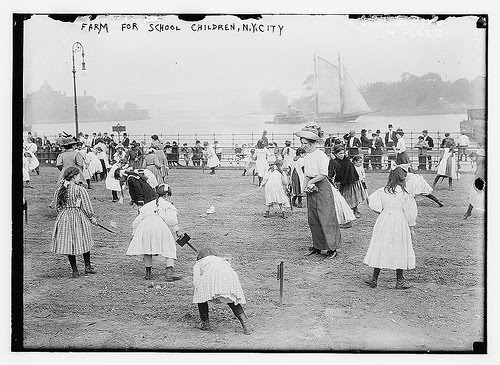
Farm for school children, New York City
Library of Congress’s Photostream @ Flickr.com

Gwynne Watkins @ Salon offers her analysis of a recent “exposé” by Jennifer Senior in the New York magazine on the unrealistic expectations of modern parenting.

“I Love My Children. I Hate My Life.” That’s the cover line on this week’s New York magazine, superimposed on a photo of a beautiful mother and infant in a sun-drenched landscape. Presumably, the mother is loving her child and hating her life. Presumably, we all are.

The whole post is worth reading, since it calls out the bullshit that is our contemporary culture’s obsession with parenting that turns human beings into infinitely perfectible projects — yet refuses to accept Senior’s conclusion, which is that if that “perfect” family life is a lie, all we have left to live on is the fumes of nostalgia.

One particular passage of Watkin’s post, however, sort of hit me in the head like a low-hanging tree-branch. So I’m hijacking it for this blog post so I can ask, once again, why the fuck “children are people too” such a difficult concept for people to grasp.

Like really.

Here’s the passage. Read and digest.

If you’re having a baby for reasons of self-gratification, of course you’re going to be miserable. Becoming a parent is less about enriching your life than it is about up-ending it entirely to make room for another human being. And that’s what Senior’s article is missing: the fact that children are people, and having a child is about forging a relationship. Take this quote from a sociologist Senior interviewed about why parents are so disgruntled: “Middle-class parents spend much more time talking to children, answering questions with questions, and treating each child’s thought as a special contribution. And this is very tiring work.” Funny, that doesn’t sound like work; that sounds like having a conversation. The true reward of parenting isn’t looking back with nostalgia, as Senior concludes; it’s getting to watch a baby turn into a fully realized person. It’s hearing the thoughts and opinions of somebody who didn’t exist until you brought them into the world. It’s a humbling, daunting, awesome experience — and it’s hard enough without the added pressure of making every moment enriching and significant.

So here’s the thing. What I find so disturbing about this passage is the way basic human interactions, when placed in the context of parent-child relationships, are suddenly framed in Senior’s article as an onerous obligation, and joyless demand. And this is seen as so normal, so common-sensical in our culture, that a sociologist seems to think there’s something problematic about asking one person in a committed relationship (parent) to treat the other person in that committed relationship (child) as if their thoughts were worth giving a damn about.

Really?

Really??

Take a minute to switch out “spouse” with “child” in the above passage:

Middle-class couples spend much more time talking to each other, answering questions with questions, and treating each other’s thoughts as a special contributions. And this is very tiring work.

“I love my spouse. I hate my marriage”? If the thought of spending time with your partner, talking together and treating each others’ thoughts with respect felt like tiring, joyless work — drudgery only relieved by the fond memories you had of your courtship or a fleeting weekend getaway — then possibly it’s time to seek out some couples counseling and/or ask yourselves whether this is really a relationship worth being in.

And while you obviously can’t walk out on a dependent child with the same impunity as you can an adult spouse, I’d suggest that it’s not too much of a stretch to stop thinking of children as hobbies or vocations and, you know, remember that you enter into a relationship with them. And that — as with all human relationships — the intrinsic reward of relatedness is the pleasure of getting to know another human being intimately. Learning to see the world through their eyes. Watching them grow and change over time. The pleasure of having conversations together, some of which last a moment and some of which will go on for years. Sharing experiences like the reading of a book, the watching of a movie, attending a concert or art show, cooking dinner and sharing the meal.

“Becoming a parent is less about enriching your life than it is about up-ending it entirely to make room for another human being,” Watkins writes, in her response to Senior. While I agree with her on the basic point that becoming a parent because you expect a child to fulfill your expectations is problematic, I would make a slightly different, possibly more radical argument: rather than juxtaposing “enriching your life” with “up-ending it” to make room for another, I’d suggest that such an up-ending is intrinsically rewarding, even if in none of the ways you initially anticipate. And that is the beauty of the chaotic unpredictability of humanity. If that sort of uncertainty is not your cup of tea, then maybe you should think again about whether you want to have kids. Or whether you want to be in a committed relationship of any kind.

‘Cause that’s kinda the point of being in a relationship.

As someone who has grown from being a dependent child to an adult in relationship with parents who treated her as a human being, I can attest first hand that (as with spousal relationships) recognizing each others’ humanity doesn’t make the experience of living together a panacea. It doesn’t mean we’ve never failed each other, struggled to communicate, lost our tempers, or felt (temporarily, sometimes for months or years at a time) at an impasse. What it does mean is that we aren’t reduced to our socially-assigned roles, and the expectations of behavior that come with those roles. It does mean we have more flexibility to adapt our relationships as the people within them grow and change — because those relationships were formed in the first place specifically to suit our own individual selves. In other words, shifting from the straight-jacket of “perfect madness” parenting to a model of ordinary human relatedness doesn’t solve all of life’s problems.

But it absolutely does open up a realm of possibility that is not possible when one person in the equation is reduced to a project rather than a person. A series of tasks and responsibilities rather than an organic being whose presence you are given the chance to experience.

Which is (surprise, surprise!) more or less the argument that feminists have made for decades about the idealization of heterosexual, monogamous marriage. When you reduce two human beings to their roles of “husband” and “wife,” and punish individuals from deviating from impossible normative standards (or make it exhausting, endless struggle for them to do so), it’s a recipe for disaster. The exact same observation can be made about “parent” and “child.”

Senior’s essay on parenting is the perfect opportunity for the feminist “click” moment, parenting style. It could offer us a chance to assess the way our culture’s idealization of family life dehumanizes children and parents, setting them up in relationships warped by power dynamics that make true intimacy all but unattainable.

Instead, Senior’s “solution,” to the extent that the article posits one, appears to be a band-aid fix that feminists will be very familiar with: the Flanaganian solution of “settling.” Senior’s article seems to suggest that the only options are

a) Playing to win. Pretending to find pleasure in the “perfect madness” of trying to conform to our culture’s ideal of the good parent (in reality, the good mother), thereby driving yourself and everyone around you crazy, but at deriving pleasure from the knowledge that you’re out-parenting all other parents or

b) Calling bullshit and giving up. Re-framing parenting as grim work, rather than a joyful vocation, undertaken out of duty and made bearable by the hope of delayed gratification of nostalgia after the raw experience has long passed. Just give up, Senior’s article ultimately seems to suggest; expecting to experience enduring happiness (gasp!) in your relationships with your children is just unrealistic. Shame on you!

I’m going to go out on a limb here and suggest that this is a false dichotomy, and that the way out of this lose-lose situation is, well, feminism for children. See, both of these “options” still posit that parenting = job rather than parenting = relationship. You can enjoy a job for intrinsic and/or extrinsic rewards (conducting oral history interviews!), or you can dislike a job but feel it’s worthwhile (canvassing before an election), or you can dislike a job but recognize it’s necessary (like doing dishes), but at the end of the day it’s still a job of work.

Why would you choose either of these options when instead you could have interesting relationships with these people who’ve walked (often invited by you!) into your life? Isn’t that one of the most awesome thing about being alive in the world — the chance to get to know and caring about the lives of others?

I say, just quit. Quit your job and go find a relationship. With that person who you’re interested in being intimate with as they grow and discover the full strength of their humanity. Who knew this would be such a radical suggestion?

quick hit: the myth of work vs. home life split

13 Tuesday Jul 2010

Posted by Anna Clutterbuck-Cook in linkspam

≈ Leave a comment

Tags

children, feminism, work-life balance

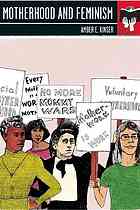
From Amanda Marcotte @ RhReality Check comes a wonderful interview with Amber Kinser, author of a new book, Motherhood and Feminism (Seal Press, 2010). The following passage, while focused specifically on mothers in the workplace, speaks to a lot of the issues I was blogging about in my recent post on feeling guilty for wanting a balanced life (starts at roughly minute 19:00).

There is an assumption in the workplace that if you’re a mother your primary loyalty is always going to be your family even during the workday and that that’s a problem. The assumption is, for men, your primary loyalty is always going to be at the workplace and that that’s not a problem. And if you’re single and you’re … childfree and female then we don’t have to worry that you’ll be called away, you know, to go pick up a child who’s sick from school or go take care of a disciplinary matter or go the Halloween parade at school.

So part of the problem [of discrimination against mothers in the workforce] is this mythical — and I talk about this in the book a good bit — this mythical split between public and private. The workforce still operates on the assumption that home life is separate from work life. It never has been, it isn’t now, and it never will be. And so part of the problem is the problematizing of people who are invested in their families. So that if someone has to go to the piano recital during the school day or someone has to go take care of a sick child this goes up against workplace policy and norms. And so what we do is penalize — largely the women, because they’re the ones who end up doing it — who do that. That’s where that motherhood penalty comes in — instead of shifting workplace norms so that they can accommodate the fact that public life and private life are not, you know, they’re just not distinguishable. Men are better positioned to be able to pretend like they’re separate than women are and so they benefit in the workplace.

The full interview can be heard as part of Amanda’s latest RhRealityCheck podcast, Pro-Choice, Feminist Support for Motherhood.

Kinser is emphasizing the parenting angle here, because that was the thrust of the conversation she and Amanda Marcotte were having. But I would extend her observations not only toward men who are attempting to parent more actively but also to individuals who are not parenting. Being invested in family life, or private life, is a choice all of us can make, regardless of whether we are parenting. Caring for, or enjoying time with, a partner or a parent, extended family members or close friends, are equally important and a necessary part of life. They should not be something we need to sideline or make invisible in order to be valuable workers, but of course in an economic system that is built to value only efficiency and workplace productivity, those values are difficult to “sell” as a benefit to one’s employer.

"oh I need a vacation!"

09 Friday Jul 2010

Posted by Anna Clutterbuck-Cook in our family

≈ Leave a comment

Tags

blogging, domesticity, family, maine, travel

Hanna and I are headed north this weekend to visit her parents in central Maine and celebrate Hanna’s birthday (yay! birthday cake!). Linda and Kevin live an hour north of Augusta is a beautiful cabin they’ve built themselves. We will be enjoying an internet-less weekend and I am thus taking a few days off from blogging. The sunday smut list will be back next week.

In the meantime, enjoy this song from the musical Pump Boys and Dinettes which I adored as a child and used to sing a top volume in public places, much to the chagrin of my parents.

"the scandal of our own non-necessity"

08 Thursday Jul 2010

Posted by Anna Clutterbuck-Cook in book reviews

≈ Leave a comment

Tags

politics, religion

On Tuesday, I posted a quote from Terry Eagleton’s On Evil. To risk appearing completely enthralled by Eagleton’s prose (which I admit are difficult not to delight in), today I’m sharing a passage from Holy Terror (Oxford: Oxford U.P., 2005), which Hanna recently finished and handed off to me.

I’ve talked briefly in a couple of recent posts about the meditation practice of metta, or “lovingkindness,” the Buddhist practice of extending intentions for well-being, peace, and and end to suffering toward all beings in the world. Even beings we do not like very much (or at all). Even ourselves. A friend of mine recently suggested this is similar to the Christian practice of “radical welcome” or “radical acceptence.” Both distinguish loving beings qua beings, so to speak, from loving individual beings in a more particular sense. I believe both types of caring — the more impersonal, unconditional love extended to all, and the particular liking of certain persons — are important. But I also believe that liking people, in a genuine way, really only takes root within the more disinterested, impartial sea of radical acceptence, or radical love.

Last week, I came across a passage in Holy Terror that speaks to the power of radical love. (Eagleton speaks from his background as a Catholic Christian, though I don’t believe the ideas need to be limited to Christian theology.)

Dionysus [in Euripides’ play The Baccae] offers men and women precious time off from their burdensome existence under the political law. We have seen already that such carnivalisque interludes are in the interests of the governing powers rather than an affort to them. As Olivia observes in Twelfth Night, there is no slander in an allowed Fool, no harm in jesters so long as they are licensed. When transgression is ordained, deviancy becomes the norm and the demonic finds itself redundant. This is why the devil finds himself with empty hands in the postmodern world. If Jesus’s law is light, however, it is not only because he, too, comes to relieve the labouring poor of their afflictions, but because God commands nothing more of his people than that they should allow him to love them.* Because he is the Other who neither lacks nor desires, unlike the Lacanian variety, he needs nothing from others, and his law is consequently free of neurotic compulsion and paranoid possessiveness. Ironically, it is God’s transcendence — the fact that he [sic] is complete in himself, has no need of the world, and created it out of love rather than need — that allows him to go so easy on his creatures.

God himself has the necessity of law, in that his being is not contingent. But this law, once again, is the law of love — for since nothing apart from God needs to exist, whatever does exist does so gratuitously, as a result of his unmotivated generousity. To say that things were created out of nothing means that they did not have to come about. The did not follow inexorably from some precedent, as elements of a causal or logical chain. Creation, in Alain Badiou’s terms, is an “event,” not a dreary necessity. The cosmos could quite easily never have happened. Instead, God could have devoted his considerable talents to, say, figuring out how to create square circles …

… Since religious fundamentalism is among other things an inability to accept contingency, the universe itself is a persuasive argument against such a creed. What fundamentalism finds hard to stomach is that nothing whatsoever needs to exist, least of all ourselves. For St Augustine, the fact that human beings are “created” means their being is shot through with non-being. Like modernist works of art, we are riddled from end to end with the scandal of our own non-necessity (p. 32-33).

*All bold passages are my emphasis, rather than Eagleton’s.

I am bewitched by Eagleton’s final passage here: “we are riddled from end to end with the scandal of our own non-necessity.” Why? Because our impracticality is the foundation upon which unconditional love is built: we do not have to be useful to be loved, we simply have to be. And this, indeed, is a radical claim.

A fuller meditation on both On Evil and Holy Terror will (knock on wood) be in a forthcoming booknote.

← Older posts
Newer posts →
"the past is a wild party; check your preconceptions at the door." ~ Emma Donoghue

Recent Posts

  • medical update 11.11.22
  • medical update 6.4.22
  • medical update 1.16.2022
  • medical update 10.13.2021
  • medical update 8.17.2021

Archives

Categories

Creative Commons License

This work by Anna J. Clutterbuck-Cook is licensed under a Creative Commons Attribution 3.0 Unported License

Meta

  • Register
  • Log in
  • Entries feed
  • Comments feed
  • WordPress.com

Blog at WordPress.com.

  • Follow Following
    • the feminist librarian
    • Join 36 other followers
    • Already have a WordPress.com account? Log in now.
    • the feminist librarian
    • Customize
    • Follow Following
    • Sign up
    • Log in
    • Report this content
    • View site in Reader
    • Manage subscriptions
    • Collapse this bar