• anna j. clutterbuck-cook
  • contact
  • curriculum vitae
  • find me elsewhere
  • marilyn ross memorial book prize

the feminist librarian

the feminist librarian

Category Archives: book reviews

booknotes: delirium

28 Tuesday Feb 2012

Posted by Anna Clutterbuck-Cook in book reviews

≈ Leave a comment

Tags

books, feminism, gender and sexuality, moral panic, politics

After hearing Nancy L. Cohen interviewed by Amanda Marcotte recently on the RhRealityCheck podcast, I requested her most recent book, Delirium: How the Sexual Counterrevolution is Polarizing America (Counterpoint, 2012), from our local library and spent a day reading through it. Cohen is an historian and journalist whose previous research also took as its topic political history in the twentieth century. Delirium looks at what are popularly termed “the culture wars,” beginning with the advent of the birth control pill and rolling up to the current election cycle — with a particular focus on the politicization of sexuality — both behavior and identity — and gender roles. You can read an excerpt of the opening chapter over at AlterNet.

Cohen’s narrative of sexual politics from 1960 to the present seeks, in some measure, to revise our understanding of the conservative revolution of the late 1970s as one led by white male reactionaries like Jerry Falwell and Pat Robertson. Instead, she argues, some of the first — and most successful — sexual counterrevolutionaries were women like Phyllis Schlafly, Lottie Beth Hobbs, and Anita Bryant. These women, like their male counterparts, were opposed to the advancements in gender equality, the changes in (hetero)sexual mores, and the growing visibility of human sexual variety that the feminist and gay liberation movements of the 60s and 70s fought for. In sometimes overwhelming detail, Cohen recounts how political activists and career politicians successfully stopped the Equal Rights Amendment, pushed back advancements made in civil rights for queer citizens, generated moral panics around sexual variation, and stymied the post-Roe landscape of women’s access to sexual health services, especially abortion.

Overall, I felt like Delirium bogged in a blow-by-blow recounting and analysis of presidential campaigns and administrations, from the fall of President Nixon to Barack Obama’s first term. Cohen draws much of her evidence from quantitative polling data and political commentary, which left me wondering how much the understanding of individual Americans support her thesis about who sexual conservatives are and why they support the policies they do. To her credit, Cohen does acknowledge that sexual conservatism, as sociologist Kristin Luker has shown, appears on both sides of the aisle. Moral panic over teenage sexuality and concern-trolling about women’s ability to meaningfully consent to an abortion are equal-opportunity topics for Democrats and Republicans alike. Her narrative, however, mostly charts the sexual conservatism and politicking of Republicans. I waited in vain, for example, for her to talk about feminist anti-porn activism, which often paralleled and intersected with — at least on a policy level — with the work of people with otherwise diametrically opposing political views.

Cohen’s work will be particularly interesting to those who enjoy thinking about strategy of electoral politics and policy negotiations, as well as those who may want a better grip on the broad sweep of sexual politics since the 1960s. However, for scholars and activists well-versed in much of this history, Cohen’s narrative fails to add much of significance to what we already know about our sexual selves in relation to formal politics. That is, that our sex, sexuality, and gender identities and experiences are presently over-determined, or constrained, by the decisions of our elected representatives at the local, state, and federal level.

booknotes: the trouble with nature

14 Tuesday Feb 2012

Posted by Anna Clutterbuck-Cook in book reviews

≈ 1 Comment

Tags

gender and sexuality, science, the body

This week’s adventures in queer theory came in the form of anthropologist Roger N. Lancaster’s The Trouble With Nature: Sex in Science and Popular Culture (University of California Press, 2003), which caught my eye on the shelves of Raven Books on Newbury Street. Yes, it really is the sort of thing I buy myself as a weekend treat.

Lancaster’s wide-ranging examination of narratives around sex, gender, sexuality, and nature in both scientific and popular culture can be read as a single monograph or as a series of fairly free-standing topical essays. Grounded in research done largely in the 1980s and 90s, Lancaster charts the various ways in which evolutionary psychology and sociobiology have been deployed across the political spectrum to argue for a stable “human nature” in the face of social and political flux. “What is most obvious about these naturalistic and naturalizing representations [of sex and gender] is that they are so emphatic on matters which recent history has been so equivocal,” he observes (8).

The language of the natural sciences are seen, in contemporary culture, as the voice of authority on the realm of the possible. Queer activists draw on the authority of supposedly innate desires to argue that they were “born this way” and therefore are eligible for equal treatment. Some strains of feminist theory ground their vision in an understanding of women as innately nurturing, pacifist, or cooperative. Religious conservatives, likewise, often utilizes the language of natural science to argue for a particular theological vision of destiny (consider the case made for intelligent design, or the “natural” complementarity of heterosexual relations). Free-market libertarians argue that human beings have a “selfish gene” and to put forward a communitarian alternative to capitalism would be inevitably futile.

In contrast to these fatalistic, mechanistic notions of humanity, Lancaster draws upon his training in cultural studies and anthropology to argue for the irreducable complexity and variety of human sex, gender, and sexual expression across time and space. While acknowledging that we are, indeed, physical bodies, those bodies are in turn never separable from the meaning we make of that matter: “Hormones, odors, and appetites do count — but their effects are always called forth within a cultural context, which is to say, they count in dynamic and non-reductive ways … it matters less that they are biological than that they are creatively articulated within a framework of arbitrary meanings and contingent practices” (204). To put it less jargonistically, “the body is enmeshed in social facts and human acts,” not an ahistorical constant (205).

Lancaster’s book is far from the most articulate or persuasive account of the cultural context in which science around sex and gender is practiced (the works of Anne Fausto-Sterling, Rebecca Jordan-Young, Cordelia Fine, Jeffrey Weeks, Gayle Rubin, and obviously Michel Foucault all come to mind, many of whom he draws upon in this work). If you’re not already at least sympathetic to the notion that scientific research is done in the context of human culture, then you will not likely be convinced by The Trouble With Nature. However, what Lancaster contributes to this field is a thorough survey of the ways in which “bioreductivism” filters into (and draws upon) the language of sex, gender, and sexuality so as to become a feedback loop of “common sense.”  He examines how, over the course of the twentieth century, the languages of sociobiology and evolutionary became the undisputed voices of authority on human behavior — a realm once shared with practitioners in such fields as anthropology, history, and sociology.

Most interesting to me was the way in which Lancaster, himself a gay man, is uncompromising in his criticism of queer activists who use “innatist” arguments to advance the rights of non-straight sexual identity groups. “At best … the new innatist claims carve out a protected niche for homosexual exceptionalism,” he writes. “At worst, they reify the prevailing logic of heterosexual metaphysics and thus actively contribute to the reproduction of an exclusionary homophobic — and sexist — environment. For gays can only be gay ‘by nature’ in a ‘nature’ that already discloses men and women whose deepest instincts and desires are also different ‘by nature” (275). As someone who shares Lancaster’s skepticism that a “born this way” argument is a sound long-term political strategy for ending heteronormative policies and prejudices, I appreciated his articulation of an approach to queer rights activism that doesn’t ground its authority in the notion of a fixed non-straight orientation, but rather the infinite variety of human sexual desires.

With that in mind, I’m closing this review with a lengthy quotation from the introduction to The Trouble With Nature in which Lancaster sketches out the talking points for how one might re-frame the political debate over human sexuality and queer practices. “The long-standing demand, made by religious conservatives, distraught parents, and liberal helping professions alike, is but this: Change your unnatural desires. Time and again, the response is given: I can’t change them — They’re part of my nature,” Lancaster writes. “Would it be as convincing to own one’s sexuality in a volantarist fashion, to say, simply, ‘No, I won’t change them — I’m as queer as I want to be?’ ” (22).  He suggests it might be possible to do just that:

“Desire and identity are inherently ambiguous,” a different kind of contention might begin. “Some of us are more or less exclusively homosexual for most of our lives, many more are exclusively heterosexual,” the argument might continue, rightly acknowledging the salient facts. “But sometimes even straight men find themselves infatuated with their best friends and — as any veteran of feminist consciousness-raising can tell you — women who think of themselves as heterosexual sometimes discover lesbian potential they didn’t know was there. It’s not unheard of for gay ment to fall for women, or lesbians to sleep with men.” 

Now for the theory: “Freud believed that all human beings have bisexual potential. Research by Alfred Kinsey, Laud Humphreys, and others suggests that a lot of people act on that potential at some point in their lives. Anthropological studies of other cultures have shown that human sexual practices are remarkably varied — that there’s more than one way to organize the institutions of family, kinship, and sexual life. Some societies even require every male to engage in same-sex relations for extended periods of time. What all of this means is that nothing in ‘human nature’ gives us a heterosexual norm and a homosexual minority. Sexuality is largely what we make of it.” 

Then, a dash of social context to make sense of how we “make” sexuality: “In modern America, people are very much in the process of making new things out of sex and sexuality. All around us, relationships are in flux: gender roles are changing, sexual practices are changing, all at a dizzying speed. None of this means that people ‘choose’ their sexuality the way a person might choose a pair of socks. But in fact, many individuals do change over time.” Segue into the argument: “So much variation, experimentation, and change makes some people very nervous: they come up with absolutist claims about an unchanging nature, or, they fall back on the premodern idea of divine law as the last recourse in these matters. But ‘nature’ explains nothing here. And nobody really knows very much about why people have the feelings they have.” 

Then, cut to the chase: “None of this is an illness or a disease. None of this means that the end of the world is at hand. There’s nothing wrong with any way that people can express love, make community, or find consensual pleasure. What’s wrong is trying to make people feel sick or evil or perverted about things that are just part of being human. What’s wrong — and dangerous — is trying to narrow the range of pleasures people find in our wondrously human bodies” (23-24).

While I doubt The Trouble With Nature is a great starting place for those interested in the cultural history of human sexuality, I think Lancaster’s book has a lot to offer on the subject and I’m glad I made it an addition to my growing library of sexuality literature.

booknotes: the secret lives of wives

09 Thursday Feb 2012

Posted by Anna Clutterbuck-Cook in book reviews

≈ 3 Comments

Tags

bigotry, books, feminism, gender and sexuality, moral panic

A couple of weeks ago, I posted a pre-review review of Iris Krasnow’s book The Secret Lives of Wives (Gotham, 2011). From those notes, it should be clear to you that I had major issues with the book — and to be fair, I expected to have major issues with any book by someone whose previous books were titled Surrendering to Marriage and Surrendering to Motherhood. Sometimes, you can judge a book by its cover. Or at least, the choice of language by which it is marketed. The breathless wording of the title (“secret lives” and “what it really takes”), along with the temptation-of-Eve cover we’re rocking here, signaled to me we were in for a rocky ride.

And to be honest, that’s part of the reason why I requested the advance review copy of the book. Because on some level I’m fascinated by people who continue to buy into — and actually seem satisfied with — the heteronormative, gender essentialist assumptions about what it means to be men and women, relate sexually, and form families. I didn’t grow up in a household where gender normativity was enforced, and while my parents have enjoyed a 35-year marriage — which at times took a lot of active work to maintain — they have never pressured us kids into partnerships, marriage, or parenthood, hetero or otherwise. So I just don’t get the concern trolling over kids-these-days being somehow unfit and unable to establish intimate partnerships.

Part of me hoped that Secret Lives would offer really interesting first-person narratives about long-term partnerships. I’m an oral historian by training, after all, and even when autobiographical narratives turn on values I strongly disagree with I still find life stories an absorbing read. And a preliminary glance at Krasnow’s website also suggested that at least some of the “secrets” to a successful marriage were going to be fairly benign: maintain strong relationships with male and female friends outside the marriage, don’t expect your spouse to meet every emotional need, make space and time for being alone or pursuing independent projects. Who’s really going to argue with those fairly basic pieces of advice for well-being? So while I went into this book with the expectation that there would be much to disagree with, I was also prepared to find something — anything! — redeeming in its pages.

Wow, that was hard. As my preliminary notes suggest, the “points for” list I started in the front cover was quickly overtaken by the “no points for” list. But I’m going to lay into this book fairly hard in a minute, so let me begin by observing what I felt Krasnow did — if not “well” at least “decently.” She situates herself in the introduction as a curious journalist, not a sociologist or psychologist, and (at least initially) acknowledges the anecdotal nature of her research. She later goes on to consistently generalize from that research, but we’ll deal with that below. In so many words, she acknowledges this is a book about heterosexual couples, though doesn’t talk about her reasons for limiting the study in this way. The fact it’s all about wives rather than husbands and wives is something that is never specifically addressed, though I think it’s tied to the fact Krasnow sees women as primarily responsible for securing and maintaining a marriage (more below).

She does acknowledge that there is no one-size-fits-all formula for marital happiness, writing that “there is no gold standard for marriage,” although I think her later arguments undermine this initial claim. As I said above, she is fairly consistent in maintaining that individual people are responsible for determining — and seeking out — what will help them thrive (in other words, don’t expect a husband to equal instant happiness). She argues for the importance of maintaining adult friendships outside long-term partnerships, and she encourages wives to maintain independent lives through work, travel, exercise, and other activities that will take them out of domestic life. Basically, “It’s okay to do things without your husband sometimes.” Which I think is pretty sane advice for partners of any persuasion (and I’m not sure it really counts as a “secret” given the number of people who know and agree with it).

And I realize this is a super-low bar, but I’m going to offer her maybe half a point for at least acknowledging the existence of women in hetero marriages who don’t have children with their partners, couples who aren’t white, and couples who aren’t upper-middle-class. With the exception of ethnic diversity (which isn’t really clearly delineated, though one woman is identified as African-American and one Bengali) there’s one example of non-parenting, and one example of a non-professional-class couple. Other than that, we’re basically talking about white upper-middle-class wives with children, most of whom have advanced degrees and are married to individuals similarly situated. Couples with the financial resources to support multiple homes or summer-long vacations abroad, hire (and have affairs with) gardening staff, choose to be a single-income family (and not suffer financially for it), etc. Her profiles of individual women include throw-away details about fur coats, caterers, manicures, high-end spas, and other markers of incredibly privileged lives. Granted, social and economic privilege has never proven to shield individuals from emotional distress or relational impoverishment — but I wish Krasnow has been more upfront about the demographic she was actually studying.

Okay, so those are the okay-ish things about Secret Lives. Things that limit the book’s generalizability, but aren’t particularly harmful if you take them for what they are. Several of the life stories Krasnow includes — if you can grit your teeth and get passed her editorializing — are actually really awesome. I particularly appreciated the one interview she did with a married couple, Phil and Pat, since it included both partners’ voices. Phil and Pat were articulate in describing the ways in which sexism made Pat’s career (in the tech industry, alongside her husband) more difficult, and how together they learned how to resist the external forces trying to push Pat out of the business world, or pit them against each other as competitors. Similarly, a couple of women — interestingly enough the wives who used “we” most often — described the way they re-negotiated their marriage arrangements in times of stress, to better share the tasks of child-rearing, or to open their marriage to other partners (more on the one swinger couple below). The women who used “we” were much more likely to describe equal partnerships in which they’d worked with their husbands to build a home life that supported both their individual needs and the nurturing of their relationship. Often through active re-negotiation of terms when the original assumptions or agreements had failed to serve one or both of them adequately.

So what are Krasnow’s secrets for a successful (note: “successful” in Krasnow’s world means long-lasting — no marriage which ended in separation or divorce gets a place in the book, and cautionary tales of people who did divorce feature prominently) hetero marriage? And what ideas concerning gender and sexuality is she promulgating on the way by?

Secret #1: Heterosexual marriage is what every woman “needs” because it is “essential.” So while I have no problem, per se with a study that focuses on one group of people (in this case wives) due to the questions being asked or simple logistics, I became increasingly suspicious of Krasnow’s decision to focus exclusively on “wives” as the book went on. She begins with a chapter about “why marriage,” as in why should she focus on describing successful marriage. “Who needs marriage?” She asks rhetorically, answering herself, “Women do, of this I’m convinced” (8). While Krasnow includes handful of throw-away lines to the effect that some marriages are abusive and should end, the actual message of the book is that marriage, virtually any marriage, is better than dating (and yes, if you’re single you’re assumed to be looking for a partner). The women who fail to keep their marriages intact in Secret Lives are seen as failures who gave up, who had unrealistic expectations, or who made a rash decision they now regret. “Better to stick with the first flawed union if you can; the second could be worse” (32) she concern-trolls over and over. 

This understanding of marriage as something women “need,” and the focus specifically on “wives” also speaks to the pervasive gender essentialism Krasnow offers up, in which women pursue marriage … with men whom she depicts as emotionally unavailable and brutish (I’m serious, she and Caitlin Flanagan should just go to housekeeping together) and frankly not all that appealing. While she insists that marriage is the essential ingredient for ultimate life-long happiness, her own descriptions belie those claims. In other words, Krasnow should be approached as an unreliable narrator.

Secret #2: The work and compromise of making a marriage successful, that is to say life-long, falls to the wife. There’s a telling scene early on in the book where Krasnow describes a point in her own marriage when she was a full-time mother with four children under the age of five and her husband was the full-time wage-earner. She describes her frustration at making breakfasts and lunches for the entire family while her husband sat at the breakfast table with the paper, ignoring the chaos around him, and then disappeared to work leaving her to clean the house and care for the kids. She describes calling her mother and announcing her intention to leave her husband — because anything would be better than the status quo. Yet in the end, she and her husband remained together and things got better. (Sort of. Frankly, the descriptions Krasnow provides of her husband and their interactions are filled with a level of animosity that belies her protestations of marital bliss. I was really uncertain what we were supposed to make of her more personal anecdotes and their place in the story, since they seemed at odds with one another.) But anyway, she fills the book with similar narratives in which women are miserable with the status quo, yet consistently turn back to themselves as the source of the problem. I agree that to focus on assigning blame rather than solving the problem can be counterproductive, but I cringed at sentences like this: “Recently, Alice has been ‘working on herself’ and blaming Chris less, fueling a discovery that he isn’t so bad after all” (66). Relentlessly, the exhausted mother of young children is counseled to stick it out, rather than speak up and say “This isn’t working, can we figure out how to make this more equitable?” These marriages all take place in a vacuum where sex and gender politics on a wider scale don’t exist, and it’s simply women’s lot to be the full-time parent with an unresponsive husband (who will start paying attention to her again once she stops wallowing in self-pity and bothers to put on tight jeans and sexy lipstick).

Lesson #3: Adultery is okay, as long as you keep it secret from your spouse, and having an open marriage is exactly the same as being an adulterer (except people with open marriages are mysteriously happier). So she has a really depressing chapter on women in relationships where either they or their husband maintain the marriage by cheating on one another — and not talking about it. I realize everyone feels different about adultery, but I believe trust and honesty and fidelity are really important in any relationship, and if a marriage is going to involve multiple people in any way, it should be openly negotiated and agreed upon by all parties involved. Which is why the one swinger couple Krasnow profiles, I’d argue, seem so damn pleased with the way they’ve chosen to conduct their sexual lives. Yet Krasnow folds this couple into the chapter on adultery, and seems at a loss to explain why their extramarital relationships aren’t causing anyone angst or despair.

Lesson #4: Youthfulness should be prized while young people are denigrated. Some people might see this as two separate issues, but I’m treating them together ’cause I think it’s two aspects of the pernicious ageism that permeates our culture. Krasnow uncritically accepts that youthful looks are desirable (in women) and should be maintained (by women) in order to keep the interest of their husbands, etc. At the same time, she portrays young people — I’m assuming any cohort younger than about age 35? — as lazy gits who are unwilling or uninterested in putting energy into maintaining relationships. We’ve all grown up with the “divorce epidemic,” I guess, and somehow technology has also made it easier to give up on people (it’s unclear why, but Facebook and iPads feature as emblematic of … whatever the problem is). I feel bad for her kids that she basically thinks they’re uninterested or incapable of connecting. While this book is ostensibly a look at marriage in the “middle years” (read: after your kids have gone away to prestigious colleges), it’s shot through with a heavy, heavy dose of judgement and unsolicited advice for younger folks who might think twice before marrying, not be interested in marrying a man, or who might try to re-negotiate the work/childcare arrangement with their spouse.

The entire book could really be reduced to a banner reading “Be Grateful You Have a Man, Any Man, Girls, Because Without One Life Isn’t Worth Living.” Which (and here’s where my own personal bias might come in a teeny-weeny bit?) is a really weird message to try and send with a shit-ton of examples of hetero marriages that sound fairly dysfunctional and unhappy to me. Even when you discount the one or two that are actually out-right abusive? It’s a fairly dismal bunch. Like I said, there are maybe three or four profiles in which the women speak with confidence about having negotiated a fairly equal arrangement with their spouse, and where the couple seems to be on the same page about their domestic life. But more often than not, there seems to be a lot of despair, resignation, rage, and yes, “secrets” that involve emotional and physical infidelity.

Seriously: I got to the end of this book and I was like, “If this is the world of straight marriage, I’m so glad I’m out.” I am so thankful for all of the people I know who are married to other-sex partners who aren’t actually acting out this sort of misery. Who are living lives of partnership and communication. Who don’t assume all women “need” marriage, and who don’t denigrate their own husbands by making snarky asides about how many hours per weekend they spend watching hockey.

I started out this post by observing that part of the reason I read books like this is to try and understand what people who think like this get out of their portrayal of women and men and marriage in this fashion. This book failed insofar as I still don’t understand it. One could write a perfectly sane, thoughtful, book about the compromises and negotiations one makes in a long-term relationship. One that didn’t hinge on making generalizations about how men and women operate and what they want out of relationships. But this is not that book.


P.S. I originally wrote this review prior to reading Samhita Mukhopadhyay’s Outdated, though the review of that book went live on Tuesday. While I was reading Outdated I kept thinking of Secret Lives and how this book — despite the fact it’s not explicitly marketed as a dating advice manual — fits so well into the paradigm of the hetero dating advice schlock Mukhopadhyay takes to task. Basically, if you’re going to read Secret, keep Outdated close at hand as an antidote!

Cross-posted at The Pursuit of Harpyness.

booknotes: clover adams

31 Tuesday Jan 2012

Posted by Anna Clutterbuck-Cook in book reviews

≈ Leave a comment

Tags

boston, feminism, friends, history, hope college, MHS


It was nearly a decade ago that I first started hearing from a former professor (turned good friend) of mine about her latest research project: the study of a set of photograph albums at an archives in Boston, albums created by a 19th century female photographer named Marian “Clover” Hooper Adams. At the time, the friend — Natalie Dykstra — was in the process of applying for an NEH fellowship to spend her sabbatical at the archives — the Massachusetts Historical Society — to work with the albums and develop a book-length project that would consider the photography of Clover Adams as autobiographical texts. Texts that might, in some way, help us to understand how Clover understood her own life, her work, her marriage to historian Henry Adams, and the factors that led to her decision to end her own life at age forty-two by drinking chemicals used in the development of her photographs.

Since then, I’ve had the privilege of drifting on the periphery of Natalie’s research and writing of the manuscript which became Clover Adams: A Gilded and Heartbreaking Life (Houghton Mifflin, 2012). It is, in part, because of her connection with the Massachusetts Historical Society that I considered relocating to Boston, that I applied to work at the MHS, and her friendship has been a sweet thread of connection between my previous life at Hope College/in Holland and my world here in Boston. Over the past four years I’ve worked with Natalie in my reference librarian hat to track down details related to Clover’s childhood and coordinated the provision of photographs by and of Clover will appear, in all their visual splendor, in the pages of her biography.

This is all by way of saying that I approach this review with a far-from objective sense of propriety when it comes to the work of a friend, and the opportunity to see the life of an overlooked female photographer — whose work is preserved at “my” library — brought into the open and shared with the world in such an eloquent way.

So, you know, take my praise for what it’s worth and form your own opinions of Natalie’s work at your leisure. But having read the advance review copy over the Christmas holidays, I do want to share a few notes on what about Natalie’s work — and Clover’s life story — particularly moved and impressed me. Because I do, in my professional historian hat, think Natalie’s done something remarkable here.

Clover Adams’ story presents a number of dilemmas for the modern biographer. In the socioeconomic sense, she was a daughter of privilege, born to a Boston family with economic resources and social and political connections. Her mother was a poet who moved in Transcendentalist circles with the likes of Margaret Fuller and the Peabody sisters. Her father’s family, the Hoopers, had made their money in business  during the previous century, and Robert Hooper (Clover’s father), with whom Clover remained close, received his medical training at Harvard and in Paris. In marrying Henry Adams, Clover became part of one of the most high-profile American families of the period; she and her husband maintained multiple residences, traveled abroad, and moved through the upper echelons of American and European society.

Yet at the same time, there were limits to what privilege could bring to Clover’s life in terms of health and well-being. Her mother died of tuberculosis when Clover was a young child, and the aunt who cared most directly for Clover thereafter eventually committed suicide. Mental health struggles seem to have haunted the Hooper family, and if read in a certain light Clover Adams appears to be one long narrative of health struggles for which contemporary late-nineteenth-century medical, religious, and philosophical frameworks had no useful remedy.

In addition, Clover contended with the fact that she was a girlchild, and later a woman, in a world that offered a limited number of options for women to craft satisfying lives for themselves. The majority of women were, of course, caught up in surviving class and race inequality. However, even those who, like Clover, didn’t face immediate material dilemmas, were nonetheless constrained by social expectation to pursue a limited number of professional and relational pathways. While Clover seems to have settled into her marriage with Henry Adams quite happily and voluntarily, her married life was colored by the couples’ inability to communicate some of their deepest needs to one another. That the two never had children also appears to have haunted Clover on some level, though I appreciated that Natalie takes note of this factor without dwelling on it extensively.

Clover’s photography, taken up in the final years of her life, remained an amateur endeavor in part because of the status of photography in the art world and in part because of the fact that Clover was a woman. Both she and Henry expressed ambivalence over her creative work and its place in their lives, and eschewed opportunities which might have brought her more attention for her work.

All of these aspects of Clover’s life — her mental health, her marriage, her work, and her place in society — are interesting to a modern audience in part because Clover’s struggles feel like very relevant in our current society, roughly a century and a quarter after Clover’s death. How we understand — and cope with — mental illness is still a live question.The benefits and limits of marriage as an institution — and as a primary relationship — are under intense discussion. The role of work and creative expression — particularly in the lives of married and mothering women — is still a subject of public debate. It would be all too easy to map our current understanding of all three of these subjects backward onto Clover’s life (what is known in the historical profession as “presentism”). We’re shown the pain of Clover’s depression without any sort of narrative pressure to diagnose cause or condition: her mental landscape is described most often in Clover’s own words. Natalie doesn’t back away from the loneliness and disconnection that, in the end, resided at the heart of the Adams marriage. Yet she manages to show Henry Adams at his most vicious (I felt real flares of anger at him while reading) without laying the blame of Clover’s suicide at the feet of her husband.

At the same time, while skillfully avoiding the trap of presentism, Natalie also refuses to absent herself — as a biographical narrator — from the storytelling endeavor. Having spent literally a decade with Clover’s story she has much to offer us in terms of synthesis and analysis. I didn’t finish the book wishing that Natalie had shown less partiality for (and more critical analysis of) her subject. She really manages to do the balancing act of letting us see Clover’s life as it was lived and understood in broader historical context, not just through Clover’s own meaning-making mechanisms.

Speaking as someone who is intensely interested in the history of feminism, gender and sexuality, I find Clover’s story compelling on a number of levels. Natalie explicitly avoids the language of gender theory in her storytelling. Which is not to say she ignores the way in which Clover’s lived experience was shaped by her womanhood — far from it. But Natalie has the grace to let Clover’s life be — as much as possible — her own. And Clover herself doesn’t seem to have understood her life through the lens of gender. Other women of her era did (though they would have used the word “sex” rather than “gender”). The years between Clover’s birth and death were active ones for women’s rights agitation, and Boston saw its fair share of feminist activism. While feminist analysis would likely not have saved Clover from the depths of despair, I found myself wondering if Clover’s ability to anchor herself — in her marriage, in her art, in her social connections — could have been aided at all by the friendship of women (or men) who outspokenly advocated for her right to be (and be seen) as an artistic individual, out beyond the confines of the domestic sphere. I found myself wondering how Clover and Henry’s expectations of the roles played by husband and wife contributed to the silences in their marriage, and whether more radical friends might have encouraged them to re-consider their assumptions and move past what seem to have been baffling obstacles to marital connection and contentment. This is something that Natalie hints at, but for the most part leaves for the reader to piece together as they will.

courtesy of the MHS

Last week, when I arrived at work, I found that the sign advertising upcoming events had been switched out to showcase the opening of our next exhibition — guest curated by Natalie — which features Clover’s own photographs. The image chosen (see right) is a striking photograph taken at Smith Point (Mass.) is a group portrait of Miriam Pratt, Alice Howe, and Alice Pratt, discussed in chapter fourteen of Clover Adams (“At Sea”). It is not, Natalie writes, “a straightforward portrait intended simply to capture the likeness of three specific women. Instead, Clover carefully stage-managed the composition, creating a mood not of friendship and connection but of lost possibility … the women are connected neither to one another nor to the sea, which might otherwise open up their visual world” (150). Despite Clover’s own ambivalence about the public exhibition of her work during her lifetime, I am proud of Natalie for bringing her photography out of the archive and into the public eye. For helping us to understand Clover’s creative work not only as the art it surely is, but also as a visual voice communicating a particular woman’s understanding of her world in a form that will long outlive its creator.

Clover Adams will go on sale on February 8th. You can pre-order it now through a variety of venues, or put it on hold at your local library.

Natalie, I’m so, so proud of you!

booknotes: the lives of transgender people

24 Tuesday Jan 2012

Posted by Anna Clutterbuck-Cook in book reviews

≈ Leave a comment

Tags

books, gender and sexuality, sociology

I was super excited to get my hands on an advance review copy of The Lives of Transgender People by Genny Beemyn and Susan Rankin (Columbia Univ. Press, 2011) a couple of months ago. Lives is being touted as a unique and much-needed large-scale study of the identities and experiences of trans* individuals as described in their own words through an online questionnaire and qualitative email, phone, and in-person interviews. Beemyn and Rankin gathered data from 3,474 individuals via the questionnaire, and followed up with over four hundred of those respondents for more lengthy interviews. By encouraging interviewees to articulate their own identities outside of pre-determined research categories, the authors allowed their subjects to provide a rich and nuanced picture of the lived experience of being someone who experiences life outside the sex and gender binaries mainstream culture assumes are innate and largely inflexible. Most studies examining the lives of trans* people to-date, as the authors point out, have focused on the life experiences of people who identify as transsexual; an overwhelming majority of those studies focus on the experience of trans women (women assigned male sex/gender at birth). As the authors point out, this renders invisible those people who do not fall into neat, polarized gender categories (trans* or otherwise). Often, as documented in books such as Brainstorm and Sexing the Body, this stems from the research community seeking discrete identity-groups they can control and measure for difference. It also comes from researchers’ own unexamined assumptions concerning sex and gender difference, assumptions which are then reinforced by the results of studies that have been designed (in part) by jettisoning the data from individuals who don’t fit into the pre-determined sex and gender categories.


The Lives of Transgender People can be read, in part, as providing a model for a much different way of exploring trans* experiences — one which honors the myriad expressions of sex and gender which the human organism manifests. “Throughout the book, we use the language of the survey participants to honor their voices and their own self-descriptions,” write Rankin and Beemyn, insisting that we, as readers, pay attention to the richness of the gendered experiences described by the people who shared their stories (36). Lives seeks to be descriptive rather than prescriptive, synthesizing the data collected in a number of different ways that suggest some patterns to be found in trans* experiences, often differentiated by other variables such as age cohort, race, economic status, and so forth.  Particularly useful was the researchers discussion of gender identity and expression, given their insistence that trans* identities and experiences not be simplified the better to accommodate researchers desire for tidy data. They discuss in great detail their decision to identify four basic categories for analysis: trans men (assigned female at birth, self-identity male), trans women (assigned male at birth, self-identity female), “female to different gender” (FTDG) and “male to different gender,” (MTDG) which allowed them to honor the current identities of respondents which don’t fit into the mainstream system of binary gender. Further chapters discuss race, sexual orientation, and age as variables which further complicate the project of identifying any stable sense of trans* identity or experience.

The researchers, both of whom work in higher education, are particularly interested in age and generational differences as a factor, and put forward some tentative observations concerning the difference in reported experience across generations. For example, older respondents were more likely than younger ones to identify as cross-dressers, while trans men were statistically more likely to be significantly younger than trans women. They also spend a great deal of time was also spent on identifying recurring “milestones” of gender identity development as articulated by the study participants. Much trans* research to-date has focused on modeling the “stages” through which individuals go on the journey to identifying themselves as transgendered, and the authors of Lives offer the more flexible model of “milestones” (which may or may not be relevant for a particular individual) as an alternative model for understanding the process of self-realization.

I hope that in the years to come Lives will be a rich source of data for activists, theorists, and policymakers, as well as one possible model for doing research on sex and gender that allows us to collect meaningful data without depending on the binary male/female, man/woman dichotomies that continue to unhelpfully reduce the variety of human experience to the inflexible straight-jackets of innate gender difference.

notes on reading "the secret lives of wives"

17 Tuesday Jan 2012

Posted by Anna Clutterbuck-Cook in book reviews

≈ 2 Comments

Tags

blogging, writing

Over the weekend, I read an advance review book from LibraryThing called The Secret Lives of Wives: Women Share What It Really Takes to Stay Married by journalist Iris Krasnow (Gotham Books, 2011). Hanna wasn’t happy with me since I spent most of Saturday ranting at the book. I find this satisfying; she finds it anxiety-producing. At least when I use words like “heteronormative” and “shallow bitch.”

I’ll be writing a review of this book, where I try to be slightly more measured in my criticisms. You know: balancing those out with the fairly innocuous observations Krasnow makes about what it takes to maintain strong interpersonal relationships with those truly heinous arguments grounded in gender essentialist bullshit. But for now, I thought readers of the feminist librarian might be amused at the notes I took in preparation for writing said review, scrawled in the front and back cover of the book. So here they are verbatim:

Inside the front cover:


     no brownie points for
     heteronormativity
     evopsych bullshit
     gender/sex essentialism
     focus on women — makes it women’s work
              — p. 66, p. 119, p. 135-36, p. 138, p. 202-08 HARMFUL, p. 219.
     concern trolling — p. 37, p. 12
     “secret”
     “surrender”
     “males” and “females”
     “divorce epidemic”
     “me decade”
     not getting [that] this book isn’t universal!!!  
     describing physical appearance –> [ran out of room; continues below “points for” list]

points for  
     acknowledging agenda, limits [of study]
     no one-size-fits-all, to a point
     self-responsibility for happiness
     outside relationships
     aloneness = positive
     “who are you beyond Mommy?” (101)
     activity, engagement, etc. duh
     p. 198 friendship    

[no brownie points for, cont’d]
     “gay best friend” stereotype
     feminist hate-ons
     privileging marriage relationships
     not recognizing economic privilege
          — travel, house, etc. professionals. p. 140
     negotiation isn’t possible? wtf?
     all couples w/kids?? — p. 145
     Depression-era idealization

*compare to marriage across cultures book*

Inside the back cover:

relentless heteronormativity — relentless
“need”
“essential”
good marriage = lasting marriage
marriage vs. dating, no other options
“women need marriage” O_o … (p. 8)
“marriage = sex” O_o … (p. 9)
better than the crazy therapy lady?
evopsych bullshit ARGH
p. 57 aloneness + self-awareness (duh)
p. 40 network of support and fulfillment (duh)
reading this book made me so grateful for my parents
any dads as primary parent??
p. 257 ARGH

gender essentialism
oppositional binary
ageism – against youth, against age
tokenism

So there you have it folks. That’s the raw material from whence my review will spring. Although I admit to being puzzled by a couple of these notes myself (who the heck is “the crazy therapy lady” I was thinking about??). Still, I hope you enjoyed this rare opportunity to observe the inner workings of a book review in process. It’s a public service after all: I read books like this so y’all don’t have to!

booknotes: post-holiday round-up

12 Thursday Jan 2012

Posted by Anna Clutterbuck-Cook in book reviews

≈ Leave a comment

Tags

gender and sexuality, history, moral panic, politics, religion

It’s that time again! Time for another round-up of books I’ve been reading that for some reason or another haven’t made it into a post-length book review. Most of these, let me be clear, deserve a full-length review. Many of them are well-researched, well-argued, or otherwise lovely reads. I just don’t have the temporal time/space to write them all up. So here’s everything that’s fallen through the cracks in the past few months.

Corey Robin | Fear: The History of a Political Idea (Oxford U.P., 2004) and The Reactionary Mind: Conservatism from Edmund Burke to Sarah Palin (Oxford U.P., 2011). I first heard of Corey Robin thanks to an episode of Amanda Marcotte’s RhRealityCheck podcast in which she interviewed Robin about The Reactionary Mind. I was impressed with what he had to say about gender and power, so I hunted up his books and got reading. Fear was the volume that came in first at the library. It’s dense political history and theory, examining the theorizing and deployment of fear in the political realm from the Thomas More to Hannah Arendt and into the twenty-first century. Robin’s core argument is that politicians (left and right) have positioned fear as an external threat to civil society and democracy and therefore obscured the way in which fear is deployed within our society to keep power hierarchies in place (e.g. in the workplace, in race and gender relations, through law enforcement, etc.). The Reactionary Mind is a collection of essays — many which began as book reviews in publications like The Nation and The London Review of Books — that explore specific reactionary thinkers. I’d recommend dipping into Robin’s work with Reactionary and then moving on to Fear if you’re really intrigued, since Reactionary is certainly the easier (though no less insightful) read. My favorite essay in Reactionary might just have been the one on Antonin Scalia in which he observes:

Scalia’s mission, by contrast, is to make everything come out wrong. A Scalia opinion, to borrow a phrase from Margaret Talbot, writing in the New Yorker, is ‘the jurisprudential equivalent of smashing a guitar on stage’. Scalia may have once declared the rule of law to be the law of rules – leading some to mistake him for a traditional conservative – but where others look for stabilising checks or reassuring supports, Scalia looks for exhilarating impediments and vertiginous barriers. Rules and laws make life harder, and harder is everything. 

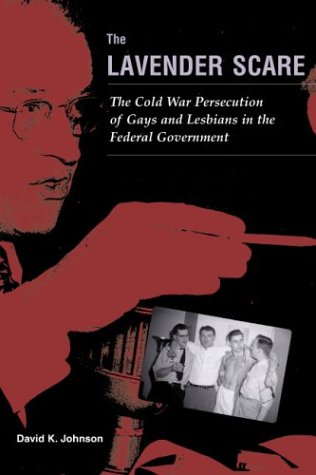
David K. Johnson | The Lavender Scare: Cold War Persecution of Gays and Lesbians in the Federal Government (Univ. of Chicago Press, 2004). Following footnotes from Corey Tobin’s Reactionary Mind, I stumbled across this detailed and well-constructed history of the McCarthy era purge of non-straight civil servants. Johnson’s book documents the way in which fears about national loyalty and psychological fitness blended together in the Cold War era and led to a mass expulsion of queer folks from the government (often destroying careers, precipitating family fissures, and causing psychological and emotional trauma on the way by). What surprised me was the relatively relaxed attitude Johnson describes toward sexual deviance immediately prior to the 1950s, when few feared loss of their job or social ostracism for homosexual identity or behavior.

Paul Russell | The Unreal Life of Sergey Nobokov (Cleis Press, 2011). Cleis Press sent me a review copy of this densely atmospheric historical novel, which attempts to reconstruct the life of Sergey Nobokov, the obscure younger brother of novelist Vladimir Nabokov of Lolita fame. I admit a certain amount of dubiousness when confronted with a historical novel that attempts to piece together the life of an actual historic person — particularly when the person in question was homosexual. The temptation for presentism (reading our own expectations onto the past) is always a danger, and often intensifies when we’re talking about the act of “recovering” queer history. The novel is also forbidding in that one anticipates, from the opening pages, Nabokov’s inevitable death at the hands of the Gestapo. To be honest, I’ve rather bogged in the middle (though I mean to go back!) just because midwinter is not really the time to be reading about the inevitable demise of a forgotten gay man under the Nazi regime.

Patricia Faith Appelbaum | Kingdom to Commune: Protestant Pacifist Culture Between World War I and the Vietnam Era (Univ. of North Carolina Press, 2009). Hanna found this one for me at the Harvard Book Store off Harvard Square. It’s a meticulously researched study of pacifism during the first half of the twentieth century, focusing — as the title suggests — on the influence of mainline protestant culture on the ways in which pacifism was articulated and enacted by women and men across the United States (and to some extent internationally as well). I’m only up to roughly the start of the Second World War thus far, but am finding it very readable history. I’m particularly interested in her focus on material and “folk” culture as a way of practicing and passing along traditions of Protestant pacifism, even in more secular pacifist communities and activism.

Joseph Cummings | Ten Tea Parties: Patriotic Protests That Time Forgot (Quirk Books, 2012). This early reviewer book from LibraryThing that is a lesson in “read more than the title when requesting your advance review copies.” I thought the book was going to be about ten unique protests that time forget; instead, it was about ten pre-revolutionary protests about tea and import taxes. Which, okay, if your thing this might be fun. Cumm ings has an engaging narrative voice and it looks like he’s done a credible amount of background research. His scant two-page bibliography is made up of secondary resources, however, and the lack of even end note citations is frustrating to those of us who like our quotations sourced!

Jeffrey Weeks | Making Sexual History (Blackwell, 2000). Following citations from Gayle Rubin’s Deviations, I tracked down this retrospective anthology of British historian and theorist of sexual politics Jeffrey Weeks’ essays on historical conceptions of human sexuality. This is a lively and articulate — if somewhat theoretically dense — collection which provides a solid picture of the work of historians of sexuality since the 1960s, and also reflects back on the work of sexologists from the 19th and early 20th centuries, and the long legacy of their contributions to research and cultural perceptions of human sexuality and how it is organized. Weeks was one of the pioneering scholars to retrieve the study of sex from the realm of nature/biology (where it was assumed to be ahistorical) and asserted the importance of understanding how human sexuality itself — not just our understanding of it — is shaped by culture.

Christopher Turner | Adventures in the Orgasmatron: How the Sexual Revolution Came to America (Farrar, Straus & Giroux, 2011). I was only able to get through about half of this ambitious history of psychoanalyist Wilhelm Reich’s work on human sexuality before the library demanded it back. However, the half that I did read was a thoroughly researched examination of Reich’s approach to psychoanalysis — one which placed orgasm at the center of both psychological and political health. Since Reich had only just arrived in America when I had to interrupt my reading, I remain dubious concerning the title’s claim (that Reich precipitated the sexual revolution in the U.S.). Nevertheless, Reich’s insistence that sexual pleasure was healthy and to be encouraged — and his placement of pleasure close to the heart of humanity’s essential character — becomes central to a number of post-WWII psychoanalytic and cultural currents that I am interested in (he was connected to, among others, A.S. Neill, Fritz Perls, and Erich Fromm).

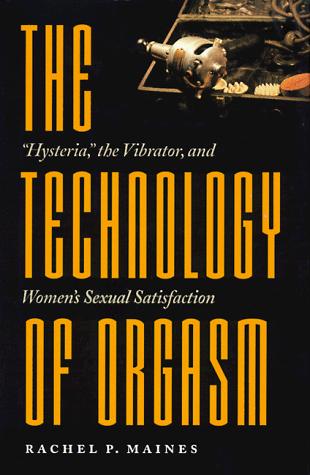
Rachel Maines | The Technology of Orgasm: “Hysteria,” the Vibrator, and Women’s Sexual Satisfaction (Johns Hopkins, 1998). Um … are you sensing a pattern in my recent reading yet? Pursuing research for an MHS “object of the month” essay, I checked out this slim volume on the medical treatment of women’s sexuality through electromechanical technology. It appears to be the only book-length work on this subject to-date, and although I found some of her arguments about male physicians and their power to be slightly simplistic, on the whole she avoids turning this into a narrative of male physicians vs. female patients, or husbands vs. wives, and instead offers a nuanced argument about the displacement of female sexual pleasure from marital intimacy to the doctor’s office due to what she terms the “androcentric model” of sex that insisted intercourse to male orgasm was sex, and women’s needs (clitoral stimulation anyone?) outside of those activities were excessive and therefore a medical issue for which one sought treatment from the professionals.

booknotes: deviations

10 Tuesday Jan 2012

Posted by Anna Clutterbuck-Cook in book reviews

≈ 1 Comment

Tags

children, feminism, gender and sexuality, moral panic, politics, reading lesbian classics, sociology, the body

find table of contents here

For the past couple of months I’ve been making my way through Deviations: A Gayle Rubin Reader (Duke University Press, 2011), an anthology of writings by anthropologist and feminist theorist Gayle S. Rubin whom I’m ashamed to admit I didn’t actually know anything about before I stumbled upon the advance review galleys of this book. Rubin  is a cultural anthropologist whose research delves into the history and culture of urban sexual subcultures, particularly BDSM communities. As a newly-out lesbian in the 1970s in Ann Arbor, Michigan, she designed her own Women’s Studies major at the University of Michigan and became active in the Women’s Movement and also the Gay Liberation Movement. In the late 70s and early 80s — in part because of her academic research into BDSM — she drew the ire of anti-porn feminist activists for her insistence that (wait for it) not all pornographic materials are inherently degrading to women. Yeah, I know. The more I read about it, the more it seems like the early 80s must have been a really weird time to be a self-identified feminist. Not to mention one who was also a lesbian and open about her s/M desires and practices.

Deviations is arranged in chronological order, beginning with Rubin’s first attempt to construct a theory of gender relations rooted in anthropological methodology — “The Traffic in Women: Notes on the ‘Political Economy’ of Sex,” written and revised between the late 60s and early 70s and first published in 1975. It is very much an artifact of its time and to be honest I bogged in this piece for the better part of a month after joyfully burning my way through the eminently readable introduction. Perhaps recognizing the opacity of “Traffic,” Rubin includes a piece reflecting back on the writing and reception of the original piece and includes it in the anthology — something she does several times throughout the book to great effect. After “Traffic” and its contextual essay comes a much more accessible piece on the English author Renee Vivien, originally written as an introduction and afterward to a new edition of Vivien’s A Woman Appeared Before Me, which is a fictionalized account of her tumultuous relationship with fellow author and outspoken lesbian-feminist Natalie Barney.

By the late 70s, Rubin was deep into the ethnographic research for her dissertation on the gay male leather bars of San Francisco, for which she received her PhD in 1994 from the University of Michigan. The majority of pieces in Deviations, therefore, wrestle not with the politics of gender or specifically lesbian-feminist history, but the politics of sexual practices, sexual subcultures, and the relationship between feminist theory and practice and human sexuality. As someone who is, like Rubin, committed to understanding the world through both a feminist and queer lens, I really appreciate her determination to remain engaged in feminist thinking and activism even as she was reviled by certain segments of the feminist movement for her “deviations” in sexual practice, and her openness to thinking about sexual subcultures that — for many in our culture, even many self-identified feminists — elicit feelings of disgust and generate sex panics. While the “porn wars” of the 1980s are largely a thing of the past, feminists continue to find sexuality, sexual desires, sexual practices, and sexual fantasy (whether private or shared via erotica/porn of whatever medium) incredibly difficult to speak about. Rubin calls upon us to think with greater clarity about the politics of sex, and how we police other peoples’ sexual activities, many of them consensual, simply because we find them distasteful.

Particularly controversial, I imagine, are Rubin’s writings on cross-generational sexual activities and children’s sexuality. Coming out of the BDSM framework, Rubin foregrounds the basic ethic of consent and argues that children have just as much right to consent to sexual activities as adults. Furthermore, within the framework of 1980s anti-pornography legislation, she emphasizes the difference between fantasy/desire and reality/action (that is: depiction of non-consensual sex in the context of a fantasy does not equal non-consensual sex and shouldn’t be treated in the same fashion). This leads her to speak up in defense of adults who express sexual desire for young people (but don’t act on that desire), and also to suggest that not all instances of underage/overage sexual intimacy should be treated as sexual abuse or assault. Read in tandem with Rubin’s insistence that we take children seriously as human beings with the right to sexual knowledge, this advocacy is clearly not a call to minimize the trauma of sexual violence (at whatever age) or a glossing over of age-related power dynamics. “The notion that sex per se is harmful to the young has been chiseled into extensive social and legal structures,” she writes, “designed to insulate minors from sexual knowledge and experience” (159). Like Judith Levine in Harmful to Minors (2002), Rubin argues that our cultural insistence on keeping young people separated from sexuality and sensuality — with a vigilance that often spills over into panic and hysteria — does little to protect them from sexual violence and exploitation while cutting them off from the means to conduct their own (safe, consensual) sexual explorations or name and resist the violence and exploitation that may come their way. Sexting panics anyone? The Purity Myth?

Overall, I highly recommend Deviations to anyone interested in the development of feminist and sexual political theory and practice over the last forty years — if nothing else, Rubin’s bibliography has already given me a handful of other thinkers whose books and articles I wish to pursue.

Cross-posted at the corner of your eye and The Pursuit of Harpyness.

booknotes: the lesbian fantastic

22 Thursday Dec 2011

Posted by Anna Clutterbuck-Cook in book reviews

≈ Leave a comment

Tags

books, gender and sexuality, genre fiction, reading lesbian classics

Back in October’s batch of LibraryThing Early Reviewer books, I won Phyllis M. Betz’ The Lesbian Fantastic: A Critical Study of Science Fiction, Fantasy, Paranormal, and Gothic Writings (McFarland, 2011). The Lesbian Fantastic is the third volume Betz, a professor of English literature, has written for McFarland examining genre fiction written by lesbian authors (a slippery category that I’ll talk more about below). The previous installments in the series look at lesbian detective fiction and lesbian romance novels.

At a slim two hundred pages, including chapter notes, bibliography, and index, The Lesbian Fantastic — as the subtitle claims — takes on the ambitious task of exploring the history  and themes of fantastical literature written by and about lesbians. The brevity of the volume is, indeed, one of its problems, since each aspect of fantastical literature Betz covers (science fiction, fantasy, paranormal, and gothic) could take up a book of its own. I was certainly thankful that Betz refused up-front to play genre border patrol and police the boundaries between, say, “gothic” vs. “paranormal,” but that decision left her with a vast landscape of literature to summarize, analyze, and place in some measure of socio-historical context. The inevitable result is that corners are cut and I was left wanting a meatier discussion on many fronts.

Likewise, Betz fails to strike a comfortable balance between examination of lesbian authorship, readership, and the lesbian as character in fantastical literature — whether or not that character is written by a self-identified “lesbian” or otherwise non-straight woman author. All of these aspects of genre fiction by and/or about lesbians would have been fascinating subjects to explore in-depth, but given the length of their treatment in this study, I felt all three topics came away muddled and short-shrifted. Was this book a study of lesbian authors? Not entirely — in part because not all authors’ sexual orientations are known and/or fit into modern-day identity categories. Betz also weaves back and forth between writing narrowly about lesbian-authored works (however she defines them) and women generally and authors in the genre generally. Was this book about lesbian readers? That category, too, suffers from a high degree of volatility … are we talking about readers of fiction involving lesbian characters? Readers who identify as lesbian? Who engage (or have engaged) in same-sex relationships? Who experience some measure of same-sex desire? While categorization is always going to be somewhat arbitrary for the sake of a study such as this, I would have appreciated a clearer sense of whom Betz herself is including under the umbrella of lesbians who read genre fiction, and what her sources are for those voices.

Finally, Betz could have used a good editor with knowledge of the genre who might have caught, for example, the fact that China Miéville does not identify, as far as I know, as a lesbian or a woman. Or could have gone over the manuscript and deleted the repetitious author introductions (Charlotte Perkins Gilman’s Herland is re-introduced almost every time it appears). 

Overall, The Lesbian Fantastic is a book on a fascinating and potentially rich (and heretofore under-studied) topic that suffers from over-vague parameters and a frustrating simplification of lesbian identity. I think Betz’ subject might have been better served had she chosen to focus on the treatment of lesbian/queer characters in fantastic fiction. In that context, she could have constructed some interesting compare-and-contrast arguments about lesbian characters in genre fiction generally versus genre fiction written by lesbian writers and/or for a lesbian/queer audience. Or, she could have focused more specifically on queer female readership and fandom, discussing the genre fiction pitched specifically to non-straight readers and the ways in which those readers interact both with “lesbian” genre fiction and its mainstream counterparts. Reader voices are notoriously difficult to locate and analyze, but online forums and fan-created transformative works (fan fiction, videos, art, etc.) have made the possibility of hearing the reader’s voice in much more depth.

The Lesbian Fantastic will be useful to other scholars in the field who will, hopefully, take Betz’s arguments in more complex directions.

booknotes: one and only

15 Thursday Dec 2011

Posted by Anna Clutterbuck-Cook in book reviews

≈ Leave a comment

Tags

history, oral history

Cleis Press recently sent me a review copy of One and Only: The Untold Story of On the Road and Lu Anne Henderson, The Woman Who Started Jack Kerouac and Neal Cassady on Their Journey by Gerald Nicosia and Anne Marie Santos (Berkeley, CA: Viva Editions, 2011). Here are a few thoughts.

In 1978, Beat biographer Gerald Nicosia had the opportunity to interview Lu Anne Henderson twice – once her a hospital in San Francisco, when she was recovering from surgery, and shortly after her release when she invited him to the house where she was recovering for a lengthy recording session. Over thirty years later, One and Only brings us these oral historical narratives in the form of heavily edited autobiographical vignettes. The sections of One and Only drawn directly from the interviews are framed by Nicosia’s contextual commentary and supplemented by other historical material about the Beats and their milieu – including a number of photographs and an essay by Henderson’s daughter, Anne Marie Santos.

I have, I will admit upfront, never been drawn to the Beat movement either in terms of its literary output or its place in American twentieth-century history. I have had passing acquaintance with its main personalities and the echoes of their work in 1960s and 70s cultural critiques. But I come to this work largely without preconceptions about the personalities of the individuals or the nature of the relationships between the main players. Therefore I’m not the best person to comment on the contribution this autobiographical narrative adds to the field of Beat studies. What I would like to talk about is the way in which Nicosia frames the oral history, and how one might approach reading the text with a skeptical eye — yet still gain a valuable personal perspective on some fairly iconic historical people and events.

Nicosia’s introduction does not inspire confidence in One and Only either as a work of oral historical scholarship or as a meaningful portrait of Lu Anne Henderson and her experience of mid-century American bohemia. Nicosia leans heavily on qualitative descriptions of his subject that came across  in my reading as tasteless objectification – he introduces her as “beautiful fortyish woman” who has a certain “homespun charm” and retains “touches of … charming innocence” (24; 33). Given his position as a younger (at the time) man requesting an interview about Henderson’s life and sexual relationships, I find the focus on her simultaneous sensuality and almost childishness to be a little creepy.

Nicosia walks a fine line between asking his readers to recognize Henderson’s agency – even as a fifteen-year-old teenage girl, she situates herself as a person who made choices about how to live her own life – and eliding the power dynamics borne of age and gender. While still a young man when he married Lu Anne, Cassady was in his early twenties, with more travel experience and a stint in the military under his belt. While not all such relationships need be inherently exploitative, this dynamic is never unpacked either by interviewer or interviewee. While Lu Anne’s interview emphasizes their shared youthfulness and complicity in continuing to live in or on the edge of poverty, readers can’t help but observe how Henderson is often forced into the position of providing for her husband and his friends, by hook or by crook, as in 1946 when Neal and Lu Anne, newly wed, arrive in New York City:

It was up to me to support us, so I found a job at a bakery. I had just gotten the job that morning, it was my first day, and Neal told me to steal some money! We didn’t have a penny, and Neal told me, like, ‘Bring some money home!’ Well, the woman who ran the bakery caught me [and] dismissed me. It really put me through a traumatic experience (67).

Henderson passes over these incidents with a light touch, often turning them into amusing anecdotes. Similarly, she glosses over the emotional and physical abuse threading through her relationship with Cassady and, later, Kerouac, and subsequent husbands. “Neal was not a violent person,” she observes at point point, and then immediately qualifies this by saying, “except with me. And when Neal would hit me, that was simply emotion” (87).

Nicosia acknowledges that Henderson herself had an agenda in granting him an interview, as did he in seeking her out. She was unhappy with contemporary accounts of her place in the constellation of Beat relationships, approached the interview as an opportunity to correct historical memory. He was collecting material for a biography of Kerouac eventually published in 1983 under the title Memory Babe. To a great extent, Nicosia’s focus on the high-profile male personalities in Henderson’s circle persists in One and Only. He observes with unselfconscious approval that “Unlike so many of the other women who have written about Kerouac, [Lu Anne] resists the temptation to shift the focus of the story from Jack (or in this case, Jack and Neal) to herself” (27). In the context of a biography of Kerouac or Cassady, such an on-task informant might be an asset to the researcher – in the context of a book that places Lu Anne Henderson front and center, the observation tastes a bit sour on the tongue. Really, Nicosia? You make it sounds like Henderson’s life story is only valuable to the degree she keeps herself in the background and focuses on the menfolk in her life? I really hope you didn’t mean that the way it came out.

Despite my (many!) frustrations with the framing of Lu Anne’s narrative by Nicosia, there will likely be value to Beat scholars in the publication of Henderson’s perspective on the oft-chronicled historical events that inspired On the Road and other Beat works. Until now, the interview was unavailable to the public, for reasons Nicosia doesn’t elaborate on – only hinting that he was “forced” to bring a lawsuit in order to open the archive. I certainly found Henderson’s narrative compelling, and while her portrait of life on the economic and cultural edge was at times heartbreaking, I think it’s an important antidote to those who might romanticize the outsider while forgetting the real material and social costs of socioeconomic and philosophical marginalization … even if some aspects of that marginalization are, at least partially, by choice.

I look forward to seeing what future scholars do with the published work as well as the raw interviews, which I hope will be made available to scholars and the general public for research purposes.

← Older posts
Newer posts →
"the past is a wild party; check your preconceptions at the door." ~ Emma Donoghue

Recent Posts

  • medical update 11.11.22
  • medical update 6.4.22
  • medical update 1.16.2022
  • medical update 10.13.2021
  • medical update 8.17.2021

Archives

Categories

Creative Commons License

This work by Anna J. Clutterbuck-Cook is licensed under a Creative Commons Attribution 3.0 Unported License

Meta

  • Register
  • Log in
  • Entries feed
  • Comments feed
  • WordPress.com

Create a free website or blog at WordPress.com.

  • Follow Following
    • the feminist librarian
    • Join 36 other followers
    • Already have a WordPress.com account? Log in now.
    • the feminist librarian
    • Customize
    • Follow Following
    • Sign up
    • Log in
    • Report this content
    • View site in Reader
    • Manage subscriptions
    • Collapse this bar