• anna j. clutterbuck-cook
  • contact
  • curriculum vitae
  • find me elsewhere
  • marilyn ross memorial book prize

the feminist librarian

the feminist librarian

Category Archives: book reviews

booknotes: the price of salt

15 Monday Aug 2011

Posted by Anna Clutterbuck-Cook in book reviews

≈ 4 Comments

Tags

books, feminism, gender and sexuality, reading lesbian classics

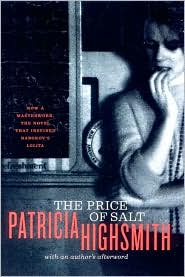
While on vacation at my in-laws’ in Maine a couple of weeks ago, I spent an afternoon reading Patricia Highsmith’s 1952 novel The Price of Salt (New York: W.W. Norton, 1990), originally published under the pseudonym “Clare Morgan.” I’d read recently that it was noted for being one of the first works of lesbian fiction with a happy ending so I thought “why not!” and ordered it interlibrary loan from our local public library.

Spoiler alert.

Romance? Well, yes. Happy ending? …. Not so much. I mean, okay, technically, yes, the two main characters end up together. So if your definition of “happy” is “two characters of the same gender/sex choose their relationship despite social prejudice and do not end up in mental institutions and/or dead” then this fits the bill. If your definition of “happy” is “two people who actually love each other establish a mutually fulfilling relationship” then … not so much.

The plot in a paragraph: Therese, an emotionally-starved young woman in her twenties, is living in New York City and working at a department store while trying to break into the theater industry as a set designer. She rather listlessly dating a man who assumes that since they’ve had sex they will eventually get married. One day at the department store Therese assists Carol, an affluent suburban housewife who is there to purchase a Christmas present for her daughter. Captivated by Carol’s presence, Therese can’t get the woman out of her mind. She sends Carol a Christmas card and when Carol receives it, she phones Therese to thank her. The two women slowly begin seeing more and more of each other until they decide to take off on a cross-country road trip while Carol’s soon-to-be-ex-husband has their daughter for three months. During the roadtrip the two women finally have sex (and pretty nice, if not very graphic, sex, actually … they’re relationship is most loving when they’re in bed). The husband has hired a private investigator to follow the two women and gather evidence of the affair to use against Carol in the divorce proceedings (to try and gain full custody of the daughter; in 1954 a completely realistic situation for women in same-sex relationships). Carol leave Therese to return to New York and try to fight for her visitation rights; when this fails she ends up returning to Therese and asking to resume their relationship. Therese initially refuses, but the novel ends with Therese being drawn back to Carol. We’re clearly meant to celebrate that Carol prioritized Therese over visitation rights with her daughter (her lesbian “record” precluded actual custody) and that Therese is not left alone, or left feeling her lesbianism is somehow dirty or unsuccessful.

The positive: So the obvious positive here is that this is a novel in which a sexual relationship between two women is central to the plot and, in the end, central to the lives of the two women involved. They defy the pressures of a world in which Therese is expected to marry the man with whom she’s had (supremely unsatisfying) sex. A world in which Carol is expected to capitulate to the demands of her husband’s family (essentially that she act straight for the rest of her life) in order to see her daughter — even in highly supervised annual visitations. The novel situates these women as heroines, and their enduring relationship as a triumph. It also doesn’t shie away from the fact that their relationship is sexual — as I said above, the scene in which Therese and Carol make love for the first time is tame and “off stage” by fanfic standards, but sweet all the same. Since a number of the “lesbian classics” I’ve read fall down in this regard (satisfying sex scenes) this is a definitely plus.

The negatives: The overarching “negative” from my perspective is that the question remains throughout the whole damn novel why Therese wants to be with Carol. Her infatuation with Carol is understandable at first as a revelation — an understanding that the way she feels drawn to Carol is wholly different from desire of the platonic sort. It provides her with some pretty clear insight into why her relationship with the boyfriend has been unsatisfying. The trouble is that Carol is manuipulative, withholding, and cruel. She entertains Therese when it’s convenient and amusing for her to do so, but drops her the minute something else catches her attention. She makes fun of Therese’s set designs and aspirations in the theater. When she returns to Therese after months of estrangement she basically assumes Therese will take her back no questions asked, and is hurt when this isn’t (initially) the case. Carol is at the center of her own personal drama and Therese is just part of the supporting cast.

Also, there was a friend of Carol’s (whose name I’m currently blanking on) who plays intermediary between Carol and Therese and is also clearly jealous of Therese’s intimacy with Carol. There’s clear intimations that the two of them were involved at some point and I kept waiting for the revelation that they were still involved behind Therese’s back. I bet you anything they were.

I was definitely left hoping, at the end of the novel, that a year or two down the road Therese — with a bit of sexual experience behind her and a more solid sense of herself as an artist and as a queer woman — would get over her obsession with Carol and find someone who, you know, actually showed some affection for her. Who loved and enjoyed Therese for Therese’s sake, rather than just as a plaything.


booknotes: contacts desired and recruiting young love

12 Friday Aug 2011

Posted by Anna Clutterbuck-Cook in book reviews

≈ 2 Comments

Tags

books, gender and sexuality, history, religion

Over the past few weeks, I’ve read two interesting — if somewhat academic — books about (loosely speaking) print culture and its intersection with queer communities and discourses about non-straight sexuality. The first was Contacts Desired: Gay and Lesbian Communications and Community, 1940s-1970s by Martin Meeker (Chicago: University of Chicago Press, 2006) and the second was Recruiting Young Love: How Christians Talk About Homosexuality by Mark D. Jordan (Chicago: University of Chicago Press, 2011). While the first book dealt largely with homophile organizations and the underground publications of the gay liberation and lesbian feminist movements, the second took up the various rhetorics deployed within Christian circles to speak and write about homosexuality (mostly gay male sexuality) from the turn of the twentieth century through the ex-gay activism of the 1990s. Despite the pro/con nature of these texts, what Contacts Desired and Recruiting Young Love share is an interest in how networks of communication spread ideas and inform opinions, actions, and identities.

“Adolescence is the possibility that desire could be different.”

Recruiting Young Love by Mark D. Jordan, focuses on what he calls “rhetoric” and I might term “discourse” concerning homosexuality — mostly (and he is upfront about this) gay male sexuality — in Christian circles over the course of the twentieth century. His interest is primarily in the 1950s forward, though he does begin in the early twentieth century with the emergence of professional discussion of healthy adolescent development (think G. Stanley Hall, the YMCA, Teddy Roosevelt, etc.) by way of providing background for later debates.

As the phrase “recruiting young love” suggests, Jordan is particularly interested in the way that Christian anti-gay voices expressed anxiety about adolescent sexual identity, and the fact that even today ex-gay therapy understands heterosexual and gender-normative identity to be both the most correct expression of sexuality and the most vulnerable. Teenagers, especially, are seen as vulnerable to recruitment and seduction. The examples of Christian rhetoric concerning homosexuality, then, focus on young people and at times seem to assume that all young men are in fact potentially gay — and that this potentiality is threatening to the moral order.

Although he focuses on anti-gay voices, Jordan also touches on some examples of what he calls “camp spirituality,” or appropriated religious imagery (i.e. the Sisters of Perpetual Indulgence), and upon Christian attempts to integrate gay identity and same-sex sexuality into their sexual ethics. He cites, for example, a 1963 Quaker pamphlet, Towards a Quaker View of Sex, that used Alfred Kinsey’s model of fluid sexual practice to argue that homosexual desire and expression, while not predominant, were healthy and normal within the human community. He writes:

For this model of development, most male adolescents are having same-sex relations or thinking about them. Bit by bit, most of them shift over a decade or more to heterosexual relationships. Some do not. The process is not so much an expression of nature as of circumstance or even chance. Indeed, the Quaker pamphlet accepts more fully than any earlier church text not just Kinsey’s terminological suggestion about how to speak of homosexuality as outlet rather than ontology, but his notion that homosexual acts vary with time. To think of yourself as a homosexual should mean no more than observing where you are in the arc of your life and with whom you are now spending it (89).

I was actually quite moved by the idea that one’s sexual “identity” was actually a question of observation and regard, suggesting change over time rather than fixity — though without the sense of enforced change, or charge from “unhealthy” to “healthy” that so many ex-gay narratives imply. Once again, Quakers FTW — and in 1963 no less!

One other aspect of anti-gay Christian rhetoric that Jordan takes note of is the fact that contemporary ex-gay ministries seem to be much more preoccupied with what we would consider gender performance than actual sexual identity, desire, or activity:

Gender matters more than sex [in many ex-gay ministries]. Marriage is the highest accomplishment not because it allows you to copulate naturally, but because it gives you the best stage for performing gender correctly … Indeed, ex-gays may actually be able to use marriage better for gender performance than heterosexuals can, since they are unlikely to enter into it on account of lust … the central category of ‘sexual identity’ means in the end only ‘roles as men and women’ (165).

In this, he relies a great deal on the research and writing of Tanya Erzen, whose recent book Straight to Jesus I reviewed here last August. I’d highly recommend her text if you’re interested in exploring this aspect of the ex-gay movement in more detail.

The weakness of Jordan’s work is one that he admits up-front in the introduction: that it is not meant to be a coherent or comprehensive historical narrative, but rather a series of proffered examples or touch-points meant to give readers a sense of the variety of discourses concerning homosexuality that have existed in Christian circles over the past half century, and some rough idea of where they sprung from, their similarities and their differences. Someone hoping for a more detailed history of anti-gay activism will have to look elsewhere.

“Homosexuals are discarding their furtive ways and openly admitting, even flaunting, their deviation” (Life, 1964).

Meeker’s Contacts Desired explores the ways by which gay- and lesbian-identified people established networks of communication in the decades before, during, and immediately after what we have come to term “the sexual revolution.” As previous scholars have pointed out, identity based on sexual orientation does not bring with it an automatic community affiliation. Unlike with racial, ethnic, religious, or even class, one rarely grows up in a family that shares one’s non-straight orientation. Particularly during the mid-century in America, where queer subcultures were obscured from public view for the safety of their members, a pervasive sense of isolation was often part and parcel to becoming aware of one’s same-sex desires. Contacts, originally written as Meeker’s PhD dissertation, documents the means by which gay and lesbian individuals made contact with the sexual underground and how they situated themselves within it through text: newsletters, interviews, press releases, pamphlets, “contacts desired” ads, guidebooks, and so forth.

Contacts bears the marks of its academic origins, and I’d suggest picking it up more for targeted rather than leisure reading. Those familiar with the history of mid-twentieth-century gay and lesbian activism will find many of the usual suspects here: the Daughters of Bilitis and the Mattachine Society, lesbian pulps and journalistic (outsider) coverage of gay lives — such as the 1964 Life photographic essay on the gay male subculture, from which the quotation above, and the cover art of Contacts, are drawn.

The primary sources I found most fascinating in Meeker’s work were actually these journalistic offerings from the 1960s, since they offered up a glimpse of (and yes, I know it’s cliche) how far we actually have come in the past fifty years in terms of de-pathologizing and de-criminalizing queer sexualities — even though it’s obvious we still have work to do. Meeker discusses popular book-length treatments of queer subcultures as well as newspaper and magazine exposés. What is clear is that “sympathetic” (straight or passing) writers understood that in order to write about homosexuality for the mainstream, it needed to be treated as a psychological disorder or as antisocial behavior. Understanding homosexuality did not mean reading it as normal. The Life article makes that clear from its sensationalistic opening sentences:

These brawny young men in their leather caps, shirts, jackets and pants are practicing homosexuals, men who turn to other men for affection and sexual satisfaction. They are part of what they call the “gay world,” which is actually a sad and often sordid world. On these pages, LIFE reports on homosexuality in America, on its locale and habits and sums up what science knows and seeks to know about it.

Homosexuality shears across the spectrum of American life – the professional, the arts, business and labor. It always has. But today, especially in big cities, homosexuals are discarding their furtive ways and openly admitting, even flaunting, their deviation. Homosexuals have their own drinking places, their special assignation streets, even their own organizations. And for every obvious homosexual, there are probably nine nearly impossible to detect. This social disorder, which society tries to suppress, has forced itself into the public eye because it dos present a problem – and parents especially are concerned. The myth and misconception with which homosexuality has so long been clothed must be cleared away, not to condone it but to cope with it.

As Meeker points out, these widely-disseminated treatments of homosexuality were often read subversively by those whose desires were the topic of discussion: gay and lesbian readers of Life who might otherwise be cut off from the networks of queer communication and community were given a roadmap to (at least some of) the popular gay and lesbian gathering places or geographic locations, thus offering hope that they were not alone. Articles that claimed to “not … condone [homosexuality] but to cope with it” actually did their part to strengthen the underground networks of queer communication that took a radically different view, at least in most cases, when it came to how sad their lives actually were and the extent to which what sadness there was came as a result of their sexual desires (versus the hostile climate in which they were forced to exist).

Reading these books has inspired me to explore some of the primary source material itself, so check back next week for reviews of Patricia Highsmith’s The Price of Salt (an early lesbian novel) and Adrienne Rich’s 1977 essay “Compulsory Heterosexuality and Lesbian Existence.”

booknotes: helping teens stop violence

05 Friday Aug 2011

Posted by Anna Clutterbuck-Cook in book reviews

≈ 1 Comment

Tags

children, education, gender and sexuality, human rights, politics, racialization

My latest early reviewer book from LibraryThing was the 20th anniversary edition of Allan Creighton and Paul Kivel’s Helping Teens Stop Violence, Build Community, and Stand for Justice (Alameda, CA: Hunter House, 2011). The authors have worked together in the field of violence prevention and social justice activism since the mid-1970s. This book is a workbook for adults seeking to work with young people, specifically teenagers, to identify and combat the various types of institutional and cultural injustice they encounter in their lives. “Professional literature about adolescents, social-service priorities, and funding trends all [emphasize] programs that [build] self-esteem,” the authors observe. “Many youth workers convey to young people that if they just had higher self-esteem, they could overcome any obstacle and succeed at anything they set out to do,” ignoring the institutionalized, systemic injustices young people as well as adults face in securing life necessities and building a satisfying life for themselves and their families (60). We do a grave disservice to youth, the authors argue, by implying that if they are struggling it is largely because of personal failure when, in fact, the problem is an imbalance of power:

Our problem [when we were young people ourselves] was not based on low self-esteem or any of the other psychologically defined problems. Rather, we had no real power over our lives. Without power to protect ourselves, we were constantly restricted, disrespected, and abused by adults. Everywhere we went, adults had the authority to decide how we should dress, where we could be, and who we could be with. They decided our future through daily decisions including discipline, records, diagnoses, arrests, report cards, evaluations, and allowences, or just by ignoring, interrupting, or neglecting us.(60-61)

The imbalance, of course, is not just one of age but also intersects with many other inequalities from which adults also suffer: poverty, sexism, racism, religious bigotry, discrimination based on disability and sexual orientation or gender identity … the list is a long and familiar one. Creighton and Kivel call on adult allies to work with youth in identifying these power imbalances and combat them. Those who benefit from inequality seek to divide the attention and alliances of those who are struggling to get by under oppressive systems. By forging networks of support among ourselves at the bottom of the inequality pyramid, the authors suggest, we can more effectively enact lasting social change as well as survive in present day far-less-than-optimal conditions.

Since the book is designed primarily as a workbook for group trainings, those who are reading Helping Teens Stop Violence outside of that context may find themselves skimming a bit and taking note of various exercises for later usefulness, rather than reading in a straightforward manner. I found myself skipping around quite a bit, once I’d read the introduction and gathered the gist of the authors’ perspective and approach. Some general impressions:

  • The authors have made an effort throughout to discuss the ways in which different types of injustice overlap and interact, so that even though (for example) a given chapter may be about “class” the exercises continually push us to think about how things like race, sexual orientation, immigrant status, etc., shape our class identities and economic opportunities.
  • As someone who is continually frustrated with the invisibility of ageism in our culture — even among groups of people willing to discuss and dismantle other “isms” such as sexism and racism, or address homophobia and access issues for folks with disabilities — I was really excited to see the first few chapters devoted to age-based discrimination, and exercises designed to get adults remembering their own teenage years and the lack of agency they had as young people in a world controlled by adults.
  • The authors emphasize the fluidity of what they call “target” and “non-target” categories (i.e. various types of social privilege), reminding us that our social status and agency is highly dependent on context and can change as the context changes — so that each of us have experienced both being part of a target group and being part of a non-target (privileged) group at various points in our lives.
  • Even without using this book as a workbook with a group, as it was intended, the various exercises often contain useful suggestions for how to intervene in situations where you see oppression happening in order to name it and (hopefully) stop the cycle of violence from continuing.
  • They also offer some good guidelines for having constructive and saf(er) discussions about difficult topics, recognizing that “we have all been hurt in various ways and have had lots of experience of not being listened to well, so we have developed a billion ways to protect ourselves from getting close to each other and becoming vulnerable to further hurt” (170). By structuring discussions in ways that may seem a bit stilted at first, groups can build enough trust by which they can have productive conversations about prejudice, violence, and institutionalized inequality.

Helping Teens Stop Violence will obviously be most useful to those who have immediate practical application for its suggested exercises and the resources listed in the back of the book (though I found their resource lists a rather odd mix, with curious gaps — particularly when it comes to the available literature on violence in education and violence against youth). However, it’s a worthwhile read for anyone who is interested in the practical aspects of social justice work at the grassroots level, and who is interested in thinking a bit more deeply about the way in which our culture has institutionalized ageism and systematically disenfranchises young people and children.

booknotes: bloodshot

29 Friday Jul 2011

Posted by Anna Clutterbuck-Cook in book reviews

≈ Leave a comment

Tags

genre fiction

Hanna and I are off to Maine for a four-day weekend today and I thought I’d leave you with a little summer reading to pass the time. Last week, when the temperatures climbed passed 100 degrees fahrenheit here in Boston and we took refuge after work at the Prudential Center mall, Hanna bought me a copy of Cherie Priest’s Bloodshot, the first installment of a promising series called the Cheshire Red Reports.

This is my first Cherie Priest novel and you bet I’ll be going back for more. Bloodshot follows the adventures of a free-lance (thief? private investigator?) named Raylene who lives in Seattle and happens to be a vampire. Bored and ready for a challenge, Raylene accepts a job offered to her from a fellow vampire — even though he warns her it could be dangerous — and ends up with the feds on her tail and the lives of the few people she cares about at stake.

I was a particular fan of the character of Raylene, whose hard-boiled detective persona doesn’t feel overly forced. Priest managed to walk the fine line between making a female protagonist so matcho it hurts (and screams “fuck femininity and all it stands for!”) and making Raylene a vampire vamp. Raylene is also fallible and unreliable without falling into the trap of some other urban fantasy women (yes, Anita Blake, I’m thinking of you) of constantly seeking male attention or affirmation. I think she and Patricia Briggs’ Mercy Thompson would possibly get on well together. The other characters include Ian Stott, vampire, and his hipster ghoul Cal; Pepper and Dominique, two Baker Street Irregulars who squat in one of Raylene’s properties in exchange for their observation skills; and Adrian deJesus/Sister Rose an ex-military man turned drag queen. Most of whom look to be returning for installment two: Hellbent. So if you’re looking for some good summer reading, this one comes highly recommended. Particularly since, if you like it Cherie Priest has written lots more.

booknotes: stuff I’ve been reading

05 Tuesday Jul 2011

Posted by Anna Clutterbuck-Cook in book reviews

≈ 1 Comment

Tags

subject verdict

Given my recent travels and the reading time sitting on the airplane affords, my “to be reviewed” pile of books has grown to a critical mass … right when I find myself with a bit less time than I had in the spring to write blog posts. So rather than let the responses I had grow stale, I thought I’d do one massive round-up of “stuff I’ve been reading” to welcome you back from the holiday weekend.

Here goes.
The Pledge: A History of the Pledge of Allegiance by Jeffrey Owen Jones and Peter Meyer (New York: Thomas Dunne, 2010). This is a highly readable, entertaining account of how the pledge of allegiance first came to be written in the 1890s and how, over the course of the twentieth century, it went from being essentially a marketing gimmick for a children’s magazine hoping to sell American flags to school children to an activity so enshrined in our national political landscape that questioning it can lead to serious penalties. The one failing of the authors is that, despite chronicaling — quite critically (and rightly so)! — all of the ways in which the pledge has been used as a weapon, they end up affirming the pledge as an activity that creates unity. When they’ve just spent an entire book documenting how it does exactly the opposite. As someone who doesn’t know the pledge and never recited it growing up, I can’t say I feel less American for the lack — and I was offended by the implication that learning the pledge is an essential part of growing up in the United States. In the end, though, I’m glad I read it for the history if not the agenda.

Packing for Mars: The Curious Science of Life in the Void by Mary Roach (New York: W.W. Norton, 2010). Having read Bonk when it first came out, I have to say I firmly believe that Mary Roach is one of the most hilarious science writers on the planet. In this book, she tackles the science behind human survival in space … from the psychological effects of long-term isolation with a small group of fellow crew members to the logistics of bodily elimination … from the question of sex in space (is it possible?) to what kills space travelers when something goes wrong upon re-entry. Roach is the kid in your college class who was always willing to ask the potentially stupid-sounding questions most of us were too self-conscious to ask, and as a result gets some of the best (and funniest) answers to her queries. Which she then shares with us. Even if you don’t think the science of space travel is for you, pick up this book and read the first chapter before giving it a miss.

Changed For Good: A Feminist History of the Broadway Musical by Stacey Ellen Wolf (New York: Oxford University Press, 2011). Wolf takes us through a rolicking, thoughtful tour of American musical theatre (1950s-present), using the recent nation-wide hit Wicked as her beginning and end-point, exploring how the conventions of twentieth-century musical theatre are re-appropriated in Wicked to tell what she argues is a female-centric and potentially “queer” (lesbian) story. As someone who grew up steeped in the musical theatre she writes about, it was a pleasure to explore the history of musicals from this perspective. Wolf obviously knows her musical theatre, and I enjoyed learning from someone who has more intimate knowledge of the form than I do. I would have been interested in more use of audience/fan interpretations and re-appropriations, particularly of the musicals whose narratives seem to be fairly hostile to female characters (Man of La Mancha), or portray women as passive (as in Phantom of the Opera). While Wolf talks about the fan culture around Wicked in depth, she draws primarily on critical reviews to discuss the reception of her other examples. I missed any in-depth discussion of the female characters in Rent which Wolf mentioned as influential but never discussed in detail — perhaps because it has been treated at length elsewhere.
I also quibbled with some of her readings of Wicked, but mainly because I read Maguire’s novel before the musical came out, and so my interpretation of the musical relies heavily on my history with the original text. Wolf’s analysis might have been strengthened if she had drawn upon the original novel and asked by certain choices were made in the adaption of the book to the musical stage. For example, she argues that Elphaba (the Wicked Witch) is not portrayed as either a physically disabled Other or an ethnic Other in the musical … whereas in the novel, she is quite clearly written as an Other who is marked by what others interpret as physical deformity. Her green skin, far from being just coloring, renders her sensitive to water to the extent she must bathe in buttermilk, and there is some suggestion that her genitalia is non-normative. While I understand Wolf’s decision to focus on the musical adaptation I feel she missed an opportunity to discuss why certain production decisions were made (I would argue for the sake of mainstream popularity).
His Majesty’s Dragon (Temeraire, Book #1) by Naomi Novik (New York: Dell Ray, 2006). A friend of ours has loaned us the first five installments in Naomi Novik’s Temeraire series, of which the sixth volume is due out this summer. Set in an alternate universe, the world of these novels is that of Regency England and the Napoelonic Wars … only with dragons. Imagine Jane Austen crossed with Horatio Hornblower with a dash of Anne McCaffrey’s Pern universe and you’ve got His Majesty’s Dragon. Though the series, I hasten to say, does not feel derivitive in the least. Temeraire (the main dragon-protagonist) has the most compellingly charming literary voice I’ve come across in ages. I’m only to book three so far (Black Powder War ) but have been thoroughly enjoying the ride.
Conspiracy of Kings by Megan Whelan Turner (New York: Greenwillow, 2010). I somehow missed that this book — the fourth in Turner’s Thief series — came out last year until the last issue of LibraryJournal did a spread on “crossover” young adult fiction — that is, YA lit that people over the age of eighteen also enjoy. (I personally don’t get the division … I’ve known adults all my life who read fiction marketed to teens, but I guess it’s a new thing to talk about in library circles.)  Don’t want to risk spoliers, but suffice to say this latest installment didn’t disappoint. It picks up shortly after book three (The King of Attolia) left off and is told from the point of view of Sophos, heir to the kingdom of Sounis, whom we first met in book one (The Thief) but who has never been center-stage to the drama. I was at first disappointed that Eugenides and the Queen of Attolia (the two characters who are center stage in books two and three) did not get more air time, but Sophos’ story didn’t disappoint … and intersected in some unexpected ways with the lives of Eugenides, the Queen of Attolia, and the Queen of Eddis.

Jane of Lantern Hill by L.M. Montgomery (1937). Who among us failed to go through an L. M. Montgomery phase? Okay, some of you might have skipped it. But I didn’t. I knew Anne of Green Gables since before I could properly read myself, but when I was twelve a friend of mine sat me down and introduced me to the full canon of Montgomery’s work … oh, the romantic agony of it! I fell hard for Emily of New Moon, Kilmeny of the Orchard, for Blue Castle and Along the Shore. Somehow, though, I neglected to read Jane of Lantern Hill and when Hanna found out recently about my dirty little secret she set out to rectify the situation as quickly as possible! It’s the same mix of homoeroticism (“kindred spirits” indeed), sneering rich relatives, fantasies about un-broken families and domesticity (at some points verring toward the disturbingly oedipal!), and salvation-via-rural living, specifically on Prince Edward Island, that we all know and love.

booknotes: queer (in)justice

30 Thursday Jun 2011

Posted by Anna Clutterbuck-Cook in book reviews

≈ Leave a comment

Tags

books, feminism, gender and sexuality, human rights, masculinity, politics

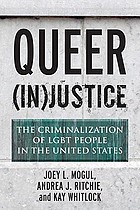
The third installment in Beacon Press’s Queer Action/Queer Ideas series, edited by Michael Bronski, Queer (In)justice: The Criminalization of LGBT People in the United States is co-authored by law professor Joey L. Mogul, police misconduct attorney Andrea J. Ritchie, and community organizer Kay Whitlock. Hanna saw it on the new book wall at the library and correctly ascertained it was the sort of title I’d be interested in. So she brought it home, I read it, and now I’m gonna blog about it.

Queer (In)justices is far more than an examination of the ways in which our legal system polices “deviant” gender and sexuality qua gender and sexuality. Yes, the authors look at the laws and policing practices related specifically to penalizing folks who engage in (publicly or privately) non-heteronormative sexual practices, or whose appearance suggests that they identify outside the gender/sex/sexuality binary. However, their analysis goes much deeper than these targeted laws. Instead, they argue that “the policing of sex and gender ‘deviance’ is central to notions of crime, and serves both as a tool of race-based law enforcement and as an independent basis for punishment” (xiii). In other words, notions about the relationship between non-normative sex and gender expression and criminality influence the way in which the legal system treats people perceived to be queer whether or not they are caught in the system specifically because of sex- or gender related policing. As they argue:

As queer identities substituted for individual perverse acts [in the late nineteenth century]  the process of criminalizing sexual and gender nonconformity was facilitated through the construction of ever-shifting and evolving archetypal narratives [of deviance]. Rooted in historical representations of Indigenous peoples, people of color, and poor people as intrinsically deviant, fueled and deployed by mass media and cultural institutions, these narratives now permeate virtually every aspect of the criminal legal system (19).

They make a compelling case for us to question the usefulness of narrowing our focus specifically on anti-gay laws, and on enacting new laws seeking to protect LGBT people from homophobia … particularly when the very law enforcement officials meant to ensure those laws are respected are among the primary culprits when it comes to bigotry and violence around sexual and gender nonconformity.  In chapters on gender and sex policing on the street, in the courtroom , in prison, and in uneven police responses to violence against LGBT people, we see how presumptions of criminality systematically influence how queer people are treated in the context of the legal system, whether they are perpetrators, victims, or both. They make the particularly important point that, regardless of what laws are officially on the books, “police and other law enforcement agents are given considerable latitude in deciding which laws to enforce, how to enforce them, and which people to target for law enforcement” (48).*

Being queer, or being perceived as queer can cause law enforcement officials to treat individuals as criminally guilty whether or not they actually are — and can bring harsher punishments (when compared to those perceived as straight and gender conforming) when those individuals are sentenced. Likewise, criminal behavior is often associated — implicitly or explicitly — with sexual depravity. Using examples that will be familiar to anti-sexual harassment or anti-sexual violence activists, Mogul, Ritchie, and Whitlock describe how individuals known or perceived to be queer are treated by law enforcement officials as if they are incapable of being victims of sexual violence. They describe victims of same-sex domestic violence who themselves were put in jail or ruled incapable of being abused because of their orientation or gender identity.

Ultimately, Queer (In)justice argues that LGBT activists must take a much more comprehensive approach to their agitation for change within the framework of law and law enforcement. While much of the mainstream LGBT work in this area in recent years has involved the quest to enact anti-discrimination and anti-hate crime legislation, and to grant same-sex couples the right to marry, Mogul, Ritchie, and Whitlock point out that a much broader cultural shift within law enforcement must take place in order for such changes in the law to have an on-the-ground effect. As they write, “The hate crime framework is … compromised by placing primary responsibility for preventing violence in the hands of a criminal legal system that is itself responsible for much LGBT violence” (129). We would do well, they seem to be pointing out, to pay closer attention to the experiences of those most vulnerable to police brutality, discrimination and abuse sanctioned by the legal system, and persecution based on presumptive criminality … not just because of their sexual identity, but because their mere presence as a non-conforming body evokes powerful notions of danger and violence whether or not these reactions are warranted in specific instances. Comprehensive reform is needed before the passage of laws will have real-world implications for the majority of the LGBT population.

Queer (In)justice is a must-read for anyone who wants to re-consider the current LGBT approach to legal reform.

*This point is exactly why I am uneasy with Jim Wallis’ argument that police force is preferable to military force. Wallis’ assumption that police only use force when it is necessary to enforce agreed-upon laws ignores all of the situations in which law enforcement officials abuse the power vested in them … something which, as a person who works in anti-poverty and anti-racism circles, Wallis ought to know full well.

booknotes: arms wide open

23 Thursday Jun 2011

Posted by Anna Clutterbuck-Cook in book reviews

≈ 2 Comments

Tags

children, feminism, gender and sexuality, history, memoir

There is a point toward the end of Patricia Harman’s Arms Wide Open: A Midwife’s Journey (Boston: Beacon Press, 2011) when author offers us another of the many particular birth scenes that punctuate the overarching narrative. It is the late 1970s and, after nearly a decade delivering babies as a lay midwife, Harman has entered medical school to become a Certified Nurse-Midwife. She describes the labors of a woman named Carla who will eventually deliver a son whom she names Joe. As the child is about to crown, the following scene takes place:

M.R. [Mary Rose, Harman’s mentor] lets go of my hands and reaches for a pair of scissors. At first I assume she’s getting ready to cut the cord, though the head’s not out yet, but she nudges me with her elbow and forces the scissors into my hand, then injects Xylocaine into our young patient’s perineum. Now I know what she wants me to do … cut an episiotomy.

So here I sit. The head of a dark-haired infant crowning before me. I know how to get this baby out without a laceration or episiotomy in two minutes, if Mary Rose and the enthusiastic nurse would leave me alone, but I am the student, enrolled to learn.

I take the scissors and cut, feel the skin crunch between the blades, see the blood ooze … and deliver the baby. It’s not a good feeling, but it’s done. The very pink body swivels out, Mary Rose cuts the cord, and the RN takes the tiny boy to the infant warmer.

“If the heart rate’s down, you have to cut an episiotomy right away,” Mary Rose whispers, “The OBs watch us, and if you hesitate, they’ll start coming in to every delivery to supervise.” She looks at the door. “We don’t want that” (246).

This scene is, I would argue, the hinge upon which this memoir turns. Arms Wide Open is a memoir in three parts. Part one (“Little Cabin in the North Woods, 1971-1972”) and part two (“Commune on the Ridge, 1977-1978”) are episodic accounts of Patricia Harman’s decade of experiments in communal, backwoods living. From an isolated cabin outside of Duluth, Minnesota to an intentional community in South Carolina, we follow Patricia Harman, her lover, her future husband, her sons, and a motley group of fellow-minded travelers through the ups and downs of community life. “Commune on the Ridge” ends with Patricia and her husband Tom’s joint decision to pursue medical degrees (he in women’s health, her as a midwife) — a decision which took them away from the commune and back into the mainstream frameworks of institutional education, hospital-based medicine, and city life. Part three (“Cedar House on Hope Lake, 2008-2009”) jumps ahead to the present, with reflections back upon some of Harman’s training and the years she and her husband worked together running a women’s health clinic. Each section is, in some ways, in dialogue with the other sections as the reader is invited to compare and contrast each location and living arrangement Patricia and her family create for themselves with their previous and future locations and arrangements.

The strength of Arms Wide Open is the immediacy of its narrative. In recreating her personal history, Harman has drawn heavily on journals she kept during the years she describes, and the resulting text bears the marks of that internal narrative: we experience the events in the book through Patsy’s senses, and what meaning is made of those events is made less through present-day commentary than with the voice of (possibly imagined) Harman’s younger self. Arms Wide Open is executed with loving care, and provides an unvarnished look at the struggles and disillusionment, as well as the joys of communal experimentation. For anyone interested in experiencing communal life vicariously through personal narrative, Arms Wide Open comes highly recommended.

It is this very sense of immediacy, however, that contributes to what I felt was one of the book’s central weaknesses: the lack of any larger framing narrative, any strong present-day voice that would exert autobiographical force upon these episodic scenes and encourage us to understand not only how Patsy-of-the-moment made sense of her life, but how Patricia Harman presently understands her past experience. I finished the book with lots of unanswered questions about how Patsy of the backwoods commune became Patricia the Certified Nurse Midwife working in a women’s clinic. It is possible that some of those questions may be answered in Harman’s first memoir, The Blue Cotton Gown (2008). At some point I may go back and read that volume. However, the point remains that readers coming to Arms Wide Open without the background of Cotton Gown are left wondering at the underlying values and choices that led Harman first in to, and then away from, the backwoods communal life. She hints around the edges about a background in New Left political action, anti-war protests, and even some jail time. The narrative implicitly endorses a very specific vision of responsible living on the earth, of childbirth and childcare, of gender and sexuality — yet the narrator never steps back from the moment to write in more overarching ways about how her politics and values have (or have not) changed over time.

I would have been very interested to know how she sees her present-day work connected (or not) to her earlier experiences, philosophically and practically. The final section, particularly, contains a lot of sadness and sense of displacement — while Harman and her husband seem to have found ways to live out their values in a more mainstream context, there is also a pervading wistfulness and at times outright pain at the way in which their lives have not played out as they hoped or expected. There is a sense that, having given up the communal way of life, Harman is not sure how to live out her most deeply-held values in a less unconventional context. Although she describes interacting with anti-war protestors and midwives who are a generation or two her junior, she seems profoundly isolated from the counter-cultures of the present day (of which, I would argue, there are plenty!). This loss of fellow travellers within the narrative speaks to me particularly, since I have spent many hours interviewing counter-culture-leaning folks from Harman’s generation about their past and present lives … and how they do and do not forge connections across age cohorts. In such an age-stratified society such a project can be difficult — even radical — but I would argue that to tie radicalism to a particular generation or stage in life is a deadly impulse if what we want to create is lasting social change.

On a similar note (although I imagine it is not her story to tell), I would also have been interested in her children’s reflections on the experience of early childhood in a communal household — and how they feel it shaped their own values and expectations as they grew into adulthood. From passing references toward the end, it sounded as though all three of Harman’s sons had chosen outwardly conventional life paths. Outward appearances can be deceptive (I could write my own biography to sound exceedingly conventional), but I would have liked further exploration into the whys and wherefores of Harman’s family as it came of age.

Ultimately, this is recommended reading for anyone who is interested in counterculture living, midwifry and childbirth, the historical period of the 1970s, and the art of memoir. If you’ve read The Blue Cotton Gown I’d be interested to hear your views on how the two books work together, and whether any of the silences I have mentioned above continue throughout.

$1 reviews: god’s politics

14 Tuesday Jun 2011

Posted by Anna Clutterbuck-Cook in book reviews

≈ Leave a comment

Tags

politics, religion

Now that my reading is no longer dictated by my thesis research I find that … well, I read more or less the same mix of stuff that I read while I was writing. Including the scary books about religion and politics. While Hanna’s parents were here a couple of weekends ago and we went shopping at the Brookline Booksmith, I picked up a copy of Jim Wallis’ God’s Politics: Why the Right Gets it Wrong and the Left Doesn’t Get It  (New York: Harper, 2005). Jim Wallis is one of the founders of Sojourners, an evangelical social justice organization that grew out of anti-war activism during the 1970s. To this day, Sojourners is active in anti-war, anti-racism, and anti-poverty work. They have tried to exist, as the subtitle of Walli’s book suggests, as a third way in the American religio-political landscape: progressive on some social justice matters while also remaining very conservative in some issues I would argue are also social justice questions — but which Wallis sees as divisive “culture war” issues (i.e. gay marriage and abortion). Recently, Sojourners came under fire from some more queer-inclusive religious groups for rejecting an ad submitted to its magazine from an LGBTQ Christian organization. Given the recent buzz, when I saw a copy of God’s Politics at the store I decided it was time for a re-read.

I vaguely remember reading the book when it came out right after the 2004 election. Mostly, I remember feeling fairly certain that Wallis didn’t “get it” when it came to characterizing leftist politics … since most of his criticisms of leftist activists (people he often characterizes as “secular fundamentalists”) bore little resemblance to the people who I understood as left-liberal. I can’t say that my overall impression, upon re-reading God’s Politics six years later, has changed. I still feel the book is condescending towards those whose politics fall to the left of Wallis’ (I’ll return to this below) and I think that he’s trying a little too hard to have his cake and eat it too.

Take, for example, the “culture war” issues he tries to dismiss as meaningful political topics. He wants to claim that evangelical Christians can stand at once for the full human rights of queer folks while continuing to exclude gay people from full participation in church life. He argues that they can be “pro-life” but also feminist, while defining “pro-life” in a way that actually makes him politically pro-choice. While I agree with Wallis that it is possible to be personally against abortion, and to work to reduce the need for abortion, without robbing women of the ability to make necessary decisions for themselves and their families, I find it offensive that he makes what is essentially a reproductive justice argument and yet re-frames it as something that is distinct from (and superior to) the arguments of feminist activists. While I’m not against trying to re-claim “pro-life” as a more comprehensive idea — anti-death penalty, anti-war, reproductive justice — for Wallis to act as if by using the term he can change its political meaning overnight is naive at best and disingenuous at worst.

I also grew very tired of his use of language like “moral” and “values” as if religious folks have a monopoly on morality and ethics. Assuming as he does that religious folks are better at thinking and acting “morally” than their secular peers, I feel that he is blind to non-religious possibilities for some of the problems he diagnoses in American society. His reflexive support for normative family structures, and his assertion that children thrive best in two-parent (by implication heterosexual) families, for example, fails to ask deeper questions about how we might re-form our understanding of family to meet the needs of all people, regardless of their marital status, age, sexual orientation, or other social ties. In his efforts to appease the Christian right, I can’t help feeling that he missed an opportunity to imagine new ways of caring for one another that actually fit quite well into Biblical visions of community as well as dovetailing with very left-radical notions of how non-traditional families might be recognized and honored.

He also loses me when he writes about the degradation of modern culture and the need to re-affirm the value of nuclear family life in language full to bursting with nostalgia for the 1950s that never was. While he never overtly calls for a return to “father knows best,” his recourse to the politics of disgust over hypersexualized television commercials and the comic book violence of Van Helsing (really? that’s the movie you found worthy of condemnation??) amounts to a recoil from modern popular culture that suggests he would be more comfortable if such things would just disappear. I’m always confused by this argument, since surely if you don’t like the violence of Van Helsing or the ideas about human nature found in reality television shows you can turn the television off. Or you can engage in deconstruction and analysis of the show’s messages.  (Perhaps he should read Jennifer Pozner’s Reality Bites Back?) In these moments of recoil and the impulse to make the icky thing just go away I feel Wallis betrays his mid-century evangelical youth, when even films like “The Sound of Music” were Godless indulgences.

Wallis’s strength lies, unsurprisingly, in the sections where he writes about nonviolence and economic justice. I was particularly struck by his insistence on positive alternatives to war as the only effective way of breaking down the notion that violence will somehow bring about a more peaceful world. “If nonviolence is to have any credibility, it must answer the question that violence purports to answer, but in a better way” (160). I was not particularly satisfied with Wallis’ nonviolent solutions (he distinguishes “military” from “police” enforcement without recognizing that in many parts of the world, “police” are justifiably seen as perpetrators of, not protectors from, violence) but I appreciate that he realizes that simple opposition to violence is not an effective political position. I also think he is on much firmer theological ground when arguing that the God of the New Testament (and Jesus) have an inherently anti-war message, and that the Bible calls on us to care for the most vulnerable members of the human community.  In some ways, I wish that he had stuck to these two messages rather than trying to forge a “middle way” between social justice and cultural conservatism — since I think his capitulation to cultural conservative ultimately undermines his claims for the latter.

quick hit: I’m live-blogging ‘feminism for real’

07 Tuesday Jun 2011

Posted by Anna Clutterbuck-Cook in book reviews

≈ Leave a comment

Tags

blogging, feminism, harpyness, live-blogging

This morning over at The Pursuit of Harpyness, I started a series of 22 “live blogging” posts on Jessica Yee’s new anthology Feminism For Real: Deconstructing the Academic Industrial Complex of Feminism (2011). I’ll be posting my reading notes for each chapter on Tuesday mornings for the next few months.

Please do join us!

booknotes: feel-bad education

02 Thursday Jun 2011

Posted by Anna Clutterbuck-Cook in book reviews

≈ 1 Comment

Tags

children, education, politics

Alfie Kohn’s latest collection of essays, Feel-Bad Education; and Other Contrarian Essays on Children and Schooling (Boston: Beacon, 2011) was one of the books I read while on vacation in Michigan last week. Kohn as been writing “contrarian” books on schooling and childcare for going on two decades now, and anyone who has read his previous work will find little of surprise in this latest volume, which contains mostly previously-published pieces from between 2004-2010. However, for those of us who don’t subscribe to the wide variety of education periodicals he wrote them for, this book is a great opportunity to sit down and read them in one sitting (and not on the internets!).

I’m not sure how Kohn reads to a skeptic. Ever since devouring his No Contest (1989) and Punished By Rewards (1993) as a teenager, I’ve been following Kohn’s work, which dovetails more or less with my own understanding of human motivation, effective learning, and what it means to live the good life. In other words, when it comes to me he’s preaching to the converted. However, I suspect that Kohn might be one of those authors who — while fitting in very well with the philosophy of self-directed education I prefer — is able to speak about radical childcare and pedagogy without reflexively alienating those who choose more mainstream (institutional) forms of education and childcare. In large part because unlike many other activists in this area, he hasn’t given up on schools as institutions, and continues to believe that teachers within the system of formal education can implement more holistic modes of facilitating learning.

The essays are organized thematically, but all more or less stand on their own. A few specific essays stood out in my own estimation, and I thought I’d use the remainder of this post to highlight those. I encourage you to read the book yourself and find the ones that speak to you! (When I’ve been able, I’ve linked to the online versions of these articles found at Kohn’s website)

In the first section, Progessivism and Beyond, is the essay “Getting-Hit-On-the-Head Lessons,” which argues that the “better get used to it” argument for saddling young children with unappealing tasks (as preparation for, it seems, an adulthood of drudgery) is based in some pretty faulty assumptions about how human beings cope with what my friends and I sometimes refer to as the “fuck my life” experiences of living:

This leads us to the most important, though rarely articulated, assumption on which BGUTI [better-get-used-to-it] rests – that, psychologically speaking, the best way to prepare kids for the bad things they’re going to encounter later is to do bad things to them now. I’m reminded of the Monty Python sketch that features Getting Hit on the Head lessons. When the student recoils and cries out, the instructor says, “No, no, no. Hold your head like this, then go, ‘Waaah!’ Try it again” – and gives him another smack. Presumably this is extremely useful training . . . for getting hit on the head again.

But people don’t really get better at coping with unhappiness because they were deliberately made unhappy when they were young. In fact, it is experience with success and unconditional acceptance that helps one to deal constructively with later deprivation. Imposing competition or standardized tests or homework on children just because other people will do the same to them when they’re older is about as sensible as saying that, because there are lots of carcinogens in the environment, we should feed kids as many cancer-causing agents as possible while they’re small to get them ready.

To me, the BGUTI principle extends beyond homework to such experiences as fraternity pledging, street harassment, and the grueling experience of medical school residency rotations. BGUTI is basically just hazing … for life. It reminds me of a recent post my friend Molly @ first the egg wrote about the willingness of adults to minimize the suffering they experienced at the hands of bullies when they were children, because they feel like somehow the bullying experience made them stronger.

In section three, Climate & Connections: How Does School Feel to the Students? there is a delightfully insightful essay titled “The Value of Negative Learning,” in which Kohn ponders what it takes to make a radical educational activist — given that the majority of contrarian educators themselves grew up within the mainstream mode of education. He writes:

So how is it that some folks emerge with an understanding that traditional education is unhealthy for children and other living things, and with some insight about why that’s true (and what might make more sense instead), and with a commitment to show the rest of us a better way? How did they get here from there?

I suspect the key is a phenomenon that might be called “negative learning,” in which people regard an unfortunate situation as a chance to figure out what not to do. They sit in awful classrooms and pay careful attention because they know they’re being exposed to an enormously useful anti-model. They say to themselves, “Here is someone who has a lot to teach me about how not to treat children.” Some people perfect this art of negative learning while they’re still in those environments; others do it retrospectively, questioning what was done to them earlier even if they never thought – or were unable – to do so before. Some people do it on their own; others need someone to lend them the lens that will allow them to look at things that way.

Of course, a mind-numbing, spirit-killing school experience doesn’t reliably launch people into self-actualization, intellectual curiosity, or a career in alternative education. If it did, we’d want everyone to live through that. Nontraditional educators had to beat the odds, and they’ve set themselves the task of improving those odds for other children, creating places where the learning doesn’t have to be by negative example.

As someone who survived college in large part by intellectualizing the experience (there was good classroom learning and not-so-good classroom learning, but regardless I was taking mental notes on the culture of institutional learning) I was drawn to his image of the survivor as one who learns from the negative … but refuses to interpret that learning as necessary (the BGUTI argument). Rather, the “negative learner” never loses their sense of perspective: their belief that there can, and will be, other ways of growing. And the negative learner who turns into a social justice activist is the person who steps beyond questions of their own personal well-being and asks, “how can I make the world a better place for others too?”

In the final section, Beyond the Schools: Psychological Issues & Parenting, Kohn expands on the idea of unconditional acceptance as a path toward learning and social responsibility. The book-length version of this argument may be found in his book Unconditional Parenting (2005). My favorite article in this section was one called “Why Self-Discipline is Overrated.” The idea of self-discipline or self-regulation is one that often finds adherents in both conservative and liberal circles. Kohn argues that behind the rhetoric can often lie internalized feeling of inadequacy and anxiety that undermine true learning:

More generally, self-discipline can be less a sign of health than of vulnerability.  It may reflect a fear of being overwhelmed by external forces, or by one’s own desires, that must be suppressed through continual effort.  In effect, such individuals suffer from a fear of being out of control. 

He suggests that the reflexive fall-back of encouraging self-discipline as a moral value, even within otherwise liberal-progressive-radical (whatever-the-shit-label-we’re-using-today) circles undermines the very view of human nature that many WTSLWUT individuals would consciously espouse:

What’s interesting about all this is how many secular institutions and liberal individuals, who would strenuously object to the notion that children are self-centered little beasts that need to be tamed, nevertheless embrace a concept that springs from just such a premise. Some even make a point of rejecting old-fashioned coercion and punishment in favor of gentler methods. But if they’re nevertheless engaged in ensuring that children internalize our values – in effect, by installing a policeman inside each child – then they ought to admit that this isn’t the same thing as helping them to develop their own values, and it’s diametrically opposed to the goal of helping them to become independent thinkers. Control from within isn’t inherently more humane than control from without, particularly if the psychological effects aren’t all that different, as it appears they aren’t.

Even beyond the vision of human nature, a commitment to self-discipline may reflect a tacit allegiance to philosophical conservatism with its predictable complaint that our society — or its youth — has forgotten the value of hard work, the importance of duty, the need to accept personal responsibility, and so on. (Never mind that older people have been denouncing youthful slackers and “modern times” for centuries.) And this condemnation is typically accompanied by a prescriptive vision that endorses self-denial and sarcastically dismisses talk about self-exploration or self-esteem.

I hope that with these snippets of pieces I’ve whet your appetite for more, even if it’s only so that you go and read the whole piece in order to argue with it!

Stop back in this time next week for something a little fluffier reviewed: Napoleon … with dragons!

← Older posts
Newer posts →
"the past is a wild party; check your preconceptions at the door." ~ Emma Donoghue

Recent Posts

  • medical update 11.11.22
  • medical update 6.4.22
  • medical update 1.16.2022
  • medical update 10.13.2021
  • medical update 8.17.2021

Archives

Categories

Creative Commons License

This work by Anna J. Clutterbuck-Cook is licensed under a Creative Commons Attribution 3.0 Unported License

Meta

  • Register
  • Log in
  • Entries feed
  • Comments feed
  • WordPress.com

Blog at WordPress.com.

  • Follow Following
    • the feminist librarian
    • Join 36 other followers
    • Already have a WordPress.com account? Log in now.
    • the feminist librarian
    • Customize
    • Follow Following
    • Sign up
    • Log in
    • Report this content
    • View site in Reader
    • Manage subscriptions
    • Collapse this bar