• anna j. clutterbuck-cook
  • contact
  • curriculum vitae
  • find me elsewhere
  • marilyn ross memorial book prize

the feminist librarian

the feminist librarian

Category Archives: book reviews

‘the future of marriage’ live-blog: what marriage is

09 Thursday May 2013

Posted by Anna Clutterbuck-Cook in book reviews

≈ Leave a comment

Tags

family scholars blog, live-blogging, marriage equality, married life

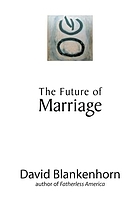
Welcome to part four of my live-blog reading of David Blankenhorn’s The Future of Marriage (2007). You can read part one, part two and part three here. 

We began The Future of Marriage by asking “What is marriage?” Despite acknowledging that “there is no single, universally accepted definition of marriage” (11; emphasis his), David B. seems hellbent on coming up with just such a definition. Without one, he seems to feel, all of our discussions about marriage law — and particularly the desire to be more inclusive in American society regarding what forms marriage and family might legitimately take — are specious.

So in chapter five, after our exploration of definitions he feels are too vague or over-inclusive, our romp through prehistory, and our case-study exploration of Mesopotamia and the Trobriand islands, we circle back around to the question of defining marriage. But this time rather than posing a question, David B. is offering and answer: the chapter title is “What Marriage Is.”

The chapter opens:

In all or nearly all human societies, marriage is socially approved sexual intercourse between a woman and a man, conceived as both a personal relationship and as an institution, primarily such that any children resulting from the union are — and are understood by society to be — emotionally, morally, practically, and legally affiliated with both of the parents (92). 

This is David’s working definition of what marriage is. He goes on to argue that it is “a way of living rooted in the fundamental physiological and biochemical adaptation of our species … constantly evolving … [yet it] also reflects one idea that does not change: For every child, a mother and a father” (92).

This definition of marriage has obvious implications for the legitimacy of marriage in the lives of couples like myself and my wife: how does it include marriages within which no children are biologically procreated between the two spouses? how does it include marriages with children wherein the parents are of the same sex and/or gender? However, before we get to that part of David B.’s thought process (he does address those issues later in the chapter), I’d like to point out a few things about this definition qua definition.

  • To claim that in all times and in all places there is one idea about marriage that does not change is an awfully big claim. Certainly, scholars are fond of grand claims; that doesn’t mean we aren’t also vulnerable to having our grand claims deflated when those claims rest upon a shaky scaffolding of evidence. And in this instance, the scaffolding isn’t a whole lot: a survey of contentious evopsych literature and two geo-temporal locations in which marriage was practiced in two very different ways, but both included childcare on some level.
  • Following from the broad scope of the claim comes the fairly random/convenient selection of child-rearing as the core concept behind marriage. Based on Blankenhorn’s own examples,we could just as easily make the argument that the core concept of marriage was to regulate sexual activity, to formalize extended family relationships into the next generation, or celebrate the pair-bond of a couple by the larger community. All of these features were present in both cases, so why pick the mother-father-childcare option? To my understanding, most historians exploring the history of marriage and family life would identify a cluster of concepts and behaviors around which marriage circles, some aspects rising to the fore in certain eras or cultures, others in a different period among another group of people. I don’t think anyone (well, probably someone, but certainly not any mainstream theorist) would deny that for most cultures throughout history the provision of care for the young (and the elderly!) is an important feature of family life. And marriage has often been a vehicle for securing familial structures for the following generation(s). It doesn’t follow, however, that we can therefore reduce the meaning of marriage to parent-provision. We actually provide parents (and other care-givers) for children in multiple ways, only some of which involve marriage. Adoption, fostering, recognition of bastards, even prison, all have served to provide children with some sort of care (however lacking) until they are old enough to start earning their own keep.
  • Finally, I just want to note this question of providing children with both “a mother and a father.” David B. clearly believes that children have a right not only to know their biological origins — that is, which two persons (and probably under what circumstances) provided the sperm and egg from which the child was formed — but also to be raised by both biological parents. This is a multi-level claim that I am uncertain can be adequately dealt with in the context of a conversation about marriage, since it raises issues that are not contingent upon marriage. 
    • We certainly have, in modern America since the 1970s, a strong tradition of privileging the right of a birth parent(s) with presumptive legal rights: unless a birth mother specifically surrenders her parental rights, and often the biological father a well, they are — barring proven abuse — the adults responsible for the welfare of the child. This is irrespective of any marital relationship between the two parents. So independent of marriage a child is entitled to their biological parents unless other provisions for parentage have been made. And even then, there is a strong movement toward ensuring a child access to the information surrounding their biological origins in instances where they are not raised by their biological parents. 
    • But David B. is going beyond the right of a child to know; he’s making the argument that children have a right to be functionally parented by both biological parents — and that marriage between the two bio parents is both the primary and the best vehicle for such an activity. I won’t argue with him that, in modern America at least, this is the dominant model for parenting. Statistically speaking, it appears that the majority of children are growing up in households in which the primary care-giving adults are also their biological and legal parents. Arguing that this is the best model, in a universal sense — the model most likely to result in child well-being — is a much more complicated discussion. Blankenhorn has, thus far in The Future of Marriage, not made a convincing case (or, really, any case at all) for the married bio-parent model being superior to all other models, and explained on what grounds such an argument might rest.

What are the implications of this definition of marriage for same-sex couples who are (or desire to be) married? And where does such a definition leave couples who are not planning (or are unable) to procreate and/or parent? Blankenhorn ignores the demographic of female-male couples who are not directly procreating (they still fit within his model of male-female parents in type if not in functional fact) and focuses on the case for same-sex couple inclusion within this definition of marriage. I’m not going to tackle every point he makes inthis chapter, but two facets of his argument struck me:

  • He argues that “the leading proponents of same-sex marriage in the United States today … studiously avoid any implication that marriage is connected to sex. Instead, they insist that marriage is an abstract and radically non-physical ‘relationship’ that is separate and apart from, you know, what people do in the bedroom” (92). Ahem. Well, first of all, I gotta say my wife and I don’t always do it in the bedroom, but … wait, what? Did he actually just make the argument that LGBT rights activists have separated sex from marriage?? …. o_O. I think this is an example of fairly serious mis-interpretation if not intentional mis-construction of the pro-marriage equality case. Here are a few observations that spring to mind:
    • Most egregiously, the charge that LGBT folks avoid speaking about sex in the context of their primary intimate relationships ignores the context of virulent and systemic discrimination we’ve experienced, historically, when we dare to speak about same-sex sexuality in public. I’m going to repeat that: Arguing that it is lesbian and gay couples and their allies who are primarily responsible for erasing “the bedroom” from definitions of marriage is an argument born of heteronormative privilege. 
    • How often do heterosexual couples talk about their sex lives in the context of public marriage-related proceedings? I recently came across a reference in another book on marriage to a (heterosexual) couple whose marriage vows had included the promise to be one another’s “lovers” — wording that many wedding guests had felt inappropriate to the occasion. I rather suspect this is a situation wherein David B. is holding such conversations to a double-standard of sexual transparency, suspicious that same-sex relationships are not sufficiently sexual to be considered marriages (which I have to say has got to be a first in terms of charges leveled at the queer community!) and thus we need to prove our sexual credentials in order to truly belong. While straight sex is just assumed.
    • Wait … who exactly is making these arguments? I want names, dates, quotations, and citations. More than cherry-picked courtroom definitions (which are often designed to be flexible and contextual, because that’s how our legal system works), I want evidence that there’s some sort of systematic campaign on the part of same-sex marriage proponents to de-couple sexual intimacy from marriage.
    • Finally, a word in support of my asexual friends and others for whom sexual intimacy is actually not a central component of their marriage relationship(s): Arguing that not all marriages include sexual intimacy is not equal to claiming that sexual intimacy is outside the bounds of marriage, or somehow not central to most marital relationships. For many, I daresay most, married people, sexual intimacy is (or has been, or will be) a component of married life. But that’s not the same as requiring sexual intimacy to be a part of married life. Just like procreation and/or parenting is a part of married life for many people (I think I saw a number recently that claimed about 80% of all married couples raise children together?) but isn’t a requirement to marriage. We don’t ask couples seeking a marriage license whether they are sexually active together and/or whether they intend to procreate. People who argue that sexual activity with one’s partner is not an essential part of marriage are likely arguing simply that: sex is not a required component of marriage. That is not the same as removing sexual intimacy from our cultural understanding of what many or most marriages encompass.
  • Why all the angst over a “big umbrella” definition of marriage that can encompass many more (religiously- or subculturally- or even individually-specific) definitions within it? Because David believes that in order for marriage to be viable it must be a strong social institution with a widely agreed upon meaning. He writes: “I can never assume that another person shares my view … [a clear, centralized definition of marriage] establishes an ‘ought’ not just for me alone, but for everyone who is or wants to be part of the institution, including (I have good reason to believe) the person I will marry” (98). Excuse me while I get out the sad trombone … because this particular concern that we have definitions we can count on meaning the same thing to all people without actually clarifying with the people in question in so many words strikes me as a profoundly majority-culture presumption. Maybe it’s because I grew up in many ways a minority within a majority culture. My immediate family (and later myself, as an individual) differed in our values in many ways from the families and institutions around us. I never got to assume people held the same values I did. I always had to clarify, converse, ask. Communication is a good thing, and should be happening between partners as they decide whether or not to marry. To take David B.’s example (97-98), if “fidelity” to one person means only ever having sex with your marital partner, and to the other person it means the spouse being your primary relationship but includes sexual experiences with others — well, then you’ve got to discuss that and decide how to come to a meeting of minds and hearts on the subject (or go your separate ways). David B. seems to be rather appalled by this diversity in human relationship organization; I just see it as an opportunity for important clarifying conversation.
As we turn to chapter six, “Deinstitutionalize Marriage?” this question of shared assumptions looms large. Blankenhorn fears that big tent definitions of meaning within a pluralistic society will lead to a weakening of smaller-group understandings and thus to a loss of marriage as a key life event within our culture (something he obviously views as a negative thing). He also (circa 2007) views proponents of same-sex marriage as primarily interested in this pluralization (or, as he frames it, “deinstitutionalization”) of marriage, and perhaps using marriage equality campaigns as a Trojan horse approach to bringing about the downfall of marriage-as-institution once and for all.
I’ll be exploring those fears next time! Stay tuned.

‘the future of marriage’ live-blog: the river valleys & the trobrianders

07 Tuesday May 2013

Posted by Anna Clutterbuck-Cook in book reviews

≈ Leave a comment

Tags

family scholars blog, live-blogging, marriage equality, married life

Welcome to part three of my live-blog reading of David Blankenhorn’s The Future of Marriage (2007). You can read part one and part two here. 

Following his introduction, defining his core question (“what is marriage?”), and a romp through prehistorical mating and family formation, David B. turns his attention to two case-studies, if you will, of cultures in which marriages serve an important role in family formation. We’re moving, in this case, away from the entirely speculative to slightly firmer ground, as the primary source material for early human civilizations is a bit more robust. In chapter three (“The River Valleys”), Blankenhorn draws on art and artifacts, and the work of historians and archeologists who study the ancient world. In chapter four (“The Trobriand Islands”), he turns to the work of ethnographers (from the West) who have studied the lives and culture of the native people of the the Kiriwina islands in Papua New Guinea over several generations, beginning in the early twentieth century with Bronislaw Malinowski’s work. We’ll return to chapter four below, but first let’s take a look at chapter three.

Chapter Three: “The River Valleys”

  • This chapter opens with a visit to the Metropolitan Museum of Art in NYC, and two plaques from lower Mesopotamia, circa 2000-1000 BCE. One plaque depicts a female-male couple in the midst of penis-in-vagina intercourse. The other shows a couple, clothed and facing one another in an intimate embrace. Blankenhorn’s interpretation of this plaque is one of an early image of social (rather than sexual) couple intimacy. I’m comfortable with that interpretation. What I’m less comfortable with is his dismissal of the sexually-explicit plaque, and others like it, as “almost pornographic,” (almost?) “as if intended for entertainment and (primarily male) sexual arousal” (43). I’m — what? First of all, I’d call a plaque depicting naked fun sexytimes as straight-up porn. I mean, I suppose you could quibble that the term is anachronistic, okay, but it’s certainly sexually explicit. And wherefore have we suddenly decided it was designed for “primarily male” arousal? Sounds to me like the lady in question is having a fairly good time — from David’s description, she’s on top/in front of the standing male partner, with her legs wrapped around his hips as she rides him. That takes initiative, and would be a fairly good angle by which to have one’s ladybits stimulated. So I’m not sure why the imagery suggests men only — except if you assume porn is an all-male preserve. Which in turn tells me something about your perspective on gender and sexuality.
  • Exploring the Code of Hammurabi (circa 1750 BCE) and other ancient marital practices, David B. dismisses the notion of women being bought and sold as wives to be “nonsense,” and the notion of a “bride price” to be “misleading” (50). He contends, instead, that gifts were exchanged between families and therefore … equality! His point here is, I think, to push back against a narrative of marriage that some political activists and scholars, including many feminists, put forward which is that it is inherently an oppressive and patriarchal institution. The origins of marriage, some feminists conclude, is so corrupt that it cannot be redeemed as a social practice that embraces gender equality and diverse family forms. I have two thoughts on this push-pull undercurrent (which will resurface again, with more virulence, in later chapters):
    • First, I think that David B. has an exaggerated sense of how widespread anti-marriage sentiment is in the present day. I think he’s cherry-picking again. Yes, obviously, you’re going to find scholars and activists who rail against marriage as tantamount to sexual slavery or indentured servitude. In some eras, and in some cultures, that charge holds more weight than in others. American women in the 1840s, for example, had a case to make that the laws of coverture — which legally erased their independent existence — were unjust, a violation of their dignity and worth as human beings. But America as a nation is one of the most pro-marriage cultures in the world, so the fact that he’s writing as if he’s discovered a great conspiracy of scholars to make marriage seem evil is kinda undermining his case. It cues into right-wing accusations of liberal bias within the academy which just aren’t all that persuasive without much more evidence than David B. provides. 
    • Second, I am concerned that his sense of marriage being under siege from some anti-marriage lobby is causing him to ignore certain historical evidence that doesn’t fit with his own desire for a history of strong marriage culture in the river valley cultures. History is complicated, and always a matter of interpretation on some level. Obviously. So he’s free to make the case that Mesopotamian marriages show signs of a more egalitarian principle than other scholars have argued. But he needs to make that case: acknowledging what other scholars in the field have said before him, and articulating where he thinks they’ve gone wrong based on the evidence. This chapter is full of vague references to “some scholars” and “others have suggested,” none of which references are directly footnoted (50). I know I’m a footnote-crazed historian, but I like my sources documented. And as a feminist, I’m also concerned that in the interest of his pro-[a certain vision of]-marriage agenda, he’s glossing over ways in which some marriage practices in some cultures over time have, indeed, been extremely patriarchal and have absolutely involved “bride price” tributes between families. To call the identification of such material exchange “nonsense” erases the experience of women whose marriages were (and in some cases continue to be) subject to such arrangements. He describes such non-egalitarian practices the “patriarchal distortion,” a turn of phrase that suggests the original, the real form of marriage (this river valleys model) was, in fact, gender-egalitarian. I’m unsure how this helps his case with marriage skeptics, since however pure the original model might have been, the derivatives still existed (and continue to exist) and are still frameworks for coercion. To erase the coercive forms from history is an act of violence toward those who had to live within them.
  • Throughout this chapter, we see again the desire to come up with One True Definition of Marriage for All Time and in All Places, despite the earlier acknowledgement that there has never been one. On page 55, for example: “We moderns often seem to assume that couples long ago were not as emotionally aware as we are today … For almost all of humanity, marriage has always and in all places ‘really’ been about the male-female sexual bond and the children that result from that bond. That was certainly true in the two river valleys where this distinctive way of men and women living together became a vibrant public institution.” In my chosen field of history we like to quote L.P. Hartley: “The past is a foreign country: they do things differently here.” This doesn’t mean we are incapable of understanding, on some measure, what human beings of hundreds, thousands of years ago might have experienced or felt. It does mean that we must always be aware of the dangers of presentism: the inclination to interpret the evidence of the past through the paradigms of the present. To some extent, presentism is unavoidable — but it is also important to acknowledge it as one of our limitations. I am hardly arrogant enough to imagine the people living in 1750 BCE were “not as emotionally aware as we are today.” But I am wary of assuming they were emotionally aware in the same way I am; that they made sense of the world in the way I would. 
The overall goal of chapter three seems to be this seeking of the One True Form of Marriage within, once again, origin stories: “The basic marriage template that emerged from the Near East has greatly influenced Western civilization and world history,” and particularly important for David B.’s argument, “the river valley accomplishment clearly shows us that marriage is more than a private relationship … [it is] a social institution … a relatively stable pattern of rules and structures intended to meet basic social needs” (60). Marriage, he believes, arose primarily to solve a social problem: “The problem is that humans are divided into males and females and that they reproduce sexually. The need is for a shared life between the sexes and for the successful raising of children” (61). Marriage, he argues, resolved the problem, fulfilled the need. He may be right on both counts, but a) I’m not sure why sex differentiation is framed as a “problem,” and b) while marriage may be A solution to the need of procreation and successful parenting, it is not THE ONLY solution that was or remains possible. To say marriage emerged as the result of a need doesn’t not automatically make it the best possible, or sole, solution.

Chapter Four: “The Trobriand Islands”

Am I the only one who was disturbed by the fact that this chapter begins, “I am an old woman, a grandmother. I live on the island of Boyowa. I can tell you what you want to know” (69)?

Okay, good.

See, I’m deeply uncomfortable with the fact that the one section in this book that imagines the voice of another individual in this manner is a situation in which we have a white, Western dude taking on the voice of a Papua New Guinean elderwoman.

Just sayin’.

“The Trobriand Islands” chapter is, like chapter three, another case study. The purpose of these two case studies together is to set us up for chapter five, in which we are given the outline of the One True Form of Marriage. By comparing and contrasting marriage as found in Mesopotamia and marriage on twentieth-century Kiriwina, Blankenhorn is hoping to “test the hypothesis that there is a core, cross-cultural there to marriage — that underneath all the astonishing diversity of custom, there is in fact a definable human universal called marriage“ (71).

So, well, first off two examples does not a “universal” make. Take any two examples of something, put them side-by-side, and pick a commonality: yay! we’ve found our common core. It’s enticingly simple, but ultimately sloppy. The universal that Blankenhorn ultimately comes up with involves tethering the male and female human to their offspring (more on that when we get to chapter five). But that core is shaky at best. For one, modern conceptions of biological parenthood — of key importance to David B. in 2007 (and many others still today) as they sought to continue excluding same-sex couples from marriage — simply don’t fit within the metaphysical realm of Trobriand traditions as David B. himself explains them. I am not a trained anthropologist, nor have I read any of the anthropologists whom Blankenhorn cites here. But according to his own narrative, the people of Kiriwina believe (or at least believed for many centuries) that human beings were created separate from sexual intercourse — that the souls of ancestors descended into the wombs of women when they were ready to be reborn. David glosses over this aspect of procreation and describes how male-female couples parent, and how they exist in a wider web of familial relationships … while maintaining that the key lesson to be derived from all of this is that marriage exists to provide human children with a mother and a father.

It’s just that … I could as easily take different lessons away from the contours of the society he describes. For example, I could argue that a society in which physical procreation is understood to be a metaphysical combination of lost soul and female procreative energy, a very different framework might exist to think about the ethics of assisted reproduction. I could argue that the interwoven system of extended family support — by which each male head-of-household not only provides for his children and his sisters’ children, but accepts support from his brother-in-laws as well — makes an argument for a more communal system of successful childcare (“it takes a village…”), as opposed to the isolated dyads of our modern Western society.

Blankenhorn’s focus keeps shifting from the practice(s) of marriage to the practice(s) of childrearing. I agree with him that both are aspects of how humans create kin and share the care and keeping of one another. However, I think his determination to extract from all of human diversity some sort of proof that the only and best way of doing this is through male-female bio-parent pairs is … well, both boring and destined to … “fail” is too strong a word. “Over-reach”? He looks at these “past is a foreign country” civilizations, sees marriage, and goes, “Aha! I know what marriage looks like, therefore …” but marriage — even the parenting aspects of marriage — have been quite different in days gone by. People of all classes fostered (or sold) their children into servitude in order to better their children’s lives (and/or their own), for example. Sometimes this was exploitative, but sometimes it was a canny way to get your children fed, housed, and educated. The result was that you — the biological parent(s) — were not the functional parent of your child.

On Kiriwina, to return to David’s example, a child’s uncle, not father, is understood to be their closest biological male relative. The father (whom we would understand as the biological parent) is the socially-accepted parent of a child not believed to be biologically related to him. Later in the book, David B. describes in shocked tones the way some same-sex couples seek to have both parents down as simply parents not adoptive parents or some other form of legal kin. Their argument is not particularly far away from the Kiriwina concept — it’s just that one instance fits tidily into Blankenhorn’s notion of marriage’s One True Form and the other doesn’t. So one gets described as an ingenious cross-cultural example of marriage’s universality … the other as a shocking deviation from the marriage plot.

Next we’ll tackle chapter five, “What Marriage Is.”

(I know; such a cliff-hanger!)

guest post @ first the egg: swallows and amazons!

06 Monday May 2013

Posted by Anna Clutterbuck-Cook in book reviews

≈ Leave a comment

Tags

blogging, children, guest post

My friend Molly is running a delightful series of guest posts from her friends about their favorite books from childhood. The first part of my contribution (because I never did learn to keep it snappy) went up today:

When I told my mother about this blogging assignment, she pointed out that of all the noteworthy books from a seriously bibliophilic childhood, there was really only one book (or, rather, series of books) that I could choose: the Swallows and Amazons novels by eccentric Englishman Arthur Ransome. …

…While some later novels — particularly Pigeon Post and Great Northern? – take on more serious “adult” concerns such as the danger of drought and the importance of protecting endangered species, the stories remain child-centered and full of imaginative adventure. My only caution for parents would be that they are, as with all works of fiction, a product of their time — in this case early twentieth-century imperial Britain. The children imagine themselves as British adventurers in a world for of friendly and unfriendly “natives” (the adults), and like all children sometimes reflect the prejudices of their elders. Much like the presence of Native Americans in Laura Ingalls Wilders’ Little House books or the misogyny with which Susan Pevensie is treated in The Chronicles of Narnia, the problems with race (and to a lesser extent gender) in Ransome’s work can hopefully be treated with light parental skepticism that encourages critical thinking rather than serving as cause to dismiss the series overall. As a child for whom Swallows and Amazons fuelled literally years worth of imaginative outdoor play, I can’t but hope future generations will find as much pleasure in them as I have.

Check out the whole post (and the rest of the series!) over at Molly’s blog, first the egg.

‘the future of marriage’ live-blog: what is marriage & prehistory

02 Thursday May 2013

Posted by Anna Clutterbuck-Cook in book reviews

≈ 5 Comments

Tags

family scholars blog, live-blogging, marriage equality, married life

Welcome to part two of my live-blog reading of David Blankenhorn’s The Future of Marriage (2007). You can read part one here. Even though the Family Scholars Blog has gone on hiatus, I have decided to complete this live-blog series (and the book!).

According to Blankenhorn’s introduction, the first five chapters of his book focus on a single question: “What is marriage?” (9). He argues that existing histories of marriage are either so narrowly focused as to “tell us little or nothing about marriage as a cross-cultural institution,” or overly-broad, necessarily “superficial and unsatisfying” in their attempt to provide a trans-historical narrative of a diverse institution. Not himself a trained historian, David B. does not attempt “a history of marriage, but [does] aim to capture the essence of marriage as a human institution” (10).

So as a historian — one who finds both narrowly-focused monographs and ambitious synthesis histories to be of value — I am naturally interested in Blankenhorn’s alternative approach: what sources does he use, what bodies of evidence does he draw on, and what analytic tools does he employ, to answer the question “What is marriage?” in a meta-historical, essence-seeking sense?

To begin answering these questions, let’s take a look at chapters one and two.

Chapter One: “What is Marriage?”

Chapter one, a mere 11 pages in length, seeks to establish that the status quo in marriage understanding is deficient — is too vague. In order to wrestle with the question of whether or not same-sex partners can or should be granted social and legal access to marriage as an institution, we need (David B. believes) an “adequate answer … a working definition of marriage for our time” (21). I have three observations about this opening salvo:

  • David Blankenhorn’s sources, ranging as they do across time and space and context (Andrew Sullivan op-eds, E.J. Graff’s book-length history of marriage, legal decisions from the U.S. and Canada, a Mae West quotation…), are cherry-picked soundbites that don’t offer us any sense of the cultural specificity. In what historical or social context were these observations made?  An opinion piece by a gay marriage advocate like Sullivan, for example, is a different type of source than is a quip by Mae West than is a court decision in a specific case, than is a journalist’s argument about the historical meaning(s) of a social institution. To pick out the one source I have recent knowledge of, David argues that E.J. Graff’s definition of marriage is, “a commitment to live up to the rigorous demands of love, to care for each other as best you humanly can” (12). This may be technically accurate, as a quote, but it is misleading. Graff actually lays out a detailed set of interlocking answers to what marriage has been for: it has been an economic arrangement, a sexual arrangement, a way to organize procreation and parenting, a way of creating kinship networks, and a way to exert social control over individuals through institutions (the church, the state). Using Graff as an example of modernity’s squeamishness over providing concrete responses to the question “What is marriage?” is a poor choice at best, and intentionally misleading at worst. 
  • Even if we were to accept that modern definitions of marriage are vague (historians might argue they are going through a period of flux — something marriage definitions have done before, and will no doubt do again), I find myself wondering what’s so bad about vague? Does that make marriage any less real to you and me? As you all know, I just went through the process of getting married myself. It didn’t feel vague. It felt concrete, it felt real. Hanna and I made specific promises — promises drawn from legal and religious tradition. We signed our marriage license paperwork and our own marriage contract. We had interlocking webs of meaning — religious, legal, social, political, historical — with which to make sense of what we chose to do. Just because Joe Schmoe down the street or Mary Smith up the hill might have radically different conceptions of what it means to marry, or be living out radically different married-life arrangements than Hanna and I are currently living, doesn’t make our marriage less meaningful or specific than if we were all living cookie-cutter replicas of one anothers’ lives. We live in a pluralistic society, and as long as people aren’t stabbing one another with olive forks, and are responsive when I shout out the window to turn-the-music-down-please, I’m pretty okay with that.
  • Along those lines, I found myself thinking about E.J. Graff’s multi-strand approach to marriage definition(s), and I wonder why we need to reduce marriage to a single “working definition” in order to move forward. Marriage, as David B. acknowledges has never had “a single, universally accepted definition of marriage — partly because the institution is constantly evolving, and partly because many of its features vary across groups and cultures” (11). That’s certainly a statement I’d be willing to get behind! So why, then, are we immediately turning around to search for an “adequate….working definition”? Surely we might more usefully observe that there are a cluster of marriage behaviors  or meanings that can be seen across many, if not all, marriage relationships historically and globally. Within that cluster of behaviors and meanings, some will be more constant than others, some will crop up in some cultures and historical periods only to fade away … and then to return. Some might be said to fairly reliably appear in most marriages — sexual intimacy, for example — although we would be inaccurate to say such a behavior was a requirement of marriage; very few cultures police their married members’ sexual activities and some people who marry never or cease engaging in sexual intimacy with one another (or altogether). This more fluid, descriptive approach may be entertaining and illuminating, without the strain of requiring such human diversity to fit into a single concept across all time and space. 
Perhaps David Blankenhorn and I fundamentally disagree in that I am skeptical that there actually is any sort of “essence” of marriage, something which exists outside of what we humans make and remake of it.
Chapter Two: “Prehistory”

The evidence base for chapter two is archaeological, anthropological, literary, philosophical, with a liberal dose of evolutionary psychology thrown in. I will admit to a strong bias against any theory that tries to account for human behavior through narratives of human physical evolution. Quite simply, as Blankenhorn himself acknowledges, human prehistory “is a time about which we can only speculate, based on sparse and fragmentary bits of evidence. Yet scholars have speculated on the subject for more than two millennia” (23). Given the dearth of evidence against which to reality-check one’s work, it’s all too easy to read into our pre-human ancestors and our bodies a biological determinism that — presto! — just happen to fit with our own dearly-held desires for what human society or human beings “naturally” are, or what we are “hard-wired” to do. It’s a situation ripe for confirmation bias. And obviously, cultural conservatives are not the only culprits: there have long been feminists arguing the case for a prehistoric matriarchy, and anyone who bases their case for queer acceptance on a “born this way” platform is standing on similarly shaky ground.

However, in this instance we’re talking about a narrative of prehistory that suggests that marriage was developed by humans “to increase the likelihood of survival and success [of] the infant human,” because human young “need a father and the human mother needs a mate” (35). It is because of this survival strategy (keeping male humans involved in parenting their young) that relational sex, rather than simple procreative sex, developed: “A lot more sexual intercourse among the humans, not so as to make a baby, but to make a couple to raise a baby” (35).

Which … okay. Like, if that’s the (pre)story you want to tell yourself? But human biology and human behavior interact in really complicated ways, as any responsible neuroscientist will tell you. This all makes for a great story (if you find that kind of gender-essentialist shit attractive, which I don’t, but we’ll get to that later) but it doesn’t really tell us much about how humans might best respond to their current environment.  Because here’s the thing about evolution … it’s evolutionary. We keep on changing. So the way human societies worked in the past tells us about the past, not so much about the present and what our present-day needs and desires might be.

Two additional points before we close this post:

  • I’m not trained in the fields of evolutionary psychology, human neurology, or prehistorical anthropology. However, it is my understanding that the theories that David B. uses to sketch out his prehistorical narrative are deeply contested by feminist scientists and others. Yet this chapter reads authoritatively — despite its opening caution about speculation. It reads, quite frankly, like the work of someone who has recently read some stuff in the field and is wowed by its arguments. There is little critical analysis of the researchers’ potential bias or the quality of their work. All of this gives me pause, and would give me pause even if the person was arguing for something I might philosophically be disposed to want evidence to conclude: for example that humans sexual variety was “hard-wired” or that early human males were “hard-wired” to wash the prehistorical dishes and offer to do the laundry when their prehistorical female partners were busy lactating for the youngins.
  • Blankenhorn posits that the sexual division of humans (male and female) is “the primary division in our species,” and argues that long-term coupling created a “new way of living [that] bridged that divide” (30). I am skeptical on two levels about this assertion, which is presented as uncontested fact. First, I question whether sex differentiation is, in fact, the primary division of the human species. Certainly, in our modern world, sex (and its kissing-cousin, gender) feel like a primary division. But we could just as well imagine that rather than sorting by male/female we might sort by left-handedness and right-handedness. Or by skin tone or eye color or height or any number of physical characteristics. We have chosen to over-determine peoples’ lives through gender expectations. Second, I am uncertain what he means when he argues that coupling “bridged that divide.” Did it need bridging, particularly? Are female and male humans naturally at odds with one another? Would our agendas really be so dissimilar if we were not drawn to one another in sexual desire (setting aside, for the moment, procreation)? After all, other species have solved the care and keeping of infants problem in other ways: human females might have surrendered care of infants to the males (a la sea horses), or might have banded together to care for their young while keeping a few males on hand for procreative purposes (science fiction is rife with such scenarios). It is not a biological imperative that we exist heterosocially — only that we make arrangements to procreate sexually. And yet, we do. Presumably because we have more in common as a common species than we do differences as a species with two general sex-types and all the lovely variation that comes around and between. 
Finally, pulling us back to the question of compelling stories, I’d like to point out that as compelling as these secular origin stories narratives might be to some, they are also exclusively heterosexual and heteronormative. They might speak to those for whom procreative ability, pair-bonding, parenting, and sexual desire all come together in a tidy-ish package. They’re hardly compelling to those of us with more, shall we say, diverse tastes. I’m hardly going to be swayed by the notion that male penises evolved to be extra large so as to satisfy my ladybits. Or that my vagina is tilted so I can look the guy in the eyes while we enjoy us some penetrative sexytimes. I mean, if my wife was endowed with such bits I’m sure we’d work it out. But I find it laughable that human sexual preferences are supposed to be so monochromatic that we’d actually evolve to satisfy something as specific as the missionary position!
(Plus, he suggests that female humans are the only females of any species capable of orgasm … a claim upon which the jury is out, at best. After all, how do you ask a snake or a dolphin or even a great ape how much they enjoyed themselves, and what exactly it felt like?)
So, in sum:

Chapter one argued that modern, North American (or perhaps Western?) culture lacks a working definition of marriage, based on a series of quotations from a variety of modern sources — mostly from the fields of journalism and law. Chapter two argued that marriage is a human creation/evolution that developed as an effective strategy for raising young — and that sexual intimacy (elaborating upon sexual procreation) developed to ensure the long-term survival of the couple who created the young. Sources for chapter two were the work of scholars in anthropology, evolutionary psychology, and animal behavior, and the narrative he constructed upon those works is speculative at best.
Next up, “The River Valleys” and the “Trobriand Islands”!

a third of the way through one hundred four books…

01 Wednesday May 2013

Posted by Anna Clutterbuck-Cook in book reviews

≈ Leave a comment

Tags

family, holidays

It’s May 1st today, which means we’re 1/3 of the way through 2013, and I should be 1/3 of the way through my reading goal of 104 books ….. oooh, not so much. According to GoodReads, I’m three books behind.
le sigh.
Still, I’d say this is a pretty accurate example of my taste in reading … 

Stay tuned this week for more Blankenhorn (tomorrow!) and some photos of spring here in Boston (Saturday!).

Also, P.S., it’s my parents’ 37th wedding anniversary today. According to Wikipedia, that puts them somewhere between coral and ruby on the anniversary gift metric. I wish them a good year to come and at least 36 more of happily married life!

booknotes: hard to get

30 Tuesday Apr 2013

Posted by Anna Clutterbuck-Cook in book reviews

≈ Leave a comment

Tags

family scholars blog, feminism, gender and sexuality

note: this post was originally written to be cross-posted at the family scholars blog. since I drafted it, the family scholars blog has gone abruptly on hiatus, so this review will only appear here at the feminist librarian.

Several weeks ago, when I reviewed Donna Freitas’ book, The End of Sex, I linked out to an interview with Leslie C. Bell, author of the newly-released study Hard to Get: Twenty-Something Women and the Paradox of Sexual Freedom (University of California Press, 2013). Like Freitas, Bell studies the sexual habits of humans. A sociologist and psychoanalyst,  Bell became interested in modern relationship dynamics while working with clients in private practice in the Bay Area. Driven by a desire to better serve the women she counseled, Bell set out to explore how today’s twenty-something women navigate sexual relationships — from casual sexual encounters to long-term partnerships. Through extensive and multiple qualitative interviews with a diverse group of women*, Bell sought to understand how and why women made the choices they did about forming, maintaining, and ending sexual relationships.

Hard to Get is, overall, diagnostic rather than prescriptive. It seeks to identify the interviewees common struggles and strategies for addressing those struggles — both strategies that increase her subjects’ well-being and strategies that seem ultimately counterproductive. She sorts her interviewees by three relationship strategy types: the “sexual woman,” who has prioritized sexual self-knowledge and pleasure, but resisted forming interpersonal attachments; the “relational woman,” who seeks to maintain her intimate relationships, at times even at the expense of her sexual satisfaction; and finally “the desiring woman,” who has (sometimes after one of the first two strategies failed) arrived in a place where she feels able to be an independent, sexually-assertive being and capable of intimate relationships without loss of individual identity or desires. 
One of the most interesting aspects of Hard to Get is that Bell’s “desiring women” are, for the most part, women with queer sexual histories or identities.  She suggests, in her concluding chapter, that part of the reason queer women in her sample expressed a greater sense of well-being and relationship satisfaction was that their intimate relationships were less freighted with gender-based assumptions about what each partner wanted or needed. She makes a passionate plea for straight couples, as well, to pull away from gender-based assumptions about what “women” and “men” want in a partner, and instead approach one another as individual humans.
I actually noticed another commonality among the “desiring women” that had little to do with their adult sexual identities: many of them came from homes in which parents and/or step-parents modeled a great deal of gender independence — that is, the ability to draw on human capacities, whether “feminine” or “masculine,” which best served them in the situation to hand. Single fathers, for example, who knew their way around the kitchen and nurtured their daughters, and mothers who worked in gender-atypical employment. I suspect that this modeling, perhaps even more than the individuals sexual flexibility, might account for the “desiring” women’s resilience and adaptability — their willingness to meet a relationship partner on individual, rather than rigidly gendered, terms. 
One of my fears about this book was (and remains) that it perpetuates the pervasive and sexist assumption that relationship creation and maintenance is “women’s work,” that women suffer disproportionately in the absence of relationships, and that we should focus on women when asking questions about relationship success and failure. 
On the one hand, I can’t fault Bell for choosing to focus her energies on women; we all have to create boundaries around our research topics in order to say anything meaningful about the data we collect. I think she does an excellent job of centering women without blaming or victimizing them. Bell’s subjects actively create and narrate their own lives, even maintaining agency in situations where their choices are severely constrained (such as when they experience sexual assault). This saves the volume from being yet another hand-wringing polemic about “girls these days.” Indeed, I really appreciated Hard to Get‘s feminist sensibility. Bell identifies as a feminist in her introduction, and refuses — unlike many others who have explores this subject — to play the “let’s blame feminism!” game even when she is looking at the ways changing gender role expectations and sexual opportunities create new challenges. 
On the other hand, time and time again these women seem very much alone in their quest for mutuality. The men (in the lives of those who make connections with men) don’t appear to be aware of their partner’s struggles, engaged in finding solutions, or even. At the end of Hard to Get we aren’t left a whole lot wiser about where these women, at least the hetero-minded among them, might find men with whom they could successfully connect. I find myself wondering, once again, about the emotional and relational lives of men — and how their experiences fit within this puzzle. As long as straight men remain (by their own volition and/or by neglect) outside of the relationship discussions, it seems doubtful that much progress will be made resolving hetero relationship struggles.
In my last book review, folks at FSB appreciated my question, “Who would I recommend this book to?” So here is my response for Hard to Get: Bell’s study should be required reading for anyone who has a scholarly or personal interest in how modern Americans are forming sexually-intimate relationships (and how we might do so more successfully). Bell’s urge for us to move forward instead of backward in search of solutions to our relationship struggles is an important counterpoint to more conservative voices. Even if you end up disagreeing with her conclusions, her participants offer us valuable insights into how adult (not college-age) women think and feel about, and how they do, sexual relational intimacy.


*While all from roughly the same age cohort, and largely professional-class women in the Bay Area when they are interviewed by Bell, the participants are about half white and half non-white, half straight and half non-straight, and grew up in a range of different geographical and socioeconomic circumstances. This mix was a deliberate decision on Bell’s part and, I think, strengthens her study immeasurably.

‘the future of marriage’ live-blog: introduction

27 Saturday Apr 2013

Posted by Anna Clutterbuck-Cook in book reviews

≈ 8 Comments

Tags

family scholars blog, live-blogging, marriage equality, married life

Since I started guest-blogging for the Institute for American Values’ Family Scholars Blog back in January, I’ve been meaning to read IAV founder David Blankenhorn’s The Future of Marriage (Encounter Books, 2007). To the extent that David B.’s views on marriage equality have shifted since he authored this text it’s outdated — yet it remains an influential text. Furthermore, David himself has affirmed that he still believes in his central argument in the text: that access to marriage as a civil right (one “good”) must be balanced with the rights of children to be raised by their biological male/female parents (another “good”). What he terms “goods in conflict.”

So I felt that it was important to get a book-length sense of where he is coming from, as I have from reading his colleague Elizabeth Marquardt’s One Parent or Five? study. So this morning at the local public library I checked out a copy of The Future of Marriage and sat down to read it with a cup of tea when we got home. I can tell right away I’ll need to live-blog it, or a review will never happen (too much to talk back to / about) so I’m going to put together my informal thoughts chapter by chapter.

Here are my notes on the Introduction.

  • He makes the assertion that “marriage is fundamentally about the needs of children,” as opposed to fundamentally about the needs of adults (2). I’m curious to see how this argument plays out across the book for a couple of reasons. First, because I wonder why we need to set up such a dichotomy (children vs. adults … why not “marriage is fundamentally about the needs of human beings”?). Must it be an either/or? Second, if we were to accept that marriage, as a social institution, were “fundamentally” about the needs of children the question obviously arises as to the place in such a social institution for married couples with no children (and no capability for procreation and/or plans to  parent). Regardless of the sexual orientation of those non-parenting couples, one wonders how we understand their marriages. This is obviously a very personal question to me since I am a married person without a) the capacity to procreate with my spouse and/or plans to become a parent.
  • He introduces the “goods in conflict” framework, using the following example: “It is good to deter crime by punishing criminals; it is also good to forgive” (3). While he doesn’t explicitly say so, I assume he believes this to be a self-evident example of two “good” things. I’d point out that this is not necessarily the case: not everyone agrees that either a) punishment actually deters crime, or b) that it is  always a good thing to forgive. Similarly, the two “good” things David suggests stand in conflict in the marriage debate are not always both seen as “good” goals. There are those who don’t believe in privileging bio-parent families, and there are those who don’t believe access to marriage for same-sex couples is a positive thing. So I will be interested to see how he speaks to this dis-unity on matters of social goods.
  • Why choose marriage as a key social issue? This is something I’ve been thinking about a lot since I started writing for FSB, where participants across the political spectrum seem to take the notion mostly as read that marriage as a social institution isn’t only something we should all have the option to access, but also something which has broad social benefits. (The corollary to this is, of course, that marriage promoters spend a lot of time wringing their hands about peoples’ reluctance — at least the right peoples’ reluctance — to marry.). I obviously chose, in agreement with my wife, to become married. I do not, however, think of marriage as a blanket social good. I am skeptical of its powers for social betterment. If we are interested in enhancing the well-being of the greatest number of people, I don’t think marriage promotion is a very efficient campaign — nor do I like the way it overlaps so significantly with intrusive moralizing about peoples’ personal life choices (“settle” for a man — any man! — before it’s too late; marry your “baby daddy,” “take responsibility” for your pregnant girlfriend, etc.). 
  • I was struck by the repeated use of the term “marriage” where the broader notion of “family” might actually be more appropriate? For example, “[Humans] have devised an institution to bridge the sexual divide, facilitate group living, and carry out reproduction. All societies have this institution. They call it ‘marriage’ ” (5). I would have said, actually, that the institution in question is actually “family,” and that “marriage” is one tool in the toolbox for creating family. It strikes me as a peculiarly American/Western way of conceiving of family — as something that could be reduced to (or at least centers around) the married pair. In other times and places, the married pair has been subordinated to other familial structures. 
  • Does marriage “bridge the sexual divide” (5)? And what does that even mean? I actually suspect it means that the state of being married is society’s way of ensuring that men and women (those oh-so-different creatures!) must  learn how to co-exist. I suspect this because it’s an argument I’ve heard from sexual conservatives who preach gender complementarity. If we don’t force hetero young people into “opposite”-sex pairings, what will the world come to!? Women and men won’t know how to communicate or co-exist any more! For obvious reasons, I am skeptical that it is only through a normative culture of marriage that the differently-sexed members of our humans species would learn to get along.
  • David B. refers to the notion that marriage is “a commitment between two people … an intimate, caring relationship … an expression of love” as “inadequate” (9). Rather than “inadequate,” I might have picked “flexible,” or “big tent,” or “pluralistic” (although one could quibble about the last, since it actively excludes more political-transactional notions of what marriage is for). It is interesting to me that David finds such general notion of marriage to be disturbing — surely it leaves us all room to flesh out the particulars of our own family lives and values? To get too rigidly prescriptive about what marriage means for all people would be to define many people who currently marry out of the state of marriage. Which is not to say I don’t, also, have boundaries in mind for what marriage is and is not — but I think my line in the sand for actively policing those boundaries for other peoples’ relationships falls in a very different place from David’s. I will be interested to learn more about where his boundaries are (or were, circa 2007).
On to chapter one!

booknotes: does jesus really love me?

23 Tuesday Apr 2013

Posted by Anna Clutterbuck-Cook in book reviews

≈ Leave a comment

Tags

family scholars blog, gender and sexuality, religion, the personal is political


cross-posted from the family scholars blog.

On Friday, while stuck at home due to the “shelter in place” orders here in Boston, I read Jeff Chu’s recent book Does Jesus Really Love Me?: A Gay Christian’s Pilgrimage in Search of God in America (Harper, 2013).

Part memoir, part ethnography, part journalistic endeavor, Does Jesus…? is more impressionistic than it is polemical or scholarly. Chu offers a series of portraits, featuring both people (pastors, congregants, ex-Christians, agnostics) and institutions (from the Metropolitan Community Church, overwhelmingly queer in membership, to the Westboro Baptist Church). Across sections titled “Doubting,” “Struggling,” “Reconciling,” and “Hoping,” Chu offers us a tour around America and the religious and sexual-identity spectrum  as well, introducing us to individuals and congregations wrestling with the relationship between faith and queer sexuality. Chu himself has settled into a life of being gay and Christian, he nevertheless draws empathic (if at times slightly baffled) portraits of LGBT individuals who have forged other paths: queer folks who have been driven from the church or simply drifted away, a gay man who has chosen to remain celibate, a straight woman and gay man in a “mixed orientation” marriage. While he features a few high-profile individuals (Ted Haggard, Fred Phelps, Mary Glasspool), more of the voices in Does Jesus…? are unknowns: the Bible teacher fired from his job for a same-sex affair, the closeted young adult wrestling with if, when, and how to come out to his parents and community, the Christian musician who describes with charming self-deprecation her first gig at a lesbian bar.

I found myself thinking, as I read, a very librarian question: to whom might I recommend this book? One of the pastors Chu interviews offers the following observation: she sees anti-gay Christians and affirming/welcoming Christians trying to have two very different conversations in their discussions around homosexuality. The anti-gay contingent, she maintains, is focused on scriptural authority. The affirming group is focused on stories — on personal testimony. If this is true (though I’m not ready to buy the theory wholesale), then Chu’s book will not have much success in convincing those who believe Christianity demands abstaining from same-sex sexual activity. It is not a work of exegesis, of Biblical interpretation. It is not making a theological argument. Rather, Does Jesus…? is offering us a chance to reconsider our simplistic notions of what “Christian” and “gay,” and the assumption that there is but one type of relationship between the two: a repressive or alienated one.

This is an approach that I think might resonate more strongly with the “personal testimony” contingent. With LGBT folks who are, themselves, wondering, “Does Jesus really love me?” Or with queer activists asking how to engage American believers in the LGBT push for equality and acceptance. Or with unchurched/secular-identified queer folks and allies who see the church as bolstering anti-gay sentiment and are baffled why queer Christians seek to remain in the fold.

For example, as a queer woman who grew up in a conservative Christian community (in a region settled by the Reformed Church in America, Chu’s present denomination!) and attended a college with deep RCA roots, one of the chapters which spoke most directly to my own experience was the chapter about Harding University.  Or, more specifically, Harding University’s student-published Queer Press zine, created and distributed by queer students and alumni primarily to reach out to other (largely closeted) students on the conservative Christian campus. Not only did the creators face a backlash from the administration, they also discovered that their sectarian struggle didn’t always translate very well before a secular audience:

[Secular] bloggers would praise the zine but add, “Why would you go to a school that doesn’t accept you for who you are?” or “Why not just leave?” These questions reflect a different type of thoughtlessness. For one thing, Harding students are just like millions of others who depend financially on Mom and Dad [to attend college]. Then there’s the fact that, again like millions of others everywhere, these students are in a season of fragility and flux. They’re still wrestling with their identities, their faith, and their homosexuality, which may not even be acknowledge before college. As one puts it to me, “It’s not like someone woke up one morning and said, I’m gay but I’m to go there and make my life suck.”

When queer students and allies at my alma mater were making a concerted effort to get the Board of Trustees to revisit their official anti-gay stance, some high-profile queer-friendly blogs got wind of the struggle and there was a lot of puzzlement over why these students had enrolled in, or remained at, such a hostile institution. Setting aside the reality that secular institutions are not always bastions of acceptance themselves, it seems important for non-Christian LGBT activists and allies to remember that “Christian” is often as deeply-held an identity as “lesbian,” “bi,” or “gay.” To ask a queer person raised Christian why they don’t just quit their faith is profoundly lacking in compassion or understanding for the complexity of the human soul.*

Overall, I highly recommend Does Jesus..? to anyone interested in reflecting on the human face of the culture war (for lack of a better term) over sexual diversity in American Christianity. It might also, given its episodic nature, make for really good Sunday School or Church reading group material.

Related: For those unable to put their hands on a copy of the book, Chu was a guest on the Diane Rehm Show back in March, and it was an excellent conversation. You can listen to the audio or read a full transcript of the interview (your support for NPR at work!) courtesy of WAMU.


*On a side note, I know many feminists who’ve encountered similar disbelief that they choose to reconcile their religiosity and their feminism — often, in fact, grounding their feminist values in their faith. It’s fascinating to me that so many people on both sides (the religious side or the queer/feminist side) view these aspects of self as oil-and-water opposites.

the feminist librarian’s bookshelf: five women’s lives

11 Thursday Apr 2013

Posted by Anna Clutterbuck-Cook in book reviews

≈ 2 Comments

Tags

family scholars blog, feminism, history, the personal is political

cross-posted from the family scholars blog.

March was women’s history month and this post was supposed to go up the week of March 25 … but the last couple of weeks have gotten away from me. So here is the second installment of The Feminist Librarian’s Bookshelf — the March edition in April!

The theme this time is women’s history and I chose to highlight five biographies or autobiographies by and about women whose lives and work have left an impression upon my own sense of “how to live?”

If I had to draw out some common themes from across these women’s lives I would say that some of the characteristics that unite this women are: leftist-radical politics, a vision for more equality and well-being (of many kinds)  in the world, and unconventional personal and family relationships.

Sylvia Pankhurst, 1909

Sylvia Pankhurst (1882-1960). Sylvia Pankhurst: A Crusading Life by Shirley Harrison (Aurum Press, 2003). An often-overlooked member of the notorious Pankhurst family, Sylvia Pankhurst was the second daughter of women’s rights activists Emmeline and Richard Pankhurst. Her elder sister Cristabel would become famous on both sides of the Atlantic for her political theater. Sylvia was deeply involved in her family’s feminist activism, but eventually loosened her ties with them as Britain’s entry into the First World War exacerbated their differences over tactics and priorities. Sylvia pursued her own work in London’s impoverished East End, publishing a journal called the Women’s Dreadnaught, providing affordable meals and health services as well as supporting efforts to organize labor unions. Further radicalized by the Great War, Sylvia became an increasingly outspoken peace activist and also a critic of British imperialism. In the 1930s she became involved in anti-colonization activism, principally in support of Ethiopian independence; she would eventually make her home in Ethiopia. 

Sylvia never married, though she sustained two long-term relationships: the first with Labour Party founder Keir Hardie (though there is no conclusive evidence the two had a physical relationship), and the second with Italian anarchist Silvio Corio. Sylvia and Silvio lived together for over thirty years (until his death) and Sylvia gave birth to their son, Richard, in 1927. Reportedly, it was Sylvia’s refusal to marry Silvio which caused the final rupture with her parents and elder sister Cristabel. I am fascinated by the way the story of this particular radical Pankhurst daughter is so often eclipsed by the high-profile lives of her mother and sister who were radical on the subject of suffrage but reactionary and chauvinistic in many other ways.

Dorothy Day (1897-1980). The Long Loneliness (Harper and Row, 1952). Catholic activist Dorothy Day began her career in political struggle as a journalist  in the Lower East Side of New York City where she covered labor and feminist activism for such eminent socialist newspapers as The Liberator and The Masses. During this period Day was in a serious relationship with fellow leftist Forster Batterham, though her increasing interest in Catholicism put a strain on their relationship and by the time Day gave birth to their daughter, Tamar, she and Batterham were no longer a couple. Several years after Tamar’s birth, in the depths of the Great Depression, Day met French emigre and eccentric intellectual Peter Maurin; the two formed a friendship which would become the foundation from which Dorothy Day pursued her social justice work. Together, they began publishing The Catholic Worker and eventually expanded their efforts to provide meals and shelter to the destitute in a communal setting.  The Catholic Worker Movement is still extant today, maintaining uneasy ties to the Catholic church.

Throughout the Second World War, Day and her fellow Workers maintained a commitment to pacifism, and following the war Day was arrested numerous times while on nonviolent protest against the Cold War and nuclear proliferation. They also became involved in the Civil Rights movement. There is a movement within the Catholic church to have Dorothy Day canonized as a saint, although throughout her life she resisted efforts to describe her work as somehow super-human, miraculous or otherwise noteworthy. I am a troubled admirer of Dorothy Day, whose complicated relationship with the feminist activism of her day makes her a difficult ally in many ways — even as she dedicated her life to lessening human suffering of many kinds.

Eleanor Roosevelt (1884-1962 ). A World Made New: Eleanor Roosevelt and the Universal Declaration of Human Rights by Mary Ann Glendon (Random House, 2001). I have never been particularly interested in Eleanor Roosevelt as a public personage — though the two-volume biography by Blanche Weisen Cook is a tour de force — but a history professor at my undergraduate college once made me a gift of this slim historical study of Roosevelt’s role in the drafting of the Universal Declaration of Human Rights. It’s not a biography per se, but I include it here because I think it captures a unique historical moment in the twentieth century through the lens of one woman’s involvement. The UDHR was drafted by an international committee in the “pause” between World War Two and the height of the Cold War, and represents the hubris of the West (particularly the United States) in believing they could create a truly “new” internationalist, peaceful, humanitarian world — as well as the pragmatic reality of international politics which demanded compromise of that vision in order to produce anything of use.

Even if you are a skeptic of the United Nations, of internationalism, and/or not a fan of Eleanor Roosevelt, I think there is much to learn from this particular chapter in our political past.

Margaret Mead (1901-1978). Blackberry Winter: My Earlier Years  (William Morrow, 1972). I first encountered Mead’s story in college while working on an independent study on the first generations of women college graduates. Mead was the daughter of two academics — her father was a professor of economics and her mother a sociologist. Her childhood was spent in and out of formal schooling as her family moved around the country, and she spent a year at DePauw University in Indiana before transferring to Barnard College (then a young upstart of a women’s college in cosmopolitan New York). She went on from Barnard to study under anthropologists Franz Boaz and Ruth Benedict, earning her PhD from Columbia University in 1929. Mead is best known for her study of adolescent girls in Samoa, Coming of Age in Samoa (1928), although her anthropological curiosity ranged far and wide. While some of her frameworks for understanding feel outmoded today, she was instrumental in making the lives of women and children a legitimate field of study.

In Blackberry Winter Mead suggests a connection between her wide-ranging study of human cultures and her own exploration of relationships and family life, which took a decidedly unconventional path. Married while in graduate school (she refers in Winter to her “student marriage”), she and her first husband parted apparently amicable ways before she left for her fieldwork in Samoa. Her second marriage was equally short-lived and rocky by all accounts, ending in 1935. British anthropologist Gregory Bateson was her third husband, and the only spouse with whom she had children — a daughter, Mary, whom she gave birth to in 1939. Mead also had long-lasting, passionate relationships with Ruth Benedict and another anthropologist, Rhoda Metraux, although the extent to which either relationship was sexually intimate is up for debate.

Gerda Lerner and her husband Carl, 1966 (via)

Gerda Lerner (1920-2013). Fireweed: A Political Autobiography (Temple University, 2002). When historian Gerda Lerner passed away on January 2 of this year, her obituaries widely proclaimed her one of the founding mothers of the field of women’s and gender history. Without question, it is thanks to Lerner and her pioneering cohort of historians who insisted on gender as a valid category of analysis that I am able to do what it is that I do and be taken seriously as a scholar. Yet what I think is even more intriguing is the political and social milieu that such a scholar came out of — and it is this “pre-history,” if you will, that Fireweed sets out to tell.

Gerda Lerner (nee Kronstein) was born in Austria on the eve of the Second World War, was a student activist against the Nazi party (a form of political participation that landed her in jail when she was seventeen), and escaped to the United States as a refugee in 1939. She married the boyfriend with whom she had fled to America, but the marriage did not last by the mid-1940s she was married to Carl Lerner, a director in theater and later film, and an active Communist. Husband and wife shared a common political cause and throughout the 40s and 50s they worked side by side (with their children in tow) on behalf of labor, civil rights, peace, and against McCarthyism. Lerner did not return to school until she was in her 40s, earning her PhD from Columbia University in 1966 with a dissertation examining the work of Sara and Angelina Grimke, two white Southern women who had found it in themselves to agitate against slavery. Lerner was 46 years old.

I think what I find most compelling about Lerner’s biography is its testament to the human capacity for “second acts,” if you will — that a life so filled with political struggle and the daily grind of survival could change direction at the midpoint and channel that energy into scholarship that was, perhaps, quieter than high-stakes anti-Nazi activism or labor organizing (certainly involving less jail time!) but was just as revolutionary in its own way.

This list is obviously limited by my own inclinations and concerns. I am conscious that of these five women, all are white and middle class by upbringing and education if not by fiscal measures. Although only three of the five are American by birth, the other two are Western European. None lived the majority of their lives in a same-sex relationship, although at least two women (Mead and Roosevelt) appear to have “swung both ways,” holding passionate attachments to both women and men during their lives.

What biographies and autobiographies of and by women have you found meaningful in your own life? What women in history speak to you?

subject/verdict: stuff I’ve been reading in two-sentence reviews

04 Thursday Apr 2013

Posted by Anna Clutterbuck-Cook in book reviews

≈ Leave a comment

Tags

subject verdict

Teazle likes to help me with my book reviews.

Despite the fact that my GoodReads reading goal is judging me fiercely (I’m a woeful books behind so far this year!), I have read a fair number of titles since January 1st that I simply haven’t had the chance to blog about. And those books, too, are judging me for the lack of reviews. Because time is short, here are my two-line summaries of the stuff I’ve been reading — one sentence for content, the other for my “verdict.” I hope those thoughts spur some of you to add a title or two to your “to read” list!

A couple of titles will get actual honest-to-god reviews in the fullness of time, and I’ve noted which ones those be.

Bell, Leslie C. Hard to Get: Twenty-Something Women and the Paradox of Sexual Freedom (University of California Press, 2013). Sociologist and psychotherapist Bell explores contemporary sex and relationship patterns among a group of young women in the Bay Area as a way of identifying larger themes of change and struggle in our half-finished revolution in gender role expectations and sexual mores. While necessarily limited in its scope, Hard to Get is refreshingly non-judgy about young women’s sexual practices and while Bell doesn’t articulate her findings in quite this way, I would argue that her subjects’ relationship success is strongly correlated with the degree of gender independence they and their sexual-romantic partners enjoy. [Review to come.]

Berebitsky, Julie. Sex in the Office: A History of Gender, Power, and Desire (Yale University Press, 2012). Historian Berebitsky has written an insightful and entertaining history of wanted and unwanted (hetero)sexual expression in white collar settings, 1860s to the present. Beginning with the entrance of women into office work, Berebitsky explores how the newly-heterosocial white collar workspace led to a reconceptualizing of the office as a space for flirtation, romance, and exploitation, as well as attempts to police heterosexual interaction in complex and evolving ways.

Boylan, Jennifer Finney. Stuck in the Middle With You: A Memoir of Parenting in Three Genders (Crown, 2013). A raw feeling memoir about parenting as a transgender person, Stuck in the Middle combines first-person narrative with transcripts of interviews Boylan conducted with friends and acquaintances about fatherhood, motherhood, and parent-child relationships. While I felt it could have used a stronger editorial hand and guiding purpose, I particularly appreciated the interview sections. [Reviewed in slightly more depth at LibraryThing.]

Brownson, James V. Bible, Gender, Sexuality: Reframing the Church’s Debate on Same-Sex Relationships (W. B. Eerdman’s, 2013). Brownson, a New Testament theologian, grounds his case for the inclusion of same-sex sexuality within the realm of Christian sexual ethics in a close reading of the Biblical texts from a historically-minded, broad-themes perspective. While he often concedes too much to anti-gay conservatives, in my opinion, and draws too little on the work of queer and feminist theologians who have gone before him, hopefully his skillful and compassionate hermeneutics will encourage some to rethink their faith-based condemnation of homosexuality. [Full disclosure: Jim is the father of a good friend of mine, and holds a faculty position at Western Theological Seminary named for my late grandfather James I. Cook, who I feel confident would approve of this book.]

Corvino, John. What’s Wrong With Homosexuality? (Oxford University Press, 2013). Corvino’s apologetic on the subject of homosexuality is at once personal, grounded in his own experience as a gay man, and theoretical, drawing on his training as a professor of philosophy and ethics. I appreciated that Corvino thoughtfully acknowledged his focus on gay male sexuality, and while I doubt his arguments will convince anyone with an emotional-personal stake in animosity toward queer folks it is enjoyable to have someone so articulate on our side. [To be reviewed.]

Grogan, Jennifer. Encountering America: Humanistic Psychology, Sixties Culture, and the Shaping of the Modern Self (New York: Harper Perennial, 2013). In a book I devoutly wish I could have read while crafting my thesis, cultural historian Jennifer Grogan explores the origins, insights, and effects of one of the partial revolutions of mid-twentieth-century America: the humanist psychologists’ campaign to re-form the practice of psychology and the modern concept of the human Self. Grogan is a skillful historian and writer who manages to write with deep sympathy for her subject without glossing over the limitations of her subjects’ vision and practice.

Kipnis, Laura. Bound and Gagged: Pornography and the Politics of Fantasy in America (Grover Press, 1996). In the wake of the “porn wars” of the 1980s and the resurgence of moral panic around sexual expression, Kipnis, a professor of media studies, pushed back against the conflation of fiction and reality in Bound and Gagged: how acceptable or tenable is it to police peoples’ fantasies, and to what extent is it fair to assume that peoples’ fantasies translate into real-world desires? In case-study fashion, Kipnis points to the way America in the mid-90s was (and still is) appallingly comfortable policing the imagination, particularly where sex is concerned.

Lepore, Jill. The Story of America: Essays on Origins (Princeton University Press, 2013). Historian and masterful essayist Jill Lepore offers, in her latest book, a series of essays that first appeared in the New Yorker on various topics on American history. All revolving in some way around the printed word and the narratives we tell to make meaning of our lives, The Story of America explores how we have made sense of being American during the first 24 decades of our nation’s youthful existance.

Pleck, Elizabeth M. Not Just Roommates: Cohabitation after the Sexual Revolution (University of Chicago, 2012). Historian of human development Elizabeth Pleck explores an under-studied aspect of the mid-twentieth-century’s “sexual revolution”: the rise in cohabitation by sexually-intimate yet unmarried partners, and the continued discrimination unmarried couples face in our marriage promotion-happy nation. Roughly chronological in its organization, Not Just Roommates begins with the persecution of cohabiting interracial couples in the early 1960s and ends with activism around domestic partnership registration as a marriage alternative — laying out a convincing case for discrimination against the unmarried as pervasive and harmful in the lives of many. [Review to come.]

Speck, Jeff. Walkable City: How Downtown Can Save America, One Step at a Time (Farrar, Straus & Giroux, 2012). Urban planner Jeff Speck offers lessons from several decades of experience redesigning urban core areas on how to make our major metropolitan areas more environmentally sustainable and conducive to human well-being. While I quibble with some of his minor points (for example he finds extensive green spaces boring), his overall vision of a “walkable” urban environment is one I can get behind, and reading this book has prompted me to be more mindful of my own built environment — and proud of how walkable our Allston-Brighton-Brookline-Back Bay area of Boston truly is!

Tea, Michelle, ed. Without a Net: The Female Experience of Growing Up Working Class (Seal Press,  2003). This powerful anthology offers up diverse voices of women who experienced a working class, and sometimes destitute, childhood. Contributors’ stories range from stomach-turning accounts of abuse and neglect at the hands of healthcare providers to lighthearted tales bordering on the “we were poor but never knew it” to deeply thoughtful reflections on what it means to escape poverty even as you watch your parents continue to struggle: highly recommended.

Williams, Linda. Hard Core: Power, Pleasure, and the “Frenzy of the Visible” (University of California Press, 1989). Pioneering scholar in the field of pornography studies, film studies professor Linda Williams explores “hard core” moving image pornography through the lens of film conventions, asking how it might be understood as a genre in its own right (my favorite chapter was the one that explored pornographic film as a sister-genre to the movie musical, a bare-bones narrative punctuated by sexual “numbers”). While some of her observations feel outdated in this age of the Internet, and I’d argue she concedes too much to the anti-porn feminists, Williams’ work is still key in the field and offers much food for thought.

← Older posts
Newer posts →
"the past is a wild party; check your preconceptions at the door." ~ Emma Donoghue

Recent Posts

  • medical update 11.11.22
  • medical update 6.4.22
  • medical update 1.16.2022
  • medical update 10.13.2021
  • medical update 8.17.2021

Archives

Categories

Creative Commons License

This work by Anna J. Clutterbuck-Cook is licensed under a Creative Commons Attribution 3.0 Unported License

Meta

  • Create account
  • Log in
  • Entries feed
  • Comments feed
  • WordPress.com

Create a free website or blog at WordPress.com.

  • Subscribe Subscribed
    • the feminist librarian
    • Join 37 other subscribers
    • Already have a WordPress.com account? Log in now.
    • the feminist librarian
    • Subscribe Subscribed
    • Sign up
    • Log in
    • Report this content
    • View site in Reader
    • Manage subscriptions
    • Collapse this bar