• anna j. clutterbuck-cook
  • contact
  • curriculum vitae
  • find me elsewhere
  • marilyn ross memorial book prize

the feminist librarian

the feminist librarian

Category Archives: media

movienotes: calamity jane

06 Friday Jan 2012

Posted by Anna Clutterbuck-Cook in media

≈ Leave a comment

Tags

gender and sexuality, movies, reading lesbian classics

Calamity Jane (Day) and Wild Bill Hickok (Keel)
via

Cross-posted at the corner of your eye.

When Hanna and I were visiting her folks back in December, we decided to watch the old VHS copy of Calamity Jane (1953) starring Doris Day and Howard Keel that we found in their video collection. In our defense, may I point out that a) we love making fun of crap movies, and b) Seven Brides for Seven Brothers was a childhood favorite of Hanna’s, and c) when I was about eight the original Broadway cast recording of Annie Get Your Gun starring Ethel Merman was where it was at as far as I was concerned. I was the proud owner of a vinyl record (my very first!) and would make my best girl friend at the time play Frank Butler to my Annie Oakley as we sang, “The Girl That I Marry” and “Anything You Can Do I Can Do Better.” To this day, I feel our relationship fell apart at least partially because she wanted a girl who was “soft and pink as a nursery” while I was more of a “Doin’ What Comes Natur’lly” kinda gal.

Anyway, so we decided to watch Calamity because of these things. And obviously we were anticipatory of the cringe-inducing depiction of Native Americans, the weak plot (this was no Deadwood), and to some extent the weak music and lyrics (Sammy Fain and Paul Webster are no Irving Berlin). What we didn’t anticipate was the lesbian (sub)text and the total confusion in the heteroromance department.

See, here’s the deal. As the film opens, Calamity Jane and Bill Hickok are pals living and working in Deadwood. They clearly see one another as besties, a situation which lasts through to the end of the film where their platonic friendship is required to morph into a romantic one in order to satisfy the demands of the marriage plot. Until the last-minute deus ex machina, however, Jane overtly professes desire for Lt. Danny Gilmarten (Philip Carey), stationed in Deadwood, and simultaneously acts out a courtship and marriage scenario with the other leading lady, Katie Brown (Allyn McLerie). Katie is a dance hall singer/stripper who Calamity Jane brings to Deadwood from Chicago to help the local saloon owner satisfy his customers. While Katie’s role in the movie is very obviously scripted to teach Jane how to be feminine, their relationship plays out as a romance from the very start. When Jane goes to meet Katie backstage in Chicago, Katie first reads Jane’s body language and dress as male, and reacts as if Jane is a male intruder. Even after Jane clears up the misconception, the two continue to act out a butch/femme dynamic as Jane shepherds Katie to Deadwood (protecting her from hostile Indians), defends her honor at the saloon, and invites Katie to move in with her. The two set up housekeeping and Katie invites Jane to learn how to behave like a “proper” woman. Interestingly enough, despite Jane’s transformation from “one of the boys” into a feminine girl, she persists in wearing her buckskin outfit in all of the scenes not focused on her transformation — her femininity doesn’t require skirts.

The romantic cross-currents in the film are terribly confused — in no small part because the Jane/Katie pairing follows the classic girl-civilizes-boy courtship arc, except that the two characters are both women. The two are initially at odds, but find aspects of the other to appreciate, and settle into a domestic arrangement. Obviously, however, the film-makers needed the marriage plot they’d initiated to end in heterosexual marriage. So: re-enter Hickock and Gilmarten, who come to the women’s idyllic cabin in the woods to woo (you guessed it) Katie Brown. Katie, knowing Jane desires Danny, resists initial advances but accepts an invitation to a local ball on the condition that Jane be invited as Bill’s date. At this point I count three romantic triangles: (1) Katie and Jane in rivalry for Danny, (2) Danny and Bill in rivalry for Katie, and (3) Bill and Jane in rivalry over Katie.

Obviously, the solution would be for them all to move to Planet O. But barring that, the scriptwriters obviously felt they needed to resolve the plot in a timely and heterosexual manner. So Katie, despite earlier protestations, takes up with Danny at the ball — causing Jane to storm off in jealousy. Jane later confronts Katie in the midst of Katie’s stage show, demanding that she leave town. Bill helps Katie make Jane look foolish (in order to teach her a lesson) and then at the eleventh hour professes his love for Jane. Jane, having resolved her jealousy by transferring her affection for Bill, rides off to collect Katie from the departing stagecoach and the two straight couples have a joint wedding just before the credits roll.

The essential confusion of the show’s narrative, I feel, can be summed up in an an exchange between Bill and Jane in which Bill suggests to Jane that her rage at Katie is caused by “female thinking,” which clouds her rational mind and stops her from thinking clearly. Since the ostensible thrust of the narrative to that point was to move Jane from an essentially masculine position to a feminine one (from which she can be paired with Bill), the last-minute accusation of too much femininity highlights the nonsensical nature of the plot. Only by reclaiming her active, masculine position in the narrative (riding off in her buckskin to retrieve Katie from the retreating coach), can Jane reclaim her honor and win her place by Bill’s side … even as all of the cues of the narrative put her and Katie together as a butch/femme couple.

In short, don’t watch Calamity Jane for the music, the Wild West themes, or the heteroromance. Instead, watch it for the lesbian relationship hiding in plain sight. As Hanna put it, “This isn’t subtext, this is just plain old text.”

e-reading: the pros and cons

02 Monday Jan 2012

Posted by Anna Clutterbuck-Cook in media

≈ 5 Comments

Tags

books, moral panic, technology

this is my new favorite picture of geraldine

Welcome to 2012!

The past week has been full of reading and writing, much of which I’m planning to share with you eventually (a lot of the writing was in the form of reviews of the stuff I’d been reading — it all gets a little circular). In the meantime, I thought I’d kick this year’s worth of posts off with a few musings on that perennially-hot topic of e-books.

I want to preface this post with the disclaimer that while I prefer, on the whole, to read books analog, I am not into the doom-and-gloom prognostications of those who rend their clothes and gnash their teeth over the rise in popularity of digital reading. So while I’m presenting this in a pro/con format I remain agnostic on the general principle of e-books as a thing in the world. Basically, I’m the biblio equivalent of an omnivore: I’ll read wherever, whenever, whatever, as long as it captures and holds my attention.

So: e-reading.

About six months ago, I downloaded Adobe Digital Editions in order to read advance review e-galleys of forthcoming books on my laptop. Using the interface is my first sustained interaction with “e-book” reading — as opposed to reading online content which we’re used to reading on the computer (i.e. this blog). More on that later. But reading books I’d normally read in actual physical paper-and-glue-and-ink form in digital form has given me a chance to think in a more concrete way about reading digital vs. analog texts, what I like and don’t like about the experience, and where I’d love to go from here.

The Pros

  • Price. I already have a laptop, so downloading the software from Adobe incurred no additional expense. Since I’m reading e-galleys for the most part, those are also free. I have only actually purchased one e-book so far (a Laurie King’s short story) but do notice that e-book versions of texts are often significantly less expensive than their analog counterparts. So, assuming one has the budget to purchase and maintain a laptop, tablet, or other e-reader device, I can see where the financial incentive to adopt e-book reading might come from. I’m also grateful for the way the low overhead of producing e-books and e-galleys has made publishers more open to providing advance review copies to bloggers and other reviewers who previously might not have been considered worth contacting.
  • Speed of Access. It’s great to be able to download a galley or e-book and begin reading immediately, I have to say. If an e-version is going to get me an advance review copy of a book I’d otherwise have to wait six months to read, I’m totally down with all the other inconveniences entailed.
  • Compactness. So I don’t really have any portable devices (I carry my netbook to work sometimes, but as Hanna and I walk daily the two miles to work and back and I have to carry lunch, etc., plus there might be errands to run on the way home, I usually think carefully about whether the additional 2-3 pounds of computer is worth it. But I can see the appeal of e-readers for people who want to pack 5-10 titles (or more) and have some options for their lunch-time reading. Similarly, I can see how e-readers appeal to minimalist folks who are looking to strip down their material possessions … though I personally feel no living space is quite complete without the teetering stacks of library books and the overflowing bookcases stacked with $1 cart finds. 
  • Environmental considerations. I haven’t actually looked for any sort of analysis of the “green” rating for various e-reader devices, or the cradle-to-grave environmental impact of electronic vs. analog books. However, if a compelling case could be made that e-reading was somehow less environmentally wasteful than traditional book production, it would be a point in favor of e-books.
  • Co-sleeping. The backlit screen of the laptop makes it a convenient choice for reading when Hanna wants to get to sleep before I do at night. I can cuddle up next to her and finish a chapter or read some fic without having a bedside light on. Obviously there are solutions to this problem for analog books as well, but it’s a nice perk with digital reading.

The Cons

  • More time staring at a screen. I don’t obsess about the number of hours a day or week I stare at a computer screen (it’s 10pm and I’m blogging, for goodness sake), but during the weekdays especially when I spent 7-8 hours at work per day working heavily with computer interfaces, I resent coming home at night and remembering that the book I was in the middle of reading requires that I spend more time looking at a screen. I find I put off reading my electronic books until the weekend, and even then sometimes drag my feet.
  • Marginalia. God, I’m addicted to taking notes — particularly in non-fiction books which I plan to review or otherwise interact with intellectually. And yes, ADE and other interfaces have highlight/comment/bookmark/sticky note functions. I AM NOT CONVINCED. I have yet to find an electronic interface that allows me to scribble notes, underline, annotate, argue with, and generally synthesize my reading experience to the same degree that a plain old pencil or ballpoint and a pack of post-it notes does. This is a serious downside (for me) with the e-reading experience. 
  • Accessing Endnotes. ADE, at least, doesn’t have any sort of dynamic way to access references in a work. Again, this is largely a non-fiction problem, but I love being able to flip back and forth between end-notes and the body of the text (I love footnotes even better for ease of reference). The clumsiness of the interfaces I’ve encountered basically mean I avoid moving back and forth through the text in significant ways because it’s difficult to get back to where you were. This leads to a thinner reading experience, since I’m interacting less with the various portions of the book and thinking less about how they’re related.
  • Physical time/space experience. This is a very specific-to-me sort of complaint, but I read and relate to books in a very physical fashion. When I need to access a particular passage I remember it in a physical way — I remember where it was located on the page, at what point in the text, etc. The book as object is an integral part to how I access the information contained within it. And I find that without that physical object, I digest and retain the information within the e-book with much more difficulty. I’m open to the possibility of re-training myself, but for now … it’s really an inadequate way for me to encounter important texts. 
  • Attention Span. I’m not into the moral panic over digital devices and how they’re changing our brains in horrible ways OMG!! (I’m overdue to write a ranty post about that …) But I do notice for myself that certain kinds of reading are much better done away from the computer and its associated distractions — the constant compulsion to check email, check Google Reader, Twitter, etc. All of the internet reading I do is, I believe, important in its own right. But it requires a different sort of attention and interaction than book-length works of fiction and non-fiction. And reading in a digital interface cues the short-form attention span part of my brain to activate.

What I’d Love to See


So, overall, right now, I find e-reading to be a highly second-rate experience compared to analog books. I’m still more likely to tuck a print book into my bag for reading at lunch, or over coffee in a cafe, or to request a print advance review copy of a book if given the option. Even at reduced prices, I don’t find e-books worth the cover price over an actual physical print book at this point — even setting aside the worrying “who owns a book that isn’t really a physical object” question such a purchase raises. Here are the improvements — including a couple of fantastical ones — I’d like to see when it comes to digital reading in the years to come:

  • Interactive references. Seriously. Wikipedia already does this, and I know other web interfaces as well, where the footnotes are hyperlinks or pop-out text bubbles, anything so that you can access a person’s sources without scrolling to the end of the damn book and back. 
  • Better marginalia options. On the one hand, I love the speed of keypad typing but with marginalia I’m old-school and like that pencil in my hand so I can triple-underline and put in as many outraged exclamation points as I so desire. Also happy and sad faces. Any successful e-reader is going to have to allow me to doodle in the margins of my reading matter, and access said doodles at a later date in order to write those oh-so-serious reviews.
  • A screen that didn’t tire my eyes. Computer screens are getting so much better, and I know the Kindle and other custom e-readers are way better at this than a simple netbook … but as helpful as the light from the computer screen is in bed, the light from the computer screen is also a pain in the ass (or, more accurately, the eye). Half my wearyness for looking at the screen comes from the light. So obviously, the less overtly computer-like a reader screen can be, the better.
  • The ability to transform e-reading to print and back again. Obviously, there are times when e-reading is the most efficient option, and times when print is best for the situation at hand. I personally would love some sort of book-like Teselecta to come along allowing me to turn print books into e-book and digital reading matter into print depending on the most appropriate form for the occasion. I’d love, for example, to be able to turn my favorite fan fiction stories into anthologies to flip through on the T or cozy up with in bed. 
  • An object is an object is an object. There’s something about books qua books that I find to be not only pleasurable on sensual level (ah! the smell and feel of a well-made book!) but also integral to the intellectual act of reading and integrating what I’ve read. I’m not sure how e-books are going to offer a workable alternative to my physical-object-as-intellectual-reference way of taking in and retaining knowledge, but in order for me to make the switch from primarily analog to a higher proportion of digital books, a solution will have to be presented.
Have any of you used digital readers? If so, what kinds and what have your experiences with them been? What do you love and/or hate about them? What do you find easy and/or difficult to read in digital form? Share away in comments.

multimedia monday: purity myth trailer

12 Monday Dec 2011

Posted by Anna Clutterbuck-Cook in media

≈ Leave a comment

Tags

books, feminism, gender and sexuality, multimedia monday, web video

Via @courtwrites (and lots of others by now, but that’s where I first saw the link!):


The Purity Myth Trailer from Media Education Foundation on Vimeo.

I read and reviewed Jessica Valenti’s Purity Myth when it first came out back in 2009 and in my opinion it’s the best of her published works to-date. I’m definitely going to check out the documentary version.

See also: my review of Hanne Blank’s Virgin: The Untouched History.

multimedia monday: "automobile row"

31 Monday Oct 2011

Posted by Anna Clutterbuck-Cook in media

≈ Leave a comment

Tags

boston, history, multimedia monday

Hanna and I live in the Allston neighborhood of Boston, just west of Boston University’s main campus. Commonwealth Avenue stretches from Kenmore Square (near Fenway Park) to Boston College out in Newton. We live in an apartment building sandwiched between Comm Ave to the north and the town line of Brookline to the south, and the neighborhood in this little documentary is one through which we walk and ride the “T” on a regular basis:

The Kenmore Square building that now houses Barnes & Noble at BU was home to a dealer of Peerless automobiles. The Star Market by Packard’s Corner was once a Chevrolet dealership. And in between lay more than a mile of storefronts selling cars, parts, and accessories or repairing cars. In the 1920s there were more than 100 such businesses on and near that strip of Comm Ave. Downtown Boston had its “Piano Row” and its “Newspaper Row.” This was Boston’s “Automobile Row.”

 
The article which accompanies this video is quite interesting in its own right. I’m really impressed by the research that went into making the video — obviously a few people spent some time in the BU college archives! — and the way in which the historical images were edited into the present-day footage.

multimedia monday: "but mary his mother she nurses him / and baby jesus fell back to sleep"

17 Monday Oct 2011

Posted by Anna Clutterbuck-Cook in media

≈ Leave a comment

Tags

breastfeeding, children, moral panic, multimedia monday, television, web video

When we were small, my mother sang us an alternate version of the Christmas carol “Away in a Manger” because we were upset by the factual error of a baby who supposedly didn’t cry (being the eldest of three, I knew what a lie this was). In our version, Away in a Manger went like this:

Away in a manger,
No crib for His bed
The little Lord Jesus
Laid down His sweet head
The stars in the bright sky
Looked down where He lay
The little Lord Jesus
Asleep on the hay
The cattle are lowing
The poor Baby wakes
And little Lord Jesus
What crying he makes
But Mary his mother
She nurses him
And baby Jesus
Falls back to sleep
Needless to say when I joined the Holland Area Youth Chorale as a teenager and tried to insist on singing the song my way it didn’t go over so well. Not just because it was “non-traditional” but because there was nursing! And probably some blasphemous implications that baby Jesus wasn’t a perfectly angelic being.  But also nursing! (This was the same youth chorale that had issues with the word “breast” in a song about a robin. As in the bird.)

Our contemporary, American culture is so freaked by breastfeeding and I don’t really get it. I’ve known enough folks for whom nursing didn’t work that I know better than to be all “breastfeeding is the only responsible way to feed your infant” about it. But I also don’t understand the politics of disgust and outage that surround nursing in public places.  What is particularly fascinating is to realize how recent a development this is (or rather, how recently the pendulum has swung back from the free-to-be-you-and-me 1970s). Gwen Sharp @ Sociological Images posted clips from Seseme Street recently that depicted women matter-of-factly nursing infants on screen. Here’s one of them:

live-blogging ‘inspector lewis’: wild justice (5.2)

11 Sunday Sep 2011

Posted by Anna Clutterbuck-Cook in media

≈ Leave a comment

Tags

british isles, live-blogging, masterpiece, television

James Hathaway (Laurence Fox)

Welcome to another installment of live-blogging Masterpiece with Minerva, Hanna and Anna, at the particular request of our friend Lola who joins us today via Skype. Today’s Masterpiece is an episode from season five “Inspector Lewis”: “Wild Justice” (5.2).

Stay tuned for updates beginning at 9pm this evening.


Mmm. Okay. Last minute change of plans as WGBH has revised their schedule at the 11th hour and we aren’t getting “Lewis” tonight! Check back in next Sunday and we’ll try once again.

multimedia monday: doctor who’s arctic adventure

22 Monday Aug 2011

Posted by Anna Clutterbuck-Cook in media

≈ Leave a comment

Tags

fun, web video, whoniverse

Via …fly over me, evil angel… via Neil Gaiman’s twitter feed.

multimedia monday: "Americans only have children by accident"

08 Monday Aug 2011

Posted by Anna Clutterbuck-Cook in media

≈ 2 Comments

Tags

gender and sexuality, humor, multimedia monday, politics, web video

The new House and Human Services classification of birth control as preventative medicine has the crazies at Fox News up in arms. Why? Stephen Colbert is on hand to explain: “If we give your daughters and granddaughters access to birth control they will instantly turn into wanton harlots with an insatiable sexual appetite!”

The Colbert Report Mon – Thurs 11:30pm / 10:30c
Women’s Health-Nazi Plan
www.colbertnation.com
Colbert Report Full Episodes Political Humor & Satire Blog Video Archive

Via Feministing, RhRealityCheck and many others.

multimedia monday: archival conservation in action

01 Monday Aug 2011

Posted by Anna Clutterbuck-Cook in media

≈ Leave a comment

Tags

history, librarians, MHS, multimedia monday, web video

This is a bit of shameless workplace and colleague promotion!

The Massachusetts Historical Society has just released its second YouTube video, featuring our art curator Anne Bentley discussing the process of conserving Thomas Jefferson’s Notes on the State of Virginia. It was directed and edited by my friend and colleague Heather Merrill.

You can view the digital version of Thomas Jefferson’s manuscript (which Anne talks about in the video) online at the Thomas Jefferson Papers Electronic Archive.

multimedia monday: cambridge porn debate

25 Monday Jul 2011

Posted by Anna Clutterbuck-Cook in media

≈ Leave a comment

Tags

feminism, sexuality, web video

The author of one of the sexuality education blogs I follow, The Sexademic, was invited to Cambridge (England) to debate the pros and cons of pornography. Specifically: Does pornography perform a “good public service” yay or nay?

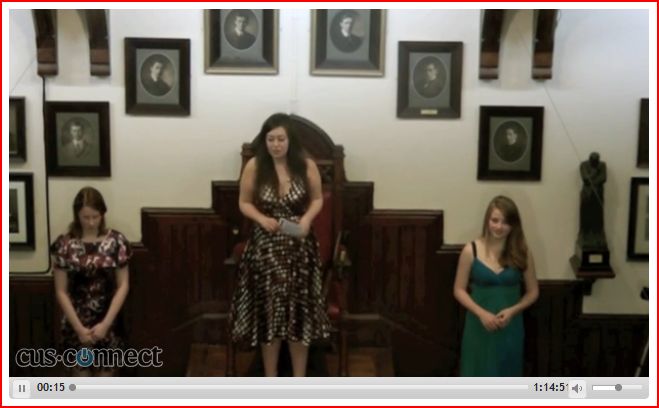
I would totally debate pornography in a room like this.

The full debate was recently made available by the Cambridge Union Society. You’ll have to click through the link for the actual video as it won’t let me embed (it’s over an hour long, too, so be forewarned!). If you can’t or don’t want to be bothered watching the whole thing, The Sexademic provides her own commentary on/synopsis of the event in a post written back in February before she realized the event would be made available online.

Again: Click through to the Cambridge Union Society for the full video.

← Older posts
Newer posts →
"the past is a wild party; check your preconceptions at the door." ~ Emma Donoghue

Recent Posts

  • medical update 11.11.22
  • medical update 6.4.22
  • medical update 1.16.2022
  • medical update 10.13.2021
  • medical update 8.17.2021

Archives

Categories

Creative Commons License

This work by Anna J. Clutterbuck-Cook is licensed under a Creative Commons Attribution 3.0 Unported License

Meta

  • Create account
  • Log in
  • Entries feed
  • Comments feed
  • WordPress.com

Create a free website or blog at WordPress.com.

  • Subscribe Subscribed
    • the feminist librarian
    • Join 37 other subscribers
    • Already have a WordPress.com account? Log in now.
    • the feminist librarian
    • Subscribe Subscribed
    • Sign up
    • Log in
    • Report this content
    • View site in Reader
    • Manage subscriptions
    • Collapse this bar