• anna j. clutterbuck-cook
  • contact
  • curriculum vitae
  • find me elsewhere
  • marilyn ross memorial book prize

the feminist librarian

the feminist librarian

Tag Archives: bigotry

trans day of remembrance

20 Saturday Nov 2010

Posted by Anna Clutterbuck-Cook in think pieces

≈ Leave a comment

Tags

bigotry, gender and sexuality, human rights

Today is the 12th Annual International Transgender Day of Remembrance, on which folks around the world take time to remember those who have died as a result of anti-transgender hatred or prejudice.

For most of this week, I didn’t think I had anything to offer for today — at least here on this blog. Being involved in feminist politics, and caring about intersectionality, I’ve become increasingly more aware of trans issues over the past decade or so.  Particularly in the last few years, I’ve come to know as personal friends a couple of people who self-identify as trans in one way or another.  And — in the way of such things — as the issue became more concrete (in the shape of people whom I crossed paths with in daily life) in my life, the once-abstract theoretical and political issues began to matter in a way they had not before. But I don’t have anything very profound or original to offer when it comes to memorializing the dead.

But I’ve been thinking a lot lately about gender, sex, and body policing, and I realized this week that that sort of community policing has a lot to do with anti-transgender hatred and prejudice, and the violence that hatred and prejudice can beget. So today, for Transgender Remembrance Day, I want to write about the importance of understanding about how personal opinions about other peoples’ bodies, when expressed in the world (and enforced through a variety of sociocultural mechanisms) aren’t just assholery, insecurity, or stupidity. Well, yeah, they are. They’re the opinions of stupid, insecure assholes. But in the past, much more than now, I think I believed it was in the power of people to just blow off stupid, ill-informed opinions. Sure, they hurt. Sure, they should not have been said. But you can’t control what other people think or say (still true) so … in the past I’ve focused on how to make those asshole opinions matter less to the individuals who were being bullied, harassed, ridiculed.

And all of that is as good as far as it goes.

But recently, I’ve been thinking way more about the collective power of body policing, and how combating it on an individual level just isn’t enough.  We need to connect the dots as much as possible between everyday, individual acts of body policing (passing judgment on whether someone picked out the right shirt, whether they should lose a few pounds, whether they “pass” as their chosen gender, whether X act is appropriate for their gender identity) and a culture that normalizes that pressure to conform to such an extent that folks who are prone to violence feel justified in exerting physical and emotional force in order to exact “correct” behavior from their victims.

We all make snap judgments about our fellow human beings. We’re socialized to do so: it’s part of the process of making sense of an otherwise untenably chaotic world. And I’m sure a certain amount of that categorization activity is necessary for us to function successfully as organisms in our environment.

But today, I’d like to point out that not all interpersonal judgments are necessary for our (physical and social) survival. Assessing whether someone’s likely to be an abuser? Probably a good skill to have. Passing judgment on whether or not someone made “good” or “bad” decisions about how to dress this morning? Whether their food or exercise choices are healthy? Questioning their self-identified gender or sexual orientation? Making them feel somehow dirty or wrong for being who they are in the world … when who they are is hurting exactly no one?

It’s just not cool. And it helps to perpetuate a culture in which we make it our business to police the gender and sexual identity of those around us, according to our own personal understanding of what boundaries should and shouldn’t be crossed. And that includes the personal understanding of those of us who think queerness is cool and the gender binary is passe AND those who think that any deviation from gender essentialist, heteronormative world is a fucking nightmare. And will resort to violence in order to protect themselves, and those around them, from it.

So next time you find yourself judging someone else’s identity or self-expression? Take a deep breath and think twice. I’d like to believe each time we do that, we make the world a little less violent than it otherwise would have been.

And maybe, collectively, we can stop so many people from dying just because someone stupid found their existence offensive.

"you should call it the doppler effect. then people will shag you."

08 Monday Nov 2010

Posted by Anna Clutterbuck-Cook in think pieces

≈ 2 Comments

Tags

bigotry, blogging, politics

shout and scream by Mindaugas Danys
available at Flickr.com

So this past weekend I was enjoying some stimulating, thoughtful conversation over on Emily Nagoski’s blog about teaching women’s sexuality in higher education. A student in the semester-long class on the subject recently contacted Emily and suggested that the course material was “unintentionally heteronormative.” This provoked an interesting conversation on the comment thread about how to teach the biological aspects of human sexuality to students more comfortable in the world of sociocultural analysis — students who are (rightly) suspicious of simplistic truth claims from the world of hard science, but who are perhaps hastily dismissing an entire way of seeing the world that could be useful, as long as it remains one of many tools we have to increase our understanding.

I digress. If you’re interested in that conversation, you can head over to the original thread.

The thing is, a commenter jumped into the conversation and suggested this student — solely on evidence that they used the word “heteronormativity” was an “unhinged crank,” who “sees ‘heteronormativity in A/C plugs and sockets.” When Emily replied “I know with certainty they are not,” he begged to differ:

Anyone who would accuse the Emily Nagoski I know of ThoughtCrime – excuse me, “heteronormativity” – is nearing the straitjacket stage of gender politics.

The thing is — this guy obviously knows and wants to defend the thoughtfulness and openness of his friend. Both of these impulses are laudable. But I really, really wish we had a Godwin’s Law for references to ThoughtCrime, ThoughtPolice, 1984 and the derogatory use of “politically correct”  and the label of  “language police.” Attempt to invalidate someone’s argument by accusing them of being the thought police? You lose.

Like with Godwin’s Law,  the Feminist Librarian’s Law of Accusations in Place of Honest Reflection, allows that there are instances in which it is legitimate to speak out against genuine instances of attempted censorship or policing of other peoples’ life experience. I believe policing other peoples’ sexualities, identities, bodies, clothing choices, food choices, and yes, even language choices (when it comes to self-identification and description at least) is not okay. It’s their life, not yours. And unless their actions are causing you or other people demonstrable harm (for which you have to show not just claim causal effect), it’s none of your damn business. And if there were actually state-sanctioned censorship going on here, it’s legitimate to challenge it. (Although I’d suggest accusing the proponents of being the “thought police” might not be the best way to get your message concerning freedom of speech across.)

The thing is: No one in this scenario has tried to thought-police anyone.  A student in a class has raised concerns that a class on women’s sexuality is unintentionally perpetuating heteronormative culture. Heteronormativity is not a “thought crime”: it’s the accumulated effect of myriad cultural cues that suggest to us that the normal (and best) form of sexual identity and expression is one in which individuals’ gender matches their assigned sex, that gender expresses itself in only two mutually-exclusive ways (“male” and “female”) and that the most appropriate expression of human sexuality is through opposite-sex pairings.

Far from acting as the Thought Police (who, ahem, had the weight of the government behind them), the student in Emily’s class is raising a question from the margins. Our government supports heteronormativity not its opposite. One cannot literally act as the “thought police” unless one has the power of cultural, political, and/or legal authority behind them.

In my experience, the people who get most often accused of policing other peoples’ thoughts or words are people who are challenging the status quo.  People with no political authority or cultural weight behind them. While the people who respond to those challenges with accusations of language policing and characterizations of the first person’s challenge as a call for “political correctness” are defending the status quo.  They’re skeptical of the first person’s challenge, dismissive of their concerns, and all too ready (as this gentleman has) to label the challenger as a “crank” or “unhinged.”

This is not what Orwell was talking about, people. This is not censorship.  This is just, you know, people bringing up ideas that are outside your comfort zone.

And crying “thought police” just ’cause you’re a little uncomfortable is, shall we say, slightly over-egging the cake.

In my experience, the only goal of this tactic to get the challenger to shut the fuck up by telling them their question-asking is an hysterical over-reaction or a calculated power-play (probably both!). It signals to me that the accuser the doesn’t understand the crucial distinction between the exertion of power-over with the full weight of the Powers That Be behind it and the actions or speech of those who are challenging the Powers That Be the passive or active abuses the often come with those Powers.  It signals to me that the accuser does not care enough about the challenger as a person or about their ideas to give them due consideration, even if that person and their ideas make the accuser uncomfortable.  Reflexive defensiveness: Not. Cool.

Had similar experiences? Discovered ways of dealing with this sort of response effectively? Share in comments!

monday morning madness: fluid sexuality and marriage equality

16 Monday Aug 2010

Posted by Anna Clutterbuck-Cook in think pieces

≈ 3 Comments

Tags

bigotry, gender and sexuality, human rights, politics

So after a weekend away from my RSS feeds, I finally got around, this morning, to reading conservative columnist Ross Douthat’s second column on why same-sex couples should be excluded from the institution of marriage. Adam Serwer @ The American Prospect offers his take which covers a lot of the bases. And Douthat’s justifications are so convoluted that I’m not going to try and untangle them here.

But as a queer woman in a lesbian relationship, there were a couple of … let’s call them interesting assumptions Douthat makes about fertility, gender, and marriage relationships that I’d like to briefly respond to.

Douthat realizes that he can’t credibly make the claim that marriage should be limited to couples capable of biological reproduction. As Judge Walker observed in the Prop 8 ruling (and as many other advocates of marriage equality have pointed out), being straight doesn’t equal being capable of, or interested in, bearing and raising children. We don’t ask straight couples to undergo fertility testing in advance of issuing marriage licenses. And we don’t enforce any sort of mandate that married couples produce genetically-related offspring.

So there’s that argument off the table.

But Douthat wants to make that argument anyway. So what he does is suggest that it’s not the physical act of bearing and raising biological children that makes hetero marriage particularly worthy of state sanction: instead, it’s the cultural experience of being heterosexual.

The interplay of fertility, reproductive impulses and gender differences in heterosexual relationships is, for want of a better word, “thick.” All straight relationships are intimately affected by this interplay in ways that gay relationships are not. (And I do mean all straight relationships. Because they’ve grown up and fallen in love as heterosexuals, the infertile straight couple will experience their inability to have children very differently than a same-sex couple does. Similarly, even two eighty-nine-year-old straights, falling in love in the nursing home, will be following relational patterns — and carrying baggage, no doubt, after eighty-nine years of heterosexual life! — laid down by the male-female reproductive difference.) This interplay’s existence is what makes it possible to generalize about the particular challenges of heterosexual relationships, and their particular promise as well. And the fact that this interplay determines how and when and whether the vast majority of new human beings come into the world is what makes it possible to argue — not necessarily convincingly, but at least plausibly! — that both state and society have a stronger interest in the mating rituals of heterosexuals than in those of gays and lesbians.

So it’s not about the capacity to reproduce, it’s about “fall[ing] in love as heterosexuals,” and “carrying baggage … after eighty-nine years of heterosexual life” based on “male-female reproductive difference.”

Obviously, there’s levels of wrong going on here, but the points I want to make are these.

1) As a queer woman, I am affected by the sex and gender norms of our (predominantly) heterosexual society. I was born into a world that expects certain things of girls and certain things of boys. In childhood, we aren’t categorized according to sexual orientation (since children are assumed to be nonsexual, or only latently sexual, beings — a topic for a whole different post) but by gender. Girls who aren’t exclusively straight in their sexual attractions nevertheless find themselves on the recieving end of powerful normalizing pressures concerning what girls/women should do, be, want, etc. This includes the pressure to parent. I think, perhaps, Douthat as a straight man might be underestimating the way in which this pressure affects women, particularly, regardless of their sexual orientations. It’s a gender thing, not a sexual orientation thing.

2) Douthat’s understanding of heterosexual vs. homosexual pairings ignores the experience of everyone else. What about equality for folks who experience sexual fluidity, whose attractions change over the course of their lifetimes? What about trans folks whose experience of society’s gender expectations shifts over the course of their lifetimes? For many of us, the idea that one would experience eighty-nine years of either “heterosexual life” or “lesbian life” (check the box that applies to you) is meaningless. We approach our relationships (no matter the gender of the person we’re relating to) as ourselves, as persons whose sum total of experience doesn’t fit neatly into one category or the other. Douthat’s assumptions concerning the differences between straight folks and queer folks is based on the belief that one’s sexual attractions are either always same-sex or always other-sex, and that these attractions are stable throughout life. This is simply not the case for many people (again, particularly women, which once more leads me to wonder how much Douthat is speaking out of his own personal biases rather than any actual research and reflection).

Thus, Douthat’s distinction between the nature of “thick” heterosexual relationships and (“thin”?) queer ones completely falls apart based upon the lived experience of real human beings.

Finally, I want to tackle Douthat’s parting shot: that omg gay marriage will lead to polygamy:

The claim that gay wedlock will lead inexorably to polygamous marriages or incestuous marriages has never been all that credible, because there just isn’t a plausible constituency in the United States (Europe might be another matter) that’s going to start claiming those rights in the way gays are on the verge of claiming the right to marry one another. But it’s still striking how easily the logic of gay marriage can be extended to encompass all kinds of relationships that we definitely don’t want to call marriages.

I am clearly not the constituency Douthat is writing for in his column, because the question I have for him is: “relationships that we definitely don’t want to call marriage”? Who is this “we” you refer to? Please don’t include me in this claim! ‘Cause I refuse, as a queer woman in favor of marriage equality, to scapegoat polyamorous relationships. I don’t need to make poly relationships the Other (or incestuous relationships for that matter) in order to prove that same-sex monogamous couplings should be sanctioned by civil marriage. I’m for consensual, adult relationship commitments being recognized as marriages. Full stop. If that marriage includes more than two adults, then those adults should all be able to enter into the contract of marriage and have that marriage be recognized by our legal system and honored by society. And if that’s what the case for marriage equality portends, I think we should be proud of that inclusivity.

Fear mongering is just not cool, man.

This time around, even more than in his first post-Prop 8 column, Douthat seems to be transparently arguing that heterosexuals are just better, or deserve to be treated with greater respect, than non-heterosexuals. The whole column is a barely-concealed bid to privilege heterosexual marriages simply on the basis of their being heterosexual.

Bigotry: not so cool either.

because, sadly, ranting didn’t stop the pain

04 Wednesday Aug 2010

Posted by Anna Clutterbuck-Cook in think pieces

≈ 2 Comments

Tags

bigotry, blogging, children

I don’t know why, but for some reason this latest round of judgmental exclusivity over children in public spaces has really gotten to me. It’s not like I haven’t seen it happen before and it’s not like I thought I’d never see it again. I’ve been a kid. I have kids as friends. I have parents as friends. Even though I will likely never have a child myself, I have lived and moved long enough in the world of families-that-include-young-people that my radar is up, reflexively, for the hate that inevitably showers down when those people do something our fucked up family-hating/family-idealizing (you thought these were separate camps in the childfree vs. parenting war? psyche!) feels is out of line.

What’s so painful to me is that I feel like this is so fucking simple — and should be even simpler for people familiar with feminist theories about how these dichotomies work. You can’t win. You choose not (or cannot be) a parent — particularly a mother? You’re vilified. You have kids — with a greater or lesser degree of deliberation? Suddenly a whole new world of discrimination comes crashing down upon you. Both sides of the coin interact with all other forms of prejudice and discrimination like physical and mental health issues, classism, sexism, racism, homophobia, etc.

We’re being played people. The system is fucked and the people who are existing in it can’t win if they play by the rules. And it’s intensely painful to me to see people I love and respect trash each other from both sides instead of working together to dismantle the expectations that surround them. About what it means to be a child. About what it means to be a parent. About what it means to be a family and have a fulfilling life (hint: you don’t have to be a parent to be a healthy, connected grown-up).

This is all by way of a blithering introduction to a few blog posts written in response to the latest in hating (sparked by a post by Mai’a on Feministe which I thought was purposefully combative but no less insightful for it). Most of these came via my friend Molly who happened to mention the blog Blue Milk (thinking+motherhood=feminist) in a post earlier today which sent me link hopping.

Violet @ Beekeeper & Schwartz | Oh dear.

When I was four, my mom’s friend’s husband was talking about how he didn’t like kids on airplanes and you fucking tool, I’m right here. I still hate that guy. And now, whenever I fly with Little Miss Beekeeper, my heart is in my throat for hours at a time even though she’s really well-behaved (and too small not to be, I’d add) even though no one has ever been anything worse than indifferent to her presence.

This, I have to say, makes my chest all tight. Because a part of me dies inside at the thought of four-year-old Violet hearing that asshole and internalizing that hatred of herself, so that now as a grown woman and as a parent she fears that all of the other passengers on the airplane are telegraphing hate toward her and her daughter. If that’s not toxic shit, I don’t know what is.

scatx @ Speaker’s Corner | Feminism/Feministe’s Problem with Mothers?

What is bothering me about this discussion is that for the first time, I saw firsthand on an issue that directly includes me and my life choices the way that feminists can be exclusive. And that was a disappointment for me. That was a HUGE disappointment.

Because part of what draws me to feminism is that most feminist activists are working to make the world more open, more inclusive, not less. So, if you think that I am trying to say that you need to have children, or like children, or whatever, I’m not.

What I am saying is that we live in a society and part of the social contract is that we put up with each other in public spaces, even if that means dealing with children, or poor people, or minorities, or men, or whomever gets under your skin. That’s my point. It’s about a society that includes everyone.

scatx puts her finger, here, on part of what’s so painful to me about these knock-down, drag-out fights over ageism. I came to feminism as someone already acutely aware of ageism (having been a young person who was routinely in spaces not designated especially/solely for children) and I came to feminism in part because of the way this experience exposed me to prejudice and marginalization. I involve myself in feminist politics because I believe in the power of feminist ideas and feminist activism to make the world a better place for all people. And I hate it when shit like this forces me to remember how easy it is for marginalized people to turn around and replicate the bullying and exclusionary behavior they so often have to deal with on the flipside. It’s like having your lover suddenly say something transphobic, or your best friend crack a racist joke.

I get why it happens, but that doesn’t make it easy to acknowledge.

bfp @ flip flopping joy! | last thoughts on motherhood stuff at feministe.

Right now at feministe, people are backtracking. Saying that maybe mai’a isn’t such a bad mother, now that I’ve read more of her posts. But somehow they are coming up with ideas for commenting policies that revolve around “guest bloggers should not assume we know their lives” or “guest bloggers should be more aware of who they are writing for.”

And it’s kind of astonishing to me that the very simple solution of asking questions for context may be a responsibility that commenters can handle quite easily is not really being discussed.

While I believe that a blogger (the same goes for any writer) is responsible for her own work, I am also disturbed by the notion that it is the writer’s responsibility not to offend, rather than the commenters responsibility to be courteous to a guest who has been invited into their space — for the express purpose of introducing new voices into the conversation. It reminds me of the kerfluffle about whether gay actors could play straight roles, and about whether trans folks are responsible for how they are read.

People who step outside of the norm are routinely more scrutinized and held to stricter standards for communicating their views than are people who more or less fit within the mainstream. Someone who expresses a minority viewpoint is more often condemned for their “tone” or for using nonstandard language, for not being and effective ambassador for their point of view. While I’m a long-time advocate of not being obscure for obscurity’s sake, so that you can then feel smug an elitist about being smarter than all the plebeians who fail to understand you (yes, dude in my undergrad creative writing class, I’m thinking of you!) I am also suspicious of people who refuse to engage the minute an idea or the language used to express it goes outside their comfort zone. Particularly if those people then proceed to make fun of the person they’ve refused to listen to for not using BBC English or whatever the benchmark of normality and authority is.

And finally, because Molly brought it up in a comment on my last post about this, let me be clear: I don’t think this is primarily a feminist problem. Like hating on women who are overweight (or women who fit the cultural beauty norms), hating on children/parents (or hating on people who choose not to parent) are wider societal prejudices that, as feminists, I think we should seriously unpack before carrying unthinking into our lives as activists. There are plenty of awesome feminist parents, feminist not-parents, and feminist children out there in the world — and a huge part of modern feminist movement(s) have been about making the world a less hostile place for people who can’t or won’t fulfill the expectations of the ideal, self-sufficient adult. So this isn’t (in my opinion) about feminism, per se being hostile to families or children (or people who don’t parent). It’s about unthinkingly regurgitating the hostility that seeps through out skin as we move through a toxic culture without stopping to think if that’s really the orientation we want to have toward other human beings in the world.

Image: Statue of crying woman @ Flickr.com

arbiters of the appropriate? more on kids and public space

20 Thursday May 2010

Posted by Anna Clutterbuck-Cook in think pieces

≈ 3 Comments

Tags

bigotry, children, politics

Irrational Point @ Modus dopens has a great addition to the conversation about why saying you “hate children” is problematic, and why debates about children in public spaces so often miss the mark (on both sides of the chasm!).

She makes a list of thirteen ways she sees people talking about children and/or parents in public spaces that she believes are discriminatory. They’re all worth reading and thinking about as we move through the world (and the internets), but I wanted to highlight a couple of particular ones.

People who think that all fussing, “noisy,” or “socially inappropriate” behaviour is misbehaviour get very little sympathy from me. Children may fuss because they are legitimately upset or uncomfortable. It’s not, like, totally unheard of for adults to raise their voices when they are upset either. Children may be a bit noisy because they have little concept of the noise they make (something which applies to many adults too). Children may display “socially inappropriate” behaviour just because, well they haven’t learned all that stuff yet, what with being little kids and all. Some adults haven’t learned them either.

I think this is particularly important to remember for two reasons.

One is that any one person’s idea of “socially inappropriate,” stopping short of one person attacking another (physically, materially or emotionally) is very subjective. We all have our own options about what kind of behavior crosses the line of what’s public and private. Sure, we can make our opinions known (i.e. “people who talk on their cell phone in the subway drive me crazy!”), and sure we can have conversations about how to share public spaces with others…but assuming we have the right to be the arbiters of what is or is not “appropriate” in public is a huge presumption. IP goes on

Statements of the form “x shouldn’t go out in public if y” make me distinctly uncomfortable because they assume that public spaces somehow belong to the speaker or the speaker’s Kind of People, and they get to decide who uses the public space. No deal. Public spaces get to be used by everybody — the clue is in the word “public.”

Many of the folks who assert their “right” (or at least desire) to be segregated from young people in public spaces are the same folks who speak out stridently against segregation according to race, gender, able-bodiedness and many other ways in which human beings discriminate against each other. I really do hope that we can start moving toward a better understanding of how these debates about where children do and do not belong — and how they should be “controlled” or “behave” when they are there — employ narratives of exclusion (exclusion, I would argue, often based on similar fears of the Other and the desire for social control) strikingly similar to narratives used to justify excluding women from male spaces, men from female spaces, people of color from white spaces and so on.

Which brings me to the second point I want to highlight. Beyond the dangers inherent in trying to arbitrate who does and does not belong in public spaces (you want only people over twenty-one at your wedding? your prerogative), the “I don’t want children in X space” argument is a form of Othering. It moves us away from focusing on a particular human being in a particular situation (whose actions may be an understandable response to situation Y) and instead draws upon our assumptions about children and about how “they” behave in public. The child sobbing in the cart behind you at the grocery store becomes The Child — representing all children, everywhere — who (in our minds) is incapable, simply because they are Child, of behaving “appropriately” (see point one) in public.

As IP points out in comments, musing about the importance of designated quiet spaces (on commuter trains, for example)

When I’ve worked with disabled kids, having a space that’s set aside as a “quiet room” can sometimes be really important. Kids can get too stressed out if there’s lots of noisy shouting and playing, just like adults can. So it’s not like the desire for some quite time is unique to adults, nor is quiet behaviour unique to adults.

The important thing, I think, is not to have entire classes of spaces (eg, restaurants) defined as “quiet” or “for grown-ups”, because that rules out too many people, and isn’t consistent (adults do talk, and laugh and play music in restaurants. Why shouldn’t kids?)

We hear a child screaming and instead of imagining that the child — as one particular human being — may have a good reason for being upset (don’t we all have bad days??) we ascribe the behavior to individual child as a group character trait. We stereotype. And in stereotyping, we lose site of the individual person. We dehumanize. We want this class of thing (Child), which we imagine incapable of any other type of behavior, out of our space where it is disrupting our lives.

And because of this animosity and impulse toward dehumanization on a cultural scale* the child (and by extension, the parents in many cases) cease being able to move through the world as human beings — who have good moments and not-so-good moments, highs and lows — and start bearing the burden of Ambassador for One’s Kind. It’s like being the one guy in a women’s studies class, whom everyone turns to (completely unfairly) for the Male Perspective. Or being the one woman of color. The one queer.

Hey, I’m glad that some people are able and willing to take on this role — and possibly by being a good ambassador help people think twice about their own prejudices and preconceptions. But I don’t think it’s the responsibility of all children and parents to be constantly, 24/7, model citizens.

As IP writes, “People who say ‘I don’t have to want kids…’ are right. You don’t have to want kids. And accommodating kids ain’t the same as saying you have to want to have kids.” Too often, it seems like, this conversation about children in public spaces turns into a mudslinging match over whether or not people who do not wish to be parents or caregivers are lesser human beings, less capable of love and compassion (see my post on the problem with Mother’s Day). People on both “sides” of this supposed dichotomy (“kids are angels” vs. “kids are demons”) fall into this trap. And in my opinion it detracts from the larger human rights issue, which is that children aren’t angels or demons, but simply people with the right to exist in public spaces just like the rest of us.

Sadly, as people have been pointing out in comments over at Modus dopens, all too often these conversations end up devolving into a scrabble for what are (rightly or wrongly) perceived to be precious and limited resources: a quiet park bench, a space on the bus, the attention of a sale’s clerk, right of way on the pavement. As ommenter Ariane writes

I think so much of this subject gets so wound up in the fact that pretty much everyone has been treated very shabbily by someone from a different “camp” at some point. There isn’t a parent who hasn’t been berated unreasonably, there isn’t a person who hasn’t found some other person’s child unbelievably difficult to tolerate, there isn’t a disabled person who hasn’t been treated abysmally, there isn’t a childfree woman who hasn’t been damned for not mothering. It’s so hurtful, it’s really hard not to resent other groups for not copping what you cop, or to remember that they are copping their own tailored abuse.

When we advocates of children’s human rights speak about the importance of treating children as people, often what is heard by skeptical listeners is the message that children and children’s needs are more important than adults (read: more important than them). What skeptics hear instead of “children are people with human rights” is, “children are extra special people who have the right to be the center of attention always and never be asked to treat others with care and compassion.”

I’ve been thinking a lot lately about what to do about this mis-communication. And, to be honest, I’m really not sure there are quick solutions…other than continuing to point out that seeing children as people means being equally critical of both characterizations: the angel-child as well as the demon-child. In my world, there are no “good children” or “bad children”…just “children.”

And, too, I think it’s really, really important to emphasize that the goal is to find a way of sharing our public spaces in a way that enables everyone, as much as possible, to enjoy them, utilize them, move through them — whatever our individual goals are. This is not about taking space away; it should not be about denigrating one set of peoples’ needs in order to elevate another set of people to a position of privilege. The goal is to create a world in which all of us have less occasion to scrabble, feel desperate, freak out, or live in anticipation of being found socially “inappropriate” by another human being.

Some related links:

Irrational Point @ Modus dopens | The whole “I hate kids” thing.

Sybil @ BitchPhD | So, Ok.

Jill @ Feministe | On Hating Kids.

For my own previous posts on this topic, see:

not-so-quick hit: bigotry towards children | 4 may 2010

teaching moment: children are people too | 12 december 2008

children are people: take two | 17 december 2008

and, on a related note, today, I am able | 1 may 2010

*Again: this is not only (or even primarily) about individuals behaving intolerantly toward young people in public, this is about how we as a society talk about children’s presence in public spaces — and how that talk informs how we, as individuals, respond to actual sightings of said children in said public spaces.

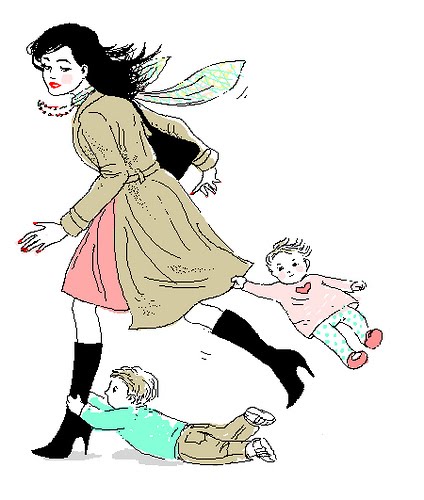
*image credit: mum tries to escape – ELLE # 3, Mar 2010 by pixel endo @ Flickr.com.

"it’s Michigan": some thoughts on regionalism

13 Thursday May 2010

Posted by Anna Clutterbuck-Cook in think pieces

≈ 5 Comments

Tags

bigotry, michigan, politics

So I’ll start out this post by saying up front that there are myriad personal and political reasons why I moved out of West Michigan. I spent the first twenty-six years of my life (with a few brief gaps) living in or near Holland, in Ottawa County, one of the most politically conservative counties in the nation. While my liberal (dare I say radical?) parents did what they could to connect us with other like-minded families and groups, both local and far-flung, it was clear we were out of step politically, culturally, religiously with the majority of our fellow residents. At of this writing, I’m living in Boston, my brother in Portland, Oregon and my sister leaves Holland in a few weeks’ time for Austin, Texas. We’ve all felt the need to get the hell out of Dodge, so to speak. At least for a while. And our parents have understood, completely, our reasons why.

But, in part because I lived for so long in the area, I resist writing Holland off as a town full of Euro-American Calvinists, insular and disengaged from the political and sociocultural issues of our era. I became who I am not only despite, or in opposition to, the people around me as I grew into my twenties: I became who I am, as well, thanks to the encouragement and example of many, many mentors. Some of whom were Hollanders born and bred, some of whom had moved to West Michigan from other parts of the country (or, in some cases, the globe). These people are part of Holland, too, and far from being glad I got the hell away I’m often acutely saddened that I left them behind.

I’ve been thinking about all this again in the past week for a couple of reasons. One is the conversations that have taken place in the wake of last Friday’s decision by the Hope College Board of Trustees not to rescind the College’s 1995 stance against homosexuality. There is, justifiably, a lot of anger about the College’s decision, and a lot of the national net-based coverage (and associated comment threads) have characterized the decision as one that is right-wing religious wingnuttery (agreed!) that is more or less what one could have expected from small-minded, religiously conservative small-town Midwesterners hmm . . . possibly not-so-agreed).

“It’s Michigan,” wrote one ex-Michigander in a comment at Change.org. “Those Neaderthals up there HATE gay people.”

This view of West Michigan was shared, after a fashion, by Jill @ I Blame The Patriarchy who recently traveled to Holland and Saugatuck (twelve miles south of Holland) to visit relatives. A trip which she documented in her customary snarky fashion last Monday.

Back in Holland Michigan, at one of the 358 or 359 Tulip Time parades down the main drag, I made a few observations.

1. I espied a float, sponsored by the Turning Pointe School of Dance and Borculo Wrecker Service, toting the Holland Area Mothers of Multiples. Nothing warms a spinster aunt’s heart like the spectacle of white women dressing up like LDS wives and getting acclaimed for their feats of reproduction.

2. No persons of color attended the event.

3. White people in Holland, Michigan, when feeling festive, eat things called ‘elephant ears’: absurd globs of fried dough the size of hubcaps.

Again, don’t get me wrong: having lived through Tulip Time as a local for twenty-six years, I have no illusions about its “wholesomeness” quotient. The whole thing was invented during the 1920s as a municiple beautification project that had less to do with historic ties to the Netherlands than it had to do with ethnic stereotypes about the Dutch drawn from the Old Dutch cleanser girl ads of the era (Jill, this might make the whole “street scrubbing” phenomenon a little clearer!) As Jill rightly observes, Tulip time is terrifying! Though I’d argue more in a Waiting For Guffman way, rather than in a Stepford Wives kinda way. As my mother summed it up in a recent email: “Tulip Time pretty much a pain.”

So in many ways, I agree with these observations. That is, most stereotypes have within them an element of truth. Holland and Hope are not exempt from any of the “isms” that plague the rest of the nation: racism, sexism, homophobia, class divides, political divides, etc. Holland has a significant Latina/Latino and Asian-American population, as well as other non-Dutch, non-Euro-American populations whose presence is often ignored or sidelined when it comes to community celebrations. Particularly when it comes to Tulip Time.

The problem with these narratives of insularity and exclusion, however, is that too often they rely on the larger story we tell ourselves (on both the right and the left) about Middle America. Since moving to Boston I’ve become more aware of the way in which “the Midwest,” as a region, occupies the space of the Other in the minds of many folks who live in big cities in the East and West. This is by no means universal (I don’t want to perpetuate the same Othering here I’m trying to call out in this post!) but it can be frustrating to hear one’s home town or region, with all of its multi-layered, globally-interconnected politics, be dismissed as full of bigoted, white fundamentalist Republicans.

This ignores the presence of bigoted, white fundamentalist Republicans in America’s coastal urban centers and likewise erases the presence of non-whites, non-Christians, liberals and queers from anywhere except cosmopolitan cities.

Racism happens in Holland, Michigan. Every day. It also happens on the streets of Boston. Homophobia happens here (in Boston) as well as there (in Holland). Neither coastal, urban America nor cities in the Midwest have a monopoly on progressive politics or small-mindedness and bigotry. Geography doesn’t determine personal or community values. We do.

I suspect that a lot of the knee-jerk ridicule of “small town America” (although Holland is hardly a small town) rings true to a lot of folks precisely because they’ve escaped, escaping, or ardently wish to escape, from their own places of origin. The Midwest of our minds is Anywhere, USA: the deadend, insular place where motivated people escape from to the urban centers, full of the chaotic possibilities of freedom and self re-invention.

The urban/rural cultural narrative works both ways, depending on which side of the argument you’re on (folks can argue for the superior conservative morality of rural and Midwestern spaces or for the superior cosmopolitan morality of urban, Coastal spaces) and both are reductive. Both erase anyone living in those spaces who do not fit the stereotypical image of the region.

This also lets both groups off the hook, allowing folks who argue both sides of the coin to claim they’re spaces are more inclusive, more diverse (if you’re on the liberal side of the argument) or more Christian, more harmonious (if you’re on the conservative side). It allows us to assume there is a simple “geographic cure” for what ails us, socially and politically as well as personally, rather than challenging us to dig in and do the hard work of being the change we want to see in the world no matter where in this country we happen to live.

I fail at this constantly. I roll my eyes at West Michigan and say things like, “What did you expect? It’s Michigan.” I left Holland because I got tired of running up against the same (seemingly immobile) ideological walls. I was tired of having to start (or end) every discussion of values with the Bible as lingua franca. I was tired, I was lonely. So I left.

But I want to be careful to remember (this post is a reminder to myself as much as anyone else) that that shift of mine was not, geographically speaking at least, a move to somewhere better. It is only somewhere different.

*image credit: 8th Street by eridony @ Flickr.com.

alma mater update: in other unsurprising news…

08 Saturday May 2010

Posted by Anna Clutterbuck-Cook in think pieces

≈ 2 Comments

Tags

bigotry, education, gender and sexuality, hope college, human rights, michigan

Here’s the promised update re: Hope College and its Institutional Statement on Homosexuality, which I wrote about on Thursday.

The group Hope Is Ready, which has been one of those petitioning to have the statement withdrawn by the Board of Trustees, shared (through their Facebook page; apologies if this means you can’t follow the link) the following letter from Hope College President James Bultman yesterday afternoon.

May 7, 2010

Dear Members of Hope is Ready:

Thank you for your interest in Hope College and for the time and effort committed to sharing your concerns with the Board of Trustees. Your insights were helpful in our discussions. Those elected to hold the college in their trust have thoughtfully, thoroughly, and prayerfully considered your petition.

Relative to your petition, the Trustees have taken these actions:

1. The Board of Trustees denied your request to remove the 1995 Institutional Statement on Homosexuality

2. The Board of Trustees appointed a Trustee committee to expand the college’s 1995 position statement in the larger context of all human sexuality in such a way that the Hope community is called to a renewed encounter with the clear, demanding, and healing biblical witness regarding human sexuality.

The college’s current position on homosexuality is based on its interpretation of scripture. It is recognized that well-intentioned Christians may disagree on scriptural interpretation. Still, humbly and respectfully, the college aligns itself in its interpretation with is founding denomination, the Reformed Church in America, the orthodox Christian Church throughout the ages, and other Christian colleges and universities.

On behalf of the Hope College Board of Trustees, I thank you for your concern for the college we love and respectfully ask that you accept these decisions in the spirit with which they are rendered.

Cordially,

James E. Bultman
President

In short, it basically says nothing that hasn’t already been said, and the fact it was up on the web by 2:33pm yesterday afternoon makes it pretty clear that the Board of Trustees didn’t spend much time deliberating on their course of action.

Sad, despiriting, but unsurprising.

I’ll be thinking today about all those folks in the Hope College community — many of whom I’ve known my whole life — who do not think this way, and who work hard everyday to make sure the official college position is not the only one that gets heard.

I said in my letter to the Board, and I’m going to repeat it here: to tell any person that being sexual and making positive, fully consensual, sexually intimate connections with another human being is destructive to their spiritual well-being is an act of violence. To codify such a belief in an institutional statement makes it institutionalized bigotry, giving that belief the authority of college administration that has the power to materially effect the lives of students and employees.

I absolutely believe that such an act of violence runs counter to the Christian message that we are all called to increase joy, practice love, and work toward wholeness in the world. I don’t see how this decision by Hope’s Board of Trustees does any of that. So it sure as hell doesn’t seem very Christian to me.

*image credit: Hope College Voorhees Hall, made available through the public relations office website.

not-so-quick hit: bigotry towards children

04 Tuesday May 2010

Posted by Anna Clutterbuck-Cook in think pieces

≈ 7 Comments

Tags

bigotry, children, feminism

Via Molly @ first the egg comes a passionate articulation of the right of children to be treated as human beings, rather than as a subspecies to be “liked” or “not liked” en masse. Sybil Vane @ Bitch PhD writes

Now, maybe I meet someone who doesn’t necessarily dislike Little V in a personal way but who is “not really a kid person.” And here I mean not necessarily someone who doesn’t want to have kids or who doesn’t have any experience being around kids or someone who lives a lifestyle that doesn’t produce any exposure to kids. I mean someone who is expressive about a “I don’t really like kids” attitude or a “I hate going to restaurants or museums where kids are making noise” attitude or a “of course it’s fine for other people to have kids but I don’t want to be around them” attitude. This sort of thing is a deal-breaker for me. I’ve gotten pretty rigid about it in recent years as I become more assured in my certainty that it’s an anti-feminist attitude and you suck if you hold it. Kids are a vulnerable, disempowered, inevitable portion of the human community and you do not get to “not like” them or to wish that weren’t a part of your public space. Not allowed. I invite you to swap out “kids” for any other disempowered community in the above phrases (“women,” “schizophrenics,” “hispanics,” “the blind”) and notice what an asshole you sound like.

You can read the whole post over at BitchPhD.

I’ve blogged about this before (last year in what turned into a two-part post here and here and in passing on Saturday in my blog against disableism post).

The first time I wrote about it, I realized I was coming down hard on someone who sounded like an asshole in comments (they’d left a post on my blog calling young people “feral, shrieking little carpet apes”). But I was largely unprepared for the backlash I got on the post, where people resisted mightily the possibility that there might be parallels between dehumanizing children (based on age) and dehumanizing other segments of society based on other group characteristics (such as race, national origin, gender, etc.). People made all sorts of assumptions about my socioeconomic status, my personal background, my status as a parent, and suggested that being an advocate of children’s humanity is only the province of privileged, solipsistic white mothers with ivy league educations.

So let me be clear, here. I’m not a parent. At this point, it’s unlikely that I will ever be a parent. The reasons for this are personal, relational, ethical, sociopolitical and economic in nature — too complicated to delve into in this post. But the point is: not a parent. And to tell you the truth (contrary to popular opinion re: women and infants) I’m okay with that.

There was a time (I won’t lie) when my fondest dream (at age nine) was to set up an orphanage with my best friend and spend my days nurturing a vast brood of Anne Shirleys who otherwise would not have caring adults to call their own. But I’ve grown and changed, tried quasi-parenting for a while (I spent a year as a live-in childcare provider), and realized that is not where my primary interest lies.

There are even days when I’m not just “okay” but incredibly relieved by the idea that I will never — unforeseen crises not withstanding — be the 24/7 primary caregiver of a young person. Even with a willing and able partner, that job seems prohibitively daunting. Particularly in a culture where meaningful support for caregivers (of the elderly as well as the young) is so thin on the ground.

But the point is: none of these personal decisions or experiences absolve me from the responsibility of including children in the human community. They don’t absolve me from the responsibility of treating them with the same courtesy and respect with which I expect folks to treat me, and with which I treat adult members of the human community. As Molly writes @ first the egg

I actually am not “a kid person” in any normal sense of the term — I’m not that whipped up about children just because they’re children, I’m generally much more interested in a puppy or kitten…or adult person…or this here computer screen…than a baby I don’t know personally — but they’re people.

The awesome thing about this is, in my experience, that young people thrive on being taken seriously. On being treated with a straight-ass, no bullshit attitude. Speaking from my own remembered experience as a child, I had zero interest in being fawned and fussed over, having my personal space invaded by adults who thought of themselves as “liking children” and were subsequently pissed when I failed to delight in their cosseting.

I wanted to be taken seriously, to be leveled with, and to be given a seat at the table with all the adults around me who discussed interesting and complicated things, had wicked skills for creating things and exploring the world, and who might possibly share that experience with me.

It’s true that children, by virtue of their still-developing brains and bodies, do not always meet the requirements set forth by our culture’s model of ideal able-ness and imagined self-sufficiency . . . but then, as I pointed out last Saturday, neither do we. Children need help meeting their material needs, need spaces and resources to explore the world and gain material, cognitive, and emotional skills to become more independent. Not every adult is prepared to provide on-the-ground assistance to children in this way, just like not every adult provides eldercare around the clock. But as members of the human community, citizens of the world, we can recognize that all of us matter — and treat those whose paths we cross accordingly.

And the sooner, the more ardently, we can impress upon young people that they matter just as much as the next person, the more likely it is that those young people will grow into older people who — no matter how privileged, how able, they become — will remember that their able-ness is not what imbues them with worth: it is their membership in the human community. Just as that membership in the human community grants the person sitting next to them on the subway, or standing in line behind them at the coffee shop, or playing on the swings at the park, intrinsic worth.

And hopefully, just maybe, this belief in the worth of humanity will make the world a richer, more compassionate, less threatening, less defensive, more bountiful world to live in for us all.

*image credit: Christmas Day Morning by Carl Larsson @ the Carl Larsson Gallery.

today, I am able

01 Saturday May 2010

Posted by Anna Clutterbuck-Cook in think pieces

≈ Leave a comment

Tags

bigotry, blogging, human rights

I learned earlier this week via Brilliant Mind, Broken Body that today, in addition to being my parents’ wedding anniversary, is blogging against disablism day out there (out here?) in the blogosphere.

Blogging Against Disablism Day, May 1st 2010

At first, I wasn’t going to participate because I don’t think of myself as having a disability: I’m basically physically healthy and mobile, have never been diagnosed with cognitive or emotive impairments, and am mostly able to move through life on a day-to-day basis without special equipment, medication, or modification of my surroundings.

But then I thought a little more about the words “disability” and “ability,” and what they mean as we move through our daily lives. And realized I have some thoughts on the subject I want to share. (As I type these words, I can feel the rippling echoes of non-surprise from friends and relations emanating out across the internets).

So here’s what I’d like to talk about this day of blogging against disablism/ableism (depending on which side of the pond you’re on): the fact that, today, I am able, but I have not always been able, and I certainly won’t always be so.

And what that awareness, the fact of moving through the world as a person who is able (today), means to me.

As an historian, I am trained to be aware of changes over time, and of the ever-changing nature of “common sense,” of our understanding of the world around us and the categories in which we put things. Including things that we imagine to be immutable. In short, our understanding of what it means to be “able” and “dis-able” is fluid and contextual, rather than fixed. When we speak of ourselves or someone else being “disabled,” we conjure up in our minds, in collective understanding, what it means to be “able,” what it means to embody or emulate able-ness.

This is not to say that disability is an illusion. To me, disabilities are a complicated mix of self and society. They are made up of the gaps between the desires we have as individuals to be and live a certain way and the cognitive, emotional, and physical resources we have to fulfill those desires. They are made up of the gaps between the pressure we are under to be and live a certain way, and the resources we have to meet those expectations.*

But nevertheless, I think it’s incredibly important to remember how much we define “disability” by measuring individual people against our vision of “ability” — and how much “ability” is, in turn, defined in this day and age, but the ideal of a physically healthy (dare I say “flawless”), cognitively efficient and rational, and emotionally “well-adjusted.” That is to say a a youthful adult capable of being an efficient worker whose personal needs are such that minimal (if any) adjustments need to be made by the people or social and physical structures around them as they move through the world.

The “able” person in convenient. The “able” person is economically productive, appears entirely self-sufficient (an illusion, as every human being in modern society is in some measure dependent on other human beings), is uncomplaining, intellectually adept without being challenging, with a healthy respect for the Powers That Be.

Ableism is structural and cultural acceptance of this model.

Ableism means policing each other and policing ourselves to ensure that we continue to accept and strive toward that model of able-ness.

Ableism means that we punish each other and ourselves for failing to approximate this ideal of able-ness in our everyday lives.

When I move through the world thinking to myself “today, I am able,” I am trying to remember that ableism exists: that the messages I am inundated with, the pressures I feel, pushing me towards approximating that ideal are culturally created rather than immutable. That I have the freedom to accept or reject those expectations (though rejecting them does not come without social penalty, since we all police one another in this regard). That I can choose whether I police myself or other people according to those standards.

And here’s the kicker. Today, I am able. Today, I can more or less approximate able-ness. I am mostly physically healthy (and what physical ailments I suffer from, there are corrections and cures readily available to me). I am young (but not too young), and have socially-acceptable skills and aptitudes which give me access to respected institutions of learning and places of employment. I am able to meet the expectations of my employers and other people who hold positions of authority in my world, and can tailor my social demeanor in ways that make me unobtrusive and outwardly inoffensive to the majority of people.

But all of these things: they’re just luck of the draw. They’re highly contingent, fluid, liable to shift beneath my feet. Someday, inevitably, I will become less able to decide whether or not to approximate able-ness. Because I will lose my ability to approximate. The choice will be taken away.

In a blog post last year concerning the dehumanization of children in the feminist blogosphere, I quoted historian Gerda Lerner, who reflects, in her book of essays Why History Matters, on why all human beings should care about hate and discrimination in myriad forms. She writes

All of us, ultimately, will join one of the most despised and abused groups in our society–the old and the sick (17).

What does it mean, to me, to move through through the world with the awareness that I am (only temporarily) able? That I am (only temporarily) acceptable to those in power? It means that I carry with me an awareness of, and gratitude for, the way in which my able-bodiedness gives me access to the world in myriad ways. It means I am aware of the contingency of that access.

And, in what might seem to many of you a counter-intuitive leap of faith, the knowledge that I will lose access someday, no matter how much I scramble to preserve it, frees me from the existential anxiety of that failure.

Knowing already that I will means that it’s untenable to build my sense of self-worth on the foundations of able-bodied privilege, for if I do that, then knowledge of my worth will vanish the minute I develop a debilitating illness, lose my hearing or eyesight, lose mobility, experience diminished stamina, flexibility, memory — all of the things that (as an adult) I have come to take more or less for granted.

Knowing that we will all fail, in the end, to measure up to the imagined ideal of able-ness means that it is unconscionable for me to police and punish others for likewise falling short. Their humanity is so much more than their emulation of an impossible norm.

When I was a teenager, and attended church for a few years, there was a woman there whose son was struggling in the school system. He’d had been diagnosed with various social and learning disabilities and she was really anxious about his future growing into an adult who had to fend for himself. She tried hard to remember, she said, the words of the prophet Micah (6:8). I’m not usually prone to quoting the Bible, but I think this one is worth sharing

He hath shewed thee, O man, what is good;
and what doth the LORD require of thee,
but to do justly, and to love mercy,
and to walk humbly with thy God?

The Powers That Be in the world work hard encouraging us to forget that this is all that is required. That to be a worthy person, what counts is to be just, merciful, and humble. That everything else is, in the end, mere details.

And while we live every day with the reality of a world that forces us (in some measure) to comply with the expectations of the Ideal of Ableness, we can refuse to be held hostage by that ideal: we can name it, and recognize the limits of its power, and choose to focus instead on calling out and correcting injustice (including injustices wrought upon ourselves), on rewarding acts of mercy and compassion (including our own), and encouraging (and practicing) humility: the realization that, in the end, we are all unable to make it alone.

Today, I am able. Tomorrow, I will be no longer. But I will still be a person of worth. And so will you.

*What we do to bridge those gaps is likewise complicated, and not the subject of this post. I just want to say here that while I believe we in some measure construct disability and ability through cultural narratives, I absolutely do not mean to imply that medication, psychotherapy, and other personal solutions have no place. They are of incredible help to many people, and I have family and friends for whom such solutions have been essential to their wellbeing.

Newer posts →
"the past is a wild party; check your preconceptions at the door." ~ Emma Donoghue

Recent Posts

  • medical update 11.11.22
  • medical update 6.4.22
  • medical update 1.16.2022
  • medical update 10.13.2021
  • medical update 8.17.2021

Archives

Categories

Creative Commons License

This work by Anna J. Clutterbuck-Cook is licensed under a Creative Commons Attribution 3.0 Unported License

Meta

  • Create account
  • Log in
  • Entries feed
  • Comments feed
  • WordPress.com

Create a free website or blog at WordPress.com.

  • Subscribe Subscribed
    • the feminist librarian
    • Join 37 other subscribers
    • Already have a WordPress.com account? Log in now.
    • the feminist librarian
    • Subscribe Subscribed
    • Sign up
    • Log in
    • Report this content
    • View site in Reader
    • Manage subscriptions
    • Collapse this bar