• anna j. clutterbuck-cook
  • contact
  • curriculum vitae
  • find me elsewhere
  • marilyn ross memorial book prize

the feminist librarian

the feminist librarian

Tag Archives: books

wishing you a restful holiday

24 Saturday Dec 2011

Posted by Anna Clutterbuck-Cook in admin

≈ Leave a comment

Tags

books, domesticity, holidays

via

As I write this post, Hanna and I are listening to the Festival of Nine Lessons and Carols broadcast from King’s College, Cambridge, England and eating cornmeal molasses pancakes. I put in my last hours of work for 2011 yesterday afternoon at the MHS and now both Hanna and I will be on holiday until January 3rd — all, the luxury of slightly anachronistic academic schedules! Later this afternoon we might wander down to the Boston Public Garden to check out the Christmas bustle before returning home to prepare cinnamon pull-apart bread for Christmas morning and possibly a screening of White Christmas. 

And then possibly reading some picture books before bed. Because I don’t know about you, but Christmas isn’t really complete until you’ve read your favorite Christmas stories. Such as:
The Conscience Pudding, by E. Nesbit (available as a free audio file from Librivox!)
The Story of Holly and Ivy, by Rumer Godden, illustrated by Barbara Cooney
Child’s Christmas in Wales, by Dylan Thomas, illustrated by Edward Ardizzone 
The Tomten and the Fox, by Astrid Lindgren (see illustration above)
The Best Christmas Pageant Ever, by Barbara Robinson
What are the favored Christmas and/or winter holiday stories in your house? Share them in comments!
Schaerer family Christmas tree (Dec. 2003)
photograph by Anna
Best to you and yours this season, and warm wishes for the turn of the year.

~Anna

booknotes: the lesbian fantastic

22 Thursday Dec 2011

Posted by Anna Clutterbuck-Cook in book reviews

≈ Leave a comment

Tags

books, gender and sexuality, genre fiction, reading lesbian classics

Back in October’s batch of LibraryThing Early Reviewer books, I won Phyllis M. Betz’ The Lesbian Fantastic: A Critical Study of Science Fiction, Fantasy, Paranormal, and Gothic Writings (McFarland, 2011). The Lesbian Fantastic is the third volume Betz, a professor of English literature, has written for McFarland examining genre fiction written by lesbian authors (a slippery category that I’ll talk more about below). The previous installments in the series look at lesbian detective fiction and lesbian romance novels.

At a slim two hundred pages, including chapter notes, bibliography, and index, The Lesbian Fantastic — as the subtitle claims — takes on the ambitious task of exploring the history  and themes of fantastical literature written by and about lesbians. The brevity of the volume is, indeed, one of its problems, since each aspect of fantastical literature Betz covers (science fiction, fantasy, paranormal, and gothic) could take up a book of its own. I was certainly thankful that Betz refused up-front to play genre border patrol and police the boundaries between, say, “gothic” vs. “paranormal,” but that decision left her with a vast landscape of literature to summarize, analyze, and place in some measure of socio-historical context. The inevitable result is that corners are cut and I was left wanting a meatier discussion on many fronts.

Likewise, Betz fails to strike a comfortable balance between examination of lesbian authorship, readership, and the lesbian as character in fantastical literature — whether or not that character is written by a self-identified “lesbian” or otherwise non-straight woman author. All of these aspects of genre fiction by and/or about lesbians would have been fascinating subjects to explore in-depth, but given the length of their treatment in this study, I felt all three topics came away muddled and short-shrifted. Was this book a study of lesbian authors? Not entirely — in part because not all authors’ sexual orientations are known and/or fit into modern-day identity categories. Betz also weaves back and forth between writing narrowly about lesbian-authored works (however she defines them) and women generally and authors in the genre generally. Was this book about lesbian readers? That category, too, suffers from a high degree of volatility … are we talking about readers of fiction involving lesbian characters? Readers who identify as lesbian? Who engage (or have engaged) in same-sex relationships? Who experience some measure of same-sex desire? While categorization is always going to be somewhat arbitrary for the sake of a study such as this, I would have appreciated a clearer sense of whom Betz herself is including under the umbrella of lesbians who read genre fiction, and what her sources are for those voices.

Finally, Betz could have used a good editor with knowledge of the genre who might have caught, for example, the fact that China Miéville does not identify, as far as I know, as a lesbian or a woman. Or could have gone over the manuscript and deleted the repetitious author introductions (Charlotte Perkins Gilman’s Herland is re-introduced almost every time it appears). 

Overall, The Lesbian Fantastic is a book on a fascinating and potentially rich (and heretofore under-studied) topic that suffers from over-vague parameters and a frustrating simplification of lesbian identity. I think Betz’ subject might have been better served had she chosen to focus on the treatment of lesbian/queer characters in fantastic fiction. In that context, she could have constructed some interesting compare-and-contrast arguments about lesbian characters in genre fiction generally versus genre fiction written by lesbian writers and/or for a lesbian/queer audience. Or, she could have focused more specifically on queer female readership and fandom, discussing the genre fiction pitched specifically to non-straight readers and the ways in which those readers interact both with “lesbian” genre fiction and its mainstream counterparts. Reader voices are notoriously difficult to locate and analyze, but online forums and fan-created transformative works (fan fiction, videos, art, etc.) have made the possibility of hearing the reader’s voice in much more depth.

The Lesbian Fantastic will be useful to other scholars in the field who will, hopefully, take Betz’s arguments in more complex directions.

multimedia monday: purity myth trailer

12 Monday Dec 2011

Posted by Anna Clutterbuck-Cook in media

≈ Leave a comment

Tags

books, feminism, gender and sexuality, multimedia monday, web video

Via @courtwrites (and lots of others by now, but that’s where I first saw the link!):


The Purity Myth Trailer from Media Education Foundation on Vimeo.

I read and reviewed Jessica Valenti’s Purity Myth when it first came out back in 2009 and in my opinion it’s the best of her published works to-date. I’m definitely going to check out the documentary version.

See also: my review of Hanne Blank’s Virgin: The Untouched History.

four years ago today: "personal canon"

11 Sunday Dec 2011

Posted by Anna Clutterbuck-Cook in life writing

≈ Leave a comment

Tags

books, four years ago today, friends, fun

It’s been awhile since we did one of the four years ago today flashback posts. So here’s a fun one I pulled from the Gmail archive. My friend Joseph and his brother had generated lists of the top ten novels in their “personal canon” and Joseph emailed to ask what mine would be. After some thought, this is what I came up with. Looking it over today, I can’t say there are any huge revisions to this list. 


From: Anna
To: Joseph
Date: Tue, Dec 11, 2007 at 10:22 PM
Subject: Re: Personal canon of books

Hiya,

My canon is decidedly more “lowbrow” and than yours, but I am squelching my impulse to apologise for it on Nick Hornby’s firm orders (even though he loves Dickens’ and writes tedious novels about men who refuse to grow up, so I am not sure how much I trust him . . .)

I have artificially controlled against all non-fiction and children’s literature (well, below the teen level).  Not sure if that’s quite what you had in mind, but there we are.  I discover my criteria are a) enduring “good read”–something I will go back to over and over again, as well as b) things that have had deep impact on how I answer the question, “how to live?” . . . these categories don’t always overlap.  There are books that have had great impact on how I think about the world, but which I’ve only read once . . . and books that I read habitually, but that I don’t really think of as life-shaping in any explicit way.  Maybe they’re just sneaker at it? And of course these change over time . . . I was just thinking today how His Dark Materials has really grown on me over the years.  And even though I have issues with some of his didacticism, his theological imagery really speaks to me.  And, I mean, who could resist the idea of a reversal of the whole Genesis/Fall/Eve story? (Um . . . wait . . . that’s right . . . a LOT of people 😉 ).

via

That long introduction completed, here are my nominations. The top ten in a strictly alphabetical order. I figure once you make top-ten I’m not going to be judgmental. ALTHOUGH I do sometimes find myself paralyzed by the question of which book I would become if I were a character in Fahrenheit 451 . . . possibly a clear indication of how troubled I actually am :).

Top Ten:

1. E.M. Forester. A Room With a View.
2. Shirley Hazzard. The Great Fire.
3. Haven Kimmel. The Solace of Leaving Early.
4. Robin Lippincott. Our Arcadia.
5. Michelle Magorian. Not a Swan.
6. Robin McKinley. The Blue Sword, et al.
7. Audrey Niffinegger. The Time-Traveler’s Wife.
8. Dorothy Sayers. Gaudy Night.
9. Martin Cruz Smith. Rose.
10. Tom Stoppard. Arcadia.

Some possible future candidates/honorable mentions:

Isabel Allende. Daughter of Fortune & Portrait in Sepia.
Jane Austen. Persuasion.
A.S. Byatt. Possession.
Sheryl Jordan. The Raging Quiet.
Laurie R. King. The Beekeeper’s Apprentice, et al.
Barbara Kingsolver. Bean Trees.
David Levithan. The Realm of Possibility.
Gregory Maguire. Wicked, Son of a Witch
Philip Pullman. His Dark Materials.
Margaret Whelan Turner. The Thief, Queen of Attolia, King of Attolia.

Anna

nanowrimo 2011 commencing in 3…2…1…

01 Tuesday Nov 2011

Posted by Anna Clutterbuck-Cook in fandom

≈ 4 Comments

Tags

blogging, books, fanfic, writing

Today is November 1st and thus the beginning of National Novel Writing Month 2011. As I wrote at The Pursuit of Harpyness last Thursday, I’ll be participating this year for the second time (my first year being 2009).

For those of you unfamiliar with National Novel Writing Month, basically it’s an opportunity to join thousands of other amateur fiction writers in solidarity as you try to write 50,000 words of fiction between midnight on November 1st and 11:59pm November 30th. A lot of people attempt a full-length novel, but me I’ve got some fan fiction planned and maybe some non-fanfic erotic short stories I’ve had kicking around for a while in the back of my brain. We’ll see. I’m not particularly gunning for the full 50k, but I’d like to contribute as many words as possible to the overall pool of creativity the event sparks. So … the upshot is that y’all may not be seeing so much of me between now and the end of the month. My goal is to keep writing at least one post a week here at the feminist librarian — either a book review or a “thirty at thirty” post. I’ve already got a virtual book tour event later in the month that I’m committed to (Rachel Kramer Bussel’s new anthology Women in Lust!) as well as a couple of advance review items I want y’all to know about (Gayle S. Rubin’s collection of essays, Deviations, and Jeanne Cordova’s memoir When We Were Outlaws). So look for those reviews in upcoming weeks. I’ll also continue posting links at the feminist librarian reads and writing at least one post a week over at The Pursuit of Harpyness. Hanna and I also continue to post three fan fiction recommendations per week at everything is gay and nothing hurts. Plus, obviously, harassment by email is always an option for those of you who miss me!
In the meantime, I hope all of you have a cozy and creative November — and we’ll be back to our regularly scheduled programming sometime around December 1st.

booknotes: premarital sex in america

30 Friday Sep 2011

Posted by Anna Clutterbuck-Cook in book reviews

≈ 6 Comments

Tags

books, gender and sexuality, sociology

It’s not that I had terribly high expectations for a book titled Premarital Sex in America: How Young Americans Meet, Mate, and Think About Marrying (New York: Oxford University Press, 2011). Because seriously: “premarital”? Particularly when the authors — sociologists Mark Regnerus and Jeremy Uecker — acknowledge in their introduction that by “premarital sex” they actually mean sexual activities undertaken by an “emerging adult” (ages 18-23) who is not married, and that by “young Americans” they actually mean people who are cisgendered and straight. In other words, the very framing of this book-length study by the title alone suggest that what readers will get is a familiar story re-packaged as a ground-breaking assessment of how “contemporary shifts in [sexual] market forces … have dramatically altered how [heterosexual] relationships are conducted” (as the jacket copy claims). As I said: not that I had terribly high expectations going in.

The thing is, this book could have been a successful and insightful analysis of 18-to-23-year-old heterosexual attractions, identities, and practices. With a mixture of quantitative and qualitative analysis (national data collection and 40 in-depth interviews), the authors could have offered new ways of understanding heterosexual sexual practices in young adulthood. They could of provided us with an in-depth exploration of the individual and cultural values, social pressures, and practical concerns that lead to those practices. They could have taken the opportunity to counter moral panic about changing sexual mores with data that show, for example, that college sexual cultures are much more relationship-based than a freewheeling marketplace of hook-ups. In fact, occasionally, Premarital Sex in America seems poised to take on this role of reality-check for media moralizing: marriage doesn’t mean the end of one’s sexual happiness (p. 174: “marriage tends to be good for emotional intimacy as well as sexual intimacy”) and the so-called hook-up culture (p. 106: “casual sex from hook-ups is rare by comparison, suggesting that popular perceptions of the depravity of the ‘hook-up culture’ may be somewhat overstated”). So despite initial trepidation, I was ready to give this book a reasonable change to prove my pre-conceptions wrong.
The problem can be boiled down to two systemic (and, I would argue, inter-related) issues. First, the persistence of the authors in leaning heavily on unexamined assumptions about what is “just a fact” or “inescapable” (they actually use both on p. 22) as well as the use of terms without specific definition — they never indicate, for example, how they determined the sexual orientation of their interviewees (identity? practice? desires?), and later in the book divide respondents into “reds”/conservatives and “blues”/liberals without detailing the criteria by which they sorted these groups (political affiliation? beliefs about sex? upbringing? religious practices?). They “explain” many of the assumptions I found problematic by relying heavily on shakey theories of innate gender difference (see here, here, here, and here) and the perennially popular theory of “sexual economics” in which men are the lustful consumers of sex which women “sell” for relationships. 
I obviously don’t have any first-hand experience in this heterosexual “marketplace” in which we ladies are selling the sex we don’t want for the emotional intimacy men reluctantly give in exchange for booty … but can I just say, on behalf of the many women and men I know who swing that way: EW. Not only is this theory an impoverished way of thinking about human sexuality, it has absolutely no explanatory power for peoples’ motivations to get into sexual relationships. Because if dudes are all about getting it off, hello: you have two hands and lots of (supposedly equally horny) fellow dudes who could help you out. If sex is just sex and the relational context in which it happens is meaningless, then what benefit would men have in seeking out women to be sexually intimate with? Zilch. The authors of this book actually say this at one point, when discussing pornography: “If porn-and-masturbation increasingly satisfies some of the male demand for intercourse, it reduces the value of intercourse, access to which women control” (246). You can only capture and keep a man by bartering sex in exchange for intimacy — if your fella has access to sex all on his ownsome, then tough. In turn, if women aren’t that into sex and want emotional intimacy — why bother with the work of selling sex in exchange for (presumably reluctantly-expressed or faux) emotional intimacy or relational stability when you could meet your emotional needs elsewhere — say with family members or close friends? — and avoid the trouble of putting out?
So basically, you could bother to describe heterosexual interactions in terms of economic transactions, but it’s not going to help you explain why men and women continue to seek each other out for long-term intimate relationships. In fact, the theory of sexual economy these authors put forward argues against hetero sex being at all rational as a way of meeting our emotional and physical needs — unless you happen to want to procreate (something they barely touch on within the text). It’s irritating and unsatisfying and, aside from everything else, makes me wonder why anyone who believes hetero sex works like this enjoys being heterosexual. 
I’d point out that another gaping hole in the theory of sexual economics these authors put forward is that they argue it’s just the way humanity operates … except they fail to take into account queer folks relationships, which are also part of humanity and are an interesting control group for the power of their pet theory. For example: if women barter sex for relational intimacy, then what happens when two women are in a relationship? Why hello, “lesbian bed death” the theory that will never die! Except … plenty of women in same-sex relationships are getting it on together … are we selling each other sex (that we don’t want) in exchange for emotional intimacy (that we already have?). You can see how it starts to get ridiculous damn fast.
Obviously, once someone’s overall framework for analysis fails to impress, the little shit begins to grate on one’s nerves. So for the sake of relieving my spleen I’m going to bullet-point the smaller issues I had with how the data was presented and analyzed:
  • The use of “virgin” to mean “person who hasn’t had vaginal intercourse.” First, I’m skeptical that all of the studies from which the authors drew data defined “virgin” in exactly this way, and second … really book? really? We’re going to reinforce the idea that sex = tab A into slot B one more frickin’ time? Particularly when in the same breath, practically, you go on to talk about “virgins” who’ve engaged in oral and anal sex?
  • Lack of transparency in data. So I realize I’m hypercritical of data because, well, I’m suspicious and I’ve been trained by good friends and colleagues that way. But when you start telling me things like what the average number of sexual partners for X group over X period of years is … and then tell me you’re relying on self-reporting … I’m tempted to throw out the data. Unless you’re going to tell me how you asked study participants to define “sex” and “partner” and whether you asked them to keep track over a period of months or years, or whether this was data based on recollection, etc. 
  • Describing people as “attractive” without qualification. Especially when you’re two men describing your college-age study participants as “attractive 20-year-old women.” Just: EW. But beyond that, the assumption that attractiveness is some sort of objective, measurable quality and that it exists on a static scale rather than being deeply subjective and situational. 
  • Suggesting sexual “mystery” is better than reality in relationships. Again, a symptom of seeing sex as transactional: men, it seems, are most interested in sex they think they desire but must pursue. So the “easier” women are to fuck, the quicker the relationship is to “age” and grow stale. Additional negative points for working in sentences like: “It’s a classic tale that characterizes billions of sexual relationships in human history” (80). Naturalizing something by making it seem historically inevitable = no cookies for you!
  • Failing to define “pornography.” Yeah, it becomes clear that they (like so many other critics) mean commercially-produced videos and photographs. But that’s no excuse for laziness in reporting. Since they seem to have assumed everyone was on the same page about what pornography was, they accepted the reporting on their interviewees concerning the effect “porn” had on their relationships and sexual desires. A much more interesting conversation could have been had if they had probed a little more deeply into their subjects engagement with erotic materials on a broader scale (I bet at least some of the young women they interviewed are writers and readers of slash fan-fiction, for example). Instead, we just got the tired scare story about how mainstream video pornography is creating unrealistic expectations in men concerning women’s bodies and sexuality.
  • Failing to delve beyond the most obvious analysis of their data. This happens repeatedly, so I’m just going to give one example. In a section on negotiating unwanted sexual practices, the authors report that the top “unwanted sexual request made by men of women is for anal sex” (the top unwanted request by women of men is for cunnilingus). It becomes clear that what they mean is men are requesting penis-in-anus sex, though they don’t articulate this. No mention is made whether they asked the men (or women) about penetrative anal sex to stimulate the prostate, which is something I don’t think they count as “sex” because they suggest that “there is no biological basis for preferring anal sex to vaginal sex” … a statement that would only make sense if they were thinking about stimulation of a penis. They go on to argue that men are only asking to perform anal sex because they’ve learned it’s part of the sexual script from watching pornographic films. They also accept without further analysis women’s self-reporting that they just don’t like anal sex, full stop, without exploring in what contexts it was tried (i.e. did the partners have lube? did they prep adequately? was there coercion? did they try a second time, with better results?). Precision counts people!
  • “Intercourse is more satisfying than masturbation” (157). Written in a section headed “Semen: An Antidepressant?” So … yeah. I just want to point out — AGAIN — that reducing sex to penis-in-vagina intercourse is a big problem in this book. I also think there is something deeply troubling about the idea that solitary sexual activity is and unsatisfactory substitute for relational sex. Not because it isn’t for many people (though I’m going to go out on a limb and say that for some it likely is) but because masturbation isn’t a substitute activity. It’s a parallel or complementary sexual activity. We do it, and enjoy it. We get different things out of it than we get out of partnered sex. Many women in The Hite Report and Our Bodies, Ourselves, among other texts, report very distinct types of orgasms (both pleasurable) from self-stimulation and partnered stimulation. 
  • Characterizing a relationship that ends as a relationship that “failed.” Relationships can be formed for many reasons, and as long as they were mutually-satisfying for all the people involved for the duration of the relationship, there’s no reason why the fact the relationship ended means the relationship failed. It’s true that many relationships do come to an end because one member or both stops being satisfied. But “end” doesn’t automatically mean “fail.”
  • Emotional health is a woman thing. Again: seriously? Yeah … they’re serious. Not only do they bring up the correlation between abortion and depression (without clarifying it’s a correlation and not necessarily causation), as well as a throw-away mention of the correlation between same-sex activity and poor mental health outcomes, but they out-and-out argue that women’s emotional health is the only story that matters: “the central story about sex and emotional health is how powerful the empirical association is for women–and how weak it is among men” (138). They explain this using the theory of “natural” gender differences which, since the data to support this theory is shite, isn’t really an explanation at all. 

By way of a conclusion, Renerus and Uecker offer to dispel “ten myths about sex and relationships” for which the evidence “just isn’t there” (242). Some of these are fairly value-neutral — for example the first one is the myth that “long-term exclusivity is a fiction,” when in fact only about 12-13% of American adults followed in a longitudinal study reported cheating on their partners. But others are off-the-wall wacky, such as the assertion that “to call the sexual double standard wrong is a little like asserting that rainy days are wrong” (243), or their suggestion that women control men’s sexual impulses by playing hard to get: “If the average price for sex should rise, men’s sexual behavior could become subject to more constraints” (245). Their sexual economics lens for viewing human relationships, oddly enough, leads them to espouse a deeply conservative and moralizing tone when it comes to suggesting how we can effect change in sexual interactions.

Finally, as I argued above, the theory of a (hetero)sexual economy that pervades the analysis in this book is deceptively simplistic in its power to “explain” human interactions. Instead, it could more aptly be understood as a compelling set of metaphors for a specific type of sexual scene — say a fraternity party or a singles bar. Because, as reviewer Evan Hughes notes, “shaky when you examine it closely, the sexual economics theory in its broad outline seems almost trivially true: it describes what we know but does little to explain what we do not understand.” Because the economy is so compelling as a metaphor (at least to Regnerus and Uecker), they fail to ask any new questions of their material, instead regurgitating outdated gender stereotypes in place of fresh insight.

Cross-posted at The Pursuit of Harpyness.

30 @ 30: reading [#10]

28 Wednesday Sep 2011

Posted by Anna Clutterbuck-Cook in life writing

≈ 1 Comment

Tags

books, thirty at thirty

I was going to follow up last week’s “work and vocation” post with a “work and money” post … because I feel like I still have some things to say about work and class-based experiences of work and vocation, and what it means to have income and economic agency … but all that’s going to take a bit more brainpower to formulate than I have at the minute. So we’re taking a time-out this week with a lighter topic: reading!


It probably hasn’t escaped you that I’m fond of reading. What with being a librarian and all. Reading, even more than writing, is probably in my blood given that I’m the daughter of two English majors and grew up in a home that — I’m speaking literally here — had books in every room.

But what I’ve read has, for obvious and not-so-obvious reasons, changed over the years. The part of me that’s prone to list-making and historical chronicaling (in my parents’ attic, I have lists of “books read” stretching back into my early adolescence) enjoys taking note of trends over time and speculating about what this means about the sort of person I currently am, used to be, and will become.


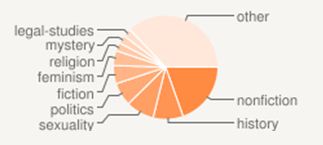
books read so far in 2011 (goodreads)

This year, for example — as evidenced by my GoodReads list, at right — I’ve been reading a lot of nonfiction in the areas of history, sexuality, and politics (big surprise, I know). The two years before that, unsurprisingly, were even heavier in history given all the background research I was doing for my thesis. Still, I read lots more non-fiction these days, even sans graduate school, then I did as a child and into my teens. Oh, I still read fiction — mostly genre stuff (fantasy, science fiction, mystery) and fan fiction, truth be told — but to be honest? I never made the leap from middle grade/young adult fiction to adult literature.

Like, okay, yes. I can get sucked into a modern novel but it usually has to have some sort of supernatural or historical element — if you can squeeze in some of both, I’m totally there. Think Camille DeAngelis’ Mary, Modern, a modern-day Frankenstein in which a geneticist clones her grandmother in the basement and it all goes wrong. Or Martin Cruz Smith’s Rose, a historical novel/mystery/romance in which an American explorer down on his luck gets hired to investigate the disappearance of a vicar in Wigan, Yorkshire. Or Audrey Niffenegger’s now-famous The Time-Traveler’s Wife, which not only involved time travel by the landscape of my childhood — how could I escape getting sucked into that? And well-written sexytimes will never go amiss.

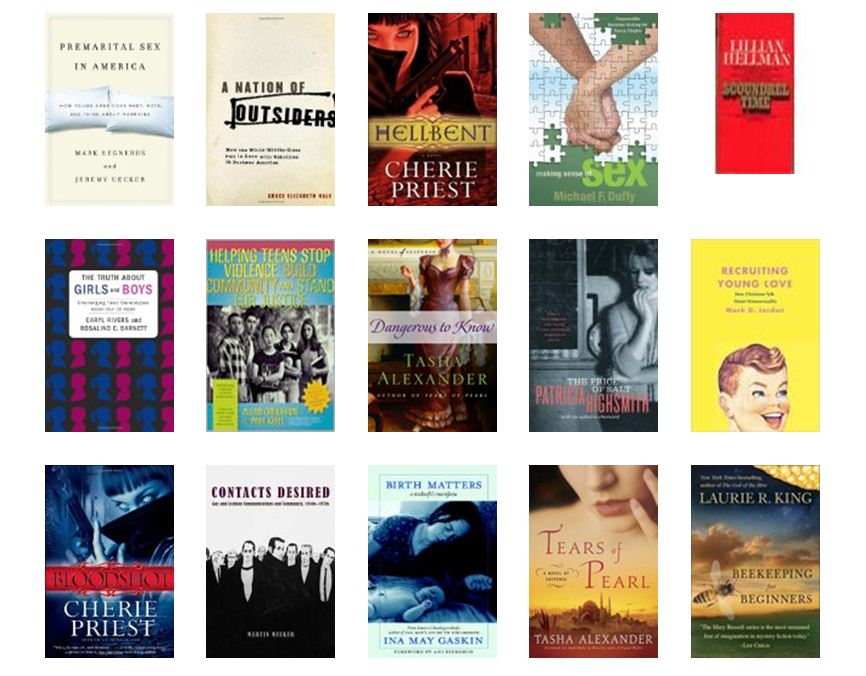
I’d say, on the whole, that these recent titles are a fairly accurate representation of the type books that I read these days:


last fifteen titles read (goodreads)

I actually learned to read “late,” according to a lot of school-based expectations. I was about six years old, between six and seven. I wasn’t much into practicing at reading (practicing at anything, really) and found
those beginning-to-read books mostly boring, unless I happened to like them for the story rather than the repetitive words. I must have been rehearsing on some level, though, because what I remember is the day I pulled The Best Christmas Pageant Ever off the shelf and discovered the words on the page made sense.

That obviously wasn’t the beginning of my love affair with reading, given that my parents read to us regularly and continued to do so long after we could read for ourselves — family bedtime stories didn’t stop until I was into my teens. But being able to read on my own meant more books. I used to go to the library, check out a stack of novels — I’m talking 10, 12, 15 books at a time — and read through them in an afternoon.

Ah, happy memories.

I have to say being able to read like that was a big incentive not to go to school, like, ever. Because going to school would have meant not being able to spend the day reading. And seriously: who would want that sort of fate!

Of course, as a college student and graduate student reading (and writing) were a major part of what I did, what I was expected to do, in school — so the conflict sort of faded away. Though there were always types of reading that waxed and waned during term-time. New fiction, for example, rarely got a look-in while my stand-by favorites became battered from the constant emergency comfort reading.

I was introduced to the world of advance review copies as a teenager when I worked at a children’s bookstore. We used to circulate the ARCs among the staff and eventually got to take them home once they’d outlived their usefulness. Again at Barnes & Noble free pre-pub copies were a regular and delicious perk of being on staff. I love the element of surprise in advance review copies: they’re unknown quantities, particularly if by unknown authors, which hold the promise of being brilliant gems as well as dreadful mistakes.

One of the best things about being a librarian (and, really, a blogger) is that they give you books for free. In the past five years I’ve been offered advance copies and electronic galleys of really interesting stuff that I might otherwise never have read — in part because I offer to review stuff on the internets, and in part because I am a librarian which is a professional credential that opens doors.

It’s like crack for bibliophiles: come work for us and we will give you free books to read!

Um, sure! Where do I sign!

Georges Island (Boston Harbor), 2007
When I learned to read, reading was still something you did offline. In that, there actually wasn’t an online — or at least, not an online for people like me (and probably you). I didn’t have a personal email address until … 1997ish? College. I was in college before the internet was a reality in my life. Which I’m sure to some of you makes me seem like an infant just out of diapers and to some of you makes me seem ancient.
Anyways. The point being, this reading-shit-online is still a new development for me. I’m still getting used to counting the reading I do online as reading, in fact, despite the reality that maybe 50% at least of the reading I do during the course of any day is now online or in electronic form: e-books, PDFs, etc. We pre-‘net generation types are used to thinking about reading in terms of books finished, or pages read. According to GoodReads I’ve read (for example) 59 books and 16,710 pages so far this year. But that doesn’t include all the fan fiction I read, or the blog posts I take in, or the journal articles I read for work and pleasure.
I downloaded a PDF file of one of my favorite fan works a few weeks ago and the PDF was over 200 pages long. That’s a respectable novella-length story. Just sayin’.
For those of us interested in chronicling our reading habits, how do we document that sort of thing? How do we leave a record of online materials read and digested — how do we leave traces of our textual influences? It’s an ongoing question.
Hanna and I argue about whether things like fan fiction actually “count” as “reading” (of the legitimate vs. non-legitimate variety). If you read this blog regularly you probably know where I come down on the issue of categorizing things as “legit” or not. It’s a friendly debate (although she absolutely draws the line at audiofic, since apparently fic-on-tape is the final straw!) and an apparently insoluable one, for now.
I’m not sure if all this online reading has altered the way I read. I find it more difficult to get lost in a book these days — the sort of uninterrupted reading sessions I had as a child and adolescent which involved resurfacing at 3am bleary-eyed and a little bit nauseated from the virtigo. I remember distinctly half a dozen specific books over which I made the concious decision to read until they were finished, even if it meant falling asleep at 5am. Because the story simply couldn’t wait.
I don’t do that so much anymore, but I don’t know how much of that is the (supposedly) shortened attention span created by extensive internet connectivity and how much is the training I had as a college student — that dual-consciousness of both reading a book and analyzing it. It’s hard for me to turn that part of my brain off now, even when I’m reading a ripping yarn. I don’t think it necessarily detracts from the experience of the story, though it does mean I need to be sure to keep multiple books on hand for when distraction rears its head and I need to switch genres for a bit.
All things considered, I’m more inclined to blame it on school and work (both of which demand constantly-divided attention) than the medium of the internet per se. If blame even needs to be considered as an option, seeing as I’m still reading and enjoying it — which frankly is all that matters to me.

"The second vital smirch"

20 Tuesday Sep 2011

Posted by Anna Clutterbuck-Cook in book reviews

≈ 2 Comments

Tags

blogging, books, fun, harpyness, humor, writing

So last night I got a pingback on a book review I wrote earlier in the year at Harpyness of Stephanie Coontz’ A Strange Stirring. Out of curiosity (who would be linking to a six-month-old post?) I clicked through. At first glance it appeared to be a book review of Judith Warner’s Perfect Madness. At second glance it turned out to be a plagiarized version of my review of Judith Warner’s Perfect Madness.

Well, sort of.

“mommy and baby are people of highly importance”
(click image to imbiggen)

As I started skimming the post, I realized that they hadn’t quite plagiarized it … they’d thrown it through a translation filter (or maybe several?) so that the result was complete gobbledygook. The whole site reads like it was put together by a robot with only a thin grasp of English.

It’s just not worth going after them for stealing my post, because in actual fact their garbled version is much more colorful and entertaining than my own incisive analysis! I’m not going to link to the post because I’m philosophically opposed to sending traffic their way (though, *cough*cough*, you can find the ping-back on the Coontz review comment thread above … they were foolish enough to leave the internal links intact from the original post … bwahahahah!). However, I’m totally not above providing y’all with some Tuesday afternoon laughs.

My review reads:

Suddenly, living in the Washington D.C. metropolitan area, Warner found herself with no critical distance on a culture that rewarded mothers for being entirely absorbed in, perfectionists at, a very particular type of mothering.

The plagiarized review reads:

Suddenly, vital in a Washington D.C. civil area, Warner found herself with no vicious stretch on a enlightenment that rewarded mothers for being wholly engrossed in, perfectionists at, a unequivocally sold form of mothering.

My review reads:

The second major flaw in Perfect Madness was the way Warner allows herself to make pretty harsh judgments about specific parenting choices.

The plagiarized review reads:

The second vital smirch in Perfect Madness was a proceed Warner allows herself to make flattering oppressive judgments about specific parenting choices.

My review reads:

Warner lays the blame for her sorrows at the feet of ‘the culture wars’ between social conservatives and feminists, whom she believes waste their energies on issues that are not of concern to the majority of Americans.

The plagiarized review reads:

Warner lays a censure for her sorrows at a feet of ‘the enlightenment wars’ between social conservatives and feminists, whom she believes waste their energies on issues that are not of regard to a infancy of Americans.

My review reads:

As a thirty-year-old woman in a lesbian relationship with no immediate plans to parent, I am not the demographic that Warner is writing about or writing for.  Even if I were to find myself a parent, the legacies of my own childhood in a fairly radical household and my own values system would preclude parenting the way the women in this book are parenting. Their values are, in many ways, decidedly not my values. And because of that, the experience of reading Perfect Madness felt voyeuristic at times. The study of lives and concerns at far remove from my own.

The plagiarized review reads (this might be my very favorite paragraph):

As a thirty-year-old lady in a lesbian attribute with no evident skeleton to parent, we am not a demographic that Warner is essay about or essay for.  Even if we were to find myself a parent, the legacies of my possess childhood in a sincerely radical domicile and my possess values complement would preclude parenting a proceed a women in this book are parenting. Their values are, in many ways, decidedly not my values. And given of that, a knowledge of reading Perfect Madness felt voyeuristic during times. The investigate of lives and concerns during distant mislay from my own.

My friend Lola has suggested that now she should qualify every introduction of me with “a lesbian attribute” as in, “this is Anna, a lesbian attribute.” When we find out what I’m an attribute of you’ll certainly be the first to know!

booknotes: birth matters

02 Friday Sep 2011

Posted by Anna Clutterbuck-Cook in book reviews

≈ Leave a comment

Tags

books, children, feminism, human rights, sexuality

I must have hallucinated starting the review of this book, because I have a clear memory of doing so but now cannot find the draft anywhere. Och, well. We’ll just have to begin again.

I need to admit upfront that I’m an entirely biased reviewer of anything Ina May Gaskin writes. My mother’s copy of Spiritual Midwifery was, along with Our Bodies, Ourselves, one of my adolescent introductions to feminism, as well as to female bodies and the amazing things they’re capable of. I think what Gaskin and the other midwives at The Farm have been doing for the past forty years is hands-down one of the most awesome things to come out of the 1960s, the women’s health movement, and feminist activism. So when my friend Molly offered up Ina May Gaskin’s Birth Matters: A Midwife’s Manifesta (New York: Seven Stories Press, 2011) as one of the reading options for her GoodReads reading group on feminist pregnancy, birth, and parenting, I jumped at the chance.

UPDATE: You can read Molly’s review over at first the egg.

That having been said, I also approached the Gaskin’s memoir with some trepidation: how would her work and her writing come across in a new book, one that would be impossible to read through the filter of “that’s just how they talked about things back in the 70s…”? I was a little bit worried about being let down, much in the same way one’s favorite books from childhood often feel a bit tarnished upon re-reading.

My fears, however, were (mostly) all for naught. Birth Matters is highly readable, compelling, contemporary, and unapologetically feminist in its approach to the political and cultural barriers to high-quality pregnancy, birth, and parent-and-child care in our society. “The way a culture treats women in birth is a good indicator of how well women and their contributions to society are valued and honored,” Gaskin argues in chapter one, “The Importance of Birth and Birth Stories”:

My intention in this book is not to persuade those women who want to avoid pregnancy to change their minds — far from it. But I do want to convince even women with no interest in motherhood that the right to a positive and safe birth is just as important as the right to choose whether or not to have a child (7).

She gently points out that the often bitter divisions between parents and non-parents is an unhelpful model for making our world a better place for all humanity: “It is time for feminists to realize that pitting the needs of nonmothers against those of mothers is a way of weakening — not strengthening — women. Women should not lose their human rights when they become mothers” (41). Beyond looking at women and mothers, she articulates what I think should be shouted from the rooftops by us all: that the way we welcome children into the world speaks volumes about how we value humanity — and as such, birth matters to all of us simply because we are part of that human community. The way we were welcomed into the world and cared for as infants and children is part of that story, even if we don’t ever plan on becoming parents ourselves.

Gaskin has been in the enviable (for most midwives) position of enjoying strong, positive working relationships with practicing OB/GYN physicians throughout her tenure as a midwife at The Farm, and her belief in the ability of medical doctors and lay or nurse-midwives to work together to foster positive birth experiences for families is evident throughout the book. I really appreciated the way she highlighted the work of medical doctors who trust birthing parents’ bodies and offer their expertise without trying to direct the process or fueling fear of the body’s work during pregnancy. Yes, sometimes life-threatening complications develop during pregnancy and birth — but too often in our culture we attempt medical interventions in childbirth that end up being detrimental to the health and well-being of both infants and their birth parents. Gaskin offers an alternative vision of how birth practices can be (and have for the nearly three thousand births Gaskin and her team have overseen in the forty years between 1970-2010). Indeed, it is the outcomes of Gaskin’s practice that will likely be most compelling for skeptics of out-of-hospital childbirth: of the 2,844 births attended at the Farm 94.7% were completed at home with a maternal death rate of 0% and a neonatal death rate of 1.7 deaths per 1,000 births. The Farm’s rate for c-sections stands at 1.7% which nation-wide hovers between 30-50% (far exceeding the World Health Organization’s recommendation of 5-10% of all births*).

Most of what Ina May Gaskin has to say will sound familiar to anyone who has read recent books on pregnancy and birth, particularly Born in the USA by Marsden Wagner and Pushed by Jennifer Block (I highly recommend them both). However, there is some valuable material here that even those familiar with the arguments for the midwifery model of care will likely be interested in. Interspersed throughout are birth narratives written by women who have given birth at The Farm. From my point of view, there can never be too many birth narratives out there for us to draw upon. It’s particularly useful to read how different each person’s story is, even though they have made some of the same basic choices about the type of care they want to receive. I was also glad to see a chapter on sexuality and childbirth — something I wish Gaskin had done more with. The midwives at the farm have long advocated for sexual interaction between a laboring woman and her partner(s) as a way of facilitating a less painful, more effective labor. The idea of “orgasmic childbirth” might seem obscene to some, idealistic to others, but even if you don’t want to think about childbirth itself as a sexual experience, I think Gaskin has some important points to make about the way medicalizing childbirth (treating it as an illness) has removed women’s bodies and their physical presence — sexual and otherwise — from the active birth process.

My one frustration with Birth Matters is the consistency with which Gaskin’s language choices and examples reinforce the assumption that all birthing takes place within the context of heterosexual, gender-normative lives. The birth parent is consistently a woman/mother and is never identifiably partnered with a woman, although in several stories it is unclear whether the birth parent is single or has a partner. This seemed like an odd oversight for someone who is otherwise so clearly open to the possibility that families come in many shapes and sizes. At times, Gaskin also over-simplifies the history of midwifery and falls into the trap of romanticizing the sacred feminine and female bodies — something that makes me slightly uncomfortable since I try to avoid essentializing femininity/femaleness. I’d recommend, as a supplement to reading this, the wonderful essay “The Manly Art of Pregnancy,” by j wallace (found in Gender Outlaws: The Next Generation, edited by S. Bear Bergman and Kate Bornstein, 2010) which just might be my favorite thing written about pregnancy ever. And I would hope that future editions of this work acknowledge more overtly that people with many different sex and gender identities and family contexts become pregnant and wish to give birth in supportive, low-intervention settings such as The Farm.

The final verdict: Read this book if you care about the cultural and political contexts in which we come into the world, and if you question — even a little bit — the medicalization of pregnancy and childbirth that has become the norm in our country at this point in history. Gaskin’s memoir-manifesta is a beautiful testament to how there is a different way — not just in the future, but here and now.

*See the WHO report The Global Numbers and Costs of Additionally Needed and Unnecessary Caesarean Sections Performed per Year: Overuse as a Barrier to Universal Coverage [PDF]

booknotes: the price of salt

15 Monday Aug 2011

Posted by Anna Clutterbuck-Cook in book reviews

≈ 4 Comments

Tags

books, feminism, gender and sexuality, reading lesbian classics

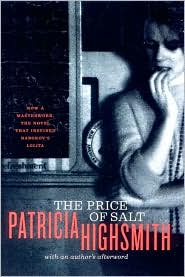
While on vacation at my in-laws’ in Maine a couple of weeks ago, I spent an afternoon reading Patricia Highsmith’s 1952 novel The Price of Salt (New York: W.W. Norton, 1990), originally published under the pseudonym “Clare Morgan.” I’d read recently that it was noted for being one of the first works of lesbian fiction with a happy ending so I thought “why not!” and ordered it interlibrary loan from our local public library.

Spoiler alert.

Romance? Well, yes. Happy ending? …. Not so much. I mean, okay, technically, yes, the two main characters end up together. So if your definition of “happy” is “two characters of the same gender/sex choose their relationship despite social prejudice and do not end up in mental institutions and/or dead” then this fits the bill. If your definition of “happy” is “two people who actually love each other establish a mutually fulfilling relationship” then … not so much.

The plot in a paragraph: Therese, an emotionally-starved young woman in her twenties, is living in New York City and working at a department store while trying to break into the theater industry as a set designer. She rather listlessly dating a man who assumes that since they’ve had sex they will eventually get married. One day at the department store Therese assists Carol, an affluent suburban housewife who is there to purchase a Christmas present for her daughter. Captivated by Carol’s presence, Therese can’t get the woman out of her mind. She sends Carol a Christmas card and when Carol receives it, she phones Therese to thank her. The two women slowly begin seeing more and more of each other until they decide to take off on a cross-country road trip while Carol’s soon-to-be-ex-husband has their daughter for three months. During the roadtrip the two women finally have sex (and pretty nice, if not very graphic, sex, actually … they’re relationship is most loving when they’re in bed). The husband has hired a private investigator to follow the two women and gather evidence of the affair to use against Carol in the divorce proceedings (to try and gain full custody of the daughter; in 1954 a completely realistic situation for women in same-sex relationships). Carol leave Therese to return to New York and try to fight for her visitation rights; when this fails she ends up returning to Therese and asking to resume their relationship. Therese initially refuses, but the novel ends with Therese being drawn back to Carol. We’re clearly meant to celebrate that Carol prioritized Therese over visitation rights with her daughter (her lesbian “record” precluded actual custody) and that Therese is not left alone, or left feeling her lesbianism is somehow dirty or unsuccessful.

The positive: So the obvious positive here is that this is a novel in which a sexual relationship between two women is central to the plot and, in the end, central to the lives of the two women involved. They defy the pressures of a world in which Therese is expected to marry the man with whom she’s had (supremely unsatisfying) sex. A world in which Carol is expected to capitulate to the demands of her husband’s family (essentially that she act straight for the rest of her life) in order to see her daughter — even in highly supervised annual visitations. The novel situates these women as heroines, and their enduring relationship as a triumph. It also doesn’t shie away from the fact that their relationship is sexual — as I said above, the scene in which Therese and Carol make love for the first time is tame and “off stage” by fanfic standards, but sweet all the same. Since a number of the “lesbian classics” I’ve read fall down in this regard (satisfying sex scenes) this is a definitely plus.

The negatives: The overarching “negative” from my perspective is that the question remains throughout the whole damn novel why Therese wants to be with Carol. Her infatuation with Carol is understandable at first as a revelation — an understanding that the way she feels drawn to Carol is wholly different from desire of the platonic sort. It provides her with some pretty clear insight into why her relationship with the boyfriend has been unsatisfying. The trouble is that Carol is manuipulative, withholding, and cruel. She entertains Therese when it’s convenient and amusing for her to do so, but drops her the minute something else catches her attention. She makes fun of Therese’s set designs and aspirations in the theater. When she returns to Therese after months of estrangement she basically assumes Therese will take her back no questions asked, and is hurt when this isn’t (initially) the case. Carol is at the center of her own personal drama and Therese is just part of the supporting cast.

Also, there was a friend of Carol’s (whose name I’m currently blanking on) who plays intermediary between Carol and Therese and is also clearly jealous of Therese’s intimacy with Carol. There’s clear intimations that the two of them were involved at some point and I kept waiting for the revelation that they were still involved behind Therese’s back. I bet you anything they were.

I was definitely left hoping, at the end of the novel, that a year or two down the road Therese — with a bit of sexual experience behind her and a more solid sense of herself as an artist and as a queer woman — would get over her obsession with Carol and find someone who, you know, actually showed some affection for her. Who loved and enjoyed Therese for Therese’s sake, rather than just as a plaything.

← Older posts
Newer posts →
"the past is a wild party; check your preconceptions at the door." ~ Emma Donoghue

Recent Posts

  • medical update 11.11.22
  • medical update 6.4.22
  • medical update 1.16.2022
  • medical update 10.13.2021
  • medical update 8.17.2021

Archives

Categories

Creative Commons License

This work by Anna J. Clutterbuck-Cook is licensed under a Creative Commons Attribution 3.0 Unported License

Meta

  • Create account
  • Log in
  • Entries feed
  • Comments feed
  • WordPress.com

Create a free website or blog at WordPress.com.

  • Subscribe Subscribed
    • the feminist librarian
    • Join 37 other subscribers
    • Already have a WordPress.com account? Log in now.
    • the feminist librarian
    • Subscribe Subscribed
    • Sign up
    • Log in
    • Report this content
    • View site in Reader
    • Manage subscriptions
    • Collapse this bar