• anna j. clutterbuck-cook
  • contact
  • curriculum vitae
  • find me elsewhere
  • marilyn ross memorial book prize

the feminist librarian

the feminist librarian

Tag Archives: children

booknotes: birth matters

02 Friday Sep 2011

Posted by Anna Clutterbuck-Cook in book reviews

≈ Leave a comment

Tags

books, children, feminism, human rights, sexuality

I must have hallucinated starting the review of this book, because I have a clear memory of doing so but now cannot find the draft anywhere. Och, well. We’ll just have to begin again.

I need to admit upfront that I’m an entirely biased reviewer of anything Ina May Gaskin writes. My mother’s copy of Spiritual Midwifery was, along with Our Bodies, Ourselves, one of my adolescent introductions to feminism, as well as to female bodies and the amazing things they’re capable of. I think what Gaskin and the other midwives at The Farm have been doing for the past forty years is hands-down one of the most awesome things to come out of the 1960s, the women’s health movement, and feminist activism. So when my friend Molly offered up Ina May Gaskin’s Birth Matters: A Midwife’s Manifesta (New York: Seven Stories Press, 2011) as one of the reading options for her GoodReads reading group on feminist pregnancy, birth, and parenting, I jumped at the chance.

UPDATE: You can read Molly’s review over at first the egg.

That having been said, I also approached the Gaskin’s memoir with some trepidation: how would her work and her writing come across in a new book, one that would be impossible to read through the filter of “that’s just how they talked about things back in the 70s…”? I was a little bit worried about being let down, much in the same way one’s favorite books from childhood often feel a bit tarnished upon re-reading.

My fears, however, were (mostly) all for naught. Birth Matters is highly readable, compelling, contemporary, and unapologetically feminist in its approach to the political and cultural barriers to high-quality pregnancy, birth, and parent-and-child care in our society. “The way a culture treats women in birth is a good indicator of how well women and their contributions to society are valued and honored,” Gaskin argues in chapter one, “The Importance of Birth and Birth Stories”:

My intention in this book is not to persuade those women who want to avoid pregnancy to change their minds — far from it. But I do want to convince even women with no interest in motherhood that the right to a positive and safe birth is just as important as the right to choose whether or not to have a child (7).

She gently points out that the often bitter divisions between parents and non-parents is an unhelpful model for making our world a better place for all humanity: “It is time for feminists to realize that pitting the needs of nonmothers against those of mothers is a way of weakening — not strengthening — women. Women should not lose their human rights when they become mothers” (41). Beyond looking at women and mothers, she articulates what I think should be shouted from the rooftops by us all: that the way we welcome children into the world speaks volumes about how we value humanity — and as such, birth matters to all of us simply because we are part of that human community. The way we were welcomed into the world and cared for as infants and children is part of that story, even if we don’t ever plan on becoming parents ourselves.

Gaskin has been in the enviable (for most midwives) position of enjoying strong, positive working relationships with practicing OB/GYN physicians throughout her tenure as a midwife at The Farm, and her belief in the ability of medical doctors and lay or nurse-midwives to work together to foster positive birth experiences for families is evident throughout the book. I really appreciated the way she highlighted the work of medical doctors who trust birthing parents’ bodies and offer their expertise without trying to direct the process or fueling fear of the body’s work during pregnancy. Yes, sometimes life-threatening complications develop during pregnancy and birth — but too often in our culture we attempt medical interventions in childbirth that end up being detrimental to the health and well-being of both infants and their birth parents. Gaskin offers an alternative vision of how birth practices can be (and have for the nearly three thousand births Gaskin and her team have overseen in the forty years between 1970-2010). Indeed, it is the outcomes of Gaskin’s practice that will likely be most compelling for skeptics of out-of-hospital childbirth: of the 2,844 births attended at the Farm 94.7% were completed at home with a maternal death rate of 0% and a neonatal death rate of 1.7 deaths per 1,000 births. The Farm’s rate for c-sections stands at 1.7% which nation-wide hovers between 30-50% (far exceeding the World Health Organization’s recommendation of 5-10% of all births*).

Most of what Ina May Gaskin has to say will sound familiar to anyone who has read recent books on pregnancy and birth, particularly Born in the USA by Marsden Wagner and Pushed by Jennifer Block (I highly recommend them both). However, there is some valuable material here that even those familiar with the arguments for the midwifery model of care will likely be interested in. Interspersed throughout are birth narratives written by women who have given birth at The Farm. From my point of view, there can never be too many birth narratives out there for us to draw upon. It’s particularly useful to read how different each person’s story is, even though they have made some of the same basic choices about the type of care they want to receive. I was also glad to see a chapter on sexuality and childbirth — something I wish Gaskin had done more with. The midwives at the farm have long advocated for sexual interaction between a laboring woman and her partner(s) as a way of facilitating a less painful, more effective labor. The idea of “orgasmic childbirth” might seem obscene to some, idealistic to others, but even if you don’t want to think about childbirth itself as a sexual experience, I think Gaskin has some important points to make about the way medicalizing childbirth (treating it as an illness) has removed women’s bodies and their physical presence — sexual and otherwise — from the active birth process.

My one frustration with Birth Matters is the consistency with which Gaskin’s language choices and examples reinforce the assumption that all birthing takes place within the context of heterosexual, gender-normative lives. The birth parent is consistently a woman/mother and is never identifiably partnered with a woman, although in several stories it is unclear whether the birth parent is single or has a partner. This seemed like an odd oversight for someone who is otherwise so clearly open to the possibility that families come in many shapes and sizes. At times, Gaskin also over-simplifies the history of midwifery and falls into the trap of romanticizing the sacred feminine and female bodies — something that makes me slightly uncomfortable since I try to avoid essentializing femininity/femaleness. I’d recommend, as a supplement to reading this, the wonderful essay “The Manly Art of Pregnancy,” by j wallace (found in Gender Outlaws: The Next Generation, edited by S. Bear Bergman and Kate Bornstein, 2010) which just might be my favorite thing written about pregnancy ever. And I would hope that future editions of this work acknowledge more overtly that people with many different sex and gender identities and family contexts become pregnant and wish to give birth in supportive, low-intervention settings such as The Farm.

The final verdict: Read this book if you care about the cultural and political contexts in which we come into the world, and if you question — even a little bit — the medicalization of pregnancy and childbirth that has become the norm in our country at this point in history. Gaskin’s memoir-manifesta is a beautiful testament to how there is a different way — not just in the future, but here and now.

*See the WHO report The Global Numbers and Costs of Additionally Needed and Unnecessary Caesarean Sections Performed per Year: Overuse as a Barrier to Universal Coverage [PDF]
booknotes: the truth about boys and girls

26 Friday Aug 2011

Posted by Anna Clutterbuck-Cook in book reviews

≈ 1 Comment

Tags

children, education, feminism, masculinity, science

I have recently discovered NetGalley, an online resource for requesting e-book versions of forthcoming titles from a wide variety of publishers. As a blogger and librarian, I was able to sign upi for an account and I’ve requested a handful of titles. It’s my first true foray into the work of e-book reading. Verdict so far: meh on e-books in general, but I’m totally down with electronic advance review copies. It makes distributing ARCs so much more cost effective for publishers, which in turn makes it much more likely they’ll be willing to share them with bloggers who might review the book but have no purchasing budget.

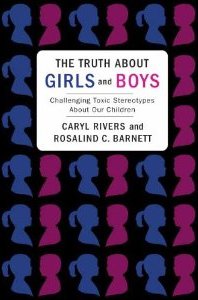
The first galley I read was The Truth About Boys and Girls: Challenging Toxic Stereotypes About Our Children (New York: Columbia University Press, 2011), by Caryl Rivers and Rosalind C. Barnett. Rivers and Barnett are the team that brought us Same Difference (2004), which tackles the work of scientists who claim that men and women are innately different in their psychological makeup. The Truth About Boys and Girls picks up this same subject, but focuses specifically on the way claims about innate gender difference are a) unsupported by rigorous scientific research, and b) continue to have potent persuasive power among parents, teachers, policymakers, and others involved in shaping the everyday life of children. This thesis is not going to be news to anyone who moves in feminist circles, so I would caution that unless you want to stay current on all the publications in this area, a quick skim of this book is likely all that is in order. Maybe I’m biased toward the overly technical and detailed, but when it comes to reviews of the relevant scientific research on this subject, I’ve found Rebecca Jordan-Young’s Brainstorm and Cordelia Fine’s Delusions of Gender to be the best critiques out there.

Still, this is a highly-readable book that might serve as an introduction to the topic, particularly those who feel at sea fairly quickly amidst scientific jargon. The chapters are arranged to take on the major areas of supposed gender difference: ability with maths, ability with language, empathy and caring, physical aggression, and several chapters at the end specifically targeted toward the rising popularity of sex-segregated classrooms (and the myth that sex-segregation enhances learning for both boys and girls).

The most frightening take-away from this book, I found, was the reminder that our world is becoming more not less invested in the idea of innate gender difference. As Barnett and Rivers point out in their introduction, “It’s ironic that as neuroscience tells us more and more about the similarity of our brains, popular culture incessantly beams the opposite message, drowning out the real story” (5). Both girls and boys are harmed by these difference stereotypes (girls consistently being told they will under-perform in math and science, for example, thus increasing the likelihood due to stereotype threat that they will meet those low expectations). However, it’s particularly striking to see how — in our current cultural climate, at least — boys are particularly vulnerable to the straightjacket of gendered expectations. Girls, at least, have alternate and fairly prominent voices advocating for them: they might get relentlessly marketed to by the Disney princess line and told they can’t do math because their brains don’t work that way … but they also (most likely) have adults in their lives who encourage them to play soccer, ride bicycles, or take on leadership roles. The “boy crisis” panic of recent years, rather than focusing on the harm that gender stereotyping does to boys has actually focused mostly on reinforcing those stereotypes in ever-more extreme ways:

Out of this crucible of alarm, a particular image of the ‘typical’ boy has emerged in many media reports: he’s unable to focus, can’t sit still, hates to read, acts up in class, loves sports and video games, and gets in trouble a lot. Indeed, such boys do exist — it has long been established that boys suffer more from attention deficit disorder than girls do — and they need all the help they can get. But research shows that this picture does not reflect the typical boy. Boys, in fact, are as different from one another as they are from girls. Nonetheless, some are advocating boys-only classrooms in which boys would be taught in boot-camp fashion (78).

And a few pages later, summarizing the recommendations of author Leonard Sax:

A boy who likes to read, who does not enjoy contact sports, and who does not have a lot of close male friends has a problem, even if he thinks he is happy (89).

Although the authors don’t overtly connect such panic about masculine behavior to homophobia, I have to say the above sentence fairly screams with “oh my god what if he has teh gay!” Later on, in the chapter about “rough and tumble” play, the authors do note that adult interpretation of children’s play as conforming to gender stereotypes might actually be subverting them or otherwise working around those expectations in interesting ways. Rough and tumble play, they suggest “gives boys an acceptable medium for being physically close in cultural or social environments that otherwise discourage such behavior” (114). Obviously this doesn’t mean that all physical closeness is homoerotic to the participants, but it does suggest that in a society that discourages boys from physical intimacy with one another and/or with girls — physical closeness that most human beings need regardless of gender — play that adults read as “masculine” and aggressive might actually be a way of meeting the human need for touch.

Like Cordelia Fine in Delusions of Gender, Rivers and Barnett emphasize the degree to which children perform gender based on the modeling and perceived expectations of the adults around them. For example, they note that the majority of research of the group behavior of children is conducted in school settings — sites where adults are constantly reminding children that they are gendered beings (from the greeting of “good morning boys and girls!” to sorting children into male and female groups for recess).  Recent research on play behavior among children has found that in spaces where gender is not brought to the fore by adults — for example in unstructured neighborhood play — children are less likely to fall into gendered patterns of behavior, and to seek playmates across gender lines.

“In short,” Barnett and Rivers write toward the end of The Truth, “the differences within each sex are greater than the differences between the sexes. It makes no sense to talk about boys and girls as if they were homogeneous groups that are different enough to warrant separate educational treatment” (180). “Not only do single-sex public schools violate constitutional principles, but they deprive our children of important learning opportunities and run the very real risk of reinforcing the toxic sex stereotypes that are rampant in our society” by encouraging children to think that boys and girls are so wholly alien from one another they can’t even learn side-by-side.

Hopefully our society will get the message sooner or later. In the meantime, I can only say that I’m glad that there are so many feminist parents out there who are encouraging their daughters and sons to carry on bravely being who they are rather than what the outside world insists they ought to become.

30 @ 30: (not) being a parent [#4]

10 Wednesday Aug 2011

Posted by Anna Clutterbuck-Cook in life writing

≈ 1 Comment

Tags

children, thirty at thirty

I’ve had a hard time finding my way into this post, and while the reasons are several I’m going to use my allotted space this week to talk about one in particular: the odd and unexpectedly liminal space I find myself in these days regarding parenting and childcare. I want to talk about my own feelings about childcare and potential parenting as they’ve evolved over the years, and I want to talk about the network of relationships and examples that have created the context in which those feelings have evolved. I’m specifically thinking here about my own desires and abilities to conceive, give birth to and/or adopt and raise children as a primary caregiver. I’ve already written lots in this space about the importance of incorporating children into the human family and how I think our culture falls down in this regard (see here, here, here, here, here, here, here, here, here, and here … I really gotta make a separate index page for these things). Today, I’d like to talk in more personal terms about what the decision to parent or not parent means in my own life right now.

I grew up in an environment that revolved around the daily experience of being a child. There are a lot of different ways being child-centric can manifest itself (for more on my own particular version go here). I would say that, from a child’s perspective, my family life normalized the primacy of caring for young people as a central task of being human, and also modeled that care-taking as an activity that was integrated into the “real” world — as opposed to being something one did either as a school teacher or (necessarily) as a “stay at home mom.” Yes, my mother was the parent dedicated to arranging our home life, but my parents didn’t back this decision up with ideology concerning gender. This meant that I grew up believing that: 1) caring for children was an important and legitimate adult responsibility 2) it was work that required full-time attention from someone or someone(s) to do well, and 3) this important responsibility was not “naturally” women’s job, but rather something that one did out of a sense of vocation. And because it was simply what family members did: look out for one anothers’ needs.

At age three, I thought I’d grow up to be Nora (Helen Reddy)
from Pete’s Dragon. Lighthouse keeper and adoptive parent
— what could possibly be better? 

In the manner of most children (at least I assume this is so?), I imagined that growing up to be an adult meant more or less growing up to take on the sort of responsibilities my parents and the other adults around me had. And that meant, in part, the responsibility of being a parent. I was an oldest child (and daughter) who positioned myself in my pre-adolescent and early adolescent years as someone who both liked parenting and was good at it. Younger children seemed comfortable with me. I was comfortable with them. As a girlchild I obviously got tons of positive social reinforcement for this behavior. (To be fair, my brother was also a nurturer, did childcare as a teenager, and today teaches middle school … so this wasn’t a completely gendered phenomenon. But I’m willing to bet I was meeting gendered expectations on some level.) Childcare also, actually, gave me an easy “out” when it came to socializing with my peers — something I felt generally awkward about. With the exception of spending time with close friends, as a child and adolescent I was pretty much constantly on the lookout for opportunities to ditch my age-mates in order to hang out with grown-ups (I wanted to be one) and smaller children (caring for them gave me an adult-like excuse to avoid my peers).  Caring for children was a legitimate role. And I did genuinely like the wee ones I was responsible for.

When I was five I wanted to be Maria from The Sound of Music.
If you’re going to adopt, why stop at just one?

In that context, to the extent I imagined being an adult, I imagined being a parent. My best friend (coughcough childhood crush coughcough) and I had a long-standing fantasy about adopting lots of orphans and raising them together. As I went through puberty I developed a massive obsession with the physiology and sociology of pregnancy and childbirth (thank you Our Bodies, Ourselves and the other literature of the women’s health movement!). I had very concrete ideas about what sort of pregnancy and birth experience I wanted when it came to having kids — however, whenever that happened. As the realm of possibilities for family creation expanded, my sense of how I might parent (and with whom) shifted, but I never entirely dropped the idea of being a parent someday. During my teen years and early twenties I learned some things about myself, including the fact that I wasn’t really interested in parenting in the context of a dyadic relationship in which I would be the full-time hands-on caregiver. At the same time, I remained committed to the sort of out-of-the-mainstream parenting that had been my own childhood experience. The only way I could see that sort of parenting happening in conjunction with my personality would be to have co-parenting with probably more than one other person, either in a co-housing or communal setting, in a committed poly marriage, or some other heretofore unspecified situation.

Because such a situation was so difficult to imagine establishing successfully, I started re-evaluating my assumption that being an adult me would involve parenting. I was lucky enough to have family members who didn’t pressure me to settle into a heteronormative family and start popping out babies, and also lucky enough to be surrounded not only by folks who had parenting radically (the homeschooling/unschooling community) but also by some really kick-ass single and non-parenting adults — notably single and non-parenting women — whom I could look to as models for what it would mean to be a not-parent.  My father’s sister, for example, is now married with an adult stepson, but spent the majority of my childhood as a single female academic pursuing her PhD in theology and an MS in Social Work. A close family friend who was likewise single for years used to have dinner with our family regularly and provide childcare when my parents needed a break; being without children himself did not seem to impede his ability to be close with us or with his nieces and nephews. In college of the six female professors who I’d identify as the most influential in my academic career, three were single when they had me as a student and four were not parenting. All four of those women were living examples of how to be a whole person and build relationship networks without a marriage or children.

I took some flak from a couples’ counselor a year or so ago for starting to answer her question about whether I did or did not want children (Hanna’s immediate answer: “No”) by providing all of this background. Hanna pointed out to me later that the therapist — being unfamiliar with how my mind worked — probably thought I was evading her query. I wasn’t, but I honestly didn’t know how to answer her in any other (more succinct) way. Because my current location on the parenting continuum is a result of all these experiences, and that location is situational. Unlike people who experience bodily knowledge about their desire to parent or not parent, I am comfortable in the in-between space of offering my skills as a caregiver where and when I am called upon to do so.

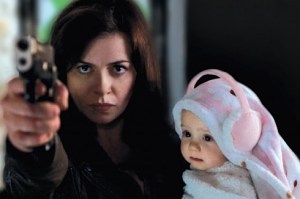
Gwen Cooper and Baby Cooper (Torchwood).
This is how I picture Hanna’s parenting would be (sans pink).
For the fucking win.

This frightens Hanna sometimes, the fact that my resistance to being a parent isn’t as complete as hers. We’re still working out how to negotiate that. While I don’t need (and for a number of reasons don’t actively want) to be a parent or primary caregiver, I also don’t experience the passionate rejection of that role that Hanna and some of our close friends articulate. I want to stay open to our lives and desires changing. Not because I think being a parent (or more specifically a mother) is something we need to lead fulfilling lives as women, or to have coherent and meaningful identities. But because I, personally, have a very difficult time taking any possibility off the table permanently. Closing and locking doors frightens me, makes me feel claustrophobic.

I also want to stay open to the accidental parenting. Obviously, the chances of this happening given our collective anatomical make-up are incredibly slim, but I still want to stay alive to the possibility that at some point in the future we may be called upon to parent in some way: the children of friends or relatives, for example, in need of a temporary home. Gods forefend anything so traumatic happening to the people we love — but I live with the knowledge that shit sometimes does hit the fan, and I want to be there for the vulnerable survivors if it does.

All of this leaves me in what feels like a bit of a no man’s land when it comes to the current state of our cultural assumptions about parenting. In a landscape where children and families are simultaneously idolized and marginalized, and where single and non-parenting adults (particularly women) feel vilified for their decision not to parent, the pressure to “choose sides” is intense and I find it hard not to feel rendered invisible as a non-parent who is neither proudly childless by choice nor mourning her infertility and/or circumstances unconducive to parenting. I feel bi-lingual, in a sense, able to speak the language of parenting and of not-parenting with equal willingness and ease. I can see my future life unfolding in multiple directions, and I’m okay with that. Most of the time. But certainty about uncertainty (e.g. openness-to-change) is sometimes a more difficult position to articulate or defend than is certainty about certainty. Which is perhaps why it’s taken me two weeks and this meandering blog post to do so — and why our couples’ therapist thought I was evading the question.

I’m going to pick up the theme of openness-to-change in next week’s post on “desire.” In the meantime, this is what I got. I hope it at least approximates what I set out to offer.

booknotes: helping teens stop violence

05 Friday Aug 2011

Posted by Anna Clutterbuck-Cook in book reviews

≈ 1 Comment

Tags

children, education, gender and sexuality, human rights, politics, racialization

My latest early reviewer book from LibraryThing was the 20th anniversary edition of Allan Creighton and Paul Kivel’s Helping Teens Stop Violence, Build Community, and Stand for Justice (Alameda, CA: Hunter House, 2011). The authors have worked together in the field of violence prevention and social justice activism since the mid-1970s. This book is a workbook for adults seeking to work with young people, specifically teenagers, to identify and combat the various types of institutional and cultural injustice they encounter in their lives. “Professional literature about adolescents, social-service priorities, and funding trends all [emphasize] programs that [build] self-esteem,” the authors observe. “Many youth workers convey to young people that if they just had higher self-esteem, they could overcome any obstacle and succeed at anything they set out to do,” ignoring the institutionalized, systemic injustices young people as well as adults face in securing life necessities and building a satisfying life for themselves and their families (60). We do a grave disservice to youth, the authors argue, by implying that if they are struggling it is largely because of personal failure when, in fact, the problem is an imbalance of power:

Our problem [when we were young people ourselves] was not based on low self-esteem or any of the other psychologically defined problems. Rather, we had no real power over our lives. Without power to protect ourselves, we were constantly restricted, disrespected, and abused by adults. Everywhere we went, adults had the authority to decide how we should dress, where we could be, and who we could be with. They decided our future through daily decisions including discipline, records, diagnoses, arrests, report cards, evaluations, and allowences, or just by ignoring, interrupting, or neglecting us.(60-61)

The imbalance, of course, is not just one of age but also intersects with many other inequalities from which adults also suffer: poverty, sexism, racism, religious bigotry, discrimination based on disability and sexual orientation or gender identity … the list is a long and familiar one. Creighton and Kivel call on adult allies to work with youth in identifying these power imbalances and combat them. Those who benefit from inequality seek to divide the attention and alliances of those who are struggling to get by under oppressive systems. By forging networks of support among ourselves at the bottom of the inequality pyramid, the authors suggest, we can more effectively enact lasting social change as well as survive in present day far-less-than-optimal conditions.

Since the book is designed primarily as a workbook for group trainings, those who are reading Helping Teens Stop Violence outside of that context may find themselves skimming a bit and taking note of various exercises for later usefulness, rather than reading in a straightforward manner. I found myself skipping around quite a bit, once I’d read the introduction and gathered the gist of the authors’ perspective and approach. Some general impressions:

  • The authors have made an effort throughout to discuss the ways in which different types of injustice overlap and interact, so that even though (for example) a given chapter may be about “class” the exercises continually push us to think about how things like race, sexual orientation, immigrant status, etc., shape our class identities and economic opportunities.
  • As someone who is continually frustrated with the invisibility of ageism in our culture — even among groups of people willing to discuss and dismantle other “isms” such as sexism and racism, or address homophobia and access issues for folks with disabilities — I was really excited to see the first few chapters devoted to age-based discrimination, and exercises designed to get adults remembering their own teenage years and the lack of agency they had as young people in a world controlled by adults.
  • The authors emphasize the fluidity of what they call “target” and “non-target” categories (i.e. various types of social privilege), reminding us that our social status and agency is highly dependent on context and can change as the context changes — so that each of us have experienced both being part of a target group and being part of a non-target (privileged) group at various points in our lives.
  • Even without using this book as a workbook with a group, as it was intended, the various exercises often contain useful suggestions for how to intervene in situations where you see oppression happening in order to name it and (hopefully) stop the cycle of violence from continuing.
  • They also offer some good guidelines for having constructive and saf(er) discussions about difficult topics, recognizing that “we have all been hurt in various ways and have had lots of experience of not being listened to well, so we have developed a billion ways to protect ourselves from getting close to each other and becoming vulnerable to further hurt” (170). By structuring discussions in ways that may seem a bit stilted at first, groups can build enough trust by which they can have productive conversations about prejudice, violence, and institutionalized inequality.

Helping Teens Stop Violence will obviously be most useful to those who have immediate practical application for its suggested exercises and the resources listed in the back of the book (though I found their resource lists a rather odd mix, with curious gaps — particularly when it comes to the available literature on violence in education and violence against youth). However, it’s a worthwhile read for anyone who is interested in the practical aspects of social justice work at the grassroots level, and who is interested in thinking a bit more deeply about the way in which our culture has institutionalized ageism and systematically disenfranchises young people and children.

quick hit: SCOTUS on young peoples’ free speech rights

28 Tuesday Jun 2011

Posted by Anna Clutterbuck-Cook in linkspam

≈ 2 Comments

Tags

children, human rights, politics

I’m in Michigan for a whirlwind visit to attend my brother and sister-in-law’s wedding celebration. I thought I might have fun photos to share with you today, but not yet. Instead, I’ll post this story that I heard on National Public Radio this afternoon.

The Supreme Court on Monday struck down a California law banning the sale of violent video games to children, saying it ran afoul of the First Amendment right to free speech.

In one of the most closely watched cases this term, in a 7-to-2 vote, the justices said governments did not have the authority to “restrict the ideas to which children may be exposed.”

I was struck, when I heard the story on All Things Considered, that the issue was being framed as a free-speech issue. That is, that children have a constitutional right to information…even if its information we find disturbing and wish to protect them from on a legal level.

This may be the first (and only!!) time I find myself agreeing with Antonin Scalia:

Writing for the majority, Justice Antonin Scalia said the country has no tradition of restricting depictions of violence for children. He said California’s law did not meet a high legal bar to infringe on the First Amendment or the rights of parents to determine what’s best for their children.

Note that parents still have the authority to determine what their children can and cannot access; it’s just that the government cannot legislate one particular type of parental values for all children.

The article goes on to note:

Although regulating children’s access to depictions of sex has long been established, Scalia said there was no such tradition in the United States in relation to violence. He pointed to violence in the original depiction of many popular children’s fairy tales like Hansel and Gretel, Cinderella and Snow White.

“Certainly the books we give children to read — or read to them when they are younger — contain no shortage of gore,” Scalia added.

Read the whole thing over at NPR.

While I agree with Scalia that as a society we routinely expose children to a high level of violent stories and imagery (not to mention leaving them vulnerable to actual physical and emotional violence), I think it’s interesting that the question of restricting access to sexual materials was left unquestioned. If children have a constitutional right to play first-person shooters, don’t they also have a constitutional right to see images of people making love, if that is what they wish to do? (Most young children are probably more interested in violence than sex … but for the sake of legal consistency they should be allowed either).

I have a lot of questions about the nuances of this ruling, and no time in the next 48 hours to do any background reading. But I’ll let you know if there are further developments!

booknotes: arms wide open

23 Thursday Jun 2011

Posted by Anna Clutterbuck-Cook in book reviews

≈ 2 Comments

Tags

children, feminism, gender and sexuality, history, memoir

There is a point toward the end of Patricia Harman’s Arms Wide Open: A Midwife’s Journey (Boston: Beacon Press, 2011) when author offers us another of the many particular birth scenes that punctuate the overarching narrative. It is the late 1970s and, after nearly a decade delivering babies as a lay midwife, Harman has entered medical school to become a Certified Nurse-Midwife. She describes the labors of a woman named Carla who will eventually deliver a son whom she names Joe. As the child is about to crown, the following scene takes place:

M.R. [Mary Rose, Harman’s mentor] lets go of my hands and reaches for a pair of scissors. At first I assume she’s getting ready to cut the cord, though the head’s not out yet, but she nudges me with her elbow and forces the scissors into my hand, then injects Xylocaine into our young patient’s perineum. Now I know what she wants me to do … cut an episiotomy.

So here I sit. The head of a dark-haired infant crowning before me. I know how to get this baby out without a laceration or episiotomy in two minutes, if Mary Rose and the enthusiastic nurse would leave me alone, but I am the student, enrolled to learn.

I take the scissors and cut, feel the skin crunch between the blades, see the blood ooze … and deliver the baby. It’s not a good feeling, but it’s done. The very pink body swivels out, Mary Rose cuts the cord, and the RN takes the tiny boy to the infant warmer.

“If the heart rate’s down, you have to cut an episiotomy right away,” Mary Rose whispers, “The OBs watch us, and if you hesitate, they’ll start coming in to every delivery to supervise.” She looks at the door. “We don’t want that” (246).

This scene is, I would argue, the hinge upon which this memoir turns. Arms Wide Open is a memoir in three parts. Part one (“Little Cabin in the North Woods, 1971-1972”) and part two (“Commune on the Ridge, 1977-1978”) are episodic accounts of Patricia Harman’s decade of experiments in communal, backwoods living. From an isolated cabin outside of Duluth, Minnesota to an intentional community in South Carolina, we follow Patricia Harman, her lover, her future husband, her sons, and a motley group of fellow-minded travelers through the ups and downs of community life. “Commune on the Ridge” ends with Patricia and her husband Tom’s joint decision to pursue medical degrees (he in women’s health, her as a midwife) — a decision which took them away from the commune and back into the mainstream frameworks of institutional education, hospital-based medicine, and city life. Part three (“Cedar House on Hope Lake, 2008-2009”) jumps ahead to the present, with reflections back upon some of Harman’s training and the years she and her husband worked together running a women’s health clinic. Each section is, in some ways, in dialogue with the other sections as the reader is invited to compare and contrast each location and living arrangement Patricia and her family create for themselves with their previous and future locations and arrangements.

The strength of Arms Wide Open is the immediacy of its narrative. In recreating her personal history, Harman has drawn heavily on journals she kept during the years she describes, and the resulting text bears the marks of that internal narrative: we experience the events in the book through Patsy’s senses, and what meaning is made of those events is made less through present-day commentary than with the voice of (possibly imagined) Harman’s younger self. Arms Wide Open is executed with loving care, and provides an unvarnished look at the struggles and disillusionment, as well as the joys of communal experimentation. For anyone interested in experiencing communal life vicariously through personal narrative, Arms Wide Open comes highly recommended.

It is this very sense of immediacy, however, that contributes to what I felt was one of the book’s central weaknesses: the lack of any larger framing narrative, any strong present-day voice that would exert autobiographical force upon these episodic scenes and encourage us to understand not only how Patsy-of-the-moment made sense of her life, but how Patricia Harman presently understands her past experience. I finished the book with lots of unanswered questions about how Patsy of the backwoods commune became Patricia the Certified Nurse Midwife working in a women’s clinic. It is possible that some of those questions may be answered in Harman’s first memoir, The Blue Cotton Gown (2008). At some point I may go back and read that volume. However, the point remains that readers coming to Arms Wide Open without the background of Cotton Gown are left wondering at the underlying values and choices that led Harman first in to, and then away from, the backwoods communal life. She hints around the edges about a background in New Left political action, anti-war protests, and even some jail time. The narrative implicitly endorses a very specific vision of responsible living on the earth, of childbirth and childcare, of gender and sexuality — yet the narrator never steps back from the moment to write in more overarching ways about how her politics and values have (or have not) changed over time.

I would have been very interested to know how she sees her present-day work connected (or not) to her earlier experiences, philosophically and practically. The final section, particularly, contains a lot of sadness and sense of displacement — while Harman and her husband seem to have found ways to live out their values in a more mainstream context, there is also a pervading wistfulness and at times outright pain at the way in which their lives have not played out as they hoped or expected. There is a sense that, having given up the communal way of life, Harman is not sure how to live out her most deeply-held values in a less unconventional context. Although she describes interacting with anti-war protestors and midwives who are a generation or two her junior, she seems profoundly isolated from the counter-cultures of the present day (of which, I would argue, there are plenty!). This loss of fellow travellers within the narrative speaks to me particularly, since I have spent many hours interviewing counter-culture-leaning folks from Harman’s generation about their past and present lives … and how they do and do not forge connections across age cohorts. In such an age-stratified society such a project can be difficult — even radical — but I would argue that to tie radicalism to a particular generation or stage in life is a deadly impulse if what we want to create is lasting social change.

On a similar note (although I imagine it is not her story to tell), I would also have been interested in her children’s reflections on the experience of early childhood in a communal household — and how they feel it shaped their own values and expectations as they grew into adulthood. From passing references toward the end, it sounded as though all three of Harman’s sons had chosen outwardly conventional life paths. Outward appearances can be deceptive (I could write my own biography to sound exceedingly conventional), but I would have liked further exploration into the whys and wherefores of Harman’s family as it came of age.

Ultimately, this is recommended reading for anyone who is interested in counterculture living, midwifry and childbirth, the historical period of the 1970s, and the art of memoir. If you’ve read The Blue Cotton Gown I’d be interested to hear your views on how the two books work together, and whether any of the silences I have mentioned above continue throughout.

booknotes: feel-bad education

02 Thursday Jun 2011

Posted by Anna Clutterbuck-Cook in book reviews

≈ 1 Comment

Tags

children, education, politics

Alfie Kohn’s latest collection of essays, Feel-Bad Education; and Other Contrarian Essays on Children and Schooling (Boston: Beacon, 2011) was one of the books I read while on vacation in Michigan last week. Kohn as been writing “contrarian” books on schooling and childcare for going on two decades now, and anyone who has read his previous work will find little of surprise in this latest volume, which contains mostly previously-published pieces from between 2004-2010. However, for those of us who don’t subscribe to the wide variety of education periodicals he wrote them for, this book is a great opportunity to sit down and read them in one sitting (and not on the internets!).

I’m not sure how Kohn reads to a skeptic. Ever since devouring his No Contest (1989) and Punished By Rewards (1993) as a teenager, I’ve been following Kohn’s work, which dovetails more or less with my own understanding of human motivation, effective learning, and what it means to live the good life. In other words, when it comes to me he’s preaching to the converted. However, I suspect that Kohn might be one of those authors who — while fitting in very well with the philosophy of self-directed education I prefer — is able to speak about radical childcare and pedagogy without reflexively alienating those who choose more mainstream (institutional) forms of education and childcare. In large part because unlike many other activists in this area, he hasn’t given up on schools as institutions, and continues to believe that teachers within the system of formal education can implement more holistic modes of facilitating learning.

The essays are organized thematically, but all more or less stand on their own. A few specific essays stood out in my own estimation, and I thought I’d use the remainder of this post to highlight those. I encourage you to read the book yourself and find the ones that speak to you! (When I’ve been able, I’ve linked to the online versions of these articles found at Kohn’s website)

In the first section, Progessivism and Beyond, is the essay “Getting-Hit-On-the-Head Lessons,” which argues that the “better get used to it” argument for saddling young children with unappealing tasks (as preparation for, it seems, an adulthood of drudgery) is based in some pretty faulty assumptions about how human beings cope with what my friends and I sometimes refer to as the “fuck my life” experiences of living:

This leads us to the most important, though rarely articulated, assumption on which BGUTI [better-get-used-to-it] rests – that, psychologically speaking, the best way to prepare kids for the bad things they’re going to encounter later is to do bad things to them now. I’m reminded of the Monty Python sketch that features Getting Hit on the Head lessons. When the student recoils and cries out, the instructor says, “No, no, no. Hold your head like this, then go, ‘Waaah!’ Try it again” – and gives him another smack. Presumably this is extremely useful training . . . for getting hit on the head again.

But people don’t really get better at coping with unhappiness because they were deliberately made unhappy when they were young. In fact, it is experience with success and unconditional acceptance that helps one to deal constructively with later deprivation. Imposing competition or standardized tests or homework on children just because other people will do the same to them when they’re older is about as sensible as saying that, because there are lots of carcinogens in the environment, we should feed kids as many cancer-causing agents as possible while they’re small to get them ready.

To me, the BGUTI principle extends beyond homework to such experiences as fraternity pledging, street harassment, and the grueling experience of medical school residency rotations. BGUTI is basically just hazing … for life. It reminds me of a recent post my friend Molly @ first the egg wrote about the willingness of adults to minimize the suffering they experienced at the hands of bullies when they were children, because they feel like somehow the bullying experience made them stronger.

In section three, Climate & Connections: How Does School Feel to the Students? there is a delightfully insightful essay titled “The Value of Negative Learning,” in which Kohn ponders what it takes to make a radical educational activist — given that the majority of contrarian educators themselves grew up within the mainstream mode of education. He writes:

So how is it that some folks emerge with an understanding that traditional education is unhealthy for children and other living things, and with some insight about why that’s true (and what might make more sense instead), and with a commitment to show the rest of us a better way? How did they get here from there?

I suspect the key is a phenomenon that might be called “negative learning,” in which people regard an unfortunate situation as a chance to figure out what not to do. They sit in awful classrooms and pay careful attention because they know they’re being exposed to an enormously useful anti-model. They say to themselves, “Here is someone who has a lot to teach me about how not to treat children.” Some people perfect this art of negative learning while they’re still in those environments; others do it retrospectively, questioning what was done to them earlier even if they never thought – or were unable – to do so before. Some people do it on their own; others need someone to lend them the lens that will allow them to look at things that way.

Of course, a mind-numbing, spirit-killing school experience doesn’t reliably launch people into self-actualization, intellectual curiosity, or a career in alternative education. If it did, we’d want everyone to live through that. Nontraditional educators had to beat the odds, and they’ve set themselves the task of improving those odds for other children, creating places where the learning doesn’t have to be by negative example.

As someone who survived college in large part by intellectualizing the experience (there was good classroom learning and not-so-good classroom learning, but regardless I was taking mental notes on the culture of institutional learning) I was drawn to his image of the survivor as one who learns from the negative … but refuses to interpret that learning as necessary (the BGUTI argument). Rather, the “negative learner” never loses their sense of perspective: their belief that there can, and will be, other ways of growing. And the negative learner who turns into a social justice activist is the person who steps beyond questions of their own personal well-being and asks, “how can I make the world a better place for others too?”

In the final section, Beyond the Schools: Psychological Issues & Parenting, Kohn expands on the idea of unconditional acceptance as a path toward learning and social responsibility. The book-length version of this argument may be found in his book Unconditional Parenting (2005). My favorite article in this section was one called “Why Self-Discipline is Overrated.” The idea of self-discipline or self-regulation is one that often finds adherents in both conservative and liberal circles. Kohn argues that behind the rhetoric can often lie internalized feeling of inadequacy and anxiety that undermine true learning:

More generally, self-discipline can be less a sign of health than of vulnerability.  It may reflect a fear of being overwhelmed by external forces, or by one’s own desires, that must be suppressed through continual effort.  In effect, such individuals suffer from a fear of being out of control. 

He suggests that the reflexive fall-back of encouraging self-discipline as a moral value, even within otherwise liberal-progressive-radical (whatever-the-shit-label-we’re-using-today) circles undermines the very view of human nature that many WTSLWUT individuals would consciously espouse:

What’s interesting about all this is how many secular institutions and liberal individuals, who would strenuously object to the notion that children are self-centered little beasts that need to be tamed, nevertheless embrace a concept that springs from just such a premise. Some even make a point of rejecting old-fashioned coercion and punishment in favor of gentler methods. But if they’re nevertheless engaged in ensuring that children internalize our values – in effect, by installing a policeman inside each child – then they ought to admit that this isn’t the same thing as helping them to develop their own values, and it’s diametrically opposed to the goal of helping them to become independent thinkers. Control from within isn’t inherently more humane than control from without, particularly if the psychological effects aren’t all that different, as it appears they aren’t.

Even beyond the vision of human nature, a commitment to self-discipline may reflect a tacit allegiance to philosophical conservatism with its predictable complaint that our society — or its youth — has forgotten the value of hard work, the importance of duty, the need to accept personal responsibility, and so on. (Never mind that older people have been denouncing youthful slackers and “modern times” for centuries.) And this condemnation is typically accompanied by a prescriptive vision that endorses self-denial and sarcastically dismisses talk about self-exploration or self-esteem.

I hope that with these snippets of pieces I’ve whet your appetite for more, even if it’s only so that you go and read the whole piece in order to argue with it!

Stop back in this time next week for something a little fluffier reviewed: Napoleon … with dragons!

in love with new blogs: born this way

24 Thursday Mar 2011

Posted by Anna Clutterbuck-Cook in linkspam

≈ 2 Comments

Tags

call to participate, children, gender and sexuality, in love with new blogs

Okay. I don’t know about you folks, but this week has really knocked me back a few paces in one way or another. Can’t believe it’s only Thursday. Looking forward to the weekend. But! In the meantime, what does one do to de-stress?

Well, there are lots of options, but the one I’m going to share here is my new favorite blog: Born This Way!

In its own words, Born This Way! is “A photo/essay project for gay adults (of all genders) to submit childhood pictures and stories (roughly ages 2 to 12), reflecting memories & early beginnings of their innate LGBTQ selves.”

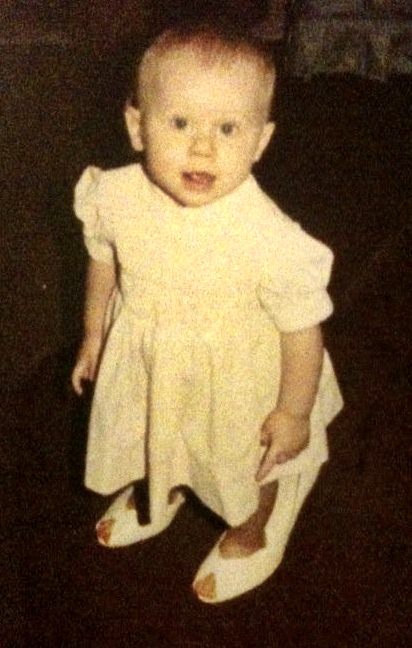
Heather, age 1

Quite simply: How could you not become addicted to a blog devoted to posting adorable pictures of queer folks when they were children, alongside stories of their early memories of growing up not-quite-straight? Sometimes the snippets of life are hard, sometimes they’re heartening. I know not everyone will agree with me, but I find every single one of the photographs completely compelling — no matter how awkward they might be, particularly when read alongside stories of childhood marginalization. I think the thing I love most about them is that, almost by default, every single child in these photographs has grown into a self-possessed adult who believes in themselves enough to submit their story to this blog. They are, by definition, all resilient survivors.

Here are a few of my favorite pictures and memories from the last couple of weeks’ worth of posts.


Heather, age 1 (Guam, USA)


“I first learned that openly admiring girls was ‘wrong’ when I was 4, and saw an episode of ‘Beverly Hills 90210.’ It was a beach scene, and the girls were in bikinis. Several times, I mentioned how pretty the girls were, and my aunt told my mom I was going to be gay. Oh, me and my mouth.”

Clarissa, age 4 (Bronx, NY)


Clarissa, age 4 (Bronx, NY)

 “I loved being a tomboy! I wanted to be tough and dirty, and would go to work with my dad the mechanic. I didn’t always wear coveralls, though. My mom found a way to get me to wear dresses by making them herself, patterning them after Lucy Van Pelt of the ‘Peanuts’ cartoon. I acknowledged Lucy’s toughness, and felt tough in those dresses, too!”

Isaac, age 4 (Lodi, WI)
“This is a picture of me dressing up in the pre-school that I attended. It was actually published in the local paper, for a feature story about the pre-school. I loved to put on that tutu and dance around the play area, and pretend to be a princess. I loved making the other students play princess with me, especially the boys.”

It’s interesting to me, reading these submissions, how often gender-atypical behavior (being a girl who resists dresses, a boy who likes makeup) gets identified by the author of the post as one of their earliest signs that they were “different” … even though gender-atypical behavior doesn’t actually correlate with a non-straight sexual orientation. I wonder if these narratives of being gender-atypical are a product of adults looking back into their own childhoods in search of confirmation that they were queer from their earliest memories — long before they would have had conscious feelings of adult sexual desire. I certainly know that since realizing (as an adult) my fluid sexuality, I’ve caught myself looking backwards into the past for signs of queerness in my childhood. Sometimes I question whether that’s the most accurate or valid approach to self-confirmation!

But that’s enough metaphysical speculation for today! If you yourself identify as queer and want to participate in the project, check out the submission guidelines page. It’s definitely on my own “to do” list once I have a little space to breathe around here. If/when I end up submitting something and if/when it gets published, watch for the link to appear right here at the feminist librarian.

zinenotes: unschooling diaries no. 1

17 Thursday Feb 2011

Posted by Anna Clutterbuck-Cook in media

≈ 1 Comment

Tags

children, education, zines

I recently ordered the first volume of P.S. Pirro’s new zine, unschooling diaries (no. 1 “In Media Res”) from Mud River Press. It’s a lovely little 16-page booklet bound with twine. P.S. is a blogger, artist, author, and (as is evident from the title of the zine) an unschooler.

I’m a novice in the zine genre, so I won’t attempt to review this in the context of zines as an established medium, or the culture of self-published magazines. I will say that — as much as I love blogging and love reading other peoples’ ideas on the internet — there’s something tangibly delicious about actually holding a physical object that has been created by another human being. The texture of the paper and twine, the ink on the page. The font chosen, the images used. There’s something in that experience that I find uniquely pleasing.

Perhaps that’s the librarian in me talking? I dunno. But just the pleasure of holding an actual physical copy of unschooling diaries somehow seemed well worth the $3 cover price. Even before I opened the volume.

diaries reads like a cross between a chapbook and someone’s commonplace book. Each page contains a distinct thought or idea, although arranged together they do create something sustained and connected. Integrated. I think my favorite idea might have been this one (p. 2)

How to unschool
1. Don’t go to school
2. Find stuff you like to do
3. Do that stuff
Some unschoolers choose to go to school.
Find the operative word in that sentence.
Hint. If it isn’t a choice,
it isn’t unschooling.
There are dogmatic homeschoolers just like there are dogmatic believers in schooling. I’ve always appreciated that my folks consciously chose not to go the dogmatic route, and instead worked with my siblings to find a middle way … both of them ultimately attended public school (one part-time, one full-time). And yet my parents still considered our family a “homeschooling” family. Because the point was that we were forming a life that worked for us, and tailoring the learning experience for each of us kids. It’s about the philosophy of childcare and about how we understand human nature and the relationship of human beings to the natural and social world. Not about whether or not you set foot in school spaces.
Anyways. That’s about all I can say about unschooling diaries thus far. If you’re interested, you can purchase your own copy at Mud River Press or follow P.S. at her blog: unschooling & other persuasions.

booknotes: the self-organized revolution

10 Thursday Feb 2011

Posted by Anna Clutterbuck-Cook in book reviews

≈ 2 Comments

Tags

children, education, human rights, politics

The other day, while I was tracking down an errant citation for my thesis I happened to stumble upon the fact that an historian of education (and education alternatives activist) whom I greatly admire had put out a collection of essays on education activism in 2008 that I had somehow missed. So needless to say I ordered a copy. In The Self-Organizing Revolution: Common Principles of the Education Alternatives Movement (Brandon, VT: Holistic Education Press, 2008), author Ron Miller considers a variety of “education alternatives” (home-based education, Waldorf and Montessori schools, free schools, etc.) and suggests that although they have historically been resistent to collectively identifying as a movement in fact practitioners and advocates do have a common set of core principles.

The principles Miller identifies are:

  • Respect for every person, including children (human rights)
  • Balance (openness rather than fixed ideology)
  • Decentralization of authority (human scale democracy)
  • Non-interference between political, cultural, and economic spheres of society
  • A holistic or integrative perspective

To me, it is interesting to think about how these five principles or perspectives on humanity, social organization, and human growth, articulate a particular subculture that stretches across different educational counter-cultures (i.e. the home education movement) but doesn’t wholly define any one of them. There are home educators out there who in no way subscribe to this vision of how education could or should be. There are public school teachers who struggle within the confines of institutional education to live out a form of education that fits this paradigm. I appreciate how Miller is trying to build bridges between segments of a very heterogeneous bunch of folks (what was that about herding cats again?)

I’m particularly pleased to see the way he foregrounds the issue of human rights and children’s rights. “Rather than treating individuals as a means to some culturally determined end (such as national pride or global economic dominance),” he writes, “this perspective insists that every human being is an end in oneself” (48). Decentralization of authority and the principle of noninterference follow from this first principle: in order to ensure that the needs of individuals are not subsumed by the interests of the state or the interests of corporations, education must be dis-entangled from government and for-profit enterprise.

This is not to say Miller believes that the government should not play any role in ensuring that all individuals have access to educational opportunities. Only that he does not believe the government should dictate what should be in the curriculum and how it should be taught. I am not particularly persuaded by his vision of voluntary community-run charities to fund educational programs. But I see in it the seeds of a new way of thinking about funding education: A future system that operated more like the National Endowment for the Humanities, perhaps, than like No Child Left Behind.

This is definitely a book written for movement “insiders” — folks who already have at least some working knowledge of pedagogical theories and practices, the major thinkers in counter-cultural education, and the recent history of educational alternatives. If you weren’t familiar with the work of people like John Holt or know at least a thumbnail version of the history of Montessori education the book might feel pretty shallow and cursory to you. Even I would have appreciated a bit more fleshing out of Miller’s vision of what a human-right-centered education would look like. Other historian-activists such as Joel Spring (Wheels in the Head) and Clive Harber (Schooling as Violence) have written a much greater length about possible models for an alterntiave to the national-military-industrial model we’re currently stuck with and flailing to sustain.

You can read selections of Miller’s work — including some of the essays that make up this book — online at Paths of Learning.

← Older posts
Newer posts →
"the past is a wild party; check your preconceptions at the door." ~ Emma Donoghue

Recent Posts

  • medical update 11.11.22
  • medical update 6.4.22
  • medical update 1.16.2022
  • medical update 10.13.2021
  • medical update 8.17.2021

Archives

Categories

Creative Commons License

This work by Anna J. Clutterbuck-Cook is licensed under a Creative Commons Attribution 3.0 Unported License

Meta

  • Create account
  • Log in
  • Entries feed
  • Comments feed
  • WordPress.com

Create a free website or blog at WordPress.com.

  • Subscribe Subscribed
    • the feminist librarian
    • Join 37 other subscribers
    • Already have a WordPress.com account? Log in now.
    • the feminist librarian
    • Subscribe Subscribed
    • Sign up
    • Log in
    • Report this content
    • View site in Reader
    • Manage subscriptions
    • Collapse this bar