• anna j. clutterbuck-cook
  • contact
  • curriculum vitae
  • find me elsewhere
  • marilyn ross memorial book prize

the feminist librarian

the feminist librarian

Tag Archives: domesticity

the language of love

14 Monday Feb 2011

Posted by Anna Clutterbuck-Cook in our family

≈ 1 Comment

Tags

books, domesticity, family, holidays

This one’s for Hanna.

They smiled, comforted, joyful, trembling, certain that they would never settle for a brief
adventure, because they were born to share life in its totality and to undertake together the
audacity of loving each other forever.

~ Isabel Allende, Of Love and Shadows (126).

frabjous (snow) day!

12 Wednesday Jan 2011

Posted by Anna Clutterbuck-Cook in Uncategorized

≈ 1 Comment

Tags

boston, domesticity, family, outdoors

Thanks to a lovely winter storm, Hanna and I both have the day off from our respective places of work today. I’m working at home on the laptop in my pajamas (reading Juliet Nicholson’s The Perfect Summer and Judith Warner’s Perfect Madness while we wait for the power to come back on) … makes me feel so grown-up! And even better, Hanna made us carob chip muffins :). Here are some of her photographs of the Grand Weather Event.

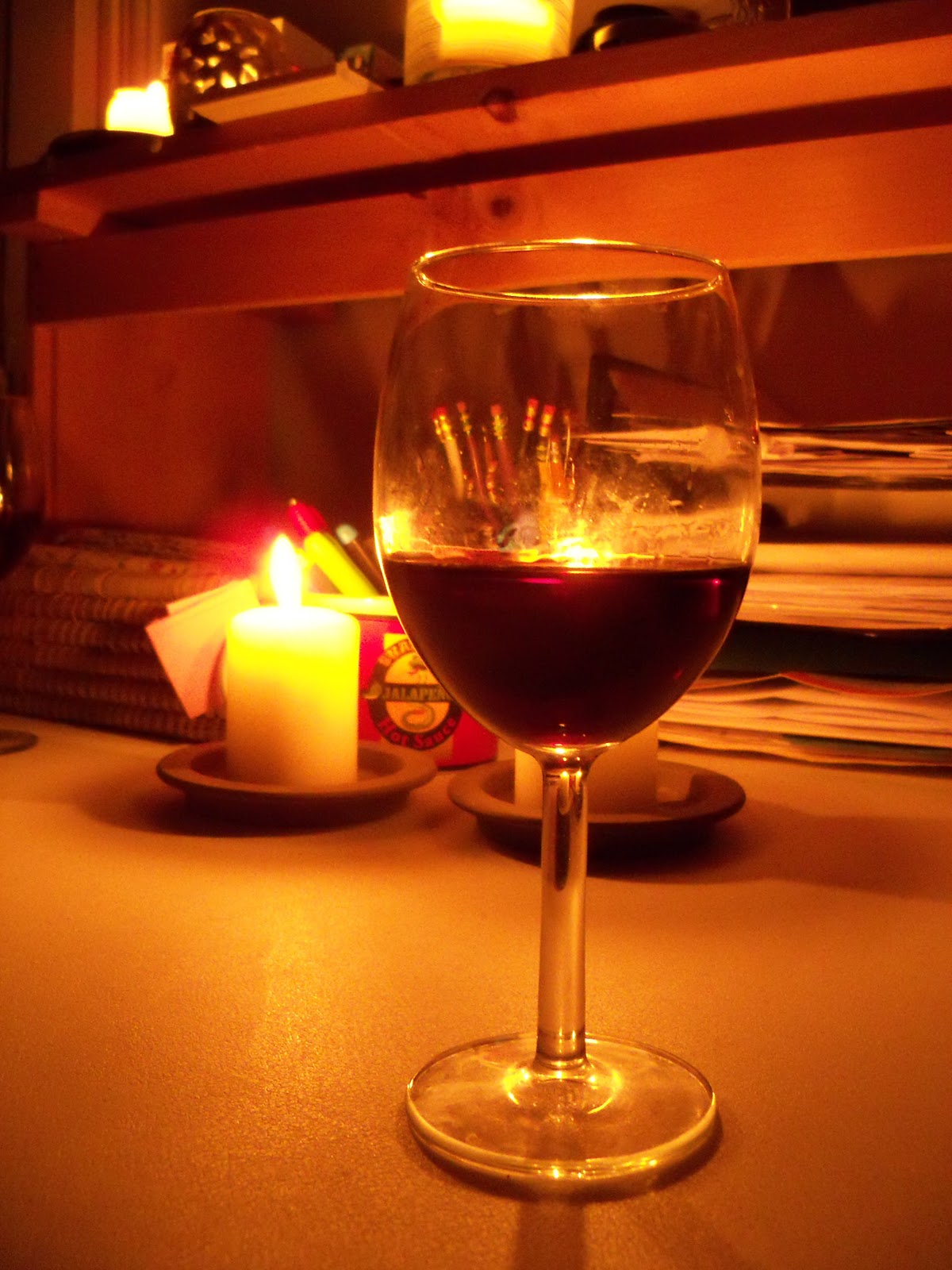
Our power went out for several hours last night;
luckily our stove is gas-powered so we could make
supper anyway! (And enjoy pre-dinner wine.)

Our street, with falling snow taken by Hanna just before the power went
out for about six hours.

$1 reviews: tassajara bread book (in pictures)

04 Tuesday Jan 2011

Posted by Anna Clutterbuck-Cook in book reviews

≈ 2 Comments

Tags

domesticity, family, fun, photos

Last week, while on our winter vacation, Hanna and I went down to the Brattle and picked up a whole stack of books from the $1 cart. One of them was a much-used paperback copy of the 1970s classic Tassajara Bread Book, published by the San Francisco Zen Center.  This is a cookbook along the lines of the Moosewood cookbooks or Diet for a Small Planet: the hand-drawn illustrations are whimsical and the descriptions all sound vaguely as if they were written while the authors were slightly high. A recipe for alfalfa ice cream: “Take it like you find it, or leave it like it is.” For “Oriental” spice muffins: “Inscrutable.” For unkneaded unyeasted bread: “Never made this, but it must be all right.”

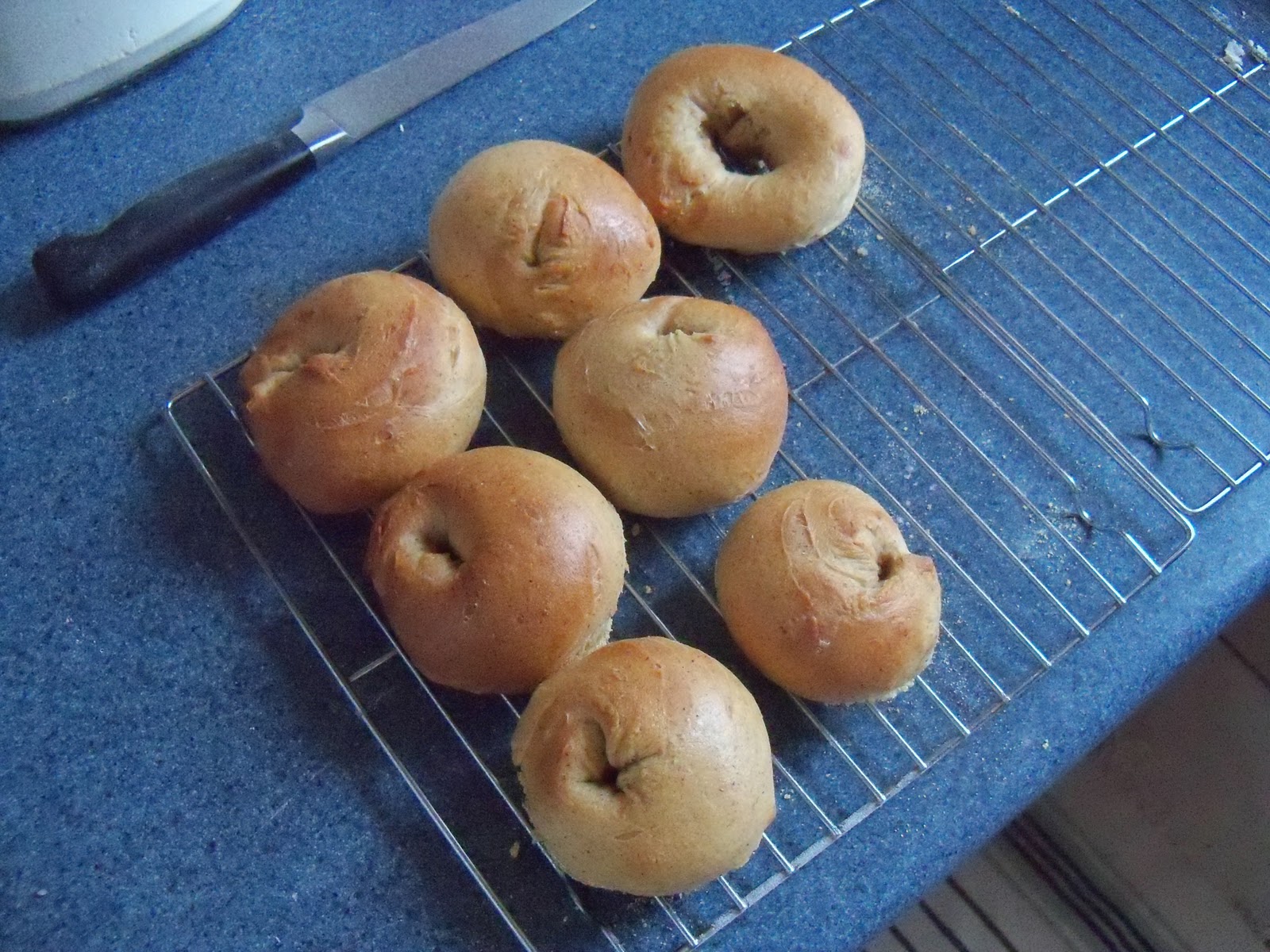
And all of the quantities would feed an army. The recipe we ended up making (bagels) we halved and still ended up with two dozen fist-sized bagels.

None of this detracts from the tastyness of the recipes therein, at least to judge by the two we have made thus far: Egg Bagels (#55) and Cheesecake Bar Cookies (#83).  The bagels don’t have a very springy bagel texture on the inside, but are a lovely bread regardless — and fairly easy to boil and bake. They also taste nice reheated in oven or toaster for breakfast or teatime.

TASSAJARA EGG BAGELS

Halved from original; makes 24 small bagels

Sponge:
1 1/2 cups warm water
1/2 Tbl yeast
1/4 cup sugar or honey
3 whole eggs, well beaten
3 cups flour (I used 1 cup white, 2 cups multigrain)

Stage two ingredients:
2-3 cups flour
1/2 cup oil
1/2 Tbl salt

1. Whisk together warm water, yeast and sugar until dissolved. Add in eggs and flour to make a thick muddy “sponge.”

2. Cover the sponge with another 1-2 cups flour (from “stage two” ingredients) and cover the bowl with a towl. Place in a warm, sheltered location (i.e. inside an unheated oven) for about 50 minutes so yeast can ferment.

3. After rising, fold in oil, salt, and work in remaining flour, kneading well until dough comes together away from the sides of the bowl.

4. Cover and let rise for 50 minutes. Punch down and knead lightly.

5. Let rise 20 minutes.

6. Punch down, knead lightly and cut in half. Set half the dough aside and divide the remaining half into half again, then each half into six equal pieces for a total of twelve lumps of dough. Roll each lump into a worm and then pinch the ends together to form rings. (The wider the rings, the more likely you’ll end up with bagel shapes rather than buns!)

7. Boil the rings of dough in water for 10 seconds each (the bagels will float to the top of the water, making it easier to scoop them out) and place on a pan either greased or dusted with cornmeal to reduce sticking.

8. Rest bagels for 20 minutes under a towl while oven heats to 425 degrees (Fahrenheit).

9. Bake bagels for 20 minutes or until the tops are golden brown.

new favorite thing: vegan peanut butter chocolate pillows

30 Thursday Dec 2010

Posted by Anna Clutterbuck-Cook in our family

≈ 1 Comment

Tags

domesticity, fun, holidays

Vegan Peanut Butter Chocolate Pillows
image pulled from Diary of a Vegan

About a year ago, Hanna and I bought the amazing Vegan Cookies Invade Your Cookie Jar cookbook by Isa Chandra Moskowitz and Terry Hope Romero. I do not exaggerate when I say we have loved every single cookie recipe we’ve made out of Vegan Cookies. Since neither of us are vegan, we occasionally substitute dairy products (butter, milk) for the nondairy ingredients, but we’ve had equally good luck with nondairy alternatives such as soy milk.

Over the Christmas weekend we made a new recipe from the book, the Peanut Butter Chocolate Pillows. Neither Hanna nor I are big into peanut butter cookies, so we hadn’t tried them before. But for some reason they sounded good on Sunday so I made them.

This quite possibly was a mistake.

Because they were AWESOME.

Here’s the recipe.

VEGAN PEANUT BUTTER CHOCOLATE PILLOWS

Makes 2 dozen (24) cookies

For the Chocolate Dough:

1/2 cup canola oil

1 cup sugar

1/4 cup pure maple syrup

3 tablespoons nondairy milk

1/2 teaspoon pure vanilla extract

1 1/2 cups all-purpose flour

1/3 cup unsweetened cocoa powder

2 tablespoons black unsweetened cocoa powder or more regular unsweetened cocoa powder

1/2 teaspoon baking soda

1/4 teaspoon salt

For the Filling:

3/4 cup natural salted peanut butter, crunchy or creamy style [or any other nut butter that strikes your fancy]

2/3 cup powdered sugar

2 to 3 tablespoons soy creamer or nondairy milk

1/4 teaspoon pure vanilla extract

1. In a large mixing bowl, combine oil, sugar, maple syrup, nondairy milk, and vanilla and mix until smooth. Sift in flour, cocoa powder, black cocoa powder if using, baking soda, and salt. Mix to form a moist dough.

2. Make the peanut butter filling: In another mixing bowl, use a hand mixer to beat together peanut butter, powdered sugar, 2 tablespoons of the soy creamer, and vanilla to form a moist but firm dough. If peanut butter dough is dry and crumbly (natural peanut butters have varying moisture contents), stir in the remaining tablespoon of nondairy milk. If dough is too wet knead in a little extra powdered sugar.

3. Preheat oven to 350°F. Line two baking sheets with parchment paper [or tinfoil].

Shape the Cookies:

1. Create the centers of the cookies by rolling the peanut butter dough into twenty-four balls (try dividing dough in half, then each part in half again and roll each portion into six balls). Scoop a generous tablespoon of chocolate dough, flat¬ten into a thin disc, and place a peanut butter ball in the center. Fold the sides of the chocolate dough up and around the peanut butter center and roll into a smooth ball between your palms. Place on a sheet of waxed paper and repeat with remaining dough. If desired, gently flatten cookies slightly, but this is not necessary.

2. Place the dough balls on lined baking sheets about 2 inches apart and bake for 10 minutes. Remove the sheet from the oven and let the cookies stand for 5 minutes before moving them to wire racks to complete cooling. Store cookies in tightly covered container.

’twas the night before the night before Christmas

24 Friday Dec 2010

Posted by Anna Clutterbuck-Cook in admin

≈ 1 Comment

Tags

blogging, domesticity, holidays

Fenway Victory Gardens (Boston, Mass.)
December 2007

It’s the eve before Christmas Eve as I write this and Hanna and I are hunkered down with Geraldine for the Christmas holidays. I’m breaking my self-imposed blogging hiatus to wish you all a happy holiday season and to share with you the gracious welcome post the gals over at The Pursuit of Harpyness put up today, announcing the new members of the blogging team. In addition to the founding members Miss BeckySharper, Michelle Dean, PhDork, PIlgrimSoul, SarahMC and sarah.of.a.lesser.god, I will also be in the company of Marie Anelle and foureleven. Hooray for more bloggers to get to know and learn from in the new year!

We’re looking forward to a quiet day tomorrow listening to the carols from Kings’ and eating Joy the Baker’s incredible sugar and spice cinnamon buns. And I’m going to head back off the internets now to read more of Jill Lepore’s The Whites of Their Eyes: The Tea Party’s Revolution and the Battle over American Memory (2010) which Hanna bought for me today as a pre-Christmas present.

A warm and restful weekend for you all.

changes afoot in blogland: adventures in group blogging

20 Monday Dec 2010

Posted by Anna Clutterbuck-Cook in admin

≈ 3 Comments

Tags

blogging, domesticity, feminism

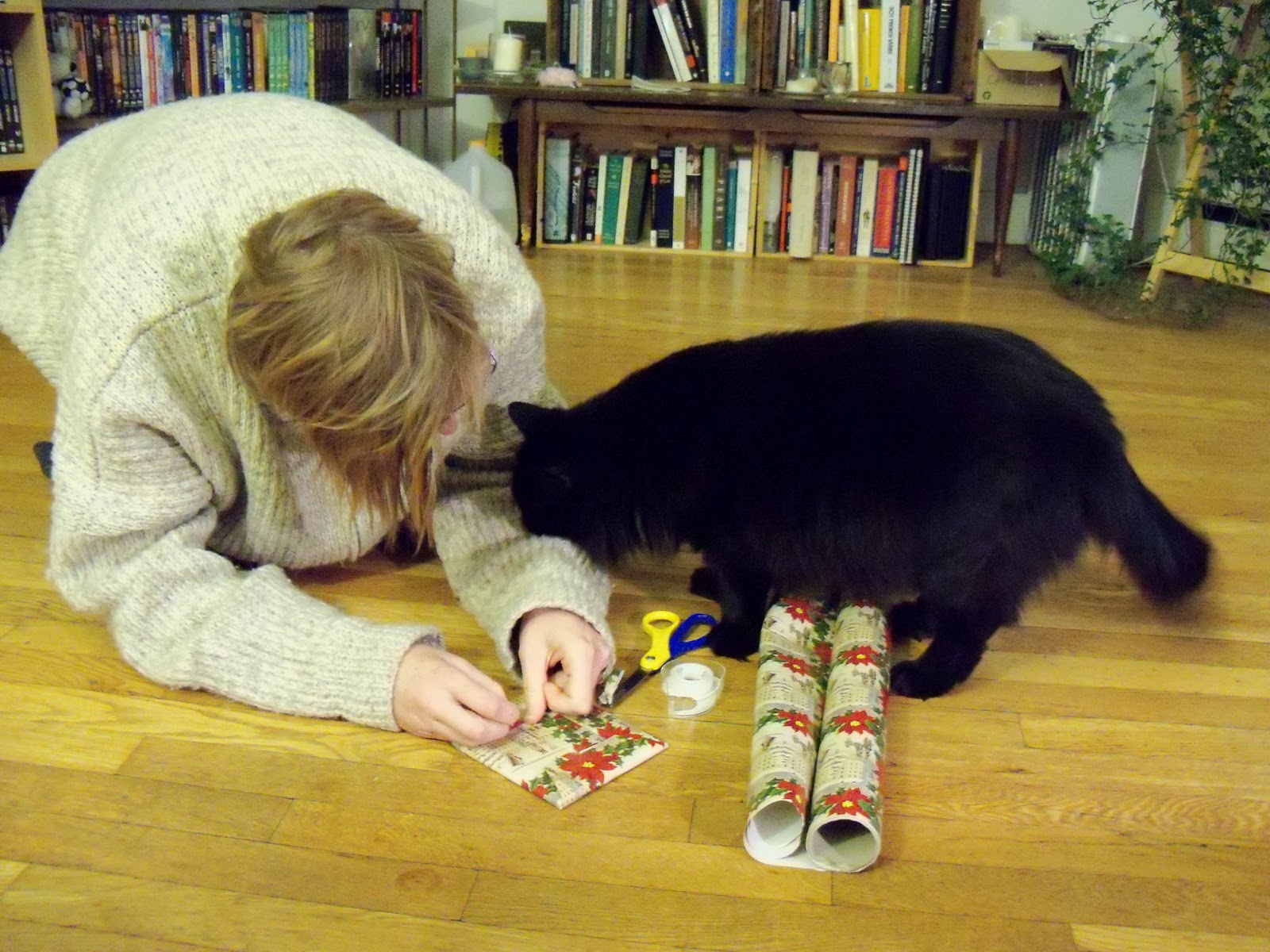
Geraldine assists with wrapping gifts
photo by Hanna (2010-12-14). See …fly over me, evil angel… for more!

As we head into the Christmas break I plan to take a couple of weeks away from blogging so that Hanna and I can have some time together sans internets. We need to focus on enjoying the vacation time we both get (many thanks for libraries that are closed between Christmas and New Years!). It’s been an unexpectedly exhausting autumn for our household, due to some personal health and work/life balance issues — issues we’re working hard to address moving forward! — and we just need some time to recoup and reconnect. Without outside distractions.

When I come back in the new year, there will be some changes here at the Future Feminist Librarian-Activist, although I’m not yet entirely sure what those changes will look like.

This is my 679th post on the Future Feminist Librarian-Activist. I’ve been blogging here, more or less steadily, for about three and a half years: roughly the time I’ve been preparing for and actually attending graduate school (my very first post, back in March of 2007, talked about my financial aid and housing decisions).  It seems somewhat appropriate, therefore, that as I transition out of being in graduate school and into professional librarianship, I pause to consider what sort of webspace I want this blog to be, and become.

 In addition, I’ve been offered the chance to join the team of bloggers who write over at The Pursuit of Harpyness, a feminist-oriented group blog I’ve been enjoying since they first started publishing back in January 2009. You’ll be able to find me (and all the other marvelous bloggers!) there roughly three times a week starting after the New Year. If you don’t already follow them (er … us), I highly recommend stopping by and adding Harpyness to your blog reader of choice.


I’d like to take this opportunity to ask you, dear readers, what you’d like to see more of / less of / something entirely new in both this space and over at the group blog.  I’ll be blogging at Harpyness on issues of human sexuality, sexual identities, gender identities, education, politics, economics, and life on the cultural margins. More or less the stuff I do here. But if you have any specific requests, do feel free to drop me a line at feministlibrarian [at] gmail [dot] com or leave your thoughts in comments. As they say over at tumblr, “the Ask box is open and taking questions!”

In addition to group blogging of the feminist persuasion, I may also be more actively involved in the Massachusetts Historical Society’s blog, The Beehive, moving forward, as I take some of the reigns from Jeremy when leaves to begin his position at LibraryThing. We’re still hammering out the details.

In other words, I’ll have my cyber-hands full in the new year when it comes to creating online content. Hopefully, it’ll help me curb my knack for writing impossibly long sentences!

I plan to keep you all updated, here at the FFLA, about my plans for this blog, the feminist librarian reads, and other web-based media as time goes on and life becomes a bit less (fingers crossed!) in-transition.  In the meantime, I have a personal goal of writing 1-2 original-content posts per week for the FFLA (as opposed to cross-posting from Harpyness).  And I do plan to keep up with tumblr since it’s how I share those short-and-sweet internet links that are organic matter that eventually become — or support — all those blogs posts. Or just exist to make us smile (everyone knows, afterall, the internet is made of cats).


A very, very joyous and restful holiday season to you and yours. I won’t promise them, but it’s entirely possible more Christmas-themed cat pictures will make their way to this blog before the New Year.

the tattooed lady: or, more than you ever wanted to know about my first tattoo

19 Sunday Dec 2010

Posted by Anna Clutterbuck-Cook in life writing

≈ 6 Comments

Tags

children, domesticity, librarians, simmons, travel

Maggie (age 4), Anna (age 11), Brian (age 7), Holland, Michigan, Summer 1992

I promise this is about my new tattoo (!). So bear with me here.

In 1943 prolific journalist and novelist Arthur Ransome wrote to a young friend, Pamela Whitlock in an attempt to encourage her in her own endeavors as a writer — even as she was pulled into work for the war effort. “The training for your own private job is going on all the time,” he counseled her (Signaling from Mars, 301).

Stick to it, filling your notebooks. Nothing is odder than the way in which a big slice of life, vivid at the time, fades utterly away when you escape from it into something different. It’s like coming back from a year abroad. But notes, no matter how scrappy, are like stones dropped into a pool of still water. They stir up the whole picture and bring to life all sort of other things, including things you don’t happen to have written down at the time (Signaling from Mars, 307).

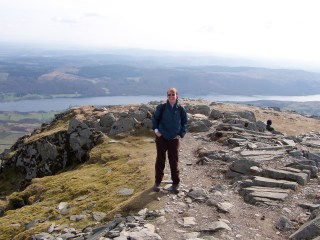
Coniston Water, Cumbria (30 March 2004)

Ransome knew of what he spoke, having started his own writing career as a young university drop-out, scraping by on the salary of an office boy while trying his hand at memoir and other miscellaneous bits of writing. His Bohemia in London (1907) is something of a classic in the genre of starving artist memoirs, recounting days spent shivering in unheated flats and surviving on apples for weeks at a time so that he had enough money to buy books.  From London — and his first, deeply unhappy, marriage — Ransome escaped to St. Petersburg where he witnessed first-hand the Russian Revolution and its aftermath, sending back dispatches to both newspapers and family members (his mother received regular reports on his digestive health, including harrowing tales of surgery in wartime medical facilities; his small daughter received letters adorned with illustrations of papa in great fur coats) and editing a collection of Russian folktales in translation.

Eventually, he abandoned Russia — taking with him one of Trotsky’s secretaries, Evgenia Shvelpina, whom he had to smuggle out of the country through the Mediterranean. The two later married and eventually retired to Ransome’s beloved Lake District in Cumbria where between 1931 and 1947 Ransome authored a series of adventure stories with child protagonists (Ransome himself always protested that he had not set out to write children’s stories, but rather wrote the stories that he himself most enjoyed). Set primarily in the Lake District — though later volumes take the cast of characters into Scotland, south to the Broads, and into the realm of half-fantasy — each book follows the adventures of several families of children who spend their school holidays sailing, camping, and spinning out all sorts of adventure stories that weave seamlessly between fiction and reality. As Ransome observed after completing Swallows and Amazons, the introductory tale,

I was enjoying the writing of this book more than I have ever enjoyed writing any other book in my life. And I think I can put my finger on the thing in it which gave me so much pleasure. It was just this, the way in which the children in it have no firm dividing line between make-believe and reality, but slip in and out of one and the other again and again (quoted in In Search of Swallows and Amazons, Roger Wardale, 32).

Above Coniston Water on my 23rd Birthday (30 March 2004)

While Ransome’s novels have become enduring classics in Britain and, oddly enough, have a devoted following in Japan, they are known only rarely here in the United States. When my family stumbled upon them in the early 1990s, they were unknown treasures. Treasures which we readily devoured, my parents reading them to us every night before bed. Treasures that turned into extended fantasy play of our own. Lacking an island or annual holidays in the Lake District, we turned our own urban landscape into a wilderness, camping in the backyard and repurposing the (profoundly unseaworthy) hull of an abandoned rowboat in which to play captain, first mate, and “ship’s girl” for hours on end.

Suffice to say, the series, its author, and its landscape (both fictional and actual) continue to signify, for me, profound ties to my childhood and my family of origin, as well as my particular affection for the landscape (both literary and actual) of Britain.

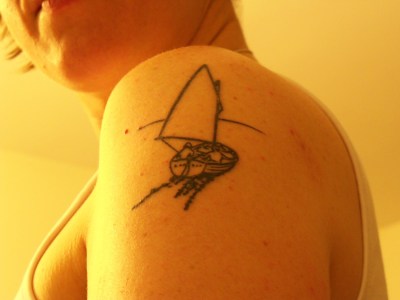
Ransome illustrated all of his own stories with whimsical pen and ink drawings … which is where this post finally makes its way back around to tattoos. Because when I began thinking about what sort of tattoo I was looking to acquire in celebration of my completion of library school, I knew I wanted something that was able to weave together in a particular image the part of myself that is at the fore when I am living that part of myself that sought out librarianship as a vocation. And that is the part of myself that is grounded in my childhood steeped in literature — the part of myself that does not distinguish between reading and living, between gaining knowledge and doing. As well as the part of myself that seeks both the comfort of the familiar and domestic … and the sharp edge of political analysis and social critique. And knowing what I know about Ransome as a person, while also relating to the novels he created very much as an ingenuous child, Swallows and Amazons offers just such a mix of the political and personal.

Amazon sails (photo by Hanna), ink done by Ellen @ Chameleon Tattoo Cambridge, Mass.)

It was my mother who suggested I look to AR’s illustrations — and she who finally located the illustration that became the basis for my finished tattoo. The sailboat is the Amazon, the boat belonging to Nancy and Peggy Blackett of Beckfoot Farm.

We are introduced to the Amazon sisters in the first novel of the series, Swallows and Amazons, and they remain central throughout. One of the strengths of Ransome’s series — which is indubitably visited by the British imperialist fairy on occasion, not to mention the overtly racist fairy — is his range of both male and female characters. He goes much further than his contemporary, C.S. Lewis (for example) in portraying girls who openly eschew gendered expectations — and who are celebrated for their agency. Nancy Blackett (who has changed her name from “Ruth” to a name she feels more aptly reflects her position as pirate captain of the Amazon) abhors wearing dresses is often de facto leader of the expeditionary forces. Neither does Ransome punish boys whose idea of a good time is less conquering and more conservation: The plot of Great Northern celebrates the ethic of preserving a rare species of bird in the wild, rather than harvesting its eggs for scientific study and prowess.

I close this post with the text of a telegram that, in Swallows and Amazons begins the whole adventure. The Walker children, on holiday in the Lake District with their mother, have been anxiously awaiting word from their father (serving in the Navy) who is to weigh in on the proposition that they be allowed to camp sans adult chaperon on an island in the middle of the (unnamed) lake.  In the opening pages of the book, young Roger is racing from the house across the headland to his siblings to deliver the final word:

BETTER DROWNED THAN DUFFERS IF NOT DUFFERS WONT DROWN.

On the one hand you can (and I often do) read this in a fairly harsh, survival-of-the-fittist, fashion (see? I said the British-imperialist fairy came to visit!). Yet on balance I prefer to imagine that the absent Walker parent is expressing trust in his children’s judgement and abilities — something I often find is uniquely in the power of a very small set of English literary parents (see E. Nesbit’s fictional parents for another example). These adults are always present — yet rarely intrusive. They engage with their children when called upon to do so, taking their children’s concerns seriously and often deferring to them as the experts of the moment.

It is this act of trust in their own children’s abilities to act independent of them in the world, and not only to survive but in fact thrive while doing so, that makes the wonderful adventures of the following thirteen novels possible.

Which (coming full circle) is precisely the same trust my parents placed in us as children — and made possible, for me, so many things that have led up to this moment.

So for all of those reasons let me say: I am very pleased with my first tattoo. And am already well on my way to envisioning a second!

changes afoot in jobland (part two): on being employed

18 Saturday Dec 2010

Posted by Anna Clutterbuck-Cook in library life

≈ 2 Comments

Tags

domesticity, human rights, MHS, work-life balance

Massachusetts Historical Society
(December 2008)

This is the promised part two of my post on being hired as the Assistant Reference Librarian at the Massachusetts Historical Society.

Being hired for a modestly-renumerated full-time professional position straight out of graduate school during a recession (one in which there has been a much-reported-on “jobless” recovery no less), and being hired for that job while surrounded by many other fellow graduates and friends who are struggling on the hellish job market was a sobering experience.

Because that’s the sort of person I am. It’s incredibly, incredibly painful for me to accept opportunities that come my way when those opportunities are being offered conditionally. When those opportunities are offered supposedly on merit, due to some particular alchemy of my personal character or skills; when what I am being given — in short — is not being given to others.

I read somewhere recently that folks on the liberal end of the spectrum tend to have personalities that are “intolerant” of inequality. I laughed when I read that, ’cause I practically break out in hives when I feel like good things are being offered to folks based on some external (and, to my mind, inherently flawed) set of expectations concerning who is deserving and who is not.

We all deserve work that is challenging and rewarding. That exercises our abilities and builds new skills. And that provides materially for us and our families.

The fact that I, currently, have at least an approximation of that — and others, including others close to me — do not makes it really hard to meet the future with joyful expectation.I may have mentioned in my last post Brian Hawkins’ observation about being liberal in America: “Ring a bell and I’ll feel guilty for weeks!”

But guilt is unproductive (thank you Tim Wise), so I’ve been trying to focus instead on what it means to take responsibility for being employed in this particular time and place. And here is an (unfinished, ad hoc) compilation of initial observations.

  • Wage-work is not a privilege to be grateful for, but labor we offer in exchange for material gain. While being employable in today’s economy comes in part through social privilege (for more, see below), I think it’s dangerous to start acting as if wage-work ipso facto is a state for which we should be grateful.  Wage-work is something we do, not something that is given to us. Yet in a recession, it’s really easy to start saying to ourselves that we should be grateful to have a job — any job — and that those who employ us deserve our gratitude for hiring us. When we start to believe we should be grateful, we hurt not only ourselves, but also every person who feels pressured to accept and/or remain in wage-work in which they are exploited.
  • The process of being hired is not (solely) about personal qualifications. Most of us know that, despite idealistic talk about meritocracies, we live in a society in which structural inequalities exist and work (often invisibly) to position some of us to greater material advantage than others regardless of our individual abilities. Do I believe I’m qualified for the position I was hired into? Yes. Yet I am far from the only qualified person out there, and the fact I was hired hinged on a complex set of circumstances. I’ve had a lot of folks congratulate me on my new position with language that suggested I had “earned” the offer, that somehow through my efforts I have been rewarded with this position. I call bullshit on that because people who have valuable skills to offer the world remain un- or underemployed. Once we start talking about employment in the language of who deserves and does not deserve wage-work, whose efforts should or should not be rewarded, we’re supporting a way of understanding employment and economic security in terms of those who are “deserving” and those who are “undeserving.” I will not allow my personal circumstances to be employed in narratives that support that understanding.
  • All of my jobs have been “real” jobs. At least one person has suggested that now I have a “real” job … as opposed to the “fake” wage-work I’ve done since I was about nine and started working as a bagger at the college bookstore? As opposed to the “fantasy” wage-work of delivering newspapers? Working retail? Providing assistance to undergraduates as a teaching assistant? To faculty as a research assistant? As opposed to the reference and processing work I’ve done for the past three years as a library and archival assistant? I think the words were thoughtless rather than intentionally demeaning, but the net result was to imply that all of my colleagues who continue to work part-time, non-salaried, sans benefits, under-compensated positions are somehow not “real” workers. Whose labor does not count. In a capitalist economy that relies on such marginalized sources of labor, implying such work isn’t “real” is beyond insulting. And once again: not okay to be insulting to folks while invoking my name.

So my responsibilities (as I see them) as someone who has a reasonably well-respected and well-renumerated position:

  • To understand that I am granted social privilege by virtue of my position rather than through any personal awesomeness … and do what I can to identify and name that privilege, so that it is not invisible.
  • To respect, not look down upon, those folks who are un- or underemployed; to recognize that no individuals should be reduced to their employment status, and not assume that their employment status is a result of their own personal actions/worth (or lack thereof).
  • To advocate for decent working conditions for all, including myself. To remember that critically assessing my own position as a worker and advocating for change when I believe it is warranted can be part of pushing back against inhumane working conditions more generally.

This probably isn’t anything new for those who cut their political teeth in labor activism, or for those who have spent much more time than I have thinking in terms of class and economic disparity, but labor activism should not stop at the simplistic goal of employment. Rather, it needs to continue critically analyzing the place of wage-work in the economy, and the need for economic endeavors to (ultimately) cycle back to support the well-being of us all.

Put like that it sounds hopelessly idealistic. But I really, I only have this to say in response: Intellect and Romance Over Brute Force and Cynicism.

… 28 days later

10 Friday Dec 2010

Posted by Anna Clutterbuck-Cook in library life

≈ 1 Comment

Tags

art, domesticity, simmons

As this post goes live, I will be executing my final presentation for my final class in fulfillment of the requirements for the Master’s in Library Science degree offered by Simmons Graduate School of Information and Library Science (GSLIS). It’s been an … interesting ride.


by dalekhugger

You can check out all the stuff I’ve written about Simmons over the years on this blog by checking out all the posts tagged simmons (imaginative, I know). Don’t think I have a lot more to say at the moment.

Over the next few weeks, look for updates concerning my history thesis, my new job, and (most important!) my celebratory tattoo, chosen as a way to commemorate my entrance into the community of professional librarians (whom I hear are all about tattoos these days; I look on it as a professional investment).

Meanwhile, Hanna and I plan to meet up with fellow class member Gabrielle tomorrow night at M. J. O’Connor’s for some delicious boxty wedges, fish & chips, and a couple of drinks to toast what, I hope, will be the end-for-a-long-while of my tenure as a formal student.*

*I realise my thesis revision technically counts as part of my academic requirements, but frankly it’s on a whole different plane from coursework. The busywork is over and that’s what matter.

"negotiation and compromise": reflections on my childhood outside of school

08 Wednesday Dec 2010

Posted by Anna Clutterbuck-Cook in life writing

≈ 5 Comments

Tags

children, domesticity, education, family, human rights, work-life balance

It seems fitting, in this last week of formal coursework in pursuit of my Master’s in Library Science, that I take some time out to reflect on a very different experience: that of growing up for the first seventeen years of my life outside of formal institutions of schooling. Those of you who follow my blog probably know that cultures of schooling, education, and learning are a topic of scholarly and personal concern to me. As I wrote on Saturday, Idzie @ I’m Unschooled. Yes I Can Write is running a series of interviews with grown unschoolers about their experience learning outside of school. I took some time out from wrapping up my coursework last week (read: spent time procrastinating like it was going out of style!) to respond to her questions. And yesterday Idzie published my responses.


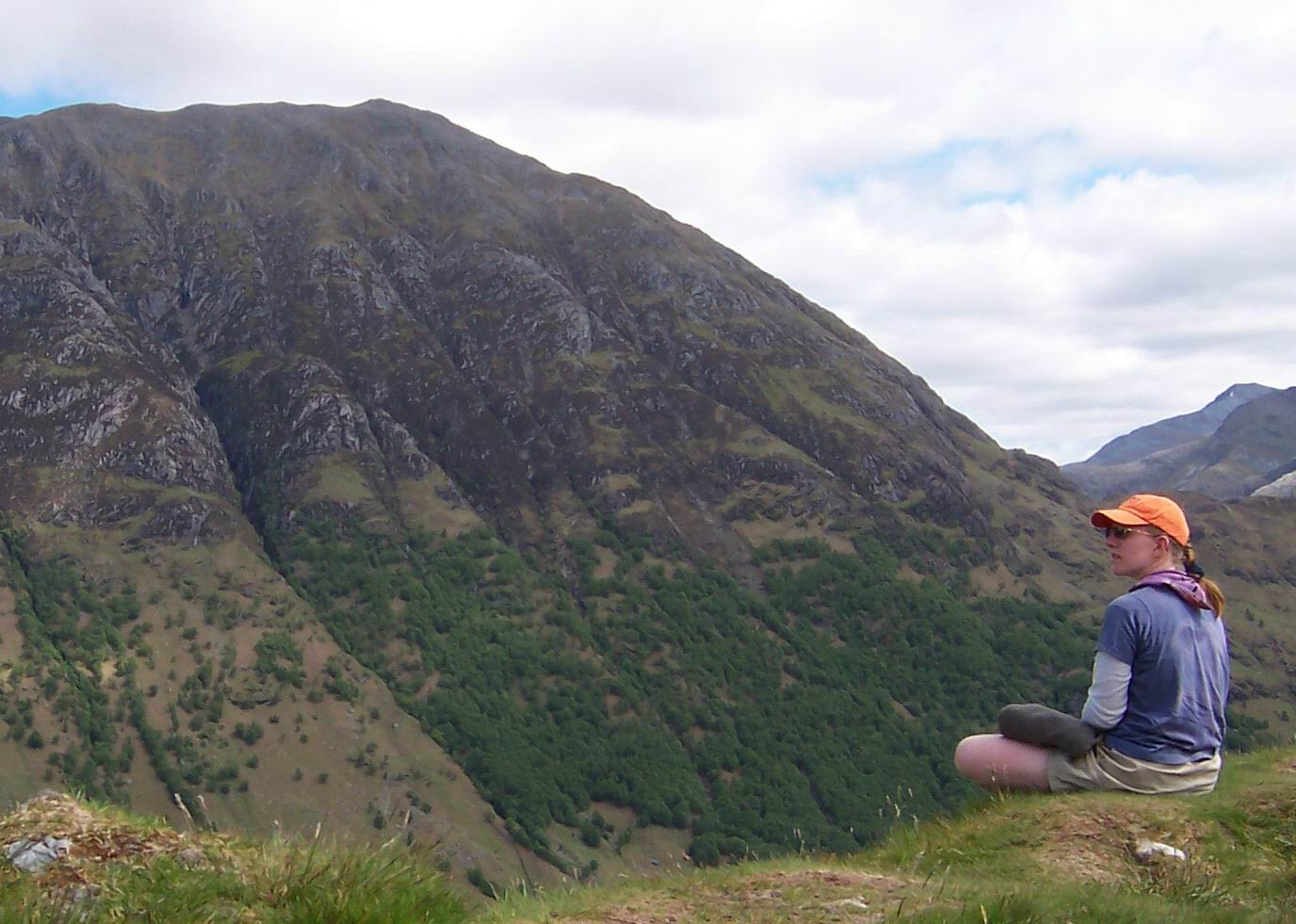
Glen Nevis, West Highlands, Scotland (May 2004)

Since I thought many of my readers would be interested in my responses, I’m cross-posting what I wrote here. But if you enjoy what you read, do check out Idzie’s blog since she publishes lots of awesome stuff — and promises an ongoing series of similar interviews.

The Basics

When did you become an unschooler?
birth (1981) and/or first year I was school age (1987)

How long have you/did you unschool?
Difficult question! I still think of myself as practicing the values of unschooling, even though I have had interactions with formal education and its institutions. I did not attend grade or secondary school at all (though my siblings did to varying degrees). I began taking courses at the college where my father worked when I was seventeen and continued there part time through 2005; until 2002 I was not a degree-seeking student, though I did take the courses for credit. During the seven years I pursued undergraduate coursework, I did lots of other things too, like work and travel. Since completing my B.A. I’ve moved on to graduate school (more below). However, I still feel very much an unschooler at heart.

How old are you now?
29, nearly 30.

The Decision to Unschool

If your parents chose unschooling, do you know how/why they made that decision?
My mother was, I think, the initiator of home-based education, since she was the primary at-home parent and also very interested in child development and early childhood education. She always preferred non-interventionist approaches, and when it came time to think about schooling for us kids she felt we were doing really well in our current environment — and that the schooling opportunities in our area were too conventional for our family’s needs. My father was completely on board with it, even though he usually took a back seat with the home-life arranging, given he was the parent with a full-time job.

My parents are not categorically opposed to working with formal institutions of learning. My father works at Hope College (where I eventually attended classes) and my siblings both expressed a desire to do some measure of formal schooling during their teen years. My brother attended some courses at the local public school, although he never enrolled as a degree-seeking student, and my sister went full-time to public high school. But the focus throughout was what worked best for our family as a whole and for each of us kids individually.

The Best and Worst

What do you think the best thing about unschooling is?
Speaking from the point of view of a unschooled child (rather than an unschooling parent), I would say that the experience of unschooling helped me to remain confident in myself: confident that I had the ability to learn new ideas and skills when I need them, confident I could find meaningful ways to occupy myself without a strict schedule, confident that I could navigate the world and find help when I needed it from people with particular expertise, or whom I had caring relationships with.

The worldview of unschoolers draws (in my opinion) on a specific understanding of human nature that is at odds with the beliefs of the dominant culture. In order to really practice unschooling, you have to trust in the human being to be interested in the world, to seek situations (physical, social, intellectual) in which that being will thrive in community with other beings. You have to trust that the being themselves — not external authorities — are the best source of information about what the being needs to thrive. Not to say that external feedback and expertise isn’t helpful — it’s often crucial. But at the end of the day, the individual themselves is the best authority on, well, themselves. And on what they need to feel nourished.

In society as a whole, children aren’t trusted to have that kind of knowledge about themselves. In part because children do often think and communicate in different ways than adults, given their stage of development, so children’s self-knowledge is often difficult for adults to access. But it’s there if we know how and where to look! And unschooling teaches us to cultivate that awareness in ourselves and others.

What do you think the worst (or most difficult) thing about unschooling is?
The most stressful thing about practicing unschooling in our culture is that it really is fundamentally counter-cultural. It challenges many of the hidden assumptions of our society about human nature, the nature of children, the purpose of education, the meaning of the “good life,” and so forth. I, personally, think people who unschool are on a much healthier track (by and large) than people who do not, because of their values and their orientation toward the world and the rest of humanity. But there’s definitely a cultural dissonance between the life we wish to lead as unschoolers, and the world in which we have to carve a space for ourselves beyond our families. It requires constant negotiation and compromise.

Beyond High School

Did you decide to go/are you going to college or university? If so, could you talk a bit about that experience?
I did go to college, both undergraduate and (currently) a graduate program. It’s always difficult to talk “a bit” about the experience, since my interest as an historian in counter-cultural education means I spent a lot of my waking moments thinking about the culture of institutional schooling, of teaching and learning, and about how “education” is framed in our contemporary cultural debates.

Casting my mind back to age seventeen, when I enrolled in my first college course — a first-year writing course — I remember how thrilling it was to be engaged in writing and thinking about ideas. At that point I wanted to be a creative writer and developed an enormous crush on my professor, a poet and photographer who had that rare ability to read one’s writing and discern what you meant to say, even if your early drafts were hopelessly muddled. At the same time, I felt like a foreign exchange student, struggling to assimilate to the academic culture that was invisible to most of my classmates. I cold be exhausting and isolating. The fact I was a politically and culturally progressive-radical student on a campus dominated by politically and culturally conservative students didn’t help to bridge the gap between me and conventionally-schooled peers. Nor did the fact I was a part-time, commuter student on a campus dominated by full-time, resident students.

I did not struggle with the coursework much at all. In the early years, I took courses that interested me without a thought toward graduation. Later on, when I was fulfilling requirements, I did take classes that were in subjects not of my instinctive interest (I wept through a one-month class in statistics, for example) … but by conventional measures (i.e., grades) I succeeded in conventional education despite my lack of formal training up to that point. And undergraduate college unquestionably opened doors for me — intellectually, socially, geographically — that might have been more difficult to open otherwise. I had access to off-campus programs and study abroad opportunities; I had faculty-student research opportunities and professors who I connected with and library resources, etc. The same can be said, to some extent, for my graduate work. The classes themselves have often been frustrating, inefficient, etc. But given the organization of our culture’s learning resources at institutions of education, it’s difficult to piece together a similar experience without being an enrolled student.

Difficult, but not impossible.

I never completely made peace with the structured nature of academic semesters, graded projects, competitive learning, being judged by external rather than internal expectations. It stressed me out on a pretty deep level; makes me feel like I’m complicit in a system that rewards some at the expense of the rest. which is something I have problems with, even if (especially if??) I’m one of those who gets rewarded. It’s complicated. I’m definitely looking forward to being done with formal academics for a while after I complete my current program (a dual-degree in library science and history).

Money Earning and Work

Are you currently earning money in any way?
Yes.

What jobs/ways of earning money do you, and have you, had?
Oh, gosh. I’ve been earning money since I was about nine. I started working seasonally for my father at the college bookstore he manages for pocket money and stayed there on and off throughout college. I also worked at a local children’s bookstore and a branch of Barnes & Noble. I did childcare as a teenager and worked one year as a nanny. I’ve served as teaching and research assistants for a number of college faculty. I spent a semester working as an office assistant for a study abroad program. I’ve also done a number of work-for-food-and-lodging type situations, sometimes in combination with other paid work and sometimes for short stints alone … like the month I spent at a women’s land trust in Missouri the summer after graduating from college.

When I moved to Boston, I was hired as a library assistant at the Massachusetts Historical Society, an independent research library in Boston that holds rare books and manuscript materials. It’s a wonderful way of being connected to a scholarly community without being tied to a college or university setting. For the past three years, I’ve worked there part time along with other part-time employment (in the field) and internships. I was just recently offered a promotion to full-time with enough wages and benefits to support remaining in Boston for the next few years, as my partner and I would like to do. It pays modestly well, and is definitely the type of work I was hoping to find when I began graduate school in library science.

Have you found work that’s fulfilling and enjoyable?
I won’t pretend that my partner and I don’t struggle with the question of balancing the need to earn wages to support ourselves in the short and long term. My partner, who also learned outside of school for much of her life (until going to public high school) resists, as do I, a culture that equates paid employment with identity and fulfillment. On the one hand, I do believe in seeking out ways to earn a living doing what you love … but I also resist creating a situation in which my life is defined by the work I do, or dictated by it. So that’s an ongoing balancing act. Even without children to care for, I find myself more and more appalled at how little flexibility our modern workplaces have for the rhythms of personal and family life.

Have you found that unschooling has had an impact on how hard or easy it is to get jobs or earn money?
This is a tricky question. I was very privileged in that I had a chance to work in the “family business” as a child and teenager prior to getting other jobs. Not being in school meant, too, that I could work in positions that school schedules could not accommodate easily, and gain really good work experience even before I started college. I had extensive volunteer experience, too, that filled out my resume. Another privilege was the fact that my father’s job at the college meant I got tuition benefits and could take classes without applying for a degree. By the time I petitioned to be a degree-seeking student I had a strong enough academic record they waived the requirements of national test scores or a high school diploma (a stumbling block for some unschoolers seeking to enter higher education). I have not felt limited by my lack of formal schooling pre-college. I do wish, sometimes, I had been braver about seeking alternatives to college and post-graduate schooling. I was tired of the effort it takes to forge the nonconventional path. And there are days when I’m not proud of that.

Do you feel that unschooling has had an impact on what methods of earning money or jobs you’re drawn to?
In a word: yes. In a few more words, I would argue that the worldview lying behind (my understanding of) unschooling supports de-emphasizing wage-work as either the primary mode of self-identification or as a measure of self-worth. Since unschooling encourages self-reliance and independence, being able to support myself — or, now, to contribute to the financial security of my newly-formed family — is a part of how I measure my success. However, it is one small part of my self-evaluation, all of which comes down to challenging myself to live in accordance with my values. Which would take a lot more than this questionnaire to explicate in depth! But in short, they can be summed up with the belief that all that 1) all life is of value, and 2) all that is required of humanity is “to do justice, love kindness and walk humbly.” (The original quote comes from the Christian Old Testament, Micah 6:8, and reads “walk humbly with God,” but I prefer leaving the question of whom or what one walks with up to the listener!)

General

What impact do you feel unschooling has had on your life?
The experience of growing up outside of the mainstream educational system colors virtually everything I do and the way I understand the world. I think it particularly shapes how I understand myself in relation to the mainstream culture and ways of thinking and being in the world. My family didn’t opt out of the mainstream to the extent that some unschooling families do: we had a television, we lived in an urban environment, we had friends who were schooled and so forth. We weren’t insulated from the mainstream and from the outside — except for the fact that we didn’t attend school — our family didn’t look that radical. But we were pretty damn radical anyway! So what I learned, growing up, was that individuals and families have choices. We can stand apart from some of the mainstream “common sense” beliefs about how people should grow and learn, what it means to be a functioning adult, what it means to be a family — but we don’t have to seek “purity” in pursuit of that. We can pick and choose, appropriate, make our own meanings of things, piecing together a life out of what we find to be beautiful and useful. It’s sort of a steampunk ethos, I guess.

If you could go back in time, is there anything about your learning/educational journey that you’d change?
I really wish I had been able to find practical alternatives to graduate school that gave me the same opportunities in the library/scholarly fields I’m interested in. Unfortunately library and archives training in the US takes place in the context of higher education, and most living-wage positions with opportunities for professional growth require an MLS.

If you were to have children, would you choose to unschool them?
I just recently read a blog post by Molly @ first the egg called parenting as holding the space in which she talks about how she and her husband don’t practice according to any particular parenting philosophy but that she’s come to realize that the way they parent is akin to the way in which doulas are trained to “hold the space” for women in labor. She writes, “the basic idea is that a calm, focused, loving person can protect a space in which the laboring/birthing person can do what she needs to do.” I think this is a really nice one-line description of what parents can and should provide their children — regardless of whether the decide they want (or are practically able) to unschool their children.

My partner and I are pretty sure we are not going to be parents, for a complex constellation of reasons. I won’t speak for her in this instance, but in my case I don’t want to have children unless I am able to unschool them — in spirit if not by actually keeping them out of institutional education altogether. I don’t want to take on a responsibility that I don’t have the resources — emotional, logistical, financial — to really follow through on according to my values. And my values would demand giving that small person in my care as much calm, focused loving as I could — and trying to surround them with adults and other young people who could support me, my partner, and our child(ren) in that endeavor. And right now we aren’t in a place to do that.

Advice

What advice would you give to teens looking to leave high school? What advice would you give to someone looking to skip, or to drop out of, college or university?
Since I didn’t ever leave high school and eventually ended up completing university and going on to do post-graduate work, I’m not sure how much I can speak to this. However, I would say this: in my experience, it pays to reject either/or thinking and be creative about how you use your available resources.

What advice would you give to unschooling parents (or parents looking into unschooling)?
In addition to what I wrote above about “holding the space,” I think it’s important — with all childcare, but particularly with unschooling — to emphasize that the choices you make about family life effect outcomes. That may sound elementary, but I’ve seen a lot of nominally “unschooling” or homeschooling families where the parents really, really want their kids to look and act like, and hold the same values, as their conventionally-schooled peers. Or even worse, they expect them to be conventional-PLUS: they think that unschooling their kids are going to make them even more successful than their peers by all the mainstream cultural standards.

It’s not an impossible goal … and it’s not that I think having goals and accomplishing them is a bad thing. But the “conventional-plus” approach to unschooling is, to my mind, a really impoverished approach … because it leaves behind the really radical aspect of unschooling, which is to question the foundational values of American culture concerning human nature, what it means to be a successful human being, what you need to thrive in the world, and how human relationships facilitate that process. If I had to offer advice in a nutshell to unschooling parents, it would be: Expect different outcomes — and try not to be afraid of them. Be clear about what your own values for “the good life” are and share them with your children, and then let your kids develop their own values from that foundation.

Also, don’t encourage your kids to see mainstream culture or conventional schooling as evil. There are good people who teach in schools, there are good people who send their children there, and there are children who thrive despite the many problems of institutional schooling. I’ve seen too many unschooling families turn their personal and familial choices into an “us vs. them” negativity that doesn’t encourage building alliances, accessing resources, and remembering to seek out support and learning in even the most unexpected places. Encourage your kids to remain open-minded about the mainstream, even as you challenge them to engage with it critically.

Is there anything else you’d like to talk about or add?
I think I’ve already said way more than is reasonable in terms of a blog post, so I’ll leave it there. Thanks so much for the opportunity to share my thoughts on being a grown unschooler and I look forward to reading what others have to say in response to these questions!

← Older posts
Newer posts →
"the past is a wild party; check your preconceptions at the door." ~ Emma Donoghue

Recent Posts

  • medical update 11.11.22
  • medical update 6.4.22
  • medical update 1.16.2022
  • medical update 10.13.2021
  • medical update 8.17.2021

Archives

Categories

Creative Commons License

This work by Anna J. Clutterbuck-Cook is licensed under a Creative Commons Attribution 3.0 Unported License

Meta

  • Create account
  • Log in
  • Entries feed
  • Comments feed
  • WordPress.com

Blog at WordPress.com.

  • Subscribe Subscribed
    • the feminist librarian
    • Join 37 other subscribers
    • Already have a WordPress.com account? Log in now.
    • the feminist librarian
    • Subscribe Subscribed
    • Sign up
    • Log in
    • Report this content
    • View site in Reader
    • Manage subscriptions
    • Collapse this bar